
Computing Well-Balanced Spanning Trees of Unweighted Networks


Abstract
1. Introduction
Problem Statement
2. Methods and Data
2.1. Definitions and Notations
2.2. Spanning Tree Algorithms
2.2.1. Prim’s Algorithm
2.2.2. Kruskal’s Algorithm
2.2.3. Breadth-First Search
2.2.4. Other Algorithms
2.3. Tree Balance Index
2.4. Collections of Networks
3. Results
3.1. Motivating Example
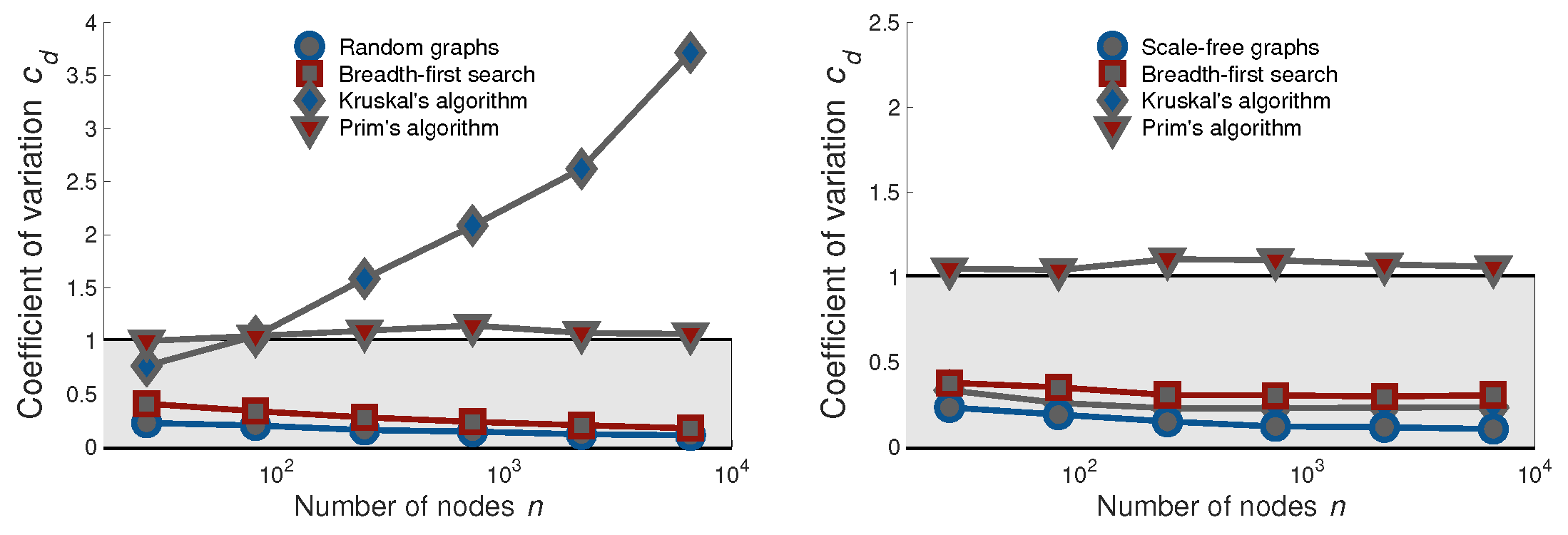
3.2. Synthetic Graphs
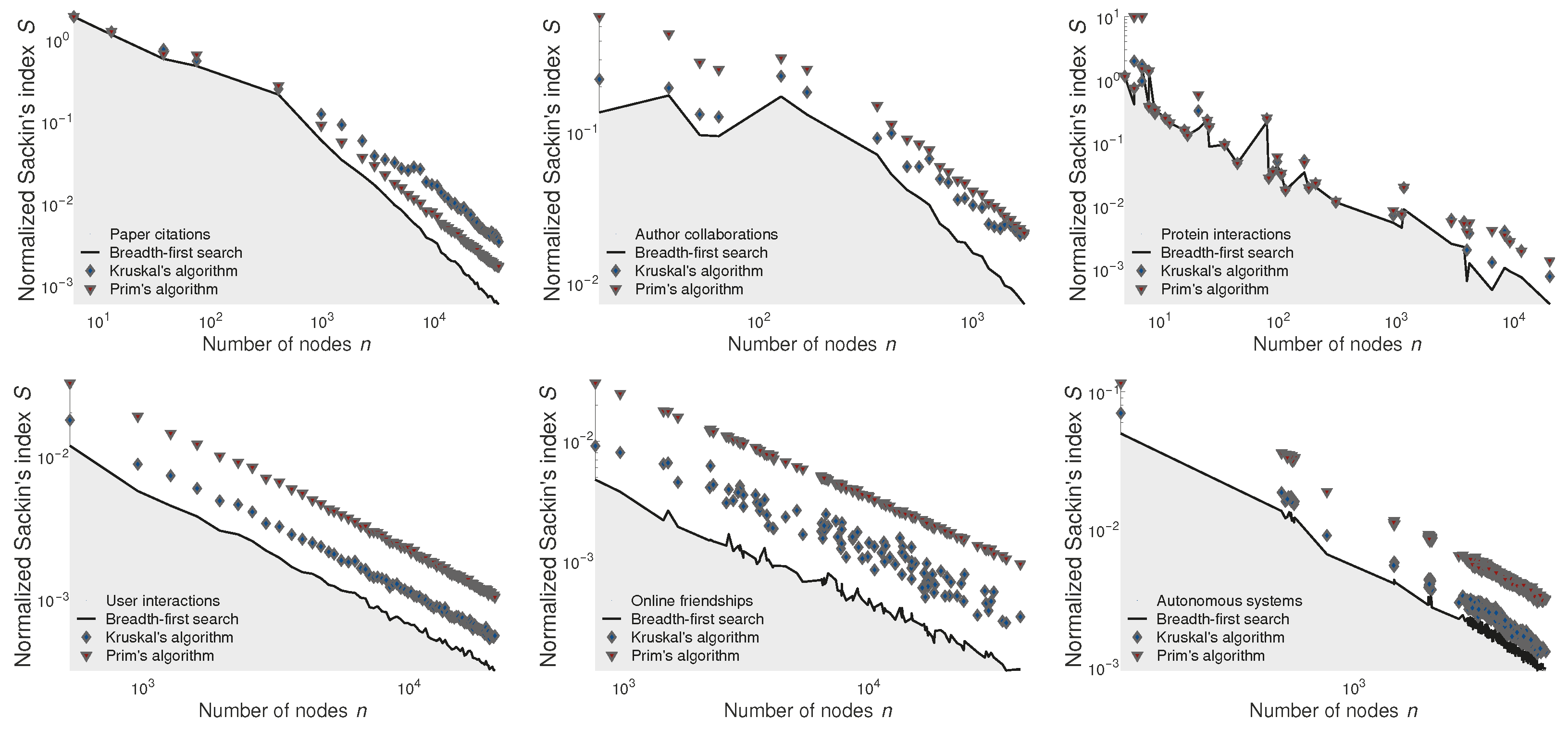
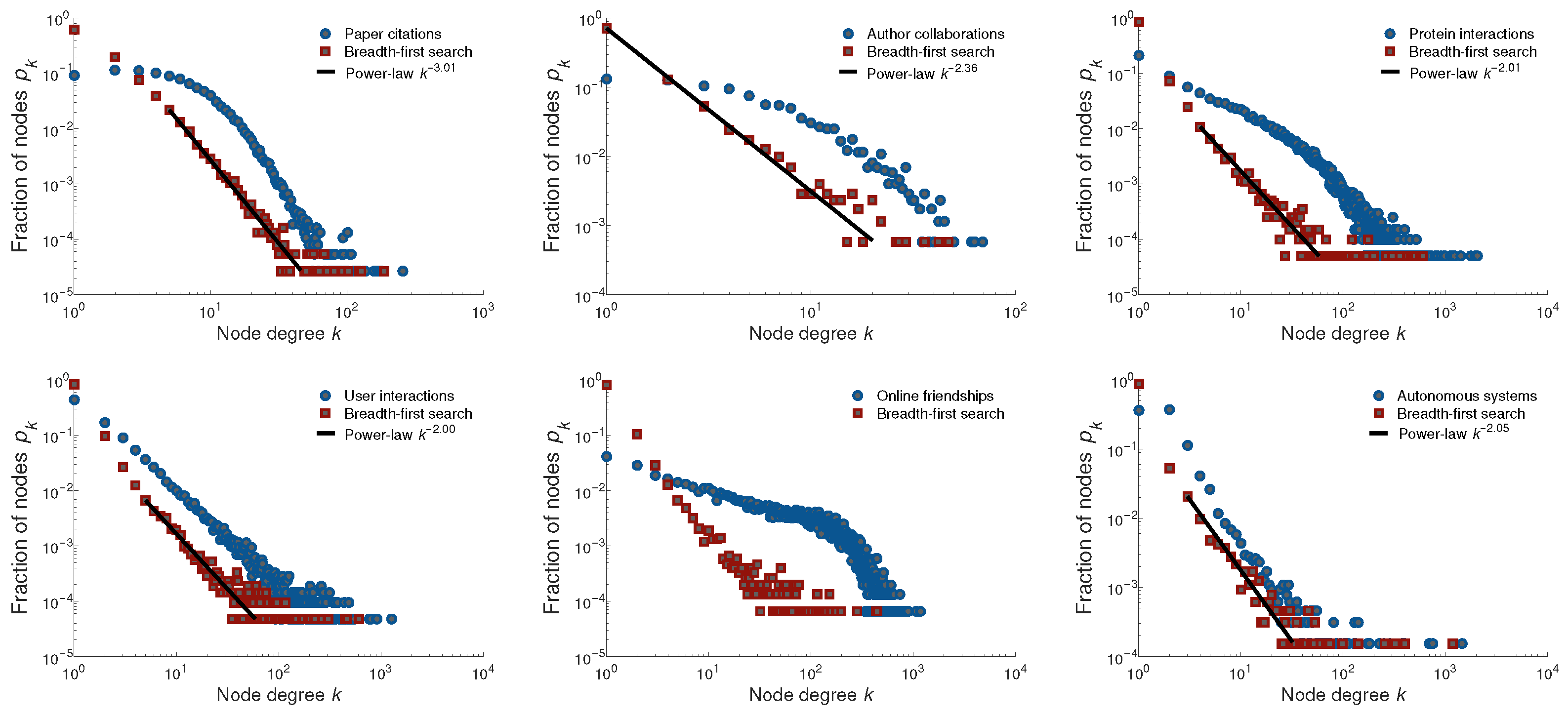
3.3. Real Networks
4. Applications
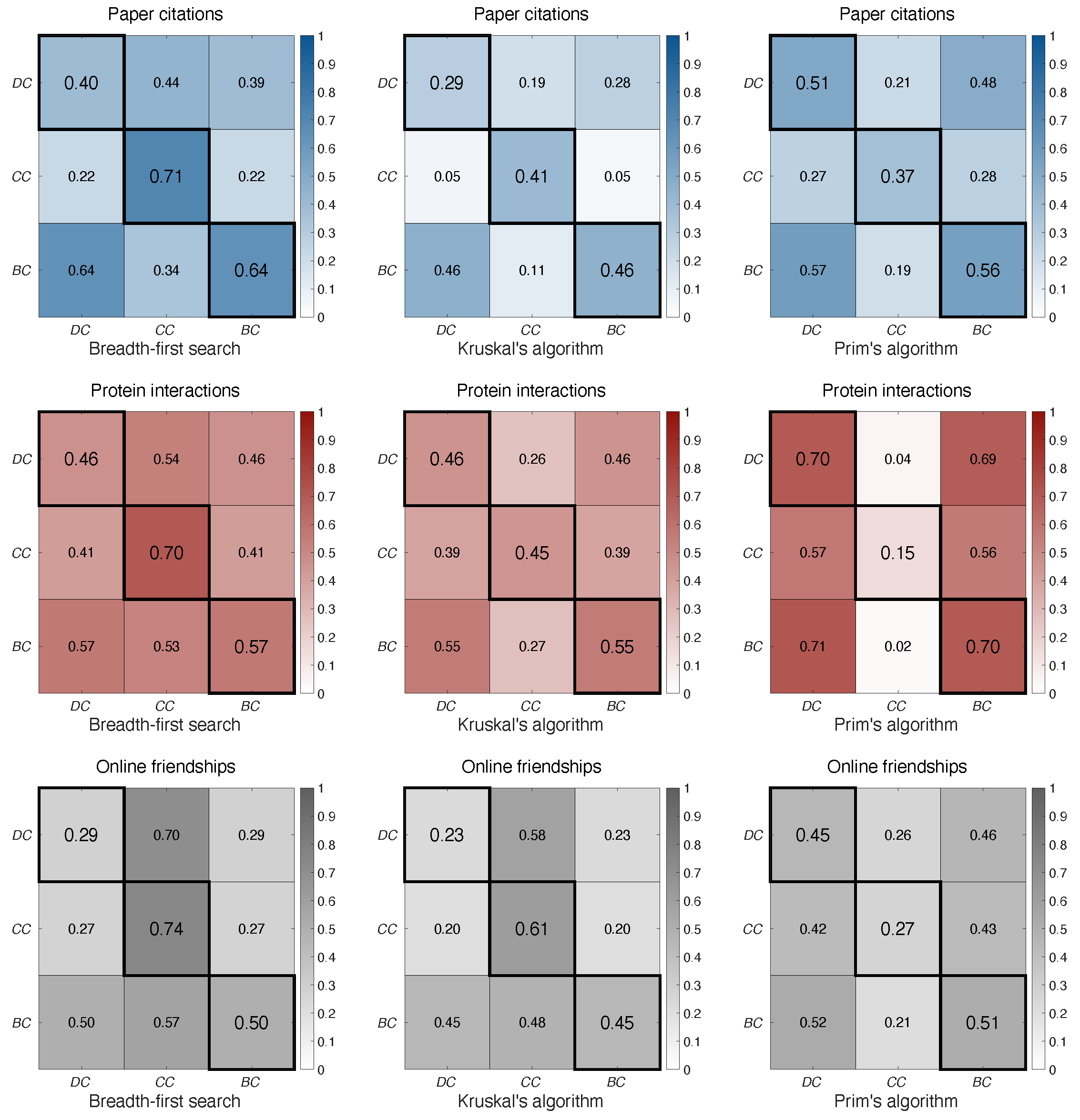
4.1. Node Importance
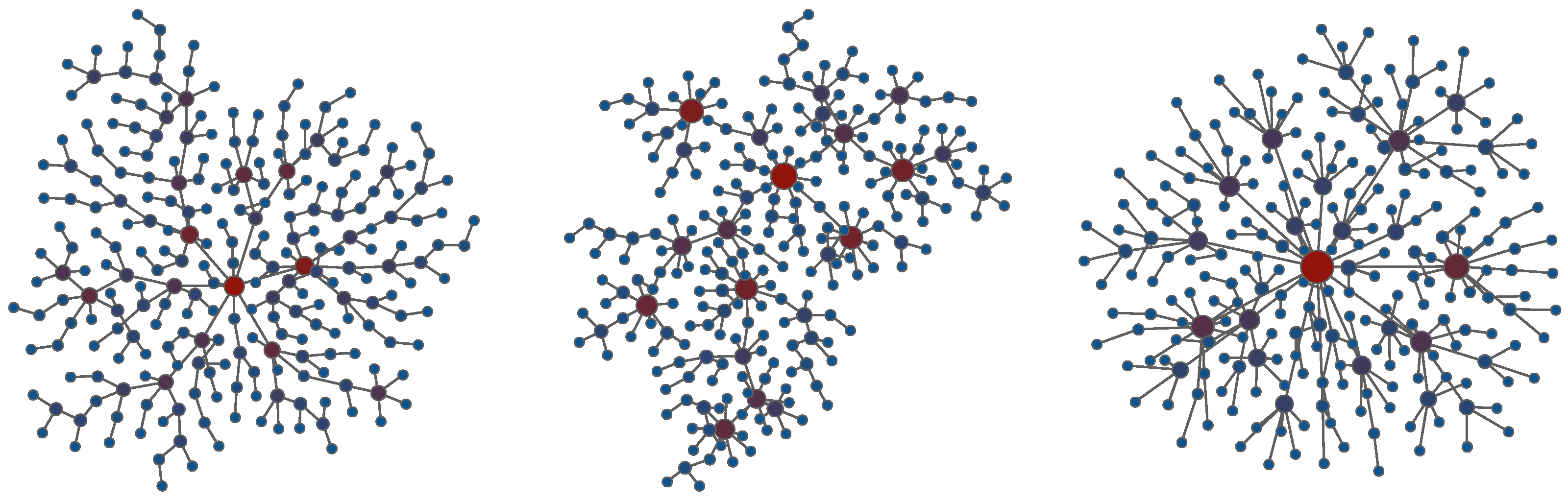
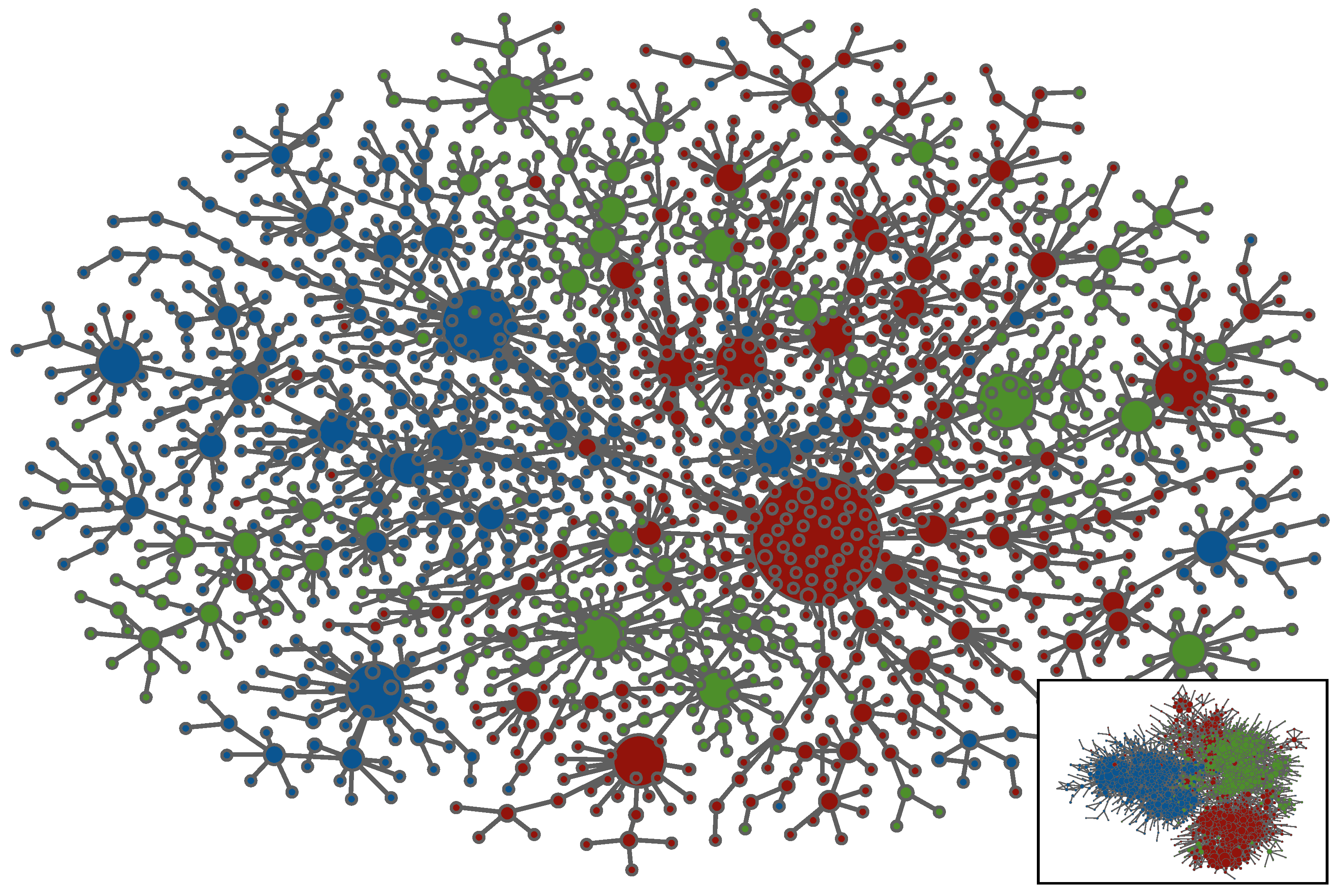
4.2. Network Visualization
5. Conclusions
Funding
Data Availability Statement
Acknowledgments
Conflicts of Interest
Appendix A. Algorithms’ Details
Appendix A.1. Prim’s Algorithm
| Algorithm A1 Prim’s algorithm |
| Require: undirected graph G Ensure: spanning tree T
|
Appendix A.2. Kruskal’s Algorithm
Appendix A.3. Breadth-First Search
| Algorithm A2 Breadth-first search |
| Require: undirected graph G Ensure: spanning tree T
|
References
- Newman, M.E.J. Networks, 2nd ed.; Oxford University Press: Oxford, UK, 2018. [Google Scholar]
- Tizzoni, M.; Bajardi, P.; Poletto, C.; Ramasco, J.J.; Balcan, D.; Gonçalves, B.; Perra, N.; Colizza, V.; Vespignani, A. Real-time numerical forecast of global epidemic spreading: Case study of 2009 A/H1N1pdm. BMC Med. 2012, 10, 165. [Google Scholar] [CrossRef] [Scilit]
- Zitnik, M.; Sosič, R.; Feldman, M.W.; Leskovec, J. Evolution of resilience in protein interactomes across the tree of life. Proc. Natl. Acad. Sci. USA 2019, 116, 4426–4433. [Google Scholar] [CrossRef] [Scilit]
- Fortunato, S.; Bergstrom, C.T.; Börner, K.; Evans, J.A.; Helbing, D.; Milojević, S.; Petersen, A.M.; Radicchi, F.; Sinatra, R.; Uzzi, B.; et al. Science of science. Science 2018, 359, eaao0185. [Google Scholar] [CrossRef] [Scilit] [PubMed]
- Backstrom, L.; Boldi, P.; Rosa, M.; Ugander, J.; Vigna, S. Four degrees of separation. In Proceedings of the ACM International Conference on Web Science, Evanston, IL, USA, 22–24 June 2012; pp. 45–54. [Google Scholar]
- Leskovec, J.; Faloutsos, C. Sampling from large graphs. In Proceedings of the ACM SIGKDD International Conference on Knowledge Discovery and Data Mining, Philadelphia, PA, USA, 20–23 August 2006; pp. 631–636. [Google Scholar]
- Hamann, M.; Lindner, G.; Meyerhenke, H.; Staudt, C.L.; Wagner, D. Structure-preserving sparsification methods for social networks. Soc. Netw. Anal. Min. 2016, 6, 22. [Google Scholar] [CrossRef] [Scilit]
- Blagus, N.; Šubelj, L.; Bajec, M. Empirical comparison of network sampling: How to choose the most appropriate method? Phys. A Stat. Mech. Its Appl. 2017, 477, 136–148. [Google Scholar] [CrossRef] [Scilit]
- Grady, D.; Thiemann, C.; Brockmann, D. Robust classification of salient links in complex networks. Nat. Commun. 2012, 3, 864. [Google Scholar] [CrossRef] [Scilit]
- Coscia, M.; Neffke, F. Network backboning with noisy data. In Proceedings of the IEEE International Conference on Data Engineering, San Diego, CA, USA, 19–22 April 2017; pp. 425–436. [Google Scholar]
- Šubelj, L. Convex skeletons of complex networks. J. R. Soc. Interface 2018, 15, 20180422. [Google Scholar] [CrossRef] [Scilit]
- Simas, T.; Correia, R.B.; Rocha, L.M. The distance backbone of complex networks. J. Complex Netw. 2021, 9, cnab021. [Google Scholar] [CrossRef] [Scilit]
- Bollobás, B. Modern Graph Theory; Springer: Berlin/Heidelberg, Germany, 1998. [Google Scholar]
- Pop, P.C. The generalized minimum spanning tree problem: An overview of formulations, solution procedures and latest advances. Eur. J. Oper. Res. 2020, 283, 1–15. [Google Scholar] [CrossRef] [Scilit]
- Diggans, C.T.; Bollt, E.M.; Ben-Avraham, D. Spanning trees of recursive scale-free graphs. Phys. Rev. E 2022, 105, 024312. [Google Scholar] [CrossRef] [Scilit]
- Henke, L.; Mehta, D. C-RST: A parallel algorithm for random spanning trees in network analytics. Appl. Netw. Sci. 2024, 9, 45. [Google Scholar] [CrossRef] [Scilit]
- Dhouib, S. Innovative method to solve the minimum spanning tree problem: The Dhouib-Matrix-MSTP (DM-MSTP). Results Control Optim. 2024, 14, 100359. [Google Scholar] [CrossRef] [Scilit]
- Rezvanian, A.; Vahidipour, S.M.; Jalali, Z.S. A spanning tree approach to social network sampling with degree constraints. Soc. Netw. Anal. Min. 2024, 14, 101. [Google Scholar] [CrossRef] [Scilit]
- Amure, R.; Agarwal, N.A. A comparative evaluation of social network analysis tools: Performance and community engagement perspectives. Soc. Netw. Anal. Min. 2025, 15, 100359. [Google Scholar] [CrossRef] [Scilit]
- Abdallah, S. Generalizing unweighted network measures to capture the focus in interactions. Soc. Netw. Anal. Min. 2011, 1, 255–269. [Google Scholar] [CrossRef] [Scilit]
- Bourgain, J. On Lipschitz embedding of finite metric spaces in Hilbert space. Isr. J. Math. 1985, 52, 46–52. [Google Scholar] [CrossRef] [Scilit]
- Watts, D.J.; Strogatz, S.H. Collective dynamics of ’small-world’ networks. Nature 1998, 393, 440–442. [Google Scholar] [CrossRef] [Scilit]
- Newman, M.E.J. The structure and function of complex networks. SIAM Rev. 2003, 45, 167–256. [Google Scholar] [CrossRef] [Scilit]
- Wiener, H. Structural determination of paraffin boiling points. J. Am. Chem. Soc. 1947, 69, 17–20. [Google Scholar] [CrossRef] [Scilit]
- Sackin, M.J. “Good” and “bad” phenograms. Syst. Biol. 1972, 21, 225–226. [Google Scholar] [CrossRef] [Scilit]
- Adai, A.T.; Date, S.V.; Wieland, S.; Marcotte, E.M. LGL: Creating a map of protein function with an algorithm for visualizing very large biological networks. J. Mol. Biol. 2004, 340, 179–190. [Google Scholar] [CrossRef] [Scilit]
- Knuth, D.E. The Art of Computer Programming; Addison-Wesley Professional: Amsterdam, The Netherlands, 2011. [Google Scholar]
- Rényi, A.; Szekeres, G. On the height of trees. J. Aust. Math. Soc. 1967, 7, 497–507. [Google Scholar] [CrossRef] [Scilit]
- Meir, A.; Moon, J.W. The distance between points in random trees. J. Comb. Theory 1970, 8, 99–103. [Google Scholar] [CrossRef] [Scilit]
- Fischer, M.; Herbst, L.; Kersting, S.A.; Kühn, L.; Wicke, K. Tree Balance Indices: A Comprehensive Survey, 1st ed.; Springer: Cham, The Netherlands, 2023. [Google Scholar]
- Lemant, J.; Le Sueur, C.; Manojlović, V.; Noble, R. Robust, universal tree balance indices. Syst. Biol. 2022, 71, 1210–1224. [Google Scholar] [CrossRef] [Scilit]
- Shao, K.T.; Sokal, R.R. Tree balance. Syst. Zool. 1990, 39, 266–276. [Google Scholar] [CrossRef] [Scilit]
- American Physical Society. APS Dataset. 2015. Available online: http://journals.aps.org/datasets (accessed on 1 October 2025).
- Institute of Information Science. SICRIS Database. 2010. Available online: http://www.sicris.si (accessed on 1 October 2025).
- Stark, C.; Breitkreutz, B.J.; Reguly, T.; Boucher, L.; Breitkreutz, A.; Tyers, M. BioGRID: A general repository for interaction datasets. Nucleic Acids Res. 2006, 34, 535–539. [Google Scholar] [CrossRef] [Scilit]
- Biological General Repository for Interaction Datasets. BioGRID Database. 2016. Available online: http://thebiogrid.org (accessed on 1 October 2025).
- Paranjape, A.; Benson, A.R.; Leskovec, J. Motifs in temporal networks. In Proceedings of the ACM International Conference on Web Search and Data Mining, Cambridge, UK, 6–10 February 2017; pp. 601–610. [Google Scholar]
- Leskovec, J.; Krevl, A. SNAP Datasets. 2014. Available online: http://snap.stanford.edu/data (accessed on 1 October 2025).
- Traud, A.L.; Mucha, P.J.; Porter, M.A. Social structure of Facebook networks. Phys. A Stat. Mech. Its Appl. 2012, 391, 4165–4180. [Google Scholar] [CrossRef] [Scilit]
- Rossi, R.A.; Ahmed, N.K. Network Data Repository. 2015. Available online: http://networkrepository.com (accessed on 1 October 2025).
- Leskovec, J.; Kleinberg, J.; Faloutsos, C. Graphs over time: Densification laws, shrinking diameters and possible explanations. In Proceedings of the ACM SIGKDD International Conference on Knowledge Discovery and Data Mining, Chicago, IL, USA, 21–24 August 2005; pp. 177–187. [Google Scholar]
- Erdős, P.; Rényi, A. On random graphs I. Publ. Math. Debr. 1959, 6, 290–297. [Google Scholar] [CrossRef] [Scilit]
- Barabási, A.L.; Albert, R. Emergence of scaling in random networks. Science 1999, 286, 509–512. [Google Scholar] [CrossRef] [Scilit]
- Cohen, R.; Havlin, S. Scale-free networks are ultrasmall. Phys. Rev. Lett. 2003, 90, 058701. [Google Scholar] [CrossRef] [Scilit]
- Barabási, A.L. Network Science; Cambridge University Press: Cambridge, UK, 2016. [Google Scholar]
- Ozen, M.; Lesaja, G.; Wang, H. Globally optimal dense and sparse spanning trees, and their applications. Stat. Optim. Inf. Comput. 2020, 8, 328–345. [Google Scholar] [CrossRef] [Scilit]
- Clauset, A.; Shalizi, C.R.; Newman, M.E.J. Power-law distributions in empirical data. SIAM Rev. 2009, 51, 661–703. [Google Scholar] [CrossRef] [Scilit]
- Broido, A.D.; Clauset, A. Scale-free networks are rare. Nat. Commun. 2019, 10, 1017. [Google Scholar] [CrossRef] [Scilit]
- Fortunato, S.; Hric, D. Community detection in networks: A user guide. Phys. Rep. 2016, 659, 1–44. [Google Scholar] [CrossRef] [Scilit]
- Schoch, D.; Brandes, U. Re-conceptualizing centrality in social networks. Eur. J. Appl. Math. 2016, 27, 971–985. [Google Scholar] [CrossRef] [Scilit]
- Freeman, L. A set of measures of centrality based on betweenness. Sociometry 1977, 40, 35–41. [Google Scholar] [CrossRef] [Scilit]
- Freeman, L.C. Centrality in social networks: Conceptual clarification. Soc. Netw. 1979, 1, 215–239. [Google Scholar] [CrossRef] [Scilit]
- Brandes, U. A faster algorithm for betweenness centrality. J. Math. Sociol. 2001, 25, 163–177. [Google Scholar] [CrossRef] [Scilit]
- Ma, K.L.; Muelder, C.W. Large-scale graph visualization and analytics. Computer 2013, 46, 39–46. [Google Scholar] [CrossRef] [Scilit]
- Gibson, H.; Faith, J.; Vickers, P. A survey of two-dimensional graph layout techniques for information visualisation. Inf. Vis. 2013, 12, 324–357. [Google Scholar] [CrossRef] [Scilit]
- Eades, P. A heuristic for graph drawing. Congr. Numer. 1984, 42, 149–160. [Google Scholar]
- Fruchterman, T.M.J.; Reingold, E.M. Graph drawing by force-directed placement. Softw. Pract. Exp. 1991, 21, 1129–1164. [Google Scholar] [CrossRef] [Scilit]
- Kamada, T.; Kawai, S. An algorithm for drawing general undirected graphs. Inf. Process. Lett. 1989, 31, 7–15. [Google Scholar] [CrossRef] [Scilit]
- Šubelj, L.; Fiala, D.; Ciglarič, T.; Kronegger, L. Convexity in scientific collaboration networks. J. Inf. 2019, 13, 10–31. [Google Scholar] [CrossRef] [Scilit]
- Kalyagin, V.A.; Pardalos, P.M.; Prokopyev, O.; Utkina, I. Computational Aspects and Applications in Large-Scale Networks, 1st ed.; Springer: Cham, Switzerland, 2017. [Google Scholar]
- Blomsma, N.; de Rooy, B.; Gerritse, F.; van der Spek, R.; Tewarie, P.; Hillebrand, A.; Otte, W.M.; Stam, C.J.; van Dellen, E. Minimum spanning tree analysis of brain networks: A systematic review of network size effects, sensitivity for neuropsychiatric pathology, and disorder specificity. Netw. Neurosci. 2022, 6, 301–319. [Google Scholar] [CrossRef] [Scilit]
- Hosseini, A. Uncertainty modeling and stability assessment of minimum spanning trees in network design. Mathematics 2024, 12, 3812. [Google Scholar] [CrossRef] [Scilit]
- Strzelczyk, A.; Guze, S. An approach to the analysis of critical elements of transport and logistics networks using graph theory. Int. J. Mar. Navig. Saf. Sea Transp. 2024, 18, 535–544. [Google Scholar] [CrossRef] [Scilit]
- Augustine, J.; Gilbert, S.; Kuhn, F.; Robinson, P.; Sourav, S. Latency, capacity, and distributed minimum spanning trees. J. Parallel Distrib. Comput. 2022, 126, 1–20. [Google Scholar] [CrossRef] [Scilit]




| Collection | Networks N | Nodes n | Edges m | Degree | Distance | Clustering |
|---|---|---|---|---|---|---|
| Paper citations | 46 | |||||
| Author collaborations | 25 | |||||
| Protein interactions | 40 | |||||
| User interactions | 75 | |||||
| Online friendships | 97 | |||||
| Autonomous systems | 733 |
| Breadth-First Search vs. Prim’s alg. | Breadth-First Search vs. Kruskal’s alg. | |||||
|---|---|---|---|---|---|---|
| Collection | ||||||
| Paper citations | ||||||
| Author collaborations | ||||||
| Protein interactions | ||||||
| User interactions | ||||||
| Online friendships | ||||||
| Autonomous systems | ||||||
| Breadth-First Search vs. Prim’s alg. | Breadth-First Search vs. Kruskal’s alg. | |||||
|---|---|---|---|---|---|---|
| Collection | ||||||
| Paper citations | ||||||
| Author collaborations | ||||||
| Protein interactions | ||||||
| User interactions | ||||||
| Online friendships | ||||||
| Autonomous systems | ||||||
| Breadth-First Search vs. Prim’s alg. | Breadth-First Search vs. Kruskal’s alg. | |||||
|---|---|---|---|---|---|---|
| Collection | ||||||
| Paper citations | ||||||
| Author collaborations | ||||||
| Protein interactions | ||||||
| User interactions | ||||||
| Online friendships | ||||||
| Autonomous systems | ||||||
| Breadth-First Search vs. Prim’s alg. | Breadth-First Search vs. Kruskal’s alg. | |||||
|---|---|---|---|---|---|---|
| Collection | ||||||
| Paper citations | ||||||
| Author collaborations | ||||||
| Protein interactions | ||||||
| User interactions | ||||||
| Online friendships | ||||||
| Autonomous systems | ||||||
Disclaimer/Publisher’s Note: The statements, opinions and data contained in all publications are solely those of the individual author(s) and contributor(s) and not of MDPI and/or the editor(s). MDPI and/or the editor(s) disclaim responsibility for any injury to people or property resulting from any ideas, methods, instructions or products referred to in the content. |
© 2025 by the author. Licensee MDPI, Basel, Switzerland. This article is an open access article distributed under the terms and conditions of the Creative Commons Attribution (CC BY) license (https://creativecommons.org/licenses/by/4.0/).
Share and Cite
Šubelj, L. Computing Well-Balanced Spanning Trees of Unweighted Networks. Algorithms 2025, 18, 760. https://doi.org/10.3390/a18120760
Šubelj L. Computing Well-Balanced Spanning Trees of Unweighted Networks. Algorithms. 2025; 18(12):760. https://doi.org/10.3390/a18120760
Chicago/Turabian StyleŠubelj, Lovro. 2025. "Computing Well-Balanced Spanning Trees of Unweighted Networks" Algorithms 18, no. 12: 760. https://doi.org/10.3390/a18120760
APA StyleŠubelj, L. (2025). Computing Well-Balanced Spanning Trees of Unweighted Networks. Algorithms, 18(12), 760. https://doi.org/10.3390/a18120760