1. Introduction
Optical channels in long-haul communications introduce a range of nonlinear effects that can severely degrade signal integrity [
1]. Nonlinearities become more problematic in m-QAM as the order of the format increases. This leads to a highly dense set of data symbols, requiring advanced signal-processing techniques for successful symbol separation at the demodulation stage. Some well-known phenomena include Kerr-induced phase noise, four-wave mixing (FWM), and cross-phase modulation (XPM) [
2,
3]. Numerous studies have explored traditional approaches that often rely on deterministic models and signal-processing techniques for mitigating nonlinear noise in optical communications [
4,
5]. Recently, the state of the art has used advanced correction and demodulation strategies to maintain signal integrity. For example, there is a growing interest in machine learning techniques, which have the potential to adaptively model and mitigate nonlinearities without requiring explicit knowledge of the underlying physical processes [
6,
7,
8,
9]. Representing the symbols of a transmission in a two-dimensional diagram where we can represent the power and phase, known as a constellation diagram, is a widely used approach for coherent optical communication systems. The constellation allows us to see the transmitted symbols as a snapshot of the moment that shows the phenomena affecting the channel and the distortions suffered by the grouping of symbols passing through the channel, enabling the possibility of applying machine learning techniques to the constellation.
In machine learning approaches, clustering techniques have demonstrated exceptional promise for nonlinear noise mitigation [
10]. Clustering is a form of unsupervised learning involving grouping similar data points based on specific criteria, such as distance metrics or density estimates [
11]. Applying clustering algorithms to the data streams received by optical systems represented in a constellation diagram makes it possible to segment signal distortion symbols effectively. Clustering can be particularly advantageous in dealing with constellation working and discovering complex relationships that might not be apparent through linear analysis methods.
Data streams have become pervasive across various domains, including data mining, cybersecurity, the Internet of Things (IoT), and medicine. Formally, a data stream is defined as an unbounded sequence of multidimensional, sporadic, and transient observations available over time [
12]. Data streams are characterized by inherent properties such as constant evolution, rapid transmission, and a high volume, which present significant challenges for processing and analysis. These characteristics make data flows dynamic and complex, requiring advanced systems for their efficient management. Identifying the characteristics and challenges of handling data streams is essential for developing effective real-time processing tools. In this context, both supervised and unsupervised algorithms have been proposed to meet the specific demands of data stream processing. Unsupervised algorithms are widely favored due to their ability to operate without the need for training, thereby simplifying the process and reducing associated complexities.
Clustering algorithms employ various approaches to handle constant evolution, high throughput, efficient memory usage, and high dimensionality of data. The review paper ‘Data stream clustering: a review’ [
13] makes a classification of data stream clustering algorithms. It divides them into: Hierarchical algorithms, partitioning algorithms, grid-based algorithms, density-based algorithms, and model-based algorithms.
Partitioning algorithms divide data into a fixed number of clusters based on centroid similarity. While relatively straightforward to implement, these algorithms can only form hyperspherical clusters as is the case with k-means, limiting their applicability in some contexts [
13]. However, this is not the case for all partitioning algorithms; they can implement other strategies to address such shortcomings. An example of this is kernel k-means. Other techniques such as spectral clustering make use of eigenvectors obtained from a kernel. This technique changes the constellation domain by applying a transformation to the eigenvector space, where the separation of the clusters can be evident; this opens the possibility of working in a new domain different from the power and phase diagram representing the constellation. Using eigenvectors to initialize kernel k-means gives better initial and final objective function values and better clustering results [
14].
1.1. Related Work
The study presented in [
15] inspired our work and is the closest study in approach to our work. The authors present the spectral clustering algorithm to compensate for the nonlinear deficiencies. The authors compare spectral clustering against DBSCAN and k-means. However, there is no detail on the parameters used for the DBSCAN setup and no information on how the algorithm is affected by varying the nonlinear phase noise and increasing the modulation format. We extended the work to validate the spectral clustering algorithm for different values of nonlinear phase noise and varied the modulation format by 16, 32, and 64 to verify the algorithm’s behavior. We performed an approach to operate the algorithm in streaming because the algorithm is a good candidate for real-time applications. We performed a comparison against k-means as the standard reference in clustering algorithms because it has no parameters except k, which is always equal to the constellation size. The comparison with other algorithms, such as DBSCAN, hierarchical, or deep learning [
16], whose performance depends on other parameters, is an exciting and complex topic that deserves a unique approach to determine a relationship between the multiple variables addressed in this study. A comparative work between the behavior of different clustering algorithms applied to constellations can be seen in [
17]. However, the spectral clustering algorithm is not included in this article, and the nonlinear phase noise presents a distortion in the cluster shape that would make the work difficult for all the cases presented. With a similar approach to the previous work, in [
18], we find the most recent work at the time of writing. The authors formally present the spectral clustering algorithm as a coherent receiver with no data preamble. However, the behavior of the spectral clustering algorithm is not explored for different levels of nonlinear phase noise, and tests are performed for the 16-QAM modulation format.
In [
19], the authors developed a k-means clustering phase correction algorithm to address phase deviations in special-shaped 8-QAM constellations for underwater visible light communication. Their experimental results showed that a circular constellation achieved the most significant performance improvement after applying the correction method. The authors demonstrated the power of machine learning algorithms, in this particular case, k-means, to find the relationship in non-standard ways, such as those proposed in geometrical shaping. The algorithm is specific to the particular case of 8-QAM and does not explore nonlinear phase noise.
1.2. Contribution and Organization
To our knowledge, X. Liu et al. [
15] presented the first implementation of the spectral clustering algorithm to compensate for nonlinear phase noise in 16-QAM modulation. We extend the work mentioned above by performing a study on the response of the spectral clustering algorithm to the variation of nonlinear phase noise and signal-to-noise ratio (SNR) with a range from 5 dB to 20 dB, applied to modulation formats with 16-QAM, 32-QAM, and 64-QAM. Each constellation was generated with a frequency offset, with values of −90, −100, and −110 dB/Hz at 1 MHz, for a transmission frequency of 10 GHz. The contributions of this work can be summarized as follows:
Presentation of a modified spectral clustering algorithm to work with data streams for future real-time implementations and integration with a demapping stage for m-QAM.
The methodology involves simulating scenarios that approximate real-world conditions using widely accepted transmission values and large transmission formats.
The comprehensive approach allows us to explore the response of the spectral clustering algorithm in three scenarios of nonlinear phase noise and SNR variation.
The article is organized as follows:
Section 2 presents the spectral clustering algorithm, an example of its operation, and a proposal for its use for data streaming.
Section 3 presents the configuration used for the data simulation. The results are presented in
Section 4, and the discussion and conclusions are presented in
Section 5 and
Section 6, respectively.
2. Spectral Clustering Algorithm
The k-means machine learning algorithm is widely implemented to cluster time-varying information in optical communications. However, this is hindered when the obtained constellations present nonlinear phase noise due to elongated clusters, confusing the algorithm based on the Euclidean distance. The spectral clustering algorithm proposed in [
20] is an alternative to the classical k-means for elongated cluster shapes.
The spectral clustering algorithm selects the number of eigenvectors of a matrix according to the number of groups required to partition the original data set. Subsequently, k-means clustering is applied to the normalized eigenvectors, thereby achieving data grouping. The description above provides a brief overview of the algorithm, but a formal description will be provided, and a visual example will illustrate the behavior of the data when applying this algorithm.
2.1. Spectral Clustering Algorithm Description
Let
in
be a data set that will be partitioned into
k groups, applying a radial basis function (RBF) kernel to build a symmetric matrix known as the affinity matrix
, as defined in Equation (
1). The RBF kernel includes a parameter
—referred to as the kernel bandwidth—that must be adjusted to achieve appropriate data clustering.
Given the computed affinity matrix
A, a diagonal matrix
D is defined, where its
represent the sum of the elements of the
i-th row of matrix
A, as delineated in Equation (
2). Subsequently, the diagonal elements of matrix
D are normalized, as specified in Equation (
3):
The Laplacian matrix
L is constructed from the matrices
A and
, and is denoted by
. The first
k eigenvectors
of the matrix
L are used to partition the data set
S into
k mutually exclusive clusters. This process results in the building of the matrix
. Subsequently, the matrix
X is renormalized following Equation (
4):
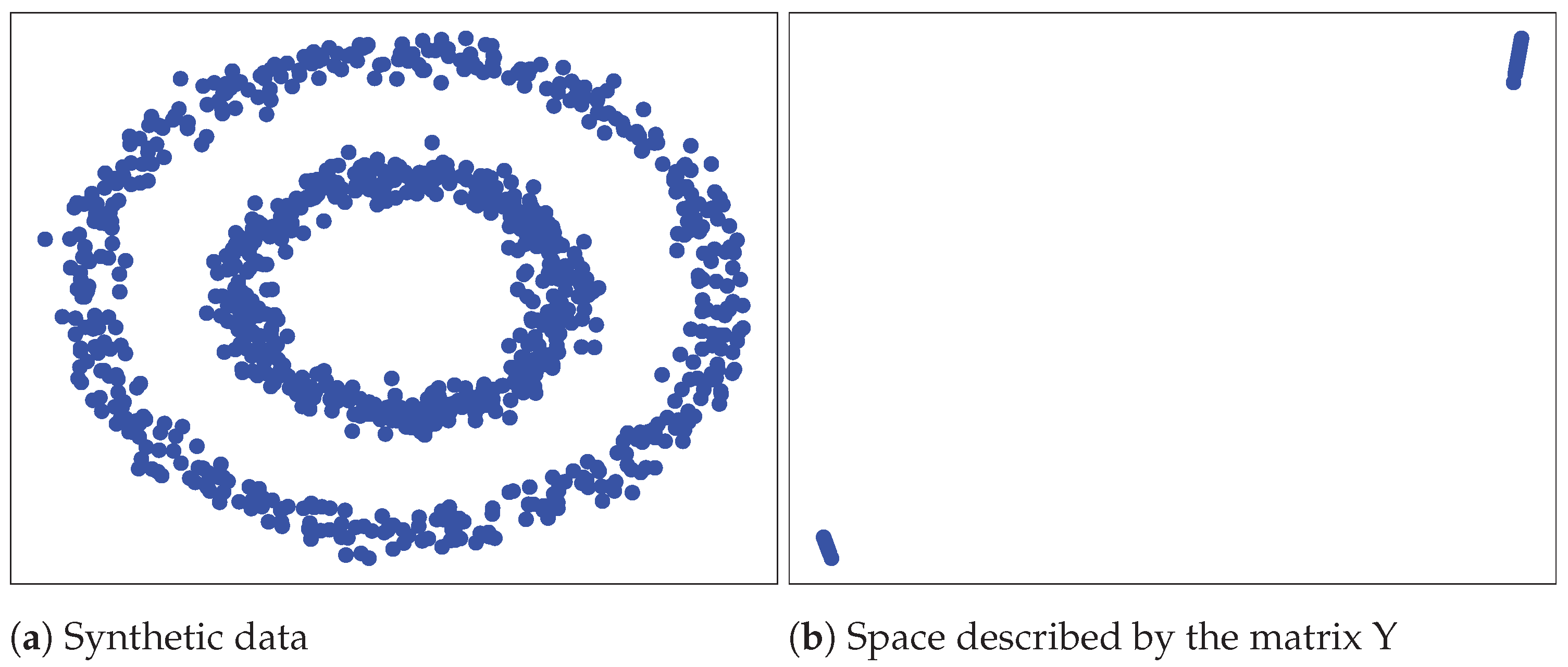
Figure 1b shows the effect of constructing the
Y matrix from the synthetic data set shown in
Figure 1a, whose data are in
space. Although the data in
Figure 1b are still in
space (this will not always be the case as the Y matrix will be in
), the distribution has transformed, thus allowing us to proceed with the final step of the algorithm.
The rows of matrix Y are considered points in , and the data set is partitioned into k clusters via the k-means algorithm. Accordingly, the initial point designated as is assigned to cluster j strictly when the row i of matrix Y has been allocated to cluster j.
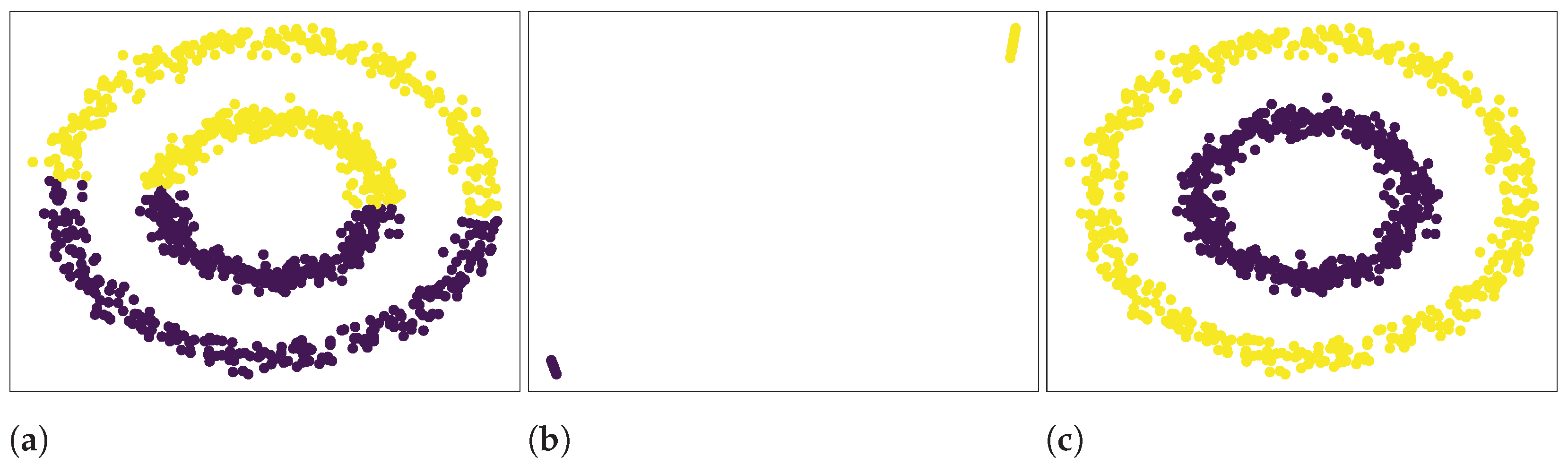
Figure 2a shows the effect when we apply k-means directly on the synthetic data set, obtaining an unsuitable clustering of the synthetic data. However, if we follow the spectral clustering algorithm and apply k-means in the space described by the
Y matrix shown in
Figure 1b, we obtain two clusters, as shown in
Figure 2b. Subsequently, by assigning the memberships of these clusters to the synthetic data set in
Figure 1a, we achieve a proper clustering of the synthetic data set, as illustrated in
Figure 2c.
2.2. Data Streaming and Spectral Clustering Implementation
The primary objective of this work is to apply the spectral clustering algorithm to data streams characterized by “an unlimited sequence of multidimensional, sporadic, and transient observations available over time” [
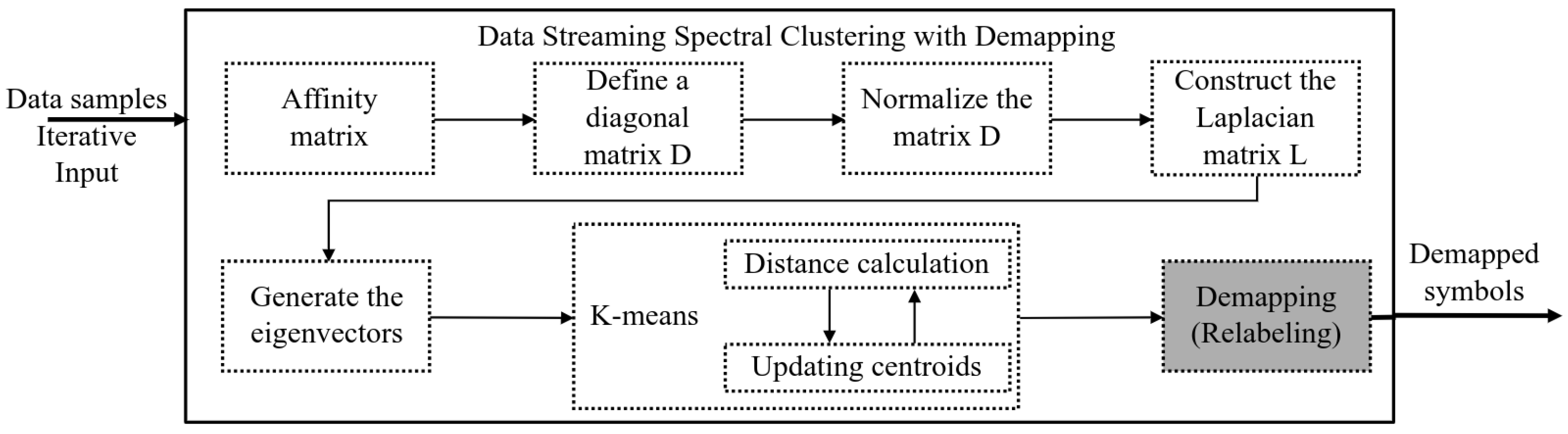
12]. Processing large amounts of information in a single step necessitates excessive memory usage, and unlimited data streaming is practically impossible using the default definition of the spectral clustering algorithm. Consequently, in real-time applications, we must implement a model that allows us to process data dynamically while simultaneously serving as input in an iterative form. For this reason, we defined the data samples denoted as
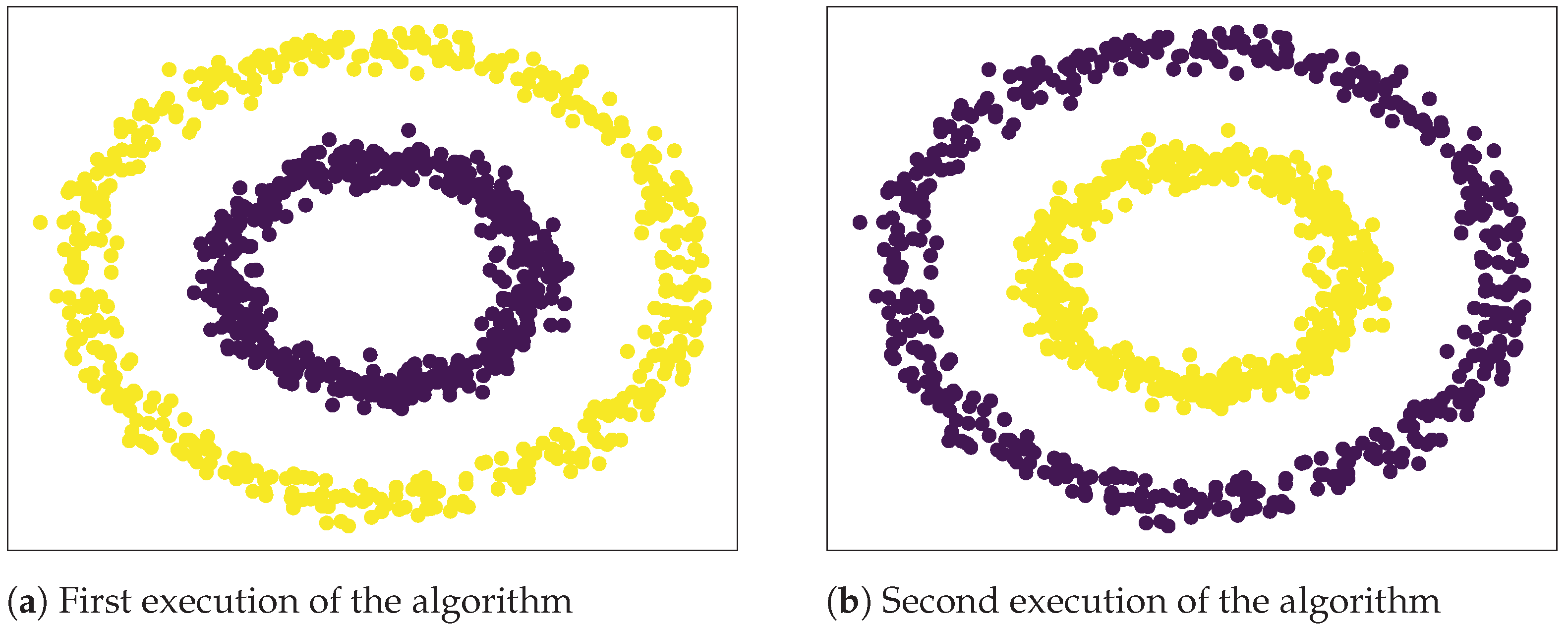
, each containing the same number of symbols, avoiding the excessive memory consumption previously mentioned. In practice, data transmission change over time can present the challenge of label inconsistency causing wrong demapping, as illustrated in
Figure 3a,b, which show a switch in the label assigned to the data across different algorithm iterations. A relabeling step has been added to the algorithm to correct the demapping at the output of the algorithm.
2.3. Demapping Strategy Correcting Label Inconsistency
Figure 4 shows the different stages of the spectral clustering algorithm. In real-time data stream processing, the stages that process matrices consume memory and can generate bottlenecks. Our proposal involves processing data samples that are buffers to store a portion of the data stream. As mentioned above, the algorithm has a final demapping stage that relabels the symbols with the correct value of the ideal constellation.
The process for addressing the potential labeling inconsistency or the correct mapping of symbols is explained as follows:
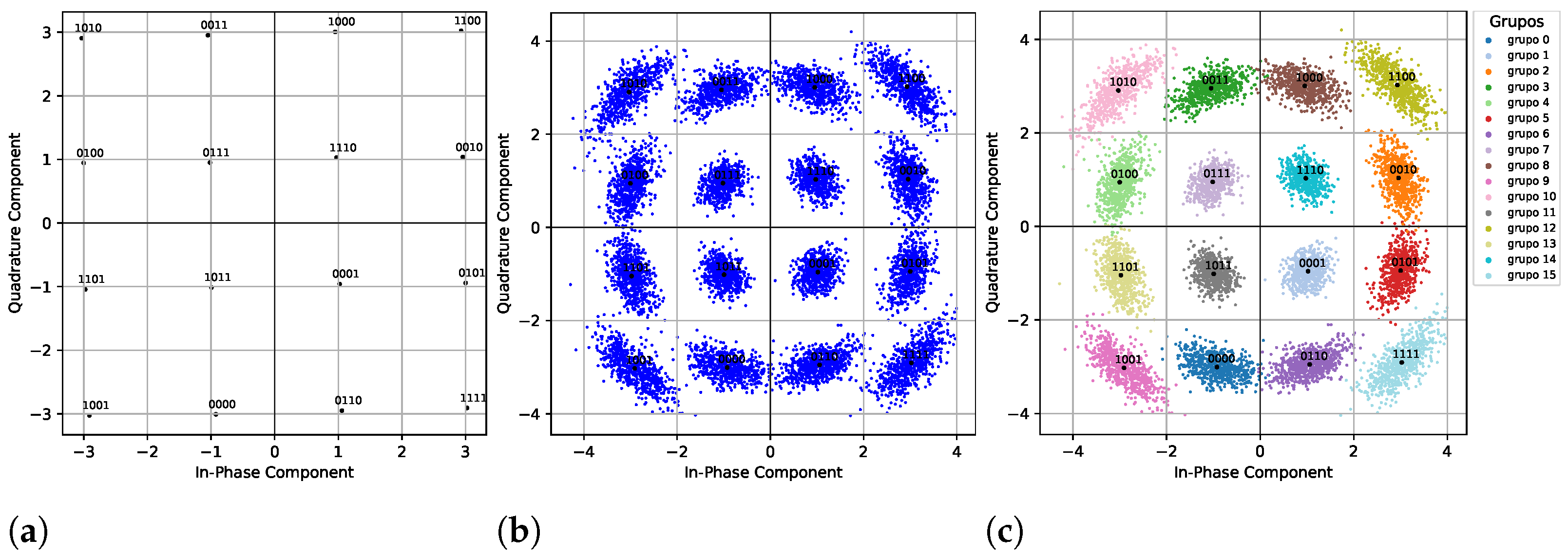
The first step involves selecting the mapping for the ideal constellation, which is used as the reference for the correct labeling of the symbols, as shown in
Figure 5a.
A specified quantity of data
is received, as illustrated in
Figure 5b.
The data stored in the window are clustered using the spectral clustering algorithm.
Independently of the memberships returned by the spectral clustering algorithm, the demapping step calculates the average of the coordinate values within each identified cluster.
The demapping algorithm calculates the distance between the coordinates of the reference points assigned in step 1 and the averages of cluster coordinates obtained in step 4.
The labels from step 1 are assigned to the coordinates identified in step 4 closest to the reference points of the ideal constellation assigned in step 1.
The labels specified in step 6 are assigned to the symbols from which the average coordinates were obtained in step 4.
Upon completing these seven steps, data clustering is achieved (as depicted in
Figure 5c) that maintains consistent labels regardless of the number of algorithm runs. The removal of label inconsistencies constitutes the final phase of the algorithm.
3. Simulation Setup
The simulation was performed using the Matlab Communications Toolbox, which is a standard and widely used tool in the communications community. The simulation’s focus is on evaluating the spectral clustering algorithm against nonlinear phase noise, so a sweep was performed using −90, −100, −110 dBc/Hz at 1 MHz offset, simulating a 10 GHz transmission. The measurements were selected from the the state of the art, and the justification for this is given in the
Section 5. The phase noise scenarios were applied to three modulations, 16-QAM, 32-QAM, and 64-QAM, to appreciate the effect as the constellation size increases.
The nonlinear phase noise is accompanied by additive white Gaussian noise (AWGN), which varies the signal-to-noise ratio in the range of 5 dB to 20 dB by observing the behavior in scenarios where the channel is dominated by noise. A summary of the parameters used for the simulation is shown in
Table 1. The data generated in Matlab were exported as files and fed as inputs to the k-means and spectral clustering algorithms developed in Python.
We used a heuristic method to determine the kernel bandwidth value (). This involved taking a buffer with low nonlinear noise (16-QAM, 110 dBc/Hz) to be processed by spectral clustering. At the same time, we varied the value of sigma until we obtained the appropriate clustering for the chosen buffer. The value found for sigma was equal to 10. We used this previously obtained value to apply spectral clustering to the other modulations. In future work, we will explore how to obtain the kernel bandwidth’s value from the data automatically.
Despite adjusting the value of sigma for spectral clustering with a single modulation format, applying spectral clustering to other modulations yielded promising results, demonstrating that it is a robust algorithm.
The application of the algorithm is assumed to be downstream of the ADC in the receiver of a real system, so the result of the noise application includes all previous optical stages and the inclusion of electrical noise. Therefore, the plots used for the analysis are the SNR vs. BER (bit error rate) generated in Python as output. The approach presented in this paper will allow us to move towards the real-time implementation of the algorithm on FPGA-based heterogeneous architectures in future work. The implementation of algorithms on FPGAs requires exploring the design space to optimize the architecture, taking into account hardware resources and performance in terms of latency and throughput. The exploration is a non-trivial task that encompasses the design of each part of the architecture, such as memory buffers, parallel processing units, and communication interfaces for data input and output; so, it is a research focus that we will address in future work.
Since the computational complexity of spectral clustering is , which is challenging in this case for high-order modulation schemes like 64-QAM, the idea is to make an analysis in C/C++ code, identifying loops that can be accelerated by applying directives such as pipeline and unroll array partition, among others. The main challenge is to accelerate the calculation of the eigenvectors.
4. Results
The proposed spectral clustering algorithm applies the data streaming processing explained above with a window of 2048 points, which will allow us to design a hardware architecture for processing large volumes of data in future work. The total number of symbols sent for testing was 100,000 randomly generated symbols, keeping the exact data for both k-means and spectral clustering, with an oversampling rate of 2 for 16-QAM, 4 for 32-QAM, and 8 for 64-QAM.
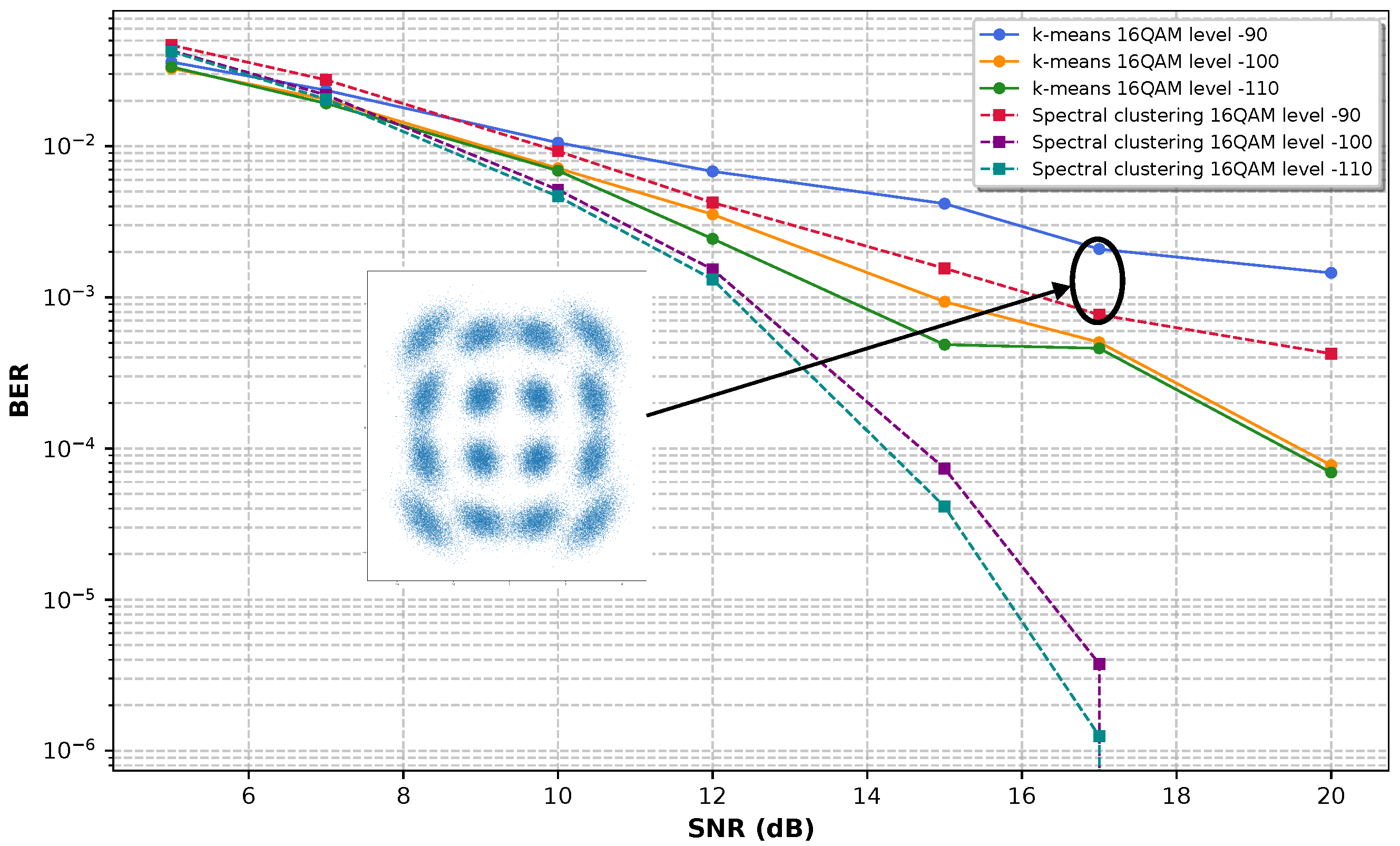
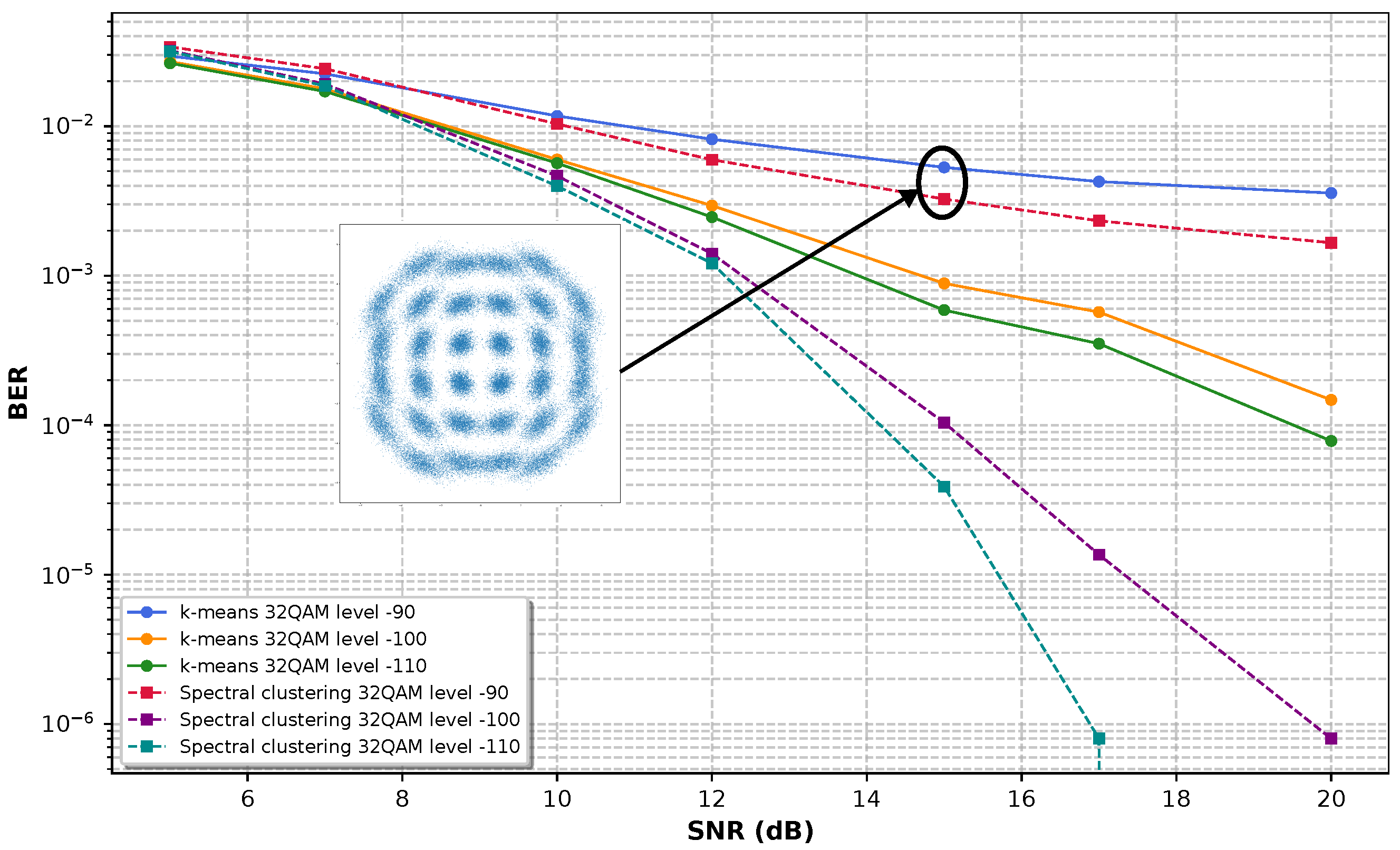
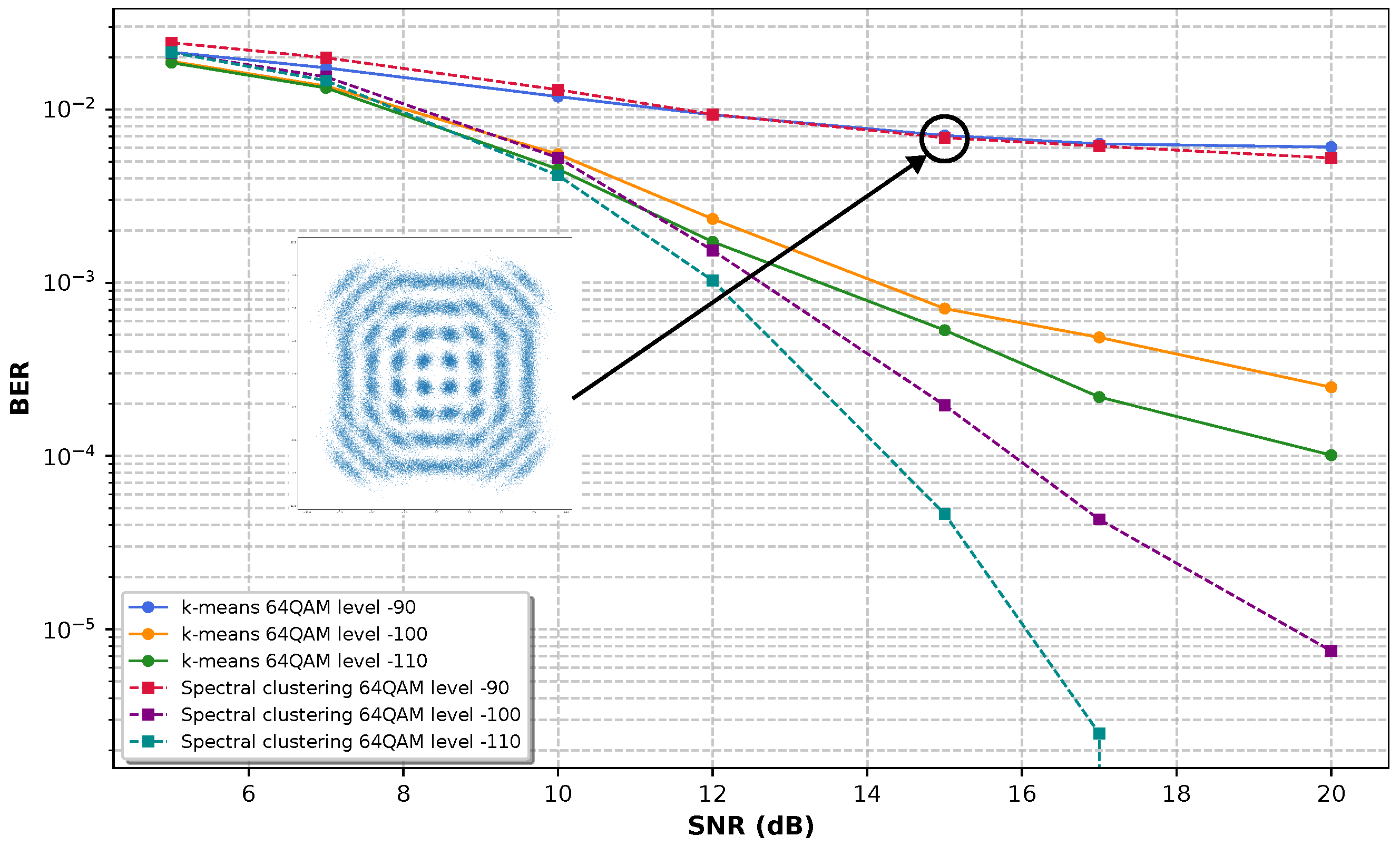
Figure 6,
Figure 7 and
Figure 8 show the results obtained for 16-QAM, 32-QAM, and 64-QAM modulation, respectively, when applying different levels of nonlinear phase noise of −90, −100, and −110 dBc/Hz at 1 MHz offset. The plots are constructed on a semi-logarithmic scale, with the x-axis representing the SNR in dB and the y-axis representing the BER on a logarithmic scale. An inset shows the labels for the result curves for k-means as solid lines and spectral clustering represented by dotted lines.
Figure 6 shows a better performance of the spectral clustering algorithm for dealing with nonlinear phase noise than the results obtained by k-means. Especially at noise levels below −100 dBc/Hz, we observe that the result for values greater than 17 dB SNR is zero for BER, as represented in the graph with the curves going downwards. The behavior of k-means for all cases is close to that of spectral clustering for −90 dBc/Hz, which is the worst-case scenario.
In
Figure 7, the nonlinear noise punishes the k-means behavior more strongly, and it does not go below a BER of
for any of the SNR values. On the contrary, the spectral clustering algorithm performs well at phase noise levels of −100 and −110 dBc/Hz, even achieving zero BER at values greater than 17 dB SNR for −110 phase noise. However, its performance is affected by −90 dBc/Hz noise, and it does not manage to decrease the BER lower than
, which is a challenging scenario for 32-QAM modulation due to the fact that the distance between symbols is smaller than in 16-QAM.
Figure 8 is the scenario for 64-QAM, in which k-means cannot decrease the noise to values less than
. Spectral clustering achieves a BER of
at 20 dB SNR for −100 dBc/Hz and zero BER for values greater than 17 dB SNR for a phase noise of −110 dBc/Hz. As expected, the BER for −90 dBc/Hz worsens compared to that of 32-QAM, achieving BER values around
for values above 10 dB SNR.
Moreover,
Table 2 shows a comparison of the algorithmic complexity, execution time, and BER for the clustering techniques used on constellations with different modulation formats. In the table,
n stands for the number of data,
k is the number of groups, and
t is the number of iterations executed. Although the OSC has higher complexity, and this leads to a higher execution time, it presents the lowest BER for all modulation formats.
5. Discussion
Some papers mention the possible use of spectral clustering as a coherent receiver when reviewing the different non-supervised learning techniques but without addressing its behavior in the presence of nonlinear phase noise [
21]. In this paper, we expand the work presented in [
15] to evaluate the spectral clustering algorithm in a channel dominated by nonlinear phase noise and AWGN. The expansion of the work focuses on covering larger modulations, so we add 32-QAM and 64-QAM to observe the effect of nonlinear noise as the format increases. The nonlinear noise characteristics used in this paper were extracted from work such as [
22], where the development of optical oscillators with phase noise of −100 dBc/Hz at a frequency offset of 1 MHz is mentioned, and other experimental references such as “phase noise of −90 dBc/Hz at 1–10 MHz frequency offset will be low enough for transmission with 16-ary QAM”. Also, Ref. [
23] mentions characteristics such as “the minimum requirement for the carrier phase noise is −96 dBc/Hz at 1 MHz offset for 64 QAM”. The mentioned characteristics were used as a guide to define the ranges used in the simulation. Our goal for future work is to implement the algorithm in real time on an FPGA-based architecture.
6. Conclusions
This paper presents a study on the response of the spectral clustering algorithm to variations in nonlinear phase noise and signal-to-noise ratio (SNR). The study deals with the simulation of transmissions at a 10 GHz symbol rate for different phase noise, with levels of −90, −100, and −110 dBc/Hz at a frequency offset of 1 MHz, mimicking the real scenarios found in the literature. The algorithm was tested with different modulation formats of 16-QAM, 32-QAM, and 64-QAM, exceeding in size those found in the literature for the use of spectral clustering.
The spectral clustering algorithm was modified to work with data streams for future real-time implementations. It was also integrated with a demapping stage for m-QAM to correct labeling inconsistencies when working with windowed data in the demapping stage.
The spectral clustering algorithm outperforms k-means in the presence of nonlinear phase noise and performs well in a noise-dominated channel, as shown in the SNR vs. BER plots presented in this paper. In future work, we will explore the design of a heterogeneous FPGA-based architecture for real-time implementation of the spectral clustering algorithm as a coherent receiver in an optical communication system.
Author Contributions
Conceptualization, D.M.-V. and A.E.C.-O.; methodology, M.S.-S., D.M.-V. and A.E.C.-O.; software, M.S.-S.; validation, M.S.-S., D.M.-V., A.E.C.-O., E.R.-V., N.G.-G. and J.B.-V.; formal analysis, M.S.-S., D.M.-V., A.E.C.-O., E.R.-V., N.G.-G. and J.B.-V.; investigation, M.S.-S., D.M.-V. and A.E.C.-O.; resources, N.G.-G. and J.B.-V.; data curation, M.S.-S.; writing—original draft preparation, M.S.-S., D.M.-V. and A.E.C.-O.; writing—review and editing, M.S.-S., D.M.-V., A.E.C.-O., E.R.-V., N.G.-G. and J.B.-V.; visualization, M.S.-S., D.M.-V. and A.E.C.-O.; supervision, D.M.-V., A.E.C.-O., N.G.-G. and J.B.-V. All authors have read and agreed to the published version of the manuscript.
Funding
This research was funded by the Office of Naval Research Global (ONRG) and the Air Force Office of Scientific Research/Southern Office of Aerospace Research and Development (AFOSR/SOARD) grant number N62909-24-1-2088 and the project PF24211 “Fortalecimiento de Capacidad Técnico-Científica del Grupo Sistemas de Control y Robótica 2024”.
Institutional Review Board Statement
Not applicable.
Informed Consent Statement
Not applicable.
Data Availability Statement
The raw data supporting the conclusions of this article will be made available by the authors on request.
Conflicts of Interest
The authors declare no conflicts of interest.
Abbreviations
The following abbreviations are used in this manuscript:
| SNR | Signal-to-noise ratio |
| BER | Bit error rate |
| QAM | Quadrature amplitude modulation |
| AWGN | Additive white Gaussian noise |
| FWM | Four-wave mixing |
| XPM | Cross-phase modulatio |
| RBF | Radial basis function |
References
- Ali, F.; Shakeel, M.; Ali, A.; Shah, W.; Qamar, M.S.; Ahmad, S.; Ali, U.; Waqas, M. Probing of nonlinear impairments in long range optical transmission systems. J. Opt. Commun. 2023, 44, s1225–s1231. [Google Scholar] [CrossRef]
- Jin, C.; Shevchenko, N.A.; Li, Z.; Popov, S.; Chen, Y.; Xu, T. Nonlinear Coherent Optical Systems in the Presence of Equalization Enhanced Phase Noise. J. Light. Technol. 2021, 39, 4646–4653. [Google Scholar] [CrossRef]
- Yang, S.; Yang, L.; Luo, F.; Li, B.; Wang, X.; Du, Y.; Liu, D. Joint Fiber Nonlinear Noise Estimation, OSNR Estimation and Modulation Format Identification Based on Asynchronous Complex Histograms and Deep Learning for Digital Coherent Receivers. Sensors 2021, 21, 380. [Google Scholar] [CrossRef] [PubMed]
- Demir, A. Nonlinear Phase Noise in Optical-Fiber-Communication Systems. J. Light. Technol. 2007, 25, 2002–2032. [Google Scholar] [CrossRef]
- Tao, Z.; Zhang, K.; Su, X.; Nakashima, H.; Hoshida, T. Nonlinear Noise Measurement for Optical Communication. In Proceedings of the 26th Optoelectronics and Communications Conference, Hong Kong, China, 3–7 July 2021; p. W2A.5. [Google Scholar] [CrossRef]
- Melek, M.M.; Yevick, D. Machine learning compensation of fiber nonlinear noise. Opt. Quantum Electron. 2022, 54, 685. [Google Scholar] [CrossRef]
- Musumeci, F.; Rottondi, C.; Nag, A.; Macaluso, I.; Zibar, D.; Ruffini, M.; Tornatore, M. An Overview on Application of Machine Learning Techniques in Optical Networks. IEEE Commun. Surv. Tutor. 2019, 21, 1383–1408. [Google Scholar] [CrossRef]
- Jain, V.; Bhatia, R. A survey on machine learning schemes for fiber nonlinearity mitigation in radio over fiber system. J. Opt. Commun. 2023. [Google Scholar] [CrossRef]
- Pan, X.; Wang, X.; Tian, B.; Wang, C.; Zhang, H.; Guizani, M. Machine-Learning-Aided Optical Fiber Communication System. IEEE Netw. 2021, 35, 136–142. [Google Scholar] [CrossRef]
- Giacoumidis, E.; Lin, Y.; Jarajreh, M.; O’Duill, S.; McGuinness, K.; Whelan, P.F.; Barry, L.P. A Blind Nonlinearity Compensator Using DBSCAN Clustering for Coherent Optical Transmission Systems. Appl. Sci. 2019, 9, 4398. [Google Scholar] [CrossRef]
- Huang, X.; Wang, Y.; Li, C.; Xu, H.; Zhang, Q.; Yang, L.; Xin, X. Improved DBSCAN algorithm based signal recovery technology in coherent optical communication systems. Opt. Commun. 2022, 521, 128590. [Google Scholar] [CrossRef]
- Bahri, M. Improving IoT Data Stream Analytics Using Summarization Techniques. Ph.D. Thesis, Institut Polytechnique de Paris, Palaiseau, France, 2020. [Google Scholar]
- Zubaroğlu, A.; Atalay, V. Data stream clustering: A review. Artif. Intell. Rev. 2021, 54, 1201–1236. [Google Scholar] [CrossRef]
- Dhillon, I.S.; Guan, Y.; Kulis, B. Kernel k-means: Spectral clustering and normalized cuts. In Proceedings of the Tenth ACM SIGKDD International Conference on Knowledge Discovery and Data Mining, Seattle, WA, USA, 22–25 August 2004; pp. 551–556. [Google Scholar]
- Liu, X.; Wang, Y.; Xu, H. Nonlinearity Compensation Technique by Spectral Clustering for Coherent Optical Communication System. In Proceedings of the Asia Communications and Photonics Conference/International Conference on Information Photonics and Optical Communications 2020 (ACP/IPOC), Beijing, China, 24–27 October 2020; p. M4A.291. [Google Scholar] [CrossRef]
- Li, Y.; Chang, H.; Gao, R.; Zhang, Q.; Tian, F.; Yao, H.; Tian, Q.; Wang, Y.; Xin, X.; Wang, F.; et al. End-to-End Deep Learning of Joint Geometric Probabilistic Shaping Using a Channel-Sensitive Autoencoder. Electronics 2023, 12, 4234. [Google Scholar] [CrossRef]
- Mouton, J.P.; Ferreira, M.; Helberg, A.S. A comparison of clustering algorithms for automatic modulation classification. Expert Syst. Appl. 2020, 151, 113317. [Google Scholar] [CrossRef]
- He, J.; Zhan, Y.; Pan, H.; Peng, H. An unsupervised coherent receiver digital signal processing algorithm based on spectral clustering with no data preamble. IET OptoElectron. 2024, 18, 131–139. [Google Scholar] [CrossRef]
- Wu, X.; Chi, N. The phase estimation of geometric shaping 8-QAM modulations based on K-means clustering in underwater visible light communication. Opt. Commun. 2019, 444, 147–153. [Google Scholar] [CrossRef]
- Ng, A.Y.; Jordan, M.I.; Weiss, Y. On spectral clustering: Analysis and an algorithm. In Proceedings of the 14th International Conference on Neural Information Processing Systems: Natural and Synthetic (NIPS’01), Vancouver, BC, Canada, 3–8 December 2001; pp. 849–856. [Google Scholar]
- Saif, W.S.; Esmail, M.A.; Ragheb, A.M.; Alshawi, T.A.; Alshebeili, S.A. Machine Learning Techniques for Optical Performance Monitoring and Modulation Format Identification: A Survey. IEEE Commun. Surv. Tutor. 2020, 22, 2839–2882. [Google Scholar] [CrossRef]
- Kanno, A. Seamless Convergence Between Terahertz Radios and Optical Fiber Communication Toward 7G Systems. IEEE J. Sel. Top. Quantum Electron. 2023, 29, 1–9. [Google Scholar] [CrossRef]
- Hasanuzzaman, G.K.M.; Iezekiel, S.; Kanno, A. W-Band Optoelectronic Oscillator. IEEE Photonics Technol. Lett. 2020, 32, 771–774. [Google Scholar] [CrossRef]
| Disclaimer/Publisher’s Note: The statements, opinions and data contained in all publications are solely those of the individual author(s) and contributor(s) and not of MDPI and/or the editor(s). MDPI and/or the editor(s) disclaim responsibility for any injury to people or property resulting from any ideas, methods, instructions or products referred to in the content. |
© 2024 by the authors. Licensee MDPI, Basel, Switzerland. This article is an open access article distributed under the terms and conditions of the Creative Commons Attribution (CC BY) license (https://creativecommons.org/licenses/by/4.0/).



 ,
,