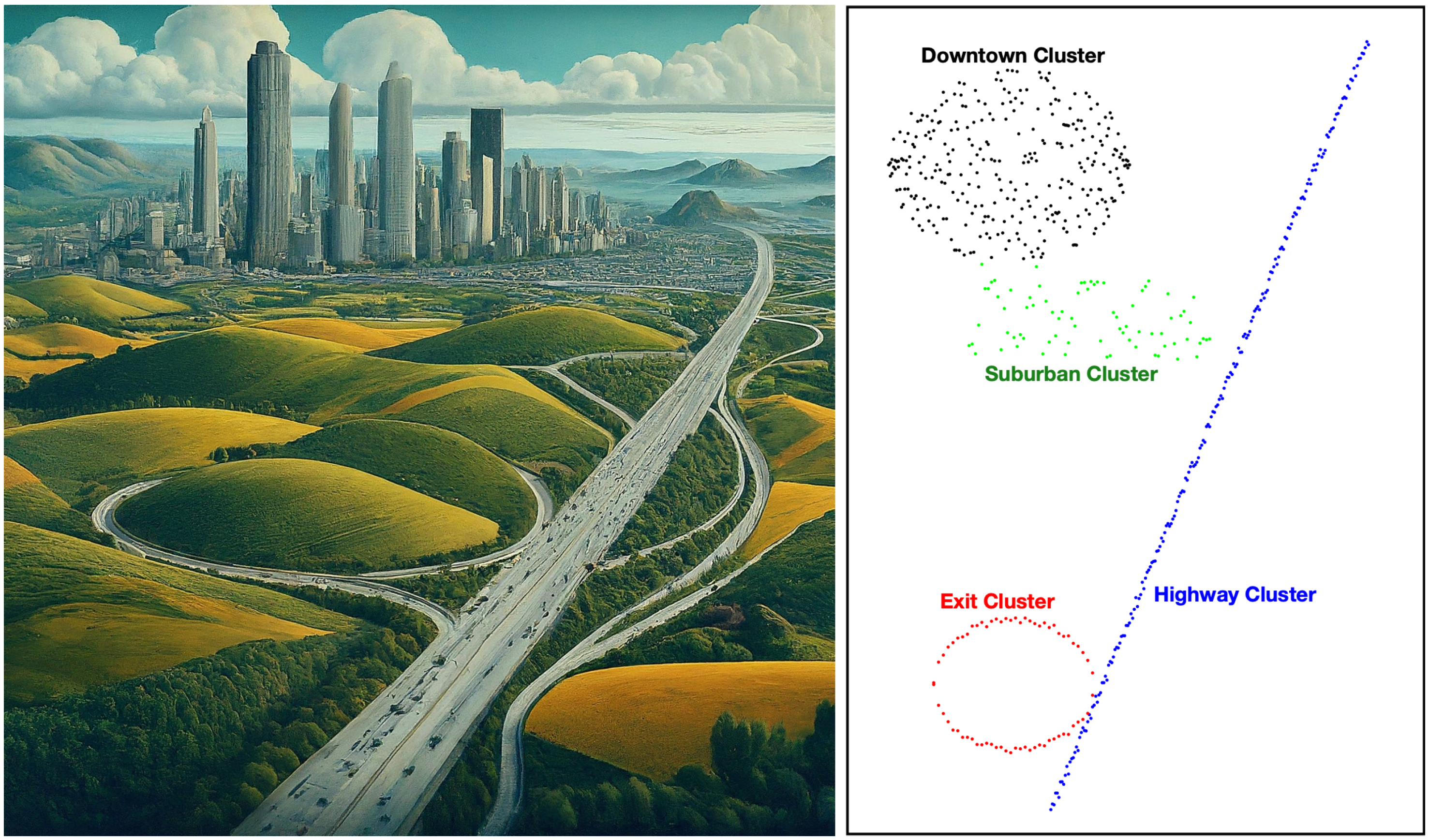

Ellipsoidal K-Means: An Automatic Clustering Approach for Non-Uniform Data Distributions

 ,
,  ,
,  ,
,  and
and 
Abstract
1. Introduction
2. Adaptive Ellipsoidal Clustering Technique
2.1. The Proposed Clustering Objective Function
2.2. Ellipsoidal Clustering Technique
- Step 1:
- Assume that each cluster k, with center , contains points indexed by , i.e., the cluster points are . First, compute the maximum distance between the cluster points and their center . Denote this maximum distance by a, which represents the length of the major axis of the elliptical cluster, as follows:Let be the index corresponding to the point with the maximum distance, and define the vector as
- Step 2:
- Assume we have vectors that are pairwise perpendicular and each of length a. For each , , the component values , , can be computed as in the case of a 2-dimensional rotation, without loss of generality, as follows:The component values and can be determined usingTo ensure that is perpendicular to , we requirewhich simplifies toFrom Equations (7) and (9), we can deriveleading toThe farthest point is computed as at the edge of the cluster. Then, compute b, the minor axis of the kth ellipsoidal cluster, as
- Step 3:
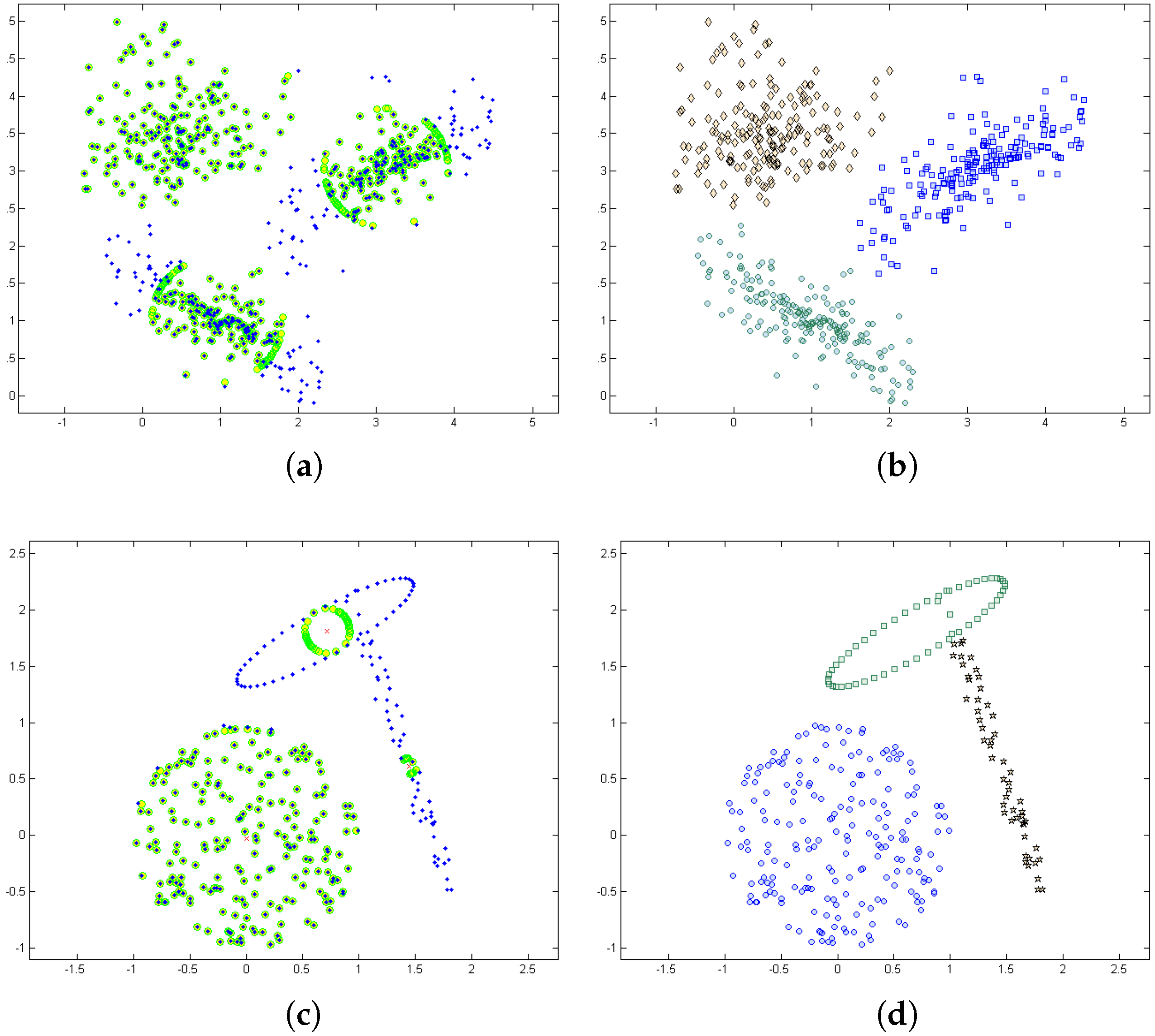
- Transform the points of the kth cluster into hyperspherical cluster points , where the diameter of the resulting sphere equals the minor axis b, as shown in Figure 4. Using the properties of the unit vector for two identical vectors, as follows:then,We set when , meaning that any point outside the new spherical cluster is relocated to the surface of this sphere.
2.3. Assignment of Points
2.4. The Nearest-Neighbor Algorithm
- Step 1:
- For each point , determine the distance between and its nearest neighbor, as expressed by
- Step 2:
- Calculate the average of the nearest-neighbor distances as follows:Let , where the parameter determines the distance d.
- Step 3:
- Display the objects as nodes of a graph. Then, compute the neighboring matrix as follows:
- Step 4:
- Let each cluster be represented by the connected components of this graph as , where all the points in are assigned the label , where . Specifically, for all .
- Step 5:
- Compute the nearest-neighbor score as follows:where is the number of data elements of the largest component in cluster k that have the same label ℓ.
2.5. Cluster Merging and Splitting
- 1.
- Input the average silhouette width for all clusters, where , along with , the number of objects in each cluster, and their centers .
- 2.
- Identify the two clusters with the minimum values of , where , with i and j being indices in the range .
- 3.
- Set a new center as .
- 4.
- Replace the centers and with , and update
- 5.
- Adjust the newly generated centers based on the K-means.
- 1.
- Input the average silhouette width for all clusters, where , together with , the objects in each cluster and their centers .
- 2.
- Identify the cluster with the minimum value ,
- 3.
- Subdivide cluster i into two sub-clusters, and , by dividing the points along the longest coordinate of the cluster. The center serves as the boundary between these sub-clusters.
- 4.
- Determine the number of objects in the subclusters, denoted and .
- 5.
- Replace with , where and , and update .
- 6.
- Adjust the newly-generated centers based on K-means.
2.6. Objective Function
3. Integrating Adaptive Ellipsoidal Clustering with Simulated Annealing Heuristic
3.1. Simulated Annealing Heuristic
| Algorithm 1: Pseudo-code for the simulated annealing clustering algorithm to allocate cluster centers |
 |
3.2. SAELLC Algorithm
| Algorithm 2: SAELLC Algorithm |
 |
4. Experimental Study
4.1. Datasets
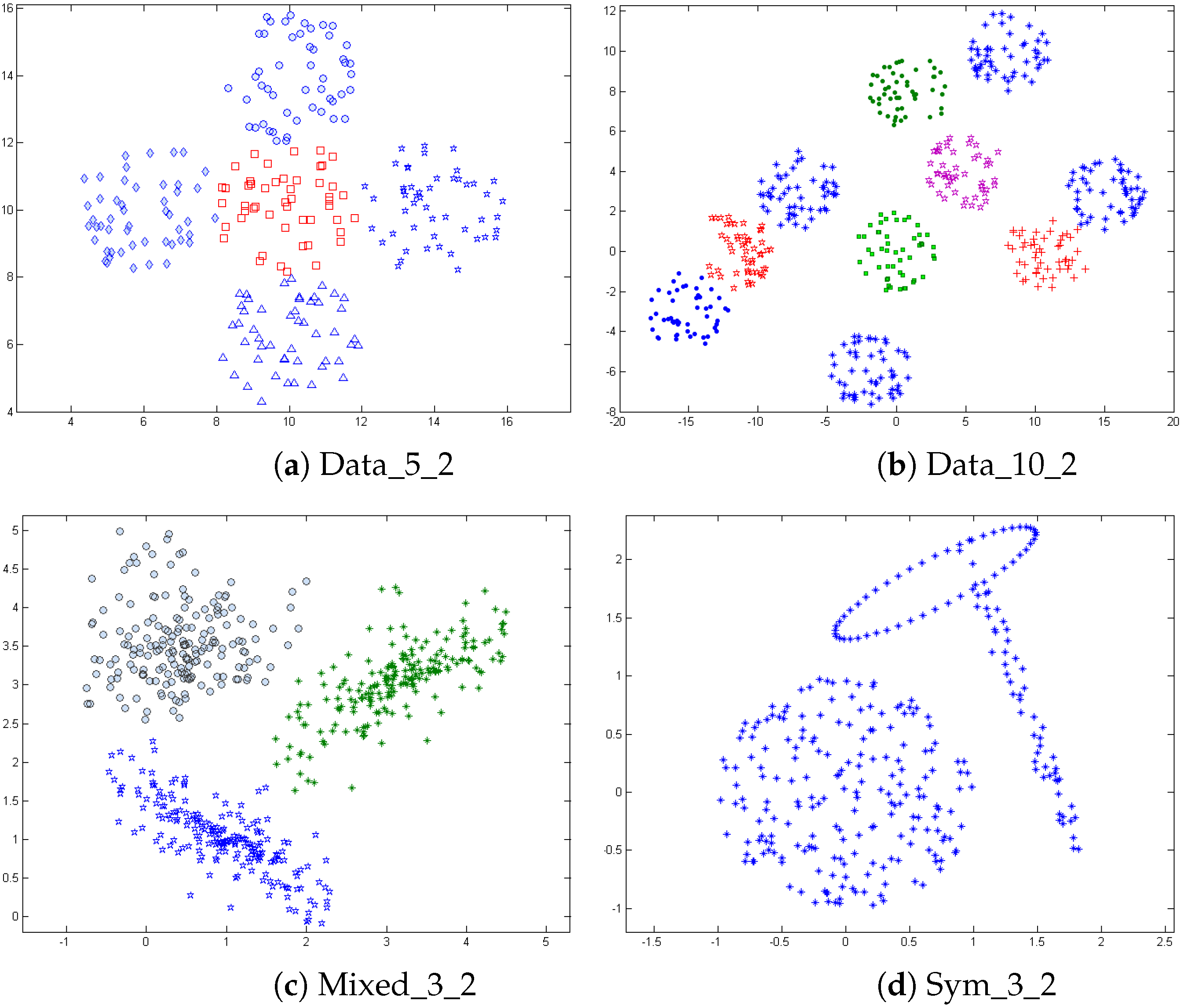
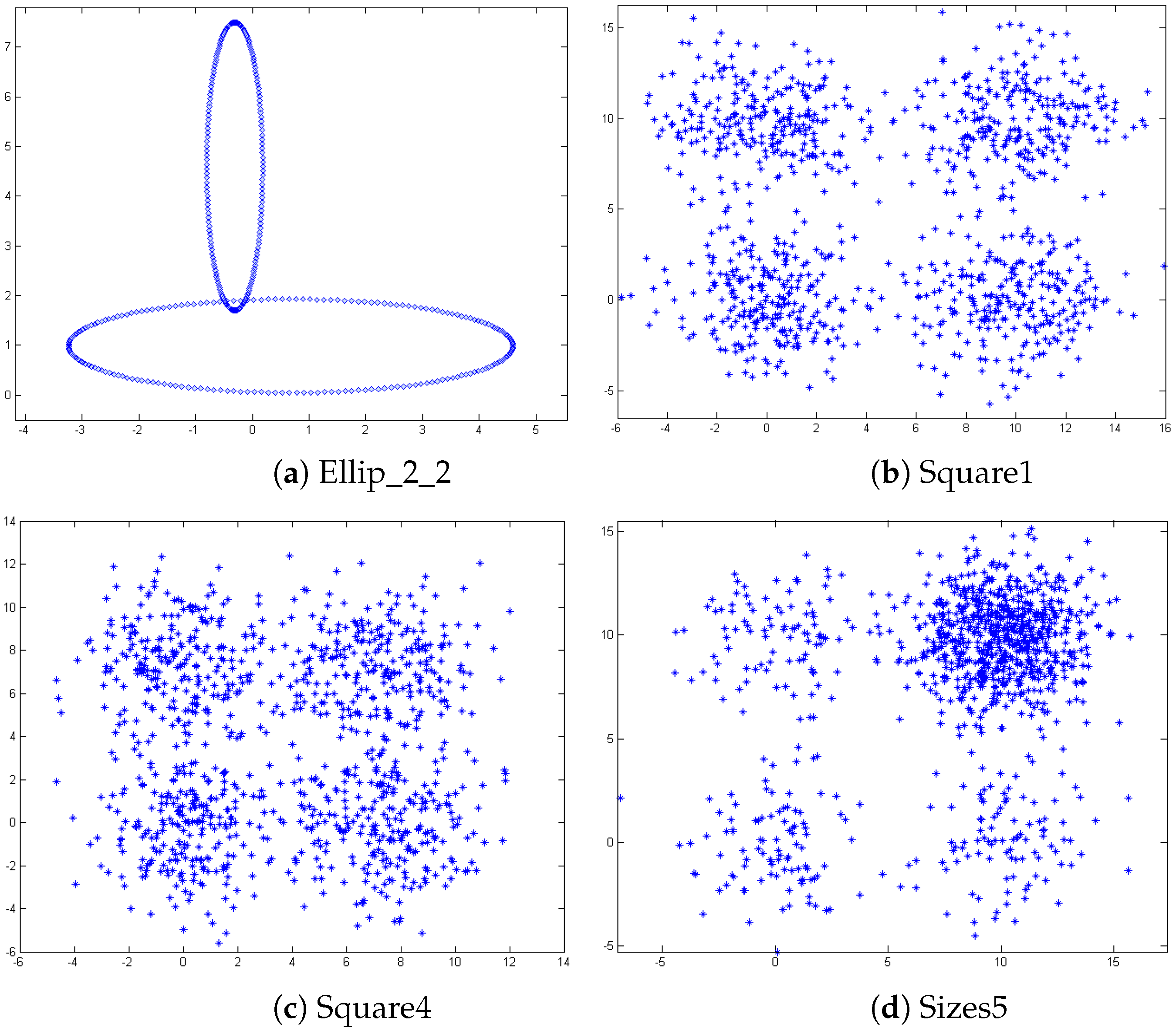
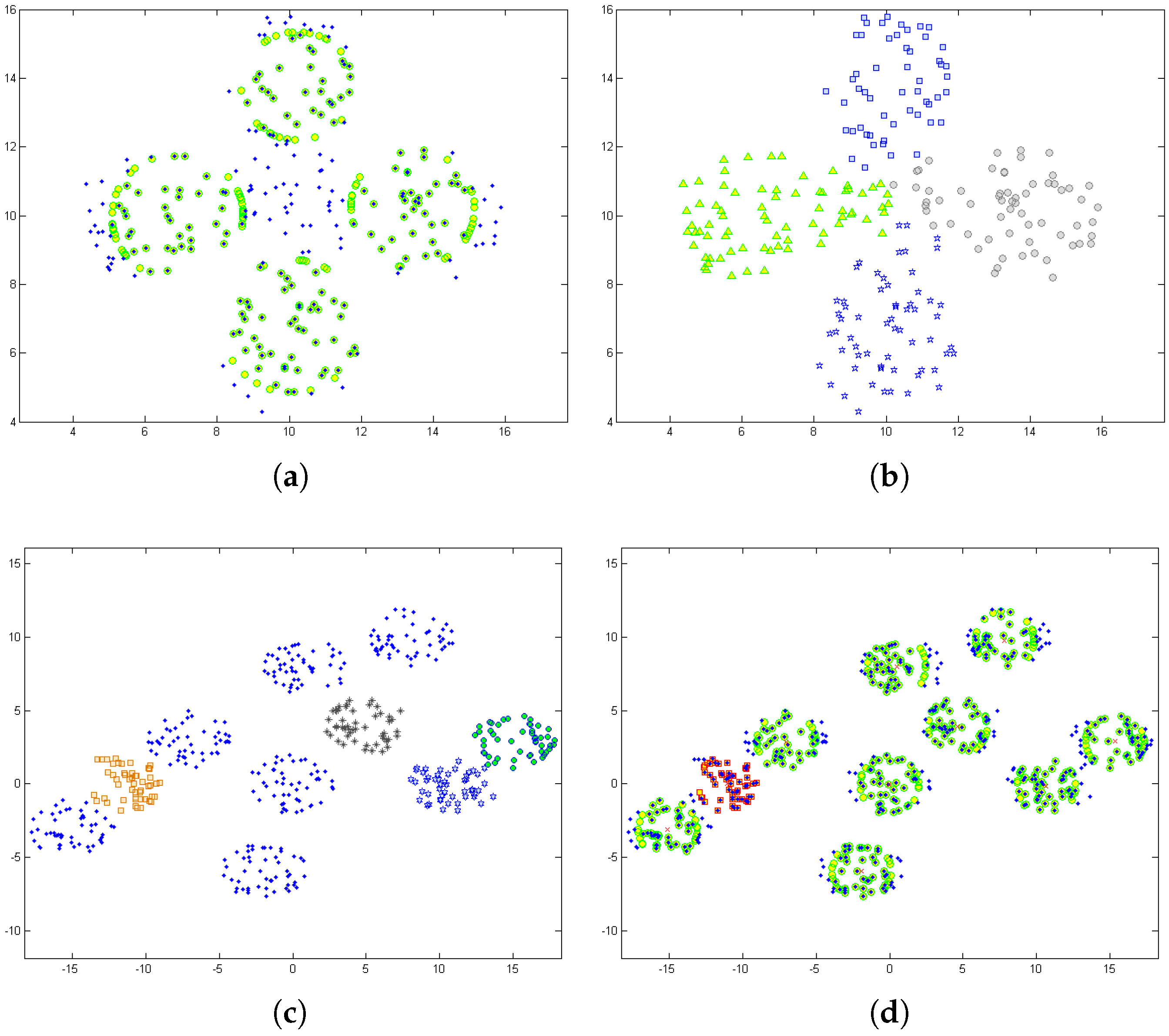
- Mixed_3_2: This dataset contains 600 two-dimensional points arranged into three clusters, with shapes that are either ellipsoidal or hyperspherical. Figure 6c illustrates this dataset.
- Iris: The Iris dataset features 150 flower samples from three species (Setosa, Versicolor, Virginica). Each class contains 50 samples, with four features: sepal length, sepal width, petal length, and petal width.
- Cancer: The cancer dataset is based on breast cancer in Wisconsin. It is a diagnosis of breast cancer, with 2 classes (classify a tumor as benign or malignant). The cancer dataset contains 683 objects and 9 variables.
- Newthyroid: Thyroid involves the diagnosis of thyroid, whether it is hyper or hypofunction. Five attributes are used to classify 3 classes of thyroid functions as over-function, normal-function, or under-function. The dataset is based on new thyroid data and contains 215 patterns.
- Lungcancer: The Lung Cancer dataset from the UCI repository contains data on lung cancer patients. It includes information on various attributes like age, smoking habits, and cancer type, among others, to help in the classification and prediction of lung cancer incidences.
- Wine: Wine data, obtained through chemical analysis, originate from three different cultivators. Consequently, the analysis categorizes the wines into three types. The dataset comprises 178 samples of wine, each characterized by 13 inputs.
- LiverDisorder: The liver disorder dataset consists of 345 instances and 6 conditional attributes. It contains records of individuals with liver disorders, intended for binary classification tasks to predict liver disease. The attributes include various liver function tests and a selector field used to split the data into training and validation sets.
4.2. Parameter Settings
4.3. Results and Technical Discussion
4.4. A Real-World Application: IoV Deployment
5. Summary and Conclusions
Author Contributions
Funding
Data Availability Statement
Acknowledgments
Conflicts of Interest
References
- Ran, X.; Xi, Y.; Lu, Y.; Wang, X.; Lu, Z. Comprehensive survey on hierarchical clustering algorithms and the recent developments. Artif. Intell. Rev. 2023, 56, 8219–8264. [Google Scholar] [CrossRef]
- de Amorim, R.C.; Makarenkov, V. On k-means iterations and Gaussian clusters. Neurocomputing 2023, 553, 126547. [Google Scholar] [CrossRef]
- Oyewole, G.J.; Thopil, G.A. Data clustering: Application and trends. Artif. Intell. Rev. 2023, 56, 6439–6475. [Google Scholar] [CrossRef] [PubMed]
- Saxena, A.; Prasad, M.; Gupta, A.; Bharill, N.; Patel, O.P.; Tiwari, A.; Er, M.J.; Ding, W.; Lin, C.T. A review of clustering techniques and developments. Neurocomputing 2017, 267, 664–681. [Google Scholar] [CrossRef]
- Mittal, H.; Pandey, A.C.; Saraswat, M.; Kumar, S.; Pal, R.; Modwel, G. A comprehensive survey of image segmentation: Clustering methods, performance parameters, and benchmark datasets. Multimed. Tools Appl. 2022, 81, 35001–35026. [Google Scholar] [CrossRef]
- Chivukula, A.S.; Yang, X.; Liu, B.; Liu, W.; Zhou, W. Adversarial Machine Learning: Attack Surfaces, Defence Mechanisms, Learning Theories in Artificial Intelligence; Springer: Berlin/Heidelberg, Germany, 2023. [Google Scholar]
- Ikotun, A.M.; Ezugwu, A.E.; Abualigah, L.; Abuhaija, B.; Heming, J. K-means clustering algorithms: A comprehensive review, variants analysis, and advances in the era of big data. Inf. Sci. 2023, 622, 178–210. [Google Scholar] [CrossRef]
- Yang, M.S.; Hussain, I. Unsupervised multi-view K-means clustering algorithm. IEEE Access 2023, 11, 13574–13593. [Google Scholar] [CrossRef]
- Maravarman, M.; Babu, S.; Pitchai, R. An Extended Agglomerative Hierarchical Clustering Techniques. In Proceedings of the 2023 International Conference on Advances in Computing, Communication and Applied Informatics (ACCAI), Chennai, India, 25–26 May 2023; pp. 1–8. [Google Scholar]
- Kumar, A.; Nadeem, M.; Banka, H. Nature inspired optimization algorithms: A comprehensive overview. Evol. Syst. 2023, 14, 141–156. [Google Scholar] [CrossRef]
- Tang, X.; Duan, M.; Xu, K.; Zhang, Q. Augmentation of degranulation mechanism for high-dimensional data with a multi-round optimization strategy. Fuzzy Sets Syst. 2024, 486, 108969. [Google Scholar] [CrossRef]
- Mohammed, A.H.; Ashour, M.A.H. Enhancing Fuzzy C-Means Clustering with a Novel Standard Deviation Weighted Distance Measure. Baghdad Sci. J. 2024, 21, 2956. [Google Scholar] [CrossRef]
- Kaushal, M.; Danish Lohani, Q.; Castillo, O. Weighted Intuitionistic Fuzzy C-Means Clustering Algorithms. Int. J. Fuzzy Syst. 2024, 26, 943–977. [Google Scholar] [CrossRef]
- Scitovski, R.; Sabo, K.; Nikić, P.; Majstorović, S. A new efficient method for solving the multiple ellipse detection problem. Expert Syst. Appl. 2023, 222, 119853. [Google Scholar] [CrossRef]
- Son, E.T.; Oh, B.C.; Cho, J.T.; Kim, H.J.; Kim, S.Y. Optimizing load transfer ability in short-term planning of advanced distribution management system: An empirical study on South Korea. Int. J. Electr. Power Energy Syst. 2024, 157, 109807. [Google Scholar] [CrossRef]
- Nguyen-Trang, T.; Nguyen-Thoi, T.; Vo-Van, T. Globally automatic fuzzy clustering for probability density functions and its application for image data. Appl. Intell. 2023, 53, 18381–18397. [Google Scholar] [CrossRef]
- Hedar, A.R.; Ibrahim, A.M.M.; Abdel-Hakim, A.E.; Sewisy, A.A. K-Means Cloning: Adaptive Spherical K-Means Clustering. Algorithms 2018, 11, 151. [Google Scholar] [CrossRef]
- Kirkpatrick, S.; Gerlatt, C.; Vecchi, M. Optimization by simulated annealing. Science 1983, 220, 671–680. [Google Scholar] [CrossRef]
- Saha, S.; Bandyopadhyay, S. A new multiobjective clustering technique based on the concepts of stability and symmetry. Knowl. Inf. Syst. 2010, 23, 1–27. [Google Scholar] [CrossRef]
- Corne, D.W.; Jerram, N.R.; Knowles, J.D.; Oates, M.J. PESA-II: Region-based Selection in Evolutionary Multiobjective Optimization. In Proceedings of the Genetic and Evolutionary Computation Conference (GECCO-2001), San Francisco, CA, USA, 7–11 July 2001; pp. 283–290. [Google Scholar]
- Handl, J.; Knowles, J. An evolutionary approach to multiobjective clustering. IEEE Trans. Evol. Comput. 2007, 11, 56–76. [Google Scholar] [CrossRef]
- Bandyopadhyay, S.; Saha, S. A point symmetry based clustering technique for automatic evolution of clusters. Knowl. Data Eng. 2008, 20, 1–17. [Google Scholar] [CrossRef]
- Bandyopadhyay, S.; Maulik, U. Genetic clustering for automatic evolution of clusters and application to image classification. Pattern Recognit. 2002, 35, 1197–1208. [Google Scholar] [CrossRef]
- Jain, A.; Murty, M.; Flynn, P. Data clustering: A review. ACM Comput. Surv. 1999, 31, 264–323. [Google Scholar] [CrossRef]
- Celebi, M. Partitional Clustering Algorithms; Springer International Publishing: Cham, Switzerland, 2015. [Google Scholar]
- Peter, J. A grafical aid to the interpertation and validation of cluster analysis. Comput. Appl. Math. 1987, 20, 53–65. [Google Scholar]
- Campello, R.; Hruschka, E. A fuzzy extension of the silhouette width criterion for cluster analysis. Fuzzy Sets Syst. 2006, 157, 2858–2875. [Google Scholar] [CrossRef]
- Bandyopadhyay, S.; Saha, S. GAPS: A clustering method using a new point symmetry-based distance measure. Pattern Recognit. 2007, 40, 3430–3451. [Google Scholar] [CrossRef]
- Dubiner, M. A heterogeneous high-dimensional approximate nearest neighbor algorithm. IEEE Trans. Inf. Theory 2012, 58, 6646–6658. [Google Scholar] [CrossRef][Green Version]
- Gao, Y.; Pan, J.; Ji, G.; Yang, Z. A novel two-level nearest neighbor classification algorithm using an adaptive distance metric. Knowl.-Based Syst. 2012, 26, 103–110. [Google Scholar] [CrossRef]
- Smith, S. Threshold validity for mutual neighborhood clustering. Pattern Anal. Mach. Intell. IEEE Trans. 1993, 15, 89–92. [Google Scholar] [CrossRef]
- Tseng, L.; Yang, S.B. A genetic approach to the automatic clustering problem. Pattern Recognit. 2001, 34, 415–424. [Google Scholar] [CrossRef]
- Li, B.; Chen, Y.; Chen, Y. The nearest neighbor algorithm of local probability centers. Syst. Man, Cybern. Part B Cybern. IEEE Trans. 2008, 38, 141–154. [Google Scholar] [CrossRef]
- Hedar, A.R.; Abdel-Hakim, A.E.; Deabes, W.; Alotaibi, Y.; Bouazza, K.E. Deep Memory Search: A Metaheuristic Approach for Optimizing Heuristic Search. arXiv 2024, arXiv:2410.17042. [Google Scholar] [CrossRef]
- Liu, Y.; Yi, Z.; Wu, H.; Ye, M.; Chen, K. A tabu search approach for the minimum sum-of-squares clustering problem. Inf. Sci. 2008, 178, 2680–2704. [Google Scholar] [CrossRef]
- Cao, B.; Glover, F.; Rego, C. A tabu search algorithm for cohesive clustering problems. J. Heuristics 2015, 21, 457–477. [Google Scholar] [CrossRef]
- Che, Z. Clustering and selecting suppliers based on simulated annealing algorithms. Comput. Math. Appl. 2012, 63, 228–238. [Google Scholar] [CrossRef]
- Hruschka, E.; Campello, R.; Freitas, A.; de Carvalho, A. A Survey of evolutionary algorithms for clustering. IEEE Trans. Syst. Man Cybern. Part C Appl. Rev. 2009, 39, 133–155. [Google Scholar] [CrossRef]
- Kao, Y.; Lee, S. Combining k-means and particle swarm optimization for dynamic data clustering problems. In Proceedings of the 2009 IEEE International Conference on Intelligent Computing and Intelligent Systems, Shanghai, China, 20–22 November 2009; Volume 1, pp. 757–761. [Google Scholar]
- Gungor, Z.; Unler, A. k-harmonic means data clustering with simulated annealing heuristic. Appl. Math. Comput. 2007, 187, 199–209. [Google Scholar]
- Mohamadi, H.; Habibi, J.; Abadeh, M. Data mining with a simulated annealing based fuzzy classification system. Pattern Recognit. 2008, 41, 1824–1833. [Google Scholar] [CrossRef]
- Saha, S.; Bandyopadhyay, S. A new multiobjective simulated annealing based clustering technique using symmetry. Pattern Recognit. Lett. 2009, 30, 1392–1403. [Google Scholar] [CrossRef]
- Asuncion, A.; Newman, D. University of California at Irvine Repository of Machine Learning Databases. 2007. Available online: http://archive.ics.uci.edu/ml/ (accessed on 30 November 2024).
- Bandyopadhyay, S.; Saha, S.; Pedrycz, W. Use of a fuzzy granulation—Degranulation criterion for assessing cluster validity. Fuzzy Sets Syst. 2011, 170, 22–42. [Google Scholar] [CrossRef]
- Gong, W.; Cai, Z.; Ling, C.; Huang, B. A point symmetry-Based automatic clustering approach using differential evolution. Adv. Comput. Intell. 2009, 5821, 151–162. [Google Scholar]
- Hedar, A.R.; Ibrahim, A.M.M.; Abdel-Hakim, A.E.; Sewisy, A.A. Modulated clustering using integrated rough sets and scatter search attribute reduction. In Proceedings of the Genetic and Evolutionary Computation Conference Companion, Kyoto, Japan, 15–19 July 2018; Association for Computing Machinery: New York, NY, USA, 2018; pp. 1394–1401. [Google Scholar] [CrossRef]
- Jardine, N.; Sibson, R. Mathematical taxonomy; Willey: Hoboken, NJ, USA, 1971. [Google Scholar]
- Patel, E.; Kushwaha, D.S. Clustering cloud workloads: K-means vs gaussian mixture model. Procedia Comput. Sci. 2020 2008, 171, 158–167. [Google Scholar] [CrossRef]
- Saha, S. A line symmetry based genetic clustering technique: Encoding lines in chromosomes. International Journal of Machine Learning and Cybernetics 2018 2018, 9, 1963–1986. [Google Scholar] [CrossRef]
- Qureshi, K.N.; Din, S.; Jeon, G.; Piccialli, F. Internet of vehicles: Key technologies, network model, solutions and challenges with future aspects. IEEE Trans. Intell. Transp. Syst. 2020, 22, 1777–1786. [Google Scholar] [CrossRef]
- Abdel-Hakim, A.E.; Deabes, W.; Bouazza, K.E.; Hedar, A.R. Dynamic Deployment of Mobile Roadside Units in Internet of Vehicles. IEEE Access 2024, 12, 155534–155548. [Google Scholar] [CrossRef]
- Salim, A.; Khedr, A.M.; Alwasel, B.; Osamy, W.; Aziz, A. Somaca: A new swarm optimization-based and mobility-aware clustering approach for the internet of vehicles. IEEE Access 2023, 11, 46487–46503. [Google Scholar] [CrossRef]
- Senouci, O.; Harous, S.; Aliouat, Z. Survey on vehicular ad hoc networks clustering algorithms: Overview, taxonomy, challenges, and open research issues. Int. J. Commun. Syst. 2020, 33, e4402. [Google Scholar] [CrossRef]





| Datasets | Objects | Attributes | Class |
|---|---|---|---|
| Data_5_2 | 250 | 2 | 5 |
| Data_10_2 | 500 | 2 | 10 |
| Mixed_3_2 | 600 | 2 | 3 |
| Sym_3_2 | 350 | 2 | 3 |
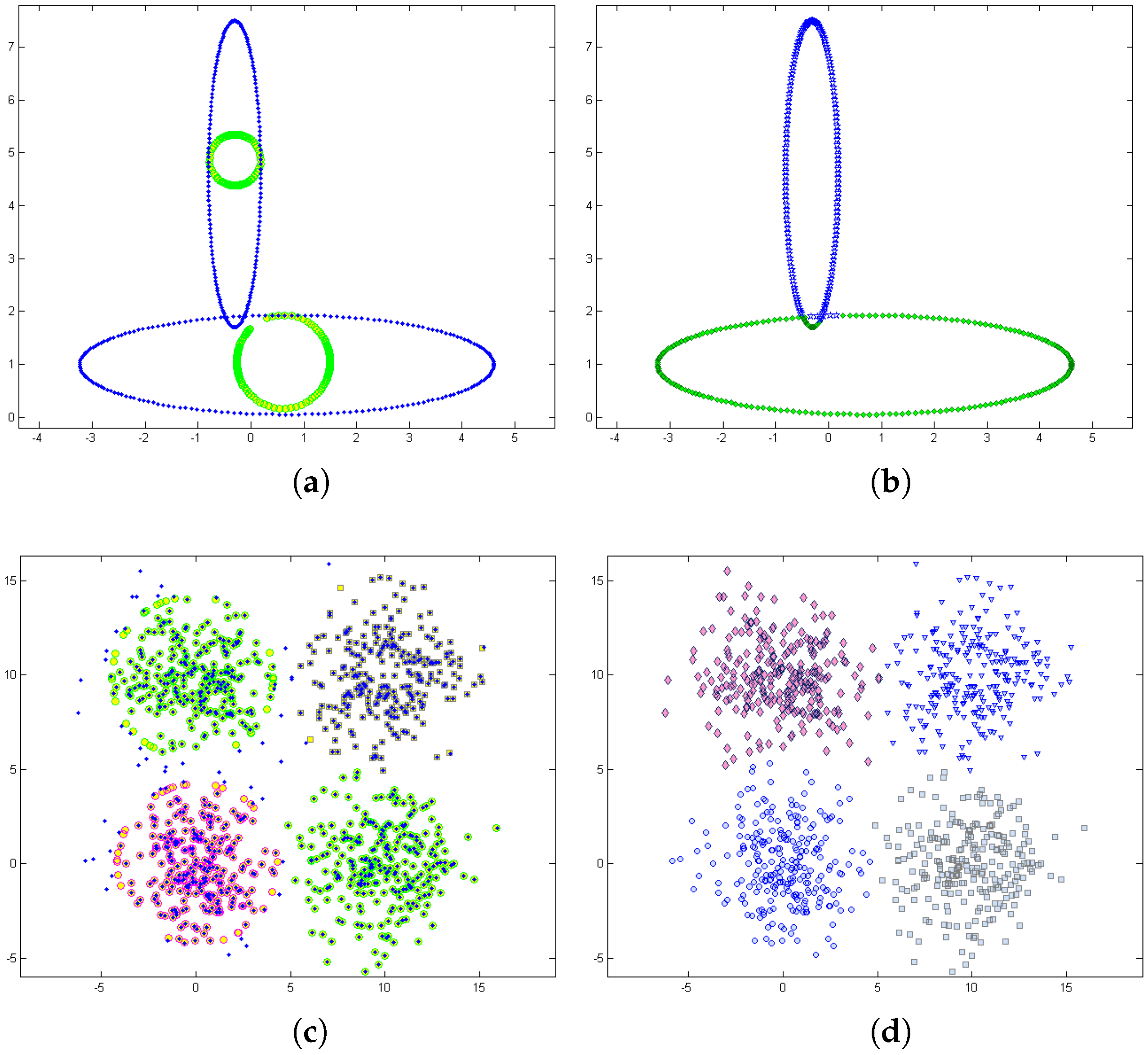
| Ellip_2_2 | 400 | 2 | 2 |
| Square1 | 1000 | 2 | 4 |
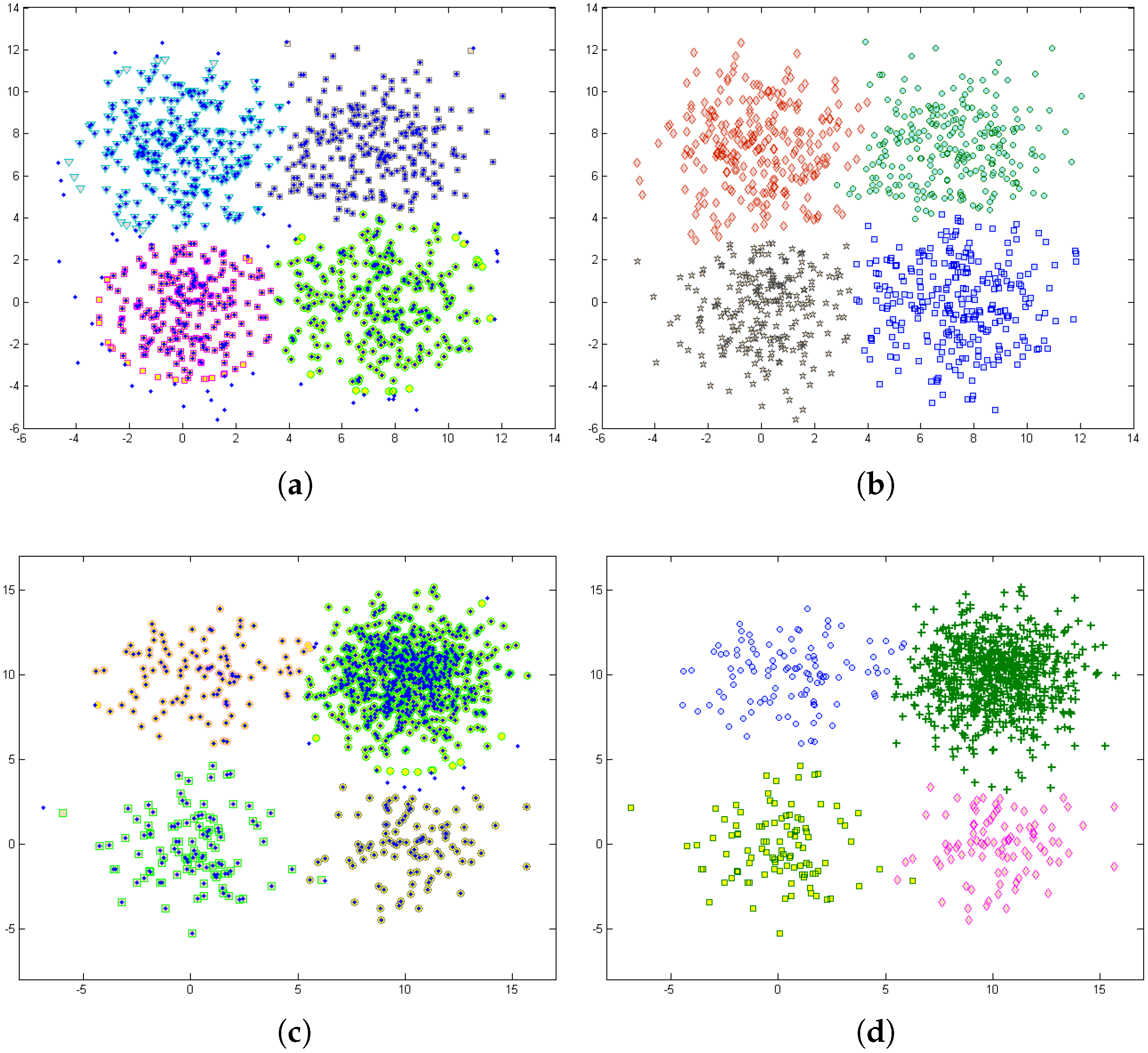
| Square4 | 1000 | 2 | 4 |
| Sizes5 | 1000 | 2 | 4 |
| Iris | 150 | 3 | 3 |
| Cancer | 683 | 9 | 2 |
| Newthyroid | 215 | 5 | 3 |
| Lungcancer | 32 | 56 | 3 |
| Wine | 178 | 13 | 3 |
| LiverDisorder | 345 | 6 | 2 |
| Datasets | AC | MOCK | VGAPS | GCUK | KMC | SSymPESAII | SSymAMOSA | SAELLC |
|---|---|---|---|---|---|---|---|---|
| Data_5_2 | 5 | 6 | 5 | 5 | 5 | 5 | 5 | 4 |
| Data_10_2 | 10 | 6 | 7 | 10 | 10 | 13 | 10 | 10 |
| Mixed_3_2 | 3 | 2 | 3 | 6 | 2 | 6 | 3 | 3 |
| Sym_3_2 | 3 | 2 | 2 | 7 | 3 | 3 | 3 | 3 |
| Ellip_2_2 | 2 | 4 | 2 | 3 | 3 | 7 | 2 | 2 |
| Square1 | 4 | 4 | 4 | 5 | 4 | 9 | 4 | 4 |
| Square4 | 4 | 4 | 5 | 4 | 4 | 7 | 4 | 4 |
| Sizes5 | 4 | 2 | 5 | 2 | 4 | 6 | 4 | 4 |
| Iris | 3 | 2 | 3 | 3 | 2 | 3 | 3 | 3 |
| Cancer | 2 | 2 | 2 | 2 | 2 | 2 | 2 | 2 |
| Newthyroid | 3 | 2 | 3 | 7 | 2 | 3 | 2 | 3 |
| Lungcancer | 3 | 7 | 2 | 2 | 2 | 3 | 5 | 3 |
| Wine | 3 | 3 | 6 | 9 | 3 | 3 | 6 | 3 |
| LiverDisorder | 2 | 3 | 2 | 3 | 2 | 2 | 2 | 2 |
| Datasets | MOCK | VGAPS | GCUK | SSymPESAII | SSymAMOSA | SAELLC |
|---|---|---|---|---|---|---|
| Data_5_2 | 0.55 | 0.25 | 0.18 | 0.35 | 0.25 | 0.00 |
| Data_10_2 | 1.01 | 0.84 | 0.15 | 0.57 | 0.13 | 0.11 |
| Mixed_3_2 | 0.82 | 0.22 | 0.80 | 0.72 | 0.22 | 0.15 |
| Sym_3_2 | 0.69 | 0.12 | 0.81 | 0.51 | 0.12 | 0.15 |
| Ellip_2_2 | 0.74 | 0.00 | 0.86 | 0.72 | 0.00 | 0.00 |
| Square1 | 0.19 | 0.19 | 0.31 | 0.81 | 0.19 | 0.14 |
| Square4 | 0.60 | 0.52 | 0.51 | 0.73 | 0.49 | 0.35 |
| Sizes5 | 0.64 | 0.22 | 0.48 | 0.66 | 0.25 | 0.12 |
| Iris | 0.82 | 0.62 | 0.58 | 0.55 | 0.54 | 0.40 |
| Cancer | 0.40 | 0.37 | 0.38 | 0.39 | 0.37 | 0.32 |
| Newthyroid | 0.82 | 0.58 | 0.81 | 0.74 | 0.75 | 0.52 |
| Lungcancer | 0.96 | 0.97 | 0.84 | 0.60 | 0.69 | 0.59 |
| Wine | 0.90 | 0.97 | 0.96 | 0.89 | 0.92 | 0.83 |
| LiverDisorder | 0.98 | 0.98 | 0.99 | 0.96 | 0.96 | 0.95 |
| Dataset/Algorithm | Mixed_3_2 | Ellip_2_2 | Square1 | Square4 | Sizes5 |
|---|---|---|---|---|---|
| EM | 0.08 | 0.87 | 0.25 | 0.51 | 0.16 |
| SAELLC | 0.15 | 0.00 | 0.14 | 0.35 | 0.12 |
Disclaimer/Publisher’s Note: The statements, opinions and data contained in all publications are solely those of the individual author(s) and contributor(s) and not of MDPI and/or the editor(s). MDPI and/or the editor(s) disclaim responsibility for any injury to people or property resulting from any ideas, methods, instructions or products referred to in the content. |
© 2024 by the authors. Licensee MDPI, Basel, Switzerland. This article is an open access article distributed under the terms and conditions of the Creative Commons Attribution (CC BY) license (https://creativecommons.org/licenses/by/4.0/).
Share and Cite
Abdel-Hakim, A.E.; Ibrahim, A.-M.M.; Bouazza, K.E.; Deabes, W.; Hedar, A.-R. Ellipsoidal K-Means: An Automatic Clustering Approach for Non-Uniform Data Distributions. Algorithms 2024, 17, 551. https://doi.org/10.3390/a17120551
Abdel-Hakim AE, Ibrahim A-MM, Bouazza KE, Deabes W, Hedar A-R. Ellipsoidal K-Means: An Automatic Clustering Approach for Non-Uniform Data Distributions. Algorithms. 2024; 17(12):551. https://doi.org/10.3390/a17120551
Chicago/Turabian StyleAbdel-Hakim, Alaa E., Abdel-Monem M. Ibrahim, Kheir Eddine Bouazza, Wael Deabes, and Abdel-Rahman Hedar. 2024. "Ellipsoidal K-Means: An Automatic Clustering Approach for Non-Uniform Data Distributions" Algorithms 17, no. 12: 551. https://doi.org/10.3390/a17120551
APA StyleAbdel-Hakim, A. E., Ibrahim, A.-M. M., Bouazza, K. E., Deabes, W., & Hedar, A.-R. (2024). Ellipsoidal K-Means: An Automatic Clustering Approach for Non-Uniform Data Distributions. Algorithms, 17(12), 551. https://doi.org/10.3390/a17120551