1. Introduction
Runge–Kutta methods (RKMs) have been used in many works for solving the Cauchy problem for ordinary differential equations (ODEs). Many computational schemes for the solution of problems with partial differential equations (PDEs) are based on the method of lines (MOL), based on an approach wherein spatial derivatives are discretized in order to transform PDEs into a semi-discrete system of ODEs. For practical computations, the time step size should be taken as large as possible to yield good computational performance since the cost of solving up to a fixed time is proportional to the number of time steps. For many problems that arise in electrodynamics and fluid mechanics, the number of ODEs can easily reach
or higher [
1], so explicit methods are preferable. But explicit schemes are conditionally stable, and the used time step is limited.
The problem of obtaining optimal stability polynomials for the explicit methods has been studied by many authors [
2,
3]. The widely used approach to optimization has two stages. At first, a stability polynomial of fixed degree is constructed. In many works, this is realized in such a way that stability domain or stability interval should be as large as possible. In most papers, this approach is based on the use of Chebyshev polynomials [
4]. At the second stage, an explicit method corresponding to the obtained polynomial is constructed. Usually, such methods have a low order, and additional stages are exploited to increase the stability region. Lebedev-type methods [
5] are based on optimal-stability polynomials, but an appropriate ordering of zeros is needed for ensuring stability properties. In [
6], an approach based on a linear combination of shifted Chebyshev polynomials is proposed. It is based on the use of a three-term recurrence relation. But the stability region on the negative real axis is only about 80% of the optimal interval. In [
7], the combined approach, based on the use of orthogonal polynomials of second order, is proposed. Bogatyrev, in [
8], proposed an analytical approach to the construction of an optimal-stability polynomial. In [
9], the problem of stability polynomial construction is expressed in terms of the general least-deviation feasibility problem. Its solution is obtained by an algorithm based on convex optimization techniques. Sommeijer and Verwer, in [
10], proposed a special two-step form of RKM for application to PDEs. Their method simplifies the choice of temporal step sizes, satisfying the von Neumann stability criterion by embedding a thin and very long rectangle inside the stability region. Torrilhon and Jeltsch, in [
11], considered the method for ODEs with Jacobian matrix spectra in the shape of thin regions, placed along the real axis, but also embedded into the whole complex plane. In [
12], a procedure for the construction of algorithms of explicit Runge–Kutta–Chebyshev (RKC) methods for stiff problems is proposed, and second-order methods with up to 320 stages are derived. In [
13], approaches to the construction of stabilized explicit methods of higher orders are considered. In [
14], extrapolated stabilized methods based on Chebyshev polynomials are proposed. Croci and de Souza [
15] proposed mixed-precision methods, based on RKC schemes. Three mixed-precision schemes (a first- and a second-order RKC method and a first-order multirate RKC scheme) are constructed. These schemes perform only the few function evaluations needed for accuracy (1 or 2 for first- and second-order methods, respectively) in high precision, while the rest are performed in low precision.
Original approaches to optimization without the application of Chebyshev polynomials are described in [
1,
16,
17,
18,
19,
20]. Niegemann et al. [
1] proposed a general approach to obtain low-storage RKMs with enlarged and tailored stability domains. The construction of stability polynomials is based on the fixation of the desired shape of the stability regionwith the spectra of ODEs derived by MOL from an original PDE. After that, the coefficients of the method are obtained. Fourth-order methods with 12–14 stages are constructed and applied to the solution of Maxwell equations. Mead and Renaut, in [
16], proposed an optimal method with respect to large stability intervals on the imaginary axis (unlike the previously mentioned approaches, where the interval on the real negative axis is maximized). It must be noted that, in the proposed approach, the parameters of the method are used for optimization. The coefficients of stability polynomials depend on these parameters. According to this approach, optimal parameters are obtained through the construction of optimal polynomials, and their values can be substituted into the computational scheme of the method. As such, in this approach, we do not need to perform the construction of method. In [
17,
18,
19,
20], the so-called paired RKMs are constructed. The stability polynomials of such RKMs depend on the free parameters, which are chosen in order to perform computations with the largest time step and appropriate stability properties. These methods have many parameters, which are equal to zero, so they are considered quite effective from a computational point of view. Authors present many examples of the applications of such methods in computational fluid dynamics. The approach to the construction of optimal stability polynomials for the explicit method, oriented toward the application to problems for hyperbolic equations and systems, is proposed in [
21]. In [
22], the authors proposed an original approach to stabilziation, based on the use of the Lyapunov function for a system of solved ODEs. In [
23], the authors proposed a technique to stabilize standard explicit RKMs by associating them with W-methods, used for the solution of stiff problems. As has been demonstrated, for any given explicit four-stage fourth-order RKM, two uniparametric families of third-order W-methods can be obtained. The free parameter can be used to increase the stability properties of the W-methods. Methods, based on the application of time-accurate and highly stable explicit operators, are proposed in [
24,
25,
26]. The methods are developed for application to stiff problems and proposed operators act as preconditioners on the stiff terms and can be deployed to any existing explicit time-marching methods straightforwardly.
In the last decades, RKMs with higher-order derivatives have been considered in many works. The higher derivative terms in RKMs give more freedom and provide the possibility to construct methods with higher orders. These derivatives are used for the evaluation of a number of terms in the Taylor expansion for local error [
27]. An advantage of these methods over classical RKMs is that they can reach a higher order with fewer function evaluations. Although the computations of higher-order derivative terms put some restrictions on these methods, the advantage gained may still be beneficial [
28]. The review of multi-derivative methods is presented in [
29]. Gekeler and Widmann in [
30] construct explicit and semi-implicit methods up to orders 7 and 6, respectively. Goeken and Johnson in [
31] proposed methods with the computation of derivatives in the internal stages of the method. Extended RKMs with the use of derivatives at external stages are proposed in [
32]. Chan et al. [
33] proposed two-derivative RKMs (TDRKMs), where the second derivative is incorporated in both internal and external stages. Fang et al. [
34] used the trigonometrical fitting to TDRKMs for solving oscillatory ODEs. In [
35], TDRKMs are extended for the solution of the Schrodinger equation. Lee et al. [
36] proposed the exponentially fitted TDRKM of Nystrom type. Kalogiratou and Monovasilis [
37] constructed sixth-order TDRKMs. In [
38,
39], the authors presented optimized TDRKMs for the simulation of oscillating and wave processes. Strong-stability TDRKMs for application to the numerical solutions of PDEs are proposed in [
40]. Singh et al. [
41] proposed implicit–explicit TDRKMs for the solution of stiff reaction–diffusion PDEs. In [
42], the new approach to the discretization of PDEs, based on TDRKMs, is presented. This approach differs from the classical MOL, where the PDE is first discretized in space and then an ODE solver is applied to solve the semi-discretized system. Turaci and Ozis, in [
28], derived three-derivative RKMs (ThRKMs). In [
43], stability-preserving ThRKMs are proposed.
The presented study is devoted to the optimization of explicit RKMs with higher-order derivatives. The applied method is based on an idea described in [
16] and is realized by the numerical maximization of the integral characteristics of the stability domains, such as the area and length of the stability interval. These characteristics are considered as functions of the free parameters. The optimal values of parameters are computed for RKMs with higher-order derivatives presented in [
28,
31,
33]. The cases of fourth, fifth, and sixth order methods are considered. Obtained values are used in numerical examples, which deal with the construction of the high-order schemes applied in MOLs. The problems for linear and nonlinear PDEs are considered. In most cases, it is demonstrated that stability intervals on the Courant–Friedrichs–Lewy (CFL) numbers for optimal schemes have a larger length than for schemes based on parameter values from [
16,
28,
31,
33].
The paper has the following structure. In
Section 2, explicit RKMs with higher-order derivatives, proposed in [
28,
31,
33], are described. Expressions for the stability polynomials are presented in
Section 3. In
Section 4, the numerical optimization of the considered methods is realized. The results of the solution are discussed, and the obtained stability domains are compared with the domains for methods presented in previous works. In
Section 5, numerical examples are presented. Some concluding remarks are made in
Section 6.
4. Maximization of the Integral Characteristics of RKMs with Higher-Order Derivatives
As can be seen, the stability polynomials in (
7)–(
11) have terms that are dependent on the input parameters. Thus, the stability polynomials are represented as
, where
is a vector of input parameters. According to this dependency, the geometric form of the stability domain
is dependent on the values of
. We may characterize this domain by two integral characteristics: by its area
and by the length of the stability interval
, which is defined as the length of the stability domain on the real negative axis:
The following computational method for stability optimization can be proposed. Let us know the domain where the values of are defined: . For the simplification of the computations, let us propose that Q is a rectangle in : , where boundary values and are considered as known. It must be noted that these values can be obtained by a computational analysis of the domain by varying or by a theoretical analysis of terms in the expression for , which are dependent on . The first approach leads to the procedure of the localization of parameter values in some intervals, and the second one, for example, can provide the possibility to exclude the large values of some parameters if they are presented in denominators.
Let be the optimal value of , which is obtained as a solution of the following optimization problem: , and is obtained by the maximization of : . Optimal parameters, obtained after the maximization of S, can be used in situations when the Jacobian matrix has a full complex spectrum. Parameters that maximize can be used when a matrix has a real spectrum or when the imaginary parts of eigenvalues are situated close to the real negative axis.
According to the unknown analytical dependencies of
S and
on
, the proposed approach can only be realized computationally because the integrals in Formula (
15) can only be computed numerically. For this computation, the rectangular quadrature is used.
The maximization problem is solved by the semi-heuristic approach, based on two stages. According to the absence of exact expressions for derivatives, we should use only methods that are based on the values of the objective functions and do not use their derivatives. We realize the solution of the maximization problems by two steps. First, we use a random search in
Q for the calculation of the approximate initial values of optimal parameters. In computation, we use
uniformly distributed random points. The generation of random numbers is performed by the function
rand() in Matlab (version R2021a). At the second stage, we apply the direction set method [
44], based on the transition to the solution of 1D problems along every coordinate direction. These problems are solved with the golden section search [
44], with accuracy equal to
.
It should be noted that the stated maximization problems can have multiple solutions. In the present study, we do not investigate the uniqueness of the solution and sensitivity to parameter variations. Numerical solutions presented in this paper can be considered as possible optimal solutions.
4.1. Optimal Parameters of RKMs with Higher-Order Derivatives
For all methods, values of S and are obtained for the case when , where . The computations of integrals are performed on a grid with nodes, constructed in .
4.1.1. Optimized Stability Polynomials for GJRKMs at
For the optimization of GJRKM at
, the value of
should be obtained. After the computational experiments, this parameter is localized on the interval
. The optimal value corresponds to the maximal value of
S being equal to
; the value obtained after the maximization of
is equal to
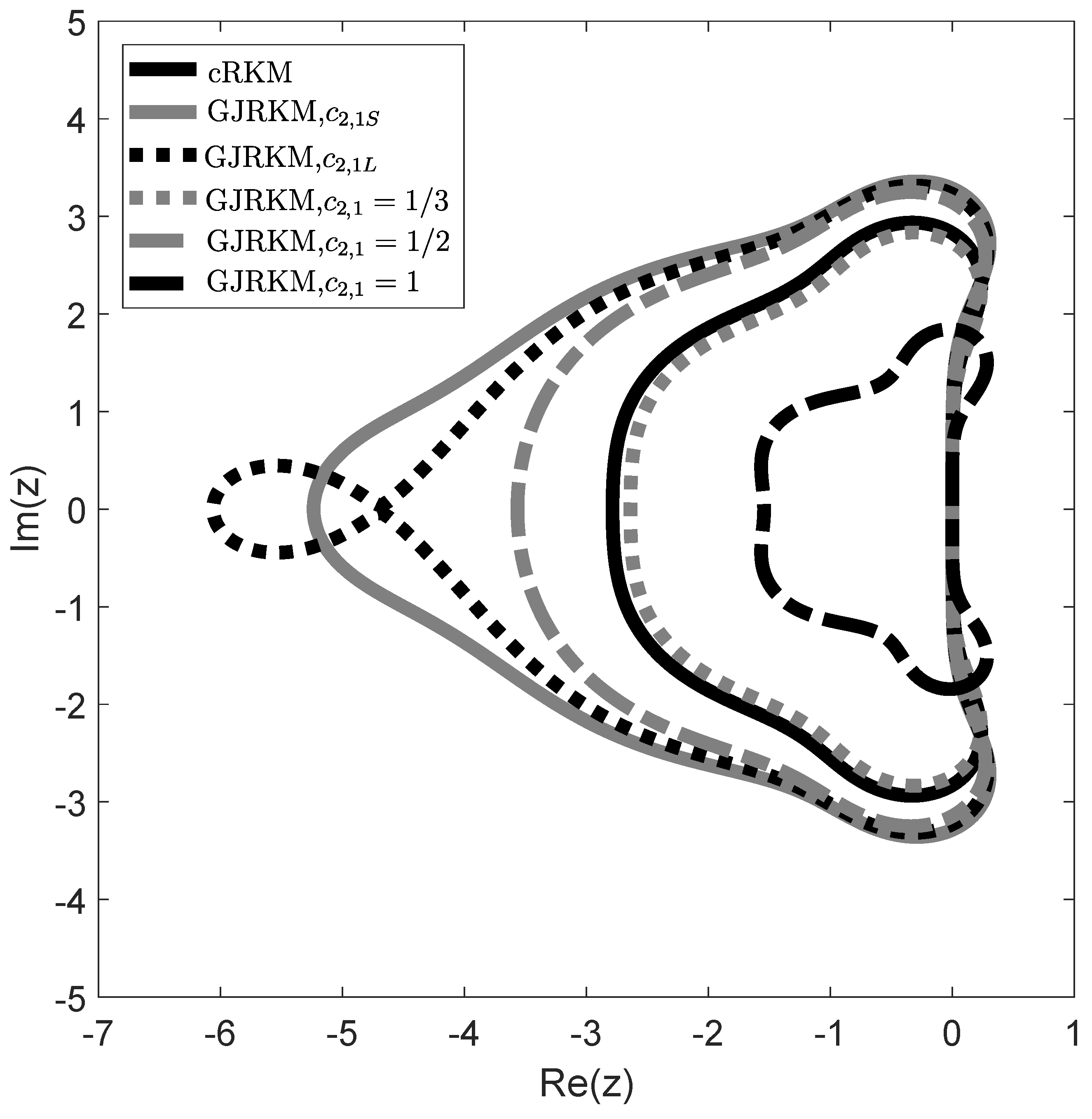
. In
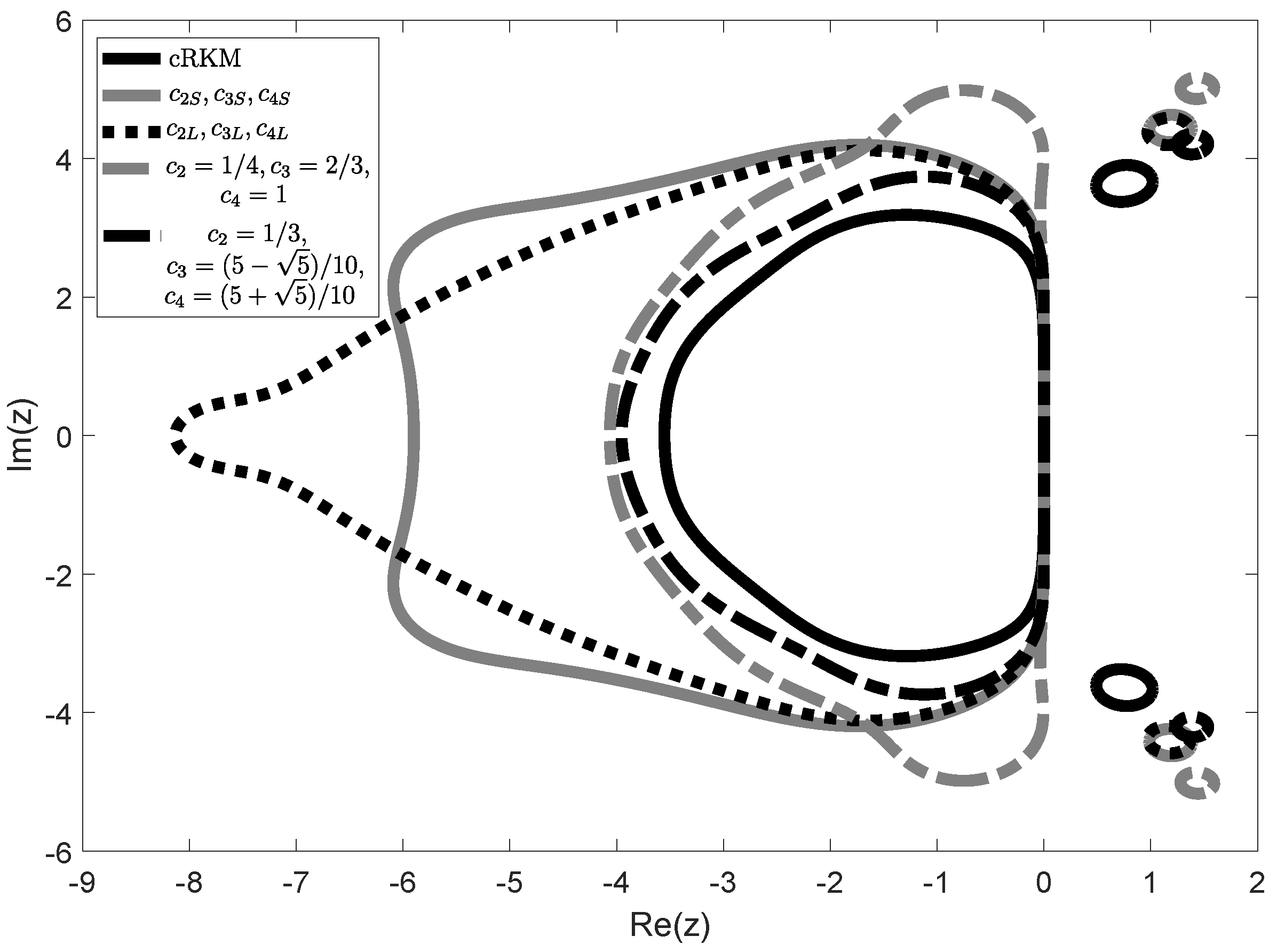
Figure 1, the boundaries of the stability domains of fourth-order GJRKMs at
are presented. In
Table 1, the values of
S and
are presented. The notation cRKM corresponds to the classical RKM, based on traditional formulas.
4.1.2. Optimized Stability Polynomials for TDRKMs
In the case of , the admissible interval of values of is obtained after computational experiments as . The area of the stability domain is maximized at and is maximized at .
In
Table 2, the values of
S and
are presented. In
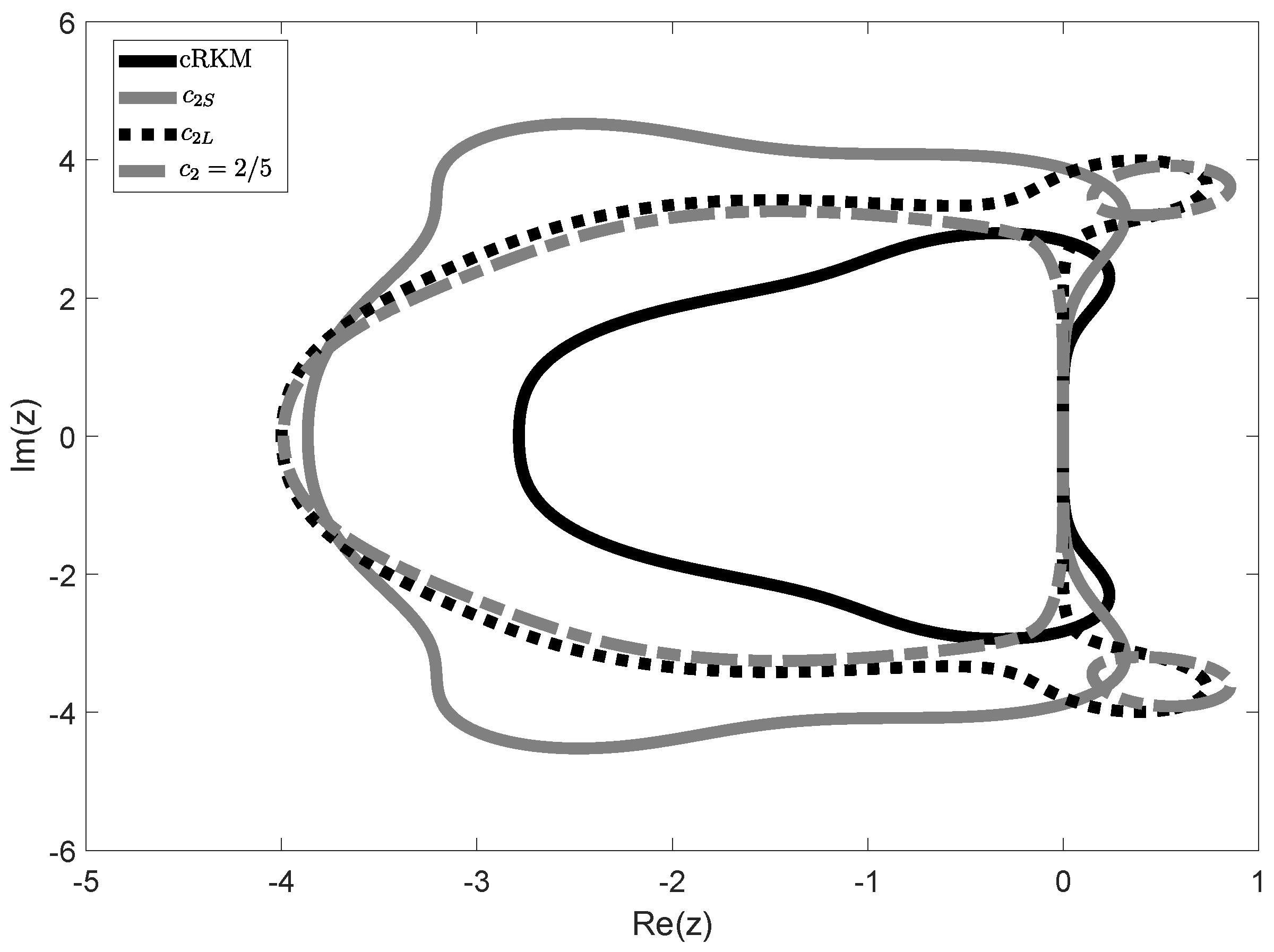
Figure 2, the boundaries of stability domains are presented. It should be noted that, in the case of
, the stability polynomials for classical fifth-order RKM and TDRKM are the same, so only the case of TDRKM is presented.
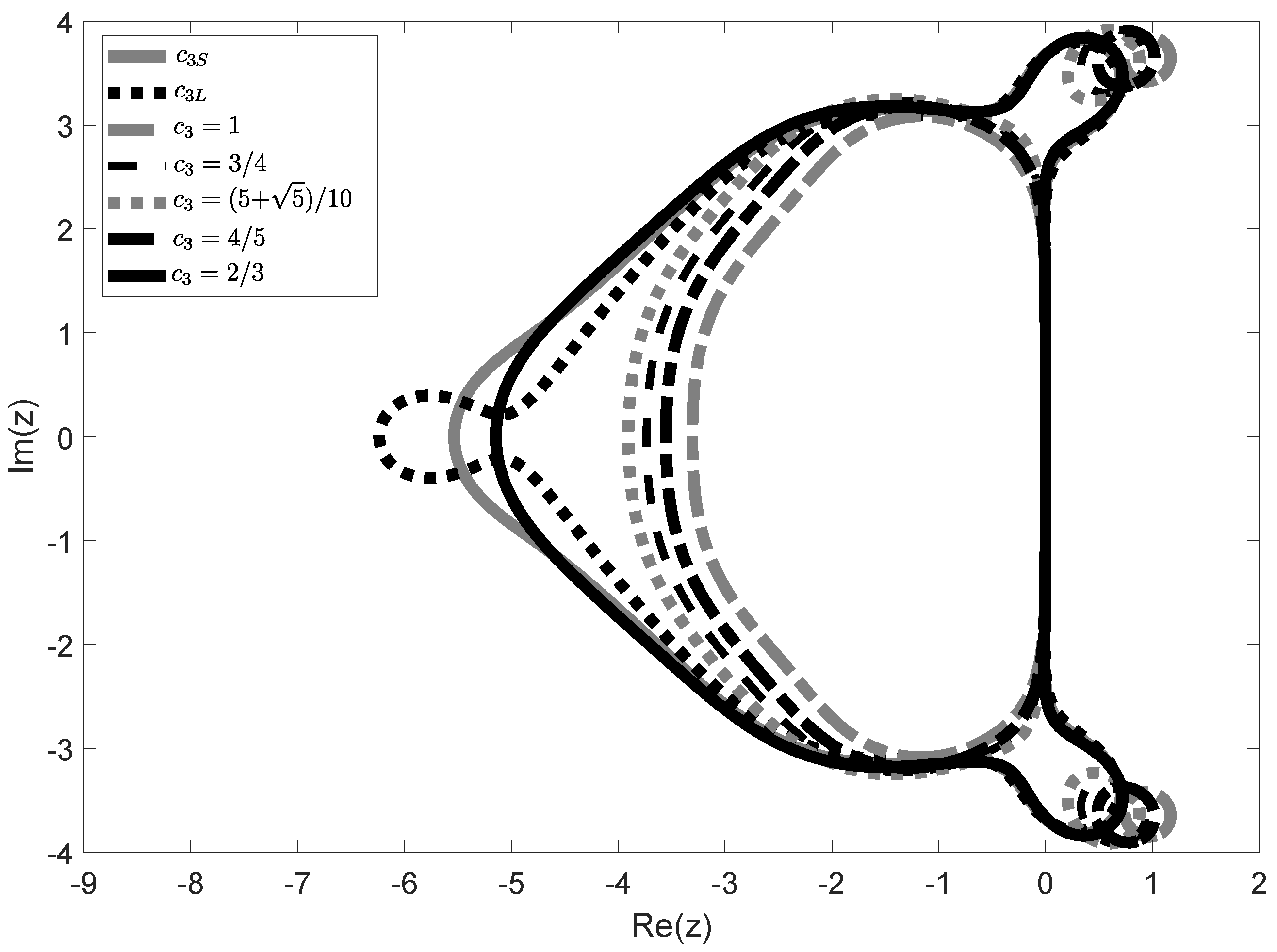
In the case of
values of
,
and
are localized in interval
. For maximization of area the following parameters are obtained:
,
,
. Function
is maximized at
,
,
. In
Table 3, values of
S and
are presented. We do not separately present cases of
,
,
and
,
,
obtained in [
33], because their stability polynomials are represented by (
14) and integral characteristics
S and
are the same as in the case of classical sixth-order RKM. In
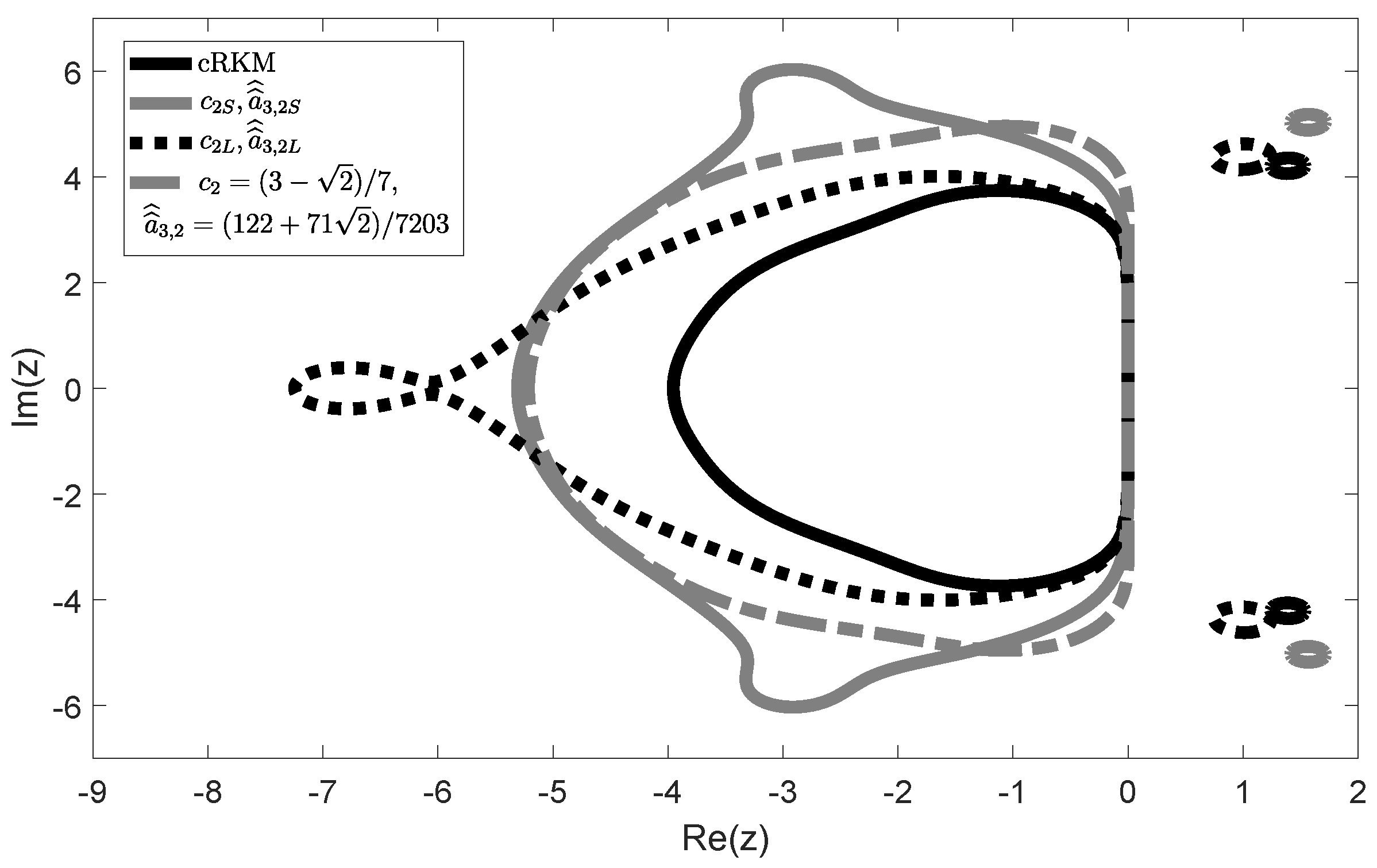
Figure 3 boundaries of stability domains are presented.
4.1.3. Optimized Stability Polynomials for ThDRKMs
In the case of ThDRKM, presented in [
28] for
, the values of
are localized on the interval
. The area of the stability domain
S is maximized at
, and length
is maximized at
. In
Table 4, the values of these characteristics are presented with comparison with values for the classical fourth-order RKM and values for the case of
, presented in [
28]. In
Figure 4, the boundaries of stability domains are presented.
For
, the values of
and
are localized on the interval
. The area is maximized at
,
. The length has its maximal value at
and
. In
Table 5, their values are presented for comparison with the case of
and
, presented in [
28]. In
Figure 5, the boundaries of stability domains are presented.
4.1.4. Comparison of Fourth-Order Methods
As mentioned above, in [
16], the original idea on the optimization of RKMs based on the maximization of integral characteristics is proposed. In [
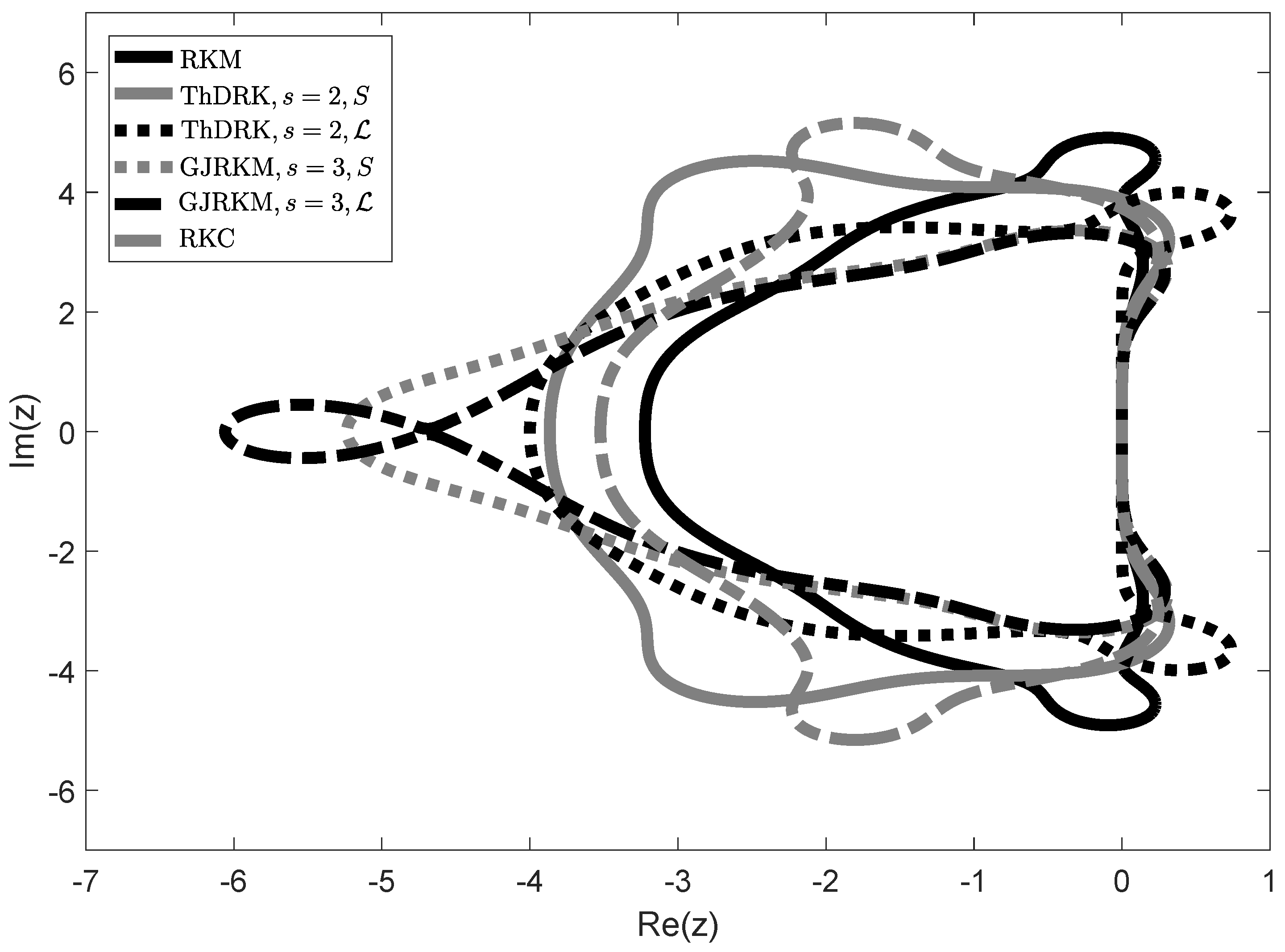
16], two fourth-order methods are constructed—RKM, based on the maximization of length on the imaginary axis, and so-called RKC, based on the simultaneous optimization of area and length on the imaginary axis.
In the present study, we try to compare the Mead and Renaut methods with the optimized methods considered above. The integral characteristics for RKM are equal to 21.6352 and 3.2062. In the case of RKC, they are equal to 26.5619 and 3.6543. As can be seen from
Table 1 and
Table 4, only for the case of ThDRKM is the value of
S larger than the same value for RKC, while the values of
for all considered methods are larger. In
Figure 6, boundaries of the stability domains are presented.
6. Conclusions
In the present study, the stability optimization of RKMs with higher-order derivatives is realized. The approach for optimization is based on the structure of the stability polynomials of methods—their coefficients depend on free parameters. Thus, the geometry of the stability domain can be modified by variations of the parameter values. This idea is close to the approach proposed in [
16]. The numerical optimization is realized by the maximization of the area of the stability domain and the length of the stability interval.
For the discussion, the following notions can be made:
1. The optimization of methods proposed in [
28,
31,
33] is realized. Optimal values of parameters are computed for methods of fourth, fifth, and sixth orders. Obtained values are used in numerical examples, based on the application of MOL to the solution of problems for linear and nonlinear PDEs. The results of computations demonstrate that, by taking into account the behavior of the spectrum of the Jacobian matrix, better stability properties are demonstrated for schemes based on RKMs with optimal parameters;
2. As can be seen from
Table 6,
Table 7,
Table 8 and
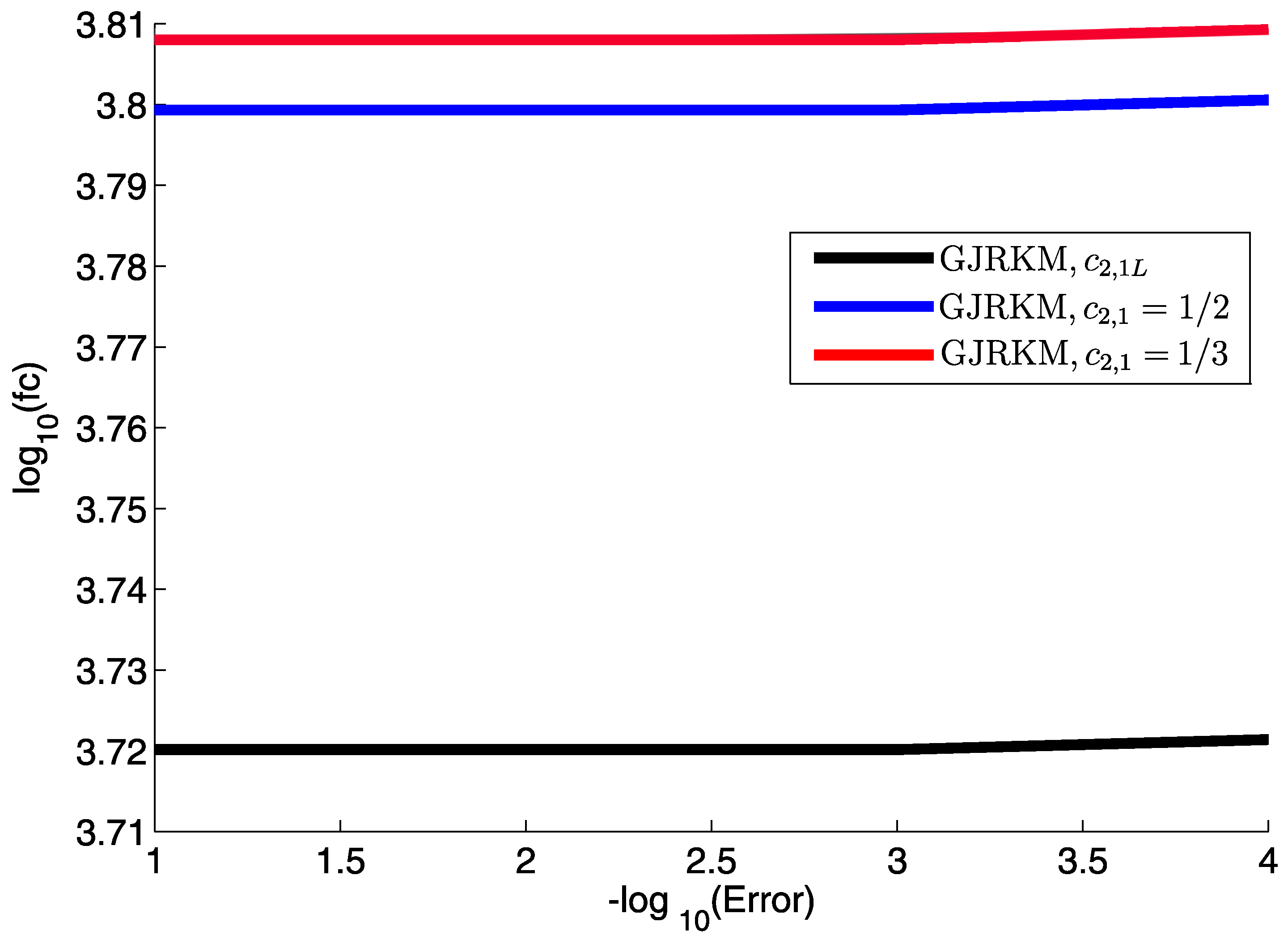
Table 9, the largest values of CFL number in the case of constant time step are observed for optimized methods. According to the expressions
and
for hyperbolic and parabolic CFL numbers, optimized methods provide the possibility to perform computations with a larger time step, but with the same accuracy order as the non-optimized methods. This leads to a decrease in the total number of time steps and, as a consequence, a decrease in computational time.
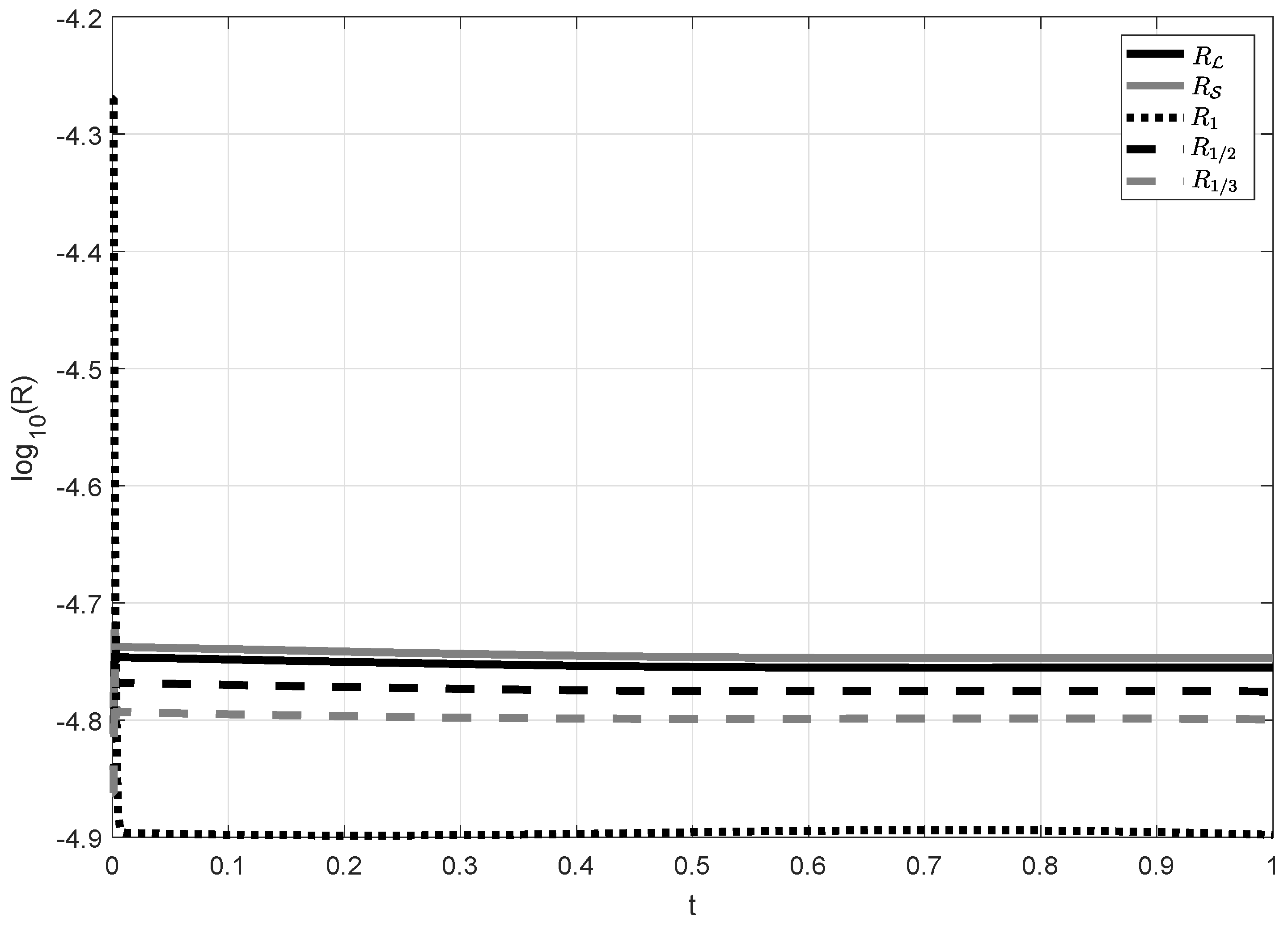
In the case of the variable time step, as can be seen from
Figure 10 and
Figure 13, the use of optimized methods leads to a decrease in the right part of evaluations and, as a consequence, to a decrease in computational time;
3. The obtained values of free parameters are independent of the approach to spatial discretization used in MOL. Moreover, they can be used for the construction of computational schemes based on the modified MOL, as proposed in [
42];
4. The limitation of the proposed approach relates to the fixed number of stages of the considered method and, as a consequence, to the bounded number of free parameters. For strongly stiff problems, the constructed methods are not applicable as explicit methods in comparison to the explicit stabilized RKC method, which has low order, but their stability intervals can be enlarged by an increase in stage number;
5. For the optimization, we consider two ’opposite’ cases: when stability domain is maximized on its area and its length on the real negative axis. In future studies, this problem can be stated as a multicriterial problem, or a problem of the optimization of composite functional, which is constructed as the convex combination
, where
(similar approaches are used in [
39,
48]). In the present paper, we try to estimate the perspectives of the optimization of high-order RKMs. Other optimization problems can be solved in future studies;
6. Another associated problem with the optimization of RKMs is the problem of the simultaneous optimization of stability and accuracy properties by free parameters. For hyperbolic PDEs, this problem is associated with the construction of low-dispersion and low-dissipation RKMs, where the stability and accuracy characteristics are simultaneously optimized. This problem is considered in many works (see [
39,
48,
49,
50,
51,
52]). The optimization of TDRKM in the case of
is realized in [
39], where it is demonstrated that the accuracy properties and performance of the optimized method are better than for other well-known methods. This approach to the optimization of other classes of RKMs with higher-order derivatives will be considered in future studies.