


Bus Network Adjustment Pre-Evaluation Based on Biometric Recognition and Travel Spatio-Temporal Deduction


Abstract
1. Introduction
2. Technical Roadmap
3. Bus Network Model
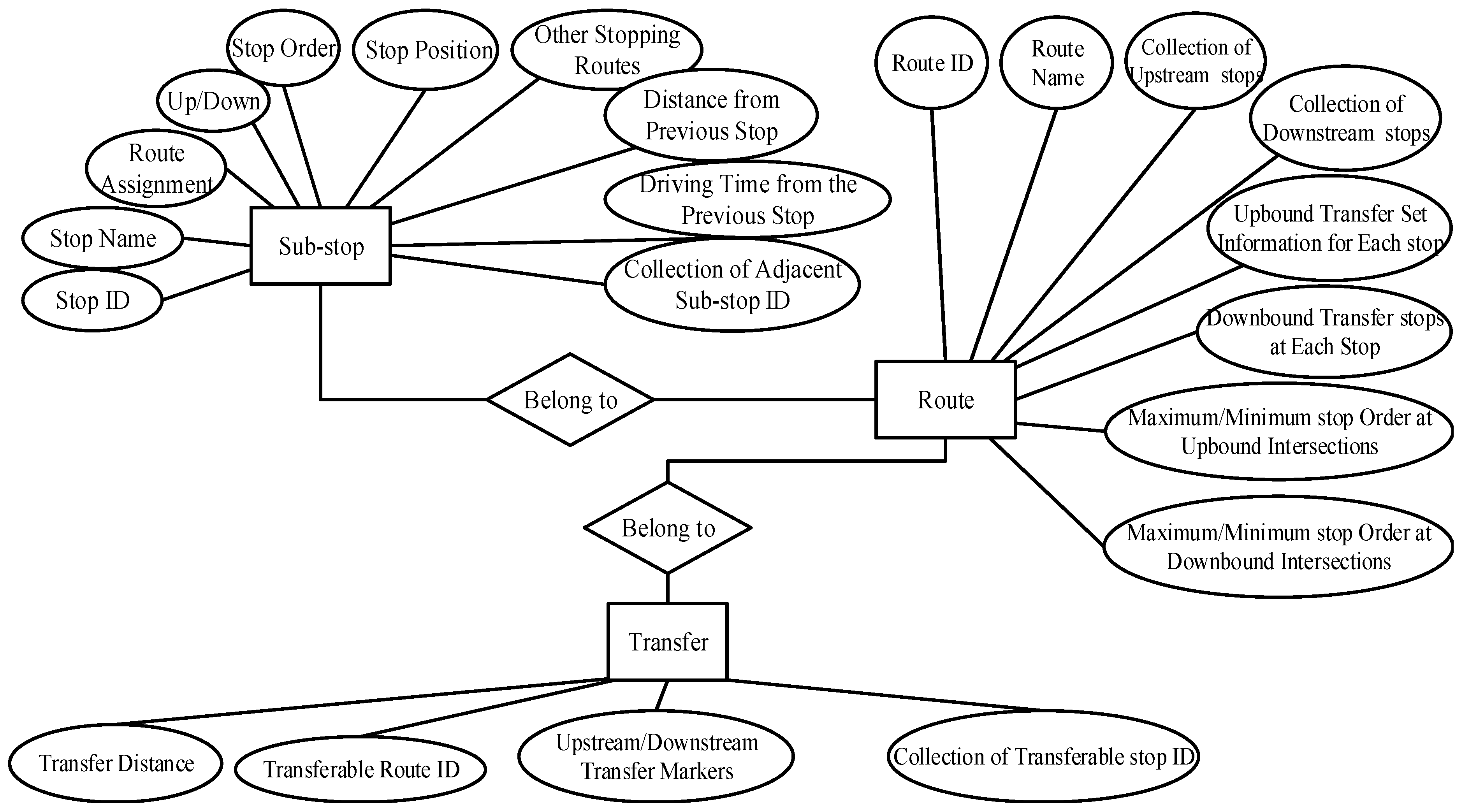
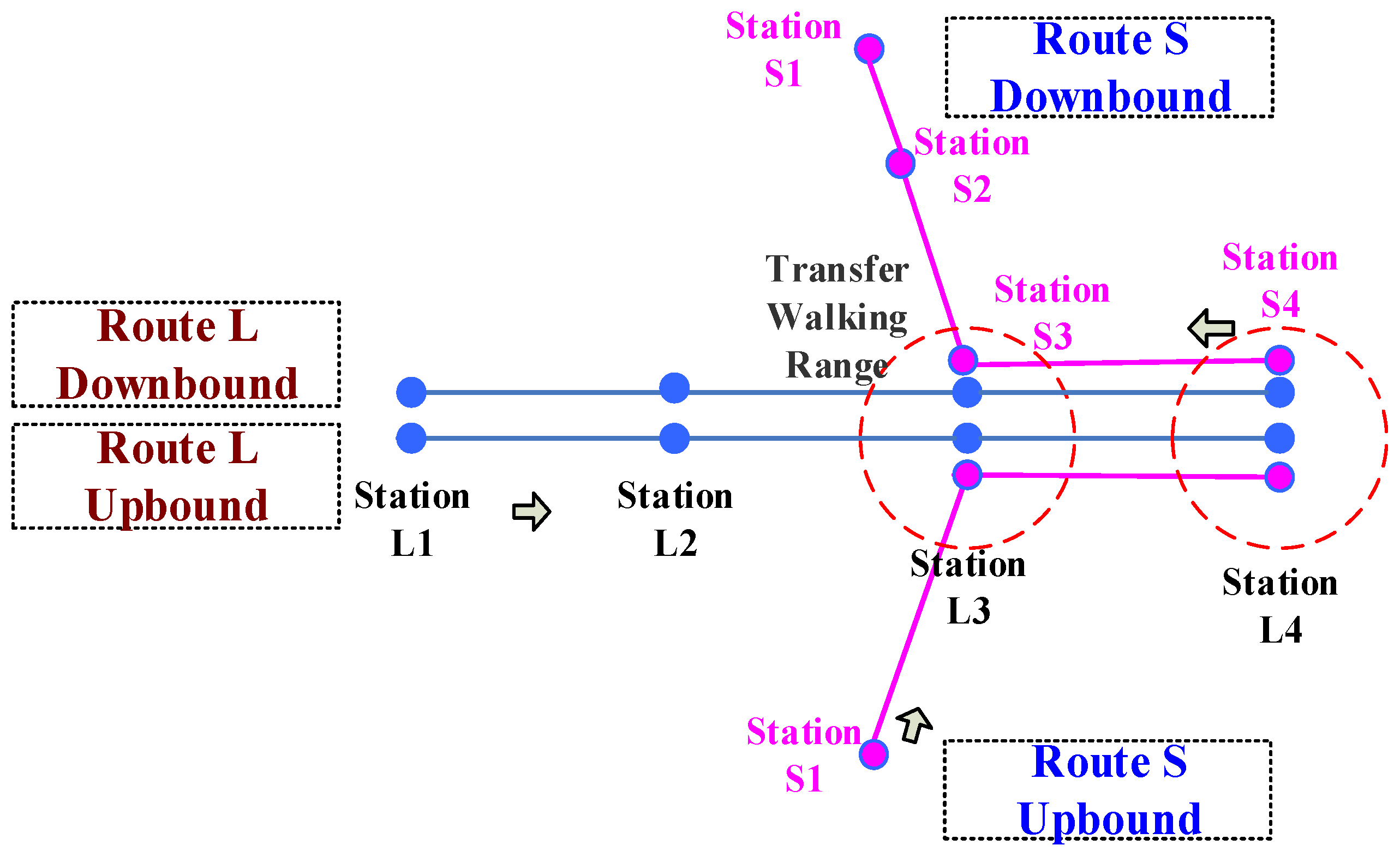
- The sub-stop model is the smallest unit in a bus network and is used to describe a single line and unidirectional stop. It is also the core model of the entire network model. Its elements include the line that the stop belongs to, the direction (up/down), name, ID, stop order, distance and travel time from the previous stop, latitude and longitude, adjacent sub-stop collection (which refers to the stops set that can be reached by walking), and stop class (which is divided into four classes: Class1, directly adjusted stops; Class2: walkable stops from direct stops; Class3: stops on the same line as direct stops; Class4: other associated stops). The sub-stop ID is unique, which means that different bus lines have different IDs when they pass through bus stops with the same physical properties.
- The route model is used to describe the information about stops upstream and downstream. Such information mainly includes the route name, route ID, collection of upstream and downstream stops, the collection of transfers of each stop (adjacent sub-stops), and the starting and ending overlap stop order between the current line and the adjusted line. The route model is used to calculate the association of the stops on the same lines.
- The transfer model focuses on transfer stop and route information, expressing the relationships between different lines. It records details about the upstream and downstream transfers, the starting and target transfer stops, riding distance before and after the transfer, walking distance during the transfer, and the transfer stop itself.
4. Pre-Evaluation Based on the Spatio-Temporal Model
4.1. Input Parameters
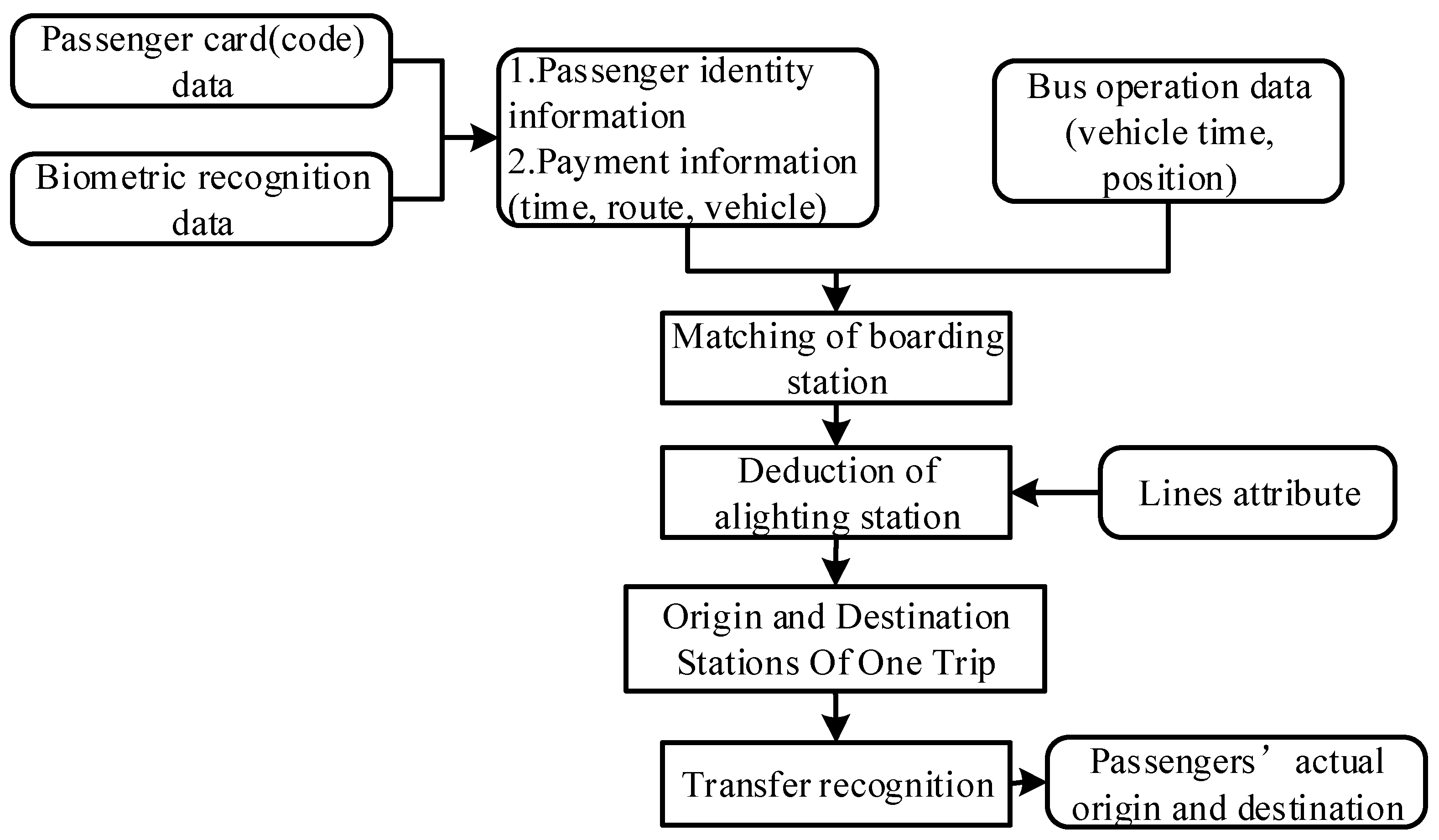
4.2. Passenger Travel Demand Analysis Based on Card (Code) Data and Biometric Recognition Data
4.3. Accessible Path Analysis Between Origin and Destination
4.3.1. Direct Path Analysis
4.3.2. Primary Transfer Path Analysis
4.4. Passenger Path Selection Model
4.4.1. Analysis of Influencing Factors
Analysis of Passengers’ Attributes
Analysis of Passenger Travel Habits
Analysis of the Impact on Travel Efficiency
Alternative Path Impact Analysis
4.4.2. Path Selection Function
Path Selection Function
Weight Determination
4.5. Passenger Path Comparison
5. Case Study Analysis
5.1. Calibration of Results
5.2. Pre-Evaluation Analysis
6. Conclusions
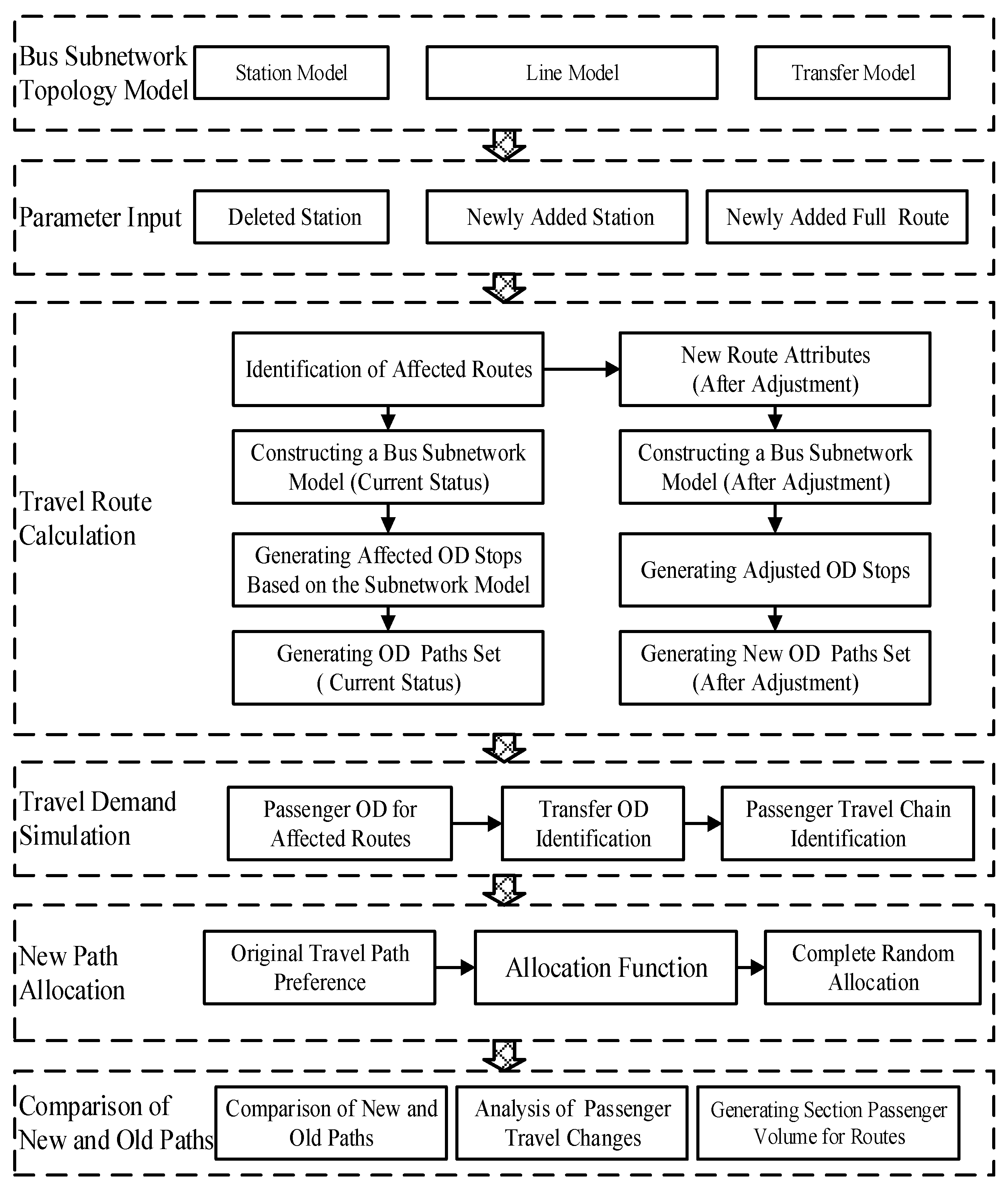
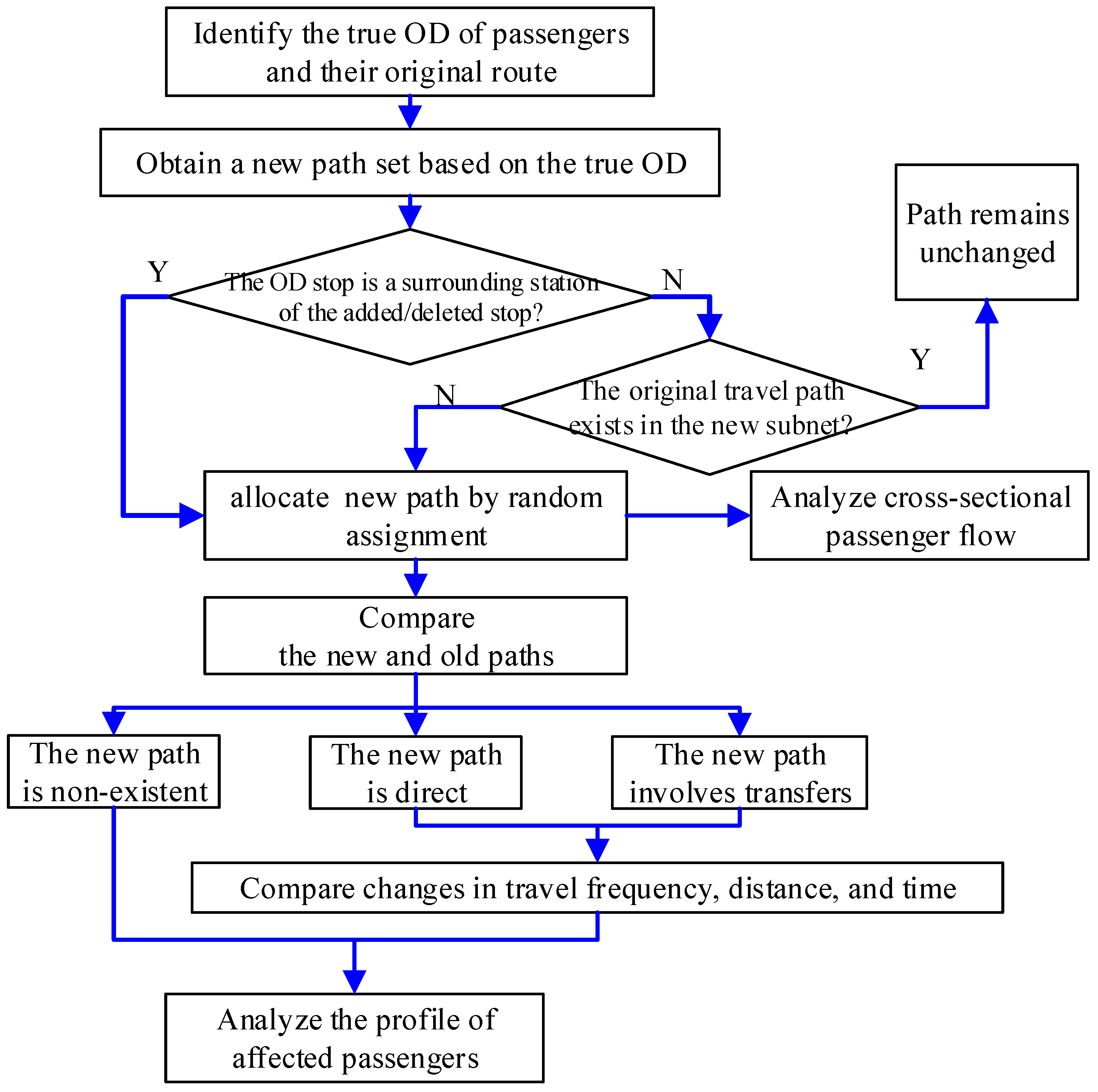
- The calculation of accessible paths is crucial for effective pre-evaluation. To enhance calculation efficiency, the core mission is to design a bus network model, recording information such as stops and bus lines accessible via walking or transferring. This involves controlling the calculative size through the affected bus sub-networks. Additionally, employing the ‘stop class’ method can significantly reduce unnecessary path calculations for unrelated OD pairs, thereby decreasing computational complexity.
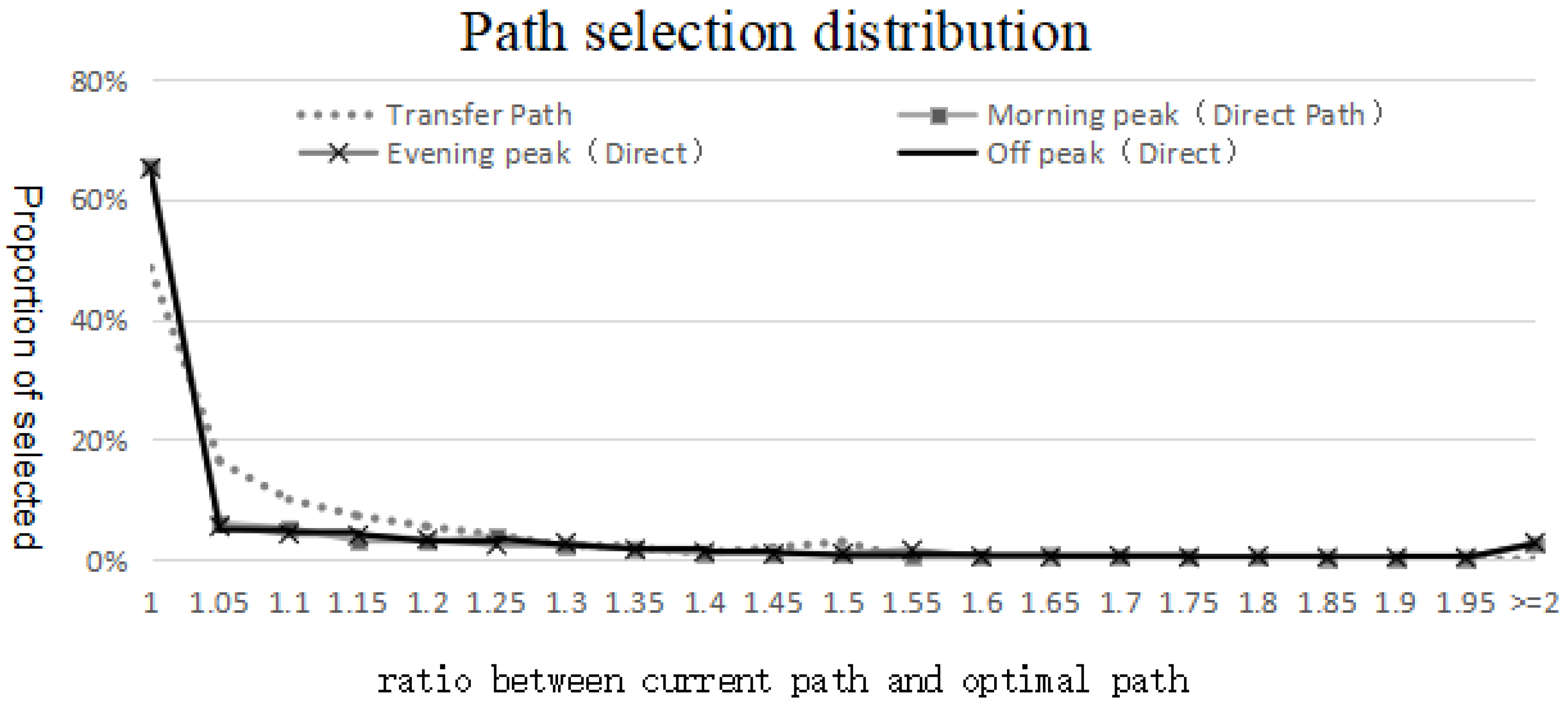
- Accurate bus passenger flow distribution is essential. In the case of multiple paths, passenger travel choices are not always completely rational. Although these choices generally conform to the principle of ‘the higher the path cost, the lower the probability of being selected’, a degree of randomness is also evident. The proportions of direct and optimal paths are 65% and 50%, respectively. The selection probability curves of different travel times—such as peak and weekday—are nearly the same.
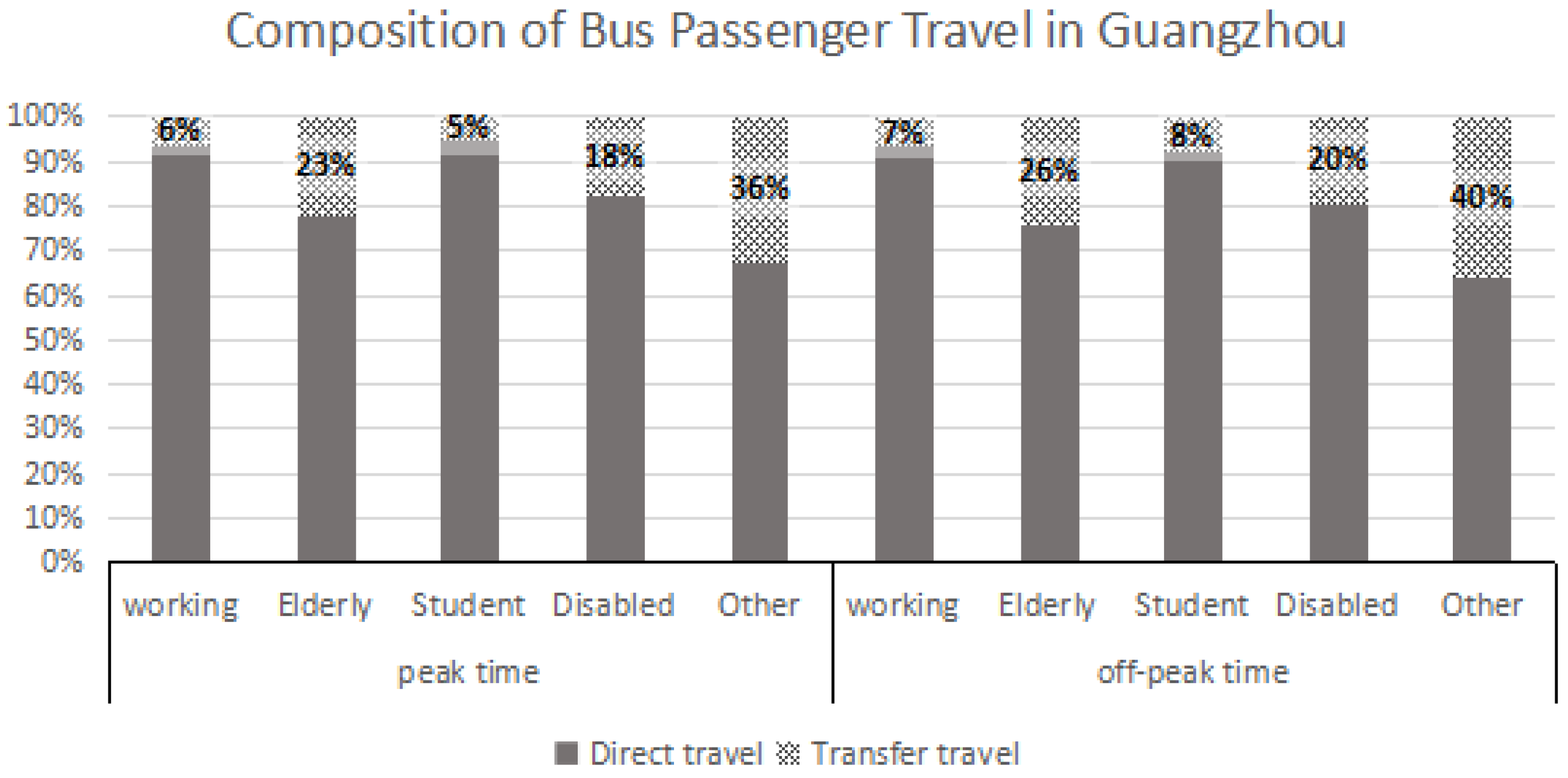
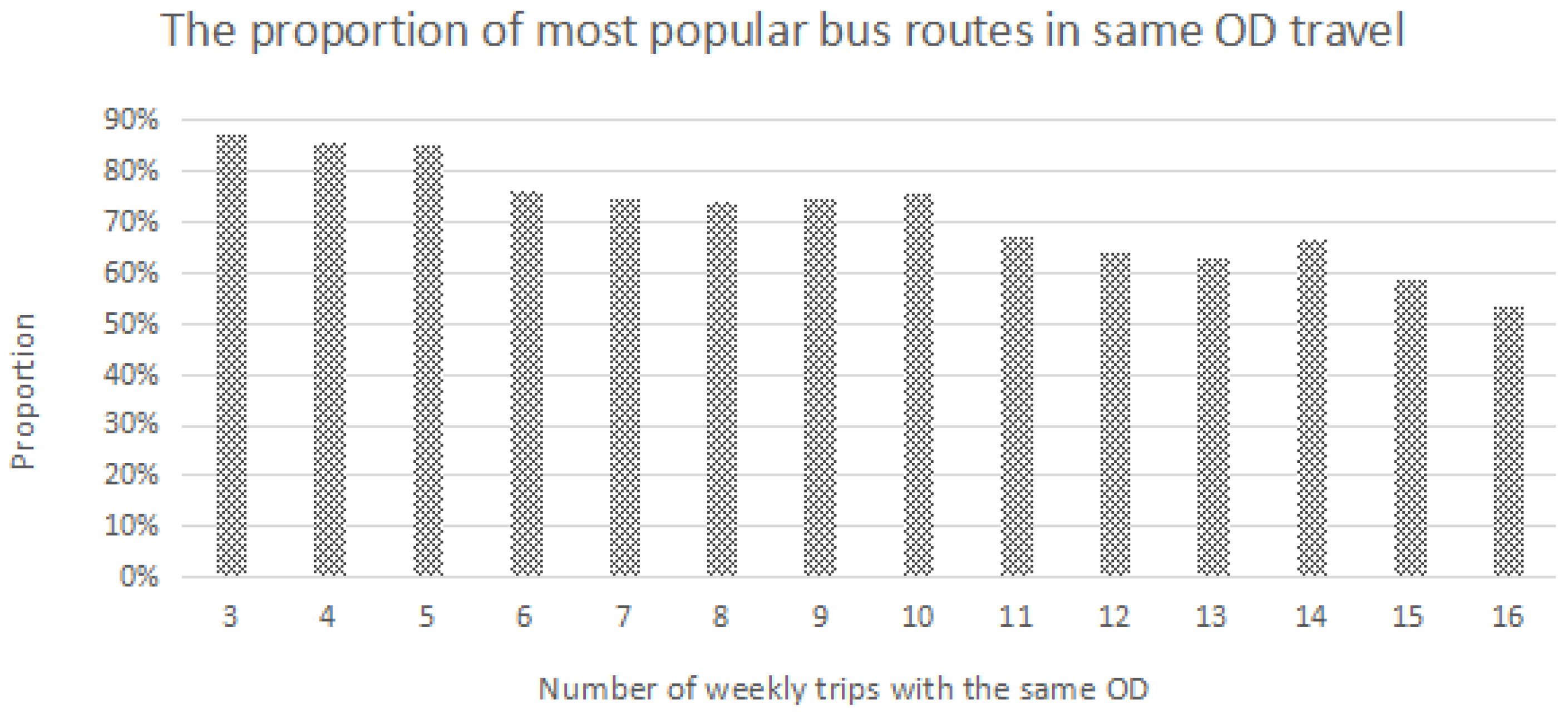
- Passengers tend to consider more comparisons rather than focusing solely on a single route. The main factors they consider include consistency between the origin and destination stop, walking time, whether a route is familiar, historical travel frequency, the efficiency ratio between the current and optimal path, and the number of alternative paths.
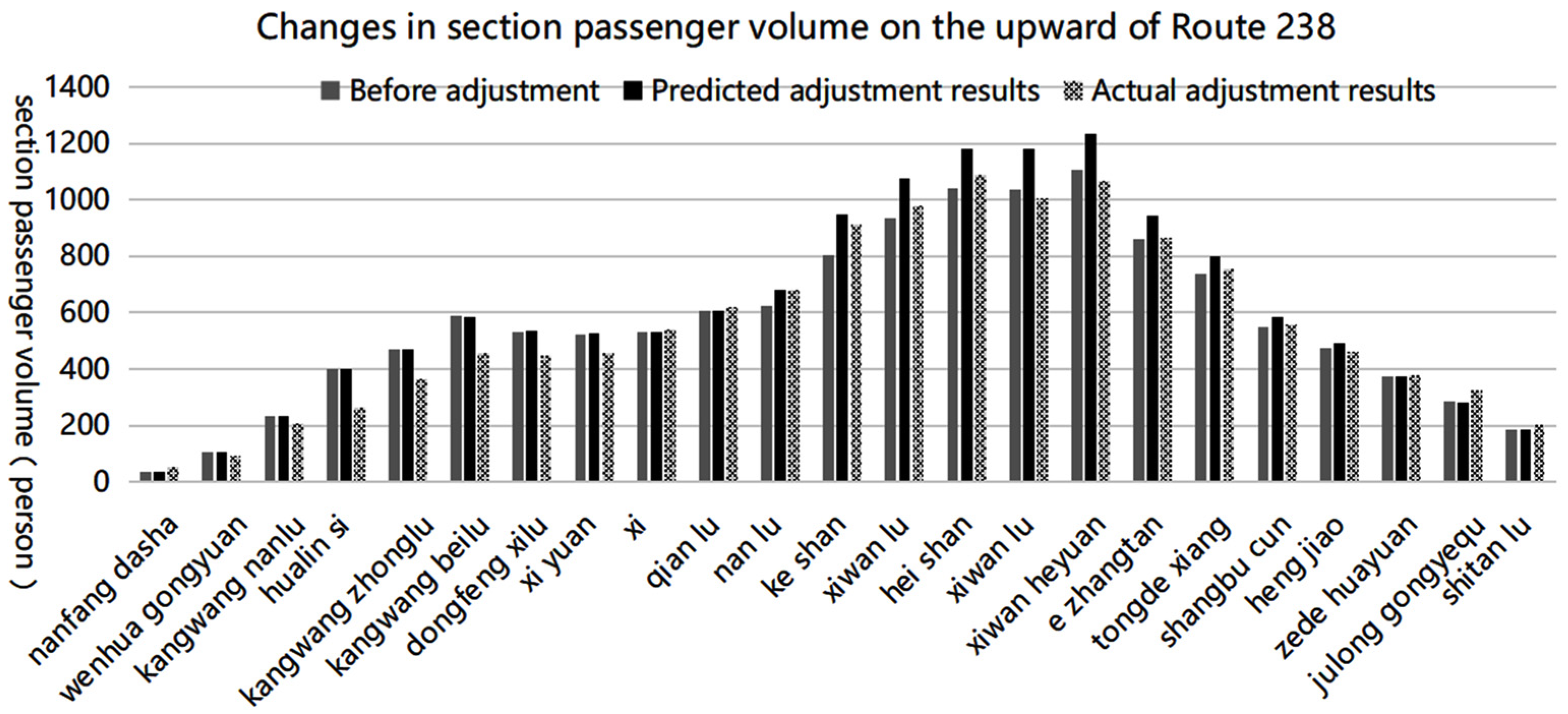
- According to the tracking of passenger samples before and after adjustment, the proposed method demonstrates an accuracy rate of 89.6% in estimating changes in trips (both direct and transfer). Moreover, changes in passenger flows and line section traffic volume closely align with actual observed outcomes.
- The primary reasons for evaluation errors are related to two aspects: inaccuracies in OD inference and variations in what different passengers consider acceptable walking distances.
- Compared with the conventional four-stage method, this proposed model requires only the relevant parameters of the line being adjusted. This model enables the automatic calculation of evaluation results and insights into the varying impacts on different passenger demographics. This represents a certain degree of improvement in terms of both evaluation efficiency and refinement.
Author Contributions
Funding
Data Availability Statement
Conflicts of Interest
References
- Wang, J.; Mao, L.; Yang, R.; Shi, C.; Li, D. Overview of research on bus network optimization technology. Highw. Traffic Technol. (Appl. Technol. Ed.) 2019, 15, 343–346. [Google Scholar]
- Čižiūnienė, K.; Prokopovič, M.; Zaranka, J.; Matijošius, J. Biometric Breakthroughs for Sustainable Travel: Transforming Public Transportation through Secure Identification. Sustainability 2024, 16, 5071. [Google Scholar] [CrossRef] [Scilit]
- Deng, H.; Zhao, Z.; Wang, W. Research on transit OD estimation based on transit IC card and GPS data. J. Chongqing Univ. Sci. Technol. (Nat. Sci.) 2019, 33, 220–226. [Google Scholar]
- Wei, Q.; Su, Y.; Gao, Y.; Yang, J.; Mo, J. Real Time Estimation of Bus Loading Rate Based on Electronic Payment Data. Transp. Syst. Eng. Inf. 2021, 21, 75–81+89. [Google Scholar]
- Ziming, W.; Hui, J.; Zhang, Y.; Yang, X. Exploration on boosting bus ridership in the post-pandemic era referring to bus rider behavior changes. Alex. Eng. J. 2024, 109, 685–701. [Google Scholar]
- Pei, Y.; Ran, S.; Wang, W.; Dong, C. Bus-Passenger-Flow Prediction Model Based on WPD, Attention Mechanism, and Bi-LSTM. Sustainability 2023, 15, 14889. [Google Scholar] [CrossRef] [Scilit]
- Chen, C.; Liu, Z.; Wan, S.; Luan, J.; Pei, Q. Traffic Flow Prediction Based on Deep Learning in Internet of Vehicles. IEEE Trans. Intell. Transp. Syst. 2021, 22, 3776–3789. [Google Scholar] [CrossRef] [Scilit]
- Nagaraj, N.; Gururaj, H.L.; Swathi, B.H.; Hu, Y.-C. Passenger Flow Prediction in Bus Transportation System Using Deep Learning. Multimed. Tools Appl. 2022, 81, 12519–12542. [Google Scholar] [CrossRef] [Scilit]
- Du, B.; Peng, H.; Wang, S.; Bhuiyan, M.Z.A.; Wang, L.; Gong, Q.; Liu, L.; Li, J. Deep Irregular Convolutional Residual LSTM for Urban Traffic Passenger Flows Prediction. IEEE Trans. Intell. Transp. Syst. 2020, 21, 972–985. [Google Scholar] [CrossRef] [Scilit]
- Briand, A.-S.; Côme, E.; Trépanier, M.; Oukhellou, L. Analyzing year-to-year changes in public transport passenger behaviour using smart card data. Transp. Res. Part C Emerg. Technol. 2017, 79, 274–289. [Google Scholar] [CrossRef] [Scilit]
- Ma, Z.; Xing, J.; Mesbah, M.; Ferreira, L. Predicting short-term bus passenger demand using a pattern hybrid approach. Transp. Res. Part C Emerg. Technol. 2014, 39, 148–163. [Google Scholar] [CrossRef] [Scilit]
- Li, P.; Wu, W.; Pei, X. A separate modelling approach for short-term bus passenger flow prediction based on behavioural patterns: A hybrid decision tree method. Phys. A Stat. Mech. Appl. 2023, 616, 128567. [Google Scholar] [CrossRef] [Scilit]
- Han, Y.; Wang, C.; Ren, Y.; Wang, S.; Zheng, H.; Chen, G. Short-Term Prediction of Bus Passenger Flow Based on a Hybrid Optimized LSTM Network. ISPRS Int. J. Geo-Inf. 2019, 8, 366. [Google Scholar] [CrossRef] [Scilit]
- Glisovic, N.; Milenkovic, M.; Bojovic, N.; Svadlenka, L.; Avramovic, Z. A Hybrid Model for Forecasting the Volume of Passenger Flows on Serbian Railways. Oper. Res. 2016, 16, 271–285. [Google Scholar]
- Xu, D.; Wang, Y.; Jia, L.; Qin, Y.; Dong, H. Real-Time Road Traffic State Prediction Based on ARIMA and Kalman Filter. Front. Inf. Technol. Electron. Eng. 2017, 18, 287–302. [Google Scholar] [CrossRef] [Scilit]
- Li, Y.; Ma, C. Short-Time Bus Route Passenger Flow Prediction Based on a Secondary Decomposition Integration Method. J. Transp. Eng. Part A Syst. 2023, 149, 04022132. [Google Scholar] [CrossRef] [Scilit]
- Wang, Z.; Chen, Y.; Duan, W. Evaluation Method of Regular Bus Route Adjustment Scheme. Transp. Syst. Eng. Inf. 2011, 11, 124–130. [Google Scholar]
- Wei, C.; Luo, H.; Chen, Y. Bus route adjustment and impact analysis based on big data. In Proceedings of the 2021/2022 China Urban Transport Planning Annual Conference, Shanghai, China, 17–18 November 2022; pp. 916–924. [Google Scholar]
- Chen, M.; Wen, W. Research on the impact assessment method of passenger flow of regular bus route adjustment based on big data. Traffic Transp. 2022, 38, 1–4. [Google Scholar]
- Igor, D.; Ludovic, L.; Monica, M. On the optimization of the bus network design: An analyticalapproach based on the three-dimensional macroscopic fundamental diagram. Transp. Res. Part B Methodol. 2021, 149, 393–417. [Google Scholar]
- Jang, J.; Cho, Y.; Park, J. Bus Route Sketching: A Multimetric Analysis from the User’s and Operator’s Perspectives. Sustainability 2024, 16, 7172. [Google Scholar] [CrossRef] [Scilit]
- Lopez-Ramos, F. Integrating network design and frequency setting in public transportation networks: A survey. SORT 2014, 38, 181–214. [Google Scholar]
- Ibarra-Rojas, O.J.; Delgado, F.; Giesen, R.; Muñoz, J.C. Planning, operation, and control of bus transport systems: A literature review. Transp. Res. Part B Methodol. 2015, 77, 38–75. [Google Scholar] [CrossRef] [Scilit]
- Iliopoulou, C.; Kepaptsoglou, K.; Vlahogianni, E. Metaheuristics for the transit route network design problem. a review and comparative analysis. Public. Transp. 2019, 11, 487–521. [Google Scholar] [CrossRef] [Scilit]
- Wang, Y.; Shi, D.; Zhou, W. Convolutional Neural Network Approach Based on Multimodal Biometric System with Fusion of Face and Finger Vein Features. Sensors 2022, 22, 6039. [Google Scholar] [CrossRef] [Scilit]
- Ma, G. Research on Behavior Characteristics and Influencing Factors of Passenger Travel Route Choice Based on Intelligent Public Transport Data; Southwest Jiaotong University: Chengdu, China, 2019. [Google Scholar]
- Chen, M. Research on Bus Passenger Travel Route Identification and Choice Behavior; Chang’an University: Xi’an, China, 2021. [Google Scholar]

| Data Type | Content of Entry | |
|---|---|---|
| Line Parameter | Line truncation or cancellation | The ID of all deleted stops |
| Extension and Detour or New | Line ID, direction, stop order, distance from the previous stop, line name, ID (unique), stop name, stop type (terminal/midway stop), longitude and latitude, distance from the next stop | |
| Passenger Travel Demand | Passenger ID, passenger type (elderly, students, working), trading time, boarding time, boarding stop, alighting time, alighting stop, travel route, direction, travel distance, etc. | |
| Group | Time Period | Weight Coefficient | ||||||||||
|---|---|---|---|---|---|---|---|---|---|---|---|---|
| α1 | α2 | α3 | α4 | α5 | α6 | α7 | α8 | α9 | α10 | α11 | ||
| working | Peak | 91 | 80 | 70 | 3 | 5 | 13 | 1 | 33 | 40 | 64 | 44 |
| Off-peak | 97 | 90 | 31 | 1 | 2 | 8 | 1 | 6 | 10 | 19 | 34 | |
| elderly | Peak | 87 | 88 | 21 | 9 | 12 | 67 | 1 | 4 | 8 | 2 | 51 |
| Off-peak | 56 | 97 | 46 | 2 | 13 | 37 | 3 | 1 | 24 | 8 | 93 | |
| student | Peak | 81 | 80 | 30 | 3 | 5 | 25 | 1 | 8 | 77 | 8 | 25 |
| Off-peak | 97 | 76 | 7 | 19 | 12 | 70 | 5 | 14 | 30 | 50 | 35 | |
| disabled | Peak | 87 | 97 | 73 | 4 | 28 | 94 | 3 | 27 | 7 | 24 | 29 |
| Off-peak | 39 | 82 | 75 | 10 | 1 | 50 | 1 | 68 | 31 | 11 | 35 | |
| other | Peak | 99 | 85 | 91 | 7 | 4 | 59 | 42 | 49 | 50 | 59 | 85 |
| Off-peak | 77 | 97 | 24 | 11 | 3 | 40 | 4 | 6 | 40 | 14 | 22 | |
| Bus Line | Actual Flow Before Adjustment | Actual Flow After Adjustment | Estimated Flow | Relative Error | Difference Between Actual And Estimated |
|---|---|---|---|---|---|
| Line 238 | 4491 | 4759 | 4759 | 0.00% | 268 |
| Line 539 | 5723 | 6052 | 5992 | −0.99% | 269 |
| Line 215 | 12,579 | 12,600 | 12,842 | 1.92% | 263 |
| Line 556 | 5690 | 6262 | 5898 | −5.81% | 208 |
| Line 524 | 4708 | 4980 | 4867 | −2.27% | 159 |
| Passengers Flow | Rigid Passengers | |
|---|---|---|
| Trips with more than 2 transfers | 0 | 0 |
| Trips with increasing riding numbers | 645 | 328 |
| Of which are elderly | 128 | 35 |
| Of which are students | 14 | 9 |
| Of which are disabled | 5 | 4 |
Disclaimer/Publisher’s Note: The statements, opinions and data contained in all publications are solely those of the individual author(s) and contributor(s) and not of MDPI and/or the editor(s). MDPI and/or the editor(s) disclaim responsibility for any injury to people or property resulting from any ideas, methods, instructions or products referred to in the content. |
© 2024 by the authors. Licensee MDPI, Basel, Switzerland. This article is an open access article distributed under the terms and conditions of the Creative Commons Attribution (CC BY) license (https://creativecommons.org/licenses/by/4.0/).
Share and Cite
Wei, Q.; Zhang, N.; Gao, Y.; Chen, C.; Wang, L.; Yang, J. Bus Network Adjustment Pre-Evaluation Based on Biometric Recognition and Travel Spatio-Temporal Deduction. Algorithms 2024, 17, 513. https://doi.org/10.3390/a17110513
Wei Q, Zhang N, Gao Y, Chen C, Wang L, Yang J. Bus Network Adjustment Pre-Evaluation Based on Biometric Recognition and Travel Spatio-Temporal Deduction. Algorithms. 2024; 17(11):513. https://doi.org/10.3390/a17110513
Chicago/Turabian StyleWei, Qingbo, Nanfeng Zhang, Yuan Gao, Cheng Chen, Li Wang, and Jingfeng Yang. 2024. "Bus Network Adjustment Pre-Evaluation Based on Biometric Recognition and Travel Spatio-Temporal Deduction" Algorithms 17, no. 11: 513. https://doi.org/10.3390/a17110513
APA StyleWei, Q., Zhang, N., Gao, Y., Chen, C., Wang, L., & Yang, J. (2024). Bus Network Adjustment Pre-Evaluation Based on Biometric Recognition and Travel Spatio-Temporal Deduction. Algorithms, 17(11), 513. https://doi.org/10.3390/a17110513

