


Abstract
In this paper, we provide and study the concept of multi-valued generalized -nonexpansive mappings, which is the multi-valued version of the recently developed generalized -nonexpansive mappings. We establish some elementary properties and fixed point existence results for these mappings. Moreover, a multi-valued version of the M-iterative scheme is proposed for approximating fixed points of these mappings in the weak and strong senses. Using an example, we also show that M-iterative scheme converges faster as compared to many other schemes for this class of mappings.
1. Introduction
We often denote the set of natural numbers by using the notation . Fixed point theory provides useful tools for solving different types of nonlinear problems, for which ordinary analytical methods fail. Fixed point theory for different types of single-valued mappings is now well-developed. One of the basic results, the Banach contraction theorem (BCT) [1], was successfully applied for finding the approximate solutions for many nonlinear problems that arise in the applied sciences. However, fixed point theory of multi-valued mappings is more difficult but more important than the corresponding theory of single-valued mappings (see, e.g., [2] and others). Thus, it is always desirable to study and extend the fixed point results for single-valued mappings to the case of multi-valued mappings. To study fixed point theory in the case of multi-valued mappings, we often need the following notion of distance—, known as the Pompeiu Housdorff metric, which is defined by
where B is a subset of a Banach space and is the set of all subsets of B. A subset E of X is said to be proximinal if, for all , there is an element such that , where . Throughout this paper, we use the notations for the set of all proximinal subsets and for the set of all bounded and closed subsets of B. Suppose X is a Banach space and . Let and . The point is regarded as a fixed point for if . On the other hand, if is a multi-valued mapping and , the point is regarded as a fixed point (resp. an endpoint) for if (resp. . The set of fixed point (resp. the set of endpoints) of is often represented by (resp. by ).
Note that Nadler [3] proved the multi-version of BCP. In 1965, Browder [4] and Gohde [5] (cf. also Kirk [6] and others) provided a well-known result, which shows that, in a uniformly convex Banach space (UCBS) setting, nonexpansive selfmaps admit fixed points. The multi-valued version of these results are proved by Lim [7]. In 2008, Suzuki [8] suggested a condition on selfmaps, which he named condition (C) and proved that this condition is weaker than the concept of nonexpansive selfmaps. Very soon, Abkar and Eslamian [9] extended his concept to the case of multi-valued maps. In 2011, Aoyama and Kohsaka [10] defined and studied the notion of -nonexpansive selfmaps. These mappings also include nonexpansive maps. The multi-valued version of -nonexpansive mappings was introduced by Hajisharif [11]. In the year 2017, Pant and Shukla [12] studied the class of generalized -nonexpansive mappings and showed that this new class of maps properly included Suzuki maps [8] and partially included -nonexpansive maps due to Aoyama and Kohsaka [10]. Soon, Iqbal et al. [13] showed that their idea holds for the case of multi-valued mappings. In 2019, Pandey et al. [14] introduced the notion of –Riech–Suzuki type nonexpansive selfmaps. Recently, Maldar et al. [15] obtained the multi-valued version of these maps. In 2020, Ullah et al. [16] defined generalized -nonexpansive maps. These maps are very important because they included both of the classes due to Pant and Shukla [12] and Pandey et al. [14]. The purpose of the present work is to provide the multi-valued version of these maps and to study the related fixed point results.
After existence of fixed point for a mapping, it is natural to find the value of that fixed point. For this purpose, different iteration processes, i.e.,those of Mann [17], Ishikawa [18], Agarwal [19], SP [20], Abbas [21], Noor [22], CR [23], Normal-S [24], Thakur New [25] and M-iteration [26], etc., have been introduced. The approximating of a fixed point using an effective iterative technique is an important field of research. For instance, Khatoon and Uddin [27] studied Abbas’ iterative scheme for G-nonexpansive operators while Wairojjana [28] proved strong convergence of a certain scheme for variational inequalities problems. Moreover, different authors made claims about the convergence speed of their iteration processes: according to the authors in [19], the Agarwal iteration converges faster than Mann’s and has the same convergence speed as the Picard iteration. In [21], the author proved that the iteration process of Abbas converges faster than Agarwal’s. Similarly, according to Gursoy and Karakaya [29], the Picard-S iterative process is converge than the Picard, Ishikawa, Noor, SP, CR, Normal-S iteration processes. The author proved in [25] that the Thauker-New iterative process is fast in terms of convergence when compared to Picard, Mann, Ishikawa, Noor, Agarwal, and Abbas iteration processes for Suzuki generalized nonexpansive mappings. In 2018, Ullah and Arshad [26] proved that, compared to all the above mentioned iteration processes, newly introduced M-iteration processes have high speeds of convergence for Suzuki generalized nonexpansive mappings.
For multi-valued nonexpansive mappings, initially, Sastry and Babu [30] worked on the convergence of Mann and Ishikawa iterative processes in Hilbert spaces. Shehzad and Zegeye [31] (cf. also Song and Cho [32] and others) introduced for multi-valued mappings and also proved convergence of Ishikawa iteration process in a UCBS.
Consider a multi-valued mapping . Choose . We list here multi-valued versions of Noor [22], Picard–Mann [33], Abbas [21], and Picard-S [29], respectively, as follows:
where , and .
where and .
where , and .
where , and .
The multi-valued version of the M-iterative process reads as follows:
where , and . Ullah et al. [34] used this scheme for finding fixed points of multi-valued -nonexpansive maps. Here, using (5), we will provide weak and strong convergence results for the class of multi-valued generalized -nonexpansive mappings. The results will be supported by examples.
2. Preliminaries
Let B be a subset of a Banach space and . Then:
- (i)
- is called nonexpensive if
- (ii)
- is called quasi-nonexpensive if and
- (iii)
- is called Suzuki generalized nonexpansive or endowed with condition if
- (iv)
- is called -nonexpensive if there exists such that ,
- (v)
- is called generalized -nonexpansive if exists such that ,
- (vi)
- is called -Reich–Suzuki type nonexpansive if exists such that ,
The single-valued example of a generalized -nonexpansive selfmaps is the following.
Example 1.
If , then we may set
If one chooses , then is easy to observe that exceeds the class of generalized α-nonexpansive and β-Reich–Suzuki type selfmaps; however, with the help of triangular inequality, one can show that it is generalized -nonexpansive.
Proposition 1
([31]).For a multi-valued mapping and . Then, the following conditions are equivalent:
- (1)
- ,
- (2)
- ,
- (3)
- .Further .
Definition 1.
Let be a bounded sequence in X and B be a subset of X, then:
- (1)
- Asymptotic radius of at a point is defined as
- (2)
- Asymptotic radius of with respect to B is defined as
- (3)
- The asymptotic center of with respect to B is defined as
Lemma 1
([35]).Suppose that X is a UCBS. Consider a real sequence named in such a manner that . Now assume and are two sequences in X with the property that there exists a positive real umber h such that , and . Then,
Definition 2
([36]).Suppose , where X is a Banach space. Then, satisfies condition if there exists a function such that and for and
for each .
Definition 3
([37]).Let X be a Banach space. The space X is said to be endowed with Opial’s condition if for any sequence , with , it follows that
where and .
Definition 4.
Consider a multi-valued mapping and in B. The sequence is said to be an approximate fixed point sequence (shortly ) for if as .
Definition 5.
Suppose a multi-valued mapping . Now one can say that is demiclosed at if for any sequence in B that is for some and , which is strongly converges to b then we have .
3. Generalized ()-Nonexpansive Multi-Valued Mapping
Definition 6.
Consider a multi-valued mapping . Then, is called generalized ()-nonexpansive if there exists two positive real constants with and for all , we have
Remark 1.
Obviously, the class of multi-valued generalized -nonexpansive maps includes both the multi-valued generalized α-nonexpansive and multi-valued Riech–Suzuki type nonexpansive maps classes.
Lemma 2.
Suppose a Banach space X and and also consider a multi-valued mapping . If is ()-nonexpansive with a fixed point and satisfies the endpoint condition, then is quasi-nonexpansive.
Proof.
Assume that . Then for any , so
This provides
Since , we obtain our desired result. □
Lemma 3.
Let B be a nonempty subset of a Banach space X and be a multi-valued mapping satisfying the endpoint condition. Then, is closed provided that is generalized ()-nonexpansive.
Proof.
Let such that . Now
Using Definition 6, we have
The previous inequalities imply
because and . So and hence . Thus, is closed. □
4. Fixed Point Existence Results
Lemma 4.
Let B be a nonempty subset of a Banach space X and let be a generalized ()-nonexpansive multi-valued mapping. In addition, let e and be elements in B for which . Then, the following inequalities holds:
- (a)
- ,
- (b)
- for every we have either or .
Proof.
(a) Since for any , we obtain
Since and , we can write,
for any .
(b) Suppose to the contrary that for any and , we have
From (6) and (a), we have
and a contradiction occurs. Hence, the result follows. □
Lemma 5.
Let B be a nonempty subset of a Banach space X and let be a generalized ()-nonexpansive multi-valued mapping. Then,
Proof.
By Lemma 4, we have the following two cases:
Case 1. If , we have
From the previous inequalities, we obtain
From the latter inequalities, we see
The required result is proved.
Case 2. Let . Then, we see
Therefore, according to Lemma 4, we infer
As a consequence of the above inequalities, we obtain
Therefore, since and , we obtain
Hence, in both cases the result is proved. □
For the fixed point existence result, the following lemmas are needed.
Lemma 6.
Consider a nonempty closed bounded subset B of a Banach space X and let be a generalized ()-nonexpansive multi-valued mapping. Let be a bounded a.f.p.s for in B. Then, is -invariant.
Proof.
Let Since the mapping satisfies (7), we obtain
Now,
By definition of Asymptotic center we have, . Hence, is -invariant. □
Lemma 7.
Consider a nonempty closed convex and bounded subset B of a Banach space X and suppose is an a.f.p.s for where is a generalized ()-nonexpansive multi-valued mapping. Then
for each .
Proof.
Since satisfies Equation (7), for any we have
Since is an a.f.p.s in B,
for . □
Now, we prove the fixed point existence result.
Lemma 8.
Let X ba a Banach space and B ba a nonempty closed convex and bounded subset of X. Let be a generalized ()-nonexpansive multi-valued mapping and for each approximate fixed point sequence for , the asymptotic center is nonempty and compact. Then, has a fixed point.
Proof.
Let be an a.f.p.s in the asymptotic center . However, since this center is compact, there exists of such that
As Lemma 6 has an asymptotic center that is -invariant, . Additionally, by Lemma 7, we have
which implies that □
5. Convergence Results
Lemma 9.
Suppose that B be a nonempty closed and convex subset of UCBS X. Assume that is a multi-valued mapping such that . Additionally, assume that is a generalized ()-nonexpansive mapping. Suppose that is a sequence iteratively generated by (5) then for , exists and
Proof.
If and , then, by Lemmas 2 and (5), we have
By the same token, we obtain
and also
Thus, is bounded and nonincreasing, and so exists for .
Next, we need to prove that
Suppose that
We can easily obtain the following inequalities by using (5), (9), (8) and Lemma 2:
and
By taking the superior limit of the extreme expressions of the above two rows of inequalities and keeping in mind (10), we infer that
Then, it follows that
By (12) and (13), we obtain
From (5) and (9) we obtain,
As a result, we obtain
Therefore, by (11), (10), (14) and Lemma 1, we have
Hence,
This completes the proof. □
Next, we are to prove convergence results.
Theorem 1.
Suppose that B be a nonempty compact and convex subset of UCBS X. Assume that is a multi-valued mapping such that . Additionally, assume that be a generalized ()-nonexpansive mapping. Then, a sequence defined as in (5) converges strongly to a fixed point of .
Proof.
We have observed in Lemma 9 that
Due to compactness of B, there exists a subsequence of that converges to . Since is a generalized -nonexpansive and the sequence satisfies (5), it follows that
Since , we obtain as . As a result, converges strongly to . □
Proof of the theorem below is elementary, and hence is omitted.
Theorem 2.
Suppose that B is a nonempty closed convex subset of a UCBS X and let the multi-valued mapping be such that the mapping is generalized ()-nonexpansive. Assume that and that the sequence , which is iteratively generated as in (5), stisfies . Then, this sequence converges strongly to a fixed point of .
Now, we use condition for establishing another strong convergence theorem.
Theorem 3.
Suppose that B is a nonempty closed convex subset of a UCBS X. Assume that the multi-valued mapping satisfies condition and is such that is a generalized ()-nonexpansive mapping. If, moreover, , then any sequence which is iteratively generated as in (5) converges strongly to a fixed point of .
Proof.
Let the sequence be iteratively generated as in (5) and let . In light of Lemma 9, since the sequence is nonincreasing, the constant defined by
exists.
It follows that for , the proof is trivial. Therefore, we suppose that . Now,
As a result, exists. Additionally, according to Lemma 1, . From Lemma 9, together with condition , we then infer
Due to the nonincreasing nature of f and , we have
The required result now follows from Theorem 2. □
Theorem 4.
Suppose that B is a nonempty closed convex subset of a UCBS X which satisfies Opial’s condition. Assume that is a multi-valued mapping such that and is such that is a generalized ()-nonexpansive mapping. Additionally, let be demiclosed with respect to zero. Then, any sequence iteratively generated as in (5) converges weakly to a fixed point of .
Proof.
Let the sequence be iteratively generated as in (5) and let (see Lemma 1). Then, according to Lemma 9, exists. Since X is uniformly convex, it is reflexive. Therefore, there must exist a subsequence of that converges weakly to some . Additionally, is demiclosed at zero, therefore . If the sequence does not weakly converg to , then there must be a subsequence of such that where . Clearly, . By Opial’s property, we obtain
and a contradiction occurs. Thus, the sequence converges weakly to a point in . □
6. Example
Example 2.
Let and and be defined by,
Then, we verify that is generalized -nonexpansive.
However, is not α-nonexpansive.
Proof.
If then also if , then and if then . Now we prove that is -nonexpansive for .
Case (1).
When ,
Case (2).
When ,
Case (3).
When and, ,
Case (4).
When and ,
Case (5).
When and ,
Here, we have two cases:
For the first case (i.e., ), (16) implies:
For the second case (i.e., ), (16) implies:
Thus, is a generalized -nonexpansive mapping.
(b) On the other hand, for and , we have
However,
Thus, is not a generalized -nonexpansive mapping.
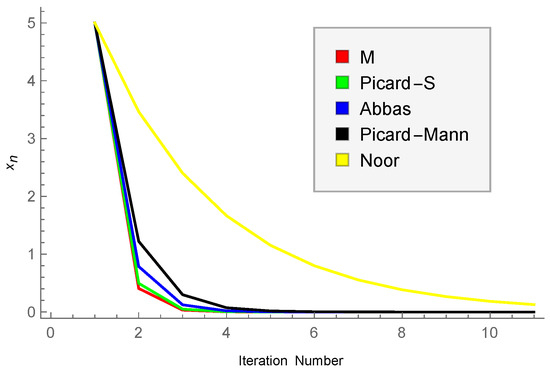
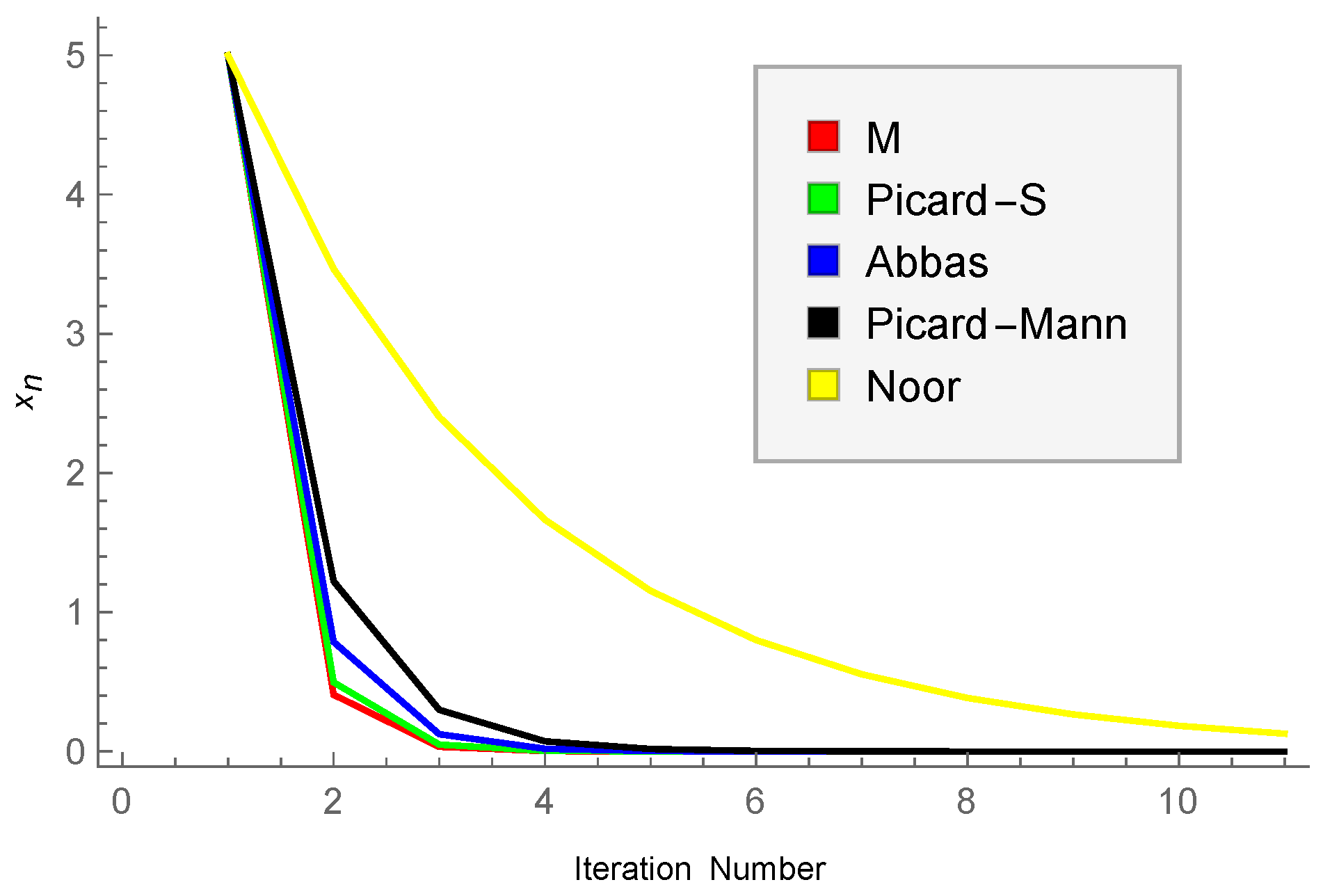
Note that Figure 1 and Table 1 reflect the efficiency of the M-iteration process as compare to the other iteration processes in the case of multi-valued generalized -nonexpansive mapping defined in Example 2.
Figure 1.
Convergence behaviors of different iterative schemes to a fixed point of the map .
Table 1.
Initial points influence on different iteration algorithms.
7. Conclusions
We have provided the multi-version of the generalized -nonexpansive operators. Basic properties of these maps in a Banach space setting are established. For finding fixed points of these maps, we have provided the multi-valued version of the M-iteration and showed, by an example, that it is more effective than the other iterative schemes. Since multi-valued -nonexpansive are more general than the multi-valued generalized -nonexpansive and multi-valued Reich–Suzuki type nonexpansive maps, we conclude that our main outcome improves and extends the corresponding results of Iqbal et al. [13] and Maldar et al. [15].
Author Contributions
K.U., M.S.U.K. and M.d.l.S. provided equal contributions to this research paper. All authors have read and agreed to the published version of the manuscript.
Funding
The authors are very grateful to the Basque Government for their support through Grant no. IT1207-19.
Institutional Review Board Statement
Not applicable.
Informed Consent Statement
Not applicable.
Data Availability Statement
The data used to support the findings of this study are included in the references within the article.
Acknowledgments
Moreover, the authors are very grateful to the Basque Government for its support through Grant IT1207-19.
Conflicts of Interest
The authors declare no conflict of interest.
References
- Banach, S. Sur les operations dans les ensembles abstraits et leur application aux equations integrales. Fund. Math. 1922, 3, 133–181. [Google Scholar] [CrossRef] [Scilit]
- Gorniewicz, L. Topological Fixed Point Theory of Multivalued Mappings; Kluwer Academic Pub.: Dordrecht, The Netherlands, 1999. [Google Scholar]
- Nadler, S.B. Multi-valued contraction mappings. Pac. J. Math. 1969, 30, 282–291. [Google Scholar] [CrossRef] [Scilit]
- Browder, F.E. Nonexpansive nonlinear operators in a Banach space. Proc. Natl. Acad. Sci. USA 1965, 54, 1041–1044. [Google Scholar] [CrossRef] [Scilit]
- Gohde, D. Zum Prinzip der Kontraktiven Abbildung. Math. Nachr. 1965, 30, 251–258. [Google Scholar] [CrossRef] [Scilit]
- Kirk, W.A. A fixed point theorem for mappings which do not increase distance. Am. Math. Mon. 1965, 72, 1004–1006. [Google Scholar] [CrossRef] [Scilit]
- Lim, T.C. A fixed point theorem for multivalued nonexpansive mappings in a uniformly convex Banach spaces. Bull. Am. Math. Soc. 1974, 80, 1123–1126. [Google Scholar] [CrossRef] [Scilit]
- Suzuki, T. Fixed point theorems and convergence theorems for some generalized non-expansive mapping. J. Math. Anal. Appl. 2008, 340, 1088–1095. [Google Scholar] [CrossRef] [Scilit]
- Abkar, A.; Eslamian, M. A fixed point theorem for generalized nonexpansive multivalued mappings. Fixed Point Theory 2011, 12, 241–246. [Google Scholar]
- Aoyama, K.; Kohsaka, F. Fixed point theorem for α-non-expansive mappings in Banach spaces. Nonlinear Anal. 2011, 74, 4387–4391. [Google Scholar] [CrossRef] [Scilit]
- Hajisharifi, H.M. On some generalizaton of multivalued nonexpansive mappings. Bull. Iran. Math. Soc. 2020, 46, 557–571. [Google Scholar] [CrossRef] [Scilit]
- Pant, R.; Shukla, R. Approximating fixed points of generalized α-non-expansive mappings in Banach spaces. Numer. Funct. Anal. Optim. 2017, 38, 248–266. [Google Scholar] [CrossRef] [Scilit]
- Iqbal, H.; Abbas, M.; Hussnine, S.M. Existence and approximation of fixed points of multivalued generalized α-nonexpansive mappings in Banach spaces. Numer. Algor. 2019, 85, 1029–1049. [Google Scholar] [CrossRef] [Scilit]
- Pandey, R.; Pant, R.; Rakocevic, V.; Shukla, R. Approximating fixed points of a general class of nonexpansive mappings in Banach spaces with applications. Result Math. 2019, 74, 1–24. [Google Scholar] [CrossRef] [Scilit]
- Maldar, S.; Gursoy, F.; Atalan, Y.; Abbas, M. On a three-step iteration process for multivalued Reich-Suzuki type α-nonexpansive and contractive mappings. J. Appl. Math. Comp. 2021. [Google Scholar] [CrossRef] [Scilit]
- Ullah, K.; Ahmad, J.; de la Sen, M. On generalized nonexpnsive maps in Banach spaces. Computation 2020, 8, 61. [Google Scholar] [CrossRef] [Scilit]
- Mann, W.R. Mean value methods in iteration. Proc. Am. Math. Soc. 1953, 4, 506–510. [Google Scholar] [CrossRef]
- Ishikawa, S. Fixed points by a new iteration method. Proc. Am. Math. Soc. 1974, 44, 147–150. [Google Scholar] [CrossRef]
- Agarwal, R.P.; O’Regon, D.; Sahu, D.R. Iterative construction of fixed points of nearly asymtotically non-expansive mappings. J. Nonlinear Convex Anal. 2007, 8, 61–79. [Google Scholar]
- Phuengrattana, W.; Suantai, S. On the rate of convergence of Mann, Ishikawa, Noor, and SP-iterations for continuous functions on an arbitrary interval. J. Comp. Appl. Math. 2011, 235, 3006–3014. [Google Scholar] [CrossRef] [Scilit]
- Abbas, M.; Nazir, T. A new faster iteration process applied to constrained minimization and feasibility problems. Math. Vesnik 2014, 66, 223–234. [Google Scholar]
- Noor, M.A. New approximation schemes for general variational inequalities. J. Math. Anal. Appl. 2000, 251, 217–229. [Google Scholar] [CrossRef] [Scilit]
- Chugh, R.; Kumar, V.; Kumar, S. Strong convergence of new three step iterative scheme in Banach spaces. Am. J. Comp. Math. 2012, 2, 345–357. [Google Scholar] [CrossRef]
- Sahu, D.R.; Petrusel, A. Strong convergence of iterative methods by strickly pseudocontractive mappings in Banach spaces. Nonlinear Anal. TMA 2011, 74, 6012–6023. [Google Scholar] [CrossRef] [Scilit]
- Thakur, B.S.; Thakur, D.; Postolache, M. A new iterative scheme for numerical reckoning fixed points of Suzuki’s generalized non-expansive mappings. Appl. Math. Comput. 2016, 275, 147–155. [Google Scholar]
- Ullah, K.; Arshad, M. Numerical reckoning fixed points for Suzuki’s generalized nonexpansive mappings via new iteration process. Filomat 2011, 32, 187–196. [Google Scholar] [CrossRef] [Scilit]
- Khatoon, S.; Uddin, I. Convergence analysis of modified Abbas iteration process for two G-nonexpansive mappings. Rend. Circ. Mat. Palermo Ser. 2021, 70, 31–44. [Google Scholar] [CrossRef] [Scilit]
- Wairojjana, N.; Pakkaranang, N.; Pholasa, N. Strong convergence inertial projection algorithm with self-adaptive step size rule for pseudomonotone variational inequalities in Hilbert spaces. Demonstr. Math. 2021, 54, 110–128. [Google Scholar] [CrossRef] [Scilit]
- Gursoy, F.; Karakaya, V. A Picard-S hybrid type iteration method for solving a differential equation with retarted argument. arXiv 2014, arXiv:1403.2546. [Google Scholar]
- Sastry, K.P.R.; Babu, G.V.R. Convergence of Ishikawa iterates for a multivalued mapping with a fixed point. Czechoslov. Math. J. 2005, 55, 817–826. [Google Scholar] [CrossRef] [Scilit]
- Shahzad, N.; Zegeye, H. On Mann and Ishikawa iteration schemes for multi-valued maps in Banach spaces. Nonlinear Anal. 2009, 71, 838–844. [Google Scholar] [CrossRef] [Scilit]
- Song, Y.; Cho, Y.J. Some notes on Ishikawa iteration for multivalued mappings. Bull. Korean Math. Soc. 2011, 48, 575–584. [Google Scholar] [CrossRef] [Scilit]
- Khan, S.H. A Picard-Mann hybrid iterative process. Fixed Point Theory Appl. 2013, 69, 1–10. [Google Scholar] [CrossRef] [Scilit]
- Ullah, K.; Ahmad, J.; Khan, M.S.U.; Muhammad, N. Convergence results of a faster iterative scheme including multi-valued mappings in Banach spaces. Filomat 2021, 35, 1–10. [Google Scholar]
- Schu, J. Weak and strong convergence to fixed points of asymptotically nonexpansive mappings. Bull. Aust. Math. Soc. 1991, 43, 153–159. [Google Scholar] [CrossRef] [Scilit]
- Sentor, H.F.; Dotson, W.G. Approximating fixed points of nonexpansive mappings. Proc. Am. Math. Soc. 1974, 44, 375–380. [Google Scholar] [CrossRef]
- Opial, Z. Weak and strong convergence of the sequence of successive approximations for non-expansive mappings. Bull. Amer. Math. Soc. 1967, 73, 591–597. [Google Scholar] [CrossRef] [Scilit]

Publisher’s Note: MDPI stays neutral with regard to jurisdictional claims in published maps and institutional affiliations. |
© 2021 by the authors. Licensee MDPI, Basel, Switzerland. This article is an open access article distributed under the terms and conditions of the Creative Commons Attribution (CC BY) license (https://creativecommons.org/licenses/by/4.0/).