Abstract
The locating-chromatic number of a graph combines two graph concepts, namely coloring vertices and partition dimension of a graph. The locating-chromatic number is the smallest k such that G has a locating k-coloring, denoted by . This article proposes a procedure for obtaining a locating-chromatic number for an origami graph and its subdivision (one vertex on an outer edge) through two theorems with proofs.
MSC:
05C12; 05C15
1. Introduction
The study of the partition dimension of connected graphs was introduced by Chartrand et al. [1,2] with the aim of finding a new method for attacking the problem of determining the metric dimension in graphs. The application of these metric dimensions can be seen in the navigation of a robot modeled by a graph [3,4], solving the problem of chemical data classification, and determining how to represent a set of chemical compounds in such a way that different compounds have different representations [5,6]. The concept of the locating-chromatic number was first introduced by Chartrand et al. in 2002, with two obtained graph concepts, namely coloring vertices and partition dimensions of a graph [7]. Finding the locating-chromatic number of a graph is one of the interesting (and un-completely solved) problems of graph theory. Let be a connected graph; the distance between two of its vertices x and y is the length of the shortest path between them. Let c be a proper k-coloring of G with color , and be a partition of that is induced by the coloring c. The color code of v is the ordered k-tuple , where min for any . If all distinct vertices of G have distinct color codes, then c is called a k-locating coloring of G. The locating-chromatic number denoted by is the smallest k such that G has a locating k-coloring. Let c be a locating k-coloring on graph . Furthermore, the locating-chromatic number has been determined for a few graph classes; for example, if is a path of order then the locating-chromatic number is 3; for a cycle if is odd, was obtained, and if n is even, was obtained; for a double star graph , and , was obtained. Let be the partition of induced by c. A vertex is called a dominant vertex if , where . Chartrand et al. characterized all graphs of order n with the locating-chromatic number [8].
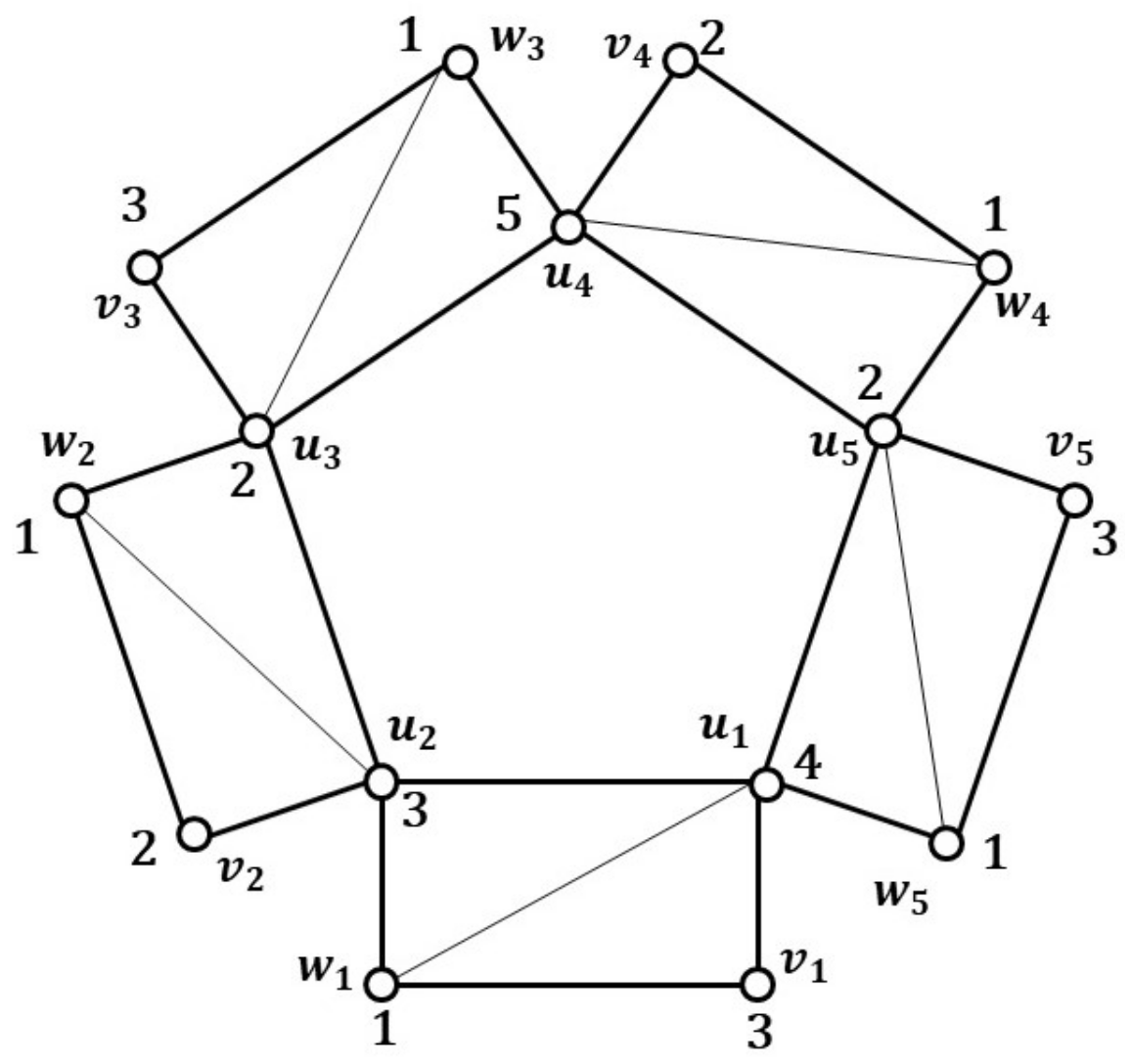
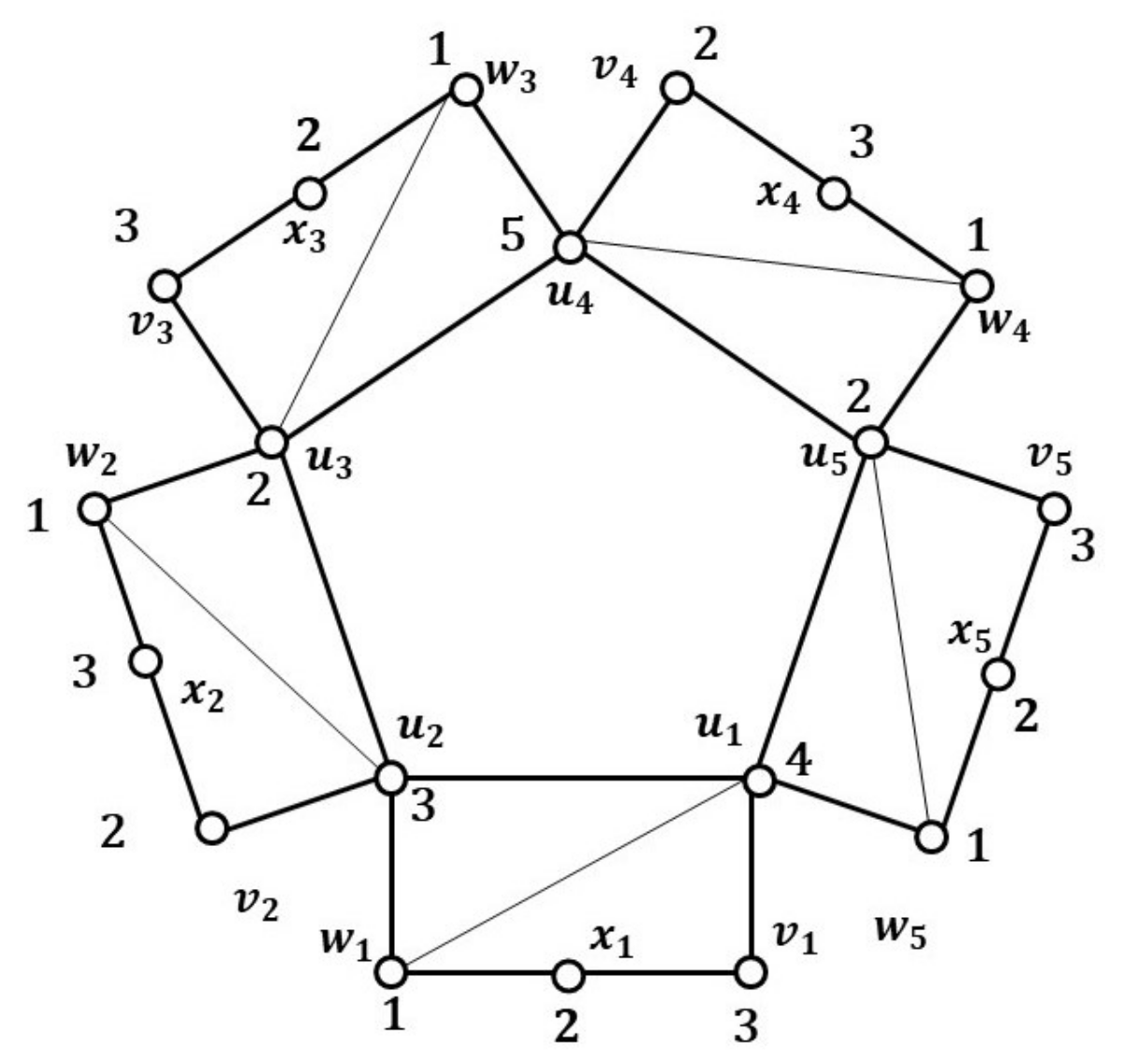
The problem of determining the locating-chromatic number of any general graph is an NP-hard problem [9]. This means that to determine the locating-chromatic number of any given graph, we need a specific algorithm. In 2012, Baskoro and Purwasih proposed a procedure to obtain the locating-chromatic number of corona products of two graphs [9]. In 2014, Asmiati obtained the locating-chromatic number of a non-homogeneous amalgamation of stars [10]. Moreover, to determine the locating-chromatic number of disconnected graphs, graphs with dominant vertices and graphs of two components have been discussed in [11,12,13]. In 2019, the characterization of the locating chromatic number of powers of paths and a condition (sharp upper and lower bounds) for the locating chromatic number of powers of cycles were discussed [14] (see [15] for a discussion of the necessary and sufficient conditions for a pair of two specific start graphs to be an odd mean graph). Asmiati et al. determined the locating-chromatic number of some Petersen graphs; four for odd or five for even were obtained [16], and in [17] results were obtained for certain barbell graphs. Syofyan et al. have succeed in determined the locating-chromatic number of homogeneous lobsters [18]. In [19], Asmiati obtained the locating-chromatic number for non-homogeneous caterpillar graphs and non-homogeneous firecracker graphs. Next, Irawan and Asmiati in 2018 determined the locating-chromatic number of subdivision firecrackers graphs [20] and in [21] obtained the certain operation of generalized Petersen graphs . In 2014, Behtoei and Anbarloei determined the locating-chromatic number of the joining of two arbitrary graphs [22]. In addition to that, in this article we propose a procedure for obtaining the locating-chromatic number for an origami graph and its subdivision (one vertex on an outer edge). The following definition of an origami graph is taken from [23]. Let with . An origami graph is a graph with and (see Figure 1 for an example). Meanwhile, a subdivision of an origami graph is a graph with and (see Figure 2 for an example).
Figure 1.
An origami graph .
Figure 2.
A subdivision of an origami graph .
2. Results and Discussions
Let c be a locating coloring in a connected graph G and denote the set of neighbor of a vertex q in G. If p and q are distinct vertices of G such that = for all , then . In particular, if p and q are non-adjacent vertices such that , then [7].
In the following subsection, the locating-chromatic number of origami graphs and their subdivisions called is described.
2.1. Locating-Chromatic Number of Origami Graphs
Theorem 1.
Let be an origami graph for . Then, the locating-chromatic number of ,
Proof.
Let with . An origami graph is a graph with and ∪∪. Next, to prove the theorem, we consider the following two cases:
Case 1.
First, we determine the lower bound of . In the origami graphs for , there are three adjacent vertices (complete graph with three vertices, denoted by ); we then need at least 3-locating coloring. Without loss of generality, we assign three colors for any in for , and then the three vertices are dominant vertices. As a result, if we use three colors it is not enough because there are more than one in for . Therefore, .
Next, we determine the upper bound of . To show that 4 is an upper bound for the locating-chromatic number for the origami graph we describe a locating coloring c using four colors as follows:
The coloring c will create the partition on . We shall show that the color codes of all vertices in are different. We have: ; ; ; ; ; ; ; ; . Since the color codes of all vertices are different, c is a locating-chromatic coloring. Thus, .
Case 2.
, for
To determine the lower bound, we will show that four colors are not enough. For a contradiction, assume that there exists a 4-locating coloring c on for . We assign , where because , . Observe that, on for , there are n vertices whose degree is 5. As a result, at least two vertices , have the same color codes, which is a contradiction. Therefore, , for .
To show the upper bound for the locating-chromatic number of origami graphs for , let us differentiate some subcases.
Subcase 1.
(Odd n), for odd,
Let c be a coloring of origami graph , odd, and ; we make the partition of :
- ;
- for odd ∪ for even ;
- for even ∪ for even ∪ for odd ;
- ;
- .
For odd, the color codes of all the vertices of are:
- .
For , we have:
For we have:
For
we have:
For we have:
for odd ∪ for even .
For i odd, we have:
For i odd, we have:
For i even, we have:
For , we have:
For i even, we have:
for even ∪ for even ∪ for odd
For , we have:
For i odd, we have:
For i odd, we have:
For i even, we have:
For , we have:
For , we have:
Since for n odd all vertices have different color codes, c is a locating coloring of origami graphs , so that , for odd, .
Subcase 2.
(Odd n), for even, .
Let c be a coloring of origami graph , even, and ; we make the partition of as follows:
- ;
- for odd ∪ for even ;
- for even ∪ for even ∪ for odd ;
- ;
- .
For even, the color codes of all the vertices of are:
For , we have:
For we have:
For , we have:
For we have:
for odd ∪ for even .
For i odd, we have:
For i odd, we have:
For i even, we have:
For , we have:
For i even, we have:
for even ∪ for even ∪ for odd
For we have:
For i odd, we have:
For i odd, we have:
For i even, we have:
, we have:
, we have:
Since for n odd all vertices have different color codes, c is a locating coloring of origami graphs , so that , for even, .
Subcase 3.
(even n), for odd, .
Let c be a coloring of origami graph , odd, and ; we make the partition of :
- ;
- for odd ∪ for even ;
- for even ∪ for odd ;
- ;
- .
For odd, the color codes of all the vertices of are:
For , we have:
For we have:
For we have:
for odd ∪ for even
For i odd, we have:
For i odd, we have:
For i even, we have:
for even ∪ for odd
For , we have:
For i odd, we have:
For , we have:
For i odd, we have:
For i even, we have:
For , we have:
For , we have:
Since for n even all vertices have different color codes, c is a locating coloring of origami graphs , so that , for odd, .
Subcase 4.
(even n), for even, .
Let c be a coloring of origami graph , even, and ; we make the partition of as follows:
- ;
- for odd ∪ for even ;
- for even ∪ for odd ;
- ;
- .
For even, the color codes of all the vertices of are:
For we have:
For we have:
For we have:
for odd ∪ for even
For i odd, we have:
For i odd, we have:
For i even, we have:
for even ∪ for odd
For , we have:
For i odd, we have:
For , we have:
For i odd, we have:
For i even, we have:
For , we have:
For , we have:
Since for n even all vertices have different color codes, c is a locating coloring of origami graphs , so that , for even, . this completes the proof of Theorem 1. □
Note that Figure 1 is an example locating coloring for origami graph .
2.2. Locating-Chromatic Number for Subdivision Outer Edge of Origami Graphs
Theorem 2.
Let be a subdivision outer edge of origami graphs for . Then the locating-chromatic number of ,
Proof.
Let , be a subdivision of an origami graph; is a graph with and ∪∪}. Next, to prove the theorem, we consider the following two cases:
Case A.
First, we determine the lower bound of .
Without loss of generality, we assign . Then, there are three dominant vertices in A, while we still have vertices on other A that must be colored. As a result, there will be two vertices with the same color codes. Thus, .
Next, we determine the upper bound of . To show that 4 is an upper bound for the locating-chromatic number for a subdivision outer edge of origami graph , we describe a locating coloring c using four colors as follows:
The coloring c will create the partition on . We shall show that the color codes of all vertices in are different. We have: ; ; ; ; ; ; ; ; . ; ; . Since the color codes of all vertices are different, c is a locating-chromatic coloring. Thus, .
Case B.
for
Since a subdivision of origami graphs for is obtained by origami graph with one added vertex in edge , we have for . The addition of one vertex on the outside does not reduce the number of colors needed because the number of the sets is the same.
To show the upper bound for the locating-chromatic number for a subdivision outer edge of origami graph for , let us consider different subcases.
Subcase a.
(odd n), for odd, .
Let c be a coloring for a subdivision outer edge of origami graph , for odd, and ; we make the partition of :
- ;
- for odd ∪ for even ∪ for odd ;
- for even ∪ for even ∪ for odd ∪ for even ;
- ;
- .
For for odd the color codes of all the vertices of are:
Since for n odd all vertices have different color codes, c is a locating coloring for subdivision of origami graph , so that , for odd, .
Subcase b.
(odd n), for even, .
Let c be a coloring for a subdivision outer edge of origami graph , for even, and ; we make the partition of :
- ;
- for odd ∪ for even ∪ for odd ;
- for even ∪ for even ∪ for odd ∪ for even ;
- ;
- .
For even, the color codes of all the vertices of are:
Since for n odd all vertices have different color codes, c is a locating coloring for a subdivision of the outer edge of origami graph , so that , for even, .
Subcase c.
(even n), for odd, .
Let c be a coloring for a subdivision outer edge of origami graph , for odd, and ; we make the partition of :
- ;
- for odd ∪ for even ∪ for odd ;
- for even ∪ for odd ∪ for even ;
- ;
- .
For odd, the color codes of all the vertices of are:
Since for n even all vertices have different color codes, c is a locating coloring for a subdivision of the outer edge of origami graph , so that , for odd, .
Subcase d.
(even n), for even, .
Let c be a coloring of subdivision origami graph , for even, and ; we make the partition of :
- ;
- for odd ∪ for even ∪ for odd ;
- for even ∪ for odd ∪ for even ;
- ;
- .
For even the color codes of all the vertices of are:
Since for n even all vertices have different color codes, c is a locating coloring for a subdivision outer edge of origami graph , so that , for even, . This completes the proof of Theorem 2. □
Note that Figure 2 is an example locating coloring for a subdivision of the outer edge of origami graph .

3. Conclusions
The proving steps of the two theorems we gave earlier show that the locating-chromatic number of origami graphs , is 4 for and 5 for ; the same result holds for a subdivision of the outer edge of origami graph . This research can be continued so as to determine the locating-chromatic number for some certain operations of origami graphs.

Author Contributions
Conceptualization, A.I. and A.A.; methodology, L.Z. and A.A.; software, A.I. and K.M.; validation, L.Z., A.A. and A.I.; formal analysis, L.Z.; investigation, A.I. and A.A.; resources, A.I. and A.A.; data curation, A.A. and L.Z.; writing—original draft preparation, A.I. and A.A.; writing—review and editing, A.I., A.A., L.Z. and K.M.; visualization, A.I. and K.M.; supervision, A.A. and L.Z.; project administration, A.A.; funding acquisition, A.A. All authors have read and agreed to the published version of the manuscript.
Funding
This research received no external funding.
Data Availability Statement
Not applicable.
Acknowledgments
The authors would like to thank the Directorate of Research and Community Services at Kemendikbud RI for funding this research and the Head of the Institute of Research and Community Services of Lampung University, who supported this research.
Conflicts of Interest
The authors confirm that they have no conflict of interest to declare for this publication.
References
- Chartrand, G.; Zhang, P.; Salehi, E. On the partition dimension of a graph. Congr. Numer. 1998, 131, 55–66. [Google Scholar] [CrossRef]
- Chartrand, G.; Zhang, P.; Salehi, E. The Partition Dimension of a Graph. Aequ. Math. 2000, 55, 45–54. [Google Scholar] [CrossRef]
- Khuller, S.; Raghavachari, B.; Rosenfeld, A. Landmarks in graphs, Discrete Applied Mathematics. DIscrete Appl. Math. 1996, 70, 217–229. [Google Scholar] [CrossRef]
- Saenpholphat, V.; Zhang, P. Conditional resolvability: A survey. Int. J. Math. Math. Sci. 2004, 38, 1997–2017. [Google Scholar] [CrossRef]
- Johnson, M.M. Structure activity maps for visualizing the graph variables arising in drug design. J. Biopharm. Stat. 1993, 3, 203–236. [Google Scholar] [CrossRef]
- Chartrand, G.; Zhang, P. The theory and applications of resolvability in graphs: A survey. Congr. Numer. 2003, 160, 47–68. [Google Scholar]
- Chartrand, G.; Erwin, D.; Henning, M.A.; Slater, P.J.; Zhang, P. The locating-chromatic number of a graph. Bull. Inst. Comb. Appl. 2002, 36, 89–101. [Google Scholar]
- Chartrand, G.; Erwin, D.; Henning, M.A.; Slater, P.J.; Zhang, P. Graf of order n with locating-chromatic number n — 1. Discret. Math. 2003, 269, 65–79. [Google Scholar] [CrossRef]
- Baskoro, E.T.; Purwasih, I.A. The locating-chromatic number for corona product of graphs. Shoutheast Asian J. Sci. 2012, 1, 124–134. [Google Scholar]
- Asmiati, A. The Locating-Chromatic Number of Non-Homogeneous Amalgamation of Stars. Far East J. Math. Sci. 2014, 93, 89–96. [Google Scholar]
- Welyyanti, D.; Simanjuntak, R.; Uttunggadewa, R.S.; Baskoro, E.T. The locating-chromatic number of disconnected graphs. Far East J. Math. Sci. 2014, 94, 169–182. [Google Scholar]
- Welyyanti, D.; Simanjuntak, R.; Uttunggadewa, R.S.; Baskoro, E.T. On locating-chromatic number for graphs with dominant vertices. Procedia Comput. Sci. 2015, 74, 89–92. [Google Scholar] [CrossRef]
- Welyyanti, D.; Simanjuntak, R.; Uttunggadewa, R.S.; Baskoro, E.T. Locating-chromatic number for a graph of two components. AIP Conf. Proc. 2017, 1707, 20–24. [Google Scholar]
- Ghanem, M.; Al-Ezeh, H.; Dabbour, A. Locating Chromatic Number of Powers of Paths and Cycles. Symmetry 2019, 11, 389. [Google Scholar] [CrossRef]
- Sudhakar, S.; Francis, S.; Balaji, V. Odd mean labeling for two star graph. Appl. Math. Nonlinear Sci. 2017, 2, 195–200. [Google Scholar] [CrossRef]
- Asmiati; Wamilliana, W.; Defriadi; Yulianti, L. On some petersen graphs having locating chromatic number four or five. Far East J. Math. Sci. 2017, 102, 769–778. [Google Scholar] [CrossRef]
- Asmiati, A.; Yana, I.K.S.G.; Yulianti, L. On the locating-chromatic number of certain barbell graphs. Int. J. Math. Math. Sci. 2018, 5. [Google Scholar] [CrossRef]
- Syofyan, D.K.; Baskoro, E.T.; Assiyatun, H. On the locating-chromatic number of homogeneous lobsters. AKCE Int. J. Graphs Comb. 2013, 10, 245–252. [Google Scholar]
- Asmiati, A. On the locating-chromatic numbers of non-homogeneous caterpillars and firecracker graphs. Far East J. Math. Sci. 2016, 100, 1305–1316. [Google Scholar] [CrossRef]
- Irawan, A.; Asmiati, A. The locating-chromatic number of subdivision firecrackers graphs. Int. Math. Forum 2018, 13, 485–492. [Google Scholar] [CrossRef]
- Irawan, A.; Asmiati, A.; Suharsono, S.; Muludi, K.; Zakaria, L. Certain operation of generalized petersen graphs having locating-chromatic number five. Adv. Appl. Discret. Math. 2020, 22, 83–97. [Google Scholar] [CrossRef]
- Behtoei, A.; Anbarloei, M. The locating chromatic number of the join of graphs. Bull. Iran. Math. Soc. 2014, 40, 1491–1504. [Google Scholar]
- Nabila, S.; Salman, A.N.M. The rainbow conection number of origami graphs and pizza graphs. Procedia Comput. Sci. 2014, 74, 162–167. [Google Scholar] [CrossRef]
Publisher’s Note: MDPI stays neutral with regard to jurisdictional claims in published maps and institutional affiliations. |
© 2021 by the authors. Licensee MDPI, Basel, Switzerland. This article is an open access article distributed under the terms and conditions of the Creative Commons Attribution (CC BY) license (https://creativecommons.org/licenses/by/4.0/).