

Decision-Making Approach Based on Neutrosophic Rough Information



Abstract
:1. Introduction
2. Neutrosophic Rough Information
- (a)
- R is a neutrosophic tolerance relation on ,
- (b)
- S is a neutrosophic tolerance relation on ,
- (c)
- is a neutrosophic rough set on ,
- (d)
- is a neutrosophic rough relation on ,
- (e)
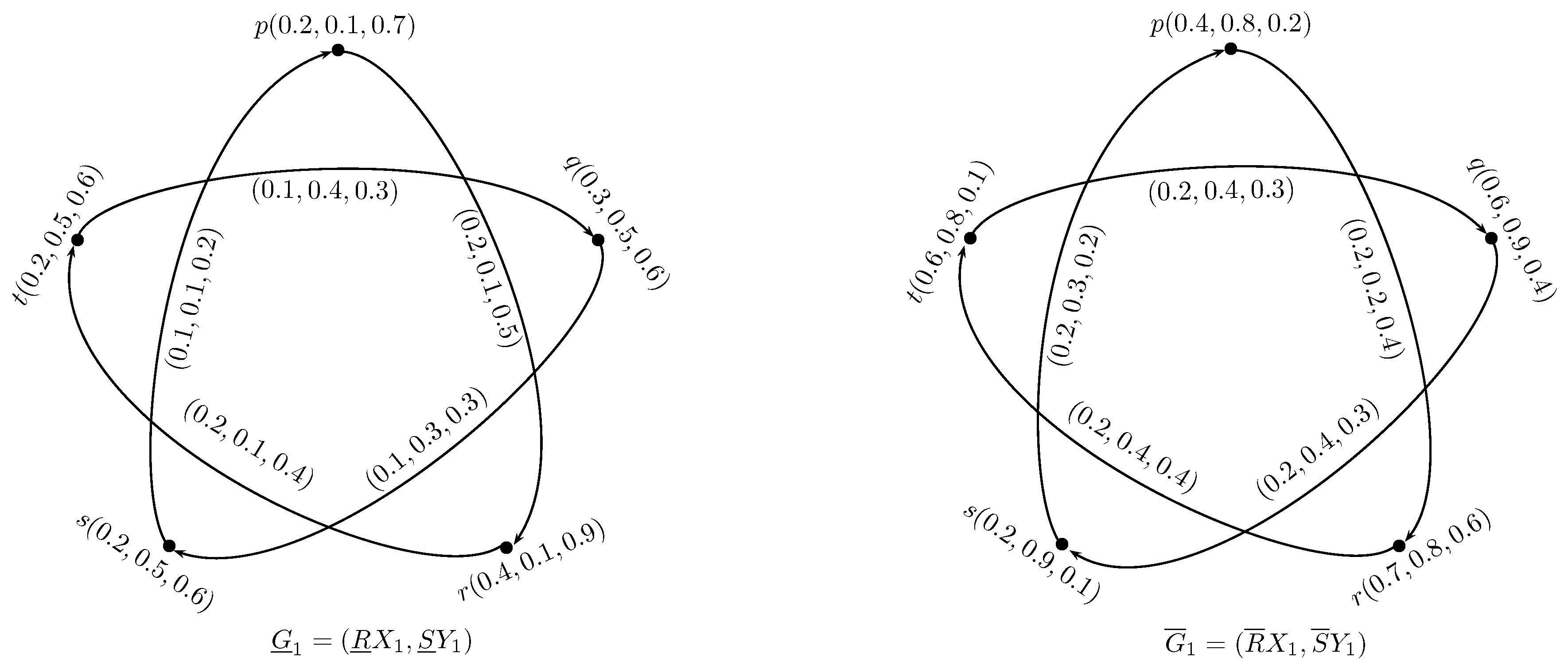
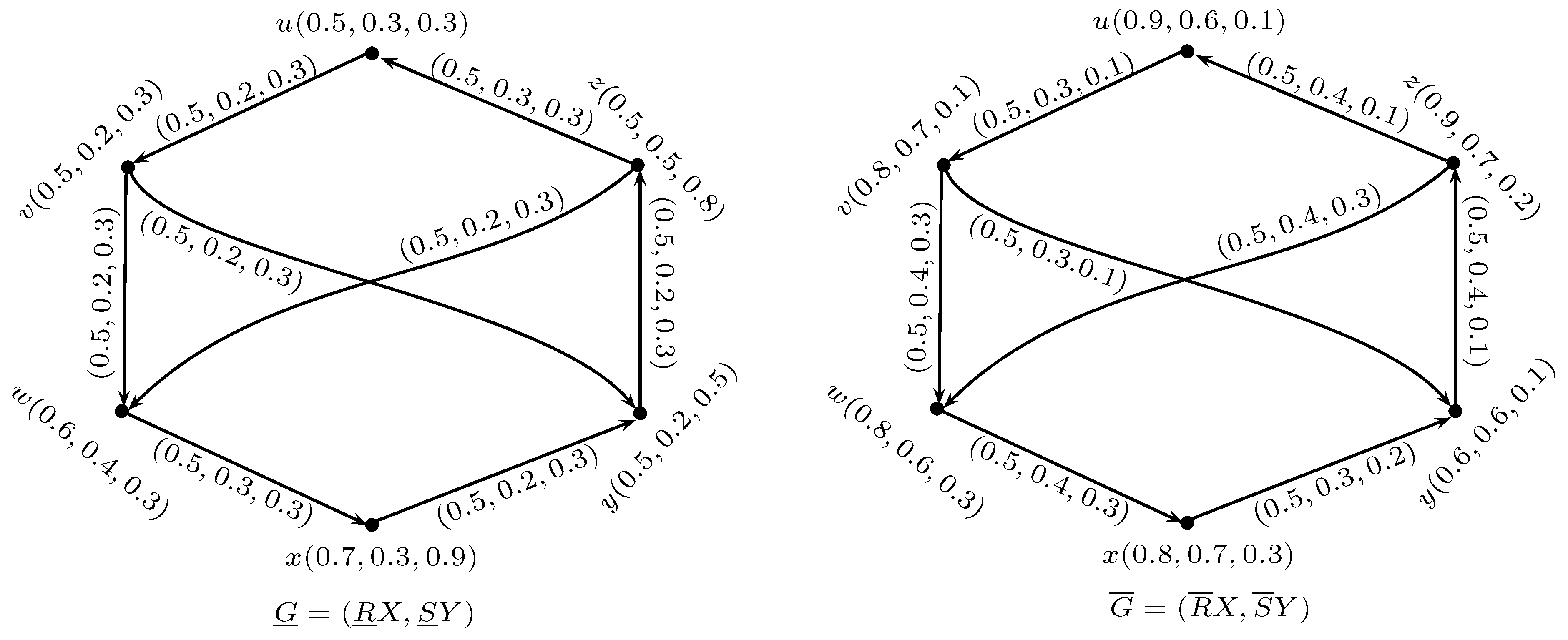
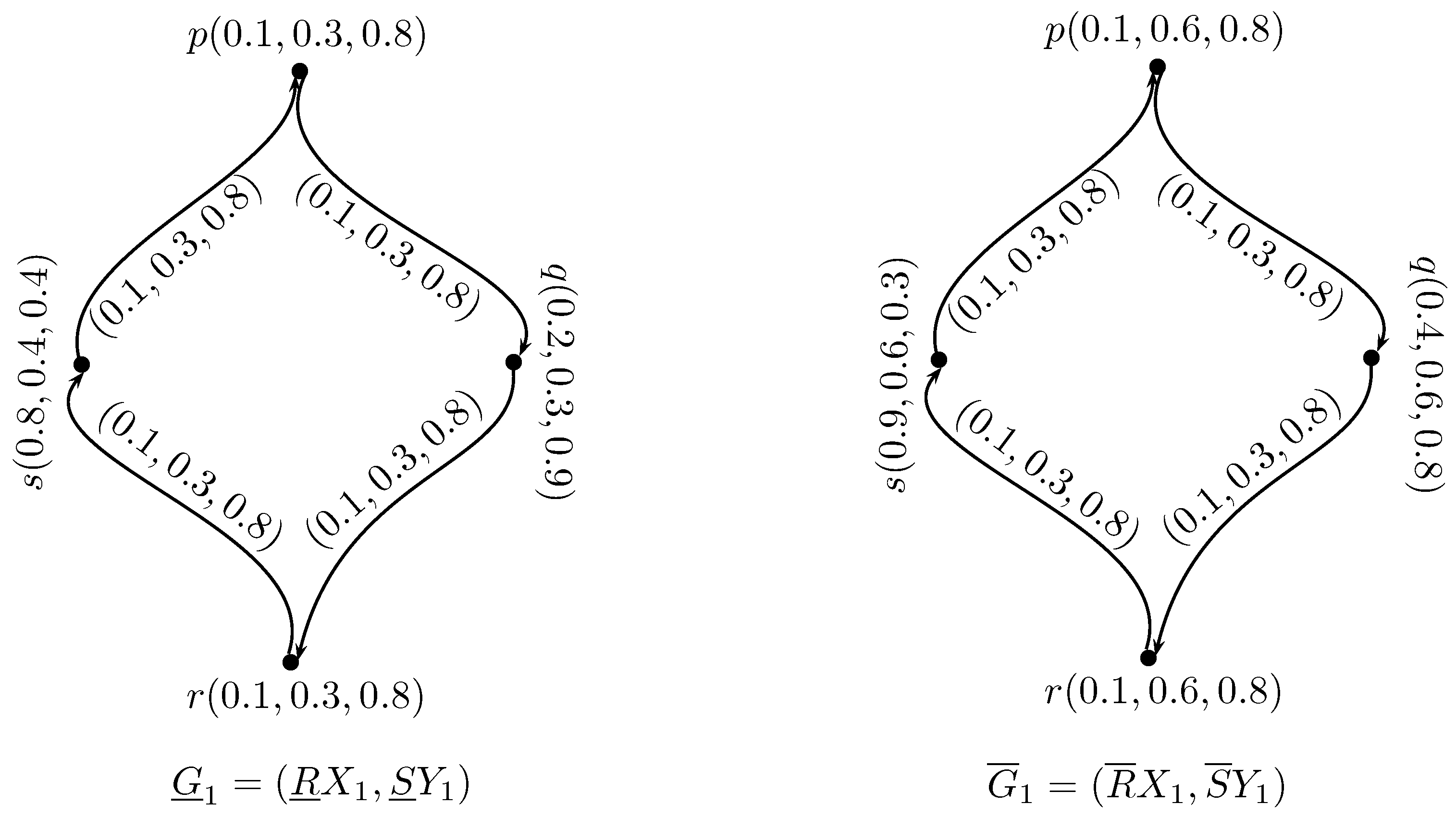
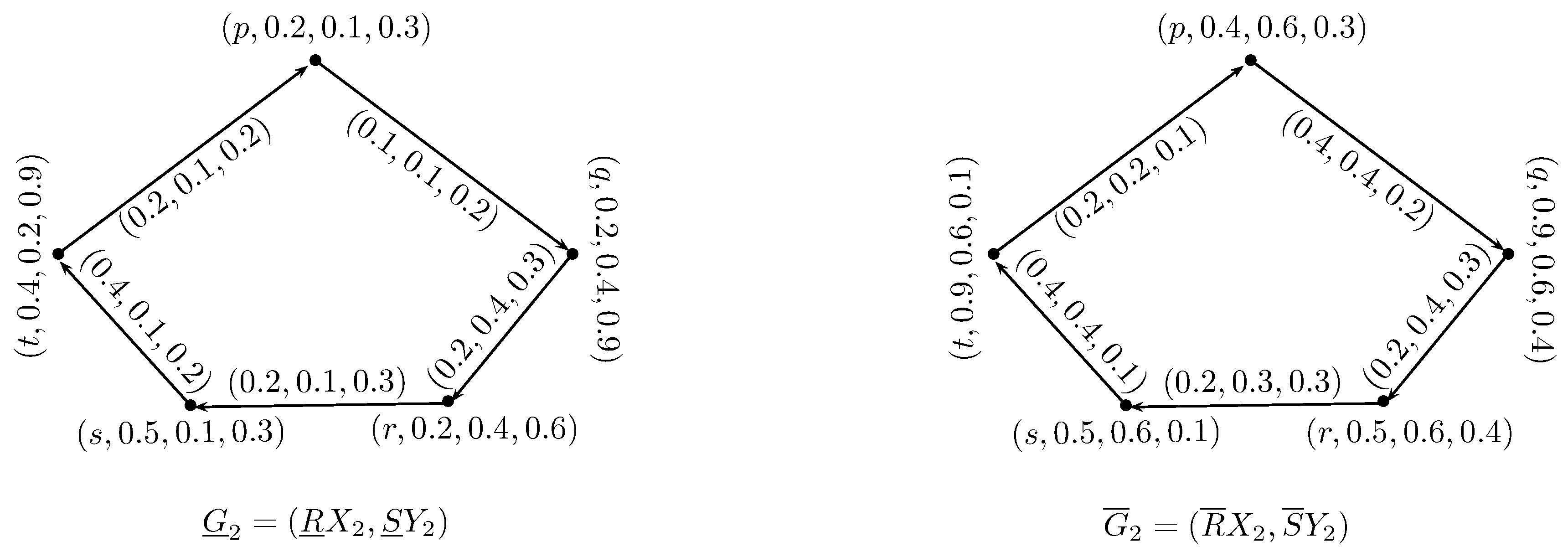
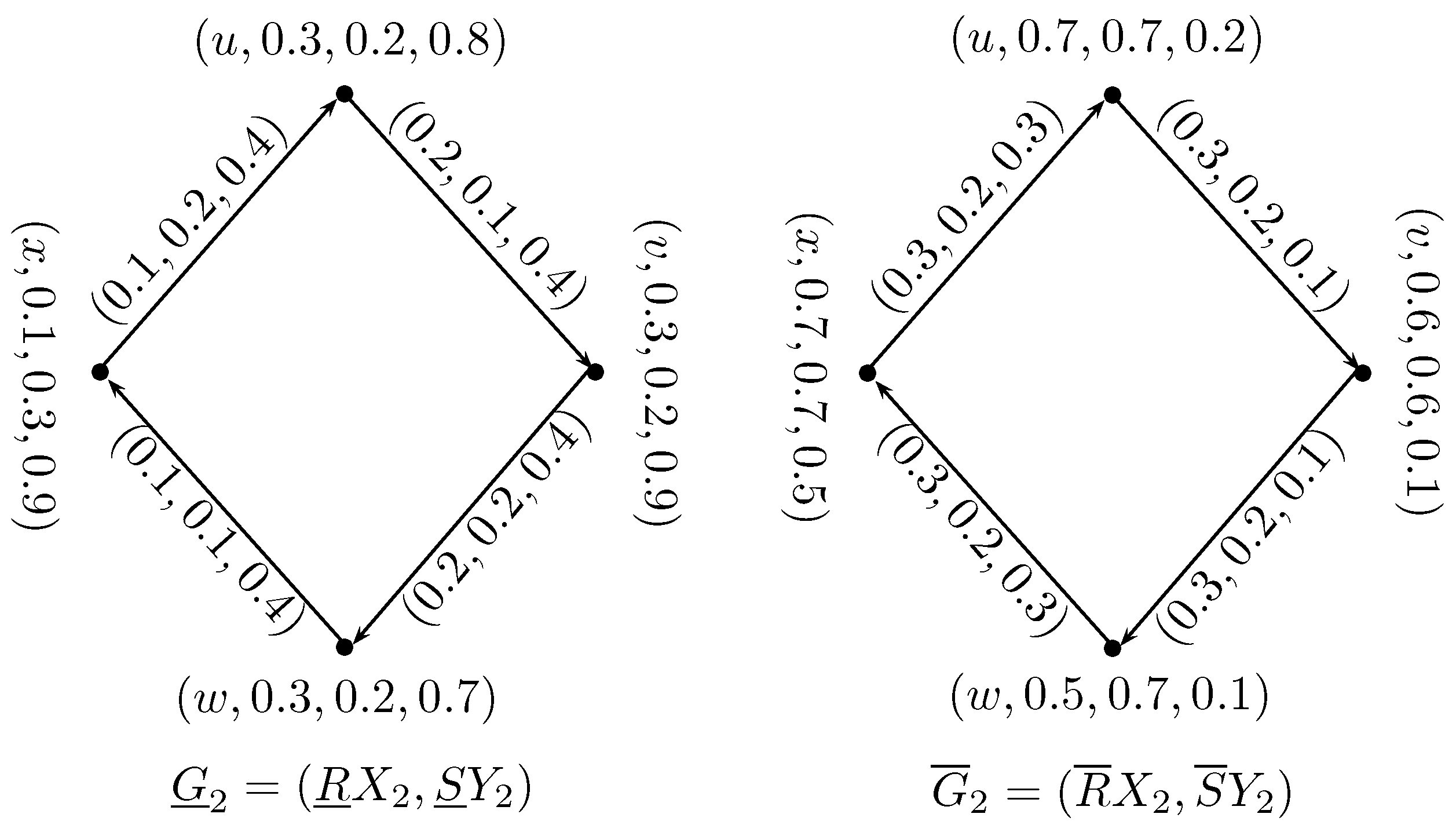
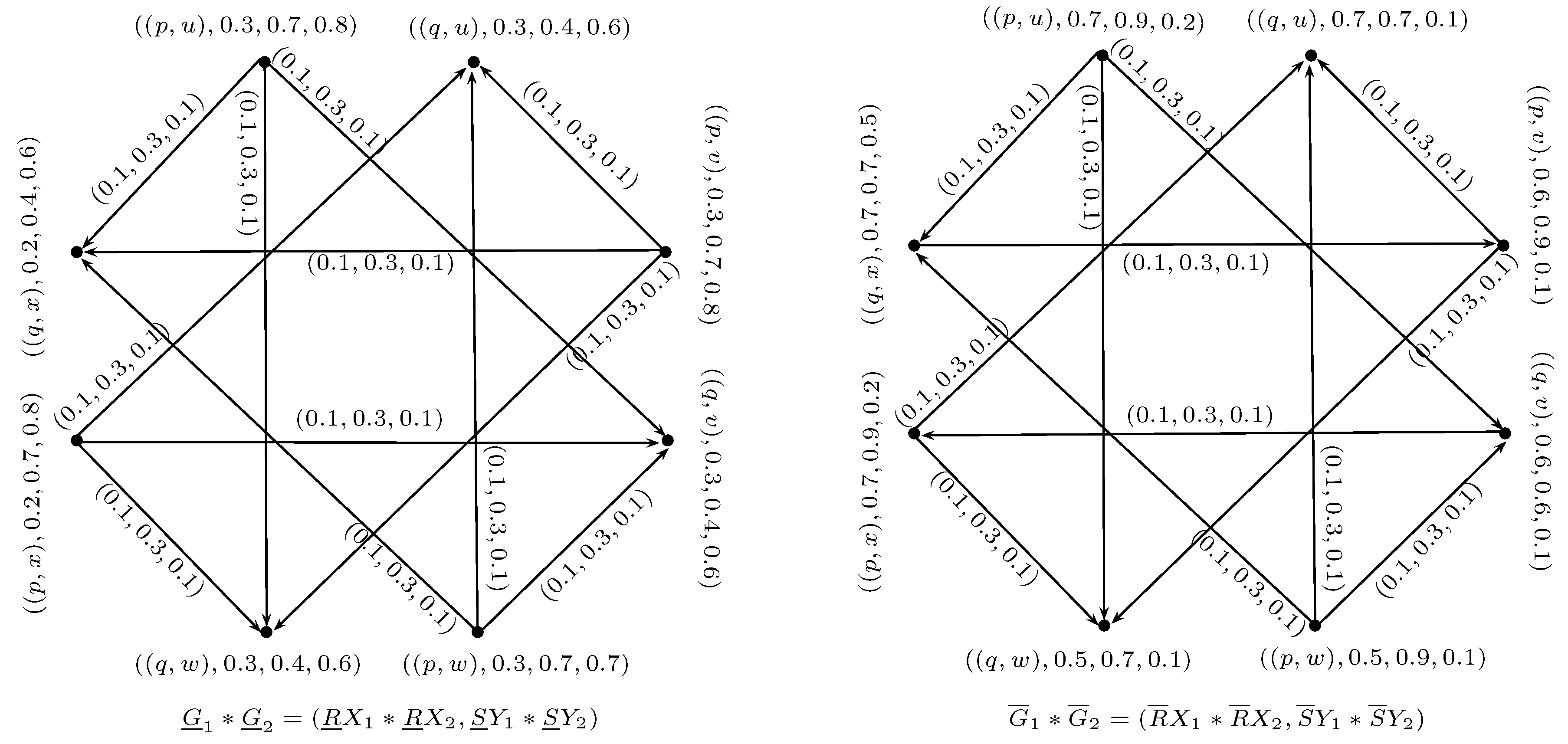
- is a neutrosophic rough digraph where and are lower and upper approximate neutrosophic digraphs of G such that
| R | p | q | r | s | t |
| p | (1,1,0) | (0.5,0.2,0.3) | (0.1,0.9,0.4) | (0.6,0.5,0.2) | (0.2,0.1,0.8) |
| q | (0.5,0.2,0.3) | (1,1,0) | (0.3,0.7,0.5) | (0.1,0.9,0.6) | (0.6,0.5,0.1) |
| r | (0.1,0.9,0.4) | (0.3,0.7,0.5) | (1,1,0) | (0.2,0.8,0.7) | (0.1,0.9,0.6) |
| s | (0.6,0.5,0.2) | (0.1,0.9,0.6) | (0.2,0.8,0.7) | (1,1,0) | (0.2,0.3,0.1) |
| t | (0.2,0.1,0.8) | (0.6,0.5,0.1) | (0.1,0.9,0.6) | (0.2,0.3,0.1) | (1,1,0) |
| S | |||||
| (1,1,0) | (0.2,0.2,0.7) | (0.1,0.9,0.6) | (0.1,0.5,0.4) | (0.2,0.1,0.8) | |
| (0.2,0.2,0.7) | (1,1,0) | (0.2,0.3,0.5) | (0.1,0.5,0.6) | (0.1,0.5,0.6) | |
| (0.1,0.9,0.6) | (0.2,0.3,0.5) | (1,1,0) | (0.2,0.1,0.8) | (0.1,0.5,0.6) | |
| (0.1,0.5,0.4) | (0.1,0.5,0.6) | (0.2,0.1,0.8) | (1,1,0) | (0.2,0.2,0.3) | |
| (0.2,0.1,0.8) | (0.1,0.5,0.6) | (0.1,0.5,0.6) | (0.2,0.2,0.3) | (1,1,0) |
| R | u | v | w | x | y | z |
| u | (1,1,0) | (0.2,0.3,0.5) | (0.5,0.6,0.9) | (0.3,0.8,0.3) | (0.3,0.2,0.1) | (0.1,0.1,0.5) |
| v | (0.2,0.3,0.5) | (1,1,0) | (0.9,0.5,0.6) | (0.1,0.5,0.7) | (0.8,0.9,0.1) | (0.8,0.9,0.1) |
| w | (0.5,0.6,0.9) | (0.9,0.5,0.6) | (1,1,0) | (0.3,0.6,0.8) | (0.2,0.3,0.6) | (0.7,0.6,0.6) |
| x | (0.3,0.8,0.3) | (0.1,0.5,0.7) | (0.3,0.6,0.8) | (1,1,0) | (0.5,0.1,0.9) | (0.8,0.7,0.2) |
| y | (0.3,0.2,0.1) | (0.8,0.9,0.1) | (0.2,0.3,0.6) | (0.5,0.1,0.9) | (1,1,0) | (0.6,0.5,0.9) |
| z | (0.1,0.1,0.5) | (0.8,0.9,0.1) | (0.7,0.6,0.6) | (0.8,0.7,0.2) | (0.6,0.5,0.9) | (1,1,0) |
| S | ||||||||
| (1,1,0) | (0.2,0.3,0.6) | (0.1,0.5,0.9) | (0.3,0.8,0.3) | (0.3,0.2,0.1) | (0.1,0.1,0.5) | (0.1,0.1,0.6) | (o.2,0.3,0.5) | |
| (0.2,0.3,0.6) | (1,1,0) | (0.3,0.5,0.8) | (0.1,0.3,0.7) | (0.7,0.6,0.6) | (0.5,0.6,0.9) | (0.8,0.9,0.1) | (0.2,0.3,0.6) | |
| (0.1,0.5,0.9) | (0.3,0.5,0.8) | (1,1,0) | (0.3,0.1,0.9) | (0.2,0.3,0.6) | (0.3,0.6,0.6) | (0.3,0.6,0.8) | (0.5,0.1,0.9) | |
| (0.3,0.8,0.3) | (0.1,0.3,0.7) | (0.3,0.1,0.9) | (1,1,0) | (0.5,0.1,0.9) | (0.3,0.2,0.2) | (0.2,0.3,0.6) | (0.1,0.5,0.7) | |
| (0.3,0.2,0.1) | (0.7,0.6,0.6) | (0.2,0.3,0.6) | (0.5,0.1,0.9) | (1,1,0) | (0.1,0.1,0.9) | (0.6,0.5,0.9) | (0.6,0.5,0.9) | |
| (0.1,0.1,0.5) | (0.5,0.6,0.9) | (0.3,0.6,0.6) | (0.3,0.2,0.2) | (0.1,0.1,0.9) | (1,1,0) | (0.5,0.6,0.9) | (0.3,0.3,0.1) | |
| (0.1,0.1,0.6) | (0.8,0.9,0.1) | (0.3,0.6,0.8) | (0.2,0.3,0.6) | (0,6,0.5,0.9) | (0.5,0.6,0.9) | (1,1,0) | (0.2,0.3,0.6) | |
| (0.2,0.3,0.5) | (0.2,0.3,0.6) | (0.5,0.1,0.9) | (0.1,0.5,0.7) | (0.6,0.5,0.9) | (0.3,0.2,0.1) | (0.2,0.3,0.6) | (1,1,0) |
| R | p | q | r | s |
| p | (1,1,0) | (0.1,0.9,0.8) | (0.7,0.5,0.8) | (0.1,0.9,0.8) |
| q | (0.9,0.8,0.1) | (1,1,0) | (0.1,0.9,0.8) | (0.4,0.3,0.9) |
| r | (0.7,0.5,0.8) | (0.1,0.9,0.8) | (1,1,0) | (0.1,0.9,0.8) |
| s | (0.1,0.9,0.8) | (0.4,0.3,0.9) | (0.1,0.9,0.8) | (1,1,0) |
| S | ||||
| (1,1,0) | (0.1,0.9,0.8) | (0.4,0.3,0.9) | (0.1,0.9,0.8) | |
| (0.1,0.9,0.8) | (1,1,0) | (0.1,0.9,0.8) | (0.4,0.3,0.9) | |
| (0.4,0.3,0.9) | (0.1,0.9,0.8) | (1,1,0) | (0.1,0.9,0.8) | |
| (0.1,0.9,0.8) | (0.4,0.3,0.9) | (0.1,0.9,0.8) | (1,1,0) |
- (1)
- (2)
3. Applications to Decision-Making
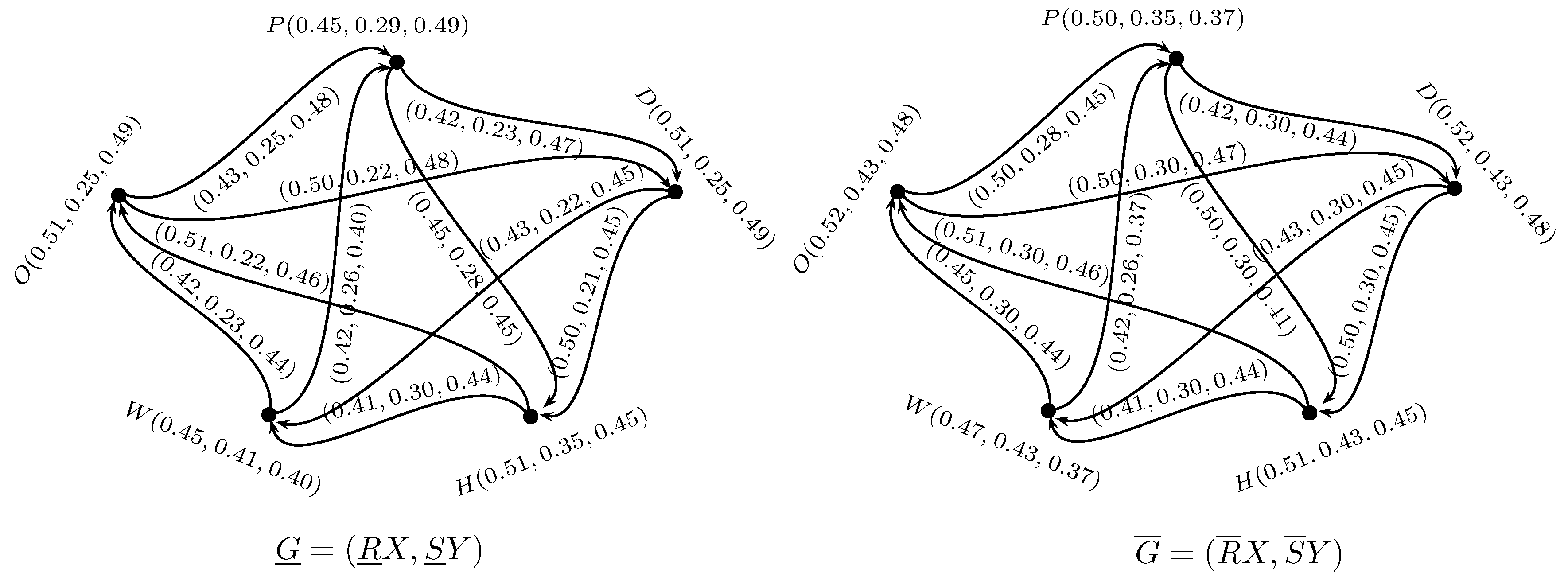
3.1. Online Reviews and Ratings
| R | P | D | H | W | O |
| P | (1,1,0) | (0.5,0.6,0.9) | (0.2,0.3,0.6) | (0.1,0.2,0.3) | (0.4,0.6,0.8) |
| D | (0.5,0.6,0.9) | (1,1,0) | (0.1,0.6,0.9) | (0.4,0.5,0.9) | (0.9,0.8,0.2) |
| H | (0.2,0.3,0.6) | (0.1,0.6,0.9) | (1,1,0) | (0.2,0.9,0.6) | (0.1,0.9,0.7) |
| W | (0.1,0.2,0.3) | (0.4,0.5,0.9) | (0.2,0.9,0.6) | (1,1,0) | (0.2,0.5,0.9) |
| O | (0.4,0.6,0.8) | (0.9,0.8,0.2) | (0.1,0.9,0.7) | (0.2,0.5,0.9) | (1,1,0) |
| S | (P,D) | (P,H) | (D,H) | (D,W) | (H,W) |
| (P,D) | (1,1,0) | (0.1,0.6,0.9) | (0.1,0.6,0.9) | (0.4,0.5,0.9) | (0.2,0.3,0.9) |
| (P,H) | (0.1,0.6,0.9) | (1,1,0) | (0.5,0.6,0.9) | (0.2,0.6,0.9) | (0.2,0.3,0.6) |
| (D,H) | (0.1,0.6,0.9) | (0.5,0.6,0.9) | (1,1,0) | (0.2,0.9,0.6) | (0.1,0.6,0.9) |
| (D,W) | (0.4,.5,.9) | (0.2,0.6,0.9) | (0.2,0.6,0.9) | (1,1,0) | (0.1,0.6,0.9) |
| (H,W) | (0.2,0.3,0.9) | (0.2,0.3,0.6) | (0.1,0.6,0.9) | (0.1,0.6,.9) | (1,1,0) |
| (H,O) | (0.2,0.3,0.6) | (0.1,0.3,0.7) | (0.1,0.6,0.9) | (0.1,0.5,0.9) | (0.2,0.5,0.9) |
| (W,P) | (0.1,0.2,0.9) | (0.1,0.2,0.6) | (0.2,0.3,0.9) | (0.1,0.2,0.9) | (0.1,0.2,0.6) |
| (W,O) | (0.1,0.2,0.3) | (0.1,0.2,0.7) | (0.1,0.5,0.9) | (0.2,0.5,0.9) | (0.2,0.5,0.9) |
| (O,P) | (0.4,0.6,0.9) | (0.2,0.3,0.8) | (0.2,0.3,0.6) | (0.1,0.2,0.3) | (0.1,0.2,0.7) |
| (O,D) | (0.4,0.6,0.8) | (0.1,0.6,0.9) | (0.1,0.6,0.9) | (0.4,0.5,0.9) | (0.1,0.5,0.9) |
| S | (H,O) | (W,P) | (W,O) | (O,P) | (O,D) |
| (P,D) | (0.2,0.3,0.6) | (0.1,0.2,0.9) | (0.1,0.2,0.3) | (0.4,0.6,0.9) | (0.4,0.6,0.8) |
| (P,H) | (0.1,0.3,0.7) | (0.1,0.2,0.6) | (0.1,0.2,0.7) | (0.2,0.3,0.8) | (0.1,0.6,0.9) |
| (D,H) | (0.2,0.3,0.9) | (0.1,0.5,0.9) | (0.2,0.3,0.6) | (0.1,0.6,0.9) | (0.1,0.6,0.9) |
| (D,W) | (0.1,0.2,0.9) | (0.2,0.5,0.9) | (0.1,0.2,0.3) | (0.4,0.5,0.9) | (0.1,0.5,0.9) |
| (H,W) | (0.1,0.2,0.6) | (0.2,0.5,0.9) | (0.1,0.2,0.7) | (0.1,0.5,0.9) | (0.2,0.5,0.9) |
| (H,O) | (1,1,0) | (0.2,0.6,0.8) | (0.2,0.9,0.6) | (0.1,0.6,0.8) | (0.1,0.8,0.7) |
| (W,P) | (0.2,0.6,0.8) | (1,1,0) | (0.4,0.6,0.8) | (0.2,0.5,0.9) | (0.2,0.5,0.9) |
| (W,O) | (0.2,0.9,0.6) | (0.4,0.6,0.8) | (1,1,0) | (0.2,0.5,0.9) | (0.2,0.5,0.9) |
| (O,P) | (0.1,0.6,0.8) | (0.2,0.5,0.9) | (0.2,0.5,0.9) | (1,1,0) | (0.5,0.6,0.9) |
| (O,D) | (0.1,0.8,0.7) | (0.2,0.5,0.9) | (0.2,0.5,0.9) | (0.5,0.6,0.9) | (1,1,0) |
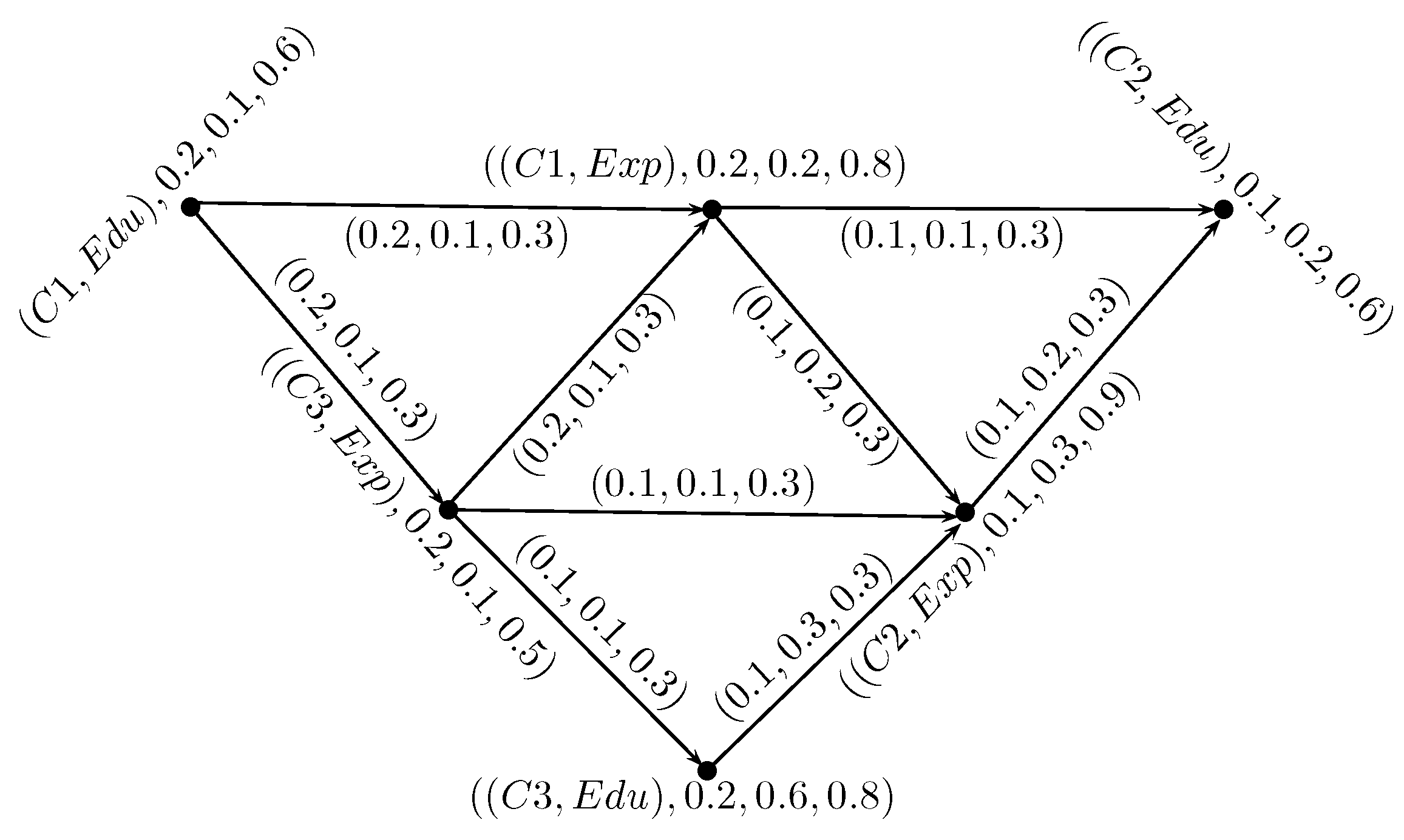
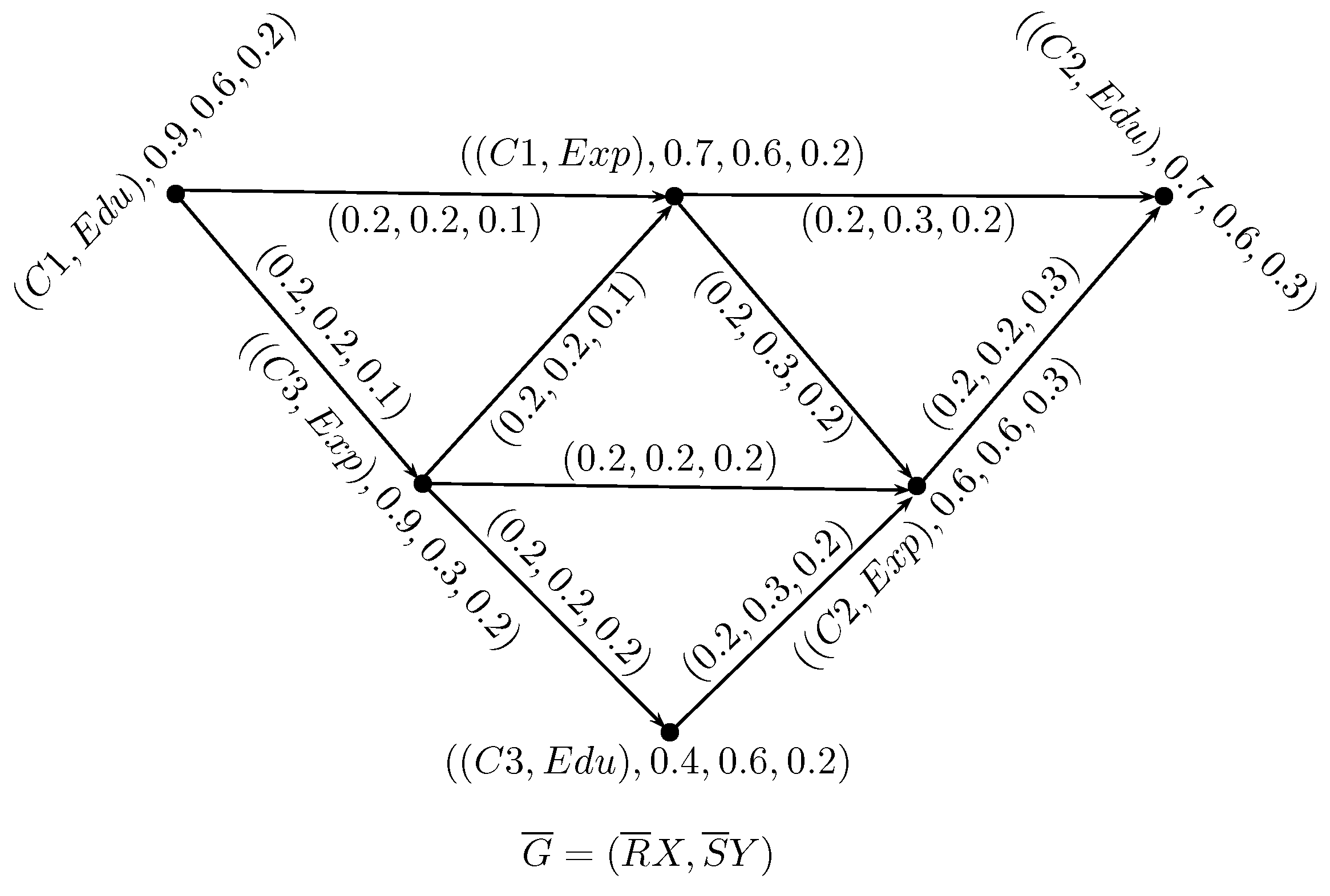
3.2. Context of Recruitment
| R | (C1,Edu) | (C1,Exp) | (C2,Edu) | (C2,Exp) | (C3,Edu) | (C3,Exp) |
| (C1,Edu) | (1,1,0) | (0.3,0.6,0.1) | (0.6,0.7,0.2) | (0.6,0.5,0.8) | (0.3,0.2,0.1) | (0.9,0.1,0.1) |
| (C1,Exp) | (0.3,0.6,0.1) | (1,1,0) | (0.9,0.9,0.3) | (0.8,0.7,0.6) | (0.4,0.5,0.9) | (0.3,0.1,0.1) |
| (C2,Edu) | (0.6,0.7,0.2) | (0.9,0.9,0.3) | (1,1,0) | (0.6,0.5,0.1) | (0.3,0.2,0.1) | (0.4,0.8,0.7) |
| (C2,Exp) | (0.6,0.5,0.8) | (0.8,0.7,0.6) | (0.6,0.5,0.1) | (1,1,0) | (0.1,0.1,0.2) | (0.5,0.6,0.7) |
| (C3,Edu) | (0.3,0.2,0.1) | (0.4,0.5,0.9) | (0.3,0.2,0.1) | (0.1,0.1,0.2) | (1,1,0) | (0.2,0.1,0.2) |
| (C3,Exp) | (0.9,0.1,0.1) | (0.3,0.1,0.1) | (0.4,0.8,0.7) | (0.5,0.6,0.7) | (0.2,0.1,0.2) | (1,1,0) |
| S | (C1,Edu)(C1,Exp) | (C1,Exp)(C2,Edu) | (C1,Edu)(C3,Exp) | (C3,Exp)(C1,Exp) | (C1,Exp)(C2,Exp) |
| (C1,Edu)(C1,Exp) | (1,1,0) | (0.3,0.6,0.3) | (0.3,0.1,0.1) | (0.9,0.1,0.1) | (0.3,0.6,0.6) |
| (C1,Exp)(C2,Edu) | (0.3,0.6,0.3) | (1,1,0) | (0.3,0.6,0.7) | (0.3,0.1,0.3) | (0.6,0.5,0.1) |
| (C1,Edu)(C3,Exp) | (0.3,0.1,0.1) | (0.3,0.6,0.7) | (1,1,0) | (0.3,0.1,0.1) | (0.3,0.6,0.7) |
| (C3,Exp)(C1,Exp) | (0.9,0.1,0.1) | (0.3,0.1,0.3) | (0.3,0.1,0.1) | (1,1,0) | (0.3,0.1,0.6) |
| (C1,Exp)(C2,Exp) | (0.3,0.6,0.6) | (0.6,0.5,0.1) | (0.3,0.6,0.7) | (0.3,0.1,0.6) | (1,1,0) |
| (C2,Exp)(C2,Edu) | (0.6,0.5,0.8) | (0.8,0.7,0.6) | (0.4,0.5,0.8) | (0.5,0.6,0.7) | (0.6,0.5,0.6) |
| (C3,Exp)(C2,Exp) | (0.8,0.1,0.6) | (0.3,0.1,0.1) | (0.5,0.1,.7) | (0.8,0.7,0.6) | (0.3,0.1,0.1) |
| (C3,Exp)(C3,Edu) | (0.4,0.1,0.9) | (0.3,0.1,0.1) | (0.2,0.1,.2) | (0.4,0.5,0.9) | (0.1,0.1,0.2) |
| (C3,Edu)(C2,Exp) | (0.3,0.2,0.6) | (0.4,0.5,0.9) | (0.3,.2,.7) | (0.2,0.1,0.6) | (0.4,0.5,0.9) |
| S | (C2,Exp)(C2,Edu) | (C3,Exp)(C2,Exp) | (C3,Exp)(C3,Edu) | (C3,Edu)(C2,Exp) |
| (C1,Edu)(C1,Exp) | (0.6,0.5,0.8) | (0.8,0.1,0.6) | (0.4,0.1,0.9) | (0.3,0.2,0.6) |
| (C1,Exp)(C2,Edu) | (0.8,0.7,0.6) | (0.3,0.1,0.1) | (0.3,0.1,0.1) | (0.4,0.5,0.9) |
| (C1,Edu)(C3,Exp) | (0.4,0.5,0.8) | (0.5,0.1,0.7) | (0.2,0.1,0.2) | (0.3,0.2,0.7) |
| (C3,Exp)(C1,Exp) | (0.5,0.6,0.7) | (0.8,0.7,0.6) | (0.4,0.5,0.9) | (0.2,0.1,0.6) |
| (C1,Exp)(C2,Exp) | (0.6,0.5,0.6) | (0.3,0.1,0.1) | (0.1,0.1,0.2) | (0.4,0.5,0.9) |
| (C2,Exp)(C2,Edu) | ( 1,1,0) | (0.5,0.5,0.7) | (0.3,0.2,0.7) | (0.1,0.1,0.2) |
| (C3,Exp)(C2,Exp) | (0.5,0.5,0.7) | (1,1,0) | (0.1,0.1,0.2) | (0.2,0.1,0.2) |
| (C3,Exp)(C3,Edu) | (0.3,0.2,0.7) | (0.1,0.1,0.2) | ( 1,1,0) | (0.1,0.1,0.2) |
| (C3,Edu)(C2,Exp) | (0.1,0.1,0.2) | (0.2,0.1,0.2) | (0.1,0.1,0.2) | (1,1,0) |
4. Comparative Analysis of Rough Neutrosophic Digraphs and Neutrosophic Rough Digraphs
| R | P | D | H | W | O |
| P | 1 | 0 | 1 | 0 | 1 |
| D | 0 | 1 | 0 | 0 | 0 |
| H | 1 | 0 | 1 | 0 | 1 |
| W | 0 | 0 | 0 | 1 | 0 |
| O | 1 | 0 | 1 | 0 | 1 |
| S | (P,D) | (P,H) | (D,H) | (D,W) | (H,W) | (H,O) | (W,P) | (W,O) | (O,P) | (O,D) |
| (P,D) | 1 | 0 | 0 | 0 | 0 | 0 | 0 | 0 | 0 | 0 |
| (P,H) | 0 | 1 | 0 | 0 | 0 | 1 | 0 | 0 | 1 | 1 |
| (D,H) | 0 | 0 | 1 | 0 | 0 | 0 | 0 | 0 | 0 | 0 |
| (D,W) | 0 | 0 | 0 | 1 | 0 | 0 | 0 | 0 | 0 | 0 |
| (H,W) | 0 | 0 | 0 | 0 | 1 | 0 | 0 | 0 | 0 | 0 |
| (H,O) | 0 | 1 | 0 | 0 | 0 | 1 | 0 | 0 | 1 | 1 |
| (W,P) | 0 | 0 | 0 | 0 | 0 | 0 | 1 | 1 | 0 | 0 |
| (W,O) | 0 | 0 | 0 | 0 | 0 | 0 | 1 | 1 | 0 | 0 |
| (O,P) | 0 | 1 | 0 | 0 | 0 | 1 | 0 | 0 | 1 | 1 |
| (O,D) | 0 | 1 | 0 | 0 | 0 | 1 | 0 | 0 | 1 | 1 |
5. Conclusions
Author Contributions
Acknowledgments
Conflicts of Interest
References
- Zadeh, L.A. Fuzzy sets. Inf. Control 1965, 8, 338–353. [Google Scholar] [CrossRef]
- Atanassov, K.T. Intuitionistic fuzzy sets. Fuzzy Sets Syst. 1986, 20, 87–96. [Google Scholar] [CrossRef]
- Smarandache, F. Neutrosophy: Neutrosophic Probability, Set, and Logic; American Research Press: Santa Fe, NM, USA, 1998. [Google Scholar]
- Wang, H.; Smarandache, F.; Zhang, Y.; Sunderraman, R. Single-valued neutrosophic sets. Multispace Multistructure 2010, 4, 410–413. [Google Scholar]
- Pawlak, Z. Rough sets. Int. J. Comput. Inf. Sci. 1982, 11, 341–356. [Google Scholar] [CrossRef]
- Dubois, D.; Prade, H. Rough fuzzy sets and fuzzy rough sets. Int. J. Gen. Syst. 1990, 17, 191–209. [Google Scholar] [CrossRef]
- Liu, P.; Chen, S.M. Group decision-making based on Heronian aggregation operators of intuitionistic fuzzy numbers. IEEE Trans. Cybern. 2017, 47, 2514–2530. [Google Scholar] [CrossRef] [PubMed]
- Mordeson, J.N.; Peng, C.S. Operations on fuzzy graphs. Inf. Sci. 1994, 79, 159–170. [Google Scholar] [CrossRef]
- Akram, M.; Shahzadi, S. Neutrosophic soft graphs with applicatin. J. Intell. Fuzzy Syst. 2017, 32, 841–858. [Google Scholar] [CrossRef]
- Akram, M.; Sarwar, M. Novel multiple criteria decision-making methods based on bipolar neutrosophic sets and bipolar neutrosophic graphs. Ital. J. Pure Appl. Math. 2017, 38, 368–389. [Google Scholar]
- Akram, M.; Siddique, S. Neutrosophic competition graphs with applications. J. Intell. Fuzzy Syst. 2017, 33, 921–935. [Google Scholar] [CrossRef]
- Akram, M.; Sitara, M. Interval-valued neutrosophic graph structures. Punjab Univ. J. Math. 2018, 50, 113–137. [Google Scholar]
- Akram, M.; Zafar, F. Rough fuzzy digraphs with application. J. Appl. Math. Comput. 2018. [Google Scholar] [CrossRef]
- Zafer, F.; Akram, M. A novel decision-making method based on rough fuzzy information. Int. J. Fuzzy Syst. 2018, 20, 1000–1014. [Google Scholar] [CrossRef]
- Broumi, S.; Smarandache, F.; Dhar, M. Rough neutrosophic sets. Neutrosophic Sets Syst. 2014, 3, 62–67. [Google Scholar]
- Yang, H.L.; Zhang, C.L.; Guo, Z.L.; Liu, Y.; Liao, X. A hybrid model of single valued neutrosophic sets and rough sets: Single valued neutrosophic rough set model. Soft Comput. 2016. [Google Scholar] [CrossRef]
- Nabeela, I.; Sayed, S.; Akram, M.; Smarandache, F. Notions of Rough Neutrosophic Digraphs. Mathematics 2018, 6, 18. [Google Scholar]
- Sidra, S.; Ishfaq, N.; Akram, M.; Smarandache, F. Rough Neutrosophic Digraphs with Application. Axioms 2018, 7, 5. [Google Scholar]
- Akram, M.; Shum, K.P. Bipolar neutrosophic planar graphs. J. Math. Res. Appl. 2017, 36, 631–648. [Google Scholar]
- Peng, H.G.; Zhang, H.Y.; Wang, J.Q. Probability multi-valued neutrosophic sets and its application in multi-criteria group decision-making problems. Neural Comput. Appl. 2016. [Google Scholar] [CrossRef]
- Ye, J. Multicriteria decision-making method using the correlation coefficient under single-valued neutrosophic environment. Int. J. General Syst. 2013, 42, 386–394. [Google Scholar] [CrossRef]
- Ye, J. Improved correlation coefficients of single valued neutrosophic sets and interval neutrosophic sets for multiple attribute decision-making. J. Intell. Fuzzy Syst. 2014, 27, 2453–2462. [Google Scholar]
- Smarandache, F. A Unifying Field in Logic. In Neutrosophy; American Research Press: Santa Fe, NM, USA, 1999. [Google Scholar]
- Akram, M.; Malik, H.M.; Shahzadi, S.; Smarandache, F. Neutrosophic Soft Rough Graphs with Application. Axioms 2018, 7, 14. [Google Scholar] [CrossRef]
- Banerjee, M.; Pal, S.K. Roughness of a fuzzy set. Inf. Sci. 1996, 93, 235–246. [Google Scholar] [CrossRef]
- Liu, P.; Chen, S.M.; Junlin, L. Some intuitionistic fuzzy interaction partitioned Bonferroni mean operators and their application to multi-attribute group decision-making. Inf. Sci. 2017, 41, 98–121. [Google Scholar] [CrossRef]
- Liu, P. Multiple attribute group decision-making method based on interval-valued intuitionistic fuzzy power Heronian aggregation operators. Comput. Ind. Eng. 2017, 18, 199–212. [Google Scholar] [CrossRef]
- Liang, R.X.; Wang, J.Q.; Zhang, H.Y. A multi-criteria decision-making method based on single-valued trapezoidal neutrosophic preference relations with complete weight information. Neural Comput. Appl. 2017. [Google Scholar] [CrossRef]
- Nie, R.X.; Wang, J.Q.; Zhang, H.Y. Solving solar-wind power station location problem using an extended weighted aggregated sum product assessment (WASPAS) technique with interval neutrosophic sets. Symmetry 2017, 9, 106. [Google Scholar] [CrossRef]
- Luo, S.Z.; Cheng, P.F.; Wang, J.Q.; Huang, Y.J. Selecting project delivery systems based on simplified neutrosophic linguistic preference relations. Symmetry 2017, 9, 151. [Google Scholar] [CrossRef]
- Zhang, X.; Dai, J.; Yu, Y. On the union and intersection operations of rough sets based on various approximation spaces. Inf. Sci. 2015, 292, 214–229. [Google Scholar] [CrossRef]
- Bao, Y.L.; Yang, H.L. On single valued neutrosophic refined rough set model and its application. J. Intell. Fuzzy Syst. 2017, 33, 1235–1248. [Google Scholar] [CrossRef]

| Good Reviews | Neutral | Bad Reviews | |
|---|---|---|---|
| PEL | |||
| Dawlance | |||
| Haier | |||
| Waves | |||
| Orient |
© 2018 by the authors. Licensee MDPI, Basel, Switzerland. This article is an open access article distributed under the terms and conditions of the Creative Commons Attribution (CC BY) license (http://creativecommons.org/licenses/by/4.0/).
Share and Cite
Akram, M.; Ishfaq, N.; Sayed, S.; Smarandache, F. Decision-Making Approach Based on Neutrosophic Rough Information. Algorithms 2018, 11, 59. https://doi.org/10.3390/a11050059
Akram M, Ishfaq N, Sayed S, Smarandache F. Decision-Making Approach Based on Neutrosophic Rough Information. Algorithms. 2018; 11(5):59. https://doi.org/10.3390/a11050059
Chicago/Turabian StyleAkram, Muhammad, Nabeela Ishfaq, Sidra Sayed, and Florentin Smarandache. 2018. "Decision-Making Approach Based on Neutrosophic Rough Information" Algorithms 11, no. 5: 59. https://doi.org/10.3390/a11050059
APA StyleAkram, M., Ishfaq, N., Sayed, S., & Smarandache, F. (2018). Decision-Making Approach Based on Neutrosophic Rough Information. Algorithms, 11(5), 59. https://doi.org/10.3390/a11050059

