Review

Recent Advances in the Fabrication of High-Performance Polypropylene Micro-Nano Composites via Supercritical Foaming

1
State Key Laboratory of Advanced Processing and Recycling of Non-Ferrous Metals, School of Materials Science and Engineering, Lanzhou University of Technology, Lanzhou 730050, China
2
Key Laboratory of Material Processing and Mold Technology, School of Electrical Engineering, Chongqing Industry Polytechnic University, Chongqing 401120, China
3
School of Materials Science and Engineering, Zhengzhou University, Zhengzhou 450001, China
*
Authors to whom correspondence should be addressed.
Materials 2026, 19(8), 1527; https://doi.org/10.3390/ma19081527
Submission received: 25 December 2025 / Revised: 9 February 2026 / Accepted: 3 April 2026 / Published: 10 April 2026

Abstract

Against the backdrop of the global trends toward lightweighting, multi-functionalization, and greening of materials, polypropylene (PP) has been extensively applied owing to its advantages of low density and low cost. However, its inferior foaming performance fails to meet high-end application requirements, which is primarily attributed to its low melt strength and restricted crystallization behavior. In this paper, the five-dimensional selection mechanism and classification of components for PP micro/nanocomposites fabricated via supercritical foaming are systematically summarized. The regulatory effects of micro/nano additives on the crystallization, rheological properties, and foaming behavior of PP are quantitatively analyzed. The parameter optimization windows of three foaming processes, namely batch foaming, extrusion foaming, and injection foaming, are integrated (e.g., a foaming temperature of 150–170 °C and a saturation pressure of 8–20 MPa). Additionally, the application progress of PP micro/nanocomposite foams in fields such as automotive lightweighting (with a weight reduction rate of 64.29%) and building thermal insulation (with a thermal conductivity as low as 29 mW/(m·K)) is outlined. The core novel insight of this work lies in clarifying the unified mechanism of crystal refinement induced by reinforcing agents with different geometric morphologies, which is dominated by the synergy between heterogeneous nucleation and steric hindrance. This finding provides theoretical and technical guidelines for the industrial-scale preparation of high-performance PP foams.

Graphical Abstract

1. Introduction

Against the backdrop of the global materials industry transitioning towards lightweighting, multi-functionality, and greenization [1,2,3], general thermoplastic polymers have become core materials in automotive, construction, electronic information, and other fields due to their excellent processing adaptability and cost advantages [4,5]. As one of the highest-yield general polyolefins, polypropylene (PP) has been widely applied owing to its low density (0.90–0.91 g/cm3) [6], outstanding chemical stability [7], high processing fluidity [8], and low cost [9].
However, the linear molecular chain structure of PP leads to low melt strength and poor viscoelasticity, resulting in defects such as cell collapse and coalescence during foaming. This makes the performance of pure PP foams unable to meet the requirements of high-end applications. For instance, the cell diameter of pure isotactic polypropylene (iPP) foams can reach 174.63 μm, with a cell density of only 5.07 × 10⁵ cells/cm3 and a thermal conductivity as high as 40–50 mW/(m·K) [10]. The 5G base station casings require electromagnetic interference shielding effectiveness (EMI SE) > 5 dB [11] and lithium battery thermal insulation pads thermal conductivity < 30 mW/(m·K) [12]. Additionally, PP exhibits a slow crystallization rate and its crystal structure is susceptible to processing conditions, which further limits the optimization space of its foaming performance [13,14,15]. Thus, modification methods are urgently needed to break through the aforementioned bottlenecks.
To enhance the performance and functional integration of PP foams, researchers have adopted chemical modification and physical modification [16]. Among them, micro-nano composite modification is the current research hotspot. The micro or nano fillers were introduced into polypropylene matrix to achieve the synergistic reinforcement of composite properties [17]. It also solves the problems of insufficient melt strength and low nucleation efficiency [18]. Supercritical foaming technology, using supercritical CO2(scCO2) or N2(scN2) as physical blowing agents, is a core solution for PP foaming pain points, featuring environmental friendliness, high gas solubility, and controllable cell structure [19]. Compared with traditional chemical/solvent-based physical foaming, it enables directional cell structure design of PP micro-nano composites via precise control of saturation pressure and foaming temperature [20]. Additionally, the scCO2 plasticizing effect reduces PP crystallization temperature and accelerates crystallization, synergizing with micro-nano reinforcements’ heterogeneous nucleation to optimize foam performance [21]. This technology has developed into batch foaming (laboratory precision regulation) [22], continuous extrusion foaming (large-scale production) [23], and precision open-mold injection foaming (complex part fabrication) [24].
Based on this, this paper systematically reviews the research progress in the preparation of PP micro-nano composites via supercritical foaming. It first elaborates on the composition design and compounding mechanism of PP micro-nano composite systems. Then, it explores the regulatory mechanisms of micro-nano reinforcements on the crystallization behavior, rheological properties of PP, and their synergistic effects with the supercritical foaming process. The integration of supercritical foaming processes (batch, extrusion, injection) and parameter optimization rules are analyzed. Subsequently, the application status of such materials in automotive lightweighting, building fireproof insulation, packaging protection, and emerging fields is summarized. Finally, the key bottlenecks in current research are pointed out, and the future development directions of raw material innovation, process intelligence, and functional integration are prospected. This paper provides relevant enlightenment and reference or guidance for researchers.

2. Selection Mechanism and Classification of Micro-Nano Additives

2.1. Properties of PP Matrix

As a typical semi-crystalline thermoplastic, PP possesses intrinsic physicochemical properties that make it a preferred matrix for high-performance supercritical fluid foamed materials. Its linear molecular chain with saturated C-C bonds and methyl side groups endows excellent resistance to acids, alkalis, organic solvents, and supercritical fluids, while supercritical CO2 solubility in PP lays the foundation for fine, dense cell formation [25]. PP exhibits superior lightweight mechanical synergy: its intrinsic density (0.90–0.91 g/cm3) drops to 0.1–0.5 g/cm3 post-foaming, and crystallinity adjustment balances rigidity and toughness, resulting in >90% closed cell content and mechanical stability exceeding expanded polystyrene and polyethylene [26]. The three main types of PP foam materials are shown in Table 1.
With a suitable melt flow index, PP is compatible with conventional injection molding/extrusion equipment, reducing industrialization costs [27,28]. Economically and environmentally, PP can be recycled and paired with non-toxic supercritical foaming, aligning with sustainability trends [29]. Despite these advantages, PP’s inherent properties and crystallization characteristics induce three critical bottlenecks limiting foam quality and industrialization. First, linear molecular chains with insufficient entanglement lead to low melt strength, causing cell wall rupture/coalescence during expansion [30,31]. Long-chain branching modification improves melt strength but increases process complexity and costs by 10–30%. Second, sensitive crystallization kinetics results in poor foam uniformity, with cell distribution coefficient of variation > 20% due to uneven industrial cooling [32,33]. Third, dominant α-crystal structure and high low-temperature crystallinity cause poor toughness: impact strength decreases by 30–50% below 0 °C, and toughening via crystallinity reduction sacrifices rigidity [34]. To address these intrinsic bottlenecks, micro-nano additives have emerged as a versatile modification strategy, simultaneously regulating the matrix structure and the foaming mechanisms.
Table 1. The three main types of PP foam materials.
PP TypeMolecular StructureCrystallinityCell Density (Cells/cm3)Ref.
iPPLinear chain65%5.07 × 10⁵~2.3 × 10⁹[18,35]
LCBPPLong-chain branched55%1.0 × 10¹⁰~5.4 × 10¹¹[36]
HPPBlended elastomer45%8.0 × 10⁸~3.5 × 10⁹[37]

2.2. Selection Mechanism of Micro-Nano Modification Reinforcements

The selection of micro-nano additives in the PP matrix for supercritical foaming relies on five core mechanisms, which synergistically address PP foaming bottlenecks and ensure the stability of the “polymer–gas” homogeneous system.
(1) Thermal stability. The thermal decomposition temperature of micro-nano additives must exceed the supercritical CO2 foaming temperature of PP [38]. This prevents additive degradation during foaming, thereby maintaining the thermal stability of the foaming system. (2) Compatibility. Additives should form stable interfacial interactions (e.g., van der Waals forces, hydrogen bonds, and chemical bonds) with PP molecular chains to optimize interfacial bonding and mitigate phase separation [39,40], effectively suppressing gas escape during foaming. (3) CO2 solubility promotion. Additives need to possess interaction sites (e.g., dipole interactions or van der Waals forces) with CO2, which enhances CO2 solubility in the PP matrix [41]. This mechanism lays the foundation for constructing the homogeneous “polymer–gas” system required for supercritical foaming. (4) Melt strength enhancement. The melt strength and elasticity of PP are improved via two pathways: (i) introducing long branches on PP molecular chains to increase chain entanglement density [42]; and (ii) forming a network structure in the matrix (e.g., graphene) to restrict molecular chain sliding [43], in order to inhibit cell wall rupture during foaming process. (5) Nucleation assistance. Micro-nano additives act as heterogeneous nucleation sites, reducing the nucleation free energy barrier (by >70% compared to homogeneous nucleation) to improve nucleation efficiency and cell uniformity [44]. This mechanism supports the preparation of microcellular (<10 μm) and nanoporous PP foams.
This correlation fills the adaptation gap between PP and supercritical foaming, providing core support for subsequent process optimization, performance regulation, and application expansion.

2.3. Classification of Micro-Nano Reinforcements

With the design objectives of adapting to supercritical foaming processes, synergistically regulating foam properties, and endowing functional characteristics, the core components of PP micro-nano composites form a synergistic system through precise proportioning [45,46].
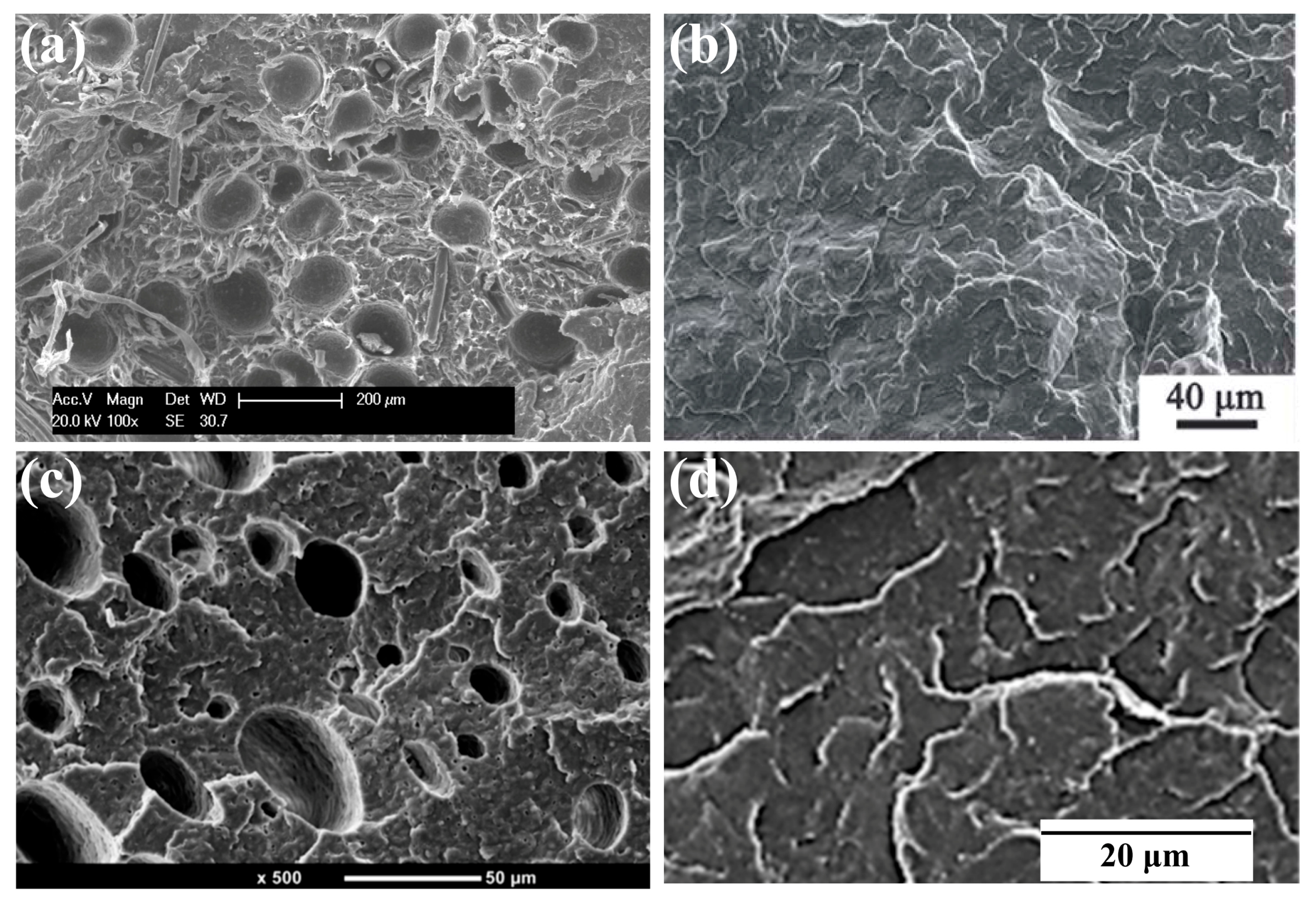
Specifically, micro-nano reinforcements are classified into four categories based on their materials. (1) Natural fibers (bamboo fiber, BF; sisal fiber, SFS) with a content range of 10–40%, where 20 wt.% BF can enhance the tensile strength of PP foam by 57% and under the testing conditions of foam density of 0.1 g/cm3 and compression rate of 1 mm/min, the incorporation of 40 wt.% SFS enhances the compressive strength of PP foam from 0.05 MPa to 1.55 MPa [16,47] (Figure 1a). (2) Inorganic nanoparticles (nano-TiO2, carbon nanotubes, CNTs, graphene, and MS) with a content of 1–15%; for instance, 3 wt.% nano-TiO2 reduces the spherulite diameter of PP from 80 μm to 20 μm and increases the crystallization temperature by 3 °C, while 12 wt.% CNTs enable the electromagnetic interference shielding effectiveness (EMI SE) of iPP/HDPE bilayer foam to reach 37.32 dB [48,49,50] (Figure 1b). (3) Polymer microfibers (polybutylene terephthalate, PBT; polytetrafluoroethylene, PTFE microfibers) with a content of 2–8%, among which 8 wt.% PBT microfibers (aspect ratio > 100) increase the melt complex viscosity (η) by three times, and 5 wt.% PTFE microfibers inhibit cell coalescence and reduce the cell diameter by one order of magnitude [51,52] (Figure 1c). (4) Elastomers (ethylene-propylene-diene monomer, EPDM; polyolefin elastomer, POE) with a content range of 5–20%, where 10 wt.% EPDM increases the impact toughness of BF/PP foam by 34.42% and 20 wt.% POE allows the open cell content of PP foam to exceed 80% [53,54] (Figure 1d).

3. Molding Processes and Optimization

3.1. Types of Supercritical Foaming Molding Processes

3.1.1. Batch Foaming

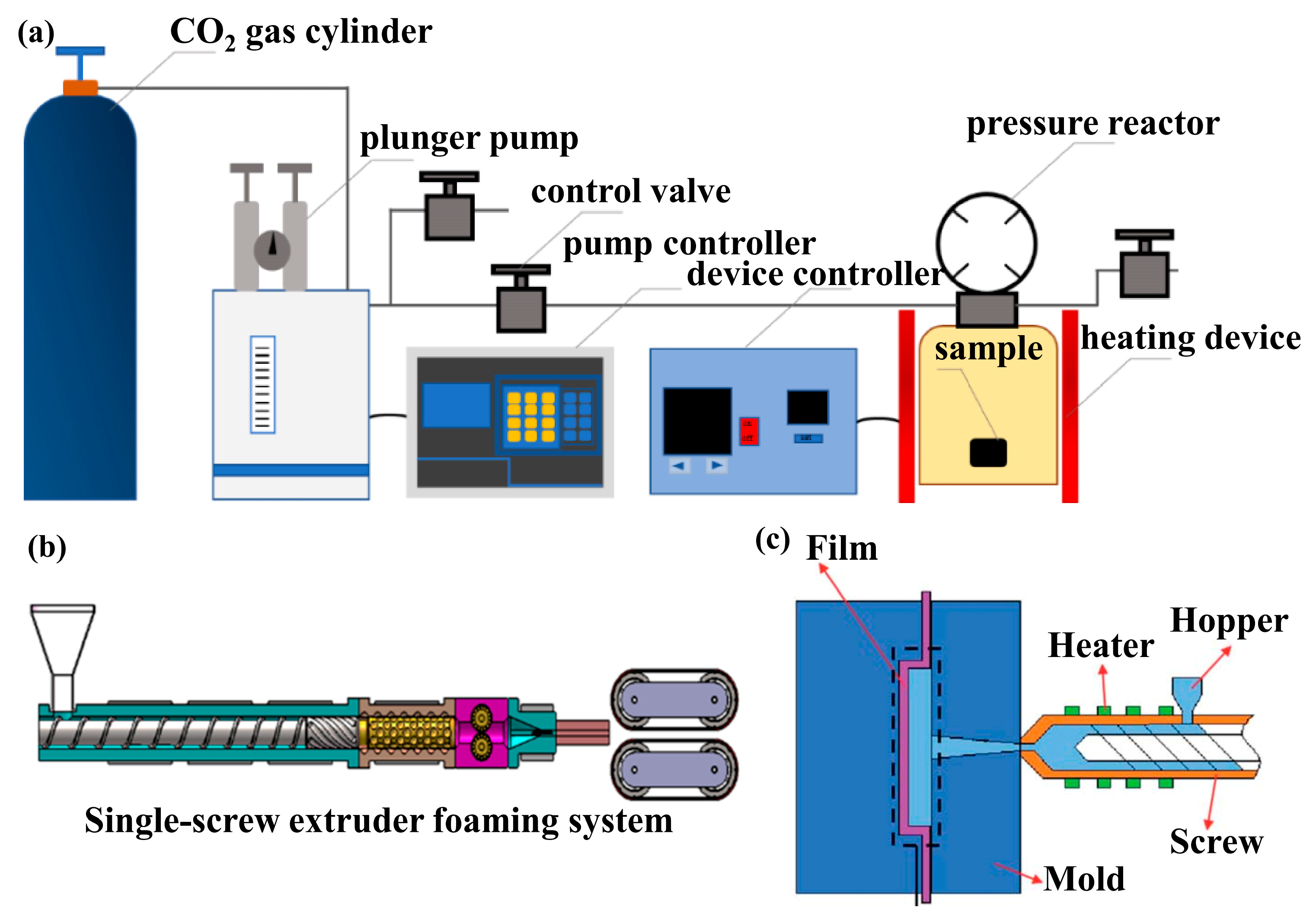
Depending on the differences in production scale and product requirements, the specific processes and technical key points of supercritical foaming vary significantly. Batch supercritical foaming is mainly applied in laboratory research and small-batch production, with three core stages: (1) melting–saturation: dissolution of SCCO2 in PP melt; (2) crystallization induction: cooling to annealing temperature to form partially melted crystals; (3) rapid depressurization and cooling to finalize the structure. Its core advantage is precise cellular structure regulation. Thermodynamic supersaturation (triggered by rapid depressurization or heating) initiates nucleation, followed by gas dissolution–diffusion for cell growth and rapid cooling for stabilization. It features high nucleation efficiency, uniform cell morphology, and high cell density (Figure 2a).
Nucleation efficiency (ηn) is defined as the ratio of the actual nucleation number to the theoretical maximum nucleation number, which is calculated by the formula:
η n = N a N t
where N a denotes the actual nucleation number with the unit of cells/cm3, and N t represents the theoretical maximum nucleation number derived from the classical nucleation theory. Specifically, N t is expressed as [58]:
N t = ( G n u c l e u s ) 2 k T l n ( S )
In the aforementioned formulas, G n u c l e u s is the nucleation free energy, k is the Boltzmann constant, T refers to the foaming temperature, and S stands for the supersaturation degree.

3.1.2. Extrusion Foaming

Continuous extrusion foaming focuses on large-scale production, with a process that sequentially includes raw material mixing (blending PP, reinforcements, and additives in proportion), melt blending, supercritical gas injection, homogeneous system formation (achieving uniform component dispersion through shear action in the mixing section), die foaming (controlling the temperature at 150–170 °C and realizing a rapid pressure drop), and cooling setting [24]. The technical keys of this process are screw structure design and die temperature control—for example, the use of a barrier screw can significantly improve mixing efficiency, and by optimizing process parameters, PP/POE blends can be processed via continuous extrusion foaming to prepare oil-absorbing foams with high open-cell content (85%) [59] (Figure 2b).

3.1.3. Injection Foaming

Precision open-mold injection foaming integrates rapid heat cycle molding and precision open-mold technology, with a specific process: First, the melt injection is performed, followed by gas saturation with scN2. Then, the mold is heated to 120 °C via rapid thermal cycling. Subsequently, precision open-molding is completed with an opening distance of 2–10 mm and an opening rate of 50 mm/s. Finally, the finished product is obtained after cooling setting [60]. Sandwich-structured foams were prepared using environmentally friendly scN2 as the physical blowing agent, with the fabrication process and final morphology shown in Figure 2c [61]. The mixture is injected into the mold through a nozzle. Due to the low temperature and pressure of the mold, thermodynamic imbalance is rapidly generated, triggering cell nucleation, and cells grow and set in the mold. The ability to use molding dies with specific desired shapes allows for the production of parts with complex geometries. The comparison of extrusion foaming and injection foaming is shown in Table 2.
Figure 2. Schematic diagrams of different supercritical foaming processes: (a) batch foaming; (b) extrusion foaming [62]; (c) injection foaming [63].
Materials 19 01527 g002
Table 2. Comparison of extrusion foaming and injection foaming.
Comparison DimensionExtrusion FoamingInjection FoamingRef.
Molding CycleContinuous molding, typical cycle < 1 min per unit length (sheet/strand)Intermittent molding, cycle 3–10 min per part[64]
Product StructureLimited to simple shapes (sheet, rod, tube, profile)Complex shapes[65]
Cell OrientationOriented along the extrusion direction (orientation degree > 0.6)No obvious orientation (orientation degree < 0.2)[66]
Production OutputHigh output, typically >100 kg/hLow output, typically <20 kg/h[67]

3.2. Optimization of Key Parameters

Process parameters exert a significant influence on the stability of the “polymer–gas” homogeneous system and the formation of cellular structures, with the optimization rules of core parameters elaborated as follows:
(1)
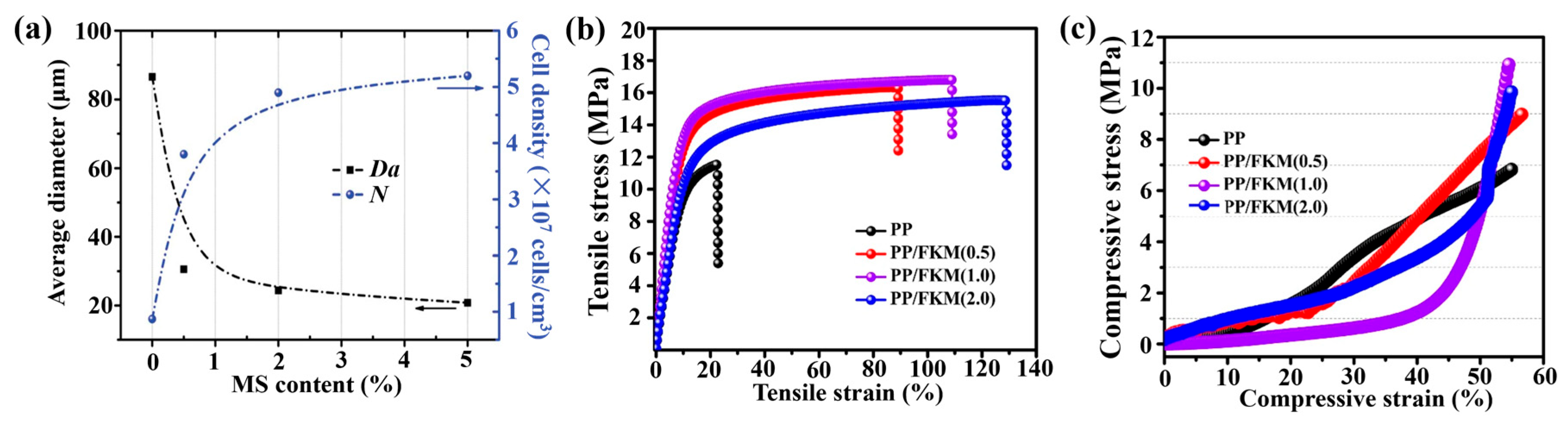
Regarding the foaming temperature (Tf), the cell density was greater than 109 cells/cm3, the expansion ratio was no less than 5, and the cell coalescence rate was less than 5%. It needs to match the crystallization and melting characteristics of PP, typically with an optimal range of 150–170 °C: Tf < 150 °C will increase the melt viscosity, thereby restricting cell growth; Tf > 170 °C will cause a sharp decrease in melt strength, easily leading to cell coalescence. Summaries of the properties (average cell size and cell density) of the cellular structure of the PP/MS composite foams as a function of MS content [56] can be seen in Figure 3a.
(2)
The optimal saturation pressure (Pf) range is 8–20 MPa, and the cell density increases by more than two orders of magnitude: increased pressure enhances gas solubility in the polymer, promoting heterogeneous nucleation. For the PP/GF30 composite, cell density at Pf = 16 MPa is 40% higher than that at Pf = 10 MPa [38]. However, Pf > 20 MPa triggers excessive scCO2-induced polymer plasticization, reducing melt strength and causing cell coalescence [68]. Pf rises from 10 MPa to 20 MPa, cell density increases by ~2 orders of magnitude, and cell size decreases to <5 μm. This is attributed to stronger nucleation driving force from high-pressure depressurization; meanwhile, enhanced CO2 plasticization of the matrix elevates the expansion ratio [69]. The mechanical properties of the resultant PP foam are the important evaluation parameters for potential industrial applications. The tensile stress–strain and compressive stress–strain curves of neat PP and PP/FKM foams are shown in Figure 3b,c.
(3)
In terms of the optimization of annealing temperature (Ta), partially melted crystals were formed, with an equilibrium CO2 solubility of ≥0.05 g/g. This parameter is mainly used to regulate the crystallization morphology of PP, with an optimal range of 110–130 °C. If Ta < 120 °C, the CO2 solubility will decrease, while Ta > 130 °C makes it difficult to form partially melted crystals, leading to insufficient melt strength [21]. The broadband dielectric constant and loss of the PP/1.0 wt.% CNT composite before and after the isothermal annealing at different temperatures [70] are measured, which confirms that the annealing treatment under supercritical carbon dioxide can effectively regulate the conductive network and dielectric properties of the composites.
(4)
The mold opening distance and rate jointly determine cell expansion space: For the PP/GF30 composite, a 3.4-fold expansion ratio and 75% porosity are achieved at 10 mm distance and 50 mm/s rate; a distance of <2 mm restricts cell growth, while >10 mm induces foam deformation [60]. The density variation in foamed PP and PP/GF30 with mold opening distance [58] is depicted. The cell density/average diameter vs. residence time is demonstrated: extended residence time increases cell density and reduces size, confirming that longer residence time improves the cell structure [71].
(5)
For gas selection: scCO2 suits most PP composite systems (due to its excellent plasticizing effect), while scN2 (with a lower diffusion rate) is preferable for thick-walled component foaming. For thin-walled products (<5 mm), scCO2 was preferred; for thick-walled products (>10 mm), scN2 was selected. Regarding process integration—it covers three typical processes (precision injection molding, continuous extrusion, batch foaming), with continuous extrusion achieving a 28-fold expansion ratio [72]. Core parameter ranges are clarified, and parameter coupling effects require experiment–model collaborative optimization to stabilize the “polymer–gas” homogeneous system (Table 3).
Table 3. Summary of core parameter optimization for supercritical foaming.
Parameter TypeOptimization RangeInfluence MechanismRefs.
Tf150–170 °C<150 °C: high melt viscosity restricts cell growth.
>170 °C: sharp drop in melt strength causes cell coalescence.
[73]
Pf8–20 MPaIncreased pressure enhances gas solubility to promote heterogeneous nucleation. Pf > 20 MPa: excessive plasticization by scCO2 decreases melt strength.[74]
Ta110–130 °CRegulates crystallization morphology. At Ta = 125 °C, partially melted crystals form to balance melt strength and CO2 solubility.[75,76]
Mold Opening
Parameters
Distance
2–10 mm,
Rate 50 mm/s
Mold opening distance determines expansion space; if <2 mm it restricts cell growth, if >10 mm it causes deformation.[77]
Gas TypescCO2, scN2scCO2 has strong plasticizing effects.
scN2 is suitable for foaming thick-walled components.
[78]
Figure 3. (a) Average cell size and cell density of PP and PP/MS nanocomposite foams saturated at 20 MPa and foamed at 154 °C [56]. Mechanical properties of neat PP and PP/FKM foams: (b) tensile strength and (c) compressive strength [79].
Materials 19 01527 g003

4. Regulation of Micro-Nano Additives on the Properties of PP Matrix

4.1. Regulation of Micro-Nano Reinforcements on the Crystallization Behavior of PP

4.1.1. Improvement of Crystallization Temperature and Rate

The synergy between the micro-nano reinforcement’s heterogeneous nucleation and the partially melted crystals reduces PP nucleation free energy significantly, enabling accelerated crystallization at higher temperatures, while supercritical gas plasticization optimizes crystallization kinetics. For the iPP-20HMSPP system, Tc increased by 3–5 °C (to 110–123 °C), melting enthalpy and crystallinity rose by 8–10%, which was attributed to HMSPP providing heterogeneous nucleation sites (reducing supercooling) [80]. The PP/30 wt.% glass fiber (GF) system showed Tc elevation by 5–8 °C (113–124 °C), 40% faster crystallization, and a narrowed peak width (~5 °C).
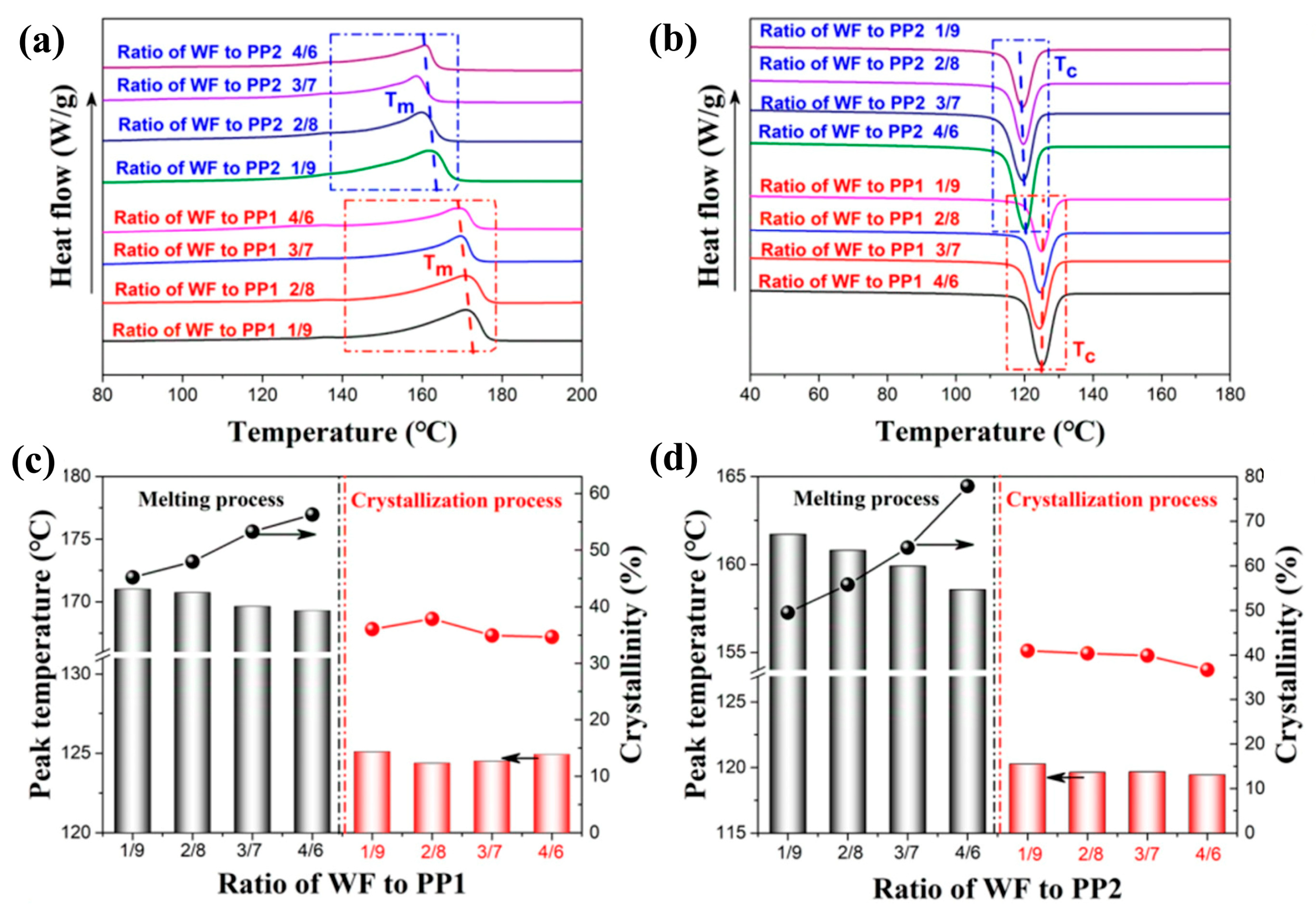
After modification of the surface hydroxyl groups of glass fiber (GF) with silane coupling agents, van der Waals forces and chemical bonds (Si–O–C bonds) are formed between the GF and polypropylene (PP) molecular chains [58]. Meanwhile, the dipole–dipole interactions between the hydroxyl groups and PP molecular chains further enhance the interfacial adhesion. In supercritical N2, carbon fiber (CF) induced PP transcrystallization: Tc increased by 5 °C (to ~120 °C) versus pure PP (Tc ≈ 115 °C without N2), benefiting from N2-reduced chain motion resistance and CF surface nucleation sites [81]. PP/20% CF had 1.5 °C higher Tc and 20% faster crystallization (the high aspect ratio of CF provided nucleation sites) [81]; PP/30% CF (Tc ≈ 123.6 °C) showed 30% faster crystallization, with high CF content slightly inhibiting crystallization via chain entanglement but overall improving [77]. Increased sisal fiber (SF) content enhanced Tc; near-critical length SF formed a lap network for continuous nucleation [47]. Nano-TiO2 (specific surface area ≈ 100 m2/g) increased Tc and reduced crystallization activation energy [49]. PBT nanofibers (vs. spherical PBT) better promoted PP nucleation [51]. Nano-carbon black (CB10) raised Tc by 6 °C and accelerated crystallization [50]. For TPEE/PP blends, Tm increased with PP content (partial compatibility) [82]. The melting and crystallization behaviors of composites with different WF contents were both characterized by differential scanning calorimetry (DSC), and the thermal properties are also shown in Figure 4a–d. According to the listed data, the peak values of DSC curves with the matrix of PP1 were much higher than PP2-based composites with the same WF content. The addition of WF caused heterogeneous nucleation and promoted the perfection of crystal morphology, which led to increased crystallinity and the decreased peak temperatures [62].

4.1.2. Optimization of Crystal Morphology and Size

In polymer matrix composites, micro-nano reinforcements’ steric hindrance effect (inhibiting polymer chain movement, regulating agglomeration and microstructure) originates from their geometry and space-occupying properties, forming physical barriers to adjust intermolecular forces. When synergized with supercritical gas high pressure, it restricts excessive PP spherulite growth; some reinforcements’ interfacial induction regulates crystal growth direction.
PP and PP/CF composite crystallization/melting heat flow: Increasing CF content slightly changes crystallization peaks but shifts melting peaks to higher temperatures, indicating enhanced PP lamellar thickness [77]. PP/25 wt.% LDPE blend nucleation/growth—cocrystallization strengthens spherulite interconnection and mechanical properties [83]. Pure iPP has large, sparsely distributed spherulites with defects, while iPP-20HMSPP exhibits 3–5 times smaller, more uniform spherulites without defects [80]. HMSPP branches restrict disordered chain growth, refining spherulites. CF-induced dendritic crystals show periodic thickness variations at the growth front; edge lamellae migrate and fuse into dense crystals [81].
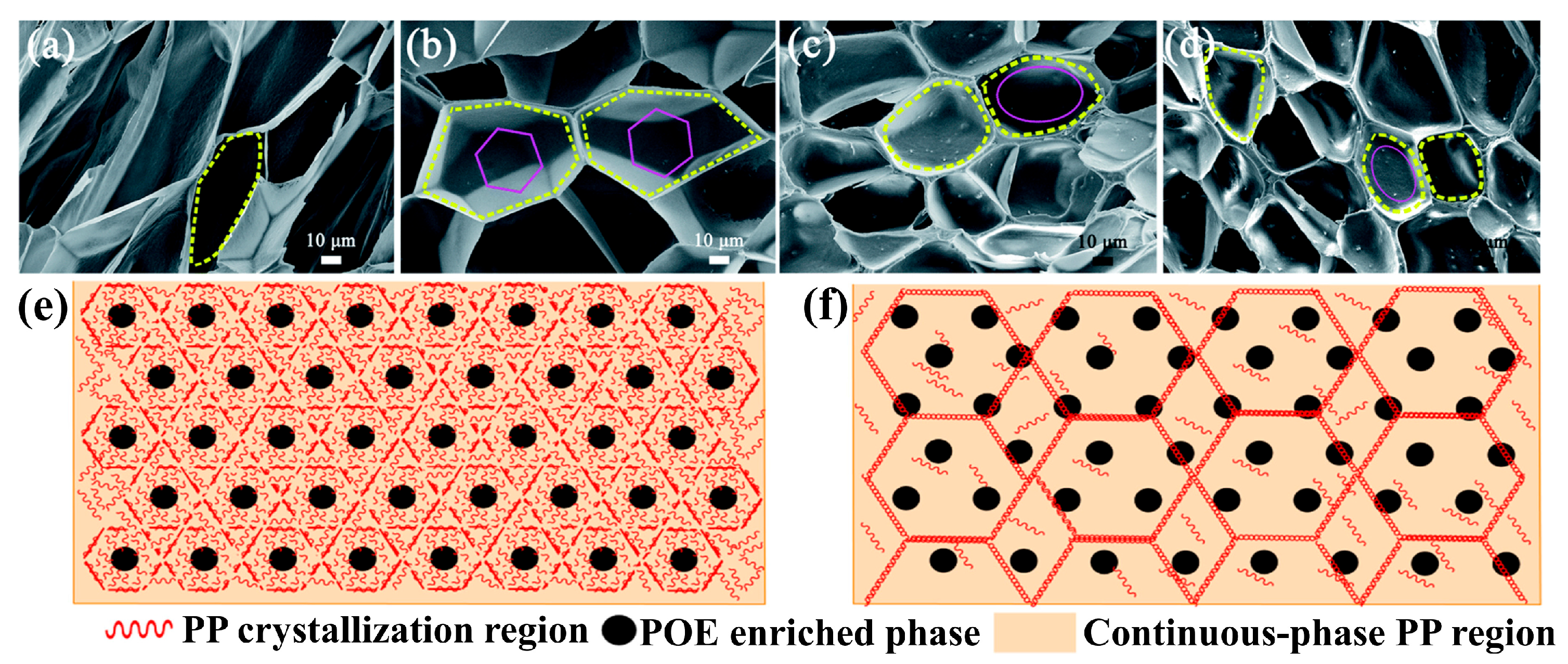
Figure 5a–d show the influence of MS addition on the cell morphologies and cell-size distributions of PP and PP/MS foams. The samples were saturated at 20 MPa and foamed at 154 °C for 10 s. As expected, the pure PP foam presented poor cellular structure and obvious cracked cells. In contrast, PP/MS (0.5%), PP/MS (2.0%), and PP/MS (5.0%) foams exhibited more uniform cell distribution, smaller cell size, a regular polygon cell shape, and well-defined cell walls (Figure 5a–d marked by purple and yellow circles). The cells were strongly in contact by the junction regions of three contacting cells of the different-content PP/MS foams [56]. The relevant crystallization mechanism is illustrated in Figure 5e,f, where the orange part represents the continuous-phase PP region, the black solid part signifies the POE-enriched phase, and the red wavy line part indicates the PP crystallization region [84].

4.1.3. Enhancement of Crystal Structure Stability

Specific micro-nano reinforcements induce stable PP crystals; combined with supercritical gas-enhanced crystal perfection, they improve thermal/melt resistance to adapt to supercritical foaming’s high-temperature environment. Additives stabilize PP’s crystalline structure via chain entanglement/interfacial interactions (maintaining α-crystal, enhancing transcrystallinity, refining grains, guiding orientation).
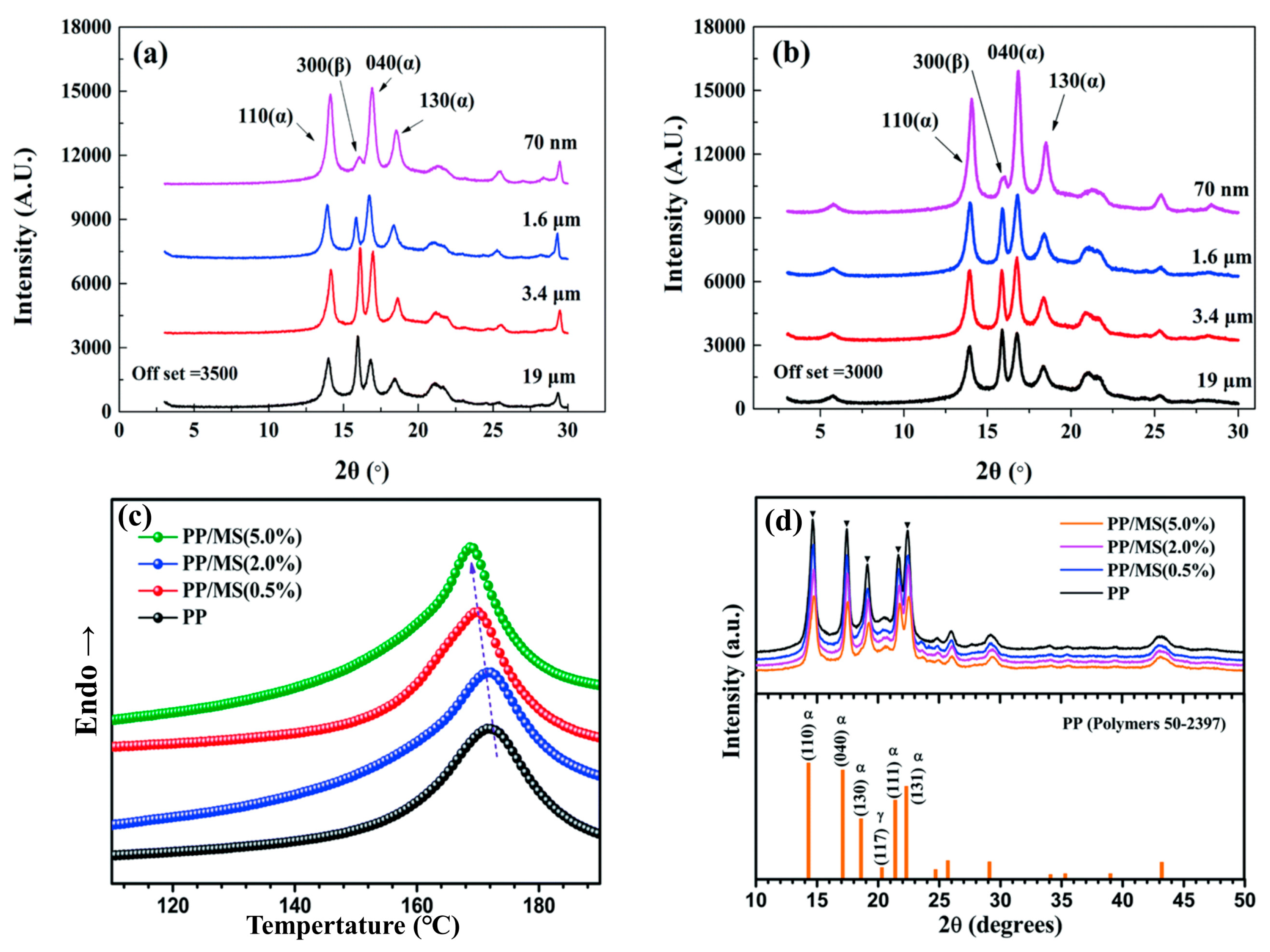
All samples exhibit only α-crystal peaks (no β-crystal peaks) with no shift after multiple heating cycles, confirming stable structures [80]. Specifically, HMSPP preserves α-crystal stability via branch-PP chain entanglement; CF optimizes α-crystal content (no transformation) with peak intensity, first increasing, then decreasing (stable position) at 0–20 wt.% CF [81]. The CF/PP interface is smooth, with sparse transcrystals in the first crystallization; after multiple crystallizations, it becomes serrated with 2–3 times higher transcrystalline density (no fragmentation) due to strong CF-PP interfacial interactions [81]. Molding/filler systems affect the crystals: traditional compression molding (CM) causes random PP orientation (diffused α-peaks); pressure-induced flow (SM) + CNTs/CB (1:1) induces flow-direction orientation (distinct arc α-peaks, narrowed width) with 5 wt.% filler being optimal (CNTs-CB network guides chain ordering) [48]. In foaming systems, fiber-added composites show higher crystallinity than pure PP (fibers exert nucleation effects; cellulose restricts amorphous chain movement) [47]. For PP/wood flour/3% TiO2, α-peak intensity is 15% higher, FWHM decreases from 0.8° to 0.5°, and grain size is refined by 40% (42 nm → 25 nm); the crystal form is stable after multiple foaming cycles (TiO2 restricts chain relaxation) [49]. PP/CB10 maintains α-crystal stability and refines grains via uniform CB dispersion and van der Waals forces with PP [50]. The XRD results of the plastic parts with two reinforcing phases are shown in Figure 6a,b. The characteristic peak of the a-crystal of the (110), (040), and (130) planes appeared at 2θ = 14.1°, 16.9°, and 18.5°, respectively, and the characteristic B-crystal peak of the (300) plane was located at 2θ = 15.9°. The appearance of the B-crystal in all plastic parts indicated that both MMT and nano-CaCO3 acted as nucleating agents and promoted the formation of the B-crystal [63]. Figure 6c presents the DSC melting curves of pure PP and PP/MS composites with different MS loadings (0.5%, 2.0%, 5.0%), showing that the melting peak temperature of the samples gradually decreases with the increase of MS content from 0% to 5.0%. Figure 6d displays the X-ray diffraction patterns of pure PP and PP/MS composites with different MS contents, all of which exhibit the typical diffraction characteristics of α-PP, with the peak positions consistent with the standard PP crystal structure [56].

4.2. Regulation of Micro-Nano Reinforcements on the Rheological Properties of PP

4.2.1. Regulation Pathways

Micro-nano reinforcements regulate PP’s rheological properties via the core mechanism of “physical entanglement-three-dimensional (3D) network construction-interfacial synergy”. Combined with supercritical gases’ (scCO2, scN2) plasticization and high-pressure effects, they directionally optimize PP’s melt elasticity (storage modulus G′), viscosity (complex viscosity η), and tensile resistance.
Four core regulation pathways exist: (1) Forming continuous 3D networks (via chain entanglement or high aspect ratio) inhibits chain slippage, significantly increasing G′ (Figure 7a). (2) Uniform dispersion enhances internal friction, delaying chain relaxation to improve η (reducing premature gas escape); elastomer-reinforcement synergy balances viscosity and fluidity. (3) Ion-cross-linkable reinforcements form reversible networks, enhancing melt strength while retaining processability. (4) Supercritical gases dually regulate rheology: scCO2/scN2 plasticization reduces viscosity (aiding gas dissolution), while high pressure promotes chain-reinforcement entanglement.
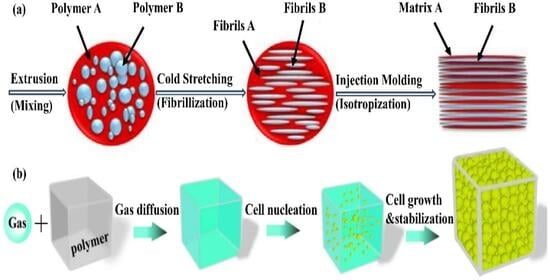
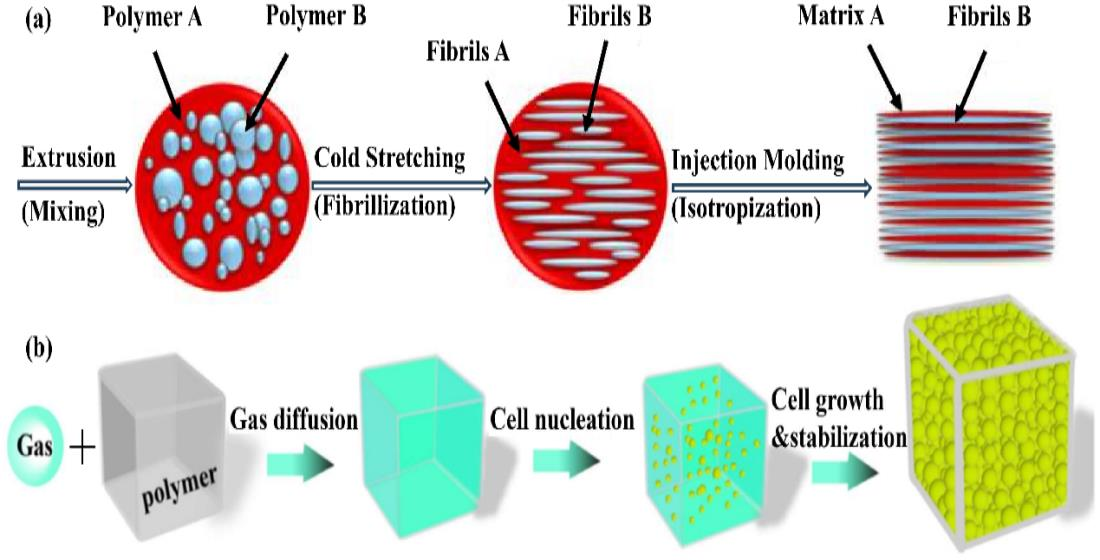
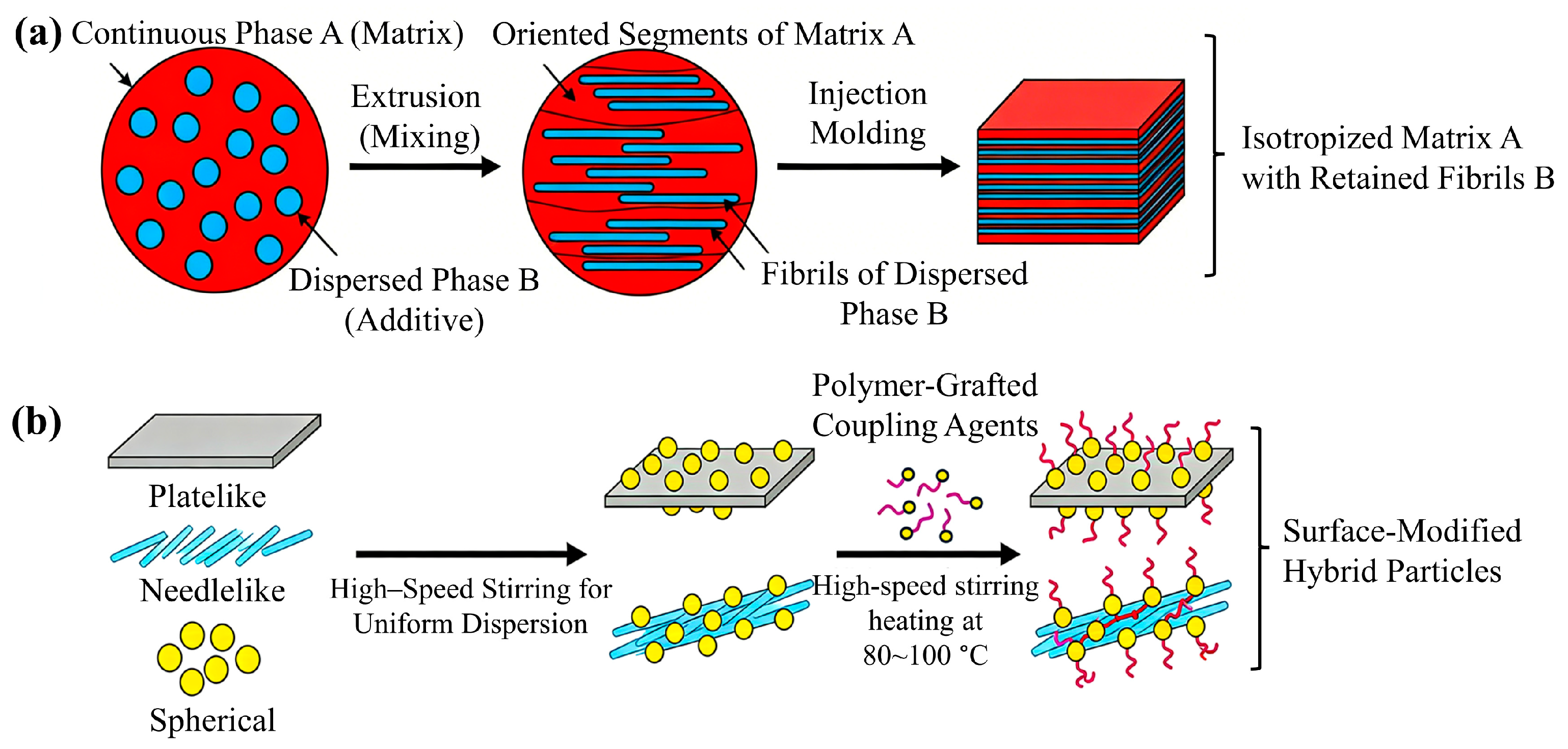
Melt strength enhanced by partially melted crystals resists cell growth expansion and CO2 escape shrinkage, reducing cell defects. Matrix-reinforcement blending undergoes three stages: (1) extrusion “sea–island” morphology, (2) fibrillation-stage highly oriented microfibers, (3) heat-treated isotropic phase A with retained phase B fibers. In situ generated high-aspect-ratio microfibers (from well-dispersed spheres) solve dispersion issues [85]. Microfiber surface-oriented crystals (transcrystalline layers) enhance interfacial adhesion [40] (Figure 7b); dispersed-phase microfibril interfacial debonding under tension connects cells to improve toughness.

4.2.2. Regulation Effects

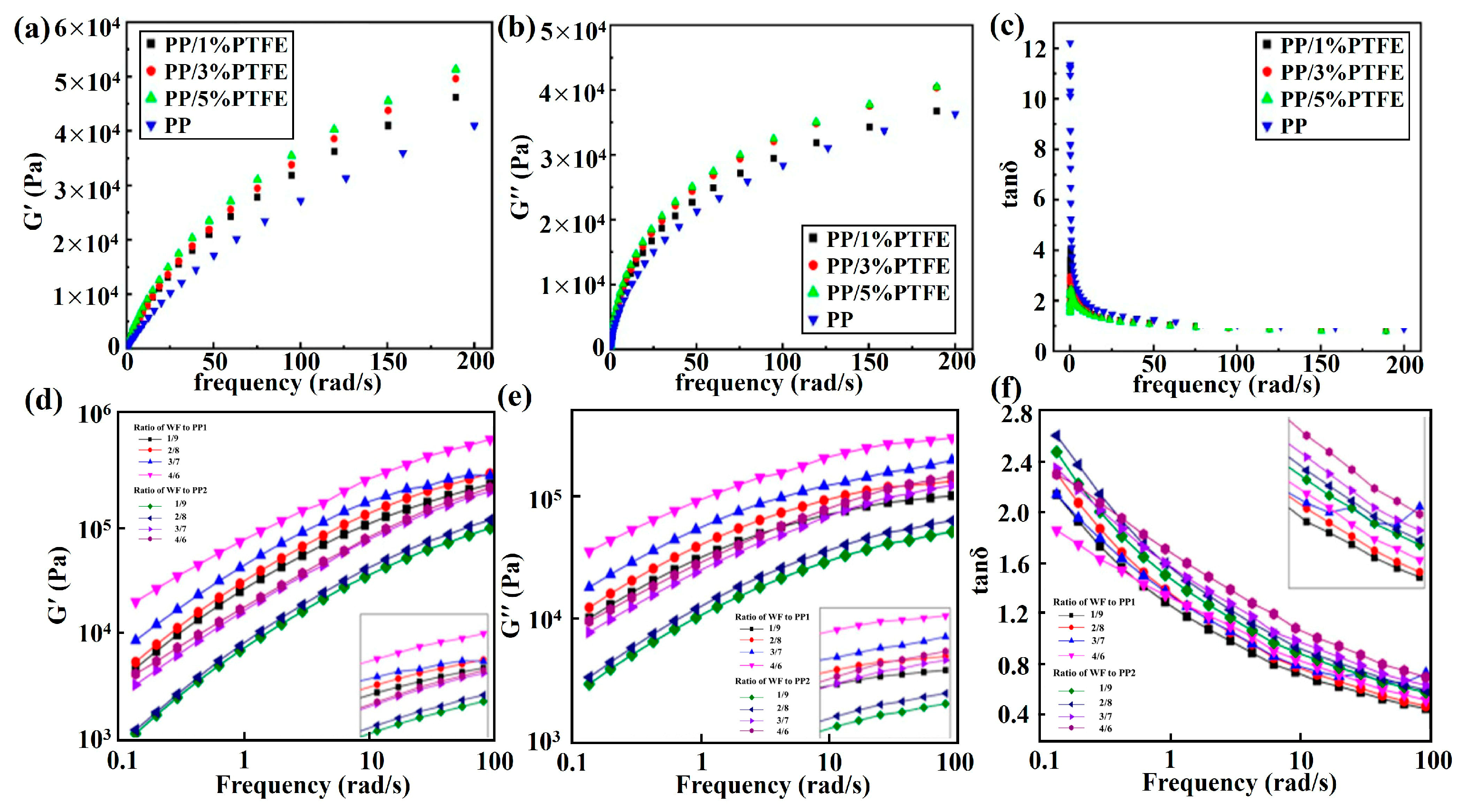
For fibrous additives: At 190 °C, 20 wt.% CF increases PP’s G′ (≈105 Pa) by one order and η (≈5 × 10⁴ Pa·s) fivefold vs. pure PP (≈104 Pa G′, ≈104 Pa·s η) [81]. Moreover, 5 wt.% carbon nanofibers both enhance PP’s G′ and η eightfold [82]. Mechanism: Fibers form “fiber–fiber” networks to boost melt elasticity/resistance. For nanoparticles/clay: At 190 °C and 1 Hz, 3 wt.% nano-TiO2 increases PP’s η by 50% (≈1.5 × 10⁴ vs. 104 Pa·s) and reduces tanδ (≈0.7) [48]; 3 wt.% nano-clay doubles PP’s G′ (≈2 × 10⁴ Pa) and η (≈2 × 10⁴ Pa·s) via lamellar networks [86,87]. For hybrid fillers: At 180 °C, 5 wt.% CNTs/CB (1:1) enhances PP’s G′ (≈104 Pa) and η (≈104 Pa·s) by two orders of magnitude (“line-point” network) [48]. At 190 °C, PP/3% MWCNT/2% PTFE shows double G′/η vs. PP/3% MWCNT (“tube-line” network) [57], Figure 8a–c. As shown in Figure 8d–f, PP1-based wood–polymer composites showed a higher storage modulus, loss modulus and complex viscosity than PP2-based composites, which were affected by the rheological properties of the matrix [62].

4.3. Regulation of Micro-Nano Reinforcements on the Foaming Performance of PP

4.3.1. Improvement of Cell Nucleation Efficiency

The micro-nano reinforcements’ heterogeneous nucleation effect is key to improving PP cell nucleation efficiency—their surface active sites and high specific surface area reduce the nucleation free energy barrier, with the high-pressure dissolution of supercritical gas further enhancing efficiency. Chai et al. [49] found nano-TiO2 (≈50 m2/g) synergized with wood fiber (WF) to form dense nucleation sites at WF/PP interface. At 3 wt.% nano-TiO2, 10 MPa, and 15 min scCO2 saturation, WF/PP cell density reached 2.8 × 10¹⁰ cells/cm3 (3-fold higher than without nano-TiO2). XRD showed nano-TiO2-induced increased α-crystals optimized nucleation site stability. Liu et al. [81] studied CF in 13.79 MPa supercritical N2: The CF rough surface grooves and transcrystalline induction formed high-concentration nucleation sites. At 20 wt.% CF, 130 °C, PP/CF nucleation efficiency was 2.7-fold higher than pure PP (1.8 × 10¹² cells/cm3). AFM confirmed that CF-induced dendritic crystals trapped scN2 to promote nucleation. Crystallization characteristics affected nucleation: PP and PP/CF had Tc ≈ 124.6 °C; 20 wt.% CF increased Tm by 2.4 °C. PP/CF crystallinity was higher than pure PP (56.8%): 5 wt.% CF increased it to 58.17%, and 30 wt.% CF reduced it to 52.17% (chain entanglement) [77]. CF induced preferential nucleation around fibers, shortening crystallization time and increasing grain growth rate.

4.3.2. Regulation of Cell Size and Density

The synergy between micro-nano reinforcements’ steric hindrance and melt elasticity restricts excessive cell growth and optimizes uniformity; combined with supercritical gas pressure regulation, it refines cell size and controls density. Wang et al. [86] found that 3 wt.% nano-clay (interlayer traps scCO2, delaying gas diffusion) and 9 wt.% PP-g-MAH (enhances compatibility) reduced the cell size coefficient of variation (CV) to <15% in B-PP extrusion foaming. HMSPP content significantly regulates the iPP cell structure [80]: pure iPP has a low nucleation density (5.07 × 10⁵ cells/cm3) and coarse cells (174.63 μm); 20 wt.% HMSPP increased the density to 5.40 × 10¹¹ cells/cm3 (≈106-fold higher efficiency), refined the size to 2.17 μm, and the expansion ratio to 5.34. The optimal annealing temperature (Ta = 125 °C) achieved the highest nucleation efficiency with stable performance after multiple cycles. Core mechanisms: (1) The HMSPP long branches induce small α-crystals (heterogeneous nucleation sites) and enhance melt strength (inhibiting coalescence); (2) Ta modulates crystal perfection, balancing scCO2 solubility and melt strength.
Crystallization characteristics significantly affect the PP composite foam cell structure. PP/30 wt.% glass fiber (GF30) exhibited optimal crystallinity (~47%) at heating rates of 5 and 10 °C /min; high heating rates reduced the crystallization temperature due to insufficient cooling time [58]. Liu et al. [77] showed that PP and PP/carbon fiber (CF) composites had a crystallization peak temperature (Tp) of ~124.6 °C; 20 wt.% CF increased melting point (Tm) by 2.4 °C (167.7 °C vs. pure PP’s 165.3 °C) [49]. PP/20% bamboo fiber (BF)/5% composite foam had an expansion ratio of 4.5 with <5% variation after multiple cycles (superior to unmodified systems). Core mechanism: BF-formed networks support cell walls, balancing nucleation and growth for stability.

4.3.3. Enhancement of Cell Structure Stability

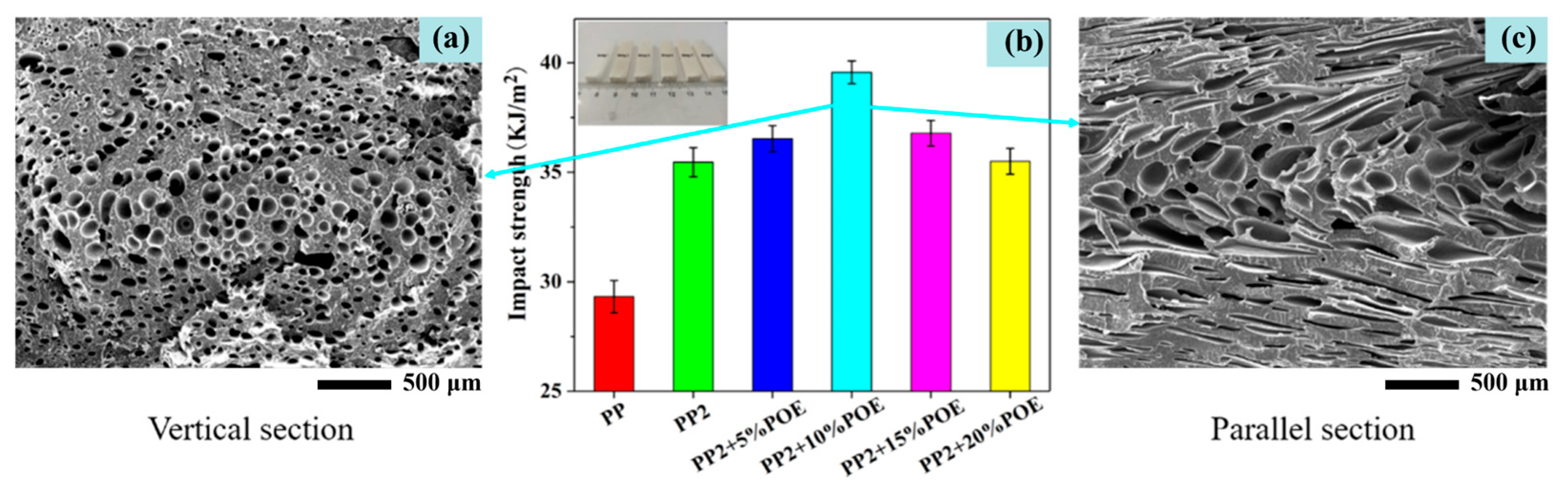
Micro-nano reinforcements can effectively resist cell wall rupture during the expansion of supercritical gases by improving PP’s melt strength (high G′ and strain hardening behavior) and crystal thermal stability. Combined with the high-pressure regulation of supercritical gases, this achieves a balance between high expansion ratio and cell structure stability, avoiding the defects of low expansion ratio and easy collapse in traditional PP foams [46]. Furthermore, Cao et al. [58] prepared 30 wt.% glass fiber (GF)-reinforced PP foams using precision open-mold technology combined with scCO2 foaming process; the results showed that the transcrystalline structure induced by GF significantly improved the tensile resistance of the PP melt, with a strain hardening factor of 2.5. When the foaming temperature was 160 °C and the scCO2 pressure was 12 MPa, the PP/GF30 foam achieved an expansion ratio of 15 times and a low density of 0.32 g/cm3, representing an 87.5% increase compared with that of pure PP foam (expansion ratio of 8 times). Computed tomography scanning results revealed that GF formed a “scaffold” structure on the cell walls, effectively preventing cell collapse, and the foam exhibited a compression rebound rate of 82%. It can be seen from Figure 9 that when 10% POE is used, the foaming effect is better. In pure PP, the foaming effect was poor due to the low melt strength, and many large cells were formed, which easily caused stress concentration and the worst impact toughness [88].

4.4. Core Mechanism of Regulation

Micro-nano reinforcements regulate PP crystallization behavior via the core mechanism of “heterogeneous nucleation–interfacial synergy”, which, combined with supercritical gases’ plasticizing and high-pressure effects, directionally optimizes PP crystallization kinetics, crystal morphology, and crystal form stability. Four core pathways are involved:
  • Reinforcements’ surface active sites and high specific surface area adsorb and align PP chains, lowering the nucleation free energy barrier and elevating crystallization temperatures; surface modification enhances interfacial compatibility [16,80].
  • The “melting–annealing–reheating” process forms partially melted crystals that act as physical crosslinks, boosting nucleation site density and restricting chain relaxation [51].
  • Reinforcements’ steric hindrance inhibits spherulite radial growth (refining crystals), synergizing with supercritical high pressure for dual regulation against excessive growth [89].
  • Inducing stable PP crystal forms, coupled with supercritical gas-regulated crystal perfection, improves thermal/melt resistance to support supercritical foaming [77,90].

4.5. PP Stability Analysis of Micro Nano Composite Foam

Thermal stability is a critical performance indicator for polypropylene (PP) composite foams in high-temperature service scenarios, and the 5% weight loss temperature (T5%) obtained via thermogravimetric analysis (TGA) is widely used to evaluate their thermal decomposition behavior under an inert atmosphere. The T5% values and TGA curve characteristics of PP composite foams are essentially dominated by the type of additives, which can be categorized into four groups—natural fibers, inorganic nanoparticles, polymer microfibers, and elastomers—with distinct influencing mechanisms.
For natural fiber-reinforced PP foams, the T5% is moderately lower than that of pure PP foam (290~305 °C) [91,92] due to the inferior thermal stability of natural fibers [93,94,95]. Inorganic nanoparticles demonstrate a significant thermal stability enhancement effect on PP foams, primarily relying on their excellent barrier properties and uniform dispersion in the matrix [96,97,98]. As for polymer microfiber-modified PP foams, their thermal stability is determined by the compatibility with the PP matrix and the thermal performance of the microfibers themselves [99,100]. Elastomer-modified PP foams generally show a slight decrease in T5% compared to pure PP, as elastomers have comparable or lower thermal stability than PP [101,102].

5. Application Fields of Supercritical Foamed PP Micro-Nano Composites

5.1. Automotive Lightweight Field

Foam performance is closely correlated with its structure—microstructural evolution during foaming endows thermoplastics with diverse functionalities (e.g., thermal insulation, low dielectric constant) [103]. The optimal comprehensive performance relies on targeted design of the key structural/process parameters: cell diameter, density, morphology, expansion ratio, and open cell content [104]. Compared with traditional foaming, microcellular foaming achieves significantly reduced cell diameter and increased density [105,106]; uniform fine cells exhibit excellent mechanical/thermal stability [107], and nanocellular foams outperform microcellular counterparts [108,109].
Based on the cell morphology and open cell content, microcellular foams are categorized into closed-cell, partially open-cell, and open-cell types [110]; reticulated foam (a special open-cell type with 3D reticulated filaments instead of cell walls) [111] is another category. Closed-cell foams dominate lightweight/thermal insulation applications, while open-cell structures are required for sound insulation, oil-water separation, and scaffolds. Controlled cell opening is critical after defining the target functionality and structure.
For structural components, PP/GF30 foam (density 0.32 g/cm3, 64.29% weight reduction, flexural strength 58.49 MPa) meets the ISO 178 (Plastics—Determination of flexural properties, the dimensions of the test specimen were 80 mm × 10 mm × 4 mm, with a span length of 50 mm, a loading rate of 2 mm/min, and a test environment temperature of 23 °C) [38]; direct-foamed LFT-D seat frames retain >80% fiber length and enhance specific stiffness by 25% [112]. For anti-collision components, PP/EPDM/BF foam (impact strength 9.62 kJ/m2) retains >90% performance at −40–80 °C [39]. PP/wood flour foam (density 0.4 g/cm3, formaldehyde emission < 0.1 mg/m3) meets GB 18580 (Indoor decorating and refurbishing materials—Limit on formaldehyde emission of wood-based panels and their products) for automotive headliners (the 1 m3 climate chamber method was adopted, with a test temperature of 23 °C, relative humidity of 45%, air exchange rate of 1 h−1, and test duration of 24 h) [113].

5.2. Building Fireproof and Thermal Insulation Field

Micro-nano reinforced PP foam meets the demands for “low thermal conductivity, fire resistance, durability, and self-healing” in building insulation via micro-nano modification (e.g., high-temperature nanofibers, ionic crosslinking, nano-clay doping) and process optimization (scCO2 foaming, in situ cooling by adsorbed water).
To meet the requirements of thermal conductivity <35 mW·m−1·K−1, fire resistance > 150 °C, and long-term energy saving, Zhao et al. prepared PP/PBT nanofiber (diameter < 200 nm) foam with an expansion ratio of 28, a density of 0.032 g/cm3, and a thermal conductivity of 32 mW·m−1·K−1 (outperforming rock wool), reducing building energy consumption by 30% [51]. Li et al.’s EVA/ZnO/PP foam (5 wt.% ZnO) exhibits <5% thermal weight loss at 150 °C, a self-extinguishing time < 10 s, and only a 5% thermal conductivity increase after 12 months of outdoor exposure [114]. Chen et al.’s PP/nano-clay foam, regulated by adsorbed water cooling, achieves a cell size < 20 μm, a thermal conductivity of 29 mW·m−1·K−1, and <3% volume shrinkage after 100 temperature cycles (−30~80 °C) [115]. In applications, PP/PBT microfiber foam (thermal conductivity 32 mW/(m·K), a service life > 20 years outperforms EPS and rock wool [72], while PP/graphite foam (solar reflectance > 85%) reduces energy consumption by 30% [116].

5.3. Packaging and Protection Field

Micro-nano reinforced PP foam achieves functional adaptation in packaging and protection via structural design and process optimization. For precision instruments, PP/carbon nanotube/carbon black foam (volume resistance 106 Ω·cm, average pore size 15 μm) controls electrostatic voltage < 100 V, achieves 88% buffer efficiency, and meets the cleanliness requirements (VOC < 0.1 mg/m3) [48]. HMSPP-reinforced iPP foam (density 0.65 g/cm3, compression modulus 85 MPa) ensures <0.1% optical accuracy error in 50 cm drop tests and stable performance after damp-heat aging. For transportation equipment, PP/POE foam (PIF-processed, STL 103.56 dB at 1000–6000 Hz, thickness of 5 mm) reduces high-speed rail noise by 15 dB [117], while SF-reinforced PP foam (NRC 0.52, high-frequency sound absorption coefficient > 0.6) lowers aircraft engine noise by 20 dB [118]. In general applications, PP/rubber microfiber foam (1.5 m drop damage rate < 1%) [72], PP/straw fiber foam (degradability >90%, FDA-compliant) [113], PP/nano-SiO2 foam (water vapor transmission rate < 1 g/(m2·24 h)) [115], PP/graphene foam (surface resistance < 106 Ω) [10,44], PP/GF/CNTs foam, and PP/ceramic microfiber foam (oxygen index > 32%, fire resistance > 90 min) [112] cover diverse needs. PP foam boxes with excellent mechanical properties (withstanding adult stepping) demonstrate their thermal insulation performance (thermal conductivity close to EPPO, stable surface temperature) [119]. Packaging for precision instruments: Priority shall be given to ensuring a cushioning efficiency of ≥85% and electrostatic control with a voltage of <100 V. EMI shielding performance can be reduced to below 20 dB, and CNT content shall be controlled at 5 wt.%. Packaging for electronic devices: Priority shall be given to ensuring an EMI shielding performance of ≥30 dB and volatile organic compound (VOC) control with a concentration of <0.1 mg/m3; the cushioning efficiency can be reduced to 75%, and a CNT/activated carbon composite filler shall be adopted.
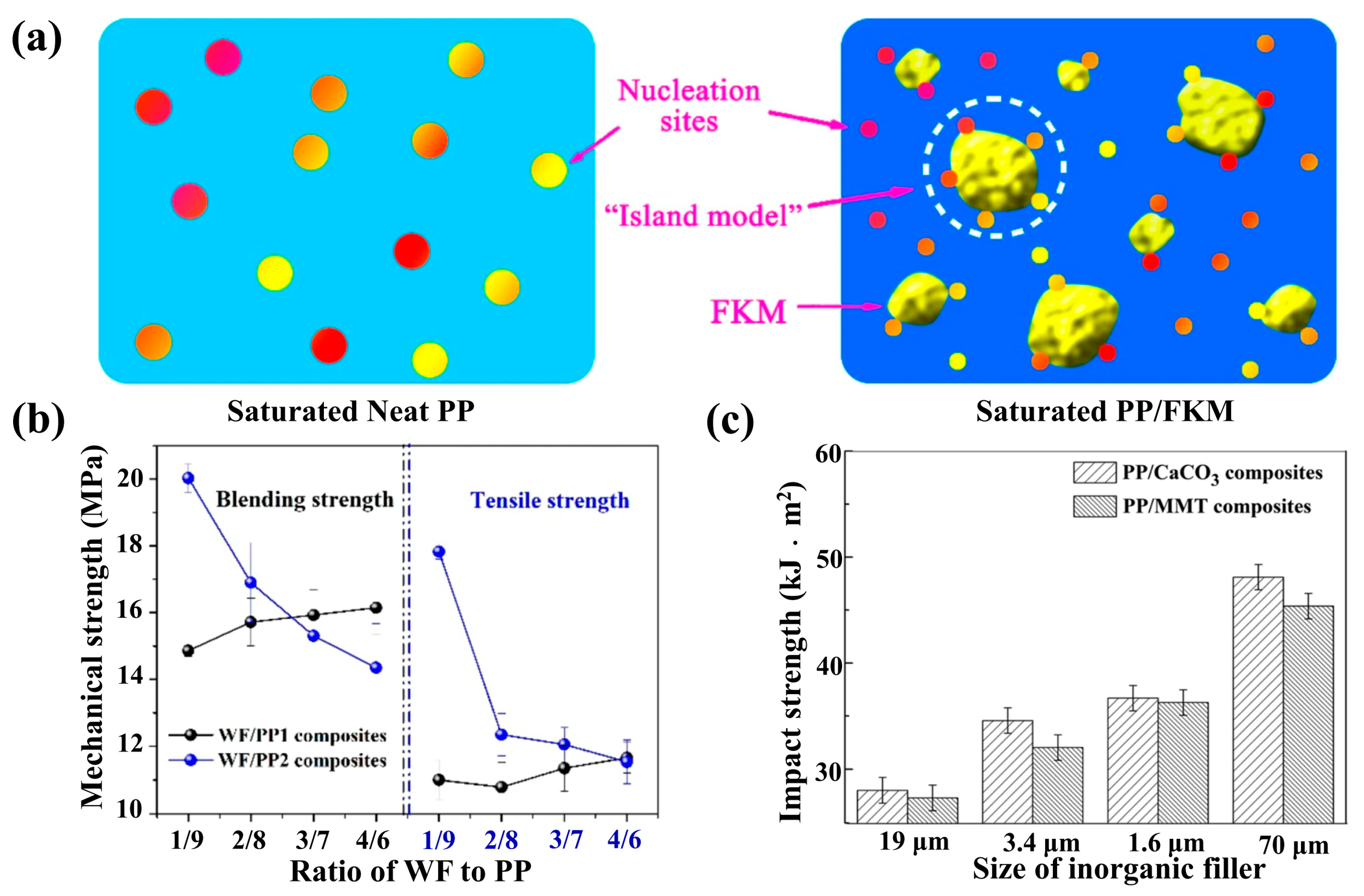
As shown in Figure 10a, it is known that foaming is a rapid process in which cells grow in a few seconds, which depends on the thermophysical and rheological properties of PP/CO2 mixtures, and this process is related to changes in temperature, pressure, and local stress [79]. The red, orange, and yellow dots in both the neat PP and PP/FKM schematics represent intrinsic heterogeneous nucleation sites with different nucleation activities in the PP matrix, while the large yellow irregular “island-like” structures in the PP/FKM sample are the dispersed FKM phase, which acts as additional high-efficiency nucleation sites at the PP-FKM interface to form the "island model" nucleation mechanism. The mechanical strengths of composites with different matrices were shown in Figure 10b [62]. As the particle size of the inorganic particles was reduced, the impact strength of the composites was remarkably improved [63] (see Figure 10c).

5.4. Other Emerging Fields

Micro-nano reinforced PP foams have been applied in electronics/new energy, biomedicine, and environmental protection/emergency response due to their structure-performance advantages.
In electronics/new energy: iPP/CNTs-HDPE/CNTs bilayer foam for 5G casings achieves an EMI SE of 37.32 dB and a 40% weight reduction [44]; PP/graphite foam as a lithium battery insulation pad has a thermal conductivity of 30 mW/(m·K) and >10 min thermal runaway suppression [112]. Wang et al.’s PP/2 wt.% CNT/5 wt.% CB foam exhibits a density of 0.5 g/cm3, an EMI SE of 45 dB (1–6 GHz), >85% EMI SE retention after 1000 bends, a compression modulus of 92 MPa, and <30% open cell content (moisture barrier) [48]. Liu et al.’s PP/20 wt.% CF foam (supercritical N2 foaming) has a density of 0.35 g/cm3, an EMI SE of 32 dB (1–6 GHz), and only a 3 dB EMI SE decrease after 1000 bends [77]. In biomedicine: PP/PCL foam scaffolds for bone repair have a pore size of 100–200 μm, an 85% cell adhesion rate, and 12–24 months degradation [51]; PP/BF foam dressings have an air permeability of >500 g/(m2·24h) and >90% antibacterial rate [39]. Bhagat et al.’s PP/near-critical length sisal fiber (SF) foam (145 °C, 100 bar, 15 min scCO2 foaming) has >80% open cell content, a compression modulus of 85 MPa (matching soft tissue mechanics), and good biocompatibility (skin wound temporary scaffold) [47]. In environmental protection/emergency response: PP/POE open-cell foam for marine oil spill recovery has a 32-fold oil absorption capacity and 15 reuse cycles [59]. Mi et al.’s PP/mPTFE foam has a superhydrophobic surface (water contact angle > 150°), a 9.1 g/g oil absorption capacity, >90% efficiency retention after five cycles, and good durability [120]. Table 4 compares polymer-based absorbent properties.
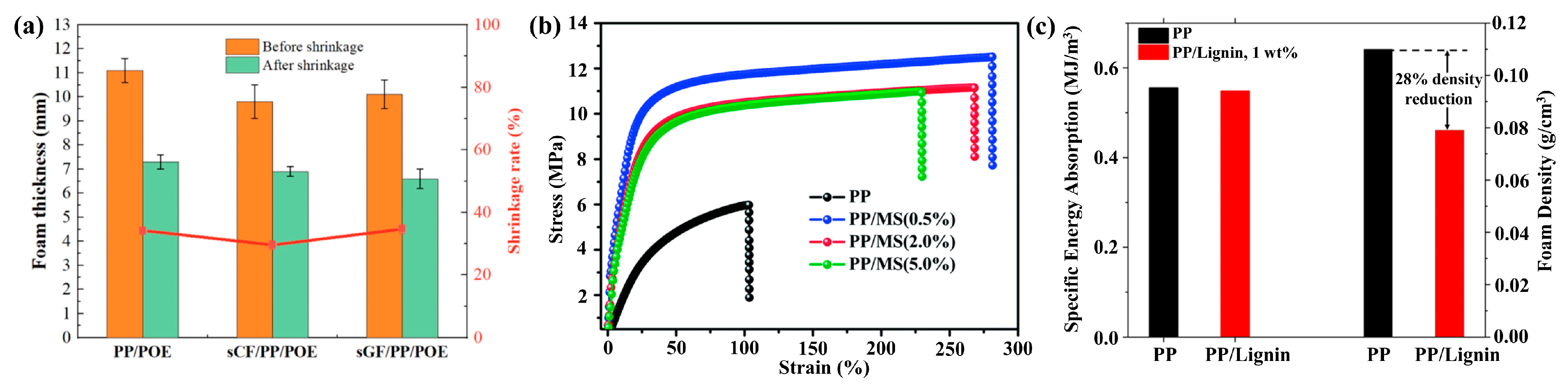
The PP/CF foam effectively shields induced current, exhibiting excellent shielding performance. The thermal conductivity of PP/CF foam on a 100 °C flat plate: the sample temperature increases with CF content, as higher CF content improves thermal conduction paths and enhances in-plane thermal conductivity (beneficial for reducing electronic device heat accumulation) [117]. The electromagnetic shielding mechanism of PP/CF foam is illustrated, including multiple reflection loss, conductivity loss, dipole polarization, and interfacial polarization loss [77]. Despite the improvement in material viscosity and thermal shrinkage to some extent with the addition of carbon fibers in sCF/PP/POE, a further comparison with Figure 11a reveals that its contribution is far less significant than the enhanced thermal shrinkage stability brought about by irradiation crosslinking [127]. The stress–strain curves for the pure PP foam and PP/MS foams prepared at 154 °C and 20 MPa are shown in Figure 11b The stress strength of the PP/MS foam improved significantly from 6.1 MPa to 12.6 MPa, and the tensile strains of the PP/MS foams also increased substantially, reaching 260% [56]. The results are presented in Figure 11c. It can be seen that even though the density of the composite foam is 28% lower than the PP foam, it has almost the same specific energy absorption property, indicating that the PP/lignin foam would allow us to achieve a larger extent of materials and weight savings than its PP counterpart without sacrificing the energy absorption capability of the foam [26].

6. Conclusions and Prospects

Notable progress has been made in the theoretical research and application of supercritical foamed PP micro-nano composites, providing eco-friendly solutions for automotive lightweighting, building insulation, and electronic shielding. However, three core bottlenecks restrict industrialization and performance upgrading: raw material compatibility/cost, process stability/scalability, and performance balance/long-term reliability.
At the raw material level: Natural fibers show poor compatibility with non-polar PP (requiring multi-step modification) and agglomerate at high loadings; nano-fillers agglomerate intrinsically, hindering industrial dispersion; high melt strength PP enhances performance but is cost-prohibitive for mass production. In processes: Continuous extrusion foaming fails to maintain “melt–gas” homogeneity (poor consistency); foam 3D printing suffers >30% interlayer bonding loss and low blowing agent retention; batch foaming is controllable but low-efficiency; precision open-mold injection demands high equipment investment. A lack of unified multi-parameter coupling models increases R&D costs. In performance: The inherent strength–toughness trade-off persists; multi-functional integration is challenging; natural fiber moisture absorption and nano-filler migration degrade long-term service performance.
Future research should focus on three breakthrough directions with clear prioritization: (1) High-priority raw material innovation: First, prioritize the development of low-cost, high-performance matrices using recycled PP (directly addressing the cost bottleneck for mass production), followed by interfacial regulation for bio-based/degradable systems and the design of “core–shell” multi-functional reinforcements. (2) Medium-priority process optimization: First, focus on machine learning and online monitoring to build unified process–structure–performance models (reducing R&D costs via multi-parameter coupling), then scale up in situ microfibrillation–continuous foaming equipment and advance foam 3D printing and functionally graded foam technologies. (3) Long-term application expansion: Prioritize deployment in new energy vehicles (aligned with high-demand lightweighting needs), then establish full-life-cycle management (e.g., industrial by-product blowing agents, degradable foams) and formulate the cell structure/long-term performance standards.
In summary, supercritical foamed PP micro-nano composites have broad prospects in high-value fields. Interdisciplinary integration of material science, process engineering, and intelligent technology to address the above challenges will accelerate industrialization, supporting lightweight, energy-saving, and sustainable materials development.

Funding

This research was funded by the financial support from Major Science and Technology Projects of Gansu Province (22ZD6GA008 and 24ZD13GA018), and the Foundation of Key Laboratory of Solar Power System (2024SPKL02); the Youth Project of Science and Technology Research Program of Chongqing Education Commission of China (KJQN202403205, KJQN202303213, KJZD-M202503201); the Doctoral Research Fund of Chongqing Industry Polytechnic University (2024GZYBSZK1-07); and the Natural Science Foundation of Chongqing, China (No. CSTB2025NSCQ-GPX0142).

Data Availability Statement

No new data were created or analyzed in this study. Data sharing is not applicable to this article.

Conflicts of Interest

The authors declare no conflict of interest.

References

  1. Wu, G.; Xie, P.; Yang, H.; Dang, K.; Xu, Y.; Sain, M.; Turng, L.-S.; Yang, W. A review of thermoplastic polymer foams for functional applications. J. Mater. Sci. 2021, 56, 11579–11604. [Google Scholar] [CrossRef]
  2. Lebreton, L.C.; Van Der Zwet, J.; Damsteeg, J.-W.; Slat, B.; Andrady, A.; Reisser, J.J. River plastic emissions to the world’s oceans. Nat. Commun. 2017, 8, 15611. [Google Scholar] [CrossRef]
  3. Pan, X.; Zhou, L.; Wang, G.; Fallatah, A.M.; Yuan, M.; Zhang, X.; Tan, D.; Ren, J.; Almalki, A.S.; Ibrahim, M.M. Study on the damage characteristics of high-temperature superconducting cable insulation under air gap discharge. J. Mater. Sci. Mater. Electron. 2024, 35, 1999. [Google Scholar] [CrossRef]
  4. Wang, G.; Dong, M.; Pan, X.; Zhang, X.; Chen, J.; Shen, J.; Li, K.; Zhang, X.; Chen, J. Effects of Nanofibrillar Nucleating Agent and Process Conditions on the Crystallization Behavior and Mechanical Properties of Isotactic Polypropylene. Nanomaterials 2025, 15, 1253. [Google Scholar] [CrossRef]
  5. Dong, M.; Mu, Y.; Zhou, L.; Zhao, Y.; Zhang, X.; Tan, D.; Pan, X.; Wei, H. Fluorinated laser-induced graphene towards high performance Zn-ion hybrid supercapacitors. J. Alloys Compd. 2024, 973, 172846. [Google Scholar] [CrossRef]
  6. Shaayegan, V.; Wang, C.; Costa, F.; Han, S.; Park, C.B. Effect of the melt compressibility and the pressure drop rate on the cell-nucleation behavior in foam injection molding with mold opening. Eur. Polym. J. 2017, 92, 314–325. [Google Scholar] [CrossRef]
  7. Eagan, J.M.; Xu, J.; Di Girolamo, R.; Thurber, C.M.; Macosko, C.W.; LaPointe, A.M.; Bates, F.S.; Coates, G.W. Combining polyethylene and polypropylene: Enhanced performance with PE/iPP multiblock polymers. Science 2017, 355, 814–816. [Google Scholar] [CrossRef] [PubMed]
  8. Chaffin, K.A.; Knutsen, J.S.; Brant, P.; Bates, F.S. High-strength welds in metallocene polypropylene/polyethylene laminates. Science 2000, 288, 2187–2190. [Google Scholar] [CrossRef]
  9. Soares, F.A.; Nachtigall, S.M.B. Effect of chemical and physical foaming additives on the properties of PP/wood flour composites. Polym. Test. 2013, 32, 640–646. [Google Scholar] [CrossRef]
  10. Chen, S.; Li, K.; Wang, G.; Ding, W.; Zhang, X.; Zhao, Y.; Yang, Y.; Chen, J. Microcellular foamed bilayer iPP/CNTs-HDPE/CNTs nanocomposites for electromagnetic interference shielding application. J. Polym. Res. 2024, 31, 357. [Google Scholar] [CrossRef]
  11. Wali, S.Q.; Sali, A.; Allami, J.K.; Osman, A.F. RF-EMF exposure measurement for 5G over mm-wave base station with MIMO antenna. IEEE Access 2022, 10, 9048–9058. [Google Scholar] [CrossRef]
  12. Xiao, H.; Si, L.; Li, Y.; Liang, X.; Song, J.; Shen, S. A thermal management hybrid membrane with both high thermal conductivity and electrical insulation. Adv. Funct. Mater. 2025, 35, e08737. [Google Scholar] [CrossRef]
  13. Jurczuk, K.; Galeski, A.; Morawiec, J. Effect of poly (tetrafluoroethylene) nanofibers on foaming behavior of linear and branched polypropylenes. Eur. Polym. J. 2017, 88, 171–182. [Google Scholar] [CrossRef]
  14. Dong, M.; Wang, G.; Zhang, X.; Tan, D.; Ren, J.; Colorado, H.; Hou, H.; Toktarbay, Z.; Guo, Z. An overview of polymer foaming assisted by supercritical fluid. Adv. Compos. Hybrid Mater. 2023, 6, 207. [Google Scholar] [CrossRef]
  15. Wang, G.; Dong, M.; Yuan, M.; Ren, J.; Gu, J.; Zhang, X.; Tan, D.; Zhang, Y.; Yao, C.; El-Bahy, Z.M. Effects of process conditions and nano-fillers on the cell structure and mechanical properties of co-injection molded polypropylene-polyethylene composites. Polymer 2024, 299, 126935. [Google Scholar] [CrossRef]
  16. Guo, W.; Zhao, J.; Zhao, F.; Feng, T.; Liu, L. Assessment of properties of bamboo fiber and EPDM reinforced polypropylene microcellular foam composites. Polymer 2024, 304, 127142. [Google Scholar] [CrossRef]
  17. Nofar, M.; Utz, J.; Geis, N.; Altstädt, V.; Ruckdäschel, H. Foam 3D printing of thermoplastics: A symbiosis of additive manufacturing and foaming technology. Adv. Sci. 2022, 9, 2105701. [Google Scholar] [CrossRef]
  18. Wang, G.; Dong, M.; Deng, H.; Ma, X.; Zhu, B.; Zhou, L.; Zhang, X.; Tan, D.; Algadi, H. Polypropylene foaming using supercritical carbon dioxide: A review on fundamentals, technology, and applications. Adv. Compos. Hybrid Mater. 2025, 8, 84. [Google Scholar] [CrossRef]
  19. Zhang, X.; Li, B.; Wang, X.; Li, K.; Wang, G.; Chen, J.; Park, C.B. Modification of iPP microcellular foaming behavior by thermal history control and nucleating agent at compressed CO2. J. Supercrit. Fluids 2018, 133, 383–392. [Google Scholar] [CrossRef]
  20. Zhan, H.; Zhang, Z.; Yang, A.; Qian, J.; Antwi-Afari, M.F.; Li, X.; Jing, X.; Dong, B.; Mi, H.-Y. Multifunctional Foams with Oriented Bimodal Cellular Structure and Barbule-like Surface Fabricated by Bi-thermoplastic Expanding Microsphere Mold-opening Foaming. Compos. Part B Eng. 2025, 310, 113173. [Google Scholar] [CrossRef]
  21. Liao, R.; Yu, W.; Zhou, C. Rheological control in foaming polymeric materials: II. Semi-crystalline polymers. Polymer 2010, 51, 6334–6345. [Google Scholar] [CrossRef]
  22. Yang, Q.; Ding, Y.; Liu, H.; Li, S.; Wang, X. Preparation of PBAT/PLA Blend Microporous Foam with Excellent Resilience and Cushioning Properties by scCO2 Technology Through Improving Compatibility. J. Appl. Polym. Sci. 2025, 142, e56542. [Google Scholar] [CrossRef]
  23. Su, Y.; Huang, P.; Luo, H.; Chong, Y.; Zhao, Y.; Wu, M.; Zheng, H.; Lan, X.; Wu, F.; Zheng, W. Supercritical CO2 extrusion foaming and steam-chest molding of polypropylene/thermoplastic polyurethane bead foams. ACS Appl. Polym. Mater. 2022, 4, 9441–9448. [Google Scholar] [CrossRef]
  24. Sun, X.; Ye, L.; Zhao, X. Microcellular polyetherimide/carbon nanotube composite foam: Structure, property and highly reinforcing mechanism. Eur. Polym. J. 2019, 116, 488–496. [Google Scholar] [CrossRef]
  25. Li, Y.; Yao, Z.; Chen, Z.-H.; Cao, K.; Qiu, S.-L.; Zhu, F.-J.; Zeng, C.; Huang, Z.-M. Numerical simulation of polypropylene foaming process assisted by carbon dioxide: Bubble growth dynamics and stability. Chem. Eng. Sci. 2011, 66, 3656–3665. [Google Scholar] [CrossRef]
  26. Ho, K.H.; Lu, X.; Lau, S.K. In situ dispersion of lignin in polypropylene via supercritical CO2 extrusion foaming: Effects of lignin on cell nucleation and foam compression properties. Polymers 2023, 15, 1813. [Google Scholar] [CrossRef]
  27. Xu, Y.; Guo, P.; Zhang, H.; Ren, M.; Lyu, M. Effect of Janus Nanosheets in Polypropylene on Rheological Properties and Autoclave Foam Performance. Polymers 2023, 15, 3433. [Google Scholar] [CrossRef]
  28. Zhang, X.; Wang, X.; Dong, B.; Zheng, G.; Chen, J.; Shen, C.; Park, C.B. Synergetic effect of crystal nucleating agent and melt self-enhancement of isotactic polypropylene on its rheological and microcellular foaming properties. J. Cell. Plast. 2021, 57, 101–121. [Google Scholar] [CrossRef]
  29. Kuang, T.; Chen, F.; Chang, L.; Zhao, Y.; Fu, D.; Gong, X.; Peng, X. Facile preparation of open-cellular porous poly (l-lactic acid) scaffold by supercritical carbon dioxide foaming for potential tissue engineering applications. Chem. Eng. J. 2017, 307, 1017–1025. [Google Scholar] [CrossRef]
  30. Sun, X.; Kharbas, H.; Peng, J.; Turng, L.-S. A novel method of producing lightweight microcellular injection molded parts with improved ductility and toughness. Polymer 2015, 56, 102–110. [Google Scholar] [CrossRef]
  31. Jia, Y.; Bai, S.; Park, C.B.; Wang, Q. Effect of boric acid on the foaming properties and cell structure of poly (vinyl alcohol) foam prepared by supercritical-CO2 thermoplastic extrusion foaming. Ind. Eng. Chem. Res. 2017, 56, 6655–6663. [Google Scholar] [CrossRef]
  32. Qiang, W.; Zhao, L.; Gao, X.; Liu, T.; Liu, Z.; Yuan, W.-K.; Hu, D. Dual role of PDMS on improving supercritical CO2 foaming of polypropylene: CO2-philic additive and crystallization nucleating agent. J. Supercrit. Fluids 2020, 163, 104888. [Google Scholar] [CrossRef]
  33. Tammaro, D.; Ballesteros, A.; Walker, C.; Reichelt, N.; Trommsdorff, U. Expanded beads of high melt strength polypropylene moldable at low steam pressure by foam extrusion. Polymers 2022, 14, 205. [Google Scholar] [CrossRef]
  34. Liu, Y.; Liu, H.; Wang, Y.; Sun, Y.; Chen, S.; Wang, X. Synergistic Toughening and Microcellular Foaming Properties of LCBPP with Oriented Elastomer Fibers and β-Nucleating Agents. ACS Appl. Polym. Mater. 2025, 7, 8421–8431. [Google Scholar] [CrossRef]
  35. Rijavec, T.; Strlič, M.; Cigić, I.K. Plastics in heritage collections: Poly (vinyl chloride) degradation and characterization. Acta Chim. Slov. 2020, 67, 993–1013. [Google Scholar] [CrossRef]
  36. Jang, H.; Kwon, S.; Kim, S.J.; Kim, Y.-T.; Park, S.-i. Synthesis and Characterization of Poly (Butylene Sebacate-Co-Terephthalate) Copolyesters with Pentaerythritol as Branching Agent. Int. J. Mol. Sci. 2023, 25, 55. [Google Scholar] [CrossRef] [PubMed]
  37. Kong, W.L.; Bao, J.B.; Wang, J.; Hu, G.H.; Xu, Y.; Zhao, L. Preparation of open-cell polymer foams by CO2 assisted foaming of polymer blends. Polymer 2016, 90, 331–341. [Google Scholar] [CrossRef]
  38. Lohr, C.; Beck, B.; Henning, F.; Weidenmann, K.A.; Elsner, P. Mechanical properties of foamed long glass fiber reinforced polyphenylene sulfide integral sandwich structures manufactured by direct thermoplastic foam injection molding. Compos. Struct. 2019, 220, 371–385. [Google Scholar] [CrossRef]
  39. Frey, M.; Romero, T.; Roger, A.-C.; Edouard, D. An intensification of the CO2 methanation reaction: Effect of carbon nanofiber network on the hydrodynamic, thermal and catalytic properties of reactors filled with open cell foams. Chem. Eng. Sci. 2019, 195, 271–280. [Google Scholar] [CrossRef]
  40. Kakroodi, A.R.; Kazemi, Y.; Rodrigue, D.; Park, C.B. Facile production of biodegradable PCL/PLA in situ nanofibrillar composites with unprecedented compatibility between the blend components. Chem. Eng. J. 2018, 351, 976–984. [Google Scholar] [CrossRef]
  41. Bhattacharya, S.; Gupta, R.K.; Jollands, M.; Bhattacharya, S.N. Foaming behavior of high-melt strength polypropylene/clay nanocomposites. Polym. Eng. Sci. 2009, 49, 2070–2084. [Google Scholar] [CrossRef]
  42. Zhang, D.; Lyu, Z.; Peng, D.; Peng, W.; Xue, W. Fabrication of Polytetrafluoroethylene Composite Membrane via Laser Perforating and Nanosilica Coating for Efficient Oil–Water Separation. J. Appl. Polym. Sci. 2025, 142, e56789. [Google Scholar] [CrossRef]
  43. Li, D.-C.; Liu, T.; Zhao, L.; Yuan, W.-K. Foaming of linear isotactic polypropylene based on its non-isothermal crystallization behaviors under compressed CO2. J. Supercrit. Fluids 2011, 60, 89–97. [Google Scholar] [CrossRef]
  44. Zhao, B.; Hamidinejad, M.; Zhao, C.; Li, R.; Wang, S.; Kazemi, Y.; Park, C.B. A versatile foaming platform to fabricate polymer/carbon composites with high dielectric permittivity and ultra-low dielectric loss. J. Mater. Chem. A 2019, 7, 133–140. [Google Scholar] [CrossRef]
  45. Wang, L.; Ishihara, S.; Ando, M.; Minato, A.; Hikima, Y.; Ohshima, M. Fabrication of high expansion microcellular injection-molded polypropylene foams by adding long-chain branches. Ind. Eng. Chem. Res. 2016, 55, 11970–11982. [Google Scholar] [CrossRef]
  46. Miyamoto, R.; Yasuhara, S.; Shikuma, H.; Ohshima, M. Preparation of micro/nanocellular polypropylene foam with crystal nucleating agents. Polym. Eng. Sci. 2014, 54, 2075–2085. [Google Scholar] [CrossRef]
  47. Bhagat, A.B.; Pal, R.; Ghosh, A.K. Foam processability of polypropylene/sisal fiber composites having near-critical fiber length for acoustic absorption properties. Polym. Compos. 2024, 45, 555–568. [Google Scholar] [CrossRef]
  48. Ju, J.; Kuang, T.; Ke, X.; Zeng, M.; Chen, Z.; Zhang, S.; Peng, X. Lightweight multifunctional polypropylene/carbon nanotubes/carbon black nanocomposite foams with segregated structure, ultralow percolation threshold and enhanced electromagnetic interference shielding performance. Compos. Sci. Technol. 2020, 193, 108116. [Google Scholar] [CrossRef]
  49. Chai, K.; Xu, Z.; Chen, D.; Liu, Y.; Fang, Y.; Song, Y. Effect of nano TiO2 on the cellular structure and mechanical properties of wood flour/polypropylene composite foams via mold-opening foam injection molding. J. Appl. Polym. Sci. 2022, 139, e52603. [Google Scholar] [CrossRef]
  50. Guo, Q.; Shi, D.; Yang, C.; Wu, G. Supercritical CO2 assisted construction of carbon black/polypropylene composite foams with bioinspired open-cell micro-nano hierarchical structure and outstanding performance for oil/water separation. J. Supercrit. Fluids 2022, 181, 105466. [Google Scholar] [CrossRef]
  51. Zhao, C.; Mark, L.H.; Chang, E.; Chu, R.K.; Lee, P.C.; Park, C.B. Highly expanded, highly insulating polypropylene/polybutylene-terephthalate composite foams manufactured by nano-fibrillation technology. Mater. Des. 2020, 188, 108450. [Google Scholar] [CrossRef]
  52. Rizvi, A.; Tabatabaei, A.; Vahedi, P.; Mahmood, S.H.; Park, C.B. Non-crosslinked thermoplastic reticulated polymer foams from crystallization-induced structural heterogeneities. Polymer 2018, 135, 185–192. [Google Scholar] [CrossRef]
  53. Keramati, M.; Ghasemi, I.; Karrabi, M.; Azizi, H. Microcellular foaming of PP/EPDM/organoclay nanocomposites: The effect of the distribution of nanoclay on foam morphology. Polym. J. 2012, 44, 433–438. [Google Scholar] [CrossRef]
  54. Li, P.; Fei, Y.; Ruan, S.; Yang, J.; Chen, F.; Jin, Y. The Influence of Pressure-Induced-Flow Processing on the Morphology, Thermal and Mechanical Properties of Polypropylene Blends. J. Compos. Sci. 2021, 5, 64. [Google Scholar] [CrossRef]
  55. Zhou, X.; Chen, L.; Lin, Q. Effects of chemical foaming agents on the physico-mechanical properties and rheological behavior of bamboo powder-polypropylene foamed composites. BioResources 2012, 7, 2183–2198. [Google Scholar] [CrossRef]
  56. Yang, C.; Wang, M.; Xing, Z.; Zhao, Q.; Wang, M.; Wu, G. A new promising nucleating agent for polymer foaming: Effects of hollow molecular-sieve particles on polypropylene supercritical CO2 microcellular foaming. RSC Adv. 2018, 8, 20061–20067. [Google Scholar] [CrossRef]
  57. Li, G.; Fei, Y.; Kuang, T.; Liu, T.; Zhong, M.; Li, Y.; Jiang, J.; Turng, L.-S.; Chen, F. The Injected Foaming Study of Polypropylene/Multiwall Carbon Nanotube Composite with In Situ Fibrillation Reinforcement. Polymers 2022, 14, 5411. [Google Scholar] [CrossRef]
  58. Gao, Z.; Zhao, H.; Zhai, D.; Li, Q.; Guo, Y.; Wang, G.; Zhao, G. Fabrication of Microcellular Injection-Molded Polypropylene with Super High Expansion Ratio by Precision Mold Opening Technology. Macromol. Mater. Eng. 2022, 307, 2200112. [Google Scholar] [CrossRef]
  59. Wang, S.; Wang, K.; Pang, Y.; Li, Y.; Wu, F.; Wang, S.; Zheng, W. Open-cell polypropylene/polyolefin elastomer blend foams fabricated for reusable oil-sorption materials. J. Appl. Polym. Sci. 2016, 133, 43812. [Google Scholar] [CrossRef]
  60. Roch, A.; Huber, T.; Henning, F.; Elsner, P. LFT foam—Lightweight potential for semi-structural components through the use of long-glass-fiber-reinforced thermoplastic foams. In Proceedings of PPS-29: The 29th International Conference of the Polymer Processing Society—Conference Papers; American Institute of Physics: Melville, NY, USA, 2014; pp. 471–476. [Google Scholar] [CrossRef][Green Version]
  61. Cui, S.; Wu, M.; Xu, M.; Li, X.; Ren, Q.; Wang, L.; Zheng, W. Supercritical CO2 extrusion foaming of highly open-cell poly(lactic acid) foam with superior oil adsorption performance. Int. J. Biol. Macromol. 2024, 269, 132138. [Google Scholar] [CrossRef] [PubMed]
  62. Wang, S.; Xue, P.; Zhang, W.; Hao, G.; Xiao, L.; Jiang, W. Effect of Material Properties on the Foaming Behaviors of PP-Based Wood Polymer Composites Prepared with the Application of Spherical Cavity Mixer. Polymers 2021, 13, 3179. [Google Scholar] [CrossRef] [PubMed]
  63. Fan, T.; Zhao, Q.; Guo, W.; Mao, H.; He, B.; Ruan, W. Effects of inorganic particles on the crystallization, mechanical properties and cellular structure of foamed PP composites in the IMD/MIM process. RSC Adv. 2021, 11, 36651–36662. [Google Scholar] [CrossRef]
  64. Patil, A.Y.; Banapurmath, N.R.; Sunal, S. Review on Period of Biodegradability for Natural Fibers Embedded Polylactic Acid Biocomposites. In Biodegradation, Pollutants and Bioremediation Principles; CRC Press: Boca Raton, FL, USA, 2021; pp. 234–271. [Google Scholar]
  65. Uysal, B.; Madduma-Bandarage, U.S.K.; Jayasinghe, H.G.; Madihally, S. 3D-Printed Hydrogels from Natural Polymers for Biomedical Applications: Conventional Fabrication Methods, Current Developments, Advantages, and Challenges. Gels 2025, 11, 192. [Google Scholar] [CrossRef]
  66. Brambilla, E.; Locarno, S.; Gallo, S.; Orsini, F.; Pini, C.; Farronato, M.; Thomaz, D.V.; Lenardi, C.; Piazzoni, M.; Tartaglia, G. Poloxamer-Based Hydrogel as Drug Delivery System: How Polymeric Excipients Influence the Chemical-Physical Properties. Polymers 2022, 14, 3624. [Google Scholar] [CrossRef]
  67. Alcalde, J.; Heinemann, N.; Mabon, L.; Worden, R.H.; de Coninck, H.; Robertson, H.; Maver, M.; Ghanbari, S.; Swennenhuis, F.; Mann, I.; et al. Acorn: Developing full-chain industrial carbon capture and storage in a resource- and infrastructure-rich hydrocarbon province. J. Clean. Prod. 2019, 233, 963–971. [Google Scholar] [CrossRef]
  68. Saiz-Arroyo, C.; Rodríguez-Pérez, M.Á.; Velasco, J.I.; de Saja, J.A. Influence of foaming process on the structure–properties relationship of foamed LDPE/silica nanocomposites. Compos. Part B Eng. 2013, 48, 40–50. [Google Scholar] [CrossRef]
  69. Qiao, Y.; Hou, J.; Tian, D.; He, Y.; Chen, J. Poly(butylene adipate-co-terephthalate)/carbon fiber foam bonded with continuous carbon fiber reinforced polypropylene prepregs for electromagnetic interference shielding. Compos. Commun. 2024, 53, 102217. [Google Scholar] [CrossRef]
  70. Kazemi, Y.; Kakroodi, A.R.; Wang, S.; Ameli, A.; Filleter, T.; Pötschke, P.; Park, C.B. Conductive network formation and destruction in polypropylene/carbon nanotube composites via crystal control using supercritical carbon dioxide. Polymer 2017, 129, 179–188. [Google Scholar] [CrossRef]
  71. Wang, L.; Wakatsuki, Y.; Hikima, Y.; Ohshima, M.; Yusa, A.; Uezono, H.; Naitou, A. Preparation of Microcellular Injection-Molded Foams Using Different Types of Low-Pressure Gases via a New Foam Injection Molding Technology. Ind. Eng. Chem. Res. 2019, 58, 17824–17832. [Google Scholar] [CrossRef]
  72. Hamidinejad, M.; Zhao, B.; Zandieh, A.; Moghimian, N.; Filleter, T.; Park, C.B. Enhanced Electrical and Electromagnetic Interference Shielding Properties of Polymer–Graphene Nanoplatelet Composites Fabricated via Supercritical-Fluid Treatment and Physical Foaming. ACS Appl. Mater. Interfaces 2018, 10, 30752–30761. [Google Scholar] [CrossRef] [PubMed]
  73. Zhang, Y.; Shi, L.; Li, J.; Chen, S.; Yi, Q. Recent Advances in Supercritical Carbon Dioxide Foaming Technology for Thermoplastic Polyurethane Foams: Process Optimization, Property Modulation, and Emerging Applications. J. Polym. Sci. 2025, 63, 3047–3064. [Google Scholar] [CrossRef]
  74. Zeng, P.-c.; Xiao, S.-p.; Wu, H.-d.; Xu, B.-p. Preparation of Polypropylene-based Cellular Materials with Stronger Deformation Ability and Research on Their Pressure Sensing Performances. Acta Polym. Sin. 2024, 55, 1381–1392. [Google Scholar] [CrossRef]
  75. Lu, M.; Jia, J.; Gao, Q.; Xia, M.; Li, J.; Wang, J.; Park, C.B.; Zhang, R. Sustainable utilization of disposed photovoltaic backsheet to microcellular thermal-insulation foam through two-steps supercritical CO2 foaming. J. Supercrit. Fluids 2025, 222, 106616. [Google Scholar] [CrossRef]
  76. Gong, Z.; Li, W.; Chen, Y.; Zhao, L.; Hu, D. Effect of long-chain branching structures on supercritical CO2 foaming behavior of iPB-1 with different crystalline form ratios. J. Appl. Polym. Sci. 2024, 141, e55525. [Google Scholar] [CrossRef]
  77. Liu, Y.; Guan, Y.; Li, X.; Zhang, Z.; Sun, X.; Zhai, J.; Lin, J. Supercritical N2 induced sandwich type lightweight and strong PP/CF foams with excellent electromagnetic shielding properties. Chem. Eng. J. 2024, 501, 157532. [Google Scholar] [CrossRef]
  78. Wang, B.; Tang, W.; Fan, Z.; Xu, R.; Li, G.; Liao, X. Study on the crosslinking reaction and foaming behavior of silicone rubber in high-pressure fluids. J. Supercrit. Fluids 2024, 216, 106449. [Google Scholar] [CrossRef]
  79. Yang, C.; Zhao, Q.; Xing, Z.; Zhang, W.; Zhang, M.; Tan, H.; Wang, J.; Wu, G. Improving the Supercritical CO2 Foaming of Polypropylene by the Addition of Fluoroelastomer as a Nucleation Agent. Polymers 2019, 11, 226. [Google Scholar] [CrossRef]
  80. Shi, Q.; Fu, L.; Yang, Y.; Li, K.; Wang, Q.; Liu, B.; Zhang, X.; Chen, J. A facile methodology to effectively improve the melt strength and microcellular foamability of isotactic polypropylene. J. Polym. Res. 2020, 27, 118. [Google Scholar] [CrossRef]
  81. Liu, Y.; Guan, Y.; Zhang, L.; Zhang, Z.; Chen, F.; Sun, X.; Lin, J. In situ growth and crystallization behavior of PP crystals induced by CF under supercritical N2. Compos. Sci. Technol. 2024, 257, 110792. [Google Scholar] [CrossRef]
  82. Li, Y.; Gu, Z.; Wang, Q.; Zang, Y.; Zhang, L. Synergistic effects of polypropylene and carbon nanofibers on shrinkage reduction in scCO2-foamed thermoplastic polyether ester elastomer composites. Colloid Polym. Sci. 2025, 303, 2189–2202. [Google Scholar] [CrossRef]
  83. Lustiger, A.; Marzinsky, C.N.; Mueller, R.R. Spherulite boundary strengthening concept for toughening polypropylene. J. Polym. Sci. Part B Polym. Phys. 1998, 36, 2047–2056. [Google Scholar] [CrossRef]
  84. Li, C.; Hu, J.; Yan, H.; Yao, Y.; Zhang, L.; Bao, J. Preparation of Open-Cell Long-Chain Branched Polypropylene Foams for Oil Absorption. ACS Omega 2023, 8, 49372–49382. [Google Scholar] [CrossRef]
  85. Kakroodi, A.R.; Kazemi, Y.; Nofar, M.; Park, C.B. Tailoring poly(lactic acid) for packaging applications via the production of fully bio-based in situ microfibrillar composite films. Chem. Eng. J. 2017, 308, 772–782. [Google Scholar] [CrossRef]
  86. Wang, M.; Xie, L.; Qian, B.; Ma, Y.; Zhou, N. Extrusion foaming behavior of a polypropylene/nanoclay microcellular foam. J. Appl. Polym. Sci. 2016, 133, 44094. [Google Scholar] [CrossRef]
  87. Wang, M.; Bo, Q.; Zhou, N. Effect of Nano-clay on Rheological and Extrusion Foaming Process of a Block-Copolymerized Polypropylene. In MATEC Web of Conferences; EDP Sciences: Les Ulis, France, 2016; Volume 67, p. 6043. [Google Scholar] [CrossRef]
  88. Mao, H.; Cheng, Y.; Guo, W.; Meng, Z.; Wei, W.; Hua, L.; Yang, Q. Effect of POE on mechanical properties and cellular structure of PP/Nano-CaCO3 composites in IMD/MIM process. Mater. Res. Express 2020, 7, 095308. [Google Scholar] [CrossRef]
  89. Li, R.; Li, J.; Zhu, J.; Gao, Z.; Liu, C.; Wang, Y.; Lai, Y.; Hu, J. A highly effective, economical and environmentally friendly composite corrosion inhibitor strategy for dynamic supercritical CO2 aqueous environments. Corros. Sci. 2025, 248, 112784. [Google Scholar] [CrossRef]
  90. Ma, Z.; Zhang, G.; Yang, Q.; Shi, X.; Li, J.; Fan, X. Microcellular foams of glass–fiber reinforced poly(phenylene sulfide) composites generated using supercritical carbon dioxide. Polym. Compos. 2015, 37, 2527–2540. [Google Scholar] [CrossRef]
  91. Yang, C.; Xing, Z.; Wang, M.; Zhao, Q.; Wang, M.; Zhang, M.; Wu, G.-Z. Better scCO2 Foaming of Polypropylene via Earlier Crystallization with the Addition of Composite Nucleating Agent. Ind. Eng. Chem. Res. 2018, 57, 15916–15923. [Google Scholar] [CrossRef]
  92. Deng, R.; Jiang, T.; Liu, B.; Yang, J.; Zeng, X.; Li, S.; Gong, W.; Zhang, C.; He, L. Visual observation and Numerical Studies of bubble formation of polypropylene chemical foaming system in the different injection foaming environment. J. Polym. Res. 2022, 29, 363. [Google Scholar] [CrossRef]
  93. Zhou, X.X.; Yu, Y.; Chen, L.H. Effects of zirconaluminate coupling agent on mechanical properties, rheological behavior and thermal stability of bamboo powder/polypropylene foaming composites. Eur. J. Wood Wood Prod. 2014, 73, 199–207. [Google Scholar] [CrossRef]
  94. Ibrahim, I.D.; Jamiru, T.; Sadiku, R.E.; Kupolati, W.K.; Agwuncha, S.C.; Ekundayo, G. The use of polypropylene in bamboo fibre composites and their mechanical properties—A review. J. Reinf. Plast. Compos. 2015, 34, 1347–1356. [Google Scholar] [CrossRef]
  95. Nayak, S.K.; Dixit, G.; K, A.K. Sisal fiber (SF) reinforced recycled polypropylene (RPP) composites. Int. J. Plast. Technol. 2012, 16, 150–165. [Google Scholar] [CrossRef]
  96. Chiu, C.-W.; Lin, C.-A.; Hong, P.-D. Melt-spinning and thermal stability behavior of TiO2 nanoparticle/polypropylene nanocomposite fibers. J. Polym. Res. 2010, 18, 367–372. [Google Scholar] [CrossRef]
  97. Semrau, M.; Reuter, S.; Hurck, R. Entwicklungschancen der Gewässer im Emschergebiet—Grundlage für einen effizienten Mitteleinsatz. Wasser Abfall 2007, 9, 30–34. [Google Scholar] [CrossRef]
  98. Jakab, E.; Omastová, M. Thermal decomposition of polyolefin/carbon black composites. J. Anal. Appl. Pyrolysis 2005, 74, 204–214. [Google Scholar] [CrossRef]
  99. Jiang, J.; Yang, L.; Jia, C.; Cao, Y.; Qiao, Y.; Hou, J.; Li, Q.; Liu, X. Lightweight and High Mechanical Properties of In Situ Poly(ethylene terephthalate) Reinforced Polypropylene Composite Foams by Chemical Foam Injection Molding. Ind. Eng. Chem. Res. 2023, 62, 21498–21508. [Google Scholar] [CrossRef]
  100. Yang, C.; Xu, Y.; Liu, H.; Li, T.; Yan, K.; Wang, W.; Wang, D. Sandwich-Structured Polypropylene/Polyurethane Composite Foam with High Thermal Insulation for Infrared Radiation Absorption. Langmuir 2025, 41, 29606–29615. [Google Scholar] [CrossRef]
  101. Huang, P.; Wu, F.; Su, Y.; Luo, H.; Lan, X.; Lee, P.C.; Zheng, W. Supercritical CO2 foaming of open-cell polypropylene/ethylene propylene diene monomer composite foams with oriented cellular structures for water treatment. J. Appl. Polym. Sci. 2022, 139, e53068. [Google Scholar] [CrossRef]
  102. Gong, L.; Chen, S.-H.; Hou, W.-M.; Yin, B.; Li, L.-P.; Yang, M.-B. Fracture Toughness of PP/EPDM/Nano-Ternary Composites: The Role of Distribution of Inorganic Particles. Int. Polym. Process. 2016, 31, 224–232. [Google Scholar] [CrossRef]
  103. Jahani, D.; Ameli, A.; Saniei, M.; Ding, W.; Park, C.B.; Naguib, H.E. Characterization of the Structure, Acoustic Property, Thermal Conductivity, and Mechanical Property of Highly Expanded Open-Cell Polycarbonate Foams. Macromol. Mater. Eng. 2014, 300, 48–56. [Google Scholar] [CrossRef]
  104. Ma, L.; Zhang, Y.; Wang, S. Modified treatment for carbonized cellulose nanofiber application in composites. Compos. Part A: Appl. Sci. Manuf. 2016, 90, 786–793. [Google Scholar] [CrossRef]
  105. Wang, G.; Zhao, J.; Wang, G.; Mark, L.H.; Park, C.B.; Zhao, G. Low-density and structure-tunable microcellular PMMA foams with improved thermal-insulation and compressive mechanical properties. Eur. Polym. J. 2017, 95, 382–393. [Google Scholar] [CrossRef]
  106. Guo, H.; Nicolae, A.; Kumar, V. Solid-state poly(methyl methacrylate) (PMMA) nanofoams. Part II: Low-temperature solid-state process space using CO2 and the resulting morphologies. Polymer 2015, 70, 231–241. [Google Scholar] [CrossRef]
  107. Wang, G.; Zhao, G.; Dong, G.; Mu, Y.; Park, C.B. Lightweight and strong microcellular injection molded PP/talc nanocomposite. Compos. Sci. Technol. 2018, 168, 38–46. [Google Scholar] [CrossRef]
  108. Miller, D.; Kumar, V. Microcellular and nanocellular solid-state polyetherimide (PEI) foams using sub-critical carbon dioxide II. Tensile and impact properties. Polymer 2011, 52, 2910–2919. [Google Scholar] [CrossRef]
  109. Wang, G.; Zhao, G.; Zhang, L.; Mu, Y.; Park, C.B. Lightweight and tough nanocellular PP/PTFE nanocomposite foams with defect-free surfaces obtained using in situ nanofibrillation and nanocellular injection molding. Chem. Eng. J. 2018, 350, 1–11. [Google Scholar] [CrossRef]
  110. Antunes, M.; Velasco, J.I. Multifunctional polymer foams with carbon nanoparticles. Prog. Polym. Sci. 2014, 39, 486–509. [Google Scholar] [CrossRef]
  111. Rizvi, A.; Chu, R.K.M.; Park, C.B. Scalable Fabrication of Thermally Insulating Mechanically Resilient Hierarchically Porous Polymer Foams. ACS Appl. Mater. Interfaces 2018, 10, 38410–38417. [Google Scholar] [CrossRef]
  112. Gong, P.; Wang, G.; Tran, M.-P.; Buahom, P.; Zhai, S.; Li, G.; Park, C.B. Advanced bimodal polystyrene/multi-walled carbon nanotube nanocomposite foams for thermal insulation. Carbon 2017, 120, 1–10. [Google Scholar] [CrossRef]
  113. Zhang, X.; Wang, X.; Sun, B.; Cheng, H.; Chen, J.; Shen, C.; Park, C.B. Broadened foaming scope of iPP adjusted by its self-enhancement and nucleating agent under compressed CO2. Mater. Today Commun. 2018, 17, 501–510. [Google Scholar] [CrossRef]
  114. Li, N.; Fan, D.; Shi, Z.; Xie, Y.; Li, M.; Tang, T. Effect of ion-crosslinking on supercritical CO2 foaming behavior and foam properties of EVA/ZnO composites. Compos. Commun. 2021, 25, 100760. [Google Scholar] [CrossRef]
  115. Li, M.; Qiu, J.; Xing, H.; Fan, D.; Wang, S.; Li, S.; Jiang, Z.; Tang, T. In-situ cooling of adsorbed water to control cellular structure of polypropylene composite foam during CO2 batch foaming process. Polymer 2018, 155, 116–128. [Google Scholar] [CrossRef]
  116. Tafreshi, O.A.; Ghaffari-Mosanenzadeh, S.; Karamikamkar, S.; Saadatnia, Z.; Kiddell, S.; Park, C.B.; Naguib, H.E. Novel, flexible, and transparent thin film polyimide aerogels with enhanced thermal insulation and high service temperature. J. Mater. Chem. C 2022, 10, 5088–5108. [Google Scholar] [CrossRef]
  117. Du, Z.; Chen, F.; Fei, Y.; Jin, J.; Li, P.; Kuang, T.; Xiao, Y.; Ruan, S.; Lu, H. High sound insulation property of prepared polypropylene/polyolefin elastomer blends by combining pressure-induced-flow processing and supercritical CO2 foaming. Compos. Commun. 2021, 28, 100958. [Google Scholar] [CrossRef]
  118. Notario, B.; Pinto, J.; Rodríguez-Pérez, M.A. Towards a new generation of polymeric foams: PMMA nanocellular foams with enhanced physical properties. Polymer 2015, 63, 116–126. [Google Scholar] [CrossRef]
  119. Huang, P.; Su, Y.; Luo, H.; Lan, X.; Chong, Y.; Wu, F.; Zheng, W. Facile one-step method to manufacture polypropylene bead foams with outstanding thermal insulation and mechanical properties via supercritical CO2 extrusion foaming. J. CO2 Util. 2022, 64, 102167. [Google Scholar] [CrossRef]
  120. Mi, H.-Y.; Jing, X.; Liu, Y.-J.; Li, L.; Li, H.; Peng, X.-F.; Zhou, H. Highly Durable Superhydrophobic Polymer Foams Fabricated by Extrusion and Supercritical CO2 Foaming for Selective Oil Absorption. ACS Appl. Mater. Interfaces 2019, 11, 7479–7487. [Google Scholar] [CrossRef] [PubMed]
  121. Duan, C.; Zhu, T.; Guo, J.; Wang, Z.; Liu, X.; Wang, H.; Xu, X.; Jin, Y.; Zhao, N.; Xu, J. Smart Enrichment and Facile Separation of Oil from Emulsions and Mixtures by Superhydrophobic/Superoleophilic Particles. ACS Appl. Mater. Interfaces 2015, 7, 10475–10481. [Google Scholar] [CrossRef] [PubMed]
  122. Chen, X.; Liang, Y.N.; Tang, X.-Z.; Shen, W.; Hu, X. Additive-free poly (vinylidene fluoride) aerogel for oil/water separation and rapid oil absorption. Chem. Eng. J. 2017, 308, 18–26. [Google Scholar] [CrossRef]
  123. Arora, R.; Balasubramanian, K. Hierarchically porous PVDF/nano-SiC foam for distant oil-spill cleanups. RSC Adv. 2014, 4, 53761–53767. [Google Scholar] [CrossRef]
  124. Bayat, A.; Aghamiri, S.F.; Moheb, A.; Vakili-Nezhaad, G.R. Oil Spill Cleanup from Sea Water by Sorbent Materials. Chem. Eng. Technol. 2005, 28, 1525–1528. [Google Scholar] [CrossRef]
  125. Adebajo, M.; Frost, R.; Kloprogge, J.; Carmody, O.; Kokot, S. Porous Materials for Oil Spill Cleanup: A Review of Synthesis and Absorbing Properties. J. Porous Mater. 2003, 10, 159–170. [Google Scholar] [CrossRef]
  126. Teas, C.; Kalligeros, S.; Zanikos, F.; Stournas, S.; Lois, E.; Anastopoulos, G. Investigation of the effectiveness of absorbent materials in oil spills clean up. Desalination 2001, 140, 259–264. [Google Scholar] [CrossRef]
  127. Li, H.; Wang, T.; Cui, C.; Mu, Y.; Niu, K. Low-Density and High-Performance Fiber-Reinforced PP/POE Composite Foam via Irradiation Crosslinking. Polymers 2024, 16, 745. [Google Scholar] [CrossRef]
Figure 1. Dispersion morphologies of different reinforcements: (a) PP/CFA (1 wt.%) [55]; (b) PP/MS (2 wt.%) [56]; (c) PP/PTFE (1 wt.%) [57]; (d) PP/POE (50 wt.%) [54].
Materials 19 01527 g001
Figure 4. DSC curves (a,b) and thermal properties (c,d) of PP1- and PP2-based composites with different WF contents [62].
Materials 19 01527 g004
Figure 5. SEM micrographs and cell size distributions of foamed PP (a), PP/MS (0.5%) (b), PP/MS (2.0%) (c), and PP/MS (5.0%) (d), saturated at 20 MPa and foamed at 154 °C [56]. Modeling of the crystalline structure of PP/POE blends at 120 °C (e) and 137 °C (f) [84].
Materials 19 01527 g005
Figure 6. The XRD spectra of composites with different particle sizes of inorganic particles added. (a) PP/CaCO3, (b) PP/MMT [63]. (c,d) DSC curves and X-ray diffraction patterns of PP and PP/MS samples with different MS contents [56].
Materials 19 01527 g006
Figure 7. (a) Schematic diagram of composite binding. (b) Dispersion and function of nano-alumina in the filler system.
Materials 19 01527 g007
Figure 8. (ac) Rheological properties of PP, PP/PTFE and PP/PTFE/MWCNTs (tanδ, G′, G″) [57]. Storage modulus G′ (d), loss modulus G″ (e), and loss tangent tanδ (f) of PP1- and PP2-based composites with different WF contents [62].
Materials 19 01527 g008
Figure 9. Impact test results: (a) cells of vertical section of PP210%POE; (b) impact strength; (c) cells of parallel section of PP2 + 10% POE [88].
Materials 19 01527 g009
Figure 10. (a) Schematic diagram showing the nucleation mechanism of the inner region of neat PP and PP /FKM samples. For clarity, the symbols are not proportional to the real size [79]. (b) Blending strength and tensile strength of composites with different resin matrices [62]. (c) The impact test results of different composites [63].
Materials 19 01527 g010
Figure 11. (a) Impact of fibers on thermal shrinkage of PP/POE foam [127]. (b) Strain–stress curves of foamed pure PP and foamed PP/MS with different MS contents at 154 C and 20 MPa [56]. (c) Specific energy absorption (left) and density (right) of the PP and PP/lignin-1% foams [26].
Materials 19 01527 g011
Table 4. A comparison of the absorption properties of polymer-based absorbents.
Absorbent MaterialOil TypeAbsorption
Capacity (g/g)
FormRef.
PP/mnPTFEChloroform9.1Foam[120]
Polyurethane/MnO2 nanowireChloroform49sponge[121]
Poly (vinylidene fluoride) (PVDF)Chloroform5.58aerogel[122]
PVDF/nano-SiCEngine oil21.5foam[123]
BagasseLight oil3.4Mesh[124]
Wood fibersCrude oil7sponge[125]
PolypropyleneHeavy oil4.5Non-woven web[126]
Disclaimer/Publisher’s Note: The statements, opinions and data contained in all publications are solely those of the individual author(s) and contributor(s) and not of MDPI and/or the editor(s). MDPI and/or the editor(s) disclaim responsibility for any injury to people or property resulting from any ideas, methods, instructions or products referred to in the content.