The Low-Velocity Oblique Impact Resistance of 3D-Printed Bouligand Laminates



Highlights
- Studied damage and energy dissipation of 3DPBLs under oblique impact.
- 15° helical configuration identified as the optimal impact-resistant design.
- Periodically rotated layers enhance resistance by increasing fracture tortuosity.
- Finite element model validated against experiments with <5% deviation.
Abstract
1. Introduction
2. Materials and Design of Experiments
2.1. Test Materials and Forming Technology
2.1.1. Test Materials
2.1.2. Method for Forming Bouligand Structures
2.2. Mechanical Properties Testing
3. Numerical Simulation
3.1. Constitutive Model
3.2. Cohesive Element
4. Results and Discussion
4.1. Experimental and Numerical Study on Low-Velocity Normal Impact of the 3DPBL
4.2. Multi-Angle Low-Speed Impact Simulation Study of the 3DPBL
4.2.1. Establishment of Multi-Angle Impact Simulation Models
4.2.2. Multi-Angle Impact Simulation Model Validation
4.2.3. Simulation Analysis of Finite Element Results at Different Impact Angles
5. Conclusions
Author Contributions
Funding
Data Availability Statement
Acknowledgments
Conflicts of Interest
Appendix A


References
- Gunwant, D. Interfacial strengthening in bio-inspired materials: A review. Compos. Interfaces 2025, 32, 509–585. [Google Scholar] [CrossRef]
- Meng, F.D. Numerical Simulation Study on the Impact of Ice Fragments Detached from High-Speed Trains on the Surface of Track Slab Specimens. Master’s Thesis, Southwest Jiaotong University, Chengdu, China, 2022. [Google Scholar]
- Yu, Y.; Wu, Y.; Wang, B.; Ma, M.; Gao, G. Experimental Study on the Retaining Characteristic to Different Style Retaining Dams. Mech. Adv. Mater. Struct. 2025, 32, 2056. [Google Scholar] [CrossRef]
- Das, N.; Nanthagopalan, P. Ballistic impact resistance of ultra-high-performance concrete (UHPC): A comprehensive experimental investigation and parametric analysis. Int. J. Impact Eng. 2024, 187, 104912. [Google Scholar] [CrossRef]
- Deng, Z.; Liu, D. Impact Resistance of Engineered Cementitious Composites Reinforced with Hybrid Fibers. J. Adv. Concr. Technol. 2025, 23, 296. [Google Scholar] [CrossRef]
- Ritchie, R.O. The conflicts between strength and toughness. Nat. Mater. 2011, 10, 817. [Google Scholar] [CrossRef]
- Zhang, Q.; Sun, Y. Novel metamaterial structures with negative thermal expansion and tunable mechanical properties. Int. J. Mech. Sci. 2024, 261, 108692. [Google Scholar] [CrossRef]
- Naji, M.M.; Alagha, A.N.; Sheikh-Ahmad, J.Y.; Abu Al-Rub, R.K. Hybrid plate-TPMS lattice metamaterials with exceptional stiffness and strength. Virtual Phys. Prototyp. 2025, 20, e2536560. [Google Scholar] [CrossRef]
- Tian, J.; Guo, Y.; Shi, C.; Zhao, Y. A multifunctional mechanical metamaterial with adjustable density, stiffness, Poisson’s ratio, and thermal expansion. Int. J. Smart Nano Mater. 2025, 16, 568. [Google Scholar] [CrossRef]
- Lakes, R.S. Negative-Poisson’s-ratio materials: Auxetic solids. Annu. Rev. Mater. Res. 2017, 47, 63. [Google Scholar] [CrossRef]
- Zou, Z.; Xu, F.; Pan, Y.; Niu, X.; Fang, T.; Zeng, C. Parametric analysis and multi-objective optimization of pentamode metamaterial. Sustainability 2023, 15, 3421. [Google Scholar] [CrossRef]
- Grima-Cornish, J.N.; Grima, J.N.; Attard, D. A novel mechanical metamaterial exhibiting auxetic behavior and negative compressibility. Materials 2019, 13, 79. [Google Scholar] [CrossRef]
- Zhang, H.T.; Deng, A.Z.; Lu, F. Mechanical Impact Protection Column Cellular Sandwich Composites and Their Energy-Absorbing Properties. Synth. Fiber China 2023, 52, 54. [Google Scholar]
- Li, W.; Huang, W.; Xiong, Y.; Zhou, L.; Gao, F.; Lin, J. Failure mechanism and heat treatment effect of 3D-printed bio-inspired helicoidal CF/PEEK composites. Compos. Commun. 2023, 37, 101464. [Google Scholar] [CrossRef]
- Weaver, J.C.; Milliron, G.W.; Miserez, A.; Evans-Lutterodt, K.; Herrera, S.; Gallana, I.; Mershon, W.J.; Swanson, B.; Zavattieri, P.; DiMasi, E.; et al. The stomatopod dactyl club: A formidable damage-tolerant biological hammer. Science 2012, 336, 1275. [Google Scholar] [CrossRef]
- Shang, J.S.; Ngern, N.H.H.; Tan, V.B.C. Crustacean-inspired helicoidal laminates. Compos. Sci. Technol. 2016, 128, 222. [Google Scholar] [CrossRef]
- Grunenfelder, L.K.; Suksangpanya, N.; Salinas, C.; Milliron, G.; Yaraghi, N.; Herrera, S.; Evans-Lutterodt, K.; Nutt, S.R.; Zavattieri, P.; Kisailus, D. Bio-inspired impact-resistant composites. Acta Biomater. 2014, 10, 3997. [Google Scholar] [CrossRef]
- Ginzburg, D.; Pinto, F.; Iervolino, O.; Meo, M. Damage tolerance of bio-inspired helicoidal composites under low velocity impact. Compos. Struct. 2017, 161, 187. [Google Scholar] [CrossRef]
- Jiang, H.; Ren, Y.; Liu, Z.; Zhang, S.; Lin, Z. Low-velocity impact resistance behaviors of bio-inspired helicoidal composite laminates with non-linear rotation angle based layups. Compos. Struct. 2019, 214, 463. [Google Scholar] [CrossRef]
- Yang, Y.; Li, X.; Zheng, X.; Chen, Z.; Zhou, Q.; Chen, Y. 3D-printed biomimetic super-hydrophobic structure for microdroplet manipulation and oil/water separation. Adv. Mater. 2018, 30, 1704912. [Google Scholar] [CrossRef]
- Guan, L.; Peng, W.; Wen, R.N.J.; Fan, J.; Le Ferrand, H. Izod impact resistance of 3D printed discontinuous fibrous composites with Bouligand structure. NPG Asia Mater. 2023, 15, 60. [Google Scholar] [CrossRef]
- Guan, L.; Peng, W.; Yuan, H.; Zhou, H.; Le Ferrand, H. Tailoring the compressive properties of 3D printed composites using bioinspired micro/macrostructure designs. Sci. Rep. 2025, 15, 36369. [Google Scholar] [CrossRef] [PubMed]
- Sun, K.; Xu, J.; Tian, Y. Dynamic behavior investigation of reinforced concrete bridge under multi-hazard effect of rockfall impact and material corrosion. Structures 2023, 58, 105557. [Google Scholar] [CrossRef]
- Song, X.; Fu, X.; Xiao, D.; Yi, C. Non-destructive evaluation method for track slabs damaged by impact of ice blocks detached from high-speed trains. Sci. Rep. 2024, 14, 14539. [Google Scholar] [CrossRef] [PubMed]
- Børvik, T.; Hopperstad, O.; Berstad, T.; Langseth, M. A computational model of viscoplasticity and ductile damage for impact and penetration. Eur. J. Mech.-A/Solids 2001, 20, 685–712. [Google Scholar] [CrossRef]
- Dey, S.; Børvik, T.; Hopperstad, O.S.; Leinum, J.; Langseth, M. The effect of target strength on the perforation of steel plates using three different projectile nose shapes. Int. J. Impact Eng. 2004, 30, 1005. [Google Scholar] [CrossRef]
- Grytten, F.; Børvik, T.; Hopperstad, O.S.; Langseth, M. Low velocity perforation of AA5083-H116 aluminium plates. Int. J. Impact Eng. 2009, 36, 597. [Google Scholar] [CrossRef]
- Chen, P.-Y.; Lin, A.Y.-M.; McKittrick, J.; Meyers, M.A. Structure and mechanical properties of crab exoskeletons. Acta Biomater. 2008, 4, 587. [Google Scholar] [CrossRef]
- Cantwell, W.J.; Morton, J. The impact resistance of composite materials—A review. Composites 1991, 22, 347. [Google Scholar] [CrossRef]
- Pascal, F.; Rogani, A.; Mahmoud, B.; Navarro, P.; Marguet, S.; Ferrero, J.-F. Impact damage prediction in thin woven composite laminates–Part II: Application to normal and oblique impacts on sandwich structure. Compos. Struct. 2018, 190, 43. [Google Scholar] [CrossRef]
- Kumar, R.; Mukhopadhyay, T.; Naskar, S.; Pandey, K.; Dey, S. Stochastic low-velocity impact analysis of sandwich plates including the effects of obliqueness and twist. Thin-Walled Struct. 2019, 145, 106411. [Google Scholar] [CrossRef]
- Zhang, C.; Liu, J.; Fang, X. Damage analysis in composite laminates under low velocity oblique impact. J. Beijing Univ. Aeronaut. Astronaut. 2022, 48, 2388–2397. [Google Scholar]
- Xie, X.; Duan, Y.Q.; Qi, J.Q. Effect of impact angle on the low-velocity impact performance of aluminum honeycomb sandwich plate. Compos. Sci. Eng. 2020, 19, 9–27. [Google Scholar]
- Chen, J. Analysis of Low-Velocity Impact Response of Composite Structures. Ph.D. Thesis, Shenyang Aerospace University, Shenyang, China, 2018. [Google Scholar]
- He, J.; Xiao, Y.f.; Yang, S.q.; Yang, D.m. Numerical simulation analysis of perforation of single-layer plates and shells. J. Harbin Eng. Univ. 2006, 27, 382. (In Chinese) [Google Scholar]
- Li, J.; Li, Y.; Ge, X.; Li, K.; Yang, Y.; Wang, S. Strength Enhancement of 3D-Printed Phosphogypsum Concrete Based on Synergistic Activation of Multi-Solid Wastes. Materials 2026, 19, 482. [Google Scholar] [CrossRef]
- Zhang, Q.; Li, Y.; Huang, Y.; Li, Y.; Yang, Y.; Hu, Y. Utilizing 3D Printing and Distributed Optic Fiber to Achieve Temperature-Sensitive Concrete. Materials 2025, 18, 1897. [Google Scholar] [CrossRef]
- ISO 179-1:2023; Plastics—Determination of Charpy Impact Properties—Part 1: Non-instrumented Impact Test. International Organization for Standardization: Geneva, Switzerland, 2023.
- ASTM D7136/D7136M-20; Standard Test Method for Measuring the Damage Resistance of a Fiber-Reinforced Polymer Matrix Composite to a Drop-Weight Impact Event. ASTM International: West Conshohocken, PA, USA, 2020.
- Donadon, M.V.; Iannucci, L.; Falzon, B.G.; Hodgkinson, J.; de Almeida, S. A progressive failure model for composite laminates subjected to low velocity impact damage. Comput. Struct. 2008, 86, 1232. [Google Scholar] [CrossRef]
- Zhou, J.; Wen, P.; Wang, S. Finite element analysis of a modified progressive damage model for composite laminates under low-velocity impact. Structures 2019, 225, 111113. [Google Scholar] [CrossRef]
- Song, C.; Jin, X. Fracture angle prediction for matrix failure of carbon-fiber-reinforced polymer using energy method. Compos. Sci. Technol. 2021, 211, 108869. [Google Scholar] [CrossRef]
- Shah, S.Z.H.; Megat-Yusoff, P.S.M.; Karuppanan, S.; Choudhry, R.; Sajid, Z. Multiscale damage modelling of 3D woven composites under static and impact loads. Compos. Part A Appl. Sci. Manuf. 2021, 151, 106659. [Google Scholar] [CrossRef]
- Shi, Y.; Swait, T.; Soutis, C. Modelling damage evolution in composite laminates subjected to low velocity impact. Compos. Struct. 2012, 94, 2902. [Google Scholar] [CrossRef]
- Ren, R.; Zhong, J.; Le, G.; Ma, D. Research on intralaminar load reversal damage modeling for predicting composite laminates’ low velocity impact responses. Compos. Struct. 2019, 220, 481. [Google Scholar] [CrossRef]
- Camanho, P.P.; Davila, C.G.; De Moura, M.F. Numerical simulation of mixed-mode progressive delamination in composite materials. J. Compos. Mater. 2003, 37, 1415. [Google Scholar] [CrossRef]
- Benzeggagh, M.L.; Kenane, M. Measurement of mixed-mode delamination fracture toughness of unidirectional glass/epoxy composites with mixed-mode bending apparatus. Compos. Sci. Technol. 1996, 56, 439. [Google Scholar] [CrossRef]
- Janssen, M.; Zuidema, J.; Wanhill, R. Fracture Mechanics: Fundamentals and Applications; CRC Press: Boca Raton, FL, USA, 2004. [Google Scholar]
- Ferreira, R.T.L.; Amatte, I.C.; Dutra, T.A.; Bürger, D. Experimental characterization and micrography of 3D printed PLA and PLA reinforced with short carbon fibers. Compos. Part B Eng. 2017, 124, 88. [Google Scholar] [CrossRef]
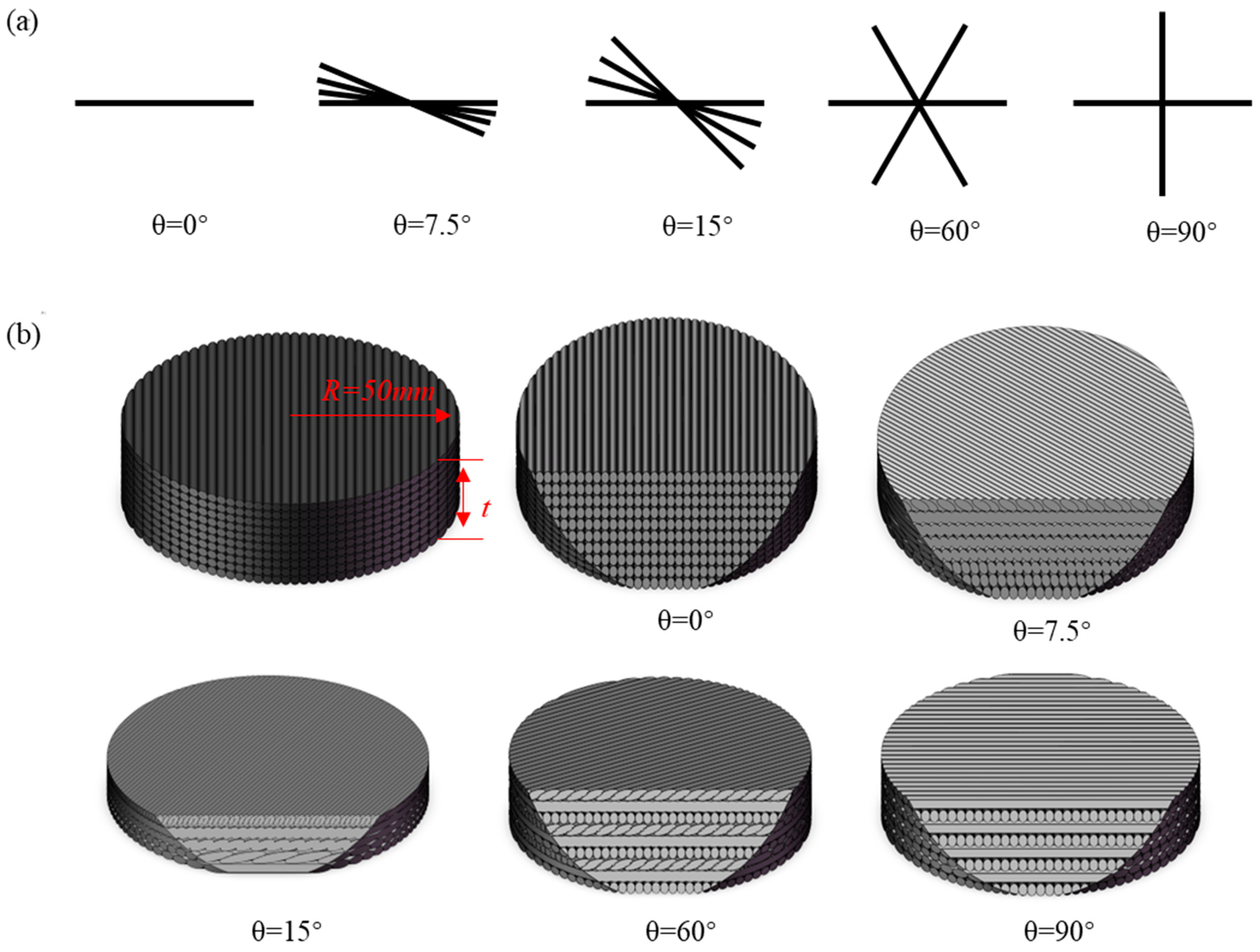
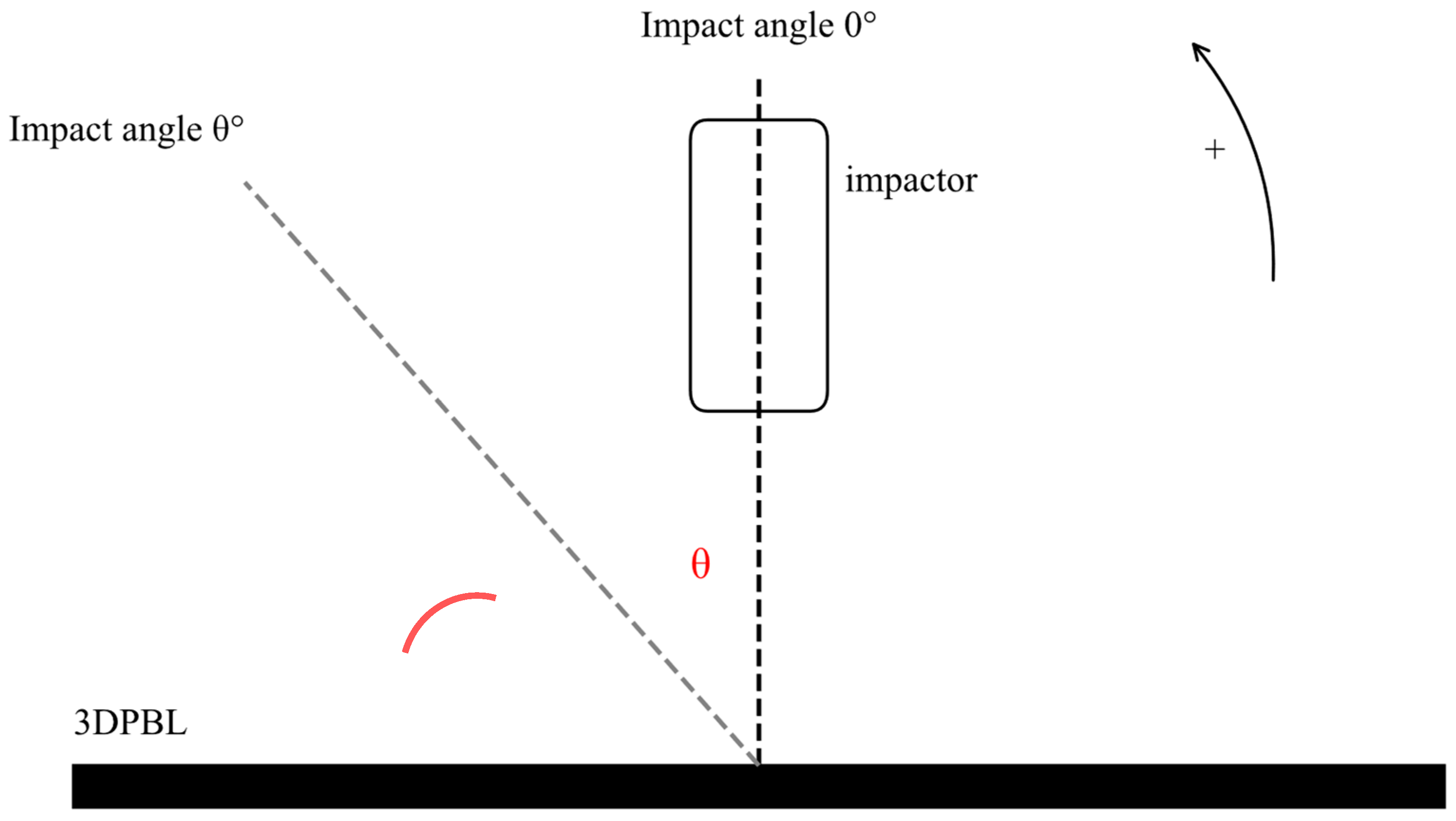

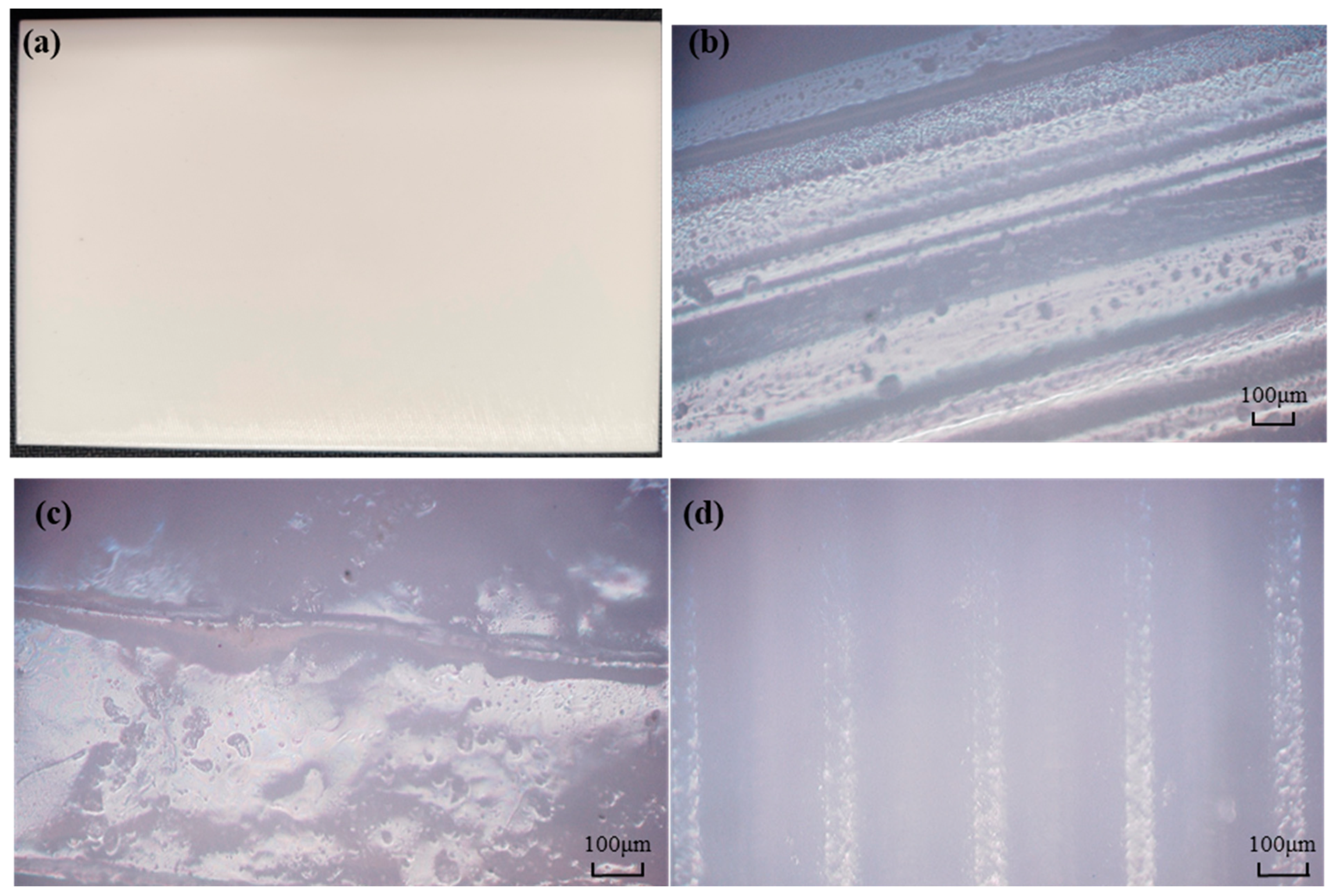



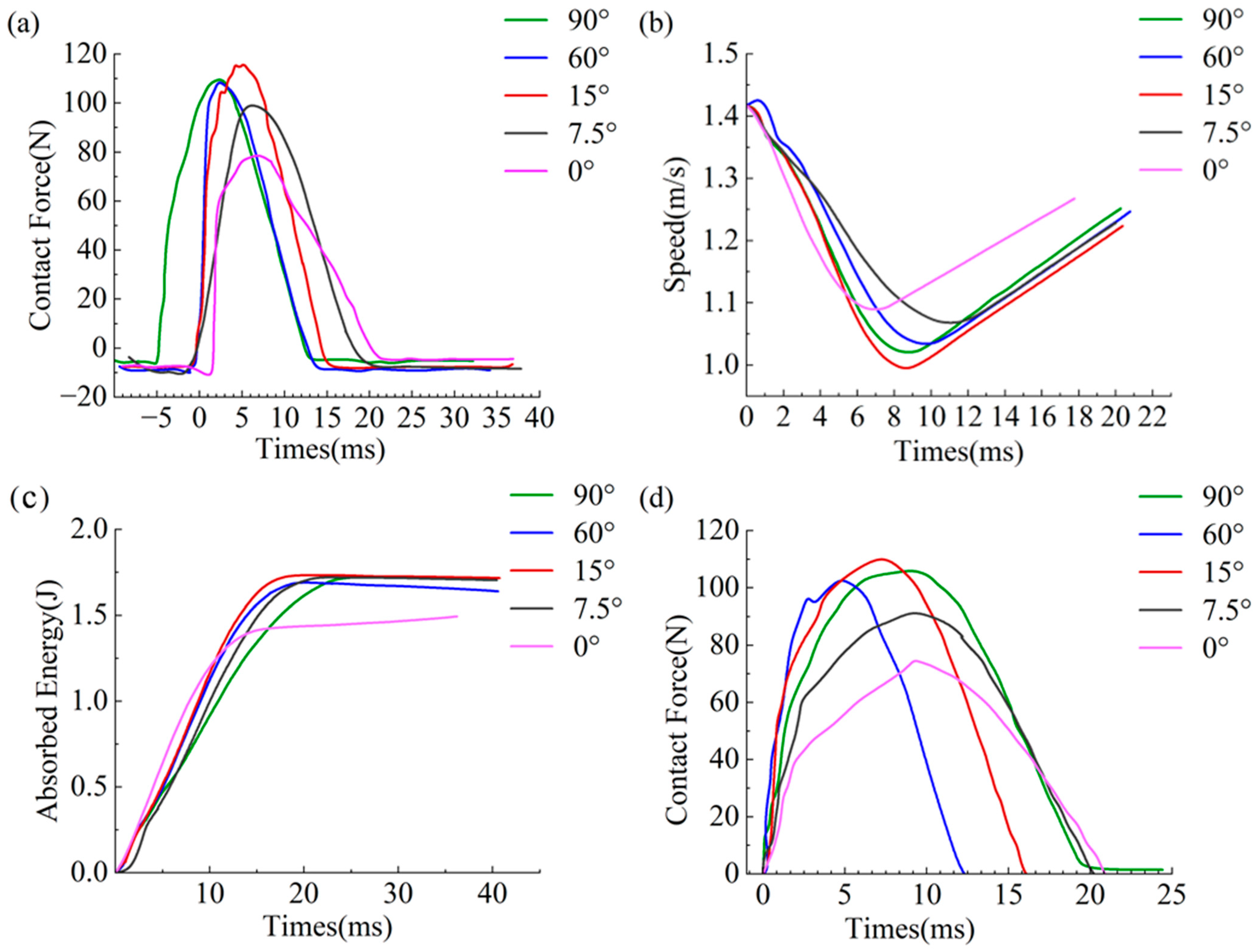



| Materials | Properties | Parameters |
|---|---|---|
| PLA Single-Layer Board Properties | Density (kg/m3) | ρ = 1220 |
| Young’s Modulus (GPa) | E11 = 3.6; E22 = E33 = 3.3; G12 = G13 = 1.25; G23 = 1.14 | |
| Poisson’s Ratio (υ) | υ12 = υ13 = 0.3; υ23 = 0.35 | |
| Strength (MPa) | XT = 33; XC = 50; YT = 25; YC = 35; | |
| S12 = S13 = S23 = 23 | ||
| Interlayer Properties | Fracture Energy (N/mm) | Gft = 1.0; Gfc = 2.8; Gmt = 0.4; Gmc = 1.8 |
| Strength (MPa) | N = S = T = 30 | |
| Fracture Energy (N/mm) | GIc = 0.35; GIIc = GIIIc = 0.75 | |
| Correlation Coefficient (η) | η = 1.45 |
| Angle (°) | Group 1 (N) | Group 2 (N) | Group 3 (N) | Mean (N) | Standard Deviation (%) |
|---|---|---|---|---|---|
| 0° | 79.80 | 74.42 | 84.27 | 79.50 | 6.21 |
| 7.5° | 99.86 | 93.27 | 103.21 | 98.78 | 5.14 |
| 15° | 116.49 | 123.38 | 109.69 | 116.52 | 5.87 |
| 60° | 109.19 | 113.21 | 104.24 | 108.88 | 4.13 |
| 90° | 110.22 | 120.51 | 104.59 | 111.77 | 7.24 |
| Strength | Fracture Energy | Correlation Coefficient | ||
|---|---|---|---|---|
| N | 30 MPa | GI | 3.5 × 10² J/m2 | 1.45 |
| S | 30 MPa | GII | 7.5 × 10² J/m2 | |
| T | 30 MPa | GIII | 7.5 × 10² J/m2 | |
| Helix Angle α | Simulation Value | Experimental Value | Relative Error |
|---|---|---|---|
| 0° | 75.20 N | 79.80 N | 3.0% |
| 7.5° | 91.06 N | 99.86 N | 4.6% |
| 15° | 110.10 N | 116.49 N | 2.8% |
| 60° | 101.96 N | 109.19 N | 3.4% |
| 90° | 101.93 N | 110.22 N | 3.9% |
| Impact Angle θ (°) | Impact Energy Ea (J) | Helix Angle α (°) |
|---|---|---|
| 45/0 | 2.5 | 7.5/15/60/90 |
| Impact Angle θ (°) | Impact Energy Ea (J) | Helix Angle α (°) |
|---|---|---|
| 0/30/45/60 | 2.5 | 15 |
Disclaimer/Publisher’s Note: The statements, opinions and data contained in all publications are solely those of the individual author(s) and contributor(s) and not of MDPI and/or the editor(s). MDPI and/or the editor(s) disclaim responsibility for any injury to people or property resulting from any ideas, methods, instructions or products referred to in the content. |
© 2026 by the authors. Licensee MDPI, Basel, Switzerland. This article is an open access article distributed under the terms and conditions of the Creative Commons Attribution (CC BY) license.
Share and Cite
Wang, S.; Li, Y.; Ge, X.; Yang, Y.; Li, J. The Low-Velocity Oblique Impact Resistance of 3D-Printed Bouligand Laminates. Materials 2026, 19, 1502. https://doi.org/10.3390/ma19081502
Wang S, Li Y, Ge X, Yang Y, Li J. The Low-Velocity Oblique Impact Resistance of 3D-Printed Bouligand Laminates. Materials. 2026; 19(8):1502. https://doi.org/10.3390/ma19081502
Chicago/Turabian StyleWang, Shuo, Yangbo Li, Xianqiang Ge, Yahui Yang, and Junjie Li. 2026. "The Low-Velocity Oblique Impact Resistance of 3D-Printed Bouligand Laminates" Materials 19, no. 8: 1502. https://doi.org/10.3390/ma19081502
APA StyleWang, S., Li, Y., Ge, X., Yang, Y., & Li, J. (2026). The Low-Velocity Oblique Impact Resistance of 3D-Printed Bouligand Laminates. Materials, 19(8), 1502. https://doi.org/10.3390/ma19081502