Article

Element-Free Galerkin Method for Analyzing Size-Dependent Thermally Induced Free Vibration Characteristics of Functionally Graded Magneto-Electro-Elastic Doubly Curved Microscale Shells


Department of Civil Engineering, National Cheng Kung University, Tainan City 70101, Taiwan
*
Author to whom correspondence should be addressed.
Materials 2026, 19(8), 1494; https://doi.org/10.3390/ma19081494
Submission received: 4 March 2026 / Revised: 2 April 2026 / Accepted: 7 April 2026 / Published: 8 April 2026

Abstract

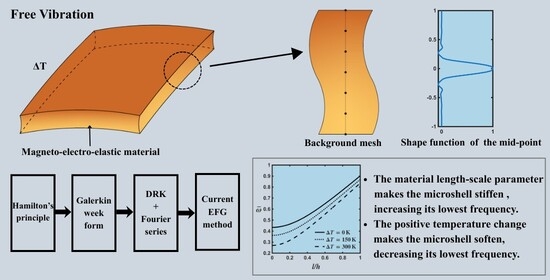
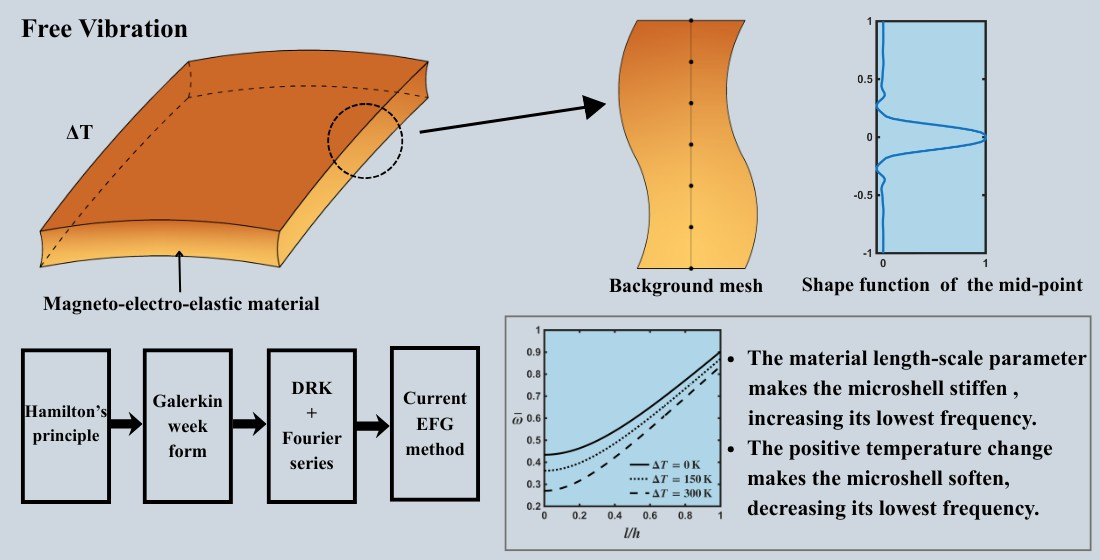
Within the framework of consistent couple stress theory (CCST) and employing Hamilton’s principle, we derive a Galerkin weak formulation to analyze the three-dimensional (3D) size-dependent free vibration characteristics of a simply supported, functionally graded (FG) magneto-electro-elastic (MEE) doubly curved (DC) microscale shell subjected to a uniform temperature change. Incorporating the differential reproducing kernel (DRK) interpolants into the weak formulation, we further develop an element-free Galerkin (EFG) method. The microscale shell of interest is composed of two-phase MEE materials, and its material properties are assumed to vary through its thickness according to a power-law distribution of the volume fractions of the constituents. The results show that the natural frequency solutions obtained using the EFG method are in excellent agreement with the reported 3D solutions for laminated composite and FG-MEE macroscale plates, with the material length-scale parameter and the inverse of the curvature radii set to zero. The effects of the material length-scale parameter, temperature change, inhomogeneity index, and mid-surface radius and length-to-thickness ratios on the FG-MEE microscale shell’s free vibration characteristics in a thermal environment are examined and appear to be significant.

Graphical Abstract

1. Introduction

Magneto-electro-elastic (MEE) materials [1], due to their coupling among mechanical, electric, and magnetic fields, can convert energy among these fields, enabling a wide range of applications in advanced industries. These include sensors that detect changes in mechanical, electrical, and magnetic fields [2]; energy-harvesting devices that convert ambient vibrations into electrical and magnetic energy [3,4]; and actuators that exploit coupling among multiple fields for precise control [5]. The analysis of the coupling of magneto-electro-mechanical behaviors in laminated composite (LC) and functionally graded (FG) MEE beam, plate, and shell-like structures has thus attracted considerable attention.
Several articles have reported results on the magneto-electro-mechanical coupling behavior of LC and FG macroscale MEE structures. Using the first-order shear deformation theory (FSDT), Zhang et al. [6] presented results for the mechanical behavior of FG-MEE plates and shells using a finite element method (FEM). Accounting for porosity and thermal effects, Zhao et al. [7] used FSDT to analyze the mechanical response of FG-MEE porous cylindrical shells in a thermal environment. Based on the refined shear deformation theory (RSDT), Moita et al. [8] developed a higher-order FEM model to investigate the free vibration and static bending behaviors of LC-MEE plates. Tornabene et al. [9] derived an equivalent layer-wise formulation to study the magneto-electro-mechanical coupling behavior of LC-MEE doubly curved (DC) shells. Within the framework of three-dimensional (3D) classical elasticity theory, Bhangale and Ganesan [10] and Wu et al. [11] developed semi-analytical FEM and meshless methods, respectively, to analyze the mechanical behavior of simply supported FG-MEE plates and shells. Pan and Heyliger [12], Brischetto and Cesare [13], Brischetto et al. [14], Wu et al. [15], Wu and Tsai [16], and Tsai and Wu [17] presented 3D exact solutions for various mechanical behaviors of LC- and FG-MEE plates and shells using classical analytical approaches, including the state space, modified Pagano, and perturbation methods. Vinyas [18] conducted a comprehensive survey of computational models to analyze the mechanical behavior of smart LC- and FG-MEE macroscale structures.
MEE materials also enable the miniaturization of components and structures in high-tech fields, including filtering antennas and inductors [19], micro-electro-mechanical systems (MEMSs) [20], vibration isolators [21], soft robotics [22], and soft sensors and actuators [23]. It is well known that the mechanical behavior of microscale devices and structures differs from that of macroscale devices and structures due to size-dependent effects. To account for these effects in classical continuum mechanics (CCM) models, several non-CCM theories have been reported, including the couple stress theory and its consistent and modified versions [24,25,26], the strain gradient theory and its consistent and modified versions [27,28,29,30], Eringen’s nonlocal elasticity theory [31], the micropolar theory [32], and the doublet mechanics theory [33]. Finally, several comprehensive surveys on the development of various non-CCM theories and their applications have been presented [34,35,36,37,38,39,40]. Among these non-CCM theories, the modified and consistent couple stress theories (MCSTs and CCSTs) are more widely used than the others because they require only one material-length scale parameter for calibration. The relevant two-dimensional (2D) analyses based on the MCST and CCST are surveyed as follows:
Mehralian and Beni [41] investigated the thermo-electro-mechanical buckling behavior of cylindrical nanoshells resting on an elastic foundation by incorporating the kinematics model of Love’s classical shell theory into the MCST. Based on the MCST, Lou et al. [42] reformulated the classical FSDT to account for size-dependent effects and used it to analyze the post-buckling response of piezoelectric hybrid microplates subjected to thermo-electro-mechanical loads. In conjunction with the MCST and the kinematics model of the RSDT, Abazid and Sobhy [43] examined the static bending response of an FG piezoelectric microplate resting on an elastic foundation. Combining the kinematics model of the sinusoidal shear deformation theory (SSDT) and the MCST, Zhang et al. [44] analyzed the static buckling behavior of a sandwich microplate. Accounting for the thickness stretching effect in the MCST-based SSDT, Dehsaraji et al. [45] presented results on the thermo-electro-mechanical buckling analysis of FG piezoelectric micro/nano-shells. Finally, based on the CCST, Wu and Hsu [46] developed a 2D unified size-dependent theory to analyze the free vibration characteristics of a simply supported FG microplate subjected to magneto-electro-thermo-mechanical loads. Wu and Hsu [26] have proved that the difference between the weak formulation of the MCST and that of the CCST is minor, and the results obtained from these two theories closely agree with each other.
On one hand, because the differential operator applied to the total stress tensor in the stress equilibrium equations for the CCST aligns with that used for the symmetric force-stress tensor in classical elasticity theory, the CCST is more practical to use than the MCST. On the other hand, the highest-order derivatives of the field variables in the current study are third order. The differential reproducing kernel (DRK), developed by the first author’s research group [47], consists of a higher-order polynomial function set that naturally exhibits a greater capacity for smoothly simulating the variations in field variables than the lower-order Lagrange functions used to construct the shape functions in traditional FEMs. Therefore, the element-free Galerkin (EFG) method with DRK interpolants becomes an efficient numerical approach for analyzing the current thermally induced physical problems.
Following the review above, we found that 3D solutions for the coupling behavior of LC- and FG-MEE microscale shells in thermal environments are limited in the literature. To provide a reference for evaluating 2D numerical solutions and understanding how key factors influence the free-vibration characteristics of LC- and FG-MEE DC microscale shells in thermal environments, such as the material length-scale parameter, temperature change, inhomogeneity index, mid-surface radius ratio, and length-to-thickness ratio, we develop an EFG method with DRK interpolants based on the Galerkin weak formulation of the CCST in this paper.

2. DRK Interpolants

In this paper, we use the DRK interpolant to model variations in each field variable across the microscale shell thickness. The relevant derivation of the DRK interpolant [47] is briefly outlined as follows:
There are  n p  discrete sampling nodes placed at natural coordinates,  ξ = ξ 1 ,   ξ 2 ,   ,   ξ n p , and their values in the natural coordinate system range from −1 to 1. The DRK interpolant (i.e.,  f a ( ξ ) ) used for simulating each field variable is expressed as follows:
f a ( ξ ) = l = 1 n p N l ( ξ )   f l = l = 1 n p ϕ l ( ξ ) + ψ l ( ξ )   f l ,
where  N l ξ  (l = 1, 2, …,  n p ) denotes the DRK interpolant’s shape functions at the reference sampling point  ξ = ξ l f l  represents the nodal value of  f a ( ξ )  at  ξ = ξ l ψ l ξ  is the selected primitive function satisfying the Kronecker delta properties, and  ϕ l ξ  is the enrichment function determined by imposing the nth-order reproducing conditions. In our DRK meshless method, the enrichment function is expressed as follows:
ϕ l ( ξ ) = w a ( ξ ξ l ) P T ( ξ ξ l ) b 0 ξ ,
where  b 0 ξ  and  w a ξ ξ l  denote the undetermined function vector and a Gaussian function, respectively, and the transport of the base function set,  P T ξ ξ l , is provided as follows:
P T ξ ξ l = 1 ξ ξ l ξ ξ l 2 ξ ξ l n .
The undetermined function vector  b 0 ξ  can be determined by employing (n + 1) reproducing conditions as follows:
l = 1 n p ϕ l ( ξ ) + ψ l ( ξ ) ξ l m = ξ m ,
where m is counted from 1 to n.
The undetermined function vector  b 0 ξ  can be obtained by substituting the enrichment functions into the reproducing condition (3) and expressed as follows:
b 0 ξ = A 0 1 ( ξ ) P 0 l = 1 n p P ξ ξ l ψ l ξ ,
where  A 0 ( ξ ) = l = 1 n p P ξ ξ l w a ξ ξ l P T ξ ξ l .
The DRK interpolant’s shape functions can thus be determined by substituting Equation (5) into Equation (2) and expressed as follows:
N l ξ = ϕ l ξ + ψ l ξ ,
where the subscript l is counted from  l = 1  to  l = n p .
The derivatives of the DRK interpolant, including first- and higher-order derivatives, are obtained using the differential reproducing conditions without relying on the traditional, time-consuming differential operation. The primitive and weight functions, along with their related derivations, are provided in Wang et al. [47].

3. Hamilton’s Principle

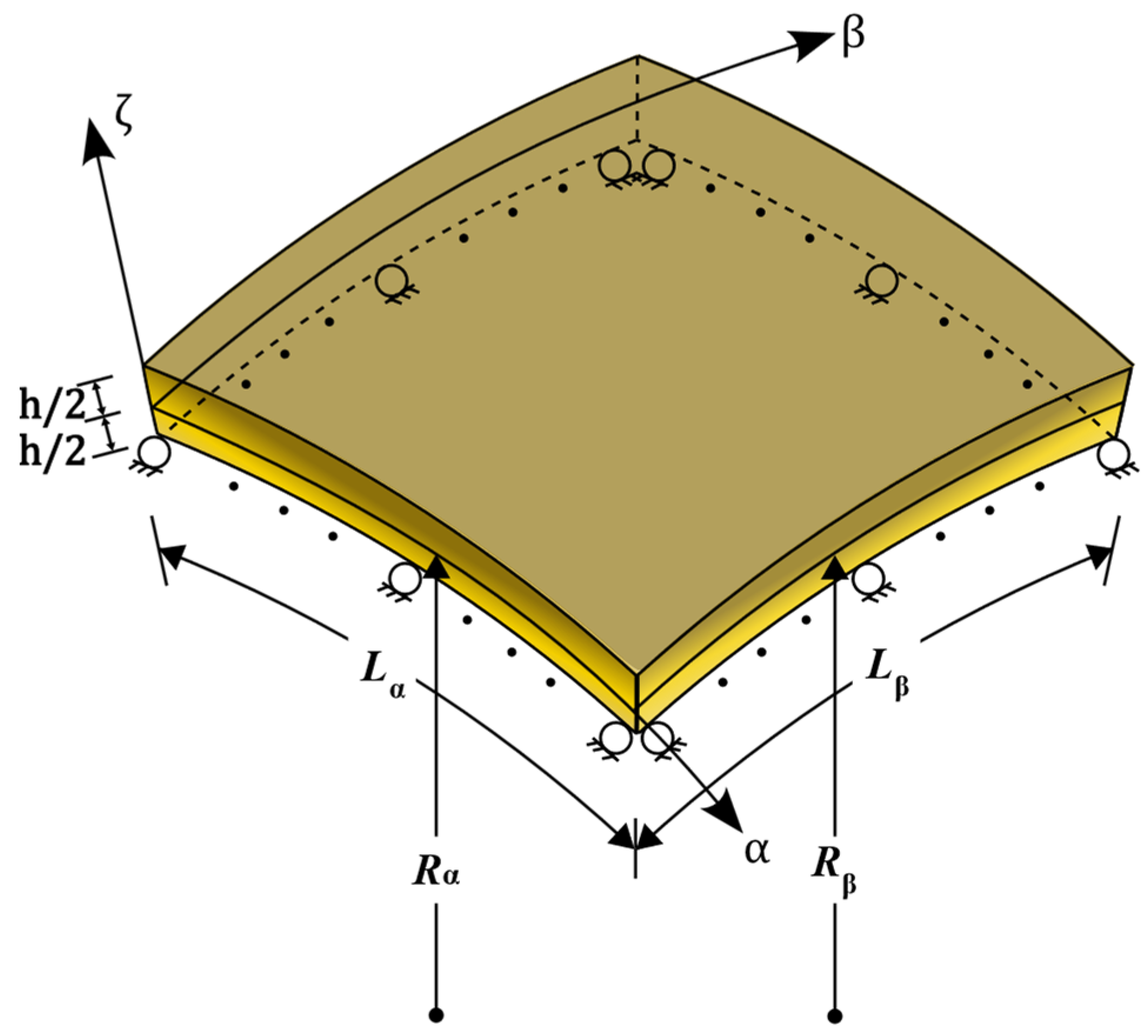
This study examines the free vibration characteristics of an LC-/FG-MEE DC microscale shell under fully simply supported conditions and a uniform temperature change (see Figure 1). A DC shell coordinate system,  α ,   β ,   and   ζ ,  is positioned on the mid-surface of the microscale shell. The shell’s thickness is h, the mid-surface radii along  α   and   β  axes are  R α   and   R β , and the in-surface dimensions along  α   and   β  axes are  L α   and   L β .

3.1. Galerkin Weak Formulation

We derive the Galerkin weak formulation to solve this issue using Hamilton’s principle [48]. The energy functional of the microscale shell subjected to a uniform temperature change is provided as follows:
I R = t 1 t 2 V U s + W d t ,
where V represents the kinetic energy functional of the microscale shell,  U s  denotes the strain energy functional of the microscale shell, and W is the work done by the thermally induced initial stresses. These energy functionals and work are expressed as follows:
V = h / 2 h / 2 A ρ / 2 u α , t 2 + u β , t 2 + u ζ , t 2 γ α   γ β   d α   d β   d ζ ,
U s = h / 2 h / 2 A 1 / 2 σ α α ε α α + σ β β ε β β + σ ζ ζ ε ζ ζ + σ α ζ γ α ζ + σ β ζ γ β ζ + σ α β γ α β   2 μ α κ α 2 μ β κ β 2 μ ζ κ ζ D α E α D β E β D ζ E ζ   B α H α B β H β B ζ H ζ γ α γ β d α d β d ζ ,
W = Δ T h / 2 h / 2 A c α 1 ε α α n l + c α 2 ε β β n l γ α γ β d α d β d ζ ,
where  ρ  denotes the mass density, A is the shell domain on the  α β -surface, and t is the time variable;  u i  represents the displacement tensors, and  σ i j   and   ε k l  are the symmetric parts of the force-stress tensor and strain tensor, respectively;  μ i   and   κ i  represent the couple stress and the skew-symmetric part of the curvature tensors, Di and  B i  are the electric and magnetic flux tensors, and Ei and Hi are the electric and magnetic potential tensors;  γ α   and   γ β  represent the scale factor for the DC shell coordinate system and are provided as  γ α = 1 + ζ / R α  and  γ β = 1 + ζ / R β c α 1   and   c α 2  represent the coupling force-stress and temperature change coefficients and are provided as  c α 1 = c 11 α 1 + c 12 α 2 + c 13 α 3 , and  c α 2 = c 21 α 1 + c 22 α 2 + c 23 α 3 , in which  c i j   and   α i  represent the elastic and thermal expansion coefficients; and  ε α α n l   and   ε β β n l  are the full nonlinear strains and are provided as follows:
ε α α n l = u ζ / R α 2 + u ζ , α 2 2 u ζ , α u α / R α + u α / R α 2 / 2 γ α 2 ,
ε β β n l = u ζ / R β 2 + u ζ , β 2 2 u ζ , β u β / R β + u β / R β 2 / 2 γ β 2 .
This study assumes a uniform temperature change and does not perform a heat conduction analysis because the temperature variations arise from the difference between the manufacturing and working environments. The shell dimensions considered are very small, approaching the micron scale, so the temperature should quickly reach a uniform steady state after the transient phase dissipates.
We choose the displacement components as the primary field variables subjected to variation; the other variables, including strain, rotation, and curvature components, are the dependent field variables, and their relationship is expressed as follows:
The strain-displacement relationship is given as follows [49]:
ε α α = u α , α + u ζ / R α / γ α ,
ε β β = u β , β + u ζ / R β / γ β ,
ε ζ ζ = u ζ , ζ ,
γ β ζ = u β , ζ u β / γ β R β + u ζ , β / γ β ,
γ α ζ = u α , ζ u α / γ α R α + u ζ , α / γ α ,
γ α β = u α , β / γ β + u β , α / γ α .
The rotation-displacement relationship is given as follows [49]
θ α = u β , ζ / 2 u β / 2 R β γ β + u ζ , β / 2 γ β ,
θ β = u α , ζ / 2 + u α / 2 R α γ α u ζ , α / 2 γ α ,
θ ζ = u α , β / 2 γ β + u β , α / 2 γ α .
The skew-symmetric parts of the curvature-rotation relationship are given as follows [49]:
κ α = 1 / 4 γ β 2 β β 1 / 4 ζ ζ 1 / 4 R α γ α + 1 / 4 R β γ β ζ + 1 / 4 R α 2 γ α 2 1 / 4 R α R β γ α γ β u α   + 1 / 4 γ α γ β u β , α β + 1 / 4 R α γ α 2 + 1 / 4 R β γ α γ β α + 1 / 4 γ α α ζ u ζ ,
κ β = 1 / 4 γ α γ β u α , α β + 1 / 4 γ α 2 α α 1 / 4 ζ ζ 1 / 4 R α γ α + 1 / 4 R β γ β ζ   + 1 / 4 R β 2 γ β 2 1 / 4 R α R β γ α γ β u β + 1 / 4 R β γ β 2 + 1 / 4 R α γ α γ β β + 1 / 4 γ β β ζ u ζ ,
κ ζ = 1 / 4 R α γ α 2 α + 1 / 4 γ α α ζ u α + 1 / 4 R β γ β 2 β + 1 / 4 γ β β ζ u β   1 / 4 γ α 2 α α + 1 / 4 γ β 2 β β u ζ .
The constitutive equations suitable for an orthotropic material are given as follows:
σ α α σ β β σ ζ ζ σ β ζ σ α ζ σ α β = c 11 c 12 c 13 0 0 0 c 12 c 22 c 23 0 0 0 c 13 c 23 c 33 0 0 0 0 0 0 c 44 0 0 0 0 0 0 c 55 0 0 0 0 0 0 c 66 ε α α ε β β ε ζ ζ γ β ζ γ α ζ γ α β 0 0 e 31 0 0 e 32 0 0 e 33 0 e 24 0 e 15 0 0 0 0 0 E α E β E ζ 0 0 q 31 0 0 q 32 0 0 q 33 0 q 24 0 q 15 0 0 0 0 0 H α H β H ζ c α 1 c α 2 c α 3 0 0 0 Δ T ,
D α D β D ζ = 0 0 0 0 e 15 0 0 0 0 e 24 0 0 e 31 e 32 e 33 0 0 0 ε α α ε β β ε ζ ζ γ β ζ γ α ζ γ α β + η 11 0 0 0 η 22 0 0 0 η 33 E α E β E ζ + d 11 0 0 0 d 22 0 0 0 d 33 H α H β H ζ 0 0 e α 3 Δ T ,
B α B β B ζ = 0 0 0 0 q 15 0 0 0 0 q 24 0 0 q 31 q 32 q 33 0 0 0 ε α α ε β β ε ζ ζ γ β ζ γ α ζ γ α β + d 11 0 0 0 d 22 0 0 0 d 33 E α E β E ζ + β 11 0 0 0 β 22 0 0 0 β 33 H α H β H ζ 0 0 q α 3 Δ T ,
where  c i j ,   e i j ,   and   q i j  represent the elastic, piezoelectric, and magnetoelastic coefficients;  η k k ,   d k k ,   and   β k k  represent the dielectric permeability, piezomagnetic, and magnetic permeability coefficients;  e α 3  and  q α 3  represent the coupling electric flux and temperature change and coupling magnetic flux and temperature change coefficients, which are given as  e α 3 = e 31 α 1 + e 32 α 2 + e 33 α 3  and  q α 3 = q 31 α 1 + q 32 α 2 + q 33 α 3 , respectively; Ei and  H i  represent the electric and magnetic field variables and are provided as  E i ( m ) = Φ , i  and  H i = Ψ , i  in which  Φ   and   Ψ  represent the electric and magnetic potential variables.
The couple stress tensor-skew-symmetric parts of the curvature tensor relationship is expressed as follows [49]:
μ α μ β μ ζ = 1 / 2 b 11 0 0 0 b 22 0 0 0 b 33 κ α κ β κ ζ ,
where  b k k  represents the coupling couple stress and the skew-symmetric parts of the curvature coefficient. For an isotropic material,  b k k = 4 G j i l 2 , in which Gji represents the shear modulus of the ji-surface and l represents the material length-scale parameter.
By taking the first-order variation of the energy functional expressed in Equation (7) and setting it to zero, the authors derive the Galerkin weak formulation of the 3D CCST for analyzing static buckling and free vibration characteristics of an FG-DC microscale shell in a temperature environment as follows:
δ I R = 0 t 1 t 2 δ V δ U s + δ W d t = 0 ,
where
t 1 t 2 δ V d t = t 1 t 2 h / 2 h / 2 Ω ρ δ u T u , t t + δ u ζ u ζ , t t γ α γ β d α d β d ζ d t ,
t 1 t 2 δ U s d t = t 1 t 2 h / 2 h / 2 A δ ε p T σ p + δ ε s T σ s + δ ε ζ ζ σ ζ ζ 2 δ κ T μ   δ E p T D p δ E ζ D ζ δ H p T B p δ H ζ B ζ γ α γ β d α d β d ζ d t ,
t 1 t 2 δ W d t = Δ T t 1 t 2 h / 2 h / 2 A δ u α c α 1 u ζ , α / γ α 2 R α + c α 1 u α / γ α 2 R α 2 + δ u β c α 2 u ζ , β / γ β 2 R β + c α 2 u β / γ β 2 R β 2 + δ u ζ c α 1 u ζ / γ α 2 R α 2 + c α 2 u ζ / γ β 2 R β 2 + δ u ζ , α c α 1 u ζ , α / γ α 2 c α 1 u α / γ α 2 R α + δ u ζ , β c α 2 u ζ , β / γ β 2 c α 2 u β / γ β 2 R β d t .
Additionally, various field variables shown in Equations (30)–(32) are expressed as follows:
u = u α u β T ,
ε p = ε α α ε β β γ α β T = B 1 u + B 2 u ζ ,
ε s = γ α ζ γ β ζ T = B 3 u + B 4 u ζ ,
ε ζ ζ = B 5 u ζ ,
κ = κ α κ β κ ζ T = B 6 u + B 7 u ζ ,
E p = E α E β T = B 8 Φ ,
E ζ = Φ , ζ ,
H p = H α H β T = B 8 Ψ ,
H ζ = Ψ , ζ ,
σ p = σ α α σ β β σ α β T = Q p ε p + Q ζ ε ζ ζ + Q 1 E ζ + Q 2 H ζ Q 3 Δ T ,
σ s = σ β ζ σ α ζ T = Q s ε s + Q e E p + Q q H p ,
σ ζ ζ = Q ζ T ε p + c 33 ε ζ ζ + e 33 E ζ + q 33 H ζ c α 3 Δ T ,
μ = μ α μ β μ ζ T = Q c κ ,
D p = D α D β T = Q e ε s + Q η E p + Q d H p ,
D ζ = Q 1 T ε p + e 33 ε ζ ζ + η 33 E ζ + d 33 H ζ e α 3 Δ T ,
where relevant matrices and vectors shown in Equations (33)–(47) are provided in Appendix A.
The Galerkin weak formulation can thus be derived by substituting Equations (30)–(32) into Equation (29).

3.2. System Equations

Incorporating the DRK interpolant given in Equation (3) into the Galerkin weak formulation derived above, we develop the EFG method as follows.
In the case of interest, the tractions on the microscale shell’s top and bottom surfaces are free, and the edge conditions of the microscale shell are simply supported. These surface and edge conditions are written as follows:
The conditions of the microscale shell’s top and bottom surfaces are as follows:
Case   1 :   σ ζ α = σ ζ β = σ ζ ζ = μ ζ α = μ ζ β = Φ = Ψ = 0       on   the   surfaces   at   ζ = ± h / 2 ,
Case   2 :   σ ζ α = σ ζ β = σ ζ ζ = μ ζ α = μ ζ β = D ζ = B ζ = 0       on   the   surfaces   at   ζ = ± h / 2 .
The edge conditions of the microscale shell are provided as follows:
u β ( m ) = u ζ ( m ) = σ α α ( m ) = μ α β ( m ) = μ α ζ ( m ) = Φ ( m ) = ψ ( m ) = 0           at   α = 0   and   α = a α ,
u α ( m ) = u ζ ( m ) = σ β β ( m ) = μ β α ( m ) = μ β ζ ( m ) = Φ ( m ) = ψ ( m ) = 0           at   β = 0   and   β = a β ,
where  m = 1 ,   2 , ,   n l .
By satisfying the edge conditions (i.e., Equations (50) and (51)) in prior, we express each layer’s displacement variables as follows:
u α = m ^ = 1 n ^ = 1 u m ^ n ^ ( ζ ) cos m ˜ α   sin n ˜ β   e i ω t ,
u β = m ^ = 1 n ^ = 1 v m ^ n ^ ( ζ ) sin m ˜ α   cos n ˜ β   e i ω t ,
u ζ = m ^ = 1 n ^ = 1 w m ^ n ^ ( ζ ) sin m ˜ α   sin n ˜ β   e i ω t ,
Φ = m ^ = 1 n ^ = 1 ϕ m ^ n ^ ( ζ ) sin m ˜ α   sin n ˜ β   e i ω t ,
Ψ = m ^ = 1 n ^ = 1 ψ m ^ n ^ ( ζ ) sin m ˜ α   sin n ˜ β   e i ω t ,
where the symbols  m ^  and  n ^  are positive integers representing the half-wave numbers in the  α   and   β  directions, and  m ˜ = m ^ π / a α  and  n ˜ = n ^ π / a β .
In the EFG method, we interpolate the primary variables  u m ^ n ^ ,   v m ^ n ^ ,   w m ^ n ^ ,   ϕ m ^ n ^ ,   and   ψ m ^ n ^  with the DRK interpolant given in Section 2, such that
F m ^ n ^ = l = 1 n p ϕ l + ψ l F m ^ n ^ l = l = 1 n p N l F m ^ n ^ l ,
where F represents u, v, w ϕ ,   and   ψ , and  F m ^ n ^ l = F m ^ n ^ ζ = ζ l .
Substituting Equations (30)–(32) and (52)–(57) into Equation (29) yields the layer element equations of the microscale shell as follows:
i = 1 n p j = 1 n p k 11 k 12 k 13 k 14 k 15 k 21 k 22 k 23 k 24 k 25 k 31 k 32 k 33 k 34 k 35 k 41 k 42 k 43 k 44 k 45 k 51 k 52 k 53 k 54 k 55 ω 2 m 11 0 0 0 0 0 m 22 0 0 0 0 0 m 33 0 0 0 0 0 0 0 0 0 0 0 0 Δ T g 11 0 g 13 0 0 0 g 22 g 23 0 0 g 31 g 32 g 33 0 0 0 0 0 0 0 0 0 0 0 0 u m ^ n ^ j v m ^ n ^ j w m ^ n ^ j ϕ m ^ n ^ j ψ m ^ n ^ j = 0 ,
where kij, mkk, and gij represent the stiffness, mass, and geometric stiffness matrix coefficients, whose detailed expressions are provided in Appendix B.
By assembling the equations of each layer element, we can obtain the corresponding system of equations, which consists of  5 n p  simultaneous algebraic equations expressed in terms of  5 n p  nodal displacement components, rewritten as follows:
K I   I K I   I I K I I   I K I I   I I ω 2 M I   I 0 0 0 Δ T G I   I 0 0 0 X I X I I = 0 ,
where  X I = u m ^ n ^ j   v m ^ n ^ j   w m ^ n ^ j   T  and  X I I = ϕ m ^ n ^ j ψ m ^ n ^ j T , and j = 1, 2, …,  n p .
For the pure free vibration problem, we let  Δ T = 0 , and the corresponding system equations are obtained as follows:
K I   I K I   I I K I I   I K I I   I I ω 2 M I   I 0 0 0 X I X I I = 0 .
The natural frequency of the microscale shell can be determined by setting the determinant of the coefficient matrix of Equation (60) to zero as follows:
K I   I K I   I I K I I   I K I I   I I ω 2 M I   I 0 0 0 = 0 .
For the free vibration problem considering a thermal environment, the corresponding system equations are derived as follows:
K ^ I   I K I   I I K I I   I K I I   I I ω 2 M I   I 0 0 0 X I X I I = 0 ,
where  K ^ I   I = K I   I Δ T G I   I .
The natural frequency of the microscale shell subjected to a uniform temperature change can be determined by setting the determinant of the coefficient matrix of Equation (62) to zero as follows:
K ^ I   I K I   I I K I I   I K I I   I I ω 2 M I   I 0 0 0 = 0 .

4. Numerical Examples

4.1. LC and FG-MEE Macro and Microscale Plates

This section examines the free vibration characteristics of simply supported, three-layered composite and FG-MEE macro- and microscale plates under two surface conditions (i.e., Cases 1 and 2). The three-layered plate consists of BaTiO3 (B) and CoFe2O4, (F) layers, with material properties provided in Table 1 [50,51].
Table 2 examines two different lay-ups (i.e., B/F/B and F/B/F). Table 3 presents the FG plate, composed of B and F materials with varying thicknesses, following a power-law distribution of the constituents’ volume fractions. The volume fractions of B and F are given as follows:
Γ B = 1 / 2 + z / h κ p
Γ F = 1 Γ B ,
where  κ p  denotes the inhomogeneity index.
The effective material properties of the FG plate are estimated using a rule of mixtures [48] and are expressed as follows:
P e f f = P B Γ B + P F Γ F ,
where P represents each material property.
In the macroscale plate cases, the geometric parameters are provided as  L α = L β = 1   m ,  and  h = 0.3   m .  In the microscale plate cases, the material length-scale parameter is provided as  l = 17.6 × 10 6   m , and the l/h ratios are 0.25, 0.5, and 1. For the three-layered plates, a dimensionless frequency, following Chen et al. [50], is defined as  ω ¯ = ω L α ρ F / c 11 F . For the FG plates, the dimensionless frequency, following Ramirez et al. [51], is defined as  ω ¯ = ω L α 2 ρ F / c 11 F / h . The current EFG method for analyzing LC/FG-MEE DC microscale shells can be applied to analyze LC/FG-MEE macroscale plates by setting the material length-scale parameter and the inverse of the radii to zero (i.e., l = 0 and  1 / R α = 1 / R β = 0 ). When executing the EFG method, we select the highest order of the base functions as n = 5, and the size of the influence zone is  a l = 5.1 Δ ζ ,  where  Δ ζ = h / n p 1 .  The accuracy and convergence of the EFG method are validated using the 3D exact solutions obtained by Chen et al. [50] with the state-space method and Wu and Lu [52] with the modified Pagano method.
Table 2 and Table 3 display the results for the first five frequencies of the three-layered composite and FG MEE macro- and microscale plates. As shown in these tables, the solutions from the EFG method are accurate and converge rapidly. When np = 31, the relative error between the current solutions and the 3D exact solutions [50,52] is less than 0.6%. The solutions obtained from the EFG method outperform those from the discrete-layer approach of Remirez et al. [51]. Moreover, the results indicate that increasing the material length-scale parameter increases the overall stiffness of the three-layered composite and the FG microplate, thereby raising their natural frequencies. Table 3 shows that the lowest frequency increases as the inhomogeneity index increases. This occurs because, as the inhomogeneity index increases, the volume fraction of the stiffer material, F, increases, thereby enhancing the overall stiffness of the FG plate and consequently its lowest frequency. Additionally, Table 3 demonstrates that the lowest frequency of the FG-MEE plate decreases as the plate becomes thinner, confirming that reducing the plate’s thickness lowers its overall stiffness and, in turn, its lowest frequency.

4.2. FG-MEE DC Microscale Shells

This section presents a parametric study to analyze how several key factors influence the free vibration characteristics of a simply supported FG-MEE DC microscale shell. These factors include the material length-scale parameter, the inhomogeneity index, the temperature change, the mid-surface radius ratio, and the length-to-thickness ratio. The microscale shell studied is made of B and F materials, with volume fractions of the constituents following a power-law distribution. The volume fractions of B and F materials, along with the estimation of the effective material properties, are provided in the same manner as in Equations (64)–(66). A dimensionless frequency parameter is also defined as  ω ¯ = ω L α ρ F / c 11 F .
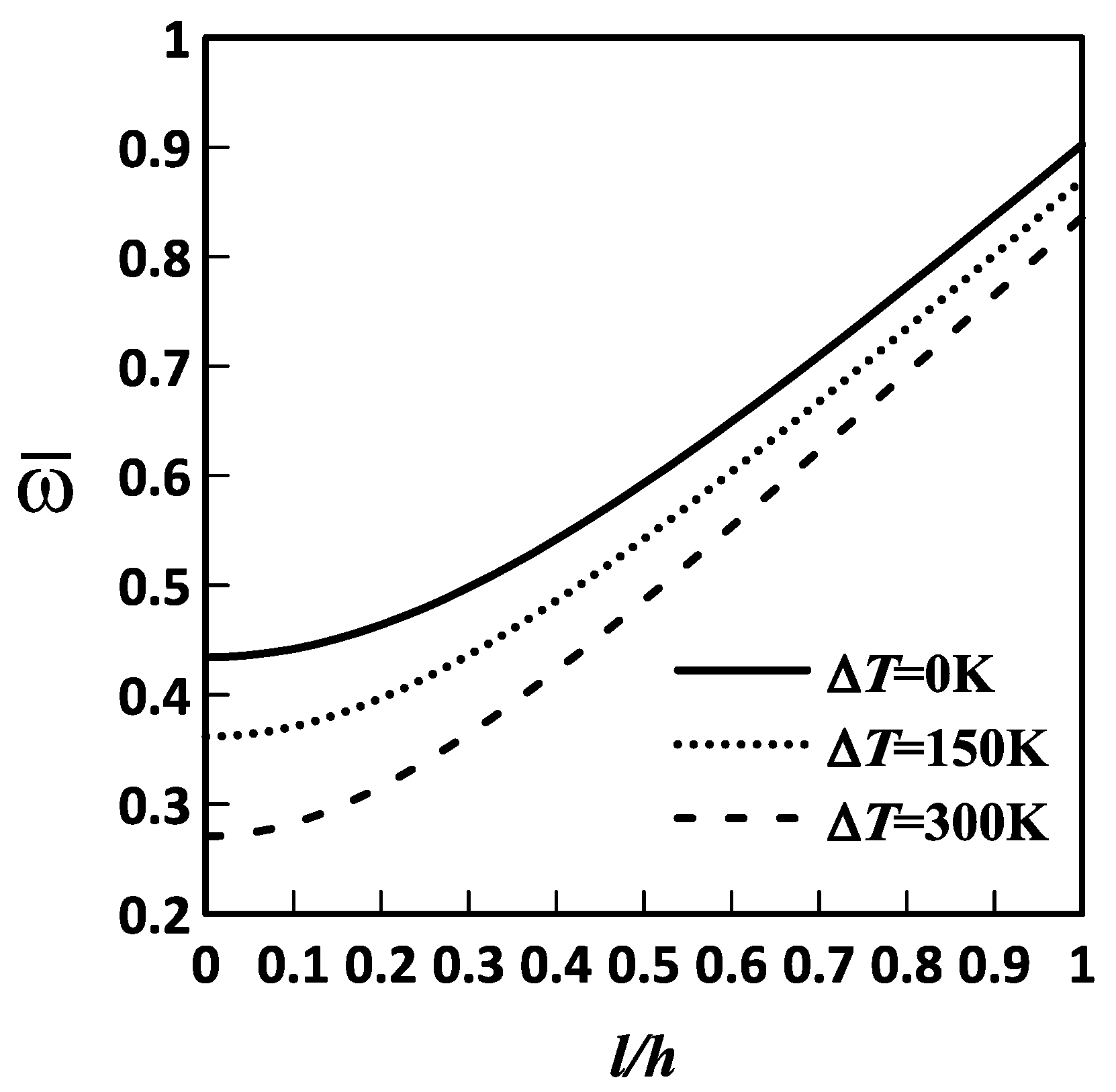
Figure 2 shows the variations in the lowest frequency of the FG-MEE DC microscale shell with the l/h ratio across different temperature changes. The relevant geometric and material parameters are  L α = L β ,   L α / h = 10 ,   R α = R β ,   κ p = 3 ,  and  h = 1 × 10 6   m .
As shown in Figure 2, the lowest frequency increases with increasing the material length-scale parameter. This indicates that the material length-scale parameter stiffens the microscale shell, thereby raising its lowest frequency.
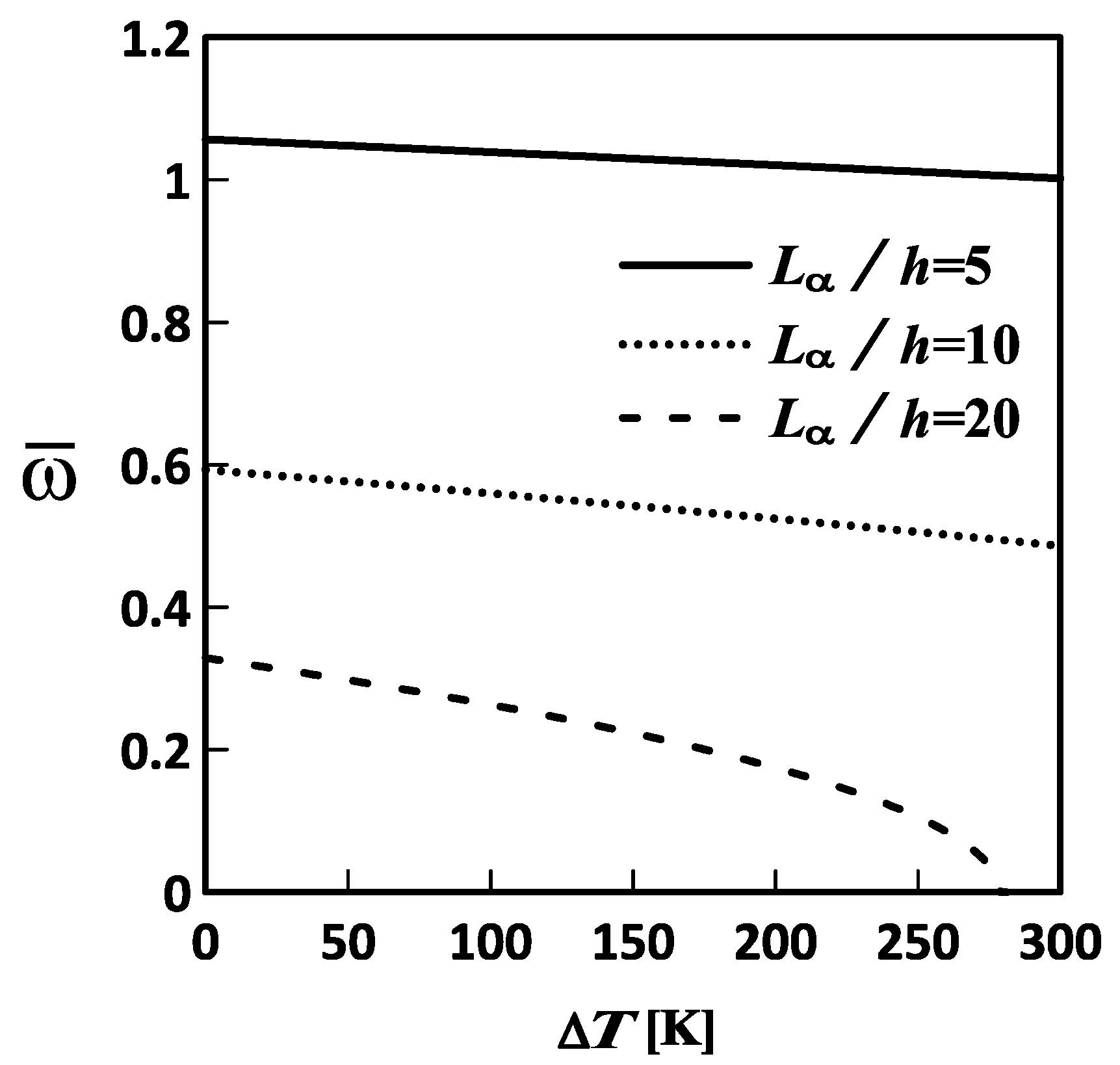
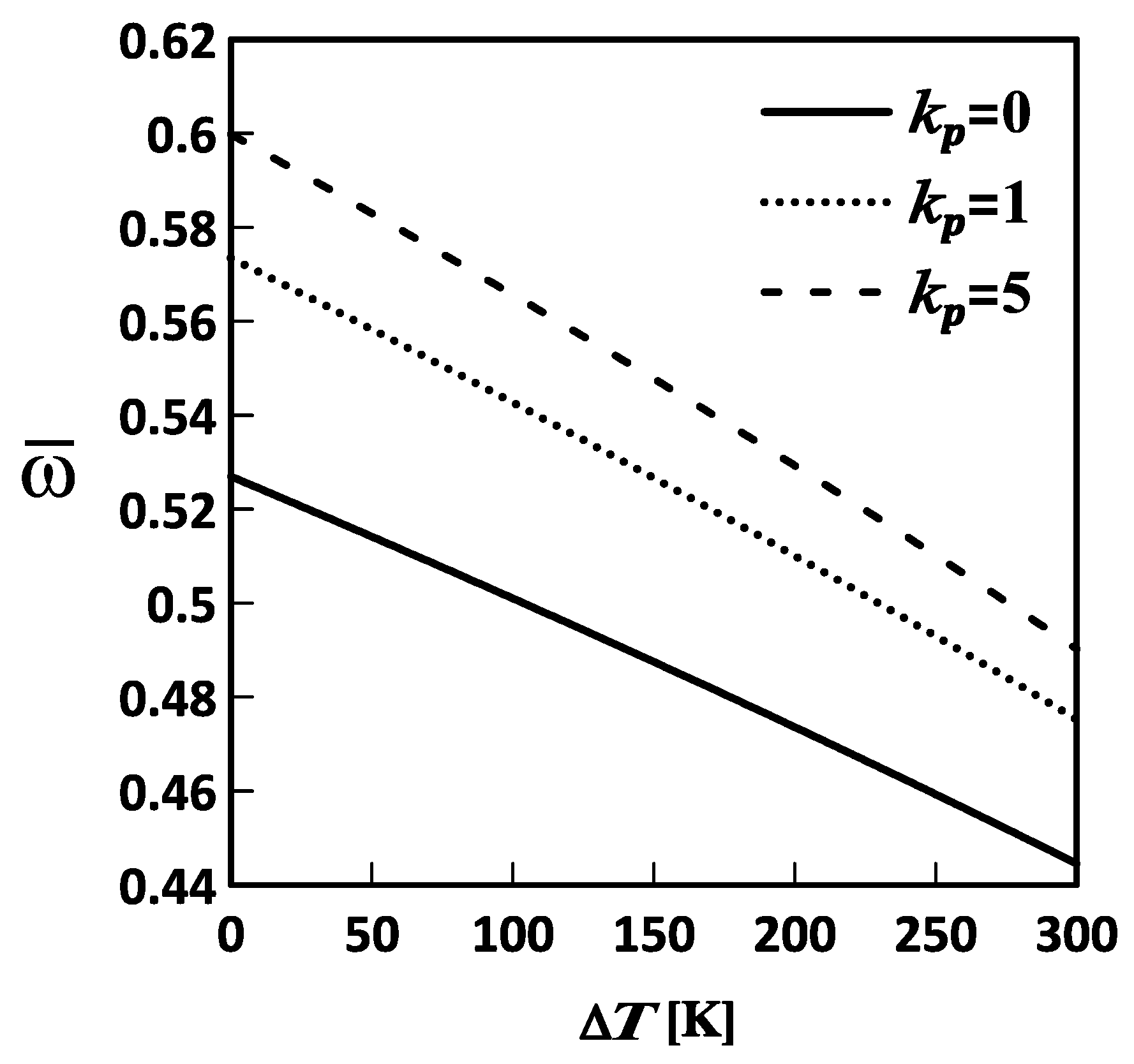
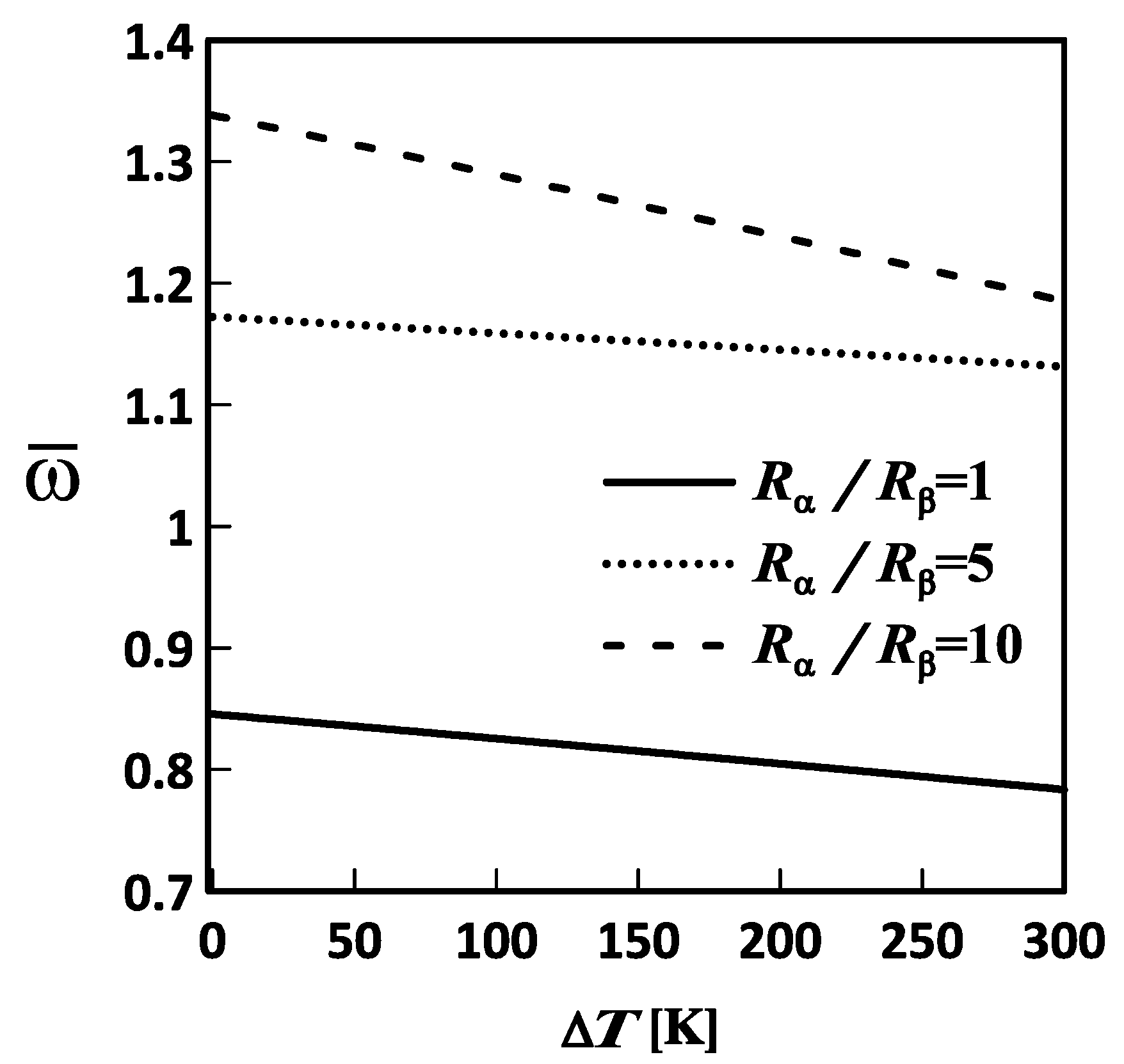
Figure 3, Figure 4 and Figure 5 show the variations in the lowest frequency of the FG-MEE DC microscale shell with temperature changes for different inhomogeneity indices, length-to-thickness ratios, and mid-surface radius ratios, respectively. The relevant geometric and material parameters considered in Figure 3, Figure 4 and Figure 5 are  L α = L β ,   L α / h = 10 ,   R α = R β ,   l / h = 0.5 κ p = 0 ,   1 ,   and   5 ;   L α = L β ,   L α / h = 5 ,   10 ,   and   20 ,   R α = R β ,   l / h = 0.5 ,   κ p = 3 ;  and  L α = L β ,   L α / h = 10 ,   R α / R β = 1 ,   5 ,   and   10 ,   l / h = 0.5 κ p = 3 ,  respectively. Additionally, the plate thickness in these figures is set to  h = 1 × 10 6   m .
As shown in Figure 3, Figure 4 and Figure 5, the lowest frequency decreases with increasing temperature change. This indicates that an increase in temperature induces a set of in-surface compressive stresses in the microscale shell, softening it and thereby decreasing its lowest frequency. Additionally, the lowest frequency increases with increasing inhomogeneity index and mid-surface radius ratio, and decreasing length-to-thickness ratio. This indicated that an increase in the inhomogeneity index and the mid-surface radius ratio results in an increase in the volume fraction of the stiffer material, F, and in a deeper microscale shell, thereby increasing the overall stiffness of the microscale shell and, in turn, its lowest frequency. Moreover, an increase in the length-to-thickness ratio of the microscale shell makes it thinner, thereby reducing its overall stiffness and, in turn, decreasing its lowest frequency.

5. Conclusions

This work develops an EFG method based on the Galerkin weak formulation of the CCST to analyze the free vibration characteristics of an FG-MEE DC microscale shell subjected to a uniform temperature change. The current EFG method can be used to analyze the free-vibration characteristics of FG-MEE DC macroscale plates when the material length-scale parameter and the inverse of the mid-surface radius are set to zero.
In the comparison and validation study, the results show that the current EFG method converges rapidly and that its converged solutions closely agree with the exact 3D solutions for LC/FG-MEE macroscale plates reported in the literature. The results in the parametric study showed that the material length-scale parameter increases the overall stiffness of the FG-MEE DC microscale shell, thereby increasing its natural frequencies. The positive temperature change softens the FG-MEE DC microscale shell, thereby decreasing its natural frequency. Additionally, an increase in the inhomogeneity index increases the volume fraction of the stiffer material, F, thereby increasing the overall stiffness of the microscale shell and, in turn, its lowest frequency.
Future research can explore the thermal effects on other static and dynamic behaviors of the FG-MEE DC microscale shell, including thermal bending, buckling, postbuckling, and forced vibration. Additionally, investigating different boundary conditions on the thermally induced static and dynamic responses of the FG-MEE DC microscale shell is also recommended.

Author Contributions

Conceptualization, C.-P.W.; methodology, C.-P.W.; software, M.-J.L.; validation, C.-P.W. and M.-J.L.; investigation, C.-P.W. and M.-J.L.; resources, C.-P.W.; data curation, M.-J.L.; writing—original draft preparation, C.-P.W.; writing—review and editing, C.-P.W.; supervision, C.-P.W.; project administration, C.-P.W.; funding acquisition, C.-P.W. All authors have read and agreed to the published version of the manuscript.

Funding

This study was funded by a grant from the National Science and Technology Council of Taiwan, under grant number NSTC 114-2221-E-006-010-MY3.

Data Availability Statement

The original contributions presented in this study are included in the article. Further inquiries can be directed to the corresponding author.

Conflicts of Interest

The authors declare no conflicts of interest.

Abbreviations/Notations

The following abbreviations and notations are used in this paper:
BBaTiO3 material
CCMClassical continuum mechanics
CCSTConsistent couple stress theory
DCDoubly curved
DRKDifferential reproducing kernel
EFGElement-free Galerkin
FCoFe2O4 material
FEMFinite element method
FGFunctionally graded
FSDTFirst-order shear deformation theory
LCLaminated composite
MCSTModified couple stress theory
MEEMagneto-electro-elastic
MEMSMicro-electro-mechanical system
RSDTRefined shear deformation theory
SSDTSinusoidal shear deformation theory
2DTwo-dimensional
3DThree-dimensional
Notations
  a l The size of the influence zone for the reference point l
AThe DC microshell’s in-surface domain
  b k k The coupling couple stress and skew-symmetric parts of the curvature coefficients
  b 0 ξ Undetermined function vector
  B k Magnetic flux tensor
  B i Relevant matrices relating dependent variables and primary variables
  c i j The elastic coefficients
  c α k The coupling force-stress-temperature change coefficients
  d k k The piezomagnetic coefficients
  D k Electric flux tensor
  D p In-surface electric flux vector
  e i j The piezoelectric coefficients
  e α 3 The coupling elastic flux and temperature change coefficients
  E k Electric field tensor
  E p In-surface electric field vector
  f a ξ DRK interpolant
  g i j Geometric stiffness matrix coefficients
  G i j Shear modulus of the ij-surface
hDC microshell’s thickness
  H k Magnetic field tensor
  H p In-surface magnetic field vector
  I R DC microshell’s total potential energy
  k i j Stiffness matrix coefficients
  L α ,   L β DC microshell’s in-surface dimensions
mLayer number
  m ^ ,   n ^ Wave numbers in the  α   and   β  directions, respectively
  m k k Mass matrix coefficients
  n p Number of sampling points
  N l ξ Shape function corresponding to the reference point l
  P ξ ξ l Base function set
  q i j The magnetoelastic coefficients
  q α 3 The coupling magnetic flux and temperature change coefficients
  Q i Relevant matrices relating the generalized stresses and strains
  R α ,   R β DC microshell’s radii in  α   and   β  directions, respectively
tThe time variable
uThe in-surface displacement vector
  u α ,   u β ,   u γ Displacement components in the  α ,   β ,   and γ  directions, respectively
  U s DC microshell’s strain energy
VDC microshell’s kinetic energy
  w a ξ ξ l Gaussian function
WWork done due to the thermally induced initial stresses
  α ,   β ,   γ The doubly curved shell coordinates
  β k k The magnetic permeability coefficients
  γ α ,   γ β Scale factors for the DC shell coordinate system
  γ i j Shear strain tensor
  Γ B ,   Γ F Volume fractions of BaTiO3 and CoFe2O4
  δ The variational operator
  Δ T Temperature change
  ε i j Normal strain tensor
  ε k k n l Full nonlinear strain tensor
  ε p In-surface strain vector
  ε s Tranverse shear strain vector
  ζ Thickness coordinate
  η k k The dielectric permeability coefficients
  θ k Rotation tensor
  κ k Skew-symmetric parts of the curvature tensor
  κ p The inhomogeneity index
  κ Skew-symmetric curvature vector
  μ k Couple stress tensor
  μ Couple stress vector
  ξ Natural coordinate
  ρ Mass density
  σ i j Symmetric parts of the force-stress tensor
  σ i j Skew-symmetric parts of the force-stress tensor
  σ p The in-surface force-stress tensor
  σ s Transverse force-stress vector
  ϕ l ξ Enrichment function corresponding to the reference point l
  Φ The electric potential
  ψ l ξ Primitive function corresponding to the reference point l
  Ψ The magnetic potential
  ω Natural frequency
  ω ¯ Dimensionless natural frequency

Appendix A. Relevant Matrices and Vectors Shown in Equations (33)–(47)

Relevant matrices and vectors shown in Equations (33)–(47) are expressed as follows:
B p = B α B β T = Q q ε s + Q d E p + Q β H p ,
B ζ = Q 2 T ε p + q 33 ε ζ ζ + d 33 E ζ + β 33 H ζ q α 3 Δ T ,
Q p = c 11 c 12 0 c 12 c 22 0 0 0 c 66 ,
Q ζ = c 13 c 23 0 T ,
Q s = c 44 0 0 c 55 ,
Q c = 2 G 32   l 2 0 0 0 2 G 13   l 2 0 0 0 2 G 21   l 2 ,
Q d = d 11 0 0 d 22 ,
Q e = 0 e 24 e 15 0 ,
Q q = 0 q 24 q 15 0 ,
Q η = η 11 0 0 η 22 , ,
Q β = β 11 0 0 β 22 , ,
B 1 = γ α 1 α 0 0 γ β 1 β γ β 1 β γ α 1 α ,
B 2 = R α γ α 1 R β γ β 1 0 T ,
B 3 = ζ R α γ α 1 0 0 ζ R β γ β 1 ,
B 4 = γ α 1 α γ β 1 β T ,
B 5 = ζ ,
B 6 = b 11 b 12 b 21 b 22 b 31 b 32 ,
B 7 = d 11 d 21 d 31 T ,
B 8 = γ α 1 α γ β 1 β T ,
b 11 = 4 γ β 2 1 β β 1 / 4 ζ ζ 4 R α γ α 1 + 4 R β γ β 1 ζ   + 4 R α 2 γ α 2 1 4 R α R β γ α γ β 1 ,
b 12 = b 21 = 4 γ α γ β 1 α β ,
b 22 = 4 γ α 2 1 α α 1 / 4 ζ ζ 4 R α γ α 1 + 4 R β γ β 1 ζ   + 4 R β 2 γ β 2 1 4 R α R β γ α γ β 1 ,
b 31 = 4 R α γ α 2 1 α + 4 γ α 1 α ζ ,
b 32 = 4 R β γ β 2 1 β + 4 γ β 1 β ζ ,
d 11 = 4 R α γ α 2 1 + 4 R β γ α γ β 1 α + 4 γ α 1 α ζ ,
d 21 = 4 R β γ β 2 1 + 4 R α γ α γ β 1 β + 4 γ β 1 β ζ ,
d 31 = 4 γ α 2 1 α α 4 γ β 2 1 β β .

Appendix B. Detailed Expressions of kij, mkk, and gij

Detailed expressions of kij, mkk, and gij are provided as follows:
k 11 = h / 2 h / 2 m ˜ 2 c 11 N i N j / γ α 2 + n ˜ 2 c 66 N i N j / γ β 2 + c 55 N i , ζ N i / R α γ α N j , ζ N j / R α γ α γ α γ β d ζ   + l 2 / 4 h / 2 h / 2 G 32 n ˜ 2 N i / γ β 2 N i , ζ ζ N i , ζ / R α γ α N i , ζ / R β γ β + N i / R α 2 γ α 2 N i / R α γ α R β γ β   n ˜ 2 N j / γ β 2 N j , ζ ζ N j , ζ / R α γ α N j , ζ / R β γ β + N j / R α 2 γ α 2 N j / R α γ α R β γ β   + G 13 m ˜ 2 n ˜ 2 N i N j / γ α 2 γ β 2 + G 21 m ˜ N i / R α γ α 2 + m ˜ N i , ζ / γ α m ˜ N j / R α γ α 2 + m ˜ N j , ζ / γ α γ α γ β d ζ ,
k 12 = h / 2 h / 2 m ˜ n ˜ c 12 + c 66 N i N j d ζ   + l 2 / 4 h / 2 h / 2 G 32 n ˜ 2 N i / γ β 2 N i , ζ ζ N i , ζ / R α γ α N i , ζ / R β γ β + N i / R α 2 γ α 2 N i / R α γ α R β γ β   m ˜ n ˜ N j / γ α γ β G 13 m ˜ n ˜ N i / γ α γ β m ˜ 2 N j / γ α 2 N j , ζ ζ N j , ζ / R α γ α N j , ζ / R β γ β + N j / R α 2 γ α 2   N j / R α γ α R β γ β + G 21 m ˜ N i / R α γ α 2 + m ˜ N i , ζ / γ α n ˜ N j / R β γ β 2 + n ˜ N j , ζ / γ β γ α γ β d ζ ,
k 13 = h / 2 h / 2 m ˜ N i / γ α c 11 N j / R α γ α + c 12 N j / R β γ β + c 13 N j , ζ γ α γ β + N i , ζ N i / R α γ α m ˜ c 55 γ β N j d ζ   + l 2 / 4 h / 2 h / 2 G 32 n ˜ 2 N i / γ β 2 N i , ζ ζ N i , ζ / R α γ α N i , ζ / R β γ β + N i / R α 2 γ α 2 N i / R α γ α R β γ β   m ˜ N j / R α γ α 2 + m ˜ N j / R β γ α γ β + m ˜ N j , ζ / γ α + G 13 m ˜ n ˜ N i / γ α γ β n ˜ N j / R β γ β 2 + n ˜ N j / R α γ α γ β   + n ˜ N j , ζ / γ β + G 21 m ˜ N i / R α γ α 2 m ˜ N i , ζ / γ α m ˜ 2 N j / γ α 2 + n ˜ 2 N j / γ β 2 γ α γ β d ζ ,
k 14 = h / 2 h / 2 m ˜ γ β e 31 N i N j , ζ + m ˜ γ β e 15 N i , ζ N i / R α γ α N j d ζ ,
k 15 = h / 2 h / 2 m ˜ γ β q 31 N i N j , ζ + m ˜ γ β q 15 N i , ζ N i / R α γ α N j d ζ ,
k 21 N i ,   N j = k 12 N j , N i ,
k 22 = h / 2 h / 2 n ˜ 2 c 22 N i N j / γ β 2 + m ˜ 2 c 66 N i N j / γ α 2 + c 44 N i , ζ N i / R β γ β N j , ζ N j / R β γ β γ α γ β d ζ   + l 2 / 4 h / 2 h / 2 G 32 m ˜ 2 n ˜ 2 N i N j / γ β 2 γ β 2 + G 13 m ˜ 2 N i / γ α 2 N i , ζ ζ N i , ζ / R α γ α N i , ζ / R β γ β   + N i / R β 2 γ β 2 N i / R α γ α R β γ β m ˜ 2 N j / γ α 2 N j , ζ ζ N j , ζ / R α γ α N j , ζ / R β γ β   + N j / R β 2 γ β 2 N j / R α γ α R β γ β + G 21 n ˜ N i / R β γ β 2 + n ˜ N i , ζ / γ β   n ˜ N j / R β γ β 2 + n ˜ N j , ζ / γ β γ α γ β d ζ ,
k 23 = h / 2 h / 2 n ˜ N i / γ β c 12 N j / R α γ α + c 22 N j / R β γ β + c 23 N j , ζ γ α γ β + N i , ζ N i / R β γ β n ˜ c 44 γ α N j d ζ   + l 2 / 4 h / 2 h / 2 G 32 m ˜ n ˜ N i / γ α γ β m ˜ N j / R α γ α 2 + m ˜ N j / R α γ α γ β + m ˜ N j , ζ / γ α   + G 13 m ˜ 2 N i / γ α 2 N i , ζ ζ N i , ζ / R α γ α N i , ζ / R β γ β + N i / R β 2 γ β 2 N i / R α γ α R β γ β   n ˜ N j / R β γ β 2 + n ˜ N j / R β γ α γ β + n ˜ N j , ζ / γ β + G 21 n ˜ N i / R β γ β 2 n ˜ N j , ζ / γ β   m ˜ 2 N j / γ α 2 + n ˜ 2 N j / γ β 2 γ α γ β d ζ ,
k 24 = h / 2 h / 2 n ˜ γ α e 32 N i N j , ζ + n ˜ γ α e 24 N i , ζ N i / R β γ β N j d ζ ,
k 25 = h / 2 h / 2 n ˜ γ α q 32 N i N j , ζ + n ˜ γ α q 24 N i , ζ N i / R β γ β N j d ζ ,
k 31 N i ,   N j = k 13 N j ,   N i ,
k 32 N i ,   N j = k 23 N j ,   N i ,
k 33 = h / 2 h / 2 N i / R α γ α c 11 N j / R α γ α + c 12 N j / R β γ β + c 13 N j , ζ + N i / R β γ β c 12 N j / R α γ α   + c 22 N j / R β γ β + c 23 N j , ζ + m ˜ N i / γ α m ˜ c 55 N j / γ α + n ˜ N i / γ β n ˜ c 44 N j / γ β + N i , ζ c 13 N j / R α γ α   + c 23 N j / R β γ β + c 33 N j , ζ γ α γ β d ζ   + l 2 / 4 h / 2 h / 2 G 32 m ˜ N i / R α γ α 2 + m ˜ N i / R β γ α γ β + m ˜ N i , ζ / γ α m ˜ N j / R α γ α 2 + m ˜ N j / R β γ α γ β   + m ˜ N j , ζ / γ α + G 13 n ˜ N i / R β γ β 2 + n ˜ N i / R α γ α γ β + n ˜ N i , ζ / γ β n ˜ N j / R β γ β 2 + n ˜ N j / R α γ α γ β   + n ˜ N j , ζ / γ β + G 21 m ˜ 2 N i / γ α 2 + n ˜ 2 N i / γ β 2 m ˜ 2 N j / γ α 2 + n ˜ 2 N j / γ β 2 γ α γ β d ζ ,
k 34 = h / 2 h / 2 γ β e 31 N i / R α + γ α e 32 N i / R β N j , ζ + m ˜ 2 γ β e 15 N i / γ α   + n ˜ 2 γ α e 24 N i / γ β N j + e 33 γ α γ β N i , ζ N j , ζ d ζ ,
k 35 = h / 2 h / 2 γ β q 31 N i / R α + γ α q 32 N i / R β N j , ζ + m ˜ 2 γ β q 15 N i / γ α   + n ˜ 2 γ α q 24 N i / γ β N j + q 33 γ α γ β N i , ζ N j , ζ d ζ ,
k 41 N i ,   N j = k 14 N j ,   N i ,
k 42 N i ,   N j = k 24 N j ,   N i ,
k 43 N i ,   N j = k 34 N j ,   N i ,
k 44 = h / 2 h / 2 m ˜ 2 γ β η 11 N i / γ α + n ˜ 2 γ α η 22 N i / γ β N j η 33 γ α γ β N i , ζ N j , ζ d ζ ,
k 45 = h / 2 h / 2 m ˜ 2 γ β d 11 N i / γ α + n ˜ 2 γ α d 22 N i / γ β N j d 33 γ α γ β N i , ζ N j , ζ d ζ ,
k 51 N i ,   N j = k 15 N j ,   N i ,
k 52 N i ,   N j = k 25 N j ,   N i ,
k 53 N i ,   N j = k 35 N j ,   N i ,
k 54 N i ,   N j = k 45 N j ,   N i ,
k 55 = h / 2 h / 2 m ˜ 2 γ β β 11 N i / γ α + n ˜ 2 γ α β 22 N i / γ β N j β 33 γ α γ β N i , ζ N j , ζ d ζ ;
m 11 = m 22 = m 33 = h / 2 h / 2 ρ γ α γ β N i N j d ζ ;
g 11 = h / 2 h / 2 c α 1 γ β N i N j / γ α R α 2 d ζ ,
g 13 = g 31 = h / 2 h / 2 m ˜ c α 1 γ β N i N j / γ α R α d ζ ,
g 22 = h / 2 h / 2 c α 2 γ α N i N j / γ β R β 2 d ζ ,
g 23 = g 32 = h / 2 h / 2 n ˜ c α 2 γ α N i N j / γ β R β d ζ ,
g 33 = h / 2 h / 2 c α 1 N i N j / γ β / γ α R α 2 + m ˜ 2 γ β / γ α + c α 2 N i N j / γ α / γ β R β 2 + n ˜ 2 γ α / γ β d ζ .

References

  1. Nan, C.W.; Bichurin, M.I.; Dong, S.; Viehland, D.; Srinivasan, G. Multiferroic magnetoelectric composites: Historical perspective, status, and future directions. J. Appl. Phys. 2008, 103, 031101. [Google Scholar] [CrossRef]
  2. Chee, C.Y.K.; Tong, L.; Steven, G.P. A review on the modelling of piezoelectric sensors and actuators incorporated in intelligent structures. J. Intell. Mater. Syst. Struct. 1998, 9, 3–19. [Google Scholar] [CrossRef]
  3. Sojan, S.; Kulkarni, R.K. A comprehensive review of energy harvesting techniques and its potential applications. Int. J. Comput. Appl. 2016, 139, 14–19. [Google Scholar] [CrossRef]
  4. Safaei, M.; Sodano, H.A.; Anton, S.R. A review of energy harvesting using piezoelectric materials: State-of-the-art a decade later (2008–2018). Smart Mater. Struct. 2019, 28, 113001. [Google Scholar] [CrossRef]
  5. Algamili, A.S.; Khir, M.H.M.; Dennis, J.O.; Ahmed, A.Y.; Alabsi, S.S.; Ba Hashwan, S.S.; Junaid, M.M. A review of actuation and sensing mechanisms in MEMS-based sensor devices. Nanoscale Res. Lett. 2021, 16, 16. [Google Scholar] [CrossRef]
  6. Zhang, S.Q.; Zhao, Y.F.; Wang, X.; Chen, M.; Schmidt, R. Static and dynamic analysis of functionally graded magneto-electro-elastic plates and shells. Compos. Struct. 2022, 281, 114950. [Google Scholar] [CrossRef]
  7. Zhao, Y.F.; Gao, Y.S.; Wang, X.; Markert, B.; Zhang, S.Q. Finite element analysis of functionally graded magneto-electro-elastic porous cylindrical shells subjected to thermal loads. Mech. Adv. Mater. Struct. 2024, 31, 4003–4018. [Google Scholar] [CrossRef]
  8. Moita, J.M.S.; Soares, C.M.M.; Soares, C.A.M. Analyses of magneto-electro-elastic plates using a higher order finite element model. Compos. Struct. 2009, 91, 421–426. [Google Scholar] [CrossRef]
  9. Tornabene, F.; Viscoti, M.; Dimitri, R. Magneto-electro-elastic analysis of doubly-curved shells: Higher-order equivalent layer-wise formulation. Comput. Model. Eng. Sci. 2025, 142, 1767–1838. [Google Scholar]
  10. Bhangale, R.K.; Ganesan, N. Free vibration of simply supported functionally graded and layered magneto-electro-elastic plates by finite element method. J. Sound Vibr. 2006, 294, 1016–1038. [Google Scholar] [CrossRef]
  11. Wu, C.P.; Chiu, K.H.; Wang, Y.M. A mesh-free DRK-based collocation method for the coupled analysis of functionally graded magneto-electro-elastic shells and plates. Comput. Model. Eng. Sci. 2008, 35, 181–214. [Google Scholar]
  12. Pan, E.; Heyliger, P.R. Exact solutions for magneto-electro-elastic laminates in cylindrical bending. Int. J. Solids Struct. 2003, 40, 6859–6876. [Google Scholar] [CrossRef]
  13. Brischetto, S.; Cesare, D. Three-dimensional magneto-elastic analysis of functionally graded plates and shells. J. Compos. Sci. 2025, 9, 214. [Google Scholar] [CrossRef]
  14. Brischetto, S.; Cesare, D.; Mondino, T. 3D exact magneto-electro-elastic static analysis of multilayered plates. Comput. Model. Eng. Sci. 2025, 144, 643–668. [Google Scholar] [CrossRef]
  15. Wu, C.P.; Chen, S.J.; Chiu, K.H. Three-dimensional static behavior of functionally graded magneto-electro-elastic plates using the modified Pagano method. Mech. Res. Commun. 2010, 37, 54–60. [Google Scholar] [CrossRef]
  16. Wu, C.P.; Tsai, Y.W. Static behavior of functionally graded magneto-electro-elastic shells under electric displacement and magnetic flux. Int. J. Eng. Sci. 2007, 45, 744–769. [Google Scholar] [CrossRef]
  17. Tsai, Y.W.; Wu, C.P. Dynamic responses of functionally graded magneto-electro-elastic shells with open-circuit surface conditions. Int. J. Eng. Sci. 2008, 46, 843–857. [Google Scholar] [CrossRef]
  18. Vinyas, M. Computational analysis of smart magneto-electro-elastic materials and structures: Review and classification. Arch. Comput. Methods Eng. 2021, 28, 1205–1248. [Google Scholar] [CrossRef]
  19. Alhegazi, A.; Zakaria, Z.; Shairi, N.A.; Salleh, A.; Ahmed, S. Review of recent developments in filtering-antennas. Int. J. Commun. Antenna Propag. 2016, 6, 125–131. [Google Scholar] [CrossRef]
  20. Hikmat, O.F.; Ali, M.S.M. RF MEMS inductors and their applications—A review. J. Microelectromech. Syst. 2017, 26, 17–44. [Google Scholar] [CrossRef]
  21. Liu, C.; Jing, X.; Daley, S.; Li, F. Recent advances in micro-vibration isolation. Mech. Syst. Signal Process. 2015, 56–57, 55–80. [Google Scholar] [CrossRef]
  22. Yasa, O.; Toshimitsu, Y.; Michelis, M.Y.; Jones, L.S.; Filippi, M.; Buchner, T.; Katzschmann, R.K. An review of soft robotics. Annu. Rev. Control Robot. Auton. Syst. 2023, 6, 1–29. [Google Scholar] [CrossRef]
  23. Chen, D.; Pei, Q. Electronic muscles and skins: A review of soft sensors and actuators. Chem. Rev. 2017, 117, 11239–11268. [Google Scholar] [CrossRef]
  24. Hadjesfandiari, A.R.; Dargush, G.F. Couple stress theory for solids. Int. J. Solids Struct. 2011, 48, 2496–2510. [Google Scholar] [CrossRef]
  25. Wang, S.; Qian, Z.; Shang, Y. Size-dependent finite element analysis of FGMs in thermal environment based on the modified couple stress theory. Eng. Comput. 2024, 41, 1035–1066. [Google Scholar] [CrossRef]
  26. Wu, C.P.; Hsu, C.H. A three-dimensional weak formulation for stress, deformation, and free vibration analyses of functionally graded microscale plates based on the consistent couple stress theory. Compos. Struct. 2022, 296, 115829. [Google Scholar] [CrossRef]
  27. Lam, D.C.C.; Yang, F.; Chong, A.C.M.; Wang, J.; Tong, P. Experiments and theory in strain gradient elasticity. J. Mech. Phys. Solids 2003, 51, 1477–1508. [Google Scholar] [CrossRef]
  28. Yang, F.; Chong, A.C.M.; Lam, D.C.C.; Tong, P. Couple stress based strain gradient theory for elasticity. Int. J. Solids Struct. 2002, 39, 2731–2743. [Google Scholar] [CrossRef]
  29. Thai, C.H.; Ferreira, A.J.M.; Phung-Van, P. Size dependent free vibration analysis of multilayer functionally graded GPLRC microplates based on modified strain gradient theory. Compos. Part B 2019, 169, 174–188. [Google Scholar] [CrossRef]
  30. Wu, C.P.; Chang, T.Y. A comparative study of consistent couple stress and strain gradient theories on the mechanical behaviors of functionally graded microplates using the local Petrov-Galerkin meshless method. Thin-Walled Struct. 2025, 215, 113527. [Google Scholar] [CrossRef]
  31. Gerami, A.; Silani, M.; Javanbakht, M. Comparative analysis of local and nonlocal elasticity theories at the nanoscale via FEM and MD simulations. Mech. Adv. Mater. Struct. 2025, 1–18. [Google Scholar] [CrossRef]
  32. Hassanpour, S. Micropolar elasticity theory: A survey of linear isotropic equations, representative notations, and experimental investigations. Meth. Mech. Solids 2015, 22, 224–242. [Google Scholar] [CrossRef]
  33. Kojic, M.; Vlastelica, I.; Decuzzi, P.; Granik, V.T.; Ferrari, M. A finite element formulation for the doublet mechanics modeling of microstructural materials. Comput. Methods Appl. Mech. Eng. 2011, 200, 1446–1454. [Google Scholar] [CrossRef]
  34. Vasiliev, V.V. Non-classical theories of beams, plates, and shells (A review). Mech. Solids 2024, 59, 3267–3281. [Google Scholar] [CrossRef]
  35. Romanoff, J.; Karttunen, A.T.; Varsta, P.; Remes, H.; Reinaldo Goncalves, B. A review on non-classical continuum mechanics. Mech. Adv. Mater. Struct. 2020, 27, 1065–1075. [Google Scholar] [CrossRef]
  36. Shang, Y.; Pan, M.D.; Cen, S. Challenges and advances in conventional finite elements for couple stress elasticity: A comprehensive review. Arch. Comput. Methods Eng. 2025, 33, 3059–3079. [Google Scholar] [CrossRef]
  37. Wu, C.P.; Chang, T.Y. A review of modified/consistent couple stress and strain gradient theories for analyzing static and dynamic behaviors of functionally graded microscale plates and shells. Materials 2025, 18, 4475. [Google Scholar] [CrossRef]
  38. Wu, C.P.; Yu, J.J. A review of mechanical analyses of rectangular nanobeams and single-, double-, and multi-walled carbon nanotubes using Eringen’s nonlocal elasticity theory. Arch. Appl. Mech. 2019, 89, 1761–1792. [Google Scholar] [CrossRef]
  39. Wu, C.P.; Hu, H.X. A review of dynamic analyses of single- and multi-layered graphene sheets/nanoplates using various nonlocal continuum mechanics-based plate theories. Acta Mech. 2021, 232, 4497–4531. [Google Scholar] [CrossRef]
  40. Nuhu, A.A.; Safaei, B. A comprehensive review on the vibration analyses of small-scaled plate-based structures by utilizing the nonclassical continuum elasticity theories. Thin-Walled Struct. 2022, 179, 109622. [Google Scholar] [CrossRef]
  41. Mehralian, F.; Beni, Y.T. Thermo-electro-mechanical analysis of cylindrical nanoshell on the basis of modified couple stress theory. J. Mech. Sci. Technol. 2017, 31, 1773–1787. [Google Scholar] [CrossRef]
  42. Lou, J.; He, L.; Du, J.; Wu, H. Buckling and post-buckling analyses of piezoelectric hybrid microplates subject to thermo-electro-mechanical loads based on the modified couple stress theory. Compos. Struct. 2016, 153, 332–344. [Google Scholar] [CrossRef]
  43. Abazid, M.A.; Sobhy, M. Thermo-electro-mechanical bending of FG piezoelectric microplates on Pasternak foundation based on a four-variable plate model and the modified couple stress theory. Microsyst. Technol. 2018, 24, 1227–1245. [Google Scholar] [CrossRef]
  44. Zhang, C.; Eyvazian, A.; Alkhedher, M.; Alwetaishi, M.; Ahammad, N.A. Modified couple stress theory application to analyze mechanical buckling behavior of three-layer rectangular microplates with honeycomb core and piezoelectric face sheets. Compos. Struct. 2022, 292, 115582. [Google Scholar] [CrossRef]
  45. Dehsaraji, M.L.; Loghman, A.; Arefi, M. Three-dimensional thermo-electro-mechanical buckling analysis of functionally graded piezoelectric micro/nano-shells based on modified couple stress theory considering thickness stretching effect. Mech. Adv. Mater. Struct. 2021, 28, 2030–2045. [Google Scholar] [CrossRef]
  46. Wu, C.P.; Hsu, C.D. A unified size-dependent theory for analyzing the free vibration behavior of an FG microplate under fully simply supported conditions and magneto-electro-thermo-mechanical loads considering couple stress and thickness stretching effects. J. Compos. Sci. 2025, 9, 201. [Google Scholar] [CrossRef]
  47. Wang, Y.M.; Chen, S.M.; Wu, C.P. A meshless collocation method based on the differential reproducing kernel interpolation. Comput. Mech. 2010, 45, 585–606. [Google Scholar] [CrossRef]
  48. Reddy, J.N. Energy and Variational Methods in Applied Mechanics; Wiley: New York, NY, USA, 1984. [Google Scholar]
  49. Wu, C.P.; Chang, R.S. Semi-analytical differential reproducing kernel element method for the size-dependent free vibration characteristics of functionally graded doubly curved microscale shells. Int. J. Struct. Stab. Dyn. 2026. [Google Scholar] [CrossRef]
  50. Chen, J.; Chen, H.; Pan, E.; Heyliger, P.R. Modal analysis of magneto-electro-elastic plates using the state-vector approach. J. Sound Vibr. 2007, 304, 722–734. [Google Scholar] [CrossRef]
  51. Ramirez, F.; Heyliger, P.R.; Pan, E. Discrete layer solution to free vibrations of functionally graded magneto-electro-elastic plates. Mech. Adv. Mater. Struct. 2006, 13, 249–266. [Google Scholar]
  52. Wu, C.P.; Lu, Y.C. A modified Pagano method for the 3D dynamic responses of functionally graded magneto-electro-elastic plates. Compos. Struct. 2009, 90, 363–372. [Google Scholar] [CrossRef]
Figure 1. The schematic diagram of a typical FG doubly curved microscale shell under fully simply supported conditions. FG: Functionally graded.
Materials 19 01494 g001
Figure 2. Variations in the lowest frequency of an FG-MEE DC microscale shell with the l/h ratio for  Δ T = 0, 150, and 300 K. DC: Doubly curved; FG: Functionally graded; MEE: Magneto-electro-elastic.
Materials 19 01494 g002
Figure 3. Variations in the lowest frequency of an FG-MEE DC microscale shell with the temperature change ( Δ T ) for the inhomogeneity index:  κ p =  0, 1, and 5. DC: Doubly curved; FG: Functionally graded; MEE: Magneto-electro-elastic.
Materials 19 01494 g003
Figure 4. Variations in the lowest frequency of an FG-MEE DC microscale shell with the temperature change ( Δ T ) for the length-to-thickness ratio:  L α / h =  5, 10, and 20. DC: Doubly curved; FG: Functionally graded; MEE: Magneto-electro-elastic.
Materials 19 01494 g004
Figure 5. Variations in the lowest frequency of an FG-MEE DC microscale shell with the temperature change ( Δ T ) for the in-surface radius ratio:  R α / R β =  1, 5, and 10. DC: Doubly curved; FG: Functionally graded; MEE: Magneto-electro-elastic.
Materials 19 01494 g005
Table 1. Elastic, piezoelectric, piezomagnetic, dielectric, and magnetic properties of piezoelectric and magnetostrictive materials.
ModuliBaTiO3 [50,51]CoFe2O4 [50,51]
c 11 = c 22  [Pa]   166.0 × 10 9   286.0 × 10 9
c 33  [Pa]   162.0 × 10 9   269.5 × 10 9
c 12  [Pa]   77.0 × 10 9   173.0 × 10 9
c 13 = c 23  [Pa]   78.0 × 10 9   170.5 × 10 9
c 44 = c 55  [Pa]   43.0 × 10 9   45.3 × 10 9
c 66  [Pa]   44.5 × 10 9   56.5 × 10 9
e 31 = e 32   C m 2 −4.40.0
e 33   C m 2 18.60.0
e 24 = e 15   C m 2 11.60.0
q 31 = q 32   N A 1 m 1 0.0580.3
q 33   N A 1 m 1 0.0699.7
q 24 = q 15   N Am 1 0.0550.0
η 11 = η 22   C 2 N 1 m 2   11.2 × 10 9   0.08 × 10 9
η 33   C 2 N 1 m 2   12.6 × 10 9   0.093 × 10 9
β 11 = β 22   N s 2 C 2   5.0 × 10 6   590.0 × 10 6
β 33   N s 2 C 2   10.0 × 10 6   157.0 × 10 6
  d 11 = d 22 = d 33   N s C 1 V 1 0.00.0
α 1 = α 2   K 1   15.7 × 10 6   10.0 × 10 6
α 3   K 1   6.4 × 10 6   10.0 × 10 6
ρ   kg m 3 5800.05300.0
l [m]   17.6 × 10 6   17.6 × 10 6
Table 2. The first five frequency parameters  ω ¯ i   i = 1 5  of sandwich piezoelectric and magnetostrictive macro- and microscale plates.
LaminatesSurface Conditionsl/hTheories   ω ¯ 1   ω ¯ 2   ω ¯ 3   ω ¯ 4   ω ¯ 5
B/F/BCase 10Current EFG method with  n p  = 210.9578 (0.30%)1.8563 (0.04%)3.2296 (0.05%)4.4454 (1.15%)5.1701 (0.86%)
0Current EFG method with  n p  = 310.9587 (0.19%)1.8537 (0.10%)3.2254 (0.08%)4.4718 (0.56%)5.1909 (0.46%)
0Modified Pagane method [52]0.96061.85563.22794.49725.2151
0.25Current EFG method with  n p  = 311.09091.86963.2364.68485.4321
0.5Current EFG method with  n p  = 311.38571.89553.24954.84185.701
1Current EFG method with  n p  = 311.92752.05133.26324.93626.317
B/F/BCase 20Current EFG method with  n p  = 210.9624 (0.29%)1.8563 (0.04%)3.2371 (0.06%)4.4454 (1.15%)5.3262 (0.97%)
0Current EFG method with  n p  = 310.9637 (0.15%)1.8537 (0.10%)3.2332 (0.07%)4.4718 (0.56%)5.3612 (0.32%)
0State space method [50]0.96521.85563.23534.49725.3786
0Modified Pagane method [52]0.96521.85563.23534.49725.3786
0.25Current EFG method with  n p  = 311.0991.86963.24644.68485.674
0.5Current EFG method with  n p  = 311.40221.89553.26614.84186.0219
1Current EFG method with  n p  = 311.92752.1033.28854.93626.6533
F/B/FCase 10Current EFG method with  n p  = 211.0616 (0.46%)1.9589 (0.04%)3.3866 (0.04%)4.6945 (1.01%)5.8315 (1.07%)
0Current EFG method with  n p  = 311.0636 (0.27%)1.9618 (0.10%)3.3904 (0.08%)4.7270 (0.33%)5.8624 (0.55%)
0Modified Pagane method [52]1.06651.95983.38784.74245.8946
0.25Current EFG method with  n p  = 311.19491.97983.41164.96516.1269
0.5Current EFG method with  n p  = 311.48942.01213.44495.15596.4094
1Current EFG method with  n p  = 312.0542.17513.48075.27157.0609
F/B/FCase 20Current EFG method with  n p  = 211.0623 (0.46%)1.9589 (0.04%)3.3868 (0.03%)4.6945 (1.01%)5.8362 (1.06%)
0Current EFG method with  n p  = 311.0642 (0.28%)1.9618 (0.10%)3.3906 (0.08%)4.7270 (0.33%)5.8643 (0.59%)
0State space method [50]1.06721.95983.38794.74245.8990
0Modified Pagane method [52]1.06721.95983.38794.74245.8990
0.25Current EFG method with  n p  = 311.19541.97983.41174.96516.1255
0.5Current EFG method with  n p  = 311.48942.01213.44475.15596.401
1Current EFG method with  n p  = 312.0542.17373.47995.27157.0492
The numbers in parentheses are the relative errors between the current solutions and those obtained with the modified Pagano method [52]. B: BaTiO3 material; EFG: Element-free Galerkin; F: CoFe2O4 material.
Table 3. The first five frequency parameters  ω ¯ i   ( i = 1 5 )  of FG-MEE rectangular plates with surface conditions of Case 2.
  2 h / L α   κ p l/hTheories   ω ¯ 1   ω ¯ 2   ω ¯ 3   ω ¯ 4   ω ¯ 5
0.110Current EFG method with  n p  = 219.5389 (0.16%)28.8388 (0.00%)51.2705 (0.00%)122.4957 (1.25%)135.9125 (1.28%)
0Current EFG method with  n p  = 319.5466 (0.08%)28.8389 (0.00%)51.2711 (0.00%)123.4124 (0.51%)136.9754 (0.50%)
0Modified Pagano solutions [52].9.554328.838951.2717124.0428137.6705
0Discrete layer solutions [51]9.52528.76250.966131.186139.106
0.25Current EFG method with  n p  = 3110.663728.9151.3336129.01143.8911
0.5Current EFG method with  n p  = 3113.359429.035251.439133.3179150.2874
1Current EFG method with  n p  = 3120.363929.200151.5722135.9741158.8259
0.130Current EFG method with  n p  = 219.7569 (0.16%)30.0245 (0.00%)53.1627 (0.00%)124.5930 (1.24%)134.2890 (0.94%)
0Current EFG method with  n p  = 319.7650 (0.08%)30.0245 (0.00%)53.1632 (0.00%)125.5131 (0.51%)135.2110 (0.26%)
0Modified Pagano solutions [52].9.773030.024653.1637126.1601135.8650
0Discrete layer solutions [51]9.74729.97553.008128.667136.634
0.25Current EFG method with  n p  = 3110.936830.093453.228131.075141.9602
0.5Current EFG method with  n p  = 3113.746530.213153.3368135.293148.3608
1Current EFG method with  n p  = 3120.966330.369953.4761137.8808157.3409
0.210Current EFG method with  n p  = 217.9228 (0.41%)14.4082 (0.00%)25.0166 (0.02%)33.0838 (1.07%)40.7352 (0.96%)
0Current EFG method with  n p  = 317.9381 (0.21%)14.4084 (0.00%)25.0189 (0.01%)33.2970 (0.44%)40.9764 (0.37%)
0Modifies Pagano solutions [52].7.955214.408625.020833.443241.1283
0Discrete layer solutions [51]7.94214.37124.96835.10641.506
0.25Current EFG method with  n p  = 318.988614.549725.191734.937643.1596
0.5Current EFG method with  n p  = 3111.332414.79125.451536.208145.5394
1Current EFG method with  n p  = 3115.09416.701925.721836.978750.4366
0.230Current EFG method with  n p  = 218.0174 (0.40%)15.0027 (0.00%)25.8847 (0.02%)33.7028 (1.06%)40.6723 (0.82%)
0Current EFG method with  n p  = 318.0326 (0.21%)15.0028 (0.00%)25.8868 (0.01%)33.9151 (0.44%)40.8711 (0.34%)
0Modified Pagano solutions [52].8.049715.003025.888834.065341.0095
0Discrete layer solutions [51]8.03714.97825.85134.64841.218
0.25Current EFG method with  n p  = 319.13415.139526.064735.538443.024
0.5Current EFG method with  n p  = 3111.565515.370126.335236.776645.4627
1Current EFG method with  n p  = 3115.657817.011526.621337.523850.7366
The numbers in parentheses are the relative errors between the current solutions and those obtained with the modified Pagano method [52]. EFG: Element-free Galerkin; FG: Functionally graded; MEE: Magneto-electro-elastic.
Disclaimer/Publisher’s Note: The statements, opinions and data contained in all publications are solely those of the individual author(s) and contributor(s) and not of MDPI and/or the editor(s). MDPI and/or the editor(s) disclaim responsibility for any injury to people or property resulting from any ideas, methods, instructions or products referred to in the content.