Optimal Design of CFRP Railway Carbody Laminates via Multi-Criterion Fiber Orientation Sensitivity



Abstract
1. Introduction
2. Methodology
- (1)
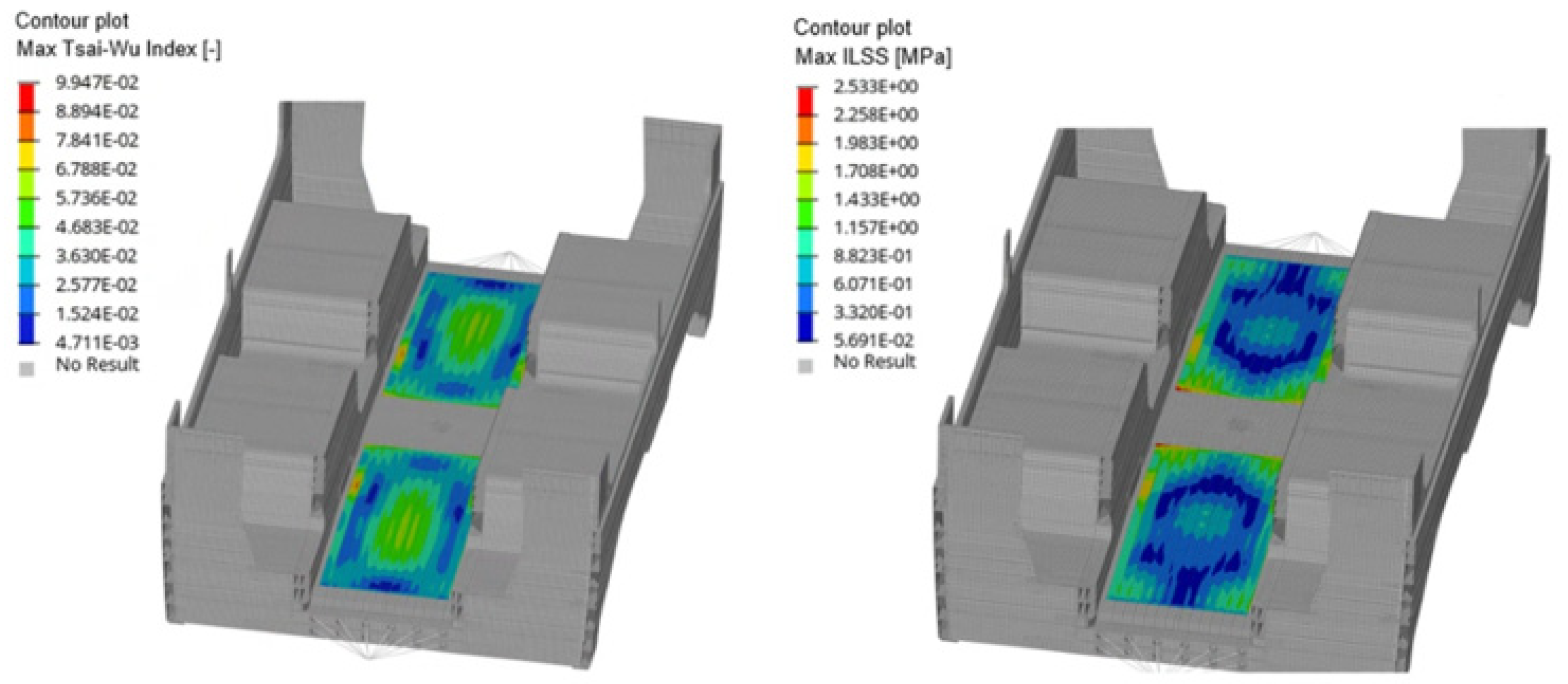
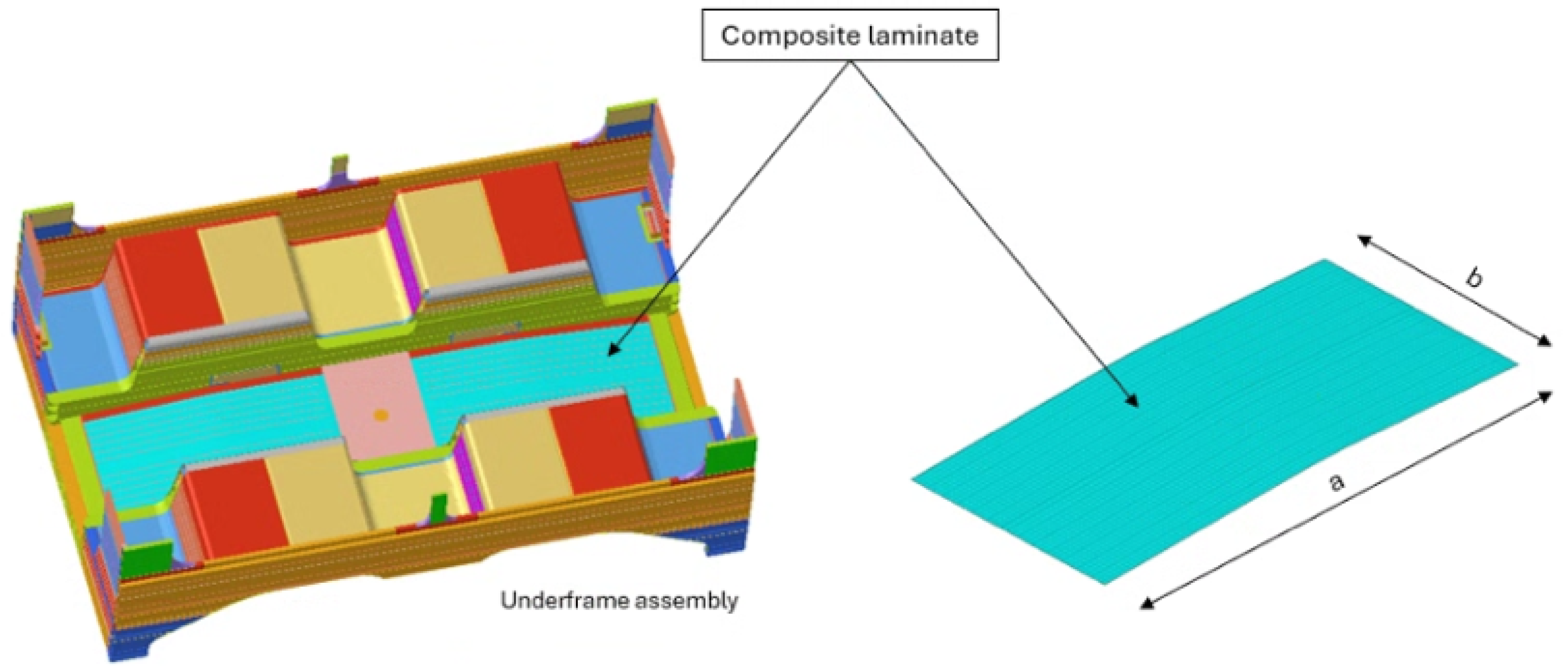
- The process begins with the development of a high-fidelity finite element (FE) model of the component. This stage involves the accurate definition of geometry, mesh discretization, boundary conditions, and operational loading scenarios. The FE model serves as the baseline for all subsequent sensitivity iterations, ensuring that the stress distributions used for optimization reflect the actual service conditions of the structure.
- (2)
- The second step involves defining the mechanical properties of the CFRP constituent layers. Each ply is characterized by its orthotropic elastic constants and its strength parameters, expressed in MPa to ensure consistency with the FE solver output. These properties are integrated into the FE environment using traditional shell theory formulations, allowing for a detailed representation of the stress tensors at each ply interface and mid-plane.
- (3)
- The core of the methodology is an automated loop that executes a massive sweep of simulations across a full 180° rotation spectrum. This framework is designed to handle two separate study cases:
- (a)
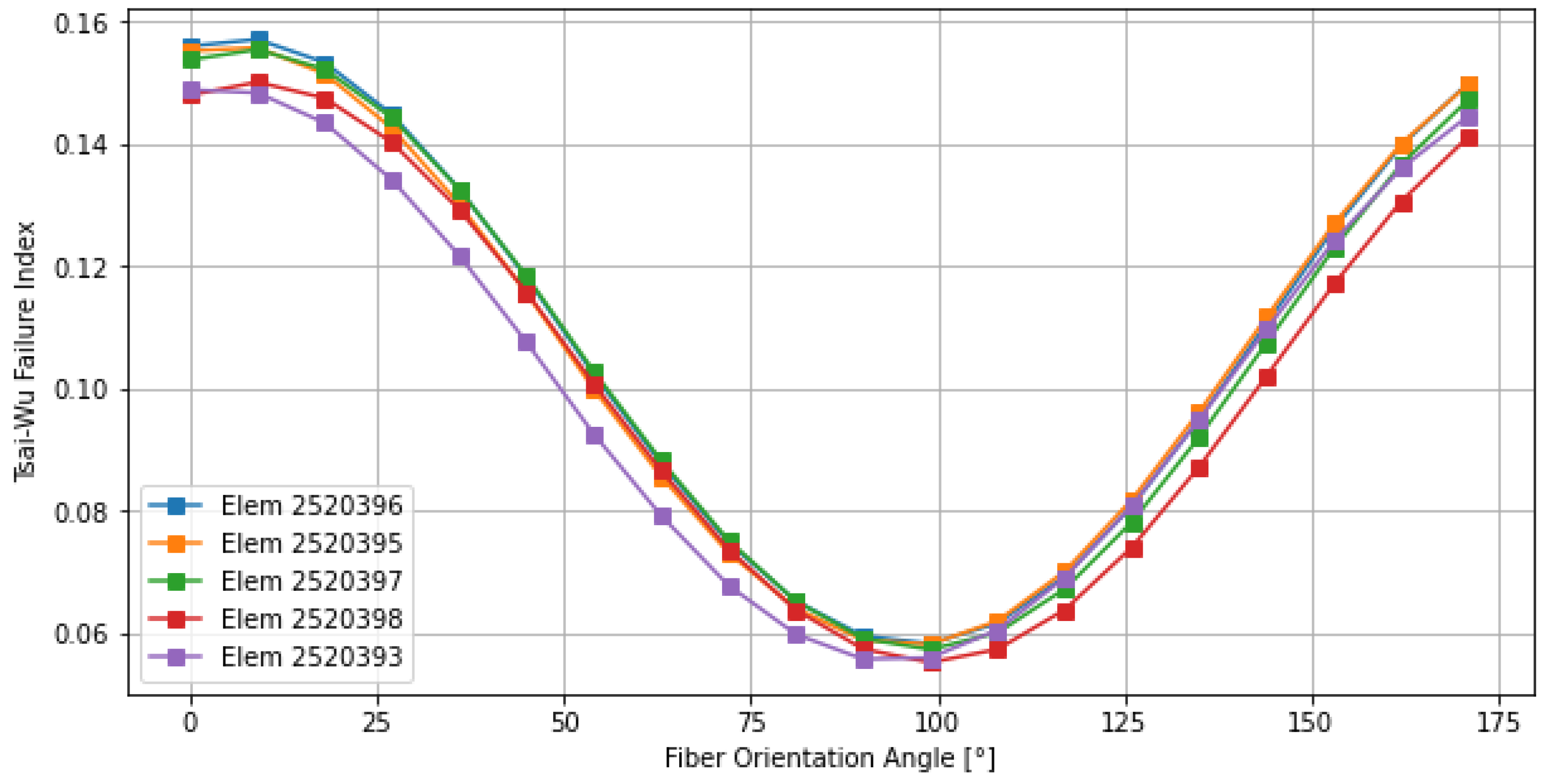
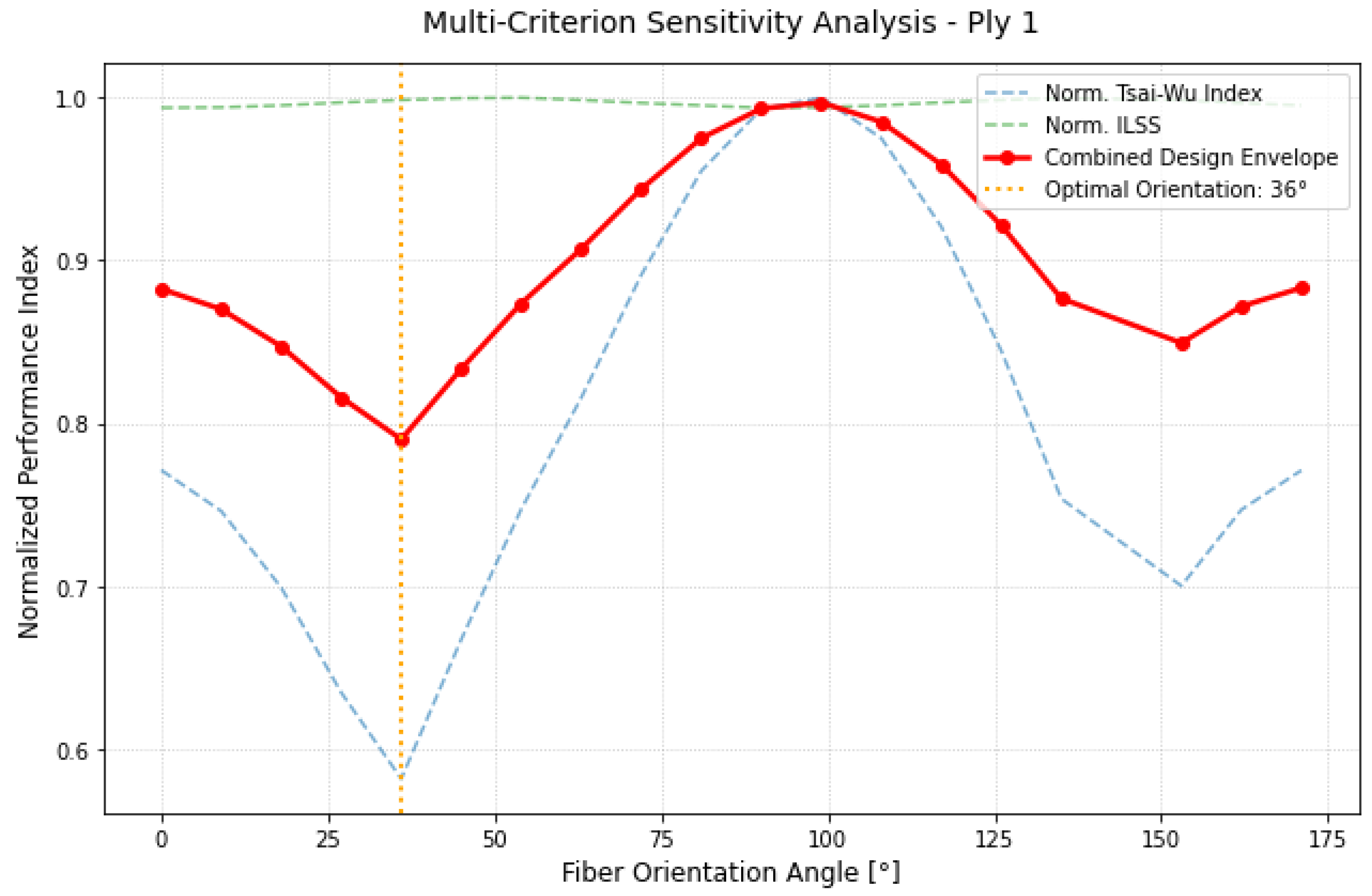
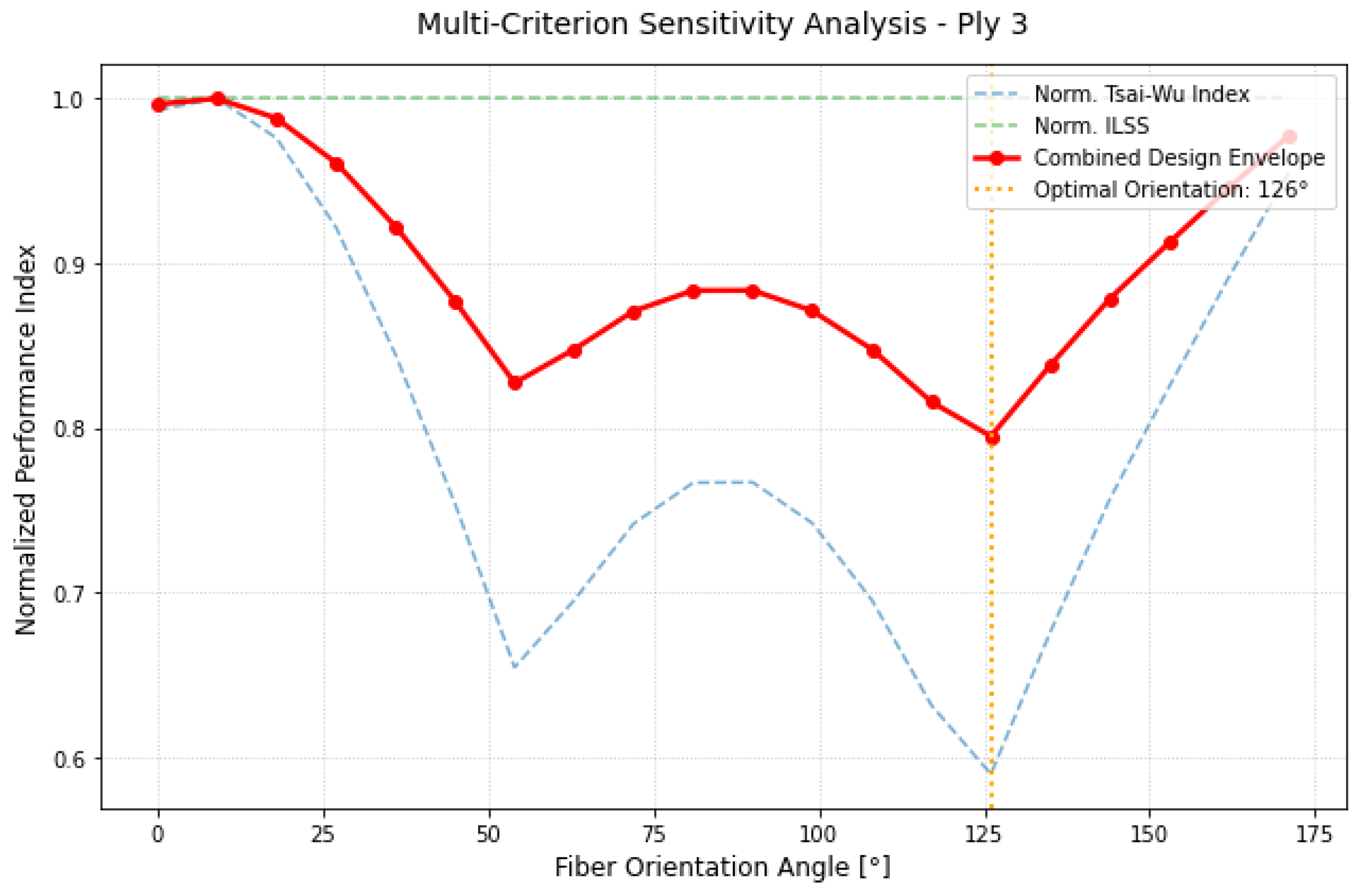
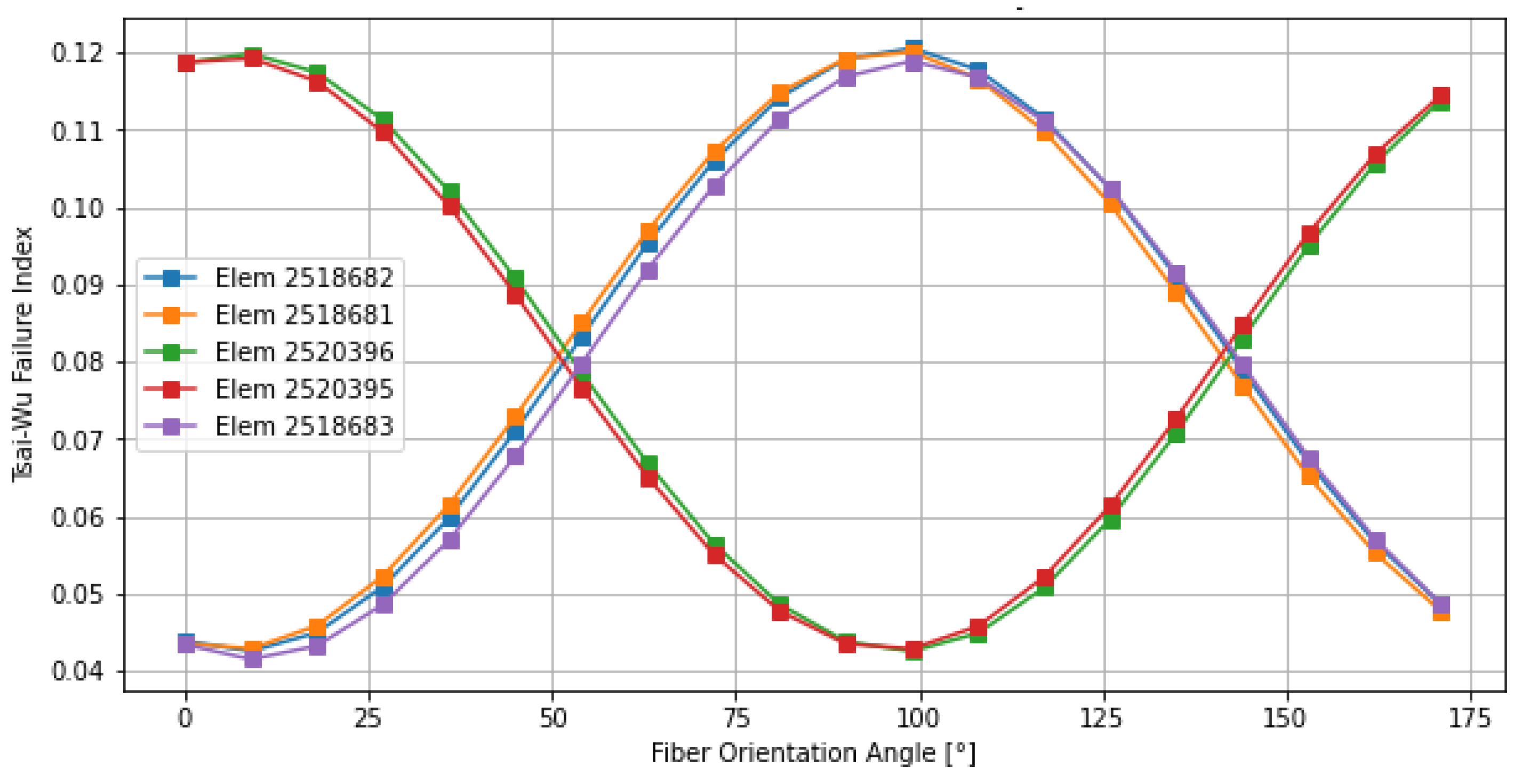
- Asynchronous strategy (ply-by-ply): the orientation of a single target ply is varied while keeping the rest of the stack constant. This identifies the specific contribution and optimal alignment of each individual layer within the laminate.
- (b)
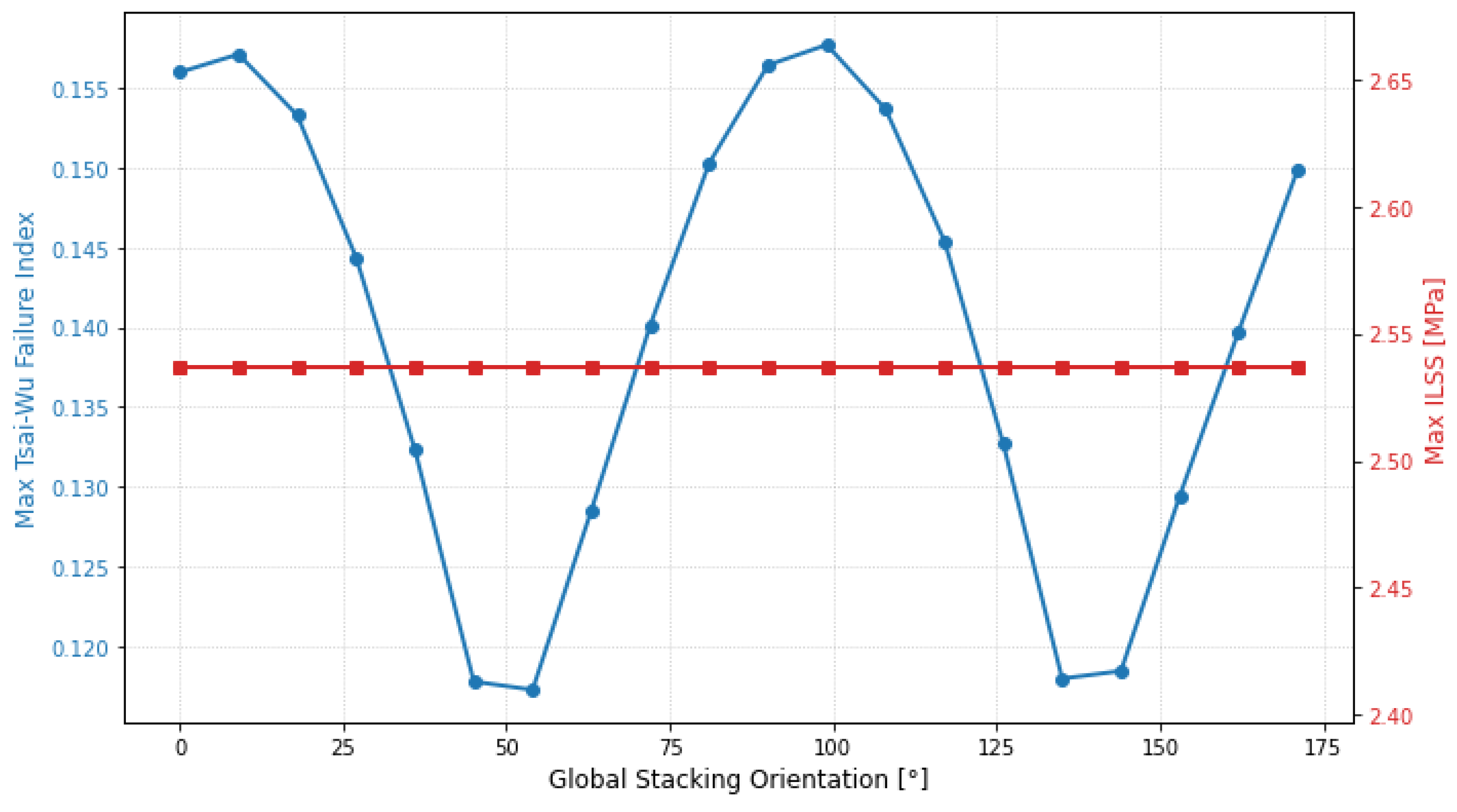
- Synchronous strategy (global rotation): all plies within the laminate are rotated simultaneously by the same angle. This strategy evaluates the global directional sensitivity of the material, effectively treating the laminate as a single orthotropic block to identify the primary principal load directions.
- (4)
- In this phase, the data extracted from the iterative simulations are processed through a dual-criterion evaluation engine. To ensure a comprehensive assessment of structural integrity, the methodology accounts for both in-plane and out-of-plane failure modes:
- (a)
- In-plane failure: evaluated using the Tsai–Wu failure criterion, which accounts for the interaction between different stress components within the fiber–matrix system.
- (b)
- Interlaminar failure: assessed via the interlaminar shear stress (ILSS) utilization ratio. This is particularly critical in the asynchronous strategy, where changing the relative angle between plies can significantly alter the shear transfer at the interfaces.
- (5)
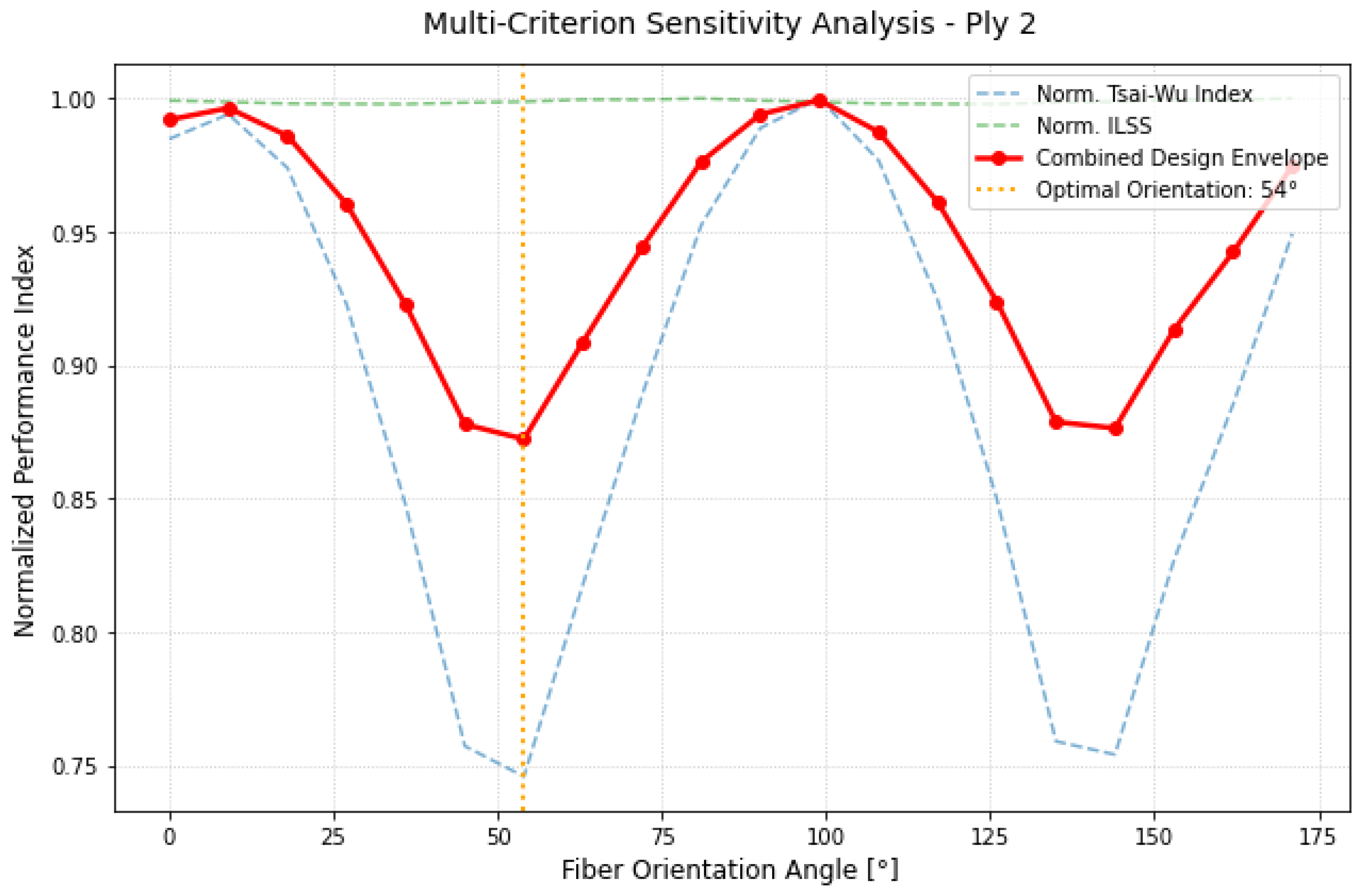
- The final step identifies the optimal configuration by calculating a combined criticality index. This index merges the normalized envelopes of the Tsai–Wu and ILSS criteria using a weighted approach. A comparative analysis is then performed between the asynchronous and synchronous results. This comparison allows for a scientific validation of the benefits of a differentiated layup versus a simpler aligned configuration, providing a definitive optimization table and performance maps that guide the final design choice toward maximum structural efficiency.
3. Railway Carbody
3.1. CFRP Composite Laminates
3.2. FE Model Description and Simulation Settings
3.3. Failure Criteria and Optimization Strategy
3.3.1. Tsai–Wu Failure Criterion
3.3.2. Interlaminar Shear Stress (ILSS)
3.3.3. Design Envelope and Multi-Objective Weighting
4. Results and Discussion
4.1. Fiber Orientation Sensitivity Framework
4.2. Asynchronous Analysis: Individual Ply Sensitivity
4.3. Multi-Criterion Optimization: The Combined Envelope Approach
4.4. Synchronous Global Sensitivity Analysis
4.5. Global Sensitivity Analysis, Final Comparison, and Real Test Strategy
5. Conclusions
Author Contributions
Funding
Data Availability Statement
Conflicts of Interest
References
- Bandini, A.; Cascino, A.; Meli, E.; Pinelli, L.; Marconcini, M. Improving Aeromechanical Performance of Compressor Rotor Blisk with Topology Optimization. Energies 2024, 17, 1883. [Google Scholar] [CrossRef]
- Cascino, A.; Meli, E.; Rindi, A.; Pucci, E.; Matoni, E. Experimental Validation and Dynamic Analysis of Additive Manufacturing Burner for Gas Turbine Applications. Machines 2025, 13, 1111. [Google Scholar] [CrossRef]
- Wang, W.; Munro, D.; Wang, C.; Van Keulen, F.; Wu, J. Space-time topology optimization for additive manufacturing. Struct. Multidiscip. Optim. 2019, 61, 1–18. [Google Scholar] [CrossRef]
- Riccio, A.; Caprio, F.; Tsai, S.; Russo, A.; Sellitto, A. Optimization of composite aeronautical components by Re-Designing with Double-Double Laminates. Aerosp. Sci. Technol. 2024, 151, 109304. [Google Scholar] [CrossRef]
- Azad, M.; Cheon, Y.; Raouf, I.; Khalid, S.; Kim, H. Intelligent Computational Methods for Damage Detection of Laminated Composite Structures for Mobility Applications: A Comprehensive Review. Arch. Comput. Methods Eng. 2024, 32, 441–469. [Google Scholar] [CrossRef]
- Jiang, H.; Ren, Y.; Liu, Z.; Zhang, S.; Lin, Z. Low-velocity impact resistance behaviors of bio-inspired helicoidal composite laminates with non-linear rotation angle based layups. Compos. Struct. 2019, 214, 463–475. [Google Scholar] [CrossRef]
- Yan, L.; Xu, H. Lightweight composite materials in automotive engineering: State-of-the-art and future trends. Alex. Eng. J. 2025, 118, 1–10. [Google Scholar] [CrossRef]
- Ahmed, O.; Aabid, A.; Ali, J.; Hrairi, M.; Yatim, N. Progresses and Challenges of Composite Laminates in Thin-Walled Structures: A Systematic Review. ACS Omega 2023, 8, 30824–30837. [Google Scholar] [CrossRef]
- Xiao, H.; Sultan, M.; Shahar, F.; Gaff, M.; Hui, D. Recent developments in the mechanical properties of hybrid fiber metal laminates in the automotive industry: A review. Rev. Adv. Mater. Sci. 2023, 62, 20220328. [Google Scholar] [CrossRef]
- Shiferaw, H.; Woldemariam, M.; Redda, D.; Ahmed, A. Drop-Weight Impact Analysis of Unidirectional Sisal Fiber –Reinforced Epoxy Resin Composite Material for Automotive Application Based on ASTM D-7136 Standard. J. Eng. 2025, 2025, 15. [Google Scholar] [CrossRef]
- Islami, D.; Muzaqih, A.; Adiputra, R.; Prabowo, A.; Firdaus, N.; Ehlers, S.; Braun, M.; Jurkovič, M.; Smaradhana, D.; Carvalho, H. Structural design parameters of laminated composites for marine applications: Milestone study and extended review on current technology and engineering. Results Eng. 2024, 24, 103195. [Google Scholar] [CrossRef]
- Ma’ruf, B.; Ismail, A.; Sari, D.; Sujiatanti, S. Strength analysis of marine biaxial warp-knitted glass fabrics as composite laminations for ship material. Curved Layer. Struct. 2023, 10, 20220209. [Google Scholar] [CrossRef]
- Okuma, S.; Obaseki, M.; Ofuyekpone, D.; Ashibudike, O. A Review Assessment of Fiber-Reinforced Polymers for Maritime Applications. J. Adv. Ind. Technol. Appl. 2023, 4, 17–28. [Google Scholar] [CrossRef]
- Cascino, A.; Meli, E.; Rindi, A. Design and Optimization of a Hybrid Railcar Structure with Multilayer Composite Panels. Materials 2025, 18, 5013. [Google Scholar] [CrossRef]
- Hudson, C.W.; Carruthers, J.J.; Robinson, A.M. Multiple objective optimisation of composite sandwich structures for rail vehicle floor panels. Compos. Struct. 2010, 92, 2077–2082. [Google Scholar] [CrossRef]
- Miao, B.R.; Luo, Y.X.; Peng, Q.M.; Qiu, Y.Z.; Chen, H.; Yang, Z.K. Multidisciplinary design optimization of lightweight car body for fatigue assessment. Mater. Des. 2020, 194, 108910. [Google Scholar] [CrossRef]
- Trzepieciński, T.; Najm, S.M. Current Trends in Metallic Materials for Body Panels and Structural Members Used in the Automotive Industry. Materials 2024, 17, 590. [Google Scholar] [CrossRef]
- Zhang, J.; Chevali, V.S.; Wang, H.; Wang, C.-H. Current status of carbon fibre and carbon fibre composites recycling. Compos. Part B Eng. 2020, 193, 108053. [Google Scholar] [CrossRef]
- Cascino, A.; Meli, E.; Rindi, A. A strategy for lightweight designing of a railway vehicle car body including composite material and dynamic structural optimization. Rail. Eng. Sci. 2023, 31, 340–350. [Google Scholar] [CrossRef]
- Cascino, A.; Meli, E.; Rindi, A. Comparative Analysis and Dynamic Size Optimization of Aluminum and Carbon Fiber Thin-Walled Structures of a Railway Vehicle Car Body. Materials 2025, 18, 1501. [Google Scholar] [CrossRef]
- Arifurrahman, F.; Budiman, B.A.; Aziz, M. On the lightweight structural design for electric road and railway vehicles using fiber reinforced polymer composites—A review. Int. J. Sustain. Transp. 2018, 1, 21–29. [Google Scholar] [CrossRef]
- Cascino, A.; Meli, E.; Rindi, A. High-Fidelity Finite Element Modelling (FEM) and Dynamic Analysis of a Hybrid Aluminium–Honeycomb Railway Vehicle Carbody. Appl. Sci. 2026, 16, 549. [Google Scholar] [CrossRef]
- Cascino, A.; Meli, E.; Rindi, A. Dynamic size optimization approach to support railway carbody lightweight design process. Proc. Inst. Mech. Eng. Part F J. Rail Rapid Transit 2023, 237, 871–881. [Google Scholar] [CrossRef]
- Tawfek, A.; Ge, Z.; Yuan, H.; Zhang, N.; Zhang, H.; Ling, Y.; Guan, Y.; Šavija, B. Influence of fiber orientation on the mechanical responses of engineering cementitious composite (ECC) under various loading conditions. J. Build. Eng. 2022, 63, 105518. [Google Scholar] [CrossRef]
- Jeppesen, N.; Mikkelsen, L.; Dahl, A.; Christensen, A.; Dahl, V. Quantifying effects of manufacturing methods on fiber orientation in unidirectional composites using structure tensor analysis. Compos. Part A-Appl. Sci. Manuf. 2021, 149, 106541. [Google Scholar] [CrossRef]
- Liu, J.; Wang, Z.; Zhao, R.; Wu, T.; Li, Y.; Li, X.; Yang, T.; Liang, J. A composite material preparation method based on convergent die induced fiber orientation in DCCM process. Polym. Compos. 2025, 46, 13363–13377. [Google Scholar] [CrossRef]
- Mohamed, Y.; Abdelbary, A. Theoretical and experimental study on the influence of fiber orientation on the tensile properties of unidirectional carbon fiber/epoxy composite. Alex. Eng. J. 2023, 67, 693–705. [Google Scholar] [CrossRef]
- Kılınç, A.; Turkoglu, T.; Arıkan, V.; Çelik, S.; Kilinc, F.; Yesiltepe, S. Effect of Fiber Orientation on the Properties of Continuous Glass Fiber Reinforced PLA Composites Produced via Nozzle-Impregnation 3D Printing. Polym. Compos. 2025, 47, 1931–1943. [Google Scholar] [CrossRef]
- Abdulaziz, F.; Abd-Ali, N.; Al-Mayali, M. Effect of fibers orientation on the health monitoring of multi-layers composite material. Diagnostyka 2025, 26, 2025103. [Google Scholar] [CrossRef]
- Annadorai, M.; Ramakrishna, M.; Jyothi, Y. Effect on mechanical properties of CFRP composites in different fiber orientations. Interactions 2024, 245, 198. [Google Scholar] [CrossRef]
- Mokhtarzadeh, M.; Jiménez, L.; Maute, K. Concurrent level set topology and fiber orientation optimization of fiber-reinforced composite structures. Struct. Multidiscip. Optim. 2024, 67, 117. [Google Scholar] [CrossRef]
- Gupta, U.; Dharkar, A.; Dhamarikar, M.; Choudhary, A.; Wasnik, D.; Chouhan, P.; Tiwari, S.; Namdeo, R. Study on the effects of fiber orientation on the mechanical properties of natural fiber reinforced epoxy composite by finite element method. Mater. Today Proc. 2021, 45, 7885–7893. [Google Scholar] [CrossRef]
- Dalfi, H.; Al-Obaidi, A.; Tariq, A.; Razzaq, H.; Rafiee, R. Optimization of the mechanical performance and damage failure characteristics of laminated composites based on fiber orientation. Front. Struct. Civ. Eng. 2023, 17, 1357–1369. [Google Scholar] [CrossRef]
- Wang, Q.-A.; Liu, Q.; Ma, Z.-G.; Wang, J.-F.; Ni, Y.-Q.; Ren, W.-X.; Wang, H.-B. Data interpretation and forecasting of SHM heteroscedastic measurements under typhoon conditions enabled by an enhanced Hierarchical sparse Bayesian Learning model with high robustness. Measurement 2024, 230, 114509. [Google Scholar] [CrossRef]
- Derazkola, H.; Khodabakhshi, F.; Simchi, A. Evaluation of a polymer-steel laminated sheet composite structure produced by friction stir additive manufacturing (FSAM) technology. Polym. Test. 2020, 90, 106690. [Google Scholar] [CrossRef]
- Basaran, M.; Turkmen, H.; Yildiz, M. Sensor-Enhanced Thick Laminated Composite Beams: Manufacturing, Testing, and Numerical Analysis. Sensors 2024, 24, 5366. [Google Scholar] [CrossRef]
- Pradeep, M.; Arivendan, A.; Das, R.; Rajan, M. Effect of stacking sequences on the mechanical properties of high-performance glass fibre epoxy composites for lightweight manufacture applications. Proc. Inst. Mech. Eng. Part E J. Process Mech. Eng. 2025, 09544089251324755. [Google Scholar] [CrossRef]
- EN 13749:2021; Railway Applications—Wheelsets and Bogies—Method of Specifying the Structural Requirements of Bogie Frames. Comité Européen de Normalisation: Brussels, Belgium, 2021.
- Cascino, A.; Meli, E.; Rindi, A. Development of a Design Procedure Combining Topological Optimization and a Multibody Environment: Application to a Tram Motor Bogie Frame. Vehicles 2024, 6, 1843–1856. [Google Scholar] [CrossRef]
- Cascino, A.; Meli, E.; Rindi, A. Lightweight Design and Topology Optimization of a Railway Motor Support Under Manufacturing and Adaptive Stress Constraints. Vehicles 2026, 8, 3. [Google Scholar] [CrossRef]
- Cascino, A.; Meli, E.; Rindi, A. A New Strategy for Railway Bogie Frame Designing Combining Structural–Topological Optimization and Sensitivity Analysis. Vehicles 2024, 6, 651–665. [Google Scholar] [CrossRef]
- Cascino, A.; Meli, E.; Rindi, A. Multi-Stage Topology Optimization for Structural Redesign of Railway Motor Bogie Frames. Appl. Sci. 2026, 16, 973. [Google Scholar] [CrossRef]
- Cascino, A.; Meli, E.; Rindi, A. Development of a Methodology for Railway Bolster Beam Design Enhancement Using Topological Optimization and Manufacturing Constraints. Eng 2024, 5, 1485–1498. [Google Scholar] [CrossRef]
- Grasso, M.; Gallone, A.; Genovese, A.; Macera, L.; Penta, F.; Pucillo, G.; Strano, S. Composite material design for rail vehicle innovative lightweight components. In Proceedings of the World Congress on Engineering, London, UK, 1–3 July 2015. [Google Scholar]
- Yang, C.; Ying, G.; Guo, W.; Yang, Y.; Xu, P.; Alqahtani, M.S. High-velocity impact behavior of curved GFRP composites for rail vehicles: Experimental and numerical study. Polym. Test. 2022, 116, 107774. [Google Scholar] [CrossRef]
- Cascino, A.; Nencioni, L.; Lanzillo, L.; Mazzeo, F.; Strano, S.; Terzo, M.; Delle Monache, S.; Meli, E. Development and Experimental Validation of a Physics-Based Digital Twin for Railway Freight Wagon Monitoring. Sensors 2026, 26, 643. [Google Scholar] [CrossRef]
- Genovese, A.; Russo, M.; Strano, S. Mechanical characterization and modeling of an innovative composite material for railway applications. Proc. Inst. Mech. Eng. Part. L J. Mater. Des. Appl. 2017, 231, 122–130. [Google Scholar] [CrossRef]
- Xue, X.; Robinson, M.; Zhang, W. The effect of composite materials interfacial discontinuities on the impact safety of future composite rail vehicles. Eng. Rep. 2024, 6, e12868. [Google Scholar] [CrossRef]
- Cascino, A.; Delle Monache, S.; Lanzillo, L.; Mazzeo, F.; Nencioni, L.; Nicolella, A.; Strano, S.; Terzo, M. Development and Experimental Testing of a 3D Vision System for Railway Freight Wagon Monitoring. Appl. Sci. 2025, 15, 11547. [Google Scholar] [CrossRef]
- Pɫaczek, M.; Wróbel, A.; Buchacz, A. A concept of technology for freight wagons modernization. IOP Conf. Ser. Mater. Sci. Eng. 2016, 161, 012107. [Google Scholar] [CrossRef]
- Sebeşans, I.; Babici, L.; Floroiu, D. Experimental measurements of composite materials from the bearing structure of railway vehicles. IOP Conf. Ser. Mater. Sci. Eng. 2016, 161, 012064. [Google Scholar] [CrossRef]
- UNI EN 1999-1-1:2014; Eurocode 9: Design of Aluminium Structures—Part 1-1: General Rules—General Rules and Rules for Buildings. UNI: Milan, Italy, 2014.
- Cascino, A.; Distaso, F.; Meli, E.; Rindi, A. Multistage Static and Dynamic Optimization Framework for Composite Laminates in Lightweight Urban Rail Vehicle Car Bodies. Materials 2026, 19, 531. [Google Scholar] [CrossRef] [PubMed]
- EN 12663-1:2024; Railway Applications—Structural Requirements of Railway Vehicle Bodies—Part 1: Locomotives and Passenger Rolling Stock (and Alternative Method for Freight Wagons). Comité Européen de Normalisation: Brussels, Belgium, 2024.
- UNI EN 15663:2019; Railway Applications—Vehicle Reference Masses. UNI: Milan, Italy, 2019.
- Huang, Z.; Zhang, W.; Qian, X.; Su, Z.; Pham, D.-C.; Sridhar, N. Fatigue behaviour and life prediction of filament wound CFRP pipes based on coupon tests. Mar. Struct. 2020, 72, 102756. [Google Scholar] [CrossRef]








| Ply | Material | Thickness [mm] | Orientation α [°] | Density [kg/m3] | E1 [GPa] | E2 [GPa] | ν12 [-] | G12 [GPa] | G13 [GPa] | G23 [GPa] |
|---|---|---|---|---|---|---|---|---|---|---|
| 1 | Carbon fiber/Epoxy | 1 | 0 | 1590 | 135 | 8.0 | 0.30 | 5.0 | 5.0 | 3.0 |
| 2 | Carbon fiber/Epoxy | 1 | 0 | 1590 | 135 | 8.0 | 0.30 | 5.0 | 5.0 | 3.0 |
| 3 | Carbon fiber/Epoxy | 1 | 0 | 1590 | 135 | 8.0 | 0.30 | 5.0 | 5.0 | 3.0 |
| Material | Xt [MPa] | Xc [MPa] | Yt [MPa] | Yc [MPa] | S [MPa] | τ_il [MPa] |
|---|---|---|---|---|---|---|
| Carbon fiber/Epoxy | 1500 | 800 | 60 | 160 | 80 | 60 |
| Strategy | Stacking Sequence | Max Tsai–Wu Index | Max ILSS [MPa] | Performance Gain |
|---|---|---|---|---|
| Baseline | 0°/0°/0° | 0.1560 | 2.53 | - |
| Synchronous | 54°/54°/54° | 0.1173 | 2.53 | +24.81% |
| Asynchronous | 36°/54°/126° | 0.0923 | 2.53 | +40.83% |
Disclaimer/Publisher’s Note: The statements, opinions and data contained in all publications are solely those of the individual author(s) and contributor(s) and not of MDPI and/or the editor(s). MDPI and/or the editor(s) disclaim responsibility for any injury to people or property resulting from any ideas, methods, instructions or products referred to in the content. |
© 2026 by the authors. Licensee MDPI, Basel, Switzerland. This article is an open access article distributed under the terms and conditions of the Creative Commons Attribution (CC BY) license.
Share and Cite
Cascino, A.; Meli, E.; Rindi, A. Optimal Design of CFRP Railway Carbody Laminates via Multi-Criterion Fiber Orientation Sensitivity. Materials 2026, 19, 1355. https://doi.org/10.3390/ma19071355
Cascino A, Meli E, Rindi A. Optimal Design of CFRP Railway Carbody Laminates via Multi-Criterion Fiber Orientation Sensitivity. Materials. 2026; 19(7):1355. https://doi.org/10.3390/ma19071355
Chicago/Turabian StyleCascino, Alessio, Enrico Meli, and Andrea Rindi. 2026. "Optimal Design of CFRP Railway Carbody Laminates via Multi-Criterion Fiber Orientation Sensitivity" Materials 19, no. 7: 1355. https://doi.org/10.3390/ma19071355
APA StyleCascino, A., Meli, E., & Rindi, A. (2026). Optimal Design of CFRP Railway Carbody Laminates via Multi-Criterion Fiber Orientation Sensitivity. Materials, 19(7), 1355. https://doi.org/10.3390/ma19071355