Performance Control and Mechanism Analysis of DCLR-Based Composite High-Modulus Asphalt Based on Synergistic Modification Effect

Abstract
1. Introduction
2. Materials and Test Methods
2.1. Raw Materials
2.1.1. Base Asphalt
2.1.2. Direct Coal Liquefaction Residue (DCLR)
2.1.3. SBS Modifier
2.1.4. SBR Modifier
2.1.5. Compatibilizer and Stabilizer
2.1.6. Aggregates
2.2. Test Methods
2.2.1. Preparation Process of Modified Asphalt
2.2.2. Conventional Performance Tests
2.2.3. Water Damage Resistance Tests
2.2.4. Fatigue Performance Test
2.2.5. Rheological Performance Tests
2.2.6. Aging Resistance Test
2.2.7. Storage Stability Test
2.2.8. Microscopic Analysis
2.2.9. Statistical Analysis
3. Results and Discussion
3.1. Optimization of DCLR-Modified Asphalt Preparation Process
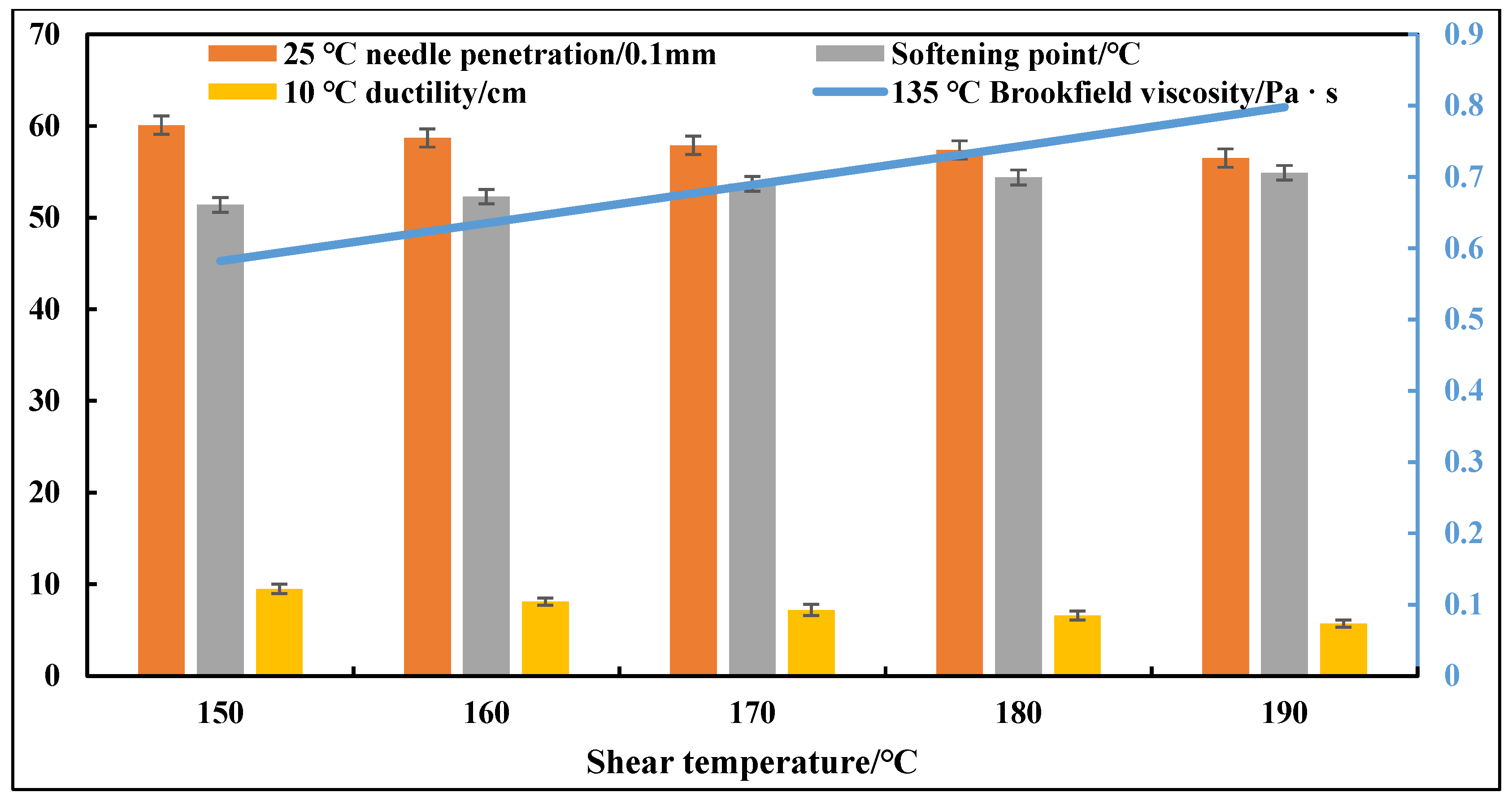
3.1.1. Effect of Shear Temperature
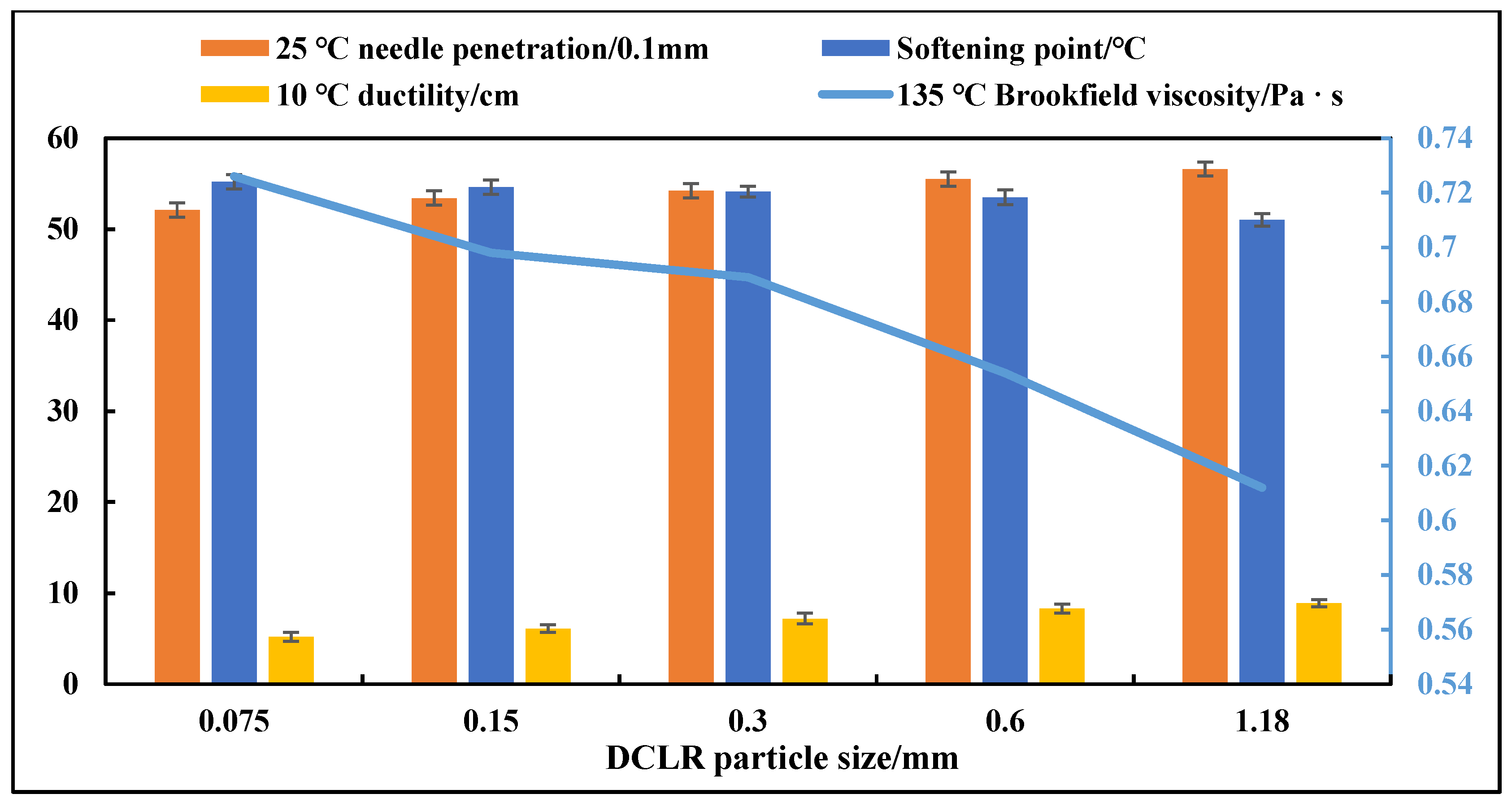
3.1.2. Effect of DCLR Particle Size
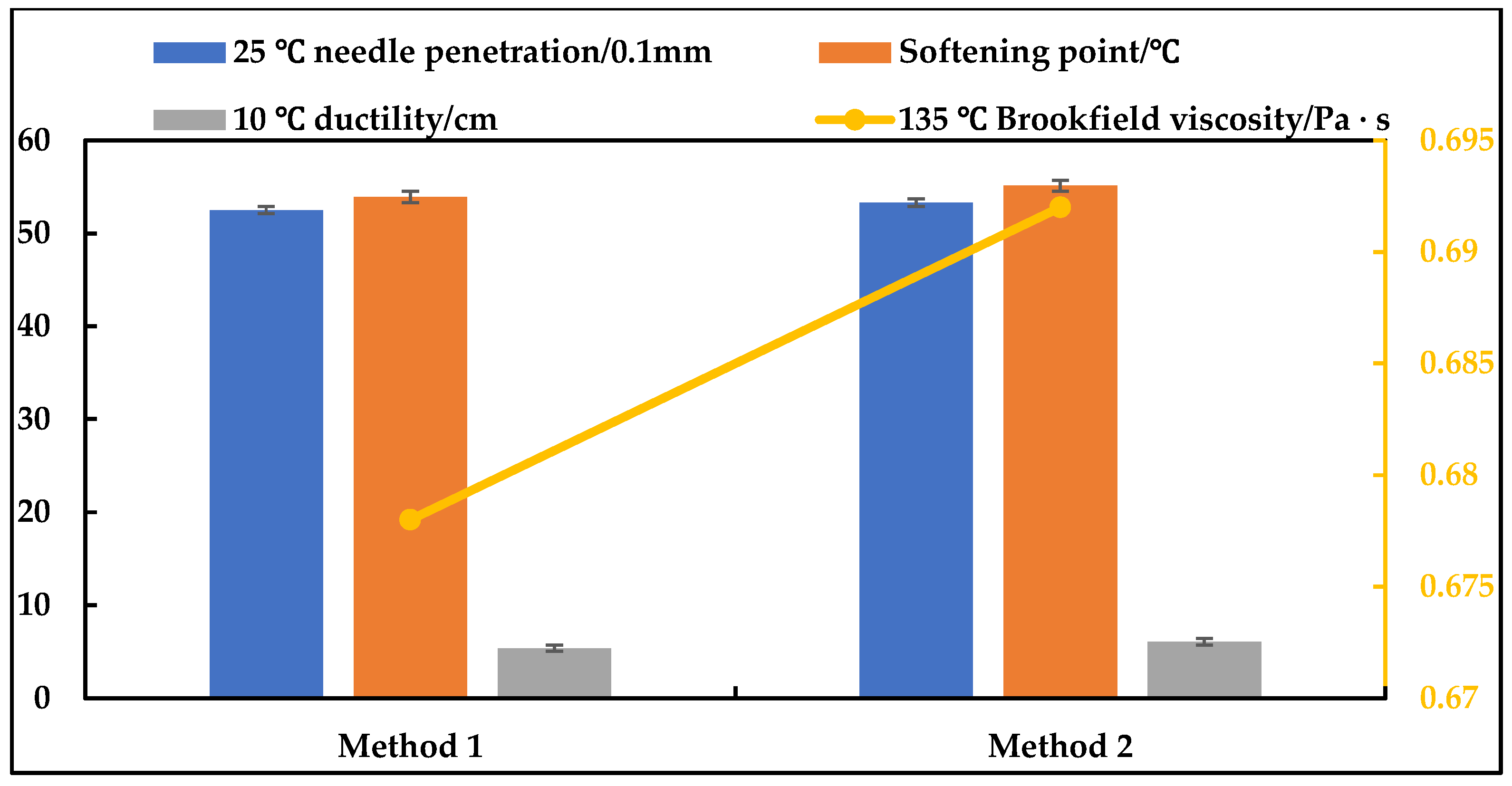
3.1.3. Effect of DCLR Addition Method
3.2. Optimization of Novel Composite High-Modulus Modified Asphalt Formula
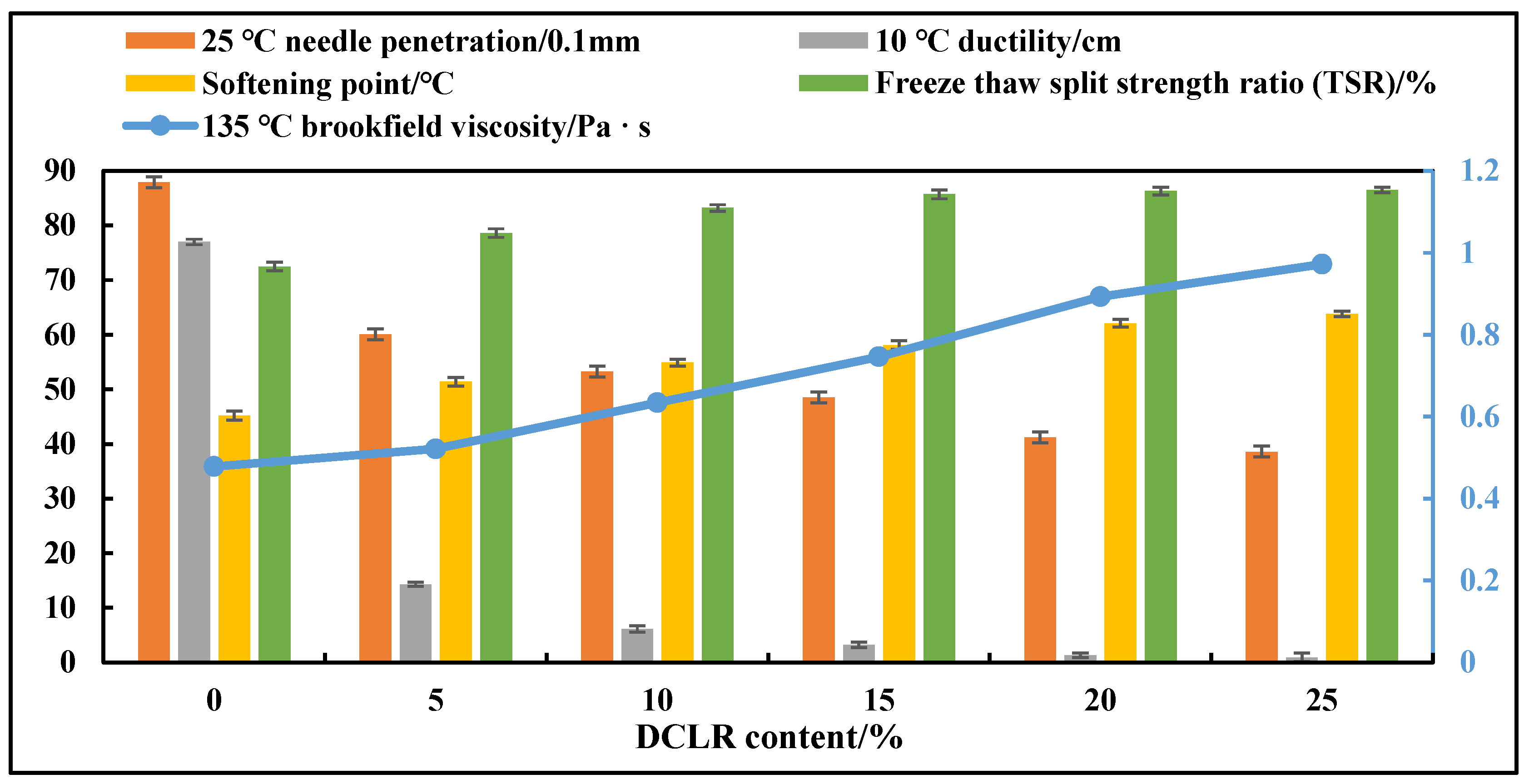
3.2.1. Determination of DCLR Dosage Range
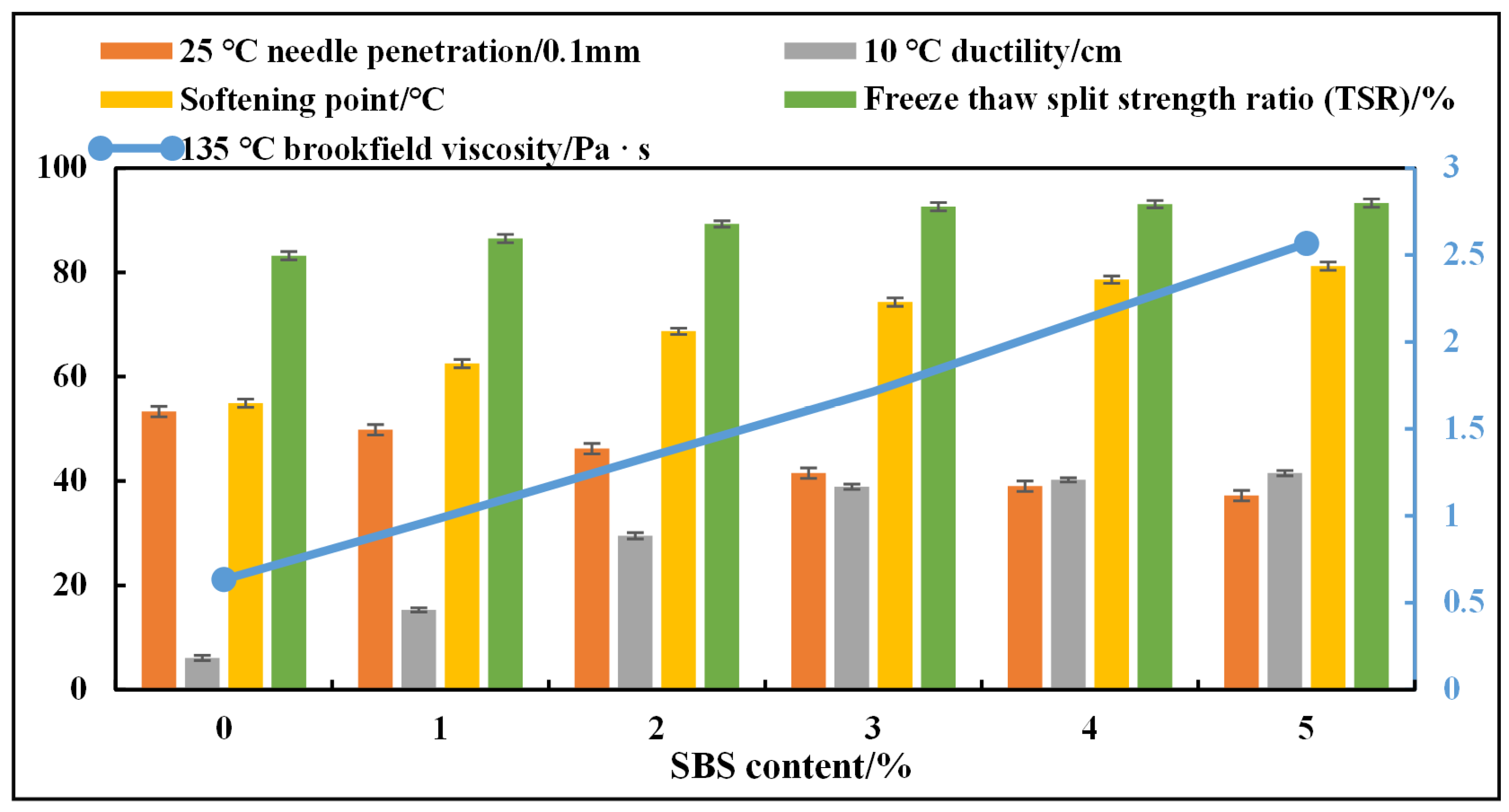
3.2.2. Determination of SBS Dosage Range
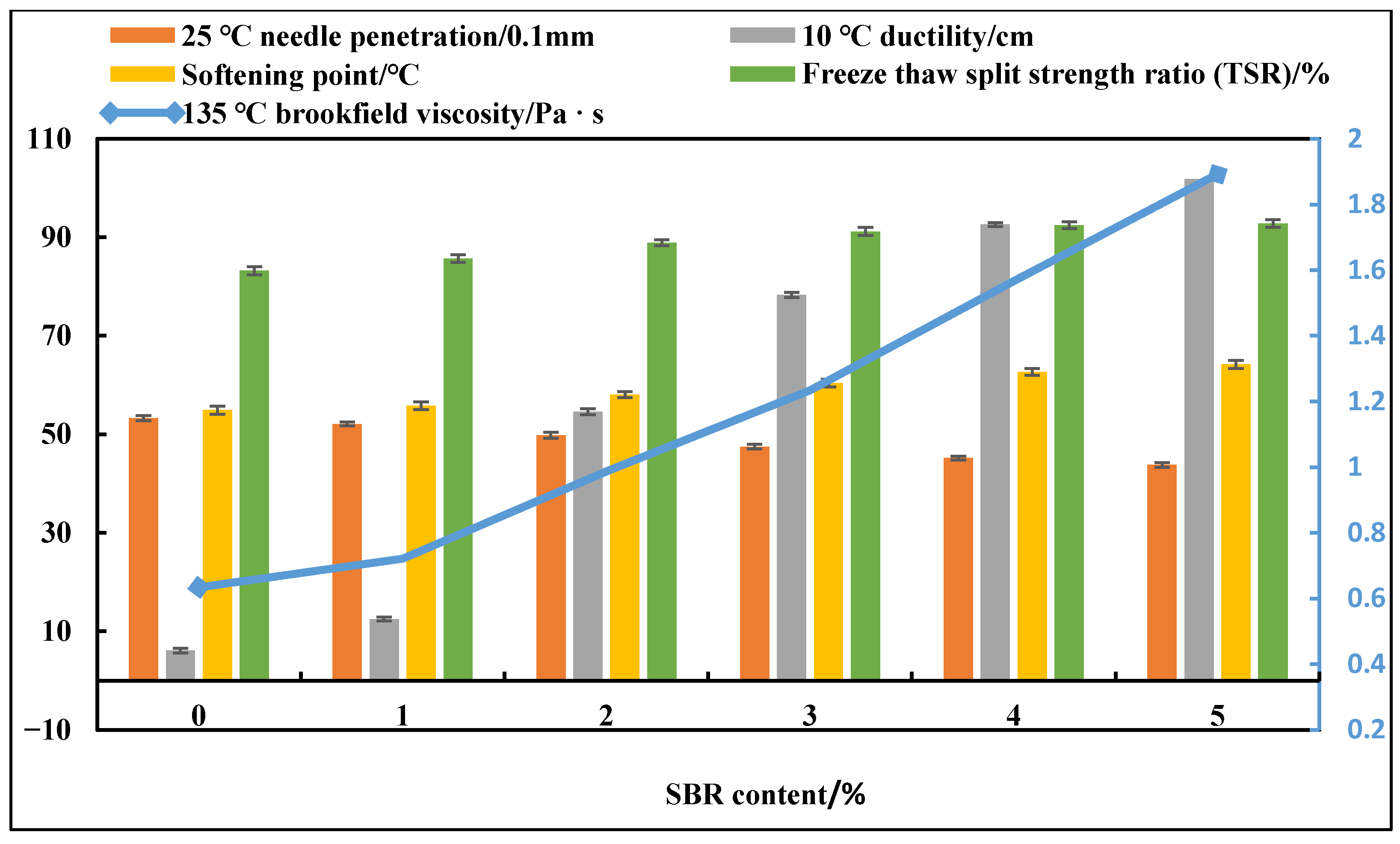
3.2.3. Determination of SBR Dosage Range
3.2.4. Optimization of Modifier Addition Sequence
3.2.5. Orthogonal Test for Optimal Formula
3.3. Performance Evaluation of Novel Composite High-Modulus Modified Asphalt
3.3.1. Conventional Performance
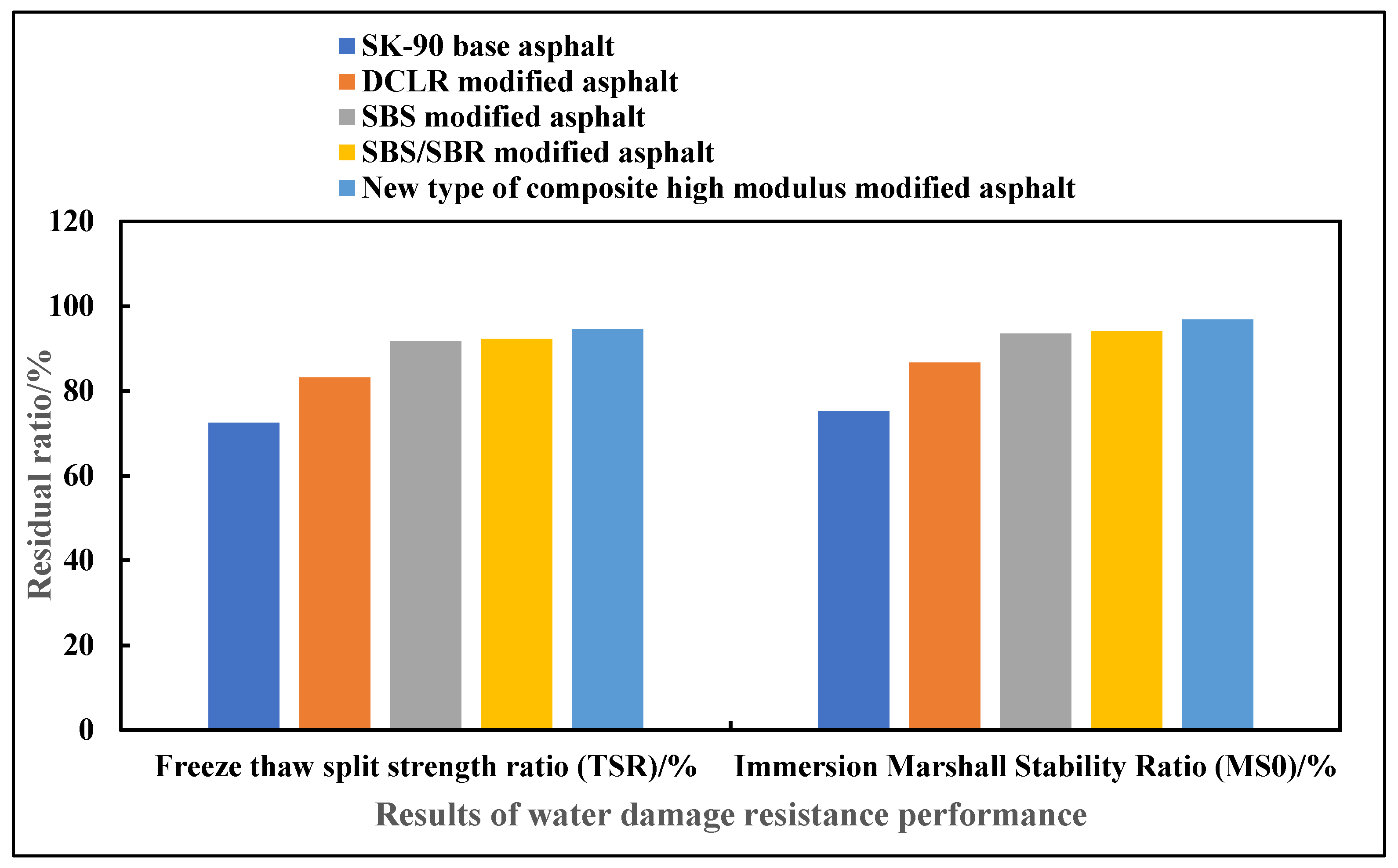
3.3.2. Water Damage Resistance
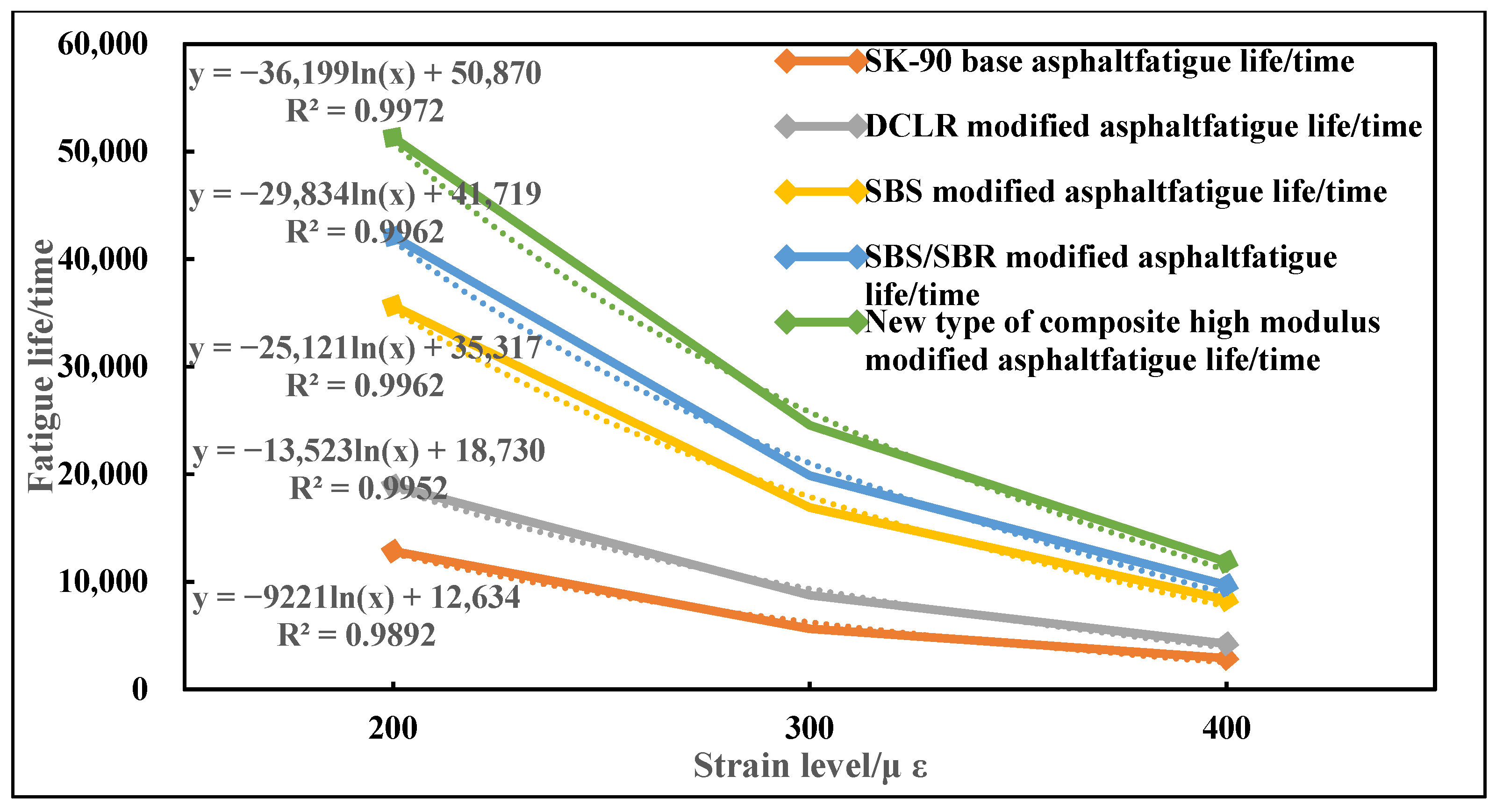
3.3.3. Fatigue Performance
3.3.4. Aging Resistance
3.3.5. Storage Stability
3.4. Rheological Performance Analysis
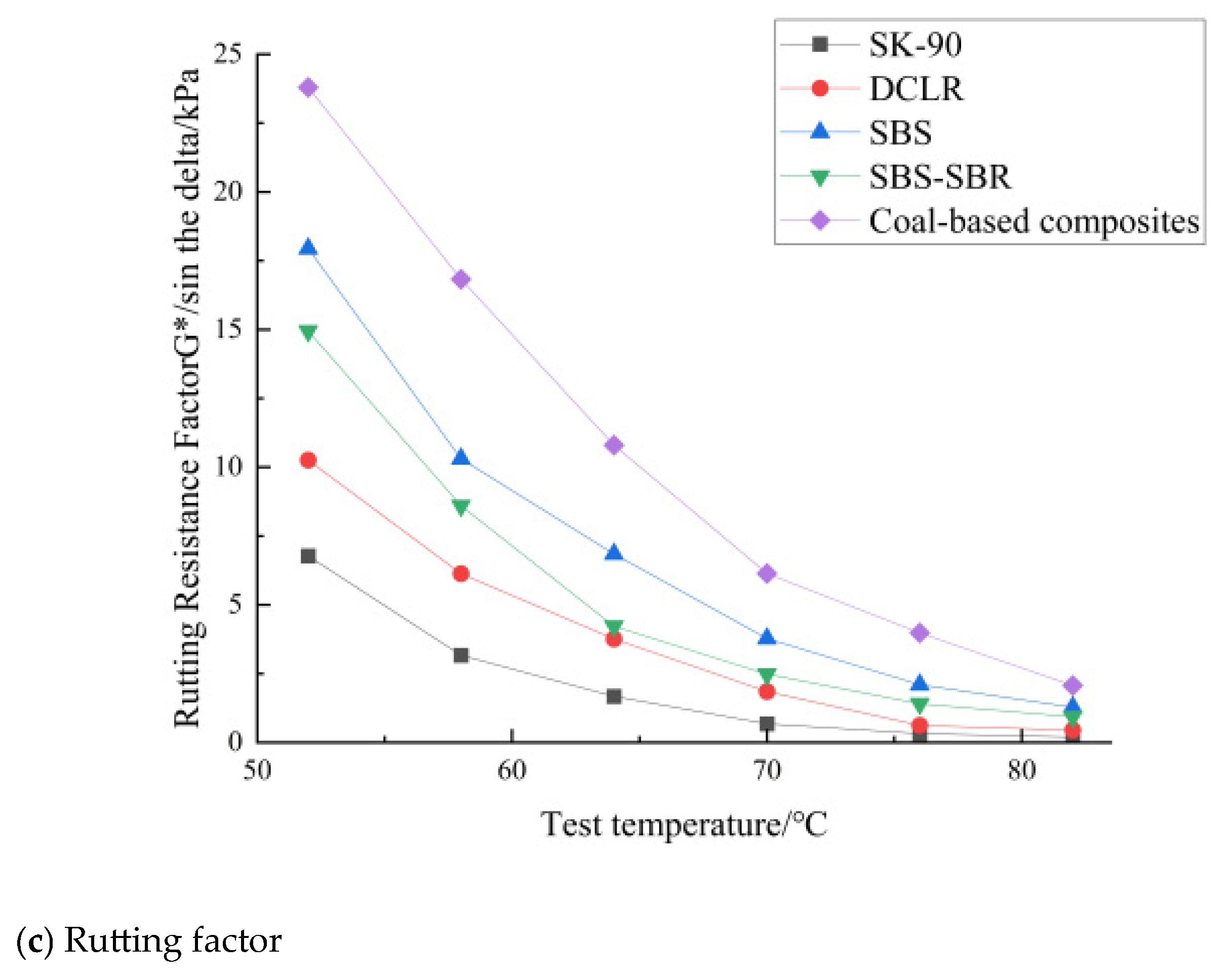
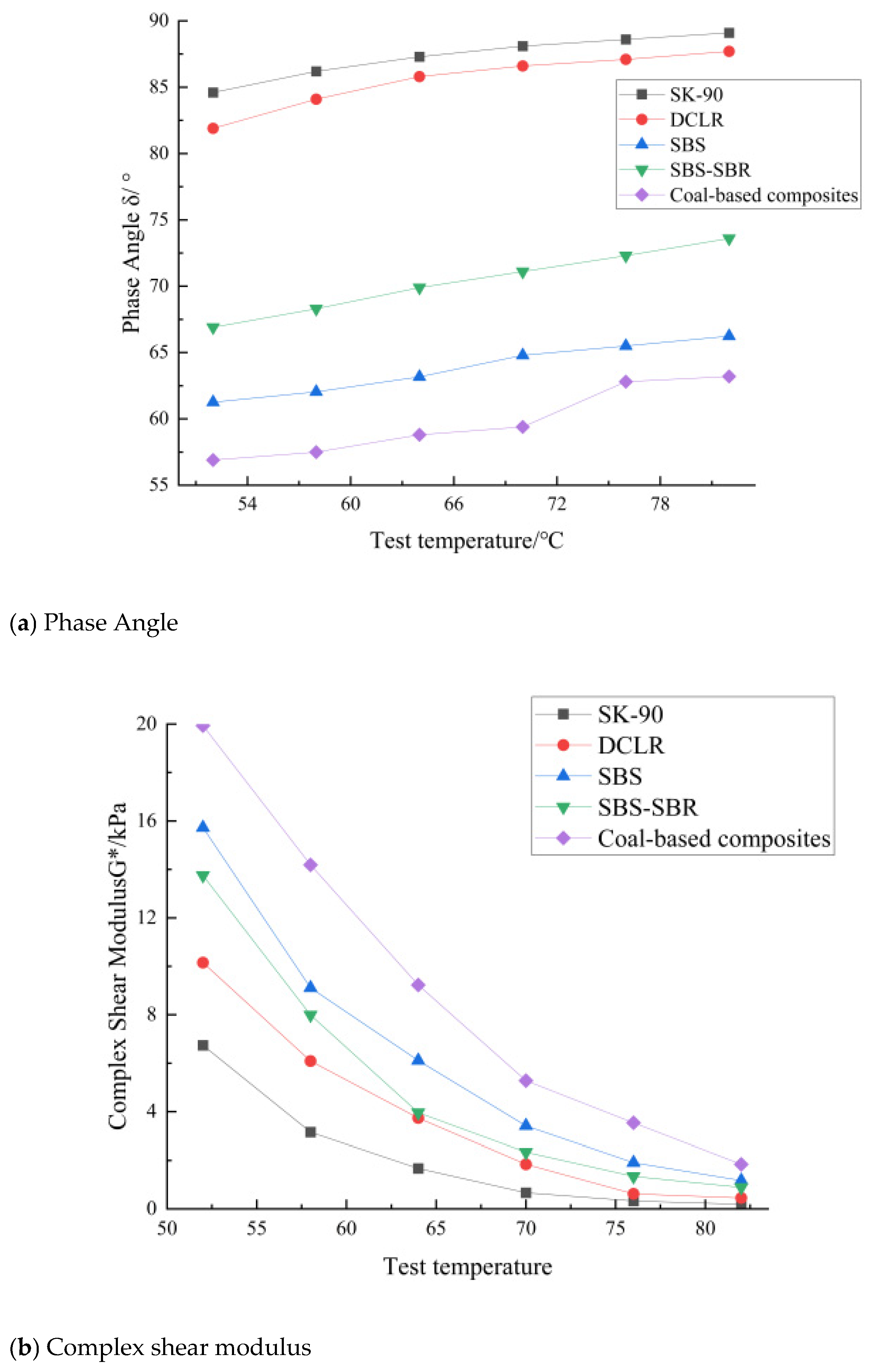
3.4.1. DSR Temperature Sweep Test
3.4.2. MSCR Test
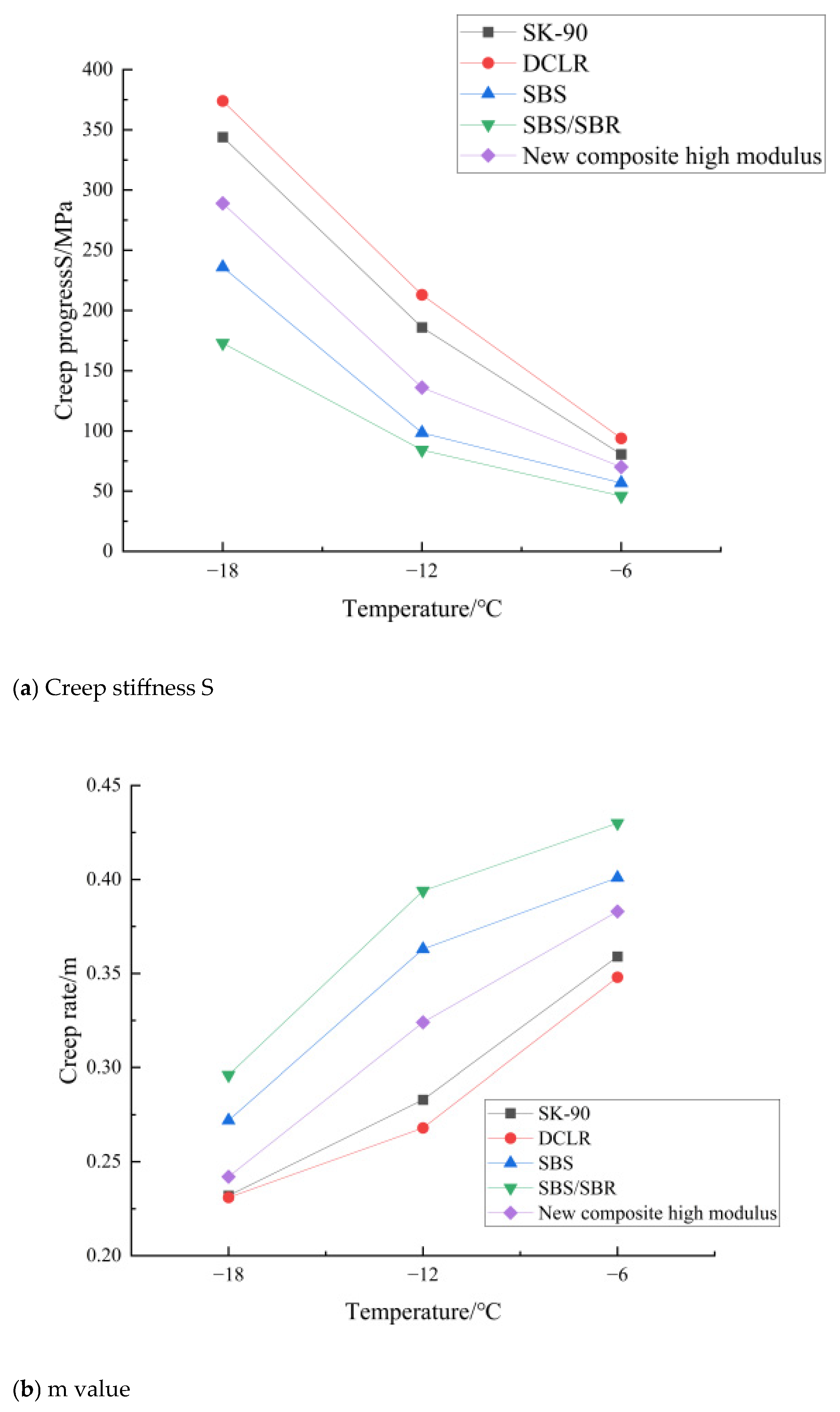
3.4.3. BBR Test
3.5. Temperature Sensitivity Evaluation
3.6. FTIR Characteristic Peak Analysis
3.7. Comprehensive Performance Evaluation
4. Conclusions
- (1)
- The rational combination of DCLR’s rigid phase characteristics with the flexible phase advantages of SBS/SBR achieves a synergistic optimization of asphalt’s high and low-temperature performance, which fundamentally overcomes the inherent defect of single DCLR modification that severely impairs low-temperature ductility.
- (2)
- The three components form a complementary rigid–flexible interpenetrating structure, and the introduction of a compatibilizer further enhances the interface compatibility between polar DCLR and non-polar SBS/SBR, avoiding phase separation and ensuring the structural stability of the composite system.
- (3)
- The preparation process parameters and modifier addition sequence have a significant regulatory effect on the dispersion state of each component in the asphalt matrix and thus on the macroperformance of the composite-modified asphalt.
- (4)
- Molten addition of DCLR (0.3 mm particle size) and high-speed shearing at 170 °C ensure the uniform dispersion of DCLR in the asphalt matrix; the stepwise addition sequence of “DCLR → SBS + compatibilizer → SBR” avoids the thermal aging of SBR at high temperatures and ensures sufficient swelling and cross-linking of SBS, which is a key technical link to realize the synergistic effect of the three components.
- (5)
- DCLR dosage is the primary factor affecting the high-temperature rigidity and low-temperature ductility of asphalt, SBS dosage dominates the improvement of the system’s cross-linked network density and high-temperature viscosity, and SBR dosage is the key to regulating the low-temperature flexibility of the composite asphalt. This quantitative analysis of the factor influence law provides a scientific method for the formula design of multicomponent composite-modified asphalt.
Author Contributions
Funding
Data Availability Statement
Conflicts of Interest
References
- Deng, Y.; Shi, X. Modeling the rutting performance of asphalt pavements: A review. J. Infrastruct. Preserv. Resil. 2023, 4, 17. [Google Scholar] [CrossRef]
- Domingos, M.D.I.; Faxina, A.L. Susceptibility of asphalt binders to rutting: Literature review. J. Mater. Civ. Eng. 2016, 28, 04015134. [Google Scholar] [CrossRef]
- Wang, C.; Zhou, X.; Yuan, H.; Chen, H.; Zhou, L.; Fu, Y. Preparation and performance of UHMWP modified asphalt and its high modulus mixture. Constr. Build. Mater. 2021, 294, 123629. [Google Scholar] [CrossRef]
- Xu, X.; Lu, G.; Yang, J.; Liu, X. Mechanism and Rheological Properties of High-Modulus Asphalt. Adv. Mater. Sci. Eng. 2020, 2020, 8795429. [Google Scholar] [CrossRef]
- Mi, S.-Z.; Li, Y.-X.; Zhang, H.-W. Preparation and characterization of high modulus agent modified asphalt and its high modulus mixture. Adv. Mater. Sci. Eng. 2022, 2022, 2374241. [Google Scholar] [CrossRef]
- Yan, J.; Leng, Z.; Ling, C.; Zhu, J.; Zhou, L. Characterization and comparison of high-modulus asphalt mixtures produced with different methods. Constr. Build. Mater. 2020, 237, 117594. [Google Scholar] [CrossRef]
- Moghaddam, T.B.; Baaj, H. Rheological characterization of high-modulus asphalt mix with modified asphalt binders. Constr. Build. Mater. 2018, 193, 142–152. [Google Scholar] [CrossRef]
- Montanelli, E.F. Fiber/polymeric compound for high modulus polymer modified asphalt (PMA). Procedia-Soc. Behav. Sci. 2013, 104, 39–48. [Google Scholar] [CrossRef]
- Zou, X.; Sha, A.; Jiang, W.; Huang, X. Modification mechanism of high modulus asphalt binders and mixtures performance evaluation. Constr. Build. Mater. 2015, 90, 53–58. [Google Scholar] [CrossRef]
- Huang, G.; Zhang, J.; Hui, B.; Zhang, H.; Guan, Y.; Guo, F.; Li, Y.; He, Y.; Wang, D. Analysis of modulus properties of high-modulus asphalt mixture and its new evaluation index of rutting resistance. Sustainability 2023, 15, 7574. [Google Scholar] [CrossRef]
- Xiong, H.; Han, J.; Wang, J.; Ren, Q.; Wu, L. Application of high viscosity-high modulus modified asphalt concrete in bus rapid transit station pavement–A case study in Chengdu, China. Case Stud. Constr. Mater. 2022, 17, e01337. [Google Scholar] [CrossRef]
- Wang, T.; Weng, Y.; Cai, X.; Li, J.; Xiao, F.; Sun, G.; Zhang, F. Statistical modeling of low-temperature properties and FTIR spectra of crumb rubber modified asphalts considering SARA fractions. J. Clean. Prod. 2022, 374, 134016. [Google Scholar] [CrossRef]
- Moreno-Navarro, F.; Sol-Sánchez, M.; Rubio-Gámez, M.; Segarra-Martínez, M. The use of additives for the improvement of the mechanical behavior of high modulus asphalt mixes. Constr. Build. Mater. 2014, 70, 65–70. [Google Scholar] [CrossRef]
- Zhu, J.; Ma, T.; Fan, J.; Fang, Z.; Chen, T.; Zhou, Y. Experimental study of high modulus asphalt mixture containing reclaimed asphalt pavement. J. Clean. Prod. 2020, 263, 121447. [Google Scholar] [CrossRef]
- Wang, T.; Wei, X.; Zhang, D.; Shi, H.; Cheng, Z. Evaluation for low temperature performance of SBS modified asphalt by dynamic shear rheometer method. Buildings 2021, 11, 408. [Google Scholar] [CrossRef]
- Ma, T.; Ding, X.; Zhang, D.; Huang, X.; Chen, J. Experimental study of recycled asphalt concrete modified by high-modulus agent. Constr. Build. Mater. 2016, 128, 128–135. [Google Scholar] [CrossRef]
- Izaks, R.; Rathore, M.; Haritonovs, V.; Zaumanis, M. Performance properties of high modulus asphalt concrete containing high reclaimed asphalt content and polymer modified binder. Int. J. Pavement Eng. 2022, 23, 2255–2264. [Google Scholar] [CrossRef]
- Li, Z.; Li, C.; Zhong, Z.; Wu, W. Mechanistic investigation and performance evaluation of amine-functionalized graphene oxide/styrene-butadiene-styrene high-modulus composite-modified asphalt. Constr. Build. Mater. 2025, 498, 144010. [Google Scholar] [CrossRef]
- Wang, C.; Wang, H.; Zhao, L.; Cao, D. Experimental study on rheological characteristics and performance of high modulus asphalt binder with different modifiers. Constr. Build. Mater. 2017, 155, 26–36. [Google Scholar] [CrossRef]
- Zhang, H.; Yang, X.; Li, Y.; Fu, Q.; Rui, H. Laboratory evaluation of dynamic characteristics of a new high-modulus asphalt mixture. Sustainability 2022, 14, 11838. [Google Scholar] [CrossRef]
- Zhang, X.; Han, C.; Yang, J.; Xu, X.; Zhang, F. Evaluating the rheological properties of high-modulus asphalt binders modified with rubber polymer composite modifier. Materials 2021, 14, 7727. [Google Scholar] [CrossRef]
- He, Q.; Li, Z.; Huang, J.; Chen, J.; Zhao, L.; Xing, C.; Cui, T.; Zou, J. Synergistic Effects of High-Modulus Additives on SBS-Modified Asphalt: Microstructural, Rheological Enhancement, and Dosage-Dependent Performance Optimization. Materials 2025, 18, 4724. [Google Scholar] [CrossRef]
- Lee, H.J.; Lee, J.H.; Park, H.M. Performance evaluation of high modulus asphalt mixtures for long life asphalt pavements. Constr. Build. Mater. 2007, 21, 1079–1087. [Google Scholar] [CrossRef]
- Gao, Y.; Zhang, X.; Jiang, Z.; Ding, W.; Miao, D.; Qiao, Q. Utilization of direct coal liquefaction residue (DCLR) in recycled emulsified asphalt mixtures: A solution as geopolymer binder and filler materials. Constr. Build. Mater. 2024, 438, 137278. [Google Scholar] [CrossRef]
- Ji, J.; Yao, H.; Yang, X.; Xu, Y.; Suo, Z.; You, Z. Performance analysis of direct coal liquefaction residue (DCLR) and Trinidad lake asphalt (TLA) for the purpose of modifying traditional asphalt. Arab. J. Sci. Eng. 2016, 41, 3983–3993. [Google Scholar] [CrossRef]
- Ji, J.; Liu, H.; Yao, H.; You, Z. Influence of compatibilization methods on the compatibility between asphalt and DCLR components with molecular dynamics (MD) method. Constr. Build. Mater. 2024, 431, 136474. [Google Scholar] [CrossRef]
- Xia, L.; Su, Q.; Liu, J.; Wang, Q.; Cao, D.; Zhang, G.; Shan, L. Preparation, Properties, and Interaction Mechanism of High-Ratio DCLR-Modified Asphalt. Materials 2025, 18, 1798. [Google Scholar] [CrossRef]
- Suo, Z.; Ji, J.; Zhang, R.; Wang, Z.; Yao, H.; Jin, D. Effects of tire pressures and test temperatures on permanent deformation of direct coal liquefaction residue mixture. Front. Mater. 2020, 7, 246. [Google Scholar] [CrossRef]
- Ji, J.; Suo, Z.; Zhang, R.; Li, H.; Han, B.; Wang, J.; You, Z. Effect of physical hardening on low temperature performance of DCLR modified asphalt. Constr. Build. Mater. 2021, 295, 123545. [Google Scholar] [CrossRef]
- Li, P.; Zheng, M.; Wang, F.; Che, F.; Li, H.; Ma, Q.; Wang, Y. Laboratory performance evaluation of high modulus asphalt concrete modified with different additives. Adv. Mater. Sci. Eng. 2017, 2017, 7236153. [Google Scholar] [CrossRef]
- Li, B.; Liu, Z.; Li, M.; Fei, Y.; Yi, J. Design of high-modulus asphalt concrete for the middle layer of asphalt pavement. Coatings 2024, 14, 185. [Google Scholar] [CrossRef]







| Test Item | Unit | Test Result | Specification Requirement (JTG F40-2004) | Test Method [28] |
|---|---|---|---|---|
| Penetration at 25 °C | 0.1 mm | 87.9 | 80~100 | T 0604-2011 |
| Ductility at 10 °C | cm | 77 | ≥20 | T 0605-2011 |
| Softening Point | °C | 45.2 | ≥45 | T 0606-2011 |
| Brookfield Viscosity at 135 °C | Pa·s | 0.478 | ≥0.16 | T 0620-2000 |
| Kinematic Viscosity at 60 °C | Pa·s | 221 | ≥160 | T 0620-2000 |
| Mass Change after RTFOT Aging | % | 0.1 | ±0.8 | T 0610-2011 |
| Residual Ductility after RTFOT Aging (10 °C) | cm | 14.6 | ≥8 | T 0605-2011 |
| Residual Penetration Ratio after RTFOT Aging | % | 67 | ≥57 | T 0604-2011 |
| Adhesion to Aggregates (Boiling Method) | Grade | 3 | ≥3 | T 0616-2011 |
| Test Item | Unit | Technical Indicator | Test Method [24] |
|---|---|---|---|
| Ash Content | % | 13.02 | GB/T 29748-2013 |
| Penetration at 25 °C | 0.1 mm | 2 | GB/T 4509-2010 |
| Softening Point | °C | >160 | GB/T 30043-2013 |
| Mass Change Rate | % | 0.374 | GB/T 5304-2016 |
| Flash Point | °C | 330 | GB/T 267-1988 |
| Density at 25 °C | g/cm3 | 1.211 | GB/T 8928-2014 |
| Tetrahydrofuran-Insoluble Content | % | 8.6 | SH/T 0734-2003 |
| Test Item | Unit | Test Result |
|---|---|---|
| Tensile Strength | MPa | 12 |
| Elongation at Break | % | 661 |
| Hardness (Shore A) | Degree | 79 |
| 300% Modulus at Constant Elongation | MPa | 2.4 |
| Block Ratio (S/B) | - | 3:07 |
| Permanent Deformation Rate | % | 30 |
| Test Item | Unit | Test Result |
|---|---|---|
| Appearance | - | White Powder |
| Particle Size | μm | 40 |
| Dry Rubber Content | % | 92 |
| Moisture Content | % | 1.2 |
| Styrene Binding Mass Fraction | % | 24 |
| Tensile Strength | MPa | 28 |
| Aggregate Type | Particle Size Range/mm | Apparent Relative Density/g/cm3 | Bulk Relative Density/g/cm3 | Crushing Value/% | Abrasion Value (Los Angeles Method)/% | Angularity (Flow Time)/s |
|---|---|---|---|---|---|---|
| Basalt | 10~15 | 2.785 | 2.762 | 12.3 | 13.5 | 32.6 |
| Basalt | 5~10 | 2.792 | 2.771 | 11.8 | 12.8 | 31.8 |
| Basalt | 3~5 | 2.795 | 2.775 | 11.5 | 12.3 | 30.5 |
| Basalt | 0~3 | 2.788 | 2.765 | / | / | / |
| Test Item | Unit | Test Result | Specification Requirement (JTG F40-2004) | Test Method |
|---|---|---|---|---|
| Apparent Relative Density | g/cm3 | 2.715 | ≥2.60 | T 0352-2000 |
| Moisture Content | % | 0.3 | ≤1.0 | T 0103-2000 |
| Particle Size Range (Passing Rate of 0.075 mm) | % | 92.5 | ≥75 | T 0351-2000 |
| Hydrophilic Coefficient | - | 0.8 | ≤1.0 | T 0353-2000 |
| Performance Indicator | Degrees of Freedom (Between/Within) | F Value | p Value | Significance |
|---|---|---|---|---|
| Penetration at 25 °C | 4/10 | 32.24 | <0.001 | Extremely Significant |
| Softening Point | 4/10 | 24.25 | <0.001 | Extremely Significant |
| Ductility at 10 °C | 4/10 | 24.24 | <0.001 | Extremely Significant |
| Brookfield Viscosity at 135 °C (Pa·s) | 4/10 | 21.89 | <0.001 | Extremely Significant |
| Performance Indicator | Degrees of Freedom (Between Groups/Within Groups) | F Value | p Value | Significance |
|---|---|---|---|---|
| Penetration at 25 °C | 4/10 | 32.24 | <0.001 | Extremely Significant |
| Softening Point | 4/10 | 24.25 | <0.001 | Extremely Significant |
| Ductility at 10 °C | 4/10 | 24.24 | <0.001 | Extremely Significant |
| Brookfield Viscosity at 135 °C (Pa·s) | 4/10 | 19.67 | <0.001 | Extremely Significant |
| Performance Indicator | Process 1 (SBS + SBR + Compatibilizer Added Simultaneously) | Process 2 (SBS + Compatibilizer Added First, Then SBR) | Process 3 (SBR Added First, Then SBS + Compatibilizer) |
|---|---|---|---|
| Softening Point/°C | 77.3 | 78.4 | 79.2 |
| Penetration at 25 °C/0.1 mm | 42.3 | 39.5 | 40.8 |
| Ductility at 10 °C/cm | 38.6 | 40.1 | 36.4 |
| Brookfield Viscosity at 135 °C/Pa·s | 1.875 | 1.912 | 1.898 |
| Adhesion Grade to Aggregates | 5 | 5 | 5 |
| Freeze–Thaw Splitting Strength Ratio (TSR)/% | 91.8 | 92.6 | 90.5 |
| Storage Stability (Softening Point Difference)/°C | 1.6 | 1.4 | 1.5 |
| Test No. | Penetration at 25 °C/0.1 mm | Ductility at 10 °C/cm | Softening Point/°C | Brookfield Viscosity at 135 °C/Pa·s | Freeze–Thaw Splitting Strength Ratio (TSR)/% | Storage Stability (Softening Point Difference)/°C |
|---|---|---|---|---|---|---|
| 1 | 49.2 | 65.3 | 68.5 | 1.921 | 90.2 | 1.6 |
| 2 | 45.7 | 42.1 | 74.2 | 1.856 | 92.3 | 1.4 |
| 3 | 41.3 | 28.5 | 78.1 | 2.435 | 93.1 | 1.3 |
| 4 | 43.8 | 41.2 | 72.3 | 1.812 | 92.5 | 1.5 |
| 5 | 40.1 | 35.6 | 75.8 | 1.898 | 93.4 | 1.2 |
| 6 | 38.5 | 48.7 | 79.5 | 2.367 | 94.2 | 1.3 |
| 7 | 37.2 | 26.8 | 76.4 | 2.413 | 92.8 | 1.4 |
| 8 | 39.6 | 32.4 | 73.6 | 1.945 | 91.7 | 1.5 |
| 9 | 35.8 | 24.7 | 80.2 | 2.512 | 93.6 | 1.2 |
| Evaluation Indicator | Factor | K1 | K2 | K3 | R | Primary and Secondary Order |
|---|---|---|---|---|---|---|
| Penetration at 25 °C/0.1 mm | A | 45.4 | 40.8 | 37.5 | 7.9 | A > B > C > D |
| B | 43.4 | 41.8 | 40.5 | 2.9 | ||
| C | 42.4 | 41.5 | 40.8 | 1.6 | ||
| D | 41.7 | 41.5 | 41.5 | 0.2 | ||
| Ductility at 10 °C/cm | A | 45.3 | 41.8 | 27.9 | 17.4 | A > C > D > B |
| B | 37.8 | 36.7 | 40.5 | 3.8 | ||
| C | 38.9 | 36.6 | 40.5 | 3.9 | ||
| D | 38.5 | 36.8 | 40.7 | 3.9 | ||
| Softening Point/°C | A | 73.6 | 75.9 | 76.7 | 3.1 | B > A > C > D |
| B | 72.4 | 74.5 | 79.3 | 6.9 | ||
| C | 73.8 | 74.5 | 77.9 | 4.1 | ||
| D | 74.8 | 75.4 | 74 | 1.4 | ||
| Brookfield Viscosity at 135 °C/Pa·s | A | 2.071 | 2.026 | 2.29 | 0.264 | B > C > A > D |
| B | 1.982 | 1.899 | 2.506 | 0.607 | ||
| C | 1.994 | 1.889 | 2.504 | 0.615 | ||
| D | 2.087 | 2.078 | 2.222 | 0.144 | ||
| Freeze–Thaw Splitting Strength Ratio (TSR)/% | A | 91.9 | 93.4 | 92.7 | 1.5 | B > A > C > D |
| B | 91.8 | 92.5 | 93.7 | 1.9 | ||
| C | 92 | 92.5 | 93.5 | 1.5 | ||
| D | 92.4 | 92.9 | 92.7 | 0.5 | ||
| Storage Stability (Softening Point Difference)/°C | A | 1.4 | 1.3 | 1.4 | 0.1 | D > C > B > A |
| B | 1.5 | 1.4 | 1.2 | 0.3 | ||
| C | 1.4 | 1.4 | 1.3 | 0.1 | ||
| D | 1.4 | 1.4 | 1.3 | 0.1 |
| Asphalt Type | Penetration at 25 °C/0.1 mm | Ductility at 10 °C/cm | Softening Point/°C | Brookfield Viscosity at 135 °C/Pa·s | Adhesion Grade to Aggregates |
|---|---|---|---|---|---|
| SK-90 Base Asphalt | 87.9 | 77 | 45.2 | 0.478 | 3 |
| DCLR-Modified Asphalt | 53.3 | 6.1 | 55.1 | 0.634 | 4 |
| SBS-Modified Asphalt | 61.4 | 29.2 | 72.6 | 1.714 | 5 |
| SBS/SBR-Modified Asphalt | 63.7 | 36.4 | 62.1 | 1.526 | 5 |
| Novel Composite High-Modulus Modified Asphalt | 40.6 | 16.9 | 77.8 | 1.928 | 5 |
| Asphalt Type | Penetration at 25 °C/0.1 mm | Ductility at 10 °C/cm | Softening Point/°C | Brookfield Viscosity at 135 °C/Pa·s | Viscosity Aging Index |
|---|---|---|---|---|---|
| SK-90 Base Asphalt | 59.6 | 1.1 | 52.3 | 0.687 | 0.0255 |
| DCLR-Modified Asphalt | 39.1 | - | 62.1 | 0.893 | 0.0224 |
| SBS-Modified Asphalt | 50.3 | 18.5 | 77.4 | 2.265 | 0.016 |
| SBS/SBR-Modified Asphalt | 52.7 | 21.3 | 66.5 | 2.051 | 0.0172 |
| Novel Composite High-Modulus Modified Asphalt | 34.5 | 11.1 | 83.1 | 2.536 | 0.0154 |
| Asphalt Type | Penetration at 25 °C/0.1 mm | Ductility at 10 °C/cm | Softening Point/°C | Brookfield Viscosity at 135 °C/Pa·s | Residual Penetration Ratio/% | Ductility Retention Rate/% |
|---|---|---|---|---|---|---|
| SK-90 Base Asphalt | 24.6 | - | 56.5 | 1.276 | 28.7 | - |
| DCLR-Modified Asphalt | 18.1 | - | 68.7 | 1.548 | 34 | - |
| SBS-Modified Asphalt | 37.2 | 8.6 | 83.9 | 3.714 | 60.4 | 29.5 |
| SBS/SBR-Modified Asphalt | 36.7 | 9.7 | 80.7 | 3.613 | 57.6 | 26.2 |
| Novel Composite High-Modulus Modified Asphalt | 25.3 | 5.1 | 98.7 | 4.465 | 62.2 | 30.1 |
| Asphalt Type | Aging Type | Viscosity Aging Index | Residual Penetration Ratio/% | Ductility Retention Rate/% |
|---|---|---|---|---|
| SK-90 Base Asphalt | RTFOT | 0.0255 | 69.5 | 25.6 |
| PAV | 0.0649 | 28.7 | - | |
| DCLR-Modified Asphalt | RTFOT | 0.0224 | 73.4 | 33.3 |
| PAV | 0.0563 | 34 | - | |
| SBS-Modified Asphalt | RTFOT | 0.016 | 81.9 | 63.4 |
| PAV | 0.0464 | 60.4 | 29.5 | |
| SBS/SBR-Modified Asphalt | RTFOT | 0.0172 | 82.7 | 61.3 |
| PAV | 0.0482 | 57.6 | 26.2 | |
| Novel Composite High-Modulus Modified Asphalt | RTFOT | 0.0154 | 85.2 | 65.7 |
| PAV | 0.0457 | 62.2 | 30.1 |
| Temperature | Parameters | SK-90 Base Asphalt | DCLR-Modified Asphalt | SBS-Modified Asphalt | SBS/SBR-Modified Asphalt | Novel Composite High-Modulus Modified Asphalt |
|---|---|---|---|---|---|---|
| 64 °C | R0.1/% | 5.9 | 14.7 | 78.5 | 70.4 | 86.6 |
| Jnr,0.1/kPa−1 | 3.958 | 1.208 | 0.1912 | 0.2867 | 0.0635 | |
| R3.2/% | 0.2 | 2.3 | 51.6 | 42.7 | 70.3 | |
| Jnr,3.2/kPa−1 | 4.892 | 1.561 | 0.4873 | 0.5914 | 0.1529 | |
| 70 °C | R0.1/% | 2.4 | 8.3 | 72.8 | 61.2 | 81.5 |
| Jnr,0.1/kPa−1 | 8.76 | 2.26 | 0.317 | 0.5294 | 0.0981 | |
| R3.2/% | 0.12 | 1.1 | 34.6 | 20.9 | 53.9 | |
| Jnr,3.2/kPa−1 | 13.15 | 3.243 | 0.7245 | 1.317 | 0.2351 |
| Asphalt Type | Penetration Index (PI) | Stiffness Modulus Temperature Sensitivity Coefficient (A) | Rheological Temperature Sensitivity Index (TSR) | Temperature Sensitivity Ranking |
|---|---|---|---|---|
| SK-90 Base Asphalt | 0.23 | 0.035 | 0.89 | 5 (Worst) |
| DCLR-Modified Asphalt | 0.38 | 0.028 | 0.76 | 4 |
| SBS-Modified Asphalt | 0.65 | 0.019 | 0.58 | 2 |
| SBS/SBR-Modified Asphalt | 0.72 | 0.017 | 0.52 | 1 (Best) |
| Novel Composite High-Modulus Modified Asphalt | 0.59 | 0.021 | 0.63 | 3 |
| Asphalt Type | 2920 cm−1 (C-H Stretching)/a.u. | 1600 cm−1 (Aromatic Ring C=C)/a.u. | 966 cm−1 (SBS Double Bond)/a.u. | 700 cm−1 (SBR Benzene Ring)/a.u. | I1600/I2920 | I966/I2920 |
|---|---|---|---|---|---|---|
| SK-90 Base Asphalt | 1.86 | 0.32 | / | / | 0.172 | / |
| DCLR-Modified Asphalt | 1.78 | 0.56 | / | / | 0.315 | / |
| SBS-Modified Asphalt | 1.92 | 0.35 | 0.48 | / | 0.182 | 0.25 |
| SBS/SBR-Modified Asphalt | 1.95 | 0.34 | 0.42 | 0.28 | 0.174 | 0.215 |
| Novel Composite High-Modulus Modified Asphalt | 1.89 | 0.49 | 0.51 | 0.23 | 0.259 | 0.269 |
| Evaluation Indicator (12 Total) | Entropy Weight (wj) | Asphalt Type | TOPSIS Comprehensive Score (Ci) | Ranking (Base Case) |
|---|---|---|---|---|
| 25 °C Penetration | 0.082 | SK-90 Base Asphalt | 0.326 | 5 |
| 10 °C Ductility | 0.076 | DCLR-Modified Asphalt | 0.487 | 4 |
| Softening Point | 0.091 | SBS-Modified Asphalt | 0.762 | 2 |
| Brookfield Viscosity at 135 °C (Pa·s) | 0.085 | SBS/SBR-Modified Asphalt | 0.785 | 1 |
| Viscosity Aging Index | 0.079 | Novel Composite High-Modulus Asphalt | 0.773 | 3 |
| Residual Penetration Ratio | 0.088 | - | - | - |
| Ductility Retention Rate | 0.093 | - | - | - |
| 64 °C Rutting Factor | 0.081 | - | - | - |
| −12 °C Creep Stiffness | 0.074 | - | - | - |
| 64 °C 3.2 kPa Creep Recovery Rate | 0.069 | - | - | - |
| Penetration Index (PI) | 0.072 | - | - | - |
| Stiffness Modulus Temperature Sensitivity Coefficient (A) | 0.08 | - | - | - |
| Source of Variation | Degrees of Freedom | Sum of Squares | Mean Square | F Value | p Value | Significance |
|---|---|---|---|---|---|---|
| Asphalt Type | 4 | 0.386 | 0.096 | 31.56 | <0.001 | Extremely Significant |
| Error | 10 | 0.03 | 0.003 | |||
| Total | 14 | 0.416 |
Disclaimer/Publisher’s Note: The statements, opinions and data contained in all publications are solely those of the individual author(s) and contributor(s) and not of MDPI and/or the editor(s). MDPI and/or the editor(s) disclaim responsibility for any injury to people or property resulting from any ideas, methods, instructions or products referred to in the content. |
© 2026 by the authors. Licensee MDPI, Basel, Switzerland. This article is an open access article distributed under the terms and conditions of the Creative Commons Attribution (CC BY) license.
Share and Cite
Xu, B.; Yu, X.; Gao, A.; Bu, G.; Lu, K. Performance Control and Mechanism Analysis of DCLR-Based Composite High-Modulus Asphalt Based on Synergistic Modification Effect. Materials 2026, 19, 1268. https://doi.org/10.3390/ma19061268
Xu B, Yu X, Gao A, Bu G, Lu K. Performance Control and Mechanism Analysis of DCLR-Based Composite High-Modulus Asphalt Based on Synergistic Modification Effect. Materials. 2026; 19(6):1268. https://doi.org/10.3390/ma19061268
Chicago/Turabian StyleXu, Bin, Xinjie Yu, Aodong Gao, Guanjun Bu, and Kaiji Lu. 2026. "Performance Control and Mechanism Analysis of DCLR-Based Composite High-Modulus Asphalt Based on Synergistic Modification Effect" Materials 19, no. 6: 1268. https://doi.org/10.3390/ma19061268
APA StyleXu, B., Yu, X., Gao, A., Bu, G., & Lu, K. (2026). Performance Control and Mechanism Analysis of DCLR-Based Composite High-Modulus Asphalt Based on Synergistic Modification Effect. Materials, 19(6), 1268. https://doi.org/10.3390/ma19061268