Effects of Nitrogen Ion Implantation on Wettability and Surface Roughness of WC–Co Tools Used for Wood-Based Panel Machining

 ,
,  ,
,  , , and
Highlights
- WC–Co tools implanted with N ions at 50 kV using fluences of 1 × 10¹⁷ and 5 × 10¹⁷ ions·cm−2
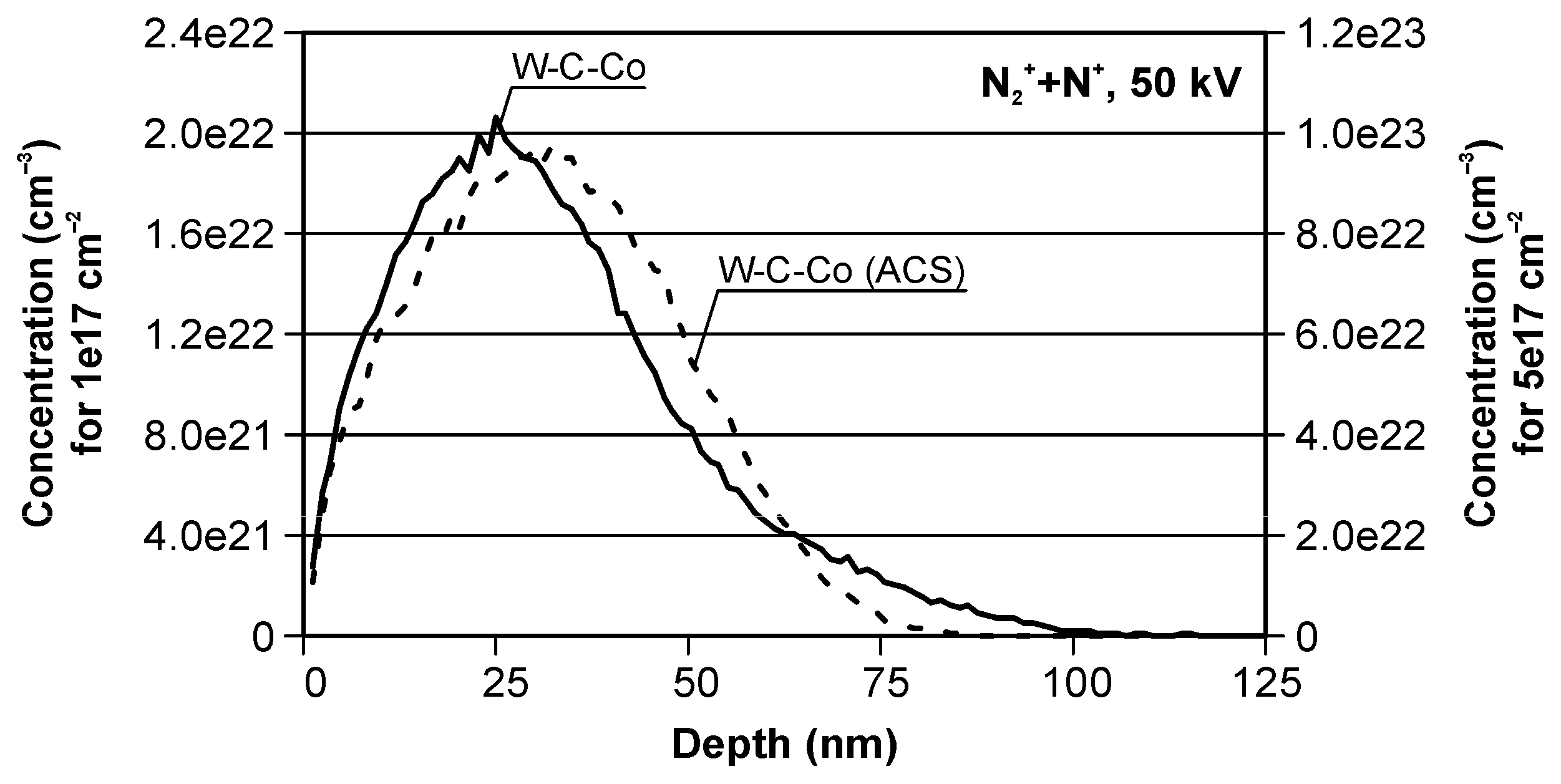
- SRIM predicts a modified near-surface layer of ~100 nm for both fluences.
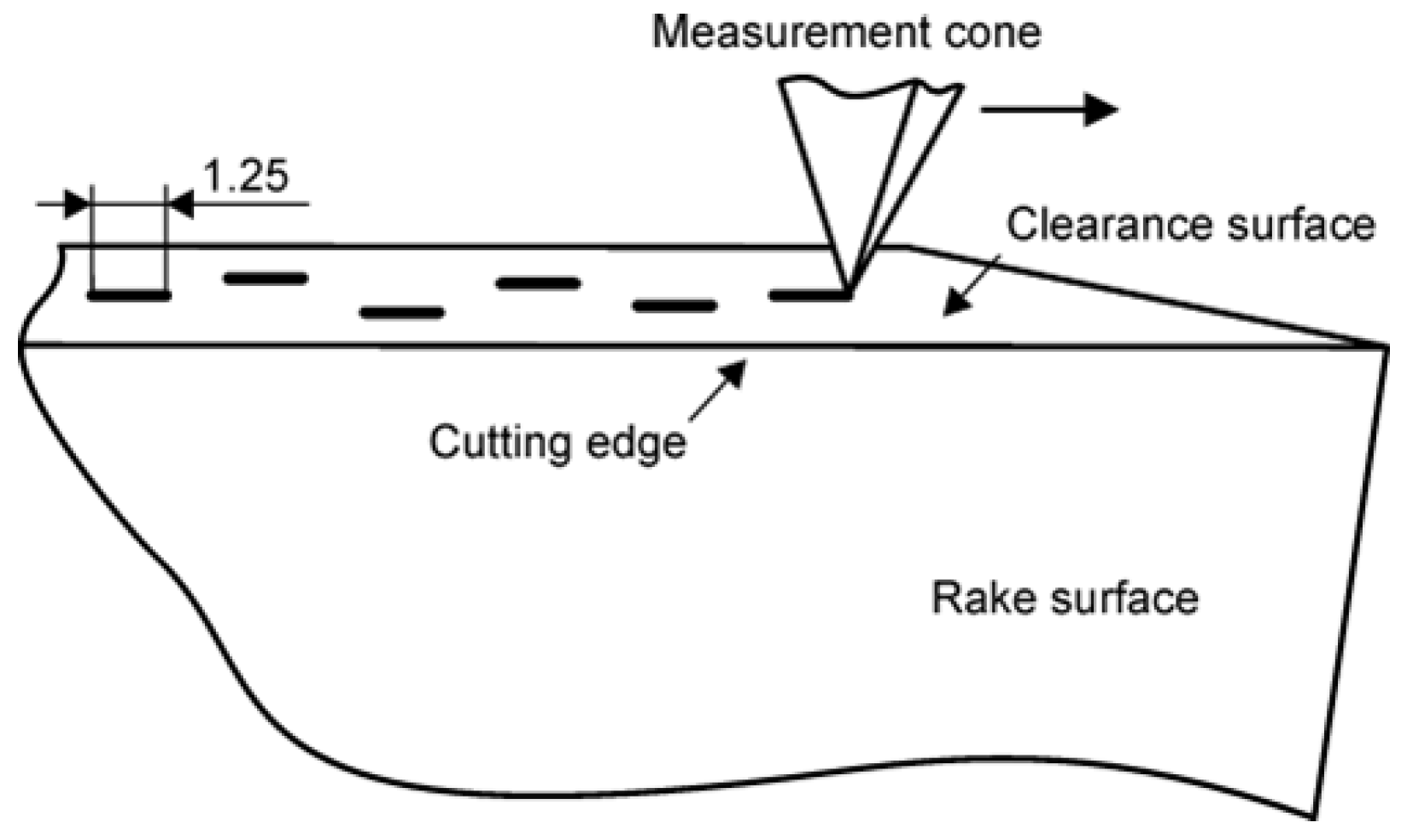
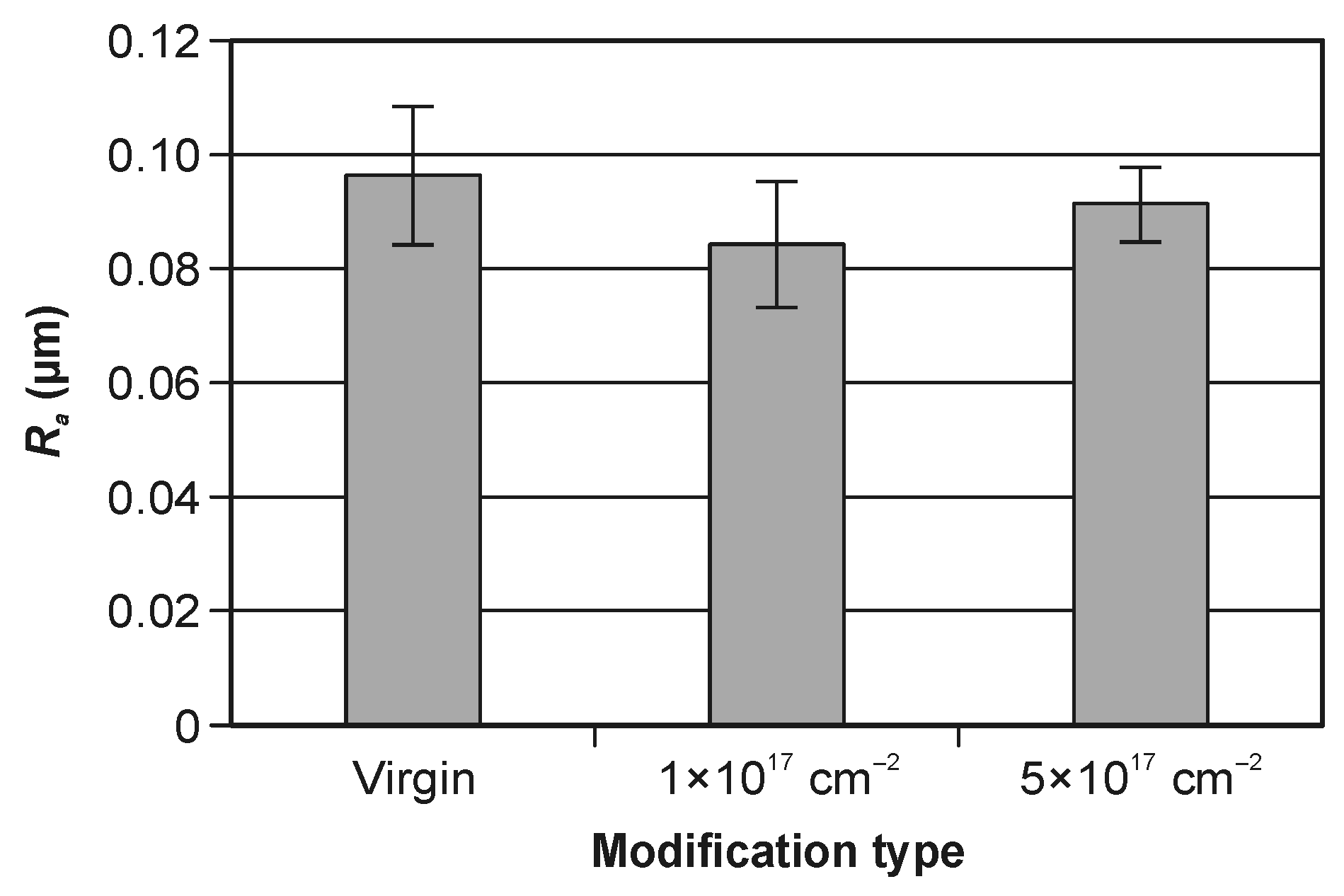
- Ra roughness from contact profilometry shows no significant change after implantation.
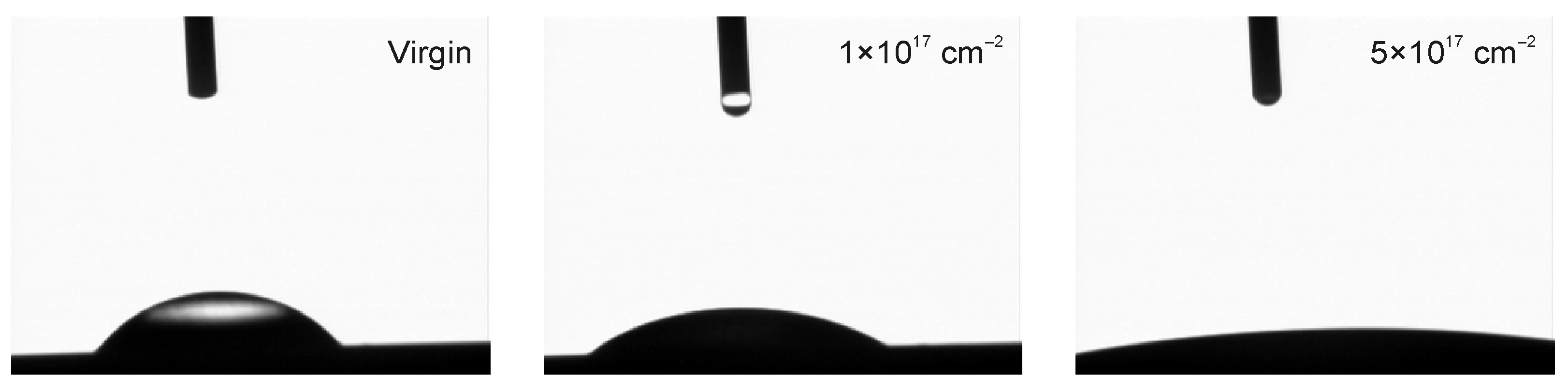
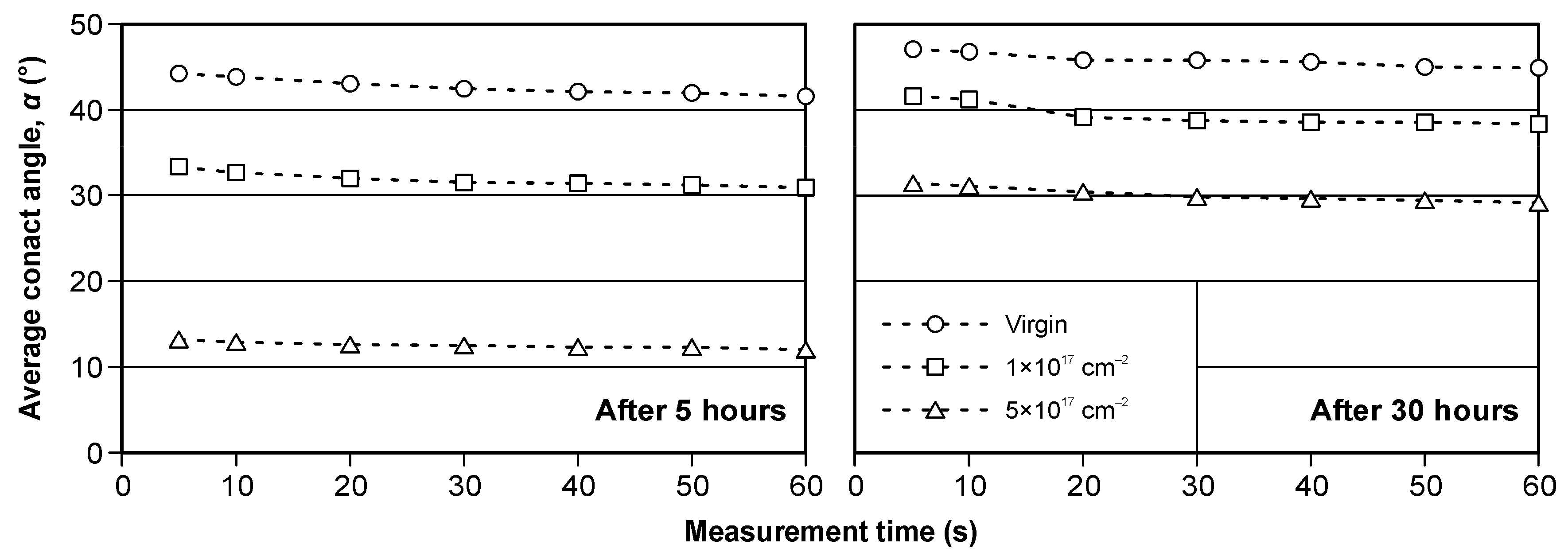
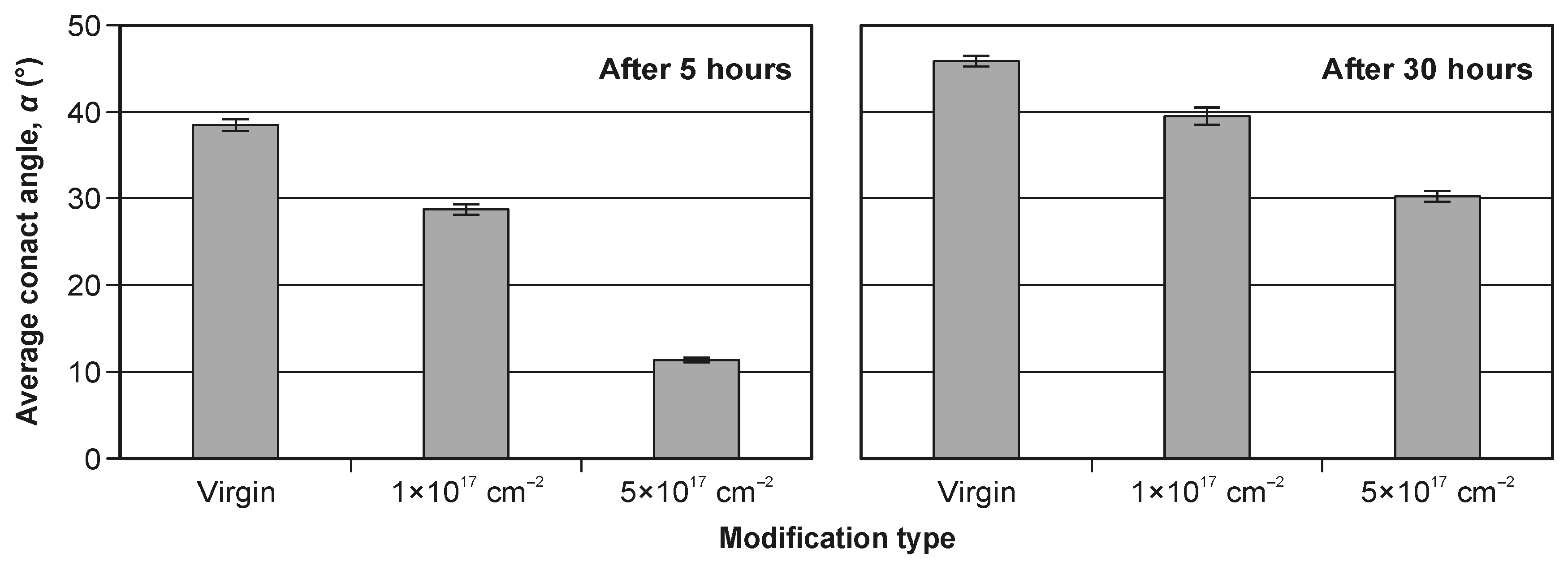
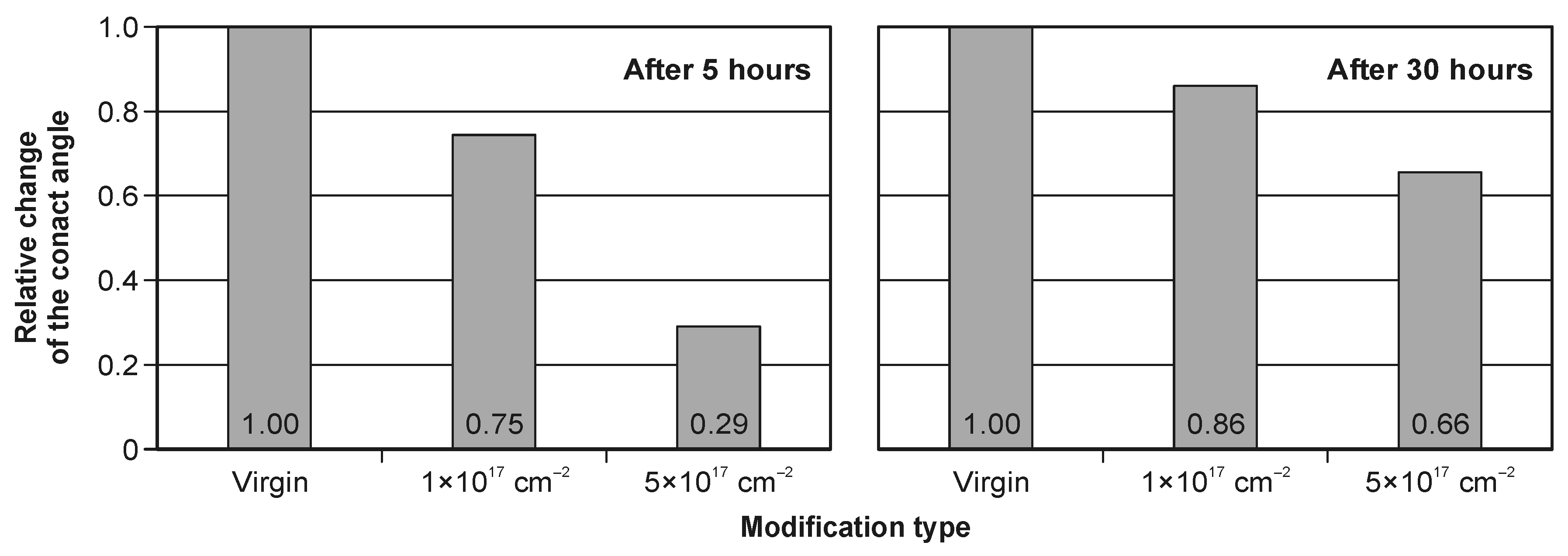
- Water contact angle drops > 70% at 5 h, indicating markedly higher wettability.
- Wettability partially recovers: contact-angle reduction achieves ~34% after 30 h in air.
- Higher fluence yields consistently lower contact angles, confirming dose dependence.
Abstract
1. Introduction
2. Materials and Methods
2.1. Samples
2.2. Modeling and Ion Implantation
2.3. Surface Roughness Measurement
2.4. Wettability Tests
2.5. Statistical Analysis
3. Results and Discussion
3.1. Results of Modeling Nitrogen Ion Implantation
3.2. Surface Roughness Analysis
3.3. Wettability Analysis
4. Conclusions
- Nitrogen ion implantation in the tested range of parameters (the acceleration voltage and the ion fluence) does not significantly change the surface roughness of the WC–Co surface. Ion implantation reduces the contact angle by more than 70% for measurements 5 h after the modification. The above effect is not long-lasting, and after 30 h it decreases to 34%.
- With an increase in the implanted dose, the value of the contact angle decreases significantly. A five-times-higher dose results in a more than three-times reduction in the contact angle.
- A decrease in the contact angle indicates improved wettability of the ion-implanted WC–Co surface, which may be beneficial from the point of view of tool–workpiece interfacial interactions during wood machining.
Author Contributions
Funding
Data Availability Statement
Conflicts of Interest
References
- Shen, F.; Jia, R. Research Progress and Development Prospect of Wood Plastic Composite. Plast. Addit. 2010, 1, 5–9. [Google Scholar]
- Huang, W.K.; Pan, Z.N. Production and Application Progress of Medium Density Fiberboard (MDF) in China. For. Mach. Woodwork. Equip. 2014, 42, 8–10. [Google Scholar]
- Irle, M.; Privat, F.; Couret, L.; Belloncle, C.; Déroubaix, G.; Bonnin, E.; Cathala, B. Advanced Recycling of Post-Consumer Solid Wood and MDF. Wood Mater. Sci. Eng. 2019, 14, 19–23. [Google Scholar] [CrossRef]
- Besserer, A.; Troilo, S.; Girods, P.; Rogaume, Y.; Brosse, N. Cascading Recycling of Wood Waste: A Review. Polymers 2021, 13, 1752. [Google Scholar] [CrossRef]
- Gogolewski, P.; Klimke, J.; Krell, A.; Beer, P. Al2O3 Tools towards Effective Machining of Wood-Based Materials. J. Mater. Process. Technol. 2009, 209, 2231–2236. [Google Scholar] [CrossRef]
- Miklaszewski, S.; Beer, P.; Zbieć, M.; Wendler, B.G.; Mitura, S.; Michalski, A. Resistance to Wear of the Surface-Modifated Milling Tools during the Milling Process of Wood-Based Materials. In Proceedings of the 14th IWMS, Paris, Epinal, Cluny, France, 12–19 September 1999; IWMS Organizing Committee: Florence, Italy; pp. 12–19.
- Wilkowski, J.; Barlak, M.; Kwidziński, Z.; Wilczyński, A.; Filipczuk, P.; Pędzik, M.; Drewczyński, M.; Zagórski, J.; Staszkiewicz, B.; Rogoziński, T. Influence of Ion Implantation on the Wear and Lifetime of Circular Saw Blades in Industrial Production of Wooden Door Frames. Appl. Sci. 2022, 12, 10211. [Google Scholar] [CrossRef]
- Wilkowski, J.; Jegorowa, A.; Barlak, M.; Werner, Z.; Zagórski, J.; Staszkiewicz, B.; Kurek, J.; Kruk, M. Effect of Nitrogen Ion Implantation on the Tool Life Used in Particleboard CNC Drilling. Materials 2022, 15, 3420. [Google Scholar] [CrossRef]
- Sheikh-Ahmad, J.Y.; Bailey, J.A. High-Temperature Wear of Cemented Tungsten Carbide Tools While Machining Particleboard and Fiberboard. J. Wood Sci. 1999, 45, 445–455. [Google Scholar] [CrossRef]
- Milman, Y.V.; Chugunova, S.; Goncharuck, V.; Luyckx, S.; Northrop, I.T. Low and High Temperature Hardness of WC-6 Wt%Co Alloys. Int. J. Refract. Met. Hard Mater. 1997, 15, 97–101. [Google Scholar] [CrossRef]
- Pirso, J.; Letunovitš, S.; Viljus, M. Friction and Wear Behaviour of Cemented Carbides. Wear 2004, 257, 257–265. [Google Scholar] [CrossRef]
- Bonny, K.; De Baets, P.; Perez, Y.; Vleugels, J.; Lauwers, B. Friction and Wear Characteristics of WC–Co Cemented Carbides in Dry Reciprocating Sliding Contact. Wear 2010, 268, 1504–1517. [Google Scholar] [CrossRef]
- Choi, S.-H.; Kang, S.-D.; Kwon, Y.S.; Lim, S.G.; Cho, K.K.; Ahn, I.-S. The Effect of Sintering Conditions on the Properties of WC–10wt%Co PIM Compacts. Res. Chem. Intermed. 2010, 36, 743–748. [Google Scholar] [CrossRef]
- Olovsjö, S.; Johanson, R.; Falsafi, F.; Bexell, U.; Olsson, M. Surface Failure and Wear of Cemented Carbide Rock Drill Buttons—The Importance of Sample Preparation and Optimized Microscopy Settings. Wear 2013, 302, 1546–1554. [Google Scholar] [CrossRef]
- David, M.L.; Ratchenkova, A.; Oliviero, E.; Denanot, M.F.; Beaufort, M.F.; Declémy, A.; Blanchard, C.; Gerasimenko, N.N.; Barbot, J.F. Radiation Damage in He Implanted Silicon at High Temperature Using Multi-Energies. Nucl. Instrum. Methods Phys. Res. B 2002, 198, 83–89. [Google Scholar] [CrossRef]
- Barlak, M.; Piekoszewski, J.; Werner, Z.; Pakiela, Z.; Sartowska, B.; Składnik-Sadowska, E.; Walis, L.; Kierzek, J.; Starosta, W.; Kolitsch, A.; et al. The Influence of Distribution of Titanium Alloyed into Carbon Ceramics by the Intense Plasma Pulses on Their Surface Wettability with Liquid Copper. Vacuum 2009, 83, S81–S85. [Google Scholar] [CrossRef]
- Barlak, M.; Wilkowski, J.; Werner, Z. Ion Implantation Changes of Tribological and Corrosion Resistance Properties of Materials Used in Wood Industry. Ann. Wars. Univ. Life Sci.-SGGW For. Wood Technol. 2016, 94, 19–27. [Google Scholar]
- Barlak, M.; Wilkowski, J.; Boruszewski, P.; Werner, Z.; Pałubicki, B. Changes of Functional Properties of Materials Used in Wood Industry after Ion Implantation Process. Ann. Wars. Univ. Life Sci.-SGGW For. Wood Technol. 2017, 97, 133–139. [Google Scholar]
- Werner, Z.; Barlak, M.; Ratajczak, R.; Konarski, P.; Markov, A.M.; Heller, R. Electron-Beam Pulse Annealed Ti-Implanted GaP. J. Appl. Phys. 2016, 120, 085103. [Google Scholar] [CrossRef]
- Straede, C.A. Application of Ion Implantation in Tooling Industry. Nucl. Instrum. Methods Phys. Res. B 1996, 113, 161–166. [Google Scholar] [CrossRef]
- Mikkelsen, N.J.; Pedersen, J.; Straede, C.A. Ion Implantation—The Job Coater’s Supplement to Coating Techniques. Surf. Coat. Technol. 2002, 158–159, 42–47. [Google Scholar] [CrossRef]
- Rodríguez, R.J.; García, J.A.; Sánchez, R.; Pérez, A.; Garrido, B.; Morante, J. Modification of Surface Mechanical Properties of Polycarbonate by Ion Implantation. Surf. Coat. Technol. 2002, 158–159, 636–642. [Google Scholar] [CrossRef]
- Petersen, J.H.; Reitz, H.; Benzon, M.E.; Bøttiger, J.; Chevallier, J.; Mikkelsen, N.J.; Morgen, P. Tribological Properties of Sulfur-Implanted Steel. Surf. Coat. Technol. 2004, 179, 165–175. [Google Scholar] [CrossRef]
- Jun, T.; Qizu, W.; Qunji, X. The Solid Film Lubrication by Carbon Ion Implantation into α-Al2O3. Nucl. Instrum. Methods Phys. Res. B 1998, 143, 488–492. [Google Scholar] [CrossRef]
- Zhu, Y.-C.; Fujita, K.; Iwamoto, N.; Nagasaka, H.; Kataoka, T. Influence of Boron Ion Implantation on the Wear Resistance of TiAlN Coatings. Surf. Coat. Technol. 2002, 158–159, 664–668. [Google Scholar] [CrossRef]
- Mitsuo, A.; Akhadejdamrong, T.; Aizawa, T. Self-Lubrication of Cl-Implanted Titanium Nitride Coating for Dry Metal Forming. Mater. Trans. 2003, 44, 1295–1302. [Google Scholar] [CrossRef]
- Aizawa, T.; Akhadejdamrong, T.; Mitsuo, A. Self-Lubrication of Nitride Ceramic Coating by the Chlorine Ion Implantation. Surf. Coat. Technol. 2004, 177–178, 573–581. [Google Scholar] [CrossRef]
- Barnes, H.M.; Stewart, H.A.; Murphy, J. Vapor Boron Treatment of Composites Reduces Tool Wear. For. Prod. J. 2004, 54, 6973. [Google Scholar]
- Betlej, I.; Barlak, M.; Wilkowski, J.; Werner, Z.; Zagórski, J.; Lipska, K.; Boruszewski, P. Wettability of the Surface of Bacterial Cellulose Film Modified with the Ion Implantation. Ann. Wars. For. Wood Technol. 2022, 118, 15–21. [Google Scholar] [CrossRef]
- Chen, X.; Yin, X.; Jin, J. A Study on the Wettability of Ion-Implanted Stainless and Bearing Steels. Metals 2019, 9, 208. [Google Scholar] [CrossRef]
- Barlak, M.; Wilkowski, J.; Werner, Z. Modelling of Nitrogen Implantation Processes into WC–Co Indexable Knives for Wood-Based Material Machining Using Ion Implanters with or without Direct Ion Beam. Ann. Wars. Univ. Life Sci.-SGGW. For. Wood Technol. 2019, 108, 68–78. [Google Scholar] [CrossRef]
- SRIM. Available online: http://www.srim.org/ (accessed on 11 October 2022).
- SUSPRE. Available online: http://uknibc.co.uk/suspre/ (accessed on 11 October 2022).
- Barlak, M.; Wilkowski, J.; Werner, Z.; Staszkiewicz, B. Increasing Technical Capabilities of the Ion Implanter in Tool Modification Processes. Biul. Inf. OB-RPPD 2022, 1–2, 59–82. [Google Scholar]
- Wilkowski, J.; Barlak, M.; Böttger, R.; Werner, Z.; Konarski, P.; Pisarek, M.; Wachowicz, J.; Von Borany, J.; Auriga, A. Effect of Nitrogen Ion Implantation on the Life Time of WC–Co Tools Used in Particleboard Milling. Wood Mater. Sci. Eng. 2022, 17, 521–532. [Google Scholar] [CrossRef]
- Wilkowski, J.; Barlak, M.; Werner, Z.; Zagórski, J.; Czarniak, P.; Podziewski, P.; Szymanowski, K. Technical Note: Life-Time Improvement and the Cutting Forces in Nitrogen-Implanted Drills during Wood-Based Material Machining. Wood Fiber Sci. 2019, 51, 209–220. [Google Scholar] [CrossRef]
- Ziegler, J.F.; Ziegler, M.D.; Biersack, J.P. SRIM—The Stopping and Range of Ions in Matter (2010). Nucl. Instrum. Methods Phys. Res. B 2010, 268, 1818–1823. [Google Scholar] [CrossRef]
- Sun, J.S.; Yan, P.; Sun, X.B.; Lu, G.; Liu, F.; Ye, W.; Yang, J.Q. Tribological Properties of Nitrogen Ion Implanted WC–Co. Wear 1997, 213, 131–134. [Google Scholar] [CrossRef]
- ISO 4287:1997; Geometrical Product Specifications (GPS)—Surface Texture: Profile Method—Terms, Definitions and Surface Texture Parameters. International Organization for Standardization: Geneva, Switzerland, 1997.
- ISO 4288:1996; Geometrical Product Specifications (GPS)—Surface Texture: Profile Method—Rules and Procedures for the Assess-ment of Surface Texture. International Organization for Standardization: Geneva, Switzerland, 1996.
- Möller, W. TRI3DYN—Collisional Computer Simulation of the Dynamic Evolution of 3-Dimensional Nanostructures under Ion Irradiation. Nucl. Instrum. Methods Phys. Res. B 2014, 322, 23–33. [Google Scholar] [CrossRef]
- Hofsäss, H.; Zhang, K.; Mutzke, A. Simulation of Ion Beam Sputtering with SDTrimSP, TRIDYN and SRIM. Appl. Surf. Sci. 2014, 310, 134–141. [Google Scholar] [CrossRef]
- Demaree, J.D.; Kirkpatrick, S.R.; Kirkpatrick, A.R.; Hirvonen, J.K. Optical Properties and Surface Roughness of Ion Implanted Single Crystal Sapphire. MRS Proc. 1996, 438, 471. [Google Scholar] [CrossRef]
- Zhou, F.; Yuan, Y.; Chen, K.; Wang, X. Influence of Nitrogen Ion Implantation Energies on Surface Chemical Bonding Structure and Mechanical Properties of Nitrogen-Implanted Silicon Carbide Ceramics. Nucl. Instrum. Methods Phys. Res. B 2009, 267, 2858–2865. [Google Scholar] [CrossRef]
- Mei, L.; Guan, G. Profilometry and Atomic Force Microscopy for Surface Characterization. Nano TransMed 2023, 2, e9130017. [Google Scholar] [CrossRef]
- Stępień, K.; Makieła, W.; Świderski, J. The Study of the Influence of the Tracing Speed on the Result of Surface Roughness Measurement Using the Tactile Method. Appl. Sci. 2023, 13, 12659. [Google Scholar] [CrossRef]
- Wan, G.J.; Fu, R.K.Y.; Yang, P.; Ho, J.P.Y.; Xie, X.; Huang, N.; Chu, P.K. Surface Wettabiliy of Nitrogen Plasma-Implanted Silicon. Nucl. Instrum. Methods Phys. Res. B 2006, 242, 296–299. [Google Scholar] [CrossRef]
- Braceras, I.; Briz, N.; Garcia, F.; Muñoz, R.; Viviente, J.L.; Onate, J.I. Effects of Ion Implantation on Nano-Topographic Properties. Surf. Coat. Technol. 2007, 201, 8511–8515. [Google Scholar] [CrossRef]
- Kozbial, A.; Li, Z.; Conaway, C.; McGinley, R.; Dhingra, S.; Vahdat, V.; Zhou, F.; D’Urso, B.; Liu, H.; Li, L. Study on the Surface Energy of Graphene by Contact Angle Measurements. Langmuir 2014, 30, 8598–8606. [Google Scholar] [CrossRef] [PubMed]
- Zhang, Z.; Cui, Z.; Wang, H.; Jiang, C.; Zhao, J.; Ren, L. Tribological Performance of Microstructured Surfaces with Different Wettability from Superhydrophilic to Superhydrophobic. Biosurf. Biotribol. 2020, 6, 118–123. [Google Scholar] [CrossRef]
- Pang, M.; Liu, X.; Liu, K. Effect of Wettability on the Friction of a Laser-Textured Cemented Carbide Surface in Dilute Cutting Fluid. Adv. Mech. Eng. 2017, 9, 168781401773815. [Google Scholar] [CrossRef]
- Yang, Q.; Zhou, W.; Wang, L.; Ren, X.; Wang, Y.; Lou, D.; Chen, L.; Cheng, J.; Zheng, Z.; Liu, D. Wettability Control on YW2 Cemented Carbide Surface by Femtosecond Laser Irradiation. Phys. Status Solidi (A) 2021, 218, 2000709. [Google Scholar] [CrossRef]



| Ion Species | Percentage Charge State Distribution (%) | Acceleration Voltage (kV) | Energy (keV) |
|---|---|---|---|
| N2+ | 67 | 50 | 25 |
| N+ | 33 | 50 | 50 |
| Implanted Ions | Peak Volume Dopant Concentration Nmax (cm−3) | Projected Range Rp (nm) | Range Straggling ΔRp (nm) | Skewness | Kurtosis | Sputtering Yield Y (Atoms/Ion) |
|---|---|---|---|---|---|---|
| N2+ + N+ | 2.07 × 10²² for 1 × 1017 cm−2 1.04 × 10²³ for 5 × 1017 cm−2 | 31.6 | 37.8 | 0.8574 | 3.6237 | 0.49 |
| ACS | 1.99 × 10²² for 1 × 1017 cm−2 9.95 × 10²² for 5 × 1017 cm−2 | 31.8 | 32.4 | 0.2732 | 2.5179 | 0.48 |
Disclaimer/Publisher’s Note: The statements, opinions and data contained in all publications are solely those of the individual author(s) and contributor(s) and not of MDPI and/or the editor(s). MDPI and/or the editor(s) disclaim responsibility for any injury to people or property resulting from any ideas, methods, instructions or products referred to in the content. |
© 2026 by the authors. Licensee MDPI, Basel, Switzerland. This article is an open access article distributed under the terms and conditions of the Creative Commons Attribution (CC BY) license.
Share and Cite
Barlak, M.; Wilkowski, J.; Auriga, R.; Zagórski, J.; Boruszewski, P.; Borysiuk, P. Effects of Nitrogen Ion Implantation on Wettability and Surface Roughness of WC–Co Tools Used for Wood-Based Panel Machining. Materials 2026, 19, 1241. https://doi.org/10.3390/ma19061241
Barlak M, Wilkowski J, Auriga R, Zagórski J, Boruszewski P, Borysiuk P. Effects of Nitrogen Ion Implantation on Wettability and Surface Roughness of WC–Co Tools Used for Wood-Based Panel Machining. Materials. 2026; 19(6):1241. https://doi.org/10.3390/ma19061241
Chicago/Turabian StyleBarlak, Marek, Jacek Wilkowski, Radosław Auriga, Jerzy Zagórski, Piotr Boruszewski, and Piotr Borysiuk. 2026. "Effects of Nitrogen Ion Implantation on Wettability and Surface Roughness of WC–Co Tools Used for Wood-Based Panel Machining" Materials 19, no. 6: 1241. https://doi.org/10.3390/ma19061241
APA StyleBarlak, M., Wilkowski, J., Auriga, R., Zagórski, J., Boruszewski, P., & Borysiuk, P. (2026). Effects of Nitrogen Ion Implantation on Wettability and Surface Roughness of WC–Co Tools Used for Wood-Based Panel Machining. Materials, 19(6), 1241. https://doi.org/10.3390/ma19061241