Insights into Hydrogen Diffusion Characteristics and Interactions with Vacancy in Fe Crystal Lattices from First-Principles Calculations

 , ,
, ,
Abstract
1. Introduction
2. Modeling and Simulation
2.1. First-Principles Simulations
2.2. Computational Model
2.3. Solution Energy Calculations
2.4. Calculation Method for the Diffusion Coefficient
3. Results and Discussion
3.1. Hydrogen Diffusion Mechanisms in Defect-Free Fe Crystal Lattices
3.1.1. Preferred Occupation Sites of Hydrogen Atoms
3.1.2. Transition State of Hydrogen Diffusion in the Fe Crystal Lattice
- (1)
- Transition state of hydrogen diffusion in the α-Fe crystal lattice
- (2)
- Transition state of hydrogen diffusion in the γ-Fe crystal lattice
- (3)
- Transition state of hydrogen diffusion in the ε-Fe crystal lattice
3.1.3. Hydrogen Diffusion Coefficient in the Fe Crystal Lattice
3.2. Interatomic Interactions of Hydrogen in the α-Fe Crystal Lattice
3.3. Hydrogen Diffusion Mechanisms in Vacancy-Containing Fe Crystal Lattices
3.3.1. Preferred Occupation Sites of Hydrogen Atoms in Vacancy-Containing Fe Crystal Lattices
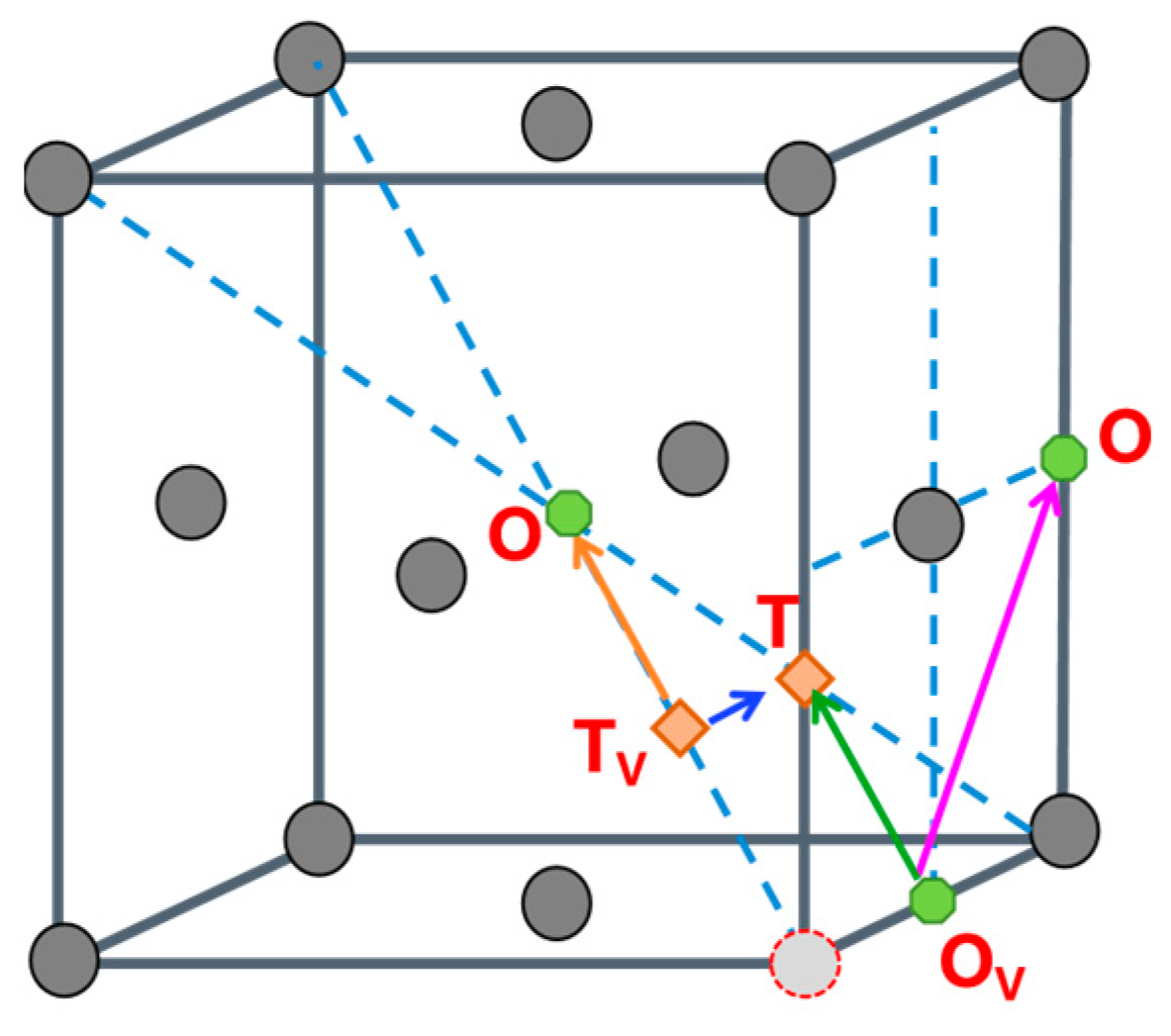
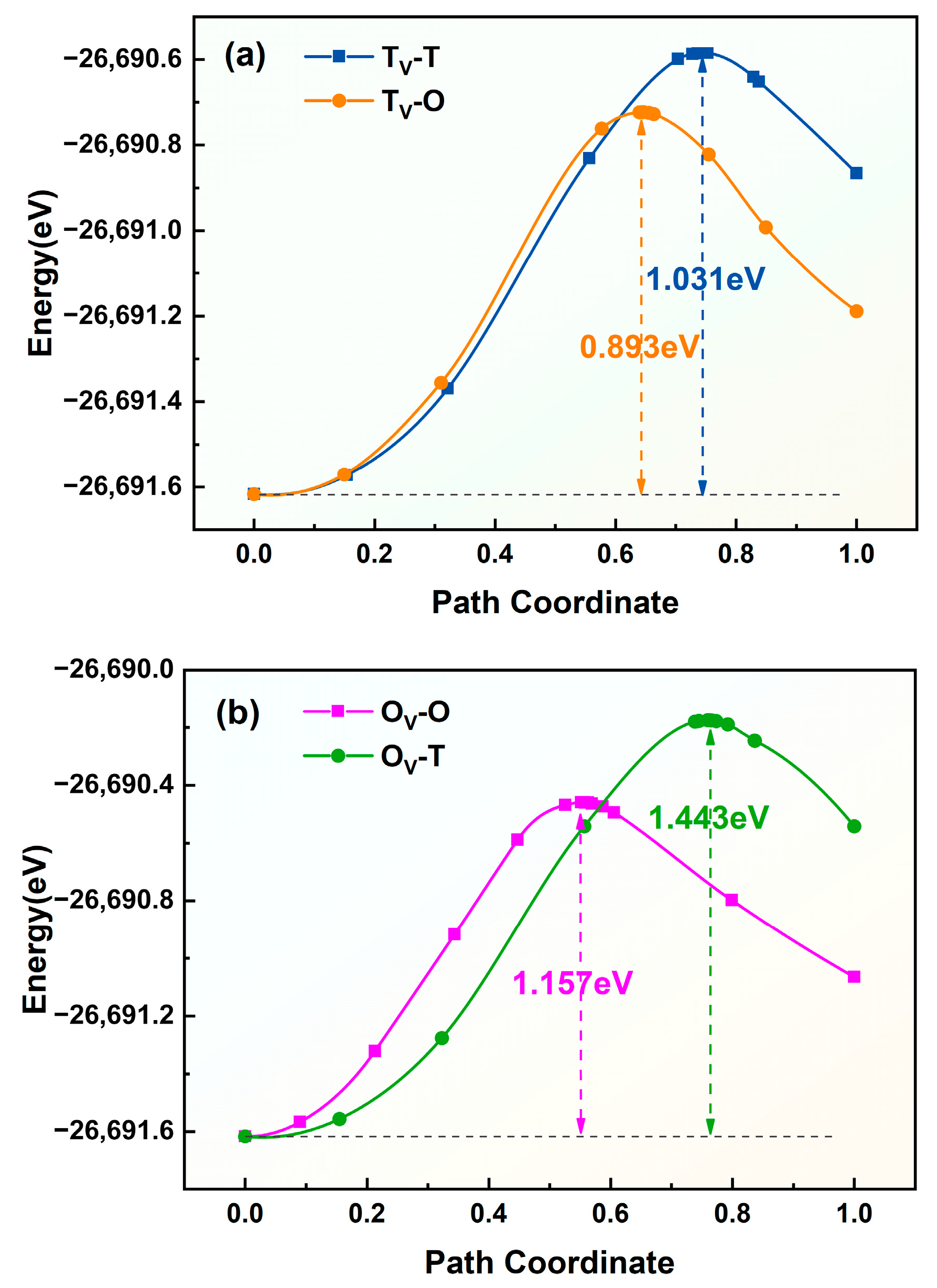
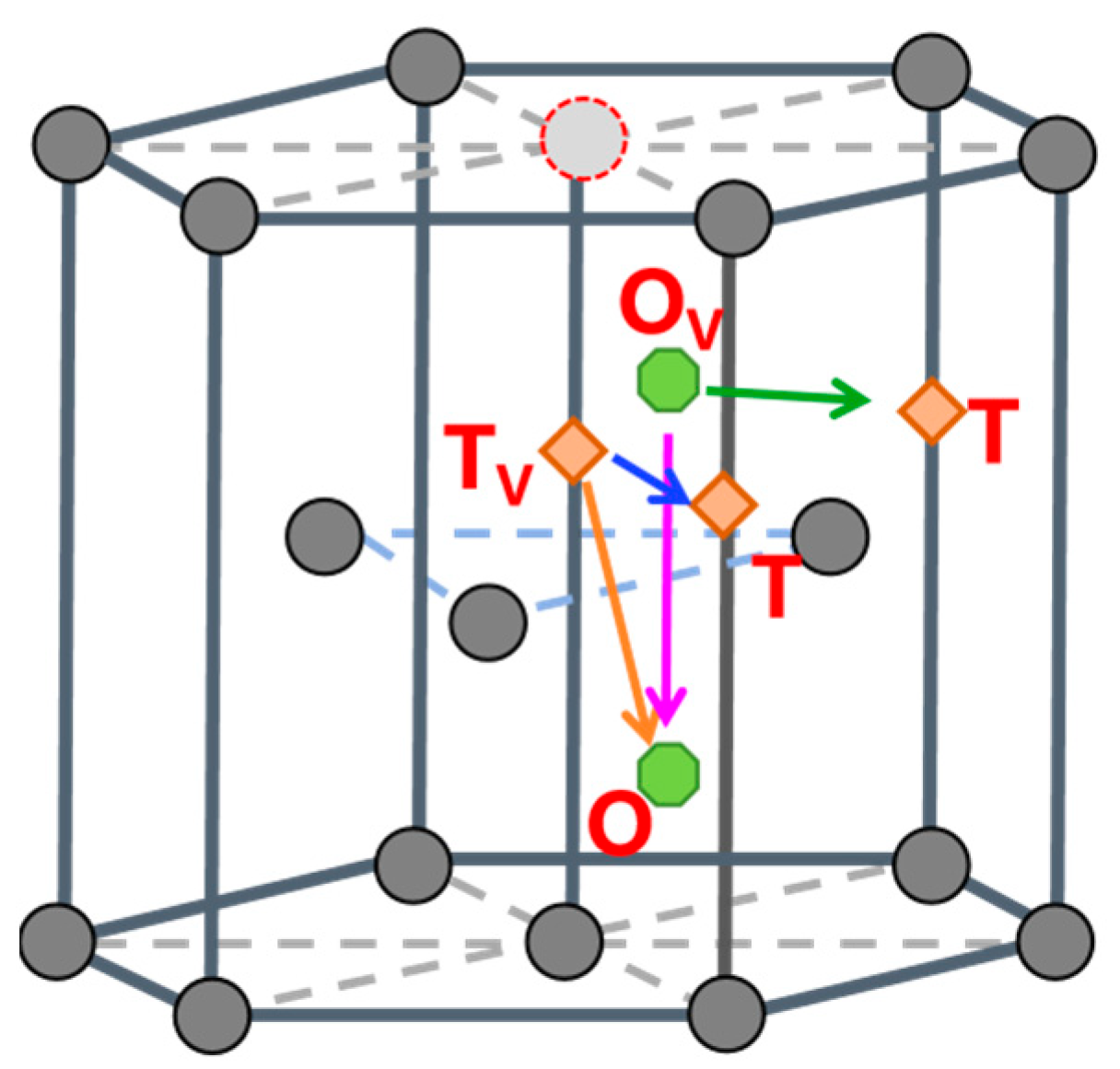
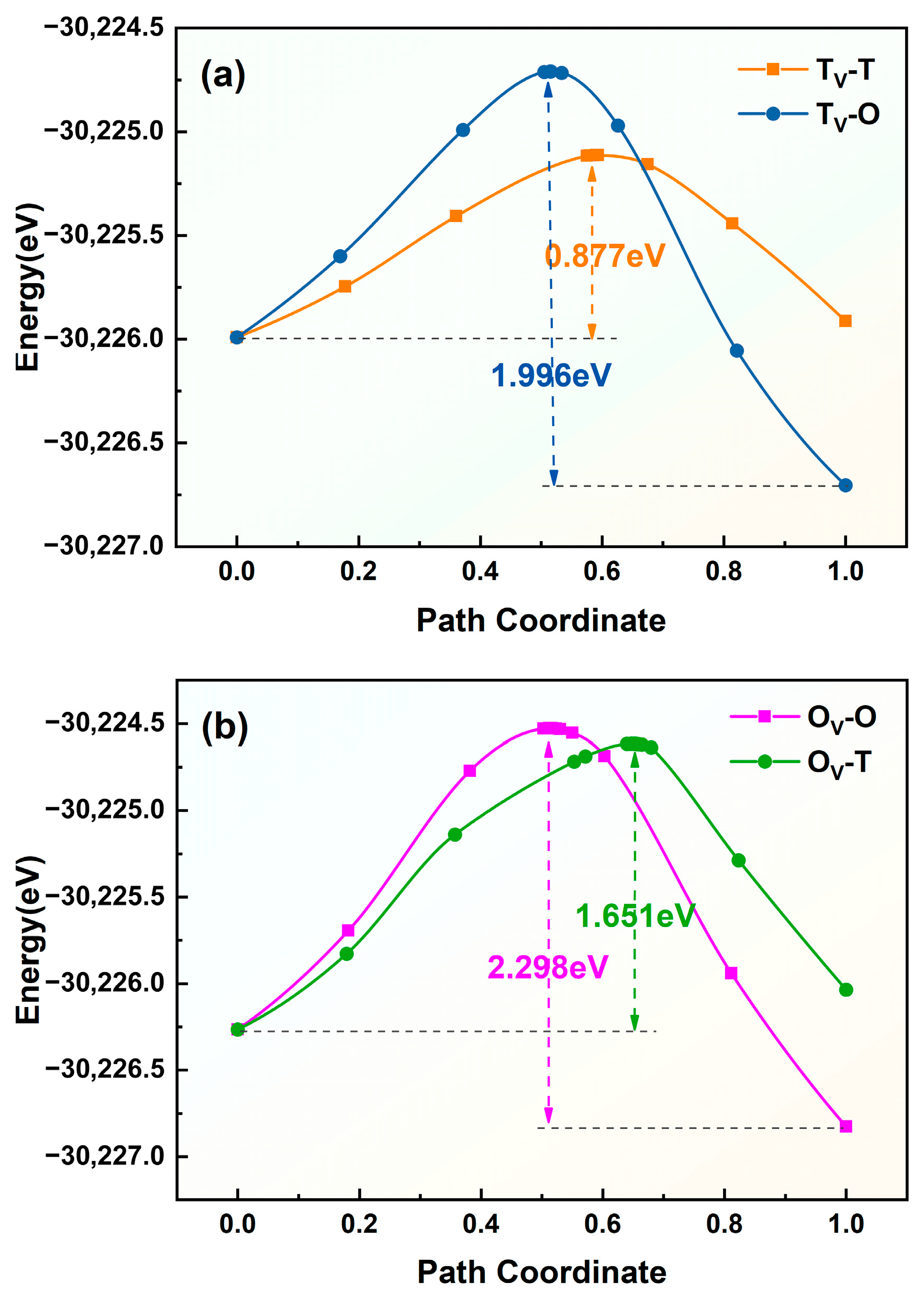
3.3.2. Transition State of Hydrogen Diffusion in a Vacancy-Containing Fe Crystal Lattice
4. Conclusions
- (1)
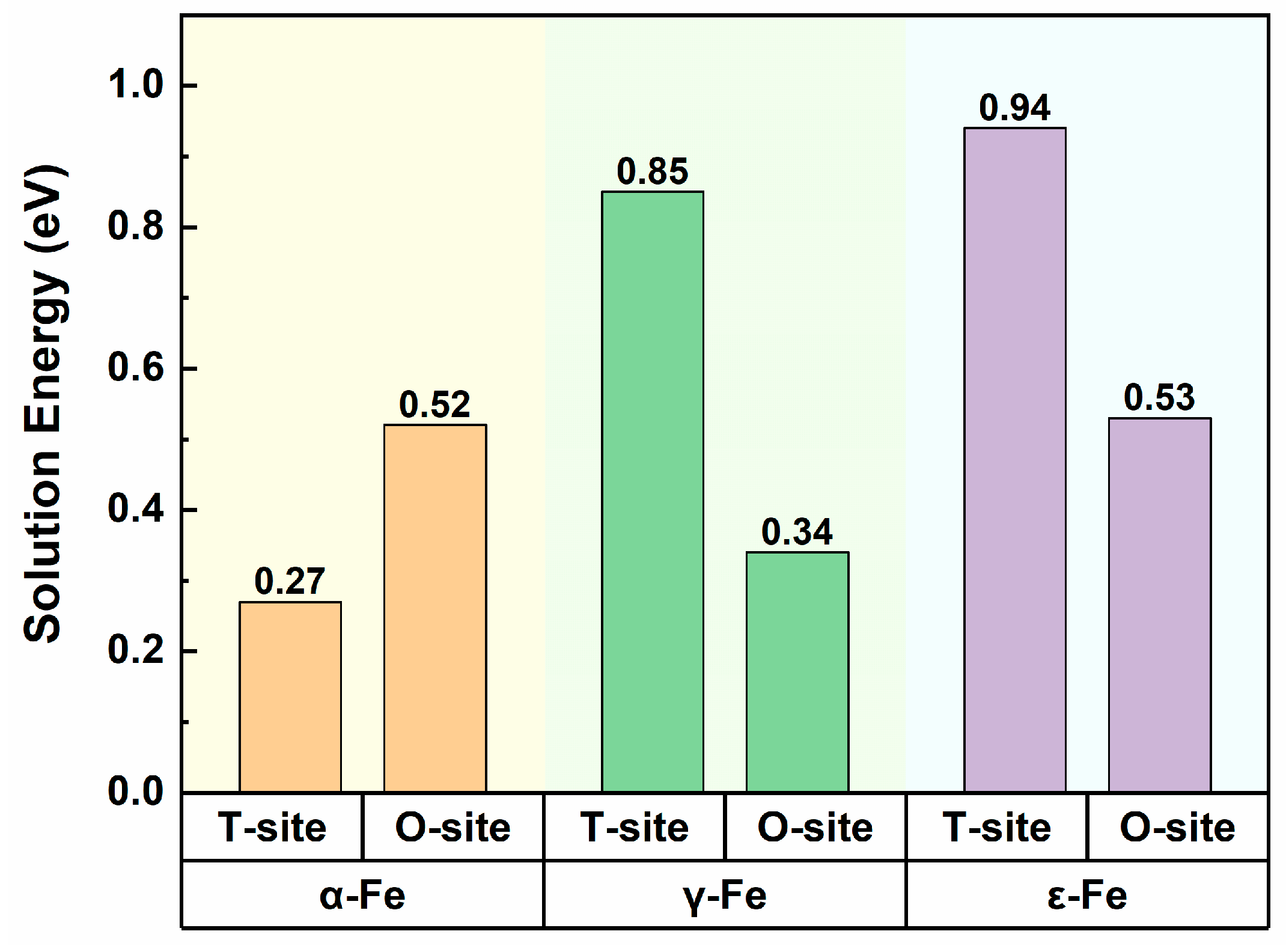
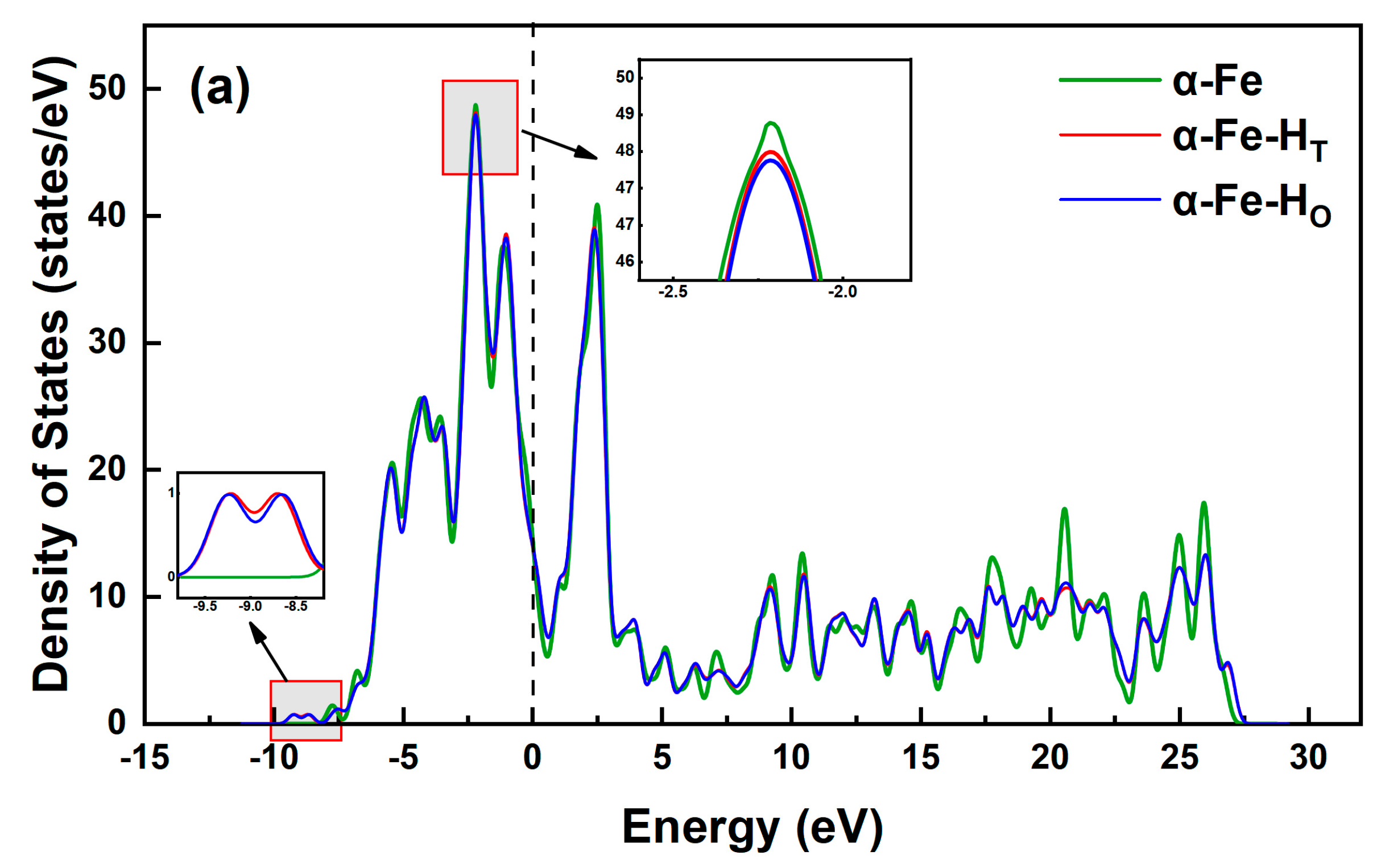
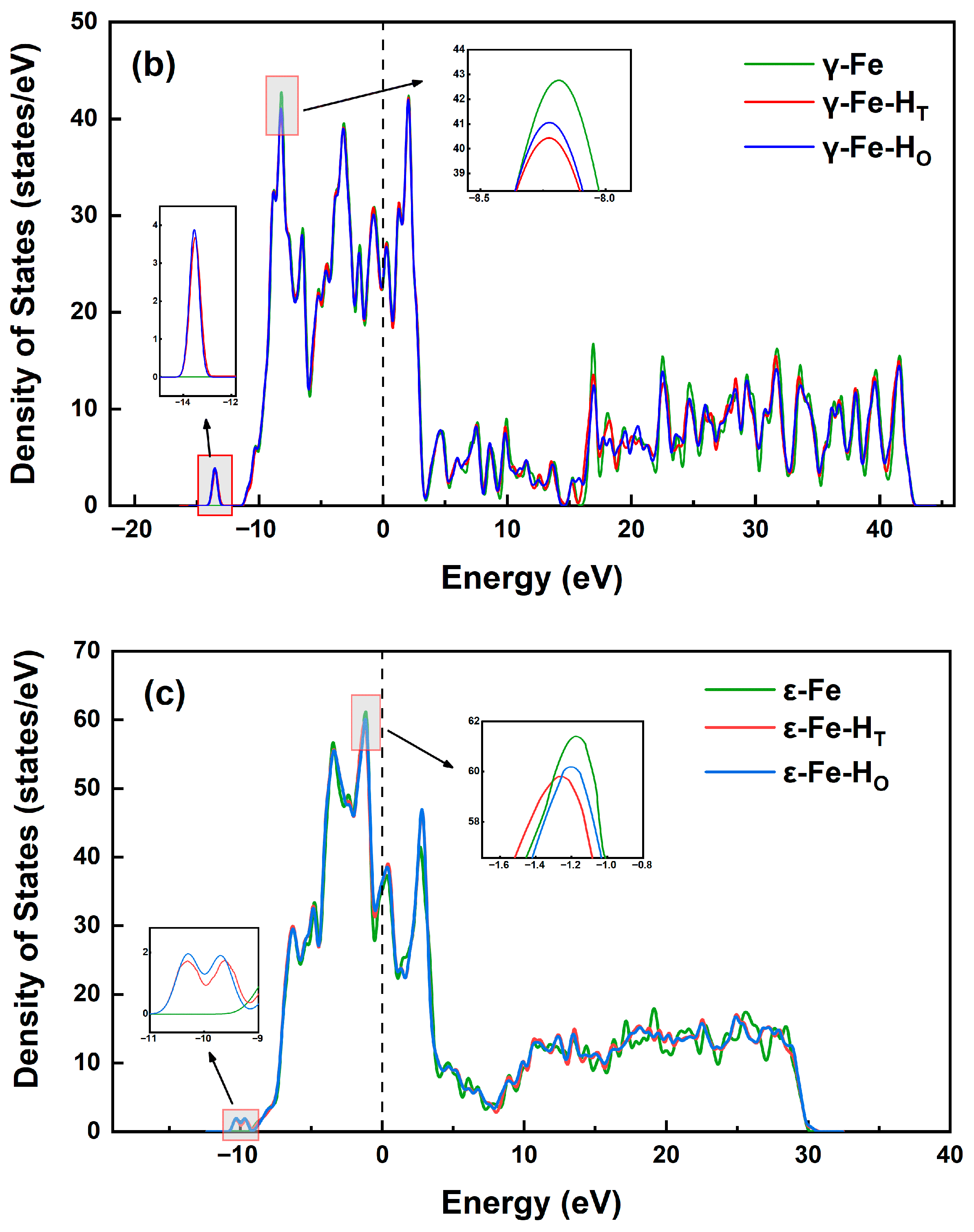
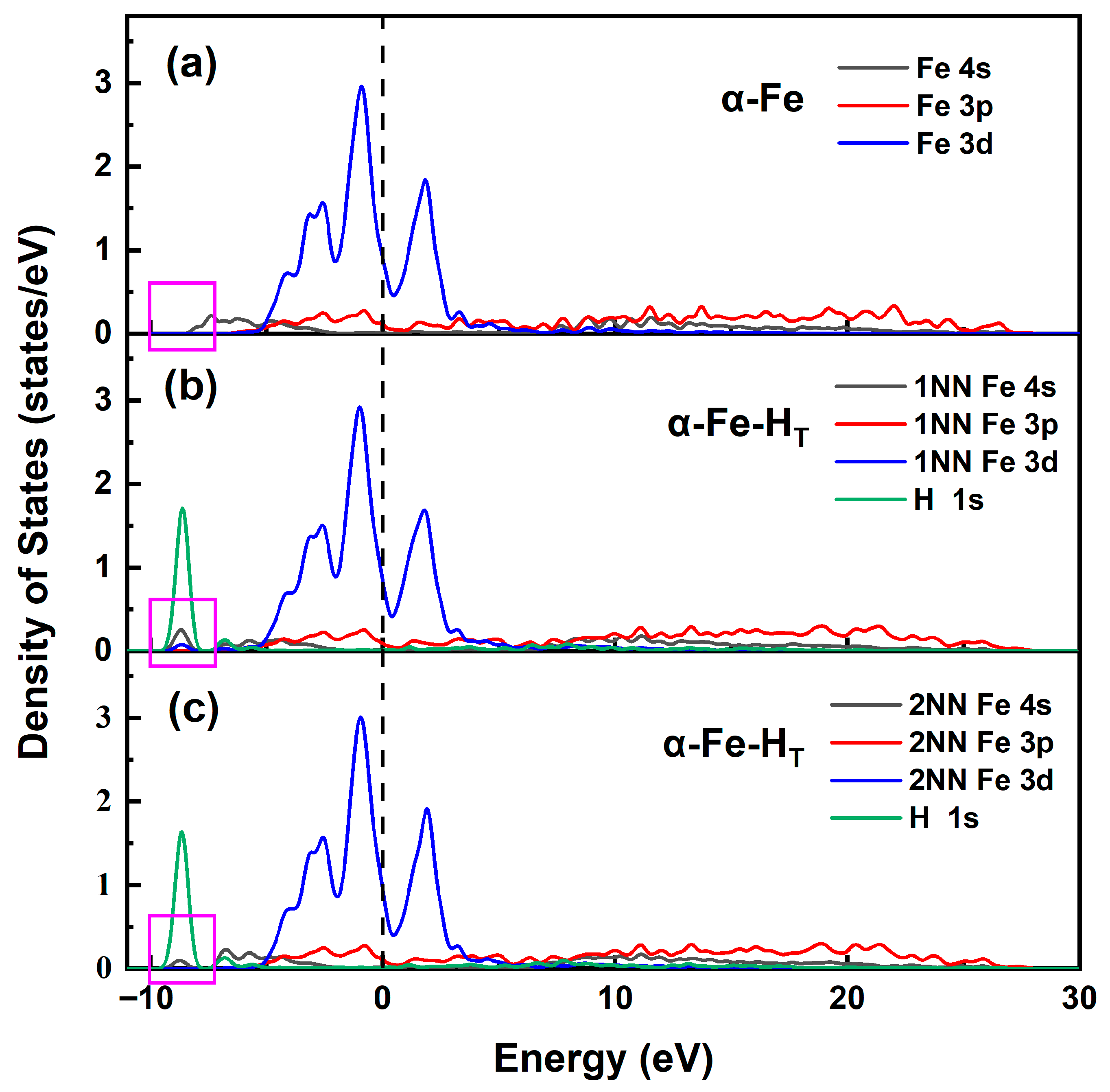
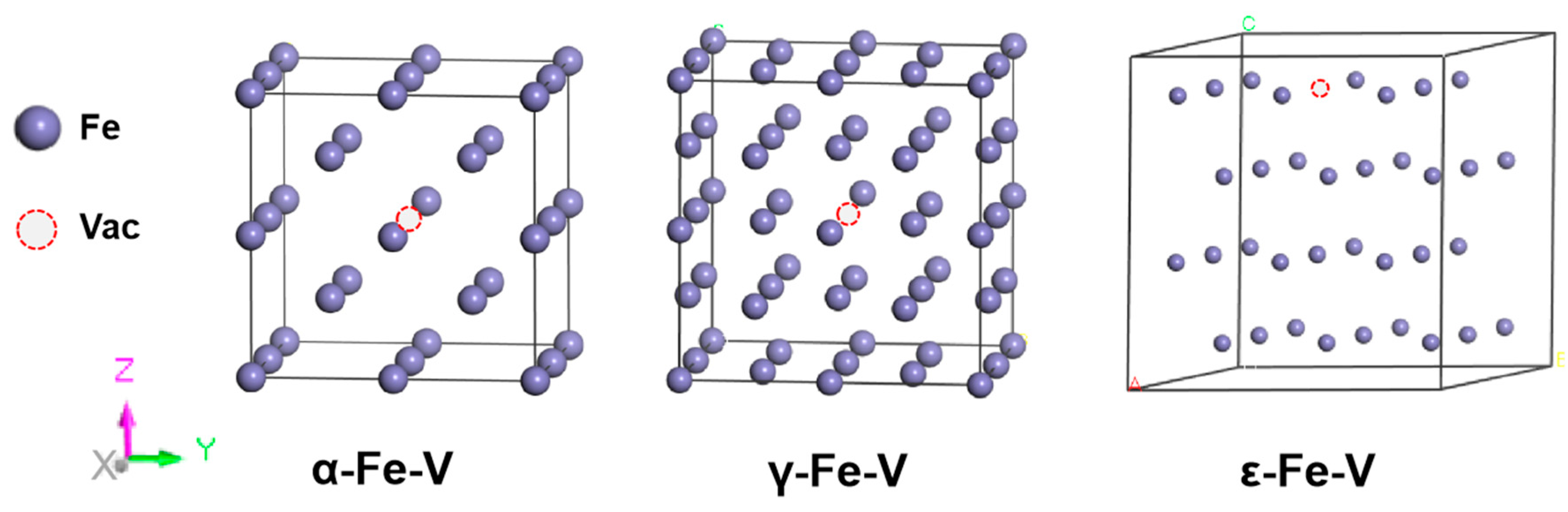
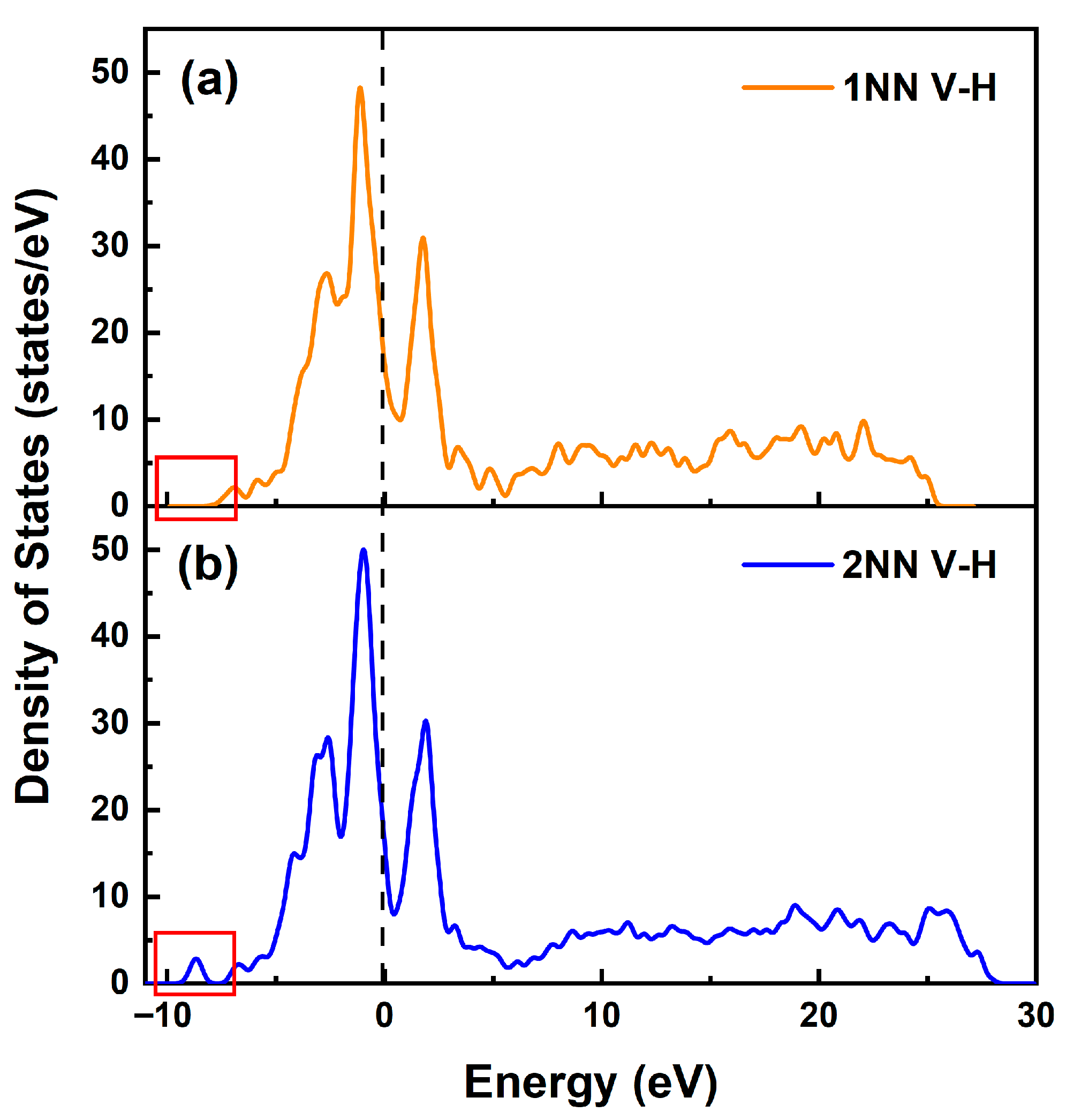
- Analysis of the solution energies and electronic density of states reveals distinct hydrogen occupancy preferences across Fe crystal lattices: Hydrogen atoms preferentially occupy tetrahedral interstitial sites (T) in α-Fe crystals but preferentially occupy octahedral sites (O) in both γ-Fe and ε-Fe crystals.
- (2)
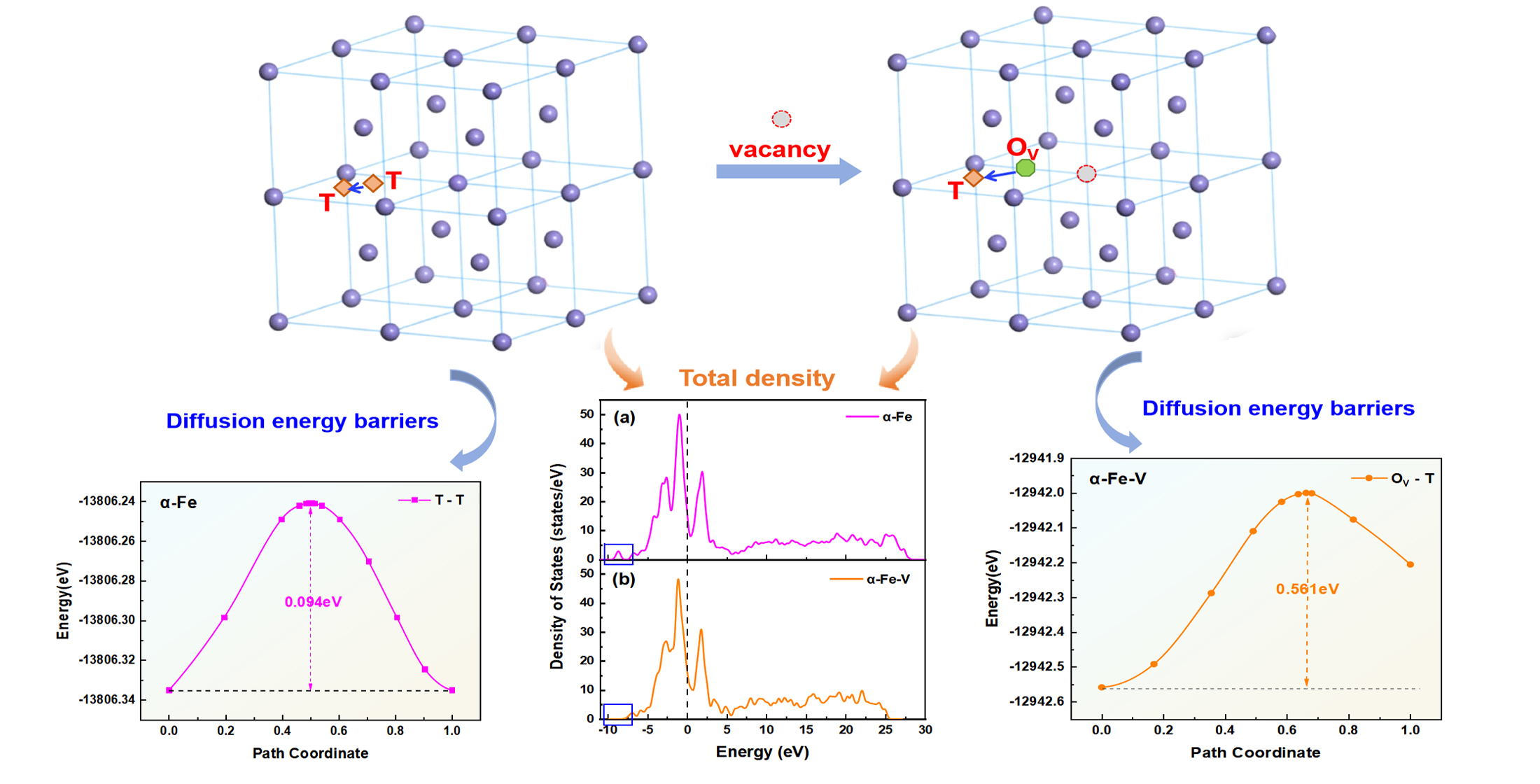
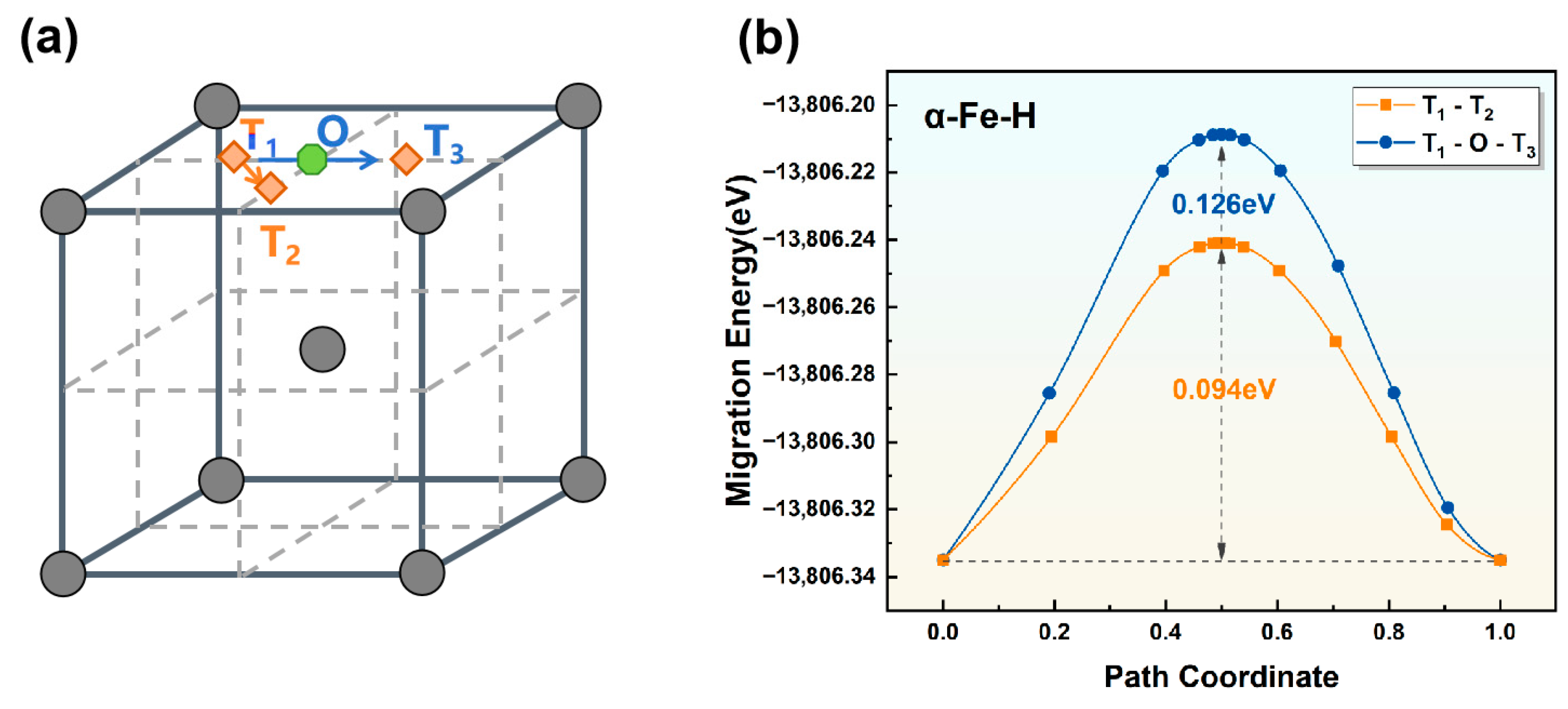
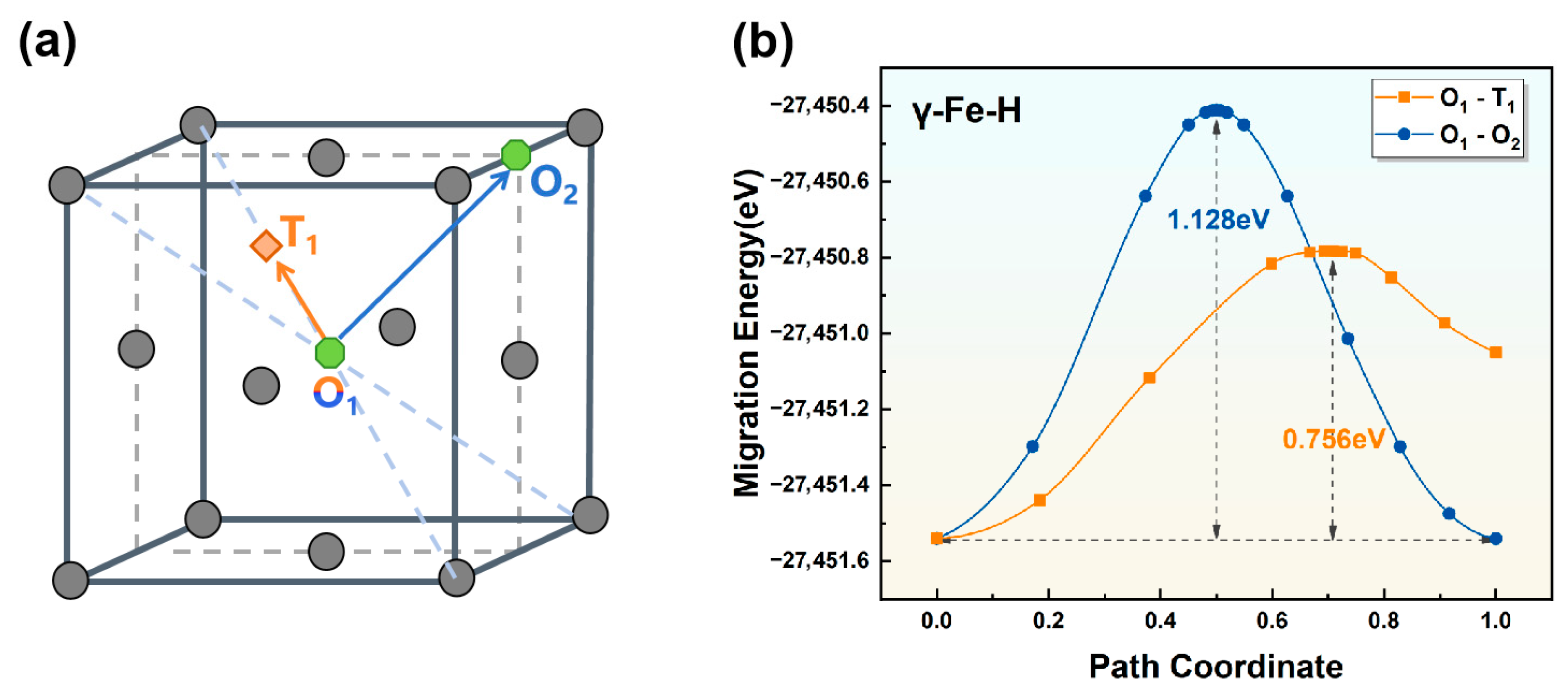
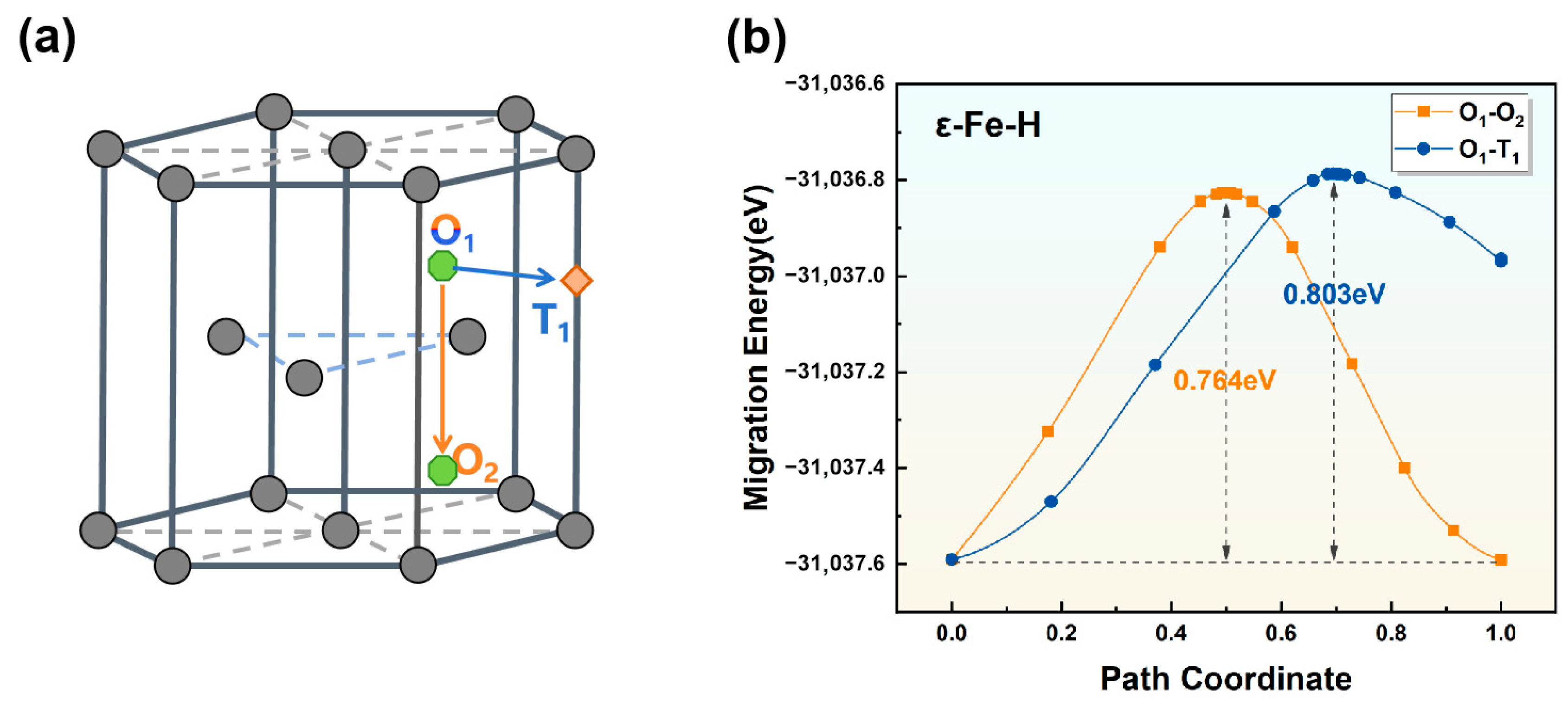
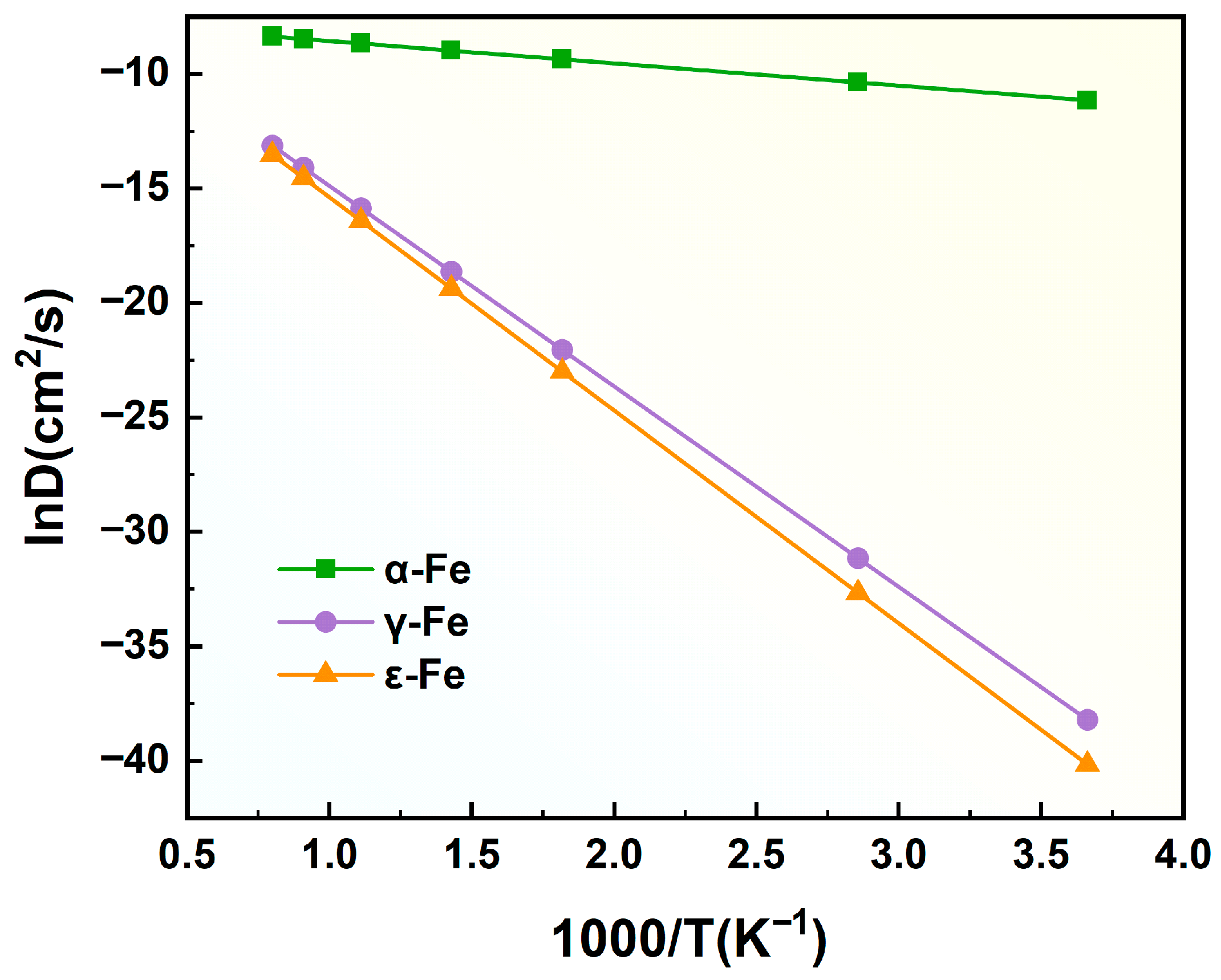
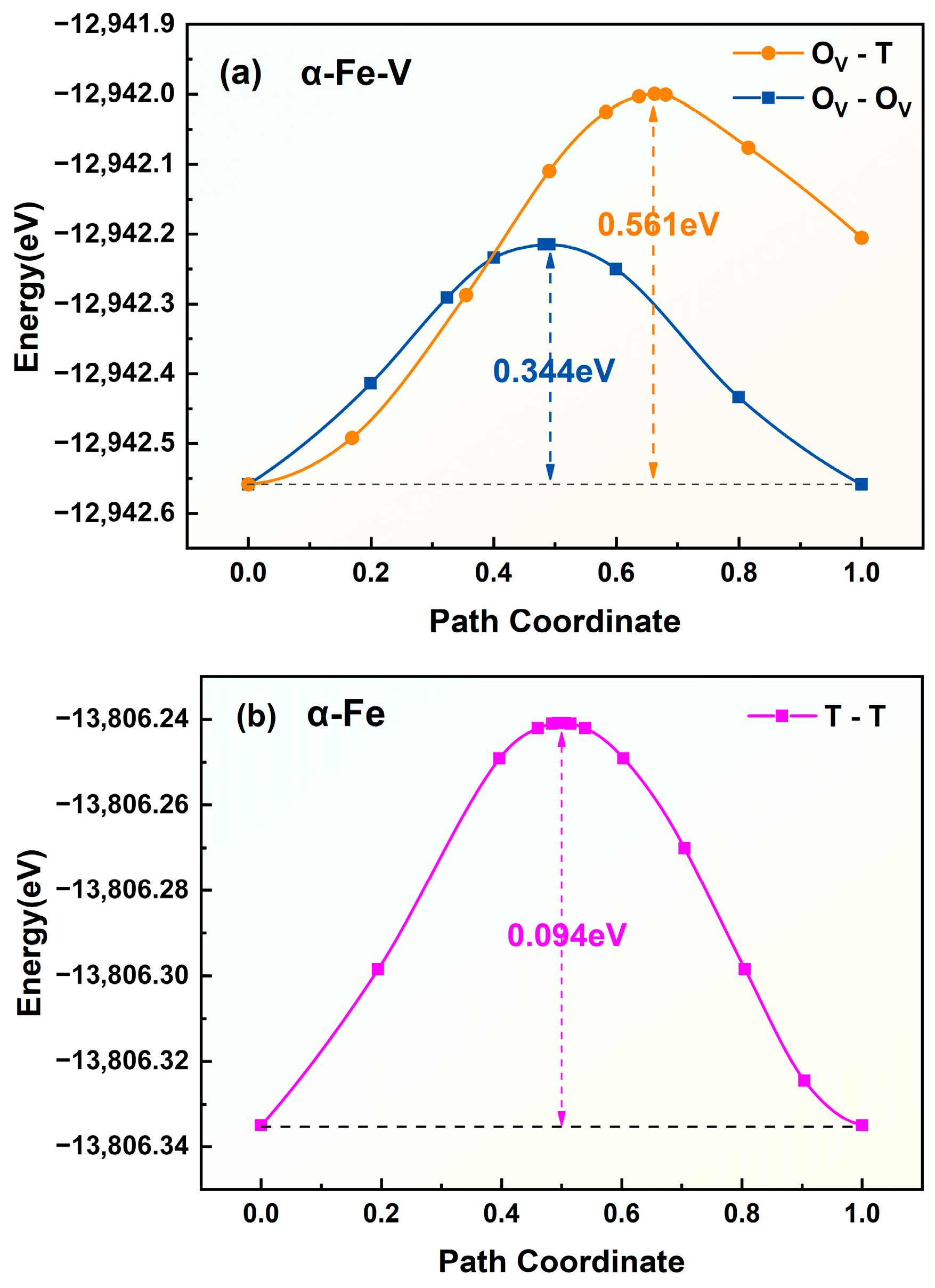
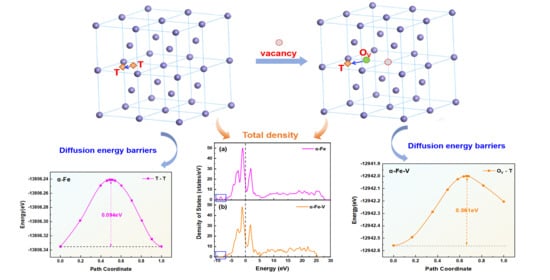
- In the α-Fe crystal, hydrogen preferentially diffuses via the T-T pathway with an energy barrier of 0.094 eV and an activation energy of 9.057 kJ/mol. For the γ-Fe crystal, overcoming a substantially higher barrier of 0.756 eV and an activation energy of 72.842 kJ/mol is needed. In the ε-Fe crystal, hydrogen primarily migrates through the O-O pathway with a 0.764 eV barrier and an activation energy of 73.612 kJ/mol. These results demonstrate that hydrogen diffusion is most facile in α-Fe, as evidenced by its significantly lower energy barrier and correspondingly higher diffusion coefficient than those of the other crystalline phases.
- (3)
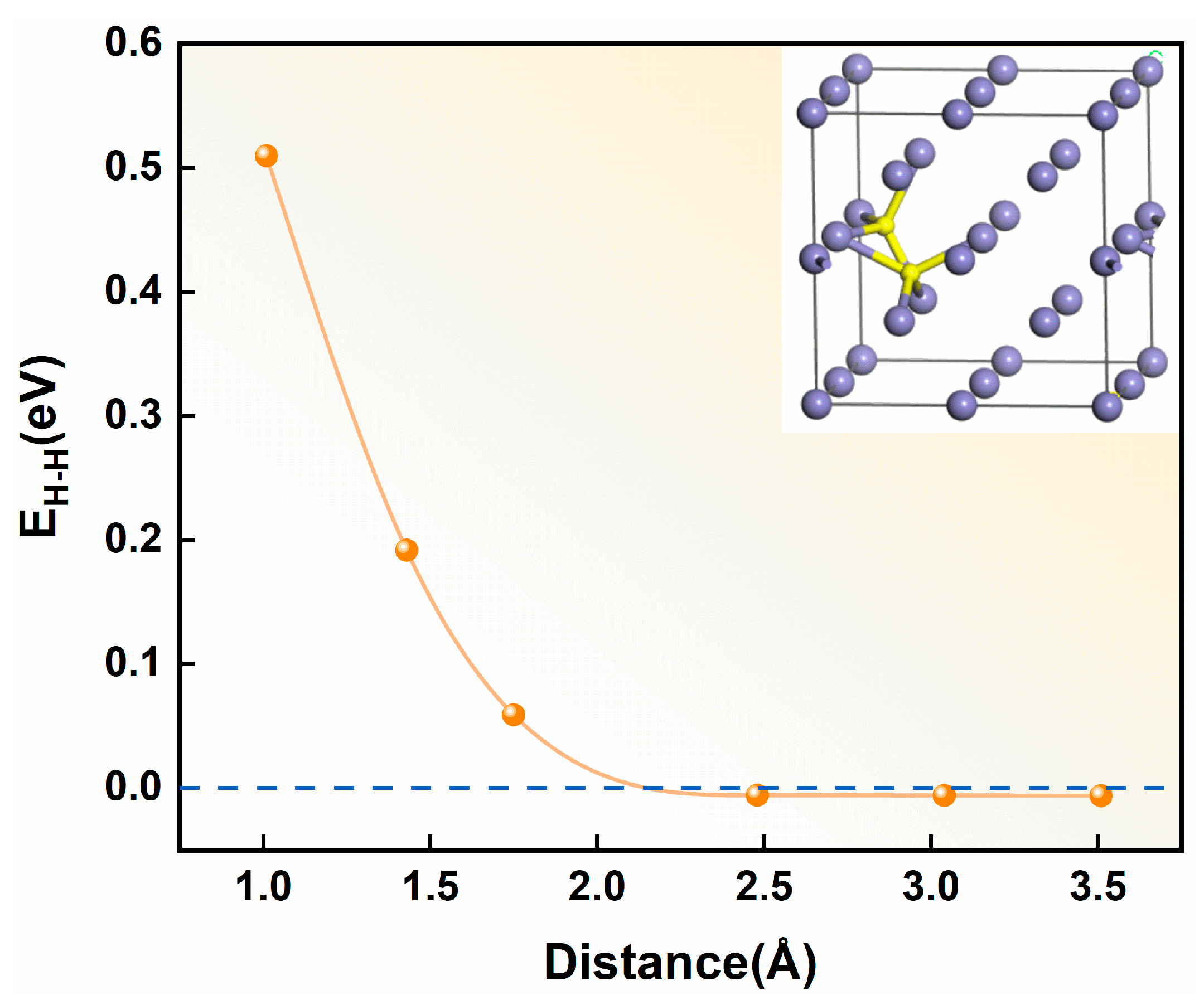
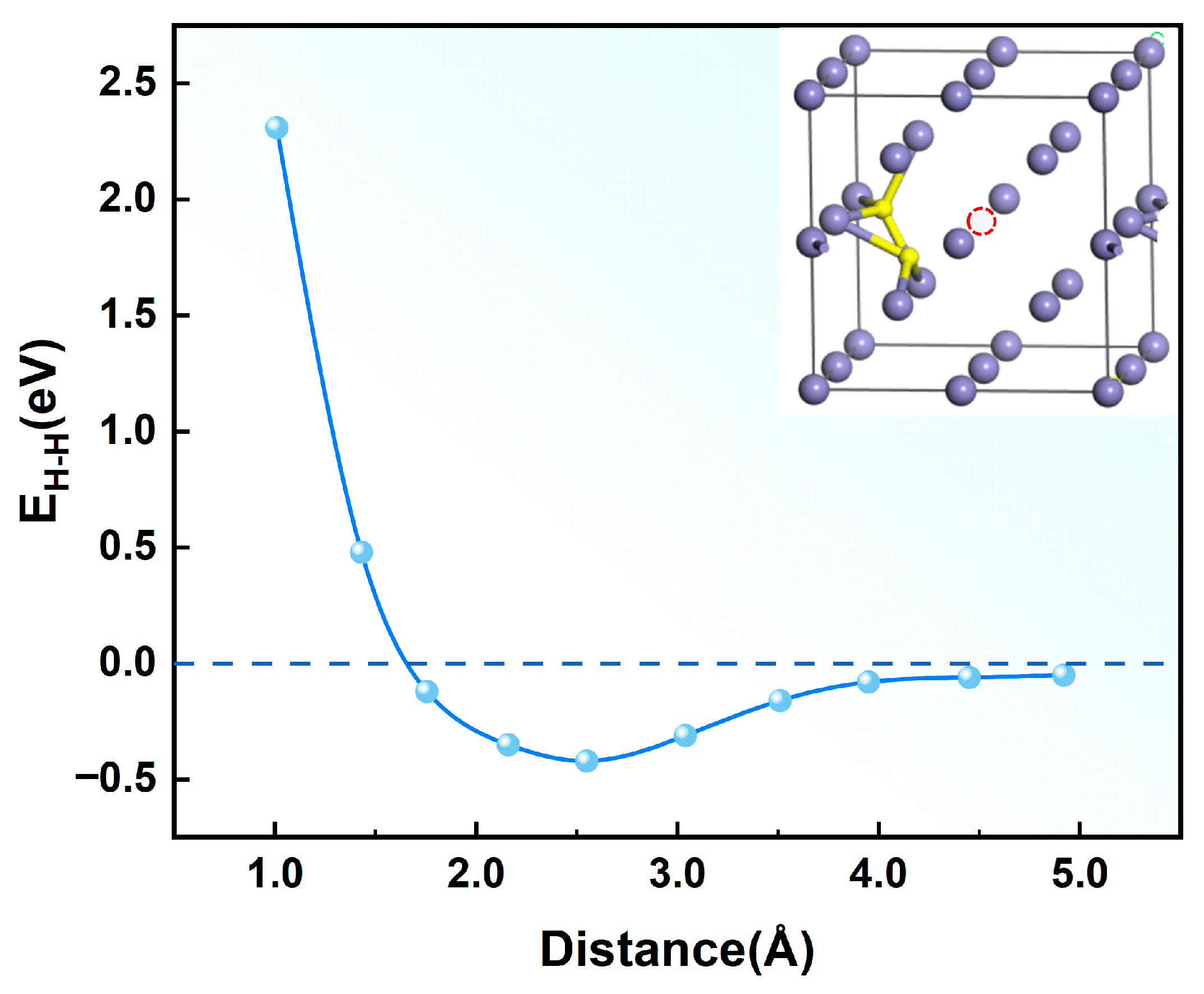
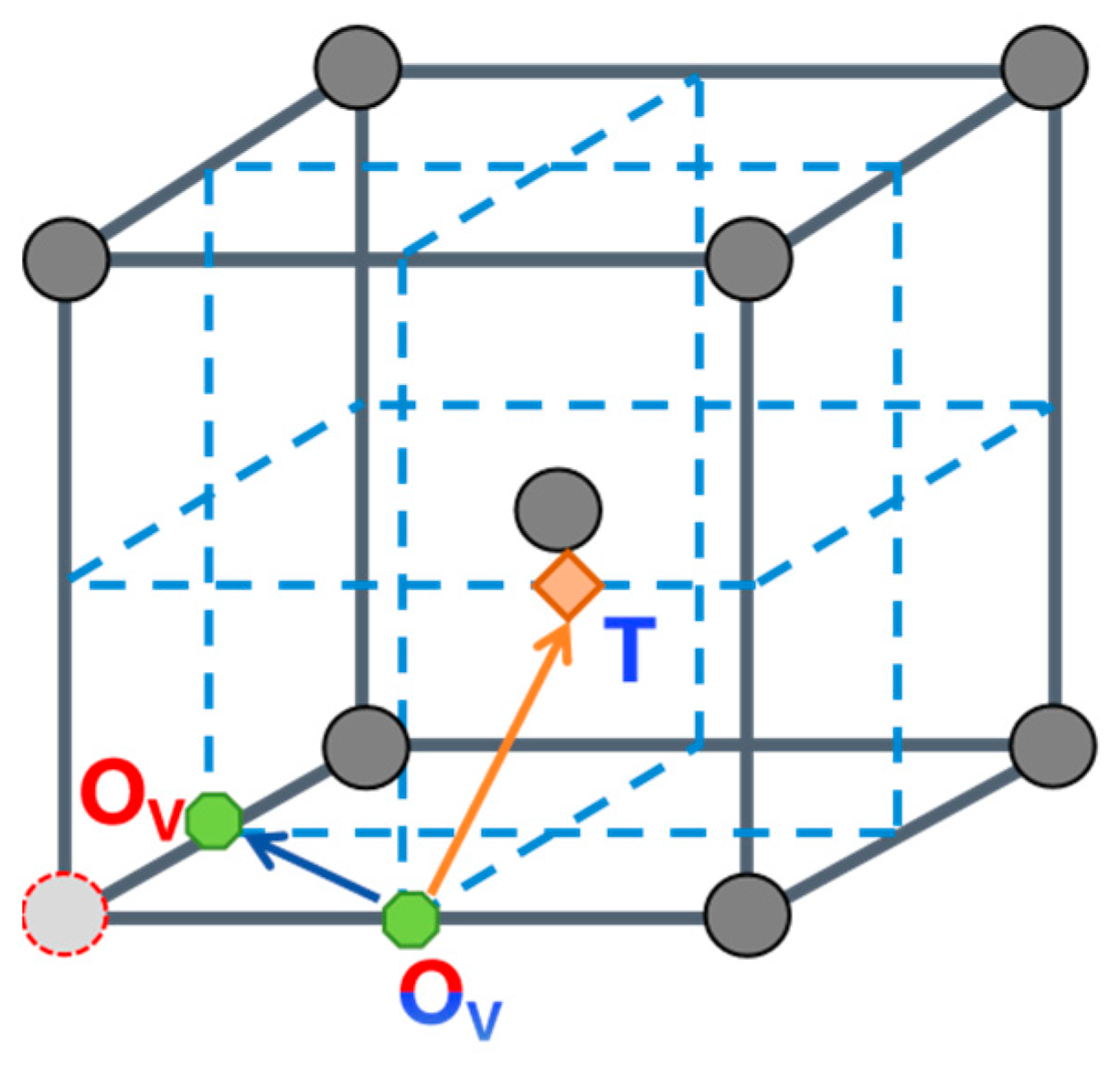
- When the distance between two hydrogen atoms in α-Fe exceeds 2.5 Å, their interaction energy is very low. When the distance is less than 2.5 Å, a significant repulsive force develops between the hydrogen atoms, making it challenging for them to aggregate and form hydrogen gas within intact, defect-free α-Fe. However, the introduction of vacancy defects enhances the attractive forces between hydrogen atoms, thereby facilitating the formation of hydrogen bubbles. Furthermore, vacancy defects alter the preferential occupation sites and diffusion pathways of hydrogen atoms in Fe crystals. Instead of residing at the interstitial centers, hydrogen atoms are positioned at locations slightly shifted toward the vacancies. Additionally, hydrogen atoms must overcome higher diffusion energy barriers to escape the trapping effect of vacancies and diffuse into the defect-free crystal.
Author Contributions
Funding
Data Availability Statement
Conflicts of Interest
References
- Dong, L.; Wang, S.; Wu, G.; Gao, J.; Zhou, X.; Wu, H.-H.; Mao, X. Application of Atomic Simulation for Studying Hydrogen Embrittlement Phenomena and Mechanism in Iron-Based Alloys. Int. J. Hydrogen Energy 2022, 47, 20288–20309. [Google Scholar] [CrossRef]
- Sun, Q.; He, J.; Nagao, A.; Ni, Y.; Wang, S. Hydrogen-Prompted Heterogeneous Development of Dislocation Structure in Ni. Acta Mater. 2023, 246, 118660. [Google Scholar] [CrossRef]
- Evro, S.; Oni, B.A.; Tomomewo, O.S. Carbon Neutrality and Hydrogen Energy Systems. Int. J. Hydrogen Energy 2024, 78, 1449–1467. [Google Scholar] [CrossRef]
- Xiao, X.; Ma, Q.; Kong, Y.; Lian, H.; Han, J.; Gao, Y. An Experimental and Numerical Investigation on Enhancing the Ballistic Resistance of 316L Stainless Steel Plates Against Blunt Projectiles by Covering with 2024-T351 Aluminum Alloy Thin Plates. Materials 2025, 18, 4264. [Google Scholar] [CrossRef]
- Sun, B.; Zhao, H.; Dong, X.; Teng, C.; Zhang, A.; Kong, S.; Zhou, J.; Zhang, X.-C.; Tu, S.-T. Current Challenges in the Utilization of Hydrogen Energy—A Focused Review on the Issue of Hydrogen-Induced Damage and Embrittlement. Adv. Appl. Energy 2024, 14, 100168. [Google Scholar] [CrossRef]
- Eliaz, N.; Banks-Sills, L.; Ashkenazi, D.; Eliasi, R. Modeling Failure of Metallic Glasses Due to Hydrogen Embrittlement in the Absence of External Loads. Acta Mater. 2004, 52, 93–105. [Google Scholar] [CrossRef]
- Lynch, S. Hydrogen Embrittlement Phenomena and Mechanisms. Corros. Rev. 2012, 30, 105–123. [Google Scholar] [CrossRef]
- Li, Q.; Ghadiani, H.; Jalilvand, V.; Alam, T.; Farhat, Z.; Islam, M.A. Hydrogen Impact: A Review on Diffusibility, Embrittlement Mechanisms, and Characterization. Materials 2024, 17, 965. [Google Scholar] [CrossRef] [PubMed]
- Hatano, M.; Fujinami, M.; Arai, K.; Fujii, H.; Nagumo, M. Hydrogen Embrittlement of Austenitic Stainless Steels Revealed by Deformation Microstructures and Strain-Induced Creation of Vacancies. Acta Mater. 2014, 67, 342–353. [Google Scholar] [CrossRef]
- Qiao, L.J.; Wang, Y.B.; Chu, W.Y. Stress Corrosion Mechanism; Science Press: Beijing, China, 1993. [Google Scholar]
- Park, G.T.; Koh, S.U.; Jung, H.G.; Kim, K.Y. Effect of Microstructure on the Hydrogen Trapping Efficiency and Hydrogen Induced Cracking of Linepipe Steel. Corros. Sci. 2008, 50, 1865–1871. [Google Scholar] [CrossRef]
- He, Y.; Li, Y.; Chen, C.; Yu, H. Diffusion Coefficient of Hydrogen Interstitial Atom in α-Fe, γ-Fe and ε-Fe Crystals by First-Principle Calculations. Int. J. Hydrogen Energy 2017, 42, 27438–27445. [Google Scholar] [CrossRef]
- He, Y.; Su, Y.; Yu, H.; Chen, C. First-Principles Study of Hydrogen Trapping and Diffusion at Grain Boundaries in γ-Fe. Int. J. Hydrogen Energy 2021, 46, 7589–7600. [Google Scholar] [CrossRef]
- Sanchez, J.; Fullea, J.; Andrade, M.C.; de Andres, P.L. Ab Initio Molecular Dynamics Simulation of Hydrogen Diffusion in α-Iron. Phys. Rev. B 2010, 81, 132102. [Google Scholar] [CrossRef]
- Jiang, D.E. Diffusion of Interstitial Hydrogen into and through Bcc Fe from First Principles. Phys. Rev. B 2004, 70, 064102. [Google Scholar] [CrossRef]
- Lu, T.; Niu, G.-J.; Xu, Y.; Wang, J.; An, Z.; Liu, H.; Zhou, H.; Ding, F.; Luo, G.-N.; Li, X.-C. Molecular Dynamics Study of the Diffusion Properties of H in Fe with Point Defects. Fusion Eng. Des. 2016, 113, 340–345. [Google Scholar] [CrossRef]
- Xiao, J.; Zeng, X.; Zhao, H.; Zhang, X. First-Principles Study on the Crystal Structure Stability and Hydrogen Storage Mechanism of Hydrogen Occupancy in Interstitial Sites in ZrCo Compounds. Mater. Today Commun. 2022, 33, 104896. [Google Scholar] [CrossRef]
- Segall, M.D.; Lindan, P.J.D.; Probert, M.J.; Pickard, C.J.; Hasnip, P.J.; Clark, S.J.; Payne, M.C. First-Principles Simulation: Ideas, Illustrations and the CASTEP Code. J. Phys. Condens. Matter 2002, 14, 2717. [Google Scholar] [CrossRef]
- Perdew, J.P.; Burke, K.; Ernzerhof, M. Generalized Gradient Approximation Made Simple. Phys. Rev. Lett. 1996, 77, 3865–3868. [Google Scholar] [CrossRef] [PubMed]
- Rauch, T.; Marques, M.A.L.; Botti, S. Electronic Structure of Molecules, Surfaces, and Molecules on Surfaces with the Local Modified Becke–Johnson Exchange–Correlation Potential. J. Chem. Theory Comput. 2021, 17, 4746–4755. [Google Scholar] [CrossRef] [PubMed]
- Monkhorst, H.J.; Pack, J.D. Special Points for Brillouin-Zone Integrations. Phys. Rev. B 1976, 13, 5188–5192. [Google Scholar] [CrossRef]
- Broyden, C.G. The Convergence of a Class of Double-Rank Minimization Algorithms: 2. The New Algorithm. IMA J. Appl. Math. 1970, 6, 222–231. [Google Scholar] [CrossRef]
- Halgren, T.A.; Lipscomb, W.N. The Synchronous-Transit Method for Determining Reaction Pathways and Locating Molecular Transition States. Chem. Phys. Lett. 1977, 49, 225–232. [Google Scholar] [CrossRef]
- Xing, B.; Gao, R.; Wu, M.; Wei, H.; Chi, S.; Hua, Z. Differentiation on Crystallographic Orientation Dependence of Hydrogen Diffusion in α-Fe and γ-Fe: DFT Calculation Combined with SKPFM Analysis. Appl. Surf. Sci. 2023, 615, 156395. [Google Scholar] [CrossRef]
- Echeverri Restrepo, S.; Di Stefano, D.; Mrovec, M.; Paxton, A.T. Density Functional Theory Calculations of Iron—Vanadium Carbide Interfaces and the Effect of Hydrogen. Int. J. Hydrogen Energy 2020, 45, 2382–2389. [Google Scholar] [CrossRef]
- Hung, A.; Yarovsky, I.; Muscat, J.; Russo, S.; Snook, I.; Watts, R.O. First-Principles Study of Metallic Iron Interfaces. Surf. Sci. 2002, 501, 261–269. [Google Scholar] [CrossRef]
- Ridley, N.; Stuart, H. Lattice Parameter Anomalies at the Curie Point of Pure Iron. J. Phys. D Appl. Phys. 1968, 1, 1291. [Google Scholar] [CrossRef]
- Li, Y.; He, Y.; Liu, S.; Wang, Y.; Ma, X. First-Principles Study the Effect of Hydrogen Atoms on the Generalized Stacking Fault Energy in γ-Fe. Int. J. Hydrogen Energy 2024, 82, 1446–1454. [Google Scholar] [CrossRef]
- Dyson, D.J.; Holmes, B. Effect of Alloying Additions on the Lattice Parameter of Austenite. J. Iron Steel Inst. 1970, 208, 469–474. [Google Scholar]
- Sha, X.; Cohen, R.E. Thermal Effects on Lattice Strain in ε-Fe under Pressure. Phys. Rev. B 2006, 74, 064103. [Google Scholar] [CrossRef]
- Boi, F.S.; Qiu, Z.; Dong, Q.; Wu, J. Possible Confinement of Hcp ε-Fe Martensite, Atomic-Shuffling, Stacking-Fault Nucleation and Large-Coercivities in Fe-Filled Multiwall Carbon Nanotubes. Carbon 2026, 246, 120932. [Google Scholar] [CrossRef]
- Wang, J.; Enomoto, M.; Shang, C. First-Principles Study on the P-Induced Embrittlement and de-Embrittling Effect of B and C in Ferritic Steels. Acta Mater. 2021, 219, 117260. [Google Scholar] [CrossRef]
- Mitsuhara, A.; Yukawa, H.; Kimizuka, H. First-Principles Thermodynamic Modeling of Hydrogen Dissolution in Metals. Acta Mater. 2025, 289, 120838. [Google Scholar] [CrossRef]
- Wert, C.; Zener, C. Interstitial Atomic Diffusion Coefficients. Phys. Rev. 1949, 76, 1169–1175. [Google Scholar] [CrossRef]
- Fu, Y.; Li, T.; Yan, Y.-B.; Wang, X.-Y.; Zhu, M.-L.; Xuan, F.-Z. A First Principles Study on H-Atom Interaction with Bcc Metals. Int. J. Hydrogen Energy 2023, 48, 9911–9920. [Google Scholar] [CrossRef]
- Li, Y.; Wei, H.; Zheng, S.; Kong, J.; Wen, L.; Yuan, Q.; Liu, Y.; Shen, Y.; Zhang, Y.; Wu, H.; et al. Hydrogen Adsorption and Diffusion on the Surface of Alloyed Steel: First-Principles Studies. Int. J. Hydrogen Energy 2024, 54, 1478–1486. [Google Scholar] [CrossRef]
- Chohan, U.K.; Koehler, S.P.K.; Jimenez-Melero, E. Diffusion of Hydrogen into and through γ-Iron by Density Functional Theory. Surf. Sci. 2018, 672–673, 56–61. [Google Scholar] [CrossRef]
- Oriani, R.A.; Hirth, J.P.; Smialowski, M. Hydrogen Degradation of Ferrous Alloys. MRS Bulletin 1986, 11, 3. [Google Scholar] [CrossRef]
- Yokobori, A.T.; Chinda, Y.; Nemoto, T.; Satoh, K.; Yamada, T. The Characteristics of Hydrogen Diffusion and Concentration around a Crack Tip Concerned with Hydrogen Embrittlement. Corros. Sci. 2002, 44, 407–424. [Google Scholar] [CrossRef]
- Shivanyuk, V.N.; Foct, J.; Gavriljuk, V.G. On a Role of Hydrogen-Induced ε-Martensite in Embrittlement of Stable Austenitic Steel. Scr. Mater. 2003, 49, 601–606. [Google Scholar] [CrossRef]
- Koyama, M.; Abe, Y.; Saito, K.; Akiyama, E.; Takai, K.; Tsuzaki, K. Martensitic Transformation-Induced Hydrogen Desorption Characterized by Utilizing Cryogenic Thermal Desorption Spectroscopy during Cooling. Scr. Mater. 2016, 122, 50–53. [Google Scholar] [CrossRef]
- Hayward, E.; Fu, C.-C. Interplay between Hydrogen and Vacancies in α-Fe. Phys. Rev. B 2013, 87, 174103. [Google Scholar] [CrossRef]
- Somenkov, V.A.; Irodova, A.V. Lattice Structure and Phase Transitions of Hydrogen in Intermetallic Compounds. J. Less Common Met. 1984, 101, 481–492. [Google Scholar] [CrossRef]
- Qin, S.-Y.; Jin, S.; Sun, L.; Zhou, H.-B.; Zhang, Y.; Lu, G.-H. Hydrogen Assisted Vacancy Formation in Tungsten: A First-Principles Investigation. J. Nucl. Mater. 2015, 465, 135–141. [Google Scholar] [CrossRef]
- Liu, Y.-L.; Zhang, Y.; Zhou, H.-B.; Lu, G.-H.; Liu, F.; Luo, G.-N. Vacancy Trapping Mechanism for Hydrogen Bubble Formation in Metal. Phys. Rev. B 2009, 79, 172103. [Google Scholar] [CrossRef]
- Takai, K.; Shoda, H.; Suzuki, H.; Nagumo, M. Lattice Defects Dominating Hydrogen-Related Failure of Metals. Acta Mater. 2008, 56, 5158–5167. [Google Scholar] [CrossRef]
- Zhang, P.; Zhang, C.; Li, R.; Zhao, J. He-Induced Vacancy Formation in Bcc Fe Solid from First-Principles Simulation. J. Nucl. Mater. 2014, 444, 147–152. [Google Scholar] [CrossRef]
- Ohnuma, T.; Soneda, N.; Iwasawa, M. First-Principles Calculations of Vacancy-Solute Element Interactions in Body-Centered Cubic Iron. Acta Mater. 2009, 57, 5947–5955. [Google Scholar] [CrossRef]
- De Schepper, L.; Segers, D.; Dorikens-Vanpraet, L.; Dorikens, M.; Knuyt, G.; Stals, L.M.; Moser, P. Positron Annihilation on Pure and Carbon-Doped α-Iron in Thermal Equilibrium. Phys. Rev. B 1983, 27, 5257–5269. [Google Scholar] [CrossRef]
- Qiu, X.; Zhang, K.; Kang, Q.; Fan, Y.; San, H.; Chen, Y.; Zhao, H. Investigation of Hydrogen Diffusion Behavior in 12Cr2Mo1R(H) Steel by Electrochemical Tests and First-Principles Calculation. Anti-Corros. Methods Mater. 2021, 69, 17–28. [Google Scholar] [CrossRef]



| Space Group | Present | Theory | Experiment | |
|---|---|---|---|---|
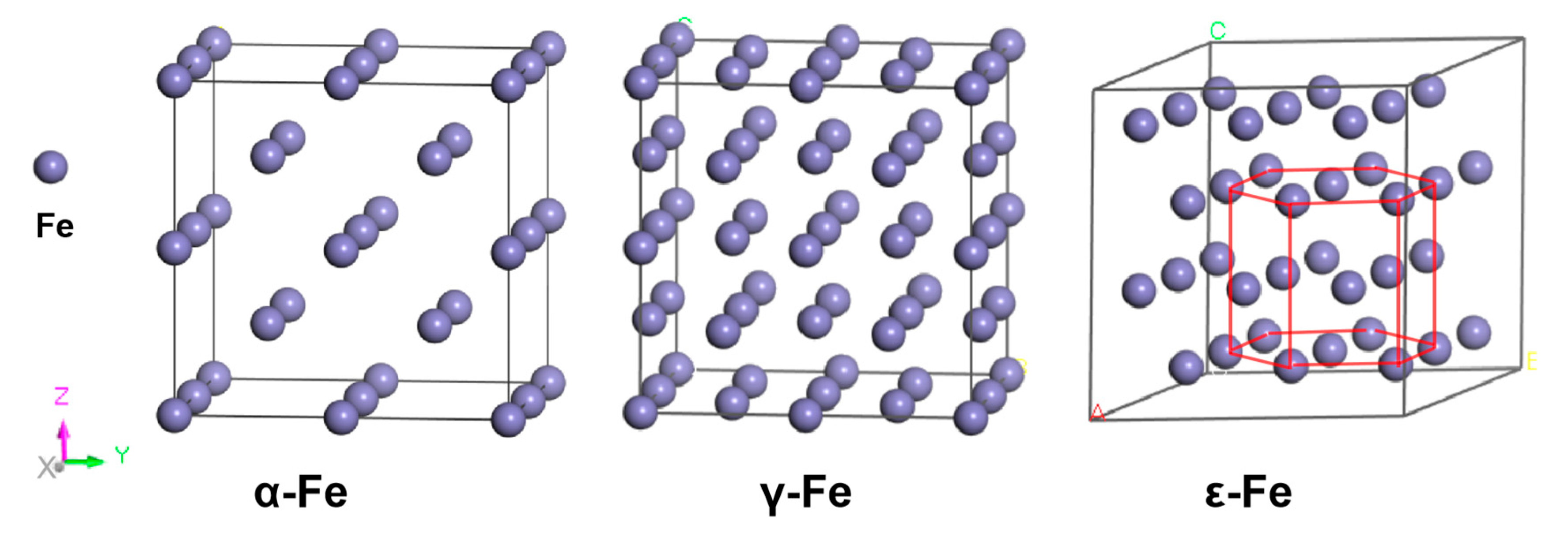
| α-Fe | Im-3m | a = b = c = 2.851 Å | a = b = c = 2.836 Å [25] a = b = c = 2.869 Å [26] | a = b = c = 2.866 Å [27] |
| γ-Fe | Fm-3m | a = b = c = 3.456 Å | a = b = c = 3.44 Å [28] a = b = c = 3.56 Å [24] | a = b = c = 3.56 Å [29] |
| ε-Fe | P63/mmc | a = b = 2.46 Å, c/a = 1.581 | a = b = 2.45 Å, c/a = 1.585 [30] | a = b = 2.46 Å, c/a = 1.598 [31] |
| Unit Cell Type | Diffusion Path | Diffusion Barrier | Jump Distance (Å) | Vibrational Frequency | Diffusion Activation Energy |
|---|---|---|---|---|---|
| α-Fe | Pathway (i): T1-T2 | 0.094 | 1.43 | 9.06 | |
| Pathway (ii): T1-O-T3 | 0.126 | 1.01 | 12.24 | ||
| γ-Fe | Pathway (i): O1-T1 | 0.756 | 2.03 | 72.84 | |
| Pathway (ii): O1-O2 | 1.128 | 1.24 | 108.69 | ||
| ε-Fe | Pathway (i): O1-O2 | 0.764 | 1.94 | 73.61 | |
| Pathway (ii): O1-T1 | 0.803 | 1.49 | 77.37 |
Disclaimer/Publisher’s Note: The statements, opinions and data contained in all publications are solely those of the individual author(s) and contributor(s) and not of MDPI and/or the editor(s). MDPI and/or the editor(s) disclaim responsibility for any injury to people or property resulting from any ideas, methods, instructions or products referred to in the content. |
© 2026 by the authors. Licensee MDPI, Basel, Switzerland. This article is an open access article distributed under the terms and conditions of the Creative Commons Attribution (CC BY) license.
Share and Cite
Feng, Y.; He, M.; Huang, G.; Zhao, W.; Cai, Z.; Zhang, D.; Bao, J. Insights into Hydrogen Diffusion Characteristics and Interactions with Vacancy in Fe Crystal Lattices from First-Principles Calculations. Materials 2026, 19, 1175. https://doi.org/10.3390/ma19061175
Feng Y, He M, Huang G, Zhao W, Cai Z, Zhang D, Bao J. Insights into Hydrogen Diffusion Characteristics and Interactions with Vacancy in Fe Crystal Lattices from First-Principles Calculations. Materials. 2026; 19(6):1175. https://doi.org/10.3390/ma19061175
Chicago/Turabian StyleFeng, Yi, Maoqing He, Guangjie Huang, Wenjuan Zhao, Zhihui Cai, Deliang Zhang, and Jianing Bao. 2026. "Insights into Hydrogen Diffusion Characteristics and Interactions with Vacancy in Fe Crystal Lattices from First-Principles Calculations" Materials 19, no. 6: 1175. https://doi.org/10.3390/ma19061175
APA StyleFeng, Y., He, M., Huang, G., Zhao, W., Cai, Z., Zhang, D., & Bao, J. (2026). Insights into Hydrogen Diffusion Characteristics and Interactions with Vacancy in Fe Crystal Lattices from First-Principles Calculations. Materials, 19(6), 1175. https://doi.org/10.3390/ma19061175