Role of Reactive Silica Addition in Enhancing Geopolymerization Efficiency and Strength Development of Calcined Granite Waste


Abstract
1. Introduction
2. Materials and Methods
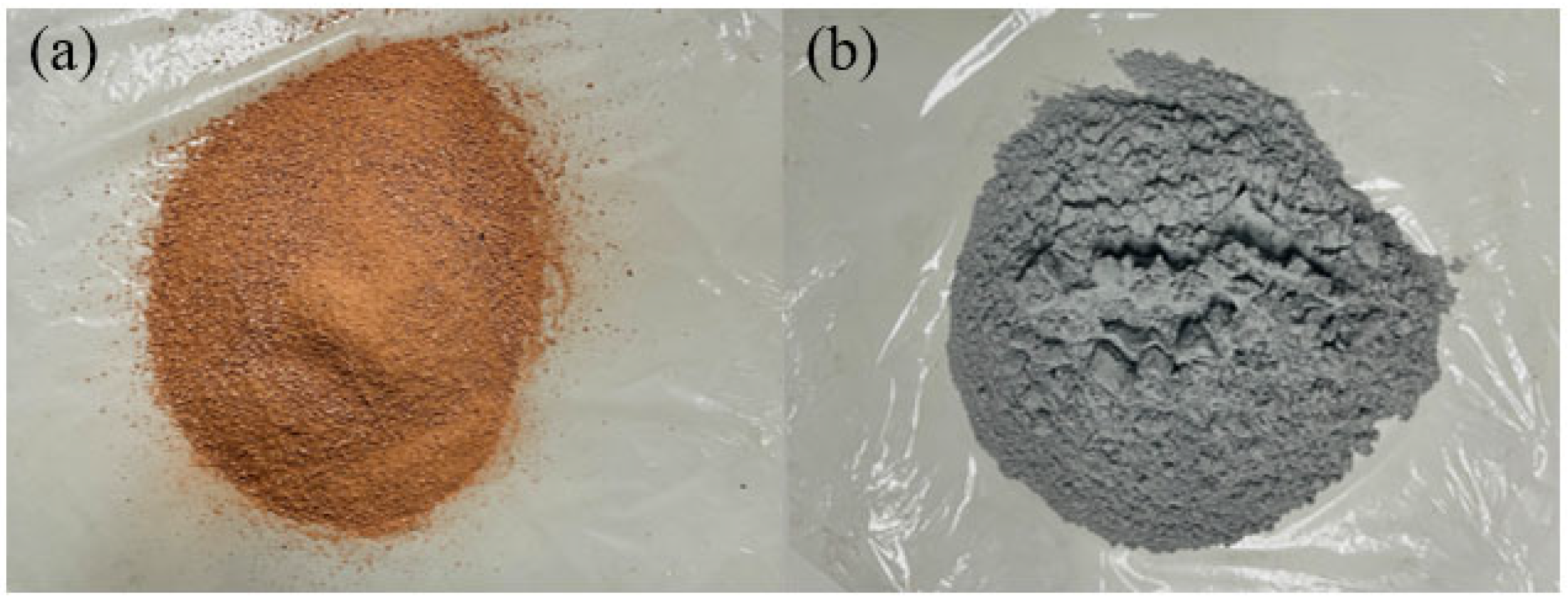
2.1. Materials Preparation
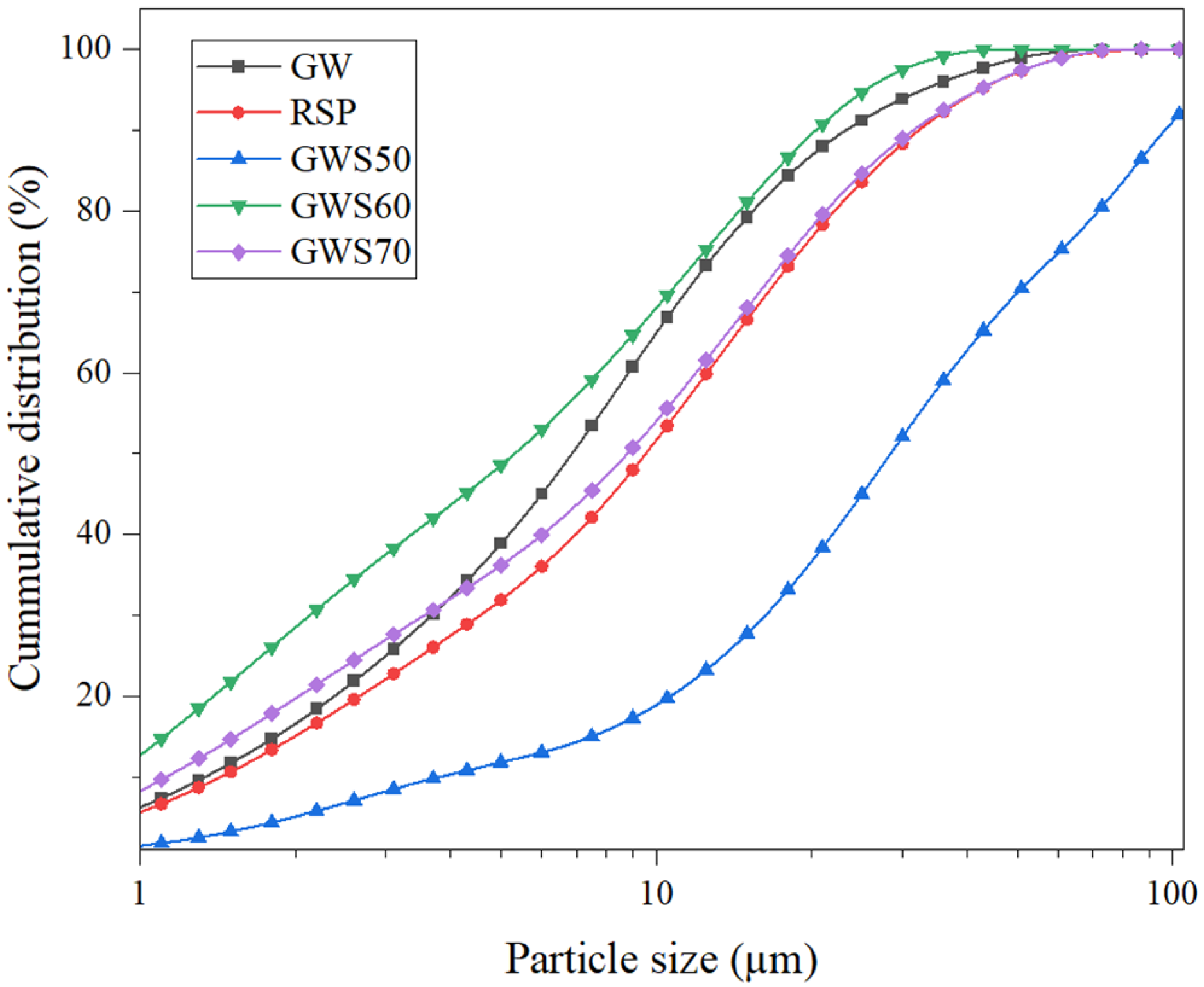
2.2. Particles Size Distribution
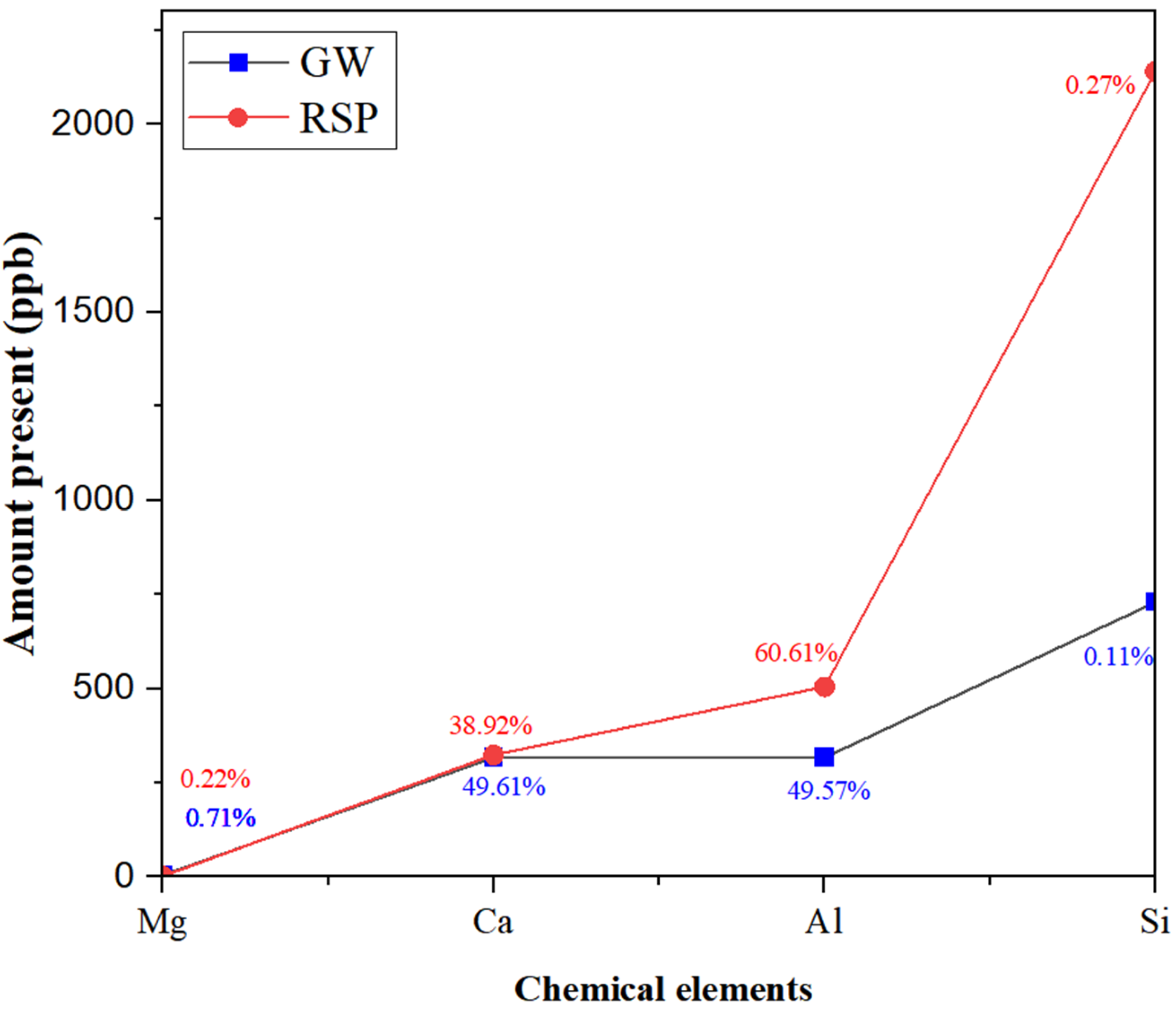
2.3. Element Composition of GW-RSP Reactivity
3. Material Characterization
Mechanical Characterization
4. Results and Discussion
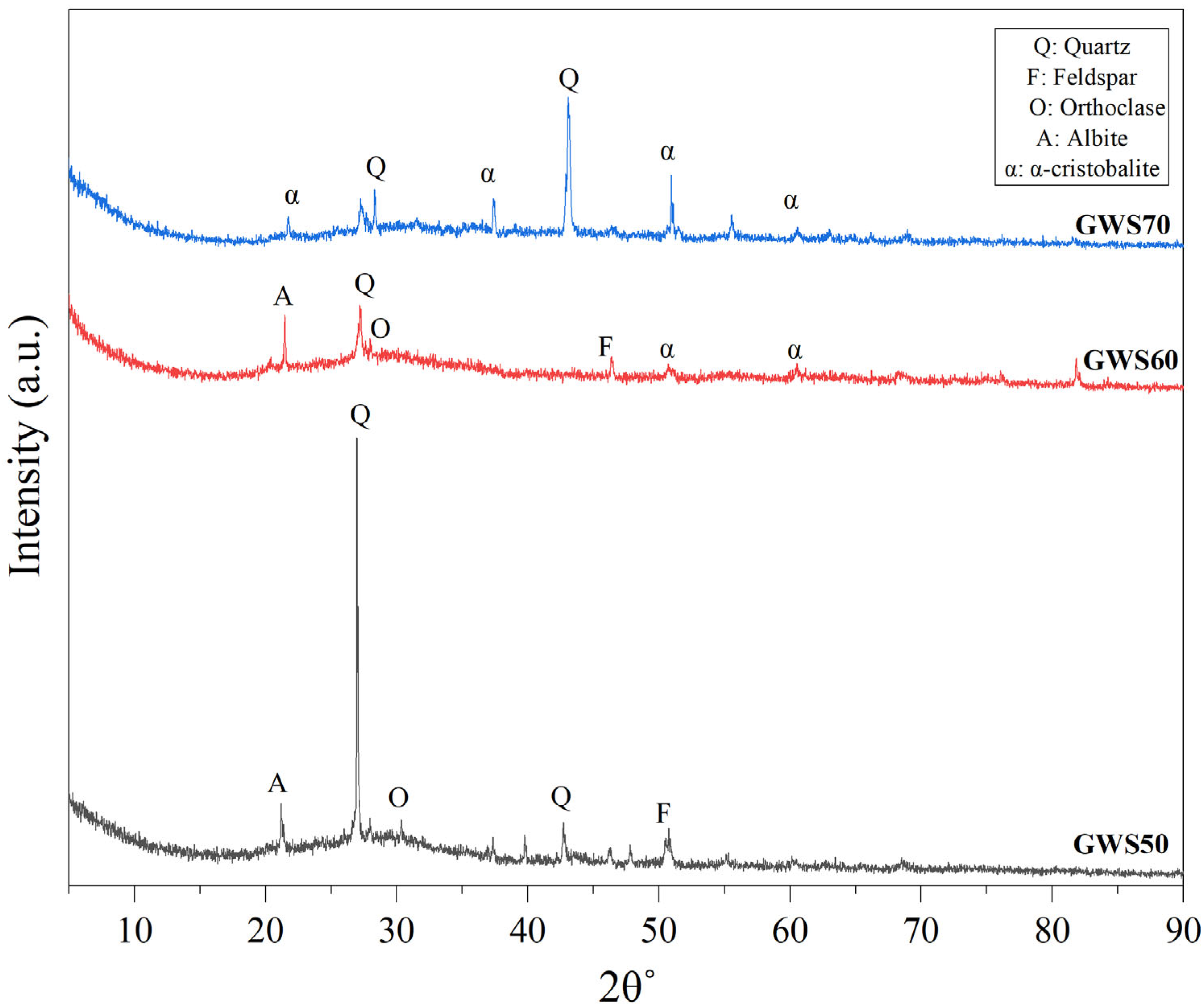
4.1. XRD
4.2. Functional Group Analysis
4.3. SEM Analysis
4.4. Compressive Strength
5. Conclusions
- i.
- ICP-MS analysis confirmed the highly complementary composition of calcined granite waste and reactive silica with balanced Si/Al ratios fulfilling the effective geopolymerization requirements.
- ii.
- XRD patterns of GWS mixes revealed that increasing granite waste content from 50 wt% to wt70% enhanced the degree of geopolymerization and alkali gel formation by amplifying the feldspar peaks (orthoclase and albite), resulting in improved chemical stability. However, the higher GW content compromised the mechanical stability and microstructural integrity in GWS70 due to diminished quartz and α-cristobalite phases, leading to weaker bonding. Optimizing GW content from 50 to 60 wt% with reactive silica offered a balanced, sustainable approach for a high-performance alkali-activated mix.
- iii.
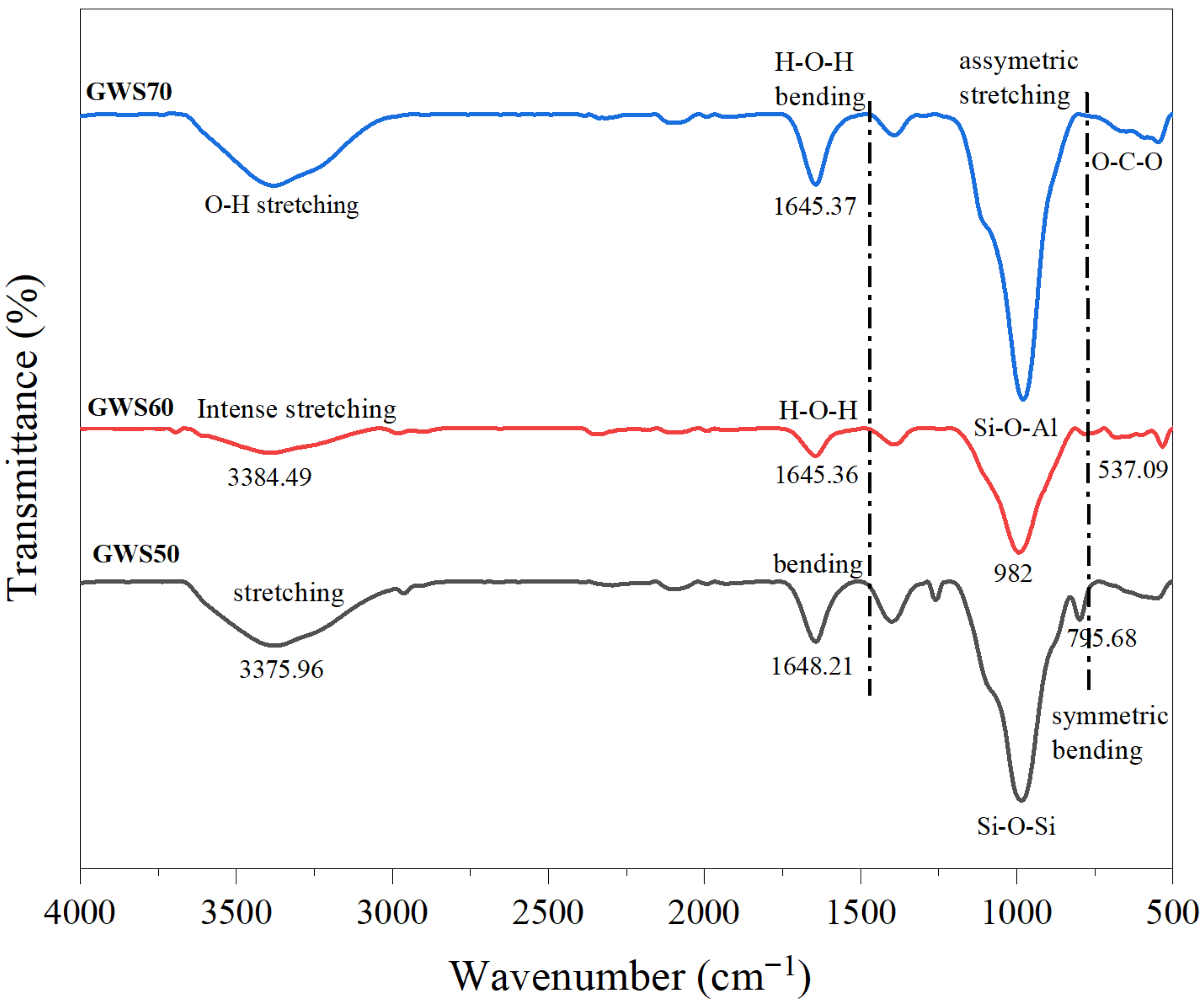
- Functional groups analysis demonstrated that increasing calcined granite waste content significantly weakened Si-O-Si bands while intensifying O-H and H-O-H vibrations, confirming the effect of alkali activators on geopolymerization and shifts in functional groups formation. These alterations transformed the initial silica-rich (GWS50) into highly geopolymerized matrices in GWS60 and GWS70 by increasing chemical reactivity, leading to strong gel formation; however, increased GW content affected the functional performances of GWS mixes noticed from sharp peaks in GWS70.
- iv.
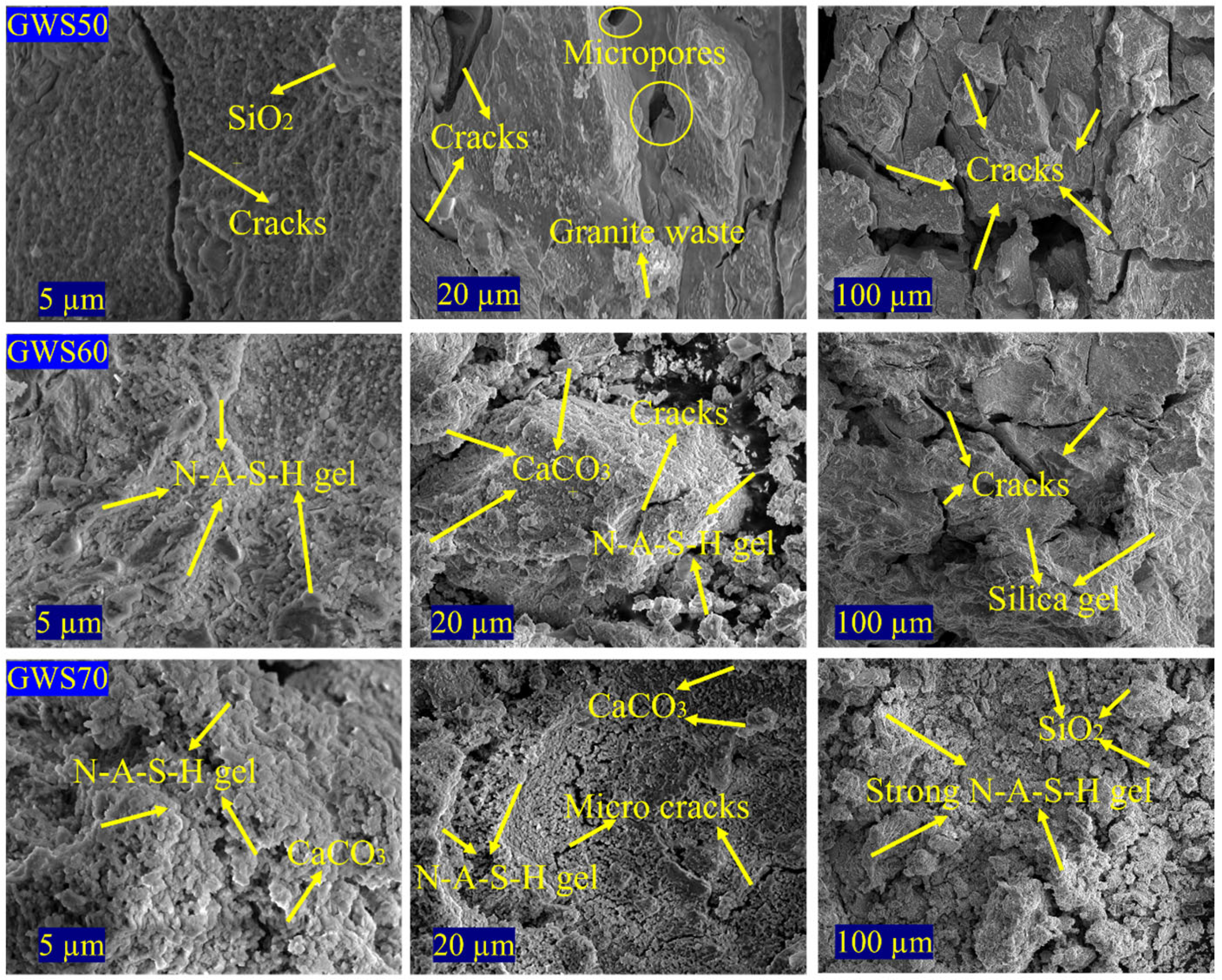
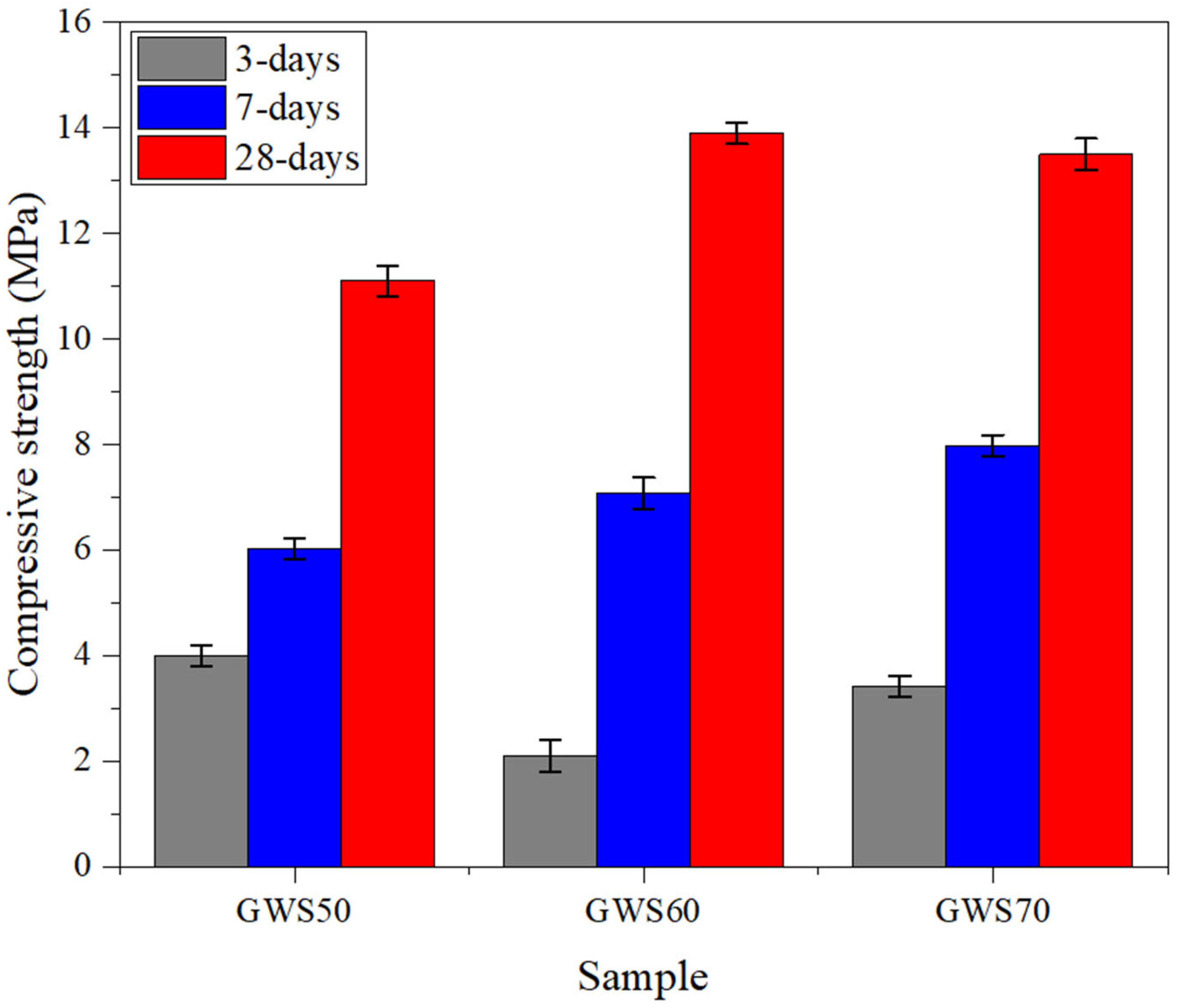
- Compressive strength results showed that GWS60 delivered the highest compressive strength of 14.1 MPa, a 32% increase in strength over GWS50 and GWS70 by achieving the optimal balance of Si/Al ratio promoted the dense N-A-S-H gel formation. GWS50 exhibited faster early strength gain due to excessive reactive silica, while GWS70 exhibited lower strength as compared to GWS60 due to Al/Ca supply effecting the mechanical strength by revealing microcracks on the sample surfaces.
Author Contributions
Funding
Data Availability Statement
Conflicts of Interest
References
- Domke, G.M.; Walters, B.F.; Nowak, D.J.; Smith, J.; Ogle, S.M.; Coulston, J.W.; Wirth, T.C. Greenhouse Gas Emissions and Removals from Forest Land, Woodlands, and Urban Trees in the United States, 1990–2018; Resource Update FS-227; US Department of Agriculture, Forest Service: Madison, WI, USA, 2020; Volume 227, pp. 1–5. [Google Scholar]
- Singh, N.B.; Middendorf, B. Geopolymers as an alternative to Portland cement: An overview. Constr. Build. Mater. 2020, 237, 117455. [Google Scholar] [CrossRef]
- Mehta, P.K.; Monteiro Paulo, J.M. Concrete: Microstructure, Properties, and Materials; Mc Graw Hill: New York, NY, USA, 2014. [Google Scholar]
- Younas, H.; Yu, J.; Leung, C.K.Y. Mechanical and environmental performance of high-strength strain-hardening cementitious composites with high-dosage ternary supplementary cementitious materials: Fly ash, limestone, and calcined clay. Constr. Build. Mater. 2024, 444, 137856. [Google Scholar] [CrossRef]
- Nunes, G.M.; Anjos, M.A.S.; Lins, A.B.S.M.; Negreiros, A.M.S.; Pessoa, L.R. Evaluation of the mechanical behaviour of representative volumetric elements of 3DCP masonry mixtures with partial replacement of cement by limestone filler and metakaolin. J. Build. Eng. 2023, 78, 107650. [Google Scholar] [CrossRef]
- Nazeer, M.; Kapoor, K.; Singh, S.P. Strength, durability and microstructural investigations on pervious concrete made with fly ash and silica fume as supplementary cementitious materials. J. Build. Eng. 2023, 69, 106275. [Google Scholar] [CrossRef]
- Mhaya, A.M.; Fahim Huseien, G.; Faridmehr, I.; Razin Zainal Abidin, A.; Alyousef, R.; Ismail, M. Evaluating mechanical properties and impact resistance of modified concrete containing ground Blast Furnace slag and discarded rubber tire crumbs. Constr. Build. Mater. 2021, 295, 123603. [Google Scholar] [CrossRef]
- Amin, M.N.; Khan, K.; Abu Arab, A.M.; Farooq, F.; Eldin, S.M.; Javed, M.F. Prediction of sustainable concrete utilizing rice husk ash (RHA) as supplementary cementitious material (SCM): Optimization and hyper-tuning. J. Mater. Res. Technol. 2023, 25, 1495–1536. [Google Scholar] [CrossRef]
- Yaseen, N. Exploring the potential of sugarcane bagasse ash as a sustainable supplementary cementitious material: Experimental investigation and statistical analysis. Results Chem. 2024, 10, 101723. [Google Scholar] [CrossRef]
- Shi, C.; Qian, X.; Yin, J.; Gautam, B.; Hu, C. Synergistic performance enhancement of cementitious materials by co-incorporation of waste brick powder and limestone powder. Constr. Build. Mater. 2024, 436, 136893. [Google Scholar] [CrossRef]
- Chen, H.; Yang, J. A new supplementary cementitious material: Walnut shell ash. Constr. Build. Mater. 2023, 408, 133852. [Google Scholar] [CrossRef]
- Dassekpo, J.B.M.; Ning, J.Q.; Zha, X.X. Potential solidification/stabilization of clay-waste using green geopolymer remediation technologies. Process Saf. Environ. Prot. 2018, 117, 684–693. [Google Scholar] [CrossRef]
- Borinaga-Treviño, R.; Cuadrado, J.; Canales, J.; Rojí, E. Lime mud waste from the paper industry as a partial replacement of cement in mortars used on radiant floor heating systems. J. Build. Eng. 2021, 41, 102408. [Google Scholar] [CrossRef]
- Scrivener, K.L.; John, V.M.; Gartner, E.M. Eco-efficient cements: Potential economically viable solutions for a low-CO2 cement-based materials industry. Cem. Concr. Res. 2018, 114, 2–26. [Google Scholar] [CrossRef]
- Sadrmomtazi, A.; Tahmouresi, B.; Saradar, A. Effects of silica fume on mechanical strength and microstructure of basalt fiber reinforced cementitious composites (BFRCC). Constr. Build. Mater. 2018, 162, 321–333. [Google Scholar] [CrossRef]
- Hossain, M.M.; Karim, M.R.; Hasan, M.; Hossain, M.K.; Zain, M.F.M. Durability of mortar and concrete made up of pozzolans as a partial replacement of cement: A review. Constr. Build. Mater. 2016, 116, 128–140. [Google Scholar] [CrossRef]
- Dassekpo, J.B.M.; Miao, L.X.; Bai, J.; Gong, Q.Y.; Shao, N.N.; Dong, Z.J.; Xing, F.; Ye, J.Q. Phase dissolution and improving properties of completely decomposed granite through alkali fusion method. Cem. Concr. Compos. 2022, 127, 104407. [Google Scholar] [CrossRef]
- Lan, H.X.; Hu, R.L.; Yue, Z.Q.; Lee, C.F.; Wang, S.J. Engineering and geological characteristics of granite weathering profiles in South China. J. Asian Earth Sci. 2003, 21, 353–364. [Google Scholar] [CrossRef]
- Song, Y.; Ma, S.; Liu, J.; Yue, Z.Q. Laboratory investigation of CDG soil as source of fine aggregates for Portland cement concrete. Constr. Build. Mater. 2023, 367, 130226. [Google Scholar] [CrossRef]
- Zhou, X.; Li, J.; Zhou, H.Y.; Fang, B.; Yu, L.; Li, S.J. Increase in thermal groundwater due to a flowing well near the Songshan hot spring in Beijing, China. Environ. Geol. 2008, 53, 1405–1411. [Google Scholar]
- Zhang, Y.; Li, Q.; Wang, X. Sustainable utilization of locally sourced natural mineral materials in cementitious composites. Constr. Build. Mater. 2020, 245, 118464. [Google Scholar]
- Song, Y.; Yue, Z.Q.; Ding, Y. Improvement in Mechanical Properties of Completely Decomposed Granite Soil Concrete Fabricated with Pre-Setting Pressurization. Materials 2024, 17, 4314. [Google Scholar] [CrossRef]
- Jhatial, A.A.; Nováková, I.; Gjerløw, E. A Review on Emerging Cementitious Materials, Reactivity Evaluation and Treatment Methods. Buildings 2023, 13, 526. [Google Scholar] [CrossRef]
- Alves, L.; Nogueira, A.; dos Santos, J.; de Barros, S. A Quick Overview on Geopolymer Chemistry and General Properties. Quick Overview on Geopolymer Chemistry and General Properties. Res. Dev. Mater. Sci. 2019, 12, 1249–1251. [Google Scholar]
- Xu, W.; Lo, T.Y.; Wang, W.L.; Ouyang, D.; Wang, P.G.; Xing, F. Pozzolanic reactivity of silica fume and ground rice husk ash as reactive silica in a cementitious system: A comparative study. Materials 2016, 9, 146. [Google Scholar] [CrossRef] [PubMed]
- Singh, N.; Sharma, R.L.; Yadav, K. Sustainable Solutions: Exploring Supplementary Cementitious Materials in Construction. Iran. J. Sci. Technol. —Trans. Civ. Eng. 2025, 49, 2191–2224. [Google Scholar] [CrossRef]
- Nemaleu, J.G.D.; Belela, E.A.; Nana, A.; Kaze, R.C.; Venyite, P.; Yanou, R.N.; Djobo, J.N.Y.; Kamseu, E. Feasibilty of valorizing quarry wastes in the synthesis of geopolymer binders: Engineering performances and microstructure. Environ. Sci. Pollut. Res. 2022, 29, 50804–50818. [Google Scholar] [CrossRef]
- Provis, J.L. Alkali-activated materials. Cem. Concr. Res. 2018, 114, 40–48. [Google Scholar] [CrossRef]
- Zhang, Z.; Wang, H.; Provis, J.L.; Bullen, F.; Reid, A.; Zhu, Y. Quantitative kinetic and structural analysis of geopolymers. Part 1. The activation of metakaolin with sodium hydroxide. Thermochim. Acta 2012, 539, 23–33. [Google Scholar] [CrossRef]
- Zhang, G.-X.; Liu, X.-X.; Cui, D.-S. Determination of 28 Elements Including Rare Earth Elements by ICP-MS in Alkali Melted Rock Sample. J. Chin. Mass Spectrom. Soc. 2010, 31, 120–124. [Google Scholar]
- Han, S.; Rao, W.; Hu, J.; Tang, X.; Ma, Y.; Du, J.; Liu, Z.; Wu, Q.; Ma, Y.; Meng, X.; et al. Direct synthesis of high silica SSZ-16 zeolite with extraordinarily superior performance in NH3-SCR reaction. Appl. Catal. B Environ. 2023, 332, 122746. [Google Scholar] [CrossRef]
- Wang, Q.; Qi, X.; Wang, H.; Tang, M.; Lu, S.; Liu, D.; Jin, J. Synergistic effect of Ce doping and phosphorylation on optimizing the low temperature NH3-SCR activity of the spent V2O5-WO3/TiO2 catalyst. Waste Dispos. Sustain. Energy 2025, 7, 73–84. [Google Scholar] [CrossRef]
- Anita, B.; Sampath, V.; Vanathi Vijayalakshmi, R. FTIR, XRD, EDAX and hardness test—An integrated approach to explore the elemental composition of archaeological and contemporary ceramic samples. Mater. Today Proc. 2022, 68, 628–635. [Google Scholar] [CrossRef]
- Croce, A.; Bellis, D.; Rinaudo, C.; Cagna, L.; Gatti, G.; Roveta, A.; Bertolotti, M.; Maconi, A. Application of a Multi-Technique Approach to the Identification of Mineral Polymorphs in Histological Samples: A Case of Combined Use of SEM/EDS and Micro-Raman Spectroscopy. Minerals 2024, 14, 633. [Google Scholar] [CrossRef]
- Luo, Y.; Bao, S.; Liu, S.; Zhang, Y.; Li, S.; Ping, Y. Enhancing reactivity of granite waste powder toward geopolymer preparation by mechanical activation. Constr. Build. Mater. 2024, 414, 134981. [Google Scholar] [CrossRef]
- Jia, L.; Huang, M.; Huang, M.; Luo, Y.; Zhang, X.; Liao, X.; Bao, S. Preparation of granite powder–based geopolymer by synergistic action of calcination and phosphoric acid. J. Am. Ceram. Soc. 2024, 107, 501–513. [Google Scholar] [CrossRef]
- Sawadogo, B.; Bao, S.; Otoo, S.L.; Baffoe, E.E.; Leba-Kamanya, C. Preparation of geopolymers from alkaline thermally activated granite waste powder and burnt coal cinder blended with blast furnace slag. Constr. Build. Mater. 2024, 445, 137826. [Google Scholar] [CrossRef]
- Hashem, F.S.; Salam, A.T.A.; Monir, D. Mechanical properties and durability of slag granite geopolymer cement incorporated zirconium aluminum layered double hydroxide. Sci. Rep. 2025, 15, 17824. [Google Scholar] [CrossRef]
- Ge, W.; Chen, J.; Min, F.; Song, S.; Liu, H. Potential Evaluation for Preparing Geopolymers from Quartz by Low-Alkali Activation. Materials 2023, 16, 1552. [Google Scholar] [CrossRef]
- Komaragiri, M.S.; Subhani, S.M. Mechanical and durability assessment of slag based alkali-activated binders incorporating granite dust. J. Build. Pathol. Rehabil. 2025, 10, 7. [Google Scholar] [CrossRef]
- Ren, L.; Zhang, L.; Zhang, Y.; Huang, M.; Qiu, Z.; Zhou, Y.; Bao, S. Preparation and characterization of phosphoric acid activation of granite powder and metakaolin-based geopolymer. J. Mater. Cycles Waste Manag. 2025, 27, 996–1007. [Google Scholar] [CrossRef]
- Qiu, Z.; Bao, S.; Zhang, Y.; Huang, M.; Lin, C.; Huang, X.; Chen, Y.; Ping, Y. Effect of Portland cement on the properties of geopolymers prepared from granite powder and fly ash by alkali-thermal activation. J. Build. Eng. 2023, 76, 107363. [Google Scholar] [CrossRef]
- Kim, Y.J.; Choi, S.; Oh, S.R. The Effects of Ester and Ether Polycarboxylate Superplasticizers on the Fluidity and Setting Be-havior of Alkali-Activated Slag Paste. Materials 2024, 17, 4951. [Google Scholar] [CrossRef]
- Palmero, P.; Formia, A.; Tulliani, J.-M.; Antonaci, P. Valorisation of alumino-silicate stone muds: From wastes to source materials for innovative alkali-activated materials. Cem. Concr. Compos. 2017, 83, 251–262. [Google Scholar] [CrossRef]
- Tchadjié, L.N.; Djobo, J.N.Y.; Ranjbar, N.; Tchakouté, H.K.; Diffo Kenne, B.B.; Elimbi, A.; Njopwouo, D.J.C.I. Potential of using granite waste as raw material for geopolymer synthesis. Ceram. Int. 2016, 42, 3046–3055. [Google Scholar] [CrossRef]
- Eroshkina, N.; Korovkin, M. The Effect of the Mixture Composition and Curing Conditions on the Properties of the Geopolymer Binder Based on Dust Crushing of the Granite. Procedia Eng. 2016, 150, 1605–1609. [Google Scholar] [CrossRef]



| Alkali-Activators (g) | |||
|---|---|---|---|
| Group | Mixture Components | NaOH | Na2SiO3 |
| GS50 | GW50% + RSP50% | 120 | 70 |
| GS60 | GW60% + RSP40% | 120 | 70 |
| GS70 | GW70% + RSP30% | 120 | 70 |
Disclaimer/Publisher’s Note: The statements, opinions and data contained in all publications are solely those of the individual author(s) and contributor(s) and not of MDPI and/or the editor(s). MDPI and/or the editor(s) disclaim responsibility for any injury to people or property resulting from any ideas, methods, instructions or products referred to in the content. |
© 2026 by the authors. Licensee MDPI, Basel, Switzerland. This article is an open access article distributed under the terms and conditions of the Creative Commons Attribution (CC BY) license.
Share and Cite
Liu, Y.; Bi, C.; Gao, Y.; Gyakari, F.N.; Zha, X. Role of Reactive Silica Addition in Enhancing Geopolymerization Efficiency and Strength Development of Calcined Granite Waste. Materials 2026, 19, 886. https://doi.org/10.3390/ma19050886
Liu Y, Bi C, Gao Y, Gyakari FN, Zha X. Role of Reactive Silica Addition in Enhancing Geopolymerization Efficiency and Strength Development of Calcined Granite Waste. Materials. 2026; 19(5):886. https://doi.org/10.3390/ma19050886
Chicago/Turabian StyleLiu, Yang, Cao Bi, Yuting Gao, Frederick Ntim Gyakari, and Xiaoxiong Zha. 2026. "Role of Reactive Silica Addition in Enhancing Geopolymerization Efficiency and Strength Development of Calcined Granite Waste" Materials 19, no. 5: 886. https://doi.org/10.3390/ma19050886
APA StyleLiu, Y., Bi, C., Gao, Y., Gyakari, F. N., & Zha, X. (2026). Role of Reactive Silica Addition in Enhancing Geopolymerization Efficiency and Strength Development of Calcined Granite Waste. Materials, 19(5), 886. https://doi.org/10.3390/ma19050886