Article

Preparation and Performance Study of Thermoplastic Polyurethane/Graphene Oxide Modified Asphalt

1
Guichen Branch, Hunan Expressway Group Co., Ltd., Changsha 410153, China
2
College of Civil Engineering, Hunan University, Changsha 410082, China
3
Key Laboratory for Green & Advanced Civil Engineering Materials and Application Technology of Hunan Province, Changsha 410082, China
4
Hunan Provincial Communications Planning, Survey & Design Institute Co., Ltd., Changsha 410200, China
*
Author to whom correspondence should be addressed.
Materials 2026, 19(5), 857; https://doi.org/10.3390/ma19050857
Submission received: 21 January 2026 / Revised: 14 February 2026 / Accepted: 23 February 2026 / Published: 25 February 2026

Abstract

To prepare a modified asphalt with excellent road performance, thermoplastic polyurethane/graphene oxide (TPU/GO) incorporating dynamic disulfide bonds was developed as an additive and the synergistic effect of TPU and GO on asphalt was evaluated. Modified asphalts with different TPU/GO contents (2%, 4%, 6%, 8%) were prepared and TPU-modified asphalts were also prepared as control groups. The compatibility between TPU/GO and asphalt was evaluated by fluorescence microscopy (FM) and the dispersion of GO in TPU and asphalt was observed by emission scanning electron microscope (SEM). The road performance of modified asphalts was also assessed in this study. The FM results show that TPU/GO has good compatibility with asphalt, and the SEM results reveal that GO can be uniformly dispersed in TPU matrix, so that GO can also be evenly dispersed in asphalt and avoid the problem of GO aggregation in asphalt. The results also demonstrate that TPU/GO-modified asphalt comprehensively utilizes the respective advantages of TPU and GO. TPU/GO-modified asphalt has excellent low-temperature performance compared with base asphalt. The 5 °C ductility of 8%TPU/GO-modified asphalt is 440% higher than that of base asphalt and the BBR test also showed that the stress relaxation capacity of TPU/GO-modified asphalt is also significantly stronger than that of base asphalt. Moreover, the introduction of GO in asphalt can improve the creep recovery rate and complex modulus compared with TPU-modified asphalt, indicating better high-temperature rutting resistance. Comprehensive performance evaluation indicates that 8% TPU/GO-modified asphalt is the optimal dosage for engineering applications, balancing high-temperature rutting resistance, storage stability, anti-aging performance, and low-temperature behavior.

1. Introduction

Asphalt concrete pavement is widely used in high-grade highways for its comfortable driving experience and easy construction [1,2]. However, asphalt is highly temperature-sensitive, which will lead to the occurrence of diseases such as rutting, cracking, oil bleeding and peeling [3,4,5]. Enhancing asphalt performance and extending pavement durability is therefore essential. At present, using polymers (elastomers, plastomers and rubbers) to modify asphalt is the most commonly used modification method. However, the current polymer-modified asphalt still has certain limitations, such as poor compatibility between the modifier and asphalt or high cost [6]. Hence, scholars began to consider using other polymers as additive to obtain modified asphalt with better comprehensive properties [7].
Thermoplastic polyurethane (TPU), characterized by its unique microphase-separated structure consisting of rigid isocyanate-based hard segments and flexible polyol-based soft segments [8,9,10], offers tailorable viscoelastic and mechanical properties that can be precisely adjusted by modulating the ratio of these two segments, thus providing ideal adaptability for asphalt modification to meet diverse pavement service requirements [11,12,13]. Different from the commonly used thermoplastic PET with a regular molecular chain structure and high strength [14,15]. The mechanical properties of TPU can be altered by changing the proportion of hard segments [16,17]. Therefore, TPU can meet the needs of asphalt in different situations by adjusting segment proportion and structure [18]. Moreover, the preparation temperature of TPU-modified asphalt is much lower than SBS modified asphalt, which can reduce aging of asphalt [19]. Based on the above advantages, TPU has become more and more popular in asphalt modification [20,21].
Li et al. [13] explored the properties of TPU-modified asphalt and the results revealed that the adhesion and waterproof performance of TPU-modified asphalt has been improved. Yang et al. [22] studied the effect of polyurethane hard segment content on asphalt performance and found that the addition of PU has a positive impact on the low-temperature performance of asphalt, but an increase in hard segment content will reduce its low-temperature performance to some extent. Kim et al. [23] studied the effect of styrene-isoprene-styrene (SIS) and TPU on asphalt. And the results showed that TPU has positive impact on low-temperature crack resistance of asphalt. Jin et al. [24] used TPU and rock asphalt to compound modify asphalt, and discovered that the TPU could obviously improve the low-temperature flexibility of asphalt. Shen et al. [25] also found adding TPU to asphalt can significantly improve its low-temperature crack resistance. According to the existing study, it can be found that TPU has a positive effect on the low-temperature crack resistance and water stability of mixture. But some researchers found that high-temperature stability of TPU-modified asphalt mixture is insufficient, which will result in the occurrence of rutting and other diseases [26]. Zhang et al. [27] evaluated the effects of TPU on the properties of asphalt and asphalt mixtures and found that TPU-modified asphalt had better low-temperature performance and moisture resistance than SBS modified asphalt, but worse high-temperature stability. Thereby, it is important to improve the high-temperature performance of TPU-modified asphalt mixture.
Adding nanomaterials to enhance mechanical properties and deformation resistance of asphalt has gradually become an important research direction [28]. Graphene oxide (GO), as a non-traditional 2D planar material, has superior mechanical properties due to its huge specific surface area and unique spatial structure. Recently, improving the mechanical properties of asphalt by GO nanomaterials has received increasing attention in road engineering [29,30]. Almashaqbeh et al. [31] studied the effects of three kinds of graphene-based materials on the performance of asphalt and found that GO can enhance the high-temperature performance and aging resistance of asphalt. Singh et al. [32] also confirmed that adding GO can improve the rutting resistance of asphalt mixture. However, Duan et al. [33] discovered that GO is prone to stacking and aggregation due to its high surface energy and weak lipophilicity, resulting in poor dispersion stability in asphalt. The aggregation of GO in asphalt can lead to uneven microstructure of modified asphalt, resulting in a decrease in the performance of GO modified asphalt [34]. Therefore, to fully utilize the unique properties of GO to improve asphalt performance, it is important to enhance the dispersion of GO in asphalt.
GO is a two-dimensional layered nanomaterial with numerous oxygen-based functional groups distributed across its surface. The active functional groups on its surface can react with specific functional groups of polymers. Therefore, introducing GO during the synthesis of polymers can attach GO to polymer molecular chains, which can effectively improve the dispersibility of GO in organic matrices [35,36]. Tang et al. [37] successfully synthesized GO/PU and their findings demonstrated that incorporating GO enhanced the elastic modulus, tensile strength and breaking elongation of the composite materials. Therefore, preparing TPU/GO composite materials for asphalt modification can not only enhance the high-temperature stability of TPU-modified asphalt, but also improve the dispersibility of GO in asphalt.
In summary, TPU has been validated as an effective modifier for improving the low-temperature crack resistance and water stability of asphalt. However, single TPU-modified asphalt suffers from insufficient high-temperature stability, which restricts its application in asphalt modification. On the other hand, although GO can improve asphalt’s high-temperature performance, its high surface energy and weak lipophilicity lead to serious agglomeration in the asphalt matrix, and few studies have investigated the chemical bonding of GO with polymer modifiers to fundamentally solve the dispersion problem. To address these critical limitations in the existing literature, this study developed a TPU/GO composite modifier by an in situ synthesis method—introducing GO into the TPU synthesis process to induce chemical bonding between GO and TPU molecular chains, which not only solves the agglomeration problem of GO in asphalt but also exerts the synergistic effect of TPU and GO on asphalt modification. Therefore, TPU/GO-modified asphalts (TGA) with different TPU/GO contents (2%, 4%, 6%, 8%) were prepared and the road performance were investigated. Moreover, TPU-modified asphalts (TA) were also prepared as control groups to compare with TGA. The research results can provide a new technical scheme and experimental basis for the preparation of high-performance modified asphalt.

2. Materials and Test Methods

2.1. Raw Materials

2.1.1. Base Asphalt

The base asphalt chosen in this study is 70 pen (70#) asphalt, which was supplied by Baoli Co., Ltd. in Changsha, Hunan, China. The basic properties were measured according to the specification [38]. The specific test results and specification requirements are showed in Table 1. But the SARA fractions, asphaltene content and elemental analysis were not available in this study.

2.1.2. Thermoplastic Polyurethane (TPU)

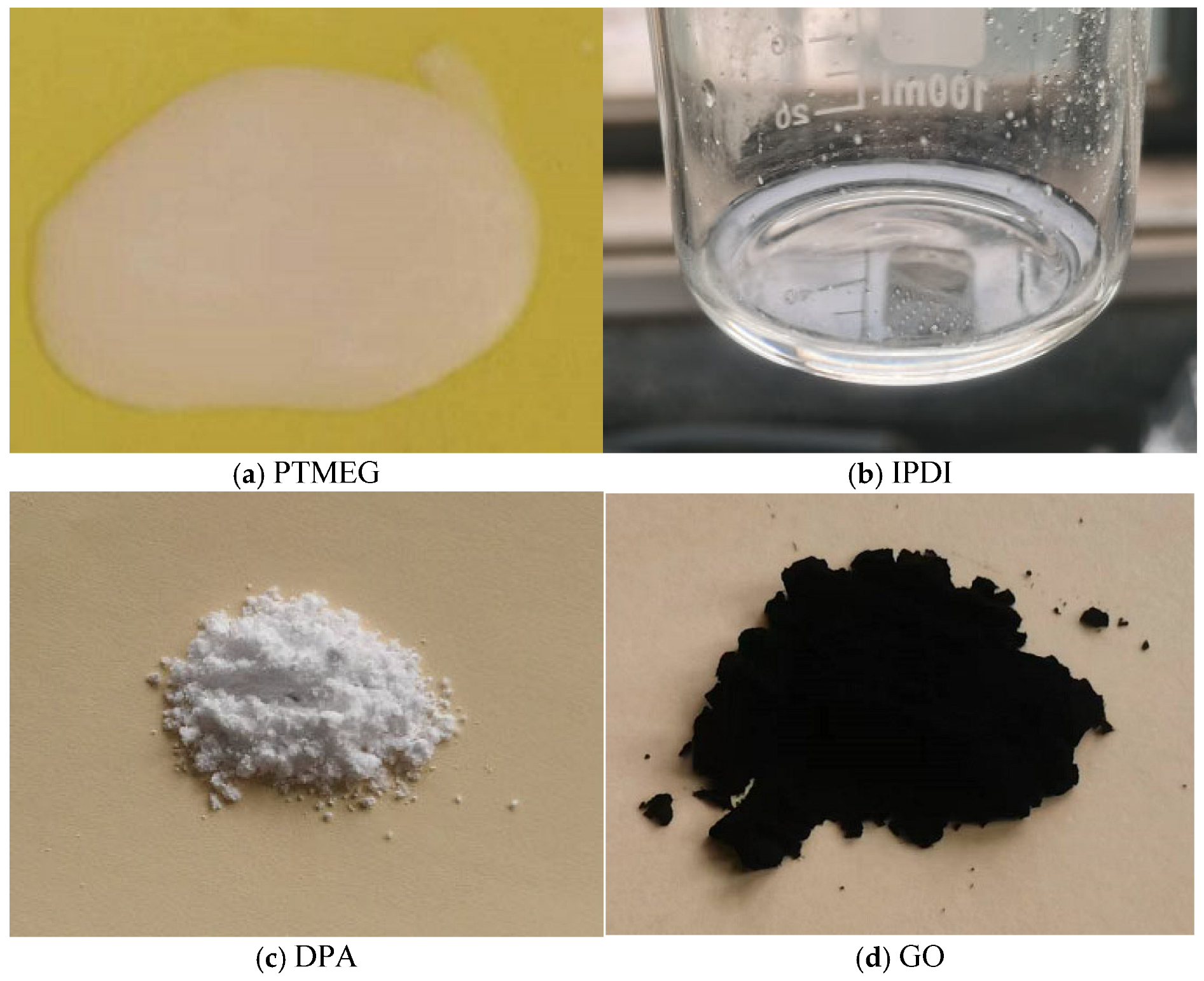
The modifier TPU used in this study is synthesized by polytetramethylene ether glycol (PTMEG), isophorone diisocyanate (IPDI) and 3,3′-Dithiodipropionic acid (DPA). The hard segment content was selected as 20%, the molar ratio of PTMEG:IPDI:DPA is 1:1.64:0.64. According to the previous study [18], the synthesis process of TPU is as follows: First, weigh an appropriate amount of PTMEG and dry it in a vacuum drying oven at 120 °C for 2 h. Then, add PTMEG and IPDI to a three-neck flask and place the flask in an oil bath at 75 °C. Add 0.1 g catalyst (DBTDL) to the flask and allow it to react for 60 min under a nitrogen atmosphere to obtain the pre-polymer. Finally, dissolve the corresponding mass of DPA in DMF and add it to the flask for a 30 min reaction. After the reaction is complete, the mixture is placed in a 60 °C drying oven and dried for 48 h to obtain TPU. The relevant physical properties and appearance of raw materials are shown in Figure 1 and Table 2. The catalyst dibutyltin dilaurat (DBTDL) and solvent N,N-Dimethylformamide (DMF) are also listed in Table 2.

2.1.3. Thermoplastic Polyurethane/Graphene Oxide (TPU/GO)

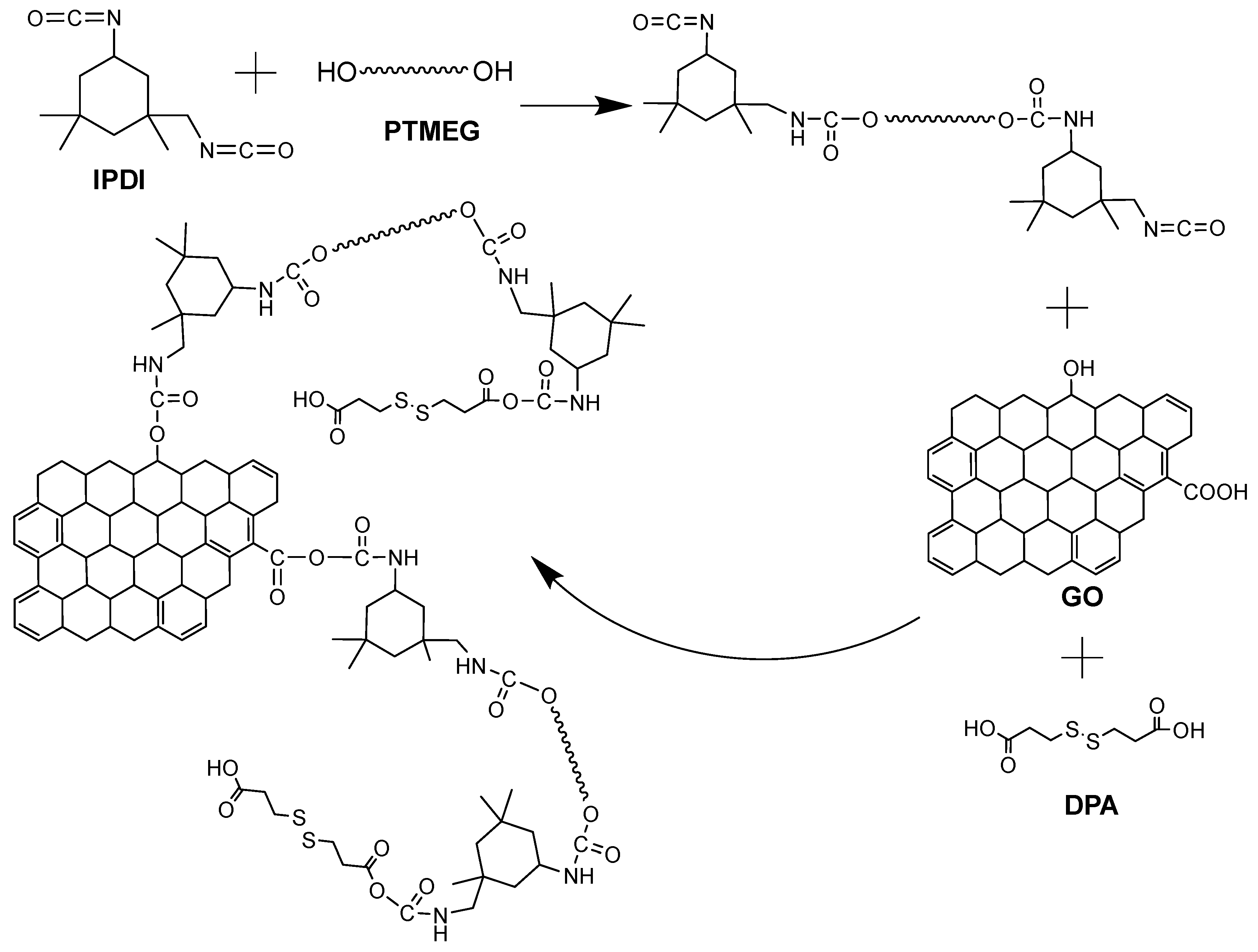
In order to synthesize TPU/GO, GO needs to be introduced into TPU during the TPU synthesis. Considering that an excessively high GO content can lead to agglomeration and relatively high cost, the GO content is determined to be 1.2% [2]. The synthesis process of TPU/GO is similar to that of TPU. The difference is that before the chain extension stage, GO needs to be introduced into the prepolymer system and react with prepolymer chains for 30 min. To enhance the dispersibility of GO in polyurethane, the GO powder needs to be introduced into a DMF solution and subjected to ultrasonic dispersion for 2 h before adding into prepolymer system. The reaction mechanism of TPU/GO synthesis is shown in Figure 2.
The relevant properties of TPU and TPU/GO are shown in Table 3.

2.2. Preparation of Modified Asphalt

Considering the melting point of the modifier and the aging problem of asphalt comprehensively, this study selected 130 °C to prepare modified asphalt. The preparation process was referenced from previous research [2]. First, heat the base asphalt to 130 °C using an oil bath. Each batch of base asphalt was 300 g. Then, add the corresponding amount of modifier (mass percentage of base asphalt) to the base asphalt and use FM300 high-speed shearing apparatus manufactured by FLUKO (Shanghai, China) to shear the asphalt at 3000 rpm for 60 min. The base asphalt was maintained in a thermostatic oil bath at 130 °C during the entire shearing process. The oil bath temperature was continuously monitored and controlled to ensure stable heating. Finally, use a mixer to stir the asphalt at 500 rpm for 10 min to remove air bubbles. After preparation, all modified asphalt binders were allowed to naturally cool down to room temperature. All tests were completed within 48 h to ensure consistent performance and reproducibility. The formula of modified asphalt is shown in Table 4.

2.3. Test Methods

2.3.1. Fourier Transform Infrared (FTIR) Test

FTIR spectroscopy was used to characterize the chemical functional groups of the base asphalt, TPU, TPU/GO composite, and modified asphalts. The FTIR spectra were recorded on a Nicolet iS 10 spectrometer (Thermo Fisher Scientific, Madison, WI, USA) in attenuated total reflection (ATR) mode. All spectra were collected over the wavenumber range of 4000–400 cm−1, with a resolution of 4 cm−1 and 32 scans per sample to ensure a high signal-to-noise ratio. The baseline correction was performed automatically by the instrument’s built-in software using the automatic baseline correction algorithm to eliminate spectral distortions. All samples were measured at room temperature (25 ± 1 °C) without any pre-treatment.

2.3.2. Compatibility Test

In practical application, polymer-modified asphalt is prone to segregation due to the density difference and intermolecular forces between polymer and asphalt. Hence, assessing the storage stability of asphalt is vital in determining the practical engineering application worthiness of modified asphalt. The test was implemented through the specification JTG E20-2011 [38]. First, the asphalt was heated to a molten state; then 50 g of the molten asphalt was weighed and poured into an aluminum tube with a length of about 14 cm and a diameter of about 2.5 cm. Then, the aluminum tube was placed upright in an oven at 163 °C for 48 h. After that, the aluminum tube was taken out of the oven and placed in the refrigerator for 4 h of freezing. And then the aluminum tube was cut into three parts. The storage stability is typically assessed by measuring the difference in softening points between its upper and lower sections. The results are obtained from the average of three repeated tests.
Furthermore, fluorescence microscopy (FM) and field emission scanning electron microscope (SEM) was also applied to observe the distribution of modifier in the asphalt. The FM tests were performed using a Nikon Eclipse Ti-S inverted fluorescence microscope manufactured by Nikon Corporation, Tokyo, Japan. The test samples of FM were specifically obtained from the upper and lower sections of aluminum tubes after the 48 h storage stability test. The SEM images were recorded on a JSM-IT800 scanning electron microscope (JEOL, Tokyo, Japan). All samples were prepared by cutting into thin slices, followed by vacuum drying to remove residual moisture. To improve the electrical conductivity of the samples, a thin layer of gold was sputtered onto the surface for 60 s using a sputter coater (Cressington Scientific Instruments Ltd., Watford, UK). The imaging was performed at an accelerating voltage of 5 kV, and the working distance was adjusted to ensure clear imaging of the sample surface.

2.3.3. Basic Performance Test

Conventional properties of the binders, including penetration, softening point, and ductility, were determined in accordance with JTG E20-2011 [38]. For the penetration test, samples were poured into molds and conditioned in a 25 ± 0.1 °C water bath for 1.5 h before testing, where a 100 g standard needle was applied for 5 s, and three parallel tests were conducted with the average result reported in 0.1 mm. The softening point test was carried out using the ring-and-ball method. The heating rate was controlled at 5 ± 0.5 °C/min, and the softening point was recorded as the temperature at which the 3.5 g steel ball fell 25 mm to touch the bottom plate. The softening point was calculated by the two parallel test results. For the ductility test, samples were conditioned in a 5 ± 0.5 °C water bath for 1.5 h before testing, with a pulling speed of 5 ± 0.25 cm/min, and the test was terminated when the specimen broke, with the elongation recorded in cm.

2.3.4. Rotational Viscosity Test

In this study, the 135 °C, 155 °C, 175 °C viscosity were tested according to the specification [38]. The rotational viscosity of the base asphalt and modified asphalts was measured using a DV2T rotational viscometer (Brookfield, New York, NY, USA) with a cylindrical spindle. The spindle was rotated at a constant speed of 80 rpm. Each sample was measured three times in parallel, and the average value was taken as the final viscosity result to ensure the accuracy and repeatability of the test. During the test, the torque should be maintained between 10% and 98%. Furthermore, viscosity temperature susceptibility (VTS) index can be obtained by measuring the viscosity at different temperatures [39], providing a method to assess the temperature sensitivity of asphalt within high-temperature ranges [40]. The calculation formula for viscosity temperature index VTS is as follows:
l g l g ( η ) = A + V T S × lg T
where η is the viscosity value of asphalt (cp); A is the intercept of viscosity temperature curve; T is the test temperature (°C).

2.3.5. Bending Beam Rheometer (BBR) Test

BBR tests were performed using a B216 bending beam rheometer, manufactured by Pavetest (Pavetest Pty Ltd., Endeavour Hills, VIC, Australia) to more comprehensively assess the low-temperature performance of asphalt. Different from the ductility test, the samples for BBR test need to undergo short-term aging through thin film oven test (TFOT), and then undergo long-term aging through pressurized aging vessel (PAV) test. And then small beams with dimensions of 6.35 mm × 127 mm × 12.70 mm were prepared for BBR test. Two temperatures (−12 °C and −18 °C) were selected for BBR test. Through the BBR test, two main parameters can be obtained: stiffness modulus S and creep rate m. According to BBR test requirements [38] the S and m at 60 s of the test are taken as the test results. And the results are the average of three parallel tests.

2.3.6. Dynamic Shear Rheometer (DSR) Test

Temperature scanning tests and multiple stress creep recovery (MSCR) tests were performed using an Anton Paar Smart Pave 102 dynamic shear rheometer, manufactured by Anton Paar GmbH, Graz, Styria, Austria. For each asphalt type, three replicate samples were tested, and all reported results are average values of three independent trials to ensure data reproducibility.
A temperature range of 30 °C to 90 °C was chosen for the temperature scanning test. The loading frequency was 1.59 Hz and the strain was 1%. Through temperature scanning, two key parameters can be obtained: dynamic shear modulus G * and phase angle δ . The larger the G * , the stronger the anti-deformation ability of asphalt. δ is used to characterize viscoelastic properties of asphalt, and the smaller the δ , the more obvious the elastic characteristics of asphalt. The error of G * / s i n δ should be controlled within 6.4% for unaged asphalt and 9.0% for TFOT aging asphalt.
The MSCR test was conducted under stress control mode, with loading cycles consisting of 1 s of loading followed by 9 s of unloading. Each stress level was subjected to 10 cycles. Through MSCR test, the creep recovery rate R and unrecoverable creep compliance J n r at different stress levels (0.1 kPa and 3.2 kPa) can be obtained. Considering that the temperature of asphalt pavement can reach around 60 °C in summer, two temperatures, 58 °C and 64 °C were selected for the MSCR test to evaluate the creep recovery ability of asphalt at high temperatures.

2.3.7. Aging Test

In this study, the aging performance of asphalt was evaluated through temperature scanning test on asphalt samples before and after short-term aging. The short-term aged asphalt samples were prepared through TFOT method according to JTG E20-2011 [38]. The aging index (AI) was calculated as the ratio of the rutting factor ( G * / s i n δ ) of short-term aged asphalt binders to that of the unaged binders, determined at the same corresponding test temperatures. Both aged and unaged samples were prepared, conditioned, and tested under identical conditions to ensure valid comparison. Rutting factor data were obtained over a temperature range from 30 °C to 90 °C, and the AI was systematically evaluated at the specified temperatures of 48, 54, 60, 66, and 72 °C. All values reported are the average of three replicate tests to ensure the reliability of the results. The AI can be calculated by Formula (1) [41].
A I = G * / s i n δ a g e d G * / s i n δ u n a g e d
where A I represents aging index, G * / s i n δ a g e d and G * / s i n δ u n a g e d represents the rutting factor of asphalt after and before aging, respectively.

2.4. Research Process

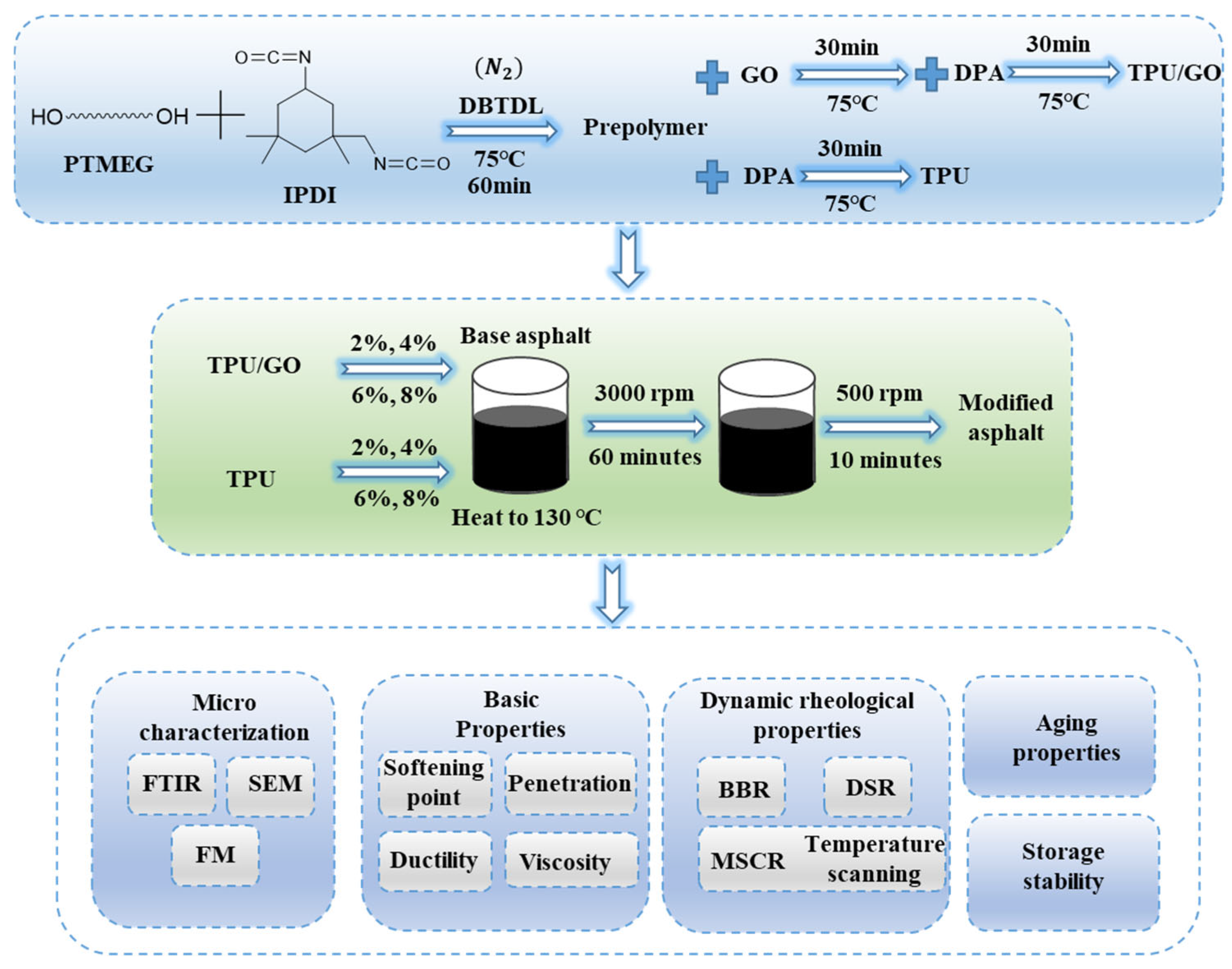
A schematic overview of the entire research workflow is presented in Figure 3, which systematically summarizes the key process of this study. The process begins with the synthesis of TPU and TPU/GO composite modifiers via a two-step polymerization reaction, followed by their incorporation into base asphalt through high-speed shear apparatus at 130 °C. Finally, a comprehensive set of characterization tests, including microstructural analysis, basic performance evaluation, dynamic rheological measurement, and aging property assessment, were conducted to fully investigate the properties of the modified asphalts.

3. Results and Discussion

3.1. FTIR Test

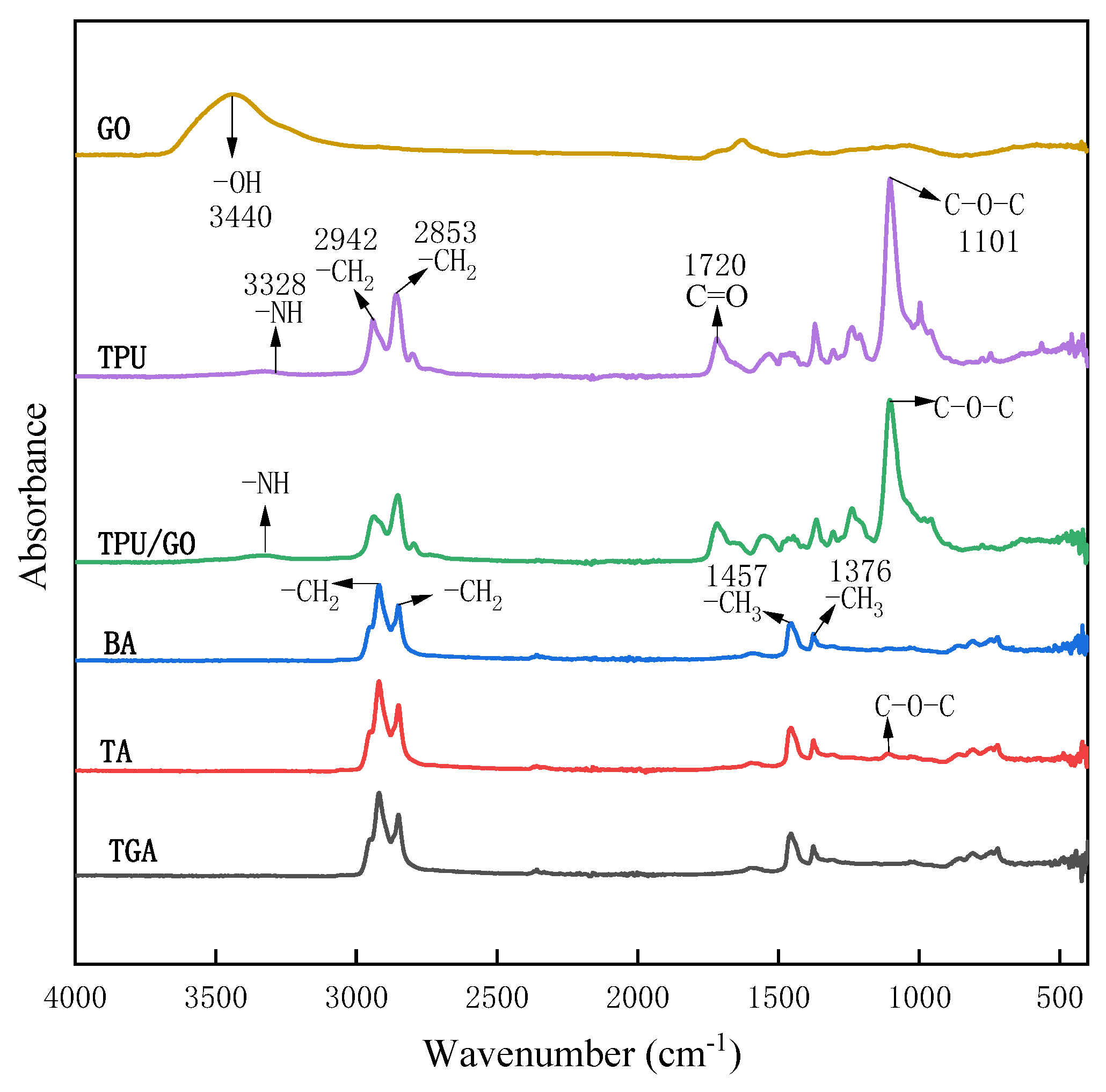
From Figure 4, the FTIR spectrum of GO shows an absorption peak of –OH, which is caused by the hydroxyl and carboxyl functional groups [42]. Although GO has been introduced into TPU, the absorption peak of –OH cannot be found in the spectrum of TPU/GO. Based on the mechanism of TPU/GO synthesis reaction, it can be inferred that the groups –OH on GO have reacted with diisocyanate groups (–NCO). This reaction will generate new functional groups –NH [43]. Therefore, the vibration peak of –NH can be found on the spectrum of TPU and TPU/GO. In addition, the absorption peak of –NCO (2250 c m 1 and 1350 c m 1 ) cannot be found on the spectrum of TPU and TPU/GO, which also indicates that the diisocyanate groups on IPDI have reacted with hydroxyl and carboxyl groups [43,44].
When it comes to the FTIR spectrum asphalt, it can be found the stretching vibration of C H 2 and C H 3 in all the asphalt type [26]. Comparatively, while the FTIR spectra of base asphalt and modified asphalt are similar, the modified asphalt exhibits a C–O–C vibration peak [45], which originates from the TPU/GO. Importantly, the modification process does not introduce new functional groups. In addition, all the vibration peaks were summarized in Table 5 for easy comparison.

3.2. Compatibility

3.2.1. Storage Stability

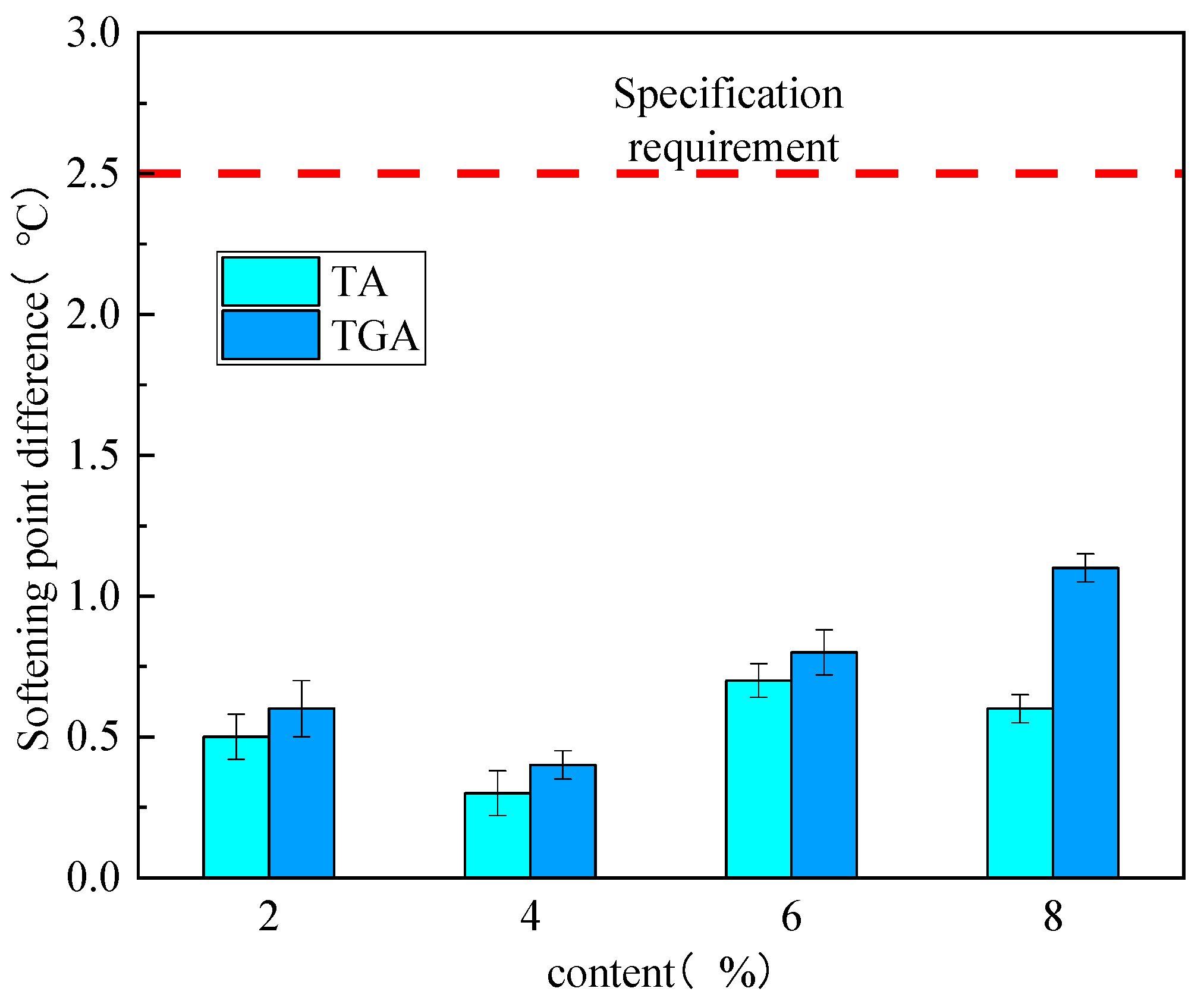
Figure 5 shows the storage stability test results of TA and TGA with different contents. The difference in softening point is a critical criterion for evaluating the compatibility between the modifier and asphalt, as well as for assessing the long-term stability of the modified asphalt. The softening point difference in polymer-modified asphalt should not exceed 2.5 °C to avoid the segregation between modifier and asphalt according to the specification [41]. From the experimental results, the softening point differences in both TA and TGA are far below the requirement of 2.5 °C at different dosages. This indicates that both TPU and TPU/GO modifiers have good compatibility with base asphalt. During the storage, transportation, and construction processes, the modified asphalt will be less prone to segregation. However, the data also reveal an intriguing trend: as the modifier content increases, the softening point difference shows a progressive increase, even though it remains below the allowable limit of 2.5 °C. This slight noticeable trend can potentially be attributed to the aggregation behavior of the polymer modifier at higher contents. When the modifier forms aggregation within the asphalt, the uneven distribution of modifier will affect the softening point characteristics. Such aggregation could reduce the overall interfacial interaction between the modifier and asphalt, thereby increasing the possibility of phase segregation over time. Therefore, in practical applications, the dosage of modifiers needs to be controlled within a reasonable range to avoid adverse effect in asphalt storage stability caused by excessive addition of modifiers [18].

3.2.2. Fluorescence Microscopy (FM)

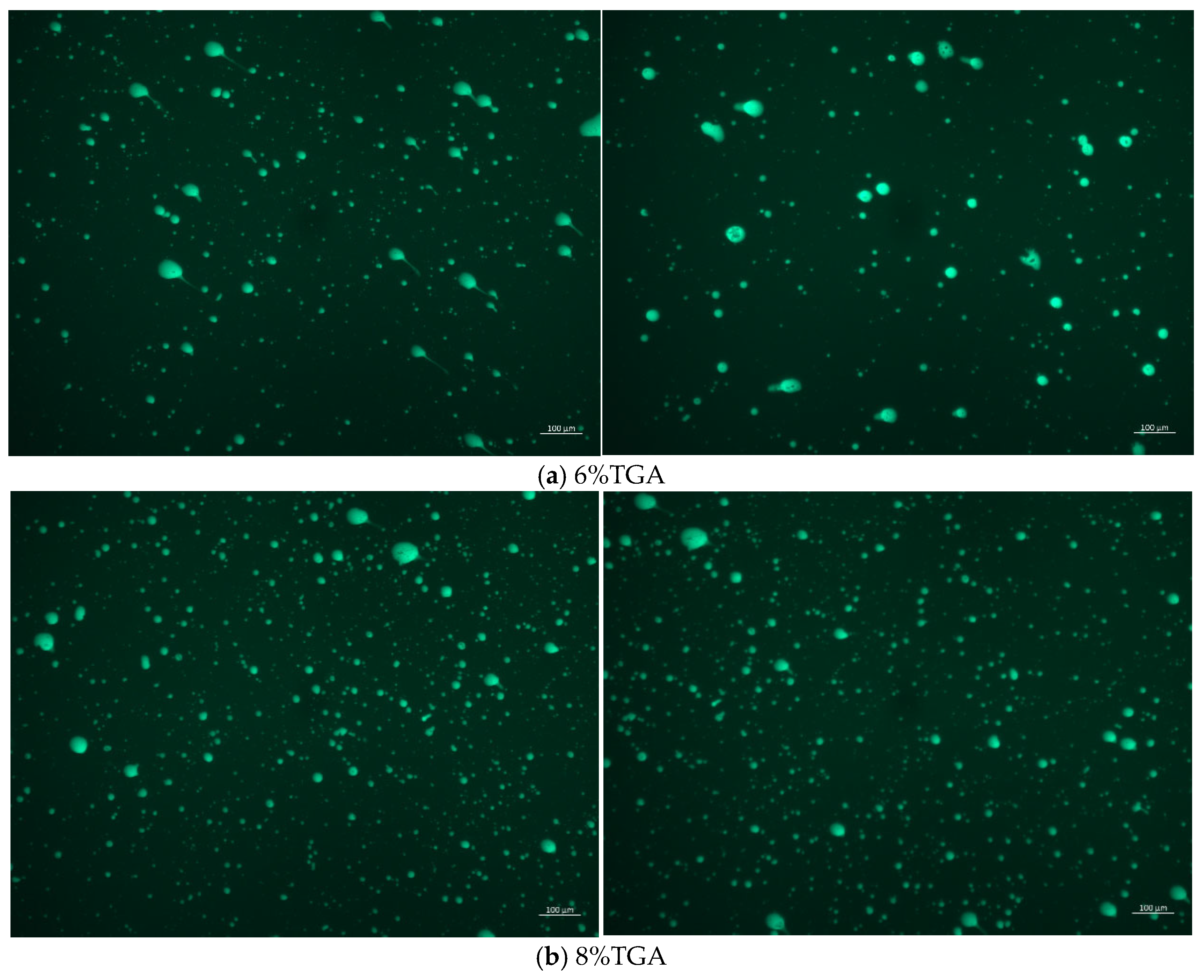
To further analyze the dispersion of TPU/GO in asphalt, fluorescence microscopy (FM) experiments on 6%TGA and 8%TGA were conducted. Figure 6 shows the FM images of upper and lower sections of TGA with different TPU/GO contents, where the left image corresponds to the upper section and the right one to the lower section. It can be observed that when the dosage of the modifier is 6%, there are relatively dense bright spots distributed on the image and no obvious agglomeration of the modifier was observed. This indicates that although the modifier content is relatively high, the modifier can still be uniformly dispersed in the asphalt. Moreover, there is no significant difference between the images of upper and lower sections after 48 h storage stability test, which proves that TPU/GO has good compatibility with asphalt. And Figure 6b presents the fluorescence image of 8% TGA. It can be observed that compared with 6% TGA, the fluorescence brightness of the image has further increased, and the distribution density of the modifier dispersed in the asphalt is further increased, but it can still maintain the uniform dispersion of smaller particles. The images of the upper and lower sections of 8%TGA exhibit slight agglomeration, with only a small amount of larger particles, and the overall system is still uniformly dispersed. From the comparison of the upper and lower images, there is no significant difference, indicating that the modifier can still exist stably in the asphalt as a uniform phase.

3.2.3. Emission Scanning Electron Microscope (SEM)

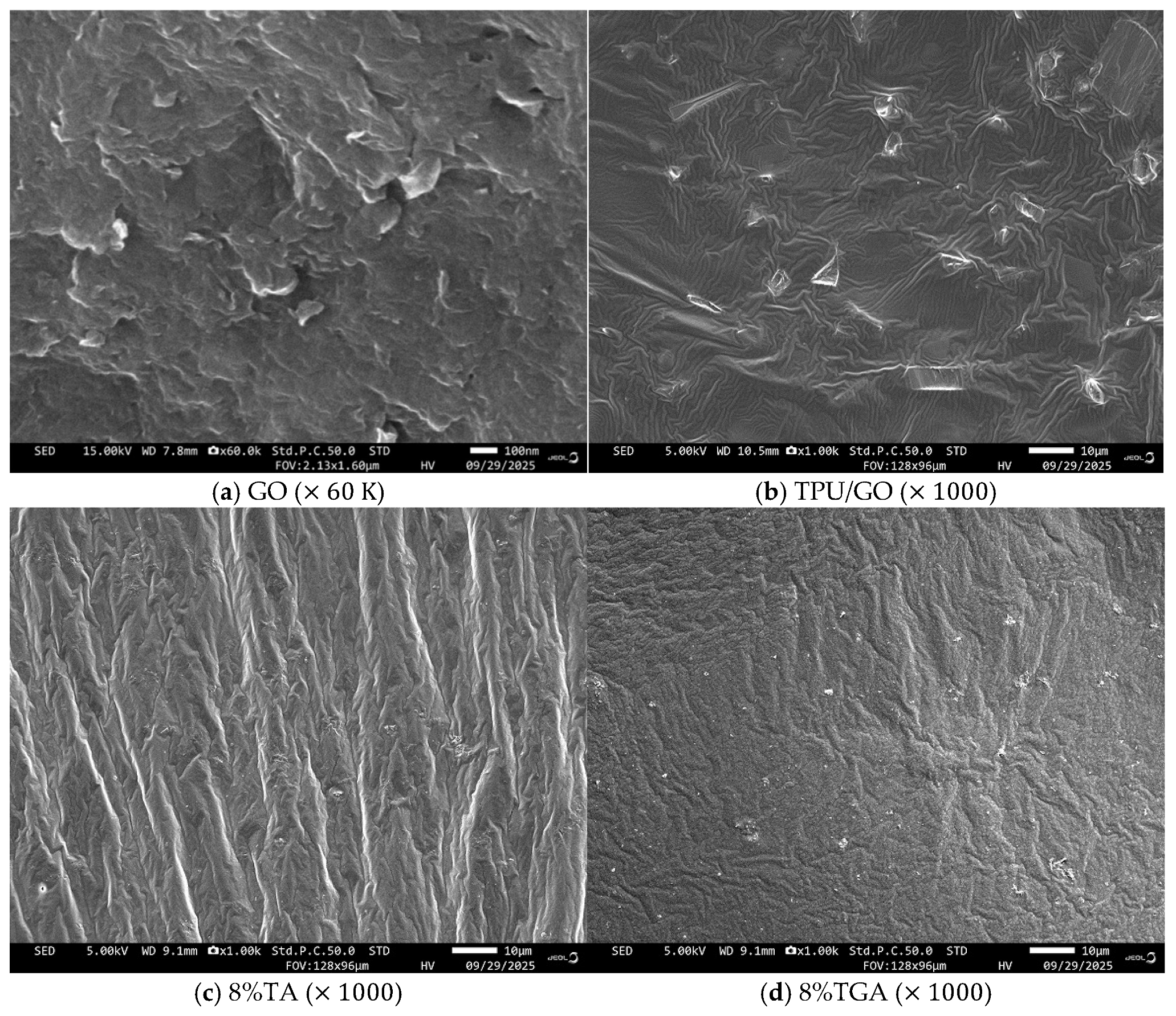
Figure 7 clearly shows the SEM images of GO, TPU/GO, and modified asphalt. From Figure 7a, the typical layered structure of GO can be clearly observed. It can be seen that there is a certain degree of stacking between GO layers, but the overall morphology remains relatively dispersed and without large-scale agglomeration, which is beneficial for its application in composite materials. From Figure 7b, it can be clearly seen that GO exhibits a layered structure and is evenly dispersed in the TPU matrix, without obvious and large-scale agglomeration. The interface between the GO layers and the TPU matrix is relatively blurred, indicating a good interfacial bonding between the TPU and GO. This strong interfacial bonding facilitates stress transfer in the composite, which may improve the overall mechanical properties of composite materials. Figure 7c shows the microscopic morphology of TA, where the surface exhibits a wrinkled or rippled structure. This may be due to the interaction between the molecular chains of polyurethane and asphalt during the mixing process, leading to this unique morphology during the cooling process of the system. The similar structures also can be seen on the surface of TGA in Figure 7d. But unlike the surface of TA, it can be observed that GO is uniformly distributed on the surface of asphalt without obvious aggregation. This indicates that incorporating GO into TPU and then using TPU/GO for asphalt modification can improve the dispersibility of GO in asphalt.

3.3. Basic Performance of Modified Asphalt

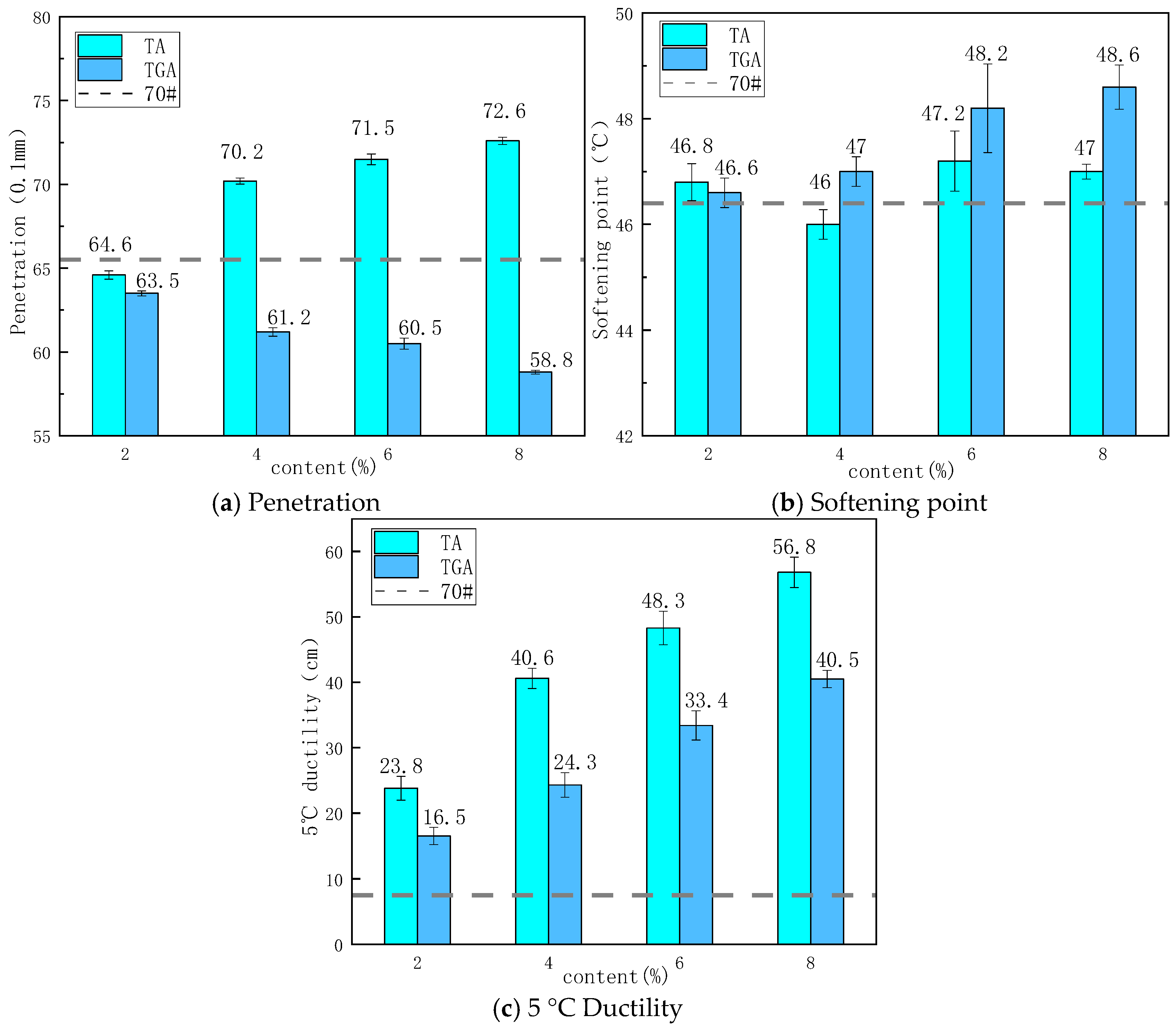
Figure 8 shows the differences in basic performance between TA and TGA. Through comparative analysis, it is evident that as the TPU content increases, the penetration shows a gradually increasing trend, indicating that with the increase in TPU dosage, the hardness of asphalt at room temperature gradually decreases. The results prove that TPU has a softening influence on asphalt, which endows asphalt with better room-temperature flow characteristics. However, after introducing GO during the modification process, the penetration of TGA shows a trend opposite to that of TA. When the TPU/GO content increases, the penetration value shows a gradually decreasing trend, showing that TPU/GO will enhance the hardness of asphalt. This change in performance is attributed to the reinforcing effect of GO on TPU material. As a high-performance nanofiller, GO’s excellent mechanical properties can effectively improve the microstructure of TPU, enhance its rigidity and hardness, and thus enhance the strength of asphalt materials [44].
From the softening point test results, the softening points of TA with different modifier contents are similar to those of the matrix asphalt, which demonstrates that TPU has no significant influence on the softening point of asphalt. However, it is observable that the softening point of TGA gradually increases with the increase in TPU/GO contents, which proves TPU/GO can enhance the high-temperature stability of asphalt to a certain extent. This can be potentially attributed to the impact of GO incorporation on the crosslinking density and molecular structure of TPU, ultimately enhancing the high-temperature performance to a certain degree.
In terms of ductility results, both types of modified asphalt exhibit notable enhancements, suggesting that the incorporation of TPU and TPU/GO can markedly enhance the low-temperature performance. Furthermore, due to the unique elastic structure of TPU material, the flexibility improvement effect of TPU on asphalt is better than that of TPU/GO. TPU has excellent flexibility and elasticity, which can impart better plastic deformation capacity under low-temperature conditions, thereby endowing asphalt materials with better low-temperature ductility.
Considering the data in Figure 8 comprehensively, the following conclusion can be drawn: both TPU and TPU/GO modifier obviously enhance the low-temperature performance. And due to the improvement impact of GO on the spatial structure of TPU, TPU/GO has a better impact on enhancing the high-temperature performance of asphalt than TPU.

3.4. Rotation Viscosity

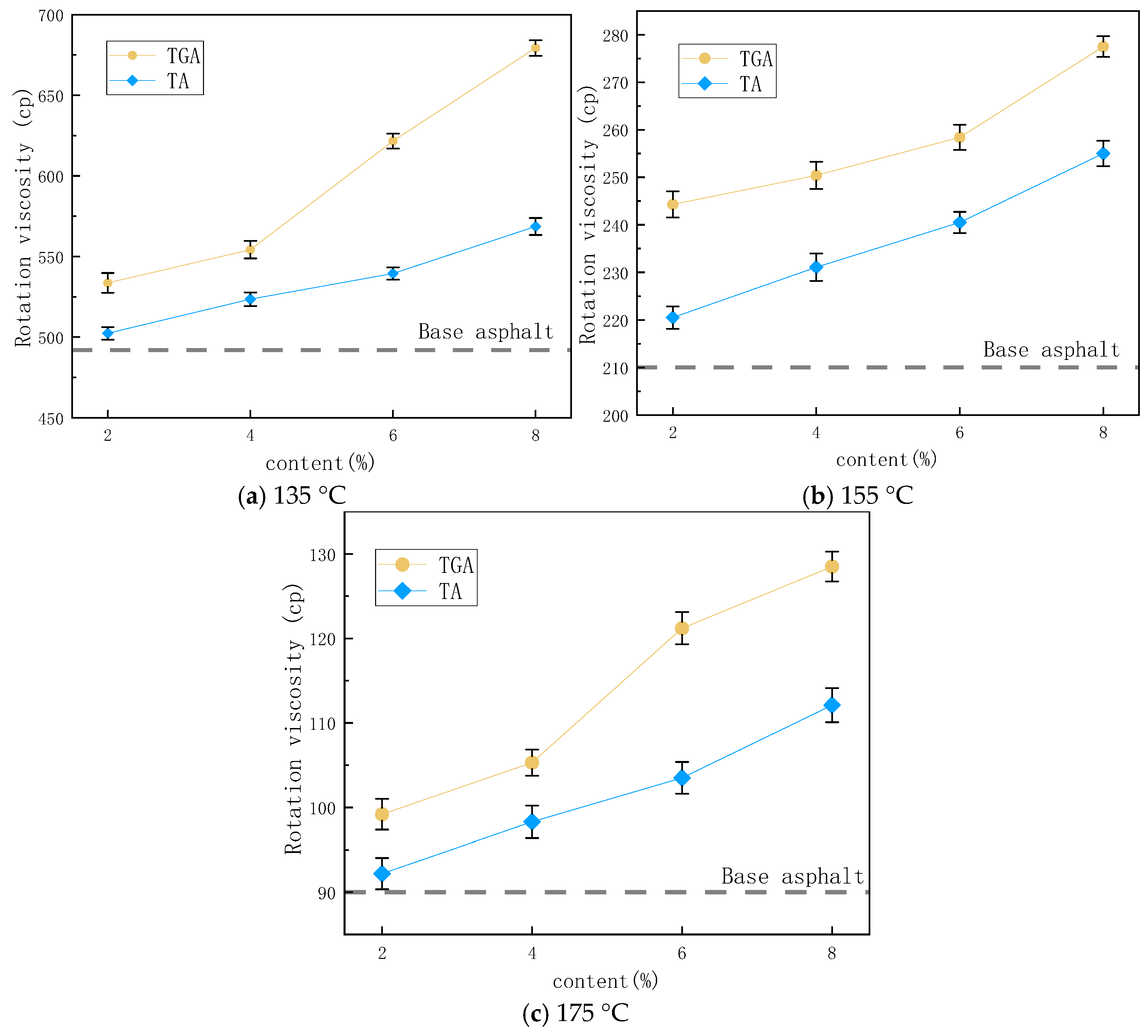
Figure 9 displays the rotational viscosity test results of TA and TGA at different temperatures (135 °C, 155 °C and 175 °C). According to the specification [41], the 135 °C rotational viscosity of modified asphalt needs to be less than 3 P a · s (3000 cp) to ensure the workability of modified asphalt [26]. From Figure 9a, the rotational viscosity of both TA and TGA at 135 °C is much lower than 3 P a · s , indicating excellent constructability and workability. On the other hand, rotational viscosity also represents the shear resistance of asphalt. The higher the rotational viscosity, the stronger the shear resistance of asphalt. It can be seen in Figure 9 that the rotational viscosity of TA and TGA at different temperatures show a gradually increasing trend with the increase in modifier dosages. This demonstrates that both modifiers can enhance the shear resistance of asphalt at different temperatures. Further analysis reveals that there is a certain difference in the improvement on asphalt shear resistance between TPU and TPU/GO modifiers. Compared with TA, the rotational viscosity of TGA further increases, which may be due to the enhancing effect of GO on the spatial structure of TPU. After adding TPU/GO to asphalt, the interaction force inside the asphalt is stronger, thereby further improving the shear resistance.
The calculation results of VTS are showed in Table 6. The larger V T S indicating the poorer temperature sensitivity. From Table 6, it can be seen that the V T S of TA and TGA is reduced to varying degrees compared with the base asphalt. The |VTS| of the base asphalt reaches 1.22849, while 6%TGA is only 1.128. This indicates that TPU and TPU/GO have an improvement effect on the temperature sensitivity of asphalt in the high-temperature range.

3.5. Low Temperature BBR Test Results

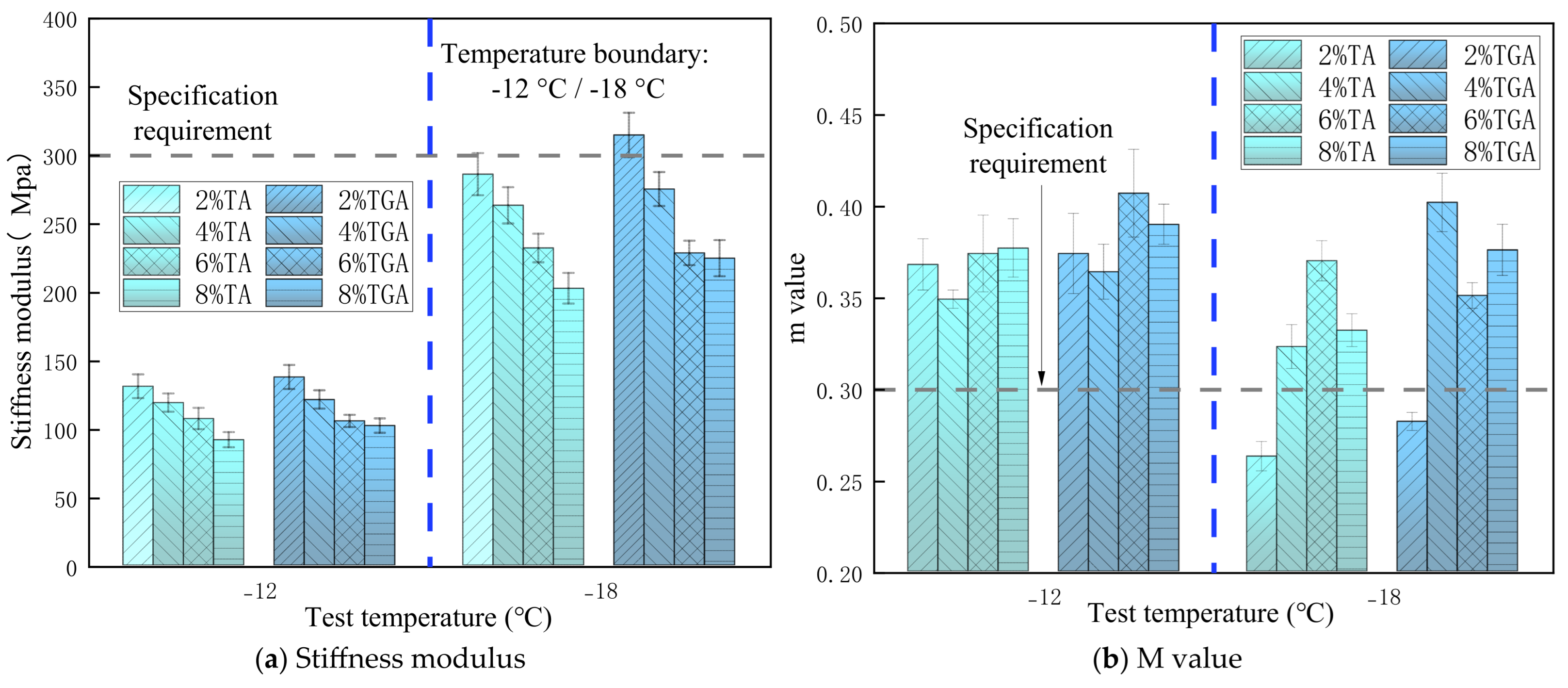
As demonstrated in Figure 10, the stiffness modulus S of TG and TGA with different modifier dosages are far lower than 300 MPa at −12 °C, which underscores that both TG and TGA still have excellent low-temperature flexibility at −12 °C. In addition, with the increase in TPU and TPU/GO dosages, the stiffness modulus of TA and TGA shows a gradual decreasing trend, indicating that both modifiers have an obvious positive effect on the low-temperature flexibility. The −18 °C BBR test results are similar to the test results at −12 °C. The stiffness modulus S shows a downward trend with the increase in modifier content. Moreover, except for the stiffness modulus S of 2% TGA exceeding 300 MPa, the S values of other modified asphalts with different dosages can satisfy the requirements of specification.
According to Figure 10b, the m value of both TA and TGA is greater than 0.3, which displays the excellent stress dissipation ability. Although the creep rate m values do not consistently increase with the increasing modifier dosage, a positive correlation between dosage and m value is evident. When the content of TPU/GO is 6%, the m value of TGA −12 °C is the highest, indicating the best stress dissipation ability. When the dosage of modifier continues to increase, the modifier may aggregate to some extent and cause stress concentration, which will reduce the stress dissipation ability of asphalt. Overall, under the condition of −12 °C, the BBR test results of TA and TGA can meet the requirements. However, under the condition of −18 °C, some modified asphalt did not meet the requirement of greater than 0.3. When the content of TPU and TPU/GO is 2%, the m values are smaller than 0.3. While the modifier content exceeds 2%, the m values of both TA and TGA are greater than 0.3, indicating that TPU and TPU/GO have an obvious enhancement effect on the stress dissipation capability of asphalt.

3.6. Dynamic Rheological Shear Test Results

3.6.1. MSCR Test Results

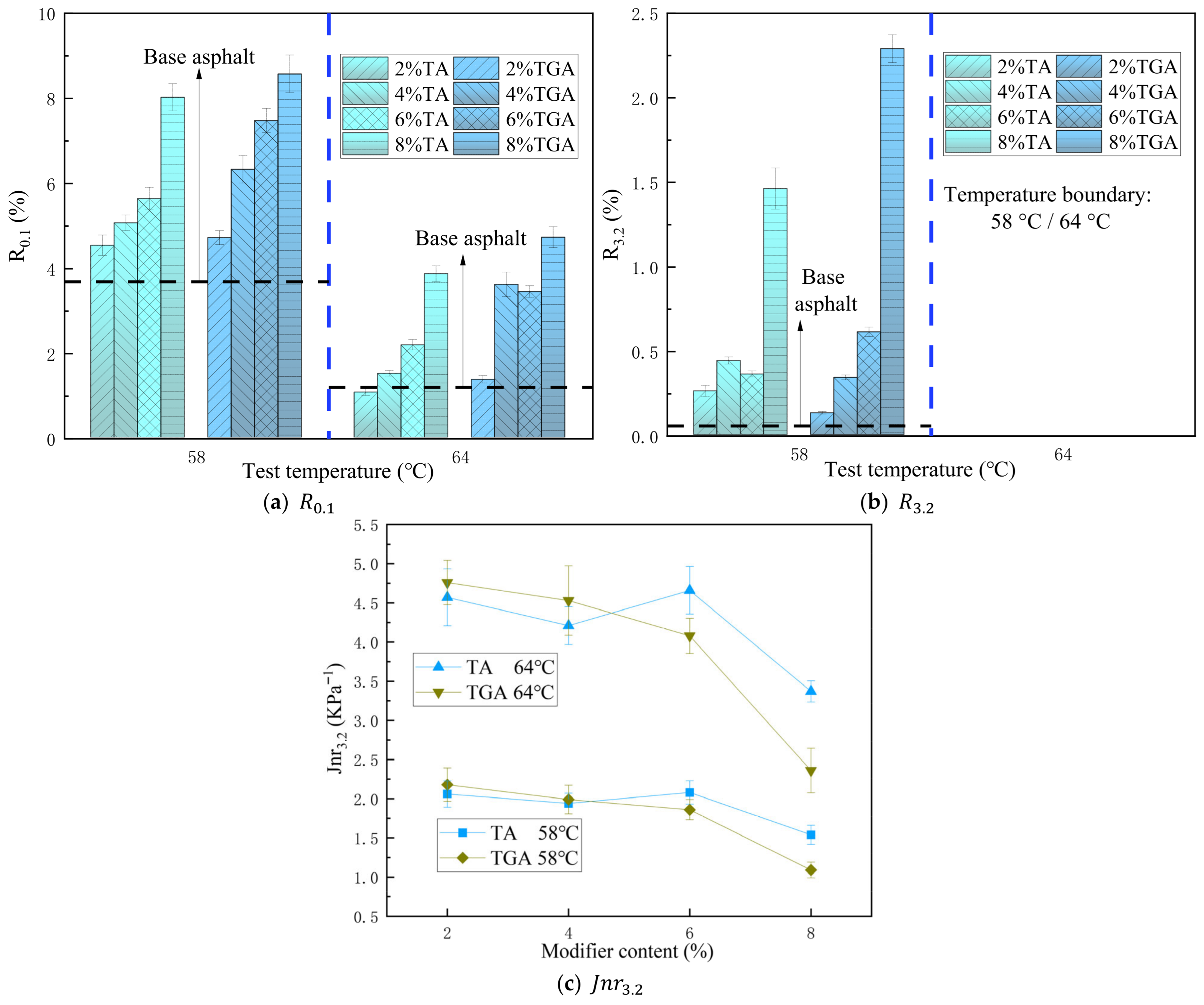
Figure 11 demonstrates the results of MSCR tests of TA and TGA with different modifier dosages. R 0.1 and R 3.2 represent the creep recovery rates of asphalt under 0.1 kPa and 3.2 kPa stress conditions, respectively. J n r represents the irreversible creep compliance of asphalt, which can reflect the resistance to high-temperature rutting. The R 0.1 of BA is 3.96% at 58 °C, while the R 0.1 of TA and TGA with different dosages have been enhanced to varying degrees. Moreover, with the increase in modifier dosage, R 0.1 at two test temperatures gradually increases, proving that TPU and TPU/GO can effectively improve the creep recovery rate of asphalt at high temperatures and enhance its high-temperature deformation resistance. Compared with TPU, TPU/GO has a better improvement influence on the creep recovery rate of asphalt. This is because the introduction of GO into TPU will enhance the structural strength of the material, thereby improve the elastic properties of the asphalt.
The test results of the creep recovery under 3.2 kPa condition are displayed in Figure 11b. When the test temperature is 64 °C, the R 3.2 of all asphalts decrease to zero. This is because as the stress increases, the deformation of asphalt become more severe, resulting in a decrease in creep recovery rate. When the test temperature is 58 °C, R 3.2 of the BA is only 0.06%, which has almost no recovery ability. After adding TPU and TPU/GO, the creep recovery rate has been improved to a certain extent. However, at lower dosages, R 3.2 of TA and TGA is still relatively low. When the TPU and TPU/GO dosages reach 8%, R 3.2 of TA and TGA is obviously enhanced. This indicates that when the TPU and TPU/GO dosages reach a certain level, they will form a skeleton structure in, which is more beneficial to increasing the deformation resistance of asphalt under higher load conditions. Similarly, TPU/GO has a stronger influence on enhancing the creep recovery ability under 3.2 kPa condition than TPU, thanks to the two-dimensional spatial structure of GO and its higher strength.
The MSCR results reveal a clear stress sensitivity in the creep recovery behavior of all binders. At 58 °C, the creep recovery rate R 0.1 (under 0.1 kPa) is consistently higher than R 3.2 (under 3.2 kPa) for all modifier contents, indicating that increased stress levels lead to more severe, less recoverable deformation. For example, at 58 °C, the R 0.1 of 8% TGA is approximately 8.57%, while its R 3.2 is reduced to around 4.72%. This stress sensitivity is typical for asphalt binders, and the addition of TPU/GO effectively mitigates this effect by improving the elastic recovery under both stress conditions. According to AASHTO M 332 [46] (formerly MP 19), the non-recoverable creep compliance J n r at 3.2 kPa is used to classify binders into traffic levels. At 58 °C, the 8% TGA formulation meets the criteria for heavy traffic (H) due to its low J n r value, while the BA only satisfies the requirements for standard traffic (S). This confirms that the TPU/GO modification significantly elevates the high-temperature performance grade of the asphalt, making it suitable for more demanding pavement applications.
Figure 11c demonstrates the results of the unrecoverable creep compliance results under 3.2 kPa conditions at 58 °C and 64 °C. It can be found that the J n r of TA and TGA displays a gradually downward trend with the increase in modifier dosage, showing both TPU and TPU/GO have an obvious influence on the deformation resistance of asphalt. This is because the application of TPU and TPU/GO will enhance the elasticity of asphalt under high-temperature conditions. When the modifier dosage is less than 6%, there is an improvement effect on J n r , but it is not significant. When the dosage reaches 8%, the J n r is significantly reduced, which may be related to the distribution of the modifier in asphalt. When the modifier dosage reaches a certain level, it can form a skeleton structure, which can remarkably enhance the elastic properties of the asphalt.

3.6.2. Temperature Scanning Test Results

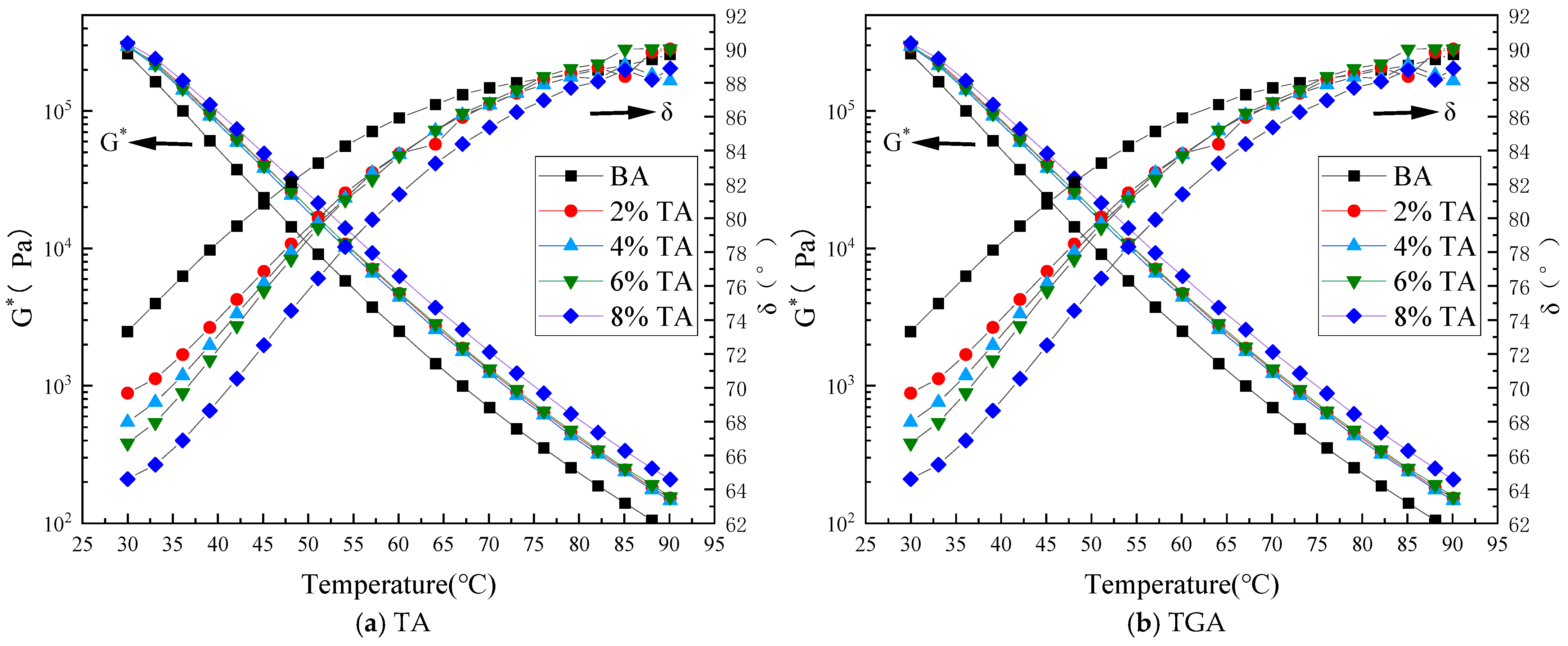
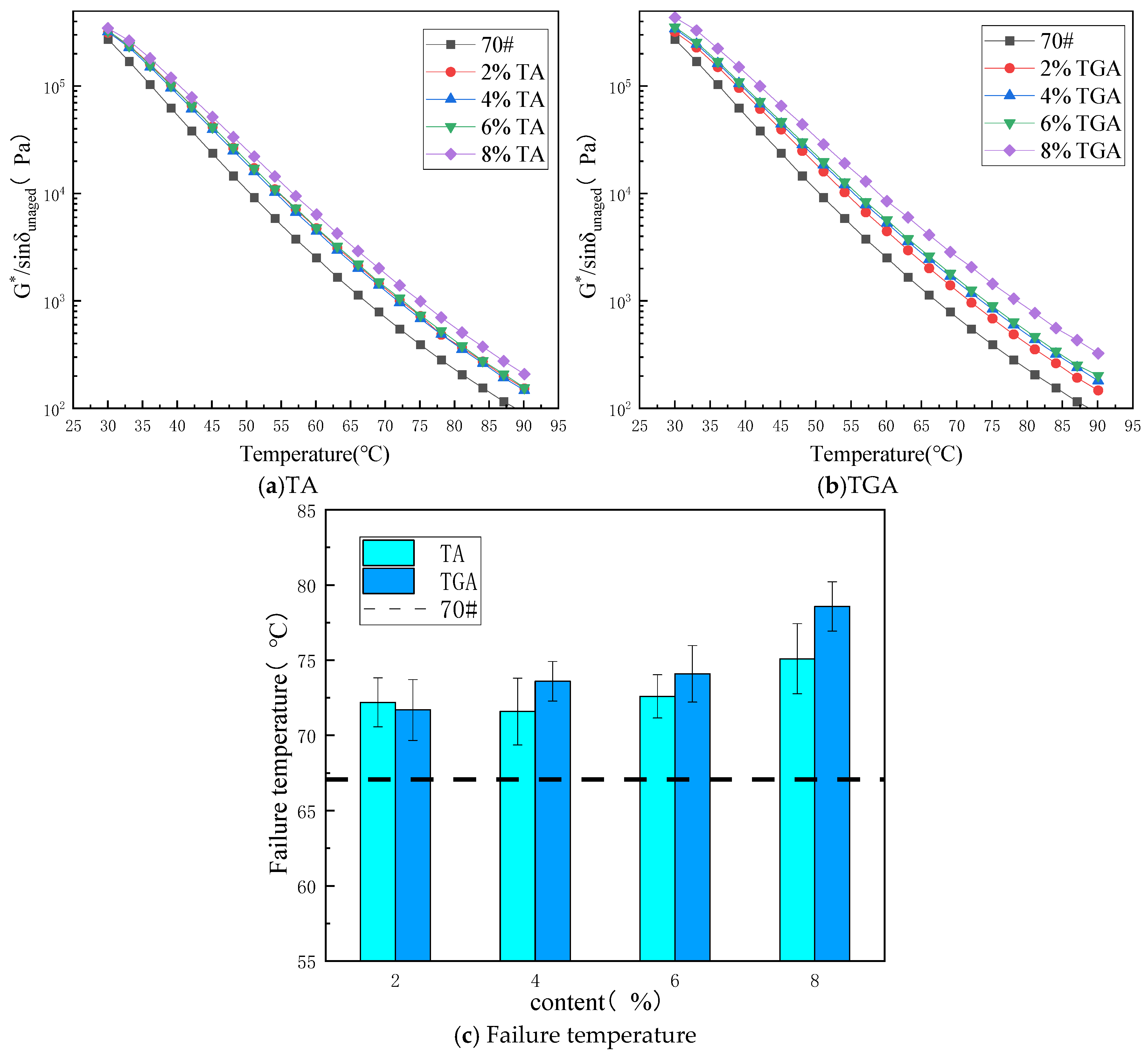
The variation of G * and δ of base asphalt and modified asphalt with increasing temperature can be obtained from Figure 12. Figure 12a clearly presents the test results of TA. The complex modulus of both the base asphalt and TA gradually decreases with the increase in temperature. This is because as the temperature gradually increases, asphalt transforms from elastic-dominant to viscous-dominant behavior, and the G *   of asphalt also decreases accordingly [47]. The δ represents the hysteresis angle of shear stress relative to shear strain. When δ = 0°, the material exhibits complete elasticity; when δ = 90°, the material exhibits complete viscosity. As the temperature rises, the flowability of asphalt gradually increases, which means that the viscous part increases and the elastic part decreases. Furthermore, the G * of TA is greater than matrix asphalt at the same temperature, proving that the application of TPU helps to improve the G * of asphalt and enhance its resistance to deformation. But at the same time, when the TPU content is 2%, 4%, and 6%, there is not much difference in its complex modulus, which may be due to the incomplete network structure of TPU in asphalt. When the content is increased to 8%, its complex modulus is significantly improved. As for the phase angle, in the medium and low temperature range, the δ of TA is significantly smaller than base asphalt, indicating that TPU obviously enhances the elastic properties of asphalt at medium and low temperatures. When the temperature gradually increases above 75 °C, the difference gradually decreases. This is because TPU is a thermoplastic material, as the temperature gradually increases, the elasticity of TPU will also gradually decrease and δ of TA and matrix asphalt tends to be the same.
Figure 12b shows the G * and δ test results of TGA. Similar to the results of TA, the G * of TGA gradually decreases and the δ gradually increases with the rising temperature. Furthermore, with the increase in TPU/GO content, the G * of modified asphalt gradually increases at elevated temperatures, which reveals that the application of TPU/GO enhances the high-temperature performance. However, at the same temperature, the G * of TGA is greater than that of TA, and the corresponding δ is smaller. This indicates that TGA exhibits better thermorheological stability compared to TA.
Figure 13 exhibits the results of the rutting factor and failure temperature of TA and TGA with different TPU and TPU/GO contents. The rutting factor is calculated from the G * and δ , which is usually selected to assess the anti-rutting capacity under dynamic shear. The higher the rutting factor, the stronger the anti-shear ability of asphalt. The results in Figure 13 reveal that the rutting factor of base asphalt and modified asphalt gradually decrease as the temperature gradually increases, indicating that temperature plays a decisive role in the anti-rutting performance of asphalt. Compared with base asphalt, the rutting factor of modified asphalt is greater in the whole temperature range, proving that TPU and TPU/GO can enhance the rutting resistance. Compared with TPU, TPU/GO has a more obvious improvement on the anti-rutting properties of base asphalt. This is because TPU/GO has better thermodynamic and mechanical properties. At the same dosage, it can endow asphalt with more elastic properties, thereby improving the anti-rutting performance. Additionally, the failure temperature (defined as the temperature when G / s i n δ = 1   k P a ) is demonstrated in Figure 13c. The failure criterion is based on the widely accepted AASHTO M 320 [48] (Superpave) performance grading specification for asphalt binders. This standard defines the high-temperature performance grade (PG) of asphalt binders using the rutting factor, where a minimum value of 1.0 kPa at the specified high temperature is required to ensure adequate resistance to permanent deformation (rutting) under traffic loads. The failure temperature of base asphalt is 67.09 °C, while the failure temperature of TA and TGA with different dosages is higher than that of base asphalt. This indicates that TPU and TPU/GO have a positive influence on improving the failure temperature. This is because as modifier content increases, the distribution of the modifier in the asphalt becomes denser, and the improvement effect will become more obvious. When the TPU content is 8%, the failure temperature of TA is increased by 8 °C compared with base asphalt, while the failure temperature of TGA is increased by 11.48 °C compared with base asphalt. The influence of TPU/GO on improving the failure temperature of asphalt is more remarkable, which is due to the introduction of GO into TPU, which improves its thermodynamic properties and thus enhances the high-temperature stability of asphalt.

3.7. Aging Test Results

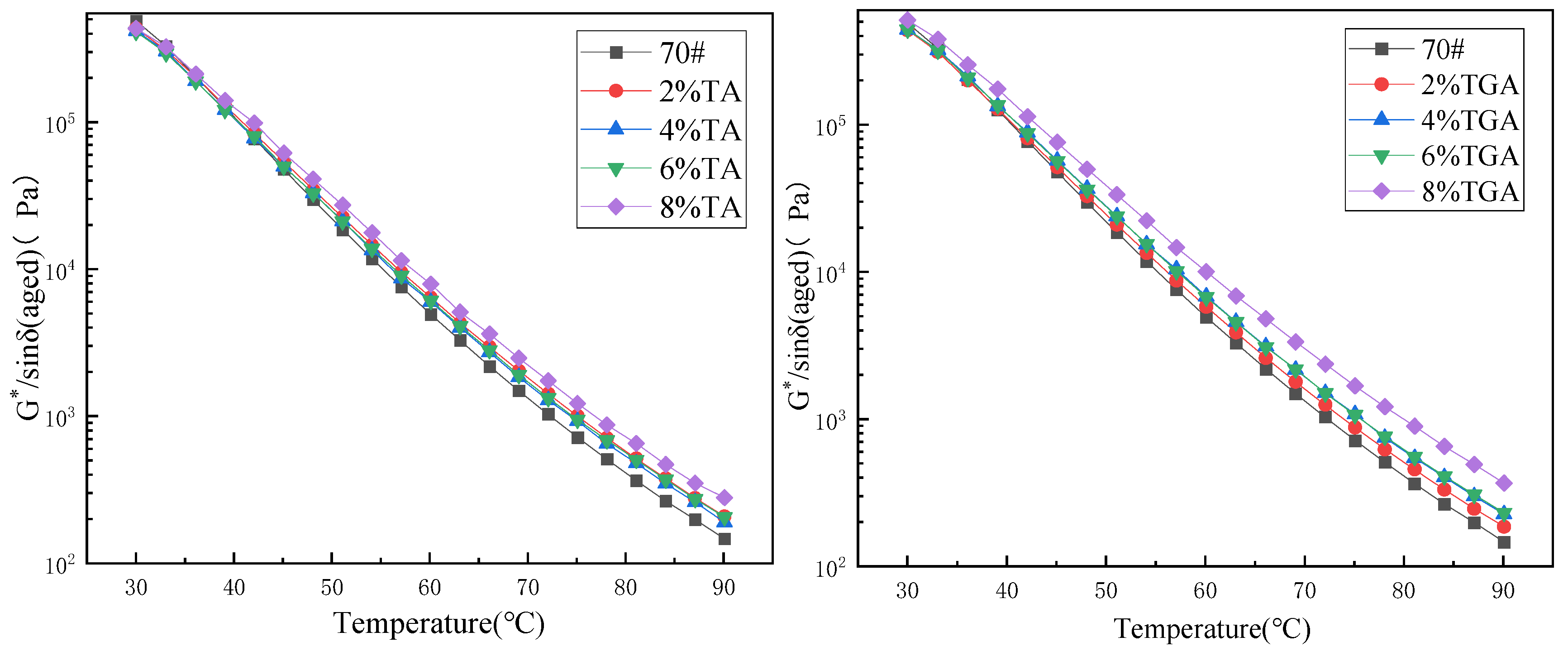
From Figure 14, the aged rutting factor G / s i n δ a g e d of TA and TGA gradually decreases with increasing temperature. The reason can be attributed to the softening effect of rising temperature on asphalt, thereby reducing the rutting resistance of asphalt. By comparing the G / s i n δ a g e d of base asphalt and modified asphalt, it can be observed that at medium and low temperatures, the G / s i n δ a g e d of base asphalt is comparable to modified asphalt. However, as the temperature gradually increases, the difference in G / s i n δ a g e d between base asphalt and modified asphalt gradually widens. This indicates that the temperature sensitivity of modified asphalt after aging is lower than that of base asphalt.
In addition, the anti-aging property of asphalt can be evaluated by comparing rutting factors before and after aging. Aging index (AI) is defined as the ratio of the rutting factor after aging to that before aging, and Table 7 presents the AI results. The smaller the AI value, the less variability in asphalt performance after aging, indicating better aging resistance. According to Table 7, the AI values of TA and TGA are obviously smaller than matrix asphalt, and they show a gradual downward trend as the modifier content increases. This indicates that both TPU and TPU/GO can enhance the anti-aging performance of asphalt. During the thermal-oxidative aging process, oxidation reactions continuously occur, and light components of asphalt continuously volatilize, which will make asphalt become harder and more brittle. The addition of TPU is equivalent to supplementing the light components of asphalt, which will delay aging process of asphalt. Furthermore, it can be observed that compared with TA, TGA has lower AI values and better anti-aging performance. Based on relevant literature [49] and the observed performance improvement in this study, it can be reasonably inferred that the abundant oxygen-containing functional groups on the GO surface enable strong interaction between GO and resin components in asphalt, which may hinder the oxidation and volatilization of light components during aging, thus contributing to the enhanced anti-aging performance.

3.8. Limitations and Future Research Directions

This study reveals the synergistic enhancement mechanism of TPU/GO on asphalt performance, which makes up for the insufficient high-temperature stability of single TPU-modified asphalt. However, there are several specific limitations in this study:
  • Modified mechanism: Although the synergistic enhancement effect of TPU and GO on asphalt performance was confirmed through macro-performance tests and micro-characterizations (FTIR, FM, SEM), the intrinsic interaction mechanism at the molecular level (e.g., the binding energy between TPU/GO and asphalt components, molecular dynamics simulation of interface behavior) was not explored.
  • Influence of other factors: The present study used only one type of base asphalt (70# pen asphalt) and fixed GO content (1.2%) in TPU/GO composites. The adaptability of TPU/GO modifiers to different types of base asphalt (e.g., 90# pen asphalt, hard asphalt) and different GO contents in TPU/GO composites for different asphalt types were not investigated.
  • Performance evaluation of mixture: This study focused on the properties of TPU/GO-modified asphalt binders, while the performance of TPU/GO-modified asphalt mixtures (e.g., Marshall stability, dynamic stability, low-temperature bending strength, and water stability) was not investigated. The binder performance does not fully represent the mixture’s actual road performance, as the interaction between TPU/GO-modified asphalt and aggregates may affect the final pavement performance.

4. Conclusions

To assess the synergistic influence of TPU and GO on the road performance of asphalt, TGA with different contents were prepared. And conventional tests, storage stability test, BBR test and DSR test were conducted. The main conclusions are as follows:
  • TPU/GO exhibits excellent compatibility with base asphalt, with its softening point difference far below the 2.5 °C specification limit after 48 h storage at 163 °C; FM and SEM results also confirm uniform dispersion of GO in the TPU matrix and asphalt.
  • TPU/GO significantly enhances asphalt’s low-temperature performance; the 5 °C ductility of 8% TGA is 440% higher than that of base asphalt, and BBR tests show decreased S and increased m value with rising content of GO, indicating excellent low-temperature stress relaxation capacity at −12 °C and −18 °C.
  • The high-temperature rutting resistance of asphalt is notably enhanced by TPU/GO; the failure temperature of 8% TPU/GO-modified asphalt is 78.57 °C, and its R 3.2 is greatly increased while J n r 3.2 is significantly reduced in the MSCR test.
  • TPU/GO endows asphalt with superior anti-aging performance, with the aging index (AI) of 8% TGA as low as 1.13–1.18 (much lower than 1.90–2.04 of base asphalt); TPU supplements light components and GO binds tightly with asphalt resin components, realizing a synergistic anti-aging effect.
  • Based on the comprehensive balance of road performance and engineering applicability, 8% is recommended as the optimal dosage of TPU/GO for asphalt modification.

Author Contributions

Conceptualization, J.D., G.L. and K.Y.; methodology, G.L. and K.Y.; validation, G.L., K.Y. and X.Z.; formal analysis, J.D. and G.L.; investigation, J.D.; resources, K.Y.; data curation, G.L.; writing—original draft preparation, J.D.; writing—review and editing, G.L., K.Y. and X.Z.; visualization, G.L.; supervision, X.Z.; project administration, K.Y. All authors have read and agreed to the published version of the manuscript.

Funding

This research received no external funding.

Institutional Review Board Statement

Not applicable.

Informed Consent Statement

Not applicable.

Data Availability Statement

The original contributions presented in this study are included in the article. Further inquiries can be directed to the corresponding author.

Conflicts of Interest

Author Jiang Du was employed by the Guichen Branch, Hunan Expressway Group Co., Ltd., Xiaowen Zhao was employed by the Hunan Provincial Communications Planning, Survey & Design Institute Co., Ltd. The remaining authors declare that the research was conducted in the absence of any commercial or financial relationships that could be construed as a potential conflict of interest.

Abbreviations

The following abbreviations are used in this manuscript:
TPUThermoplastic Polyurethane
GOGraphene Oxide
FMFluorescence microscopy
SEMEmission scanning electron microscope
TAThermoplastic Polyurethane modified asphalt
TGAThermoplastic Polyurethane/Graphene Oxide modified asphalt
FTIRFourier transform infrared
BBRBending beam rheometer
DSRDynamic shear rheometer
MSCRMultiple stress creep recovery

References

  1. Wu, H.; Yang, M.; Song, W.; Wu, Z.; Chen, D.; Chen, X. Mechanical and rheological properties of polyurethane-polyurea (PU-PUa) modified asphalt binder. Constr. Build. Mater. 2024, 411, 134798. [Google Scholar] [CrossRef]
  2. Li, G.; Wang, M.; Yan, K.; Song, X. Study on the Self-Healing Performance of Polyurethane/Graphene Oxide-Modified Asphalt Based on Dynamic Disulfide Bonds. Materials 2025, 18, 2549. [Google Scholar] [CrossRef] [PubMed]
  3. Cai, L.; Shi, X.; Xue, J. Laboratory evaluation of composed modified asphalt binder and mixture containing nano-silica/rock asphalt/SBS. Constr. Build. Mater. 2018, 172, 204–211. [Google Scholar] [CrossRef]
  4. Zhang, M.; Xiong, K.; Zhang, J.; Li, Y.; He, Y.; Pei, J. Evaluation of the rheological properties and aging resistance of asphalt modified by MDI/TDI polyurethane. Constr. Build. Mater. 2024, 411, 134350. [Google Scholar] [CrossRef]
  5. Liu, Q.; Yu, B.; Falchetto, A.C.; Wang, D.; Liu, J.; Bo, W. Characterization and molecular mechanism of the thermal-oxidative gradient aging behavior in asphalt films. Measurement 2022, 199, 111567. [Google Scholar] [CrossRef]
  6. Yang, Q.; Lin, J.; Wang, X.; Wang, D.; Xie, N.; Shi, X. A review of polymer-modified asphalt binder: Modification mechanisms and mechanical properties. Clean. Mater. 2024, 12, 100255. [Google Scholar] [CrossRef]
  7. Albayati, A.H.; Mohammed, A.M.; Al-Ani, A.F.; Al-Kheetan, M.J.; Moudhafar, M.M. Performance evaluation of highly modified asphalt binders using elastomeric and plastomeric polymers. Mech. Time-Depend. Mater. 2025, 29, 73. [Google Scholar] [CrossRef]
  8. Song, Y.; Li, J.; Song, G.; Li, Z.; Yang, X.; Ma, F.; Li, X. Superior strength, highly stretchable, bionic self-healing polyurethane and its composites for flexible conductivity and self-cleaning applications. Compos. Part B Eng. 2024, 280, 111457. [Google Scholar] [CrossRef]
  9. Wei, K.; Cao, X.; Tang, B.; Wu, Y.; Jiang, T. Castor oil-based polyurethane Vitrimer modified asphalts regulated by dual dynamic reversible reactions and crosslinking density: Preparation, basic assessment and self-healing behavior. Constr. Build. Mater. 2024, 429, 136430. [Google Scholar] [CrossRef]
  10. Chen, S.-Y.; Kokalari, I.; Parnell, S.R.; Smith, G.N.; Zeng, B.-H.; Way, T.-F.; Chuang, F.-S.; Rwei, A.Y. Structure Property Relationship of Micellar Waterborne Poly(Urethane-Urea): Tunable Mechanical Properties and Controlled Release Profiles with Amphiphilic Triblock Copolymers. Langmuir 2023, 39, 10033–10046. [Google Scholar] [CrossRef]
  11. Bi, Y.; Sun, M.; Jing, S.; Hou, D.; Zhuang, W.; Chen, S.; Jiao, X.; Zhao, Q. Interlaminar Shear Characteristics, Energy Consumption, and Carbon Emissions of Polyurethane Mixtures. Coatings 2022, 12, 400. [Google Scholar] [CrossRef]
  12. Jiang, W.; Zhang, M.; Ren, P.; Xing, C.; Yuan, D.; Wu, W. Development of porous asphalt mixture based on the synthesis of PTEMG and MDI polyurethane asphalt. Constr. Build. Mater. 2024, 411, 134537. [Google Scholar] [CrossRef]
  13. Li, Z.; Yang, F.; Yuan, J.; Cong, L.; Yu, M. Study on preparation and pavement performance of polyurethane modified asphalt based on in-situ synthesis method. Constr. Build. Mater. 2021, 309, 125196. [Google Scholar] [CrossRef]
  14. Khedaywi, T.; Haddad, M.; Bataineh, H. Effect of waste plastic polyethylene terephthalate on properties of asphalt cement. Innov. Infrastruct. Solut. 2023, 8, 232. [Google Scholar] [CrossRef]
  15. Khedaywi, T.; Baker, M.B.; Haddad, M.; Bataineh, H. Effect of Waste Plastic Polyethylene Terephthalate on Properties of Asphalt Concrete Mixtures. Int. J. Pavement Res. Technol. 2024, 17, 280–290. [Google Scholar] [CrossRef]
  16. Fernández, C.; Bermúdez, M.; Versteegen, R.; Meijer, E.; Vancso, G.; Muñoz-Guerra, S. An overview on 12-polyurethane: Synthesis, structure and crystallization. Eur. Polym. J. 2010, 46, 2089–2098. [Google Scholar] [CrossRef]
  17. Izquierdo, M.; Navarro, F.; Martínez-Boza, F.; Gallegos, C. Bituminous polyurethane foams for building applications: Influence of bitumen hardness. Constr. Build. Mater. 2012, 30, 706–713. [Google Scholar] [CrossRef]
  18. Wang, M.; Liu, J.; Yan, K. Research on the performance and mechanism of asphalt modified by thermoplastic polyurethane with different chemical structures. Constr. Build. Mater. 2023, 409, 133814. [Google Scholar] [CrossRef]
  19. Zhang, L.; Li, P.; Hu, G.; Zhang, S.; Hong, B.; Wang, H.; Wang, D.; Oeser, M. Study on the aging resistance of polyurethane precursor modified bitumen and its mechanism. Sustainability 2021, 13, 9520. [Google Scholar] [CrossRef]
  20. Li, X.; Li, J.; Wang, J.; Yuan, J.; Jiang, F.; Yu, X.; Xiao, F. Recent applications and developments of Polyurethane materials in pavement engineering. Constr. Build. Mater. 2021, 304, 124639. [Google Scholar] [CrossRef]
  21. Lu, J.; Xu, S.; Li, C.; Fu, C.; Gao, M.; Wang, Z.; Yang, F.; Zhou, G.; Li, R.; Ling, T. The latest research progress of polyurethane modified asphalt binder: Synthesis, characterization, and applications. Int. J. Adhes. Adhes. 2025, 140, 104035. [Google Scholar] [CrossRef]
  22. Yang, X.; Hong, J.; Xiong, Z.; Liu, W.; Gong, M.; Cheng, J.; Xu, Z.; Fu, C. Performance of PTMEG/CO composite polyurethane and modification mechanism of polyurethane-modified asphalt. Constr. Build. Mater. 2025, 475, 141117. [Google Scholar] [CrossRef]
  23. Kim, H.H.; Mazumder, M.; Lee, S.-J.; Lee, M.-S. Laboratory Evaluation of Sustainable PMA Binder Containing Styrene-Isoprene-Styrene (SIS) and Thermoplastic Polyurethane. Sustainability 2020, 12, 10057. [Google Scholar] [CrossRef]
  24. Jin, X.; Guo, N.; You, Z.; Wang, L.; Wen, Y.; Tan, Y. Rheological properties and micro-characteristics of polyurethane composite modified asphalt. Constr. Build. Mater. 2020, 234, 117395. [Google Scholar] [CrossRef]
  25. Shen, X.; Chen, L.; Ma, Y.; Li, Z.; Liang, B.; Zhang, Y.-F. Preparation and performance study of commercial polyurethane-modified asphalt. Polym. Bull. 2025, 83, 179. [Google Scholar] [CrossRef]
  26. Yan, K.; Yuan, J.; Wang, M.; Ge, D.; Hong, Z. Preparation process and performance of thermoplastic polyurethane/amorphous poly alpha olefin compound modified bitumen. J. Clean. Prod. 2022, 352, 131562. [Google Scholar] [CrossRef]
  27. Zhang, Z.; Sun, J.; Jia, M.; Ban, X.; Wang, L.; Chen, L.; Huang, T.; Liu, H. Effects of Polyurethane Thermoplastic Elastomer on Properties of Asphalt Binder and Asphalt Mixture. J. Mater. Civ. Eng. 2021, 33, 04020477. [Google Scholar] [CrossRef]
  28. Han, M.; Muhammad, Y.; Wei, Y.; Zhu, Z.; Huang, J.; Li, J. A review on the development and application of graphene based materials for the fabrication of modified asphalt and cement. Constr. Build. Mater. 2021, 285, 122885. [Google Scholar] [CrossRef]
  29. Li, T.; Jiang, K.; Liu, K.; Li, Q. Fourier transform infrared spectroscopy characterization of aging properties of graphene oxide modified asphalt binder. Int. J. Adhes. Adhes. 2025, 139, 103974. [Google Scholar] [CrossRef]
  30. Zhao, Y.; Guo, R.; Li, J.; Wen, L. Research on preparation and road performance of graphene oxide framework modified asphalt and asphalt mixture based on micro-mechanism and grey correlation analysis. Constr. Build. Mater. 2025, 462, 139980. [Google Scholar] [CrossRef]
  31. Almashaqbeh, H.K.; Majdoub, M.; Sengottuvelu, D.; Nouranian, S.; Doyle, J.D.; Algharibeh, O.; Alkhateb, H.; Rushing, G.; Al-Shraideh, N.; Ucak-Astarlioglu, M.G.; et al. Efficacy of octadecylamine-functionalized graphene versus graphene nanoplatelets and graphene oxide as asphalt binder modifiers for high-temperature performance. Mater. Struct. 2025, 58, 44. [Google Scholar] [CrossRef]
  32. Singh, D.; Kuity, A.; Girimath, S.; Suchismita, A.; Showkat, B. Investigation of Chemical, Microstructural, and Rheological Perspective of Asphalt Binder Modified with Graphene Oxide. J. Mater. Civ. Eng. 2020, 32, 04020323. [Google Scholar] [CrossRef]
  33. Duan, S.; Li, J.; Muhammad, Y.; Su, Z.; Meng, F.; Yang, H.; Yao, X. Synthesis and evaluation of high-temperature properties of butylated graphene oxide composite incorporated SBS (C4H9-GO/SBS)-modified asphalt. J. Appl. Polym. Sci. 2019, 136, 48231. [Google Scholar] [CrossRef]
  34. Han, M.; Zeng, X.; Muhammad, Y.; Li, J.; Yang, J.; Yang, S.; Wei, Y.; Meng, F. Preparation of Octadecyl Amine Grafted over Waste Rubber Powder (ODA-WRP) and Properties of Its Incorporation in SBS-Modified Asphalt. Polymers 2019, 11, 665. [Google Scholar] [CrossRef]
  35. Yuliani, S.; Hidayat, T.; Wahyuningsih, K.; Hoerudin. Surface Modification of Nano-Biosilica Extracted from Rice Husk using A Silane Coupling Agent. In IOP Conference Series: Earth and Environmental Science; IOP Publishing: Bristol, UK, 2021; Volume 752, p. 012053. [Google Scholar]
  36. Golestani, B.; Nam, B.H.; Nejad, F.M.; Fallah, S. Nanoclay application to asphalt concrete: Characterization of polymer and linear nanocomposite-modified asphalt binder and mixture. Constr. Build. Mater. 2015, 91, 32–38. [Google Scholar] [CrossRef]
  37. Tang, X.-Z.; Mu, C.; Zhu, W.; Yan, X.; Hu, X.; Yang, J. Flexible polyurethane composites prepared by incorporation of polyethylenimine-modified slightly reduced graphene oxide. Carbon 2016, 98, 432–440. [Google Scholar] [CrossRef]
  38. JTG E20-2011; Standard Test Methods of Bitumen and Bituminous Mixtures for Highway Engineering. China Communication Press: Beijing, China, 2011.
  39. Yan, K.; Chen, J.; You, L.; Tian, S. Characteristics of Compound Asphalt Modified by Waste Tire Rubber (WTR) and Ethylene Vinyl Acetate (EVA): Conventional, Rheological, and Microstructural Properties. J. Clean. Prod. 2020, 258, 120732. [Google Scholar] [CrossRef]
  40. ASTM D2493/D2493M-24; Standard Practice for Viscosity-Temperature Chart for Asphalt Binders. ASTM International: West Conshohocken, PA, USA, 2024.
  41. JTG F40-2004; Technical Specification for Construction of Highway Asphalt Pavements. China Communication Press: Beijing, China, 2004.
  42. Li, G.; Xiao, P.; Hou, S.; Huang, Y. Rapid and efficient polymer/graphene based multichannel self-healing material via Diels-Alder reaction. Carbon 2019, 147, 398–407. [Google Scholar] [CrossRef]
  43. Liu, M.; Zhong, J.; Li, Z.; Rong, J.; Yang, K.; Zhou, J.; Shen, L.; Gao, F.; Huang, X.; He, H. A high stiffness and self-healable polyurethane based on disulfide bonds and hydrogen bonding. Eur. Polym. J. 2020, 124, 109475. [Google Scholar] [CrossRef]
  44. Guo, T.; Li, Z.; Chen, Y.; Xu, Q.; Wang, J.; Jin, L. Study on the performance and mechanism of graphene oxide/polyurethane composite modified asphalt. Sci. Rep. 2025, 15, 2482. [Google Scholar] [CrossRef]
  45. Lu, P.; He, C.; Wang, J.; Wu, Y.; Ding, J. Polyurethane-modified asphalt mechanism. Case Stud. Constr. Mater. 2025, 22, e04247. [Google Scholar] [CrossRef]
  46. AASHTO M 332; Standard Specification for Performance-Graded Asphalt Binder Using Multiple Stress Creep Recovery (MSCR) Test. American Association of State Highway and Transportation Officials: Washington, DC, USA, 2023.
  47. Li, Y.; Meng, Y.; Pei, J.; Lyu, L.; Hu, D. Self-healing performance and rheological properties of styrene-butadiene-styrene block copolymer modified asphalt promoted by polyurea elastomers containing disulfide bonds. Constr. Build. Mater. 2024, 421, 135747. [Google Scholar] [CrossRef]
  48. AASHTO M 320; Standard Specification for Performance-Graded Asphalt Binder. American Association of State Highway and Transportation Officials: Washington, DC, USA, 2023.
  49. Wang, Q.; Yu, R.; Cai, L.; Chen, X.; Zhu, X.; Xiao, Y.; Zhang, X.; Zhou, X.; Fang, C. Aging resistance of polyurethane/graphene oxide composite modified asphalt: Performance evaluation and molecular dynamics simulation. Mol. Simul. 2022, 49, 298–313. [Google Scholar] [CrossRef]
Figure 1. Appearance of raw materials.
Materials 19 00857 g001
Figure 2. The reaction mechanism of TPU/GO.
Materials 19 00857 g002
Figure 3. Flow chart.
Materials 19 00857 g003
Figure 4. FTIR test results.
Materials 19 00857 g004
Figure 5. Storage stability test results.
Materials 19 00857 g005
Figure 6. FM test results.
Materials 19 00857 g006
Figure 7. SEM test results.
Materials 19 00857 g007
Figure 8. Test results of basic performance.
Materials 19 00857 g008
Figure 9. Rotation viscosity test results.
Materials 19 00857 g009
Figure 10. BBR test results at −12 °C and −18 °C.
Materials 19 00857 g010
Figure 11. MSCR test results at 58 °C and 64 °C.
Materials 19 00857 g011
Figure 12. Test results of complex modulus and phase angle.
Materials 19 00857 g012
Figure 13. Test results of rutting factors and failure temperature.
Materials 19 00857 g013
Figure 14. Test results of rutting factors after TFOT aging.
Materials 19 00857 g014
Table 1. Basic properties and requirements of base asphalt.
IndexUnitTest ResultsRequirementTest Method
Penetration   ( 25   ° C ,   100   g ,   5   s )0.1 mm6660–80T 0.604-201.1
S o f t e n i n g   p o i n t   ( R . & . B ) °C46.5>46T 0.606-201.1
Ductility   ( 5   ° C ,   5   cm / min ) cm7.5T 0.605-201.1
Ductility   ( 10   ° C ,   5   cm / min ) cm44.2>25T 0.605-201.1
Ductility ( 15   ° C ,   5   cm / min ) cm>150>100T 0.605-201.1
Viscosity   ( 135   ° C ) cp490T 0.625-201.1
Density (25 °C) g / c m 3 1.033
Table 2. Relevant physical properties of TPU raw material.
Molecular Weight Density   ( g / c m 3 ) Melting Point (°C)CAS NumberSupplierPurity
P T M E G 20000.9723325190-06-1Macklin
I P D I 2221.062−604098-71-9Macklin≥99.9%
D P A 2101.4521561119-62-6Macklin≥99%
D B T D L 6311.0661677-58-7Macklin≥95%
D M F 730.948−6168-12-2Macklin≥99.9%
Table 3. Relevant properties of TPU and TPU/GO.
Hard Segment Content (%)Molecular Weight Density   ( g / c m 3 ) Melting Point (°C)
TPU2056,1211.027112
TPU/GO2036,2851.029128
Table 4. Formula of modified asphalt.
AbbreviationNaming ExplanationTPU Content (%)TPU/GO Content (%)GO Content (%)
BABase asphalt000
2%TA2% TPU-modified asphalt2%00
4%TA4% TPU-modified asphalt4%00
6%TA6% TPU-modified asphalt6%00
8%TA8% TPU-modified asphalt8%00
2%TGA2% TPU/GO-modified asphalt02%0.024%
4%TGA4% TPU/GO-modified asphalt04%0.048%
6%TGA6% TPU/GO-modified asphalt06%0.072%
8%TGA8% TPU/GO-modified asphalt08%0.096%
Table 5. FTIR peak assignments and corresponding functional groups.
Wavenumber   ( c m 1 ) Functional Group
3440The vibration of –OH [42].
3328The vibration of –NH [43].
2942 and 2853Symmetric and antisymmetric stretching vibrations of C H 2 [26,43,44].
1720The vibration of C=O [43,45].
1457 and 1376The plane stretching vibration of C–H in C H 3 [26].
1101The vibration of C–O–C [45].
Table 6. The VTS calculation results.
Asphalt Type135 °C Rotational Viscosity (cp)155 °C Rotational Viscosity (cp)175 °C Rotational Viscosity (cp)VTS
Base asphalt49221090.2−1.22849
2%TA502.3220.592.2−1.22181
4%TA523.5231.198.3−1.19347
6%TA539.4240.5103.5−1.16898
8%TA568.6255112.1−1.13575
2%TGA533.6244.399.2−1.19629
4%TGA554.2250.4105.3−1.17063
6%TGA621.6258.4121.2−1.12845
8%TGA679.3277.5128.5−1.13458
Table 7. The AI indices of modified asphalt.
Asphalt Type48 °C54 °C60 °C66 °C72 °C
Base asphalt2.042.011.961.931.90
2%TA1.321.341.361.391.40
4%TA1.301.311.291.351.33
6%TA1.221.251.271.281.26
8%TA1.231.211.231.241.25
2%TGA1.321.301.301.291.30
4%TGA1.291.311.291.281.28
6%TGA1.211.221.191.181.19
8%TGA1.131.151.181.171.15
Disclaimer/Publisher’s Note: The statements, opinions and data contained in all publications are solely those of the individual author(s) and contributor(s) and not of MDPI and/or the editor(s). MDPI and/or the editor(s) disclaim responsibility for any injury to people or property resulting from any ideas, methods, instructions or products referred to in the content.