Development of a Three-Dimensional Geometric Model of Multi-Structured Woven Fabrics Using Spun Yarns for Theoretical Air Permeability Prediction

Abstract
1. Introduction
2. Materials and Computational Methodology
2.1. Materials
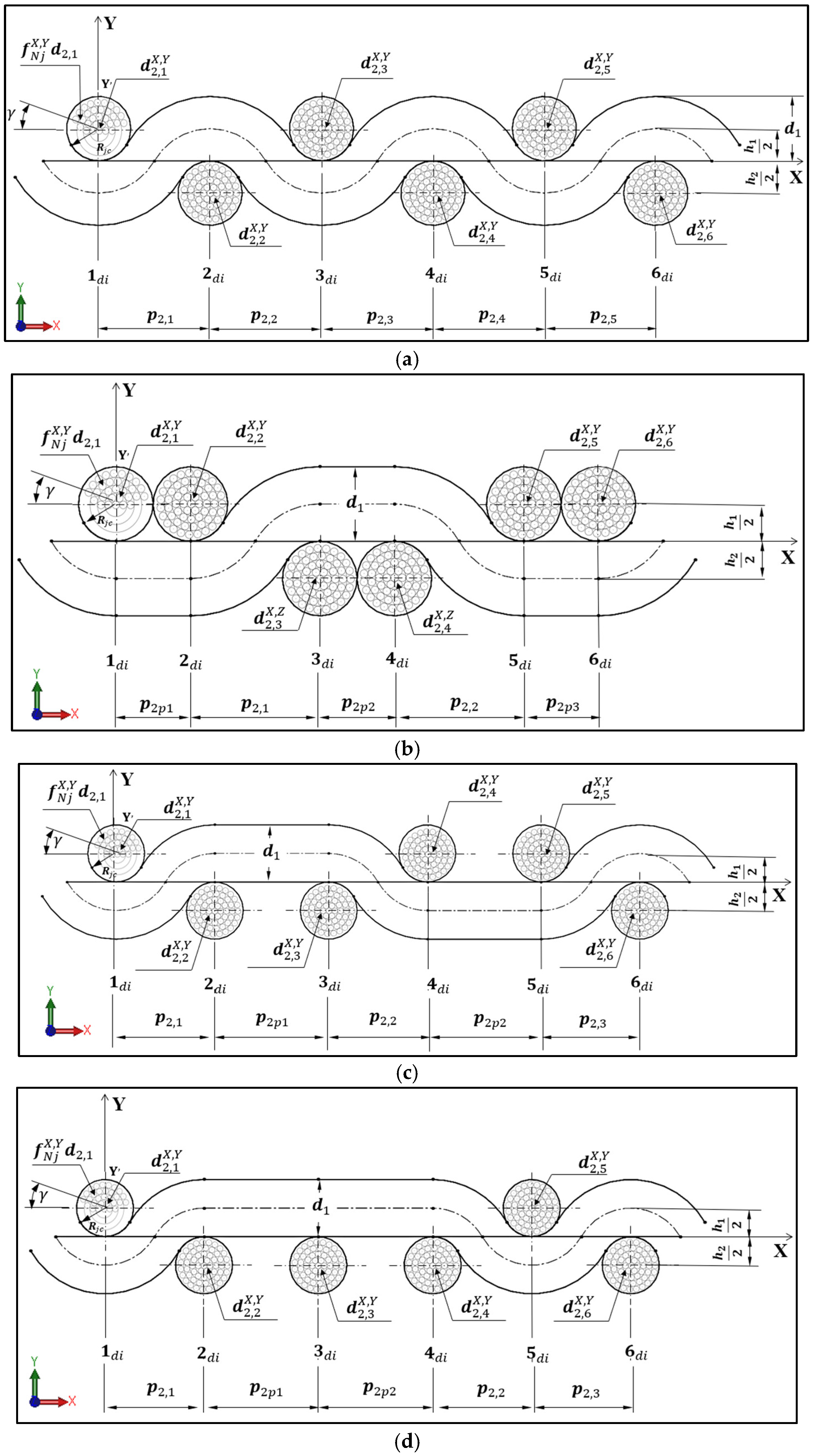
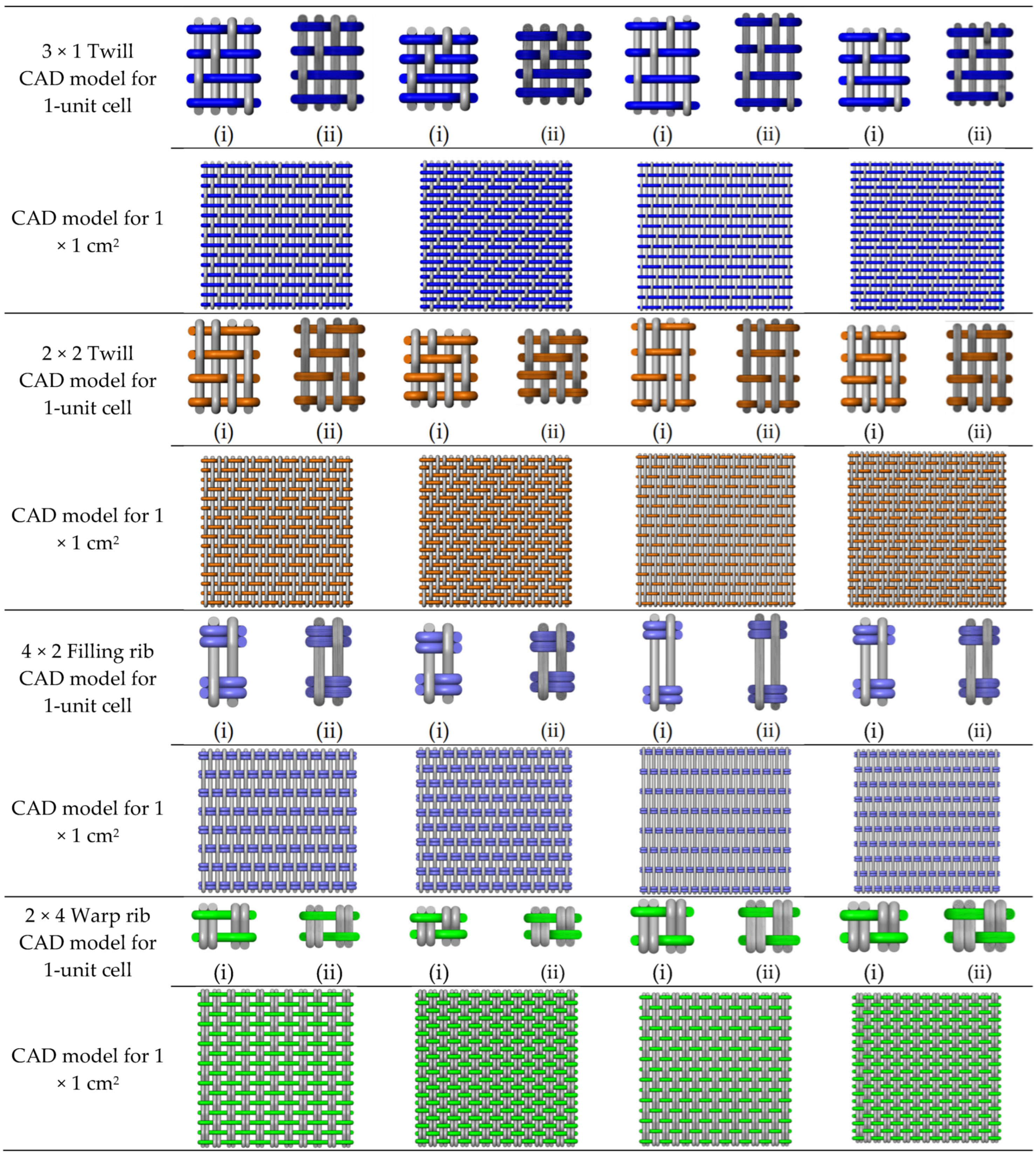
2.2. CAD Modeling of Woven Fabrics
2.3. CFD Analysis
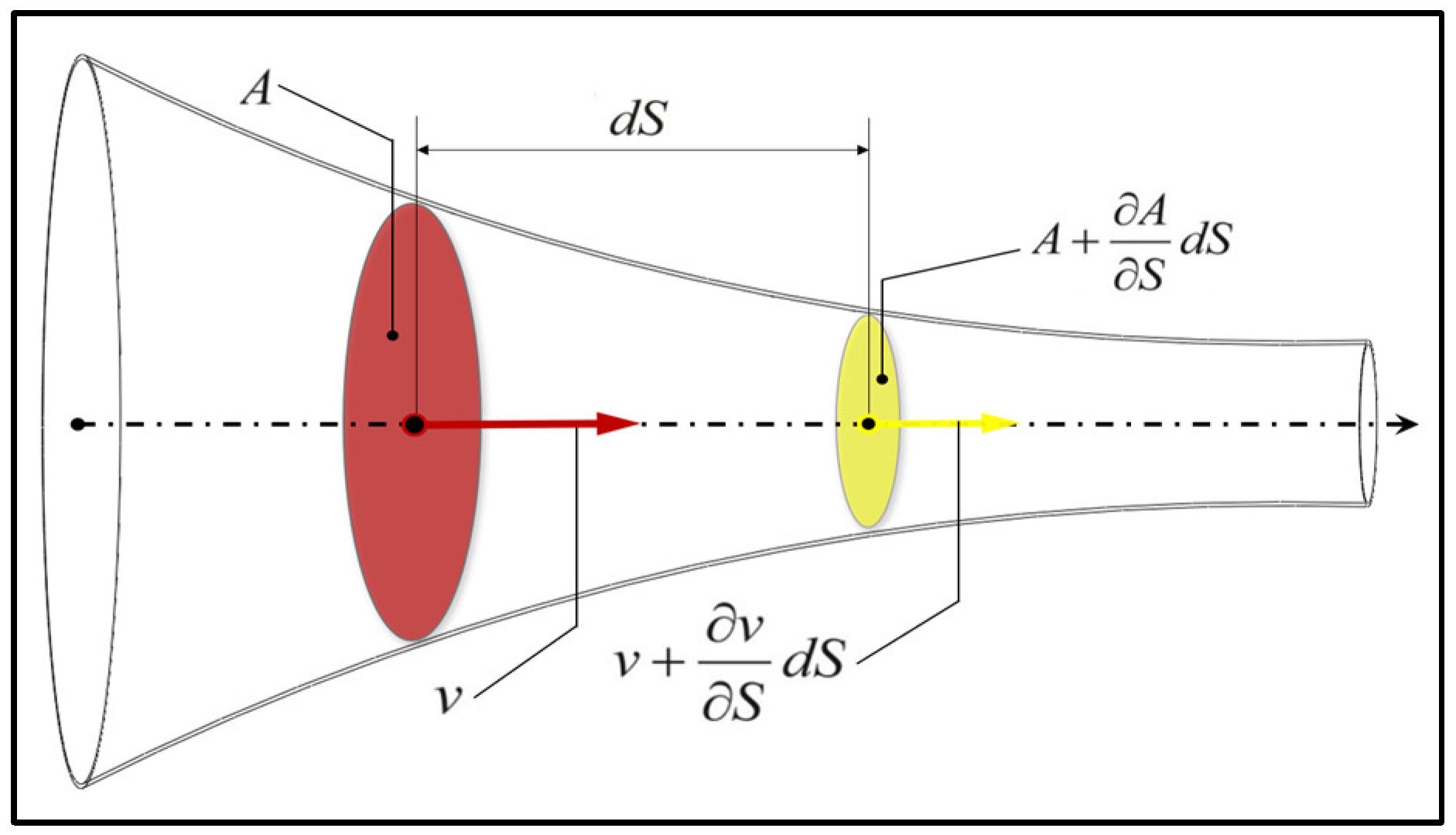
2.3.1. Equations Describing the Fluid Flow
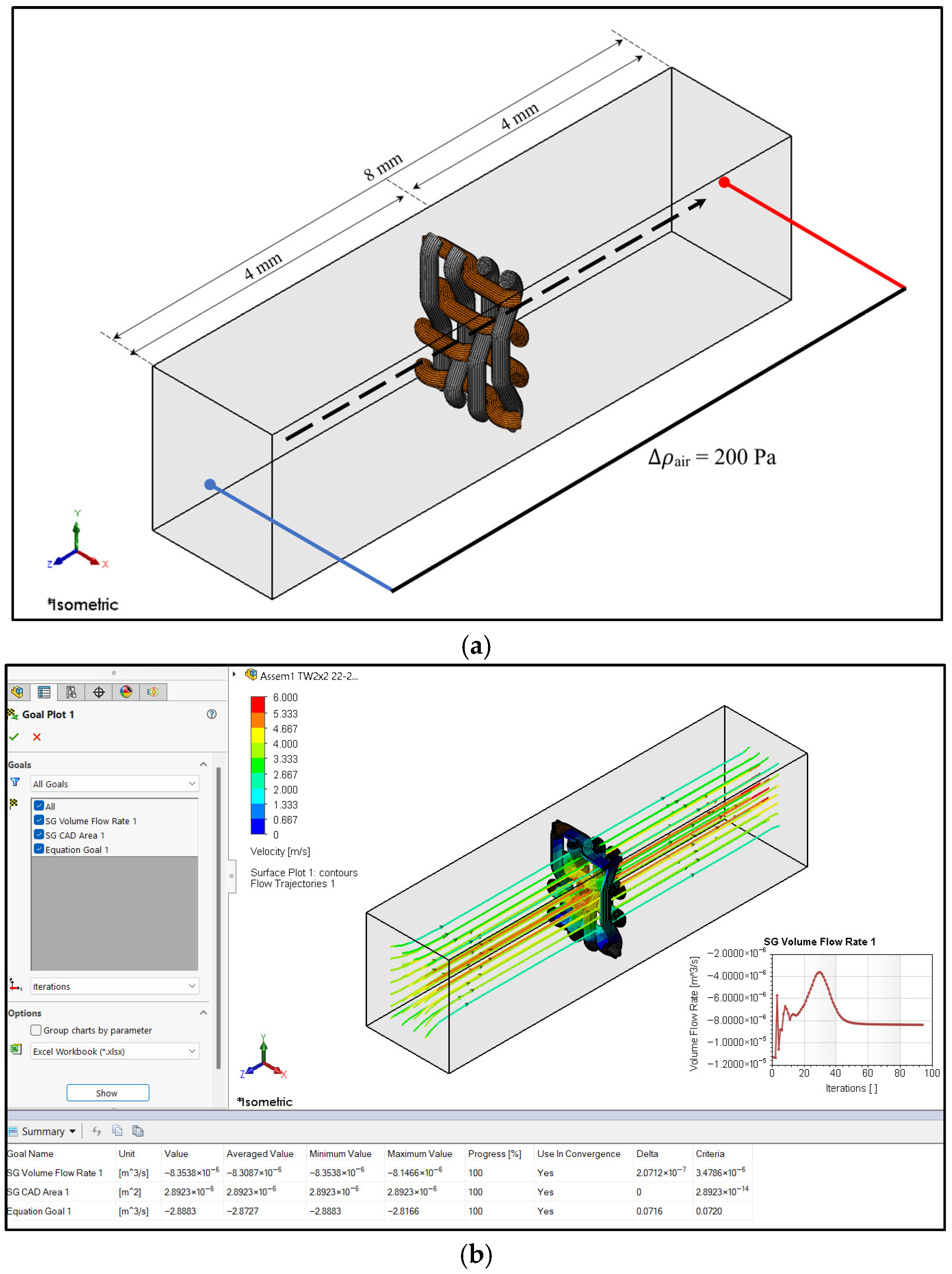
2.3.2. Boundary Conditions and Numerical Setup of Airflow Simulations
- Inlet: Pressure inlet, ΔP = 200 Pa;
- Outlet: Environmental static pressure (0 gauge);
- Lateral faces: Periodic boundary condition;
- Yarn surfaces: Impermeable no-slip wall;
- Fluid: Incompressible air at 298 K;
- Gravity: Neglected;
- Flow regime: Steady-state.
3. Results and Discussion
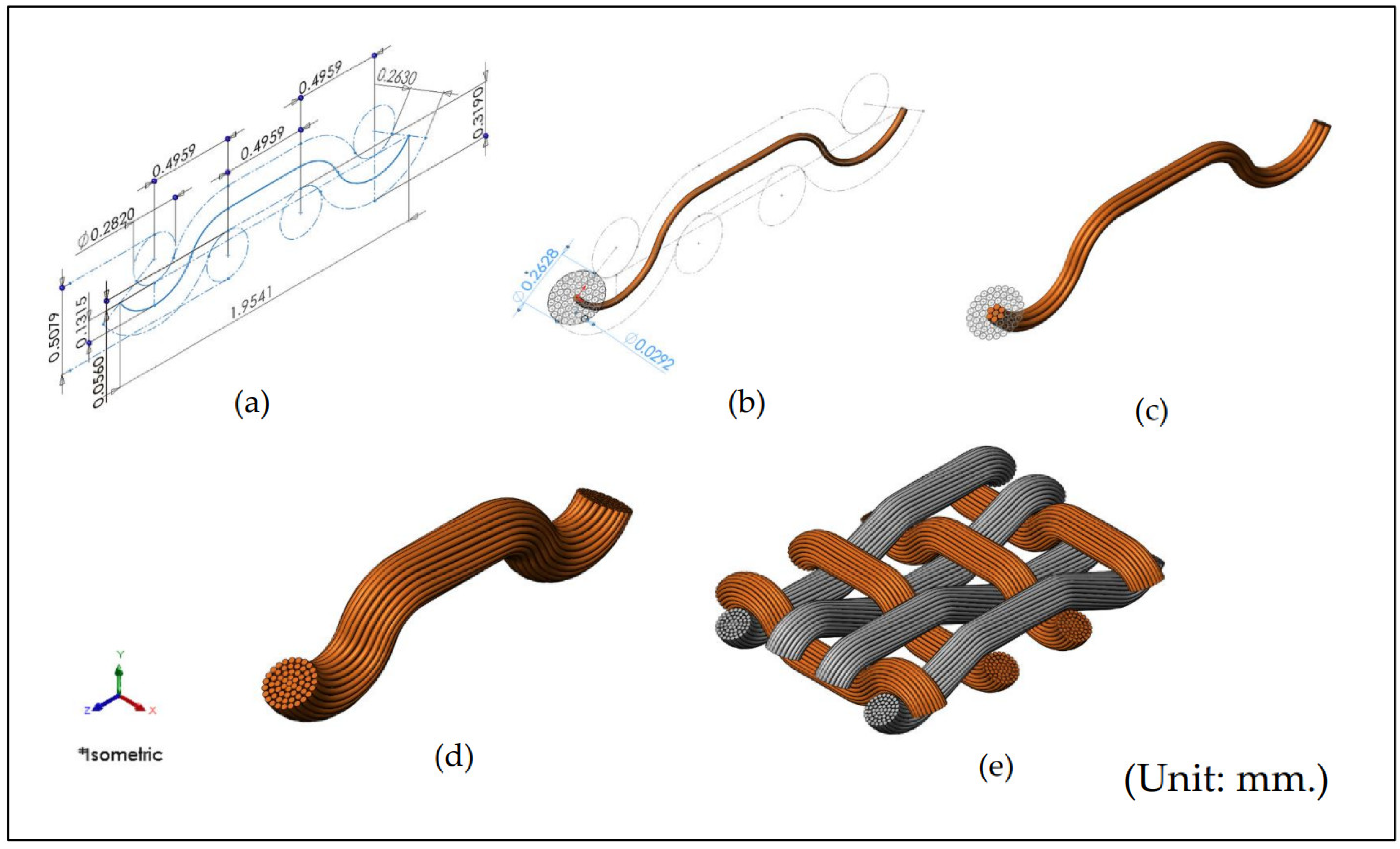
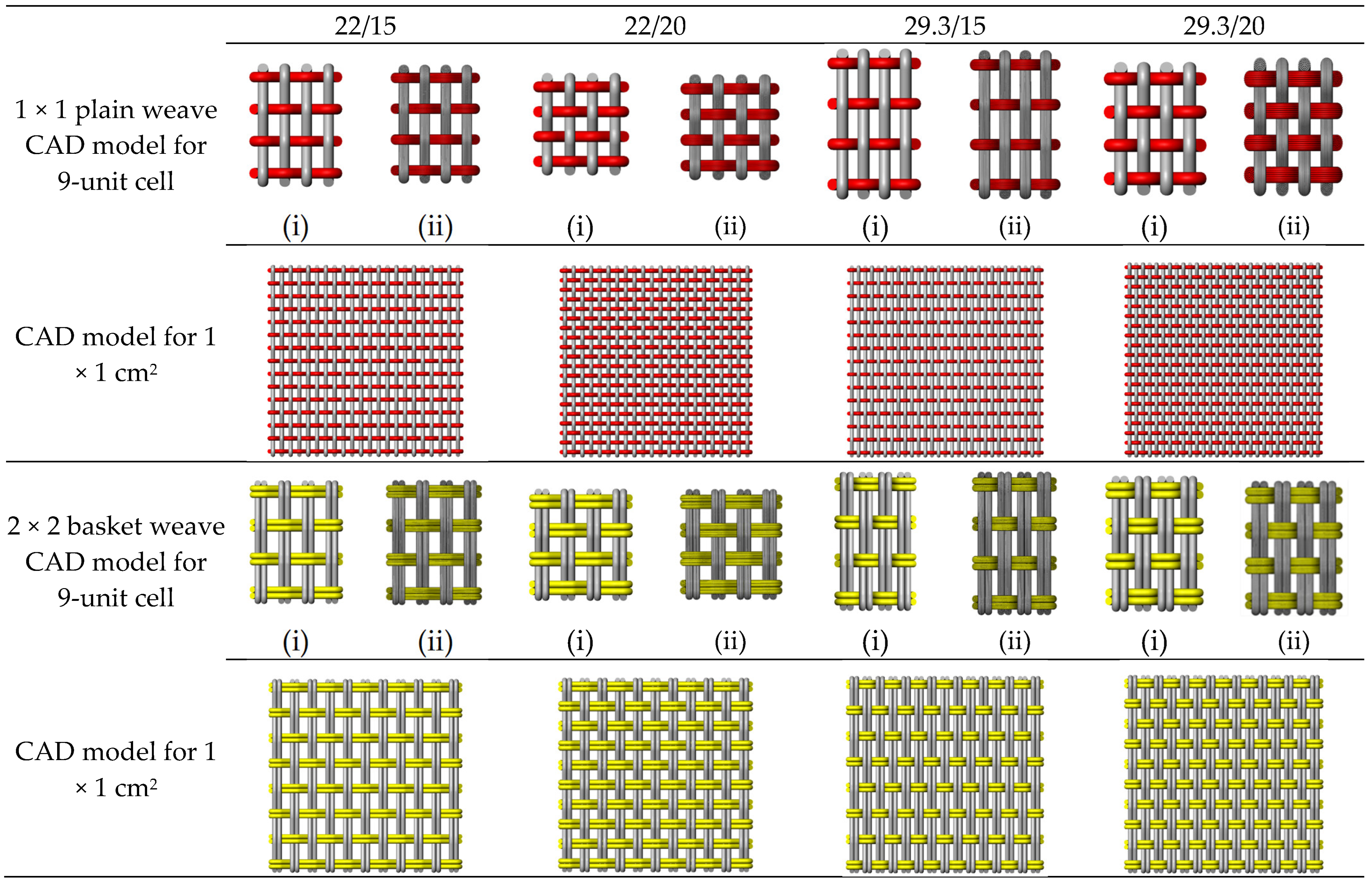
3.1. CAD Model
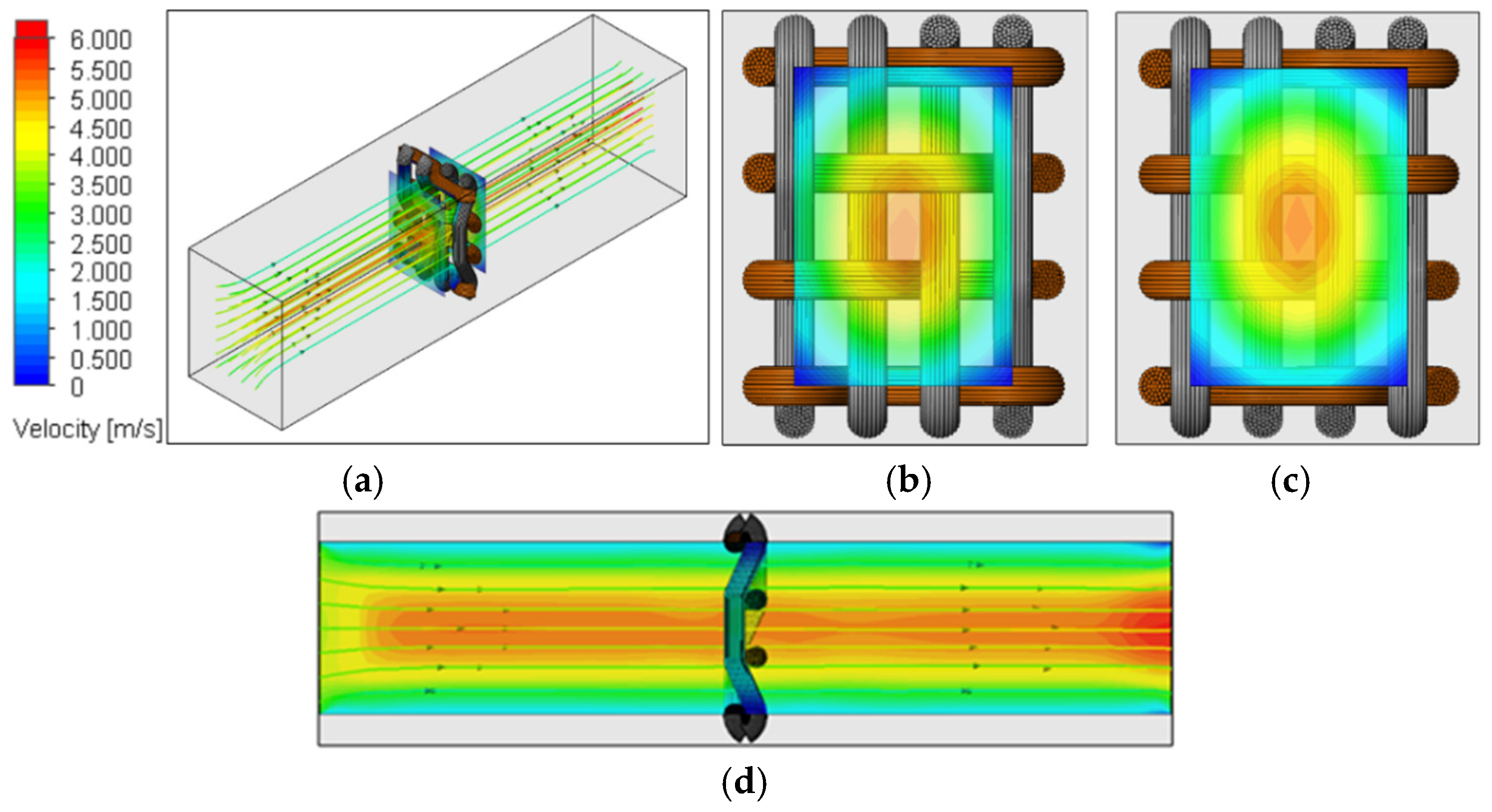
3.2. CFD Model
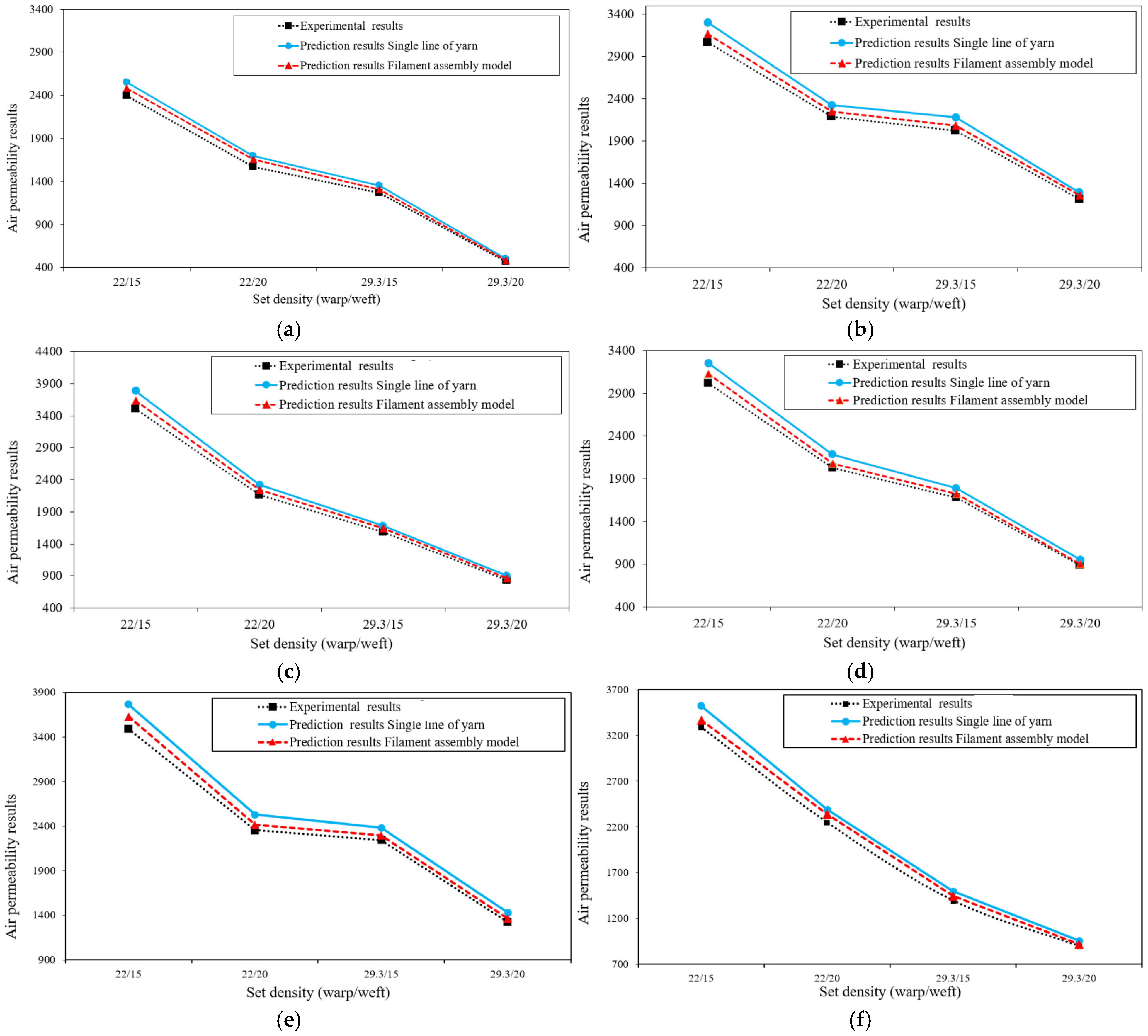
3.3. Statistical Assessment of Air Permeability Prediction
3.4. Discussion
4. Conclusions
Author Contributions
Funding
Data Availability Statement
Conflicts of Interest
References
- Ielina, T.; Halavska, L.; Mikucioniene, D.; Milasius, R.; Bobrova, S.; Dmytryk, O. Development of 3D Models of Knits from Multi-Filament Ultra-Strong Yarns for Theoretical Modelling of Air Permeability. Materials 2021, 14, 3489. [Google Scholar] [CrossRef] [PubMed]
- Burleigh, E.G.; Wakeham, H.J.R.; Honold, E.; Skau, E.L. Pore-size distribution in textiles. Text. Res. J. 1949, 19, 547–555. [Google Scholar] [CrossRef]
- Backer, S. The relationship between the structural geometry of a textile fabric and its physical properties: Part IV: Interstice geometry and air permeability. Text. Res. J. 1951, 21, 703–714. [Google Scholar] [CrossRef]
- Penner, S.E.; Robertson, A.F. Flow through fabric-like structures. Text. Res. J. 1951, 21, 775–778. [Google Scholar] [CrossRef]
- Kulichenco, A.V.; Langenhove, L.V. The resistance to flow transmission of porous materials. J. Text. Inst. 1992, 83, 127–132. [Google Scholar] [CrossRef]
- Lu, W.M.; Tung, K.L.; Hwang, K.J. Fluid flow through basic weaves of monofilament filter cloth. Text. Res. J. 1996, 66, 311–323. [Google Scholar] [CrossRef]
- Gooijer, H.; Warmoeskerken, M.M.C.G.; Wassink, J.G. Flow resistance of textile materials: Part II: Multifilament fabrics. Text. Res. J. 2003, 73, 480–484. [Google Scholar] [CrossRef]
- Xu, G.; Wang, F. Prediction of the Permeability of Woven Fabrics. J. Ind. Text. 2005, 34, 243–254. [Google Scholar] [CrossRef]
- Zupin, Ž.; Hladnik, A.; Dimitrovski, K. Prediction of one-layer woven fabrics air permeability using porosity parameters. Text. Res. J. 2012, 82, 117–128. [Google Scholar] [CrossRef]
- Havlová, M. Air Permeability and Constructional Parameters of Woven Fabrics. Fibres Text. East. Eur. 2013, 21, 84–89. [Google Scholar]
- Havlová, M. Detection of fabric structure irregularities using air permeability measurements. J. Eng. Fibers Fabr. 2014, 9, 157−164. [Google Scholar] [CrossRef]
- Havlová, M. Model of vertical porosity occurring in woven fabrics and its effect on air permeability. Fibres Text. East. Eur. 2014, 22, 58−63. [Google Scholar]
- Mohamad, G.A. Comparative Study of Air Permeability of Polyester/Metallic Blended Woven Fabrics. Life Sci. J. 2015, 12, 78–82. [Google Scholar]
- Keefe, M. Solid modeling of fibrous assemblies. Part I: Twisted Yarns. J. Text. Inst. 1994, 85, 338–349. [Google Scholar] [CrossRef]
- Harwood, R.J.; Liu, Z.; Grishanov, S.A.; Lomov, S.V.; Cassidy, T. Modelling of two-component yarns Part II: Creation of the Visual Images of Yarns. J. Text. Inst. 1997, 88, 385–399. [Google Scholar] [CrossRef]
- Adanur, S.; Liao, T. 3D modeling of textile composite per forms. Compos. Part B 1998, 29, 787–793. [Google Scholar]
- Goktepe, O.; Harlock, S.C. Three-dimensional computer modeling of warp knitted structures. Text. Res. J. 2002, 72, 266–272. [Google Scholar] [CrossRef]
- Jiang, Y.; Chen, X. Geometric and algebraic algorithms for modelling yarn in woven fabrics. J. Text. Inst. 2005, 96, 237–245. [Google Scholar] [CrossRef]
- Patumchat, P.; Sriprateep, K. New computer geometric modeling approach with filament assembly model for woven fabric structures. J. Text. Inst. 2019, 110, 50–60. [Google Scholar] [CrossRef]
- Sriprateep, K.; Singto, S. New computer geometric modeling approach with filament assembly model for two-ply yarns structures. J. Text. Inst. 2019, 110, 1307–1317. [Google Scholar] [CrossRef]
- Sriprateep, K.; Pattiya, A. Computer aided geometric modeling of twist fiber. J. Comput. Sci. 2009, 5, 221–225. [Google Scholar] [CrossRef][Green Version]
- Aychilie, D.B.; Kyosev, Y.; Abtew, M.A. Automatic Modeller of Textile Yarns at Fibre Level. Materials 2022, 15, 8887. [Google Scholar] [CrossRef]
- Patumchat, P.; Inthidech, S.; Srithep, Y.; Sriprateep, K. Computer geometric modeling approach with filament assembly model for 2 × 1 and 3 × 1 twill woven fabric structures. Autex Res. J. 2023, 23, 522–531. [Google Scholar] [CrossRef]
- Patumchat, P.; Sriprateep, K. Computer geometric modeling approach with filament assembly model for 2 × 2 twill woven fabrics structures. Indian J. Fibre Text. Res. 2023, 48, 132–140. [Google Scholar] [CrossRef]
- Sriprateep, K. CAD/CAE for stress–strain properties of a wide range of multifilament twisted man-made filament yarns. Text. Res. J. 2019, 89, 204–215. [Google Scholar] [CrossRef]
- Mezarciöz, S.; Mezarcioz, S.; Ogulata, R. Prediction of air permeability of knitted fabrics by means of computational fluid dynamics. Tekst. Konfeksiyon 2014, 24, 202–211. [Google Scholar]
- Dehkordi, S.S.H.; Ghane, M.; Abdellahi, S.B.; Soultanzadeh, M.B. Numerical modeling of the air permeability of knitted fabric using computational fluid dynamics (CFD) method. Fibers Polym. 2017, 18, 1804–1809. [Google Scholar] [CrossRef]
- Puszkarz, A.; Krucinska, I. Modelling of air permeability of knitted fabric using the computational fluid dynamics. AUTEX Res. J. 2018, 18, 364–376. [Google Scholar] [CrossRef]
- Ettehadi, Z.; Ajeli, S.; Soltani, P.; Zarrebini, M. Experimental and CFD Analysis of Air Permeability of Warp-knitted Structures. Fibers Polym. 2020, 21, 1362–1371. [Google Scholar] [CrossRef]
- Uralov, L.; Dadamirzayeva, S.; Abdulhayev, M. Calculation methods for modeling the air permeability of knitted fabric from multifilament yarn. AIP Conf. Proc. 2024, 3045, 030045. [Google Scholar]
- Tung, K.L.; Shiau, J.S.; Chuang, C.J.; Li, Y.-L.; Lu, W.-M. CFD analysis on fluid flow through multifilament woven filter cloths. Sep. Sci. Technol. 2002, 37, 799–821. [Google Scholar] [CrossRef]
- Kulichenko, A.V. Theoretical Analysis, Calculation, and Prediction of the Air Permeability of Textiles. Fibre Chem. 2005, 37, 371–380. [Google Scholar] [CrossRef]
- Wang, Q.; Maze, B.; Tafreshi, H.V.; Pourdeyhimi, B. A case study of simulating submicron aerosol filtration via light weight spun-bonded filter media. Chem. Eng. Sci. 2007, 62, 4871–4883. [Google Scholar]
- Angelova, R.A. Determination of the pore size of woven structures through image analysis. Cent. Eur. J. Eng. 2012, 2, 129–135. [Google Scholar] [CrossRef]
- Angelova, R.A.; Stankov, P.; Simova, I.; Kyosov, M. Computational modeling and experimental validation of the air permeability of woven structures on the basis of simulation of jet systems. Text. Res. J. 2013, 83, 1887–1895. [Google Scholar] [CrossRef]
- Kyosov, M.; Angelova, R.A.; Stankov, P. Numerical modeling of the air permeability of two layer woven structure ensembles. Text. Res. J. 2016, 86, 2067–2079. [Google Scholar] [CrossRef]
- Xie, M.; Chen, G.; Chen, C.; Zhu, M.; Li, H.; Hu, Z. Numerical simulation of air flow through micrometer-sized monofilament woven fabrics: Effect of fabric structure. J. Text. Inst. 2025, 116, 3045–3057. [Google Scholar] [CrossRef]
- Nazemi, S.; Khajavi, R.; Bagherzadeh, R. CFD and experimental studies on drag force of swimsuit fabric coated by silica nano particles. J. Text. Inst. 2022, 114, 43–54. [Google Scholar] [CrossRef]
- Riedy, R.; McQuerry, M. Thermal comfort analysis of auto-racing suits using a dynamic thermal manikin. J. Ind. Text. 2023, 53, 1–16. [Google Scholar] [CrossRef]
- Unal, P.G.; Üreyen, M.E.; Mecit, D. Predicting properties of single jersey fabrics using regression and artificial neural network models. Fibers Polym. 2012, 13, 87–95. [Google Scholar] [CrossRef]
- ISO 9237:1995; Textiles—Determination of the Permeability of Fabrics to Air. International Organization for Standardization (ISO): Geneva, Switzerland, 1995.
- Montgomery, D.C.; Runger, G.C. Applied Statistics and Probability for Engineers, 5th ed.; John Wiley & Son Inc.: New York, NY, USA, 2011. [Google Scholar]
- Sriprateep, K.; Patumchat, P.; Theansuwan, W. Application of Taguchi Method in the Optimization of Cutting Parameters for Turning Metal Matrix Composite. Adv. Mater. Res. 2011, 189–193, 3056–3060. [Google Scholar] [CrossRef]
- Songsorn, K.; Sriprateep, K.; Rittidech, S. Grey–Taguchi method to optimize the percent zinc coating balances edge joints for galvanized steel sheets using metal inert gas pulse brazing process. Adv. Mech. Eng. 2016, 8, 1–14. [Google Scholar] [CrossRef]




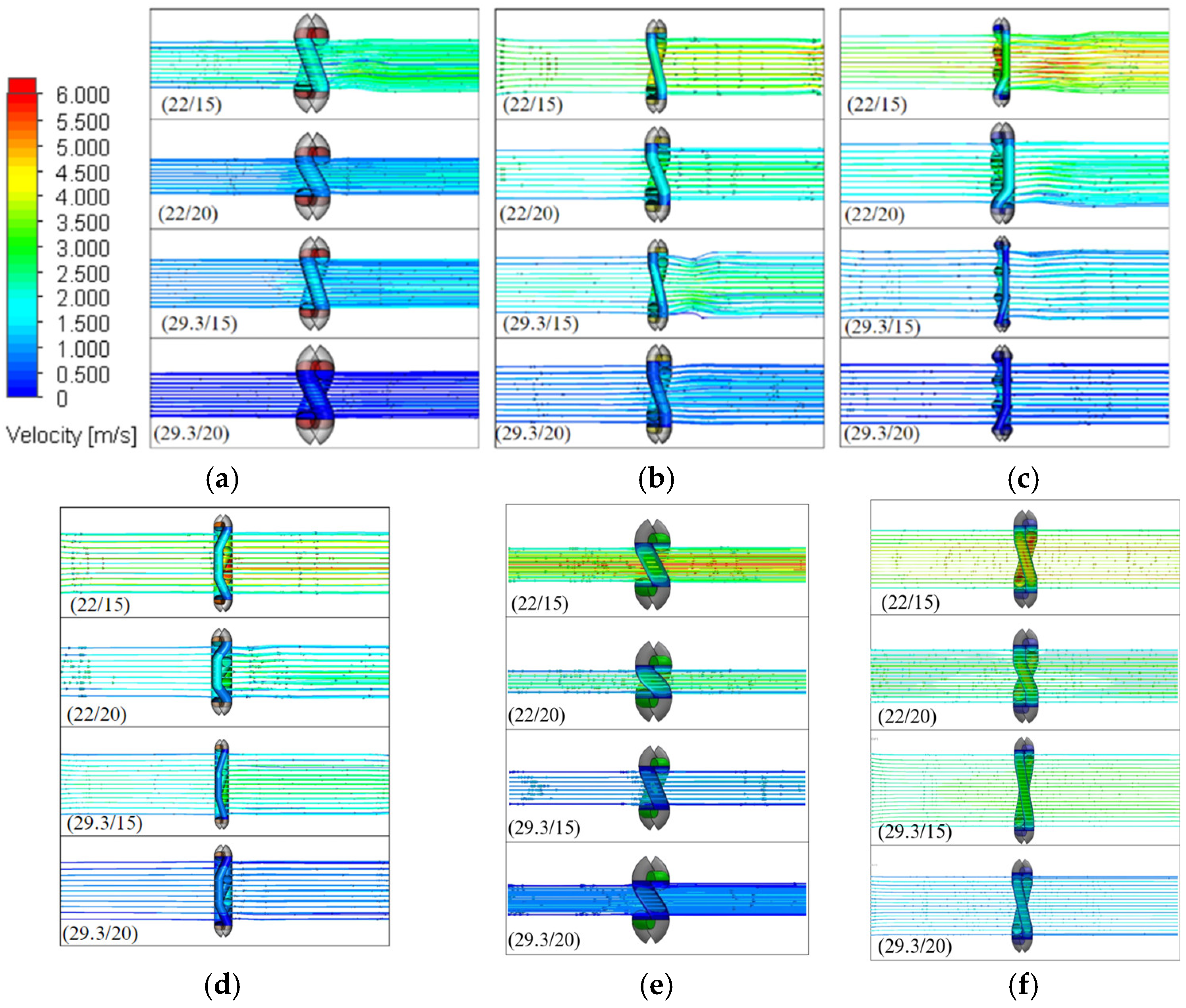
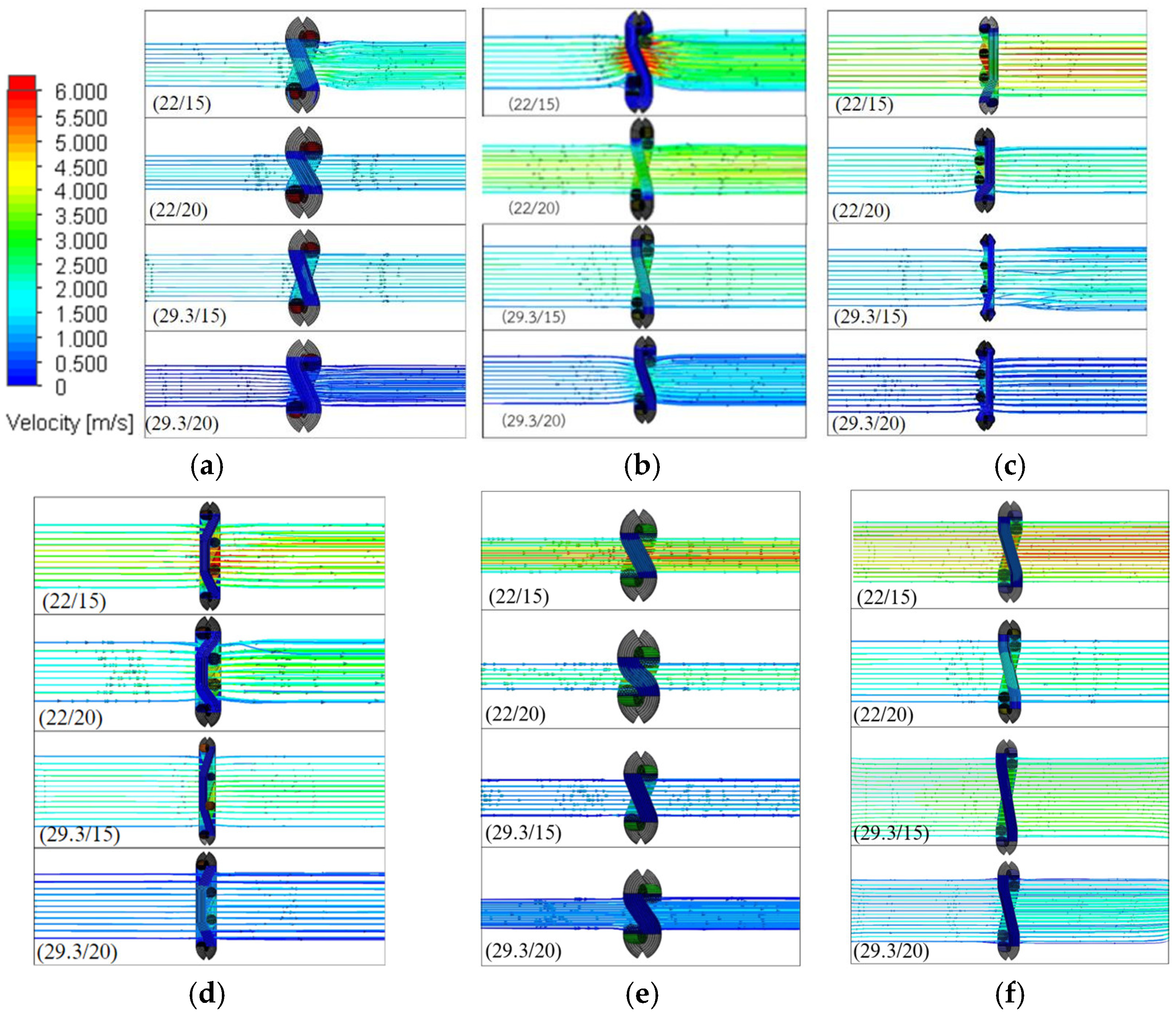


| Sample | Type of Weave | Set Density (Warp/Weft) | Mass (g/m2) | Thickness (mm) |
|---|---|---|---|---|
| 1 | Plain weave | 22/15 | 143.91 | 0.439 |
| 2 | (1 × 1 PL) | 22/20 | 166.59 | 0.438 |
| 3 | 29.3/15 | 180.41 | 0.468 | |
| 4 | 29.3/20 | 209.50 | 0.514 | |
| 5 | Basket weave | 22/15 | 140.52 | 0.506 |
| 6 | (2 × 2 BW) | 22/20 | 160.90 | 0.531 |
| 7 | 29.3/15 | 173.12 | 0.604 | |
| 8 | 29.3/20 | 195.98 | 0.567 | |
| 9 | Twill 3 × 1 | 22/15 | 141.36 | 0.565 |
| 10 | (1 × 3 T) | 22/20 | 162.24 | 0.558 |
| 11 | 29.3/15 | 176.61 | 0.596 | |
| 12 | 29.3/20 | 198.11 | 0.586 | |
| 13 | Twill 2 × 2 | 22/15 | 141.78 | 0.508 |
| 14 | (2 × 2 T) | 22/20 | 160.66 | 0.504 |
| 15 | 29.3/15 | 173.34 | 0.604 | |
| 16 | 29.3/20 | 197.48 | 0.568 | |
| 17 | Filling rib 4 × 2 | 22/15 | 138.14 | 0.591 |
| 18 | (4 × 2 R) | 22/20 | 160.60 | 0.558 |
| 19 | 29.3/15 | 171.53 | 0.620 | |
| 20 | 29.3/20 | 196.30 | 0.605 | |
| 21 | Warp rib 2 × 4 | 22/15 | 143.77 | 0.549 |
| 22 | (2 × 4 R) | 22/20 | 163.89 | 0.557 |
| 23 | 29.3/15 | 179.93 | 0.471 | |
| 24 | 29.3/20 | 202.52 | 0.480 |
| Type of Weave | Set Density (Warp/Weft) | Experimental Results (L/m2/s) [9] | Prediction Results (L/m2/s) | % Error | ||
|---|---|---|---|---|---|---|
| Single Line of Yarn | Filament Assembly Model | Single Line of Yarn | Filament Assembly Model | |||
| 1 × 1 Plain weave (1 × 1 PL) | 22/15 | 2391.67 | 2551.8 | 2482.2 | 6.69 | 3.78 |
| 22/20 | 1571.67 | 1693.4 | 1655.8 | 7.74 | 5.35 | |
| 29.3/15 | 1268.33 | 1349.4 | 1308.1 | 6.39 | 3.13 | |
| 29.3/20 | 469.67 | 502.8 | 482.2 | 7.05 | 2.66 | |
| 2 × 2 Basket Weave (2 × 2 BW) | 22/15 | 3065.00 | 3297.1 | 3165.7 | 7.57 | 3.29 |
| 22/20 | 2186.67 | 2319.9 | 2246.7 | 6.09 | 2.75 | |
| 29.3/15 | 2019.17 | 2179.1 | 2082.9 | 7.92 | 3.16 | |
| 29.3/20 | 1209.17 | 1289.5 | 1256.3 | 6.64 | 3.90 | |
| 1 × 3 Twill (1 × 3 T) | 22/15 | 3505.83 | 3782.9 | 3632.5 | 7.90 | 3.61 |
| 22/20 | 2161.67 | 2319.6 | 2242.2 | 7.31 | 3.73 | |
| 29.3/15 | 1579.17 | 1679.4 | 1642.7 | 6.35 | 4.02 | |
| 29.3/20 | 833.00 | 898.6 | 861.3 | 7.88 | 3.40 | |
| 2 × 2 Twill (2 × 2 T) | 22/15 | 3016.25 | 3249.0 | 3130.0 | 7.72 | 3.77 |
| 22/20 | 2023.33 | 2183.4 | 2076.6 | 7.91 | 2.63 | |
| 29.3/15 | 1681.67 | 1787.1 | 1722.9 | 6.27 | 2.45 | |
| 29.3/20 | 885.50 | 951.5 | 903.5 | 7.45 | 2.03 | |
| 4 × 2 Filling rib (4 × 2 R) | 22/15 | 3491.67 | 3765.5 | 3627.0 | 7.84 | 3.88 |
| 22/20 | 2352.50 | 2531.3 | 2416.8 | 7.60 | 2.73 | |
| 29.3/15 | 2241.67 | 2379.8 | 2295.8 | 6.16 | 2.41 | |
| 29.3/20 | 1325.00 | 1428.5 | 1363.5 | 7.81 | 2.91 | |
| 2 × 4 Warp rib (2 × 4 R) | 22/15 | 3288.33 | 3522.7 | 3367.8 | 7.13 | 2.42 |
| 22/20 | 2247.50 | 2391.0 | 2341.0 | 6.38 | 4.16 | |
| 29.3/15 | 1395.00 | 1495.8 | 1445.8 | 7.23 | 3.64 | |
| 29.3/20 | 898.33 | 955.2 | 922.2 | 6.33 | 2.66 | |
| Model | % Error | |||
|---|---|---|---|---|
| Min | Max | Mean | SD | |
| Single line of yarn model | 6.09 | 7.92 | 7.14 | 0.67 |
| Filament assembly model | 2.03 | 5.35 | 3.27 | 0.75 |
Disclaimer/Publisher’s Note: The statements, opinions and data contained in all publications are solely those of the individual author(s) and contributor(s) and not of MDPI and/or the editor(s). MDPI and/or the editor(s) disclaim responsibility for any injury to people or property resulting from any ideas, methods, instructions or products referred to in the content. |
© 2026 by the authors. Licensee MDPI, Basel, Switzerland. This article is an open access article distributed under the terms and conditions of the Creative Commons Attribution (CC BY) license.
Share and Cite
Songart, T.; Chaikumming, W.; Sriprateep, K. Development of a Three-Dimensional Geometric Model of Multi-Structured Woven Fabrics Using Spun Yarns for Theoretical Air Permeability Prediction. Materials 2026, 19, 1045. https://doi.org/10.3390/ma19051045
Songart T, Chaikumming W, Sriprateep K. Development of a Three-Dimensional Geometric Model of Multi-Structured Woven Fabrics Using Spun Yarns for Theoretical Air Permeability Prediction. Materials. 2026; 19(5):1045. https://doi.org/10.3390/ma19051045
Chicago/Turabian StyleSongart, Theeradech, Wasit Chaikumming, and Keartisak Sriprateep. 2026. "Development of a Three-Dimensional Geometric Model of Multi-Structured Woven Fabrics Using Spun Yarns for Theoretical Air Permeability Prediction" Materials 19, no. 5: 1045. https://doi.org/10.3390/ma19051045
APA StyleSongart, T., Chaikumming, W., & Sriprateep, K. (2026). Development of a Three-Dimensional Geometric Model of Multi-Structured Woven Fabrics Using Spun Yarns for Theoretical Air Permeability Prediction. Materials, 19(5), 1045. https://doi.org/10.3390/ma19051045