Article

Atomic-Scale Insights into Alloying-Induced Interfacial Stability, Adhesion, and Electronic Structure of Mg/Al3Y Interfaces


1
Lanxi Magnesiun Materials Research Institute, Lanxi 321100, China
2
National Engineering Research Center for Magnesium Alloys, College of Materials Science and Engineering, Chongqing University, Chongqing 400044, China
3
College of Materials Science and Engineering, Sichuan University, Chengdu 610065, China
4
School of Automotive Engineering, Yancheng Institute of Technology, Yancheng 224051, China
*
Author to whom correspondence should be addressed.
Materials 2026, 19(3), 562; https://doi.org/10.3390/ma19030562
Submission received: 7 January 2026 / Revised: 28 January 2026 / Accepted: 29 January 2026 / Published: 30 January 2026

Abstract

This work aims to enhance the stability of the Mg/Al3Y interface through first-principles investigations of low-cost dopants. Density functional theory calculations were employed to systematically examine the bulk properties of Mg and Al3Y, as well as the structural stability, electronic characteristics, and alloying element effects at the Mg(0001)/Al3Y(0001) interface. The calculated lattice parameters, elastic moduli, and phonon spectra demonstrate that both Mg and Al3Y are dynamically stable. Owing to the similar hexagonal symmetry and a small lattice mismatch (~1.27%), a low-strain semi-coherent Mg(0001)/(2 × 2)Al3Y(0001) interface can be constructed. Three representative interfacial stacking configurations (OT, MT, and HCP) were examined, among which the MT configuration exhibits significantly higher work of adhesion, indicating superior interfacial stability. Differential charge density and density of states analyses reveal pronounced charge transfer from Mg to Al/Y atoms and strong orbital hybridization, particularly involving Y-d states, which underpins the enhanced interfacial bonding. Furthermore, the segregation behavior and adhesion enhancement effects of typical alloying elements (Si, Ca, Ti, Mn, Cu, Zn, Zr, and Sn) were systematically evaluated. The results show that Mg-side interfacial sites, especially Mg2 and Mg3, are thermodynamically favored for segregation, with Zr and Ti exhibiting the strongest segregation tendency and the most significant improvement in interfacial adhesion. These findings provide fundamental insights into interfacial strengthening mechanisms and offer guidance for the alloy design of high-performance Mg-based composites.

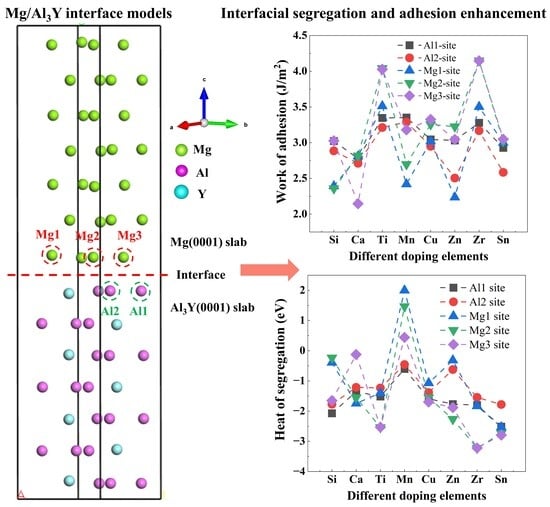
Graphical Abstract

1. Introduction

Magnesium alloys are among the lightest structural metallic materials and have attracted sustained interest for applications in aerospace, automotive lightweighting, and electronic industries owing to their low density, high specific strength, and excellent damping capacity [1,2,3,4]. However, the widespread application of conventional Mg alloys is still limited by their relatively low room-temperature strength, poor thermal stability, and inadequate creep resistance under elevated-temperature service conditions [5,6,7]. Alloying with rare-earth (RE) elements has proven to be an effective strategy to overcome these limitations [8,9]. RE additions can significantly refine grain structures, modify deformation textures, enhance thermal stability, and suppress grain-boundary-mediated deformation mechanisms [10,11]. As a result, Mg–RE-based alloys, particularly Mg–Al–RE systems, have emerged as promising candidates for next-generation lightweight structural materials. Nevertheless, the strengthening mechanisms induced by RE elements are intrinsically complex and are closely associated with the formation, stability, and interfacial behavior of RE-containing secondary phases, which remain insufficiently understood at the atomic scale [12,13].
In Mg–Al–RE alloys, RE elements tend to participate in the formation of thermodynamically stable intermetallic compounds, among which Al3RE phases play a critical role due to their high melting points, structural stability, and superior mechanical stiffness [14,15]. Experimental investigations on Mg–Al–RE and Al–RE systems have demonstrated that Al3RE phases (e.g., Al3Ce) can effectively enhance hardness, wear resistance, and high-temperature mechanical performance by acting as stable reinforcement phases [16]. Diffusion-couple studies have further revealed the formation kinetics and growth behavior of Al–RE intermetallic layers at Mg/Al–RE interfaces under various thermal conditions [17,18]. Complementary first-principles calculations have systematically evaluated the formation energies, electronic structures, elastic constants, and thermodynamic properties of a wide range of Al3RE compounds, confirming their intrinsic stability and strong bonding characteristics [14,19,20,21]. These studies collectively indicate that Al3RE phases are not only key strengthening constituents in Mg–RE alloys but also provide a robust platform for tailoring interfacial properties in multiphase Mg-based systems.
In multiphase alloys and metal–intermetallic composites, interfacial structure and properties play a decisive role in load transfer efficiency, deformation compatibility, and failure behavior [22,23]. Despite extensive investigations into the formation and bulk properties of Al3RE phases, most existing studies have focused on phase equilibria, microstructural evolution, and macroscopic mechanical responses, while the atomic-scale characteristics of Mg/Al3RE interfaces remain largely unexplored. Previous first-principles studies have predominantly addressed Al/Al3RE or fcc-Al/L12-Al3M interfaces, elucidating interfacial energies, preferred orientation relationships, and adhesion strengths [24,25]. However, direct investigations of interfaces between hcp Mg and Al3RE intermetallics are notably scarce, despite their practical relevance in Mg–Al–RE alloys. Understanding the pronounced differences in crystal structure, electronic configuration, and bonding nature between Mg and Al3RE is therefore essential to clarify interfacial stability, adhesion strength, and electronic interactions. In this work, we focus on the Mg/Al3Y interface, as yttrium (Y) is an effective strengthening element for the Mg matrix, enhancing its mechanical properties [2,26], relatively inexpensive compared with other rare-earth elements [27], and readily forms the stable intermetallic compound Al3Y with aluminum [28,29]. Using first-principles calculations, we systematically investigate the interface’s structural stability, adhesion, and electronic properties. The results provide atomistic insights into interfacial bonding mechanisms and their correlation with mechanical response, offering theoretical guidance for interface engineering and microstructural optimization in high-performance Mg–Al–RE alloys.

2. Theoretical Section

First-principles simulations were conducted to elucidate the bulk, surface, and interfacial characteristics of the Mg/Al3Y system within the density functional theory framework, as implemented in the CASTEP code (Materials Studio 8.0) [30]. Element-specific valence states were explicitly considered in the construction of the pseudopotentials, with Mg, Al, and Y treated using 2p63s2, 3s23p1, and 4s24p64d15s2 configurations, respectively. Electron–ion interactions were represented by ultrasoft pseudopotentials [31]. The numerical accuracy of the calculations was ensured by employing a plane-wave basis set truncated at 450 eV. Brillouin-zone sampling for the primitive cells of Mg and Al3Y was carried out using Monkhorst–Pack meshes of 9 × 9 × 9 and 7 × 7 × 9, respectively. Geometry optimizations were performed via the Broyden–Fletcher–Goldfarb–Shanno algorithm [32], allowing full relaxation of both atomic positions and lattice vectors until the total energy reached a minimum. Exchange–correlation effects were described using the generalized gradient approximation in the form of the Perdew–Burke–Ernzerhof revised for solids (PBEsol) functional, which is known to yield reliable structural parameters for metallic and intermetallic systems, and a Hubbard U correction of 2 eV was applied to the Y 4d states [33,34]. The self-consistent convergence criteria were defined as 1 × 10⁻⁶ eV for the total energy, 0.01 eV/Å for the maximum residual force, and 0.001 Å for atomic displacements.
Based on lattice matching considerations, the Mg(0001) and Al3Y(0001) surfaces were identified as the most suitable crystallographic combination for interface construction. Informed by our previous convergence tests on slab thickness for Mg, Ti, Mg2Y, and Al2Y systems [35,36], both the Mg(0001) and Al3Y(0001) slabs were constructed using seven atomic layers in the present study to ensure sufficient structural stability and interfacial convergence. For all slab calculations, a vacuum spacing of 15 Å was introduced perpendicular to the surface plane to suppress artificial interactions between periodically repeated images. Since only a single surface termination of the Al3Y slab was considered in our calculations, no dipole correction was needed. We further investigated the effect of various alloying elements (Si, Ca, Ti, Mn, Cu, Zn, Zr, and Sn) at the interface. Notably, Mn is magnetic, and its spin polarization was explicitly considered in all relevant calculations. Reciprocal-space sampling for surface calculations employed k-point meshes of 9 × 9 × 1 for Mg(0001) and 7 × 7 × 1 for the Al3Y(0001) surfaces. Based on these surface models, Mg(0001)/Al3Y(0001) interface supercells were subsequently constructed by combining a seven-layer Mg(0001) slab with an eleven-layer Al3Y(0001) slab. For the interfacial configurations, a reduced 3 × 3 × 1 k-point grid was adopted, while all other computational parameters were kept identical to those used in the bulk calculations to maintain internal consistency.

3. Results and Discussion

3.1. Bulk and Surface Properties

Both Mg and Al3Y crystallize in a hexagonal structure with the P63/mmc space group, which provides inherent structural anisotropy along the basal plane and the c-axis, as shown in Figure 1a,b. Table 1 shows the lattice constants of Mg and Al3Y compounds. Notably, for magnesium, the initial lattice parameters were calculated as a = b = 3.17 Å and c = 5.14 Å, corresponding to a c/a ratio of 1.62, which increased to a = b = 3.18 Å and c = 5.32 Å after full relaxation, giving a c/a ratio of 1.67. Experimentally, Mg exhibits lattice constants of a = b = 3.209 Å and c = 5.211 Å [37]; using LDA calculations, the values are a = b = 3.159 Å and c = 5.073 Å, while GGA-PBE calculations yield a = b = 3.221 Å and c = 5.172 [38]. The small deviations between the GGA-PBEsol results and the experimental data indicate that the PBEsol functional yields an accurate description of the hexagonal Mg lattice, including both the basal plane and c-axis dimensions, thereby justifying its use in the present study. Similarly, Al3Y exhibits initial lattice parameters of a = b = 6.27 Å and c = 4.59 Å, and relaxed values of a = b = 6.28 Å and c = 4.60 Å, with both cases corresponding to a c/a ratio of 0.73. The increase in the c/a ratio of Mg after relaxation reflects an anisotropic elastic response of the hexagonal lattice under interfacial constraints, characterized by a slight expansion along the c direction and a concomitant contraction in the basal plane. In contrast, the nearly unchanged c/a ratio of Al3Y suggests a highly rigid and stable hexagonal framework, particularly along the c-axis. The comparable hexagonal symmetry and the small lattice mismatch between the basal planes of Mg and Al3Y are favorable for coherent interface formation. Specifically, the in-plane lattice constants of Mg (3.18 Å) and Al3Y (6.28 Å) suggest that a 2:1 lattice matching can be achieved with minimal strain, which is beneficial for interfacial stability and strong adhesion. The relaxation-induced expansion along the c-axis of Mg and slight adjustments in Al3Y further imply that both materials can accommodate interfacial strain without significant structural distortion, highlighting their potential compatibility in composite or alloyed systems. This lattice compatibility is expected to reduce misfit dislocations at the interface and promote favorable electronic interactions, which are critical for both mechanical stability and overall structural integrity in Mg/Al3Y composites.
To further verify the dynamical stability of Mg and Al3Y, phonon dispersion relations together with the corresponding phonon density of states (P-DOS) were calculated, as shown in Figure 1c,d. The results reveal that no imaginary frequencies are present throughout the entire Brillouin zone for either Mg or Al3Y, confirming that both crystal structures are dynamically stable at 0 K. For Mg, the phonon vibration frequencies are primarily distributed within the range of 0–7 THz, exhibiting a relatively narrow and concentrated spectrum. The corresponding P-DOS peak intensity does not exceed 0.45 (1/THz), which is characteristic of the fairly uniform atomic vibrations commonly observed in lightweight metallic systems. This behavior is consistent with the low atomic mass of Mg and its relatively weak bonding stiffness, and it correlates well with the smaller elastic moduli obtained from the mechanical property analysis. In contrast, the phonon spectrum of Al3Y displays pronounced element-resolved characteristics, with vibrational modes extending over a broader frequency range of 0–10 THz. In particular, the high-frequency region between 6 and 10 THz is dominated by contributions from Al atoms, whereas the low-frequency modes below 4 THz are primarily associated with the vibrations of Y atoms, with the overall P-DOS peak intensity remaining below 0.35 (1/THz). This distinct spectral separation can be attributed to the substantial difference in atomic mass and bonding stiffness between Al and Y, whereby the lighter Al atoms preferentially contribute to high-frequency vibrational modes, while the heavier Y atoms predominantly participate in low-frequency phonon behavior.
In the field of structural materials, mechanical performance plays a pivotal role in determining both service reliability and long-term durability. Under practical operating conditions, structural components are often subjected to complex mechanical loading, thermal fluctuations, and microstructural evolution, which may induce stress accumulation, phase transformations, or deformation incompatibilities. Insufficient mechanical robustness under such conditions can result in progressive damage, structural instability, or even catastrophic failure, thereby severely limiting the service lifetime and reliability of engineering components. For emerging lightweight alloys and advanced intermetallic or rare-earth-containing materials, achieving a balanced combination of mechanical strength, stability, and damage tolerance is therefore essential for their safe and efficient deployment in structural applications. The elastic constants and elastic modulus of Mg and Al3Y compounds are listed in Table 2. For HCP crystals, there are five independent elastic constants (C11, C12, C13, C33, and C44). Based on the calculated results in Table 2, the elastic constants Cij of HCP Mg are C11 = 55.44, C33 = 71.16, C44 = 19.89, C12 = 30.73, and C13 = 23.87 GPa [35], while those of HCP Al3Y are C11 = 161.25, C33 = 186.57, C44 = 71.01, C12 = 65.33, and C13 = 24.15 GPa. All calculated elastic constants satisfy the mechanical stability criteria for HCP crystals, indicating that both Mg and Al3Y are mechanically stable [39,40]. Moreover, the calculated elastic constants show that Al3Y has significantly higher Cij values than Mg, indicating a much stiffer HCP lattice. In particular, the larger C11 and C33 reflect greater resistance to axial deformation, while the higher C44, C12, and C13 indicate enhanced shear and in-plane rigidity, consistent with Al3Y’s role as a strengthening phase in Mg-based alloys. For magnesium, the computed bulk modulus (B), shear modulus (G), and Young’s modulus (E) are 37.60, 16.79, and 43.85 GPa, respectively. These values are in good agreement with experimental data, where B = 35.4 GPa and E = 43 GPa [38], indicating that the computational approach employed in this study can reliably reproduce the mechanical response of Mg. In contrast, Al3Y exhibits significantly higher elastic stiffness, with calculated values of B = 79.36 GPa, G = 62.35 GPa, and E = 148.23 GPa, reflecting its rigid intermetallic nature. The relatively soft Mg matrix can accommodate strain through elastic deformation, whereas the stiff Al3Y phase provides reinforcement, potentially enhancing the overall structural strength of Mg/Al3Y composites.

3.2. Properties of the Mg/Al3Y Interface

3.2.1. Interfacial Configuration

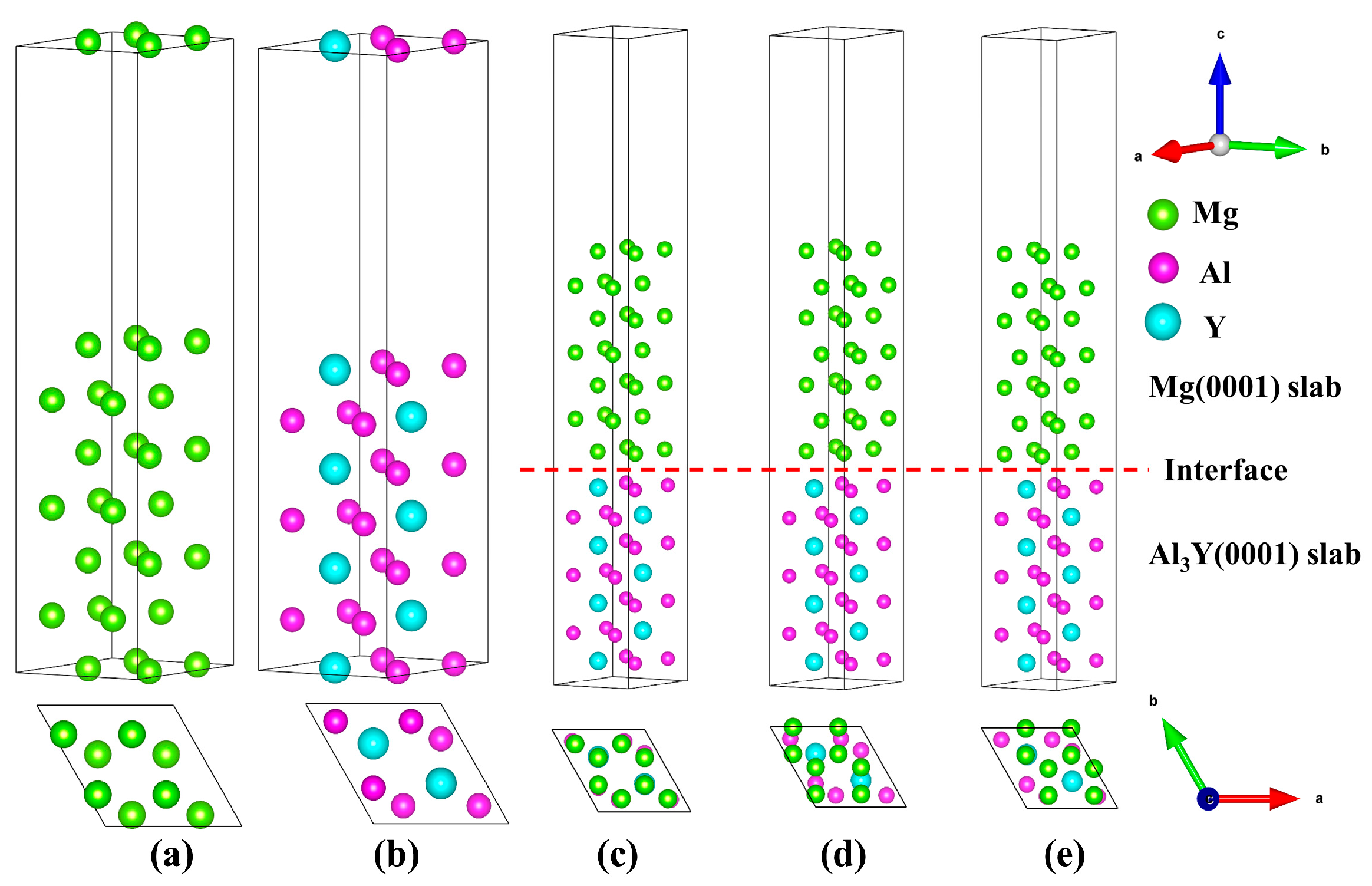
Based on the crystallographic characteristics of Mg and Al3Y, the Al3Y crystal structure features Al and Y atoms occupying the Wyckoff positions 6 h (0.145, 0.290, 0.25) and 2d (1/3, 2/3, 3/4), respectively, while Mg atoms in the Mg crystal are located at the 2c (1/3, 2/3, 1/4) site. Such atomic site occupancies within the same hexagonal crystal system and space-group symmetry provide an essential structural basis for achieving atomically ordered stacking at the Mg(0001)/Al3Y(0001) interface. The atomic configurations of the seven-layer Mg(0001) and Al3Y(0001) surface slabs are illustrated in Figure 2a,b. Owing to the intrinsic crystallographic symmetry of Mg and Al3Y, only a single surface termination is present for both the Mg(0001) and Al3Y(0001) surfaces. Accordingly, as inferred from the lattice parameters listed in Table 1, a 2 × 2 in-plane supercell expansion of the Mg(0001) surface enables excellent lattice matching with the Al3Y(0001) surface, thereby substantially reducing the interfacial lattice mismatch. The lattice mismatch ratio at the interface can be quantified using the following expression:
ξ = 1 2 Ω A 1 + A 2
where ξ is the interface mismatch, Ω represent the interfacial area of the Mg(0001)/Al3Y(0001) interface, and A1 and A2 are the areas of the Mg(0001) surface and Al3Y(0001) surface, respectively. Based on the lattice parameters of Mg and Al3Y, A1 is defined as the effective in-plane lattice constant of the Mg(0001) surface after a 2 × 2 lateral supercell expansion, yielding a value of 6.36 Å, whereas A2 corresponds to the in-plane lattice constant of the Al3Y(0001) surface, which is 6.28 Å. Since both surfaces share an identical in-plane angle of 120°, no additional rotational alignment is required during interface construction, and only the lattice-parameter mismatch needs to be considered. Substituting these values into Equation (1) results in an interfacial lattice mismatch of approximately 1.27%. This value is well below the commonly accepted threshold of 5%, indicating that the Mg(0001)/(2 × 2)Al3Y(0001) interface exhibits excellent geometrical lattice compatibility and is therefore well suited for constructing a low-strain, semi-coherent interfacial model. From an atomic arrangement perspective, the hexagonal close-packed structure of the Mg(0001) surface exhibits a high degree of in-plane symmetry compatibility with the periodic distribution of Al–Y atomic layers on the Al3Y(0001) surface, which facilitates the establishment of strong interatomic interactions across the interface. Consequently, the Mg(0001)/(2 × 2)Al3Y(0001) interfacial configuration not only demonstrates excellent geometric lattice compatibility but also provides a robust and reliable structural model for subsequent investigations of interfacial adhesion strength, electronic structure, and mechanical response. The Mg(0001)/Al3Y(0001) interfacial configuration with different stacking configurations are illustrated in Figure 2c–e. In the “OT” configuration, the interfacial Mg atoms are positioned directly above the atoms in the topmost layer of the Al3Y slab. For the “MT” configuration, the Mg atoms at the interface are located above the midpoint of the nearest-neighbor atomic bonds in the first Al3Y layer. In contrast, in the “HCP” configuration, the interfacial Mg atoms are aligned above the atoms in the second atomic layer of Al3Y [41]. The interface is indicated by a red dashed line, with the Al3Y(0001) slab occupying the upper region and the Mg(0001) slab forming the lower region of the interface. Moreover, the red dashed line denotes the interfacial plane, with the region above the dashed line corresponding to the Mg(0001) slab and the region below representing the Al3Y(0001) slab.
In interfacial studies, the work of adhesion, Wad, is widely employed as a key parameter for quantitatively evaluating interfacial bonding strength. It is defined as the interfacial energy required, under thermodynamically reversible conditions, to separate an intact interface into two mutually independent free surfaces, normalized by the interfacial area. Accordingly, a higher Wad value signifies stronger atomic interactions and more stable bonding characteristics at the interface. Based on this definition, the Wad of the Mg(0001)/Al3Y(0001) interface is calculated and predicted in the present work [42,43]:
W ad = E M g s l a b + E A l 3 Y s l a b E M g / A l 3 Y int e r f a c e / A i
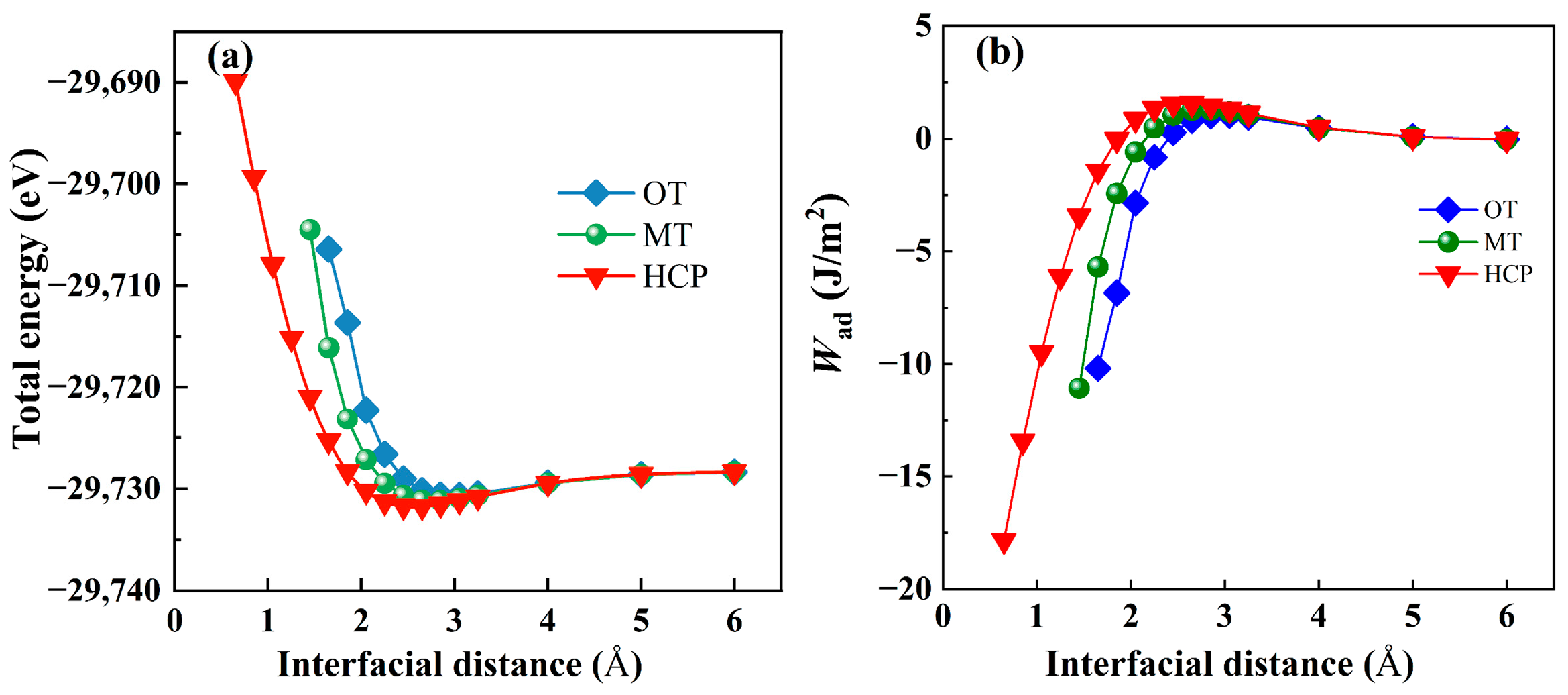
Here, E M g s l a b , E A l 3 Y s l a b , and E M g / A l 3 Y int e r f a c e are the total energies of the Mg(0001) slab, Al3Y(0001) slab, and Mg(0001)/Al3Y(0001) interface, and Ai is the area of the corresponding interface. Furthermore, Figure 3 illustrates the dependence of the total interfacial energy and the work of adhesion on the interfacial separation. With increasing separation from 1 to 6 Å, the total energy decreases rapidly at short distances and then gradually converges to a constant value. In contrast, the work of adhesion increases initially and subsequently reaches a plateau. From these trends, the equilibrium interfacial separation is determined to be approximately 2.6 Å.

3.2.2. Interfacial Stabilities and Electronic Structure

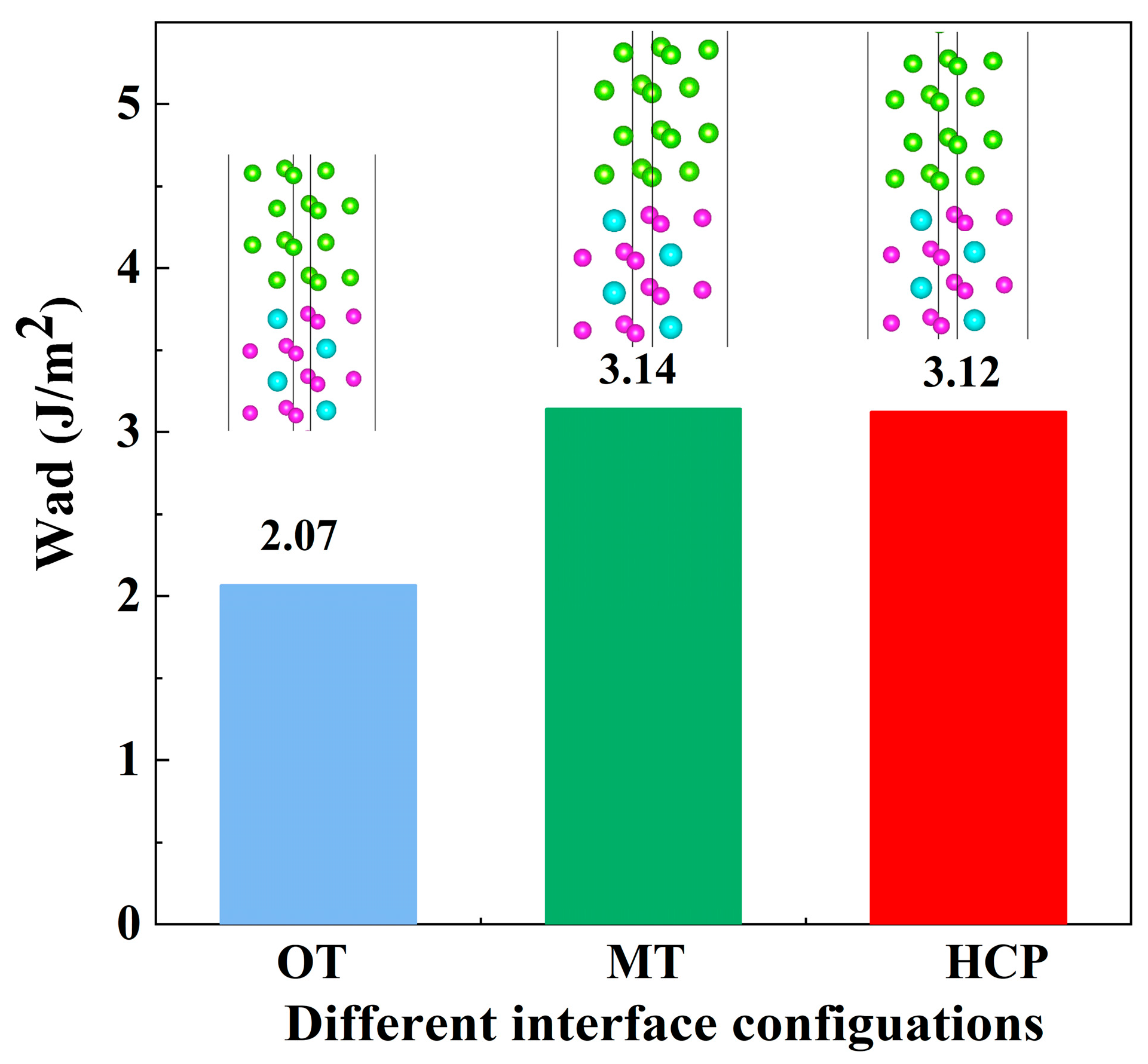
The calculated Wad for the Mg(0001)/Al3Y(0001) interface is presented in Figure 4 and listed in Table 3. The Wad values for the OT, MT, and HCP configurations are 2.07, 3.14, and 3.12 J/m2, respectively. It can be clearly seen from Table 3 that the calculated Wad shows that the Mg(0001)/Al3Y(0001) interface has the strongest bonding among the studied systems. The Mg(0001)/Al3Y(0001) interface with OT, MT, and HCP configurations exhibits Wad values of 2.07, 3.14, and 3.12 J/m2, higher than Mg/Al2Y (1.19–1.68 J/m2) and most Mg/Mg2Y interfaces (0.43–2.38 J/m2). Only the Y-site MT/HCP Mg/Mg2Y interfaces approach Mg/Al3Y with OT configuration values but remain lower than Mg/Al3Y with MT/HCP configurations. This indicates that Mg/Al3Y, especially MT and HCP, benefits from stronger orbital hybridization and charge transfer, while Mg/Al2Y and Mg/Mg2Y generally show weaker bonding with smaller stacking-dependent differences, except for sites like Mg1-MT in Mg/Mg2Y, which is notably low. A comparison of these values indicates that both the MT and HCP configurations exhibit significantly higher Wad than the OT configuration, with their values being very close to each other, suggesting stronger interfacial bonding in these arrangements. In contrast, the OT configuration shows the lowest Wad, implying relatively weaker atomic interactions and reduced interfacial stability. These differences can be primarily attributed to the variations in the local atomic coordination and bonding characteristics arising from different stacking arrangements. In the MT and HCP configurations, the interfacial Mg atoms achieve more favorable geometric matching and enhanced atomic contact with the Al3Y substrate, thereby strengthening chemical bonding and atomic interactions at the interface. By contrast, in the OT configuration, the interfacial atoms occupy top sites, resulting in stronger interatomic repulsion that hinders the formation of robust interfacial bonds. Accordingly, based on the magnitude of Wad, the MT and HCP configurations can be considered thermodynamically more stable, with the MT configuration exhibiting a slight advantage. This provides a solid basis for the subsequent analysis of interfacial stability and electronic structure.
The differential charge density serves as an intuitive visualization tool for elucidating charge redistribution within a system. It is defined as the difference between the total charge density of the combined structure and the superposition of the charge densities of its constituent components in their isolated states. The corresponding expression is given as follows [44]:
Δ ρ = ρ c r y s t a l ρ a t
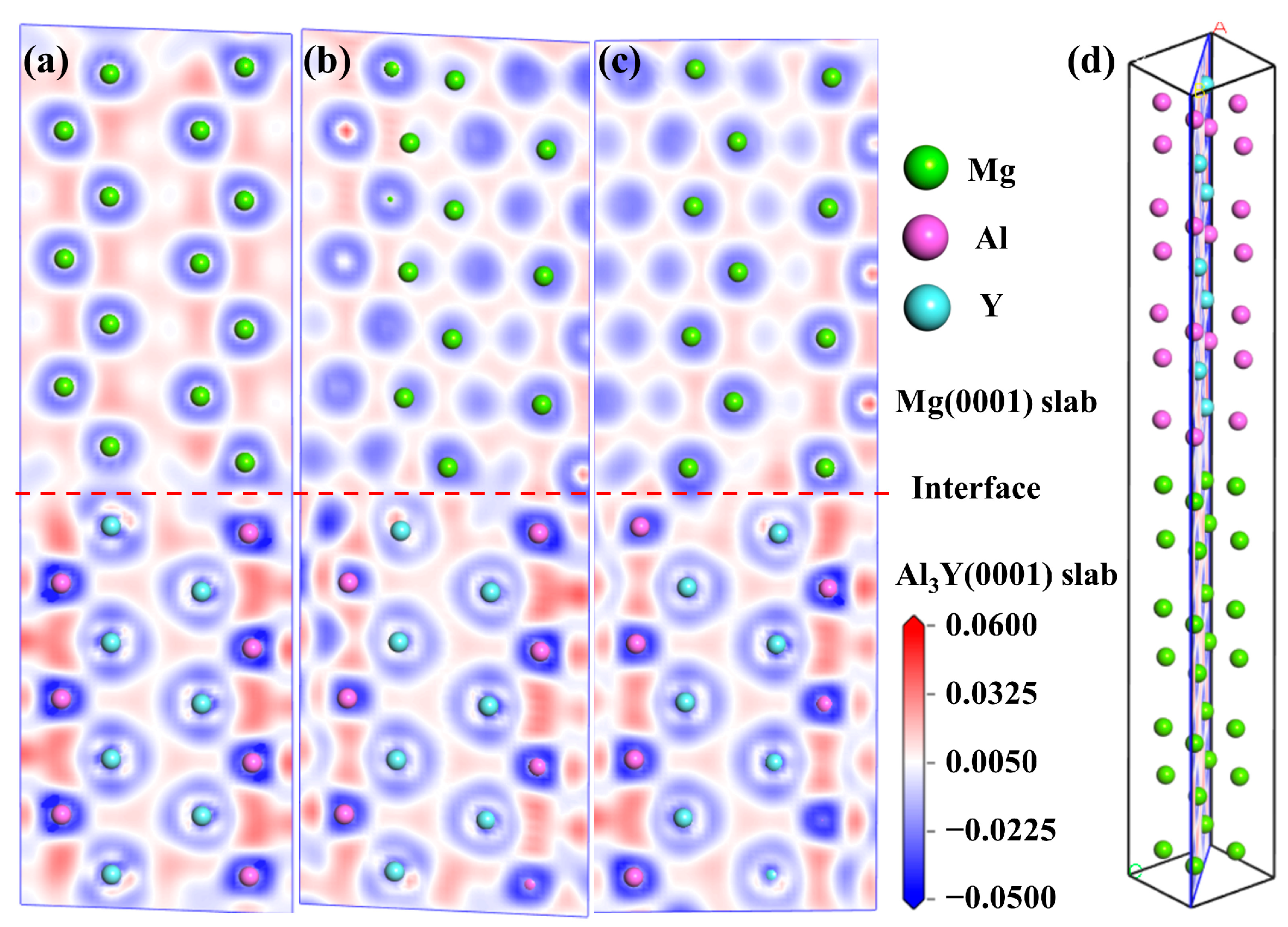
where ρ c r y s t a l and ρ a t are the valence electron densities of the compound and the reference-free atom, respectively. The charge density difference of Mg(0001)/Al3Y(0001) interface is shown in Figure 5. The differential charge density maps of Mg(0001)/Al3Y(0001) interface with OT, MT, and HCP configurations are shown in panels in Figure 5a–c, and the schematic diagram of differential charge atomic cross-sections is displayed in Figure 5d. Notably, the color scale represents electron accumulation (red region) and electron depletion (blue region). A pronounced charge redistribution is predominantly localized in the vicinity of the interface, whereas the inner layers of the Mg(0001) and Al3Y(0001) slabs largely retain their bulk-like electronic characteristics, indicating that the electronic interaction is highly confined to the interfacial region. Near the dashed line marking the interface, electron accumulation is clearly observed primarily in the bonding regions surrounding the interfacial Al and Y atoms, while electron depletion occurs around the Mg atoms and in other interstitial regions. This redistribution pattern signifies a substantial charge transfer from Mg to Al and Y atoms at the interface, which is consistent with the higher electronegativity of Al and Y compared with Mg. The accumulation of charge density in the bridging regions between Mg–Al and Mg–Y atomic pairs suggests the formation of directional interfacial bonds rather than purely metallic bonding. In particular, the more pronounced charge accumulation around Y atoms implies a stronger Mg–Y interaction, which contributes to enhanced interfacial cohesion. Furthermore, a comparison of Figure 5a–c reveals noticeable variations in both the spatial distribution and magnitude of charge accumulation, demonstrating that the interfacial stacking sequence plays a critical role in governing the extent of charge transfer and bonding strength. Configurations exhibiting more continuous and intense charge accumulation across the interface are therefore expected to possess higher interfacial adhesion, in good agreement with the calculated work of adhesion.
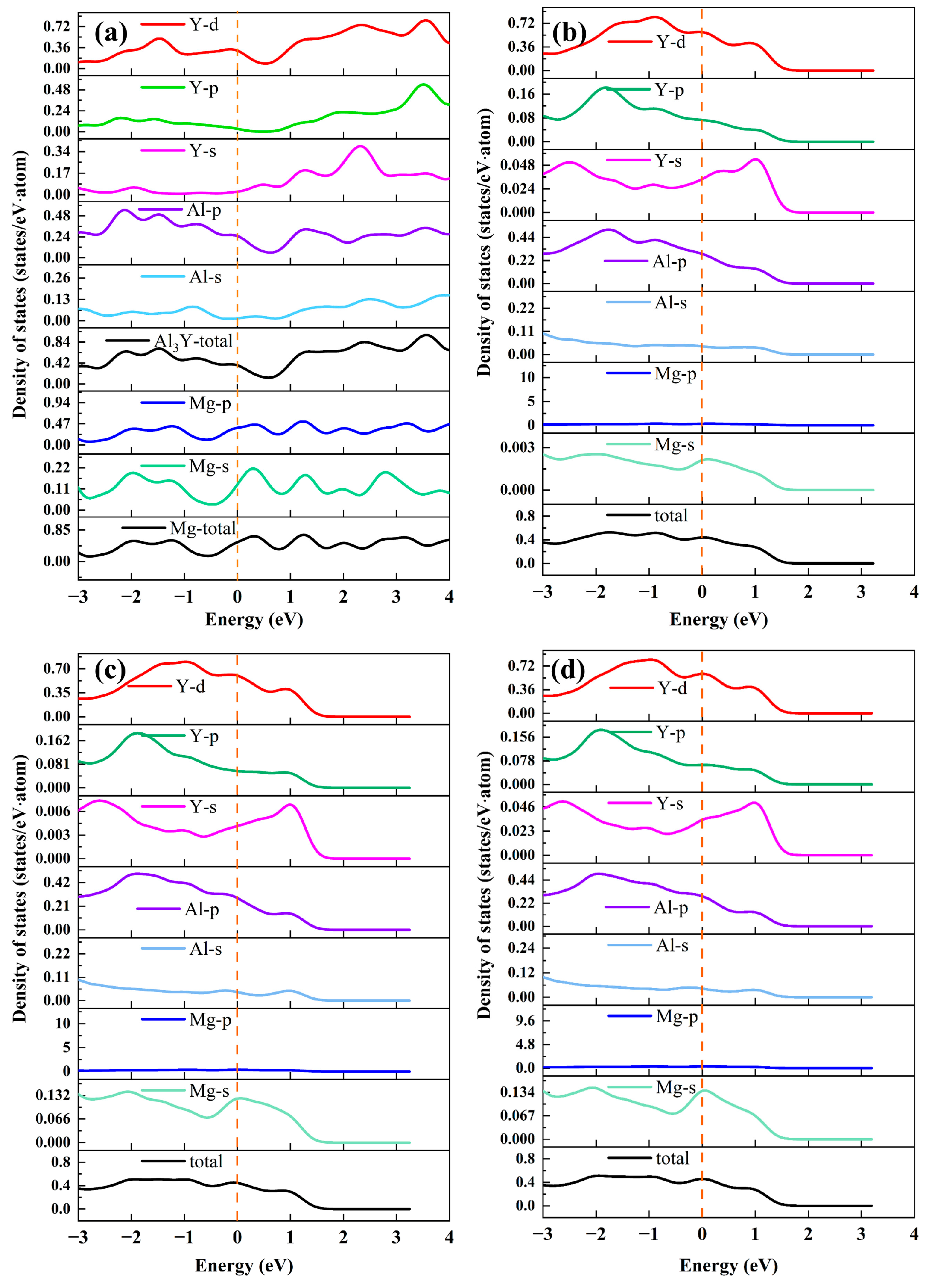
The total density of states (TDOS) represents the total number of available electronic states within a given energy interval (E to E + ΔE) and is obtained by integrating the electronic band states over all k points in the Brillouin zone. It thus reflects the overall energy distribution of electronic states in the material. The densities of states for bulk Mg, bulk Al3Y, and the Mg(0001)/Al3Y(0001) interface are shown in Figure 6. Generally, only the DOS changes near the Fermi level are considered; therefore, a DOS plot from –3 to 4 eV is presented. Figure 6a presents the projected density of states (PDOS) of the bulk Mg and Al3Y. It is observed that the states close to the Fermi level (EF) are predominantly contributed by Mg-s/p, Al-p, and Y-d orbitals. The presence of a finite density of states at the Fermi level indicates the pronounced metallic character of Mg and Al3Y. From the DOS in Figure 6b–d, it is apparent that all three interfacial structures maintain a nonzero density of states at EF (marked by the orange dashed line), confirming that the metallic character of the interfaces persists. This implies that the formation of the interface does not compromise the electronic conductivity of the system and provides favorable conditions for electronic interactions and charge transfer across the interface. The projected density of states (PDOS) further reveals that the electronic states near EF are mainly contributed by Mg-s, Mg-p, Al-s, and Al-p, as well as Y-s, Y-p, and Y-d orbitals. Notably, the Y-d states display prominent features in the vicinity of EF and show substantial overlap with the Al-p and Mg-p states within the same energy range, indicating strong orbital hybridization at the interface. In conjunction with the differential charge density analysis, electron depletion is observed around interfacial Mg atoms, whereas pronounced electron accumulation occurs near Al and Y atoms and in the interstitial regions between them. This charge redistribution is highly consistent with the energy overlap between Mg-p and Mg-p/Al-p states identified in the PDOS, confirming that interfacial bonding is accompanied by charge transfer from Mg to Al/Y atoms. Such charge transfer, together with orbital hybridization, gives rise to relatively directional interfacial chemical bonds rather than purely metallic bonding. Comparing the DOS of the interfacial structures in Figure 6b–d with the bulk DOS, it is evident that the interface formation induces modifications near the Fermi level, reflecting local electronic redistribution. Certain orbitals, particularly Mg-p and Y-d, show enhanced contributions at the interface, highlighting the increased role of specific elements in interfacial bonding. In some instances, splitting or reduction of peaks near EF indicates localized states or altered bonding characteristics. Furthermore, differences among the three interfacial configurations (OT, MT, HCP) illustrate how stacking or adsorption sites influence the DOS distribution. Notably, the MT configuration exhibits the strongest hybridization, corresponding to more pronounced interfacial charge accumulation and stronger Mg–Y interactions. This trend aligns well with the variation in the calculated Wad, confirming that enhanced orbital hybridization and charge transfer lead to stronger interfacial bonding.

3.2.3. Interfacial Segregation and Adhesion Enhancement

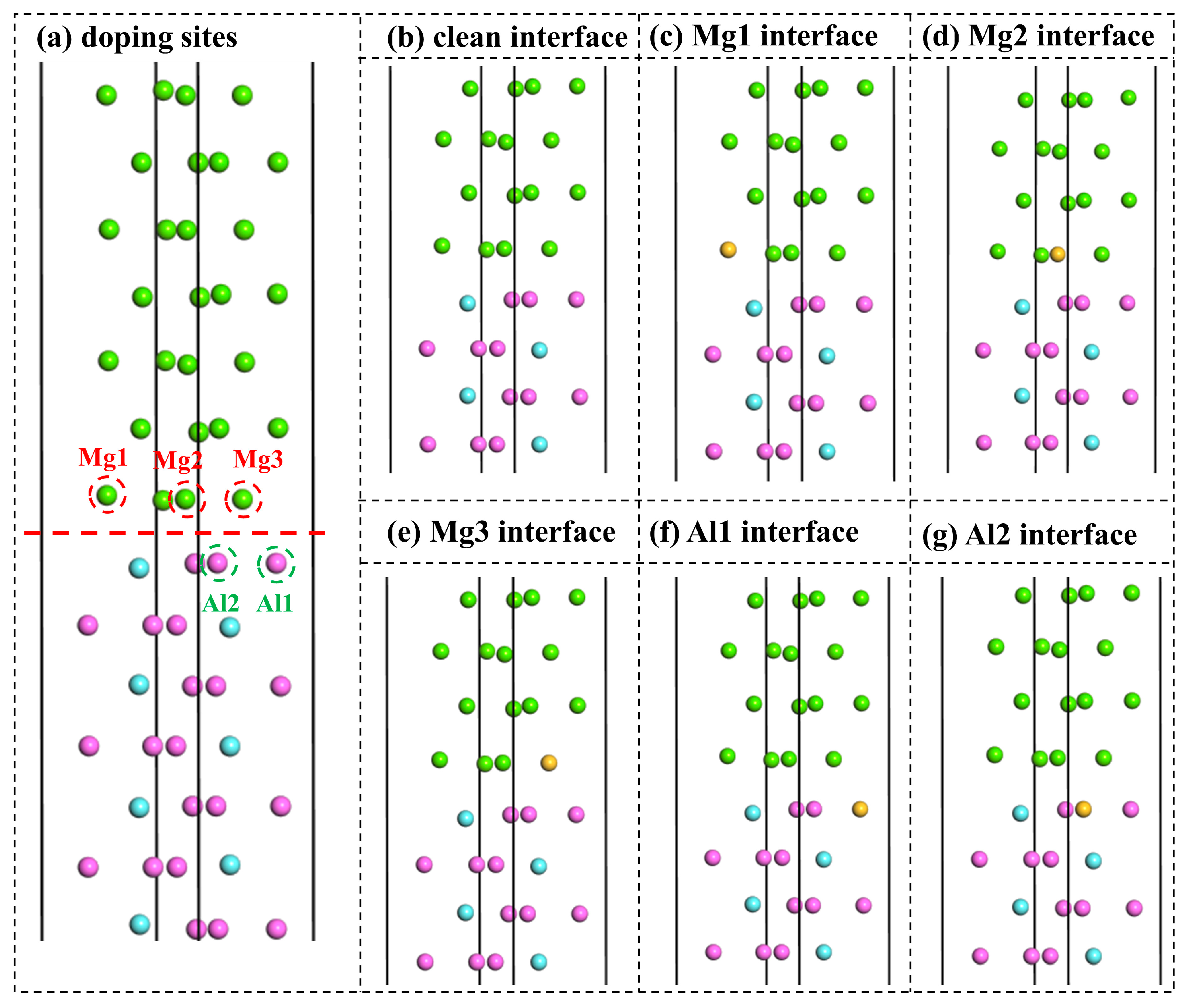
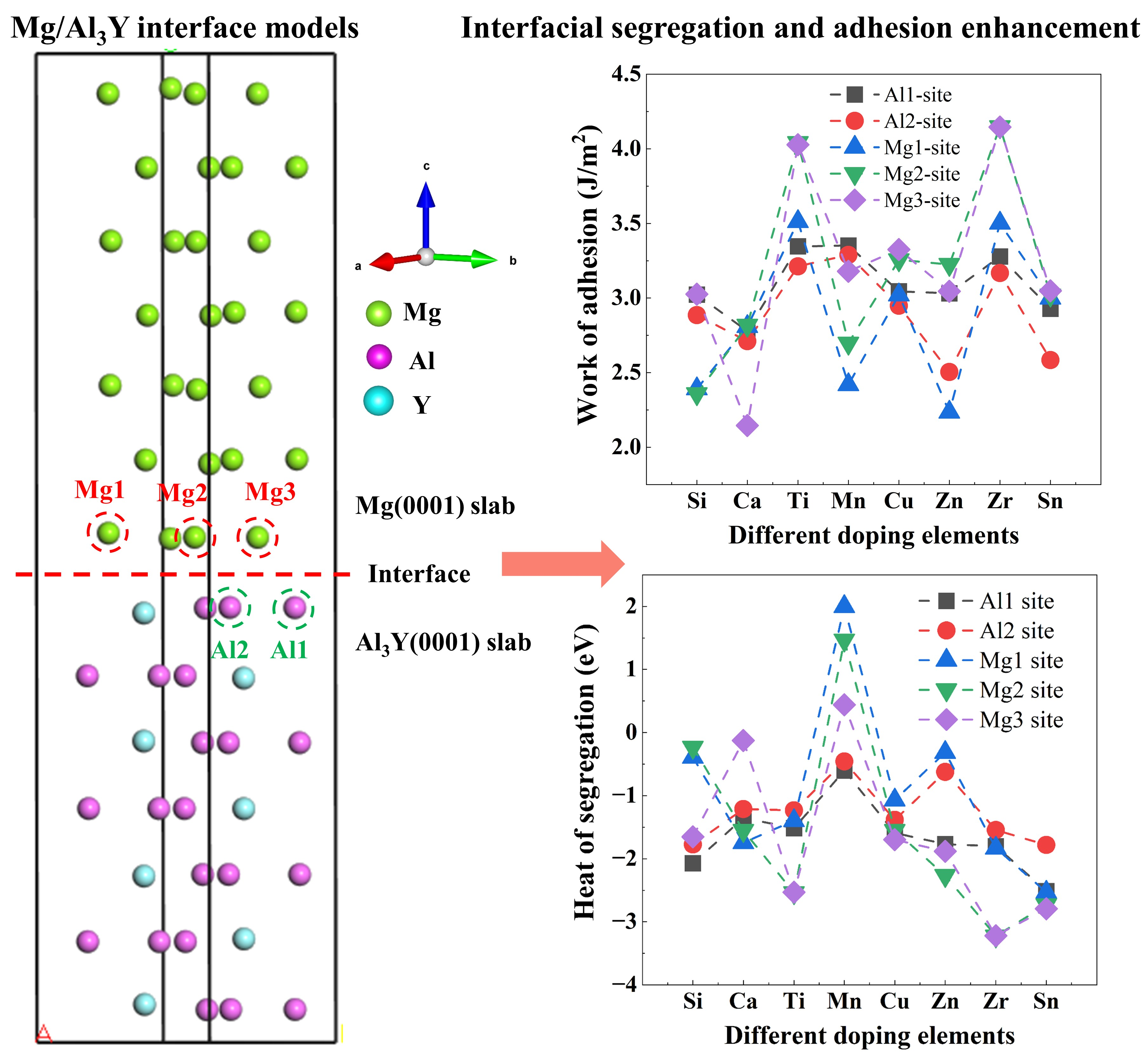
The segregation behavior of doping elements at interfaces plays a decisive role in governing interfacial stability and bonding strength, originating from the unique low-coordination atomic environment and the complex electronic structure characteristic of interfacial regions. When doping elements can reduce the total energy of the system through charge redistribution, enhanced orbital hybridization, or effective relaxation of local strain at the interface, they tend to exhibit a pronounced segregation preference. Interfacial segregation not only reconstructs the local chemical composition but also markedly influences interfacial bonding characteristics, electronic structure evolution, and key properties such as the work of adhesion. Therefore, a systematic evaluation of the segregation energies of doping elements at different interfacial sites is of significant theoretical and practical importance for elucidating the microscopic mechanisms underlying interfacial stabilization and for guiding the design of high-performance alloy interfaces. On this basis, the Mg(0001)/Al3Y(0001) with MT configuration, which exhibits the highest interfacial stability, was selected to systematically investigate the effects of Si, Ca, Ti, Mn, Cu, Zn, Zr, and Sn doping elements on interfacial structure, adhesion behavior, and segregation characteristics. Interstitial doping or Y-site substitution was not considered, as the dopant elements studied (Si, Ca, Ti, Mn, Cu, Zn, Zr, and Sn) have considerably larger atomic radii than Y. Substitution at Y sites is therefore energetically unfavorable and likely to induce significant lattice distortion and local stress, which may destabilize the Al3Y structure and complicate the interpretation of interfacial properties. The Mg(0001)/Al3Y(0001) interface doping models are shown in Figure 7. Based on the crystal structural symmetry, the Mg1, Mg2, and Mg3 sites were defined on the Mg(0001) side, while the Al1 and Al2 sites were selected on the Al3Y(0001) side. The corresponding interfacial configurations after doping are illustrated in Figure 7c–g, in which yellow balls represent doping atoms, including Si, Ca, Ti, Mn, Cu, Zn, Zr, and Sn.
Furthermore, the Wad of Mg(0001)/Al3Y(0001) after doping elements can be expressed as the following formulas [45,46]:
W a d = ( E M g s l a b + E A l 3 Y T M s l a b E M g / A l 3 Y T M int e r f a c e ) / A i
W a d = ( E M g T M s l a b + E A l 3 Y s l a b E M g T M / A l 3 Y int e r f a c e ) / A i
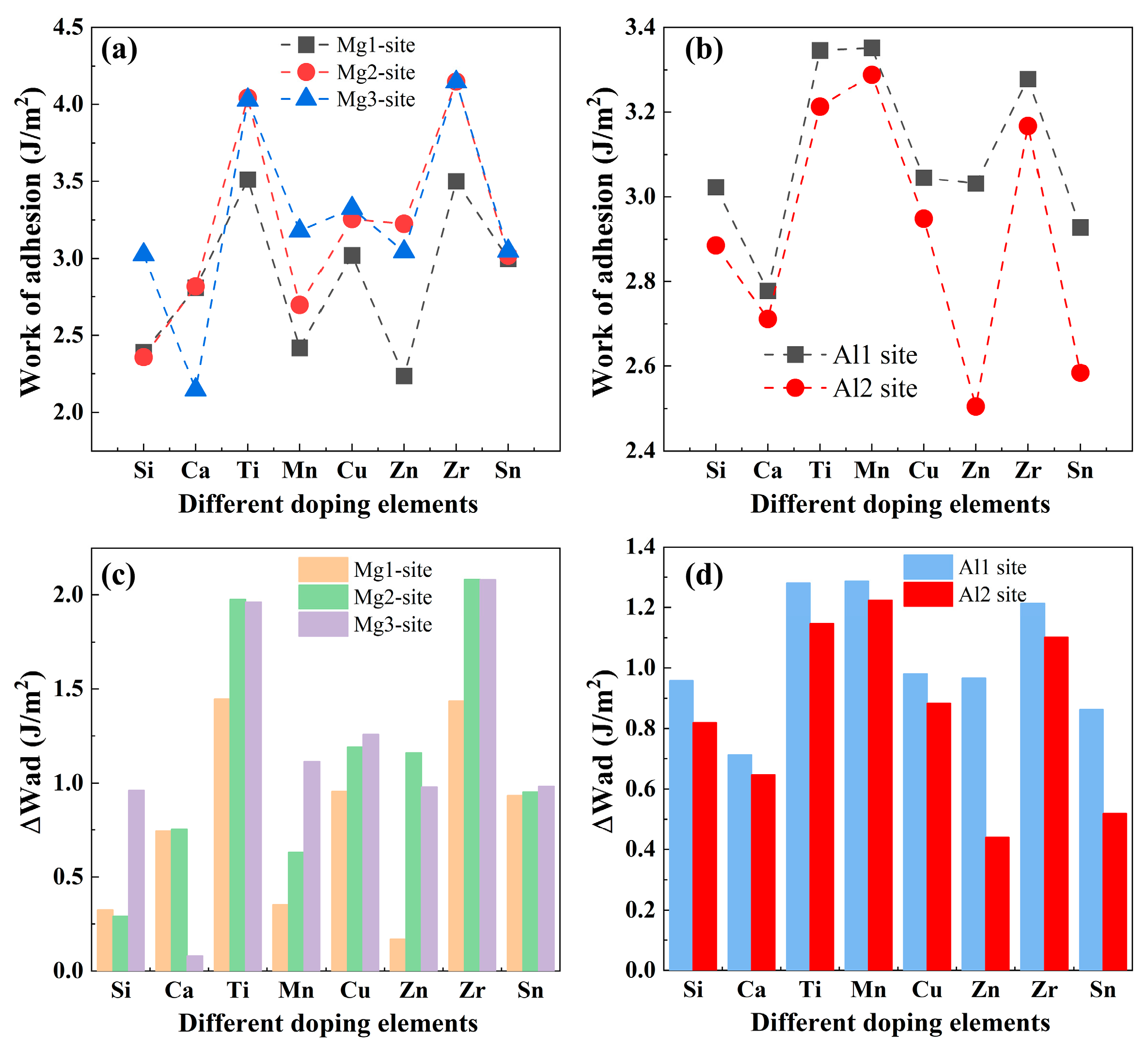
Here, Equations (4) and (5) correspond to the models in which doping is introduced at the Al and Mg sites, respectively. In addition, E M g s l a b , E M g T M s l a b , E A l 3 Y s l a b , E A l 3 Y T M s l a b , E M g T M / A l 3 Y int e r f a c e , and E M g / A l 3 Y T M int e r f a c e are the total energies of the Mg(0001) slab, doping Mg(0001) slab, Al3Y(0001) slab, doping Al3Y(0001) slab, Mg(0001)/Al3Y(0001) interface, and doping Mg(0001)/Al3Y(0001) interface. The calculated Wad and rate of change of Wad for the doping Mg(0001)/Al3Y(0001) interface with different sites are displayed in Figure 8. The data in Figure 8a,b clearly demonstrate that the effect of doping elements on the Wad is strongly dependent on the interfacial site they occupy. Overall, Zr and Ti exhibit the most pronounced interfacial strengthening effect, with consistently higher Wad values than the other elements. In particular, when occupying the Mg2 and Mg3 sites, their Wad values exceed 4.0 J/m2, indicating that Zr and Ti preferentially form strong interfacial bonding on the Mg side, thereby markedly enhancing interfacial stability. In contrast, Mn, Cu, Sn, Si, and Zn yield Wad values mainly in the range of 2.8–3.3 J/m2, corresponding to a moderate improvement in interfacial adhesion; however, their strengthening effect is more sensitive to the specific interfacial site, with the Mg2/Mg3 sites generally being more favorable than the Al1/Al2 sites. By comparison, Ca exhibits relatively low Wad values at all interfacial sites, with a minimum of only approxiniamtely 2.1 J/m2, suggesting a limited contribution to interfacial adhesion enhancement. Taken together, these results indicate that Mg-side interfacial sites, particularly Mg2 and Mg3, are more effective in strengthening interfacial bonding, and that Zr and Ti are the most promising doping elements for maximizing the work of adhesion and interfacial stability, whereas the other elements are better suited as auxiliary doping additions for fine-tuning interfacial properties. As shown in Figure 8c,d, the Wad exhibits markedly different variation-rate characteristics for different doping elements when they occupy distinct interfacial sites, indicating a pronounced element-dependent sensitivity of Wad to site selection. For the Mg-side sites, Zr and Ti display a particularly high site sensitivity, and except for Ca and Zn, most doping elements show a higher Wad variation rate at the Mg3 site than at the other Mg sites, suggesting that the Mg3 site is more effective in amplifying the interfacial strengthening effect induced by doping. Specifically, their effectiveness is primarily attributed to the larger atomic radii, which help relieve local stress, as well as stronger d-electron orbital hybridization, which enhances chemical interactions with surrounding atom [47]. On the Al-side sites, all elements exhibit higher Wad variation rates when occupying the Al1 site compared with the Al2 site, with Zn and Sn showing the largest variations among different interfacial sites, indicative of a strong site-selection effect. It should be noted that although the Wad of Ca varies with the interfacial site, its absolute values remain relatively low, implying a limited contribution to the enhancement of interfacial adhesion. Overall, the pronounced variations in Wad are predominantly associated with the Mg-side interfacial sites, highlighting that an appropriate choice of doping elements and their preferred interfacial occupancy provides an effective strategy for tuning the work of adhesion and improving interfacial stability.
In addition, the heat of segregation of the doping Mg(0001)/Al3Y(0001) interface with different sites can predicted by the following expressions [48,49,50,51]:
Δ E s e g = 1 n E M g / A l 3 Y T M int e r f a c e E M g / A l 3 Y int e r f a c e + n μ A l n μ T M
Δ E s e g = 1 n E M g T M / A l 3 Y int e r f a c e E M g / A l 3 Y int e r f a c e + n μ M g n μ T M
In Formulas (6) and (7), E M g / A l 3 Y int e r f a c e represents the total energy of the pure Mg/Al3Y interface, and μ A l , μ M g , and μ T M are the chemical potential of Al, Mg, and TM (TM = Si, Ca, Ti, Mn, Cu, Zn, Zr, and Sn), which are referenced to the energies of isolated single atoms; notably, spin polarization was explicitly considered when calculating the energy of the Mn atom. In addition, the chemical potential can be described as follows [52]:
μ T M = E T M b u l k n x
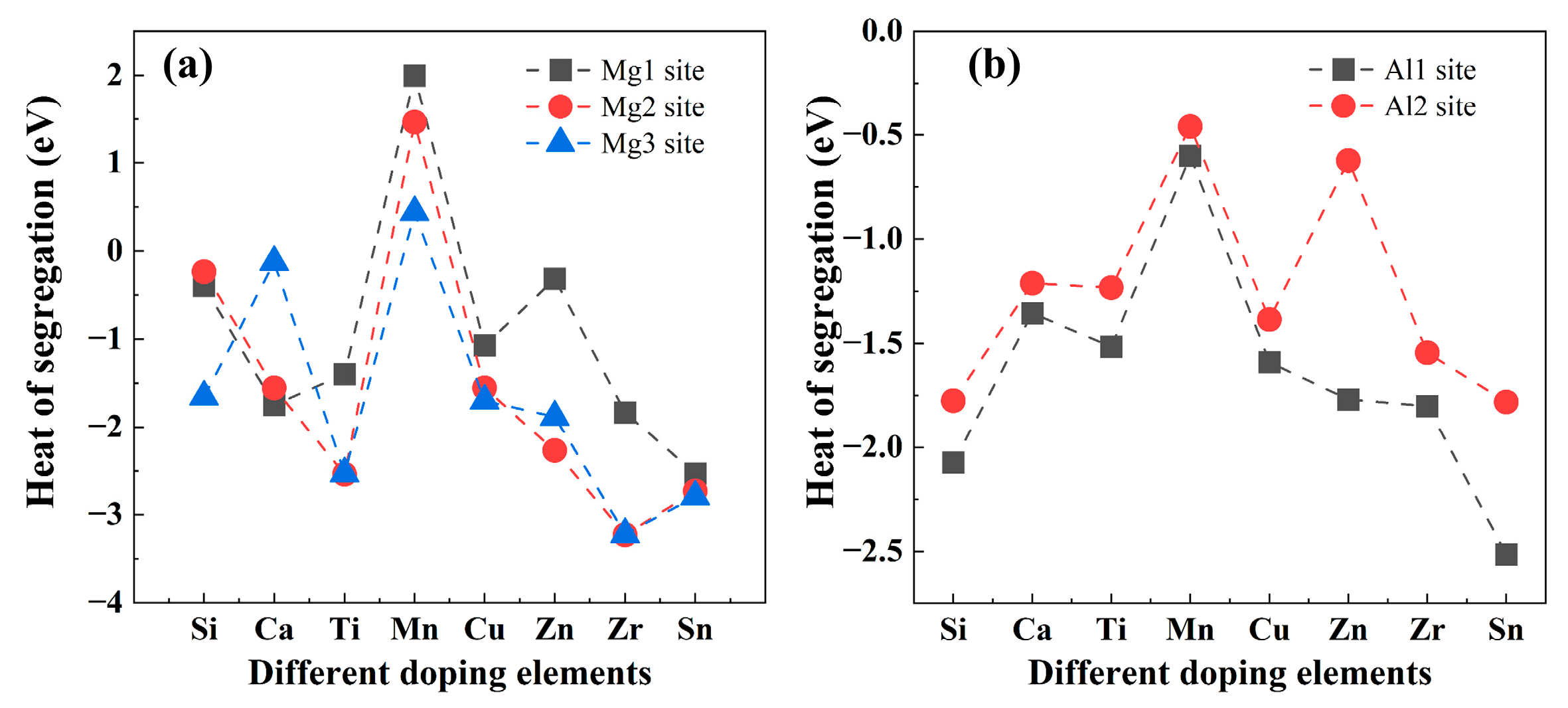
In Equation (8), n denotes the number of doping atoms. In the present study, only a single doping atom is considered; therefore, n = 1. The calculated heat of segregation of the doping Mg(0001)/Al3Y(0001) interface with Mg sites and Al sites are shown in Figure 9. From the heat of segregation data shown in Figure 9, it is evident that different doping elements exhibit pronounced differences in their segregation behaviors at various interfacial sites. Overall, most doping elements display more negative segregation energies at the Mg-side sites, particularly at the Mg2 and Mg3 positions, indicating a stronger thermodynamic driving force for segregation toward the Mg-side interface, whereas the segregation tendency at the Al-side sites (Al1 and Al2) is comparatively weaker. Among the elements considered, Zr, Sn, and Ti exhibit the most negative segregation energies at the Mg2/Mg3 sites, suggesting the strongest propensity for interfacial segregation and implying their tendency to accumulate at the interface and form thermodynamically stable configurations. In contrast, Mn shows positive segregation energies at all Mg-side sites, indicating that Mn is unlikely to segregate to the interface; a similar trend is also observed at the Al1 site. With respect to the Al-side sites, all doping elements exhibit more negative segregation energies at the Al1 site than at the Al2 site, indicating a preferential segregation to the Al1 position, with Sn showing a particularly pronounced tendency. By comparison, Ca presents relatively small absolute values of segregation energy across all interfacial sites, approaching zero at the Mg3 site, which suggests a limited capability for interfacial segregation. Taken together, the Mg-side interfacial sites are thermodynamically more favorable for doping element segregation. Therefore, the rational selection of doping elements and their preferred interfacial occupancy is crucial for tailoring interfacial composition distributions and enhancing interfacial stability.

4. Conclusions

In this work, a systematic first-principles investigation was performed to elucidate the bulk properties of Mg and Al3Y and the interfacial structure–property relationships of the Mg(0001)/Al3Y(0001) system, with particular emphasis on interfacial stability, electronic bonding mechanisms, and doping element effects. The calculated lattice parameters, elastic constants, and phonon dispersion relations confirm that both Mg and Al3Y are dynamically stable and that the GGA-PBEsol functional provides a reliable description of their structural and mechanical properties. The similar hexagonal symmetry and small lattice mismatch (~1.27%) between Mg(0001) and Al3Y(0001) basal planes enable the construction of a low-strain semi-coherent interface, which is favorable for achieving strong interfacial adhesion in Mg/Al3Y composites. Among the three considered stacking configurations, the MT and HCP configurations exhibit significantly higher work of adhesion than the OT configuration, indicating that interfacial stability is highly sensitive to atomic stacking. Electronic structure analyses reveal pronounced charge transfer from Mg to Al and Y atoms at the interface, accompanied by strong orbital hybridization between Mg-p, Al-p, and Y-d states near the Fermi level, giving rise to partially directional interfacial bonds rather than purely metallic bonding. The MT configuration shows the strongest hybridization and charge accumulation, consistent with its highest work of adhesion and superior thermodynamic stability. Furthermore, the segregation behavior and strengthening effects of typical doping elements (Si, Ca, Ti, Mn, Cu, Zn, Zr, and Sn) were systematically evaluated. The results demonstrate that Mg-side interfacial sites, particularly Mg2 and Mg3, are thermodynamically more favorable for segregation and more effective in enhancing interfacial adhesion than Al-side sites. Among the elements considered, Zr and Ti exhibit the most negative segregation energies and the most pronounced improvement in work of adhesion, identifying them as highly effective elements for interfacial strengthening, whereas Mn and Ca show limited segregation tendency and adhesion enhancement. Overall, this study provides fundamental atomic-scale insights into interfacial stabilization mechanisms and offers clear theoretical guidance for doping element selection and interface engineering in high-performance Mg-based composite systems.

Author Contributions

Conceptualization, Y.Z.; Methodology, Y.Z.; Software, J.T.; Formal analysis, L.G.; Data curation, Q.H.; Writing—original draft, Y.Z.; Writing—review & editing, Y.Z., L.G., J.T. and Z.D.; Visualization, Q.H.; Supervision, J.T. and Z.D.; Project administration, Y.Z. All authors have read and agreed to the published version of the manuscript.

Funding

This work was supported by the Jinhua Science and Technology Program of China (No. 2026-1-086) and the Preferentially Funded Postdoctoral Research Project of Zhejiang Province (Grant No. ZJ2025162).

Data Availability Statement

The original contributions presented in this study are included in the article. Further inquiries can be directed to the corresponding author.

Conflicts of Interest

The authors declare that they have no known competing financial interests or personal relationships that could have appeared to influence the work reported in this paper.

References

  1. Chen, X.; Zhang, J.; Wang, M.; Wang, W.; Zhao, D.; Huang, H.; Zhao, Q.; Xu, X.; Zhang, H.; Huang, G. Research progress of heterogeneous structure magnesium alloys: A review. J. Magnes. Alloys 2024, 12, 2147–2181. [Google Scholar] [CrossRef]
  2. Yang, Y.; Liu, Y.; He, Z.; Yuan, Y.; Sun, L.; Jiang, S.; Jia, N. Achieving excellent strength-ductility synergy in orientation-heterostructured Mg-Y alloy via element segregation-assisted pinning of twin boundary. J. Mater. Sci. Technol. 2026, 248, 69–86. [Google Scholar] [CrossRef]
  3. Qiu, J.; Wan, H.; Ding, Z.; Chen, Y.; Pan, F. Tailoring hydrogen diffusion pathways in Mg-Ni alloys through Gd addition: A combined experimental and computational study. Chem. Eng. J. 2024, 502, 157767. [Google Scholar] [CrossRef]
  4. Taherian, Z.; Shahed Gharahshiran, V.; Wei, X.; Khataee, A.; Yoon, Y.; Orooji, Y. Revisiting the mitigation of coke formation: Synergism between support & promoters’ role toward robust yield in the CO2 reformation of methane. Nano Mater. Sci. 2024, 6, 536–547. [Google Scholar] [CrossRef]
  5. Yuan, Y.; Chen, X.; Xiong, X.; Li, K.; Tan, J.; Yang, Y.; Peng, X.; Chen, X.; Chen, D.; Pan, F. Research advances of magnesium and magnesium alloys globally in 2024. J. Magnes. Alloys 2025, 13, 4689–4732. [Google Scholar] [CrossRef]
  6. Lv, H.; Tan, J.; Geng, T.; Wang, H.; Shi, H.; Lin, Y.; Bin, J.; Eckert, J. Advances in high-strength and high-thermal conductivity cast magnesium alloys: Strategies for property optimization. J. Alloys Compd. 2025, 1029, 180843. [Google Scholar] [CrossRef]
  7. Zhou, Y.; Wang, M.; Yang, H.; Li, J.; Tan, J.; Chen, X.; Pan, F. Probing the mechanical properties and interfacial bonding mechanism of AM60 alloy reinforced with co-addition of Si3N4 and Ti particles. Mater. Sci. Eng. A 2025, 941, 148625. [Google Scholar] [CrossRef]
  8. Zhou, D.; Zheng, C.; Zhang, Y.; Sun, H.; Sheng, P.; Zhang, X.; Li, J.; Guo, S.; Zhao, D. An overview of RE-Mg-based alloys for hydrogen storage: Structure, properties, progresses and perspectives. J. Magnes. Alloys 2025, 13, 41–70. [Google Scholar] [CrossRef]
  9. Lv, N.; Zhao, L.; Yan, H.; Liu, B.; Mao, Y.; Shan, Z.; Chen, R. Texture tailoring and microstructure refinement induced by {11−21} and {10−12} twinning in an extruded Mg-Gd alloy. J. Alloys Compd. 2023, 966, 171590. [Google Scholar] [CrossRef]
  10. Dong, X.; Feng, L.; Wang, S.; Ji, G.; Addad, A.; Yang, H.; Nyberg, E.A.; Ji, S. On the exceptional creep resistance in a die-cast Gd-containing Mg alloy with Al addition. Acta Mater. 2022, 232, 117957. [Google Scholar] [CrossRef]
  11. Gui, Y.; Ouyang, L.; Cui, Y.; Bian, H.; Li, Q.; Chiba, A. Grain refinement and weak-textured structures based on the dynamic recrystallization of Mg–9.80Gd–3.78Y–1.12Sm–0.48Zr alloy. J. Magnes. Alloys 2021, 9, 456–466. [Google Scholar] [CrossRef]
  12. Wang, C.; Dong, Z.; Jiang, B.; Wang, L.; Zheng, Z.; Zhang, A.; Song, J.; Zhang, D.; Vitos, L. Low thermal expansion in conjunction with improved mechanical properties achieved in Mg-Gd solid solutions. Mater. Des. 2025, 251, 113685. [Google Scholar] [CrossRef]
  13. Huang, J.; Liu, Y.; Han, Y.; Wan, Y.; Liu, C.; Chen, Z. Microstructure evolution and mechanical properties of Mg−Gd−Zn alloy with and without LPSO phase processed by multi-directional forging. Trans. Nonferrous Met. Soc. China 2025, 35, 1075–1091. [Google Scholar] [CrossRef]
  14. Pang, M.; Zhan, Y.; Ling, M.; Wei, S.; Liu, Y.; Du, Y. First-principles study on the crystal, electronic structure and mechanical properties of hexagonal Al3RE (RE = La, Ce, Pr, Nd, Sm, Gd) intermetallic compounds. Solid State Commun. 2011, 151, 1135–1140. [Google Scholar] [CrossRef]
  15. Li, H.; Gao, K.; Gao, C.; Ding, Y.; Xiong, X.; Wu, X.; Huang, H.; Wen, S.; Nie, Z.; Zhang, Q. Hardness and Young’s modulus of Al3Yb single crystal studied by nano indentation. Intermetallics 2020, 127, 106980. [Google Scholar] [CrossRef]
  16. Zhang, B.; Bian, X.; Si, P.; Zhou, J.K.; Lin, T.; Jia, Y. Crystallization behavior of novel amorphous Al85Mg10Ce5 alloy. Phys. Lett. A 2004, 327, 38–43. [Google Scholar] [CrossRef]
  17. Dai, J.; Jiang, B.; Li, X.; Yang, Q.; Dong, H.; Xia, X.; Pan, F. The formation of intermetallic compounds during interdiffusion of Mg–Al/Mg–Ce diffusion couples. J. Alloys Compd. 2015, 619, 411–416. [Google Scholar] [CrossRef]
  18. Jiahong, D.; Hongmei, X.; Bin, J.; Cheng, P.; Zhongtao, J.; Qingshan, Y.; Fusheng, P. Interfacial Reaction Between Mg-40Al and Mg-20Ce Using Liquid-Solid Diffusion Couples. Rare Met. Mater. Eng. 2018, 47, 2042–2048. [Google Scholar] [CrossRef]
  19. Liu, Y.; Wen, J.C.; Zhang, X.Y.; Huang, Y.C. A comparative study on heterogeneous nucleation and mechanical properties of the fcc-Al/L1(2)-Al(3)M (M = Sc, Ti, V, Y, Zr, Nb) interface from first-principles calculations. Phys. Chem. Chem. Phys. 2021, 23, 4718–4727. [Google Scholar] [CrossRef] [PubMed]
  20. Liu, T.; Ma, T.; Li, Y.; Ren, Y.; Liu, W. Stabilities, mechanical and thermodynamic properties of Al–RE intermetallics: A first-principles study. J. Rare Earths 2022, 40, 345–352. [Google Scholar] [CrossRef]
  21. Pan, R.-K.; Wang, H.-C.; Shi, T.-T.; Tian, X.; Tang, B.-Y. Thermal properties and thermoelasticity of L12 ordered Al3RE (RE=Er, Tm, Yb, Lu) phases: A first-principles study. Mater. Des. 2016, 102, 100–105. [Google Scholar] [CrossRef]
  22. Zhang, Q.; Qiao, J.; Zhao, Y.; Jang, J.; Ramamurty, U. Multimodality of critical strength for incipient plasticity in L12- precipitated (CoCrNi)94Al3Ti3 medium-entropy alloy: Coherent interface-facilitated dislocation nucleation. Acta Mater. 2025, 288, 120826. [Google Scholar] [CrossRef]
  23. Zhao, Y.; Zhao, T.; Lu, G.; Guo, Y.; Zhang, J.; Wang, W.Y.; Luo, Y.; Li, J. Interactions of Re and hydrogen at γ/γ′ interfaces enhanced hydrogen-embrittlement resistance of Re-optimized Ni-based superalloy. Mater. Res. Lett. 2024, 12, 551–560. [Google Scholar] [CrossRef]
  24. Li, Y.; Huang, Y.; Zhang, X. Ab-Initio Studies of the Micromechanics and Interfacial Behavior of Al3Y|fcc-Al. Metals 2022, 12, 1680. [Google Scholar] [CrossRef]
  25. van Dalen, M.E.; Karnesky, R.A.; Cabotaje, J.R.; Dunand, D.C.; Seidman, D.N. Erbium and ytterbium solubilities and diffusivities in aluminum as determined by nanoscale characterization of precipitates. Acta Mater. 2009, 57, 4081–4089. [Google Scholar] [CrossRef]
  26. Yang, W.; Quan, G.F.; Ji, B.; Wan, Y.F.; Zhou, H.; Zheng, J.; Yin, D.D. Effect of Y content and equal channel angular pressing on the microstructure, texture and mechanical property of extruded Mg-Y alloys. J. Magnes. Alloys 2022, 10, 195–208. [Google Scholar] [CrossRef]
  27. Wu, S.Z.; Qiao, X.G.; Qin, S.H.; Chi, Y.Q.; Zheng, M.Y. Improved strength in wrought Mg-Y-Ni alloys by adjusting the block-shaped LPSO phase and plate-shaped gamma’ phase. Mater. Sci. Eng. A 2022, 831, 142198. [Google Scholar] [CrossRef]
  28. Kim, Y.-Y.; Euh, K.; Son, H.-W. Unraveling mechanism of structural transformation from D022-Al3Y to L12-Al3(Y, Zr) phase by inward diffusion of Zr and anti-phase boundary in the Al-Zr-Y alloy at elevated temperature. J. Mater. Sci. Technol. 2026, 245, 278–288. [Google Scholar] [CrossRef]
  29. Qin, W.; Ji, Y.; Yao, C.; Lv, H.; Liu, X.; Jiang, Z.; Ren, X.; Xia, Y.; Dong, C. Effect of yttrium addition and Al3Y phase dissolution on corrosion behavior of Al-Mg-Zn alloys. Corros. Sci. 2025, 256, 113205. [Google Scholar] [CrossRef]
  30. Segall, M.D.; Lindan, P.J.D.; Probert, M.J.; Pickard, C.J.; Hasnip, P.J.; Clark, S.J.; Payne, M.C. First-principles simulation: Ideas, illustrations and the CASTEP code. J. Phys. Condens. Matter 2002, 14, 2717–2744. [Google Scholar] [CrossRef]
  31. Vanderbilt, D. Soft self-consistent pseudopotentials in a generalized eigenvalue formalism. Phys. Rev. B Condened Matter 1990, 41, 7892–7895. [Google Scholar] [CrossRef]
  32. Head, J.D.; Zerner, M.C. A Broyden-Fletcher-Goldfarb-Shanno optimization procedure for molecular geometries. Chem. Phys. Lett. 1985, 122, 264–270. [Google Scholar] [CrossRef]
  33. Perdew, J.P.; Burke, K.; Ernzerhof, M. Generalized gradient approximation made simple. Phys. Rev. Lett. 1996, 77, 3865–3868. [Google Scholar] [CrossRef]
  34. Perdew, J.P.; Ruzsinszky, A.; Csonka, G.I.; Vydrov, O.A.; Scuseria, G.E.; Constantin, L.A.; Zhou, X.; Burke, K. Restoring the density-gradient expansion for exchange in solids and surfaces. Phys. Rev. Lett. 2008, 100, 136406, Erratum in Phys. Rev. Lett. 2009, 102, 039902. [Google Scholar] [CrossRef] [PubMed]
  35. Zhou, Y.; Wang, H.; Dong, Q.; Tan, J.; Chen, X.; Jiang, B.; Pan, F.; Eckert, J. Probing the stability, adhesion strength, and fracture mechanism of Mg/Al2Y interfaces via first-principles calculations. Mater. Today Commun. 2022, 33, 104612. [Google Scholar] [CrossRef]
  36. Zhou, Y.; Tian, W.; Dong, Q.; Wang, H.; Tan, J.; Chen, X.; Zheng, K.; Pan, F. A First-principles study on the adhesion strength, interfacial stability, and electronic properties of Mg/Mg2Y interface. Acta Metall. Sin. (Engl. Lett.) 2023, 37, 537–550. [Google Scholar] [CrossRef]
  37. Nie, Y.; Xie, Y. Ab initiothermodynamics of the hcp metals Mg, Ti, and Zr. Phys. Rev. B 2007, 75, 174117. [Google Scholar] [CrossRef]
  38. Liu, R.; Yin, X.; Feng, K.; Xu, R. First-principles calculations on Mg/TiB2 interfaces. Comput. Mater. Sci. 2018, 149, 373–378. [Google Scholar] [CrossRef]
  39. Born, M.; Huang, K. Dynamical Theory of Crystal Lattices; Clarendon Press: Oxford, UK, 1954. [Google Scholar]
  40. Vasilyev, D. Thermal expansion anisotropy of Fe23Mo16 and Fe7Mo6 mu-phases predicted using first-principles calculations. Phys. Chem. Chem. Phys. 2024, 26, 3482–3499. [Google Scholar] [CrossRef] [PubMed]
  41. Wang, M.; Sun, J.; Li, S.; Meng, Y.; Zheng, H.; Yin, Z.; Fu, Y.; Zhang, Y. Heterogeneous nucleation mechanisms in Mg(0001)/Al3BC(0001) interfaces: Insights for advanced Mg-based composites. Surf. Interfaces 2024, 46, 104040. [Google Scholar] [CrossRef]
  42. Zheng, Q.; Li, Y.; Gao, Y.; Yang, Y.; Zhao, Z. Theoretical prediction on interfacial bonding and strengthening mechanism of polymorphic ZrO2/Fe interfaces. Phys. B Condens. Matter 2025, 699, 416871. [Google Scholar] [CrossRef]
  43. Zhang, G.; Chen, G.; Panwisawas, C.; Teng, X.; An, R.; Cao, J.; Huang, Y.; Dong, Z.; Leng, X. Uncovering the fracture mechanism of Laves (111)/ Ni6Nb7 (0001) interfaces by first-principles calculations. Acta Mater. 2024, 281, 120426. [Google Scholar] [CrossRef]
  44. Wang, X.; Chen, L.; Yuan, Z.; Rong, J.; Feng, J.; Muzammil, I.; Yu, X.; Zhang, Y.; Zhan, Z. DHQ-graphene: A novel two-dimensional defective graphene for corrosion-resistant coating. J. Mater. Chem. A 2019, 7, 8967–8974. [Google Scholar] [CrossRef]
  45. Zhou, Y.; Lv, H.; Chen, T.; Tong, S.; Zhang, Y.; Wang, B.; Tan, J.; Chen, X.; Pan, F. Probing the effect of alloying elements on the interfacial segregation behavior and electronic properties of Mg/Ti interface via first-principles calculations. Molecules 2024, 29, 4138. [Google Scholar] [CrossRef]
  46. Wu, T.; Zhang, P.; Tang, J.; Wang, L.; Deng, L.; Wu, Y.; Deng, H.; Hu, W.; Zhang, X. Segregation of alloying elements at the TiC/V interface: A first-principles study. Nucl. Mater. Energy 2023, 35, 101452. [Google Scholar] [CrossRef]
  47. Butrim, V.N.; Razumovskii, I.M.; Beresnev, A.G.; Kartsev, A.; Razumovskiy, V.I.; Trushnikova, A.S. Effect of alloying elements and impurity (N) on bulk and grain boundary cohesion in Cr-base alloys. Adv. Mater. Res. 2015, 1119, 569–574. [Google Scholar] [CrossRef]
  48. Sun, Y.; Zhu, Y.; Lyu, G.; Wang, K.; Gao, P.; Qian, P. First-principles study of the effect of solute co-segregation on Y {101¯1} twin boundary. J. Mater. Sci. Technol. 2026, 249, 109–119. [Google Scholar] [CrossRef]
  49. Jia, Z.; Xing, Y.; Ning, Y.; Ding, L.; Ehlers, F.J.H.; Hao, L.; Liu, Q. Density gradient segregation of Cu at the Si2Hf/Al interface in an Al-Si-Cu-Hf alloy. Scr. Mater. 2023, 222, 115022. [Google Scholar] [CrossRef]
  50. Gao, Y.; Liu, X.; Wei, L.; Zhang, X.; Chen, M. The segregation behavior of elements at the Ti/TiFe coherent interface: First-principles calculation. Surf. Interfaces 2022, 34, 102321. [Google Scholar] [CrossRef]
  51. Ouadah, O.; Merad, G.; Abdelkader, H.S. Energetic segregation of B, C, N, O at the γ-TiAl/α2-Ti3Al interface via DFT approach. Vacuum 2021, 186, 110045. [Google Scholar] [CrossRef]
  52. Wang, G.; Chong, X.; Li, Z.; Feng, J.; Jiang, Y. Strain-stiffening of chemical bonding enhance strength and fracture toughness of the interface of Fe2B/Fe in situ composite. Mater. Charact. 2024, 207, 113575. [Google Scholar] [CrossRef]
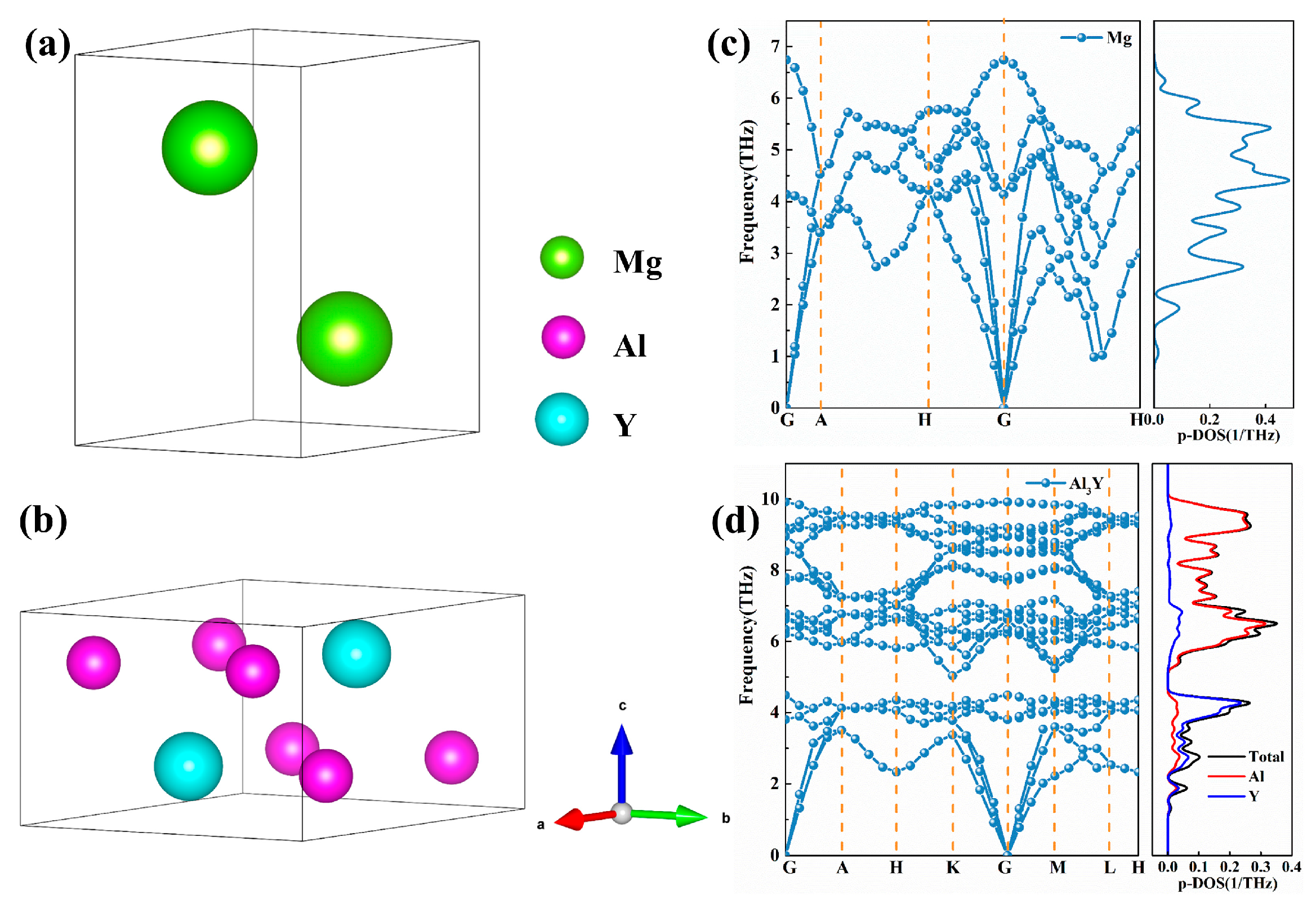
Figure 1. Crystal structure (a,b) and phonon spectrum (c,d) of Mg [36] and Al3Y compounds.
Materials 19 00562 g001
Figure 2. Surface and interface models. (a) Mg(0001) model, (b) Al3Y(0001) model, (c) Mg(0001)/Al3Y(0001)-OT configuration, (d) Mg(0001)/Al3Y(0001)-MT configuration, and (e) Mg(0001)/Al3Y(0001)-HCP configuration, and the red dashed line indicates the interface position.
Materials 19 00562 g002
Figure 3. Total energy (a) and the work of adhesion (b) of Mg(0001)/Al3Y(0001) interface.
Materials 19 00562 g003
Figure 4. Work of adhesion of Mg(0001)/Al3Y(0001) interface.
Materials 19 00562 g004
Figure 5. Charge density difference of Mg(0001)/Al3Y(0001) interface. (a) Mg(0001)/Al3Y(0001)-OT configuration, (b) Mg(0001)/Al3Y(0001)-MT configuration, (c) Mg(0001)/Al3Y(0001)-HCP configuration, and (d) schematic diagram of differential charge atomic cross-sections.
Materials 19 00562 g005
Figure 6. Density of states for bulk Mg, bulk Al3Y, and Mg(0001)/Al3Y(0001) interface. (a) Bulk Mg and Al3Y, (b) Mg(0001)/Al3Y(0001)-OT configuration, (c) Mg(0001)/Al3Y(0001)-MT configuration, and (d) Mg(0001)/Al3Y(0001)-HCP configuration, and the yellow dashed line indicates the Fermi level.
Materials 19 00562 g006
Figure 7. Mg(0001)/Al3Y(0001) interface doping models. (a) Doping sites, (b) clean interface, (c) Mg1 site, (d) Mg2 site, (e) Mg3 site, (f) Al1 site, and (g) Al2 site. The green, pink, and sky-blue spheres represent Mg, Al, and Y atoms, respectively, and the yellow balls represent doping atoms, including Si, Ca, Ti, Mn, Cu, Zn, Zr, and Sn.
Materials 19 00562 g007
Figure 8. Work of adhesion and rate of change of work of adhesion for the doping Mg(0001)/Al3Y(0001) interface with different sites. (a,c) Mg sites and (b,d) Al sites.
Materials 19 00562 g008
Figure 9. Heat of segregation of the doping Mg(0001)/Al3Y(0001) interface with different sites. (a) Mg sites and (b) Al sites.
Materials 19 00562 g009
Table 1. Lattice constants of Mg and Al3Y compounds.
SpeciesMethoda (Å)c (Å)c/a
MgGGA + PBEsol3.185.321.67
Before relax3.175.141.62
Exp. [37]3.2095.211
GGA + PBE [38]3.2215.172
LDA [38]3.1595.073
Al3YGGA + PBEsol (this work)6.284.600.73
Before relax6.274.590.73
Table 2. Elastic constants and elastic modulus of Mg and Al3Y compounds; the unit is GPa.
SpeciesMethodC11C33C44C12C13BGE
MgGGA + PBEsol55.4471.1619.8930.7323.8737.6016.7943.85
Exp. [37] 35.4
GGA + PBE [38] 35.6
LDA [38] 43.9
Al3YGGA + PBEsol161.25186.5771.0165.3324.1579.3662.35148.23
Table 3. The work of adhesion of the Mg(0001)/Al3Y(0001) interface, together with a comparison with the adhesion work of other interfaces.
SpeciesWad (J/m2)Reference
Mg/Al3Y-OT2.07This work
Mg/Al3Y-MT3.14This work
Mg/Al3Y-HCP3.12This work
Mg/Al2Y-Al-OT1.49[35]
Mg/Al2Y-Al-MT1.63[35]
Mg/Al2Y-Al-HCP1.56[35]
Mg/Al2Y-Y-OT1.19[35]
Mg/Al2Y-Y-MT1.54[35]
Mg/Al2Y-Y-HCP1.68[35]
Mg/Mg2Y-Mg1-OT0.94[36]
Mg/Mg2Y-Mg1-MT0.43[36]
Mg/Mg2Y-Mg1-HCP1.99[36]
Mg/Mg2Y-Mg2-OT1.80[36]
Mg/Mg2Y-Mg2-MT1.84[36]
Mg/Mg2Y-Mg2-HCP1.82[36]
Mg/Mg2Y-Y-OT1.99[36]
Mg/Mg2Y-Y-MT2.36[36]
Mg/Mg2Y-Y-HCP2.38[36]
Disclaimer/Publisher’s Note: The statements, opinions and data contained in all publications are solely those of the individual author(s) and contributor(s) and not of MDPI and/or the editor(s). MDPI and/or the editor(s) disclaim responsibility for any injury to people or property resulting from any ideas, methods, instructions or products referred to in the content.