1. Introduction
The remediation of organic pollutants from water resources is critically important for safeguarding public health and preserving ecological security, positioning it as a prominent focus of contemporary research [
1]. Among these pollutants, synthetic dyes warrant particular attention due to their toxic, carcinogenic, and mutagenic properties. These traits not only irritate the skin, eyes, and respiratory system but also disrupt plant physiological processes and metabolic activities in environmental settings, creating imbalances that ultimately inhibit growth [
2]. A representative example is rhodamine B (Rh-B; C
28H
31ClN
2O
3), a widely recognized cationic dye used as a pigment and additive in pharmaceuticals, textiles, and nutritional products. Notably, Rh-B exerts detrimental effects on aquatic ecosystems even at low concentrations [
3]. Despite its mutagenic and toxic profiles having driven bans in numerous countries, unregulated use in the dyeing industry persists, remaining a pressing environmental concern [
4,
5].
Numerous methods and technologies have been developed for high-efficiency degradation of Rhodamine B (Rh-B) [
6,
7]. Comparative studies reveal that the Fenton and photo-Fenton processes exhibit versatile capabilities for generating free radicals for dye degradation, making them more effective than conventional adsorption methods for removing organic dyes [
8,
9]. Fundamentally, this reaction belongs to advanced oxidation processes (AOPs), which are driven by iron ions that efficiently catalyze the breakdown of organic contaminants into simpler molecular compounds [
10,
11]. Nonetheless, conventional Fenton oxidation faces persistent challenges, including iron sludge formation, low hydrogen peroxide utilization efficiency, and difficulties with catalyst recovery and reuse [
12,
13]. To mitigate these limitations, carbon-based iron containing composites as heterogeneous Fenton-like catalysts have emerged as a promising alternative, offering high pollutant removal efficiency and low energy consumption [
14]. However, the complexity and high cost of their synthesis processes further complicate scale-up for industrial manufacturing. Consequently, there is an urgent need to develop cost-effective, environmentally benign photo-Fenton catalysts that maintain high, stable catalytic performance over extended operation [
15].
More recently, attapulgite (ATP), a crystalline hydrated magnesium silicate with a unique layer-chain structure and large specific surface area, has gained considerable attention as an effective support material in advanced oxidation processes [
16]. Notably, natural ATP contains intrinsic iron impurities (
/
) derived from its geological formation, which can participate in redox reactions. For example, ATP from Baiyin, Gansu (China) contains approximately 8 wt.% iron, as reported in our previous work [
14]. These naturally occurring iron species can catalyze the decomposition of hydrogen peroxide (H
2O
2) to generate hydroxyl radicals (•OH) through Fenton or photo-Fenton-like pathways [
15]. In classical Fenton chemistry,
reacts with H
2O
2 to produce •OH, whereas in photo-Fenton systems, light irradiation accelerates the
→
regeneration, thereby enhancing radical formation and overall degradation efficiency [
16,
17]. Consequently, ATP functions not only as a high-surface-area support but also as a naturally iron-containing material capable of facilitating heterogeneous Fenton and photo-Fenton catalytic reactions [
18,
19]. Moreover, its inherent hierarchical pore-size distribution further enhances its exceptional adsorption capacity [
20]. Furthermore, ATP can be combined with carbon to fabricate functional catalysts that enhance the degradation efficiency of diverse organic dyes [
21], including methylene blue, crystal violet, Rhodamine D, and Rhodamine B [
22,
23]. However, a critical limitation of these composite systems persists: catalytic activity is primarily governed by the carbon component, thereby preventing the full utilization of the attapulgite matrix’s intrinsic functional potential [
24,
25]. Recently, a carbon-modified pizza-like attapulgite (denoted C-AATP@CTAB) has been developed for the degradation of Rhodamine B (Rh-B). The abundant oxygen-containing functional groups on the carbon surface—including hydroxyl (–OH), carboxyl (–COOH), and amino (–NH
2) groups—further provide a flexible platform for surface modification or the fabrication of complex composite materials. Despite these advancements, research gaps persist on ATP-carbon composites for photo-Fenton degradation—along with limited mechanistic insights into their performance.
In this work, we used cetyltrimethylammonium bromide (CTAB), which improves dispersion and carbon coating, while ethylenediamine adds amine groups to enhance surface reactivity and catalytic performance. All reagents were handled safely and removed after synthesis. Their use was essential to achieve the desired structure and functionality, via a hydrothermal method to produce carbon-modified ATP composites (C-A-ATP) for Fenton-like and Photo-Fenton catalysts for rapid rhodamine B degradation. The related key parameters and possible mechanism were carefully investigated. This approach contributes to the rational development of high-performance, environmentally friendly materials and provides a practical pathway for sustainable remediation of pollutants.
2. Results and Discussion
2.1. Morphology
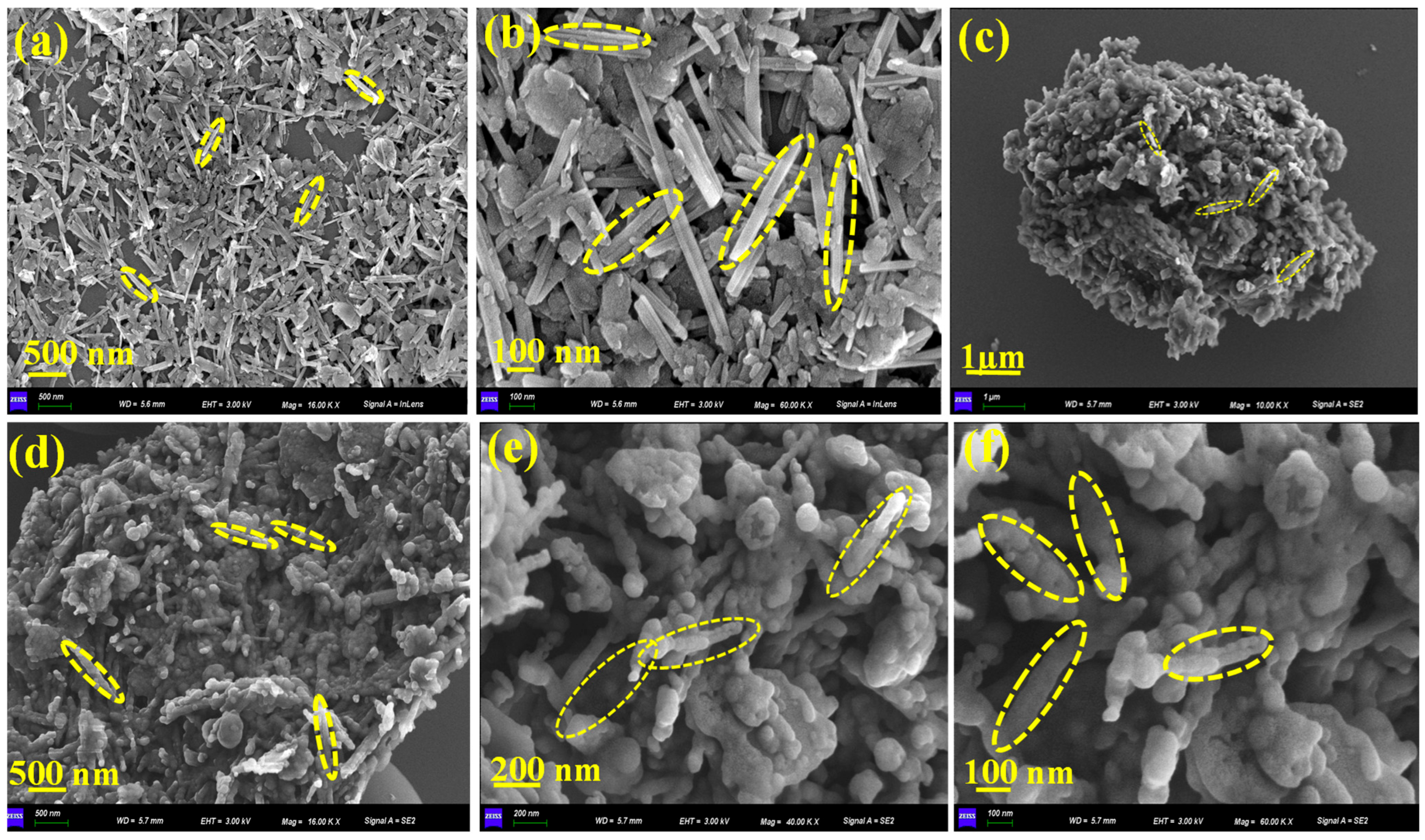
The morphological evolution of activated attapulgite (A-ATP) following surface modification was systematically investigated via scanning electron microscopy (SEM), with results shown in
Figure 1a,b. Initially, pristine A-ATP exhibited a typical rod-like structure with smooth surfaces, loosely aggregated into bundles; individual rods measured approximately 30–50 nm in length. After composite formation (
Figure 1c–f), the C-A-ATP@CTAB sample displayed significant morphological alterations: enhanced aggregation, increased surface roughness, and shortened rod-like structures embedded within a denser carbonaceous matrix. Notably, a distinctive “pizza-like” morphology emerged, which we attribute to the hydrothermal co-precipitation of citric acid-derived carbon with ATP in the presence of cetyltrimethylammonium bromide (CTAB). This process collectively promoted surface coverage, interfacial interaction, and partial encapsulation of ATP rods, resulting in altered texture and an apparent reduction in size. The observed decrease in visible rod length is not attributable to structural erosion or fragmentation—no direct evidence supports such a mechanism. Instead, we hypothesize that it stems from partial embedding of ATP rods within the carbonaceous matrix and from aggregation effects, which obscure their full dimensions in SEM images. To further corroborate composite formation and interfacial interactions, we employed X-ray photoelectron spectroscopy (XPS) and Fourier-transform infrared spectroscopy (FTIR). XPS analysis confirmed the presence of oxygen-containing functional groups (–OH, C=O, and C–O), indicating successful carbon incorporation into the ATP surface. Notably, the O 1s spectra exhibited shifts associated with –OH groups originating from both ATP and carbon, providing evidence for robust interfacial bonding.
2.2. Crystal Structure
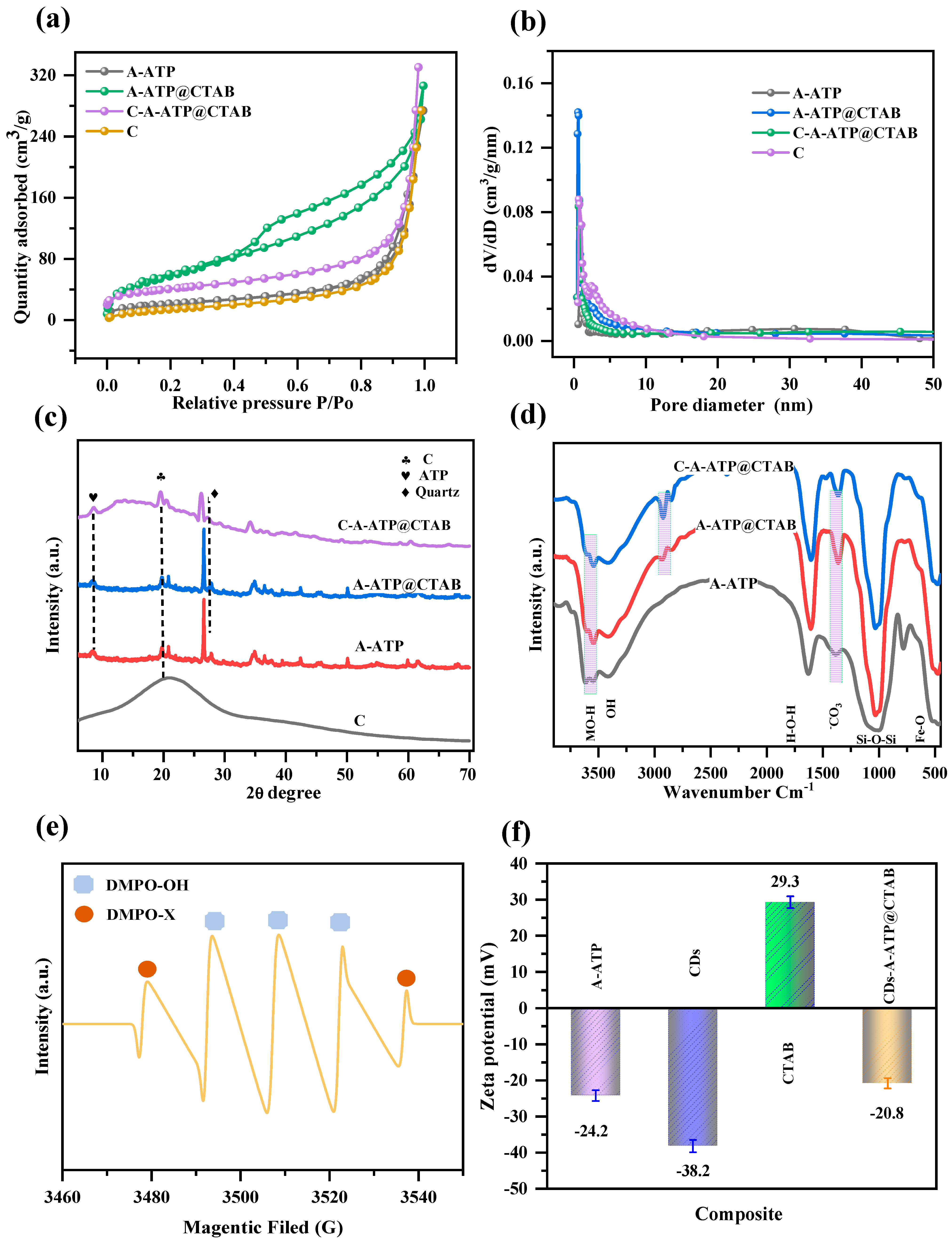
Figure 2c displays distinct diffraction peaks at specific 2θ angles in the XRD pattern of the C-ATP@CTAB nanocomposite. These peaks—located at 8.4°, 13.8°, and 19.8°—are assigned to the (110), (−110), and (040) crystallographic planes of attapulgite (A-ATP), respectively, confirming the preservation of the composite’s ordered crystalline structure. Additionally, a broad peak around 22.5°—consistent with previous studies—is attributed to amorphous carbon, verifying the successful integration of carbon into the composite matrix [
25,
26]. The absence of new diffraction peaks upon integrating A-ATP into the carbon network directly indicates the successful encapsulation of ATP within the carbon matrix [
27]. Notably, while the characteristic peaks of bare ATP remain intact in C-ATP@CTAB, the intensity of the carbon peak is significantly diminished. This observation not only reinforces evidence for effective ATP encapsulation but also suggests that ATP integration subtly modulates the composite’s crystalline environment. Collectively, the retention of characteristic peaks from both ATP and carbon confirms the successful formation of the C-A-ATP@CTAB composite, with both components stably associated—carbon adhering to the ATP surface [
28]. During carbonization, citric acid acted as a protective and stabilizing agent: it minimized ATP deformation during stirring and prevented structural collapse caused by ethanol evaporation during the drying step.
2.3. FT-IR Analysis
Figure 2e presents the FTIR spectra of both pristine A-ATP and the C-A-ATP@CTAB composite, enabling systematic identification of their key functional groups. A prominent peak at 3694 cm
−1 is assigned to the O–H stretching vibrations of hydroxyl groups present in both A-ATP and the carbon component. A sharp peak at 3616 cm
−1—attributed to the asymmetric stretching of Al–OH–Al in the aluminosilicate sheets of montmorillonite—was corroborated by previous studies [
29]. Additional peaks corresponding to in-plane and out-of-plane bending vibrations of carbonate ions further indicate the successful incorporation of carbon and ATP clay into the nanocomposite [
28]. A distinct peak at 1039 cm
−1 arises from the stretching vibration of Si–O–Si bonds in the tetrahedral sheets of montmorillonite. Absorption bands at 2908 cm
−1 and 2963 cm
−1 are linked to C–H stretching vibrations of –CH
3 and –CH
2– groups, respectively. The peak at 1654 cm
−1 originates from the bending vibration of coordinated or adsorbed water on the composite [
29]. Peaks at 1031 cm
−1 and 652 cm
−1 are attributed to the stretching vibrations of Si–O bonds and the inverted tetrahedral SiO
4 skeleton, respectively. Finally, peaks at 530 cm
−1 and 580 cm
−1 correspond to Fe–O stretching and bending vibrations, respectively. Collectively, these spectral assignments confirm the successful synthesis of the C-A-ATP@CTAB nanocomposite via the hydrothermal method [
30,
31].
2.4. Pore Structure Analysis
N
2 adsorption–desorption isotherms were employed to characterize the samples further and evaluate the impact of carbon modification on the pore structure. Pristine ATP exhibited a Type-IV isotherm with H3-type hysteresis, consistent with the characteristic slit-like pores of traditional attapulgite [
32]. Similarly, the C-A-ATP@CTAB composite displayed Type-IV isotherms with capillary condensation-induced hysteresis loops (
Figure 2a,b), indicating preserved mesoporous structure analogous to pristine ATP. As summarized in
Table 1, the BET-specific surface area (S
aβet) increased sequentially for A-ATP (156 m
2/g), A-ATP@CTAB (156 m
2/g), and C-A-ATP@CTAB (212 m
2/g)—with the latter reaching the highest value. Notably, the microporous surface area (S
micro) of C-A-ATP@CTAB contributed dominantly to the total S
aβet (212 m
2/g). This enhancement in S
aβet is primarily attributed to the citric acid-derived carbon coating on ATP rods during hydrothermal carbonization,
c.f.,
Figure 2b. Specifically, the hydrothermally synthesized carbon modified the ATP surface, increasing surface roughness and introducing additional adsorption sites. Additionally, carbonization may penetrate ATP’s mesopores, further expanding the available adsorption volume.
Furthermore, these structural modifications likely induced partial narrowing or blockage of micropores in C-A-ATP@CTAB. Nevertheless, the composite retained a dominant microporous contribution to the total specific surface area—an outcome attributed to the synergistic effect of the carbon coating on ATP surfaces, which introduced abundant new adsorption sites to offset minor changes in pore access. In one word, our results conclusively verify the successful modification of carbon species onto A-ATP. Crucially, this deposition strategy enhanced surface roughness and elevated catalytic activity without compromising ATP’s inherent chemical composition or crystalline structure.
2.5. Zeta Potential
Zeta potential measurements (
Figure 2f) revealed that all tested samples exhibited negative zeta potentials, consistent with predominantly negatively charged surfaces. In stark contrast, pure cetyltrimethylammonium bromide (CTAB) displayed a positive zeta potential (+29.3 mV), attributable to its quaternary ammonium groups [
33]. Pristine attapulgite (A-ATP; −24.2 mV) and the citric acid-derived carbon component (−38.2 mV) inherently carried negative charges, a feature driven by their abundant carboxyl (–COOH) and hydroxyl (–OH) functional groups—these groups enable electrostatic repulsion in aqueous systems, a critical factor for colloidal stability [
34]. For the composite series—from A-ATP to C-A-ATP@CTAB—zeta potentials ranged from −38.2 mV (A-ATP) to a maximum of +29.3 mV (approaching CTAB’s value). Notably, despite CTAB adsorption modifying surface chemistry, the final composite retained a net negative charge. This outcome underscores that the combined negative charge contributions from ATP and carbon dominate over CTAB’s positive charge, preserving long-range electrostatic repulsion. Such stability is essential for maintaining adsorption and catalytic degradation efficiency in wastewater treatment, as it prevents particle aggregation and maintains active-site accessibility.
2.6. EPR Analysis
To elucidate the degradation mechanism of Rhodamine B (RhB), we employed Electron Paramagnetic Resonance (EPR) spectroscopy to detect reactive oxygen species (ROS)—particularly hydroxyl radicals (•OH)—which are critical to the Fenton-like oxidation process [
35]. A spin-trapping agent, 5,5-dimethyl-1-pyrroline N-oxide (DMPO), was used to capture and stabilize these highly reactive radicals, forming DMPO-OH adducts. The formation of these adducts and their involvement in RhB degradation were subsequently verified [
36,
37]. The characteristic EPR signal (1:2:2:1 intensity ratio) in
Figure 2e provides conclusive evidence for •OH generation within the C-A-ATP@CTAB/H
2O
2 system. This strongly suggests that •OH radicals act as the primary oxidants, initiating and sustaining RhB degradation. Additionally, the sustained radical signal throughout the reaction indicates continuous •OH regeneration, likely attributed to efficient
/
redox cycling within the composite. This cycling not only enhances catalytic activity but also extends degradation efficiency—confirming that C-A-ATP@CTAB functions as a highly active and stable catalyst for advanced oxidation processes (AOPs) in wastewater treatment.
2.7. Thermal Analysis
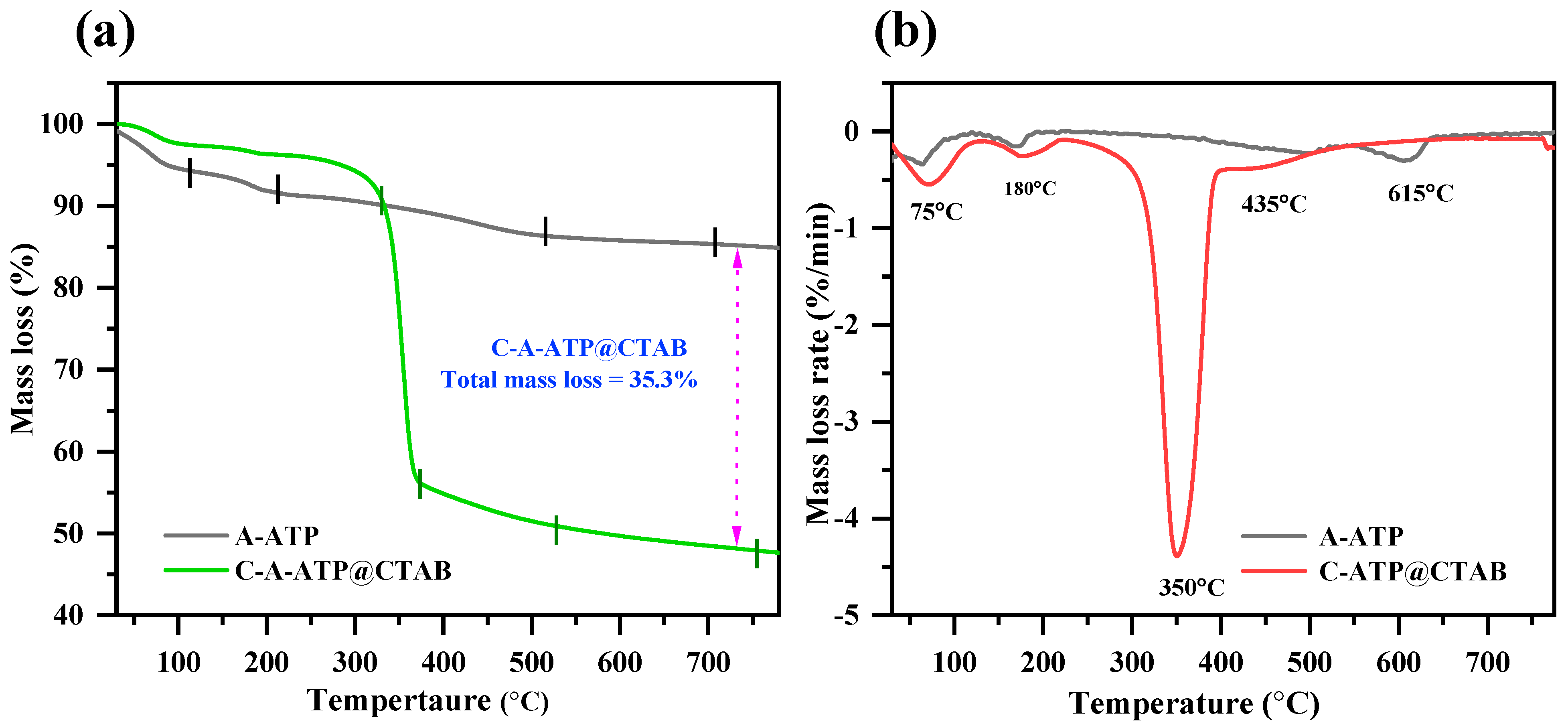
The thermal decomposition behavior of pristine attapulgite (A-ATP) and carbon-modified C-A-ATP@CTAB was investigated via thermogravimetric analysis (TGA) and derivative thermogravimetric analysis (DTGA) under an air atmosphere, with results presented in
Figure 3a,b. Pristine A-ATP exhibited three distinct weight loss stages: a first stage (0–75 °C) corresponding to the evaporation of physically adsorbed water; a second stage (75–180 °C) attributed to the desorption of structurally bound water; and a third stage (180–615 °C) associated with the decomposition of hydroxyl groups and organic impurities inherent to ATP’s aluminosilicate structure. In contrast, the carbon-modified composite (C-A-ATP@CTAB) exhibited an additional fourth weight-loss stage, directly confirming the successful incorporation of carbon. The first two stages (0–75 °C and 75–180 °C) aligned with those of unmodified A-ATP, while the third stage (180–350 °C) arose from the decomposition of residual organic functional groups (e.g., leftover surfactants or citric acid derivatives from synthesis). The fourth stage (350–435 °C) involved the breakdown of carbonaceous networks and the volatilization of decomposition byproducts. Notably, carbon in the composite decomposed within 250–600 °C—a range attributed to deacetylation, volatilization, and removal of volatile byproducts from the carbon matrix. The total mass loss of C-modified A-ATP (35.3%) was significantly higher than that of pristine ATP (15.16%), a discrepancy directly explained by the added carbon content. This quantitative difference corroborates with SEM observations, which revealed ATP rods interconnected by a carbon network—further validating that carbon was successfully integrated into the composite structure [
38,
39].
2.8. XPS Analysis
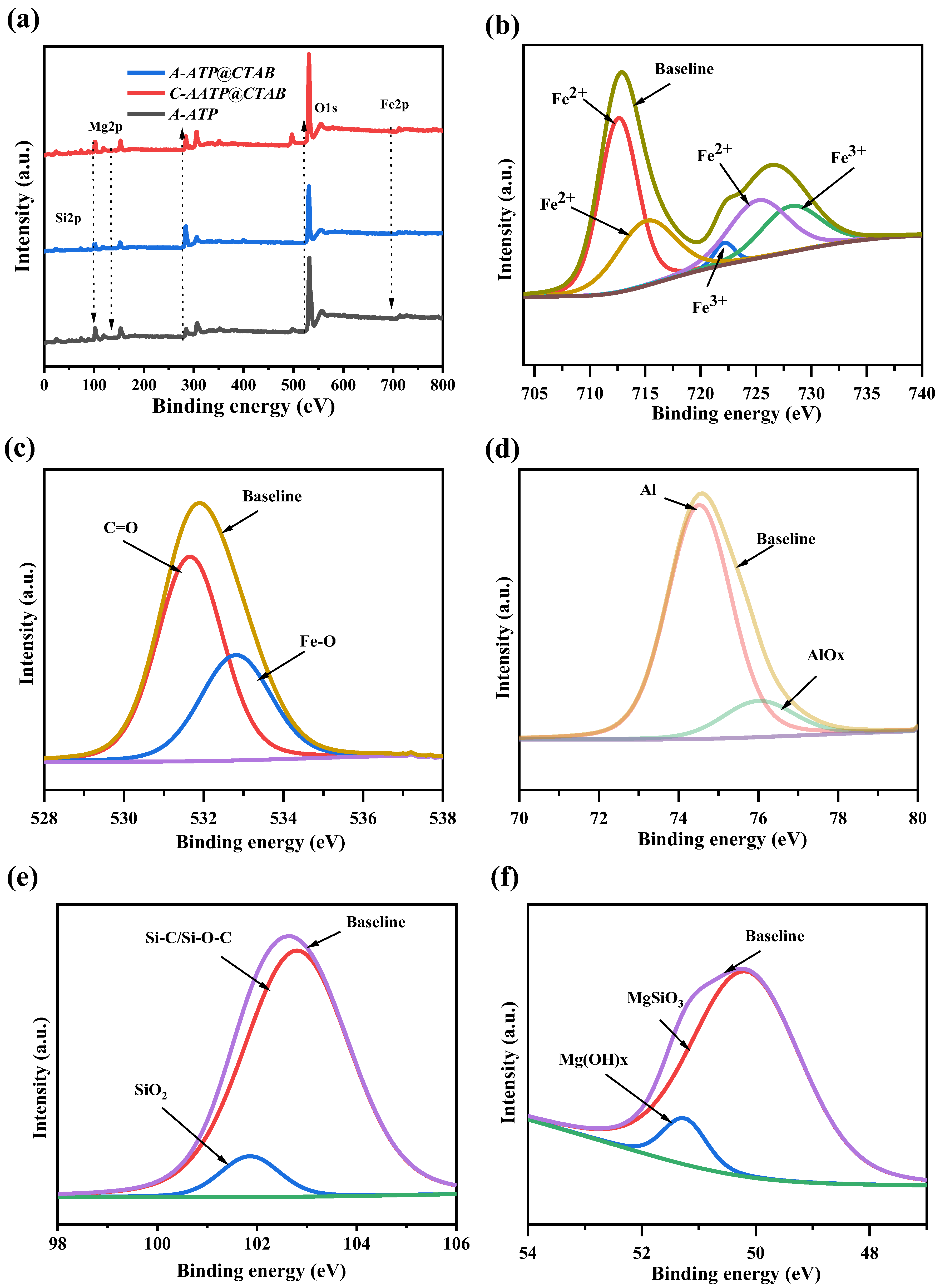
X-ray photoelectron spectroscopy (XPS) was employed to investigate changes in the chemical environment of A-ATP following carbon incorporation [
40]. Full-spectrum scans (
Figure 4a) revealed consistent elemental compositions across all samples, including oxygen (O 1s), carbon (C 1s), silicon (Si 2p), magnesium (Mg 1s), and aluminum (Al 2p)—consistent with the preservation of core mineralogical elements. Carbon and oxygen were prioritized for detailed analysis, as their bonding states offer critical insights into the interfacial interactions between ATP and the carbon component. Deconvolution of the C 1s spectrum yielded three distinct peaks, attributed to C=C/C–C (284.9 eV, graphitic/aromatic carbon), C–O (286.4 eV, hydroxyl or ether linkages), and C=O (288.7 eV, carbonyl groups), respectively [
41]. Notably, no significant shifts in peak binding energies were observed between pristine A-ATP@CTAB and C-A-ATP@CTAB—indicating that the chemical states of carbon (e.g., graphitic, hydroxyl, or carbonyl groups) remained largely unchanged after composite formation. Instead, the only measurable difference lay in the relative intensities of these C 1s peaks: the C-A-ATP@CTAB sample showed a marked increase in the proportion of C–O and C=O bonds compared to the initial A-ATP@CTAB, directly correlating with the incorporation of citric acid-derived carbon.
X-ray photoelectron spectroscopy (XPS) was used to quantify changes in carbon speciation (
Figure 4) and to elucidate the chemical environment of key elements in C-A-ATP@CTAB. For carbon, the elevated C=O content (36.26%) in the composite—representing a 6.85% increase relative to pristine A-ATP—directly correlates with the surface –COOH groups of citric acid-derived carbon. This confirms the successful integration of the carbon component with A-ATP, as the carboxyl groups on citric acid remain intact after composite formation. Conversely, the reduction in C=C/C–C bonds (graphitic/aromatic carbon) is attributed to the partial disruption of A-ATP’s layered structure during the rigorous hydrothermal synthesis, which breaks down some of the inorganic carbonaceous domains in ATP.
Complementary analysis of surface composition and chemical states (supported by
Table 2 and XPS survey spectra,
Figure 4a) verified the presence of core elements (Al, Mg, Si, O, C, Fe) in both A-ATP and its composites. Deconvolution of the O 1s spectrum (
Figure 4b) resolved three distinct oxygen species: carbonyl groups (C=O) at 531.2 eV, carbonate anions (
) at 532.4 eV, and metal-oxygen bonds in oxide phases (e.g., ATP’s aluminosilicate framework) at 534.9 eV. For iron, the Fe 2p spectrum (
Figure 4c) identified
(Fe 2p
3/2 at 712.5 eV) and
(Fe 2p
1/2 at 724.9 eV), with further deconvolution revealing five sub-peaks:
(712.5 eV, 715.1 eV) and
(722.2 eV, 724.9 eV, 728.2 eV)—consistent with the mixed-valence state of iron in ATP and its composites. Aluminum (Al 2p,
Figure 4d) showed peaks at 74.7 eV (elemental Al) and 75.8 eV (aluminum oxide, AlO
x), while magnesium (Mg 2p,
Figure 4f) and silicon (Si 2p,
Figure 4e) displayed characteristic bonds for oxide/hydroxide phases (MgO, SiO
x) and silicon-carbon interactions (Si–C/Si–O–C at 103.3 eV), respectively.
Critical to catalytic performance, the carbon binding energies (284.9 eV: C=O/carboxyl; 286.4 eV: C–O/C–N; 288.7 eV: graphitic C–C/C=C) confirmed the presence of both oxygenated (reactive for adsorption) and graphitic (stable support) carbon functionalities. The Fe 2p data further revealed a key catalytic mechanism: (81.08% before reaction) acts as the primary radical generator, producing hydroxyl radicals (•OH) for Rhodamine B (RhB) degradation via the Fenton reaction. Post-reaction, decreased to 75.23%, while increased—aligning with the expected oxidation of to during catalysis. Notably, persisted after five catalytic cycles, demonstrating that the composite’s active sites remain functional, and structural integrity is preserved.
Combined with
Figure 4,
Figure S2a–f and Table S1—which show retained reactive surface functionalities post-cycling—these findings underscore the material’s long-term stability and catalytic efficacy. The
/
redox cycling, coupled with preserved carbon-oxygen functionalities, ensures sustained adsorption and degradation of persistent organic pollutants (POPs) via an adsorption-Fenton oxidation pathway. This makes C-A-ATP@CTAB a promising candidate for environmental remediation.
2.9. Adsorption and Degradation for Rh-B
Initially, the performance of the synthesized C-A-ATP@CTAB nanocomposite in removing rhodamine B (Rh-B) from synthetic wastewater was evaluated to assess the impact of key operational parameters and to identify optimal treatment conditions. Subsequently, its efficacy was tested on real Rh-B-containing wastewater to validate practical applicability. Five critical parameters—contact time, nanocomposite dosage, initial Rh-B concentration, pH, and temperature—were systematically investigated to define ideal conditions for Rh-B removal.
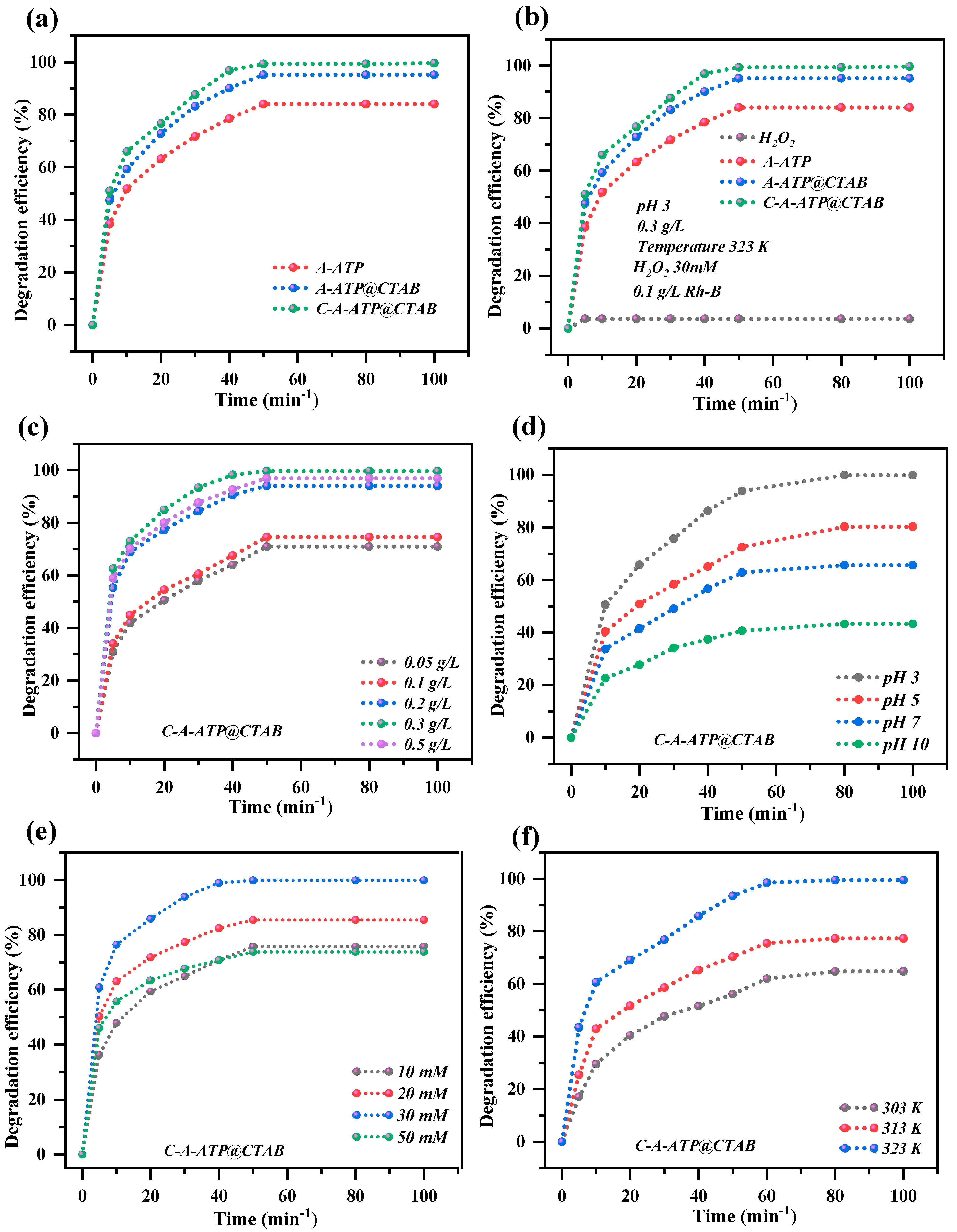
As shown in
Figure 5a, Rh-B adsorption efficiency increased rapidly with extended contact time, achieving > 60% removal within the first 120 min and
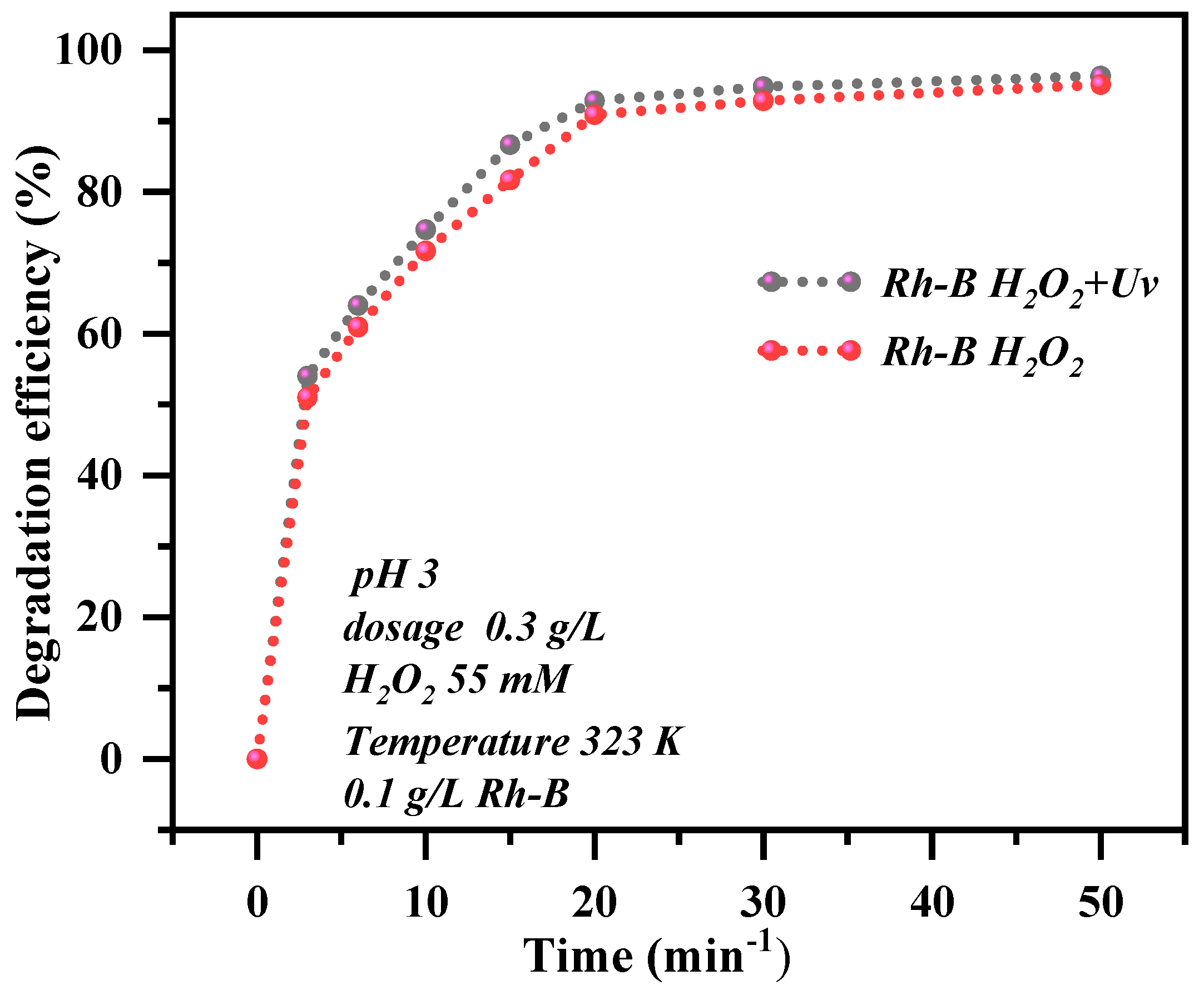
Figure 5b shows degradation efficiency of 96% in 50 min. No significant improvement was observed beyond this point, indicating that the composite’s adsorption capacity was saturated or residual Rh-B was negligible. This aligns with photo-Fenton (complete removal in 20 min) and Fenton-like oxidation (complete removal in 50 min) benchmarks. A 20 min contact time was thus selected for subsequent experiments.
Rh-B degradation increased with higher dosages, attributed to the greater number of adsorption sites available as the surface area rose. A sharp improvement in removal was seen between 0.5 and 0.05 g/L, with marginal gains at 0.5 g/L before plateauing—signaling equilibrium (
Figure 5c). An optimal dosage of 0.3 g/L was determined for an initial Rh-B concentration of 0.1 g/L, balancing efficiency and material economy. The composite exhibited pH-independent performance across 3–10 and consistent degradation across tested temperatures (
Figure 5d). The pH plays a critical role in regulating both the surface charge of the catalyst and the ionization state of Rhodamine B (Rh-B). Within the acidic to near-neutral range (pH 3–7), the composite surface remains predominantly positively charged, while Rh-B exists mainly in its neutral or zwitterionic form; consequently, electrostatic interactions are relatively weak. Under these conditions, adsorption and degradation are primarily governed by π–π interactions, hydrogen bonding, and van der Waals forces, resulting in high removal efficiency. In contrast, temperature exerts a more pronounced influence on the reaction kinetics. The apparent rate constant (
kapp) increased exponentially with increasing temperature, rising from 0.015 min
−1 at 303
kapp to 0.060 min
−1 at 313
kapp and further to 0.150 min
−1 at 323
kapp (
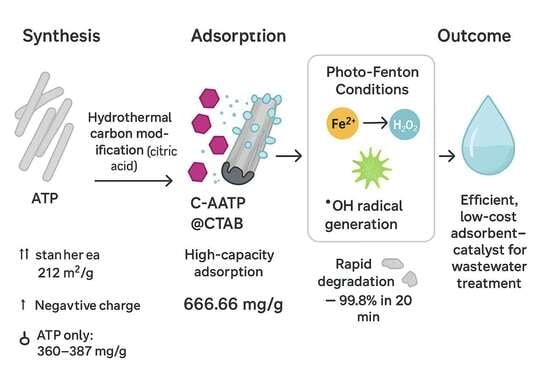
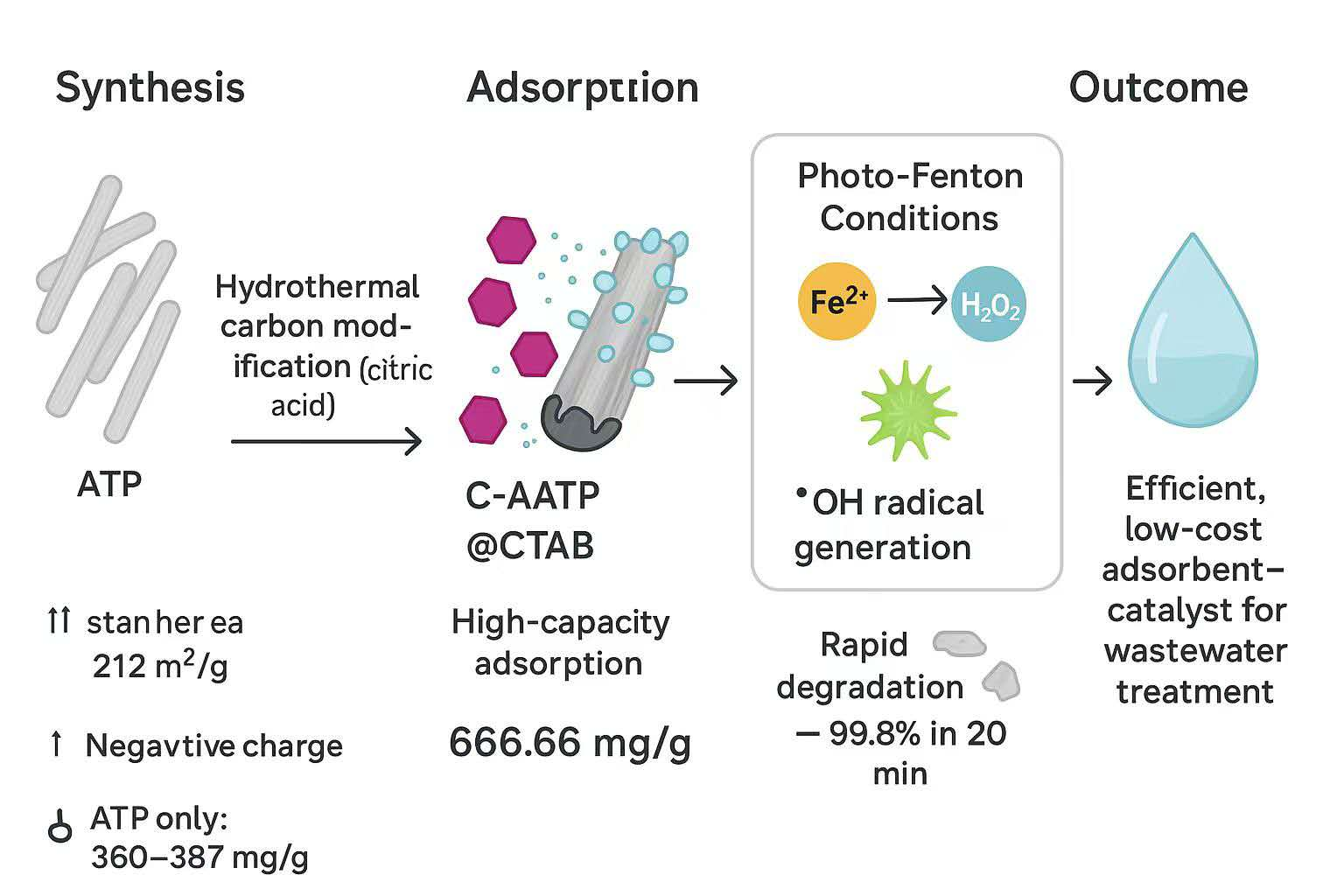
Figure 5f, inset), which is consistent with Arrhenius-type behavior. After full optimization of the operational parameters, the highest Rh-B adsorption capacity reached 666.66 mg/g (
Table 3). To elucidate reaction dynamics, the influence of temperature, H
2O
2 concentration, ATP dosage, initial Rh-B concentration, and pH on Fenton-like oxidation was evaluated (
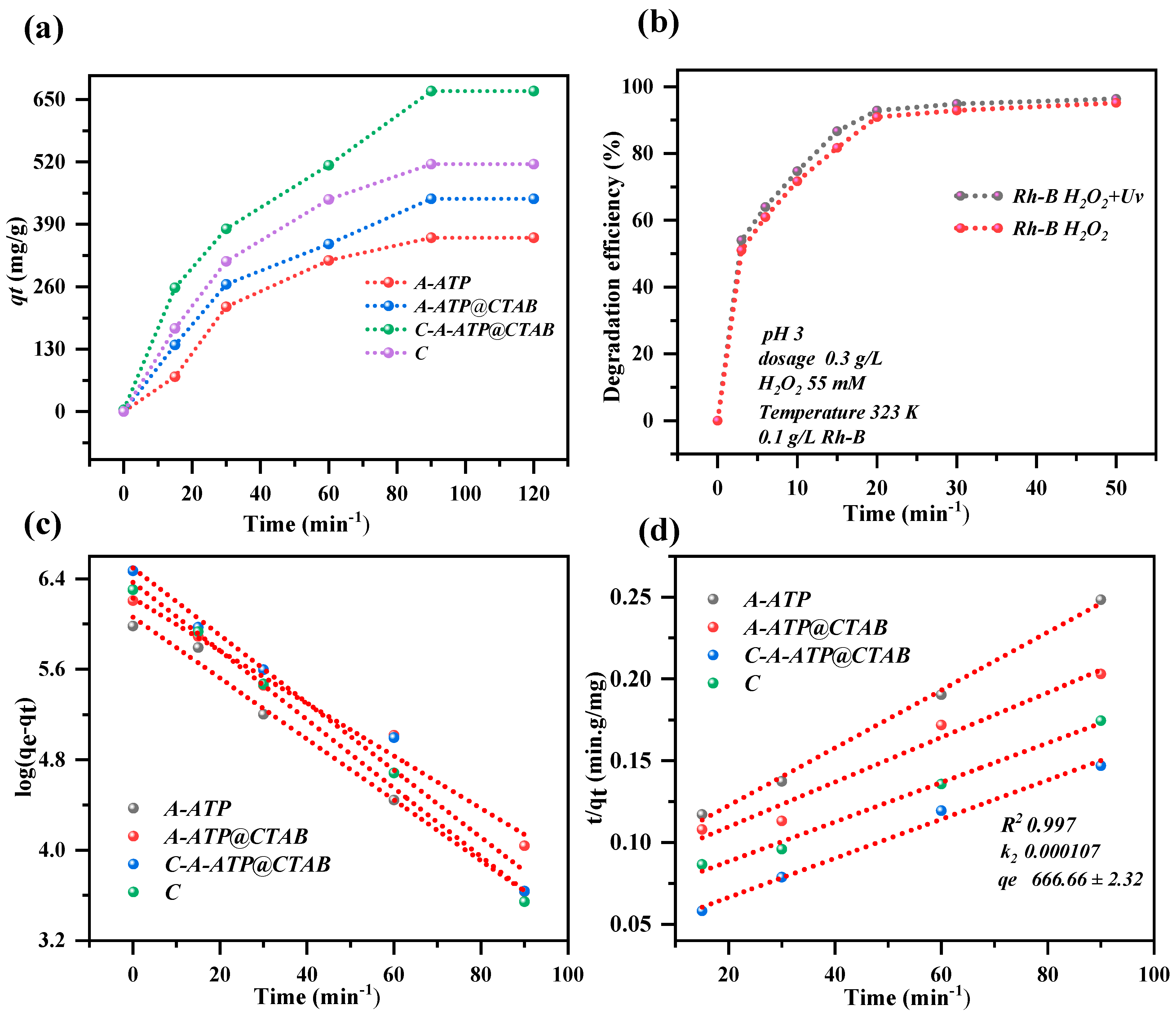
Figure 5c,d). The pseudo-second-order kinetic model provided an excellent linear fit (
Figure 5d), confirming chemisorption as the rate-limiting step.
For Fenton experiments, the dye solution (initial Rh-B: 0.5 g/L) was adjusted to pH 3–10 using NaOH/CH
3COOH, followed by adding 0.3 g/L C-A-ATP@CTAB. The mixture was equilibrated, then 55 mM H
2O
2 was added to initiate degradation (
Figure 5).
2.10. Degradation of Rh-B
The adsorption and degradation performance of pristine attapulgite (A-ATP), CTAB-modified A-ATP (A-ATP@CTAB), carbon-modified C-A-ATP@CTAB, and standalone carbon for rhodamine B (Rh-B) was systematically evaluated under varying dosages, pH, and H
2O
2 concentrations (
Figure 5a–f). Over 120 min (adsorption) and 100 min (degradation), their efficiencies were: A-ATP (36.4% adsorption/81.6% degradation), A-ATP@CTAB (41.6%/91.6%), C-A-ATP@CTAB (63.1%/99%), standalone carbon (53.4% adsorption only), and H
2O
2 alone (1.5% degradation). As summarized in
Table 3, C-A-ATP@CTAB exhibited the highest combined adsorption/degradation efficiency and adsorption capacity, outperforming all counterparts. The dramatic improvement in C-A-ATP@CTAB (vs. A-ATP@CTAB: 41.6%/91.6% → 63.1%/99%) stems from synergistic integration: ATP provides a high-specific-surface-area adsorbent for initial Rh-B uptake, while citric acid-derived carbon introduces catalytically active sites for Fenton-like •OH generation. This dual mechanism enhances mass transfer and extends the degradation pathways—addressing the limitations of standalone materials. In contrast, standalone H
2O
2 (1.5% degradation) failed to generate sufficient radicals without a catalyst, and standalone carbon (53.4% adsorption) lacked the catalytic activity to drive efficient degradation, highlighting the necessity of the composite structure.
Notably, adding C-A-ATP@CTAB to an H
2O
2-containing Rh-B solution boosted degradation to 99.6% within 20 min, demonstrating rapid and effective pollutant removal. Kinetic analysis (
Figure 6a–d) confirmed the composite follows both first-order and pseudo-second-order models, with the pseudo-second-order rate constant indicating chemisorption as the rate-limiting step. This aligns with optimal reaction conditions, where active sites (ATP’s hydroxyl groups and carbon’s C=O/C–O bonds) are fully utilized.
These results underscore C-A-ATP@CTAB’s exceptional performance in H2O2-assisted Rh-B degradation, driven by its dual adsorption-catalysis mechanism and optimized active site availability. The composite’s ability to bridge adsorption (ATP) and catalysis (carbon) makes it a superior candidate for practical wastewater treatment.
2.11. Photo-Fenton Degradation
The adsorption and photo-Fenton degradation performance of C-A-ATP@CTAB for rhodamine B (Rh-B) were evaluated via batch experiments. In each run, a predetermined amount of the nanocomposite was added to a conical flask containing 100 mL of Rh-B solution (100 mg/L, mass concentration). H2O2 was then added, and the mixture was transferred to a closed photochemical reaction system (equipped with a magnetic stirrer, a 300 W xenon lamp, and a timer). Post-reaction, the nanocomposite was separated via centrifugation (9000 rpm, 5 min), and residual Rh-B in the filtrate was quantified by UV-Vis spectrophotometry.
Rh-B removal was systematically tested under varying dosages, pH levels, and temperatures. Initial experiments at pH 3 (100 mg/L Rh-B) revealed that C-A-ATP@CTAB significantly outperformed pristine A-ATP, A-ATP@CTAB, and standalone UV treatment after 30 min of dark adsorption. This superior degradation capacity stems from synergistic surface interactions: the A-ATP framework provides a high-specific-surface-area adsorbent for initial Rh-B uptake, while the incorporated citric acid-derived carbon introduces catalytically active sites for photo-Fenton •OH generation.
As summarized in
Figure 7, degradation efficiencies varied markedly: A-ATP@CTAB achieved 99.8% Rh-B removal in 20 min, yet C-A-ATP@CTAB exhibited an even higher photo-degradation efficiency. This substantial improvement underscores the critical role of carbon incorporation in enhancing composite performance. Notably, C-A-ATP@CTAB also showed a significantly faster photo-Fenton degradation rate than other materials—including in Fenton-like oxidation—confirming a synergistic effect between ATP’s adsorption capacity and carbon’s catalytic activity. These findings highlight C-A-ATP@CTAB’s exceptional potential for Rh-B removal. By bridging high-efficiency adsorption (ATP) with catalytic radical generation (carbon), the composite addresses the limitations of standalone materials and emerges as a promising candidate for environmental remediation.
2.12. Comparative Study of Heterogeneous and Photo-Fenton
It is well-documented that light irradiation accelerates the degradation rate of organic pollutants in Fenton oxidation processes [
42,
43,
44,
45]. Building on this, the present study systematically investigated the influence of visible and ultraviolet (UV) light on Fenton-based Rh-B degradation using the high-performance C-A-ATP@CTAB composite, selected for its exceptional catalytic activity. Experiments were conducted under two conditions: with H
2O
2 (to activate Fenton/photo-Fenton reactions) and without H
2O
2 (to isolate light effects). As illustrated in
Figure 7 and quantified in
Table S2, photo-Fenton (UV + H
2O
2 + C-A-ATP@CTAB) and Fenton-like (no UV + H
2O
2 + C-A-ATP@CTAB) processes were evaluated for Rh-B removal. In the presence of H
2O
2, photo-Fenton demonstrated significantly faster Rh-B degradation than Fenton-like oxidation. Notably, without H
2O
2, light irradiation alone only marginally accelerated Rh-B elimination, with degradation rates rising slowly over time—highlighting the critical role of H
2O
2 in generating reactive oxygen species (ROS) for pollutant breakdown. Quantitative comparisons revealed that under UV irradiation, Rh-B degradation reached 98.6% within 20 min (photo-Fenton), whereas Fenton-like oxidation (no UV) achieved only 85% degradation in the same timeframe (
Table S2). This stark difference underscores that light synergies with H
2O
2 and the composite’s catalytic sites to enhance •OH generation, a key driver of rapid Rh-B mineralization. Collectively, these results confirm that photo-Fenton is the most favorable and optimal pathway for Rh-B degradation using C-A-ATP@CTAB, leveraging light to amplify the composite’s catalytic efficiency and accelerate pollutant removal.
2.13. Fe Leaching
Throughout the reaction, the catalyst inevitably releases iron species. Analysis of dissolved iron leaching revealed that
concentrations during Rh-B degradation were higher than under other conditions—an expected outcome, as
leaching is more pronounced in acidic environments, a factor that enhances Rh-B degradation rates in Fenton reactions [
46]. Across all samples,
levels increased over time, peaking at 60 min—coinciding with ~100% Rh-B removal. ICP data tracked this trend, showing a modest increase from 1.32 mg/L to 1.42 mg/L, indicating minimal overall iron leaching.
Text S1 (Reusability) and Figure S2 further demonstrate the reusability of a catalysis, which indicate its stability during the degradation process.
Total iron ion concentrations also rose gradually, remaining higher than
levels—consistent with the dominance of heterogeneous Fenton processes in Rh-B degradation [
47]. Notably, total dissolved iron (
+ other iron species) concentrations decreased with increasing carbon content in the C-A-ATP@CTAB nanocomposite, suggesting that carbon effectively mitigates iron leaching. Additionally, total iron leaching was enhanced by exposure to light or ultrasound, with leaching rates following the order: UV + Fenton > UV > Fenton. This indicates that elevated Fenton activity under light or photo-Fenton treatment correlates with increased iron ion release.
Text S2 (Degradation scheme of Rh-B) and Figure S3 further illustrate the degradation mechanism via mass spectrometric analysis.
2.14. Langmuir-Hinshelwood Kinetics
The photocatalytic degradation kinetics were described by the Langmuir–Hinshelwood model, ln (
Ct/
C0) =
kapp where
C0 and
Ct are the initial and time-dependent dye concentrations, respectively, and
kapp is the apparent first-order rate constant reflecting the surface-controlled photocatalytic reaction. The heterogeneous photocatalytic degradation kinetics at an initial dye concentration of 100 mg dm
−3 were evaluated using the Langmuir–Hinshelwood model. Under these conditions, the linearized Langmuir–Hinshelwood equation was applied, and the apparent rate constant (
kapp) was obtained from the slope of the ln (
Ct/
C0) versus degradation time plot. As summarized in
Table 4 and
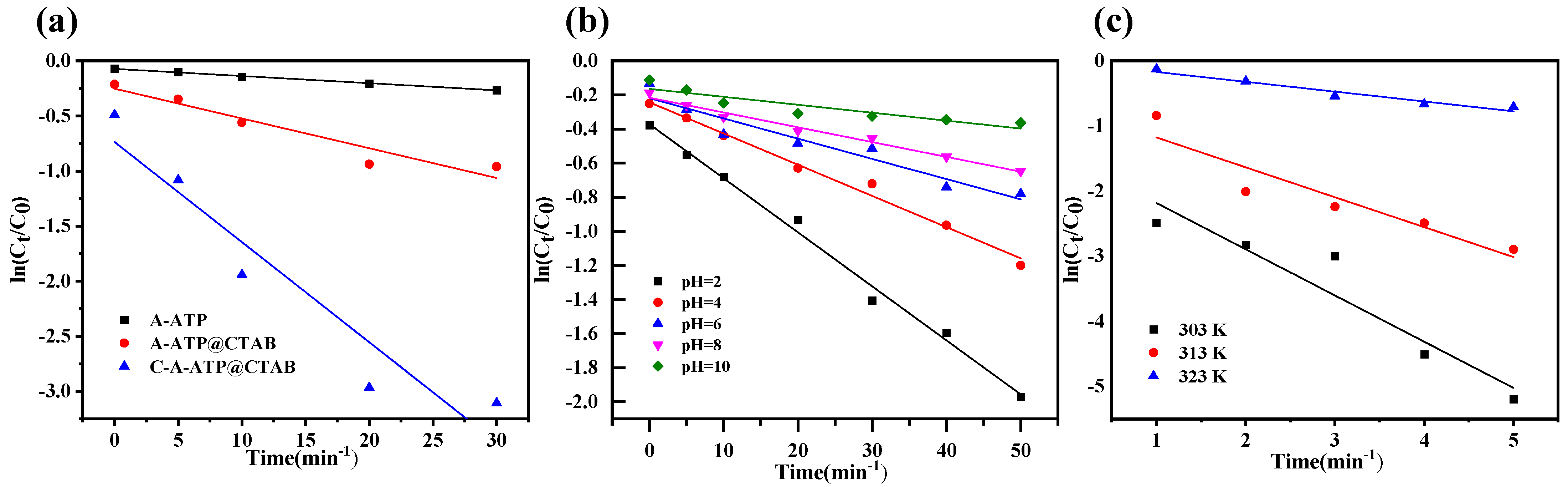
Figure 8, all studied samples—A-ATP, A-ATP@CTAB, and C-A-ATP@CTAB—exhibited excellent linearity with high determination coefficients (
R2 = 0.99), confirming that the photocatalytic degradation process follows the Langmuir–Hinshelwood mechanism [
48,
49]. The calculated
kapp values were 0.007 min
−1 for A-ATP, 0.037 min
−1 for A-ATP@CTAB, and 0.145 min
−1 for C-A-ATP@CTAB, indicating a substantial enhancement in degradation efficiency after surface modification. Among the catalysts, C-A-ATP@CTAB showed the highest photocatalytic activity, which can be attributed to improved surface characteristics and more effective interaction between the catalyst surface and dye molecules, leading to faster surface oxidation reactions. These results demonstrate that, at a fixed initial concentration, the Langmuir–Hinshelwood model reliably describes the degradation kinetics and enables meaningful comparison of photocatalytic performance among the different catalysts (
Table 5).
3. Materials and Methods
3.1. Chemicals
Chemicals were obtained from Shanghai Aladdin Bio-Chem Technology Co., Ltd. (China) and included citric acid (C6H8O7), hydrogen peroxide (H2O2, 30%), Rhodamine-B (C28H31ClN2O3), and cetyltrimethylammonium bromide (CTAB, C19H42BrN, 99.5%). All reagents were of analytical grade and were used without further purification. Attapulgite (ATP) was sourced from Baiyin City in Gansu Province, China. Deionized water used was made in the laboratory.
3.2. Synthesis of Carbon-Modified Attapulgite
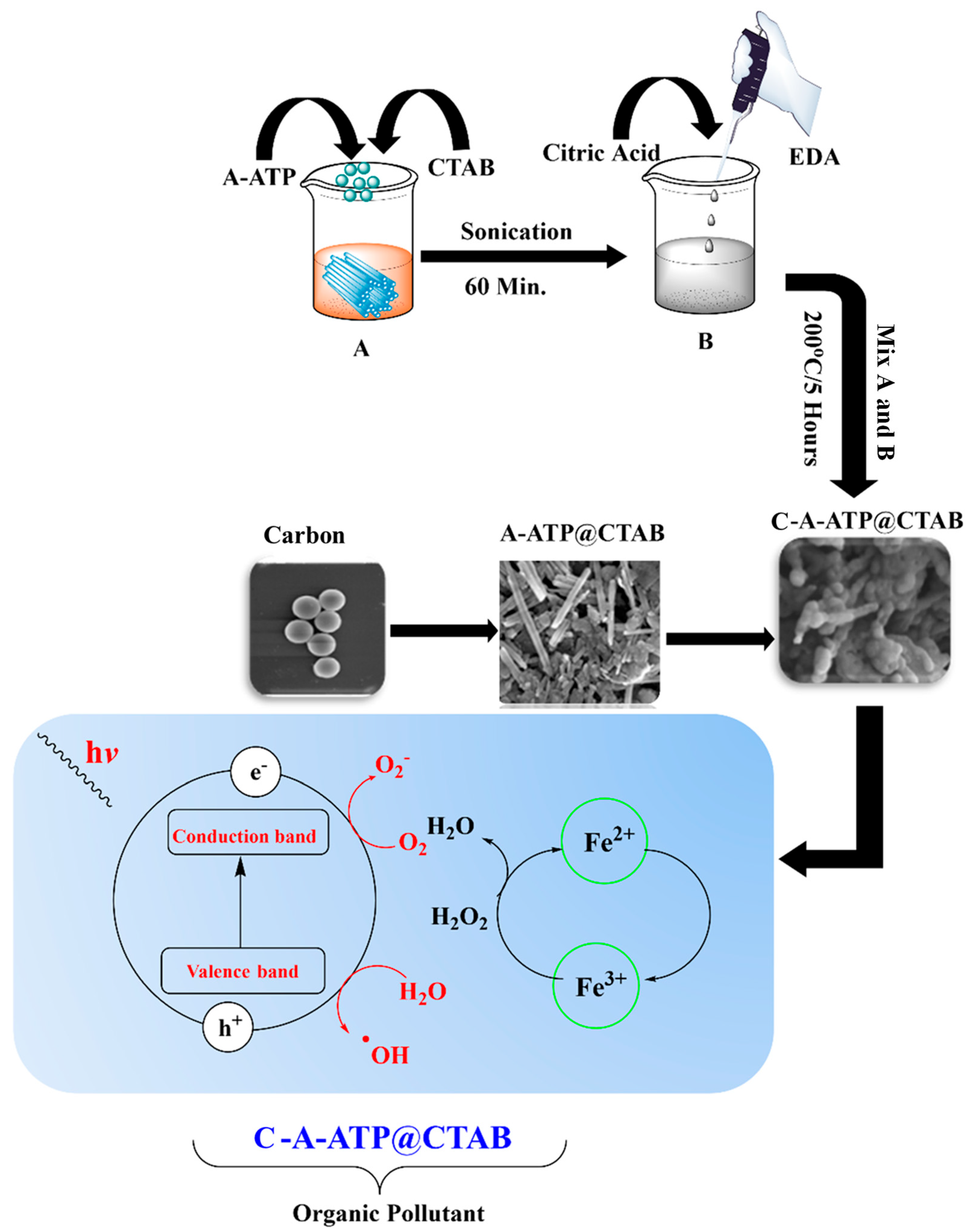
First, 2 g of attapulgite (ATP) was dispersed in deionized water via ultrasonic treatment for 60 min to ensure thorough particle dispersion. Separately, cetyltrimethylammonium bromide (CTAB) was dissolved in deionized water at a ratio of 0.6 g CTAB per gram of ATP. This CTAB solution was gradually added to the ATP dispersion, followed by vigorous stirring for two hours to promote CTAB adsorption onto ATP surfaces. This modification functionalized ATP particles, enhancing their surface properties to facilitate subsequent composite formation.
Next, 4.2 g of citric acid was dissolved in 40 mL of deionized water, and 1.34 mL of ethylenediamine was added. The mixture was transferred to a 100 mL Teflon-lined stainless-steel autoclave, sealed, and heated at 200 °C for five hours. After cooling to room temperature, the carbon product was centrifuged and dried at 80 °C for 24 h.
Finally, 0.5 g of the prepared carbon was added to 1 g of the ATP-CTAB suspension, the mixture was hydrothermally treated at 180 °C for 12 h. During this process, carbon was uniformly distributed on ATP surfaces and encapsulated. The introduction of carbon enriched the ATP with oxygen-containing functional groups (–COOH, –OH), improving its hydrophilicity, surface charge, and active sites—critical for enhanced adsorption and catalytic performance. The resulting composite, designated C-AATP@CTAB, was thoroughly washed with deionized water, dried at 80 °C, and stored for further characterization and application studies.
Figure 9 shows the schematic formation of the nanocomposite.
3.3. Instrumentation
X-ray Diffraction (XRD) Analysis: Powder XRD patterns were collected using a SHIMADZU XRD-6000 diffractometer equipped with a Cu Kα radiation source (λ = 1.5406 Å) operated at 40 kV. Data were acquired over a 2θ range of 5–70° to characterize crystalline phase composition. Fourier Transform Infrared (FT-IR) Spectroscopy: FT-IR spectra were recorded on a Bruker Vector 22 spectrometer via the potassium bromide (KBr) pellet method, with a sample-to-KBr mass ratio of 1:100. Spectra were collected in the mid-infrared region (4000–500 cm−1) to identify functional group assignments. Morphological Characterization: Surface morphology was analyzed using a Zeiss Supra 55 scanning electron microscope (SEM) and a JEOL JEM-2020 transmission electron microscope (TEM). SEM imaged surface features, while TEM resolved particle structure and dispersion. Nitrogen Adsorption–Desorption Analysis: Low-temperature (77 K) N2 adsorption–desorption isotherms were measured on a Micrometrics ASAP 2460 analyzer. Samples were degassed at 120 °C for 3 h to remove adsorbed moisture and contaminants prior to testing. Specific surface area (Saβet), pore volume, and pore size distribution were calculated from the adsorption isotherm using the Brunauer–Emmett–Teller (BET) method.
3.4. Batch Removal
Batch adsorption–desorption and degradation experiments for rhodamine B (Rh-B) were conducted in 250 mL conical flasks. Solutions were stirred in an orbital shaker with a temperature-controlled water bath (dark conditions) at 150 rpm to reach adsorption equilibrium. For degradation tests, the catalyst (C-A-ATP@CTAB, 0.05–0.5 g/L) was added to 100 mL of 100 mg/L Rh-B solutions at pH 3–12. The mixtures were equilibrated for 120 min to balance adsorption and desorption. Degradation was initiated by adding 55 mM H2O2 (from a 30% w/w stock solution) at 323 K (50 °C) to trigger the Fenton-like reaction. Rh-B concentrations were monitored over time at its maximum absorption wavelength (λmax = 556 nm). Post-reaction, the spent composite was recovered via centrifugation (9000 rpm, 5 min). All experiments were performed in triplicate to ensure reproducibility. The spent C-A-ATP@CTAB was reused to evaluate regeneration potential. Subsequent degradation tests with the recovered sorbent followed the same optimization conditions (pH, catalyst dosage, H2O2 concentration).
For the photo-Fenton process, identical conditions were applied, but reactions were conducted under UV-visible irradiation (365 nm, 300 W UV lamp positioned above the mixture) to enhance efficiency. Continuous stirring ensured uniform mixing, and degradation was monitored periodically. The synergistic effect of light irradiation and hydroxyl radical (•OH) generation was hypothesized to accelerate Rh-B mineralization. Adsorption and degradation efficiencies were calculated using Equation (1), and degradation rates were determined via this equation [
25]. Further studies with the regenerated sorbent used Equation (2) to compute degradation rates.
where
R (%) is the removal efficiency of Rh-B and at time
t (min),
C0 (mg L
−1) and
Ct (mg L
−1) are the initial concentration and the concentration at time
t (min) of Rh-B, respectively.
where
qe (mg/g) and
qt (mg/g) represent the adsorption capacities of Rh-B at equilibrium and at time
t (min), respectively.
Ct is the residual Rh-B concentration in the solution after
t minutes of adsorption, while
Ce is the concentration of Rh-B at equilibrium.
k1 (min
−1) and
k2 (mg (g·min)
−1) denote the adsorption rate constants for the pseudo-first-order and pseudo-second-order kinetic models, respectively.