This is an early access version, the complete PDF, HTML, and XML versions will be available soon.
Review

Research Progress and the Prospect of Artificial Reef Preparation and Its Impact on the Marine Ecological Environment

College of Metallurgy and Energy, North China University of Science and Technology, 21 Bohai Street, Tangshan 063210, China
*
Authors to whom correspondence should be addressed.
Materials 2026, 19(3), 447; https://doi.org/10.3390/ma19030447
Submission received: 26 November 2025 / Revised: 2 January 2026 / Accepted: 13 January 2026 / Published: 23 January 2026
(This article belongs to the Section Green Materials)

Abstract

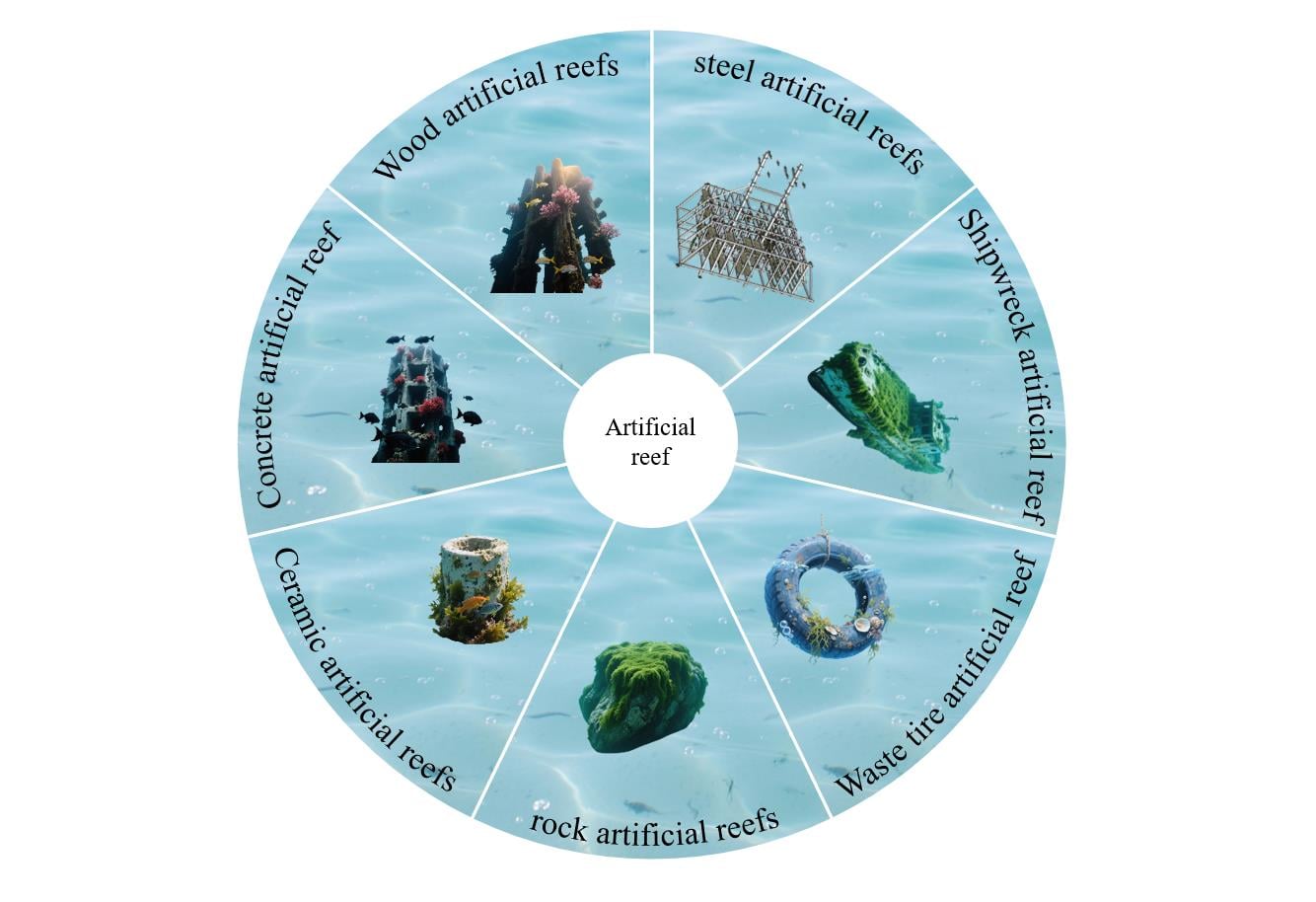
Artificial reefs are an important tool for marine ecological restoration and fishery resource proliferation, and are widely used around the world. Among them, Japan, the United States, China, South Korea, Australia, and the Mediterranean coastal countries have particularly invested in scientific research and practice in this field, and the reefs’ material selection, structural performance, and ecological benefits have attracted much attention. The purpose of this paper is to summarize the preparation methods, characterization methods (such as microstructure analysis and mechanical tests) and mechanical properties (such as compressive strength and durability) of new concrete materials (steel slag-blast furnace slag concrete, oyster shell concrete, sulfoaluminate cement concrete, recycled brick concrete, silica fume concrete, and banana peel filler concrete) that artificial reefs and ceramic artificial reefs developed in recent years, and to explore the resource utilization potential of different waste materials. At the same time, the biostatistical methods (such as species abundance and community diversity) of wood, shipwreck, steel, rock, waste tire, and ordinary concrete artificial reefs and their effects on the marine environment were compared and analyzed. In addition, the potential impact of artificial reef deployment on local fishermen’s income was also assessed. It is found that the use of steel slag, blast furnace slag, sulfoaluminate cement, and silica fume instead of traditional Portland cement can better improve the mechanical properties of concrete artificial reefs (compressive strength can be increased by up to 20%) and reduce the surface pH to neutral, which is more conducive to the adhesion and growth of marine organisms. The compressive strength of oyster shell concrete and banana peel filler concrete artificial reef is not as good as that of traditional Portland cement concrete artificial reef, but it still avoids the waste of a large amount of solid waste resources, provides necessary nutritional support for aquatic organisms, and also improves its chemical erosion resistance. The deployment of artificial reefs of timber, wrecks, steel, rock, waste tires, and ordinary concrete has significantly increased the species richness and biomass in the adjacent waters and effectively promoted the development of fisheries. Cases show that artificial reefs can significantly increase fishermen’s income (such as an increase of about EUR 13 in the value of a unit effort in a certain area), but the long-term benefits depend on effective supervision and community co-management mechanisms. This paper provides a scientific basis for the research and development of artificial reef materials and the optimization of ecological benefits, and promotes the sustainable development of marine ecological restoration technology and fishery economy.
Keywords: artificial reef; new concrete material; ecological restoration; fishery economy artificial reef; new concrete material; ecological restoration; fishery economy
Graphical Abstract