Evaluating 3D-Printed ABS and Carbon Fiber as Sustainable Alternatives to Steel in Concrete Structures

 , , and
Abstract
1. Introduction
2. Materials and Methods
2.1. Materials
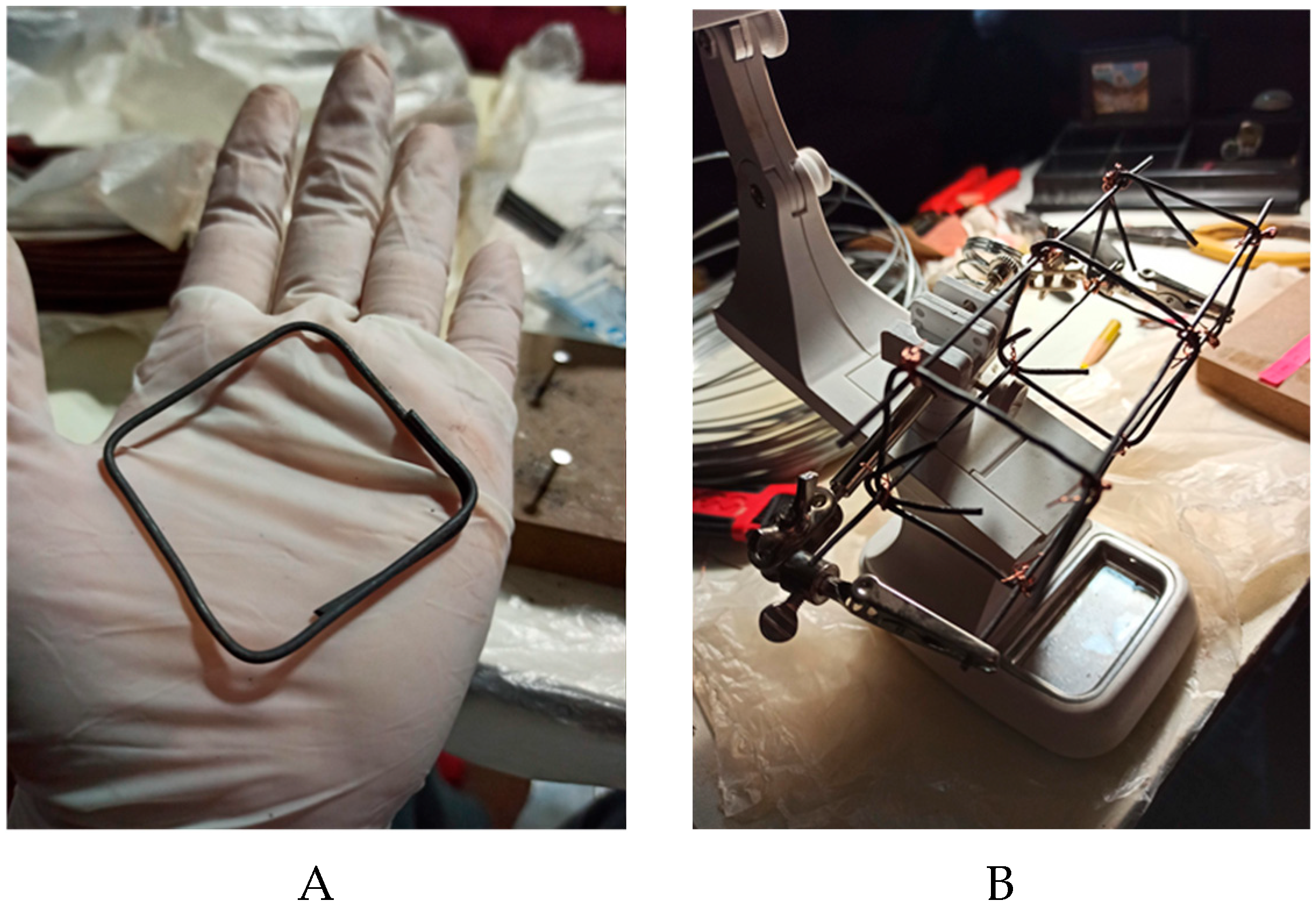
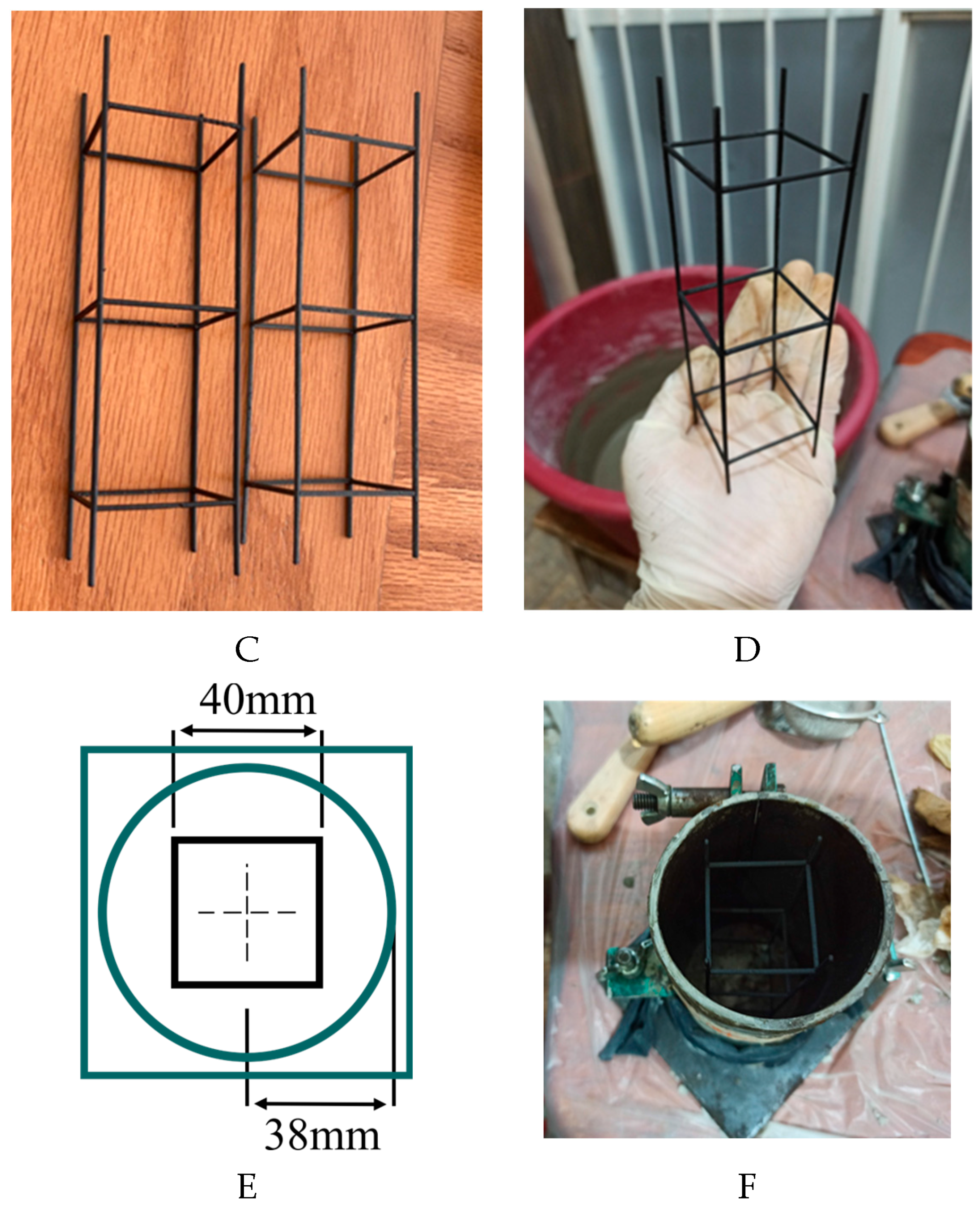
2.2. Filling the Steel Molds
2.3. Preparation of Cement Pastes Families
2.4. Preparation of Concrete Families
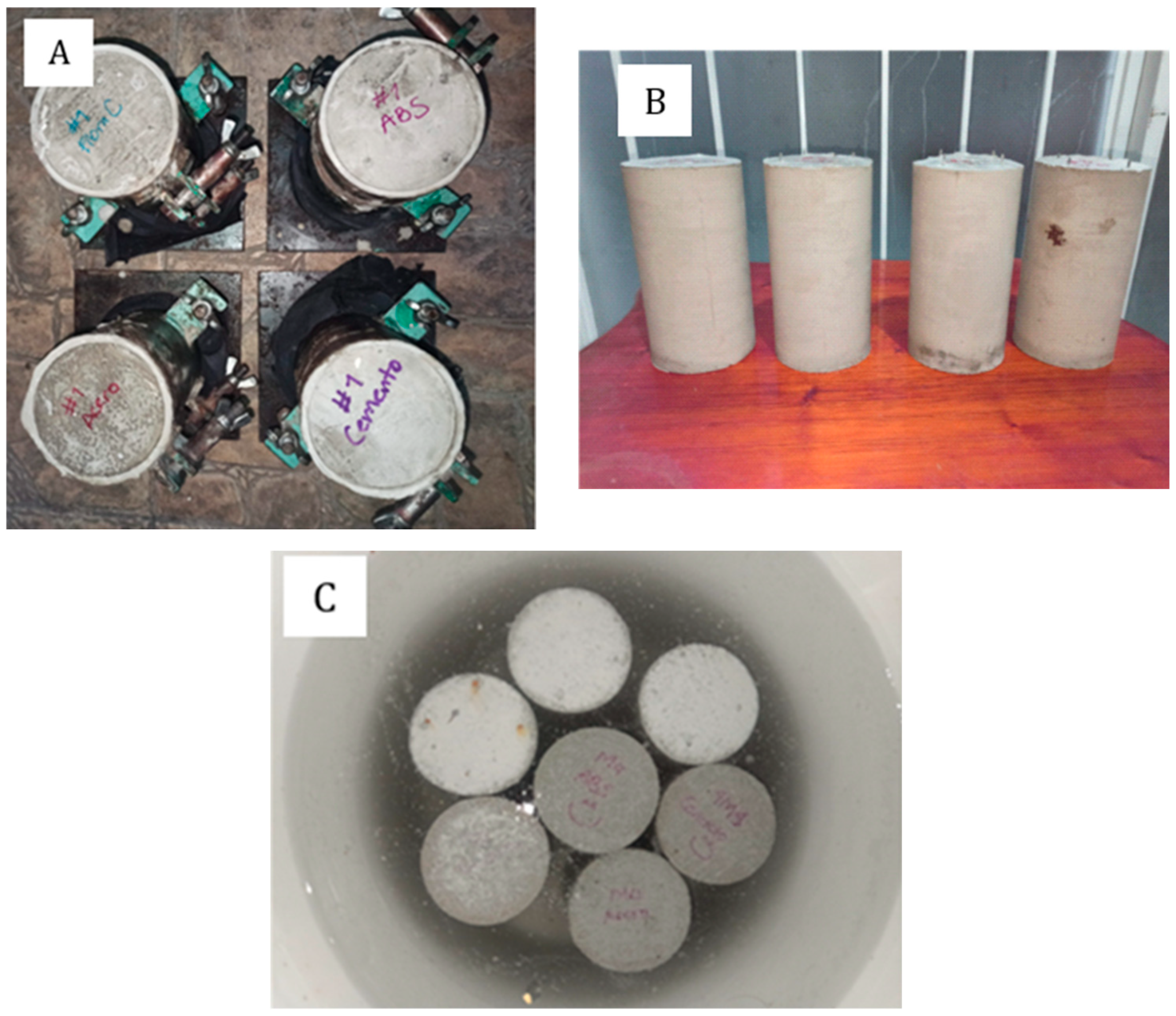
2.5. Setting, Removal of Molds, and Curing
2.6. Testing
2.7. Statistical Analysis
3. Results
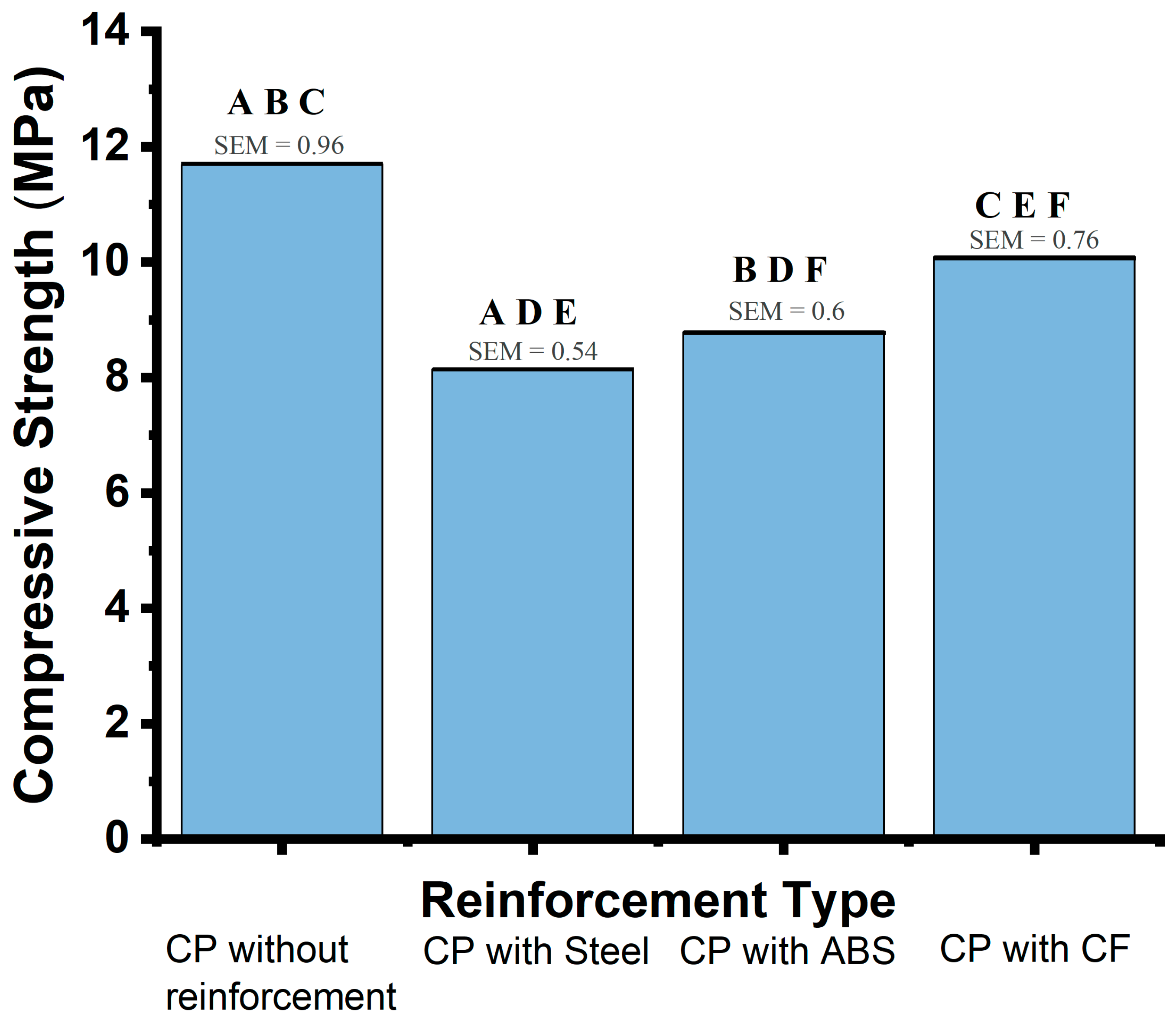
3.1. Compressive Strength of Cement Paste Cylinders
3.2. Statistical Analysis of Cement Pastes
3.3. Compressive Strength of Concrete Cylinders
3.4. Statistical Analysis of Concrete Cylinders
4. Discussion
4.1. Anisotropy in 3D-Printed Reinforcements
4.2. Impact of Reinforcement on Compressive Strength
4.3. ABS Performance
4.4. CF Performance
4.5. Statistical Analysis and Practical Implications
4.6. Sustainability and Future Prospects
4.7. Limitations
5. Conclusions
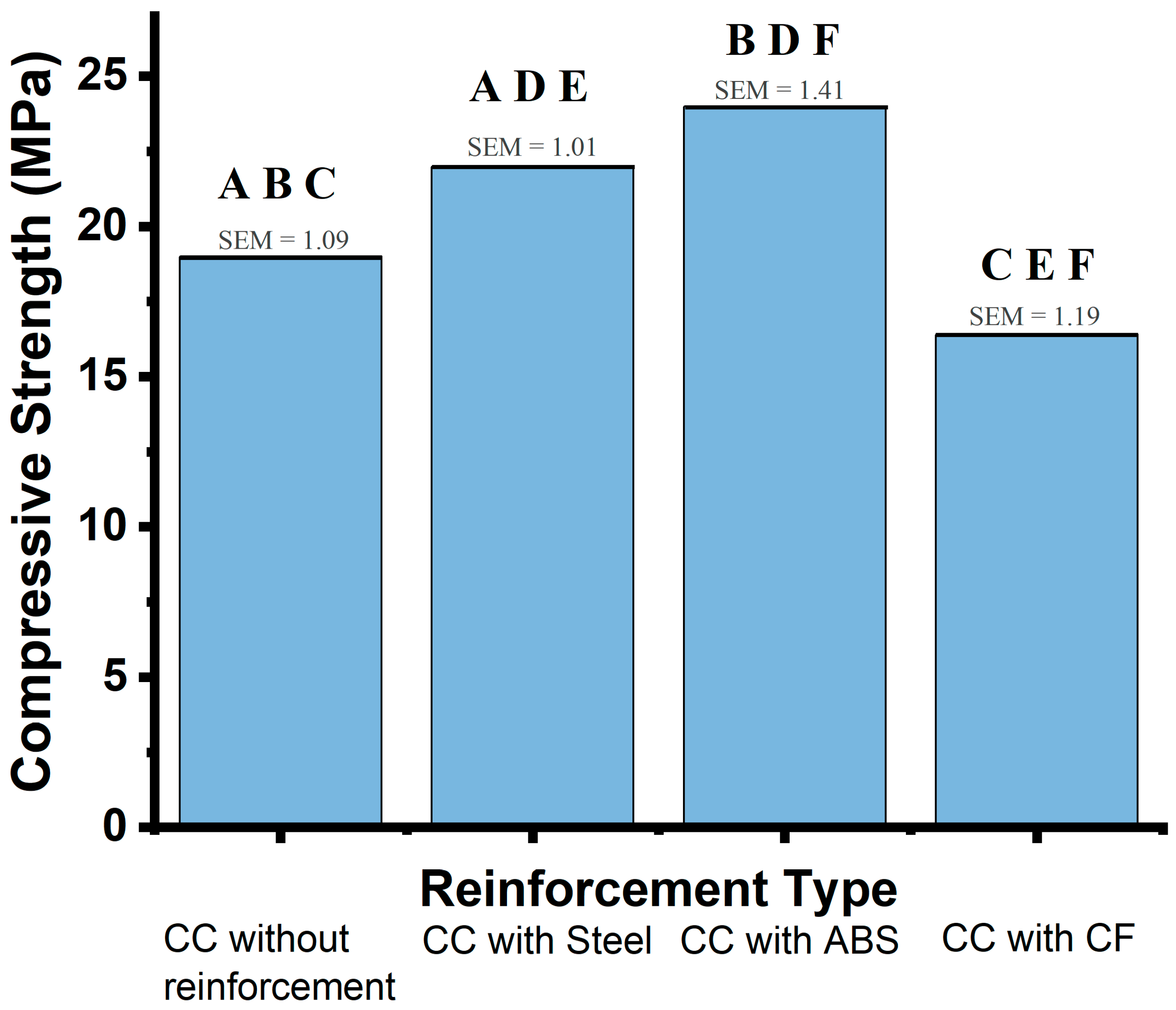
- Compressive Strength: ABS-reinforced concrete achieved an average compressive strength of 24.0 MPa, exceeding steel-reinforced concrete (22.0 MPa) and unreinforced concrete (19.0 MPa). These results indicate that ABS may serve as an effective reinforcement material in applications where compressive strength governs structural behavior.
- Sustainability: ABS offers environmental advantages due to its lower carbon footprint, recyclability, and resistance to corrosion. These attributes may reduce long-term maintenance needs and support the adoption of more sustainable construction practices.
- CF-reinforced concrete exhibited an average compressive strength of 16.4 MPa, which was lower than that of unreinforced concrete. This suggests that CF is more suited for applications where tensile behavior is critical, and further optimization is required for compression-oriented uses.
- Structural Design Considerations: The results indicate that 3D-printed ABS has the potential to challenge steel in specific compressive applications; however, steel remains indispensable in situations requiring high tensile capacity and where established design methodologies provide proven reliability.
- Anisotropy and Material Orientation: The anisotropic behavior of 3D-printed ABS and CF underscores the importance of aligning reinforcement orientation with dominant load paths. Optimized layer orientation and multi-material printing strategies could enhance load distribution and structural integrity.
6. Future Work
Author Contributions
Funding
Data Availability Statement
Acknowledgments
Conflicts of Interest
References
- Taylor, H.F.W. Cement Chemistry, 2nd ed.; Academic Press: London, UK, 1997. [Google Scholar]
- Neville, A.M. Properties of Concrete, 5th ed.; Pearson Education: Harlow, UK, 2012. [Google Scholar]
- Mindess, S.; Young, F.J.; Darwin, D. Concrete, 2nd ed.; Prentice Hall: Upper Saddle River, NJ, USA, 2003. [Google Scholar]
- Smith, W.F.; Hashemi, J. Foundations of Materials Science and Engineering, 5th ed.; McGraw-Hill Education: Columbus, OH, USA, 2010; Volume 72953586. [Google Scholar]
- ASTM C39/C39M; Standard Test Method for Compressive Strength of Cylindrical Concrete Specimens. ASTM International: West Conshohocken, PA, USA, 2001.
- Dolatabad, Y.A.; Kamgar, R.; Nezad, I.G. Rheological and Mechanical Properties, Acid Resistance and Water Penetrability of Lightweight Self-Compacting Concrete Containing Nano-SiO2, Nano-TiO2 and Nano-Al2O3. Iran. J. Sci. Technol.-Trans. Civ. Eng. 2020, 44, 603–618. [Google Scholar] [CrossRef]
- Barodawala, Q.I.; Mishra, S.S. Effect of nano materials on concrete composites: A critical review. In AIP Conference Proceedings, Proceedings of the 2nd International Conference on Recent Advances in Computational Techniques, Mumbai, India, 10–11 March 2022; AIP Publishing: Melville, NY, USA, 2023; Volume 2755. [Google Scholar] [CrossRef]
- Ortiz-Lozano, J.A.; De La Fuente-Antequera, A.; Segura-Pérez, I.; De Cea, A.A.; Dos Santos, A.C.P.; Pacheco-Martinez, J.; Soto-Bernal, J.J. Characterization of a fibre-reinforced self-compacting concrete with 100% of mixed recycled aggregates. Int. J. Comput. Methods Exp. Meas. 2018, 6, 584–593. [Google Scholar] [CrossRef]
- de Luna, A.M.; Lozano, J.Á.O.; Jaime, L.P.; Martínez, J.P.; Bernal, J.J.S.; Martínez, S.H.R.; Ceniceros, R.P.; Flores, J.A. Experimental mechanical characterization of steel and polypropylene fiber reinforced concrete. Rev. Técnica Fac. Ing. Univ. Zulia 2014, 37, 106–115. [Google Scholar] [CrossRef]
- Wu, H.; Shen, A.; Ren, G.; Ma, Q.; Wang, Z.; Cheng, Q.; Li, Y. Dynamic mechanical properties of fiber-reinforced concrete: A review. Constr. Build. Mater. 2023, 366, 130145. [Google Scholar] [CrossRef]
- Chen, L.; Chen, Z.; Xie, Z.; Wei, L.; Hua, J.; Huang, L.; Yap, P.-S. Recent developments on natural fiber concrete: A review of properties, sustainability, applications, barriers, and opportunities. Dev. Built Environ. 2023, 16, 100255. [Google Scholar] [CrossRef]
- Sabireen; Butt, F.; Ahmad, A.; Ullah, K.; Zaid, O.; Shah, H.A.; Kamal, T. Mechanical performance of fiber-reinforced concrete and functionally graded concrete with natural and recycled aggregates. Ain Shams Eng. J. 2023, 14, 102121. [Google Scholar] [CrossRef]
- Soto-Bernal, J.J.; Gonzalez-Mota, R.; Rosales-Candelas, I.; Ortiz-Lozano, J.A. Effects of Static Magnetic Fields on the Physical, Mechanical, and Microstructural Properties of Cement Pastes. Adv. Mater. Sci. Eng. 2015, 2015, 934195. [Google Scholar] [CrossRef]
- Moreno-Virgen, M.R.; Soto-Bernal, J.J.; Ortiz-Lozano, J.Á.; Frausto-Reyes, C.; Bonilla-Petriciolet, A.; González-Mota, R.; Rosales-Candelas, I.; Pineda-Piñón, J. Laser Radiation CO2 Effects in Cement Paste at Different Hydration Stages after Preparation. Ing. Investig. Tecnol. 2011, 12, 321–328. [Google Scholar] [CrossRef]
- Rammer, B.; Millner, R.; Boehm, C. Comparing the CO2 Emissions of Different Steelmaking Routes. BHM Berg- Und Hüttenmännische Monatshefte 2017, 162, 7–13. [Google Scholar] [CrossRef]
- Cruz, G.; Dizon, J.R.C.; Farzadnia, N.; Zhou, H.; Margarito, M.; Garcia, J.A.; Liza, F.P.; Advincula, R.C. Performance, applications, and sustainability of 3D-printed cement and other geomaterials. MRS Commun. 2023, 13, 385–399. [Google Scholar] [CrossRef]
- Callister, W.D., Jr.; Rethwisch, D.G. Materials Science and Engineering: An Introduction, 10th ed.; Wiley: Hoboken, NJ, USA, 2018. [Google Scholar]
- Compton, B.G.; Lewis, J.A. 3D-Printing of Lightweight Cellular Composites. Adv. Mater. 2014, 26, 5930–5935. [Google Scholar] [CrossRef] [PubMed]
- Tekinalp, H.L.; Kunc, V.; Velez-Garcia, G.M.; Duty, C.E.; Love, L.J.; Naskar, A.K.; Blue, C.A.; Ozcan, S. Highly oriented carbon fiber–polymer composites via additive manufacturing. Compos. Sci. Technol. 2014, 105, 144–150. [Google Scholar] [CrossRef]
- Ahn, S.H.; Montero, M.; Odell, D.; Roundy, S.; Wright, P.K. Anisotropic material properties of fused deposition modeling ABS. Rapid Prototyp. J. 2002, 8, 248–257. [Google Scholar] [CrossRef]
- Leigh, S.J.; Bradley, R.J.; Purssell, C.P.; Billson, D.R.; Hutchins, D.A. A simple, low-cost conductive composite material for 3D printing of electronic sensors. PLoS ONE 2012, 7, e49365. [Google Scholar] [CrossRef] [PubMed]
- Stitchi. ASTM vs. ISO Standards: Comparing Material Testing Methods. Available online: https://www.stitchi.co/blog/astm-vs-iso-standards-comparing-material-testing-methods (accessed on 5 September 2024).
- ACI Committee 318; Building Code Requirements for Structural Concrete and Commentary (ACI 318-19). American Concrete Institute: Farmington Hills, MI, USA, 2019.
- Gilson Company. Concrete and Aggregate Testing: An ASTM How-to Guide. Available online: https://www.globalgilson.com/blog/the-gray-pages-astms-how-to-for-concrete-testing (accessed on 5 September 2024).
- Shemelya, C.; De La Rosa, A.; Torrado, A.R.; Yu, K.; Domanowski, J.; Bonacuse, P.J.; Martin, R.E.; Juhasz, M.; Hurwitz, F.; Wicker, R.B.; et al. Anisotropy of thermal conductivity in 3D printed polymer matrix composites for space based cube satellites. Addit. Manuf. 2017, 16, 186–196. [Google Scholar] [CrossRef]
- ASTM C192/C192M; Standard Practice for Making and Curing Concrete Test Specimens in the Laboratory. ASTM International: West Conshohocken, PA, USA, 2019.
- ISO 1920-3:2004; Testing of Concrete—Part 3: Making and Curing Test Specimens. Available online: https://www.iso.org/standard/40554.html (accessed on 5 September 2024).
- ASTM C31/C31M; Standard Practice for Making and Curing Concrete Test Specimens in the Field. ASTM International: West Conshohocken, PA, USA, 2019.
- Entidad Mexicana de Acreditación (EMA), Portal EMA. Available online: https://www.ema.org.mx/portal_v3/ (accessed on 24 August 2024).
- Montgomery, D.C. Design and Analysis of Experiments, 8th ed.; John Wiley & Sons: Hoboken, NJ, USA, 2013. [Google Scholar]
- Zar, J.H. Biostatistical Analysis, 5th ed.; Pearson Education: Upper Saddle River, NJ, USA, 2010. [Google Scholar]
- Mehta, P.K.; Monteiro, P.J.M. Concrete: Microstructure, Properties, and Materials, 4th ed.; McGraw-Hill Education: New York, NY, USA, 2014. [Google Scholar]





| Property | Steel | 3D-Printed ABS | 3D-Printed Carbon Fiber (CF) |
|---|---|---|---|
| Tensile Strength (MPa) | 400–550 | 30–50 | 61.3 |
| Compressive Strength (MPa) | 250–350 | 24 | 44.1 |
| Young’s Modulus (GPa) | 200 | 2–2.5 | 38.7 |
| Density (g/cm3) | 7.85 | 1.04 | 41.7 |
| Anisotropy | Isotropic | Anisotropic (stronger along X-Y plane) | Anisotropic (stronger along X-Y plane) |
| Specimen | M1 | M2 | M3 | M4 | M5 | M6 |
|---|---|---|---|---|---|---|
| CP unreinforced | 69.2 | 47.1 | 61.3 | 41.7 | 45.6 | 49.1 |
| CP with Steel | 32.9 | 41.2 | 44.1 | 30.4 | 30.9 | 39.2 |
| CP with ABS | 52.0 | 34.8 | 38.7 | 40.2 | 33.4 | 37.3 |
| CP with CF | 48.6 | 55.9 | 41.7 | 49.5 | 31.4 | 44.1 |
| Specimen | M1 | M2 | M3 | M4 | M5 | M6 | Average | Standard Deviation |
|---|---|---|---|---|---|---|---|---|
| CP unreinforced | 15.4 | 10.5 | 13.7 | 9.3 | 10.2 | 11.0 | 11.7 | 2.35 |
| CP with Steel | 7.3 | 9.2 | 9.9 | 6.8 | 6.9 | 8.8 | 8.1 | 1.31 |
| CP with ABS | 11.6 | 7.8 | 8.7 | 9.0 | 7.4 | 8.3 | 8.8 | 1.48 |
| CP with CF | 10.8 | 12.5 | 9.3 | 11.1 | 7.0 | 9.9 | 10.1 | 1.87 |
| Specimen | N1 | N2 | N3 | N4 | N5 | N6 |
|---|---|---|---|---|---|---|
| CC unreinforced | 85.8 | 87.1 | 75.0 | 86.4 | 88.3 | 87.3 |
| CC with Steel | 94.2 | 105.0 | 95.7 | 99.1 | 94.2 | 102.4 |
| CC with ABS | 101.5 | 115.3 | 99.1 | 112.8 | 109.9 | 105.9 |
| CC with CF | 81.9 | 67.7 | 72.6 | 71.1 | 77.5 | 69.7 |
| Specimen | N1 | N2 | N3 | N4 | N5 | N6 | Average | Standard Deviation |
|---|---|---|---|---|---|---|---|---|
| CC unreinforced | 19.2 | 19.5 | 16.8 | 19.3 | 19.7 | 19.5 | 19.0 | 1.09 |
| CC with Steel | 21.0 | 23.4 | 21.4 | 22.1 | 21.0 | 22.9 | 22.0 | 1.41 |
| CC with ABS | 22.7 | 25.7 | 22.1 | 25.2 | 24.5 | 23.7 | 24.0 | 1.18 |
| CC with CF | 18.3 | 15.1 | 16.2 | 15.9 | 17.3 | 15.6 | 16.4 | 1.01 |
Disclaimer/Publisher’s Note: The statements, opinions and data contained in all publications are solely those of the individual author(s) and contributor(s) and not of MDPI and/or the editor(s). MDPI and/or the editor(s) disclaim responsibility for any injury to people or property resulting from any ideas, methods, instructions or products referred to in the content. |
© 2026 by the authors. Licensee MDPI, Basel, Switzerland. This article is an open access article distributed under the terms and conditions of the Creative Commons Attribution (CC BY) license.
Share and Cite
Soto-Bernal, J.J.; González-Mota, M.R.; Merida-Cabrera, J.M.; Rosales-Candelas, I.; Ortiz-Lozano, J.Á. Evaluating 3D-Printed ABS and Carbon Fiber as Sustainable Alternatives to Steel in Concrete Structures. Materials 2026, 19, 393. https://doi.org/10.3390/ma19020393
Soto-Bernal JJ, González-Mota MR, Merida-Cabrera JM, Rosales-Candelas I, Ortiz-Lozano JÁ. Evaluating 3D-Printed ABS and Carbon Fiber as Sustainable Alternatives to Steel in Concrete Structures. Materials. 2026; 19(2):393. https://doi.org/10.3390/ma19020393
Chicago/Turabian StyleSoto-Bernal, Juan José, Ma. Rosario González-Mota, Judith Marlene Merida-Cabrera, Iliana Rosales-Candelas, and José Ángel Ortiz-Lozano. 2026. "Evaluating 3D-Printed ABS and Carbon Fiber as Sustainable Alternatives to Steel in Concrete Structures" Materials 19, no. 2: 393. https://doi.org/10.3390/ma19020393
APA StyleSoto-Bernal, J. J., González-Mota, M. R., Merida-Cabrera, J. M., Rosales-Candelas, I., & Ortiz-Lozano, J. Á. (2026). Evaluating 3D-Printed ABS and Carbon Fiber as Sustainable Alternatives to Steel in Concrete Structures. Materials, 19(2), 393. https://doi.org/10.3390/ma19020393