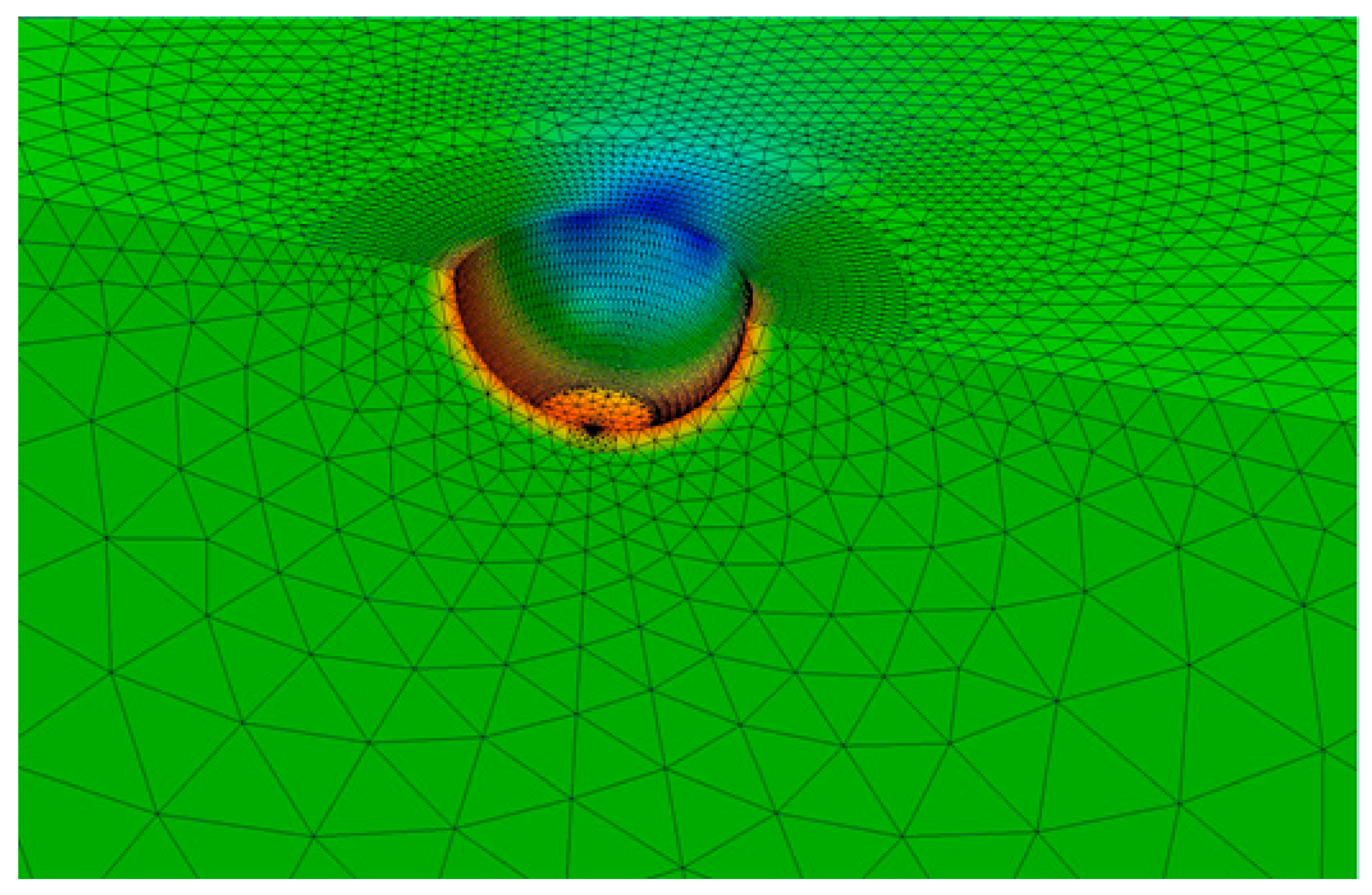
A Review of the Parameters Controlling Crack Growth in AM Steels and Its Implications for Limited-Life AM and CSAM Parts

 ,
,  , , and
Abstract
1. Introduction
- (i)
- AM can be used to address the operational issues that can arise due to parts obsolescence, logistics, and sustained operations;
- (ii)
- AM has the potential to transform battlefield logistics through on-demand fabrication of parts close to the point of need;
- (iii)
- AM has the potential to reduce the large number of parts that are currently stored and that need to be transported to where they are required.
- (i)
- The previously published Hartman–Schijve equation for long cracks in conventionally manufactured and AM Inconel 718 [44], with the term ΔKthr set to be equal to 0.1 MPa √m, was used to (accurately) predict the upper-bound curve associated with the growth of naturally occurring three-dimensional cracks in both electron beam melt (EBM) and selective laser melt (SLM)-built Inconel 718;
- (ii)
- The previously published Hartman–Schijve equation for long cracks in conventionally built CP-Ti, with the term ΔKthr set to be equal to 0.1 MPa √m, was used to (accurately) predict the growth of naturally occurring three-dimensional cracks in WAAM CP-Ti [16].
2. Materials and Methods
- (i)
- (ii)
- Wire and arc additively manufactured (WAAM) 304L steel tested at R = 0.1 and both with and without heat treatment [102]. These tests used ASTM E647 standard compact tension (CT) specimens;
- (iii)
- The R = 0.1 da/dN versus ΔK curve given in [103] for a Directed Energy Deposition (DeD) built 304L steel in the as-built condition. These tests used ASTM E647 standard compact tension (CT) specimens;
- (iv)
- The R = 0.1 crack growth curve for AM 316L specimens built using selective laser melt (SLM), the crack either parallel or perpendicular to the build direction [104]. Whilst both as-built and heat-treated specimens were tested, their da/dN versus ΔK curves were essentially identical. In the (subsequent) analyses, these tests are referred to as SLM 316L HIPed. These tests used ASTM E647 standard compact tension (CT) specimens;
- (v)
- The R = 0.1 da/dN versus ΔK curve given in [104] for an as-built SLM 316L specimen. This test, which is labelled SLM as-built, also used ASTM E647 standard compact tension (CT) specimens;
- (vi)
- The R = 0.1 da/dN versus ΔK curves given in [105] for as-built AM 316L steel specimens printed using Laser-Engineered Net Shape (LENS). Specimens with the crack both parallel and perpendicular to the build direction were tested. These specimens are labelled “LENS 316L as-built parallel” and “LENS 316L as-built perpendicular”. These tests used ASTM E647 standard compact tension (CT) specimens.
- (vii)
- The R = 0.1 da/dN versus ΔK curves presented in [106] for ASTM E647 standard compact tension (CT) tests on heat-treated laser additively manufactured (LAM) AerMet 100. This study examined three different heat treatments. The heat treatment procedures resulted in three kinds of heat-treated microstructures, viz:
- (a)
- Coarse Grain Tempered Martensite microstructure (CG-TM);
- (b)
- Fine Grain Tempered Martensite microstructure (FG-TM);
- (c)
- Fine Grain Tempered Martensite microstructure with High contents of Retained Austenite ((FG-TM-HRA).
- (viii)
- The R = 0.1 da/dN versus ΔK curves given in the paper by Nezhadfar et al. [107] for ASTM E647 standard compact tension (CT) specimen tests on LPBF 17-4PH steel. This paper examined two different heat treatments.
- (ix)
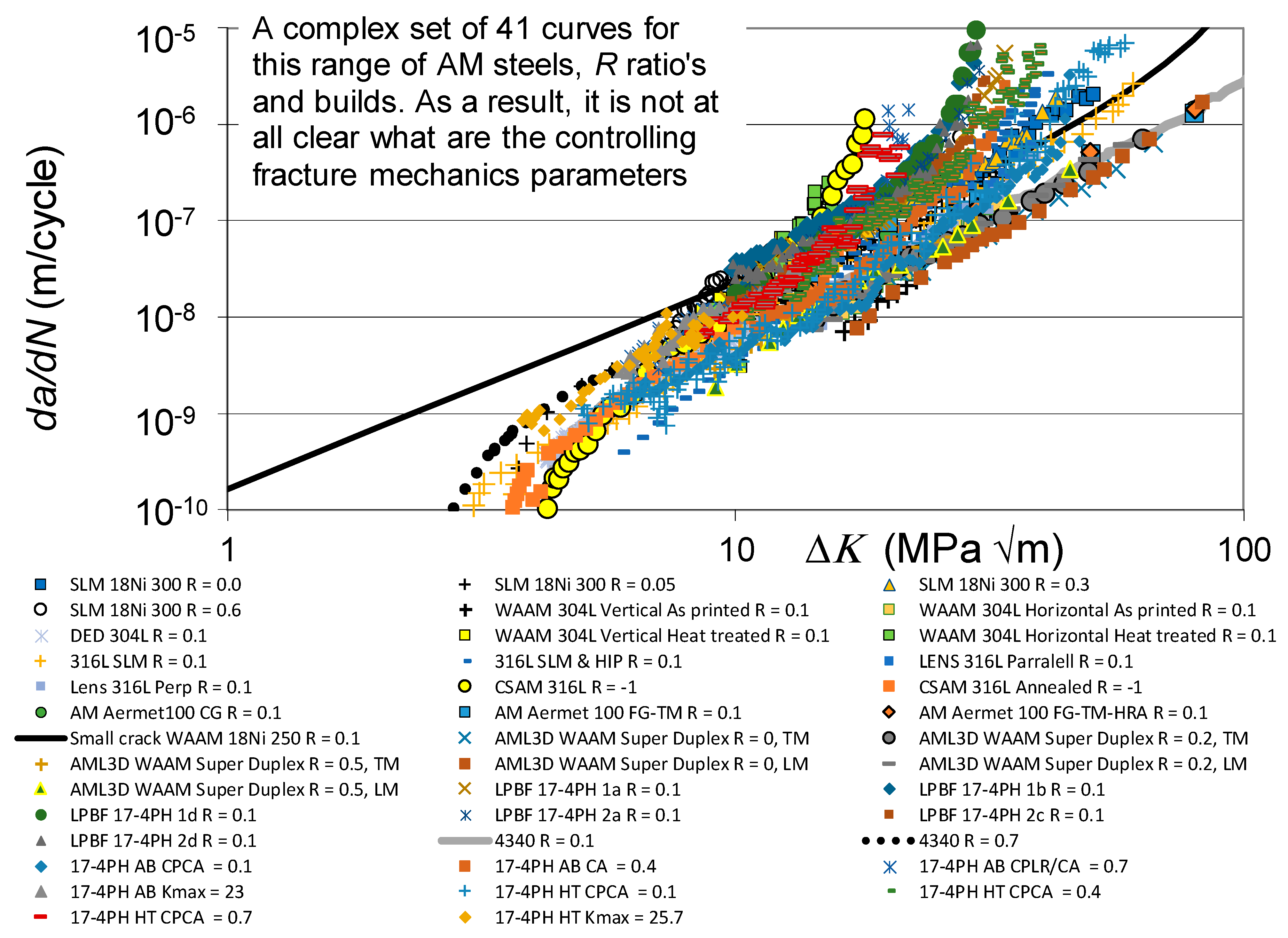
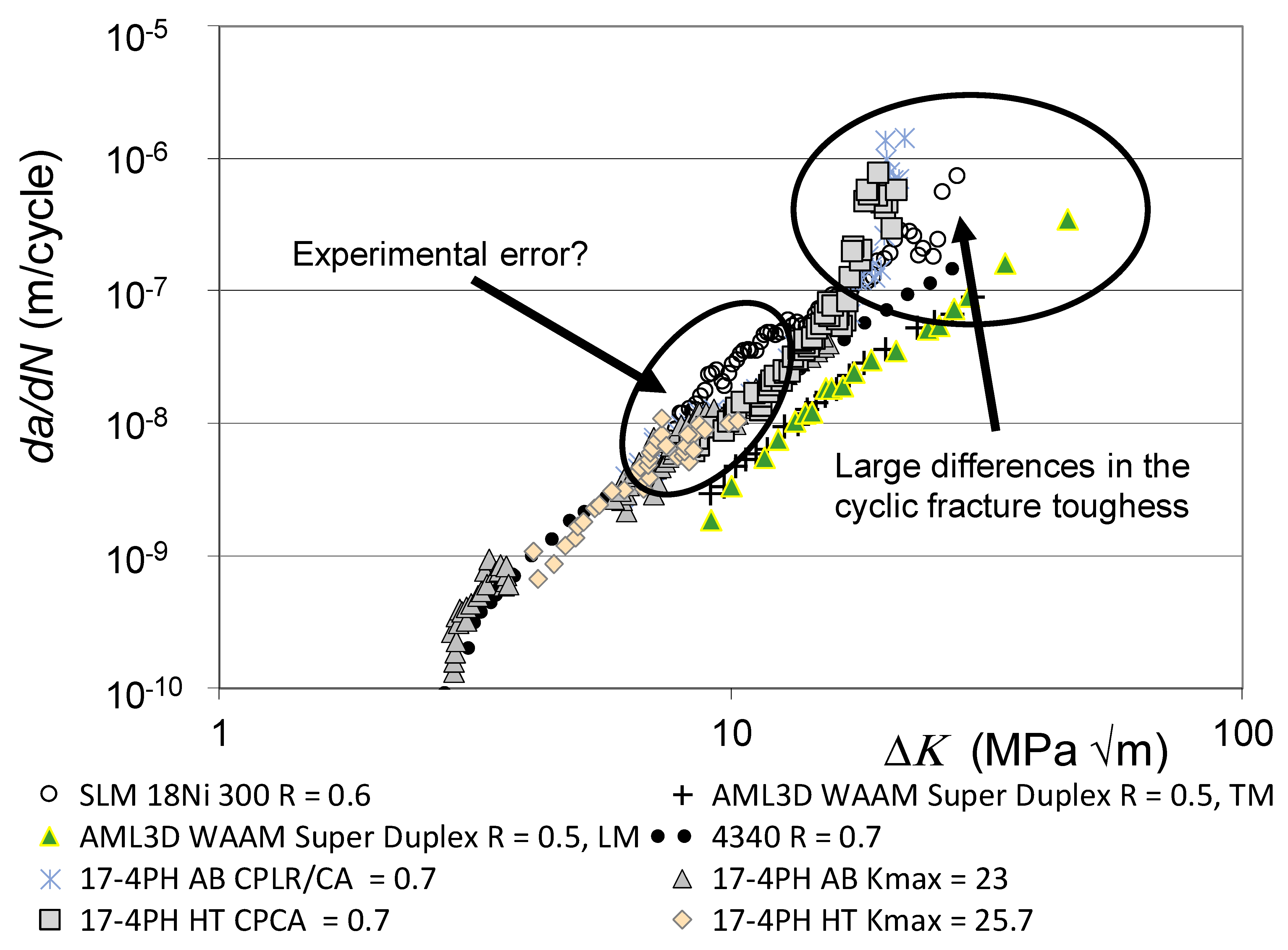
- The R = 0.1, 0.4, 0.7, and Kmax da/dN versus ΔK curves given in [108] for ASTM E647 standard compact tension (CT) specimen tests on LPBF 17-4PH in the as-built condition, and the R = 0.1, 0.7, and Kmax da/dN versus ΔK curves for LPBF 17-4PH specimens after heat treatment (HT). This study used a range of different pre-cracking test protocols. The notation associated with each of these various tests is given in Table 1.
- (x)
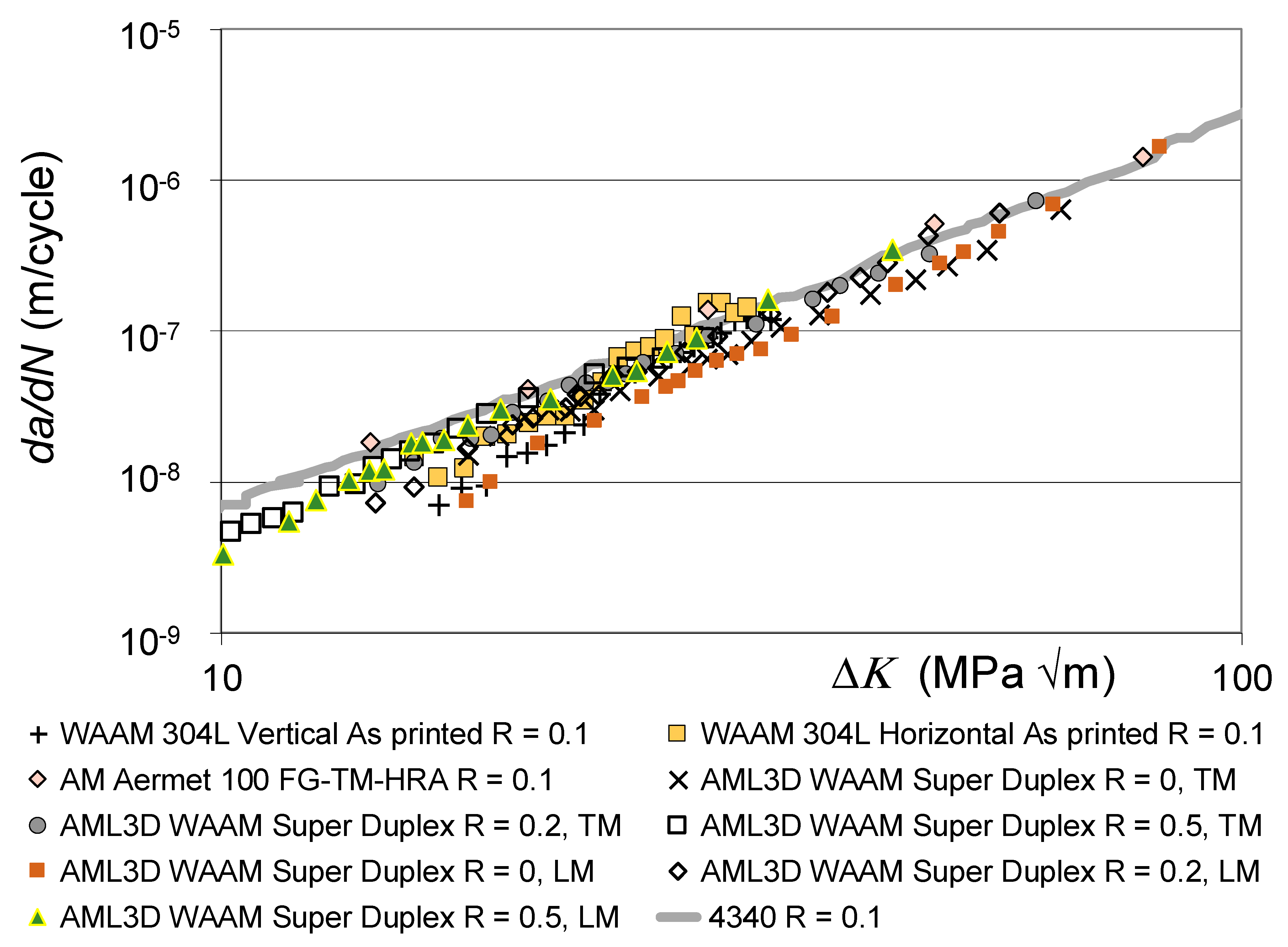
- The R = 0.1, 0.2, and 0.5 da/dN versus ΔK curves given in [109] for ASTM E647 standard compact tension (CT) tests [24] on as-built WAAM super duplex stainless steel (SDSS) specimens built by AML3D®. The specimens were pre-cracked under tension loading. (Unless stated, all of the specimen tests examined in this paper were performed in this fashion.) The notation LM stands for specimens cut with the length direction coinciding with the build direction. The notation TM stands for specimens that were cut transverse to the build direction. The specimens were left in the as-built state; i.e., they were not heat-treated.
- (xi)
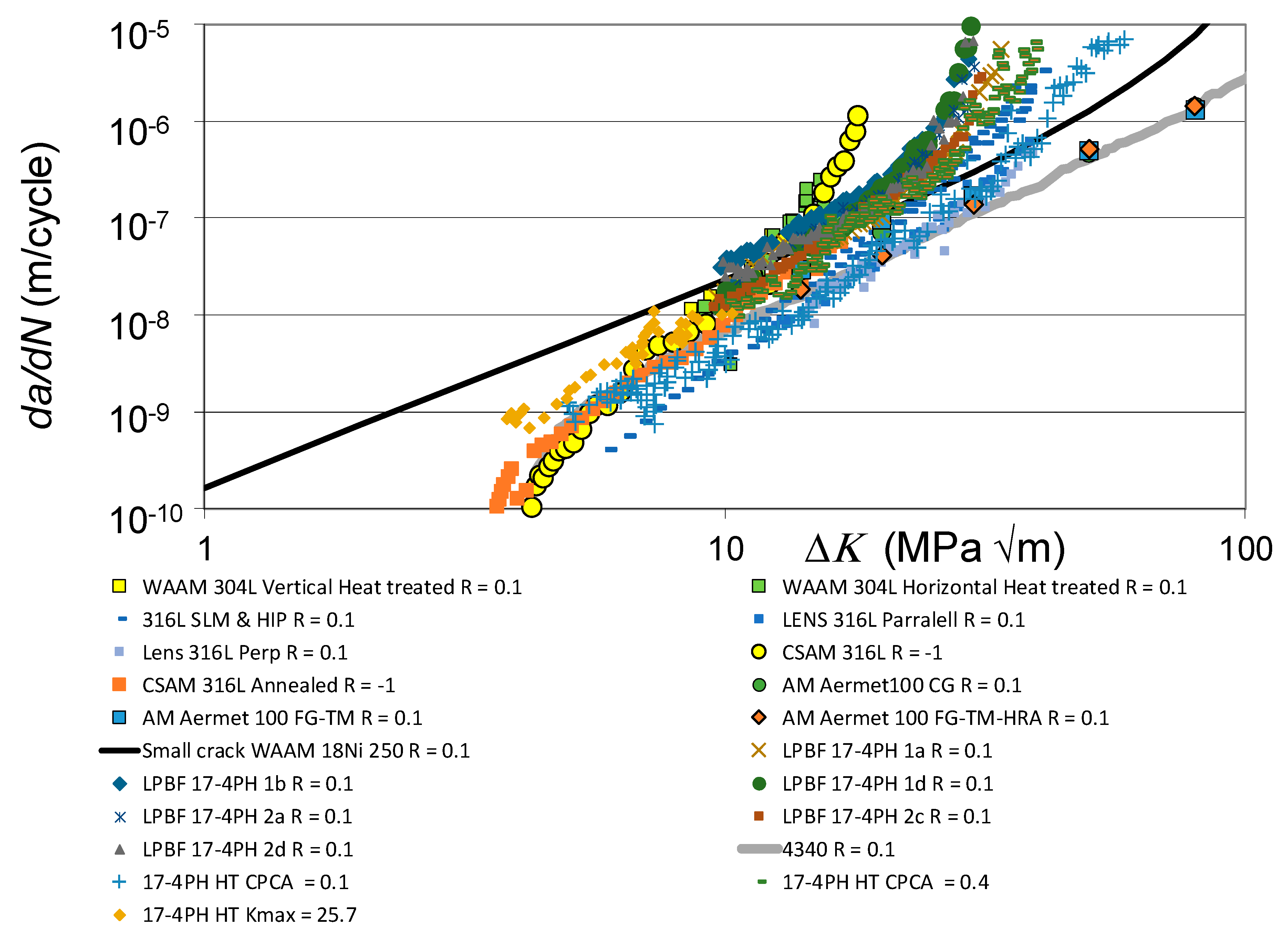
- Crack growth in cold spray additively manufactured (CSAM) 316L in both the as-sprayed and the annealed condition [41] tested at R = −1. These tests included specimens in the LS and LT directions and in both the as-printed and annealed states. In [41] these, various tests were labelled: As-sprayed 02 LS, As-sprayed 03 LS, As-sprayed 09 LT, As-sprayed 10 LT, Annealed 02, Annealed 03 LS, Annealed 08 LT, and Annealed 09 LT. Unlike all of the other tests evaluated, which all used ASTM E647 standard test specimens, this study used small single-edge notch tension specimens.
- (xii)
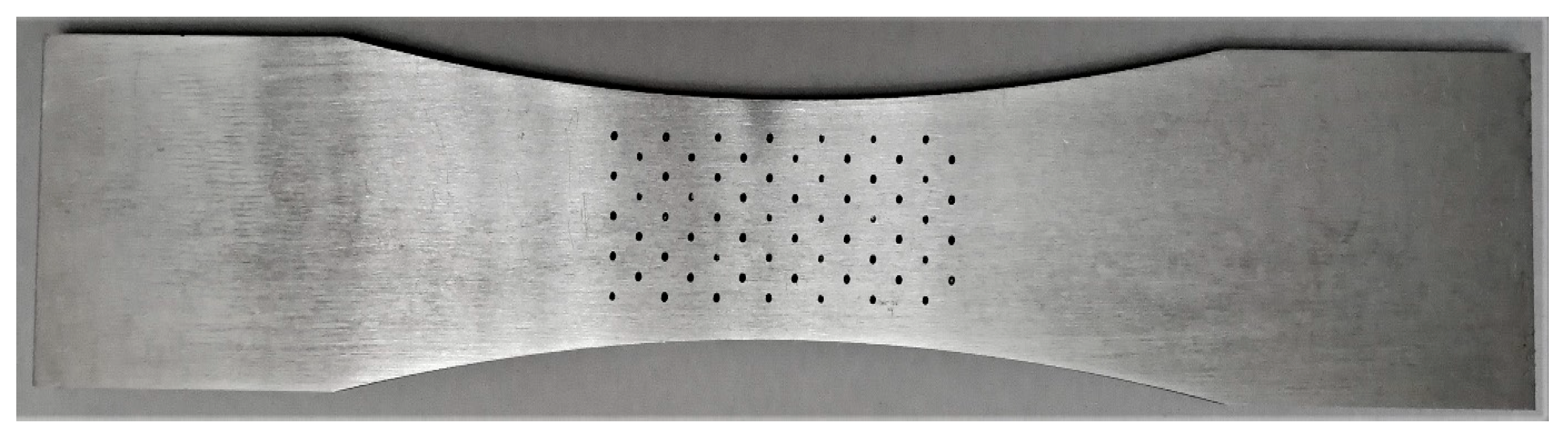
- The small crack da/dN versus ΔK curve given in [30] for WAAM 18Ni 250 Maraging steel. These tests used plain (un-notched) heat-treated specimens, and NOT ASTM 647 CT specimens. In these studies, the cracks were allowed to nucleate naturally.

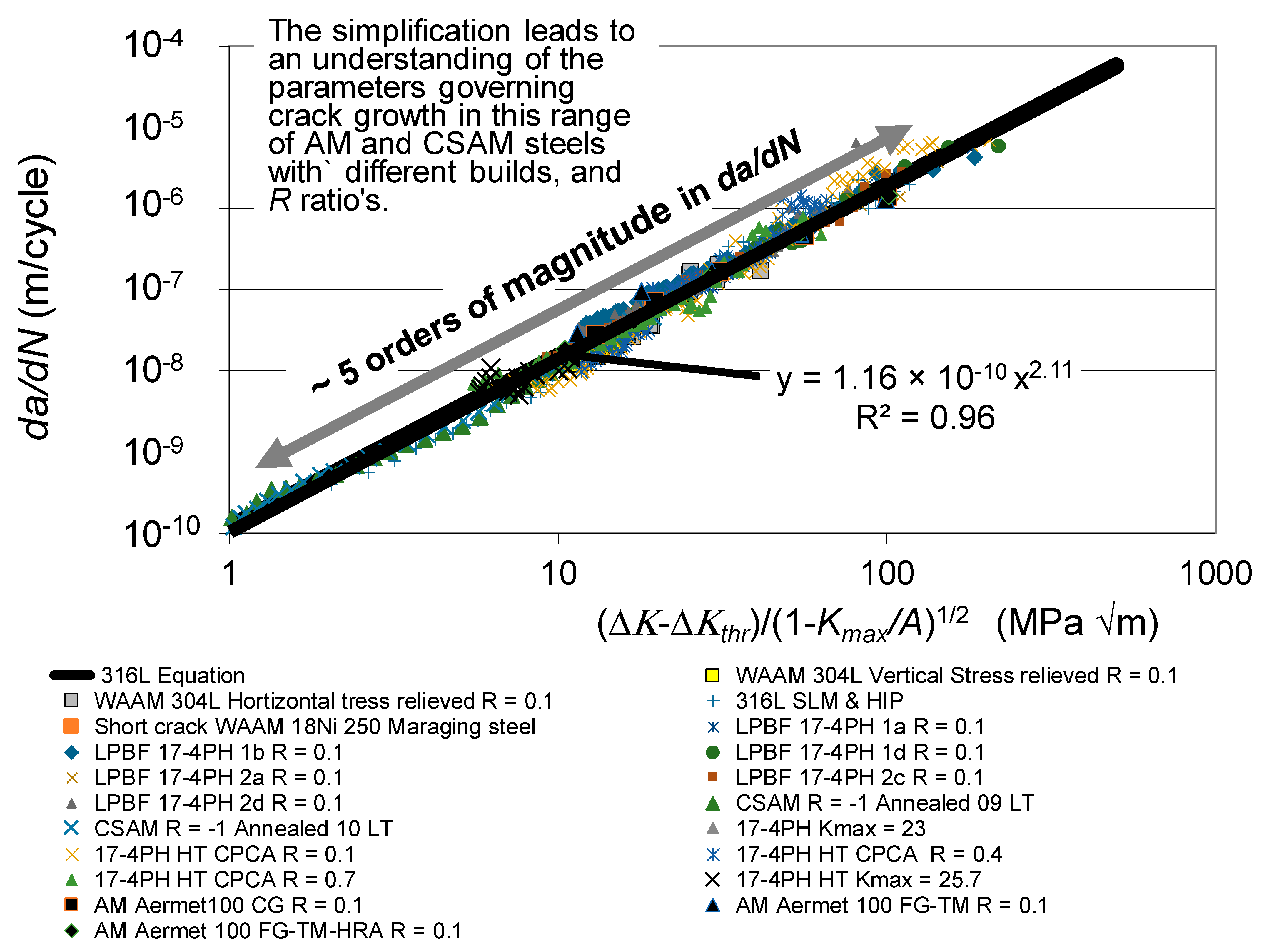
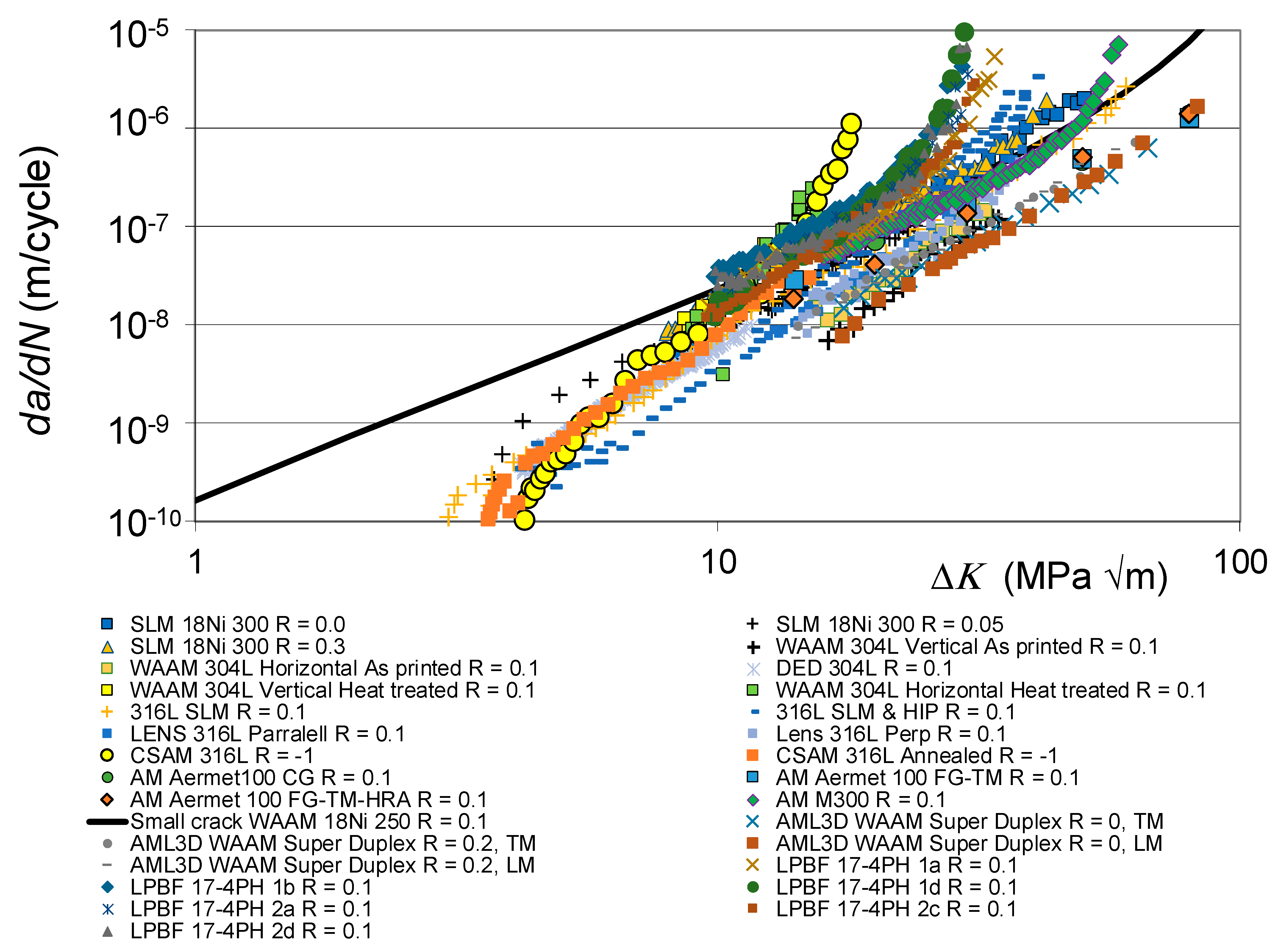
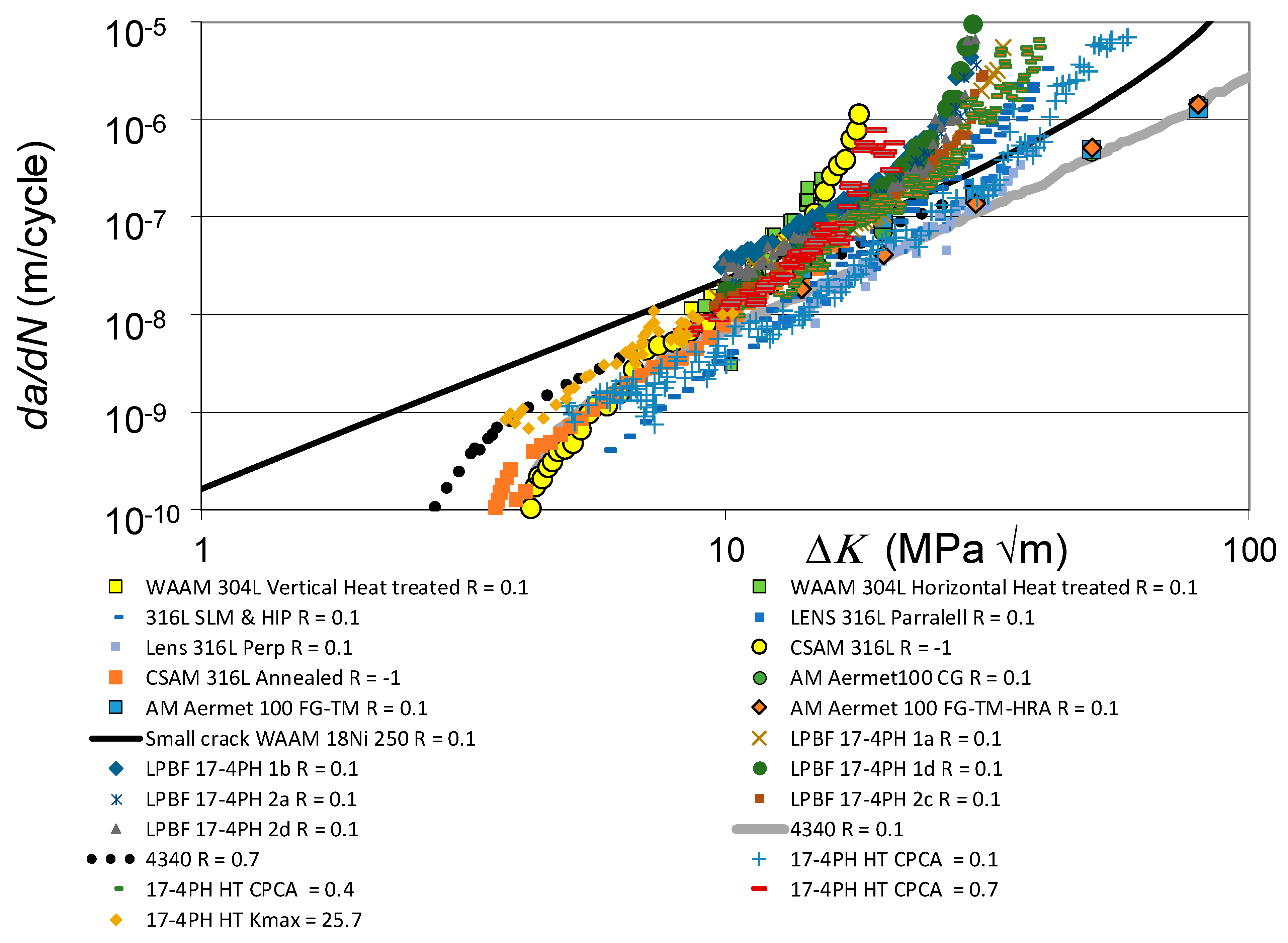
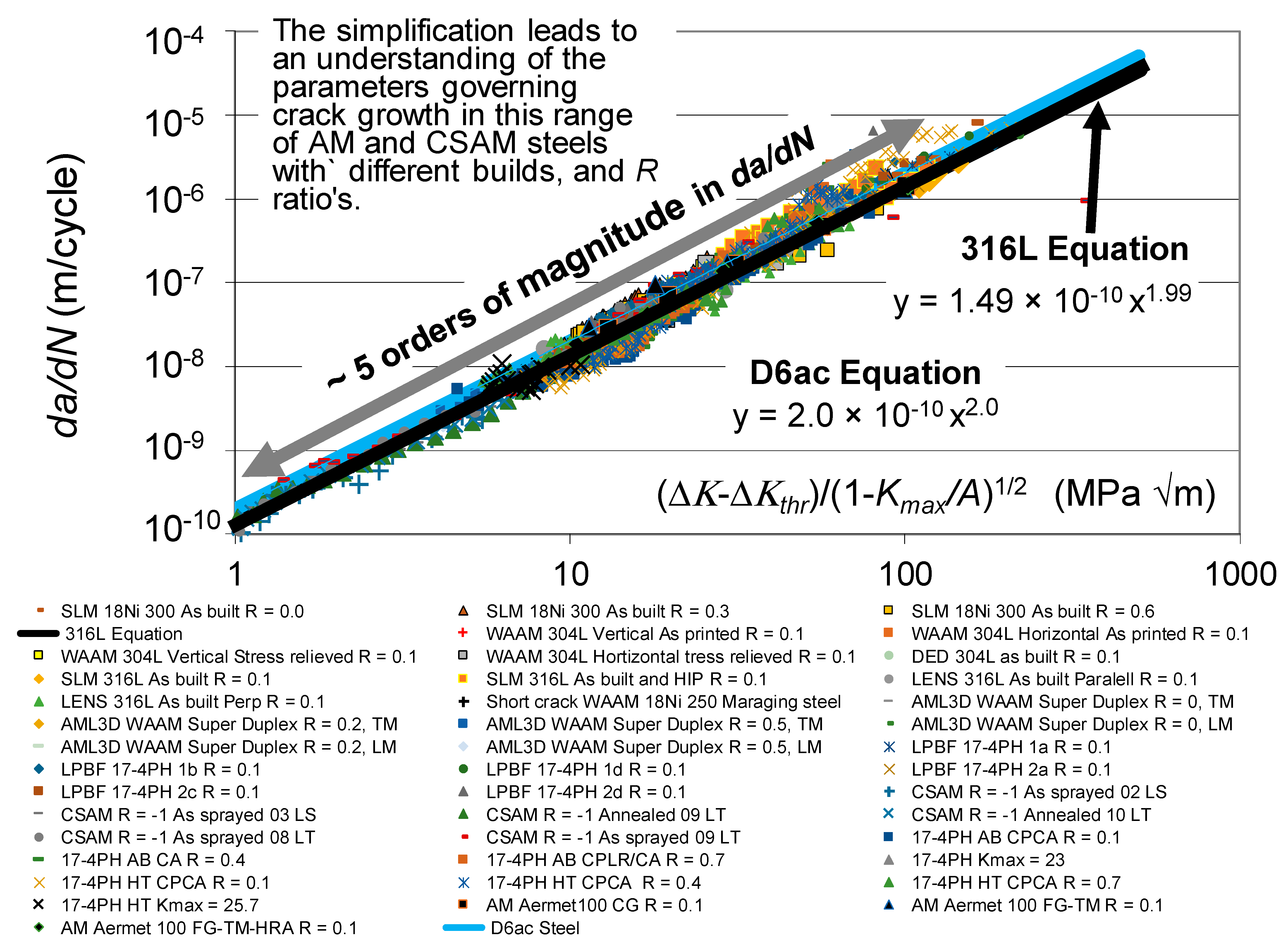
| Specimen ID, as Shown in Figure 1 and Figure 2 | R | ΔKthr (MPa √m) | A (MPa √m) |
|---|---|---|---|
| Short crack in heat-treated WAAM 18Ni 250 Maraging steel [30] (thickness = 6.35 mm) | 0.1 | 0.1 | 220.0 |
| CSAM 316L [41] (thickness = 4.0 mm) | |||
| CSAM 316L as sprayed 02, LS | −1 | 4.65 | 34.0 |
| CSAM 316L as sprayed 03, LS | −1 | 4.9 | 30.0 |
| CSAM 316L as sprayed 08, LT | −1 | 3.45 | 19.5 |
| CSAM 316L as sprayed 09, LT | −1 | 3.58 | 18.6 |
| CSAM 316L annealed 09, LT | −1 | 2.97 | 38.0 |
| CSAM 316L annealed 10, LT | −1 | 3.0 | 38.0 |
| SLM 18Ni 300, in the as-built state [101] | 0.05 | 2.0 | 78.0 |
| Ibid | 0.3 | 2.0 | 78.0 |
| Ibid | 0.6 | 0.1 | 78.0 |
| WAAM 304L [102] (thickness = 3.81 mm) | |||
| WAAM 304L Vertical As printed [102] | 0.1 | 9.8 | 112.0 |
| WAAM 304L Horizontal As printed [102] | 0.1 | 7.8 | 85.0 |
| WAAM 304L Vertical Stress relieved [102] | 0.1 | 1.0 (was 3) | 22.0 |
| WAAM 304L Horizontal Stress relieved [102]. | 0.1 | 2.0 (was 4) | 19.0 |
| DED 304, as-built [103] (thickness = 6.35 mm) | 0.1 | 3.5 | 120.0 |
| SLM 316, as-built R = 0.1 [104] (thickness = 10 mm) | 0.1 | 3.92 | 80.0 |
| SLM 316, as-built and HIP, R = −1 [104] (thickness = 10 mm) | 0.1 | 4.00 | 46.0 |
| LENS 316, as-built, Parallel [105] (thickness = 10 mm) | 0.1 | 6.5 | 55.0 |
| LENS 316, as-built, Perpendicular [105] (thickness = 10 mm) | 0.1 | 8.0 | 55.0 |
| LAM Aermet 100 R = 0.1 [106] (thickness = 4.0 mm) | |||
| Aermet 100 CG R = 0.1 | 0.1 | 1.5 | 400.0 |
| Aermet 100 FG R = 0.1 | 0.1 | 3.0 | 400.0 |
| Aermet 100 FG-HRA R = 0.1 | 0.1 | 4.0 | 350.0 |
| LPBF 17-4PH from [107] (thickness = 6 mm) | |||
| LPBF 17-4PH, Heat-treated Set 1 crack is parallel to the build direction | |||
| LPBF 17-4PH 1a R = 0.1 | 0.1 | 0.7 | 39.0 |
| LPBF 17-4PH 1b R = 0.1 | 0.1 | 0.1 | 33.5 |
| LPBF 17-4PH 1d R = 0.1 | 0.1 | 1.0 | 33.0 |
| LPBF 17-4PH, Heat-treated Set 2 crack is 90 degrees to the build direction | |||
| LPBF 17-4PH 2a R = 0.1 | 0.1 | 0.2 | 35.0 |
| LPBF 17-4PH 2c R = 0.1 | 0.1 | 0.2 | 37.5 |
| LPBF 17-4PH 2d R = 0.1 | 0.1 | 0.2 | 37.0 |
| LPBF 17-4PH from [108] * (thickness = 6 mm) | |||
| LPBF 17-4PH AB CPCA R = 0.1 | 0.1 | 5.0 | 75.0 |
| LPBF 17-4PH AB CPCA R = 0.4 | 0.4 | 4.0 | 75.0 |
| LPBF 17-4PH AB CPLRCA R = 0.7 | 0.7 | 2.0 | 75.0 |
| LPBF 17-4PH AB Kmax = 23 | - | 2.0 | 75.0 |
| LPBF 17-4PH HT CPCA R = 0.1 | 0.1 | 3.0 | 67.0 |
| LPBF 17-4PH HT CPCA R = 0.4 | 0.4 | 0.1 | 67.0 |
| LPBF 17-4PH HT CA R = 0.7 | 0.7 | 4.0 | 67.0 |
| LPBF 17-4PH Kmax = 25.7 | - | 2.0 | 67.0 |
| As-built, WAAM Super Duplex [109] (thickness = 12.7 mm) | |||
| As-built, WAAM Super Duplex TM direction | 0 | 8.25 | 400.0 ** |
| Ibid | 0.2 | 6.9 | 400.0 |
| Ibid | 0.5 | 5.5 | 400.0 |
| As-built, WAAM SSDS LM direction [109] (thickness = 12.7 mm) | |||
| Ibid | 0 | 10.0 | 350.0 ** |
| Ibid | 0.2 | 7.5 | 350.0 |
| Ibid | 0.5 | 6.0 | 350.0 |
3. Results
4. Implications for Limited-Life AM and CASM Replacement Parts
“Fatigue cracks of relevance to many structural applications are often small or short for a significant fraction of the structural life. The growth rates of such cracks usually cannot be measured with the standard procedures described in the main body of Test Method E647”.
On the Question of Heat Treatment
5. Estimating the Fatigue Threshold Associated with Naturally Occurring 3D in AM and CSAM Materials
6. Conclusions
Author Contributions
Funding
Data Availability Statement
Acknowledgments
Conflicts of Interest
Appendix A. The Finite-Element-Alternating Technique (FEAT)
References
- Under Secretary, Acquisition and Sustainment, Directive-Type Memorandum (DTM)-19-006-Interim Policy and Guidance for the Use of Additive Manufacturing (AM) in Support of Materiel Sustainment, Pentagon, Washington, DC, USA, 21 March 2019. Available online: https://static.e-publishing.af.mil/production/1/saf_aq/publication/dodi5000.93_dafi63-149/dodi5000.93_dafi63-149.pdf (accessed on 12 January 2026).
- US Army Directive 2019-29, Enabling Readiness and Modernization Through Advanced Manufacturing, Secretary of The Army, Pentagon, Washington, DC, USA, 18 September 2019. Available online: https://www.ndia.org/-/media/sites/ndia/policy/blog/documents/army-directive-201929-enabling-readiness-and-modernization-through-advanced-manufacturing.pdf (accessed on 12 January 2026).
- McMichael, E.; Frazer, E. Proceedings Summary Report: Joint Federal Aviation Administration-Air Force Workshop on Qualification/Certification of Additively Manufactured Parts, DOT/FAA/TC-16/15, 2015; NAVAIR Additive Manufacturing: Patuxent River, MD, USA, 2015. Available online: http://www.tc.faa.gov/its/worldpac/techrpt/tc16-15.pdf (accessed on 12 January 2026).
- Li, P.; Warner, D.H.; Fatemi, A.; Phan, N. Critical assessment of the fatigue performance of additively manufactured Ti-6Al-4V and perspective for future research. Int. J. Fatigue 2016, 85, 130–143. [Google Scholar] [CrossRef]
- Structures Bulletin EZ-SB-19-01, Durability and Damage Tolerance Certification for Additive Manufacturing of Aircraft Structural Metallic Parts; Wright Patterson Air Force Base: Dayton, OH, USA, 2019. Available online: https://daytonaero.com/usaf-structures-bulletins-library/ (accessed on 2 February 2020).
- Ritchie, R.O. Influence of microstructure on near-threshold fatigue-crack propagation in ultra-high strength steel. Met. Sci. 1977, 11, 368–381. [Google Scholar] [CrossRef]
- Zai, Y.; Lados, D.A.; Lagoy, J.L. Additive Manufacturing: Making Imagination the Major Limitation. JOM 2014, 66, 808–816. [Google Scholar] [CrossRef]
- Hrabe, N.; Barbosa, N.; Daniewicz, S.; Shamsaei, N. Findings from the NIST/ASTM Workshop on Mechanical Behavior of Additive Manufacturing Components, ASTM-NIST Workshop on Mechanical Behavior of Additive Manufactured Components; NIST Advanced Manufacturing Series; National Institute of Standards and Technology: Gaithersburg, MD, USA, 2016; pp. 100–104. [Google Scholar] [CrossRef]
- Moleai, R.; Fatemi, A. Fatigue Design with Additive Manufactured Metals: Issues to Consider and Perspective for Future Research. Procedia Eng. 2018, 213, 5–16. [Google Scholar] [CrossRef]
- Jones, R.; Rans, C.; Iliopoulos, A.P.; Michopoulos, J.G.; Phan, N.; Peng, D. Modelling the Variability and the Anisotropic Behaviour of Crack Growth in SLM Ti-6Al-4V. Materials 2021, 14, 1400. [Google Scholar] [CrossRef]
- MIL-STD-1530D; Department of Defense Standard Practice Aircraft Structural Integrity Program (ASIP). U.S. Department of Defense: Dayton, OH, USA, 2016. Available online: http://everyspec.com/MIL-STD/MIL-STD-1500-1599/MIL-STD-1530D_55392/ (accessed on 12 January 2026).
- JSSG-2006; Department of Defense Joint Service Specification Guide, Aircraft Structures. U.S. Department of Defense: Dayton, OH, USA, 1998. Available online: http://everyspec.com/USAF/USAF-General/JSSG-2006_10206/ (accessed on 12 January 2026).
- Newman, J.C., Jr.; Edwards, P.R. Short-Crack Growth Behaviour in an Aluminium Alloy—An AGARD Cooperative Test Programme, AGARD-R-732, December 1988. Available online: https://ntrs.nasa.gov/citations/19890007916 (accessed on 15 February 2024).
- Newman, J.C.; Phillips, E.P.; Everett, R.A. Fatigue Analyses Under Constant and Variable-Amplitude Loading Using Small-Crack Theory, NASA/TM-1999-209329, 1999. Available online: https://ntrs.nasa.gov/citations/19990046065 (accessed on 15 January 2025).
- Jones, R.; Ang, A.; Aston, R.W.; Schoenborn, N.D.; Champagne, V.K.; Peng, D.; Phan, N.D. On the growth of small cracks in 2024-T3 and Boeing Space, Intelligence and Weapon Systems AM LPBF Scalmalloy®. Fatigue Fract. Eng. Mater. Struct. 2024, 48, 31–43. [Google Scholar] [CrossRef]
- Chan, S.; Peng, D.; Ang, A.S.M.; Nicholas, M.B.; Champagne, V.K.; Birt, A.; Michelson, A.; Langan, S.; Watts, J.; Jones, R. Further Studies into The Growth of Small Naturally Occurring Three-Dimensional Cracks in Additively Manufactured and Conventionally Built Materials. Crystals 2025, 15, 544. [Google Scholar] [CrossRef]
- Edwards, P.R.; Newman, J.C., Jr. An AGARD Supplemental Test Programme on the Behaviour of Short Cracks Under Constant Amplitude and Aircraft Spectrum Loading, AGARD-R-767, Short-Crack Growth Behaviour in Various Aircraft Materials, 1.1—1-43, August 1990. Available online: https://www.sto.nato.int/publications/AGARD/AGARD-R-767/AGARD-R-767.pdf (accessed on 11 January 2025).
- Wanhill, R.J.H. Durability Analysis Using Short and Long Fatigue Crack Growth Data. In Proceedings International Conference on Aircraft Damage Assessment and Repair; Jones, R., Miller, N.J., Eds.; The Institution of Engineers Australia: Barton, ACT, Australia, 1991; ISBN 85825 537 5. Available online: https://www.researchgate.net/publication/325102704_Durability_Analysis_Using_Short_and_Long_Fatigue_Crack_Growth_Data (accessed on 5 November 2025).
- Wanhill, R. Some practical considerations for fatigue and corrosion assessment of ageing aircraft. In NLR Technical Publication TP 96253 L; National Aerospace Laboratory NLR: Amsterdam, The Netherlands, 1996; Available online: https://www.researchgate.net/publication/333965628_NLR_TECHNICAL_PUBLICATION_TP_96253_L_SOME_PRACTICAL_CONSIDERATIONS_FOR_FATIGUE_AND_CORROSION_DAMAGE_ASSESSMENT_OF_AGEWG_AIRCRAFT (accessed on 11 November 2025).
- Kaynak, C.; Ankara, A. Short fatigue crack growth in Al 2024-3 and 7075-T6. Eng. Fract. Mech. 1992, 43, 769–778. [Google Scholar] [CrossRef]
- Jones, R. Fatigue Crack Growth and Damage Tolerance. Fatigue Fract. Eng. Mater. Struct. 2014, 37, 463–483. [Google Scholar] [CrossRef]
- Schwalbe, K.H. On the Beauty of Analytical Models for Fatigue Crack Propagation and Fracture-A Personal Historical Review. J. ASTM Intl. 2010, 7, 3–73. [Google Scholar] [CrossRef]
- Schwalbe, K.H. Some aspects of crack propagation under monotonic and cyclic load. Eng. Fract. Mech. 1977, 9, 547–556. [Google Scholar] [CrossRef]
- ASTM E647-23b; Measurement of Fatigue Crack Growth Rates. ASTM: West Conshohocken, PA, USA, 2023.
- Manning, S.D.; Yang, Y.N. USAF Durability Design Handbook: Guidelines for the Analysis and Design of Durable Aircraft Structures, AFWAL-TR-83-3027, January 1984. Available online: https://apps.dtic.mil/sti/pdfs/ADA142424.pdf (accessed on 15 September 2025).
- Berens, A.P.; Hovey, P.W.; Skinn, D.A. Risk Analysis for Aging Aircraft Fleets—Volume 1: Analysis, WL-TR-91-3066, Flight Dynamics Directorate, Wright Laboratory, Air Force Systems Command, Wright-Patterson Air Force Base, October 1991. Available online: https://apps.dtic.mil/sti/pdfs/ADA252000.pdf (accessed on 15 October 2025).
- Main, B.; Molent, L.; Singh, R.; Barter, S. Fatigue crack growth lessons from thirty-five years of the Royal Australian Air Force F/A-18 A/B Hornet Aircraft Structural Integrity Program. Int. J. Fatigue 2020, 1330, 105426. [Google Scholar] [CrossRef]
- Wanhill, R.; Barter, S.; Molent, L. Fatigue Crack Growth Failure and Lifing Analyses for Metallic Aircraft Structures and Components. In Springer Briefs in Applied Sciences and Technology; Springer: Berlin/Heidelberg, Germany, 2019; ISBN 978-94-024-1673-2. [Google Scholar] [CrossRef]
- Molent, L.; Barter, S.A.; Wanhill, R.J.H. The lead crack fatigue lifing framework. Int. J. Fatigue 2011, 33, 323–331. [Google Scholar] [CrossRef]
- Peng, D.; Jones, R.; Ang, A.S.M.; Michelson, A.; Champagne, V.; Birt, A.; Pinches, S.; Kundu, S.; Alankar, A.; Singh, R.R.K. Computing the durability of WAAM 18Ni 250 Maraging steel specimens. Fatigue Fract. Eng. Mater. Struct. 2022, 45, 3535–3545. [Google Scholar] [CrossRef]
- Zhang, Y.; Zheng, K.; Heng, J.; Zhu, J. Corrosion-Fatigue Evaluation of Uncoated Weathering Steel Bridges. Appl. Sci. 2019, 9, 3461. [Google Scholar] [CrossRef]
- Shamir, M.; Zhang, X.; Syed, A.K. Characterising and representing small crack growth in an additive manufactured titanium alloy. Eng. Fract. Mech. 2021, 253, 107876. [Google Scholar] [CrossRef]
- Dastgerdi, J.N.; Jaberi, O.; Remes, H.; Lehto, P.; Toudeshky, H.H.; Kuva, J. Fatigue damage process of additively manufactured 316L steel using X-ray computed tomography imaging. Addit. Manuf. 2023, 70, 103559. [Google Scholar] [CrossRef]
- Iliopoulos, A.P.; Jones, R.; Michopoulos, J.G.; Phan, N.; Singh Raman, R.F.K. Crack growth in a range of additively manufactured aerospace structural materials. Aerospace 2019, 5, 118. [Google Scholar] [CrossRef]
- Ang, A.; Aston, R.; King, H.; Chan, S.S.L.; Schoenborn, N.D.; Peng, D.; Jones, R. Corrosion and Fatigue Behaviour of Boeing Space, Intelligence, And Weapons Systems Laser Powder Fusion Built Scalmalloy® In 5% NaCl. Fatigue Fract. Eng. Mater. Struct. 2025, 48, 2206–2220. [Google Scholar] [CrossRef]
- Jones, R.; Cizek, J.; Kovarik, O.; Ang, A.; Champagne, V.K. Observations on comparable aluminium alloy crack growth curves: Additively manufactured Scalmalloy® as an alternative to AA5754 and AA6061-T6 alloys? Addit. Manuf. Lett. 2022, 2, 100026. [Google Scholar] [CrossRef]
- Markham, M.J.; Fatemi, A.; Phan, N. Mixed-Mode Small Fatigue Crack Growth Rates and Modelling in Additively Manufactured Metals. Int. J. Fatigue 2024, 183, 108258. [Google Scholar] [CrossRef]
- Fatemi, A.; Molaei, R.; Phan, N. Multiaxial Fatigue of Additive Manufactured Metals. In MATEC Web of Conferences, Proceedings of the ICMFF12, 12th International Conference on Multiaxial Fatigue and Fracture, Bordeaux, France, 22–29 June 2019; EDP Sciences: Les Ulis, France, 2019; Volume 300, p. 01003. [Google Scholar] [CrossRef]
- Tang, D.; He, X.; Wu, B.; Dang, L.; Xin, H.; Li, Y. A fatigue life prediction approach for porosity defect-induced failures in directed energy deposited Ti-6Al-4V considering crack growth environment. Int. J. Fatigue 2014, 184, 108272. [Google Scholar] [CrossRef]
- Han, S.; Dung Dinh, T.; De Baere, I.; Boone, M.; Josipovic, I.; Van Paepegem, W. Study of the effect of defects on fatigue life prediction of additive manufactured Ti-6Al-4V by combined use of micro-computed tomography and fracture-mechanics-based simulation. Int. J. Fatigue 2023, 180, 108110. [Google Scholar] [CrossRef]
- Jones, R.; Kovarik, O.; Bagherifard, S.; Cizek, J.; Lang, J. Damage tolerance assessment of AM 304L and cold spray fabricated 316L steels and its implications for attritable aircraft. Eng. Fract. Mech. 2021, 254, 107916. [Google Scholar] [CrossRef]
- Cizek, J.; Kovarik, O.; Cupera, J.; Kondas, J.; Bajer, T.; Siska, F.; Janovska, M.; Seiner, H. Measurement of mechanical and fatigue properties using unified, simple-geometry specimens: Cold spray additively manufactured pure metals. Surf. Coat. Technol. 2021, 412, 126929. [Google Scholar] [CrossRef]
- Godefroid, L.B.; Moreira, L.P.; Vilela, T.C.G.; Faria, G.L.; Candido, L.C.; Pinto, E.S. Effect of chemical composition and microstructure on the fatigue crack growth resistance of pearlitic steels for railroad application. Int. J. Fatigue 2019, 120, 241–253. [Google Scholar] [CrossRef]
- Jones, R.; Ang, A.; Peng, D.; Champagne, V.K.; Michelson, A.; Birt, A. Modelling Crack Growth in Additively Manufactured Inconel 718 and Inconel 625. Metals 2023, 13, 1300. [Google Scholar] [CrossRef]
- Jones, R.; Raman, R.K.S.; Iliopoulos, A.P.; Michopoulos, J.G.; Phan, N.; Peng, D. Additively manufactured Ti-6Al-4V replacement parts for military aircraft. Int. J. Fatigue 2019, 124, 227–235. [Google Scholar] [CrossRef]
- Kovarik, O.; Cech, J.; Kiziklioglu, E.; Cizek, J.; Stittgen, T. Anisotropy of Mechanical Properties of high-speed DED Build Inconel 738. In Thermal Spray 2023, Proceedings of the the International Thermal Spray Conference, Quebec City, QC, Canada, 22–25 May 2023; Curran Associates, Inc.: Red Hook, NY, USA, 2003; pp. 473–479. Available online: https://dl.asminternational.org/itsc/proceedings-abstract/ITSC2023/84536/473/26347 (accessed on 2 December 2025).
- Kovarik, O.; Maffia, S.; Stittgen, T.; Wick, J.; Lukes, J.; Cizek, J. Mechanical and fracture properties of as-built 3DMD Inconel 718: Stability to process parameters variation. In Thermal Spray 2025, Proceedings of the International Thermal Spray Conference, Vancouver, BC, Canada, 5–8 May 2025; ASM International: Almere, The Netherlands, 2025; pp. 434–441. [Google Scholar] [CrossRef]
- Iliopoulos, A.P.; Jones, R.; Michopoulos, J.G.; Phan, N.; Rans, C. Further Studies into Crack Growth in Additively Manufactured Materials. Materials 2020, 13, 2223. [Google Scholar] [CrossRef]
- Kovarik, O.; Cizek, J.; Kondas, J. Anisotropy of Ti6Al4V deposited by cold spray. In Thermal Spray 2022, Proceedings of the International Thermal Spray Conference, Vienna, Austria, 2–4 May 2022; ASM International: Materials Park, OH, USA, 2022; pp. 756–767. [Google Scholar] [CrossRef]
- Nourian, A.; Kovarik, O.; Cizek, J.; Cech, J.; Zhue, S.; Ando, T.; Müftü, S. Effect of thermo-mechanical treatment on the static and cyclic performance of cold sprayed 6061 aluminum alloy. Int. J. Fatigue 2005, 201, 109197. [Google Scholar] [CrossRef]
- Ye, J.; Syed, A.K.; Zhang, X.; Eimer, E.; Williams, S. Fatigue crack growth behaviour in an aluminium alloy Al-Mg-0.3Sc produced by wire based directed energy deposition process. Fatigue Fract. Eng. Mater. Struct. 2023, 46, 3927–3938. [Google Scholar] [CrossRef]
- Endo, M.; Murakami, Y. Prediction model of S-N curve under mean stress without fatigue test or with a minimum number of fatigue tests. Theor. Appl. Fract. Mech. 2025, 138, 104918. [Google Scholar] [CrossRef]
- Nourian-Avval, A.; Fatemi, A. Fatigue life prediction of cast aluminum alloy based on porosity characteristics. Theor. Appl. Fract. Mech. 2020, 109, 102774. [Google Scholar] [CrossRef]
- Shamir, M.; Zhang, X.; Syed, A.K.; Sadler, W. Predicting the Effect of Surface Waviness on Fatigue Life of a Wire Arc Additive Manufactured Ti-6Al-4V Alloy. Materials 2023, 16, 5355. [Google Scholar] [CrossRef] [PubMed]
- Iliopoulos, A.; Michopoulos, J.G.; Jones, R.; Kinloch, A.J.; Peng, D. A framework for automating the parameter determination of crack growth models. Int. J. Fatigue 2022, 169, 107490. [Google Scholar] [CrossRef]
- Jones, R.; Singh Raman, R.K.; McMillan, A.J. Crack growth: Does microstructure play a role? Eng. Fract. Mech. 2018, 187, 190–210. [Google Scholar] [CrossRef]
- Main, B.; Evans, R.; Walker, K.; Yu, X.; Molent, L. Lessons from a Fatigue Prediction Challenge for an Aircraft Wing Shear Tie Post. Int. J. Fatigue 2019, 123, 53–65. [Google Scholar] [CrossRef]
- Tan, J.L.; Chen, B.K. Prediction of fatigue life in aluminium alloy (AA7050-T7451) structures in the presence of multiple artificial short cracks. Theor. Appl. Fract. Mech. 2015, 78, 1–7. [Google Scholar] [CrossRef]
- Tan, J.L.; Chen, B.K. A new fracture area method for predicting the growth of a newly coalesced crack in AA7050-T7451 aluminium alloy. Theor. Appl. Fract. Mech. 2015, 75, 146–150. [Google Scholar] [CrossRef]
- Tan, J.L.; Chen, B.K. A new method for modelling the coalescence and growth of two coplanar short cracks of varying lengths in AA7050-T7451 aluminium alloy. Int. J. Fatigue 2013, 49, 73–80. [Google Scholar] [CrossRef]
- Tan, J.L.; Chen, B.K. Coalescence and growth of two coplanar short cracks in AA7050-T7451 aluminium alloys. Eng. Fract. Mech. 2013, 102, 324–333. [Google Scholar] [CrossRef]
- Huang, P.; Yin, Y.; McNaulty, D.; Yan, W. A damage tolerance approach for structural integrity of truck trailers. Eng. Fail. Anal. 2022, 136, 106197. [Google Scholar] [CrossRef]
- Molent, L. Journeys in ASI, Lincoln Award Presentation. In ASIP 2025, Proceedings of the Aircraft Structural Integrity Program Conference, Austin, TX, USA, 1–4 December 2025; ASIP: Rockville, MD, USA, 2025. Available online: https://www.arctosmeetings.com/agenda/asip/2025/proceedings/presentations/P28608.pdf (accessed on 12 January 2026).
- ASTM B117-19; Standard Practice for Operating Salt Spray (Fog) Apparatus. ASTM International: West Conshohocken, PA, USA, 2023.
- Clerc, G.; Brunner, A.J.; Niemz, P.; Van De Kuilen, J.W.G. Feasibility study on Hartman-Schijve data analysis for Mode II fatigue fracture of adhesively bonded wood joints. Int. J. Fatigue 2019, 221, 123–140. [Google Scholar] [CrossRef]
- Cano, A.J.; Salazar, A.; Rodríguez, J. Evaluation of different crack driving forces for describing the fatigue crack growth behaviour of PET-G. Int. J. Fatigue 2018, 107, 27–32. [Google Scholar] [CrossRef]
- Kinloch, A.J.; Jones, R.; Michopoulos, J.G. Fatigue crack growth in epoxy polymer nanocomposites. Philos. Trans. R. Soc. 2020, A379, 20200436. [Google Scholar] [CrossRef]
- Banks-Sills, L.; Ben Gur, H. The effect of fiber bridging on mode I fatigue delamination propagation—Part I: Testing. Fatigue Fract. Eng. Mater. Struct. 2024, 47, 3232–3246. [Google Scholar] [CrossRef]
- Khudiakova, A.; Brunner, A.J.; Wolfahrt, M.; Pinter, G. Quantification approaches for fatigue crack resistance of thermoplastic tape layered composites with multiple delaminations. Materials 2021, 14, 1476. [Google Scholar] [CrossRef]
- Michel, S.; Kinloch, A.J.; Jones, R. Cyclic-fatigue crack growth in polymer composites: Data Interpretation via the Hartman-Schijve methodology. Eng. Fract. Mech. 2025, 314, 110743. [Google Scholar] [CrossRef]
- Simon, I.; Banks-Sills, L.; Fourman, V. Mode I delamination propagation and R-ratio effects in woven DCB specimens for a multi-directional layup. Int. J. Fatigue 2017, 96, 237–251. [Google Scholar] [CrossRef]
- Riedl, G.; Pugstaller, R.; Wallner, G.M. Development and implementation of a simultaneous fatigue crack growth test setup for polymeric hybrid laminates. Eng. Fract. Mech. 2002, 267, 108468. [Google Scholar] [CrossRef]
- Arhant, M.; Lolive, E.; Bonnemains, T.; Davies, P. Effect of aging on the fatigue crack growth properties of carbon-polyamide 6 thermoplastic composites using the multi ΔG-control method. Compos. Part A Appl. Sci. Manuf. 2022, 161, 107105. [Google Scholar] [CrossRef]
- Endo, M.; McEvily, A.J. Prediction of the behaviour of small fatigue cracks. Mater. Sci. Eng. A 2007, 51–58, 468–470. [Google Scholar]
- Masuda, K.; Oguma, N.; Ishihara, S.; McEvily, A.J. Investigation of subsurface fatigue crack growth behavior of D2 tool steel (JIS SKD11) based on a novel measurement method. Int. J. Fatigue 2020, 133, 105395. [Google Scholar] [CrossRef]
- Ishihara, S.; Yoshifuji, S.; McEvily, A.J.; Kawamoto, M.; Sawai, M.; Takata, M. Study of the fatigue lifetimes and crack propagation behaviour of a high speed steel as a function of the R value. Fatigue Fract. Eng. Mater. Struct. 2010, 33, 294–302. [Google Scholar] [CrossRef]
- Zheng, X.; Hirt, M. Fatigue crack propagation in steels. Eng. Fract. Mech. 1983, 18, 965–973. [Google Scholar] [CrossRef]
- Xiang, Y.; Lu, Z.; Liu, Y. Crack growth-based fatigue life prediction using an equivalent initial flaw model. Part I: Uniaxial loading. Int. J. Fatigue 2010, 2, 341–349. [Google Scholar] [CrossRef]
- Wang, K.; Wang, F.; Cui, W.; Hayat, T.; Ahmad, B. Prediction of short fatigue crack growth of Ti-6Al-4V. Fatigue Fract. Eng. Mater. Struct. 2014, 37, 1075–1086. [Google Scholar] [CrossRef]
- Wang, C.Q.; Xiong, J.J.; Shenoi, R.A.; Liu, M.D.; Liu, J.Z. A modifed model to depict corrosion fatigue crack growth behaviour for evaluating residual lives of aluminium alloys. Int. J. Fatigue 2016, 83, 280–287. [Google Scholar] [CrossRef]
- Dixon, B.; Fayek, H.; Hodgen, C.; Wiley, T.; Barter, S. Optimising fatigue crack growth predictions for small cracks under variable amplitude loading. Int. J. Fatigue 2024, 185, 108339. [Google Scholar] [CrossRef]
- Ramsamooj, D.V. Analytical prediction of short to long fatigue crack growth rate using small- and large-scale yielding fracture mechanics. Int. J. Fatigue 2003, 25, 923–933. [Google Scholar] [CrossRef]
- de Castro, J.T.P.; Meggiolaro, M.A.; de Oliveira Miranda, A.C. Fatigue crack growth predictions based on damage accumulation calculations ahead of the crack tip. Comput. Mater. Sci. 2009, 46, 115–123. [Google Scholar] [CrossRef]
- Chapetti, M.D. Fatigue propagation threshold of short cracks under constant amplitude loading. Int. J. Fatigue 2003, 25, 1319–1326. [Google Scholar] [CrossRef]
- Liu, H.W.; Liu, D. A quantitative analysis of structure sensitive fatigue crack growth in steels. Scr. Metall. 1984, 18, 7–12. [Google Scholar] [CrossRef]
- Available online: https://zentech.co.uk/software/zencrack/whats-new/version921 (accessed on 30 September 2025).
- Fatoba, O.; Akid, R. On the behaviour of small fatigue cracks emanating from corrosion pits: Part I—The influence of mechanical factors. Theor. Appl. Fract. Mech. 2022, 117, 103154. [Google Scholar] [CrossRef]
- Burns, J.T.; Larsen, J.M.; Gangloff, R.P. Effect of initiation feature on microstructure-scale fatigue crack propagation in Al–Zn–Mg–Cu. Int. J. Fatigue 2012, 42, 104–121. [Google Scholar] [CrossRef]
- Field, I.; Kandare, I.; Dixon, B.; Tian, J.; Barter, S. Effect of underloads in small fatigue crack growth. Int. J. Fatigue 2022, 157, 106706. [Google Scholar] [CrossRef]
- Newman, J.C.; Raju, I.S. Stress-intensity factor equations for cracks in three-dimensional finite bodies subjected to tension and bending loads. In Computational Methods in the Mechanics of Fracture; Elsevier Science: Amsterdam, The Netherlands, 1986; pp. 311–334. [Google Scholar]
- Yamashita, Y.; Murakami, T.; Mihara, R.; Okada, M.; Murakami, Y. Defect analysis and fatigue design basis for Ni-based superalloy 718 manufactured by selective laser melting. Int. J. Fatigue 2018, 117, 485–495. [Google Scholar] [CrossRef]
- Maharjan, N.; Mizuta, Y.; Masaki, K.; Tamaki, S.; Sano, Y.; Hosokai, T.; Ang, A. Improving fatigue behaviour of additively manufactured Scalmalloy® using laser shock peening. J. Mater. Res. Technol. 2025, 37, 3424–3433. [Google Scholar] [CrossRef]
- Murakami, Y.; Masuo, H.; Tanaka, Y.; Nakatani, M. Defect Analysis for Additively Manufactured Materials in Fatigue from the Viewpoint of Quality Control and Statistics of Extremes Defect Analysis for Additively Manufactured Materials in Fatigue from the Viewpoint of Quality Control and Statistics of Extremes. Procedia Struct. Integr. 2019, 19, 113–122. [Google Scholar]
- Serrano-Munoz, I.; Buffiere, J.Y.; Mokso, R.; Verdu, C.; Nadot, Y. Location, location & size: Defects close to surfaces dominate fatigue crack initiation. Sci. Rep. 2017, 7, 45239. [Google Scholar] [CrossRef]
- Salvati, E.; Tognan, A.; Laurenti, L.; Pelegatti, M.; De Bona, M. A defect-based physics-informed machine learning frame work for fatigue finite life prediction in additive manufacturing. Mater. Des. 2022, 222, 111089. [Google Scholar] [CrossRef]
- Raab, M.; Bambach, M. Fatigue properties of Scalmalloy® processed by laser powder bed fusion in as-built, chemically and conventionally machined surface condition. J. Mater. Process. Tech. 2023, 311, 117811. [Google Scholar] [CrossRef]
- Ishihara, S.; Saka, S.; Nan, Z.Y.; Goshima, T.; Sunada, S. Prediction of Corrosion-Fatigue Lives of Aluminum Alloy on the Basis of Corrosion Pit Growth Law. Fatigue Fract. Eng. Mater. Struct. 2006, 29, 472–480. [Google Scholar] [CrossRef]
- Murakami, Y.; Endo, M. Effects of defects, inclusions and inhomogeneities on fatigue strength. Int. J. Fatigue 1994, 16, 163–182. [Google Scholar] [CrossRef]
- Dexter, R.J.; Ocel, J.M. Manual for Repair and Retrofit of Fatigue Cracks in Steel Bridges; Federal Highway Administration Report FHWA-IF-13-020; US Department of Transportation: Washington, DC, USA, 2013. Available online: https://www.fhwa.dot.gov/bridge/steel/pubs/hif13020/hif13020.pdf (accessed on 12 January 2026).
- Ali, K.; Peng, D.; Jones, R.; Singh, R.R.K.; Zhao, X.L.; McMillan, A.J.; Berto, F. Crack growth in a naturally corroded bridge steel. Fatigue Fract. Eng. Mater. Struct. 2017, 40, 1117–1127. [Google Scholar] [CrossRef]
- Antunes, F.; Santos, L.; Capela, C.; Ferreir, J.; Costa, J.; Jesus, J.; Prates, P. Fatigue Crack Growth in Maraging Steel Obtained by Selective Laser Melting. Appl. Sci. 2019, 9, 4412. [Google Scholar] [CrossRef]
- Gordon, J.V.; Haden, C.V.; Nied, H.F.; Vinci, R.P.; Harlow, D.G. Fatigue crack growth anisotropy, texture and residual stress in austenitic steel made by wire and arc additive manufacturing. Mater. Sci. Eng. A 2018, 724, 431–438. [Google Scholar] [CrossRef]
- Smudde, C.M.; Elia, C.R.D.; San Marchi, C.W.; Hill, M.R.; Gibeling, J.C. Influence of residual stress on fatigue crack growth rates of additively manufactured Type 304L stainless steel. Int. J. Fatigue 2022, 162, 106954. [Google Scholar] [CrossRef]
- Riemer, A.; Leuders, S.; Thone, M.; Richard, H.A.; Troster, T.; Niendorf, T. On the fatigue crack growth behavior in 316L stainless steel manufactured by selective laser melting. Eng. Fract. Mech. 2014, 120, 15–25. [Google Scholar] [CrossRef]
- Xu, K.; Li, B.; Li, S.; Luo, M.; Gao, X.; Jiang, C.; Song, L. In situ observation for the fatigue crack growth mechanism of 316L stainless steel fabricated by laser engineered net shaping. Int. J. Fatigue 2020, 130, 105272. [Google Scholar] [CrossRef]
- Ran, X.Z.; Liu, D.; Li, J.; Wang, H.M.; Cheng, X.; Zhang, J.K.; Tang, H.B.; Liu, X. Effects of microstructures on the fatigue crack growth behavior of laser additive manufactured ultrahigh-strength AerMet100 steel. Mater. Sci. Eng. A 2018, 721, 251–262. [Google Scholar] [CrossRef]
- Nezhadfar, P.D.; Burford, E.; Anderson-Wedge, K.; Zhang, B.; Shao, S.; Daniewicz, S.R.; Shamsaei, N. Fatigue Crack Growth Behavior of Additively Manufactured 17-4 PH Stainless Steel: Effects of Build Orientation and Microstructure. Int. J. Fatigue 2019, 123, 168–179. [Google Scholar] [CrossRef]
- Yadollahi, A.; Mahmoudi, M.; Elwany, A.; Doude, H.; Bian, L.; Newman, J.C. Effects of crack orientation and heat treatment on fatigue-crack-growth behavior of AM 17-4PH stainless steel. Eng. Fract. Mech. 2020, 226, 10687. [Google Scholar] [CrossRef]
- Sales, A.; Khanna, A.; Hughes, J.; Yin, L.; Kotousov, A. Fatigue Crack Growth Rates and Crack Tip Opening Loads in CT Specimens Made of SDSS and Manufactured Using WAAM. Materials 2024, 17, 1842. [Google Scholar] [CrossRef] [PubMed]
- Yamada, Y.; Newman, J.C., Jr. Crack closure under high load ratio and Kmax test conditions. Procedia Eng. 2010, 2, 71–82. [Google Scholar] [CrossRef][Green Version]
- Sanaei, N.; Fatemi, A. Defects in additive manufactured metals and their effect on fatigue performance: A state-of-the-art review. Prog. Mater. Sci. 2021, 117, 100724. [Google Scholar] [CrossRef]
- Cheng, Q.; Yao, Z.; Chen, H.; Liu, D.; Lin, M.; Zhao, Q.; Zhang, B. Study on Corrosion Fatigue Degradation Performance of Welded Top Plate-U Rib of Cross-Sea Steel Box Girder. Buildings 2023, 13, 1784. [Google Scholar] [CrossRef]
- Nishioka, T.; Atluri, S.N. Analytical solution for embedded elliptical cracks, and finite element alternating method for elliptical surface cracks, subjected to arbitrary loadings. Eng. Fract. Mech. 1983, 17, 247–268. [Google Scholar] [CrossRef]
- Vijayakumar, K.; Atluri, S.N. Embedded Elliptical Crack, in an Infinite Solid, Subject to Arbitrary Crack-Face Tractions. J. Appl. Mech. 1981, 48, 88–96. [Google Scholar] [CrossRef]
- Pipkins, S.D.; Atluri, S.N. Applications of the three dimensional method finite element alternating method. Finite Elem. Anal. Des. 1996, 23, 133–153. [Google Scholar] [CrossRef]
- Simon, H.L.; O’Donoghue, P.E.; Atluri, S.N. A finite-element-alternating technique for evaluating mixed modes stress intensity factors for part- surface elliptical flaws. Int. J. Numer. Methods Eng. 1987, 24, 689–709. [Google Scholar] [CrossRef]
- Pyo, H.; Okada, H.; Atluri, S.N. An elastic-plastic finite element alternating method for analyzing wide-spread fatigue damage in aircraft structures. Comput. Mech. 1995, 16, 62–68. [Google Scholar] [CrossRef]
- Liao, C.Y.; Atluri, S.N. A finite element alternating method for evaluation of stress intensity factors fpr part-circular cracks subjected to arbitrary loadings. Comput. Methods Appl. Mech. Eng. 1991, 91, 1253–1270. [Google Scholar] [CrossRef]
- Wang, L.; Brust, F.; Atluri, S. The Elastic-Plastic Finite Element Alternating Method (EPFEAM) and the prediction of fracture under WFD conditions in aircraft structures. Comput. Mech. 1997, 19, 370–379. [Google Scholar] [CrossRef]
- Park, J.H. A Review on Finite Element Alternating Methods for Analyzing 2D and 3D Cracks. Digit. Eng. Digit. Twin 2024, 2, 79–101. [Google Scholar] [CrossRef]
- Pitt, S.; Jones, R.; Atluri, S.N. Further studies into interacting 3D cracks. Comput. Struct. 1999, 70, 583–597. [Google Scholar] [CrossRef]
- Wang, L.; Atluri, S.N. Recent advances in the alternating method for elastic and inelastic fracture analyses. Comput. Methods Appl. Mech. Eng. 1996, 137, 1–58. [Google Scholar] [CrossRef]
- Barter, S.A.; Molent, L. Investigation of an In-Service Crack Subjected to Aerodynamic Buffet and Manoeuvre Loads and Exposed to a Corrosive Environment. In Proceedings of the 28th International Congress of the Aeronautical Sciences (ICAS28), Brisbane, Australia, 23–28 September 2012; Available online: https://www.icas.org/icas_archive/ICAS2012/PAPERS/028.PDF (accessed on 12 January 2026).
- Barter, S.A.; Molent, L. Fatigue cracking from a corrosion pit in an aircraft bulkhead. Eng. Fail. Anal. 2014, 39, 155–163. [Google Scholar] [CrossRef]
- Kundu, S.; Jones, R.; Peng, D.; Matthews, N.; Alankar, A.; Raman, S.R.K.; Huang, P. Review of Requirements for the Durability and Damage Tolerance Certification of Additively Manufactured Aircraft Structural Parts and AM Repairs. Materials 2020, 13, 1341. [Google Scholar] [CrossRef]
- Lincoln, J.W.; Melliere, R.A. Economic Life Determination for a Military Aircraft. AIAA J. Aircr. 1999, 36, 737–742. [Google Scholar] [CrossRef]
- NASA-HDBK-5026, Guidance on Strength, Fatigue, and Fracture Control Requirements for Additively Manufactured Spaceflight Hardware. 12 August 2024. Available online: https://standards.nasa.gov/standard/NASA/NASA-HDBK-5026 (accessed on 15 February 2025).
- NASA-HDBK-5010, Fracture Control Handbook for Payloads, Experiments, and Similar Hardware. May 2005. Revalidated 2012. Available online: https://standards.nasa.gov/standard/nasa/nasa-hdbk-5010 (accessed on 15 February 2025).
- Jones, R.; Peng, D. A Building Block Approach to Sustainment and Durability Assessment: Experiment and Analysis. In Comprehensive Structural Integrity, 2nd ed.; Aliabadi, F.M.H., Soboyejo, W., Eds.; Elsevier: Oxford, UK, 2023; Volume 7, pp. 73–101. Available online: https://www.sciencedirect.com/science/article/pii/B9780128229446000360 (accessed on 2 December 2025).
- Forth, S.C. The Purpose of Generating Fatigue Crack Growth Threshold Data; NASA Johnson Space Center: Houston, TX, USA, 2006. Available online: https://ntrs.nasa.gov/api/citations/20060053333/downloads/20060053333.pdf (accessed on 2 December 2025).
- Hammond, M.; Fawaz, S. Stress intensity factors of various size single edge-cracked tension specimens: A review and new solutions. Eng. Fract. Mech. 2016, 153, 25–34. [Google Scholar] [CrossRef]
- Rao, K.; Yu, W.; Ritchie, R. On the behavior of small fatigue cracks in commercial aluminum-lithium alloys. Eng. Fract. Mech. 1988, 31, 623–635. [Google Scholar] [CrossRef]
- Molent, L. Fatigue crack growth from flaws in combat aircraft. Int. J. Fatigue 2010, 32, 639–649. [Google Scholar] [CrossRef]
- Paul, J.; Molent, L. Applications of energy density theory in cyclic plasticity. Theor. Appl. Fract. Mech. 1988, 10, 43–48. [Google Scholar] [CrossRef]
- An, L.S.; Park, Y.C.; Kim, H.K. A Numerical Study of the Tensile Stress Concentration in a Hemi-ellipsoidal Corrosion Pit on a Plate. Int. J. Steel Struct. 2019, 19, 530–542. [Google Scholar] [CrossRef]
- Available online: https://www.autodesk.com/tw/products/simulation-mechanical (accessed on 12 January 2026).
- Qu, Z.; Zhang, Z.; Liu, R.; Xu, L.; Zhang, Y.; Li, X.; Zhao, Z.; Duan, Q.; Wang, S.; Li, S.; et al. High fatigue resistance in a titanium alloy via near-void-free 3D printing. Nature 2024, 626, 999–1004. [Google Scholar] [CrossRef]
- Rudd, J.L.; Gray, T.D. Quantification of Fastener-Hole Quality. J. Aircr. 1978, 15, 143–147. [Google Scholar] [CrossRef]
- Gallagher, J.P. The Role of Crack Growth Life Prediction in Aircraft. Mater. Sci. Eng. A 1988, 103, 29–36. [Google Scholar] [CrossRef]
- DODIG-2021-133 (U) Audit of Navy and Marine Corps Actions to Address Corrosion on F/A-18C-G Aircraft, Inspector General, Department of Defense. 29 September 2021. Available online: https://media.defense.gov/2021/Oct/01/2002865629/-1/-1/1/DODIG-2021-133.PDF (accessed on 10 November 2025).
- Muhammad, M.; Nezhadfar, P.; Thompson, S.; Saharan, A.; Phan, N.; Shamsaei, N. A comparative investigation on the microstructure and mechanical properties of additively manufactured aluminum alloys. Int. J. Fatigue 2021, 146, 106165. [Google Scholar] [CrossRef]
- Tiffany, C.F.; Gallagher, J.P.; Babish, C.A., IV. Threats to Aircraft Structural Safety, Including a Compendium of Selected Structural Accidents/Incidents, Aeronautical Systems Center, Engineering Directorate, Wright-Patterson Air Force Base, ASC-TR-2010-5002. 2010. Available online: https://apps.dtic.mil/sti/tr/pdf/ADA519867.pdf (accessed on 11 November 2025).








| From the FEAT Analysis | From the Zencrack® Analysis | Equation (5) |
|---|---|---|
| 2.32 | 2.25 | 2.25 |
| Approximate Formulation | Estimated Value of Kmax (MPa √m) | % Error |
|---|---|---|
| Equation (3) (Murakami’s formulae) | 8.7 | 287 |
| Equation (4) (the periphery approach) | 7.6 | 238 |
Disclaimer/Publisher’s Note: The statements, opinions and data contained in all publications are solely those of the individual author(s) and contributor(s) and not of MDPI and/or the editor(s). MDPI and/or the editor(s) disclaim responsibility for any injury to people or property resulting from any ideas, methods, instructions or products referred to in the content. |
© 2026 by the authors. Licensee MDPI, Basel, Switzerland. This article is an open access article distributed under the terms and conditions of the Creative Commons Attribution (CC BY) license.
Share and Cite
Jones, R.; Ang, A.; Phan, N.; Brindza, M.R.; Nicholas, M.B.; Timbrell, C.; Peng, D.; Chandwani, R. A Review of the Parameters Controlling Crack Growth in AM Steels and Its Implications for Limited-Life AM and CSAM Parts. Materials 2026, 19, 372. https://doi.org/10.3390/ma19020372
Jones R, Ang A, Phan N, Brindza MR, Nicholas MB, Timbrell C, Peng D, Chandwani R. A Review of the Parameters Controlling Crack Growth in AM Steels and Its Implications for Limited-Life AM and CSAM Parts. Materials. 2026; 19(2):372. https://doi.org/10.3390/ma19020372
Chicago/Turabian StyleJones, Rhys, Andrew Ang, Nam Phan, Michael R. Brindza, Michael B. Nicholas, Chris Timbrell, Daren Peng, and Ramesh Chandwani. 2026. "A Review of the Parameters Controlling Crack Growth in AM Steels and Its Implications for Limited-Life AM and CSAM Parts" Materials 19, no. 2: 372. https://doi.org/10.3390/ma19020372
APA StyleJones, R., Ang, A., Phan, N., Brindza, M. R., Nicholas, M. B., Timbrell, C., Peng, D., & Chandwani, R. (2026). A Review of the Parameters Controlling Crack Growth in AM Steels and Its Implications for Limited-Life AM and CSAM Parts. Materials, 19(2), 372. https://doi.org/10.3390/ma19020372