3.1. Long-Term Studies—Analysis of Weight Loss
The raw initial-weight data are provided in
Supplementary Materials Table S1. A total of n = 36 specimens were tested per variant (0% and 5%). The statistical analysis of the experiment results was divided into two main stages:
preliminary analysis, the purpose of which was to check whether the initial masses of the samples for both variants did not differ significantly statistically,
proper analysis, the purpose of which was to check whether the mass losses in both samples differ significantly statistically, and whether the corrosion process over time does not proceed equally for both variants.
Preliminary analysis stages:
Samples must be made with sufficient accuracy to enable comparison of mass losses, which will be significantly smaller than their mass. If the two series are not comparable, it is even more impossible to compare mass losses.
Stages of the actual analysis:
Checking whether there are outliers in the seriess containing percentage weight losses—Tukey’s Fences test. Outliers are marked in red in
Table S3 Supplementary Materials.
Checking whether the samples are normally distributed—Shapiro–Wilk test. Results in
Table 6.
Analysis of statistically significant differences between individual series—one-way analysis of variance (one-way ANOVA) and Tukey’s post hoc test (
Table 7 and
Table 8).
The demonstration of statistically significant differences between individual series will indicate different patterns of sulfate corrosion in both variants. Tukey’s post hoc test allowed for the identification of pairs of samples that are statistically different.
- I.
Preliminary analysis
Table 2.
Descriptive statistics of the starting weight of samples for the 0% and 5% variants.
Table 2.
Descriptive statistics of the starting weight of samples for the 0% and 5% variants.
| Statistics (a) | 0% Option | 5% Option |
|---|
| Average [g] | 922.05 | 913.02 |
| Max [g] | 1035.85 | 1024.92 |
| Min [g] | 798.21 | 790.66 |
| Standard deviation [g] | 59.39 | 58.84 |
Table 3.
Shapiro–Wilk test parameters for the starting mass of samples for the 0% and 5% variants.
Table 3.
Shapiro–Wilk test parameters for the starting mass of samples for the 0% and 5% variants.
| Parameter | 0% Option | 5% Option |
|---|
| p-value | 0.5197 | 0.5292 |
| W | 0.9732 | 0.9735 |
Shapiro-Wilk test conclusion.
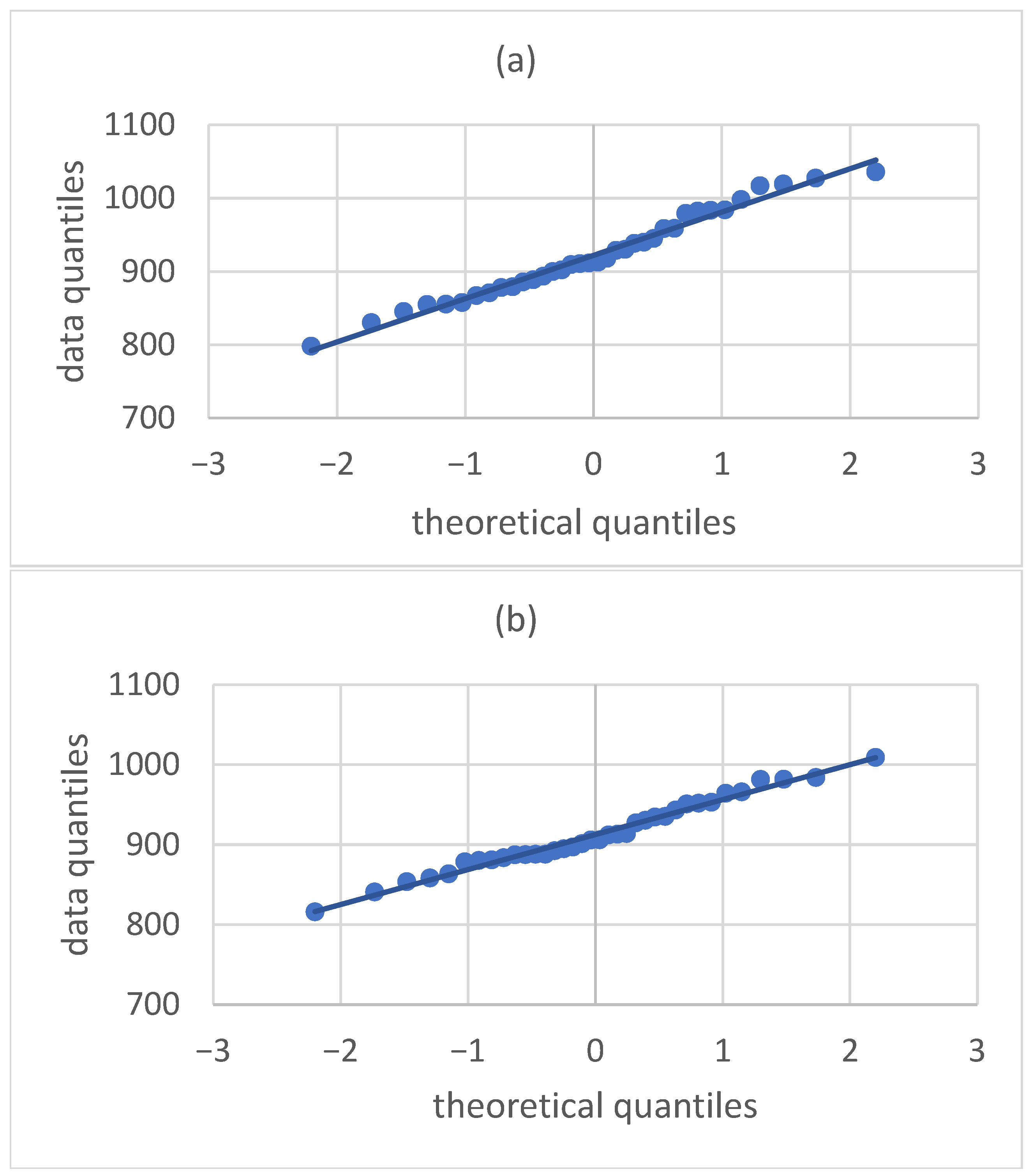
The data distributions in both samples (variants) have the characteristics of a normal distribution, as confirmed by both the high
p-values significantly exceeding the assumed significance level of α = 0.05 (
Table 3) and the arrangement of points on the Q-Q plot, which are arranged along a straight line. Therefore, there is no basis for rejecting the null hypothesis H0, which assumes that the data are normally distributed in the variants studied.
Levene’s test—conclusion.
The
p-value for Levene’s test (
Table 4) is 0.09388 and is greater than 0.05. Therefore, there are no grounds for rejecting the null hypothesis. This means that at a significance level of 0.05, we cannot conclude that the variances in both measurement series are significantly different. Furthermore, the F-statistic value falls within the acceptance range.
Table 4.
Levene test results for a series of mass measurements for the 0% and 5% variants.
Table 4.
Levene test results for a series of mass measurements for the 0% and 5% variants.
| F | Statistical Acceptance Range F | p-Value |
|---|
| 2.884 | [0:3.9778] | 0.094 |
To confirm or reject the H0 hypothesis of no significant difference between the variants under study, a two-sample Student’s
t-test was performed (under the assumptions) at a significance level of α = 0.05. The results of the test are presented in
Table 5.
Student’s t-test—conclusion.
The values presented in
Table 5 indicate that the null hypothesis H0 about the absence of differences between the two data sets cannot be rejected. This is confirmed by the high
p-value and the T-statistic, and the difference in means falling within the acceptance ranges.
Table 5.
Results of the two-sample Student’s t-test for weight measurements for the 0% and 5% variants.
Table 5.
Results of the two-sample Student’s t-test for weight measurements for the 0% and 5% variants.
| p-Value | T | Statistical Acceptance Range T | Difference in Averages | Area of Acceptance of the Difference in Means |
|---|
| 0.4444 | 0.7691 | [−1.99:1.99] | 9.47 | [−24.55:24.55] |
- II.
Proper analysis
During the experiment, two measurements of the weight loss of the sample set were taken. Raw data for sample weight loss measurements for both variants are provided in
Tables S2 and S3, Supplementary Materials.
Checking for outliers—Tukey’s Fences test—conclusion.
Comparative analyses were performed on relative percentage values of weight loss. Tukey’s Fences test was performed to determine outliers for each series of percentage weight loss. For the 0% and 5% variants, outliers occurred for the series from 1 March 2022 (2 values marked in red in
Table S3, Suplementary Materials). These values were removed from further comparative analyses.
Verification of assumptions about the normal distribution of weight loss data—conclusion.
The Shapiro–Wilk test was also performed for individual series, and the summary results are presented in
Table 6. All series are consistent with the normal distribution, which is confirmed primarily by high
p-values significantly exceeding the assumed significance level of α = 0.05.
Table 6.
Shapiro–Wilk test parameters for percentage weight loss for variants with 0% and 5% resin content.
Table 6.
Shapiro–Wilk test parameters for percentage weight loss for variants with 0% and 5% resin content.
| Test Parameter | 0% (1 March 2022) | 0% (27 March 2023) | 5% (1 March 2022) | 5% (27 March 2023) |
|---|
| p-value | 0.9382 | 0.9651 | 0.6138 | 0.09339 |
| W | 0.9863 | 0.9885 | 0.9751 | 0.9484 |
| Count (n) | 34 | 36 | 34 | 36 |
| ) | 0.941 | 1.6917 | 0.9307 | 0.9062 |
| Median | 0.942 | 1.7425 | 0.9055 | 0.898 |
| Sample standard deviation (s) | 0.1738 | 0.3677 | 0.1558 | 0.4333 |
| Skewness coefficient S | 0.01027 | −0.2796 | 0.514 | 0.3026 |
| Kurtosis K | 0.4426 | 0.0899 | 0.77 | −0.9389 |
ANOVA test assumptions.
The null hypothesis of the one-way ANOVA variance test assumes that the mean values in all groups are equal. The significance level of the test was α = 0.05. For ease of analysis, the following measurement series designations were adopted:
x1—series for the 0% variant from 2022.
x2—series for the 0% variant from 2023.
x3—series for the 5% variant from 2022.
x4—series for the 5% variant from 2023.
ANOVA test conclusion.
The calculated p-value is 3.33 × 10⁻¹⁶ and strongly supports the alternative hypothesis (H1), i.e., that the means in some series differ significantly. The F statistic is 54.38, which is significantly higher than the critical value (2.6712) at a significance level of 0.05. This means that the test result is outside the acceptance region of the null hypothesis, which strengthens the conclusion to reject it. The η2 index is 0.55, which means that 55% of the variability in the data can be attributed to differences between groups.
The results of the post hoc Tukey HSD/Tukey–Kramer test (
Table 7 and
Table 8) indicate that there are statistically significant differences between the following pairs of groups:
Table 7.
Results of the Tukey HSD/Tukey–Kramer post hoc test.
Table 7.
Results of the Tukey HSD/Tukey–Kramer post hoc test.
| Pairs | Absolute Values of Mean Differences | Standard Error of Differences SE | Tukey HSD Q Test Statistics | p-Value |
|---|
| x1–x2 | 0.7507 | 0.05248 | 14.3027 | 7.88 × 10⁻¹¹ |
| x1–x3 | 0.01026 | 0.05323 | 0.1928 | 0.9991 |
| x1–x4 | 0.03478 | 0.05248 | 0.6626 | 0.9658 |
| x2–x3 | 0.7609 | 0.05248 | 14.4983 | 7.88 × 10⁻¹¹ |
| x2–x4 | 0.7854 | 0.05173 | 15.1839 | 7.88 × 10⁻¹¹ |
| x3–x4 | 0.02451 | 0.05248 | 0.4671 | 0.9875 |
Table 8.
Comparison matrix of measurement series for absolute values of mean differences.
Table 8.
Comparison matrix of measurement series for absolute values of mean differences.
| Seria | x2 | x3 | x4 |
|---|
| x1 | 0.75 | 0.01 | 0.035 |
| x2 | 0 | 0.76 | 0.79 |
| x3 | 0.76 | 0 | 0.025 |
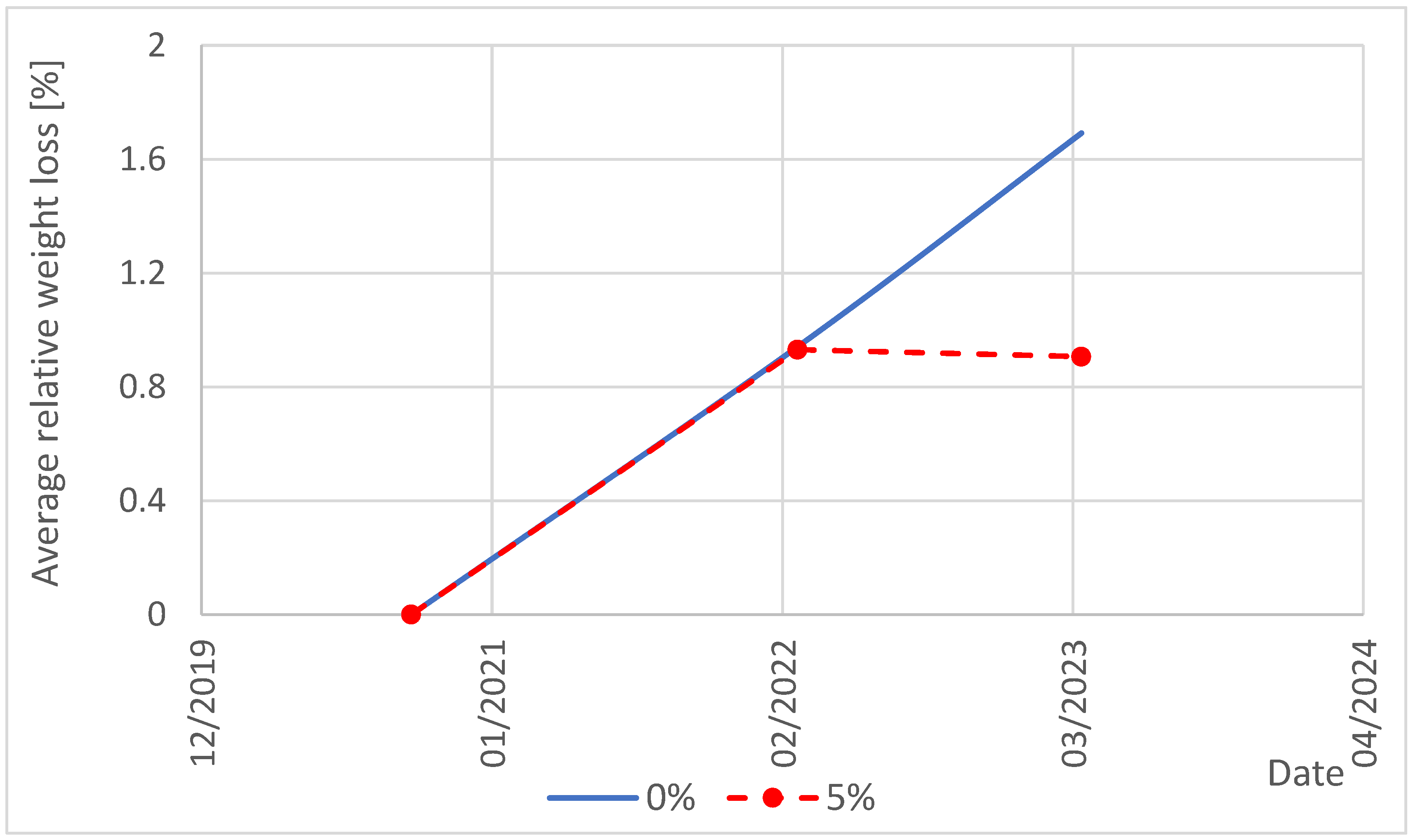
Statistically significant differences for series x1 and x2, which determine weight loss for the 0% variant, indicate that the process of weight loss increases over time. The average for series x2 is almost 80% higher than the average for series x1. The corrosion process for the 0% variant has not been stopped, as clearly illustrated in
Figure 2. The lack of differences between series x1 and x3 (measurements for both variants taken in 2022) indicates that in the initial phase of corrosion, the thin outer layer was affected, and no effect of the addition of water-based resin was observed. Statistically significant differences between series x2 and x4 (measurements taken for both variants in 2023) indicate that the corrosion process does not proceed in the same way. For the 5% variant, both series x3 and x4 do not differ statistically, which indicates a slowdown in the corrosion process. The measurement in 2023 was taken after 12 months, and the mass loss is almost the same as in the initial period (the average for series x4 is slightly lower than for series x3). This process is also well illustrated in
Figure 2, which shows that the average relative mass loss for the 5% variant does not change between the measurements in 2022 and 2023.
In summary, the ANOVA test showed statistically significant differences between the mean values in some series. The results of Tukey’s test specify which series differ from each other. A low p-value (<0.05) and a high Q-statistic indicate that these differences are significant for the interpretation of the results. Statistical tests confirmed that the addition of 5% water-soluble resin slowed down the sulfate corrosion process compared to the variant without this additive.
3.2. Short-Term Testing—Mass Loss and Chemical and Surface Analysis of Samples
An additional test to confirm the effectiveness of epoxy resins as a means of inhibiting sulfate corrosion involved placing samples made of standard mortar with added epoxy resin in a sulfuric acid solution with a pH of 2. These samples were identical to those used in the experiment to test the progress of carbonation. They were stored in acid for 6 months, then dried and weighed. Next, using a steel brush, the corroded layer of mortar was carefully removed, and the samples were weighed again. The difference in mass is the measure of this experiment. The results are presented in
Table 9.
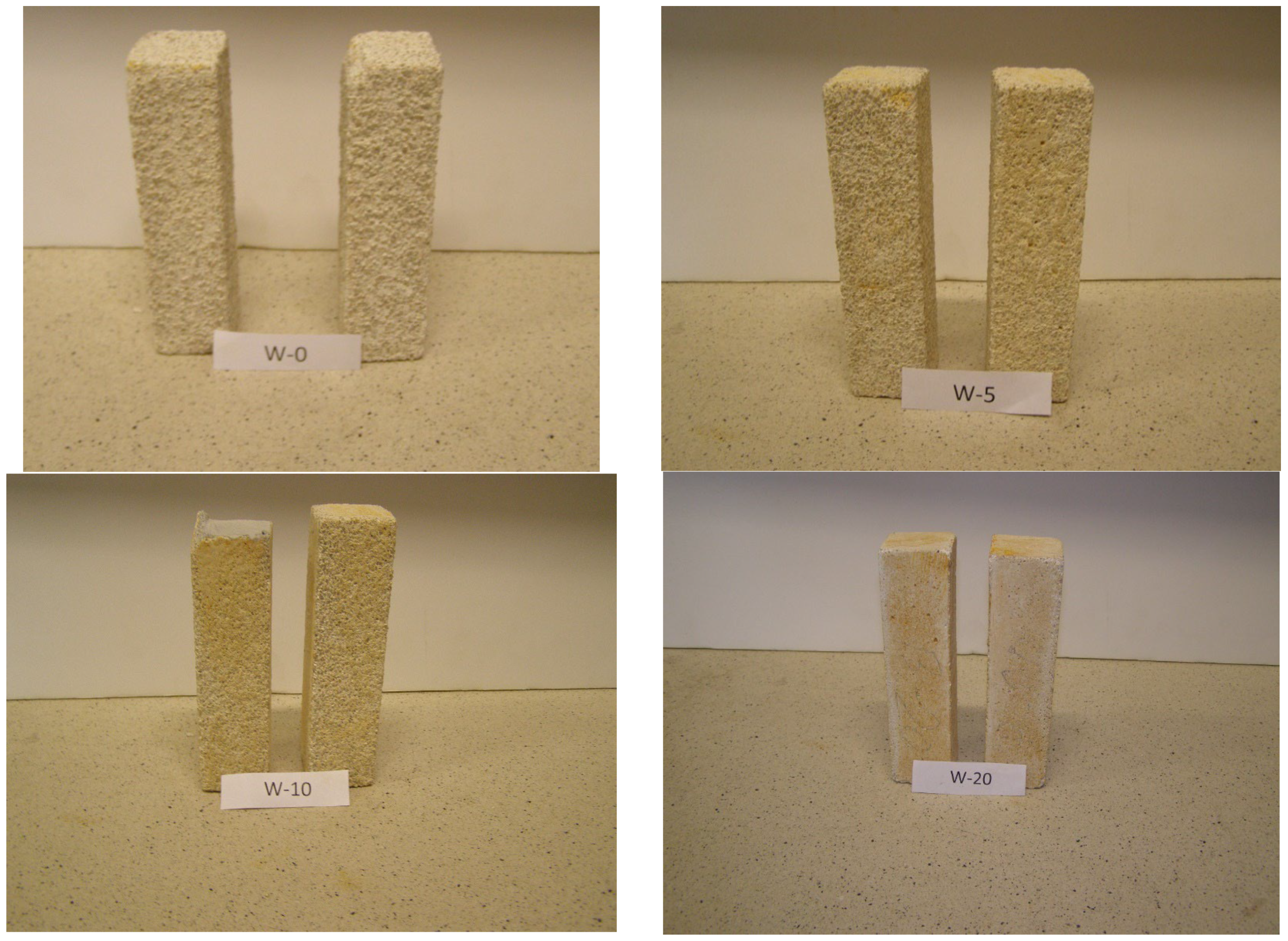
An analysis of the results shown in the column presenting average values clearly shows that as the epoxy resin content in the mortar increases, so does its resistance to sulfuric acid. Samples with 20% resin content showed minimal weight loss, indicating their high resistance to chemical degradation, almost eliminating the process of sulfate corrosion. It can therefore be concluded that the use of epoxy resins as an admixture in concrete can significantly increase its durability in chemically aggressive environments. Samples with lower resin content (5% and 10%) also showed increased resistance compared to the reference sample, but not as effective as samples with 20% content. The photo below (
Figure 3) illustrates the degree of damage to the surface of the samples after the experiment, clearly showing the differences in the degree of degradation depending on the epoxy resin content.
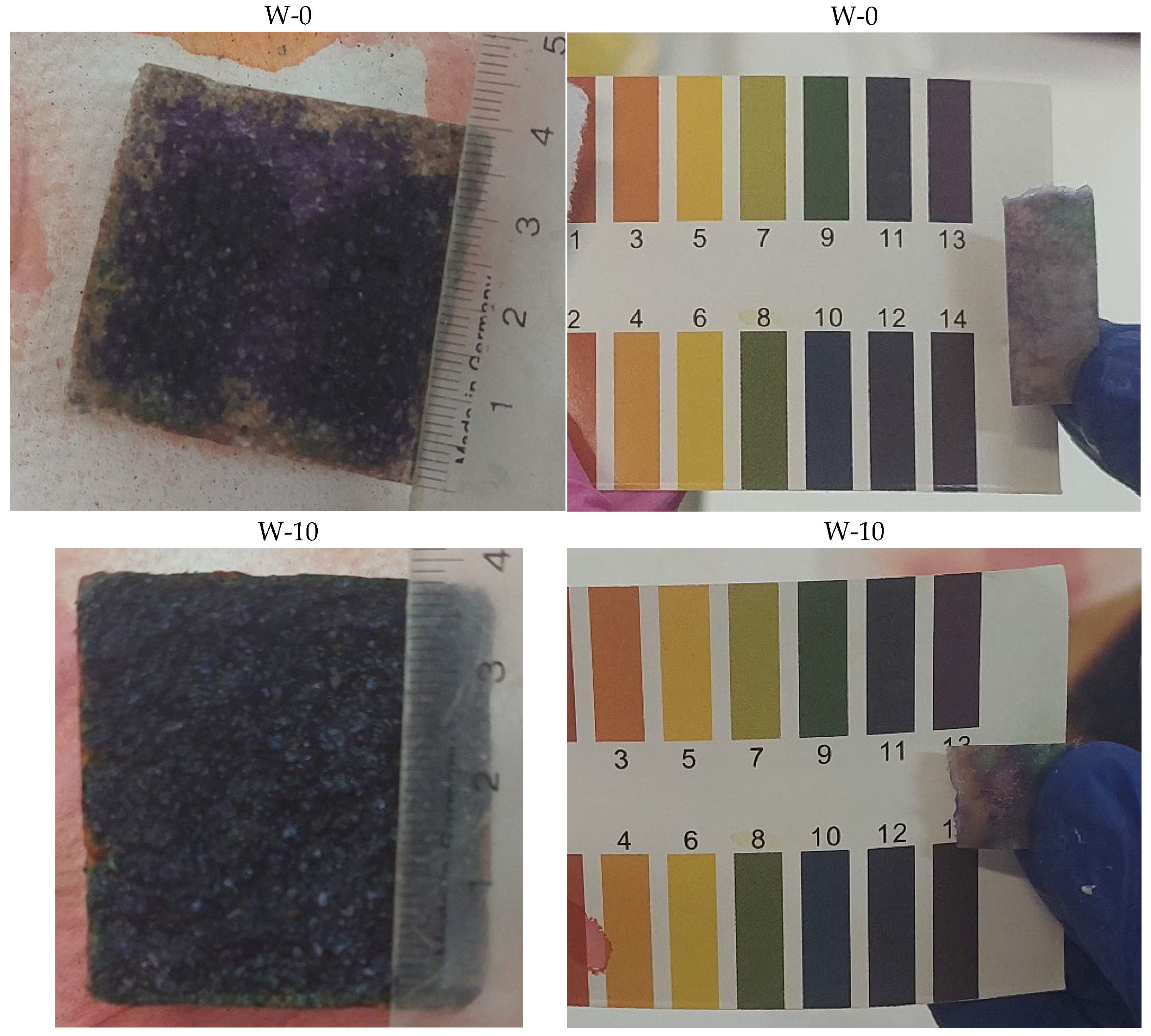
In order to determine the degree of acid penetration into the cementitious material, pH tests were carried out at various depths of the samples. Illustrative images of the samples are shown in
Figure 4.
Based on the pH results of concrete samples (
Table 10) with different resin contents (W-0, W-5, W-10, W-20) that were exposed to sulfuric acid with a pH of 2 for a period of 6 months, significant differences in their chemical resistance can be observed. In the case of sample W-0, which did not contain resin, the pH in the surface layer (up to 0.5 cm) was 5–6, which indicates significant acid penetration into the concrete structure. At greater depths (above 0.5 cm), the pH was 9, which indicates that the core of the sample remained alkaline, but also that the acid penetrated relatively deeply. In sample W-5, containing 5% resin, the zone with an acidic pH (5–6) was limited to a depth of only 0.2 cm, which means that the resin effectively increased the concrete’s resistance to acid penetration. In deeper layers, the pH was 9–11, suggesting that the alkalinity of the structure was better preserved than in the sample without resin. Sample W-10, containing 10% resin, showed even greater resistance, as the zone with a pH of 5–6 was limited to a layer 0.1 cm deep, and below this depth the pH was 13, indicating excellent protection of the alkalinity of the concrete. Sample W-20, with 20% resin content, showed the highest resistance, as the pH in the surface layer was 9, and at a depth greater than 0.1 cm, it reached a value of 13, which indicates minimal acid penetration and preservation of the strongly alkaline core of the concrete. Based on these results, it can be concluded that an increase in the resin content of concrete significantly increases its resistance to chemical degradation in an acidic environment.
3.3. Chemical Composition of Samples (EDS Analysis)
The use of EDS spectroscopy allowed for the examination of the elemental composition of samples after exposure to sulfuric acid.
For sample W-0 (without resin additive), EDS analysis (
Table 11) showed that oxygen and calcium have the highest share, which is characteristic of concrete, whose basic components are calcium hydroxide (portlandite) and calcium carbonate (calcite). The presence of sulfur at a level of 12.06% indicates an intense reaction of sulfuric acid with concrete, resulting in the formation of gypsum (CaSO
4·2H
2O)—a typical product of the reaction of sulfuric acid with calcium contained in cement. The high sulfur content suggests that the sulfate corrosion process is progressing intensively, leading to weakening of the concrete structure through the formation of gypsum and ettringite (both compounds tend to expand, causing microcracks and disintegration of the concrete matrix). The silicon (Si) content of 3.87% suggests the presence of quartz (SiO
2) or residues of incompletely hydrated cement grains. Silicon does not directly participate in the acid corrosion process, but its presence is important from the point of view of the mechanical strength of concrete.
In the case of sample W-10 (with 10% resin added), significant changes in the elemental composition were observed (
Table 12). The increased carbon (C) content of 6.05% indicates the presence of epoxy resin in the concrete structure. Epoxy resin is rich in carbon, which confirms its presence and its role in protecting concrete from sulfuric acid. The carbon content comes mainly from the polymer matrix of the resin. The reduced sulfur (S) content compared to the reference sample suggests that the addition of resin limits the penetration of sulfuric acid into the concrete, leading to fewer reaction products such as gypsum and ettringite. The resin forms a protective barrier, reducing the number of pores through which aggressive sulfate ions could penetrate. The high calcium (Ca) content still suggests the presence of portlandite and calcite, but their role in protecting the concrete structure is partially reduced by the presence of the resin.
In sample W-20 (with 20% resin added), the results indicate even more favorable protective effects (
Table 13). The sulfur content dropped to 8.52%, which means that the 20% resin additive protects the concrete even more effectively against sulfuric acid penetration. The decrease in sulfur content means fewer corrosion products, such as gypsum and ettringite, which translates into better durability of concrete in aggressive environments. The carbon (C) content of 6.05% confirms the presence of epoxy resin in an even higher concentration than in sample W-10, suggesting that a higher resin addition provides better protection. The increased amount of resin leads to more effective insulation of concrete from aggressive external factors. The significant silicon (Si) content of 17.92% suggests that the resin not only reduces corrosion but also changes the structure of the cement matrix. The presence of silica in such large quantities may indicate that the internal structure of the concrete remains intact, confirming the effectiveness of the protection.
EDS analysis provides key information about the processes occurring in concrete under the influence of sulfuric acid. Reference sample W-0 shows severe sulfate corrosion, which is confirmed by the high content of sulfur and chemical reaction products such as gypsum and ettringite. The use of epoxy resin in samples W-10 and W-20 effectively limited acid penetration and reduced the amount of sulfur, indicating fewer corrosion products. This interpretation is consistent with the pH penetration profiles, which show a shallower acid-affected zone with increasing resin dosage. The concurrent decrease of sulfur signal in EDS in the near-surface region supports the conclusion that resin modification reduces the ingress of aggressive species and/or slows down sulfur-related reaction product formation. At the same time, the higher carbon contribution observed in the resin-modified mixes is consistent with the presence of an organic (polymer) phase within the matrix. It should be noted that EDS provides local, semi-quantitative elemental information; therefore, these findings are presented as supportive evidence aligned with the pH profiles and mass-loss trends rather than as a direct identification of polymer distribution.