
Article

Enhancing Li-S Battery Kinetics via Cation-Engineered Al3+/Fe3+-Substituted Co3O4 Spinels
1
College of Electromechanical Engineering, Qingdao University of Science and Technology, Qingdao 266061, China
2
School of Physics, Shandong University, Jinan 250100, China
3
Institute of Physics, Chinese Academy of Sciences, Beijing 100190, China
*
Authors to whom correspondence should be addressed.
Materials 2026, 19(2), 326; https://doi.org/10.3390/ma19020326
Submission received: 3 December 2025 / Revised: 7 January 2026 / Accepted: 9 January 2026 / Published: 13 January 2026
(This article belongs to the Section Energy Materials)

Abstract

Lithium–sulfur (Li-S) batteries promise high energy density and low cost but are hindered by polysulfide shuttling, sluggish redox kinetics, poor sulfur conductivity, and lithium dendrite formation. Here, a targeted cation-substitution strategy is applied to Co3O4 spinels by replacing octahedral Co3+ sites with trivalent Al3+ or Fe3+, generating Al2CoO4 and Fe2CoO4 with exclusively tetrahedral Co2+ sites. Structural characterizations confirm the reconstructed cationic environments, and electrochemical analyses show that both substituted spinels surpass pristine Co3O4 in LiPS adsorption and catalytic activity, with Al2CoO4 delivering the strongest LiPS binding, fastest Li+ transport, and most efficient redox conversion. As a result, Li-S cells equipped with Al2CoO4-modified separators exhibit an initial capacity of 1327.5 mAh g−1 at 0.1C, maintain 883.3 mAh g−1 after 200 cycles, and deliver 958.6 mAh g−1 at 1C with an ultralow decay rate of 0.034% per cycle over 1000 cycles. These findings demonstrate that selective Co-site substitution effectively tailors spinel chemistry to boost polysulfide conversion kinetics, ion transport, and long-term cycling stability in high-performance Li-S batteries.

1. Introduction

The rapid growth of portable electronics, electric vehicles, and grid-scale energy storage has intensified the demand for next-generation rechargeable batteries featuring higher energy density and lower cost [1,2]. Among the many candidates, lithium–sulfur (Li-S) batteries have attracted extensive attention due to their ultrahigh theoretical energy density (2600 Wh kg−1), natural abundance of sulfur, and environmental friendliness [3,4,5,6]. Despite these advantages, their practical deployment is severely constrained by the intrinsic insulating nature of sulfur and Li2S, uncontrolled lithium dendrite formation, and the dissolution–migration of lithium polysulfides (LiPSs) that induces the notorious shuttle effect [7]. These challenges become even more critical at high sulfur loading and low electrolyte/sulfur (E/S) ratios, where elevated concentrations of soluble LiPSs trigger rapid capacity fading and poor sulfur utilization [8,9,10].
Functional separator engineering has emerged as an effective approach to overcome these limitations by regulating LiPS transport and promoting their redox conversion. The separator must maintain electronic insulation while allowing efficient Li+ migration, and incorporating functional interlayers—such as carbon materials, metal oxides, or conductive polymers—has proven effective in trapping LiPSs and accelerating their chemical transformation [11,12,13,14,15]. Catalytically active interlayers are particularly advantageous, as they facilitate the rapid conversion of long-chain LiPSs into insoluble Li2S2/Li2S, thereby improving redox kinetics, reactivating electrically isolated sulfur species, and supporting high areal capacities under practical operating conditions [16,17].
Among various catalytic candidates, metal oxides stand out due to their strong polar interactions with LiPSs, abundant Lewis acidic sites, and defect-rich surfaces. Their high mechanical and packing density also benefits the development of high-volumetric-energy Li-S systems. Bimetallic oxides, in particular, offer cooperative adsorption–catalysis effects and multiple accessible active sites, enabling excellent rate capability and long-term cycling. Representative examples, including NiCo2O4, MnO-based materials, and MnO2 composites, have demonstrated substantial improvements in LiPS conversion kinetics and the suppression of shuttle behavior [18,19,20,21,22]. Spinel Co3O4 is especially promising owing to its well-defined cation arrangement, environmental compatibility, and intrinsic catalytic activity [23]. Its AB2O4 structure consists of tetrahedral Co2+ and octahedral Co3+ sites, whose distinct coordination environments critically influence its adsorption characteristics and catalytic pathways in electrochemical reactions [24,25,26,27,28,29,30]. Importantly, the catalytic properties of Co3O4 can be deliberately tuned through selective substitution of foreign metal cations, which modulates its electronic structure, defect configuration, and interaction strength with reaction intermediates [31,32,33,34]. This site-specific tuning offers a powerful strategy for designing high-efficiency catalytic hosts tailored for Li-S chemistry.
In this work, we realize the selective substitution of trivalent metal cations (Al3+, Fe3+) into the octahedral Co3+ sites of spinel Co3O4 through a sol–gel route, forming Al2CoO4 and Fe2CoO4 with reconfigured crystal frameworks. Using Al2CoO4 as a functional separator modification layer, we systematically evaluate its LiPS anchoring capability, catalytic conversion efficiency, Li+ transport behavior, and electrochemical performance. The findings demonstrate that site-tailored spinel oxides can serve as high-performance multifunctional separator coatings, providing new insights into catalyst design for high-energy-density Li-S batteries.

2. Experimental

2.1. Synthesis of Co3O4, Al2CoO4, and Fe2CoO4

Co3O4 and its Al/Fe-substituted derivatives were synthesized via a sol–gel method. Typically, 16.5 mmol Co(NO3)2·6H2O, 33.75 mmol ammonium citrate tribasic (ACT), and 24 mL ethylene glycol (EG) were dissolved in 25 mL deionized water (DI) under stirring to form a clear solution. Citric acid was subsequently introduced as a chelating agent to stabilize the metal–ligand complex and promote homogeneous gel formation. The resulting sol was heated to 120 °C to induce dehydration and gelation. After drying, the obtained precursor was calcined in air at 800 °C for 2 h at a ramp rate of 5 °C min−1, yielding Co3O4.
For Al2CoO4, Co(NO3)2·6H2O was partially replaced by Al(NO3)3·9H2O at a molar ratio of 1:2, while Fe2CoO4 was obtained by substituting Co(NO3)2·6H2O with FeCl3 at the same ratio. All final oxides were thoroughly ground and stored for subsequent use.

2.2. Fabrication of Co3O4-, Al2CoO4-, and Fe2CoO4-Modified Separators

For separator modification, the respective oxide powders were mixed with conductive carbon black and polyvinylidene fluoride (PVDF) at a mass ratio of 7:2:1. The mixture was manually ground for 30 min, followed by the addition of N-methyl-2-pyrrolidone (NMP) to form a homogeneous slurry. The slurry was coated uniformly onto commercial polypropylene (PP) separators using a doctor blade and dried under vacuum at 65 °C overnight. The resulting films were punched into 19 mm discs to prepare the modified separators.

2.3. Preparation of S/CNT Cathode

The sulfur/carbon nanotube (S/CNT) composite was prepared via a melt-diffusion method. CNTs and sulfur were mixed at a mass ratio of 1:2, followed by the addition of carbon disulfide (CS2). The mixture was ultrasonicated at 70 °C until viscous and subsequently dried at 70 °C for 12 h. The dried powder was then heated under argon at 155 °C for 10 h to infuse sulfur, followed by an additional treatment at 200 °C for 2 h. After natural cooling, the S/CNT composite was obtained.
For cathode fabrication, the S/CNT composite was blended with carbon black and PVDF at a mass ratio of 7:2:1 and ground for 30 min. NMP was added to form a uniform slurry, which was cast onto aluminum foil and dried under vacuum at 65 °C overnight. The electrodes were punched into 16 mm discs for cell assembly.

2.4. Assembly of Cells

Coin cells (CR2032-type) were assembled for electrochemical evaluation within an Ar-filled glovebox. Prior to assembly, the cathode was prepared by depositing 15 µL of 0.2 M Li2S6 solution onto its surface, followed by complete solvent evaporation. The cell configuration consisted of the Li2S6-loaded cathode, a lithium metal foil counter electrode, a Celgard 2400 polypropylene separator (Charlotte, NC, USA), and an electrolyte comprising 1 M LiTFSI in a 1:1 (v/v) mixture of 1,3-Dioxolane (DOL) and 1,2-Dimethoxyethane (DME) solution with 2 wt%LiNO3 additive. The electrolyte amount was controlled to maintain an electrolyte-to-sulfur (E/S) ratio of 30 µL mg−1.

2.5. Lithium Polysulfide Adsorption Test

A 5 mM Li2S6 solution was prepared by dissolving Li2S and sulfur in a molar ratio of 1:5 in DOL/DME (1:1 v/v) under argon for 24 h. Subsequently, 4 mL of this solution was added to vials containing 20 mg of Co3O4, Al2CoO4, or Fe2CoO4. After standing for 12 h, digital photographs were taken, and the supernatants were collected for UV-Vis spectroscopy to evaluate polysulfide adsorption capacity.

2.6. Polysulfide Diffusion Test

An H-type glass cell was used to examine the polysulfide diffusion-blocking capability of the modified separators. The separator was clamped between the two chambers, with one chamber filled with 5 mM Li2S6 solution and the other with pure DOL/DME solvent (1:1 v/v). The color changes in both chambers were photographed after 10 min, 12 h, and 24 h.

2.7. Lithium Sulfide (Li2S) Deposition Test

Li2S nucleation behavior was assessed in coin cells assembled with an S/CNT working electrode, lithium metal counter electrode, and the modified separator. A total of 40 μL electrolyte was added: 20 μL blank electrolyte on the anode side and 20 μL of 0.5 M Li2S8-containing electrolyte on the cathode side. The cell was discharged galvanostatically at 0.112 mA to 2.15 V to ensure a consistent initial state dominated by short-chain polysulfides (e.g., Li2S4), followed by a potentiostatic discharge at 2.05 V for 50,000 s to specifically investigate the kinetics of Li2S nucleation and growth under a controlled potential.

2.8. Electrochemical Testing

Galvanostatic charge–discharge tests (GCD) are carried out in the potential range of 1.7–2.8 V to evaluate the specific capacity and cycling stability of batteries on a LAND CT2001A system. Cyclic voltammetry (CV) measurements are performed over the potential range of 1.7 to 2.8 V at scan rates of 0.1–0.5 mV s−1 to investigate the reversibility of the electrode reaction. Electrochemical impedance spectroscopy tests (EIS) are conducted in the frequency range of 0.01 Hz to 105 kHz with an AC amplitude of 5 mV to characterize the charge transfer kinetics.

2.9. Material Characterization

The crystal structures of the materials were analyzed by X-ray diffraction (XRD) on a Rigaku Ultima IV diffractometer with Cu K radiation (λ = 1.5406 Å), operating at 40 kV and 40 mA. Data were collected in the 2θ range of 20–80° with a scanning rate of 10°/min. The sample morphologies were examined using scanning electron microscopy (SEM, Hitachi Regulus 8100, Hitachi High-Tech Corporation, Tokyo, Japan) and transmission electron microscopy (TEM, FEI Talos F200x, Thermo Fisher Scientific, Brno, Czech Republic). Surface chemical states were investigated by X-ray photoelectron spectroscopy (XPS) on a Thermo Scientific K-Alpha spectrometer (Thermo Fisher Scientific, East Grinstead, UK) with a monochromatic Al Kα X-ray source. The adsorption of Li2S6 was evaluated by monitoring the UV-Vis absorption spectra of the DOL/DME solutions using a Persee TU-1810 spectrophotometer (Persee, Beijing, China).

3. Results and Discussion

3.1. Phase Analysis

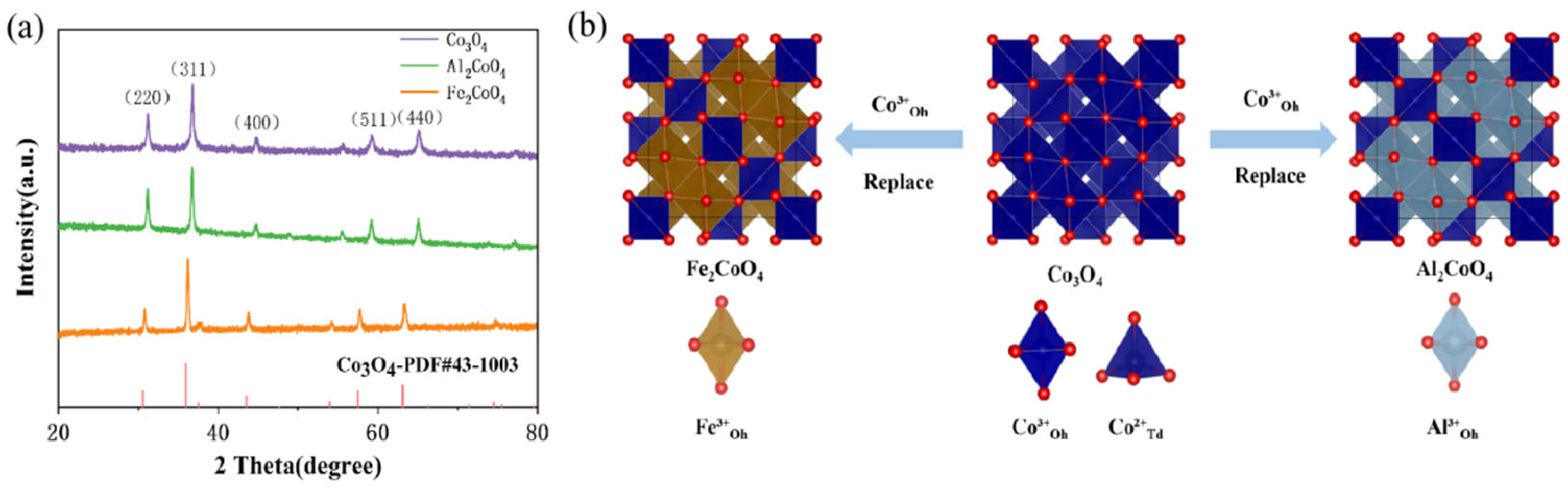
XRD was employed to investigate the influence of Al3+ and Fe3+ substitution at Co3+ sites on the crystalline phase of Co3O4. As shown in Figure 1a, all diffraction peaks of Co3O4, Al2CoO4, and Fe2CoO4 can be unambiguously indexed to the standard spinel phase (PDF# 43-1003), indicating that the introduction of Al3+ or Fe3+ does not alter the parent cubic spinel framework. The standard structures for Co3O4, Al2CoO4, and Fe2CoO4 are depicted in Figure 1b. The XRD patterns show that the diffraction peaks of Al2CoO4 almost overlap with those of Co3O4, suggesting negligible lattice contraction due to the similar ionic radii of Al3+ (0.535 Å) and Co3+ (0.545 Å). In contrast, the peaks of Fe2CoO4 exhibit a systematic shift towards lower angles, indicative of a slight lattice expansion originating from the larger ionic radius of Fe3+ (0.645 Å). Nevertheless, this change is uniform, and all diffraction peaks can be unequivocally indexed to a single spinel phase, demonstrating that the substitution is isovalent and does not compromise the overall integrity of the crystal structure.
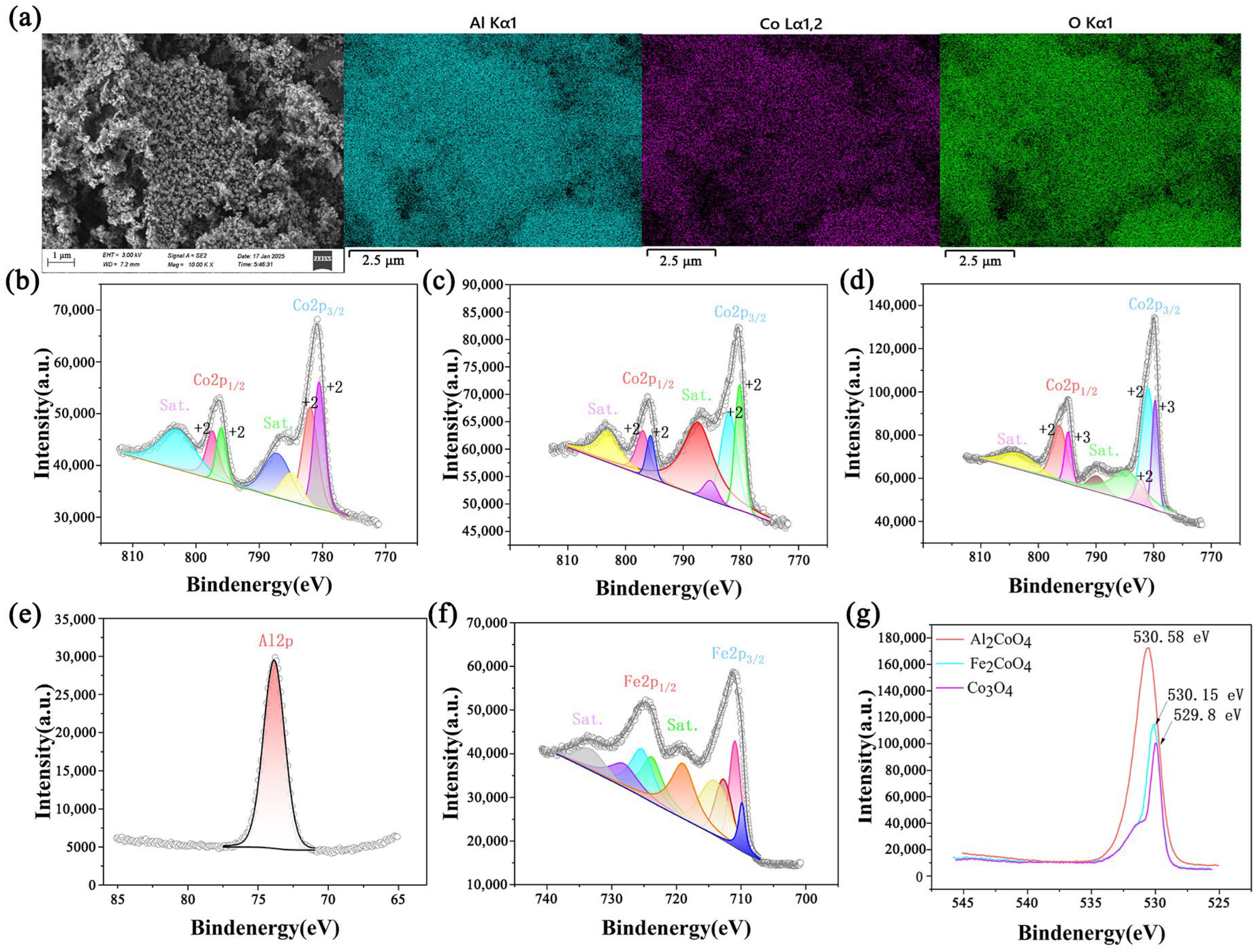
To further elucidate the cation distributions and chemical states, EDS-mapping and XPS analyses were conducted on Al2CoO4 powder. As illustrated in Figure 2a, the Al2CoO4 nanoparticles possess an irregular shape. Furthermore, Al, Co, and O elements are uniformly distributed in Al2CoO4. The Shirley method is used to eliminate interference from inelastic scattering effects. For peak modeling, a Lorentzian–Gaussian (L/G) mixed function with an L/G ratio of 0.3 is adopted for all deconvoluted peaks, a widely accepted standard for Co 2p spectral analysis. The binding energy difference between Co 2p3/2 and Co 2p1/2 is fixed at 15.0 eV (a canonical constraint for cobalt oxides), and the full width at half maximum (FWHM) values of peaks corresponding to the same valence state are constrained to be consistent to guarantee physical meaningfulness. Quantitative analysis results revealed that for Co3O4, Co3+ and Co2+ accounted for 65% and 35% of the total Co species, respectively, which is consistent with its mixed-valence spinel structure. In contrast, only Co2+-related peaks (including main peaks and satellite peaks) were detected in Al2CoO4 and Fe2CoO4, with no observable Co3+ signals (detection limit < 0.5%). This confirms that the octahedral Co3+ sites in the parent Co3O4 were fully substituted by Al3+ or Fe3+, resulting in the exclusive formation of tetrahedral Co2+ configurations in the substituted spinels. The XPS spectra of Co3O4 exhibit the typical Co 2p3/2 and Co 2p1/2 doublets, accompanied by satellite features at 782.2, 785.2, and 789.5 eV. The coexistence of Co2+ and Co3+ is consistent with the canonical mixed-valence nature of spinel Co3O4. In contrast, the Co 2p spectra of Al2CoO4 and Fe2CoO4 show deconvoluted peaks centered at ~780.0, 782.1, 785.5, and 786.5 eV, which align well with the characteristic binding energies of Co2+. No Co3+-related features are detected, demonstrating that Al3+ or Fe3+ substitution fully suppresses the formation of octahedral Co3+, resulting in spinels containing exclusively tetrahedral Co2+ sites. The Al 2p and Fe 2p spectra (Figure 2e,f) further verify the +3 oxidation states of the substituted Al and Fe ions, confirming their stable incorporation into the spinel lattice. In the Al 2p spectrum of Al2CoO4 (Figure 2e), a single peak is observed at a binding energy of 73.88 eV, characteristic of Al3+ in oxide environments [35]. Similarly, the Fe 2p spectrum of Fe2CoO4 (Figure 2f) shows primary peaks for Fe 2p3/2 and Fe 2p1/2 at 710.55 eV and 725.2 eV, respectively, accompanied by distinct satellite peaks. This signature is unequivocally assigned to high-spin Fe3+ [36]. The absence of peaks corresponding to lower oxidation states (e.g., Fe2+ or metallic Fe) confirms the phase-pure incorporation of trivalent cations into the spinel structure. Oxygen chemical-state analysis provides additional insight (Figure 2g), and the O 1s fitting was also performed using the Shirley background subtraction and the Lorentz–Gauss (L/G = 0.3) hybrid function. All spectra show a single symmetrical peak, indicating that only lattice oxygen (O2−) is present in the spinel, with no adsorbed oxygen or hydroxyl groups. The O 1s peak of Co3O4 appears at 529.8 eV, while those of Al2CoO4 and Fe2CoO4 shift to higher binding energies. This shift is attributed to the stronger Co2+-O interaction compared to Co3+-O bonding, which reflects the absence of octahedral Co3+ in the substituted spinels [37]. The combined XRD and XPS results confirm the successful synthesis of three cobalt-based spinels with distinctly different cationic configurations. Co3O4 contains both Co2+ at tetrahedral sites and Co3+ at octahedral sites, consistent with its mixed-valence spinel structure. In contrast, Al2CoO4 and Fe2CoO4 exhibit only tetrahedral Co2+, as the introduced Al3+ or Fe3+ fully replaces the octahedral Co3+. This controllable cation redistribution provides a solid foundation for tuning the electronic structure and interfacial chemistry of the materials.

3.2. Electrochemical Performance Analysis

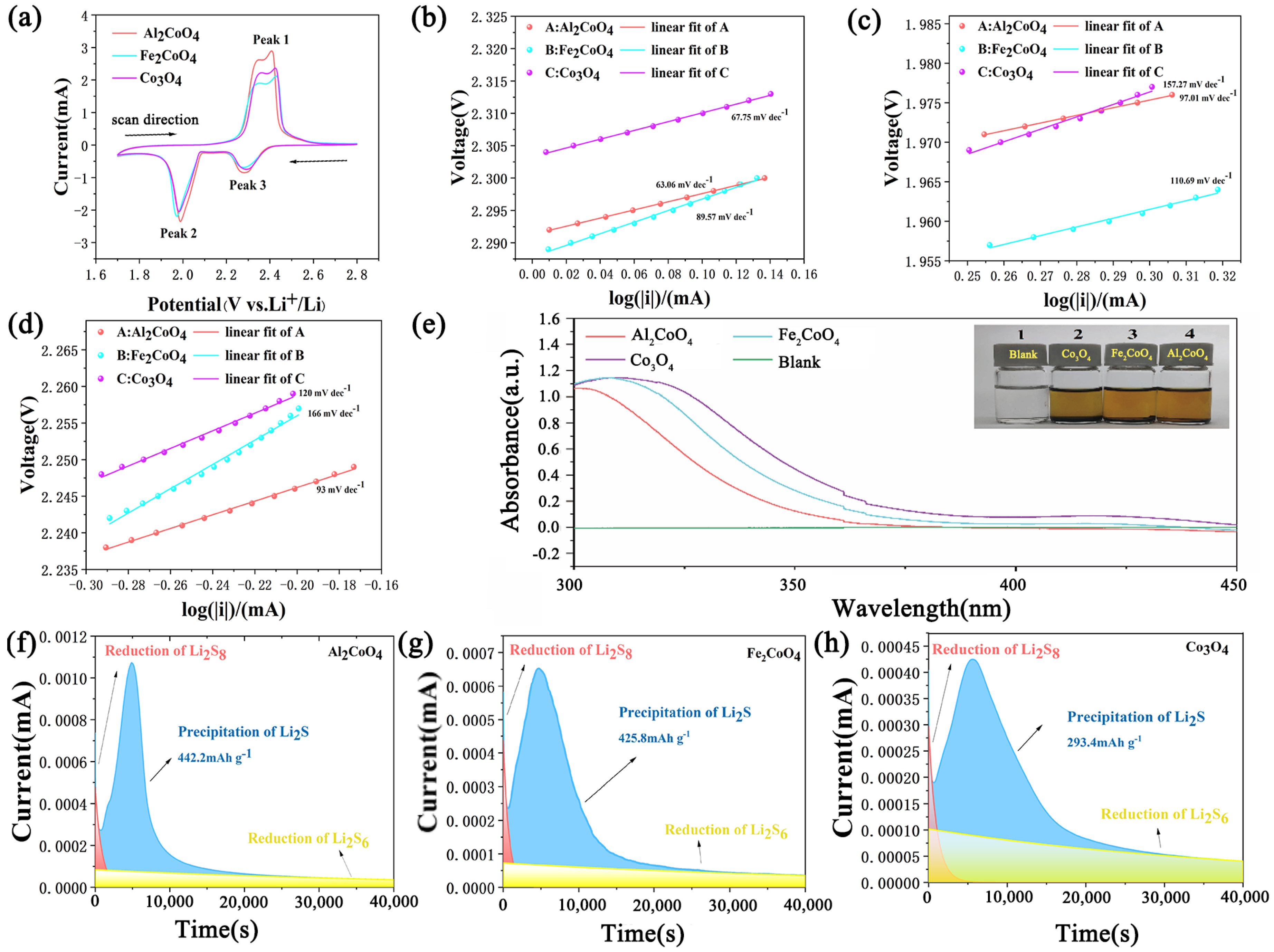
To elucidate the catalytic benefits attributed to tetrahedral Co2+ sites, a comprehensive electrochemical assessment of the three spinel oxides was conducted, as summarized in Figure 3. The CV profiles recorded at 0.1 mV s−1 (Figure 3a) exhibit one oxidation peak and two reduction peaks for all samples, corresponding to the stepwise transformation of S8 to Li2S and its reversible oxidation. The cyclic voltammetry profile reveals characteristic redox processes associated with the sulfur cathode. The oxidation peak at the higher potential (Peak 1) corresponds to the conversion of soluble long-chain polysulfides (Li2S4/Li2S6) to elemental sulfur (S8). During discharge, the primary reduction peak (Peak 3) signifies the reverse reaction, i.e., the reduction of S8 back to soluble long-chain polysulfides (Li2Sn, 4 ≤ n ≤ 8). Subsequently, the reduction peak at the lower potential (Peak 2) is attributed to the solid–liquid reduction, where these soluble polysulfides are further reduced to insoluble solid discharge products, namely Li2S2 and Li2S. The negative shift in Peak 1 for Al2CoO4 indicates that the oxidation of polysulfides (Li2Sn→S8) occurs at a lower overpotential. This is a classic signature of enhanced catalytic activity, meaning the catalyst significantly lowers the energy barrier for this oxidation step, facilitating the reverse reaction during charging. The positive shift and the remarkable increase in the current density of Peak 2 for Al2CoO4 are critically important. The shift suggests a reduced nucleation barrier for the deposition of Li2S. The dramatically higher current intensity signifies much faster kinetics for the conversion of soluble LiPS to insoluble Li2S2/Li2S. This is the core process for effectively trapping polysulfides and suppressing the shuttle effect. The enhanced intensity directly correlates with the higher Li2S deposition capacity measured in our potentiostatic discharge experiments (Figure 3f). The fact that Peak 3 remains relatively unchanged in position across all three materials suggests that the initial reduction of S8 to long-chain LiPS is less sensitive to the specific cation substitution in the spinel structure. The kinetics of this initial dissolution step may be inherently fast or governed by different factors. Notably, Al2CoO4 delivers the highest redox current responses and the smallest potential polarization, indicating accelerated sulfur redox kinetics and improved reaction reversibility. This enhancement suggests that Al2CoO4 effectively promotes the interfacial conversion of lithium polysulfides and facilitates higher sulfur utilization.
To further quantify the kinetic differences, Tafel polarization analysis was conducted (Figure 3b–d). Al2CoO4 consistently exhibits the lowest Tafel slopes among the three materials. For the oxidation process (Peak 1), Al2CoO4 exhibits a lower Tafel slope (63.06 mV dec−1) compared to that of Co3O4 (67.75 mV dec−1), indicating a reduced activation energy barrier for the oxidation of Li2S to S8 and thus accelerated charge transfer kinetics. For the reduction processes, the Tafel slopes corresponding to Peaks 2 and 3 for Al2CoO4 (97.01 and 93 mV dec−1, respectively) are substantially lower than those for Co3O4 (157.27 and 120 mV dec−1). This marked decrease confirms that Al2CoO4 can more effectively catalyze the conversion of lithium polysulfides, substantially enhancing the overall electrocatalytic performance of the cathode, and scalable fabrication of Ni(OH)2/carbon/polypropylene separators for high-performance Li-S batteries [38]. These results correlate well with the CV behavior and collectively demonstrate the strongest electrocatalytic activity of Al2CoO4 toward polysulfide conversion.
The polysulfide affinity of the three materials was further assessed through UV-Vis adsorption tests and separator diffusion experiments. As illustrated in Figure 3e, the Li2S6 solution treated with Al2CoO4 exhibits the most pronounced decrease in absorbance intensity, indicating the strongest adsorption capability. Visual observations further confirm this trend: the Li2S6 solution in contact with Al2CoO4 becomes significantly lighter in color than those exposed to Co3O4 or Fe2CoO4. Such strong adsorption helps suppress polysulfide migration and contributes to stable interfacial chemistry.
Since the conversion from Li2S4 to Li2S involves a challenging liquid-to-solid phase transition, and this step contributes approximately 75% of the total discharge capacity in Li-S batteries, investigating the nucleation and deposition mechanisms of Li2S is crucial for optimizing battery performance and enhancing practical capacity. Therefore, we systematically studied the nucleation and growth processes of solid Li2S on different electrodes using potentiostatic deposition. The assembled cells were first pre-discharged at a low current of 0.112 mA to 2.15 V, a step that converts long-chain polysulfides to Li2S4. Subsequently, the cells were held at 2.05 V for potentiostatic discharge, during which Li2S4 is reduced to Li2S. The discharge process was considered complete when the current became negligible (below 0.01 mA), indicating that all active material had been converted to Li2S (Figure 3f–h). Based on Faraday’s law, the Al2CoO4 electrode exhibits a significantly higher Li2S deposition capacity (442.2 mAh g−1) than Co3O4 (293.4 mAh g−1) and Fe2CoO4, together with a higher nucleation peak current. These observations indicate that Al2CoO4 more efficiently catalyzes the reduction of Li2S4 intermediates and accelerates Li2S precipitation, corroborating its faster sulfur reduction kinetics.
Overall, Al2CoO4 demonstrates a unique combination of fast redox kinetics, efficient Li2S nucleation, and strong polysulfide adsorption, highlighting the crucial role of modulated Co3+ environments in governing catalytic behavior in Li-S batteries.
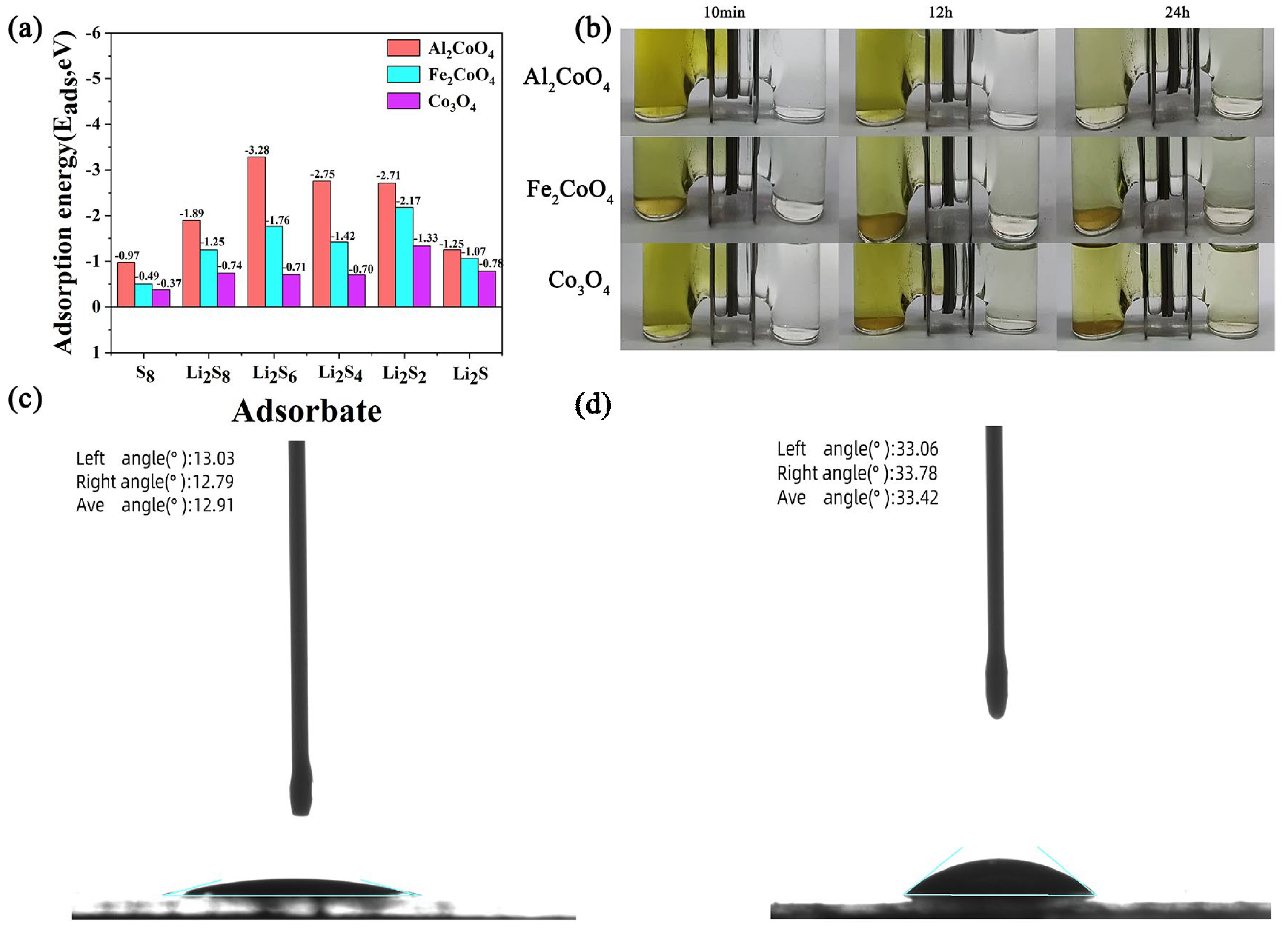
The adsorption behavior of Co3O4, Al2CoO4, and Fe2CoO4 toward lithium polysulfides (LiPS) was further evaluated through density functional theory (DFT) calculations, as shown in Figure 4a. The adsorption energies (Eads) of Li2Sₙ (n = 1, 2, 4, 6, 8) and S8 on Co3O4, Al2CoO4, and Fe2CoO4 were calculated using Equation (1). Al2CoO4 and Fe2CoO4 exhibit markedly larger absolute adsorption energies compared with Co3O4, confirming their stronger LiPS anchoring capability from a theoretical perspective. Specifically, for the critical soluble intermediate Li2S4, the calculated |Eads| values are 2.75 eV for Al2CoO4, 1.42 eV for Fe2CoO4, and 0.7 eV for Co3O4. This enhanced interaction arises from the formation of more stable chemical bonding between LiPS species and the exposed Co2+ sites, effectively suppressing polysulfide migration.
E a d s = E a d s o r b a t e @ a d s o r b e n t E a d s o r b a t e E a d s o r b e n t
where E a d s and E a d s o r b a t e @ a d s o r b e n t are the adsorption energy (eV) and the total energy of the adsorption system (eV), respectively, E a d s o r b a t e is the total energy of isolated adsorbate (eV), and E a d s o r b e n t is the total energy of clean adsorbent (eV).
To further assess the physical blocking effect of the modified separators, Li2S6 diffusion was examined using an H-type electrolytic cell. The left chamber was filled with Li2S6 solution, while the right chamber contained LiPS-free electrolyte. The degree of polysulfide crossover is reflected by the color change in the right chamber. As shown in Figure 4b, the separators modified with Al2CoO4 and Fe2CoO4 exhibit significantly lighter solution color after 12 and 24 h compared with the Co3O4 and pristine separators, indicating markedly stronger suppression of LiPS diffusion. These results highlight the excellent polysulfide-blocking ability of Al2CoO4, providing an important mechanistic basis for designing high-performance Li–S battery separators.
The wettability of the modified separator was also evaluated by contact angle measurements. The electrolyte is a lithium–sulfur electrolyte (1 M LiTFSI in DOL/DME = 1:1 v/v with 2% LiNO3). The Al2CoO4-coated separator exhibits an average contact angle of 12.91° (Figure 4c), substantially lower than that of the commercial PP separator (33.42°, Figure 4d). The cation-engineered Al3+-substituted Co3O4 spinels exhibit smaller contact angles than pristine Co3O4 (12.91° for Al2CoO4 vs. 33.42° for Co3O4), indicating superior electrolyte wettability. Although no LiPS are deliberately added to the initial electrolyte, LiPS intermediates such as Li2S8 and Li2S6 are dynamically generated in the electrolyte during battery operation via the sulfur redox reaction. It has been reported that the solubility of polysulfides in the electrolyte directly governs the interfacial contact and wetting behavior between the electrolyte and the catalyst surface [39,40]. At this point, the good wettability of the initial electrolyte promotes the diffusion of generated LiPS to the catalytically active sites, reducing mass transfer resistance. It synergizes with the intrinsic adsorption-catalytic capacity of the catalyst to accelerate LiPS conversion kinetics. The significantly improved electrolyte affinity is expected to enhance interfacial wetting, reduce interfacial resistance, and facilitate faster Li+ transport within the cell [41].
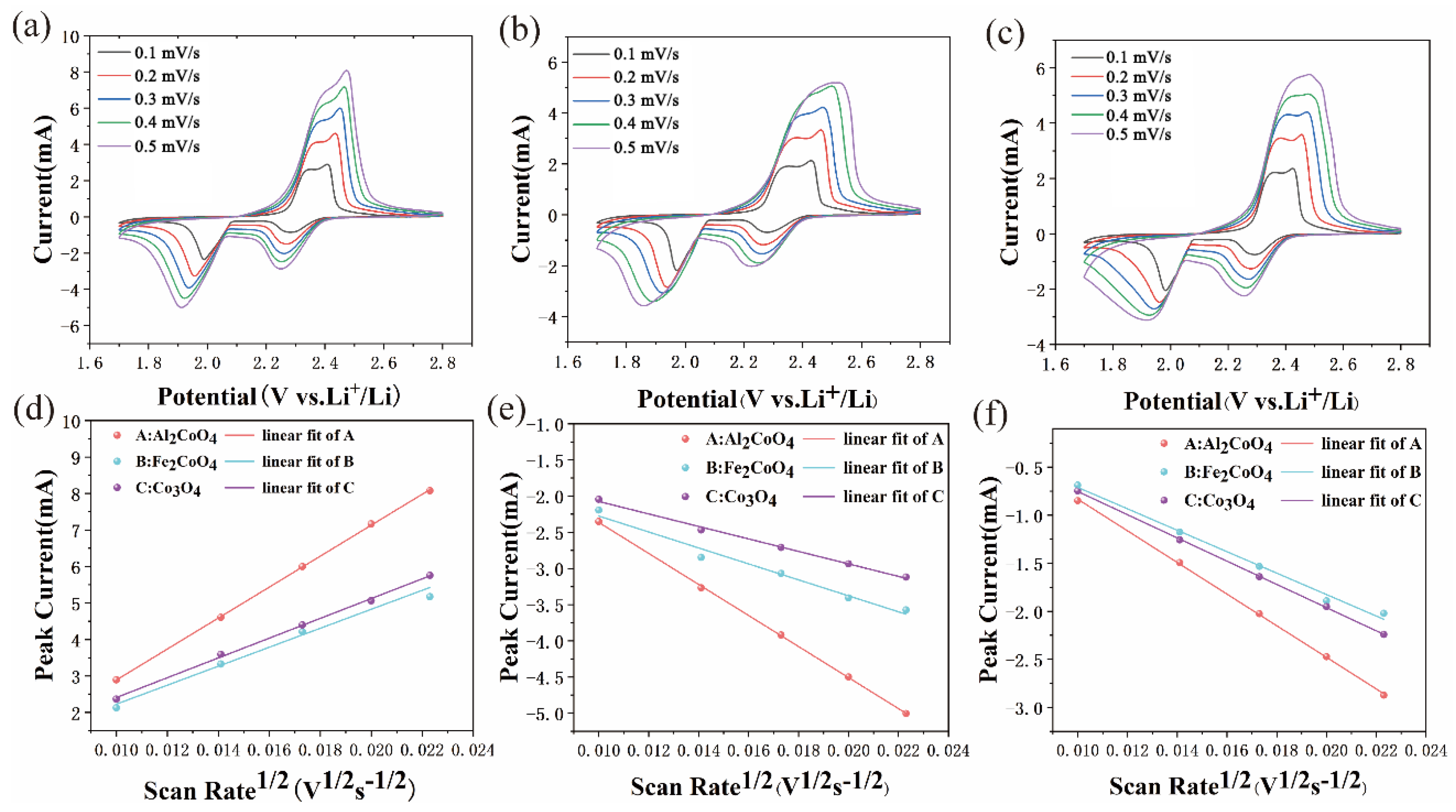
The Li diffusion coefficient ( D L i + ) was calculated from cyclic voltammetry (CV) measurements (Figure 5a–c) using the Randles–Ševčík equation (Equation (2)), and the results are summarized in Table 1. The linear relationship between the peak current and the square root of the scan rate (Figure 5d–f), established by fitting, indicates that Al2CoO4 exhibits the highest D L i + values at all three characteristic redox peaks, corresponding to accelerated Li+ diffusion, enhanced charge/mass transport, and the fastest apparent Li+ mass transport kinetics during the sulfur redox reaction. This result highlights Al2CoO4’s ability to facilitate overall polysulfide conversion and improve electrochemical reaction kinetics. At Peak 1, the D L i + of Al2CoO4 is 2.66 times that of Fe2CoO4 and 2.45 times that of Co3O4. At Peak 2, the D L i + of Al2CoO4 is 3.78 times that of Fe2CoO4 and 6.19 times that of Co3O4. At Peak 3, the D L i + of Al2CoO4 is 2.18 times that of Fe2CoO4 and 1.87 times that of Co3O4. In summary, Al2CoO4 is the most favorable electrode for Li+ diffusion and electrochemical reactions among the three materials, providing kinetic support for its catalytic performance in lithium–sulfur batteries.
I p = ( 2.69 × 10 5 ) n 1.5 D L i + 0.5 C L i v 0.5
where I p is the peak current (A) and ν is the scan rate (V s−1), respectively, n is the number of reacting electrons (taken as 2), A represents the electrode area (cm2), and C L i is the lithium-ion concentration in the electrolyte (1 × 10⁻³ mol cm3).
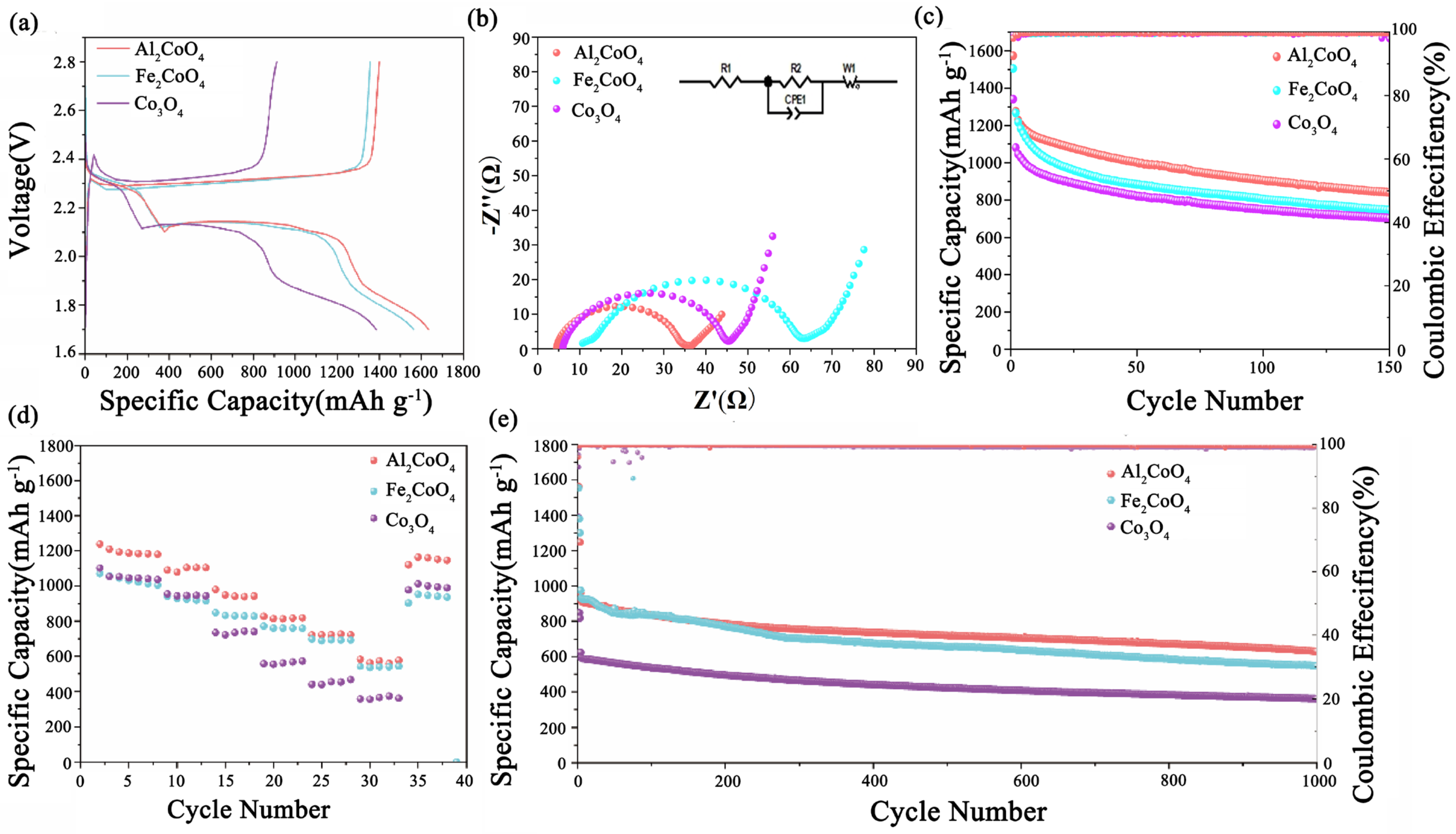
The charge/discharge profiles of Li–S cells with Co3O4-, Fe2CoO4-, and Al2CoO4-modified separators are presented in Figure 6a. All cells display two discharge plateaus and one charge plateau, consistent with the CV results. The Al2CoO4-modified cell exhibits the smallest polarization voltage, confirming its superior catalytic activity for LiPS conversion. Figure 6b presents the Nyquist plots and corresponding equivalent circuits of batteries with different separator modification layers. The results indicate that the R1 (5.37 Ω) and R2 (14.73 Ω) values of the Al2CoO4-based cell are significantly lower than the internal resistance of the Co3O4-based cell (R1 = 5.907 Ω, R2 = 37.35 Ω) and the Fe2CoO4-based cell (R1 = 11.71 Ω, R2 = 50.03 Ω). In addition, we conducted EIS measurements using symmetric cells. The Al2CoO4-based cell shows lower R1 (5.76 Ω) and R2 (13.45 Ω) than the Co3O4-based cell (R1 = 5.94 Ω, R2 = 38.83 Ω). These findings confirm the superior electrical conductivity and effective catalytic activity of Al2CoO4 [42,43].
The rate capability of Li–S batteries with different separator modifications was evaluated at 0.1, 0.2, 0.5, 1, 2, and 3C to investigate the effect of Al2CoO4 on LiPS conversion kinetics (Figure 6d). The cell with a Co3O4-modified separator (0.54 mg) delivered discharge capacities of 1101.9, 954.2, 734.5, 557.1, 439.8, and 356 mAh g−1 at increasing rates, whereas the Fe2CoO4-modified cell (0.54 mg) exhibited slightly higher capacities of 1185.9, 1023.5, 879.6, 773.9, 644.9, and 515.4 mAh g−1. The limited conductivity of sulfur and LiPS conversion kinetics becomes increasingly restrictive at high rates. In contrast, the Al2CoO4-modified battery (0.59 mg) achieved significantly enhanced capacities of 1238.9, 1090.6, 979.4, 826.2, 721.5, and 582.4 mAh g−1, indicating accelerated polysulfide redox reactions and improved lithium-ion transport. Furthermore, when the current density returned to 0.1C after high-rate cycling, the reversible capacity remained at 1120.1 mAh g−1, demonstrating excellent rate adaptability and stable electrochemical reversibility.
The cycling performance at low rates was also evaluated to assess practical applicability, particularly for extended discharge durations (Figure 6c). Li–S cells with Co3O4 (1.33 mg), Fe2CoO4 (1.40 mg), and Al2CoO4 (1.47 mg) modified separators exhibited initial capacities of 1080.5, 1227.5, and 1327.5 mAh g−1 at 0.1C, retaining 658.8, 790.3, and 883.3 mAh g−1 after 200 cycles, respectively. Long-term cycling at 1C further highlights the efficacy of Al2CoO4 in mitigating LiPS shuttle and enhancing redox kinetics (Figure 6e). The Al2CoO4-modified cell (1.18 mg) maintained an initial capacity of 958.6 mAh g−1 with a low decay rate of 0.034% per cycle over 1000 cycles, outperforming Co3O4 (622.2 mAh g−1, 0.042%) and Fe2CoO4 (931.1 mAh g−1, 0.044%). While Fe2CoO4 provides comparable initial performance, Al2CoO4 exhibits superior stability and slower capacity decay, establishing it as the optimal separator modifier for high-performance Li-S batteries.

4. Conclusions

In this work, three cobalt-based spinels, Co3O4, Al2CoO4, and Fe2CoO4, were successfully synthesized via a sol–gel route, where selective substitution of Co3+ with Al3+ or Fe3+ tailored the cationic configurations of the resulting structures. Structural analyses confirm that Al2CoO4 and Fe2CoO4 feature exclusively tetrahedral Co2+ sites, in contrast to Co3O4, which contains both Co2+ and Co3+. Electrochemical evaluations demonstrate that Al2CoO4 delivers the most robust catalytic activity for lithium polysulfide (LiPS) conversion, exhibiting the highest Li+ diffusion coefficient, the strongest LiPS adsorption capability, and the most effective suppression of the shuttle effect. As a result, Li-S batteries equipped with Al2CoO4-modified separators show an initial discharge capacity of 1327.5 mAh g−1 at 0.1C, retain 883.3 mAh g−1 after 200 cycles, and sustain 958.6 mAh g−1 at 1C with an ultralow capacity decay of only 0.034% per cycle over 1000 cycles. These performances surpass those of Co3O4- and Fe2CoO4-modified cells, underscoring the critical role of tetrahedral Co2+ sites in accelerating LiPS redox kinetics and enhancing Li+ transport.

Author Contributions

Z.L.: writing—original draft; M.W.: writing—review and editing; W.F.: Supervision; Z.G.: data curation; Z.Y. (Zhenkai Yang): Validation; K.G.: data curation; Z.Y. (Zaixing Yang): Software; L.W.: writing—review and editing; W.W.: validation and supervision; K.Z.: conceptualization and methodology. All authors have read and agreed to the published version of the manuscript.

Funding

The work reported here was supported by the National Natural Science Foundation of China under Grant No. 51972186 and the Natural Science Foundation of Shandong Province under Grant NO. ZR2024MF010, ZR20240QE524 and ZR2022ME201.

Institutional Review Board Statement

Not applicable.

Informed Consent Statement

Not applicable.

Data Availability Statement

The original contributions presented in this study are included in the article. Further inquiries can be directed to the corresponding authors.

Conflicts of Interest

The authors declare no conflicts of interest.

References

  1. Braga, M.H.; Grundish, N.S.; Murchison, A.J.; Goodenough, J.B. Alternative strategy for a safe rechargeable battery. Energy Environ. Sci. 2017, 10, 331–336. [Google Scholar] [CrossRef]
  2. Peng, H.-J.; Huang, J.-Q.; Cheng, X.-B.; Zhang, Q. Review on High-Loading and High-Energy Lithium–Sulfur Batteries. Adv. Energy Mater. 2017, 7, 1700260. [Google Scholar] [CrossRef]
  3. Batyrgali, N.; Yerkinbekova, Y.; Tolganbek, N.; Kalybekkyzy, S.; Bakenov, Z.; Mentbayeva, A. Recent Advances on Modification of Separator for Li/S Batteries. ACS Appl. Energy Mater. 2023, 6, 588–604. [Google Scholar] [CrossRef]
  4. Liu, J.; Zhang, Q.; Sun, Y.-K. Recent progress of advanced binders for Li-S batteries. J. Power Sources 2018, 396, 19–32. [Google Scholar] [CrossRef]
  5. Qi, X.; Yang, Y.; Jin, Q.; Yang, F.; Xie, Y.; Sang, P.; Liu, K.; Zhao, W.; Xu, X.; Fu, Y.; et al. Two-Plateau Li-Se Chemistry for High Volumetric Capacity Se Cathodes. Angew. Chem. Int. Ed. 2020, 59, 13908–13914. [Google Scholar] [CrossRef]
  6. Ye, Z.; Jiang, Y.; Li, L.; Wu, F.; Chen, R. Enhanced catalytic conversion of polysulfide using 1D CoTe and 2D MXene for heat-resistant and lean-electrolyte Li–S batteries. Chem. Eng. J. 2022, 430, 132734. [Google Scholar] [CrossRef]
  7. Gu, X.; Lai, C. One dimensional nanostructures contribute better Li–S and Li–Se batteries: Progress, challenges and perspectives. Energy Storage Mater. 2019, 23, 190–224. [Google Scholar] [CrossRef]
  8. Liu, Y.-T.; Han, D.-D.; Wang, L.; Li, G.-R.; Liu, S.; Gao, X.-P. NiCo2O4 Nanofibers as Carbon-Free Sulfur Immobilizer to Fabricate Sulfur-Based Composite with High Volumetric Capacity for Lithium–Sulfur Battery. Adv. Energy Mater. 2019, 9, 1803477. [Google Scholar] [CrossRef]
  9. Xu, N.; Qian, T.; Liu, X.; Liu, J.; Chen, Y.; Yan, C. Greatly Suppressed Shuttle Effect for Improved Lithium Sulfur Battery Performance through Short Chain Intermediates. Nano Lett. 2017, 17, 538–543. [Google Scholar] [CrossRef]
  10. Ye, C.; Jiao, Y.; Jin, H.; Slattery, A.D.; Davey, K.; Wang, H.; Qiao, S.-Z. 2D MoN-VN Heterostructure To Regulate Polysulfides for Highly Efficient Lithium-Sulfur Batteries. Angew. Chem. Int. Ed. 2018, 57, 16703–16707. [Google Scholar] [CrossRef]
  11. He, D.; Meng, J.; Chen, X.; Liao, Y.; Cheng, Z.; Yuan, L.; Li, Z.; Huang, Y. Ultrathin Conductive Interlayers: Ultrathin Conductive Interlayer with High-Density Antisite Defects for Advanced Lithium–Sulfur Batteries (Adv. Funct. Mater. 2/2021). Adv. Funct. Mater. 2021, 31, 2170012. [Google Scholar] [CrossRef]
  12. Hu, X.; Zhong, L.; Shu, C.; Fang, Z.; Yang, M.; Li, J.; Yu, D. Versatile, Aqueous Soluble C2N Quantum Dots with Enriched Active Edges and Oxygenated Groups. J. Am. Chem. Soc. 2020, 142, 4621–4630. [Google Scholar] [CrossRef]
  13. Li, G.; Lu, F.; Dou, X.; Wang, X.; Luo, D.; Sun, H.; Yu, A.; Chen, Z. Polysulfide Regulation by the Zwitterionic Barrier toward Durable Lithium–Sulfur Batteries. J. Am. Chem. Soc. 2020, 142, 3583–3592. [Google Scholar] [CrossRef] [PubMed]
  14. Sun, H.; Song, C.; Pang, Y.; Zheng, S. Functional Design of Separator for Li-S Batteries. Prog. Chem. 2020, 32, 1402–1411. [Google Scholar] [CrossRef]
  15. Xia, S.; Zhou, Q.; Peng, B.; Zhang, X.; Liu, L.; Guo, F.; Fu, L.; Wang, T.; Liu, Y.; Wu, Y. Co3O4@MWCNT modified separators for Li–S batteries with improved cycling performance. Mater. Today Energy 2022, 30, 101163. [Google Scholar] [CrossRef]
  16. Lim, W.-G.; Kim, S.; Jo, C.; Lee, J. A Comprehensive Review of Materials with Catalytic Effects in Li–S Batteries: Enhanced Redox Kinetics. Angew. Chem. Int. Ed. 2019, 58, 18746–18757. [Google Scholar] [CrossRef]
  17. Liu, D.; Zhang, C.; Zhou, G.; Lv, W.; Ling, G.; Zhi, L.; Yang, Q.-H. Catalytic Effects in Lithium–Sulfur Batteries: Promoted Sulfur Transformation and Reduced Shuttle Effect. Adv. Sci. 2018, 5, 1700270. [Google Scholar] [CrossRef]
  18. Chen, S.; Zhang, J.; Wang, Z.; Nie, L.; Hu, X.; Yu, Y.; Liu, W. Electrocatalytic NiCo2O4 Nanofiber Arrays on Carbon Cloth for Flexible and High-Loading Lithium–Sulfur Batteries. Nano Lett. 2021, 21, 5285–5292. [Google Scholar] [CrossRef]
  19. Feng, G.; Liu, X.; Wu, Z.; Chen, Y.; Yang, Z.; Wu, C.; Guo, X.; Zhong, B.; Xiang, W.; Li, J. Enhancing performance of Li–S batteries by coating separator with MnO @ yeast-derived carbon spheres. J. Alloys Compd. 2020, 817, 152723. [Google Scholar] [CrossRef]
  20. Deng, N.; Liu, Y.; Li, Q.; Yan, J.; Zhang, L.; Wang, L.; Zhang, Y.; Cheng, B.; Lei, W.; Kang, W. Functional double-layer membrane as separator for lithium-sulfur battery with strong catalytic conversion and excellent polysulfide-blocking. Chem. Eng. J. 2020, 382, 122918. [Google Scholar] [CrossRef]
  21. Qian, X.; Jin, L.; Zhao, D.; Yang, X.; Wang, S.; Shen, X.; Rao, D.; Yao, S.; Zhou, Y.; Xi, X. Ketjen Black-MnO Composite Coated Separator for High Performance Rechargeable Lithium-Sulfur Battery. Electrochim. Acta 2016, 192, 346–356. [Google Scholar] [CrossRef]
  22. Kong, W.; Yan, L.; Luo, Y.; Wang, D.; Jiang, K.; Li, Q.; Fan, S.; Wang, J. Ultrathin MnO2/Graphene Oxide/Carbon Nanotube Interlayer as Efficient Polysulfide-Trapping Shield for High-Performance Li–S Batteries. Adv. Funct. Mater. 2017, 27, 1606663. [Google Scholar] [CrossRef]
  23. Chen, Y.; Ji, X. Bamboo-like Co3O4 nanofiber as host materials for enhanced lithium-sulfur battery performance. J. Alloys Compd. 2019, 777, 688–692. [Google Scholar] [CrossRef]
  24. Lu, Y.; Dong, C.-L.; Huang, Y.-C.; Zou, Y.; Liu, Z.; Liu, Y.; Li, Y.; He, N.; Shi, J.; Wang, S. Identifying the Geometric Site Dependence of Spinel Oxides for the Electrooxidation of 5-Hydroxymethylfurfural. Angew. Chem. Int. Ed. 2020, 59, 19215–19221. [Google Scholar] [CrossRef] [PubMed]
  25. Saroha, R.; Oh, J.H.; Lee, J.S.; Kang, Y.C.; Jeong, S.M.; Kang, D.-W.; Cho, C.; Cho, J.S. Hierarchically porous nanofibers comprising multiple core–shell Co3O4@graphitic carbon nanoparticles grafted within N-doped CNTs as functional interlayers for excellent Li–S batteries. Chem. Eng. J. 2021, 426, 130805. [Google Scholar] [CrossRef]
  26. Sun, S.; Sun, Y.; Zhou, Y.; Xi, S.; Ren, X.; Huang, B.; Liao, H.; Wang, L.P.; Du, Y.; Xu, Z.J. Shifting Oxygen Charge Towards Octahedral Metal: A Way to Promote Water Oxidation on Cobalt Spinel Oxides. Angew. Chem. Int. Ed. 2019, 58, 6042–6047. [Google Scholar] [CrossRef]
  27. Wang, H.Y.; Hung, S.F.; Chen, H.Y.; Chan, T.S.; Chen, H.M.; Liu, B. In Operando Identification of Geometrical-Site-Dependent Water Oxidation Activity of Spinel Co3O4. J. Am. Chem. Soc. 2015, 138, 36–39. [Google Scholar] [CrossRef]
  28. Wang, X.; Li, M.; Chang, Z.; Yang, Y.; Wu, Y.; Liu, X. Co3O4@MWCNT Nanocable as Cathode with Superior Electrochemical Performance for Supercapacitors. ACS Appl. Mater. Interfaces 2015, 7, 2280–2285. [Google Scholar] [CrossRef]
  29. Wu, J.; Wang, X.; Zheng, W.; Sun, Y.; Xie, Y.; Ma, K.; Zhang, Z.; Liao, Q.; Tian, Z.; Kang, Z.; et al. Identifying and Interpreting Geometric Configuration-Dependent Activity of Spinel Catalysts for Water Reduction. J. Am. Chem. Soc. 2022, 144, 19163–19172. [Google Scholar] [CrossRef]
  30. Wu, L.; Cai, C.; Yu, X.; Chen, Z.; Hu, Y.; Yu, F.; Zhai, S.; Mei, T.A.-O.; Yu, L.; Wang, X.A.-O. Scalable 3D Honeycombed Co3O4 Modified Separators as Polysulfides Barriers for High-Performance Li-S Batteries. ACS Appl. Mater. Interfaces 2022, 14, 35894–35904. [Google Scholar] [CrossRef]
  31. Duan, Y.; Sun, S.; Sun, Y.; Xi, S.; Chi, X.; Zhang, Q.; Ren, X.; Wang, J.; Ong, S.J.H.; Du, Y.; et al. Mastering Surface Reconstruction of Metastable Spinel Oxides for Better Water Oxidation. Adv. Mater. 2019, 31, 1807898. [Google Scholar] [CrossRef]
  32. Kim, J.; Ko, W.; Yoo, J.M.; Paidi, V.K.; Jang, H.Y.; Shepit, M.; Lee, J.; Chang, H.; Lee, H.S.; Jo, J.; et al. Structural Insights into Multi-Metal Spinel Oxide Nanoparticles for Boosting Oxygen Reduction Electrocatalysis. Adv. Mater. 2022, 34, 2107868. [Google Scholar] [CrossRef]
  33. Zhao, Q.; Yan, Z.; Chen, C.; Chen, J. Spinels: Controlled Preparation, Oxygen Reduction/Evolution Reaction Application, and Beyond. Chem. Rev. 2017, 117, 10121–10211. [Google Scholar] [CrossRef]
  34. Zhou, Y.; Sun, S.; Song, J.; Xi, S.; Chen, B.; Du, Y.; Fisher, A.C.; Cheng, F.; Wang, X.; Zhang, H.; et al. Enlarged Co–O Covalency in Octahedral Sites Leading to Highly Efficient Spinel Oxides for Oxygen Evolution Reaction. Adv. Mater. 2018, 30, 1802912. [Google Scholar] [CrossRef] [PubMed]
  35. Duan, X.; Pan, M.; Yu, F.; Yuan, D. Synthesis, structure and optical properties of CoAl2O4 spinel nanocrystals. J. Alloys Compd. 2011, 509, 1079–1083. [Google Scholar] [CrossRef]
  36. Lu, C.; Tu, C.; Yang, Y.; Ma, Y.; Zhu, M. Construction of Fe3O4@Fe2P Heterostructures as Electrode Materials for Supercapacitors. Batteries 2023, 9, 326. [Google Scholar] [CrossRef]
  37. Hu, Q.; Qi, S.; Huo, Q.; Zhao, Y.; Sun, J.; Chen, X.; Lv, M.; Zhou, W.; Feng, C.; Chai, X.; et al. Designing Efficient Nitrate Reduction Electrocatalysts by Identifying and Optimizing Active Sites of Co-Based Spinels. J. Am. Chem. Soc. 2024, 146, 2967–2976. [Google Scholar] [CrossRef]
  38. Wu, Z.; He, X.; Zhou, J.; Yang, X.; Sun, L.; Li, H.; Pan, Y.; Yu, L. Scalable fabrication of Ni(OH)2/carbon/polypropylene separators for high-performance Li-S batteries. J. Alloys Compd. 2022, 935, 168136. [Google Scholar] [CrossRef]
  39. Song, Y.-W.; Shen, L.; Yao, N.; Li, X.-Y.; Bi, C.-X.; Li, Z.; Zhou, M.-Y.; Zhang, X.-Q.; Chen, X.; Li, B.-Q.; et al. Cationic lithium polysulfides in lithium–sulfur batteries. Chem 2022, 8, 3031–3050. [Google Scholar] [CrossRef]
  40. Gao, X.; Yu, Z.; Wang, J.; Zheng, X.; Ye, Y.A.-O.; Gong, H.A.-O.; Xiao, X.; Yang, Y.; Chen, Y.; Bone, S.E.; et al. Electrolytes with moderate lithium polysulfide solubility for high-performance long-calendar-life lithium-sulfur batteries. Proc. Natl. Acad. Sci. USA 2023, 120, e2301260120. [Google Scholar] [CrossRef]
  41. Cao, Y.; Wu, H.; Li, G.; Liu, C.; Cao, L.; Zhang, Y.; Bao, W.; Wang, H.; Yao, Y.; Liu, S.; et al. Ion Selective Covalent Organic Framework Enabling Enhanced Electrochemical Performance of Lithium–Sulfur Batteries. Nano Lett. 2021, 21, 2997–3006. [Google Scholar] [CrossRef]
  42. Li, B.; Wang, P.; Yuan, J.; Song, N.; Feng, J.; Xiong, S.; Xi, B. Origin of Phase Engineering CoTe2 Alloy Toward Kinetics-Reinforced and Dendrite-Free Lithium−Sulfur Batteries. Adv. Mater. 2024, 36, 2309324. [Google Scholar] [CrossRef]
  43. Wang, N.; Zhang, X.; Ju, Z.; Yu, X.; Wang, Y.; Du, Y.; Bai, Z.; Dou, S.; Yu, G. Thickness-independent scalable high-performance Li–S batteries with high areal sulfur loading via electron-enriched carbon framework. Nat. Commun. 2021, 12, 4519. [Google Scholar] [CrossRef]
Figure 1. (a) XRD patterns of Co3O4, Al2CoO4 and Fe2CoO4. (b) Schematic diagram of the synthesis principle of Al2CoO4 and Fe2CoO4.
Materials 19 00326 g001
Figure 2. (a) SEM image of Al2CoO4 and Elemental mapping images of Al, Co and O. Co 2p XPS fine spectra of Al2CoO4 (b), Fe2CoO4 (c) and Co3O4 (d). (e) Al 2p XPS fine spectrum of Al2CoO4. (f) Fe 2p XPS fine spectrum of Fe2CoO4. (g) Comparison plots of XPS fine spectra of different materials, O 1s.
Materials 19 00326 g002
Figure 3. (a) CV Curve at 0.1 mV s−1. (bd) Tafel plots of peak 1 (c), peak 2 (d) and peak 3 (b). (e) UV-Vis absorption spectra (inset: the optical image of visualized adsorption of Li2S6 by Al2CoO4, Fe2CoO4 and Co3O4). Fitted current-time transients during potentiostatic Li2S deposition at 2.05 V for (f) Al2CoO4, (g) Fe2CoO4, and (h) Co3O4 modified cells.
Materials 19 00326 g003
Figure 4. (a) DFT-calculated adsorption energies for LiPS and S8 on Co3O4, Fe2CoO4 and Al2CoO4. (b) Diffusion tests of Li2S6 with Co3O4@pp, Fe2CoO4 @pp and Al2CoO4@pp. Contact angle of the electrolyte drop on Al2CoO4@pp (c) and Commercial PP surface (d).
Materials 19 00326 g004
Figure 5. CV curves of Li–S cells with (a) Al2CoO4, (b) Fe2CoO4 and (c) Co3O4 modified separators at different sweep rates from 0.1 to 0.5 mV s−1. Linear fitting of current responses of peak 1 (d), peak 2 (e), peak 3 (f) and the square root of sweep rates.
Materials 19 00326 g005
Figure 6. (a) Charge–discharge curves of batteries with different modified separators at 0.1C. (b) EIS of batteries with separators modified by Co3O4, Al2CoO4 and Fe2CoO4 (inset: the corresponding equivalent circuit). (c) Cycling capacity curves at 0.1C. (d) Rate performance of different cells. (e) Long-term cycling performance of the cells at 1C. (R1 is electrolyte resistance and R2 is the charge transfer resistance).
Materials 19 00326 g006
Table 1. Li diffusion coefficient (DLi+) values at different redox peak positions for different electrodes.
ElectrodePeakSlope, Ip/ν0.5DLi+/cm2s−1
Peak 10.4246.17431 × 10−8
Al2CoO4Peak 20.2141.57284 × 10−8
Peak 30.1649.23729 × 10−9
Peak 10.2602.32169 × 10−8
Fe2CoO4Peak 20.1104.15568 × 10−9
Peak 30.1114.23158 × 10−9
Peak 10.2712.52229 × 10−8
Co3O4Peak 20.0862.54012 × 10−9
Peak 30.1204.94561 × 10−9
Disclaimer/Publisher’s Note: The statements, opinions and data contained in all publications are solely those of the individual author(s) and contributor(s) and not of MDPI and/or the editor(s). MDPI and/or the editor(s) disclaim responsibility for any injury to people or property resulting from any ideas, methods, instructions or products referred to in the content.