Analysis of Off-Design Performance and Thermal–Fluid–Structural Coupling Characteristics of an Adjustable Air Ejector

Abstract
1. Introduction
2. Numerical Model
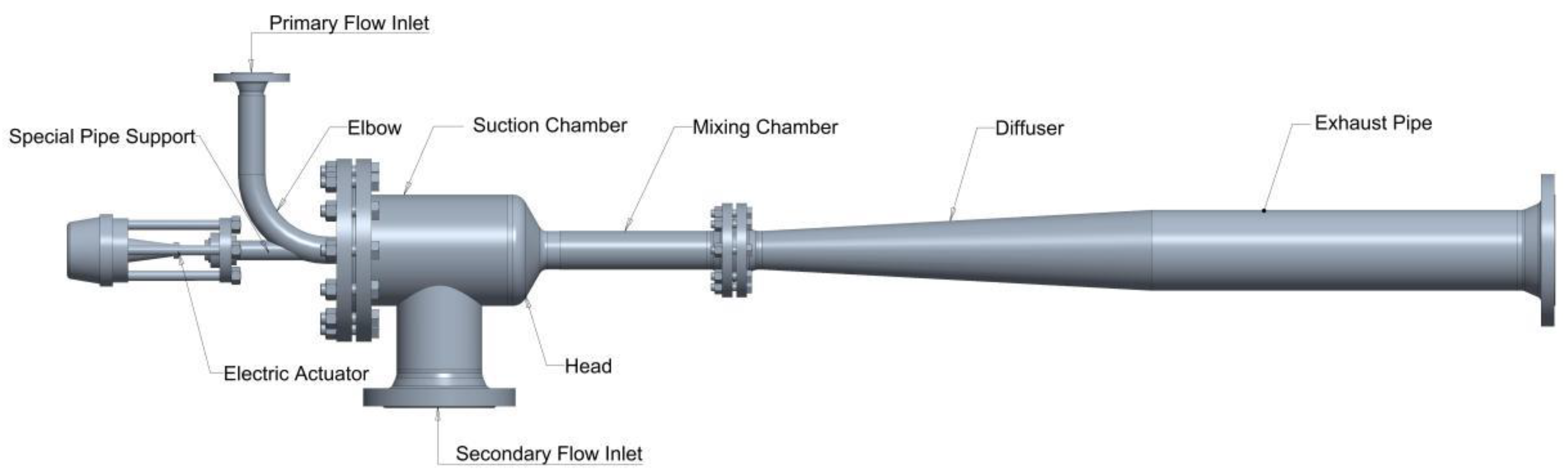
2.1. Geometric Model and Simplification
2.2. Computational Method
2.3. Governing Equations
2.4. Mesh Generation and Boundary Condition Setup
2.4.1. Fluid Domain
2.4.2. Solid Domain
3. Results and Discussion
3.1. Flow Field Characteristics Analysis
3.1.1. Variation in Performance Parameters with Opening
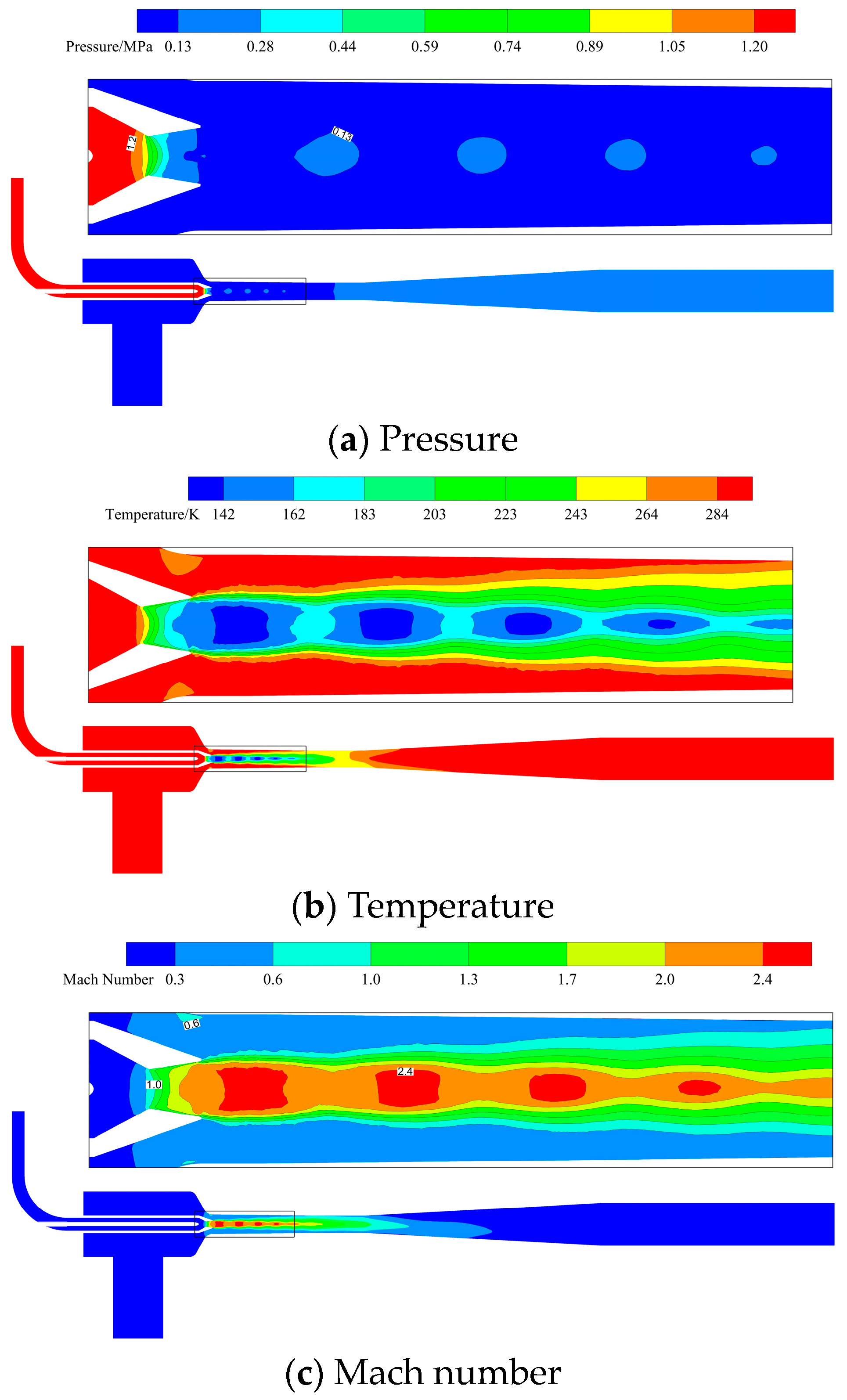
3.1.2. Internal Flow Field Structure Under Design Conditions
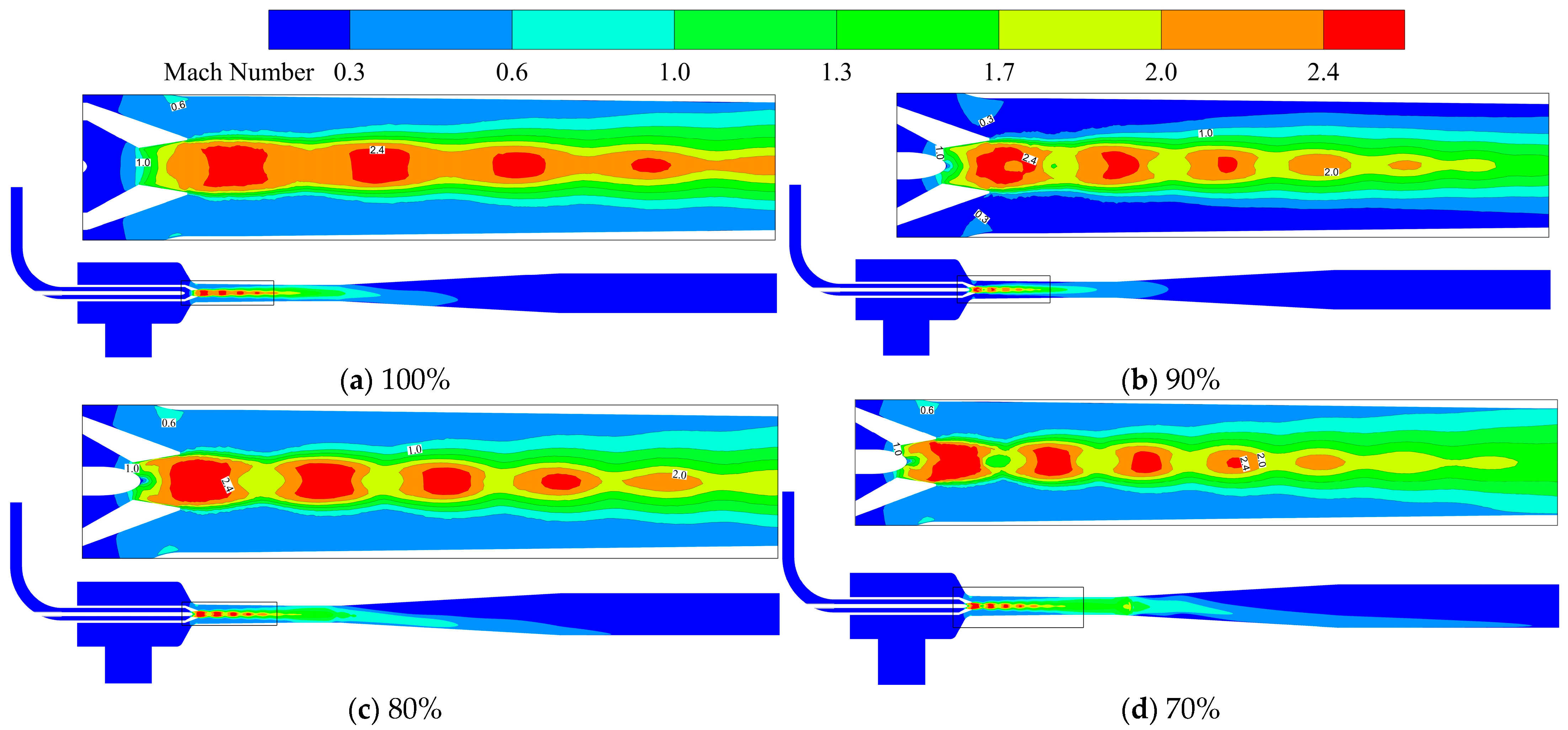
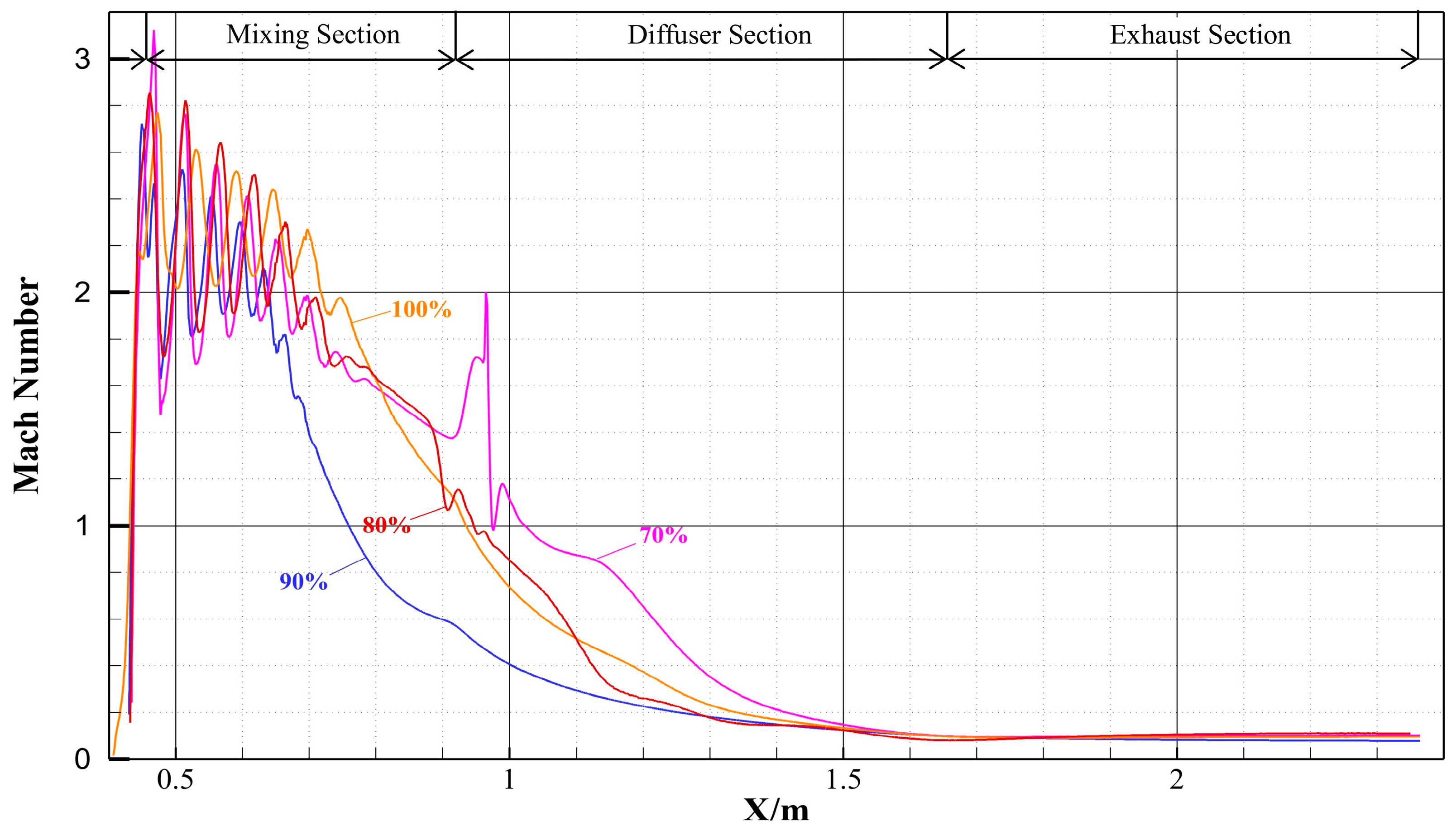
3.1.3. Internal Flow Field Structure Under Different Openings
3.2. Thermal Deformation and Stress Distribution
3.3. Measures for Reducing the Maximum Stress of the Nozzle Component
3.4. Stress Distribution of the Ejector Structure Under Different Loads
3.5. Strength Check
4. Conclusions
- (1)
- Within the region from the nozzle divergent chamber to the mixing chamber of the ejector, there exist complex supersonic flows and shock train structures in the internal flow. The axial displacement of the needle causes the sonic position to move forward and the range of the supersonic region to change, while significantly affecting the intensity and position of the shock wave.
- (2)
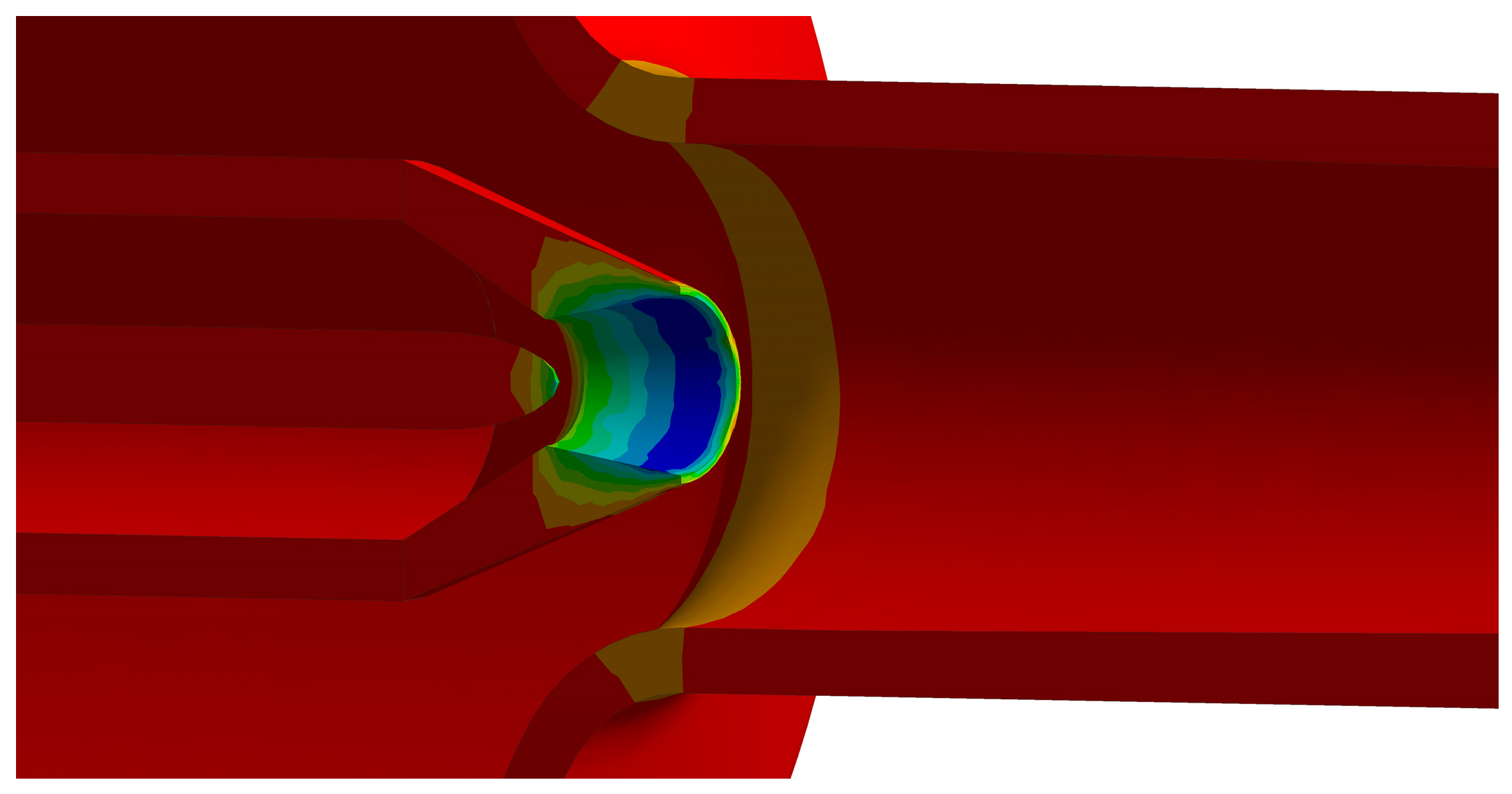
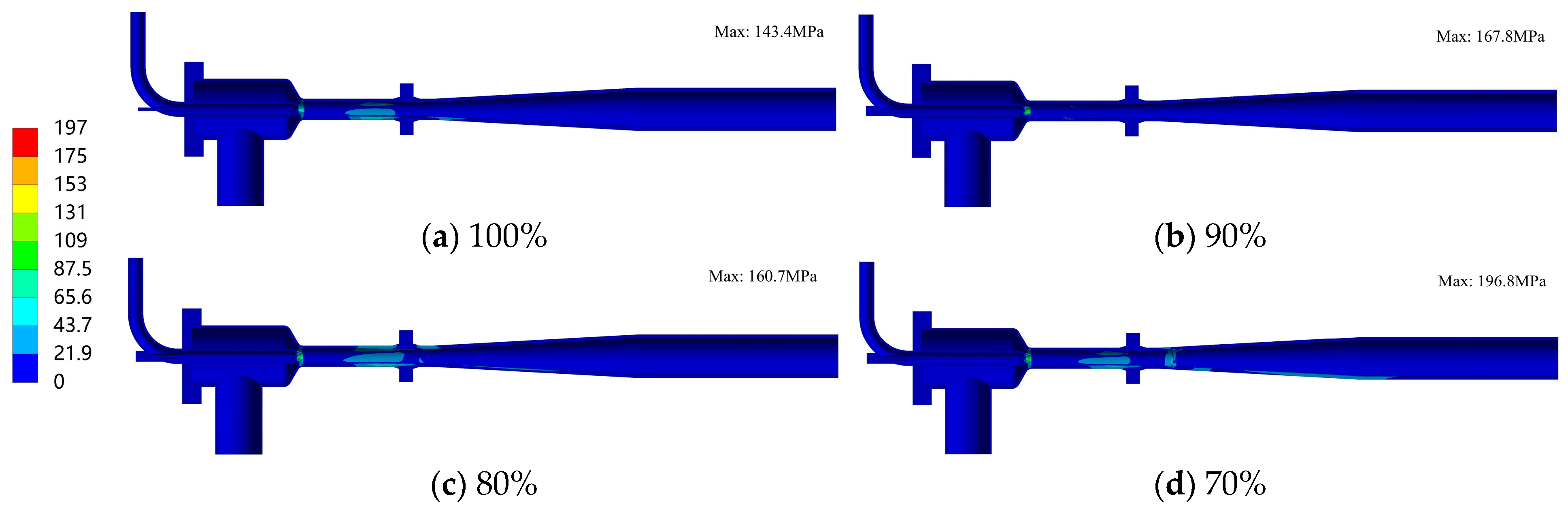
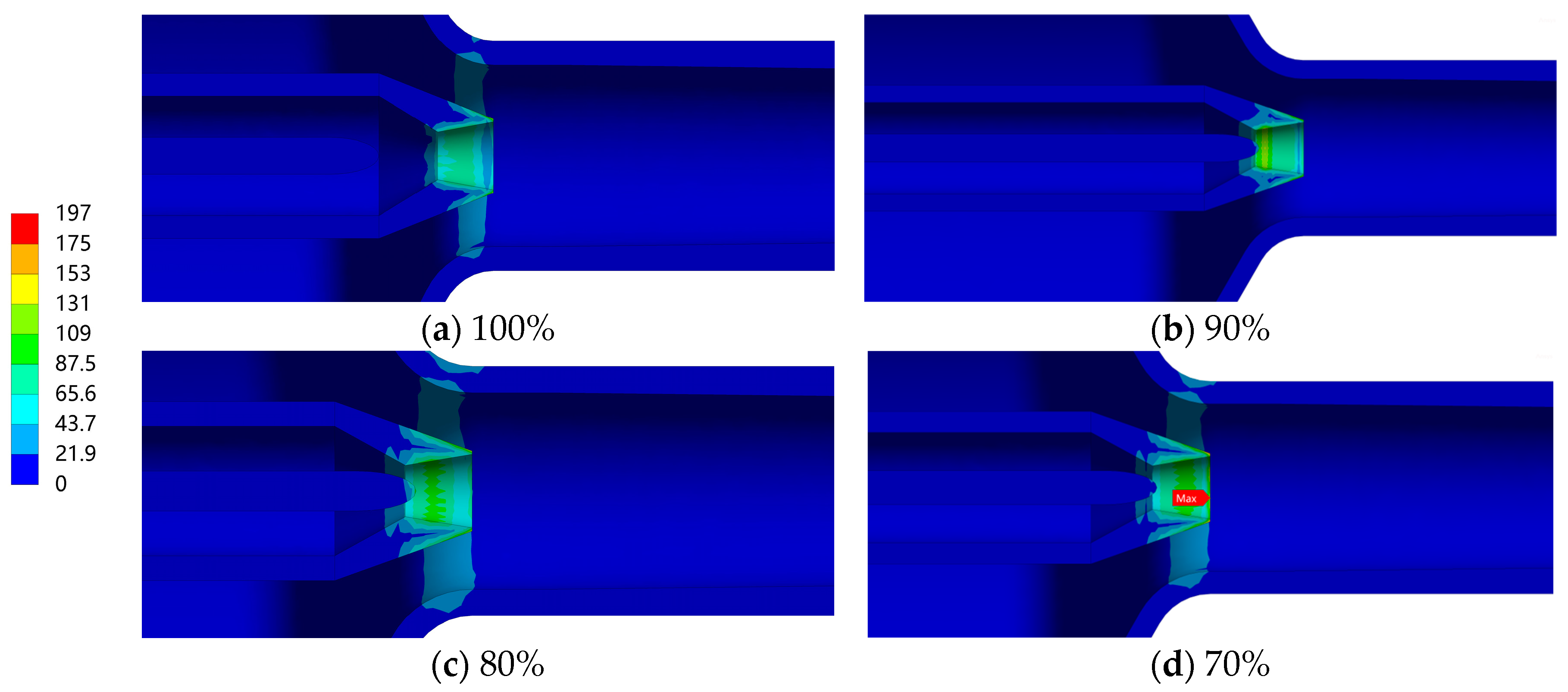
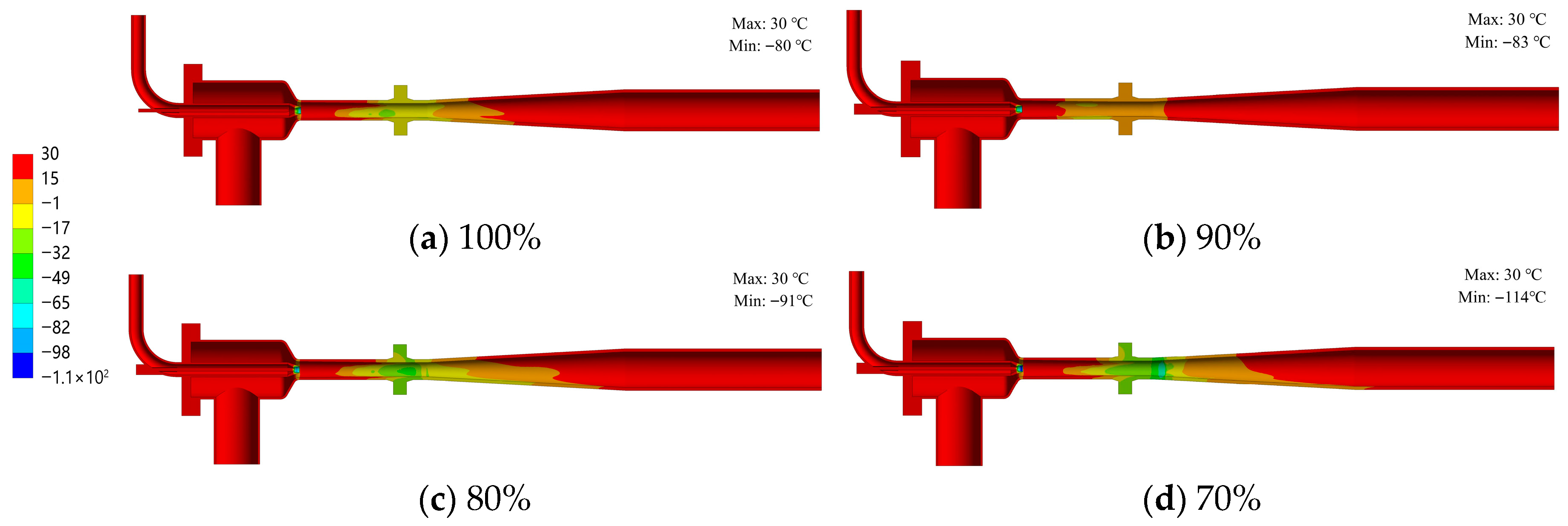
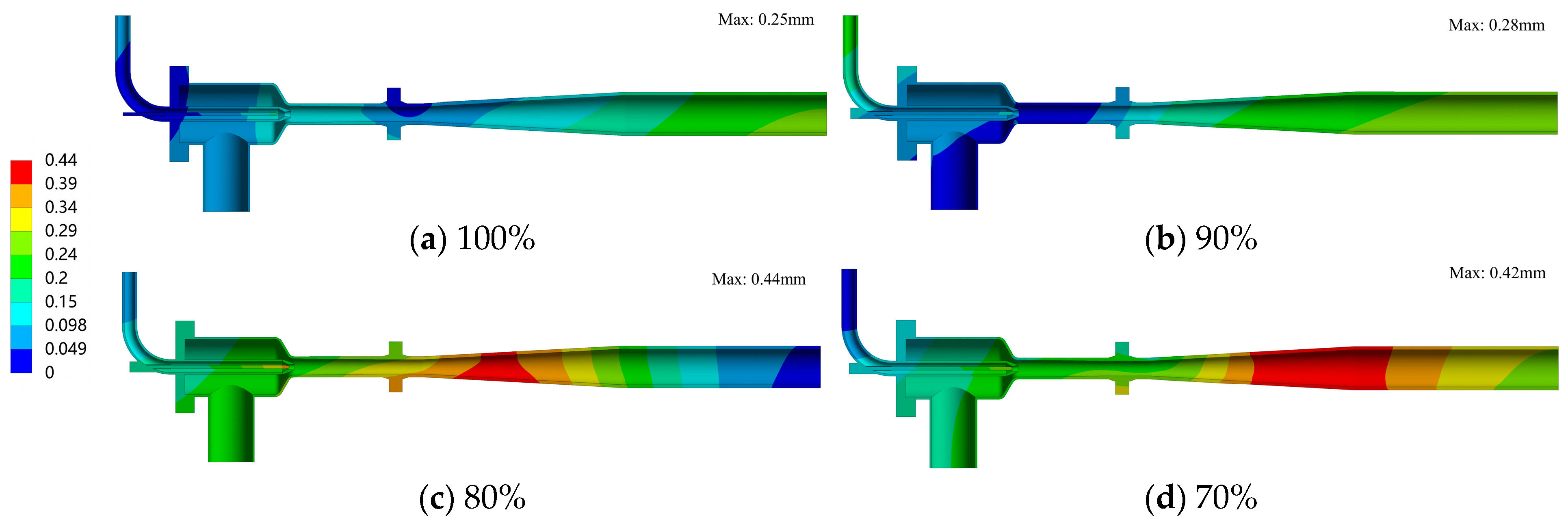
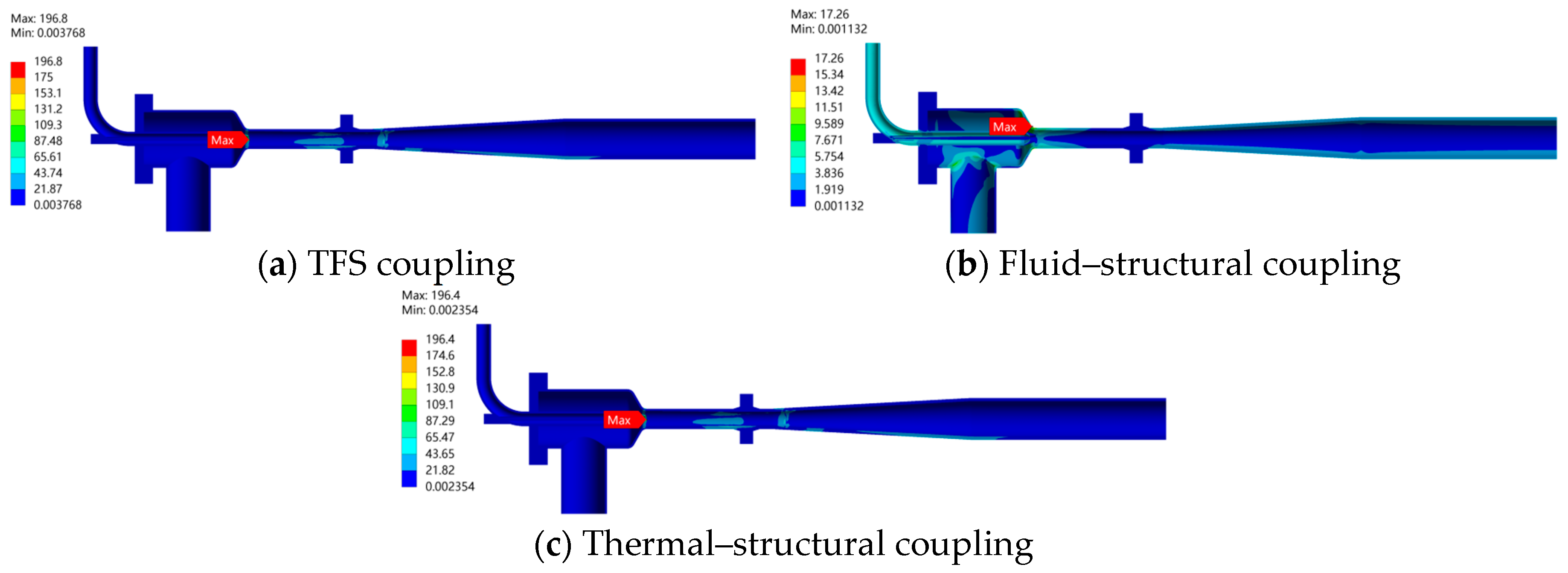
- Thermal load is the decisive factor affecting the structural stress and deformation of the ejector. Internal shock train structures, extending from the nozzle’s divergent section to the mixing chamber, induce localized high-temperature gradients through intense energy dissipation. These gradients, coupled with structural irregularities, drive significant local stress concentrations. The observed peaks in wall temperature and thermal stress align closely with the thermal load localization predicted by the energy dissipation mechanism. The maximum thermal deformation occurs at the end of the ejector, and the nozzle outlet region is the main load-bearing weak link with relatively high local stress. The maximum stress value increases as the opening decreases, reaching 196.8 MPa. Although stress concentration exists in parts such as the conical head and the needle tip, the stress levels are all below 42 MPa.
- (3)
- A nozzle material of the nickel-plated Invar alloy substrate is proposed. By fully leveraging the low thermal expansion characteristic of Invar alloy to reduce thermal stress and thermal deformation, and ensuring corrosion resistance through the nickel-plated surface, the mechanical properties and operational reliability of the nozzle are effectively improved.
Author Contributions
Funding
Data Availability Statement
Conflicts of Interest
References
- Tashtoush, B.M.; Al-Nimr, M.A.; Khasawneh, M.A. A comprehensive review of ejector design, performance, and applications. Appl. Energy 2019, 240, 138–172. [Google Scholar] [CrossRef]
- Lu, Y.; Bai, T.; Yu, J. Study on the ejector-expansion refrigeration system for low-temperature freezer application: Experimental and exergetic assessments. Int. J. Refrig. 2023, 151, 152–160. [Google Scholar] [CrossRef]
- De Souza, A.V.; Barbieri, P.E.L.; Mól, D.C.S.; de Oliveira, R.N.; de Faria, R.N. Thermodynamic analysis and optimization of a modified cascade refrigeration system using two-phase ejectors and low GWP fluids. Int. J. Refrig. 2024, 160, 54–64. [Google Scholar] [CrossRef]
- Li, S.; Yang, H.; Yuan, J.; Zeng, X.; Yang, Z.; Lu, J. Thermodynamic and economic analyses of modified ejector enhanced solar-air composite dual-source heat pump system in residential buildings. Energy Build. 2024, 308, 113978. [Google Scholar] [CrossRef]
- Liu, M.; Wang, Y.; Chen, W.; Yan, J. Thermodynamic optimization of coal-fired combined heat and power (CHP) systems integrated with steam ejectors to achieve heat–power decoupling. Energy 2021, 229, 120707. [Google Scholar] [CrossRef]
- Chen, J.; Sun, M.; Li, P.; An, B.; Gu, R.; Li, M. Experimental and numerical study on RBCC engines performance in simultaneous and combustion cycle. Int. Commun. Heat Mass Transf. 2024, 150, 107186. [Google Scholar] [CrossRef]
- Saeid, O.; Hashem, G.; Etaig, S.; Belgasim, B.; Sagade, A. Performance assessment of ammonia base solar ejector cooling system emphasizing ejector geometries: A detailed CFD analysis. Energy 2024, 301, 131770. [Google Scholar] [CrossRef]
- Shi, H.; Yuan, N.L.; Liu, Z.R.; Song, C.; Wang, R. Optimization of exhaust ejector system for marine gas turbine enclosure cooling: Computational fluid dynamics analysis and parameter optimization. Int. Commun. Heat Mass Transf. 2024, 159, 108185. [Google Scholar] [CrossRef]
- Li, C.; Fu, J.Q.; Shen, Y.R.; Song, C.; Wang, R. Innovative automatic optimization method for ejectors in fuel cell vehicles based on a combined optimization strategy. Int. J. Hydrogen Energy 2024, 96, 1146–1158. [Google Scholar] [CrossRef]
- Wang, M.T.; Chen, P.J.; Liu, H.W. Analysis of the performance enhancement of dual-pressure organic flash cycle using a split-flow evaporator and an ejector driven by low-grade energy. Energy 2024, 312, 133665. [Google Scholar] [CrossRef]
- Li, W.L.; Han, Q.Y.; Wang, C.; Song, C.; Wang, R. Influence of geometric parameters on ejector acoustics and efficiency in ejector refrigeration system. Int. J. Refrig. 2025, 169, 429–443. [Google Scholar] [CrossRef]
- Lin, J.Y.; Wu, R.H.; Yu, H.; Song, C.; Wang, R. Experimental study on thermal performance of two-stage ejector heat pump heating system with large temperature drop. Energy Build. 2024, 324, 114902. [Google Scholar] [CrossRef]
- Zou, J.K.; Li, J.; Singer, G.; Song, C.; Wang, R. Numerical study of water droplets in hydrogen recirculation ejectors for proton exchange membrane fuel cells. Appl. Therm. Eng. 2025, 261, 125084. [Google Scholar] [CrossRef]
- Keenan, J.H.; Neumann, E.P. A simple air ejector. J. Appl. Mech. 1942, 9, A75–A81. [Google Scholar] [CrossRef]
- Keenan, J.H.; Neumann, E.P.; Lustwerk, F. An investigation of ejector design by analysis and experiment. J. Appl. Mech. 1950, 17, 299–309. [Google Scholar] [CrossRef]
- Munday, J.T.; Bagster, D.F. A new ejector theory applied to steam jet refrigeration. Ind. Eng. Chem. Process Des. Dev. 1977, 16, 442–449. [Google Scholar] [CrossRef]
- Zhu, Y.H.; Cai, W.J.; Wen, C.Y.; Li, Y. Shock circle model for ejector performance evaluation. Energy Convers. Manag. 2007, 48, 2533–2541. [Google Scholar] [CrossRef]
- Sharifi, N.; Sharifi, M. Reducing energy consumption of a steam ejector through experimental optimization of the nozzle geometry. Energy 2014, 66, 860–867. [Google Scholar] [CrossRef]
- Wu, H.; Liu, Z.; Han, B.; Li, Y. Numerical investigation of the influences of mixing chamber geometries on steam ejector performance. Desalination 2014, 353, 15–20. [Google Scholar] [CrossRef]
- Fu, W.; Li, Y.; Liu, Z.; Wu, H.; Wu, T. Numerical study for the influences of primary nozzle on steam ejector performance. Appl. Therm. Eng. 2016, 106, 1148–1156. [Google Scholar] [CrossRef]
- Gu, W.; Wang, X.; Wang, L.; Yin, X.; Liu, H. Performance investigation of an auto-tuning area ratio ejector for MED-TVC desalination system. Appl. Therm. Eng. 2019, 155, 470–479. [Google Scholar] [CrossRef]
- Banasiak, K.; Hafner, A.; Andresen, T. Experimental and numerical investigation of the influence of the two-phase ejector geometry on the performance of the R744 heat pump. Int. J. Refrig. 2012, 35, 1617–1625. [Google Scholar] [CrossRef]
- Rao, S.M.V.; Jagadeesh, G. Observations on the non-mixed length and unsteady shock motion in a two dimensional supersonic ejector. Phys. Fluids 2014, 26, 036103. [Google Scholar] [CrossRef]
- Ariafar, K.; Buttsworth, D.; Al-Doori, G.; Malpress, R. Effect of mixing on the performance of wet steam ejectors. Energy 2015, 93, 2030–2041. [Google Scholar] [CrossRef]
- Tang, Y.Z.; Liu, Z.L.; Li, Y.X.; Zhao, F.; Fan, P.; Chua, K.J. Mixing process of two streams within a steam ejector from the perspectives of mass, momentum and energy transfer. Appl. Therm. Eng. 2021, 185, 116358. [Google Scholar] [CrossRef]
- Zhang, J.Y.; Geng, J.X.; Yang, S.; Cheng, F.; Zhu, G.; Wang, C.; Yang, Z.; Lyu, Y. Influence of geometric parameters on the performance of ejector used in aeroengine air system. Therm. Sci. Eng. Prog. 2023, 37, 101571. [Google Scholar] [CrossRef]
- Tang, Y.Z.; Liu, Z.L.; Li, Y.X.; Huang, Z.; Chua, K.J. Study on fundamental link between mixing efficiency and entrainment performance of a steam ejector. Energy 2021, 215, 119128. [Google Scholar] [CrossRef]
- Ding, H.B.; Zhao, Y.F.; Wen, C.; Liu, X. A visual mass transfer study in the ejector considering phase change for multi-effect distillation with thermal vapour compression (MED-TVC) desalination system. Desalination 2022, 532, 115722. [Google Scholar] [CrossRef]
- Croquer, S.; Lamberts, O.; Poncet, S.; Moreau, S.; Bartosiewicz, Y. Large eddy simulation of a supersonic air ejector. Appl. Therm. Eng. 2022, 209, 118177. [Google Scholar] [CrossRef]








| Structural Parameters | Value |
|---|---|
| Nozzle inlet diameter/mm | 39.10 |
| Nozzle throat diameter/mm | 15.50 |
| Nozzle outlet diameter/mm | 22.20 |
| Mixing chamber diameter/mm | 52.64 |
| Mixing chamber length/mm | 404.30 |
| Diffuser length/mm | 1511.00 |
| Diffuser outlet diameter/mm | 131.50 |
| Motive Inlet | Entrained Inlet | Outlet | |
|---|---|---|---|
| 100% opening | 1.3 MPa | 0.13 MPa | 0.215 MPa |
| 90% opening | 1.3 MPa | 0.13 MPa | 0.215 MPa |
| 80% opening | 1.3 MPa | 0.13 MPa | 0.165 MPa |
| 70% opening | 1.3 MPa | 0.13 MPa | 0.148 MPa |
| 100% Opening | 90% Opening | 80% Opening | 70% Opening | |
|---|---|---|---|---|
| motive inlet flow rate (t/h) | 2.00 | 1.76 | 1.60 | 1.43 |
| entrained inlet flow rate (t/h) | 1.98 | 1.22 | 2.03 | 2.01 |
| outlet flow rate (t/h) | 3.98 | 2.98 | 3.63 | 3.44 |
| entrainment ratio | 1.00 | 0.70 | 1.27 | 1.41 |
| pressure increase ratio | 1.65 | 1.65 | 1.27 | 1.14 |
| Opening | 100% | 90% | 80% | 70% |
|---|---|---|---|---|
| The variation in the distance between the needle and the throat/mm | −0.037 | +0.042 | +0.06 | +0.054 |
| Material | Density/Kg dm−3 | Coefficient of Thermal Expansion/K−1 | Elastic Modulus/GPa | Thermal Conductivity/W (m K)−1 | Yield Strength/MPa | Tensile Strength/MPa |
|---|---|---|---|---|---|---|
| 304 | 7.93 | 1.6 × 10⁻⁵ | 199 | 15 | 205 | 520 |
| 304H | 7.9 | 1.63 × 10⁻⁵ | 199 | 17 | 205 | 520 |
| 304L | 7.9 | 1.6 × 10⁻⁵ | 199 | 15 | 180 | 480 |
| Invar alloy | 8.1 | 1.2 × 10⁻⁵ | 140 | 10.2 | 276 | 448 |
| Material | 304 | 304L | 304H | Invar Alloy |
|---|---|---|---|---|
| Maximum stress value/MPa | 242.1 | 299 | 290 | 196.8 |
| Evaluation Type and Stress Limits | Calculated Stress/MPa | Allowable Stress/MPa | Conclusion |
|---|---|---|---|
| Primary membrane stress | 163.5 | 223 | Qualified |
| Primary membrane stress + Primary bending stress | 196.6 | 334.5 | Qualified |
| Primary stress + Secondary stress | 196.8 | 669 | Qualified |
Disclaimer/Publisher’s Note: The statements, opinions and data contained in all publications are solely those of the individual author(s) and contributor(s) and not of MDPI and/or the editor(s). MDPI and/or the editor(s) disclaim responsibility for any injury to people or property resulting from any ideas, methods, instructions or products referred to in the content. |
© 2026 by the authors. Licensee MDPI, Basel, Switzerland. This article is an open access article distributed under the terms and conditions of the Creative Commons Attribution (CC BY) license.
Share and Cite
Zhang, Y.; Yan, L.; Zhang, J.; Ma, S.; Guo, W. Analysis of Off-Design Performance and Thermal–Fluid–Structural Coupling Characteristics of an Adjustable Air Ejector. Materials 2026, 19, 294. https://doi.org/10.3390/ma19020294
Zhang Y, Yan L, Zhang J, Ma S, Guo W. Analysis of Off-Design Performance and Thermal–Fluid–Structural Coupling Characteristics of an Adjustable Air Ejector. Materials. 2026; 19(2):294. https://doi.org/10.3390/ma19020294
Chicago/Turabian StyleZhang, Yingwen, Liru Yan, Jingxian Zhang, Suxia Ma, and Wenlong Guo. 2026. "Analysis of Off-Design Performance and Thermal–Fluid–Structural Coupling Characteristics of an Adjustable Air Ejector" Materials 19, no. 2: 294. https://doi.org/10.3390/ma19020294
APA StyleZhang, Y., Yan, L., Zhang, J., Ma, S., & Guo, W. (2026). Analysis of Off-Design Performance and Thermal–Fluid–Structural Coupling Characteristics of an Adjustable Air Ejector. Materials, 19(2), 294. https://doi.org/10.3390/ma19020294