
Article

Preparation and Characterization of Oxide Coatings with LDH Nanosheets on AZ91 Magnesium Alloy by a One-Step Low Voltage Microarc Oxidation Process


1
College of Materials Science and Engineering, Nanjing Tech University, Nanjing 211816, China
2
Research Institute of Interdisciplinary Science, School of Materials Science and Engineering, Dongguan University of Technology, Dongguan 523808, China
*
Authors to whom correspondence should be addressed.
Materials 2026, 19(2), 216; https://doi.org/10.3390/ma19020216
Submission received: 17 November 2025 / Revised: 27 December 2025 / Accepted: 3 January 2026 / Published: 6 January 2026
(This article belongs to the Special Issue Protective Coatings for Metallic Materials)

Abstract

In this study, oxide coatings with layered double hydroxide (LDH) nanosheets were prepared on AZ91 magnesium alloy by a one-step low-voltage microarc oxidation (MAO) process. The microstructure and composition of the coatings were characterized using SEM, EDS, XRD, FT-IR, and XPS. The corrosion protection performance of the coatings was evaluated by electrochemical analysis and hydrogen evolution tests. The results showed that oxide coatings with Mg-Al-LDH nanosheets are successfully produced by microarc oxidation at a voltage of less than 100 V. The coating with a higher density of Mg-Al LDH nanosheets exhibited enhanced corrosion resistance. Moreover, after modification with stearic acid, the coatings displayed high hydrophobicity and corrosion resistance.

1. Introduction

Magnesium alloy is recognized as an ideal lightweight material owing to its high specific strength, low density, good thermal conductivity, and excellent damping capacity. It is extensively utilized in aerospace, electronic equipment, and vehicles [1,2,3,4,5,6]. However, magnesium has a relatively low standard electrode potential (−2.372 V). Furthermore, the naturally formed oxide layer on its surface is not effectively protective, thereby significantly limiting its widespread application. Consequently, enhancing the corrosion resistance of magnesium alloys has emerged as a critical research focus in materials science.
Surface treatment represents a crucial technique for enhancing the corrosion resistance of magnesium alloys [7,8]. Other such techniques include anodizing [9], chemical conversion [10,11], vapor phase deposition [12], alkaline passivation [13,14], thermal spraying [15], laser surface treatment [16], microarc oxidation [17,18,19,20,21,22,23,24], and so on. Among them, microarc oxidation (MAO) has attracted wide attention for its simple process and high efficiency. The instantaneous high temperature and pressure generated by plasma discharge trigger a series of chemical reactions on the substrate, leading to the in situ formation of an oxide ceramic coating [25,26,27,28,29]. However, the discharge during MAO process often results in various defects, including micropores and cracks. Under service conditions, corrosive agents (e.g., Cl ions) permeate through coating defects such as micropores and microcracks, initiating localized corrosion of the underlying Mg alloy substrate. Therefore, strategies to enhance the protective performance of MAO coatings should be explored to improve the corrosion resistance of Mg alloys.
To further improve corrosion protection, layered double hydroxides (LDHs) have been applied as a top layer on MAO-coated Mg alloys due to their anion-exchange capacity and barrier properties. An LDH consists of a positively charged brucite-like host layer and a negatively charged anion with a chemical formula of [ M 2 + M 3 x + x 1 (OH)2][An−] x/n·zH2O [30,31,32,33,34,35]. LDHs are widely employed in the disciplines of catalysts, adsorbents, and supercapacitors because of their simple chemical composition and strong anion exchange capacity [36,37,38]. An LDH film applied to the MAO coating surface on Mg alloy can effectively seal defects, including micropores and fractures, either completely or partially [34,39,40]. Moreover, its unique ion-exchange property allows it to wrap anions in the corrosive solution, thereby effectively reducing the corrosion of the magnesium alloy.
Hydrothermal treatment is a common method for preparing LDH coatings on MAO coatings [41,42]. For instance, Wang et al. successfully fabricated Mg-Al LDH/MAO composite coatings in a NaNO3 solution using the hydrothermal method, which effectively enhanced the corrosion resistance of the coating [43]. Jiang et al. prepared a molybdate-intercalated Mg-Al LDH film on the MAO surface via a hydrothermal process, which demonstrated a significant sealing effect on the porous defects of the MAO coating and served as a carrier for inhibitor loading to achieve active protection [44]. However, the hydrothermal method generally requires high temperature and pressure conditions, often exceeding 120 °C and 1.21 × 10⁵ Pa, which may cause issues such as cracking, spalling, or degradation of the MAO coating. Currently, the production of MAO-LDH coatings on magnesium alloys often involves multiple steps and is limited by high-temperature preparation conditions. During the hydrothermal process, uneven temperature distribution, non-uniform solution flow, or inconsistent reactant distribution may lead to the formation of non-uniform LDH films, thereby affecting their overall quality. Recently, Zhang et al. fabricated MAO/Mg-Al LDH composite coatings using a one-step MAO process by adjusting the electrolyte concentration (Na3PO4∙12H2O) [45]. This method avoided issues related to coating uniformity, but high-voltage MAO is associated with high overall energy consumption. Therefore, further research is needed to develop new methods with lower processing requirements.
In this study, a novel one-step MAO method was developed to grow LDH nanosheets in situ on magnesium alloys. By controlling the electrolyte concentration under ultra-low voltage conditions (less than 100 V), the fabrication of LDH nanosheets on the MAO coating was successfully achieved. Electrochemical characterization (potentiodynamic polarization/EIS) coupled with hydrogen evolution measurements demonstrated that the increased density of LDH nanosheets within the coating substantially improved the corrosion resistance of AZ91 Mg alloy. This enhancement is attributed to the nanosheets’ barrier effect against aggressive ion penetration and their ability to facilitate protective film formation at the metal–electrolyte interface.

2. Experiment

2.1. Materials

In this work, AZ91D magnesium alloy, with a nominal composition of Al 8.7 wt.%, Zn 0.82 wt.%, Mn 0.27 wt.%, and Si 0.05 wt.% (impurities: Cu < 0.025 wt.%, Fe < 0.004 wt.%, Ni < 0.001 wt.%, Mg balance), was employed as the substrate material. Rectangular specimens (30 mm × 20 mm × 6 mm) were sectioned for subsequent surface treatments. Prior to coating deposition, all substrates underwent sequential mechanical polishing using SiC abrasive papers with progressively finer grit sizes (600# → 800# → 1200# → 1500#). The polished surfaces were then ultrasonically cleaned in ethanol for 15 min to remove particulate contaminants, followed by air drying at room temperature (25 ± 2 °C) in a laminar flow hood.

2.2. MAO Coating Preparation

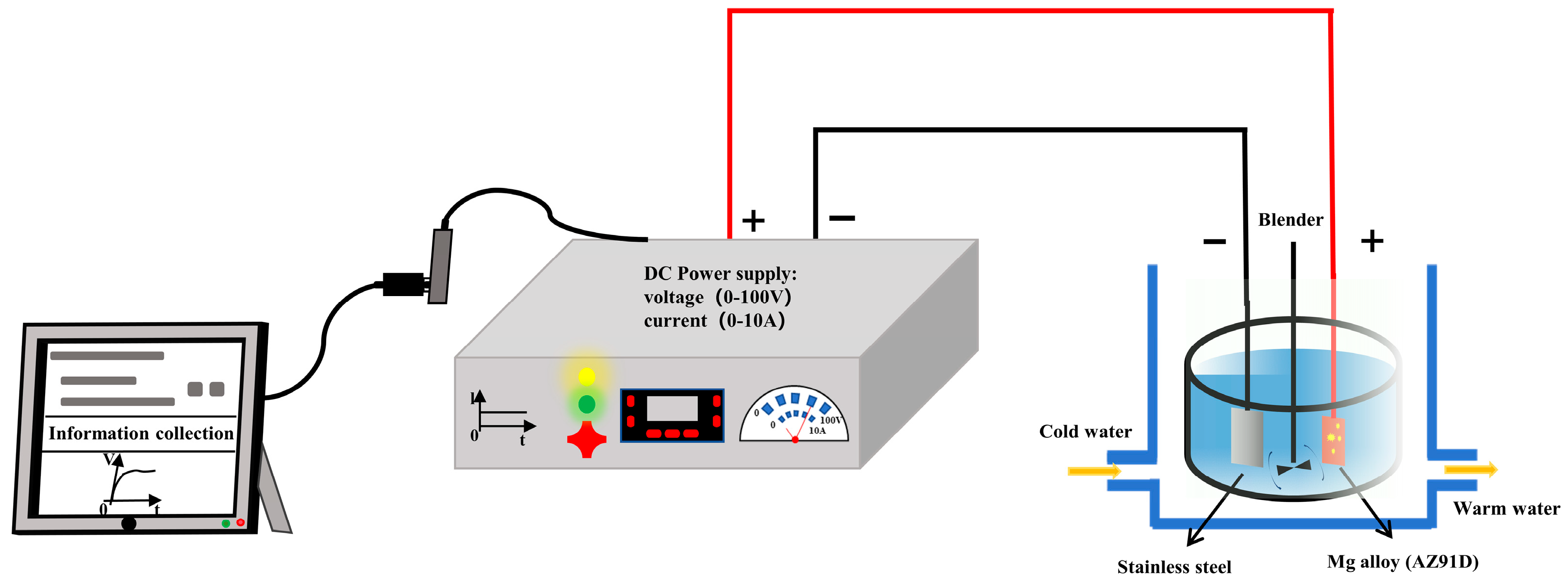
A low-voltage DC MAO process was carried out for preparing MAO coating. The preparation process of the coating is schematically illustrated in Figure 1. A two-electrode setup was used, with AZ91 Mg alloy as the anode and stainless steel as the cathode. Constant current mode was used with a current density of 2.78 A/dm2, the oxidation time was 8 min, and the water cooler temperature was set to 20 °C. For the MAO process, the electrolyte solution was prepared using 200 g of NaOH per liter of deionized water. In addition, 15 mL, and 30 mL of C3H8O3 were added to the solution as additive. Electrolytic solutions without and with different concentrations of C3H8O3 were designated as MAO–0, MAO–15, and MAO–30, with respective conductivities of 754 mS/cm, 716 mS/cm, and 660 mS/cm.
Surface modification of the MAO coating was performed via an immersion method. using an ethanol-based solution of low-surface-energy substances for surface modification. Specifically, a 100 mL 10 g/L ethanol solution of stearic acid (STA) was prepared first, the MAO samples were vertically immersed in the aforementioned solution for treatment by immersion at 80 °C for 120 min, and the samples obtained were denoted as MAO–0–STA, MAO–15–STA, and MAO–30–STA, respectively.

2.3. Characterization

The surface and cross-sectional morphology, along with the chemical composition of the coatings, were analyzed using a field emission scanning electron microscope (Waltham, MA, USA) equipped with an energy-dispersive X-ray spectrometer (Waltham, MA, USA). Additionally, the surface porosity of the coatings was quantified through the standard threshold segmentation method applied to SEM images, with computational analysis conducted using Image Pro Plus software V7.0 (Silver Spring, MD, USA). For cross-sectional observation, the Mg alloy samples were firstly cut and immersed in epoxy resin with the cross-section ground to 1500# with SiC sandpapers, followed by successive polishing with diamond polishing compound to provide a mirror-like surface. The samples were coated with gold to prevent the coating from having poor electrical conductivity prior to testing.
The crystal phases of the coatings were characterized by an X-ray diffractometer (Almelo, Overijssel, The Netherlands) with a Cu target (λ = 0.154 nm) set at an incidence angle of 0.5° and the 2θ range from 5° to 90° with the scanning rate of 5°/min. Both the chemical composition and the chemical state of the coatings were analyzed by X-ray photoelectron spectroscopy (Waltham, Massachusetts, UK). The functional group composition of the coatings was analyzed by Fourier Transform Infrared spectroscopy (Ettlingen, Baden-Württemberg, Germany) in the range of 4000~400 cm−1. Meanwhile, the water contact angle (CA) was measured with an optical contact angle meter (Shanghai, China) by depositing a 3 μL droplet onto the sample surface. The reported CA value represents the average of measurements taken at three random locations.

2.4. Corrosion Test

The corrosion resistance of the coatings was evaluated in 3.5 wt.% NaCl solution using a three-electrode electrochemical system (JinJiang, TaiZhou Province, China). The electrochemical behavior and protective properties of the coatings were evaluated via potentiodynamic polarization (PDP) and electrochemical impedance spectroscopy (EIS) measurements. The samples were employed as the working electrodes, with an exposure area of about 1 cm2, a Pt sheet, and silver/saturated silver chloride (Ag/AgCl) as counter electrodes and reference electrodes, respectively, to perform the electrochemical tests. The Tafel polarization test was performed at a scan rate of 1 mV/s, and the data were recorded from −0.5 V to 0.5 V. The EIS curves were fitted and analyzed with Zview software (3.5.0.10). To evaluate long-term corrosion resistance, hydrogen evolution tests were performed on the samples. Samples were immersed in 3.5 wt.% NaCl solution for hydrogen evolution measurement tests, placed in a beaker, and stored at room temperature, and a gas collection device consisting of a funnel and an acid bucket was used to collect the hydrogen released. Three sets of parallel tests were carried out to ensure repeatability of data.

3. Results and Discussion

3.1. Characteristics of Low-Voltage MAO Processes

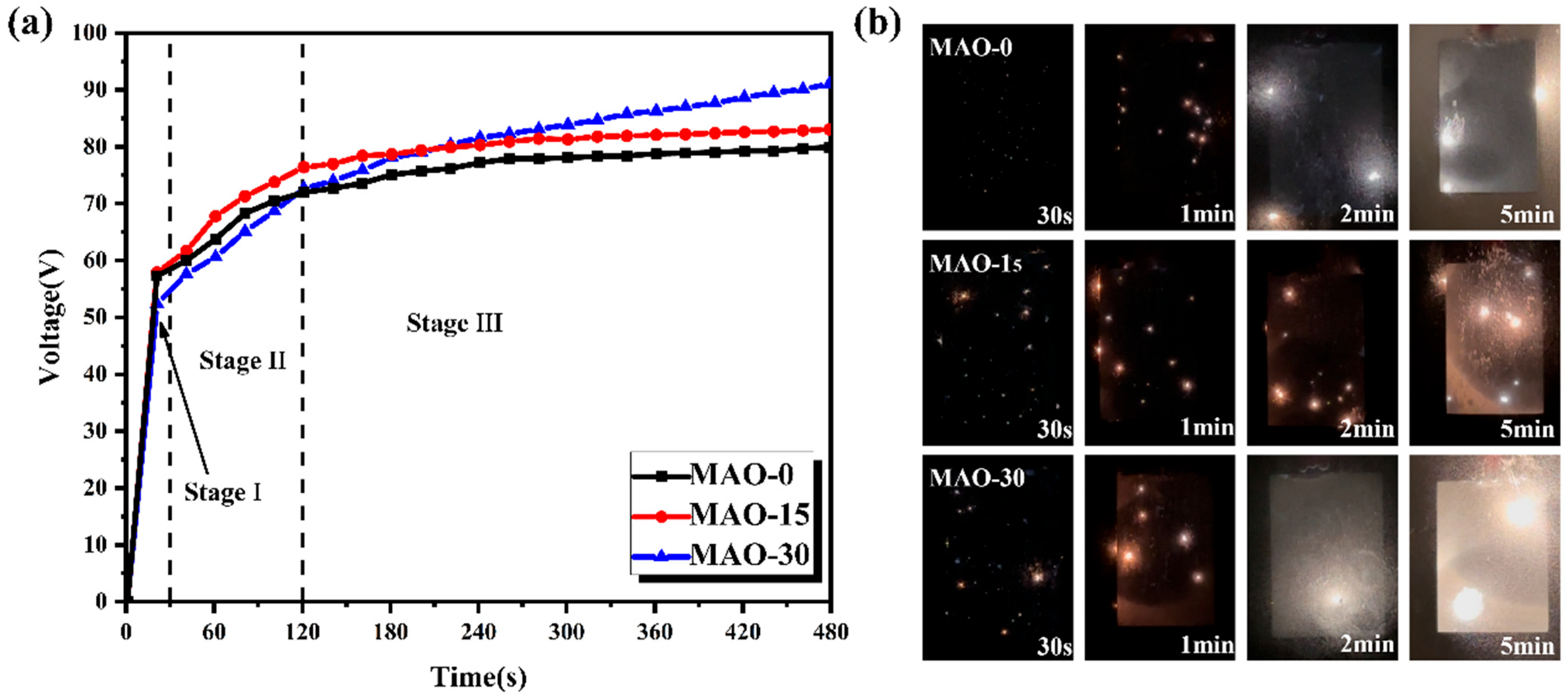
The evolution of voltages with time for the low-voltage MAO processes of AZ91 Mg alloy in the electrolytes with the addition of 0 mL, 15 mL, and 30 mL of glycerol (C3H8O3) is depicted in Figure 2. It is clear that the voltage–time curves for these different electrolytes exhibit a similar trend, which can be roughly divided into two stages: a rapid increase stage (stage I) and a gradual increase stage (stage II). During stage I, the voltage rapidly rises to approximately 60 V within 30 s for all MAO processes in the different electrolytes, indicating the formation of passive or barrier layers on the surface of the AZ91 Mg alloy [46]. Subsequently, the voltages gradually increase with the processing time until the end of the process (stage II). However, in stage II, the MAO processes in the electrolytes with the addition of 15 mL and 30 mL C3H8O3 show slightly higher voltages compared to the base electrolyte. The final voltages for the 8 min MAO processes of AZ91 Mg alloy in different electrolytes range from 75 V to 90 V. The surface discharge images of the samples during the MAO processes are shown in Figure 2b. The surface discharge state of the sample tends to stabilize after 5 min, which corresponds to the later stage where the voltage–time curve becomes stable (Figure 2a). For the MAO-0 sample, the discharges on the surface gradually evolve from small, uniform silver-white sparks in the early stage to larger, localized arcs. In comparison, the discharges on the surfaces of MAO–15 and MAO–30 samples are more intense in the early stage, with more yellow arcs appearing in the discharge process. The MAO–15 sample exhibits more uniform discharges in the late stage of MAO process, while the MAO–30 sample shows a localized accumulation of arcs after 2 min of discharge, which continues to increase and lead to localized large arc discharges.
Notably, the arc initiation and final voltages of MAO processes in these electrolytes remain within 90 V, achieving the preparation of MAO coatings at very low voltages. This is primarily attributed to the high conductivity of the solution, resulting from the high concentration of the electrolyte. Meanwhile, the electrolytes with 15 mL and 30 mL of C3H8O3 have higher final voltages than the base electrolyte. Previous studies have shown [47] that the initial voltage of MAO is related to the conductivity of the solution. The decrease in solution conductivity with increasing C3H8O3 content is mainly attributed to the enhanced adsorption of negative ions per unit area at the anode–electrolyte interface. This promotes the formation of dense and uniform discharge centers on the passive film surface [48].

3.2. Microstructure and Compositions of Coatings

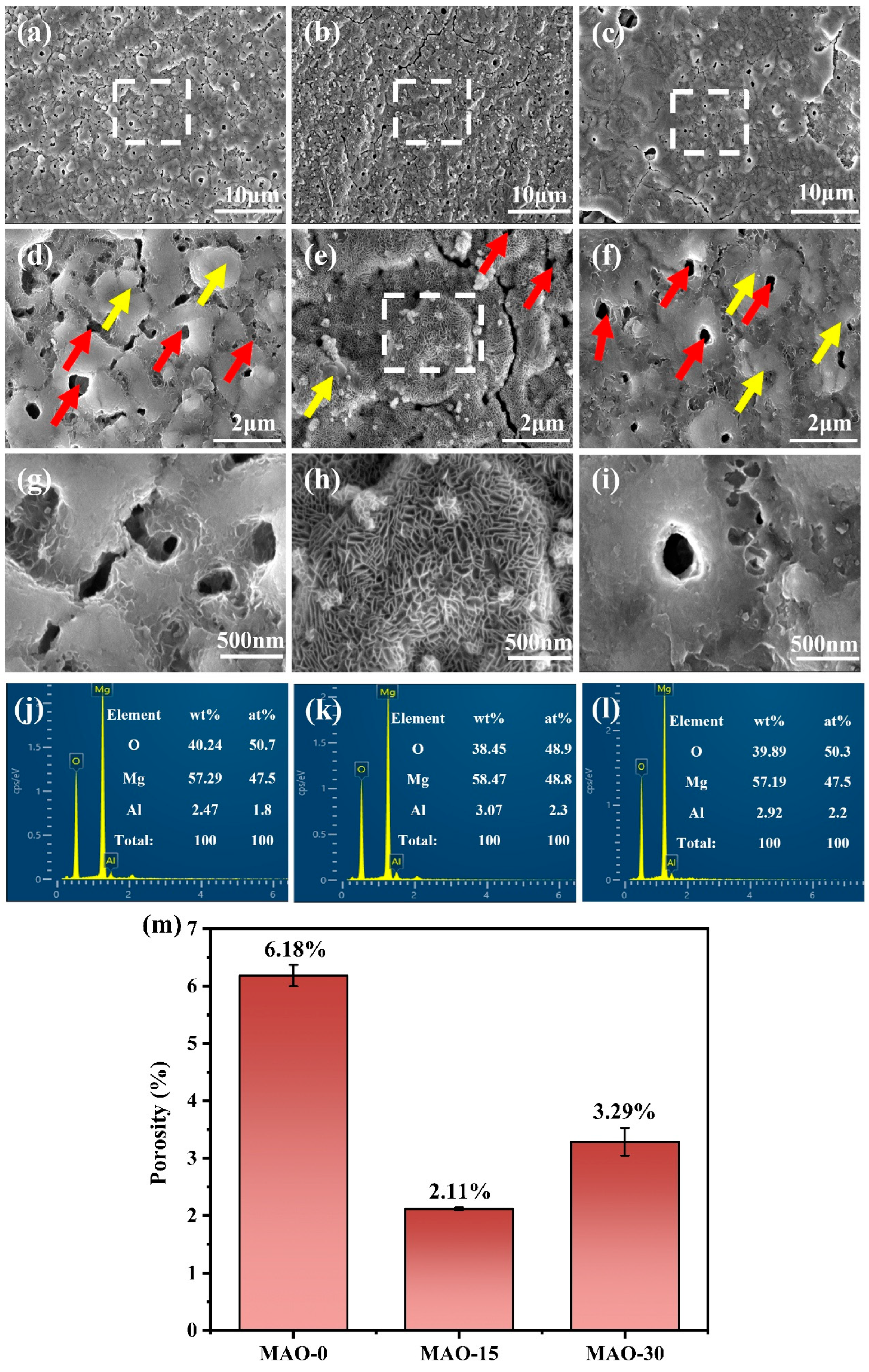
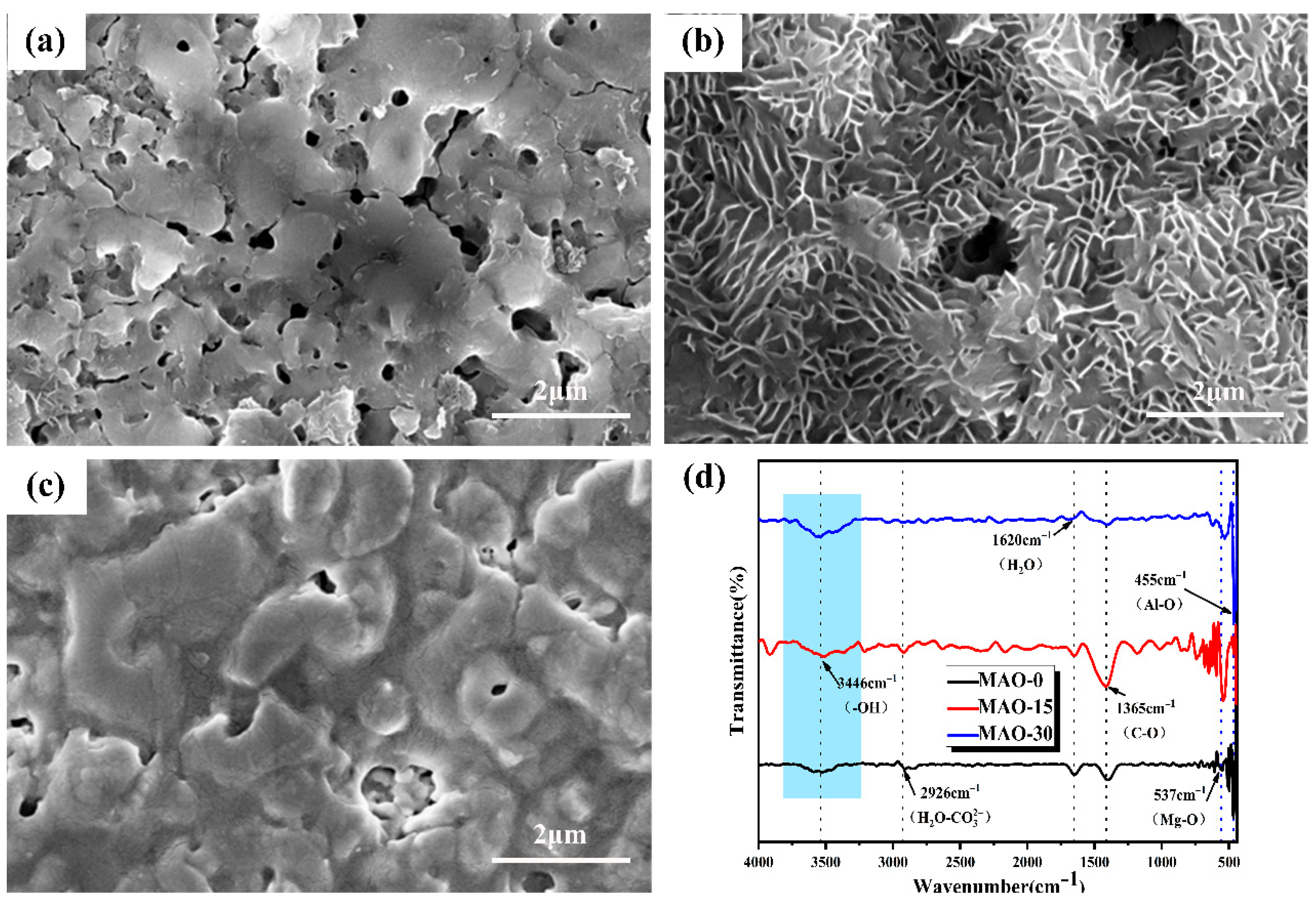
The surface morphologies of the MAO coatings are shown in Figure 3. As observed in Figure 3a–c, the coating surface exhibits the presence of pores and cracks. However, the porosity of these coatings is significantly lower than that of conventional microarc oxidation coatings [45]. The micropores formed during the MAO process arise primarily from plasma discharge and the evolution of gas bubbles [49]. Upon local zooming, Figure 3d–f reveal tiny crater-like apertures (marked by red arrows) on the coatings, formed by the ejection of molten oxide during plasma discharge. In addition, the ejected molten oxide is cold-deposited near the pores, forming oxide nodules (shown by yellow arrows), and a few cracks can be observed in the vicinity. While the lamellar surface features remain indistinct at this magnification level, their presence is clearly identifiable in Figure 3e. Subsequent higher-magnification imaging of the framed regions in Figure 3d–f reveals detailed morphological characteristics, as presented in Figure 3g–i.
Figure 3h reveals the presence of aggregated lamellar structure on the surface of the MAO–15 coating, primarily consisting of a large number of nanosheets. These nanosheets grow vertically from the alloy substrate surface of the MAO-coated AZ91. Similar nanosheets are also observed on the surfaces of the MAO–0 and MAO–30 coatings (Figure 3g,i), but their quantity is much smaller compared to that of the MAO–15 coating. Moreover, the nanosheets on the surface of the MAO–30 coating distribute near the cracks and exhibit a tendency to melt. This is because the voltage of microarc oxidation rises as the C3H8O3 increases, resulting in large, localized arc discharges during the MAO process. Under the high-temperature effect of arc discharge, the nanosheets tend to melt on the coating surface. As presented in Figure 3j–l, the surface morphologies and corresponding EDS results of the MAO–0, MAO–15, and MAO–30 coatings reveal that they are primarily composed of Mg and O. In addition, a small amount of Al element can be detected in the coatings, suggesting that Al from the AZ91 magnesium alloy substrate participates in the reaction during the MAO process. Overall, the MAO–15 coating has a higher concentration of Al element than the MAO–0 and MAO–30 coatings. Figure 3m shows that the MAO–15 coating has the lowest porosity, while the MAO–0 coating exhibits the largest porosity.
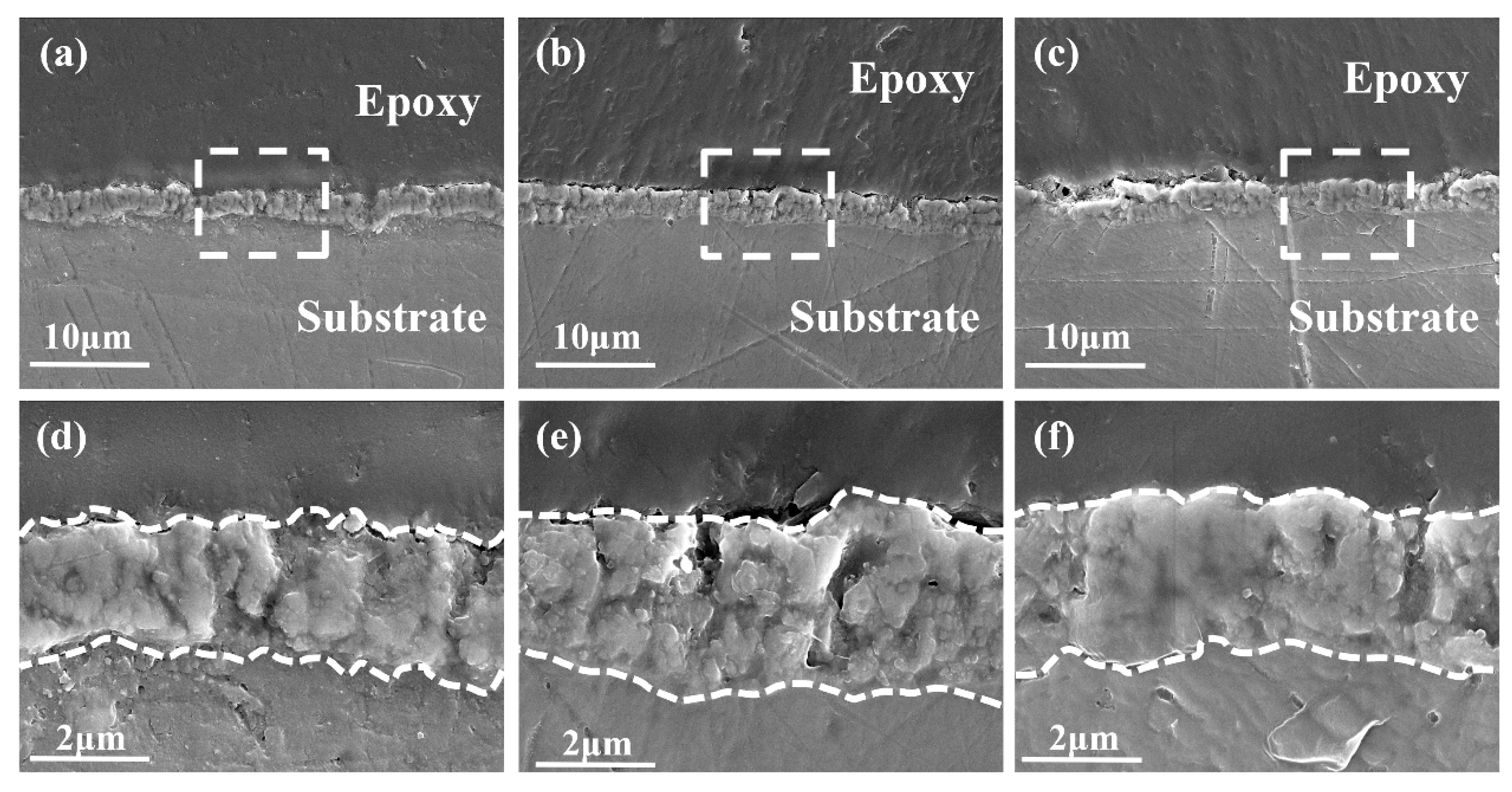
Figure 4 presents the cross-sectional SEM micrographs of the MAO–0, MAO–15, and MAO–30 coatings, demonstrating excellent adhesion between all MAO coatings and the Mg alloy substrate without visible interfacial delamination or cracks [50]. The MAO–0 coating has a thickness of approximately 2.15 ± 0.15 μm, while the MAO–15 shows a slight greater thickness of 3.05 ± 0.65 μm. The MAO–30 displays a thickness of about 2.70 ± 0.20 μm. Higher-magnification images of the framed areas in Figure 4a–c are provided in Figure 4d–f, respectively, revealing a non-uniform coating morphology with numerous voids. These voids correspond to the pores in the coating, indicating that the pores are not only present on the coating surface but also within the coating.
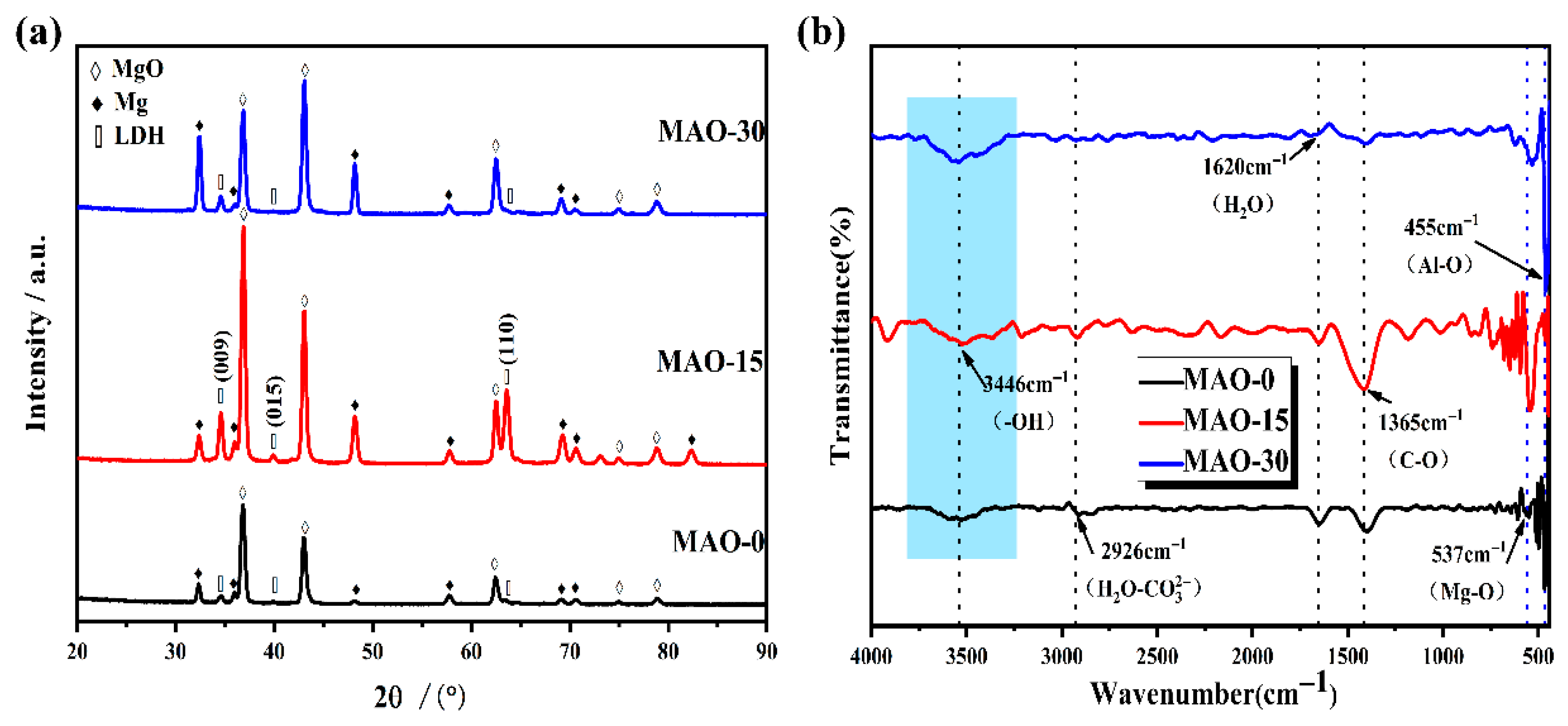
The XRD patterns of the MAO-0, MAO–15, and MAO–30 coatings on the AZ91 magnesium alloy, shown in Figure 5a, indicate that the MAO coatings are mainly composed of the MgO phase. Additionally, the diffraction peaks at 34.5°, 39.7°, and 63.4° correspond to the (009), (015), and (110) diffraction planes of the LDH phase, respectively, suggesting that the LDHs were successfully grown on the surface of the MAO coating [51]. Although the MAO–0, MAO–15, and MAO–30 samples do not show significant difference in phase composition, the MAO–15 coating has higher intensity of the diffraction peaks of the LDH phase, which correlates with the differences in surface morphology depicted in Figure 3.
Figure 5b shows the FT-IR spectra of the MAO–0, MAO–15, and MAO–30 coatings. Overall, the spectra exhibit no significant differences. The broad absorption band observed at 3446 cm−1 in the FTIR spectrum corresponds to the O-H stretching vibrations originating from both the brucite-like layers of LDH flakes and intercalated water molecules within the interlayer galleries [52]. The absorption peak observed at 2926 cm−1 is attributed to the stretching vibration of the H2O– CO 3 2 bond [53] and correlates with the intrusion of CO2 from the air [37]. The absorption band at 1620 cm−1 corresponds to the bending vibration mode δ(H-O-H) of water molecules, characteristic of both physisorbed surface water and interlayer H2O in hydrated materials [54]. The 1365 cm−1 signal arises from the antisymmetric stretching vibration of C-O, indicative of atmospheric CO2 adsorption during sample handling [55]. Other bands within the 800–500 cm−1 range are primarily assigned to lattice vibrations involving M-O, M-O-M, and O-M-O bonds [42]. Two bands at 537 cm−1 and 455 cm−1 are attributed to the Mg-O cohesive group and the Al-O translation, respectively [56,57].
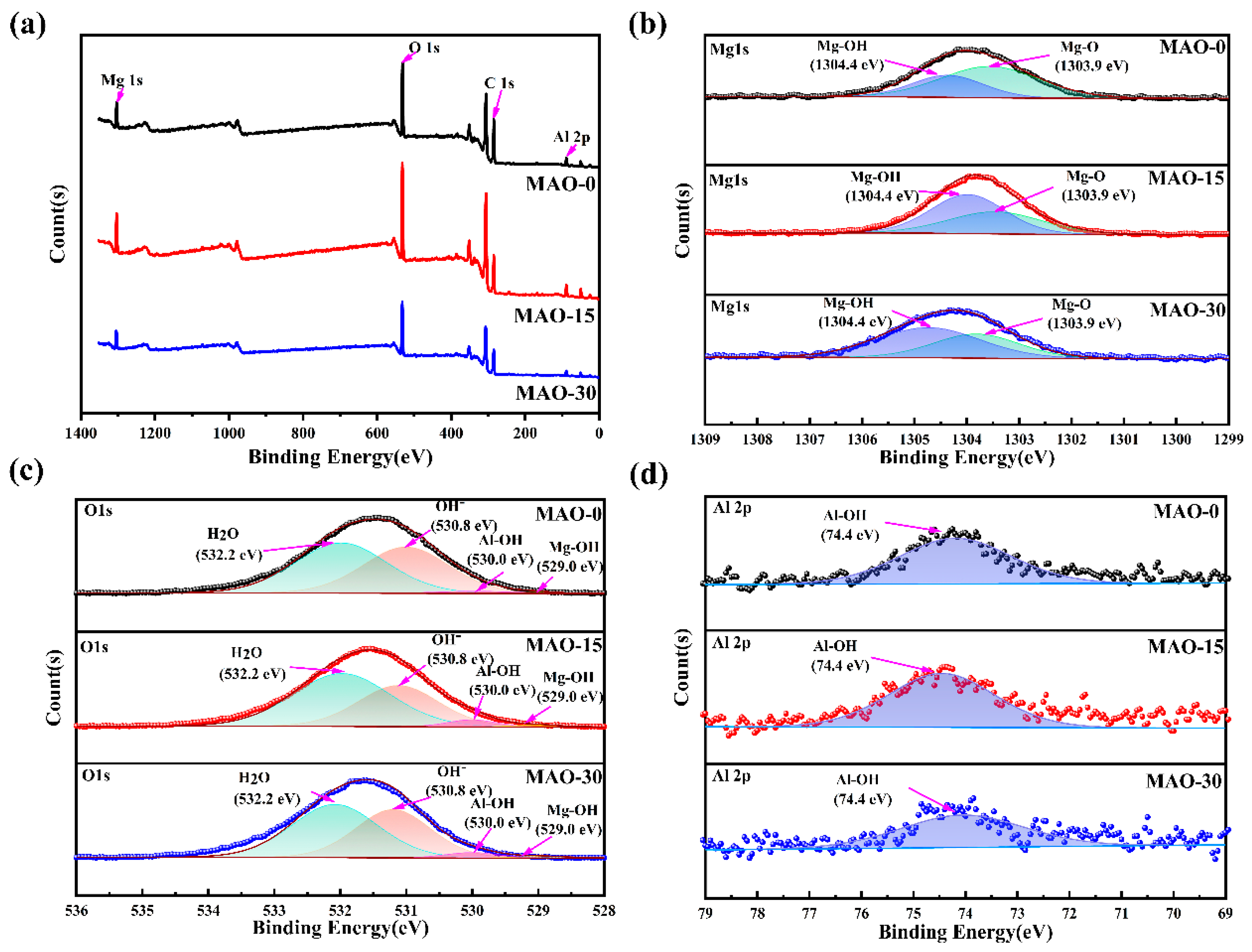
X-ray photoelectron spectroscopy (XPS) was employed to systematically investigate the surface chemical composition and bonding states of the MAO coatings (MAO–0, MAO–15, and MAO–30). As shown in Figure 6b, the Mg 1s peak at 1303.9 eV corresponds to MgO formed during the MAO process. This result confirms that MgO is the primary component of the MAO coating. The Mg 1s peak at 1304.4 eV is attributed to Mg-OH formed on the coating surface [58]. The O 1s spectra at 532.2, 530.8, 530.0, and 529.0 eV have four peaks attributed to H2O [42], OH [59], Al-OH [59], and Mg-OH [60], respectively. Al 2p is located at 74.4 eV, which corresponds to Al-OH in the coatings. For the MAO–15 coating, the peaks of Mg-OH in the Mg 1s and the peaks of Al-OH in the O 1s and Al 2p have higher intensity, indicating that the formation of Mg-Al LDHs is more abundant on the surface. This coincides with the surface differences in Figure 3 and also corroborates the XRD and FT-IR (Figure 5) results.
In summary, MAO coatings with Mg-Al LDH flakes on the surface of the magnesium alloy are successfully formed on the AZ91 Mg alloy. The formation mechanism of Mg-Al LDH flakes is proposed as follows. The C3H8O3 added to the electrolyte is a polar molecule that can be easily adsorbed on the Mg alloy due to its strong binding energy with Mg surface [61]. Furthermore, C3H8O3 exhibits high surface activity, which can be attributed to its numerous free radicals and strong polar hydroxyl groups. Therefore, specific adsorption occurs at the interface between Mg alloy substrate and the electrolyte, which subsequently reduces the solid–liquid interfacial tension. The C3H8O3 molecule has the same structure with OH groups, and it can be inferred that intermolecular repulsive force between the interfacial OH groups decreases with the specific adsorption of the C3H8O3 molecule. Since they have similar polarity and affinity, OH groups tend to adsorb with C3H8O3 molecules. Consequently, the adsorption of negative ions at the interface between the Mg alloy surface and the electrolyte is enhanced under alkaline solution conditions. Driven by the electric field during MAO, OH groups accumulate at the solid–liquid interface, thereby promoting surface reactions on the coating.
The binding energy of oxides within the coating plays a critical role in influencing ion migration in an applied electric field [62]. On the AZ91 Mg alloy substrate, the Gibbs free energy of oxidation per equivalent differs between Mg and the alloying element Al. Thermodynamically, Mg oxidizes preferentially due to its lower Mg-O binding energy (394 kJ/mol) compared to Al-O (512 kJ/mol) during oxidation. As a result, Al3+ ions formed on the surface of the coatings migrate outwards more slowly than Mg2+ ions, which leads to a gradual enrichment of Al3+ ions on the sample surface [45,63]. The degree of enrichment of Al3+ ions on the surface is an important factor in the formation of LDHs on the surface of the samples. With the addition of C3H8O3 in the electrolyte, the coating surface reaction during the MAO process is enhanced, with Al participating the oxidation reaction together with Mg, resulting in the formation of the Mg-Al LDHs according to the reactions (1–6). During the microarc oxidation (MAO) process, the addition of C3H8O3 reduces the solid–liquid interfacial tension, promoting the diffusion of the electrolyte at the interface and enhancing the adsorption of negative ions near the anode/electrolyte interface. This, in turn, catalyzes the coating surface reaction. At the initial stage of microarc oxidation, Mg reacts rapidly with H2O in the electrolyte to generate MgO under the effect of the applied electric field Meanwhile, the outward migration of Mg2+ ions from the Mg alloy substrate is fast, and Mg(OH)2 reacts rapidly with OH under the catalytic effect of C3H8O3 to generate Mg(OH)3− (Equations (1)–(3)). Furthermore, under the effect of the electric field, Al3+ ions in the Mg alloy substrate also rapidly form hydroxides in an alkaline condition according to Equations (3) and (4). In alkaline solutions, these reactions with OH reactions work together to form the Mg-Al LDHs as Equation (5). The main reaction equations are as follows:
Mg + H2O → MgO + H2
MgO + H2O → Mg(OH)2
Mg(OH)2 + OH → Mg(OH)3−
Al3+ + 3 OH → Al(OH)3
Al(OH)3 + OH → Al(OH)4−
(1−x)Mg(OH)3− + xAl(OH)4− + OH + mH2O → [Mg2+1−xAl3+x(OH)2]x+[OH]x·mH2
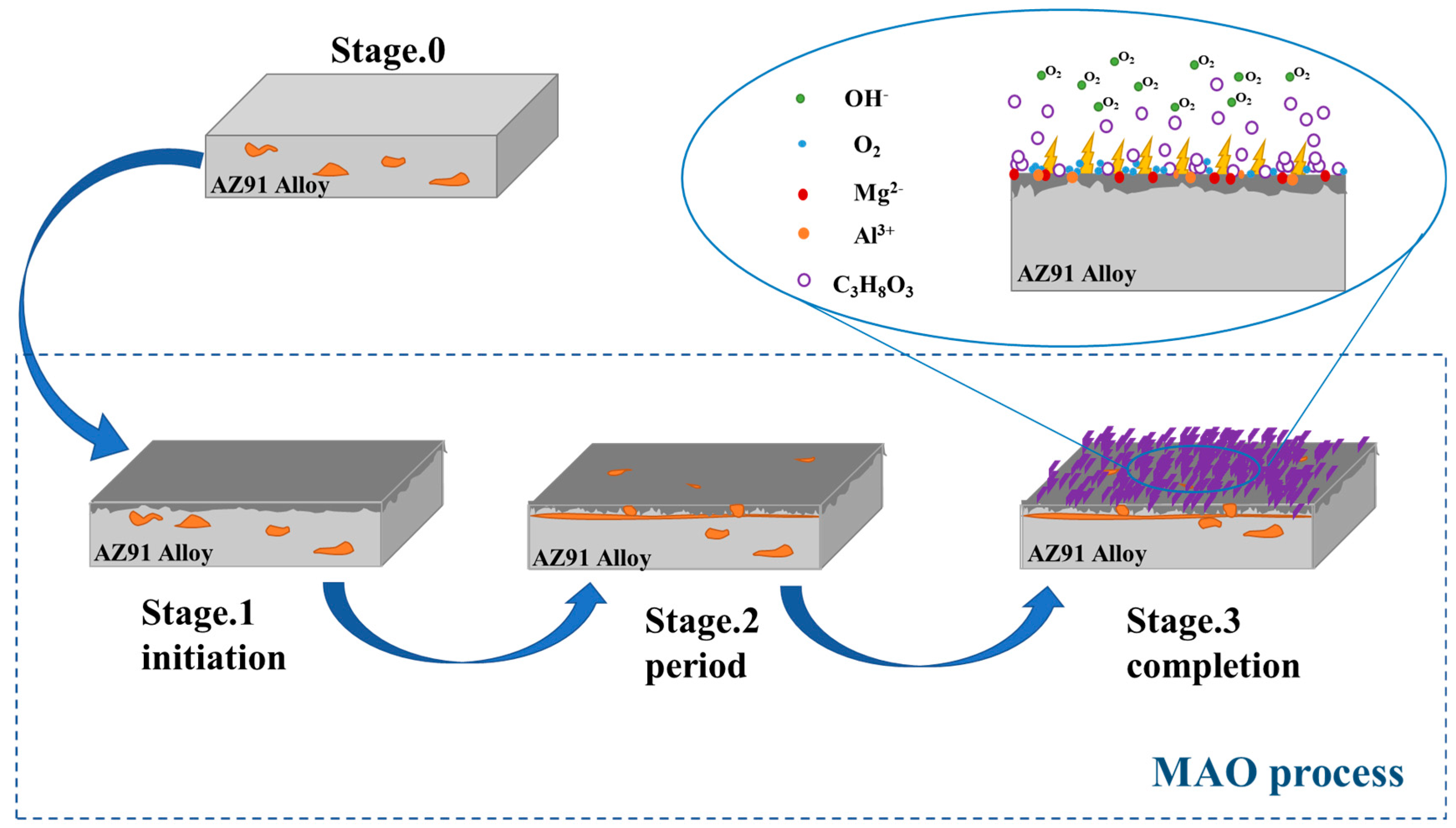
Based on the comprehensive characterization results, Figure 7 proposes a mechanistic model for the formation of MAO coatings. During the coating growth process, the surface morphology, as well as the number and size of cracks and pores, varied significantly with different concentrations of C3H8O3. In the absence of C3H8O3, the coating exhibits numerous small-sized pores and cracks. At the same time, a small number of LDH flakes can be observed on the coating surface, which is due to some Mg2+ ions and Al3+ ions being able to react with the free OH ions near the solid–liquid interface. With the addition of the C3H8O3, the inter-ion reaction rate is catalyzed, leading to a significant increase in the number of LDH flakes. The coating surfaces then appear tightly packed with continuous LDH flakes. At the same time, the pores and cracks are reduced accordingly, and some of the holes are sealed by the flakes. However, as the C3H8O3 concentration further increases, larger pores form in the coating. This is due to the higher final voltage of the microarc oxidation caused by the increased C3H8O3 content, leading to the appearance of a large, localized arc. Under the effect of high temperature from the large arc, the flakes partially melt, resulting in fewer flakes on the coating surface.

3.3. Coating Performance Evaluation

3.3.1. Hydrophobic Effect

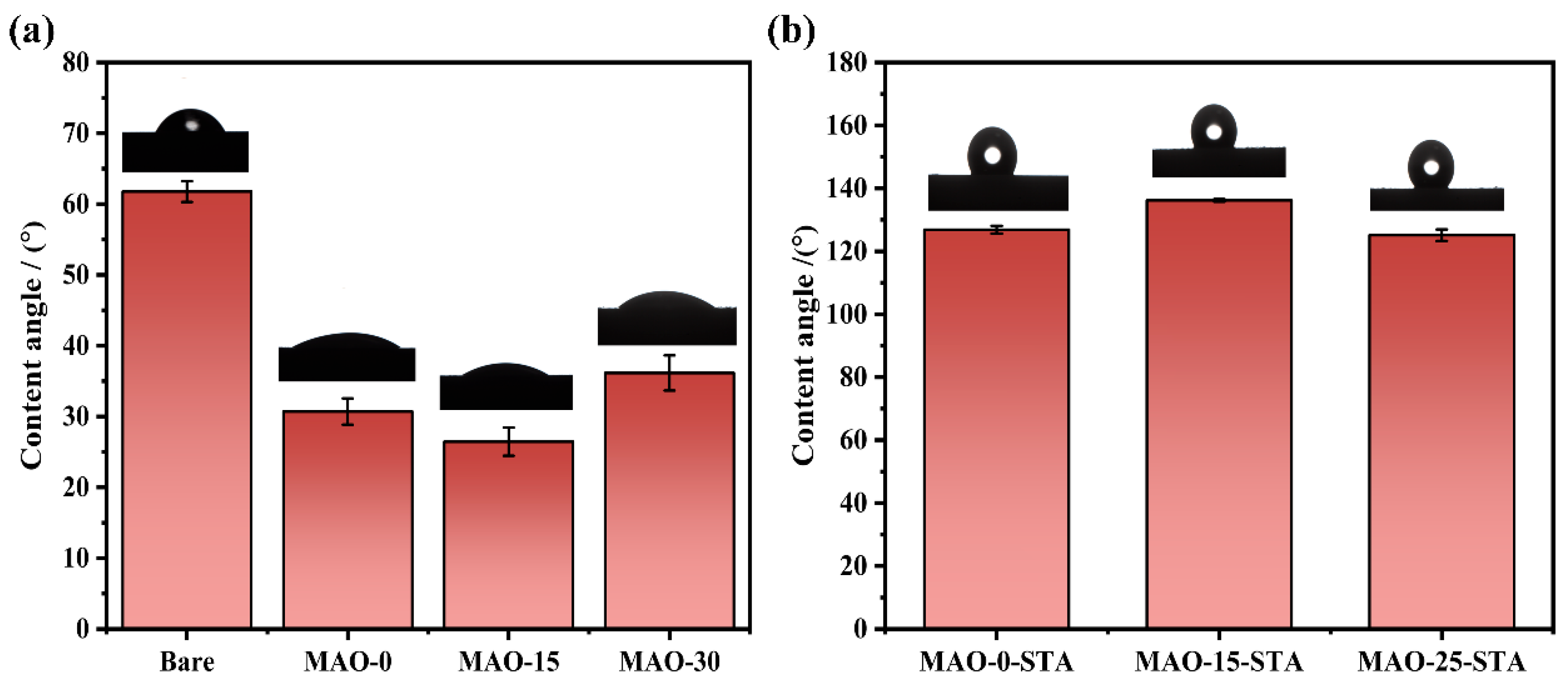
The surface wettability of the bare Mg alloy substrate, MAO–0, MAO–15, and MAO–30 coatings was characterized. Figure 8a shows that the water contact angle (WCA) of the bare Mg alloy substrate is approximately 61.76°. However, the WCAs for MAO–0, MAO–15, and MAO–30 are significantly reduced to 30.70°, 26.50°, and 36.15°, respectively, indicating that the MAO coatings exhibit good hydrophilicity. The hydrophilicity of the MAO coatings can be ascribed to the chemical compositions and surface microstructure. MgO is a compound with very good hydrophilicity. Furthermore, the roughness of the surface along with the pores and cracks make it more hydrophilic, especially for the MAO–15 coating. This observation is consistent with Wenzel’s theory, which suggests that increasing the surface roughness of a hydrophilic material enhances its wettability [64]. However, surface modification by using stearic acid (STA) significantly increases the water contact angles (WCAs) of the MAO coatings. As can be seen from Figure 8b, the MAO–0–STA, MAO–15–STA, and MAO–30–STA coatings show WCAs of 126.85°, 136.17°, and 125.12°, respectively. Notably, MAO–15–STA exhibits the largest water contact angle, deviating from hydrophilic property before modification to a near-superhydrophobic effect after modification. This phenomenon is primarily attributed to both the modification of STA and the distinctive hierarchical micro-nanostructures of LDHs formed on the coating surface.
Figure 9 shows the surface morphology and FT-IR spectra of the MAO coatings after surface modification. It can be seen from Figure 9a–c that the nano-lamellar structures of the MAO–0 and MAO–30 coatings nearly disappear, which is mainly due to the high temperature. For the MAO-15 coating, however, the lamellar structure is maintained after surface modification. The FTIR spectra (Figure 9d) reveal characteristic absorption bands at 1545 cm−1 and 1455 cm−1, which are assigned to the stretching vibrations of carbonyl (C=O) functional groups. These signatures indicate asymmetric C=O stretching in carboxylate moieties and symmetric C=O stretching or possible carbonate contamination [65], indicating the successful grafting of STA on the surface of the coatings.

3.3.2. Corrosion Resistance

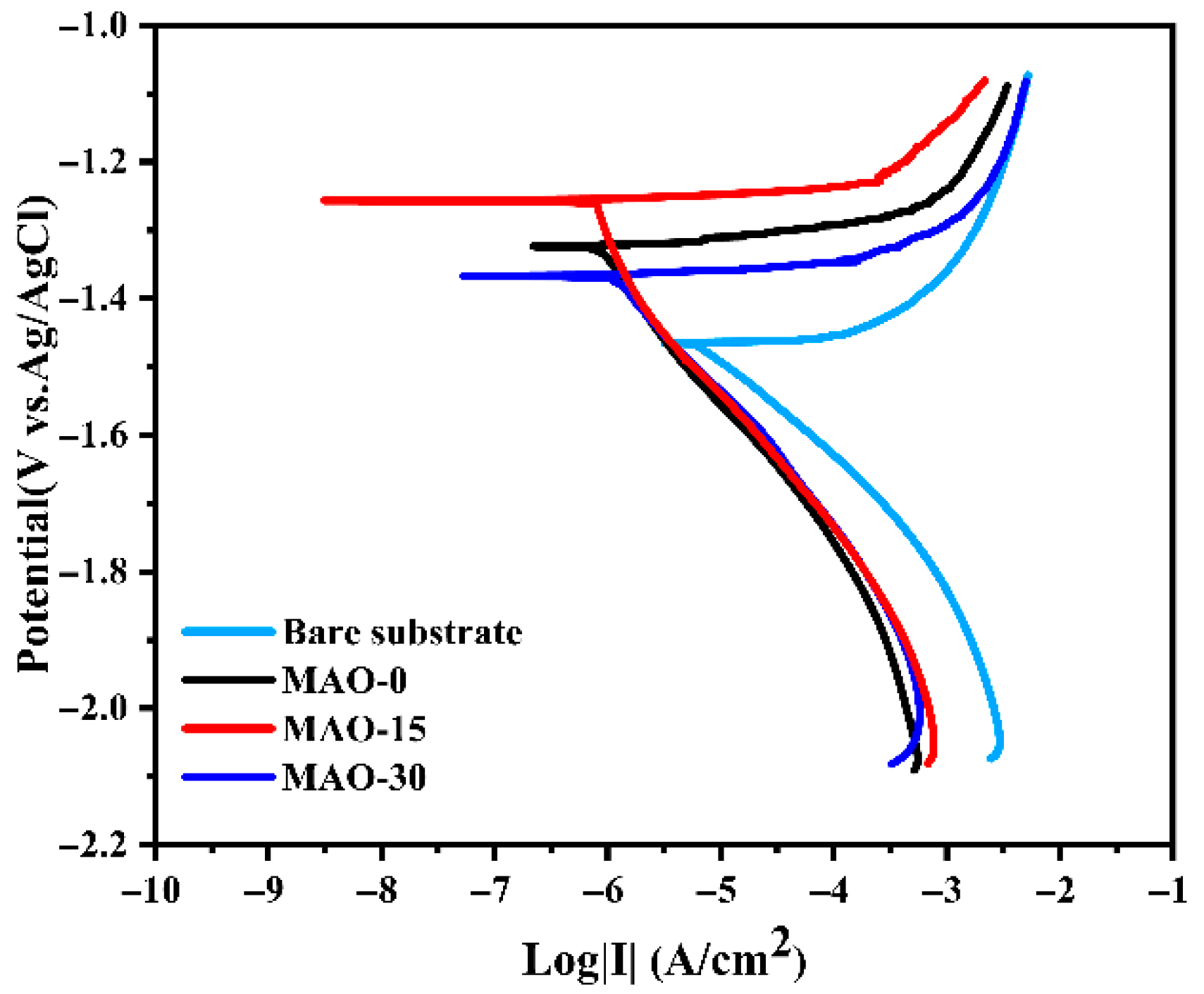
The corrosion resistance of bare and microarc oxidation (MAO)-coated AZ91 Mg alloys was systematically evaluated using electrochemical techniques complemented by hydrogen evolution measurements. Potentiodynamic polarization tests in 3.5 wt.% NaCl solution (Figure 10) revealed clear differences in electrochemical behavior between uncoated and MAO-treated samples. Through Tafel extrapolation analysis, critical parameters, including corrosion potential (Ecorr) and current density (icorr), were quantitatively determined (Table 1). Notably, the Ecorr values demonstrated a significant positive shift for MAO-coated specimens (−1.332 V for MAO–0, −1.259 V for MAO–15, and −1.367 V for MAO-30) compared to the bare alloy (−1.473 V), indicating enhanced corrosion protection. From kinetic and thermodynamic perspectives, the corrosion resistance of the coatings exhibits a positive correlation with their corrosion potential (Ecorr). The MAO–15 coating demonstrates the highest Ecorr value among all tested samples (−1.259 V vs. reference electrode), indicating its superior corrosion resistance in the aggressive 3.5 wt.% NaCl environment. For the MAO-coated samples, the MAO–15 coating exhibits the lowest corrosion current density (icorr = 4.88 × 10⁻⁷ A/cm2), indicating its superior corrosion protection. This improvement can be attributed to the sealing effect of LDHs on the pores and cracks within the coating. Furthermore, the MAO-30 coating shows reduced corrosion resistance compared to the MAO–15 coating. This can be ascribed to the formation of larger pores on the coating surface caused by strong arcs during the MAO process (Figure 2b and Figure 3a–i), which decreases the integrity of the coating.
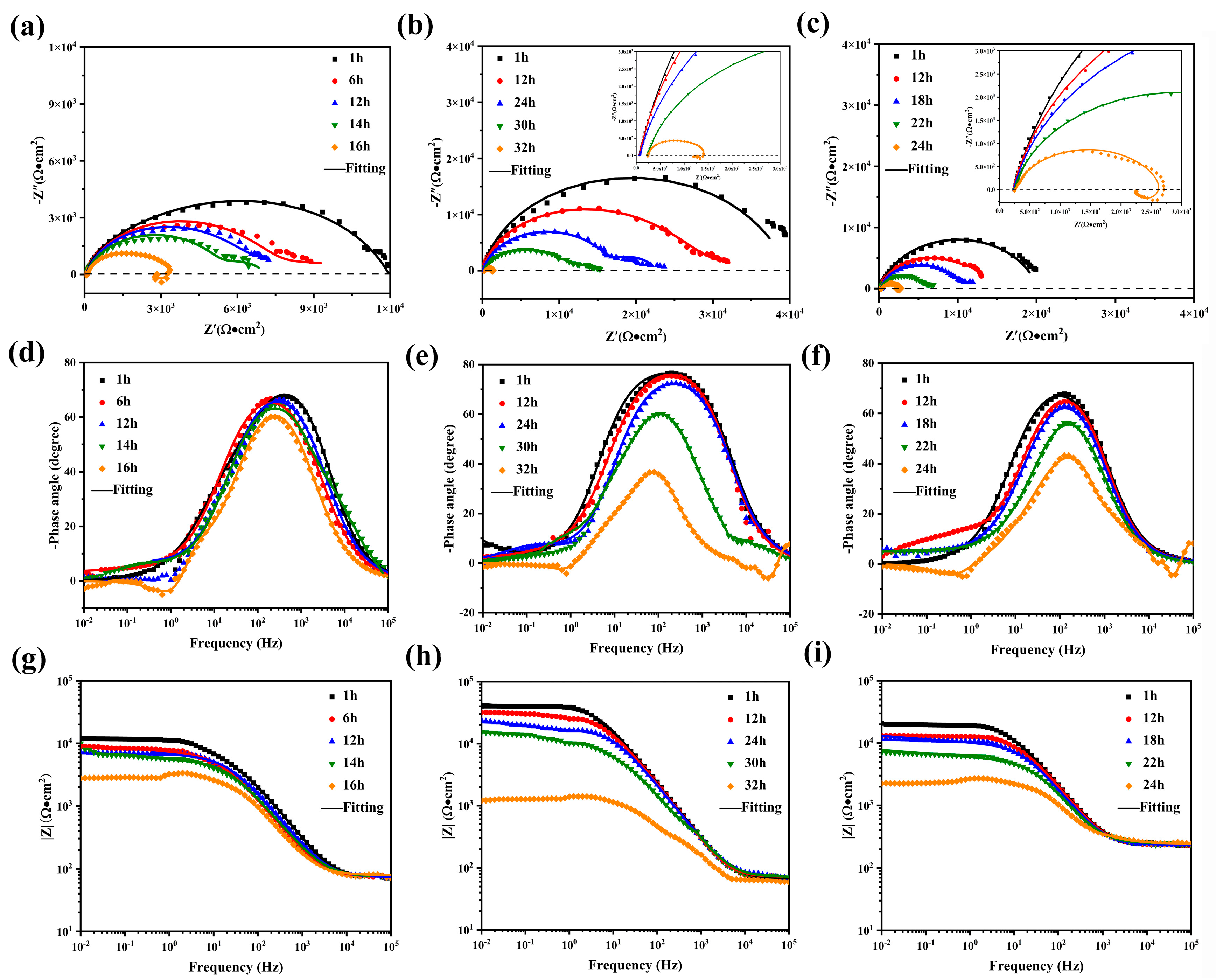
Electrochemical impedance spectroscopy (EIS) was systematically employed to evaluate the corrosion protection performance of the MAO coatings. The Nyquist and Bode plots are presented in Figure 11. In general, the capacitive loop diameter can be indicative of the overall corrosion resistance of the coating. A larger axial radius of the capacitive loop signifies better corrosion resistance, whereas the appearance of the inductive loop is attributed to the corrosion behavior of the magnesium substrate [19]. From the Nyquist plots (Figure 11a–c), it can be seen that the MAO–15 coating exhibits the largest radius of the capacitive loop, while the MAO–0 coating showed the smallest radius of capacitive loop after 1 h immersion in 3.5 wt% NaCl solution, indicating that the MAO–15 coating has much better corrosion resistance than the MAO–0 coating. The MAO–0 and MAO–30 coatings show inductive loops after 16h and 24h immersion tests, respectively, which means that the corrosive medium has penetrated through the coating to corrode the Mg alloy substrate. Furthermore, by analyzing the |Z|0.01Hz values from Bode plots, it is possible to assess and compare the corrosion resistance among various specimens. As observed, the|Z|0.01Hz values of all coatings decreased with the immersion time, suggesting a gradual decrease in the corrosion protection of the coatings. As shown in Figure 11d,f, the |Z|0.01Hz values of the MAO–0 and MAO–30 coatings decrease significantly to less than 104 Ω⋅cm2 after longer immersion. The phase–frequency Bode plots (Figure 11g,i) reveal negative phase angles (<0°) at low frequencies (0.01–0.1 Hz) for MAO coatings, further indicating a significant reduction in the protective performance of the MAO coating. When comparing the overall |Z|0.01Hz values, the corrosion resistance ranking is MAO–15 > MAO–30 > MAO–0, further confirming the enhanced corrosion resistance provided by the LDHs on the MAO–15 coating.
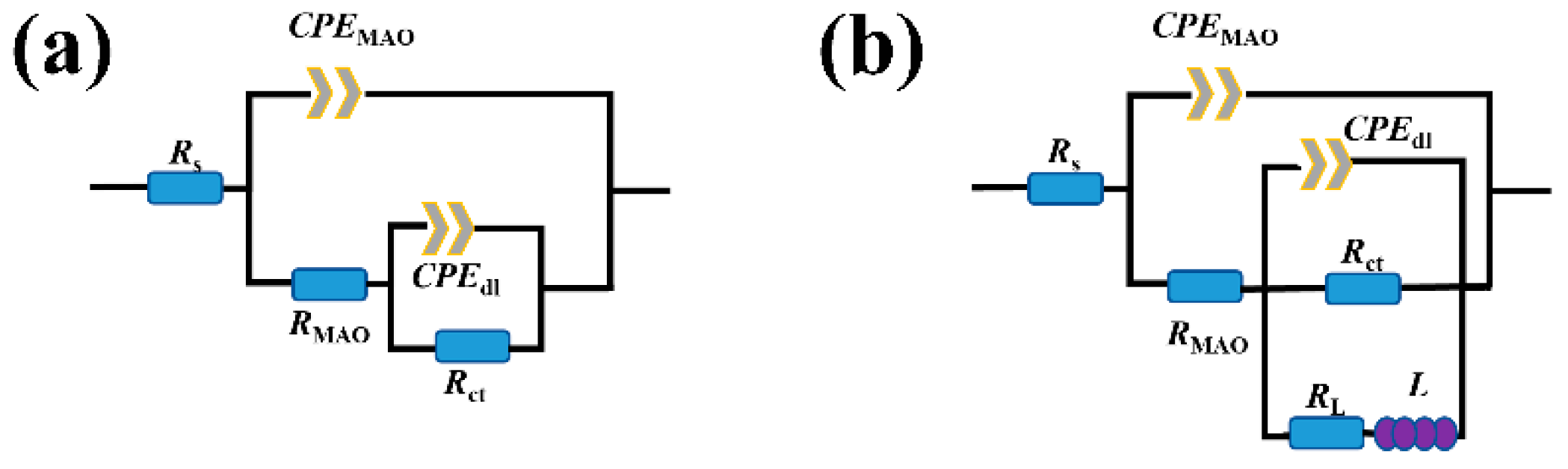
The EIS plots in Figure 11 were fitted to further analyze the corrosion behavior of the coatings. According to the EIS plots, two equivalent circuit (EC) models were proposed to fit the EIS data, respectively. The EC models depicted in Figure 12a were utilized for the EIS data of the MAO–0 coating after 1, 6, 12, and 14 h of immersion; MAO–15 coating after 1, 12, 24, and 30 h of immersion; and MAO–30 coating after 1, 12, 18, and 22 h of immersion, while the EIS data of the MAO–0 coating after 16 h of immersion and MAO–15 coating after 32 h after immersion are consistent with the EC model shown in Figure 12b. [66]. Rs represents the solution resistance, while CPEMAO and CPEdl correspond to the capacitance of the MAO coating and the capacitance of the electrical double layer at the coating/substrate interface, respectively, and RMAO and Rct correspond to the resistance of the MAO coating and charge transfer resistance at the interface, respectively. In addition, an inductive element (L) and inductance resistance (RL) are used to represent the inductance behavior of the MAO coating. The corresponding fitting results are listed in Table 2, Table 3 and Table 4.
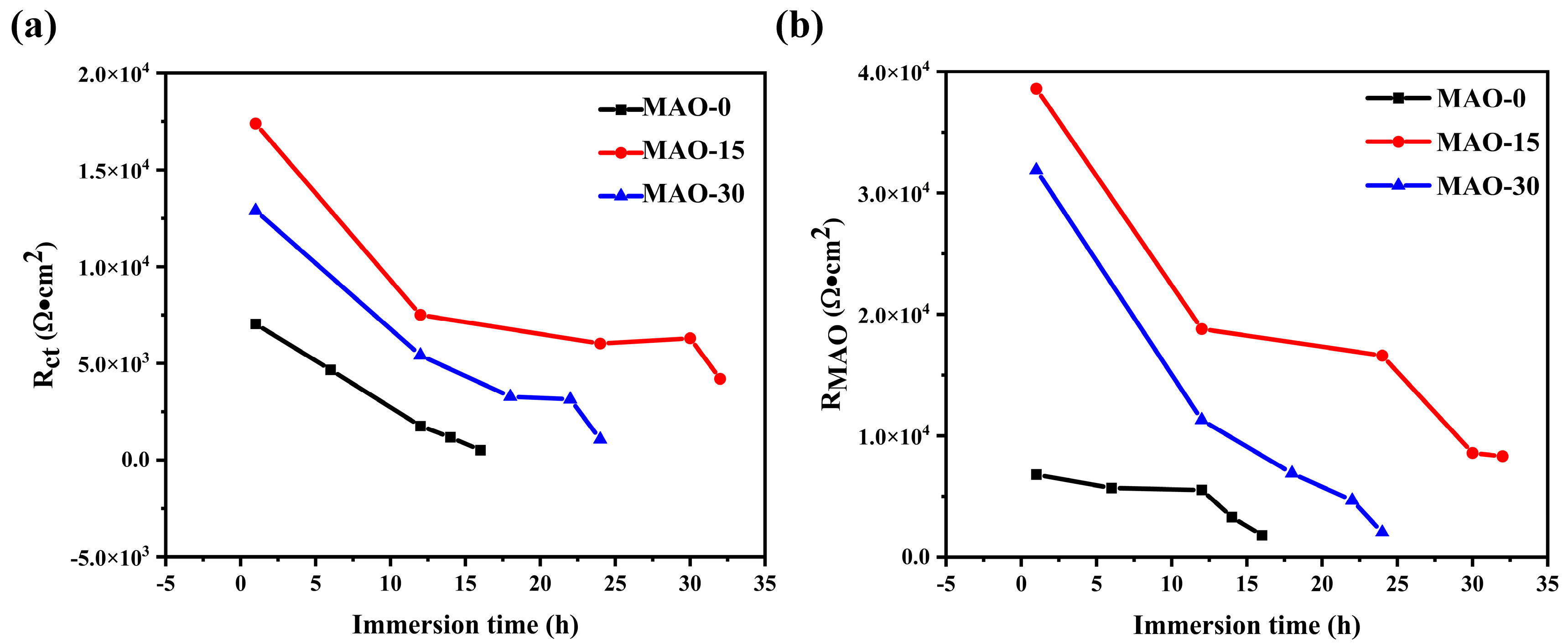
The overall corrosion resistance of the coatings, which is indicated by the changes in coating resistance (RMAO) and charge transfer resistance (Rct) over time of immersion, is shown in Figure 13. A higher RMAO value reflects better durability and protective performance. Charge transfer resistance (Rct) reflects the kinetic barrier for ion migration across the double layer, with higher values indicating superior corrosion resistance. As shown in Figure 13, the MAO–0 coating has the lowest RMAO value, which is only 1.80 × 10³ Ω/cm2 after immersion for 16 h. The MAO–15 coating still has a high RMAO value after immersion for 30 h, indicating that this coating has better durability and protection performance. It is worth noting that the RMAO value of the MAO–15 coating also decreased significantly after a long time of immersion, which may be related to the fact that the coating has a hydrophilic effect and is easily penetrated by corrosive medium [44]. Furthermore, the Rct values also exhibit a similar trend, highlighting that the MAO–15 coating possesses the highest Rct value. In summary, the corrosion protection performance of the coatings evaluated by EIS tests is consistent with the results of potentiodynamic polarization curves.
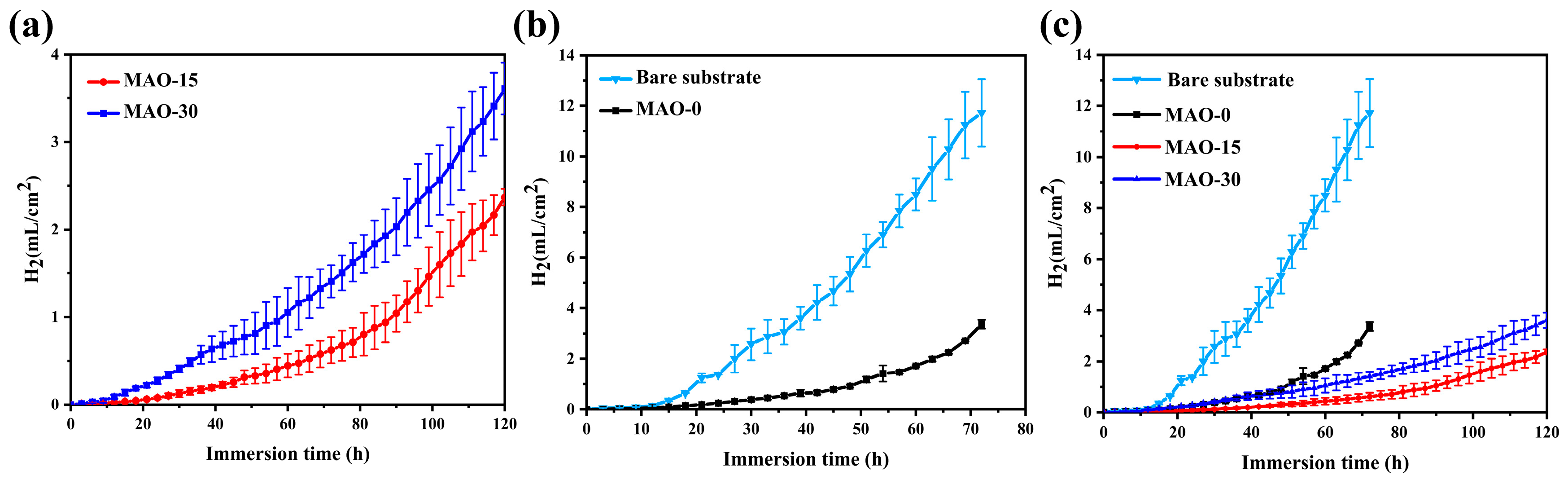
It is known that the hydrogen evolution measurements can be used to indicate the dissolution of the Mg substrate and the corrosion protection performance of the coatings. The cumulative hydrogen volume versus immersion time of bare AZ91 Mg alloy and MAO coatings immersed in 3.5 wt.% NaCl solution is shown in Figure 14. It can be seen from Figure 14a,b that the bare AZ91 Mg alloy has a much higher hydrogen evolution rate than the MAO coatings. In contrast, the MAO–0 coating shows a significant increase in the hydrogen evolution rate after 50 h of immersion, which can be attributed to the corrosion of the Mg alloy. In comparison, the MAO–15 coating demonstrates the least hydrogen evolution throughout the immersion process, suggesting the best corrosion protection. The experimental results are in good agreement with the electrochemical corrosion tests.
Both electrochemical analyses (Figure 10 and Figure 11) and hydrogen evolution tests (Figure 14) indicate that the MAO–15 coating with large number of LDHs exhibit superior corrosion resistance. On one hand, the LDHs partially seal the defects of the MAO coating, thereby enhancing its physical barrier properties. On the other hand, LDHs are able to trap Cl in the corrosive medium and form an ion-enriched barrier on the surface due to the greater exchange of OH anions than Cl [34,35,67]. However, it can be observed that the corrosion resistance of the MAO–15 coating also showed a significant decrease at the late stage of immersion, which is mainly attributed to the fact that the defects of the MAO–15 coating were not completely sealed by the LDHs (Figure 3). In addition, the MAO–15 coating exhibits a noticeable hydrophilic effect, which is beneficial for the absorption of more corrosive medium to deteriorate the long-term protection performance [68].
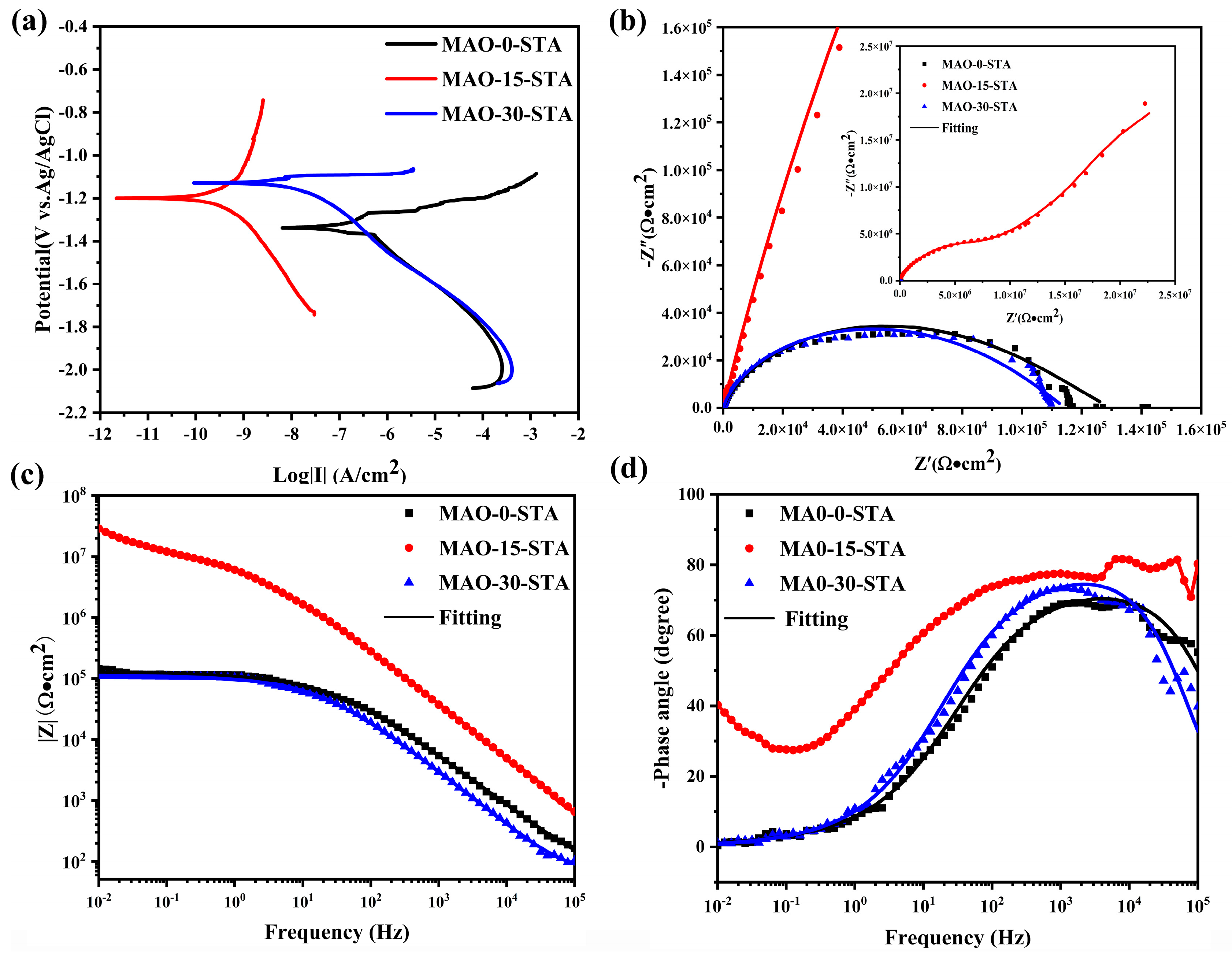
The corrosion properties of the MAO coatings modified by stearic acid (STA) were also evaluated. Figure 15a shows the potentiodynamic polarization curves of the MAO–0–STA, MAO–15–STA, and MAO–30–STA coatings in 3.5 wt% NaCl solution, and the fitting results are shown in Table 5. Compared with the MAO–0–STA film, the MAO–15–STA and MAO–30–STA films exhibit a positive shift in corrosion potential and reduced corrosion current density, indicating that the STA modification greatly decreases the corrosion tendency of the coatings. The electrochemical impedance spectra of the STA modified coatings in 3.5 wt% NaCl solution are presented in Figure 15b–d. The corresponding fitting results are listed in Table 6, and the equivalent circuit diagrams used for the fitting are shown in Figure 12a and Figure 15b. Warburg impedance is introduced in Figure 15b, and (Zw) is the diffusion resistance, which embodies the diffusion ability of the coating, and is used to characterize the interlayer ion exchange process of the LDHs [35]. The larger (Zw) of the coating indicates that it has a better ion exchange ability, which is conducive to minimizing the presence of Cl on the surface of the film in the corrosive solution, thus slowing down the corrosion process. From Table 6, it can be seen that the MAO–STA coatings have greatly higher RMAO values when compared to the MAO coatings. This is mainly attributed to the hydrophobicity of the MAO–STA coatings enhancing the protective performance. Among them, MAO–15–STA exhibits a much lower corrosion current density compared to the MAO-0-STA and MAO–30–STA coatings. Furthermore, the MAO–15–STA coating has the largest Rct values and RMAO values according to Table 6, which shows the best corrosion protection performance.
It is evident that the improved corrosion protection of the coatings can be attributed to the hydrophobicity resulting from modification with stearic acid. The hydrophobic properties reduce the contact area between the sample surface and the corrosive medium, thereby decreasing the penetration of corrosive medium. The formation of well-defined LDHs on the MAO–15 coating further enhances the hydrophobic effect, which contributes to the best corrosion resistance by acting as a barrier against the corrosive medium. The hydrophobic organic layer introduced by stearic acid modification effectively reduces the direct contact area between corrosive media and the coating through a physical barrier effect, thereby significantly enhancing the protective performance of the coating. This hydrophobic effect, in conjunction with the ion exchange and physical sealing functions of the LDH layer, collectively contributes to the excellent corrosion resistance of the composite coating.

4. Conclusions

In this study, MAO coatings with Mg–Al–LDHs were fabricated on AZ91 Mg alloy in a low-voltage process. The main findings are as follows:
  • Mg-Al LDHs with hydroxides were formed in situ on Mg alloy under low voltage conditions with a high concentration of NaOH electrolyte and the addition of C3H8O3.
  • The necessary species for the formation of the Mg-Al LDHs include Mg2+, Al3+, and OH. Mg2+ and Al3+ are derived from the AZ91 Mg alloy substrate, while OH is provided by the alkaline electrolyte. Introducing C3H8O3 into the electrolyte enhances the surface reaction and facilitates the formation of Mg-Al LDHs. The optimal concentration of C3H8O3 is 15 mL/L.
  • The MAO coating with Mg–Al–LDHs on AZ91 magnesium alloy originally exhibited hydrophilicity and transformed into a nearly superhydrophobic state after surface modification by stearic acid.
  • The MAO coating with Mg–Al–LDHs on AZ91 magnesium alloy showed enhanced corrosion resistance. After surface modification, the corrosion current density (icorr) decreased by 6 orders of magnitude, indicating a significant improvement in corrosion protection.

Author Contributions

L.S.: Investigation, Formal analysis, Writing—original draft. X.L.: Investigation, Validation. P.L.: Investigation, Validation. C.L.: Resources, Project administration, Funding acquisition. J.L.: Resources, Writing—review and editing, Supervision, Project administration, Funding acquisition. All authors have read and agreed to the published version of the manuscript.

Funding

This work was financially supported by Priority Academic Program Development of Jiangsu Higher Education Institutions (PAPD) and National Natural Science Foundation of China [Grant No. 51901099].

Data Availability Statement

The original contributions presented in this study are included in the article. Further inquiries can be directed to the corresponding authors.

Conflicts of Interest

The authors declare no conflicts of interest.

References

  1. Atrens, A.; Song, G.-L.; Liu, M.; Shi, Z.; Cao, F.; Dargusch, M.S. Review of Recent Developments in the Field of Magnesium Corrosion. Adv. Eng. Mater. 2015, 17, 400–453. [Google Scholar] [CrossRef]
  2. Li, G.Y.; Lian, J.S.; Niu, L.Y.; Jiang, Z.H.; Jiang, Q. Growth of Zinc Phosphate Coatings on AZ91D Magnesium Alloy. Surf. Coat. Technol. 2006, 201, 1814–1820. [Google Scholar] [CrossRef]
  3. Esmaily, M.; Svensson, J.E.; Fajardo, S.; Birbilis, N.; Frankel, G.S.; Virtanen, S.; Arrabal, R.; Thomas, S.; Johansson, L.G. Fundamentals and Advances in Magnesium Alloy Corrosion. Prog. Mater. Sci. 2017, 89, 92–193. [Google Scholar] [CrossRef]
  4. Heakal, F.E.-T.; Fekry, A.M.; Jibril, M.A.E.-B. Electrochemical Behaviour of the Mg Alloy AZ91D in Borate Solutions. Corros. Sci. 2011, 53, 1174–1185. [Google Scholar] [CrossRef]
  5. Pardo, A.; Merino, M.C.; Coy, A.E.; Arrabal, R.; Viejo, F.; Matykina, E. Corrosion Behaviour of Magnesium/Aluminium Alloys in 3.5 Wt.% NaCl. Corros. Sci. 2008, 50, 823–834. [Google Scholar] [CrossRef]
  6. Yeganeh, M.; Mohammadi, N. Superhydrophobic Surface of Mg Alloys: A Review. J. Magnes. Alloys 2018, 6, 59–70. [Google Scholar] [CrossRef]
  7. Zhang, C.; Wu, L.; Liu, H.; Huang, G.; Jiang, B.; Atrens, A.; Pan, F. Microstructure and Corrosion Behavior of Mg-Sc Binary Alloys in 3.5 Wt.% NaCl Solution. Corros. Sci. 2020, 174, 108831. [Google Scholar] [CrossRef]
  8. Wu, G.; Ibrahim, J.M.; Chu, P.K. Surface Design of Biodegradable Magnesium Alloys—A Review. Surf. Coat. Technol. 2013, 233, 2–12. [Google Scholar] [CrossRef]
  9. Lin, E.; Li, X.; Kure-Chu, S.-Z.; Li, X.; Xiao, X. Effect of Electrical Parameters on the Microstructure and Corrosion Resistance of Anodized Film of Mg-1Zn-1Gd Alloy Based on Orthogonal Experiment Method. J. Mater. Eng. Perform. 2024, 33, 5049–5060. [Google Scholar] [CrossRef]
  10. Duan, G.; Yang, L.; Liao, S.; Zhang, C.; Lu, X.; Yang, Y.; Zhang, B.; Wei, Y.; Zhang, T.; Yu, B.; et al. Designing for the Chemical Conversion Coating with High Corrosion Resistance and Low Electrical Contact Resistance on AZ91D Magnesium Alloy. Corros. Sci. 2018, 135, 197–206. [Google Scholar] [CrossRef]
  11. Zhang, C.; Liao, S.; Yu, B.; Lu, X.; Chen, X.-B.; Zhang, T.; Wang, F. Ratio of Total Acidity to pH Value of Coating Bath: A New Strategy towards Phosphate Conversion Coatings with Optimized Corrosion Resistance for Magnesium Alloys. Corros. Sci. 2019, 150, 279–295. [Google Scholar] [CrossRef]
  12. Keuter, P.; To Baben, M.; Aliramaji, S.; Schneider, J.M. CALPHAD-Based Modelling of the Temperature-Composition-Structure Relationship during Physical Vapor Deposition of Mg-Ca Thin Films. Materials 2023, 16, 2417. [Google Scholar] [CrossRef]
  13. Li, S.; Bacco, A.C.; Birbilis, N.; Cong, H. Passivation and Potential Fluctuation of Mg Alloy AZ31B in Alkaline Environments. Corros. Sci. 2016, 112, 596–610. [Google Scholar] [CrossRef]
  14. Pinto, R.; Ferreira, M.G.S.; Carmezim, M.J.; Montemor, M.F. Passive Behavior of Magnesium Alloys (Mg-Zr) Containing Rare-Earth Elements in Alkaline Media. Electrochim. Acta 2010, 55, 2482–2489. [Google Scholar] [CrossRef]
  15. Campo, M.; Carboneras, M.; Lopez, M.D.; Torres, B.; Rodrigo, P.; Otero, E.; Rams, J. Corrosion Resistance of Thermally Sprayed Al and Al/SiC Coatings on Mg. Surf. Coat. Technol. 2009, 203, 3224–3230. [Google Scholar] [CrossRef]
  16. Xiong, W.; Fu, J.; Liu, C.; Li, L.; Wang, H.; Zhang, M.; Ge, Z.; Zhang, T.; Wang, Q. Laser-Chemical Surface Treatment for Enhanced Anti-Corrosion and Antibacterial Properties of Magnesium Alloy. Coatings 2024, 14, 287. [Google Scholar] [CrossRef]
  17. Chen, Y.; Wu, L.; Yao, W.; Wu, J.; Xiang, J.; Dai, X.; Wu, T.; Yuan, Y.; Wang, J.; Jiang, B.; et al. Development of Metal-Organic Framework (MOF) Decorated Graphene Oxide/MgAl-Layered Double Hydroxide Coating via Microstructural Optimization for Anti-Corrosion Micro-Arc Oxidation Coatings of Magnesium Alloy. J. Mater. Sci. Technol. 2022, 130, 12–26. [Google Scholar] [CrossRef]
  18. Grubac, Z.; Roncevic, I.S.; Metikos-Hukovic, M. Corrosion Properties of the Mg Alloy Coated with Polypyrrole Films. Corros. Sci. 2016, 102, 310–316. [Google Scholar] [CrossRef]
  19. Cui, L.-Y.; Gao, S.-D.; Li, P.-P.; Zeng, R.-C.; Zhang, F.; Li, S.-Q.; Han, E.-H. Corrosion Resistance of a Self-Healing Micro-Arc Oxidation/Polymethyltrimethoxysilane Composite Coating on Magnesium Alloy AZ31. Corros. Sci. 2017, 118, 84–95. [Google Scholar] [CrossRef]
  20. Farshid, S.; Kharaziha, M.; Atapour, M. A Self-Healing and Bioactive Coating Based on Duplex Plasma Electrolytic Oxidation/Polydopamine on AZ91 Alloy for Bone Implants. J. Magnes. Alloys 2023, 11, 592–606. [Google Scholar] [CrossRef]
  21. Chen, W.H.; Huang, S.-Y.; Chu, Y.-R.; Yang, S.-H.; Cheng, I.-C.; Jian, S.-Y.; Lee, Y.-L. Effect of TiO2 Nanoparticles on the Corrosion Resistance, Wear, and Antibacterial Properties of Microarc Oxidation Coatings Applied on AZ31 Magnesium Alloy. Surf. Coat. Technol. 2024, 476, 130238. [Google Scholar] [CrossRef]
  22. Zhang, G.; Wu, L.; Serdechnova, M.; Tang, A.; Wang, C.; Blawert, C.; Pan, F.; Zheludkevich, M.L. In-Situ LDHs Growth on PEO Coatings on AZ31 Magnesium Alloy for Active Protection: Roles of PEO Composition and Conversion Solution. J. Magnes. Alloys 2023, 11, 2376–2391. [Google Scholar] [CrossRef]
  23. Kaseem, M.; Hussain, T.; Rehman, Z.U.; Ko, Y.G. Stabilization of AZ31 Mg Alloy in Sea Water via Dual Incorporation of MgO and WO3 during Micro-Arc Oxidation. J. Alloys Compd. 2021, 853, 157036. [Google Scholar] [CrossRef]
  24. Qian, K.; Li, W.; Lu, X.; Han, X.; Jin, Y.; Zhang, T.; Wang, F. Effect of Phosphate-Based Sealing Treatment on the Corrosion Performance of a PEO Coated AZ91D Mg Alloy. J. Magnes. Alloys 2020, 8, 1328–1340. [Google Scholar] [CrossRef]
  25. Mashtalyar, D.; Nadaraia, K.; Plekhova, N.G.; Imshinetskiy, I.M.; Piatkova, M.A.; Pleshkova, A.; Kislova, S.E.; Sinebryukhov, S.L.; Gnedenkov, S. Antibacterial Ca/P-Coatings Formed on Mg Alloy Using Plasma Electrolytic Oxidation and Antibiotic Impregnation. Mater. Lett. 2022, 317, 132099. [Google Scholar] [CrossRef]
  26. Zhang, X.; Wu, Y.; Lv, Y.; Yu, Y.; Dong, Z. Formation Mechanism, Corrosion Behaviour and Biological Property of Hydroxyapatite/TiO2 Coatings Fabricated by Plasma Electrolytic Oxidation. Surf. Coat. Technol. 2020, 386, 125483. [Google Scholar] [CrossRef]
  27. Zhang, X.; Lv, Y.; Cai, G.; Fu, S.; Yang, L.; Ma, Y.; Dong, Z. Reactive Incorporation of Ag into Porous TiO2 Coating and Its Influence on Its Microstructure, in Vitro Antibacterial Efficacy and Cytocompatibility. Prog. Nat. Sci. 2021, 31, 215–229. [Google Scholar] [CrossRef]
  28. Chen, L.; Zhao, R.; Qi, H.; Chen, D.; Zhou, S.; Wang, X.; Li, W. Influence of Voltage Modes on Microstructure and Corrosion Resistance of Micro-Arc Oxidation Coating on Magnesium Alloy. J. Adhes. Sci. Technol. 2023, 37, 2232–2246. [Google Scholar] [CrossRef]
  29. Zhou, S.; Chen, L.; Lv, W.; Gu, J.; Ye, F.; Oleksandr, D.; Lu, S.; Wang, Z. Growth Pattern of MAO Coating under Constant Voltage-Current Two-Step Power Mode. J. Iron Steel Res. Int. 2025, 32, 1245–1262. [Google Scholar] [CrossRef]
  30. Jijoe, P.S.; Yashas, S.R.; Shivaraju, H.P. Fundamentals, Synthesis, Characterization and Environmental Applications of Layered Double Hydroxides: A Review. Environ. Chem. Lett. 2021, 19, 2643–2661. [Google Scholar] [CrossRef]
  31. Guo, L.; Wu, W.; Zhou, Y.; Zhang, F.; Zeng, R.; Zeng, J. Layered Double Hydroxide Coatings on Magnesium Alloys: A Review. J. Mater. Sci. Technol. 2018, 34, 1455–1466. [Google Scholar] [CrossRef]
  32. To, T.X.H.; Trinh, A.T.; Nguyen, T.D.; Pebere, N.; Olivier, M.-G. Layered Double Hydroxides as Containers of Inhibitors in Organic Coatings for Corrosion Protection of Carbon Steel. Prog. Org. Coat. 2012, 74, 343–348. [Google Scholar] [CrossRef]
  33. Tan, J.K.E.; Balan, P.; Birbilis, N. Advances in LDH Coatings on Mg Alloys for Biomedical Applications: A Corrosion Perspective. Appl. Clay Sci. 2021, 202, 105948. [Google Scholar] [CrossRef]
  34. Chen, J.; Lin, W.; Liang, S.; Zou, L.; Wang, C.; Wang, B.; Yan, M.; Cui, X. Effect of Alloy Cations on Corrosion Resistance of LDH/MAO Coating on Magnesium Alloy. Appl. Surf. Sci. 2019, 463, 535–544. [Google Scholar] [CrossRef]
  35. Li, C.-Y.; Gao, L.; Fan, X.-L.; Zeng, R.-C.; Chen, D.-C.; Zhi, K.-Q. In Vitro Degradation and Cytocompatibility of a Low Temperature In-Situ Grown Self-Healing Mg-Al LDH Coating on MAO-Coated Magnesium Alloy AZ31. Bioact. Mater. 2020, 5, 364–376. [Google Scholar] [CrossRef] [PubMed]
  36. Li, H.; Cui, H.; Li, L.; Zhang, Y.; Wang, Q.; Wei, N.; Song, X.; Shao, S.; Mao, N. Incorporation of Nanometer-Sized Layered Double Hydroxide with Anions That Improve the Corrosion Resistance of Epoxy Polymer. ACS Appl. Nano Mater. 2023, 6, 20419–20430. [Google Scholar] [CrossRef]
  37. Das, J.; Patra, B.S.; Baliarsingh, N.; Parida, K.M. Adsorption of Phosphate by Layered Double Hydroxides in Aqueous Solutions. Appl. Clay Sci. 2006, 32, 252–260. [Google Scholar] [CrossRef]
  38. Li, L.; Warszawik, E.; van Rijn, P. pH-Triggered Release and Degradation Mechanism of Layered Double Hydroxides with High Loading Capacity. Adv. Mater. Interfaces 2023, 10, 2202396. [Google Scholar] [CrossRef]
  39. Chen, Y.; Wu, L.; Yao, W.; Zhong, Z.; Chen, Y.; Wu, J.; Pan, F. One-Step in Situ Synthesis of Graphene Oxide/MgAl-Layered Double Hydroxide Coating on a Micro-Arc Oxidation Coating for Enhanced Corrosion Protection of Magnesium Alloys. Surf. Coat. Technol. 2021, 413, 127083. [Google Scholar] [CrossRef]
  40. Li, Z.; Wang, Y.; Lu, X.; Chen, Q.; Zhou, Y.; Wang, F. Influence of Mg Substrate on the Formation Mechanism and Corrosion Resistance of LDH Films. Surf. Coat. Technol. 2024, 476, 130242. [Google Scholar] [CrossRef]
  41. Zeng, R.; Liu, Z.; Zhang, F.; Li, S.; He, Q.; Cui, H.; Han, E. Corrosion Resistance of In-Situ Mg-Al Hydrotalcite Conversion Film on AZ31 Magnesium Alloy by One-Step Formation. Trans. Nonferrous Met. Soc. China 2015, 25, 1917–1925. [Google Scholar] [CrossRef]
  42. Zhang, G.; Wu, L.; Tang, A.; Weng, B.; Atrens, A.; Ma, S.; Liu, L.; Pan, F. Sealing of Anodized Magnesium Alloy AZ31 with MgAl Layered Double Hydroxides Layers. RSC Adv. 2018, 8, 2248–2259. [Google Scholar] [CrossRef]
  43. Wang, H.; Song, Y.; Chen, X.; Tong, G.; Zhang, L. Microstructure and Corrosion Behavior of PEO-LDHs-SDS Superhydrophobic Composite Film on Magnesium Alloy. Corros. Sci. 2022, 208, 110699. [Google Scholar] [CrossRef]
  44. Jiang, D.; Xia, X.; Hou, J.; Cai, G.; Zhang, X.; Dong, Z. A Novel Coating System with Self-Reparable Slippery Surface and Active Corrosion Inhibition for Reliable Protection of Mg Alloy. Chem. Eng. J. 2019, 373, 285–297. [Google Scholar] [CrossRef]
  45. Zhang, X.; Zhang, Y.; Lv, Y.; Dong, Z.; Hashimoto, T.; Zhou, X. Enhanced Corrosion Resistance of AZ31 Mg Alloy by One-Step Formation of PEO/Mg-Al LDH Composite Coating. Corros. Commun. 2022, 6, 67–83. [Google Scholar] [CrossRef]
  46. Simchen, F.; Sieber, M.; Kopp, A.; Lampke, T. Introduction to Plasma Electrolytic Oxidation-An Overview of the Process and Applications. Coatings 2020, 10, 628. [Google Scholar] [CrossRef]
  47. Ikonopisov, S.; Trifonova, V.; Girginov, A. Electrical Breakdown During Anodic Film Formation on Bismuth. Surf. Technol. 1978, 7, 105–111. [Google Scholar] [CrossRef]
  48. Wu, D.; Liu, X.; Lu, K.; Zhang, Y.; Wang, H. Influence of C3H8O3 in the Electrolyte on Characteristics and Corrosion Resistance of the Microarc Oxidation Coatings Formed on AZ91D Magnesium Alloy Surface. Appl. Surf. Sci. 2009, 255, 7115–7120. [Google Scholar] [CrossRef]
  49. Duan, H.P.; Du, K.Q.; Yan, C.W.; Wang, F.H. Electrochemical Corrosion Behavior of Composite Coatings of Sealed MAO Film on Magnesium Alloy AZ91D. Electrochim. Acta 2006, 51, 2898–2908. [Google Scholar] [CrossRef]
  50. Hussein, R.O.; Zhang, P.; Nie, X.; Xia, Y.; Northwood, D.O. The Effect of Current Mode and Discharge Type on the Corrosion Resistance of Plasma Electrolytic Oxidation (PEO) Coated Magnesium Alloy AJ62. Surf. Coat. Technol. 2011, 206, 1990–1997. [Google Scholar] [CrossRef]
  51. Chafiq, M.; Al-Moubaraki, A.H.; Chaouiki, A.; Ko, Y.G. A Novel Coating System Based on Layered Double Hydroxide/HQS Hierarchical Structure for Reliable Protection of Mg Alloy: Electrochemical and Computational Perspectives. Materials 2024, 17, 1176. [Google Scholar] [CrossRef]
  52. Zeng, X.; Huang, L.; Wang, C.; Wang, J.; Li, J.; Luo, X. Sonocrystallization of ZIF-8 on Electrostatic Spinning TiO2 Nanofibers Surface with Enhanced Photocatalysis Property through Synergistic Effect. ACS Appl. Mater. Interfaces 2016, 8, 20274–20282. [Google Scholar] [CrossRef]
  53. Wu, L.; Wu, J.; Zhang, Z.; Zhang, C.; Zhang, Y.; Tang, A.; Li, L.; Zhang, G.; Zheng, Z.; Atrens, A.; et al. Corrosion Resistance of Fatty Acid and Fluoroalkylsilane-Modified Hydrophobic Mg-Al LDH Films on Anodized Magnesium Alloy. Appl. Surf. Sci. 2019, 487, 569–580. [Google Scholar] [CrossRef]
  54. Wang, H.; Xiang, X.; Li, F.; Evans, D.G.; Duan, X. Investigation of the Structure and Surface Characteristics of Cu-Ni-M(III) Mixed Oxides (M = Al, Cr and In) Prepared from Layered Double Hydroxide Precursors. Appl. Surf. Sci. 2009, 255, 6945–6952. [Google Scholar] [CrossRef]
  55. Shkirskiy, V.; Keil, P.; Hintze-Bruening, H.; Leroux, F.; Vialat, P.; Lefevre, G.; Ogle, K.; Volovitch, P. Factors Affecting MoO42− Inhibitor Release from Zn2Al Based Layered Double Hydroxide and Their Implication in Protecting Hot Dip Galvanized Steel by Means of Organic Coatings. ACS Appl. Mater. Interfaces 2015, 7, 25180–25192. [Google Scholar] [CrossRef] [PubMed]
  56. Hatami, H.; Fotovat, A.; Halajnia, A. Comparison of Adsorption and Desorption of Phosphate on Synthesized Zn-Al LDH by Two Methods in a Simulated Soil Solution. Appl. Clay Sci. 2018, 152, 333–341. [Google Scholar] [CrossRef]
  57. Mahjoubi, F.Z.; Khalidi, A.; Abdennouri, M.; Barka, N. Zn-Al Layered Double Hydroxides Intercalated with Carbonate, Nitrate, Chloride and Sulphate Ions: Synthesis, Characterisation and Dye Removal Properties. J. Taibah Univ. Sci. 2017, 11, 90–100. [Google Scholar] [CrossRef]
  58. Wang, J.; Fu, Z.; Liu, H.; Zhao, W.; Zhu, B.; Dou, J.; Yu, H.; Chen, C. Preparation and Characterization of Micro-Arc Oxidation Biological Coatings on Magnesium Alloys Containing Graphene Oxide. Chem. Eng. J. 2024, 482, 149064. [Google Scholar] [CrossRef]
  59. Wu, L.; Ding, X.; Zheng, Z.; Tang, A.; Zhang, G.; Atrens, A.; Pan, F. Doublely-Doped Mg-Al-Ce-V2O74− LDH Composite Film on Magnesium Alloy AZ31 for Anticorrosion. J. Mater. Sci. Technol. 2021, 64, 66–72. [Google Scholar] [CrossRef]
  60. Wu, J.; Wu, L.; Yao, W.; Zhou, Y.; Wu, M.; Yuan, Y.; Xie, Z.; Atrens, A.; Wang, J.; Pan, F. Self-Healing PEO/MgAlLa LDHs-MXene Composite Coating Loaded with 4-Aminophenol for Corrosion Protection of Mg-Gd-Y-Zn LPSO Mg Alloy. Electrochim. Acta 2024, 491, 144358. [Google Scholar] [CrossRef]
  61. Qiu, Z.; Zhang, Y.; Li, Y.; Sun, J.; Wang, R.; Wu, X. Glycerol as a Leveler on ZK60 Magnesium Alloys during Plasma Electrolytic Oxidation. RSC Adv. 2015, 5, 63738–63744. [Google Scholar] [CrossRef]
  62. Habazaki, H.; Zhou, X.; Shimizu, K.; Skeldon, P.; Thompson, G.E.; Wood, G.C. Mobility of Copper Ions in Anodic Alumina Films. Electrochim. Acta 1997, 42, 2627–2635. [Google Scholar] [CrossRef]
  63. Ma, Y.; Zhou, X.; Thompson, G.E.; Curioni, M.; Skeldon, P.; Zhang, X.; Sun, Z.; Luo, C.; Tang, Z.; Lu, F. Anodic Film Growth on Al-Li-Cu Alloy AA2099-T8. Electrochim. Acta 2012, 80, 148–159. [Google Scholar] [CrossRef]
  64. Zhang, J.; Kang, Z. Effect of Different Liquid-Solid Contact Models on the Corrosion Resistance of Superhydrophobic Magnesium Surfaces. Corros. Sci. 2014, 87, 452–459. [Google Scholar] [CrossRef]
  65. Lanigan, K.C.; Pidsosny, K. Reflectance FTIR Spectroscopic Analysis of Metal Complexation to EDTA and EDDS. Vib. Spectrosc. 2007, 45, 2–9. [Google Scholar] [CrossRef]
  66. Cheng, L.; Wu, H.; Li, J.; Zhao, H.; Wang, L. Polydopamine Modified Ultrathin Hydroxyapatite Nanosheets for Anti-Corrosion Reinforcement in Polymeric Coatings. Corros. Sci. 2021, 178, 109064. [Google Scholar] [CrossRef]
  67. Liu, H.-M.; Zhao, X.-J.; Zhu, Y.-Q.; Yan, H. DFT Study on MgAl-Layered Double Hydroxides with Different Interlayer Anions: Structure, Anion Exchange, Host-Guest Interaction and Basic Sites. Phys. Chem. Chem. Phys. 2020, 22, 2521–2529. [Google Scholar] [CrossRef]
  68. Huang, M.; Lu, G.; Pu, J.; Qiang, Y. Superhydrophobic and Smart MgAl-LDH Anti-Corrosion Coating on AZ31 Mg Surface. J. Ind. Eng. Chem. 2021, 103, 154–164. [Google Scholar] [CrossRef]
Figure 1. Schematic diagram of the process for preparing the coatings.
Materials 19 00216 g001
Figure 2. The voltage–time curves (a) and corresponding surface discharge characteristics (b) of the MAO process on AZ91 Mg alloy in electrolytes with different concentrations of C3H8O3.
Materials 19 00216 g002
Figure 3. Surface SEM morphologies and corresponding EDS spectra of oxide coatings: (a,d,g,j) MAO–0; (b,e,h,k) MAO–15; (c,f,i,l) MAO–30. (m) Surface porosity of the coatings.
Materials 19 00216 g003
Figure 4. Cross-sectional SEM morphologies of oxide coatings: (a,d) MAO–0; (b,e) MAO–15; and (c,f) MAO–30.
Materials 19 00216 g004
Figure 5. XRD patterns (a) and FT-IR spectra (b) of MAO–0, MAO–15, and MAO–30 coatings.
Materials 19 00216 g005
Figure 6. XPS survey spectra of MAO–0, MAO–15, and MAO–30 coatings (a) and high-resolution XPS spectra in Mg 1s (b), O 1s (c), and Al 2p (d) spectral regions.
Materials 19 00216 g006
Figure 7. Schematic of the formation process of the MAO coating with Mg-Al LDHs.
Materials 19 00216 g007
Figure 8. Water contact angle of AZ91 Mg alloy substrate, MAO–0, MAO–15, and MAO–30 coatings (a) and MAO–0–STA, MAO–15–STA, and MAO–30–STA coatings (b).
Materials 19 00216 g008
Figure 9. Surface morphologies (ac) and FT-IR spectra (d) of MAO–0–STA, MAO–15–STA, and MAO–30–STA coatings.
Materials 19 00216 g009
Figure 10. Potentiodynamic polarization curves of bare and MAO-coated AZ91 Mg alloy in 3.5 wt.% NaCl solution.
Materials 19 00216 g010
Figure 11. Electrochemical impedance spectra of MAO-coated Mg alloys in 3.5 wt% NaCl solution: (a,d,g) MAO–0 coating, (b,e,h) MAO–15 coating, (c,f,i) MAO–30 coating.
Materials 19 00216 g011
Figure 12. Equivalent circuits used to fit EIS data: (a) the EIS data of the MAO–0 coating after 1, 6, 12, and 14 h of immersion; MAO–15 coating after 1, 12, 24, and 30 h of immersion;and MAO–30 coating after 1, 12, 18, and 22 h; (b) the EIS data of the MAO–0 coating after 16 h of immersion and MAO–15 coating after 32 h. [45].
Materials 19 00216 g012
Figure 13. The evolution of (a) RMAO and (b) Rct values of MAO–0, MAO–15, and MAO–30 coatings as a function of immersion time.
Materials 19 00216 g013
Figure 14. Cumulative hydrogen volume (specific volume: volume per unit area of exposed surface) vs. immersion time in 3.5 wt.% NaCl solution: (a) cumulative hydrogen volume; (b) comparison of cumulative hydrogen volume between bare pure AZ91 alloy and MAO–0; (c) comparison of cumulative hydrogen volume between MAO–15 and MAO–30.
Materials 19 00216 g014
Figure 15. Electrochemical corrosion testing results of MAO–0–STA, MAO–15–STA, and MAO–30–STA coatings in 3.5 wt% NaCl solution: (a) potentiodynamic polarization curves, (b) EIS Nyquist plots, (c) EIS impedance–frequency Bode plots, and (d) EIS phase–frequency Bode plots.
Materials 19 00216 g015
Table 1. Corrosion current densities (icorr) and corrosion potential (Ecorr) derived from the polarization measurements of the samples.
Materialicorr (A/cm2)Ecorr (V)
Bare1.05 × 10−4−1.473
MAO–01.03 × 10⁻⁶−1.332
MAO–154.88 × 10⁻⁷−1.259
MAO–301.63 × 10⁻⁶−1.367
Table 2. Fitting results of EIS plots of MAO–0 coating.
Immersion Time (h)Rs
(Ω/cm2)
CPEMAO
(F/cm2)
CPEMAO-nRMAO
(Ω/cm2)
CPEdl
(F/cm2)
CPEdl-nRct
(Ω/cm2)
RL
(Ω/cm2)
L
(H/cm2)
173.593.27 × 10−70.906.8 × 1038.58 × 10−60.707.04 × 103--
1273.632.25 × 10−70.855.69 × 1037.83 × 10−60.674.67 × 103--
2473.62.17 × 10−70.875.53 × 1034.92 × 10−60.631.76 × 103--
3074.163.27 × 10−60.843.30 × 1033.86 × 10−60.581.18 × 103--
3276.699.67 × 10−50.831.80 × 1036.96 × 10−70.725.19 × 10230983567
Table 3. Fitting results of EIS plots of MAO–15 coating.
Immersion Time (h)Rs
(Ω/cm2)
CPEMAO
(F/cm2)
CPEMAO-nRMAO
(Ω/cm2)
CPEdl
(F/cm2)
CPEdl-nRct
(Ω/cm2)
RL
(Ω/cm2)
L
(H/cm2)
167.451.32 × 10−60.903.86 × 1049.49 × 10−60.811.74 × 104--
1271.531.17 × 10−60.921.88 × 1047.61 × 10−60.777.51 × 103--
2471.251.56 × 10−60.881.66 × 1046.47 × 10−60.766.02 × 103--
30234.82.79 × 10−60.868.58 × 1032.33 × 10−60.556.30 × 103--
32243.66.64 × 10−60.958.31 × 1031.14 × 10−70.784.20 × 1031.41 × 1039547
Table 4. Fitting results of EIS plots of MAO–30 coating.
Immersion Time (h)Rs
(Ω/cm2)
CPEMAO
(F/cm2)
CPEMAO-nRMAO
(Ω/cm2)
CPEdl
(F/cm2)
CPEdl-nRct
(Ω/cm2)
RL
(Ω/cm2)
L
(H/cm2)
12321.41 × 10−60.893.19 × 1045.49 × 10−60.731.29 × 104--
12235.71.51 × 10−60.901.13 × 1042.37 × 10−60.695.42 × 103--
18232.92.05 × 10−60.886.91 × 1031.88 × 10−60.643.28 × 103--
22245.73.27 × 10−60.894.67 × 1031.29 × 10−60.593.14 × 103--
2476.697.17 × 10−60.762.04 × 1033.77 × 10−70.761.07 × 10338874829
Table 5. Corrosion potential (Ecorr) and corrosion current densities (icorr) after surface modification of the specimen.
Materialicorr (A/cm2)Ecorr (V)
MAO-0-STA2.78 × 10−7−1.329
MAO-15-STA2.86 × 10−10−1.193
MAO-30-STA4.12 × 10−9−1.124
Table 6. Fitting results of MAO-0-STA, MAO-15-STA, and MAO-30-STA coatings immersed in 3.5 wt% NaCl solution for 30 min.
SamplesRs
(Ω/cm2)
CPEMAO
(F/cm2)
CPEMAO-nRMAO
(Ω/cm2)
CPEdl
(F/cm2)
CPEdl-nRct
(Ω/cm2)
Zw
−0.5·S−1·cm−2)
MAO–0–STA68.891.03 × 10−70.847.56 × 1067.81 × 10−70.391.29 × 105-
MAO–15–STA43.822.77 × 10−80.872.25 × 1072.14 × 10−80.897.09 × 1061.71 × 10−7
MAO–30–STA68.067.82 × 10−70.481.05 × 1071.05 × 10−70.911.14 × 105-
Disclaimer/Publisher’s Note: The statements, opinions and data contained in all publications are solely those of the individual author(s) and contributor(s) and not of MDPI and/or the editor(s). MDPI and/or the editor(s) disclaim responsibility for any injury to people or property resulting from any ideas, methods, instructions or products referred to in the content.