Effect of Underwear Materials on the Thermal Insulation of Barrier Protective Clothing



Abstract
1. Introduction
2. Materials and Methods
2.1. Materials
2.2. Equipment
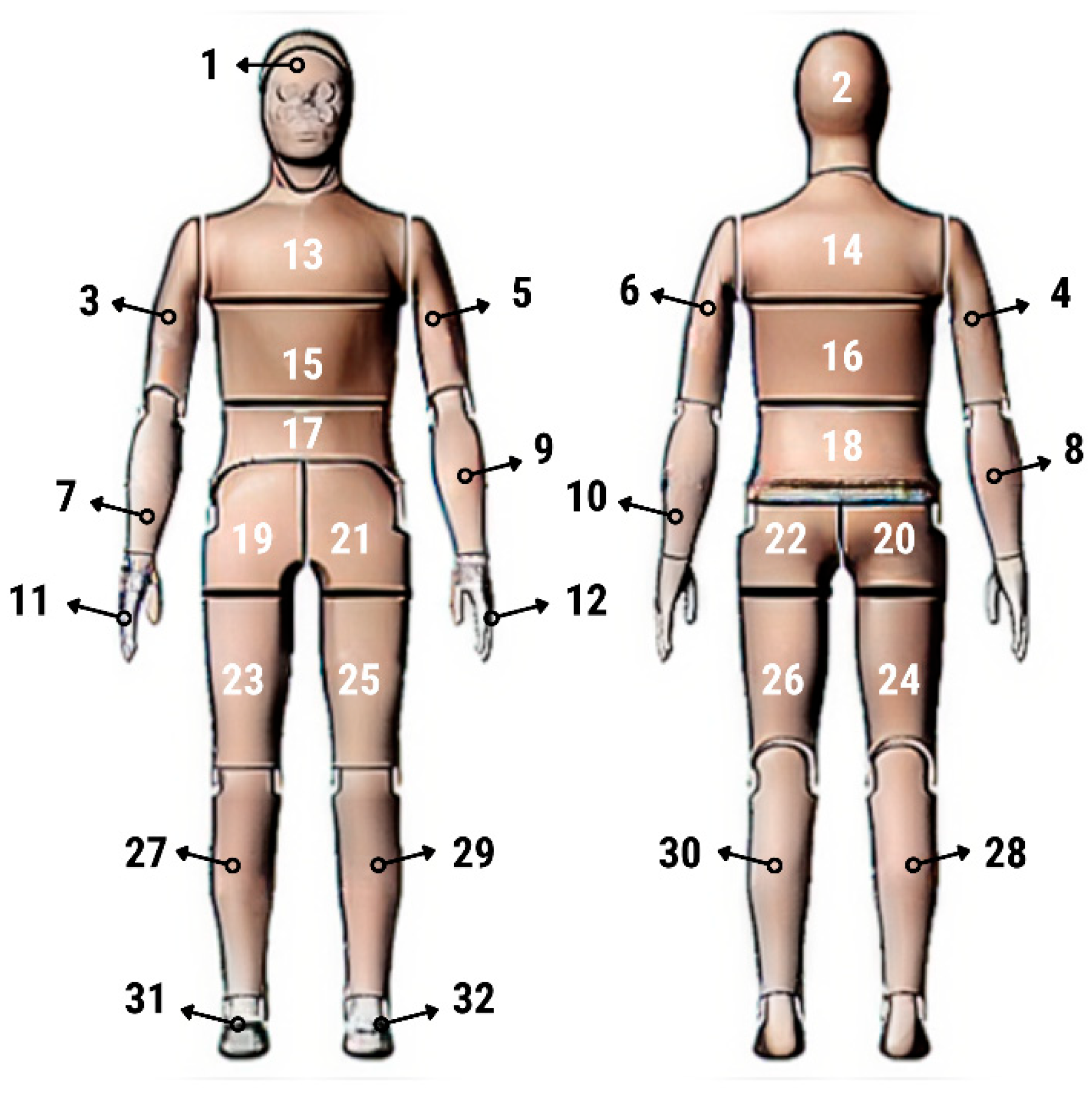
2.2.1. Thermal Manikin
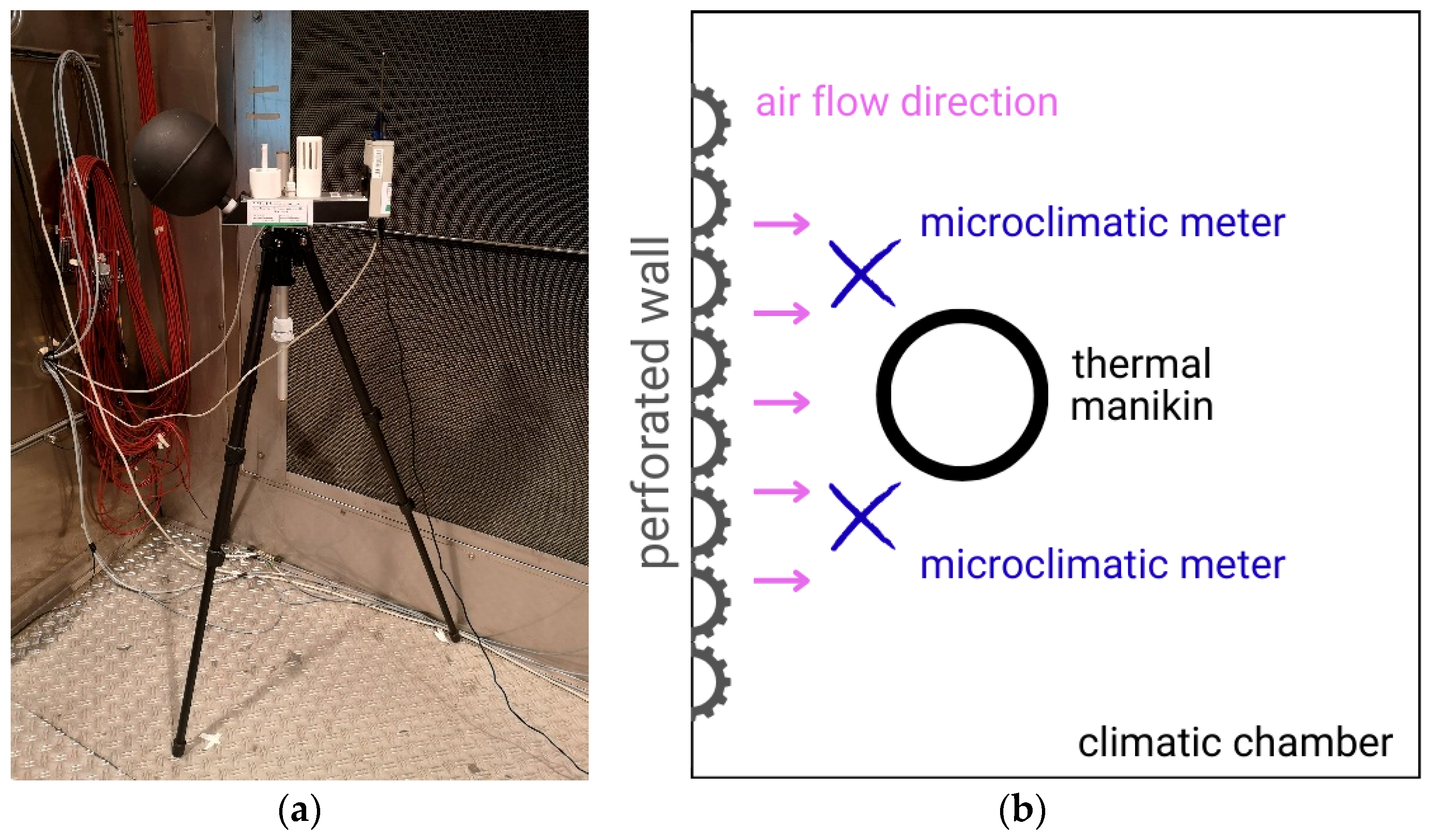
2.2.2. Climatic Chamber
2.2.3. Microclimate Meters
2.3. Methodology and Test Variants
2.3.1. Thermal Insulation
2.3.2. Water Vapor Resistance
2.3.3. TEST VARIANTS
2.3.4. Thermal Load Simulation—Predicted Internal Body Temperature Changes According to PHS Program
- Environmental parameters: air and radiation temperature, relative humidity, and air velocity;
- Metabolic rate;
- Clothing thermal parameters: thermal insulation, water vapor resistance, permeability index;
- Acclimatization level of employee.
- The output data obtained from the PHS program were the values of the safe operating time after which the internal temperature reached 38.0 °C (T1) and 38.5 °C (T2).
3. Results
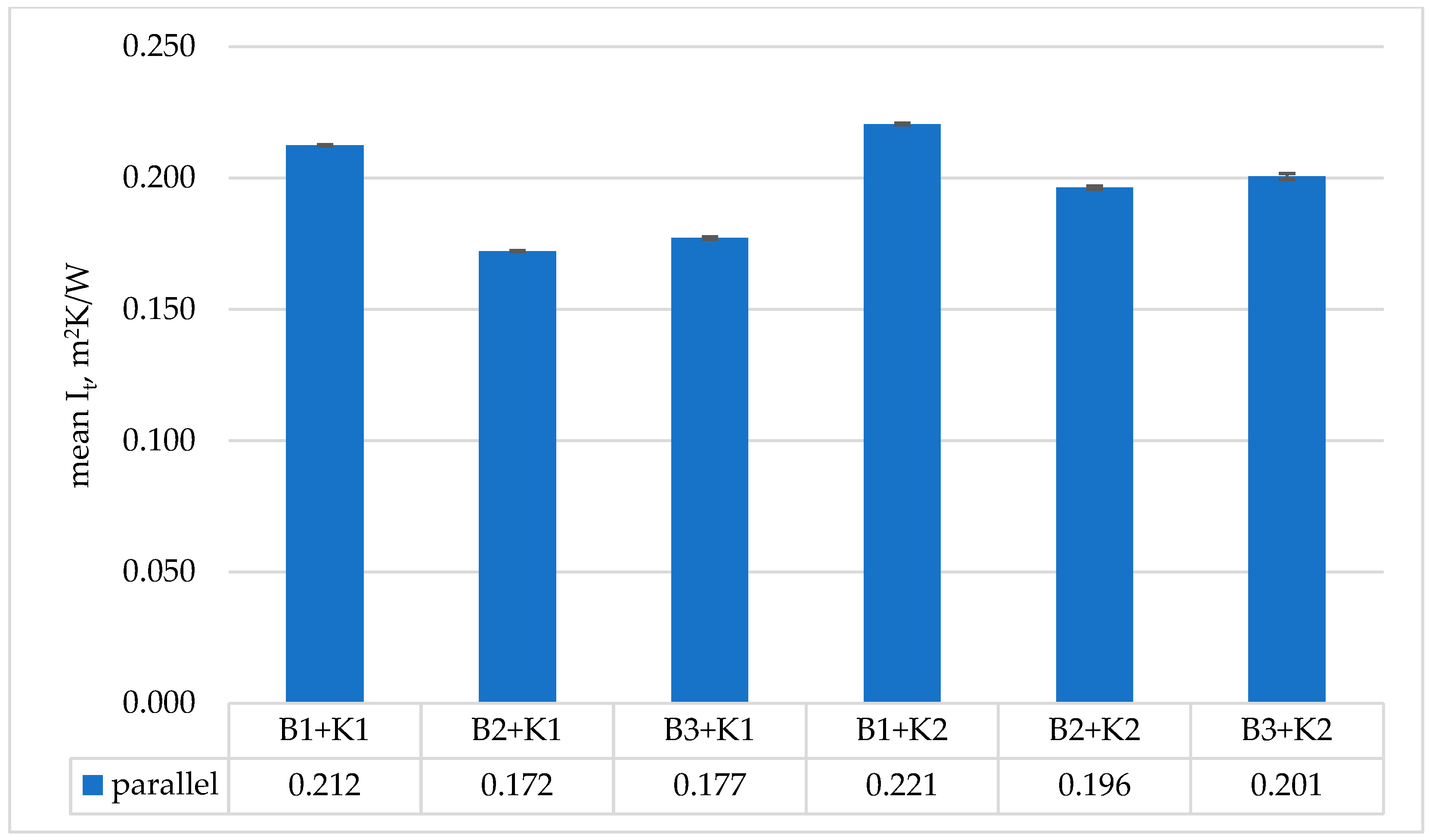
3.1. Thermal Insulation
3.2. Evaporative Resistance
3.3. Results of PHS Simulations
3.3.1. Permeability Index im
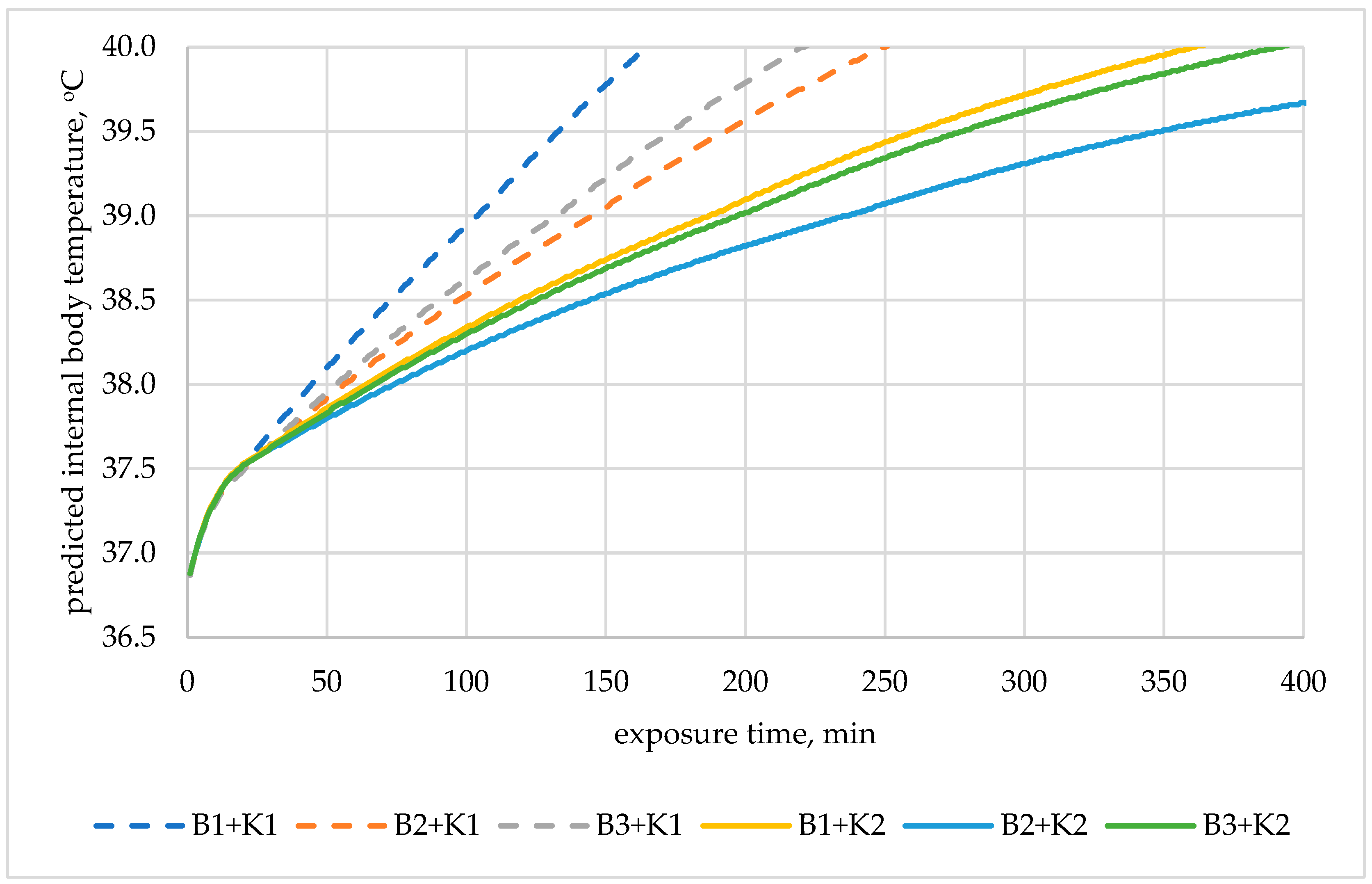
3.3.2. Simulated the Internal Body Temperature Changes According to the PHS Program
- Gender: male,
- Body weight: 70 kg,
- Height: 170 cm,
- Body surface area: 1.8 m2.
4. Discussion
5. Conclusions
Author Contributions
Funding
Institutional Review Board Statement
Informed Consent Statement
Data Availability Statement
Conflicts of Interest
References
- De Giuli, V.; Zecchin, R.; Salmaso, L.; Corain, L.; De Carli, M. Measured and perceived in-door environmental quality: Padua Hospital case study. Build. Environ. 2013, 59, 211–226. [Google Scholar] [CrossRef]
- Pirsaheb, M.; Sohrabi, Y.; Yarmohammadi, H. Assessment of Thermal Comfort in Hospital Wards of Kermanshah, Iran, based on the Standards. Indian J. Public Health Res. Dev. 2017, 8, 357–364. [Google Scholar] [CrossRef]
- Khalid, W.; Salim, S.A.Z.S.; Rijal, H.B.; Yakub, F. Investigation of comfort temperature and thermal adaptation for patients and visitors in Malaysian hospitals. Energy Build. 2019, 183, 484–499. [Google Scholar] [CrossRef]
- Yau, Y.H.; Chew, B.T. Thermal comfort study of hospital workers in Malaysia. Indoor Air 2009, 19, 500–510. [Google Scholar] [CrossRef]
- Sattayakorn, S.; Ichinose, M.; Sasaki, R. Clarifying thermal comfort of healthcare occupants in tropical region: A case of indoor environment in Thai hospitals. Energy Build. 2017, 149, 45–57. [Google Scholar] [CrossRef]
- Rogers, A.; Moltaji, S.; Wallace, D.; Cartotto, R. Ambient Temperatures in the Burn Operating Room. Plast. Surg. 2023, 32, 756–757. [Google Scholar] [CrossRef]
- Uścinowicz, P.; Bogdan, A.; Szyłak-Szydłowski, M.; Młynarczyk, M.; Ćwiklińska, D. Subjective assessment of indoor air quality and thermal environment in patient rooms: A survey study of Polish hospitals. Build. Environ. 2023, 228, 109840. [Google Scholar] [CrossRef]
- Lomas, K.J.; Giridharan, R. Thermal comfort standards, measured internal temperatures and thermal resilience to climate change of free-running buildings: A case-study of hospital wards. Build. Environ. 2012, 55, 57–72. [Google Scholar] [CrossRef]
- Lomas, K.J.; Giridharan, R.; Short, C.A.; Fair, A.J. Resilience of ‘Nightingale’ hospital wards in a changing climate. Build. Serv. Eng. Res. Technol. 2012, 33, 81–103. [Google Scholar] [CrossRef]
- Smagowska, B.; Pleban, D.; Sobolewski, A.; Pawlak, A. Warunki pracy w wybranych pomieszczeniach szpitala—Wyniki badań pilotażowych hałasu, oświetlenia i mikroklimatu. Occup. Saf.—Sci. Pract. 2018, 12, 17–21. [Google Scholar] [CrossRef]
- Uścinowicz, P.; Chludzińska, M.; Bogdan, A. Thermal environment conditions in Polish operating rooms. Build. Environ. 2015, 94, 296–304. [Google Scholar] [CrossRef]
- Potter, A.; Gonzalez, J.; Xu, X. Ebola Response: Modeling the Risk of Heat Stress from Personal Protective Clothing. PLoS ONE 2015, 10, e0143461. [Google Scholar] [CrossRef]
- Zwolińska, M.; Bogdan, A. Thermal Sensations of Surgeons During Work in Surgical Gowns. Int. J. Occup. Saf. Ergon. 2013, 19, 443–453. [Google Scholar] [CrossRef] [PubMed]
- Maklewska, E. Odzież “oddychająca” czy “paroprzepuszczalna”? Tech. Wyr. Włók. 2010, 3–4, 33–37. [Google Scholar]
- Bose-O’Reilly, S.; Daanen, H.; Deering, K.; Gerrett, N.; Huynen, M.M.; Lee, J.; Karrasch, S.; Matthies-Wiesler, F.; Mertes, H.; Schoierer, J.; et al. COVID-19 and heat waves: New challenges for healthcare systems. Environ. Res. 2021, 198, 111153. [Google Scholar] [CrossRef]
- Chen, Y.; Tao, M.; Liu, W. High temperature impairs cognitive performance during a moderate intensity activity. Build. Environ. 2020, 186, 107372. [Google Scholar] [CrossRef]
- Huang, Q.; Li, J. The effects of the dynamic thermophysical properties of clothing and the walking speed input parameter on the heat strain of a human body predicted by the PHS model. Int. J. Environ. Res. Public Health 2020, 17, 6475. [Google Scholar] [CrossRef]
- Gao, C.; Kuklane, K.; Östergren, P.O.; Kjellstrom, T. Occupational heat stress assessment and protective strategies in the context of climate change. Int. J. Biometeorol. 2018, 62, 359–371. [Google Scholar] [CrossRef]
- EN ISO 7933:2004; Ergonomics of the Thermal Environment—Analytical Determination and Interpretation of Heat Stress Using Calculation of the Predicted Heat Strain (PHS). International Organization for Standardization: Geneva, Switzerland, 2004.
- Malchaire, J.; Piette, A.; Kampmann, B.; Mehnert, P.; Gebhardt, H.; Havenith, G.; Den Hartog, E.; Holmer, I.; Parsons, K.; Alfano, G.; et al. Development and validation of the predicted heat strain model. Ann. Occup. Hyg. 2001, 45, 123–135. [Google Scholar] [CrossRef]
- Lunerová, K.; Řehák Kopečková, B.; Pokorný, J.; Mašín, M.; Kaiser, D.; Fialová, V.; Fišer, J. Applicability of human thermophysiological model for prediction of thermal strain in PPE. Appl. Sci. 2023, 13, 7170. [Google Scholar] [CrossRef]
- EN ISO 9920:2007; Ergonomics of the Thermal Environment—Estimation of Thermal Insulation and Water Vapour Resistance of A Clothing Ensemble. International Organization for Standardization: Geneva, Switzerland, 2007.
- Kopeckova, B.; Pokorny, J.; Lunerova, K.; Fiser, J.; Jicha, M. Case study comparing Fiala-based thermophysiological model and PHS index with experimental data to predict heat strain in normal and protective clothing. J. Meas. Eng. 2021, 9, 36–47. [Google Scholar] [CrossRef]
- EN ISO 11092:2014; Textiles—Physiological Effects—Measurement of Thermal and Water-Vapour Resistance Under Steady-State Conditions (Sweating Guarded-Hotplate Test). International Organization for Standardization: Geneva, Switzerland, 2014.
- Młynarczyk, M.; Havenith, G.; Léonard, J.; Martins, R.; Hodder, S. Inter-laboratory Proficiency Tests in Measuring Thermal Insulation and Evaporative Resistance of Clothing Using the Newton-Type Thermal Manikin. Text. Res. J. 2018, 88, 453–466. [Google Scholar] [CrossRef]
- Młynarczyk, M. Characteristics of Specialised Firefighter Clothing Used in Poland—The Thermal Parameters. Fibres Text. East. Eur. 2020, 28, 65–70. [Google Scholar] [CrossRef]
- Młynarczyk, M.; Bartkowiak, G.; Dąbrowska, A. Cooling Effect of Phase Change Materials Applied in Undergarments of Mine Rescuers in Simulated Utility Conditions on Thermal Manikin. Materials 2022, 15, 1999. [Google Scholar] [CrossRef]
- Młynarczyk, M.; Jankowski, J.; Orysiak, J. Określanie objętości przestrzeni powietrznych pod odzieżą z wykorzystaniem techniki skanowania 3D—Studium przypadku. Occup. Saf.—Sci. Pract. 2022, 611, 17–21. [Google Scholar] [CrossRef]
- Młynarczyk, M.; Orysiak, J.; Jankowski, J.; Prus, P. Impact of Clothing Size on Thermal Insulation—A Pilot Study. Fibres Text. East. Eur. 2023, 31, 1–8. [Google Scholar] [CrossRef]
- Bartkowiak, G.; Marszałek, A.; Dąbrowska, A. Thermal Load of Mine Rescuer in the Underwear and Protective Clothing with Phase Change Materials in Simulated Utility Conditions. Materials 2020, 13, 4320. [Google Scholar] [CrossRef]
- EN 342:2017; Clothing to Protect Against Cold. European Committee for Standardization: Brussels, Belgium, 2017.
- EN ISO 15831:2004; Clothing—Physiological Effects—Measurement of Thermal Insulation by Means of a Thermal Manikin. International Organization for Standardization: Geneva, Switzerland, 2004.
- ASTM F2370:2022; Standard Test Method for Measuring the Evaporative Resistance of Clothing Using a Sweating Manikin. ASTM International: West Conshohocken, PA, USA, 2022.
- Młynarczyk, M.; Orysiak, J.; Jankowski, J. Effect of Workwear Fit on Thermal Insulation: Assessment Using 3D Scanning Technology. Materials 2025, 18, 2098. [Google Scholar] [CrossRef]
- Martinez-Albert, M.; Díaz-García, P.; Montava-Seguí, I.; Bou-Belda, E. Experimental Investigation into the Thermal Performance of Personal Cooling Mechanisms. Appl. Sci. 2025, 15, 3296. [Google Scholar] [CrossRef]
- Schwarz, I.; Rogale, D.; Kovačević, S.; Firšt Rogale, S. A Multifunctional Approach to Optimizing Woven Fabrics for Thermal Protective Clothing. Fibers 2024, 12, 35. [Google Scholar] [CrossRef]
- Frydrych, I.; Cichocka, A.; Gilewicz, P.; Dominiak, J. Comparative Analysis of the Thermal Insulation of Traditional and Newly Designed Protective Clothing for Foundry Workers. Polymers 2016, 8, 348. [Google Scholar] [CrossRef]
- Wang, F.; Shi, W.; Lu, Y.; Song, G.; Rossi, R.; Anaheim, S. Effects of Moisture Content and Clothing Fit on Clothing Apparent ‘Wet’ Thermal Insulation: A Thermal Manikin Study. Text. Res. J. 2016, 86, 57–63. [Google Scholar] [CrossRef]
- Młynarczyk, M.; Greszta, A.; Płocińska, M.; Dąbrowska, A. Influence of Care Maintenance Cycles on Comfort-Related Parameters of Clothing Protecting Against Heat and Flame. Text. Res. J. 2025. [Google Scholar] [CrossRef]
- Kuklane, K.; Gao, C.; Wang, F.; Holmér, I. Parallel and Serial Methods of Calculating Thermal Insulation in European Manikin Standards. Int. J. Occup. Saf. Ergon. 2012, 18, 171–179. [Google Scholar] [CrossRef] [PubMed]
- Zhou, J.; Zhao, J.; Guo, X.; Hu, Y.; Niu, X.; Wang, F. Personal Wearable Thermal and Moisture Management Clothing: A Review on Its Recent Trends and Performance Evaluation Methods. Processes 2023, 11, 3063. [Google Scholar] [CrossRef]
- Renard, M.; Machnowski, W.; Puszkarz, A.K. Assessment of Thermal Performance of Phase-Change Material-Based Multilayer Protective Clothing Exposed to Contact and Radiant Heat. Appl. Sci. 2023, 13, 9447. [Google Scholar] [CrossRef]
- Saidi, A.; Gauvin, C. Intelligent Thermoregulation in Personal Protective Equipment. Eng. Proc. 2023, 52, 25. [Google Scholar]
- Houshyar, S.; Padhye, R.; Nayak, R. Effect of Moisture-Wicking Materials on the Physical and Thermo-Physiological Comfort Properties of Firefighters’ Protective Clothing. Fibers Polym. 2017, 18, 383–389. [Google Scholar] [CrossRef]
- Wang, Y.; Zhang, Z.; Li, J.; Zhu, G. Effects of Inner and Outer Clothing Combinations on Firefighter Ensembles’ Thermal- and Moisture-Related Comfort Levels. J. Text. Inst. 2013, 104, 530–540. [Google Scholar] [CrossRef]
- Puszkarz, A.K.; Machnowski, W.; Błasińska, A. Modeling of Thermal Performance of Multilayer Protective Clothing Exposed to Radiant Heat. Heat Mass Transfer 2020, 56, 1767–1775. [Google Scholar] [CrossRef]
- Su, Y.; Li, J.; Wang, Y. Effect of Air Gap Thickness on Thermal Protection of Firefighter’s Protective Clothing against Hot Steam and Thermal Radiation. Fibers Polym. 2017, 18, 582–589. [Google Scholar] [CrossRef]
- Młynarczyk, M.; Orysiak, J. Air Gaps under the Clothing—Measurement and Impact on the Thermal Insulation of the Clothing. Occup. Saf.-Sci. Pract. 2021, 4, 22–25. [Google Scholar]
- Rogale, D.; Majstorović, G.; Firšt Rogale, S. Comparative Analysis of the Thermal Insulation of Multi-Layer Thermal Inserts in a Protective Jacket. Materials 2020, 13, 2672. [Google Scholar] [CrossRef]
- Marszałek, A.; Bartkowiak, G.; Łężak, K. Physiological Effects of a Modification of the Construction of Impermeable Protective Clothing. Int. J. Occup. Saf. Ergon. 2009, 15, 61–73. [Google Scholar] [CrossRef]
- Chaudhari, A.P.C.N.; Strutton, P.H.; Wickham, A.J.; McGregor, A.H.; Mullington, C.J. Heat Stress Associated with Aerosol PPE and Its Impact. Occup. Med. 2023, 73, 120–127. [Google Scholar] [CrossRef]
- Coca, A.; Quinn, T.; Kim, J.H.; Wu, T.; Powell, J.; Roberge, R.; Shaffer, R. Physiological Evaluation of Personal Protective Ensembles Recommended for Use in West Africa. Disaster Med. Public Health Prep. 2017, 11, 580–586. [Google Scholar] [CrossRef]



| Place/Country | Range or Maximal Value of Air Temperature [°C] |
|---|---|
| patients’ room (Italy) [1] | 26–29 °C |
| different wards at a hospital (Iran) [2] | 29.9 °C |
| dialysis storeroom at a hospital (Iran) [2] | 31.5 °C |
| nurse station (emergency hospitalization) at a hospital (Iran) [2] | 30 °C |
| patient rooms (Malaysia) [3] | 23.5 °C |
| visitors room (Malaysia) [3] | 23.2 °C |
| several departments at a hospital (Malaysia) [4] | 25.3–28.2 °C |
| patients’ room at a hospital (Thailand) [5] | 21.8–27.9 °C |
| visitors’ room at a hospital (Thailand) [5] | 22.0–27.1 °C |
| medical staff room at a hospital (Thailand) [5] | 24.1–25.6 °C |
| operating surgeon (Canada) [6] | 18.7–29.6 °C |
| patients’ room (Poland) [7] | 21.9–28.4 °C |
| nurse station at a hospital (UK) [8] | 27.7–29.3 °C. |
| patients’ room (multi-bad) at a hospital (UK) [8,9] | 28.1–28.5 °C |
| operating room (Poland) [10] | 22.5 °C |
| sterilization room (Poland) [10] | 23.1 °C |
| pathology room (Poland) [10] | 27.1 °C |
| Description/Composition * | Photo—Front | Photos—Back | |
|---|---|---|---|
| B1 | medical underwear: top: 65% polyester; 35% cotton pants: 73% polyester; 25% viscose; 2% spandex surface mass: 175.1 ± 4.0 g/m2 thickness: 0.33 ± 0.01 mm air permeability: 93.0 ± 5.5 mm/s thermal resistance: 0.02 ± 0.00 m2 K/W water vapor resistance: 2.4 ± 0.4 m2 Pa/W |  | 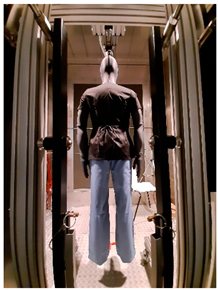 |
| B2 | short thermal underwear: 100% polyester surface mass: 197.8 ± 1.9 g/m2 thickness: 0.57 ± 0.01 mm air permeability: 652.8 ± 49.4 mm/s thermal resistance: 0.02 ± 0.00 m2 K/W water vapor resistance: 2.5 ± 0.1 m2 Pa/W |  | 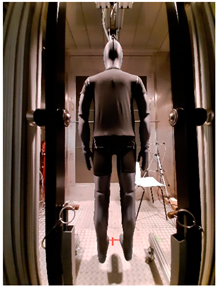 |
| B3 | long thermal underwear: 100% polyester surface mass: 242.4 ± 12.5 g/m2 thickness: 0.86 ± 0.02 mm air permeability: 111.2 ± 46.2 mm/s thermal resistance: 0.02 ± 0.01 m2 K/W water vapor resistance: 3.7 ± 0.5 m2 Pa/W |  |  |
| K1 | Cove Micro Protective suit/coverall: microporous polypropylene and polyethylene material unsealed seams surface mass: 53.6 ± 2.3 g/m2 thickness: 0.32 ± 0.01 mm air permeability: 0.0 ± 0.0 mm/s thermal resistance: 0.02 ± 0.00 m2 K/W water vapor resistance: 13.5 ± 3.3 m2 Pa/W | 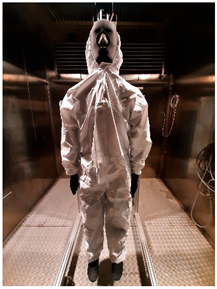 | 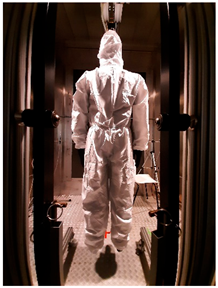 |
| K2 | Tyvek 600 Plus protective suit with TY CHA5 T WH 16 socks: Tyvek®; seams sealed surface mass: 46.5 ± 2.0 g/m2 thickness: 0.31 ± 0.02 mm air permeability: 1.8 ± 0.2 mm/s thermal resistance: 0.02 ± 0.00 m2 K/W water vapor resistance: 9.5 ± 1.5 m2 Pa/W |  | 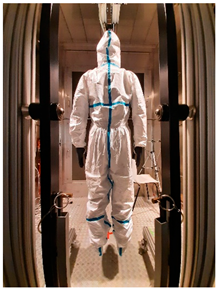 |
| Outer/Inner Layer | B1 | B2 | B3 |
|---|---|---|---|
| - | Rct | Rct | Rct |
| K1 | Rct, Ret | Rct, Ret | Rct, Ret |
| K2 | Rct, Ret | Rct, Ret | Rct, Ret |
| Mean It [m2 K/W] | sd | |
|---|---|---|
| B1 | 0.132 | 0.000 |
| B2 | 0.101 | 0.000 |
| B3 | 0.106 | 0.001 |
| ta °C | RH % | Va m/s | |
|---|---|---|---|
| Test 1 | |||
| B1 | 20.3 ± 0.0 | 30.8 ± 0.0 | 0.43 ± 0.01 |
| B2 | 20.4 ± 0.0 | 32.3 ± 0.2 | 0.47 ± 0.01 |
| B3 | 18.4 ± 0.0 | 32.0 ± 0.1 | 0.45 ± 0.01 |
| Test 2 | |||
| B1 | 20.3 ± 0.0 | 30.5 ± 0.1 | 0.43 ± 0.01 |
| B2 | 20.4 ± 0.0 | 31.5 ± 0.2 | 0.47 ± 0.00 |
| B3 | 18.4 ± 0.0 | 31.1 ± 0.2 | 0.47 ± 0.00 |
| Variant | ta °C | RH % | Va m/s |
|---|---|---|---|
| Test 1 | |||
| B1+K1 | 18.3 ± 0.0 | 31.7 ± 0.1 | 0.44 ± 0.00 |
| B2+K1 | 18.3 ± 0.0 | 36.1 ± 0.1 | 0.43 ± 0.00 |
| B3+K1 | 18.3 ± 0.0 | 34.7 ± 0.0 | 0.43 ± 0.00 |
| B1+K2 | 15.3 ± 0.0 | 37.1 ± 0.1 | 0.45 ± 0.01 |
| B2+K2 | 15.4 ± 0.0 | 29.4 ± 0.0 | 0.45 ± 0.01 |
| B3+K2 | 15.3 ± 0.0 | 33.8 ± 0.1 | 0.44 ± 0.01 |
| Test 2 | |||
| B1+K1 | 18.3 ± 0.0 | 31.8 ± 0.0 | 0.44 ± 0.01 |
| B2+K1 | 18.3 ± 0.0 | 36.3 ± 0.0 | 0.44 ± 0.01 |
| B3+K1 | 18.3 ± 0.0 | 34.5 ± 0.1 | 0.43 ± 0.00 |
| B1+K2 | 15.3 ± 0.0 | 36.6 ± 0.1 | 0.46 ± 0.01 |
| B2+K2 | 15.3 ± 0.0 | 29.5 ± 0.1 | 0.44 ± 0.01 |
| B3+K2 | 15.3 ± 0.0 | 34.1 ± 0.1 | 0.43 ± 0.01 |
| Variant | Mean Ret [m2 Pa/W] | sd |
|---|---|---|
| B1+K1 | 71.6 | 0.2 |
| B2+K1 | 64.7 | 1.2 |
| B3+K1 | 66.1 | 1.0 |
| B1+K2 | 63.2 | 1.4 |
| B2+K2 | 62.4 | 3.8 |
| B3+K2 | 49.3 | 1.0 |
| Variant | ta °C | RH % | Va m/s |
|---|---|---|---|
| Test 1 | |||
| B1+K1 | 18.3 ± 0.0 | 67.1 ± 0.1 | 0.46 ± 0.01 |
| B2+K1 | 15.3 ± 0.0 | 65.2 ± 0.2 | 0.42 ± 0.01 |
| B3+K1 | 15.3 ± 0.0 | 55.3 ± 0.9 | 0.42 ± 0.01 |
| B1+K2 | 15.3 ± 0.0 | 58.2 ± 0.3 | 0.43 ± 0.01 |
| B2+K2 | 15.3 ± 0.0 | 50.0 ± 0.8 | 0.45 ± 0.01 |
| B3+K2 | 15.3 ± 0.0 | 57.5 ± 0.3 | 0.43 ± 0.01 |
| Test 2 | |||
| B1+K1 | 18.3 ± 0.0 | 67.2 ± 0.1 | 0.46 ± 0.01 |
| B2+K1 | 15.3 ± 0.0 | 66.1 ± 0.2 | 0.42 ± 0.01 |
| B3+K1 | 15.3 ± 0.0 | 59.0 ± 0.1 | 0.42 ± 0.03 |
| B1+K2 | 15.3 ± 0.0 | 59.4 ± 0.2 | 0.43 ± 0.01 |
| B2+K2 | 15.3 ± 0.0 | 53.5 ± 0.6 | 0.44 ± 0.01 |
| B3+K2 | 15.3 ± 0.0 | 58.9 ± 0.2 | 0.43 ± 0.01 |
| Clothing Sets/Variant | im |
|---|---|
| B1+K1 | 0.18 |
| B2+K1 | 0.16 |
| B3+K1 | 0.16 |
| B1+K2 | 0.21 |
| B2+K2 | 0.19 |
| B3+K2 | 0.25 |
| Clothing Sets/Variant | im |
|---|---|
| B1 | 0.50 |
| B2 | 0.38 |
| B3 | 0.36 |
| K1 | 0.11 |
| K2 | 0.15 |
| B1+K1 | 0.15 |
| B2+K1 | 0.13 |
| B3+K1 | 0.13 |
| B1+K2 | 0.19 |
| B2+K2 | 0.17 |
| B3+K2 | 0.17 |
| Variants | T1, min | T2, min | |
|---|---|---|---|
| 100 W/m2 | |||
| K1 | B1+K1 | n.a. | n.a. |
| B2+K1 | n.a. | n.a. | |
| B3+K1 | n.a. | n.a. | |
| K2 | B1+K2 | n.a. | n.a. |
| B2+K2 | n.a. | n.a. | |
| B3+K2 | n.a. | n.a. | |
| 165 W/m2 | |||
| K1 | B1+K1 | n.a. | n.a. |
| B2+K1 | n.a. | n.a. | |
| B3+K1 | n.a. | n.a. | |
| K2 | B1+K2 | n.a. | n.a. |
| B2+K2 | n.a. | n.a. | |
| B3+K2 | n.a. | n.a. | |
| 230 W/m2 | |||
| K1 | B1+K1 | 45 | 73 |
| B2+K1 | 56 | 97 | |
| B3+K1 | 53 | 90 | |
| K2 | B1+K2 | 64 | 119 |
| B2+K2 | 74 | 144 | |
| B3+K2 | 67 | 125 | |
| Variants | T1, min | T2, min | |
|---|---|---|---|
| 100 W/m2 | |||
| K1 | B1+K1 | 55 | 81 |
| B2+K1 | 57 | 84 | |
| B3+K1 | 55 | 82 | |
| K2 | B1+K2 | 69 | 103 |
| B2+K2 | 68 | 101 | |
| B3+K2 | 66 | 98 | |
| 165 W/m2 | |||
| K1 | B1+K1 | 30 | 43 |
| B2+K1 | 30 | 44 | |
| B3+K1 | 30 | 43 | |
| K2 | B1+K2 | 34 | 50 |
| B2+K2 | 34 | 50 | |
| B3+K2 | 34 | 49 | |
| 230 W/m2 | |||
| K1 | B1+K1 | 20 | 28 |
| B2+K1 | 20 | 29 | |
| B3+K1 | 20 | 29 | |
| K2 | B1+K2 | 22 | 32 |
| B2+K2 | 22 | 31 | |
| B3+K2 | 22 | 31 | |
| Variant |  |  |
|---|---|---|
| (a) corpus | 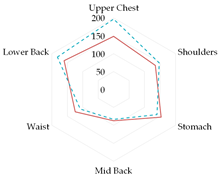 |  |
| (b) upper limbs | 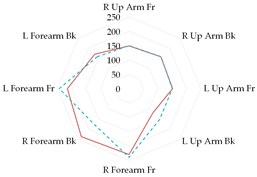 |  |
| (c) lower limbs |  |  |
Disclaimer/Publisher’s Note: The statements, opinions and data contained in all publications are solely those of the individual author(s) and contributor(s) and not of MDPI and/or the editor(s). MDPI and/or the editor(s) disclaim responsibility for any injury to people or property resulting from any ideas, methods, instructions or products referred to in the content. |
© 2025 by the authors. Licensee MDPI, Basel, Switzerland. This article is an open access article distributed under the terms and conditions of the Creative Commons Attribution (CC BY) license.
Share and Cite
Młynarczyk, M.; Orysiak, J.; Kopyt, A.; Ordysiński, S. Effect of Underwear Materials on the Thermal Insulation of Barrier Protective Clothing. Materials 2026, 19, 124. https://doi.org/10.3390/ma19010124
Młynarczyk M, Orysiak J, Kopyt A, Ordysiński S. Effect of Underwear Materials on the Thermal Insulation of Barrier Protective Clothing. Materials. 2026; 19(1):124. https://doi.org/10.3390/ma19010124
Chicago/Turabian StyleMłynarczyk, Magdalena, Joanna Orysiak, Aleksandra Kopyt, and Szymon Ordysiński. 2026. "Effect of Underwear Materials on the Thermal Insulation of Barrier Protective Clothing" Materials 19, no. 1: 124. https://doi.org/10.3390/ma19010124
APA StyleMłynarczyk, M., Orysiak, J., Kopyt, A., & Ordysiński, S. (2026). Effect of Underwear Materials on the Thermal Insulation of Barrier Protective Clothing. Materials, 19(1), 124. https://doi.org/10.3390/ma19010124