This is an early access version, the complete PDF, HTML, and XML versions will be available soon.
Open AccessArticle
Role of Heat Treatment Atmosphere on the Microstructure and Surface Morphology of DLP-Fabricated High-Entropy Alloy Components
by
Jui-Ting Liang
 Jui-Ting Liang
Ting-Hsiang Lin
Ting-Hsiang Lin
Vivekanandan Alangadu Kothandan
Vivekanandan Alangadu Kothandan  and
and
Shih-Hsun Chen
Shih-Hsun Chen
1
Department of Mechanical and Electro-Mechanical Engineering, National Ilan University, Yilan 260, Taiwan
2
Department of Mechanical Engineering, National Taiwan University of Science and Technology, Taipei 106, Taiwan
3
Department of Materials Science and Engineering, National Tsing Hua University, Hsinchu 300, Taiwan
4
Department of Mechanical Engineering, College of Engineering, National Yang-Ming Chiao Tung University, Hsinchu 300, Taiwan
*
Author to whom correspondence should be addressed.
Materials 2025, 18(24), 5607; https://doi.org/10.3390/ma18245607 (registering DOI)
Submission received: 15 November 2025
/
Revised: 7 December 2025
/
Accepted: 11 December 2025
/
Published: 13 December 2025
Abstract
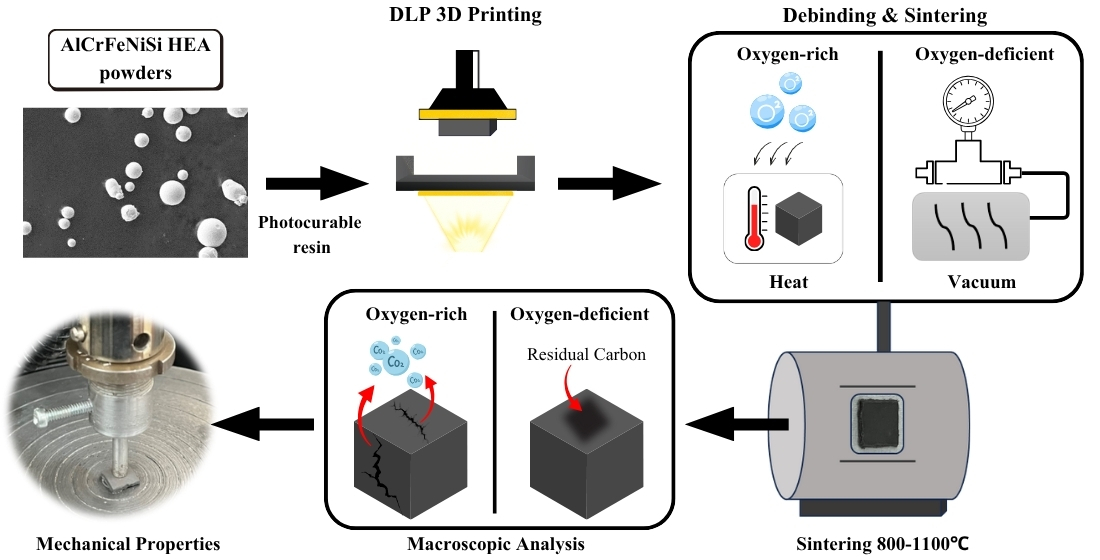
AlCrFeNiSi high-entropy alloy (HEA) components were fabricated using digital light processing (DLP) 3D printing, followed by debinding under oxygen-rich and oxygen-deficient atmospheres and sintering at various temperatures. The influence of atmosphere on microstructural evolution, elemental redistribution, and mechanical consolidation was systematically investigated. Oxygen-rich debinding induced oxidation-driven gas formation and surface cracking, whereas oxygen-deficient debinding preserved residual carbon that reduced porosity and enabled earlier densification. The layered microstructure progressively vanished with temperature, and full consolidation was achieved at 1100 °C in oxygen-rich and 1050 °C in oxygen-deficient environments. Correspondingly, both processing conditions yielded similar maximum compressive strengths (~5 MPa), although the oxygen-deficient condition attained this strength at a lower temperature. These findings demonstrate that controlling oxygen exposure during debinding provides an effective pathway to reduce the sintering temperature while maintaining the mechanical performance of DLP-printed AlCrFeNiSi HEA components.
Share and Cite
MDPI and ACS Style
Liang, J.-T.; Lin, T.-H.; Kothandan, V.A.; Chen, S.-H.
Role of Heat Treatment Atmosphere on the Microstructure and Surface Morphology of DLP-Fabricated High-Entropy Alloy Components. Materials 2025, 18, 5607.
https://doi.org/10.3390/ma18245607
AMA Style
Liang J-T, Lin T-H, Kothandan VA, Chen S-H.
Role of Heat Treatment Atmosphere on the Microstructure and Surface Morphology of DLP-Fabricated High-Entropy Alloy Components. Materials. 2025; 18(24):5607.
https://doi.org/10.3390/ma18245607
Chicago/Turabian Style
Liang, Jui-Ting, Ting-Hsiang Lin, Vivekanandan Alangadu Kothandan, and Shih-Hsun Chen.
2025. "Role of Heat Treatment Atmosphere on the Microstructure and Surface Morphology of DLP-Fabricated High-Entropy Alloy Components" Materials 18, no. 24: 5607.
https://doi.org/10.3390/ma18245607
APA Style
Liang, J.-T., Lin, T.-H., Kothandan, V. A., & Chen, S.-H.
(2025). Role of Heat Treatment Atmosphere on the Microstructure and Surface Morphology of DLP-Fabricated High-Entropy Alloy Components. Materials, 18(24), 5607.
https://doi.org/10.3390/ma18245607
Note that from the first issue of 2016, this journal uses article numbers instead of page numbers. See further details
here.
Article Metrics
Article metric data becomes available approximately 24 hours after publication online.