

Interpreting Molecular Descriptors for Glass Transition Temperature Prediction and Design of Polyimides


Highlights
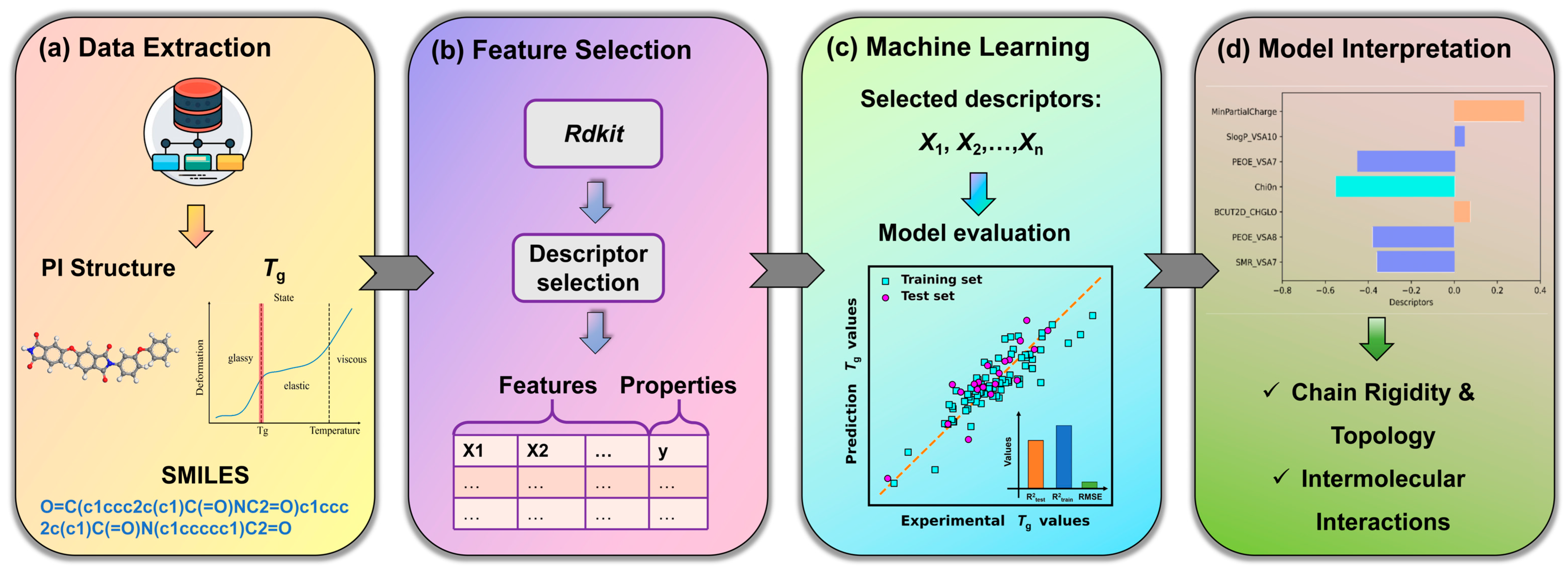
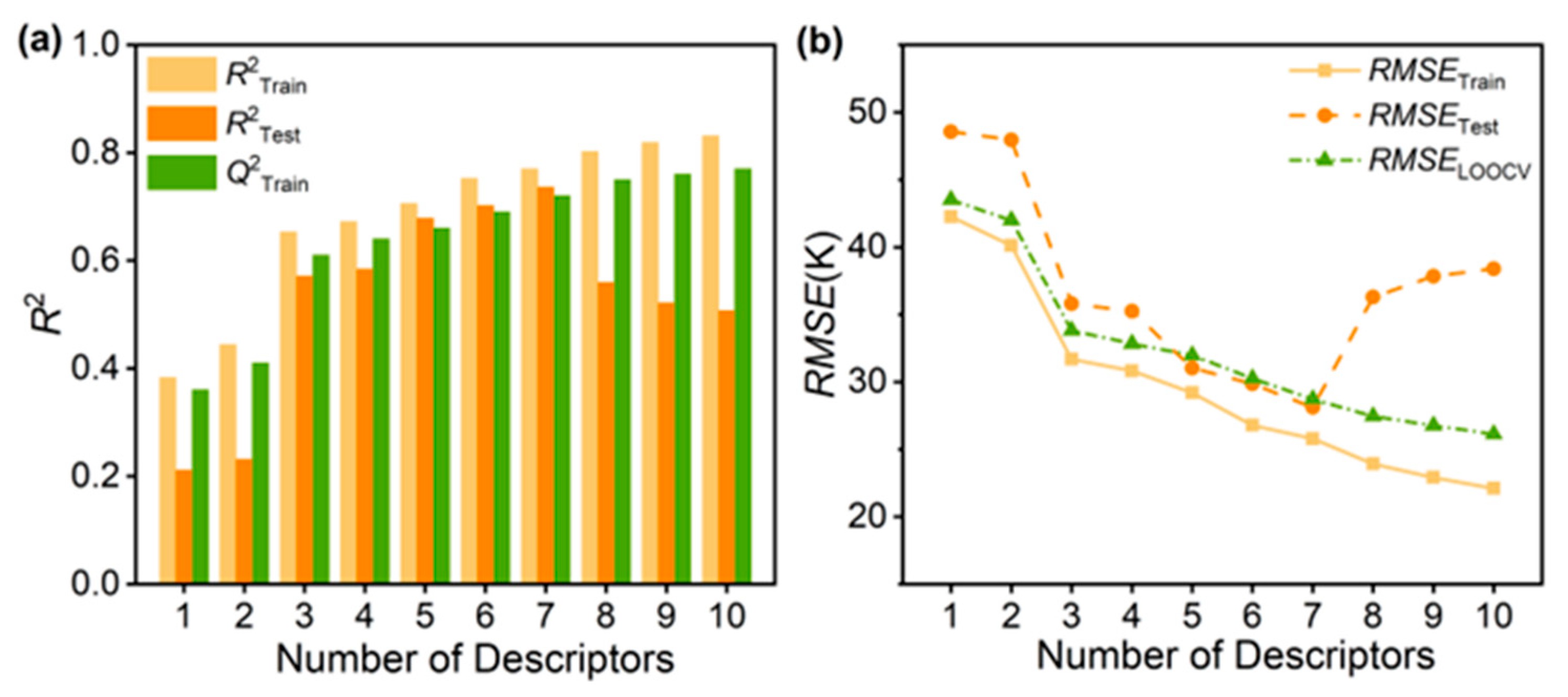
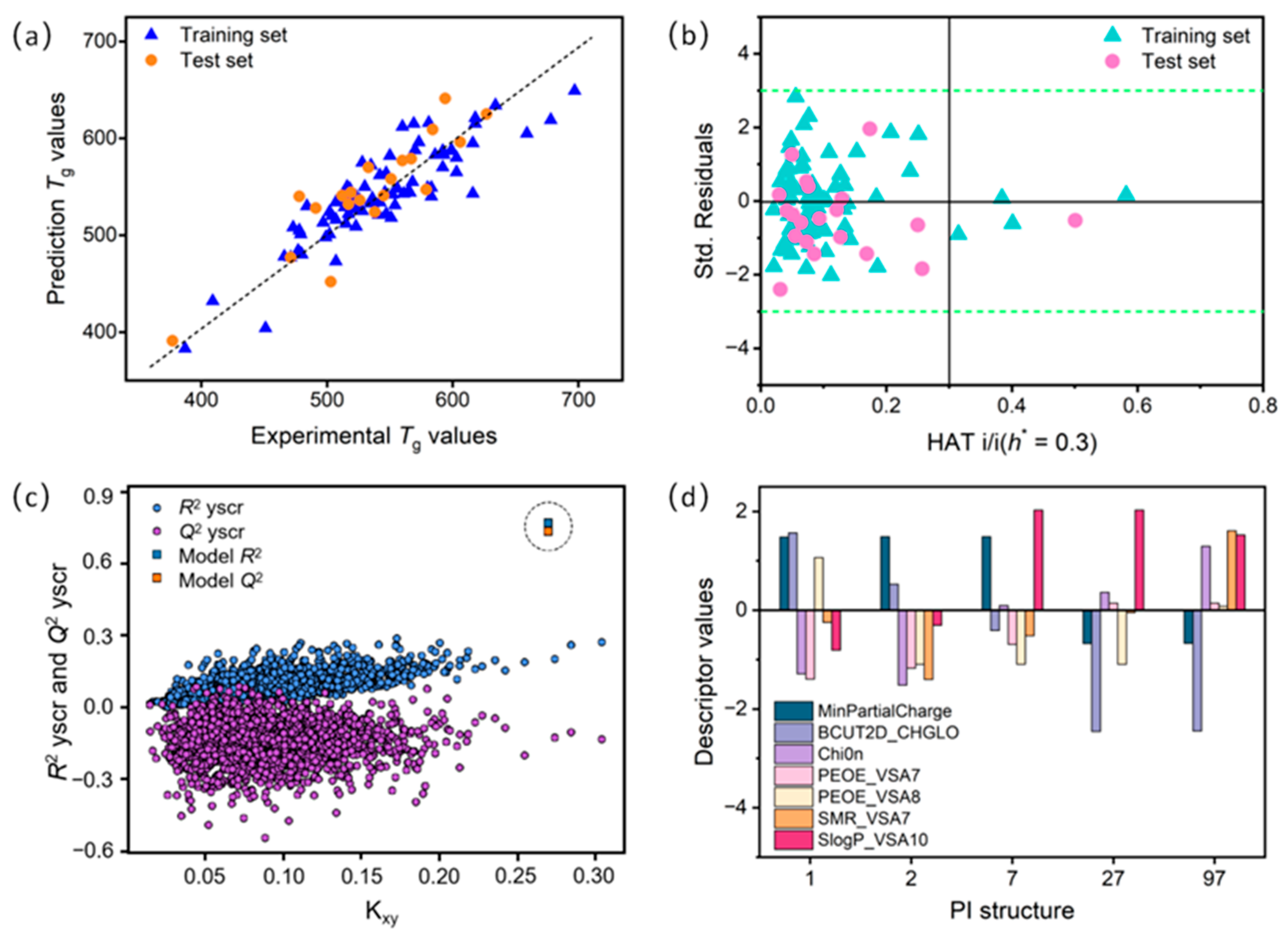
- A robust seven-descriptor QSPR model predicts polyimide Tg via GA-MLR.
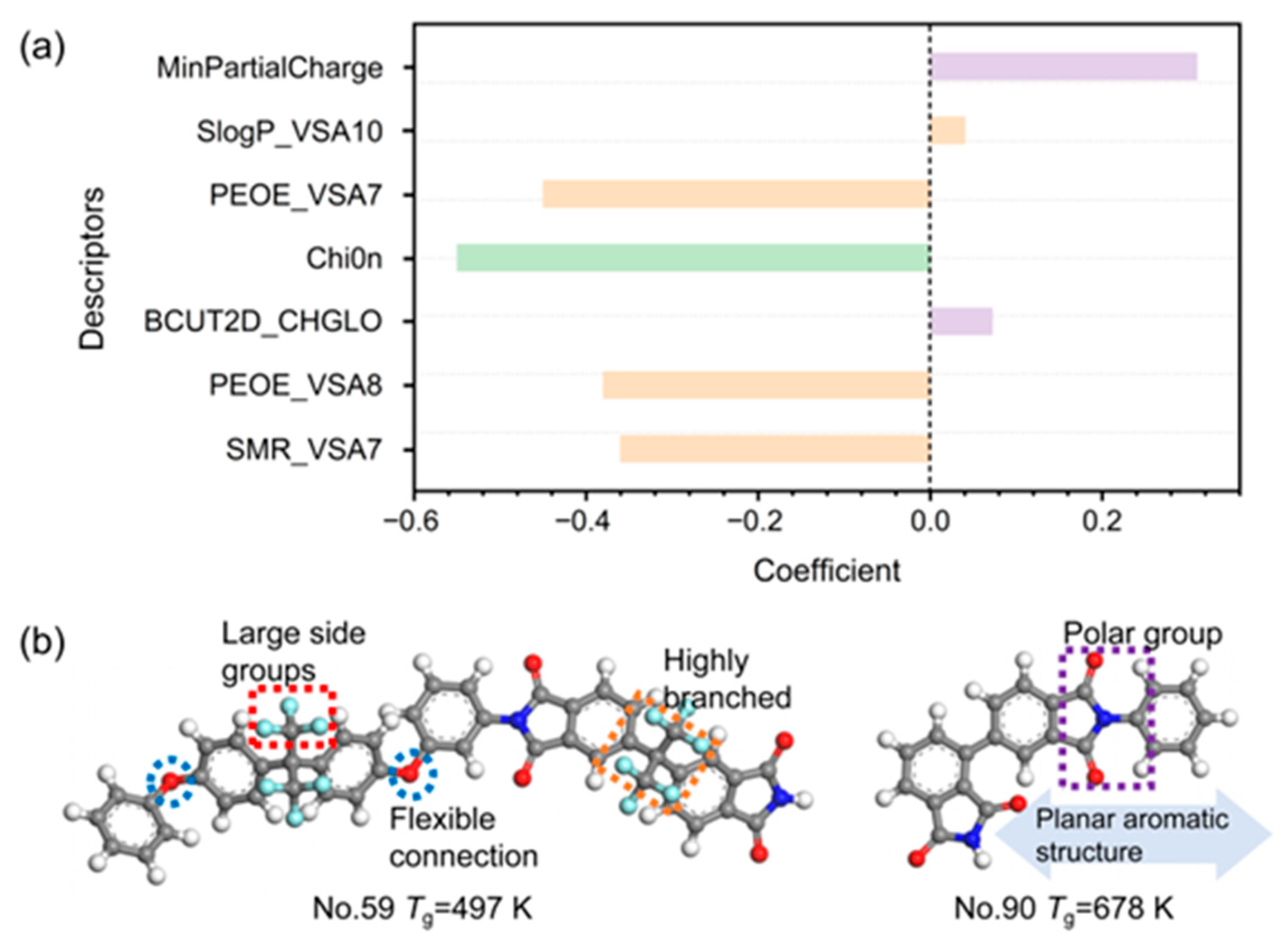
- Key descriptors (Chi0n, MinPartialCharge) govern chain rigidity and interactions.
- Tg is controlled by modulation of free volume, unifying the structure-property link.
- The model provides direct, interpretable physicochemical insights into Tg.
- Free volume theory offers a unified mechanism for diverse molecular features.
- Actionable design principles are given for tailoring Tg via molecular architecture.
Abstract
1. Introduction
2. Methodology
2.1. Data Collection and Processing
2.2. QSPR Modeling Based on Machine Learning
3. Results and Discussion
3.1. Development and Validation of the Optimal QSPR Model
0.072BCUT2D_CHGLO + 0.04SlogP_VSA10.
3.2. Physicochemical Interpretation of the Key Molecular Descriptors
3.3. Mechanistic Interpretation, Molecular Design Guidance and Future Perspectives
4. Conclusions
Supplementary Materials
Author Contributions
Funding
Data Availability Statement
Conflicts of Interest
References
- Li, Y.; Sun, G.; Zhou, Y.; Liu, G.; Wang, J.; Han, S. Progress in low dielectric polyimide film—A review. Prog. Org. Coat. 2022, 172, 107103. [Google Scholar] [CrossRef]
- Rodriguez, K.M.; Lin, S.; Wu, A.X.; Storme, K.R.; Joo, T.; Grosz, A.F.; Roy, N.; Syar, D.; Benedetti, F.M.; Smith, Z.P. Penetrant-induced plasticization in microporous polymer membranes. Chem. Soc. Rev. 2024, 53, 2435–2529. [Google Scholar] [CrossRef] [PubMed]
- Liu, X.-J.; Zheng, M.-S.; Chen, G.; Dang, Z.-M.; Zha, J.-W. High-temperature polyimide dielectric materials for energy storage: Theory, design, preparation and properties. Energy Environ. Sci. 2022, 15, 56–81. [Google Scholar] [CrossRef]
- Zhang, X.; Li, X.; Li, L.; Shi, T. Effect of methyl trifluoride substitution on colorless transparency of polyimide: A DFT/TD-DFT study. J. Mol. Liq. 2024, 411, 125691. [Google Scholar] [CrossRef]
- Lei, H.; Bao, F.; Peng, W.; Qiu, L.; Zou, B.; Huang, M. Torsion effect of the imide ring on the performance of transparent polyimide films with methyl-substituted phenylenediamine. Polym. Chem. 2022, 13, 6606–6613. [Google Scholar] [CrossRef]
- Lin, D.; Li, R.; Liu, Y.; Qi, S.; Wu, D. Clarifying the effect of moisture absorption and high-temperature thermal aging on structure and properties of polyimide film at molecular dynamic level. Polymer 2021, 214, 123251. [Google Scholar] [CrossRef]
- Qiu, H.; Qiu, X.; Dai, X.; Sun, Z.Y. Design of polyimides with targeted glass transition temperature using a graph neural network. J. Mater. Chem. C 2023, 11, 2930–2940. [Google Scholar] [CrossRef]
- Zhou, S.W.; Yu, C.; Chen, M.; Shi, C.Y.; Cu, R.; Qu, D.H. Self-healing and shape-shifting polymers controlled by dynamic bonds. Smart Mol. 2023, 1, e20220009. [Google Scholar] [CrossRef]
- Jansen, S.A.H.; Vantomme, G.; Meijer, E.W. Evolving data-driven strategies for the characterization of supramolecular polymers and systems. Angew. Chem. Int. Ed. 2025, 64, e202509122. [Google Scholar] [CrossRef]
- Zhen, Z.; Potta, T.; Christensen, M.D.; Narayanan, E.; Kanagal, K.; Breneman, C.M.; Rege, K. Accelerated materials discovery using chemical informatics investigation of polymer physicochemical properties and transgene expression efficacy. ACS Biomater. Sci. Eng. 2019, 5, 654–669. [Google Scholar] [CrossRef]
- Ni, X.; Amamoto, Y.; Kikuchi, J. Simultaneous multimodal and multitask strategies for diverse biodegradable polymers powered by NMR data science. Sustain. Mater. Tech. 2025, 47, e01781. [Google Scholar] [CrossRef]
- Ohshida, T.; Wada, T.; Kaneuchi, T.; Ohno, E.; Taniike, T. Data-driven phase analysis of immiscible polymer blends via multi-parameter AFM imaging. Polymer 2026, 343, 129391. [Google Scholar] [CrossRef]
- Miccio, L.A.; Schwartz, G.A. From chemical structure to quantitative polymer properties prediction through convolutional neural networks. Polymer 2020, 193, 122341. [Google Scholar] [CrossRef]
- Yu, M.; Shi, Y.; Jia, Q.; Wang, Q.; Luo, Z.H.; Yan, F.; Zhou, Y.N. Ring repeating unit: An upgraded structure representation of linear condensation polymers for property prediction. J. Chem. Inf. Model. 2023, 63, 1177−1187. [Google Scholar] [CrossRef]
- Tao, L.; Varshney, V.; Li, Y. Benchmarking machine learning models for polymer informatics: An example of glass transition temperature. J. Chem. Inf. Model. 2021, 61, 5395−5413. [Google Scholar] [CrossRef] [PubMed]
- Zhang, S.; He, X.; Xia, X.; Xiao, P.; Wu, Q.; Zheng, F.; Lu, Q. Machine-learning-enabled framework in engineering plastics discovery: A case study of designing polyimides with desired glass-transition temperature. ACS Appl. Mater. Interfaces 2023, 15, 37893–37902. [Google Scholar] [CrossRef]
- Zhang, T.; Wang, S.; Chai, Y.; Yu, J.; Zhu, W.; Li, L.; Li, B. Prediction and interpretability study of the glass transition temperature of polyimide based on machine learning with quantitative structure−property relationship (Tg–QSPR). J. Phys. Chem. B 2024, 128, 8807–8817. [Google Scholar] [CrossRef]
- Xu, P.; Ji, X.; Li, M.; Lu, W. Small data machine learning in materials science. npj Comput. Mater. 2023, 9, 42. [Google Scholar] [CrossRef]
- Audus, D.J.; de Pablo, J.J. Polymer informatics: Opportunities and challenges. ACS Macro Lett. 2017, 6, 1078–1082. [Google Scholar] [CrossRef]
- Ding, M. Isomeric polyimides. Prog. Poly. Sci. 2007, 32, 623–668. [Google Scholar] [CrossRef]
- Weininger, D. SMILES, A chemical language and information system. J. Chem. Inf. Comp. Sci. 1988, 28, 31–36. [Google Scholar] [CrossRef]
- Gozalbes, R.; Doucet, J.P.; Derouin, F. Application of topological descriptors in QSAR and drug design: History and new trends. Curr. Drug Targets-Infect. Disord. 2002, 2, 93–102. [Google Scholar] [CrossRef] [PubMed]
- Wen, C.; Liu, B.; Wolfgang, J.; Long, T.E.; Odle, R.; Cheng, S. Determination of glass transition temperature of polyimides from atomistic molecular dynamics simulations and machine-learning algorithms. J. Polym. Sci. 2020, 58, 1521–1534. [Google Scholar] [CrossRef]
- Joseph, V.R.; Vakayil, A. SPlit: An optimal method for data splitting. Technometrics 2022, 64, 166–176. [Google Scholar] [CrossRef]
- Devillers, J. Genetic Algorithms in Molecular Modeling; Academic Press: Cambridge, MA, USA, 1996. [Google Scholar]
- Ahmed, L.; Rasulev, B.; Turabekova, M. Receptor- and ligand-based study of fullerene analogues: Comprehensive computational approach including quantum-chemical, QSAR, and molecular docking simulations. Org. Biomol. Chem. 2013, 11, 5798–5808. [Google Scholar] [CrossRef]
- Karuth, A.; Alesadi, A.; Xia, W.; Rasulev, B. Predicting glass transition of amorphous polymers by application of cheminformatics and molecular dynamics simulations. Polymer 2021, 218, 123495. [Google Scholar] [CrossRef]
- Rasulev, B.F.; Saidkhodzhaev, A.I.; Nazrullaev, S.S.; Akhmedkhodzhaeva, K.S.; Khushbaktova, Z.A.; Leszczynski, J. Molecular modelling and QSAR analysis of the estrogenic activity of terpenoids isolated from ferula plants. SAR QSAR Environ. Res. 2007, 18, 663–673. [Google Scholar] [CrossRef] [PubMed]
- Wong, T.-T. Performance evaluation of classification algorithms by k-fold and leave-one-out cross validation. Pattern Recognit. 2015, 48, 2839–2846. [Google Scholar] [CrossRef]
- Ho, S.Y.; Phua, K.; Wong, L.; Goh, W.W.B. Extensions of the external validation for checking learned model interpretability and generalizability. Patterns 2020, 1, 100129. [Google Scholar] [CrossRef]
- Hawkins, D.M. The problem of overfitting. J. Chem. Inf. Comp. Sci. 2004, 44, 1–12. [Google Scholar] [CrossRef]
- Zhang, H.; Li, H.Y.; Xin, H.S.; Zhang, J.H. Property prediction and structural feature extraction of polyimide materials based on machine learning. J. Chem. Inf. Model. 2023, 63, 5473–5483. [Google Scholar] [CrossRef]
- Tropsha, A.; Gramatica, P.; Gombar, V.K. The importance of being earnest: Validation is the absolute essential for successful application and interpretation of QSPR models. QSAR Comb. Sci. 2003, 22, 69–77. [Google Scholar] [CrossRef]
- Gasteiger, J.; Marsili, M. Iterative partial equalization of orbital electronegativity—A rapid access to atomic charges. Tetrahedron 1980, 36, 3219–3228. [Google Scholar] [CrossRef]
- Toots, K.M.; Sild, S.; Leis, J.; Acree, W.E., Jr.; Maran, U. The quantitative structure-property relationships for the gas-ionic liquid partition coefficient of a large variety of organic compounds in three ionic liquids. J. Mol. Liq. 2021, 343, 117573. [Google Scholar] [CrossRef]
- Yang, A.; Sun, S.; Mi, H.; Wang, W.; Liu, J.; Kong, Z.Y. Interpretable feedforward neural network and XGBoost-based algorithms to predict CO2 solubility in ionic liquids. Ind. Eng. Chem. Res. 2024, 63, 8293–8305. [Google Scholar] [CrossRef]
- Luo, S.; Li, Y.; Li, N.; Cao, Z.; Zhang, S.; Ocheje, M.U.; Gu, X.; Rondeau-Gagne, S.; Xue, G.; Wang, S.; et al. Real-time correlation of crystallization and segmental order in conjugated polymers. Mater. Horiz. 2024, 11, 196–206. [Google Scholar] [CrossRef]
- Yang, M.; Zhou, L.; Li, X.; Ren, W.; Shen, Y. Polyimides physically crosslinked by aromatic molecules exhibit ultrahigh energy density at 200 °C. Adv. Mater. 2023, 35, 2302392. [Google Scholar] [CrossRef] [PubMed]
- Labute, P. A widely applicable set of descriptors. J. Mol. Graph. Model. 2000, 18, 464–477. [Google Scholar] [CrossRef] [PubMed]
- Wan, J.; Zhang, L.; Yang, G.; Zhan, C.G. Quantitative structure−activity relationship for cyclic imide derivatives of protoporphyrinogen oxidase inhibitors: A study of quantum chemical descriptors from density functional theory. J. Chem. Inf. Comp. Sci. 2004, 44, 2099–2105. [Google Scholar] [CrossRef] [PubMed]
- Burden, F.R. Molecular identification number for substructure searches. J. Chem. Inf. Comput. Sci. 1989, 29, 225–227. [Google Scholar] [CrossRef]
- Du, H.; Wang, J.; Hui, J.; Zhang, L.; Wang, H. DenseGNN: Universal and scalable deeper graph neural networks for highperformance property prediction in crystals and molecules. npj Comput. Mater. 2024, 10, 292. [Google Scholar] [CrossRef]
- Krevelen, D.W.; Te Nijenhuis, K. Properties of Polymers: Their Correlation with Chemical Structure; Their Numerical Estimation and Prediction from Additive Group Contributions; Elsevier: Amsterdam, The Netherlands, 2009. [Google Scholar]
- Zhang, B.; Li, X.; Xu, X.; Cao, J.; Zeng, M.; Zhang, W. Multi-property prediction and high-throughput screening of polyimides: An application case for interpretable machine learning. Polymer 2024, 312, 127603. [Google Scholar] [CrossRef]
- Volgin, I.V.; Batyr, P.A.; Matseevich, A.V.; Dobrovskiy, A.Y.; Andreeva, M.V.; Nazarychev, V.M.; Larin, S.V.; Goikhman, M.Y.; Vizilter, Y.V.; Askadskii, A.A.; et al. Machine learning with enormous “Synthetic” data sets: Predicting glass transition temperature of polyimides using graph convolutional neural networks. ACS Omega 2022, 7, 43678–43691. [Google Scholar] [CrossRef] [PubMed]

Disclaimer/Publisher’s Note: The statements, opinions and data contained in all publications are solely those of the individual author(s) and contributor(s) and not of MDPI and/or the editor(s). MDPI and/or the editor(s) disclaim responsibility for any injury to people or property resulting from any ideas, methods, instructions or products referred to in the content. |
© 2025 by the authors. Licensee MDPI, Basel, Switzerland. This article is an open access article distributed under the terms and conditions of the Creative Commons Attribution (CC BY) license (https://creativecommons.org/licenses/by/4.0/).
Share and Cite
Cui, T.; Liu, H.; Liu, X.; Min, Y. Interpreting Molecular Descriptors for Glass Transition Temperature Prediction and Design of Polyimides. Materials 2025, 18, 5541. https://doi.org/10.3390/ma18245541
Cui T, Liu H, Liu X, Min Y. Interpreting Molecular Descriptors for Glass Transition Temperature Prediction and Design of Polyimides. Materials. 2025; 18(24):5541. https://doi.org/10.3390/ma18245541
Chicago/Turabian StyleCui, Tingting, Heng Liu, Xin Liu, and Yonggang Min. 2025. "Interpreting Molecular Descriptors for Glass Transition Temperature Prediction and Design of Polyimides" Materials 18, no. 24: 5541. https://doi.org/10.3390/ma18245541
APA StyleCui, T., Liu, H., Liu, X., & Min, Y. (2025). Interpreting Molecular Descriptors for Glass Transition Temperature Prediction and Design of Polyimides. Materials, 18(24), 5541. https://doi.org/10.3390/ma18245541