
UV-Engineered Oxygen Vacancies in MoOX Interlayers Enable 24.15% Efficiency for Crystalline Silicon Solar Cells

 , and
, and
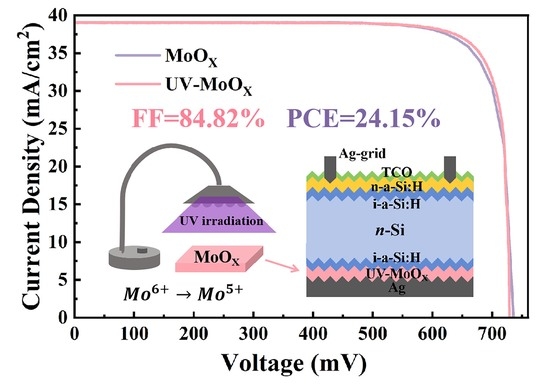
Abstract
1. Introduction
2. Materials and Methods
2.1. Device Fabrication
2.2. Material Characterization
2.3. Solar Cell
2.4. Simulation
3. Results and Discussion
4. Conclusions
Supplementary Materials
Author Contributions
Funding
Institutional Review Board Statement
Informed Consent Statement
Data Availability Statement
Conflicts of Interest
References
- Liu, Y.; Li, Y.; Wu, Y.; Yang, G.; Mazzarella, L.; Procel-Moya, P.; Tamboli, A.C.; Weber, K.; Boccard, M.; Isabella, O.; et al. High-Efficiency Silicon Heterojunction Solar Cells: Materials, Devices and Applications. Mater. Sci. Eng. R Rep. 2020, 142, 100579. [Google Scholar] [CrossRef]
- Wang, Y.; Zhang, S.T.; Li, L.; Yang, X.; Lu, L.; Li, D. Dopant-free passivating contacts for crystalline silicon solar cells: Progress and prospects. EcoMat 2022, 5, e12292. [Google Scholar] [CrossRef]
- Yang, L.; Xu, X.; Li, J.; Lu, W.; Yuan, D.; Liu, T.; Yan, H.; Kang, Q.; Zhang, Y. Transition metal oxide as hole transport layer for crystalline silicon solar cells: Progress and prospects. Sol. Energy Mater. Sol. Cells 2025, 290, 113682. [Google Scholar] [CrossRef]
- Lin, H.; Yang, M.; Ru, X.; Wang, G.; Yin, S.; Peng, F.; Hong, C.; Qu, M.; Lu, J.; Fang, L.; et al. Silicon heterojunction solar cells with up to 26.81% efficiency achieved by electrically optimized nanocrystalline-silicon hole contact layers. Nat. Energy 2023, 8, 789–799. [Google Scholar] [CrossRef]
- Longi Green Energy Technology Co., Ltd. Longi Sets New World Record with 27.81% Conversion Efficiency for Its Heterojunction Back-Contact Cells. Available online: https://www.longi.com/cn/news/isfh-hibc-conversion-efficiency/ (accessed on 14 April 2025).
- Yang, X.; Bi, Q.; Ali, H.; Davis, K.; Schoenfeld, W.V.; Weber, K. High-Performance TiO2-Based Electron-Selective Contacts for Crystalline Silicon Solar Cells. Adv. Mater. 2016, 28, 5891–5897. [Google Scholar] [CrossRef]
- Holman, Z.C.; Descoeudres, A.; Barraud, L.; Fernandez, F.Z.; Seif, J.P.; De Wolf, S.; Ballif, C. Current Losses at the Front of Silicon Heterojunction Solar Cells. IEEE J. Photovolt. 2012, 2, 7–15. [Google Scholar] [CrossRef]
- Richter, A.; Müller, R.; Benick, J.; Feldmann, F.; Steinhauser, B.; Reichel, C.; Fell, A.; Bivour, M.; Hermle, M.; Glunz, S.W. Design rules for high-efficiency both-sides-contacted silicon solar cells with balanced charge carrier transport and recombination losses. Nat. Energy 2021, 6, 429–438. [Google Scholar] [CrossRef]
- Khurgin, J.; Bykov, A.Y.; Zayats, A.V. Hot-electron dynamics in plasmonic nanostructures: Fundamentals, applications and overlooked aspects. eLight 2024, 4, 15. [Google Scholar] [CrossRef]
- Bullock, J.; Zheng, P.; Jeangros, Q.; Tosun, M.; Hettick, M.; Sutter-Fella, C.M.; Wan, Y.; Allen, T.; Yan, D.; Macdonald, D.; et al. Lithium Fluoride Based Electron Contacts for High Efficiency n-Type Crystalline Silicon Solar Cells. Adv. Energy Mater. 2016, 6, 1600241. [Google Scholar] [CrossRef]
- Gao, K.; Xing, C.; Xu, D.; Lou, X.; Wang, X.; Li, K.; Li, W.; Mao, J.; Zheng, P.; Zhang, X.; et al. Aluminum Halide-Based Electron-Selective Passivating Contacts for Crystalline Silicon Solar Cells. Small 2024, 20, 2310352. [Google Scholar] [CrossRef]
- Bullock, J.; Hettick, M.; Geissbühler, J.; Ong, A.J.; Allen, T.; Sutter-Fella, C.M.; Chen, T.; Ota, H.; Schaler, E.W.; De Wolf, S.; et al. Efficient silicon solar cells with dopant-free asymmetric heterocontacts. Nat. Energy 2016, 1, 15031. [Google Scholar] [CrossRef]
- Suchikova, Y.; Nazarovets, S.; Konuhova, M.; Popov, A.I. Binary Oxide Ceramics (TiO2, ZnO, Al2O3, SiO2, CeO2, Fe2O3, and WO3) for Solar Cell Applications: A Comparative and Bibliometric Analysis. Ceramics 2025, 8, 119. [Google Scholar] [CrossRef]
- Kusuma, J.; Balakrishna, R.G. Ceramic grains: Highly promising hole transport material for solid state QDSSC. Sol. Energy Mater. Sol. Cells 2020, 209, 110445. [Google Scholar] [CrossRef]
- Zielke, D.; Niehaves, C.; Lövenich, W.; Elschner, A.; Hörteis, M.; Schmidt, J. Organic-silicon Solar Cells Exceeding 20% Efficiency. Energy Procedia 2015, 77, 331–339. [Google Scholar] [CrossRef]
- Al-Ashouri, A.; Magomedov, A.; Roß, M.; Jošt, M.; Talaikis, M.; Chistiakova, G.; Bertram, T.; Márquez, J.A.; Köhnen, E.; Kasparavičius, E.; et al. Conformal monolayer contacts with lossless interfaces for perovskite single junction and monolithic tandem solar cells. Energy Environ. Sci. 2019, 12, 3356–3369. [Google Scholar] [CrossRef]
- Lou, X.; Bi, Q.; Diao, Y.; Wu, Z.; Gao, K.; Wang, X.; Xu, D.; Wang, J.; Lin, H.; Xie, J.; et al. High-efficiency organic–silicon heterojunction solar cells with high work function PEDOT:F-based hole-selective contacts. J. Mater. Chem. A 2025, 13, 7777. [Google Scholar] [CrossRef]
- Dréon, J.; Jeangros, Q.; Cattin, J.; Haschke, J.; Antognini, L.; Ballif, C.; Boccard, M. 23.5%-efficient silicon heterojunction silicon solar cell using molybdenum oxide as hole-selective contact. Nano Energy 2020, 70, 104495. [Google Scholar] [CrossRef]
- Geissbühler, J.; Werner, J.; Martin de Nicolas, S.; Barraud, L.; Hessler-Wyser, A.; Despeisse, M.; Nicolay, S.; Tomasi, A.; Niesen, B.; De Wolf, S.; et al. 22.5% efficient silicon heterojunction solar cell with molybdenum oxide hole collector. Appl. Phys. Lett. 2015, 107, 081601. [Google Scholar] [CrossRef]
- Xie, A.; Nong, Q.; Shang, K.; Sun, Y.; He, J.; Gao, P. In-Situ Hydrogenation Strategies on Vanadium Oxide Hole-Selective Contact for Efficiency Crystalline Silicon Solar Cells. Small 2025, 21, 2410492. [Google Scholar] [CrossRef]
- Liu, D.; Ren, P.; Zhao, D.; Li, S.; Wang, J.; Zhou, H.; Liu, W.; Zeng, Y.; Yu, X.; Wang, P.; et al. Solution-processed tungsten oxide with Ta5+ doping enhances the hole selective transport for crystalline silicon solar cells. J. Mater. Chem. C 2024, 12, 17925–17934. [Google Scholar] [CrossRef]
- Wang, L.; Zhai, Z.; Li, L. Rapid Fabrication of Tungsten Oxide-Based Electrochromic Devices through Femtosecond Laser Processing. Micromachines 2024, 15, 785. [Google Scholar] [CrossRef]
- Aldirham, S.H.; Helal, A.; Shkir, M.; Sayed, M.A.; Ali, A.M. Enhancement Study of the Photoactivity of TiO2 Photocatalysts during the Increase of the WO3 Ratio in the Presence of Ag Metal. Catalysts 2024, 14, 633. [Google Scholar] [CrossRef]
- Lin, W.; Wu, W.; Liu, Z.; Qiu, K.; Cai, L.; Yao, Z.; Ai, B.; Liang, Z.; Shen, H. Chromium Trioxide Hole-Selective Heterocontacts for Silicon Solar Cells. ACS Appl. Mater. Interfaces 2018, 10, 13645–13651. [Google Scholar] [CrossRef]
- Greiner, M.T.; Chai, L.; Helander, M.G.; Tang, W.M.; Lu, Z.H. Transition Metal Oxide Work Functions: The Influence of Cation Oxidation State and Oxygen Vacancies. Adv. Funct. Mater. 2012, 22, 4557–4568. [Google Scholar] [CrossRef]
- Li, J.; Pan, T.; Wang, J.; Cao, S.; Lin, Y.; Hoex, B.; Ma, Z.; Lu, L.; Yang, L.; Sun, B.; et al. Bilayer MoOX/CrOX Passivating Contact Targeting Highly Stable Silicon Heterojunction Solar Cells. ACS Appl. Mater. Interfaces 2020, 12, 36778–36786. [Google Scholar] [CrossRef]
- Tong, J.; Wan, Y.; Cui, J.; Lim, S.; Song, N.; Lennon, A. Solution-processed molybdenum oxide for hole-selective contacts on crystalline silicon solar cells. Appl. Surf. Sci. 2017, 423, 139–146. [Google Scholar] [CrossRef]
- Cao, L.; Procel, P.; Alcañiz, A.; Yan, J.; Tichelaar, F.; Özkol, E.; Zhao, Y.; Han, C.; Yang, G.; Yao, Z.; et al. Achieving 23.83% conversion efficiency in silicon heterojunction solar cell with ultra-thin MoOx hole collector layer via tailoring (i)a-Si:H/MoOx interface. Prog. Photovolt. Res. Appl. 2022, 31, 1245–1254. [Google Scholar] [CrossRef]
- Yang, B.; Chen, Y.; Cui, Y.; Liu, D.; Xu, B.; Hou, J. Over 100-nm-Thick MoOx Films with Superior Hole Collection and Transport Properties for Organic Solar Cells. Adv. Energy Mater. 2018, 8, 1800698. [Google Scholar] [CrossRef]
- Prayogi, S.; Cahyono, Y.; Darminto. Fabrication of solar cells based on a-Si: H layer of intrinsic double (P-ix-iy-N) with PECVD and Efficiency analysis. J. Phys. Conf. Ser. 2021, 1951, 012015. [Google Scholar] [CrossRef]
- Matsui, T.; McNab, S.; Bonilla, R.S.; Sai, H. Full-Area Passivating Hole Contact in Silicon Solar Cells Enabled by a TiOx/Metal Bilayer. ACS Appl. Energy Mater. 2022, 5, 12782–12789. [Google Scholar] [CrossRef]
- Gao, K.; Bi, Q.; Wang, X.; Liu, W.; Xing, C.; Li, K.; Xu, D.; Su, Z.; Zhang, C.; Yu, J.; et al. Progress and Future Prospects of Wide-Bandgap Metal-Compound-Based Passivating Contacts for Silicon Solar Cells. Adv. Mater. 2022, 34, 2200344. [Google Scholar] [CrossRef]
- Li, J.; Kang, Q.; Wang, Y.; Zhou, Z.; Sun, Z.; Zhang, H.; Lu, W.; Tao, X.; Zhang, S.T.; Chen, X.; et al. Low Oxygen Content MoOx and SiOx Tunnel Layer Based Heterocontacts for Efficient and Stable Crystalline Silicon Solar Cells Approaching 22% Efficiency. Adv. Funct. Mater. 2023, 34, 2310619. [Google Scholar] [CrossRef]
- Guo, Y.; Zhao, Q.; Zhan, Y.; Xu, X.; Xie, Y. Experimental study on an evaporation process to deposit MoO2 microflakes. Chem. Phys. Lett. 2017, 687, 14–18. [Google Scholar] [CrossRef]
- Li, L.; Du, G.; Lin, Y.; Zhou, X.; Gu, Z.; Lu, L.; Liu, W.; Huang, J.; Wang, J.; Yang, L.; et al. NiOx/MoOx bilayer as an efficient hole-selective contact in crystalline silicon solar cells. Cell Rep. Phys. Sci. 2021, 2, 100684. [Google Scholar] [CrossRef]
- Lu, W.; Kang, Q.; Li, J.; Xu, X.; Yuan, D.; Yang, L.; Liu, S.; Liu, T.; Yan, H.; Wu, Z.; et al. MoOX/Au/MoOX-Based Composite Heterocontacts for Crystalline Silicon Solar Cells Achieving 22.0% Efficiency. Small Struct. 2025, 6, 2400559. [Google Scholar] [CrossRef]
- Liu, Z.; Lin, H.; Wang, Z.; Chen, L.; Wu, T.; Pang, Y.; Cai, L.; He, J.; Peng, S.; Shen, H.; et al. Dual Functional Dopant-Free Contacts with Titanium Protecting Layer: Boosting Stability while Balancing Electron Transport and Recombination Losses. Adv. Sci. 2022, 9, 2202240. [Google Scholar] [CrossRef]
- Sen, M.T.S.K.A.; Melskens, J.; Weeber, A. Effects of a post deposition anneal on a tunneling Al2O3 interlayer for thermally stable MoOx hole selective contacts. AIP Conf. Proc. 2022, 2487, 020001. [Google Scholar]
- Battaglia, C.; Yin, X.; Zheng, M.; Sharp, I.D.; Chen, T.; McDonnell, S.; Azcatl, A.; Carraro, C.; Ma, B.; Maboudian, R.; et al. Hole Selective MoOx Contact for Silicon Solar Cells. Nano Lett. 2014, 14, 967–971. [Google Scholar] [CrossRef]
- Sun, T.; Wang, R.; Liu, R.; Wu, C.; Zhong, Y.; Liu, Y.; Wang, Y.; Han, Y.; Xia, Z.; Zou, Y.; et al. Investigation of MoOx/n-Si strong inversion layer interfaces via dopant-free heterocontact. Phys. Status Solidi Rapid Res. Lett. 2017, 11, 1700107. [Google Scholar] [CrossRef]
- Al-Kuhaili, M.F.; Mekki, M.B. Laser-induced photocoloration in molybdenum oxide thin films. J. Alloys Compd. 2021, 885, 161043. [Google Scholar] [CrossRef]
- DeJournett, T.J.; Spicer, J.B. The influence of oxygen on the microstructural, optical and photochromic properties of polymer-matrix, tungsten-oxide nanocomposite films. Sol. Energy Mater. Sol. Cells 2014, 120, 102–108. [Google Scholar] [CrossRef]
- Cao, S.; Li, J.; Lin, Y.; Pan, T.; Du, G.; Zhang, J.; Yang, L.; Chen, X.; Lu, L.; Min, N.; et al. Interfacial Behavior and Stability Analysis of p-Type Crystalline Silicon Solar Cells Based on Hole-Selective MoOX/Metal Contacts. Sol. RRL 2019, 3, 1900274. [Google Scholar] [CrossRef]
- Yuzheng Guo, J.R. Origin of the high work function and high conductivity of MoO3. Appl. Phys. Lett. 2014, 105, 222110. [Google Scholar] [CrossRef]
- Vijayan, R.A.; Essig, S.; De Wolf, S.; Ramanathan, B.G.; Loper, P.; Ballif, C.; Varadharajaperumal, M. Hole-Collection Mechanism in Passivating Metal-Oxide Contacts on Si Solar Cells: Insights from Numerical Simulations. IEEE J. Photovolt. 2018, 8, 473–482. [Google Scholar] [CrossRef]
- Jiang, Y.; Cao, S.; Lu, L.; Du, G.; Lin, Y.; Wang, J.; Yang, L.; Zhu, W.; Li, D. Post-annealing Effect on Optical and Electronic Properties of Thermally Evaporated MoOX Thin Films as Hole-Selective Contacts for p-Si Solar Cells. Nanoscale Res. Lett. 2021, 16, 87. [Google Scholar] [CrossRef]
- Li, L.; Du, G.; Zhou, X.; Lin, Y.; Jiang, Y.; Gao, X.; Lu, L.; Li, G.; Zhang, W.; Feng, Q.; et al. Interfacial Engineering of Cu2O Passivating Contact for Efficient Crystalline Silicon Solar Cells with an Al2O3 Passivation Layer. ACS Appl. Mater. Interfaces 2021, 13, 28415–28423. [Google Scholar] [CrossRef]
- Allen, T.G.; Bullock, J.; Yang, X.; Javey, A.; De Wolf, S. Passivating contacts for crystalline silicon solar cells. Nat. Energy 2019, 4, 914–928. [Google Scholar] [CrossRef]
- Gregory, G.; Feit, C.; Gao, Z.; Banerjee, P.; Jurca, T.; Davis, K.O. Improving the Passivation of Molybdenum Oxide Hole-Selective Contacts with 1 nm Hydrogenated Aluminum Oxide Films for Silicon Solar Cells. Phys. Status Solidi (a) 2020, 217, 2000093. [Google Scholar] [CrossRef]
- Nasser, H.; Es, F.; Zolfaghari Borra, M.; Semiz, E.; Kökbudak, G.; Orhan, E.; Turan, R. On the application of hole-selective MoOx as full-area rear contact for industrial scale p-type c-Si solar cells. Prog. Photovolt. Res. Appl. 2020, 29, 281–293. [Google Scholar] [CrossRef]
- Sinton, R.A. Andres Cuevas, A quasi-steady-state open-circuit voltage method for solar cell characterization. In Proceedings of the 16th European Photovoltaic Solar Energy Conference, Glasgow, UK, 1–5 May 2000; Volume 25, pp. 1152–1155. [Google Scholar]
- Duan, L.; Yi, H.; Xu, C.; Upama, M.B.; Mahmud, M.A.; Wang, D.; Shabab, F.H.; Uddin, A. Relationship Between the Diode Ideality Factor and the Carrier Recombination Resistance in Organic Solar Cells. IEEE J. Photovolt. 2018, 8, 1701–1709. [Google Scholar] [CrossRef]
- Kirchartz, T.; Nelson, J. Meaning of reaction orders in polymer:fullerene solar cells. Phys. Rev. B 2012, 86, 165201. [Google Scholar] [CrossRef]
- Lin, H.; Wang, G.; Su, Q.; Han, C.; Xue, C.; Yin, S.; Fang, L.; Xu, X.; Gao, P. Unveiling the mechanism of attaining high fill factor in silicon solar cells. Prog. Photovolt. Res. Appl. 2024, 32, 359–371. [Google Scholar] [CrossRef]
- Chen, L.; Lin, H.; Liu, Z.; Wu, T.; Pang, Y.; Gao, P.; Shen, W. Realization of a General Method for Extracting Specific Contact Resistance of Silicon-Based Dopant-Free Heterojunctions. Sol. RRL 2021, 6, 2100394. [Google Scholar] [CrossRef]
- Wang, W.; Lin, H.; Yang, Z.; Wang, Z.; Wang, J.; Zhang, L.; Liao, M.; Zeng, Y.; Gao, P.; Yan, B.; et al. An Expanded Cox and Strack Method for Precise Extraction of Specific Contact Resistance of Transition Metal Oxide/n-Silicon Heterojunction. IEEE J. Photovolt. 2019, 9, 1113–1120. [Google Scholar] [CrossRef]
- Cheung, S.K.; Cheung, N.W. Extraction of Schottky diode parameters from forward current-voltage characteristics. Appl. Phys. Lett. 1986, 49, 85–87. [Google Scholar] [CrossRef]



Disclaimer/Publisher’s Note: The statements, opinions and data contained in all publications are solely those of the individual author(s) and contributor(s) and not of MDPI and/or the editor(s). MDPI and/or the editor(s) disclaim responsibility for any injury to people or property resulting from any ideas, methods, instructions or products referred to in the content. |
© 2025 by the authors. Licensee MDPI, Basel, Switzerland. This article is an open access article distributed under the terms and conditions of the Creative Commons Attribution (CC BY) license (https://creativecommons.org/licenses/by/4.0/).
Share and Cite
Yang, L.; Lu, W.; Li, J.; Chen, S.; Liu, T.; Yuan, D.; Wang, Y.; Zhu, J.; Yan, H.; Zhang, Y.; et al. UV-Engineered Oxygen Vacancies in MoOX Interlayers Enable 24.15% Efficiency for Crystalline Silicon Solar Cells. Materials 2025, 18, 5167. https://doi.org/10.3390/ma18225167
Yang L, Lu W, Li J, Chen S, Liu T, Yuan D, Wang Y, Zhu J, Yan H, Zhang Y, et al. UV-Engineered Oxygen Vacancies in MoOX Interlayers Enable 24.15% Efficiency for Crystalline Silicon Solar Cells. Materials. 2025; 18(22):5167. https://doi.org/10.3390/ma18225167
Chicago/Turabian StyleYang, Linfeng, Wanyu Lu, Jingjie Li, Shaopeng Chen, Tinghao Liu, Dayong Yuan, Yin Wang, Ji Zhu, Hui Yan, Yongzhe Zhang, and et al. 2025. "UV-Engineered Oxygen Vacancies in MoOX Interlayers Enable 24.15% Efficiency for Crystalline Silicon Solar Cells" Materials 18, no. 22: 5167. https://doi.org/10.3390/ma18225167
APA StyleYang, L., Lu, W., Li, J., Chen, S., Liu, T., Yuan, D., Wang, Y., Zhu, J., Yan, H., Zhang, Y., & Kang, Q. (2025). UV-Engineered Oxygen Vacancies in MoOX Interlayers Enable 24.15% Efficiency for Crystalline Silicon Solar Cells. Materials, 18(22), 5167. https://doi.org/10.3390/ma18225167