


Abstract
Comprehensive studies of hydrogen embrittlement in high-strength austenitic alloys under cryogenic conditions are scarce, leaving the combined effect of hydrogen charging and extreme temperatures largely unexplored. Given the demands of cryogenic applications such as hydrogen storage and transport, understanding material behavior under these conditions is crucial. Here, we present the first systematic study of hydrogen’s effect at liquid helium temperature (4.2 K) on the mechanical properties of precipitation hardened austenitic alloys, specifically the nickel-based Alloy 718 and austenitic stainless steel A286. Both materials were subjected to pressurized hydrogen charging at 473 K followed by slow strain rate tensile testing at room temperature and at 4.2 K. Hydrogen charging caused significant ductility loss at room temperature in both alloys. In contrast, testing at 4.2 K resulted in increased strength and no evidence of hydrogen embrittlement. Notably, materials pre-charged with hydrogen and tested at 4.2 K exhibited higher stress drop amplitudes and increased strain accumulation during serration events, suggesting persistent hydrogen–dislocation interactions and possible enhanced dislocation pinning by obstacles such as Lomer–Cottrell locks. These results indicate that while hydrogen influences plasticity mechanisms at cryogenic temperatures, embrittlement is suppressed, providing new insight into the safe development of austenitic alloys in cryogenic hydrogen environments.
1. Introduction
Nickel-based alloys and austenitic stainless steels feature a unique combination of properties, such as high strength, high ductility and excellent corrosion resistance, explaining their widespread use under extreme conditions [1,2]. However, when exposed to hydrogen-containing environments, these alloys may exhibit significant ductility loss caused by hydrogen embrittlement (HE) [3,4,5,6,7,8,9,10]. A notable example is the significant ductility loss observed in austenitic stainless steels of the 3xx series when exposed to hydrogen-containing environments at temperatures up to approximately 200 K [11,12]. Therefore, understanding the influence of temperature on HE is crucial for applications involving gaseous or liquid hydrogen tanks or valves operating at cryogenic temperatures [2].
The mechanical properties of nickel-based alloys and austenitic stainless steels have been studied extensively at cryogenic temperatures, where it has been shown that they typically remain ductile down to very low temperatures, even in combination with hydrogen [2,11,12,13,14,15,16,17,18,19,20]. Much less is known about precipitation hardened (PH) austenitic alloys [13,14,21], which are considered possible alternatives to conventional austenitic stainless steels for the renewable energy sector applications due to their superior strength [1]. The available literature’s data suggest that although Alloy 718 (UNS N07718) is relatively resistant to hydrogen ingress from the environment, there is a sizable effect of hydrogen on ductility loss at temperatures between 233 and about 573 K [13,14]. This is critical not only for hydrogen storage but also for aerospace, oil and gas and nuclear power applications, where it has been shown to depend not only on temperature but also on the hydrogen content in the material [14].
In this study, we focus on HE of the well-studied Alloy 718 and the austenitic stainless steel A286 (UNS S66286), both examined in their PH high-strength condition. Both alloys are strengthened by γ′ (Ni3(Al,Ti)) precipitates, while Alloy 718 is additionally reinforced by γ″ (Ni3Nb). Previous studies have reported that an increased γ″ fraction enhances susceptibility to HE [6]. Moreover, suppressing the formation of δ phase (Ni3Nb), the stable phase of γ″, has been shown to improve HE in Alloy 718 [6,8]. In contrast, A286 contains η phase (Ni3Ti), the stable phase of Ti rich γ′, which, when present along grain boundaries, correlates with higher HE susceptibility as its fraction increases [21]. Even in the absence of η phase, however, Takakuwa et al. [5] observed substantial ductility loss due to hydrogen pre-charging. Earlier studies on A286 also investigated the influence of lattice misfit on HE resistance [3,22] and identified carbides, γ′ and η phase as preferential crack initiation sites [4].
Alloy 718 and A286 in their PH state are among the most promising materials for applications in H-bearing environments at cryogenic temperatures. Typical cryogenic temperatures for HE testing addressed in the literature usually do not go below 77 K (boiling temperature of liquid nitrogen), though the operating temperature of hydrogen tanks and valves can reach 20 K or less [23].
At temperatures of 20 K and below, austenitic alloys show low temperature serrated deformation (LTSD) [24]. This behavior is typically governed by the (i) thermo-mechanical and (ii) mechanical effects. The former describes localized thermal softening due to local deformation that releases heat. This heat spike can reach very high values of several 10 to 100 K [24] and is very localized due to very low heat capacity and thermal conductivity at such temperatures [25]. This heat spike is thought to cause local thermal softening that causes avalanche shear of slip bands, which manifests in stress drops and causes characteristic serrations in a stress–strain curve. Alternatively, the mechanical effect describes dislocation accumulation in front of obstacles. Once a critical stress is reached, the piled-up dislocations are released, resulting in avalanche slip and a sudden proliferation event [26]. Although recent studies [26,27,28,29] investigated alloys differing in chemistry and precipitation state compared to the present work, their room temperature (RT) stacking fault energies (SFE) fall into the similar range of approximately 30 mJ/m2 [3]. Since SFE strongly governs dislocation mobility, partial separation and the likelihood of cross-slip, a similar mechanical response at cryogenic temperatures may be anticipated, which is consistent with a mechanical origin of the LTSD in the investigated alloys.
We investigate the mechanical properties of A286 and Alloy 718 at 4.2 K in both the hydrogen pre-charged und uncharged states. The details of this investigation and the differences in mechanical response of both alloys at RT and 4.2 K, with and without hydrogen pre-charging, are presented and discussed.
2. Materials and Methods
Alloy A286 and Alloy 718, with nominal compositions given in Table 1, were solution-annealed and subsequently aged to minimum yield strengths of 1034 MPa and 724 MPa at RT, respectively. Cylindrical tensile specimens with a diameter of 4 mm and a gauge length of 20 mm were machined from the centers of rolled bars with diameters of 31.75 mm for alloy A286 and 25.4 mm for Alloy 718. Their surface was ground to P2000 to ensure a fine surface finish and minimize the influence of machining marks on the results of the mechanical testing and hydrogen charging.
Table 1.
Nominal composition of A286 and Alloy 718 in wt.%.
Hydrogen charging was performed to ensure sufficient uptake for significant ductility loss at ambient conditions. Half of the tensile specimens were charged with pressurized hydrogen at 473 K for 14 days at 1000 bar using the autoclave test bench described by Eichinger et al. [30]. This charging procedure excludes hydride formation, as Ni-H hydrides form only at pressures exceeding 10,000 bar at 473 K [31] and avoids niobium oxide formation at the on Alloy 718, which occurs only at temperatures of 800 K or higher [32]. Effective hydrogen diffusion coefficients at 473 K were extrapolated from literature values as 3.5 × 10⁻⁸ cm2/s for A286 [33] and 6.0 × 10⁻⁸ cm2/s for Alloy 718 [34,35]. Using these values, the hydrogen saturation levels at the specimen center (cylinder, 4 mm diameter) after the specified charging duration were calculated numerically by solving Fick’s second law with appropriate boundary conditions. This resulted in estimated saturation levels of 93% for A286 and 100% for Alloy 718, indicating near-uniform hydrogen uptake in both alloys under the applied charging conditions.
Total hydrogen content within the specimen gauge length was measured by thermal desorption spectroscopy using a Bruker Galileo G8 (Billerica, MA, USA), yielding 89 wt. ppm for A286 and 107 wt. ppm for Alloy 718. These measurements were performed using a rapid heating protocol where specimens were heated to 1173 K as quickly as possible and held for 15 min, without a classical defined heating rate typically applied in thermal desorption spectroscopy. Thermal desorption spectroscopy was chosen for its superior detection limit compared to conventional hot extraction techniques. The focus was exclusively on total hydrogen quantification rather than desorption kinetics or hydrogen trapping. Specimens were subsequently stored in liquid nitrogen at 77 K and tested within one week.
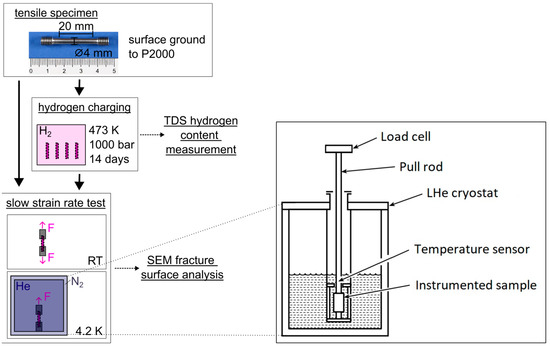
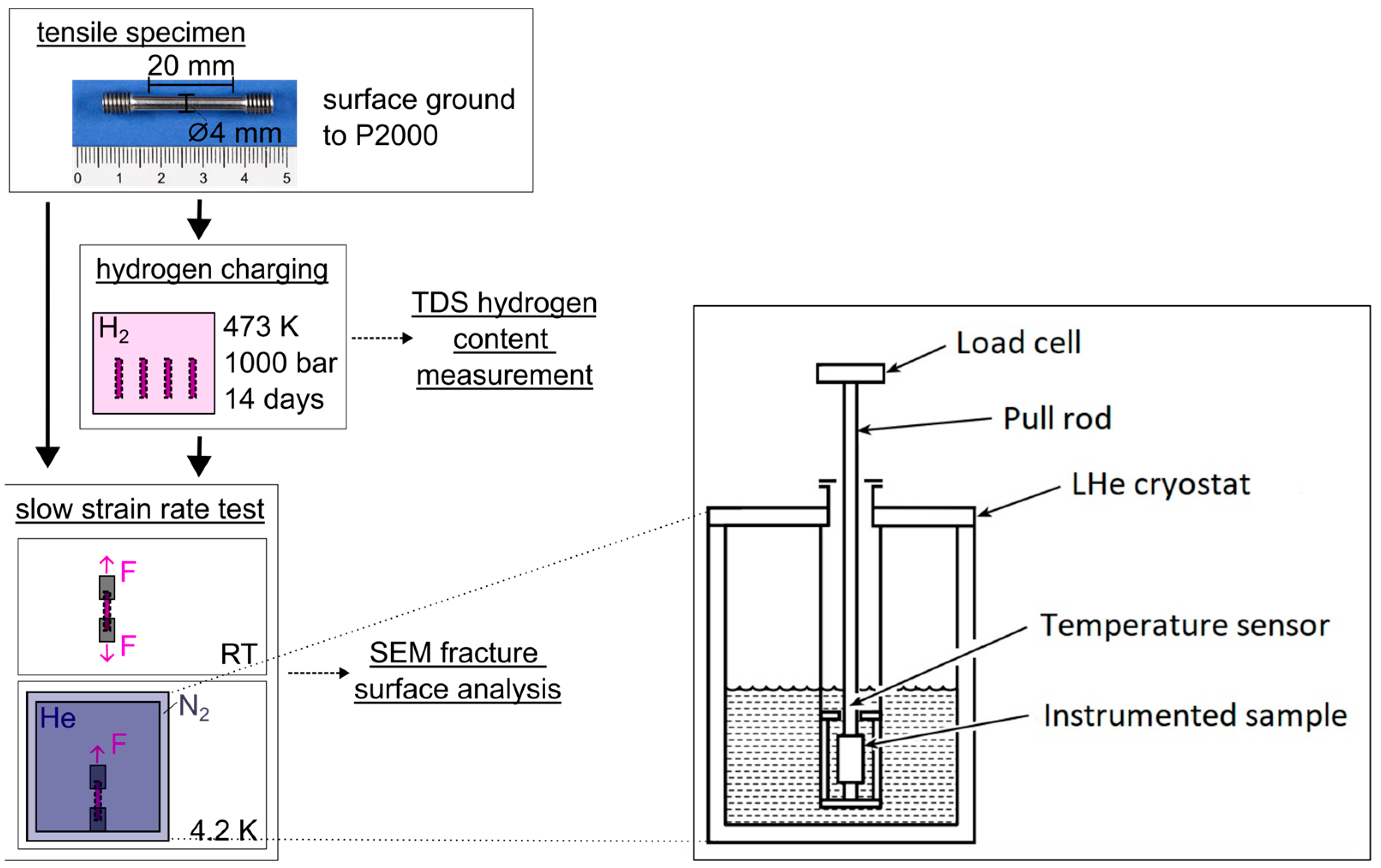
Slow strain rate tests (SSRT) at RT were performed on a Zwick Z250 (Ulm, Germany) following EN ISO 6892-1 [36], except that the initial strain rate was set to 3 × 10⁻⁵ s−1, resulting in testing durations of ~2.5 h or less per specimen. All 4.2 K SSRTs were conducted on a Messphysik Beta 200 (Fuerstenfeld, Austria). These tests were carried out with specimens mounted inside a liquid helium cryostat surrounded by a liquid nitrogen thermal shield, ensuring specimen temperature remained at 4.2 K throughout testing. Testing commenced only after the temperature stabilization at 4.2 K. The initial strain rate used in the 4.2 K SSRTs was the same as that at RT. Strain was measured using a clip-on extensometer from the elastic region into part of the plastic regime. Due to pronounced serrated yielding at 4.2 K, the extensometer slipped predominantly in the middle of the plastic regime. Consequently, strain data beyond this point were estimated by interpolation from crosshead displacement data, based on correlation with initial extensometer strain data. This interpolation approach was validated by cross-checks against extensometer data to maintain accuracy. Final strain-to-failure values for all 4.2 K tests were determined from crosshead displacement data with an uncertainty of ±1.25% strain, ensuring consistent comparison with RT results. Two specimens were tested at RT and three at 4.2 K for each material and condition. Figure 1 schematically illustrates the described study design. The summary of the testing conditions is listed in Table 2.
Figure 1.
Schematic illustration of the mechanical testing setup. After manufacturing, half of the specimens were hydrogen charged in an autoclave. Finally, all specimens were subjected to slow strain rate testing at RT or 4.2 K (boiling point of liquid helium, “F” in the figure indicates the applied force). The tests at 4.2 K took place inside a liquid helium cryostat, which is surrounded by a liquid nitrogen cooled radiation shield to ensure constant specimen temperature during testing. A schematic of the test rig for the 4.2 K SSRT is shown on the right side of the image. More details are provided in Table 2.
Table 2.
Summary of the testing conditions.
Fracture surfaces were examined using a ZEISS Crossbeam 340 scanning electron microscope (SEM) at an acceleration voltage of 10 kV (Oberkochen, Germany). Microstructural characterization was performed on cross sections from the bars’ center. Samples were ground, polished and analyzed with a ZEISS GeminiSEM 450 at 5 kV (Oberkochen, Germany). To resolve nanosized precipitates, samples were additionally prepared by ion milling (Hitachi IM4000PLUS, Tokyo, Japan) and imaged at 2 kV for optimal image quality.
3. Results
3.1. Microstructure Characterization
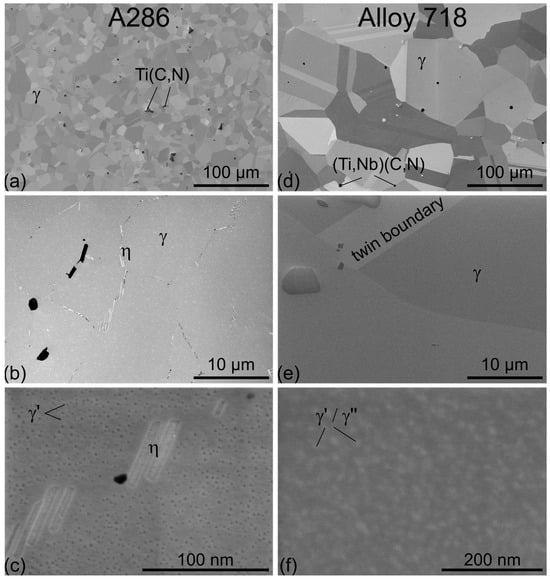
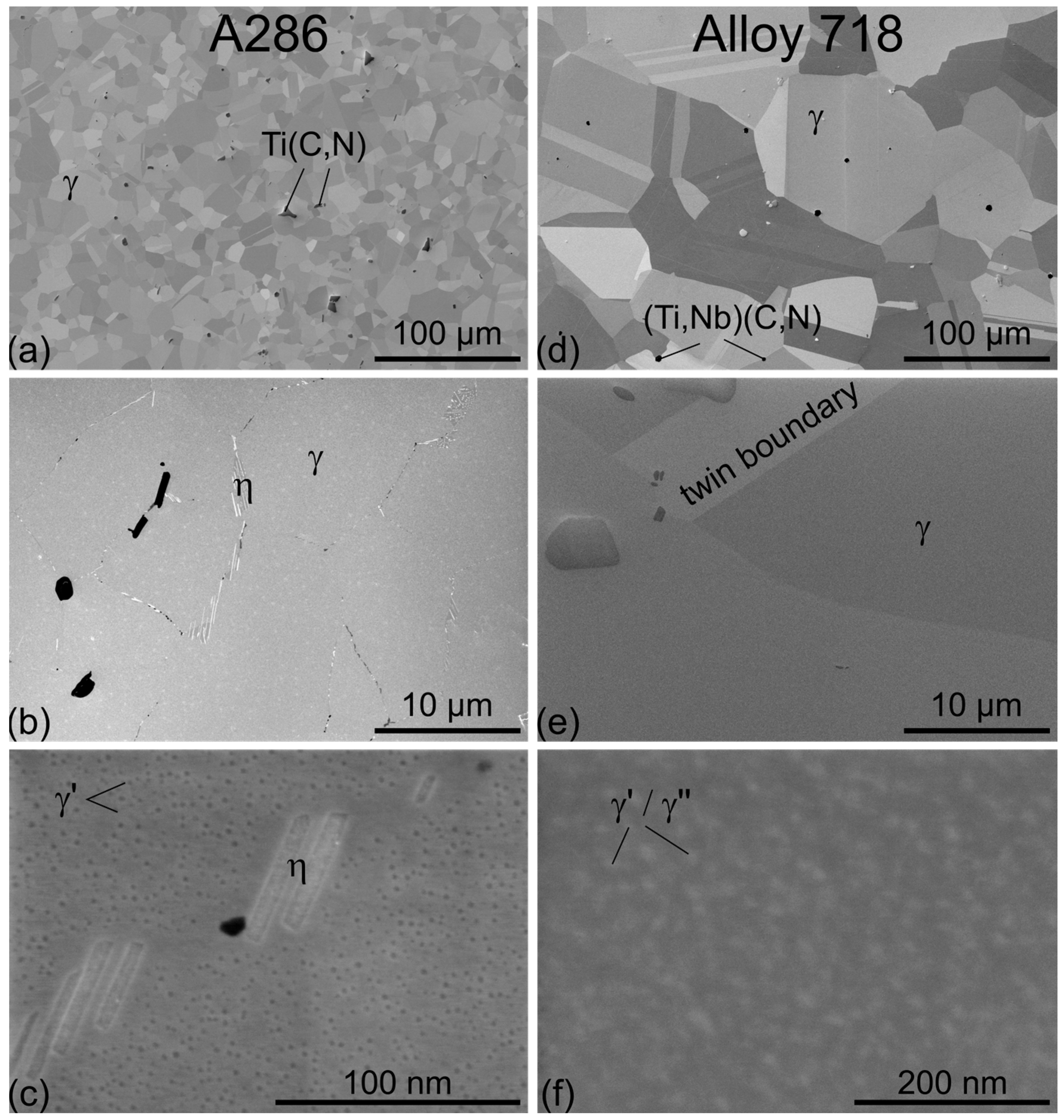
The microstructure of A286 and Alloy 718 is presented by means of SEM micrographs in Figure 2. Both alloys show the typical austenitic grains with twins and carbo-nitrides (Figure 2a,d). A286 has much finer grains than Alloy 718. A286 and Alloy 718 have average grain sizes of 13 µm (ASTM grain size number G = 9.5) and 75 µm (G = 4.5), respectively, determined according to ASTM E112-24 [37]. While the grain boundaries are free for Alloy 718 (no δ phase, Ni3Nb—stable phase of γ″), A286 show the typical η phase (Ni3Ti—stable phase of Ni3Ti-γ′) as white plates along some grain boundaries (compare Figure 2b,e). Both alloys are in the PH state and the precipitates are visualized in Figure 2c,f: γ′ (Ni3(Ti,Al)) for A286 and γ′ (Ni3(Al,Ti,Nb)) and γ″ (Ni3(Nb,Ti)) for Alloy 718. A286 does not form γ″ due to the absence of niobium. The size of the precipitates is in the range of a few nanometers. Figure 2c additionally shows a higher magnification of the η phase at a grain boundary.
Figure 2.
Cross-sectional micrographs of the studied materials taken from the center of the rods for A286 (a–c) and for Alloy 718 (d–f) in different magnifications: (a,d) overview of austenitic grains with carbo-nitrides, (b,e) higher magnification of austenitic grains with focus on the grain boundaries showing η phase in A286 and free grain boundaries for Alloy 718, and (c,f) high resolution of the γ′ precipitates for A286 and γ′ and γ″ precipitates for Alloy 718. Images (a–d) show secondary electron (SE) contrast, while images (e,f) show backscattered electron (BSE) contrast.
3.2. Slow Strain Rate Tests
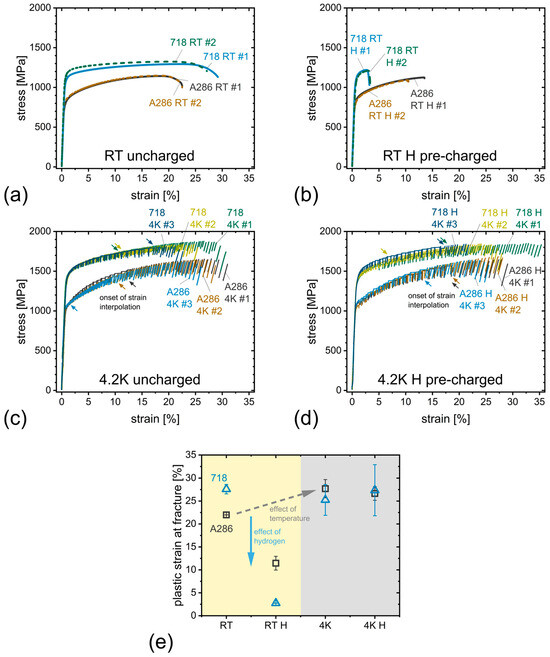
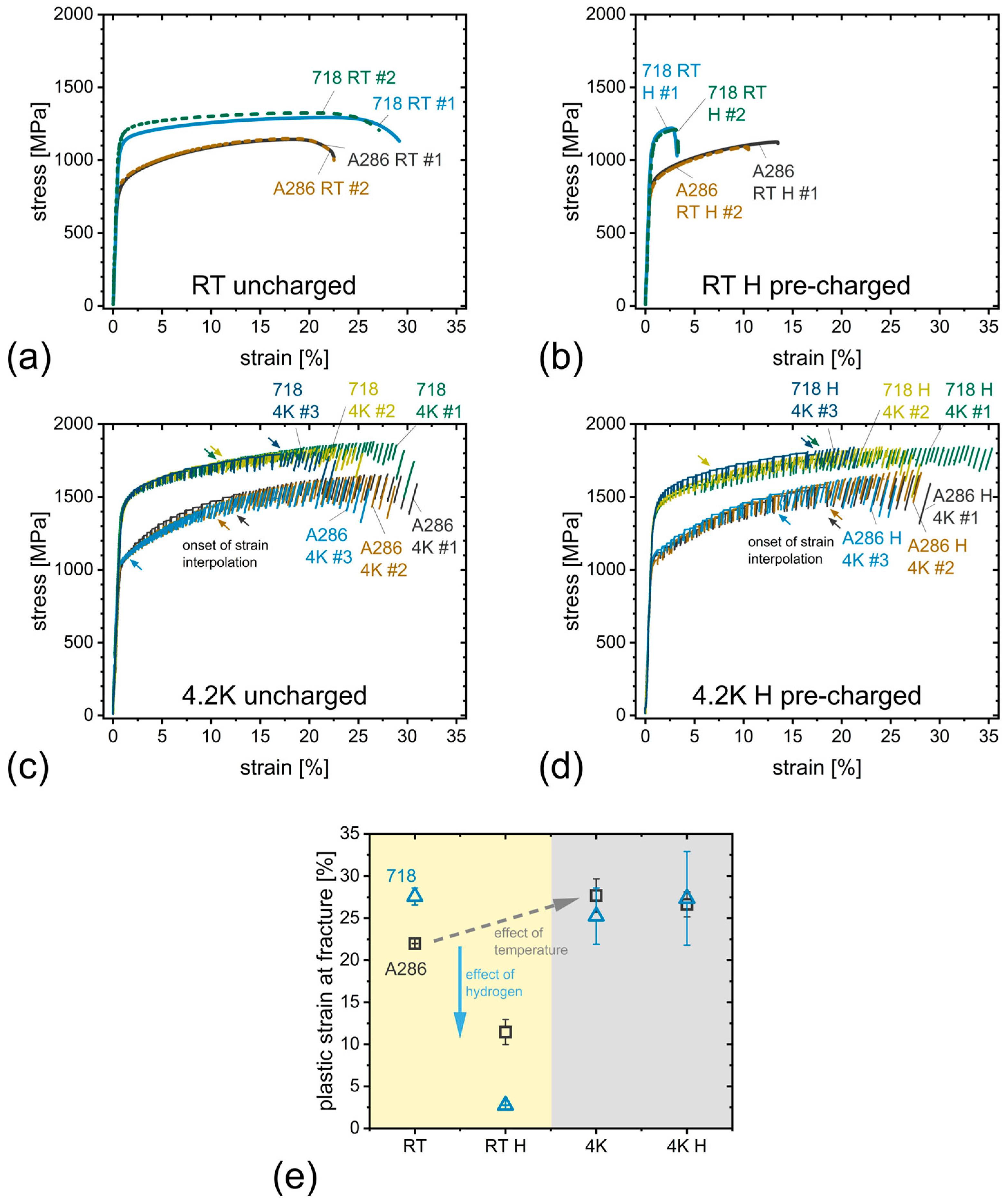
The results from the SSRT are shown in Figure 3. To distinguish between the RT and 4.2 K tests, as well as between the uncharged and the hydrogen-charged state, we introduce the following naming convention: We start with an indication of the alloy (“A286” or “718”) followed by the testing temperature (“RT” or “4K”) and an “H” to indicate the hydrogen pre-charged states. Finally, a number counts the specimens tested in each state, ranging from “#1” to “#3”, where two specimens per state have been tested at RT and three at 4.2 K.
Figure 3.
Results from SSRT at (a,b) RT, and (c,d) 4.2 K for both alloys (A286 and Alloy 718) in the uncharged and hydrogen pre-charged state, respectively. (e) Evaluation of the determined plastic strains at fracture for each condition and material including mean values and standard deviation. Hydrogen reduces the fracture strain at RT, whereas it remains virtually unchanged at 4.2 K. Colored arrows indicate points of strain interpolation corresponding to the respective stress–strain curves due to extensometer slip.
RT results of A286 and Alloy 718 (Figure 3a,b) show only small differences between different specimens tested for the same state (uncharged/hydrogen-charged). Alloy 718 has a significant higher yield strength than A286 (1100 MPa vs. 800 MPa). Hydrogen pre-charged specimens show significantly lower plastic strain at fracture, a decrease from 22 to 11% for A286 and from 28 to 3% for Alloy 718. Their mean values and standard deviations are plotted in the left part of Figure 3e. The 4.2 K results show a much larger scatter of plastic strain at fracture (right part of Figure 3e), which is especially pronounced for Alloy 718. The associated stress–strain curves at 4.2 K are shown in Figure 3c,d for both alloys in its uncharged and hydrogen pre-charged conditions, respectively. All curves show serrated yielding, which is a typical phenomenon and will be analyzed later in more detail. Note that, arrows indicate the point, where strains have been interpolated from the crosshead movement, because the clip-on extensometer slipped. This causes a visible change in the zig-zag pattern of the curves.
At 4.2 K, the plastic strain at fracture has been measured as 25.3 ± 4.1% and 27.3 ± 6.8% for Alloy 718 in uncharged and hydrogen-charged conditions, respectively, which is comparable to the uncharged alloy’s RT result (27.6 ± 1.0%). A286, however, has shown an increase in plastic strain at fracture by approximately 5% with decreasing temperature from RT to 4.2 K. The plastic strain at fracture has been measured as 22.0 ±0.0% for the uncharged RT condition and 27.7 ± 2.4% and 26.6 ± 1.8% for the 4.2 K uncharged and hydrogen-charged conditions, respectively. Additionally, an increased strength has been measured with decreasing temperature in both alloys—specifically, a rise in yield strength from 800 MPa at RT to 1040 MPa at 4.2 K for A286 and from 1100 MPa at RT to 1400 MPa at 4.2 K for Alloy 718.
The plastic strain at fracture εf of hydrogen-charged and uncharged specimens have been compared using the ductility loss, as defined in Equation (1):
A286 and Alloy 718 exhibited ductility losses of 48% and 90% at RT, respectively, which are attributed to the substantial hydrogen uptake of 89 and 107 wt. ppm.
For the 4.2 K tests, no significant influence of hydrogen charging on plastic strain at fracture or the stress strain curve behavior has been observed in both materials.
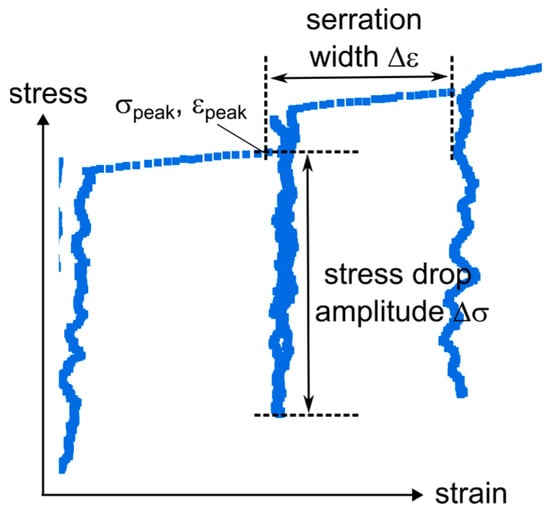
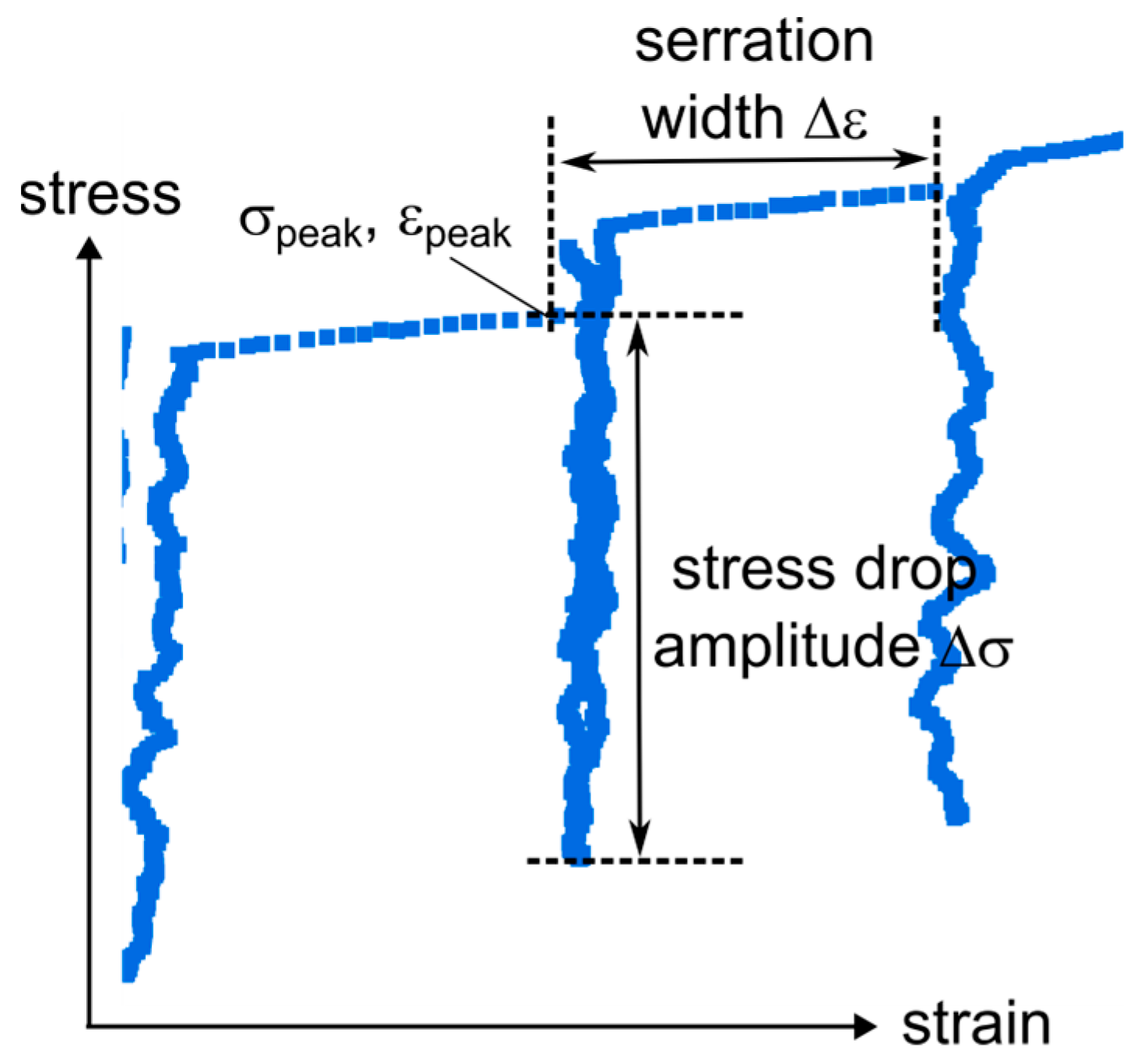
Figure 4 shows a schematic illustration of the serration and illustrates the definition of the stress drop amplitude (Δσ = σpeak − σvalley) and the serration width (Δε, defined as the strain difference between a serration peak and the preceding peak). The serration analysis at 4.2 K was conducted with the following considerations. First, the three datasets per state (uncharged and hydrogen-charged for each alloy) were treated equally, resulting in four combined datasets: A286 4K, A286 4K H, 718 4K and 718 4K H. Second, only serrations measured by the clip-on extensometer were analyzed. This restricted the analysis to strains up to 10% and excluded A286 4K #3 and 718 4K H #2 due to early extensometer slip.
Figure 4.
Schematic illustration of serrations at 4.2 K. Definition of stress drop amplitude (Δσ = σpeak − σvalley) and serration width (Δε).
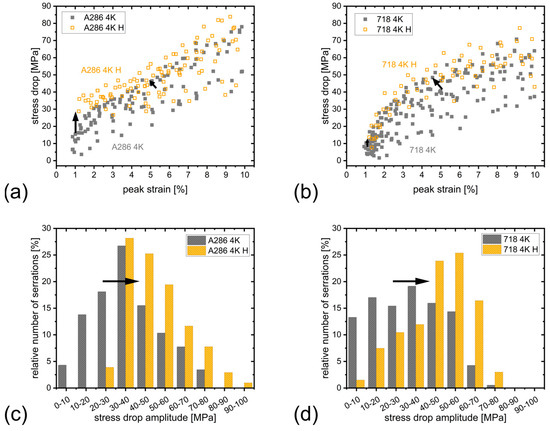
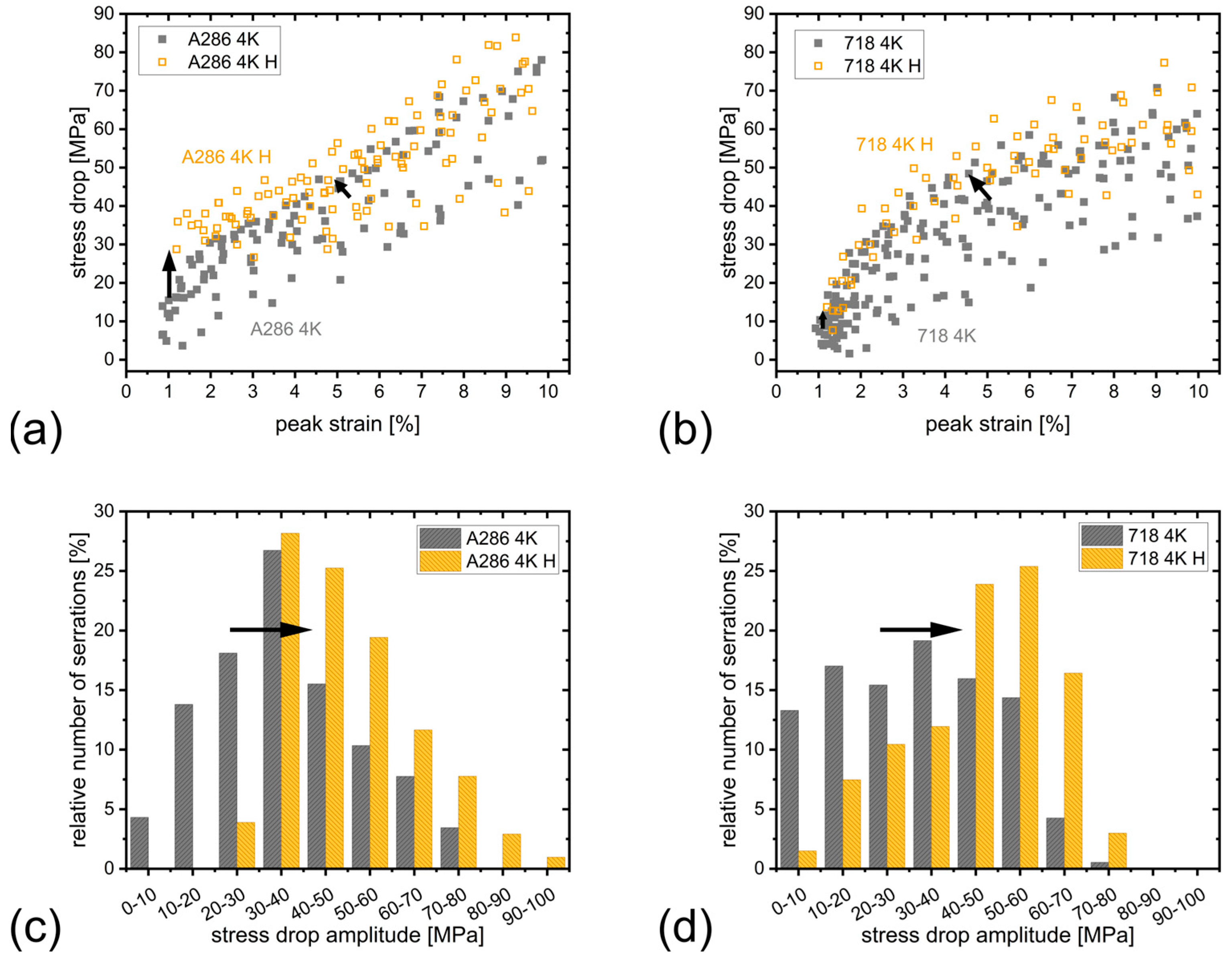
The results are presented in Figure 5 for A286 (left: a, c) and Alloy 718 (right: b, d). The stress drop amplitude (Δσ) as a function of peak strain (Figure 5a,b) shows a distinct influence of hydrogen charging. Although the data exhibit considerable scatter, the hydrogen-charged state consistently displays higher stress drop amplitudes in both alloys, as highlighted by the black arrows. A comparison of the hydrogen-charged states further reveals that the first stress drops are significantly larger in A286 than in Alloy 718. The distribution of the stress drop amplitudes (Δσ) is shown in Figure 5c,d. Both alloys exhibit higher Δσ in the hydrogen-charged state compared to the uncharged state.
Figure 5.
Results from the serration analysis up to 10% strains for A286 (a,c) and Alloy 718 (b,d): (a,b) stress drop amplitude (Δσ) as a function of the peak strain (εpeak), and (c,d) histogram of the stress drop amplitude. Hydrogen pre-charged states show higher stress drop amplitudes, as indicated by the black arrows.
Table 3 summarizes the dataset counts and number of serrations, together with the calculated serration frequency, mean stress drop amplitude Δσ and mean serration width Δε. Both alloys show increased mean Δσ and Δε in the hydrogen-charged state. This is accompanied by a reduction in serration frequency per percent strain.
Table 3.
Serration analysis up to 10% strain in A286 and Alloy 718 (uncharged vs. hydrogen-charged) at 4.2 K, reporting dataset count, serration number and frequency, mean stress-drop amplitude Δσ (MPa) and mean serration width Δε (% strain, defined as the strain difference between a serration peak and the preceding peak).
3.3. Fracture Surfaces
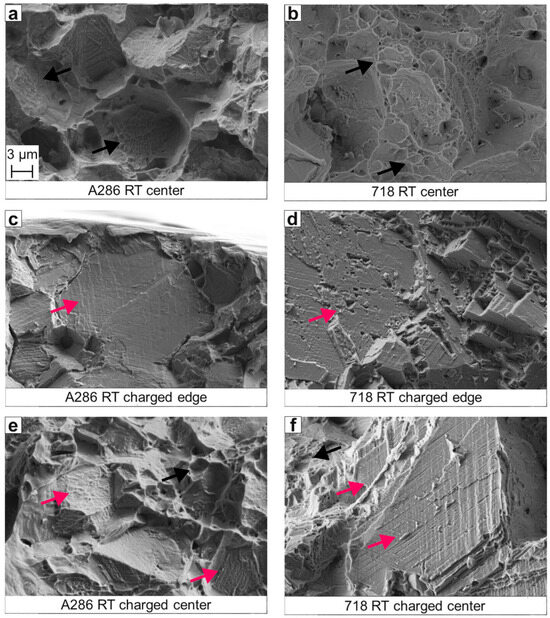
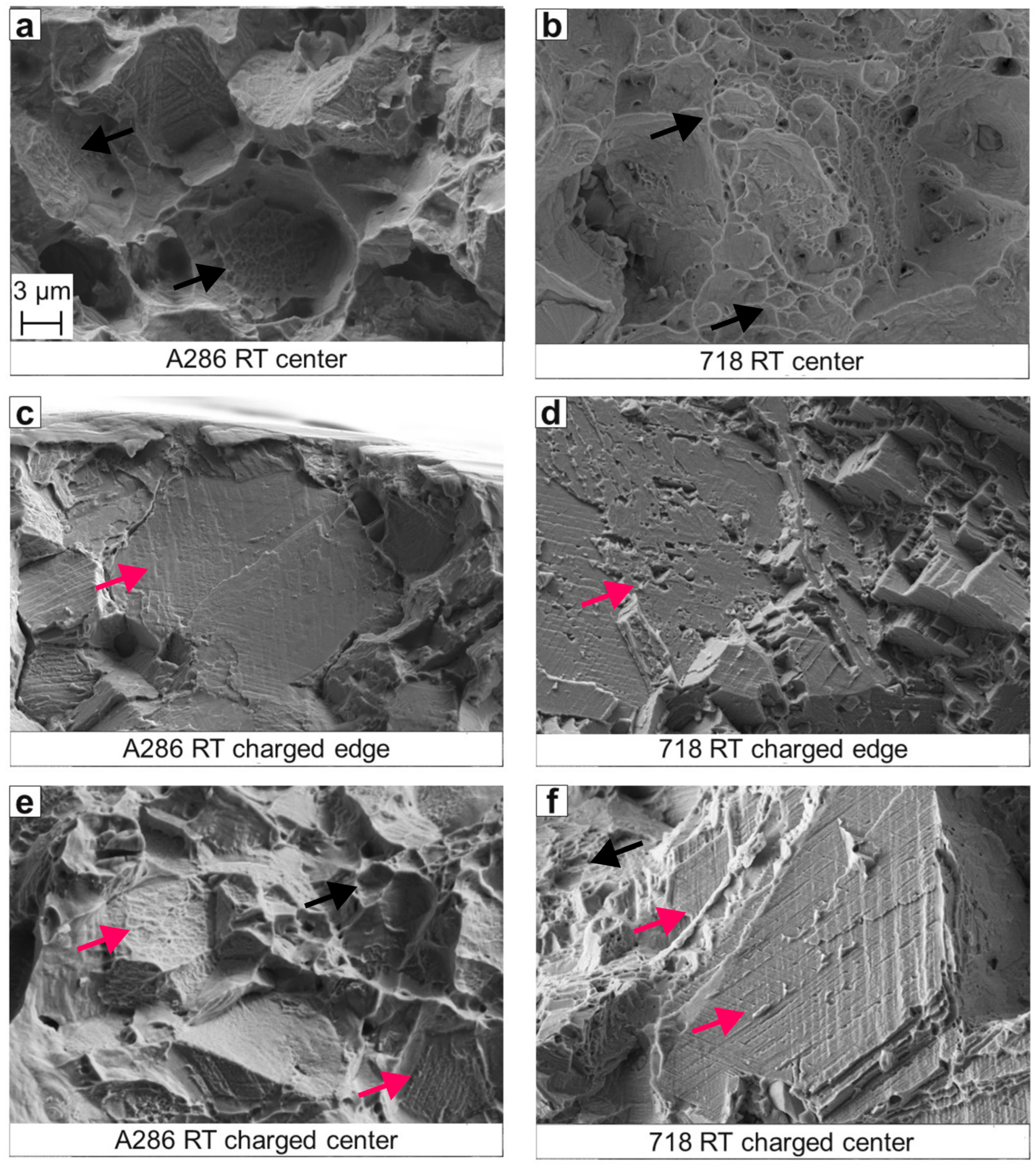
The SEM fracture surface analysis of specimens after SSRT at RT is presented in Figure 6. Specimens not subjected to hydrogen charging exhibit ductile dimples at the fracture surface center, surrounded by shear fracture region (Figure 6a,b). Conversely, hydrogen-charged specimens tested at RT (Figure 6c–f) display brittle failure at the edges, where fracture has been initiated, and a mix of brittle (cleavage and partly intergranular) and ductile (dimples) failure modes for Alloy 718 in the center, while A286 shows predominantly ductile dimples.
Figure 6.
Representative SEM fractographs of tensile A286 specimens measured in the (a) center of the fractured specimen surface tested at RT without charging and at the (c) edge and in the center (e) of the fractured specimen surface tested at RT after hydrogen charging. (b,d,f) The same measurements performed for Alloy 718. Black arrows indicate ductile dimples, while magenta arrows highlight brittle cleavage features. All images show secondary electron (SE) contrast.
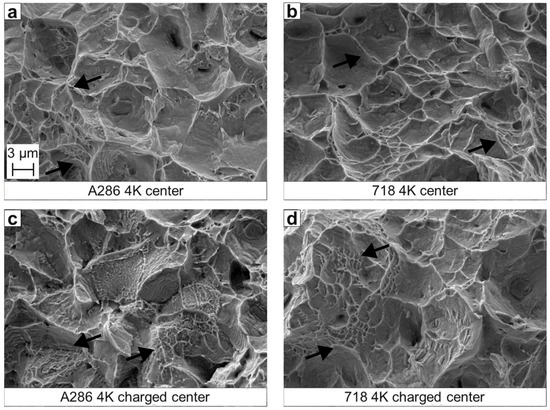
The SEM analysis of fracture surfaces from SSRT at 4.2 K is presented in Figure 7. All specimens exhibit a fully ductile center characterized by dimples, encircled by shear fracture regions. Notably, no pronounced difference is observed between hydrogen-charged and uncharged conditions.
Figure 7.
Representative SEM fractographs of tensile specimen tested at 4.2 K: (a,c) refer to A286 tested under uncharged and hydrogen charged conditions, respectively; (b,d) refer to Alloy 718 tested under uncharged and hydrogen charged conditions, respectively. Black arrows indicate ductile dimples. All images show secondary electron (SE) contrast.
4. Discussion
4.1. Ductility Loss at RT and Liquid Helium Temperature
The significant ductility losses observed at RT, approximately 48% for A286 and 90% for Alloy 718, align well with previously reported reduction in area measurements from ex situ tensile tests under comparable hydrogen charging conditions [3,5,13]. Both A286 and Alloy 718 have been recognized for their good resistance against hydrogen embrittlement [2].However, ductility loss strongly depends on hydrogen concentration [38]. In this study, the pronounced ductility losses correlate with substantial hydrogen uptake of 89 wt. ppm for A286 and 107 wt. ppm for Alloy 718.
The difference in the ductility loss magnitude between the two alloys can likely be explained by their variations in yield strength and microstructure. At RT, Alloy 718 exhibits a higher yield strength of approximately 1100 MPa compared to around 800 MPa for A286, mainly due to the additional hardening phase, γ″, alongside the γ′ phase present in both alloys. Hydrogen embrittlement susceptibility typically increases with strength [39] and with the volume fraction of γ′ and γ″ precipitates [9], although disentangling these effects remains challenging. Density functional theory (DFT) studies suggest hydrogen segregation at the matrix-γ″ interface reduces the strain to fracture, suggesting a possible role of these precipitates in hydrogen-induced ductility loss [40]. Furthermore, matrix composition, particularly austenite stability reflected in nickel equivalent [41], strongly influences hydrogen embrittlement resistance. Omura et al. [42] and Lee and Woods [11] reported that increased nickel content raises hydrogen embrittlement sensitivity, especially after precipitation hardening, consistent with Alloy 718 being more susceptible than A286.
Despite the pronounced ductility loss in hydrogen-charged specimens at RT, the uncharged A286 alloy exhibits increased ductility and strength when tested at 4.2 K. This improvement primarily stems from its low SFE, which is well known to enhance ductility in austenitic stainless steels at cryogenic temperatures [26,27,28]. The SFE decreases further with temperature, promoting deformation mechanisms such as twinning and increased strain-hardening rates [43]. Additionally, low SFE restricts cross slip and dislocation climb, contributing to the cryogenic strengthening observed in both A286 and Alloy 718.
4.2. Low Temperature Serrated Deformation
Considering deformation mechanisms at cryogenic temperatures, characteristic serrated flow behavior warrants special attention. LTSD has been reported across various metals and alloys under these conditions [24,26,27,44,45,46,47]. Obst and Nyilas [46] proposed that LTSD originates from planar dislocations (edge dislocations) piling up against intragranular obstacles, such as Lomer–Cottrell (LC) locks [48]. As applied stress increases, it reaches the cohesive strength of these obstacles, causing their collapse. This collapse can propagate through neighboring dislocation pile-ups, triggering avalanche-like dislocation motion and resulting in the distinctive stress drops observed.
LTSD may arise from twinning, characterized by disordered serration amplitudes, or from plastic slip instabilities, where the serration amplitude increases monotonically with deformation [24]. The latter behavior is observed here for A286 and Alloy 718 (Figure 5a,d), attributing serrations to localized plastic deformation from dislocation accumulation at obstacles. In austenitic alloys, martensitic transformations can also cause serrations, complicating distinction from plastic slip instability [24]. However, Fe-Cr-Ni alloys with 20 to 25% nickel and 18% chromium do not undergo phase transformations [24,49]. Given A286’s composition of approximately 25% nickel and 15% chromium, phase transformations are not expected and thus unlikely to influence serration behavior.
The impact of precipitates, namely γ′ and γ″, on LTSD remains largely unexplored. Molecular dynamics simulations have shown that at low temperatures edge dislocations traverse Ni3Al precipitates without forming dislocation locks [50]. This is consistent with the view that LC locks predominantly form within the matrix rather than at precipitate interfaces. The LTSD may also be attributed in some cases to local thermal softening effects caused by short-term temperature fluctuations and temperature dependence of thermal conductivity (thermo-mechanical effect) [24]. In the case of A286 and Alloy 718, the observed LTSD effect can most likely be attributed to the accumulation of dislocations at obstacles such as LC locks. Following the results of our DFT exact muffin-tin orbitals (EMTO) calculations (fcc Fe63Cr15Ni22 and fcc Fe21Cr22Ni57, paramagnetic at 300K), both alloys exhibit SFE of 24 mJ/m2 and in 30 mJ/m2, respectively, which is very close to that reported for an austenitic alloy with the SFE of 30 mJ/m2 in Ref. [29], where dislocation pile-ups at LC locks were directly imaged using transmission electron microscopy (TEM). The compositions used as input for the EMTO calculations represent simplified matrix composition of A286 and Alloy 718, as given in Ref. [51] and Ref. [52], respectively. The details of our DFT EMTO calculations are identical to those in Ref. [53].
4.3. Effect of Hydrogen on Serrations at Liquid Helium Temperature
Analysis of serrations up to 10% strain reveals notable differences for hydrogen pre-charged specimens. Specifically, the mean stress drop amplitude (Δσ) increases by a factor of 1.4 for both A286 and Alloy 718. Since stress drop amplitude correlates with the number of dislocations ahead of LC locks [24,26], these results suggest that hydrogen promotes greater dislocation pile-ups. As serrations reflect inhomogeneous deformation, hydrogen enhances this localized behavior. The increased dislocation pile-ups relate to the pinning force of LC locks. Stress drops, as avalanche-like events, may arise from multiple LC locks, implying that higher pinning forces arise either from increased LC lock density due to greater dislocation density or from increased pinning strength per lock caused by hydrogen.
The former requires increased dislocation density, which would manifest as changes in strain hardening; however, no such changes are evident in the tensile curves. The latter, increased pinning strength, ties to the lock’s cohesive energy [46], that is, the energy needed to separate the sessile dislocation into its partial dislocations. The SFE governs the separation of partial dislocations and thereby the strength of LC locks; an increase in SFE leads to stronger locks [54]. Since hydrogen is known to reduce SFE [55,56], one would expect a reduction in lock strength, contrary to our observations of increased stress drop amplitudes.
Stumpf et al. [57] observed an increased LC lock density due to carbon addition in an austenitic Cr-Co-Ni alloy. Hydrogen might induce a similar effect, as both, hydrogen and carbon are interstitial elements. We therefore hypothesize that hydrogen’s reduction in SFE alters the probability of two leading partial dislocations forming sessile locks, increasing their number probabilistically. Hence, hydrogen increases stress drop amplitudes primarily by raising lock density rather than individual lock strength.
Alongside larger stress drops, we observe increased strain accumulation during serrations (serration width, Δε) by factors of 1.6 and 1.5 in hydrogen-charged A286 and Alloy 718, respectively. This aligns with increased dislocation pile-up inferred from stress drop data. Correspondingly, serration frequency, that is, number of serrations per percent strain, decreases by factors of 0.6 and 0.5 for A286 and Alloy 718, respectively.
These results indicate that hydrogen interacts with dislocations even under cryogenic conditions. However, no embrittlement was detected in either alloy, consistent with Ogawa et al.’s [13] findings that Alloy 718’s hydrogen-induced ductility loss decreases markedly below −80 °C despite significant hydrogen uptake. In their work, embrittlement was attributed to diffusion-mediated mechanisms such as hydrogen condensation near dislocations and microcrack nucleation along annealing twin boundaries or {111} slip planes.
At 4.2 K, hydrogen mobility is strongly suppressed, preventing diffusion-assisted embrittlement processes. Instead, only localized hydrogen–dislocation interactions manifest as altered serration behavior. Although hydrogen is essentially immobile at this temperature, it may still influence dislocation activity through its presence in lattice traps such as dislocations, interfaces, or precipitates. In this trapped state, hydrogen can slightly modify local strain and stress fields, thereby affecting the accumulation and interaction of dislocations with obstacles such as LC locks. Though similar trends were observed in both alloys, microstructural differences may influence precise serrated yielding mechanisms. Nonetheless, the consistent absence of embrittlement suggests diffusion limitations play a dominant role over alloy-specific deformation mechanisms in fracture behavior at cryogenic temperatures.
5. Conclusions
This study demonstrates that gaseous hydrogen charging at 473 K and 1000 bar for 14 days causes significant hydrogen uptake of 89 wt. ppm in A286 and 107 wt. ppm in Alloy 718, which results in substantial ductility loss at room temperature during slow strain rate tensile testing at an initial strain rate of 3 × 10⁻⁵ s−1. Alloy 718 exhibits a drastic 90% reduction in ductility, while A286 shows a 48% loss. These large ductility losses occur despite both alloys being generally regarded as hydrogen resistant, highlighting the critical role of hydrogen concentration in embrittlement under these aggressive charging conditions.
At liquid helium temperature (4.2 K), no measurable ductility loss due to hydrogen charging is observed in either alloy, indicating that hydrogen is effectively immobile under cryogenic conditions. Both uncharged and hydrogen pre-charged specimens exhibit serrated flow behavior during tensile testing at 4.2 K. However, hydrogen modifies this behavior by increasing the stress drop amplitudes and strain accumulation within serration events. These alterations suggest that hydrogen–dislocation interactions might remain active at cryogenic temperatures, enhancing dislocation pinning forces by obstacles such as Lomer–Cottrell locks.
Both alloys exhibit significantly increased yield strengths at 4.2 K, with A286 showing improved ductility (~22% to ~27%), while Alloy 718 maintains similar ductility levels. These results suggest that, while hydrogen influences plasticity mechanisms at cryogenic temperatures, hydrogen embrittlement is suppressed, making both alloys promising candidates for hydrogen service in cryogenic environments.
Author Contributions
Conceptualization, N.D., M.L., A.D., J.P., G.M., M.S. and V.I.R.; methodology, N.D., M.L., J.P., M.E. (Magdalena Eskinja), M.S. and V.I.R.; software, N.D.; validation, N.D., M.L., A.D., M.E. (Matthias Eichinger), M.E. (Magdalena Eskinja) and Z.S.; formal analysis, N.D. and M.L.; investigation, M.E. (Matthias Eichinger), M.E. (Magdalena Eskinja), Z.S. and S.M.; resources, J.P., G.M., M.S. and S.M.; data curation, M.E. (Matthias Eichinger), M.E. (Magdalena Eskinja), Z.S., M.S. and S.M.; writing—original draft preparation, N.D.; writing—review and editing, N.D., M.L., J.P., A.D., G.M., M.S., S.M. and V.I.R.; visualization, N.D. and M.L.; supervision, G.M., M.S. and V.I.R.; project administration, J.P. and V.I.R.; funding acquisition, J.P. and V.I.R. All authors have read and agreed to the published version of the manuscript.
Funding
This research was funded by Austrian Research Promotion Agency (FFG) Production of the Future, grant number 891181. The APC was funded by the open access waiver granted to Vsevolod I. Razumovskiy.
Data Availability Statement
The raw data supporting the conclusions of this article will be made available by the authors on request.
Acknowledgments
N.D. acknowledges support of Franco Moitzi with creating a computational workflow for the SFE calculations. During manuscript preparation, the author(s) used ChatGPT (GPT-4, June 2024) by OpenAI for text generation and data analysis scripting. The authors provided original content, reviewed and edited all AI-generated material and take full responsibility for the final publication.
Conflicts of Interest
Authors Nina Damm, Marina Lukas, Stefan Marsoner and Vsevolod I. Razumovskiy were employed by the company Materials Center Leoben Forschung GmbH. Authors Jan Platl and Andreas Drexler were employed by the company voestalpine BÖHLER Edelstahl GmbH & Co KG. Authors Zoltán Simon and Michael Scheerer were employed by the company Aerospace & Advanced Composites GmbH. The remaining authors declare that the research was conducted in the absence of any commercial or financial relationships that could be construed as a potential conflict of interest.
Abbreviations
The following abbreviations are used in this manuscript:
| PH | Precipitation hardened |
| RT | Room temperature |
| LTSD | Low temperature serrated deformation |
| SFE | Stacking fault energy |
| SSRT | Slow strain rate tests |
| SEM | Scanning electron microscopy |
| LC | Lomer–Cottrell |
| DFT | Density functional theory |
| EMTO | Exact muffin-tin orbitals |
| TEM | Transmission electron microscopy |
| SE | Secondary electron |
| BSE | Backscattered electron |
References
- Liu, J.; Zhao, M.; Rong, L. Overview of Hydrogen-Resistant Alloys for High-Pressure Hydrogen Environment: On the Hydrogen Energy Structural Materials. Clean Energy 2023, 7, 99–115. [Google Scholar] [CrossRef] [Scilit]
- Fritzemeier, L.C.; Chandler, W.T. 15-Hydrogen Embrittlement—Rocket Engine Applications. In Superalloys Supercomposites Superceramics; Tien, J.K., Caulfield, T., Eds.; Academic Press: Boston, MA, USA, 1989; pp. 491–524. ISBN 978-0-12-690845-9. [Google Scholar]
- Thompson, A.W.; Brooks, J.A. Hydrogen Performance of Precipitation-Strengthened Stainless Steels Based on A-286. Metall. Trans. A 1975, 6, 1431–1442. [Google Scholar] [CrossRef] [Scilit]
- Brooks, J.A.; Thompson, A.W. Microstructure and Hydrogen Effects on Fracture in the Alloy A-286. Metall. Trans. A 1993, 24, 1983–1991. [Google Scholar] [CrossRef] [Scilit]
- Takakuwa, O.; Ogawa, Y.; Yamabe, J.; Matsunaga, H. Hydrogen-Induced Ductility Loss of Precipitation-Strengthened Fe-Ni-Cr-Based Superalloy. Mater. Sci. Eng. A 2019, 739, 335–342. [Google Scholar] [CrossRef] [Scilit]
- Liu, L.; Tanaka, K.; Hirose, A.; Kobayashi, K.F. Effects of Precipitation Phases on the Hydrogen Embrittlement Sensitivity of Inconel 718. Sci. Technol. Adv. Mater. 2002, 3, 335–344. [Google Scholar] [CrossRef] [Scilit]
- Michler, T.; San Marchi, C.; Naumann, J.; Weber, S.; Martin, M. Hydrogen Environment Embrittlement of Stable Austenitic Steels. Int. J. Hydrogen Energy 2012, 37, 16231–16246. [Google Scholar] [CrossRef] [Scilit]
- Obasi, G.C.; Zhang, Z.; Sampath, D.; Morana, R.; Akid, R.; Preuss, M. Effect of Microstructure and Alloy Chemistry on Hydrogen Embrittlement of Precipitation-Hardened Ni-Based Alloys. Metall. Mater. Trans. A 2018, 49, 1167–1181. [Google Scholar] [CrossRef] [Scilit]
- Stenerud, G.; Wenner, S.; Olsen, J.S.; Johnsen, R. Effect of Different Microstructural Features on the Hydrogen Embrittlement Susceptibility of Alloy 718. Int. J. Hydrogen Energy 2018, 43, 6765–6776. [Google Scholar] [CrossRef] [Scilit]
- Lu, X.; Ma, Y.; Wang, D. On the Hydrogen Embrittlement Behavior of Nickel-Based Alloys: Alloys 718 and 725. Mater. Sci. Eng. A 2020, 792, 139785. [Google Scholar] [CrossRef] [Scilit]
- Lee, J.A.; Woods, S. Hydrogen Embrittlement; National Aeronautics and Space Administration: Huntsville, AL, USA, 2016. [Google Scholar]
- Lee, W.-J.; Lee, J.-Y.; Oh, S.-K.; Yang, H.; Park, J.; Baek, U.B.; Lee, Y.-K. Temperature Dependency of Hydrogen Embrittlement Resistance of Austenitic Fe–24Mn–3Cr-0.5Cu-0.47C Steel. Mater. Sci. Eng. A 2024, 889, 145838. [Google Scholar] [CrossRef] [Scilit]
- Ogawa, Y.; Noguchi, K.; Takakuwa, O. Criteria for Hydrogen-Assisted Crack Initiation in Ni-Based Superalloy 718. Acta Mater. 2022, 229, 117789. [Google Scholar] [CrossRef] [Scilit]
- Patel, S.; deBarbadillo, J.; Coryell, S. Superalloy 718: Evolution of the Alloy from High to Low Temperature Application. In Proceedings of the 9th International Symposium on Superalloy 718 & Derivatives: Energy, Aerospace, and Industrial Applications; Ott, E., Liu, X., Andersson, J., Bi, Z., Bockenstedt, K., Dempster, I., Groh, J., Heck, K., Jablonski, P., Kaplan, M., et al., Eds.; Springer International Publishing: Cham, Switzerland, 2018; pp. 23–49. [Google Scholar]
- Ogata, T.; Yuri, T.; Sumiyoshi, H.; Ono, Y.; Matsuoka, S.; Okita, K. Data Sheet Program and Mechanical Properties of Ti–5Al–2.5Sn ELI and Alloy 718 at Cryogenic Temperatures. AIP Conf. Proc. 2004, 711, 122–129. [Google Scholar]
- Elkot, M.N.; Sun, B.; Zhou, X.; Ponge, D.; Raabe, D. Hydrogen-Assisted Decohesion Associated with Nanosized Grain Boundary κ-Carbides in a High-Mn Lightweight Steel. Acta Mater. 2022, 241, 118392. [Google Scholar] [CrossRef] [Scilit]
- Choi, Y.-H.; Lee, J.H.; Kim, S.-M.; Lee, D.-H.; Kim, H.-T.; Kim, J.-H.; Kim, M.; Kim, S.-K.; Lee, J.-M. Temperature-Dependent Hydrogen Embrittlement of Austenitic Stainless Steel on Phase Transformation. Metals 2023, 13, 35. [Google Scholar] [CrossRef] [Scilit]
- Kim, M.-S.; Chun, K.W. A Comprehensive Review on Material Compatibility and Safety Standards for Liquid Hydrogen Cargo and Fuel Containment Systems in Marine Applications. J. Mar. Sci. Eng. 2023, 11, 1927. [Google Scholar] [CrossRef] [Scilit]
- Cho, H.-J.; Kim, D.H.; Lee, S.; Kim, S.-J. Cryogenic Impact Toughness Characteristics of Ni/Mn Replaced Austenitic Stainless Steels Subjected to High-Pressure Gaseous Hydrogen. Int. J. Hydrogen Energy 2024, 92, 877–894. [Google Scholar] [CrossRef] [Scilit]
- Morohoshi, R.; Kawabata, T. Effect of Pre-Strain on Ductile Fracture Resistance in Metastable Austenitic Stainless Steel. In Proceedings of the ISOPE International Ocean and Polar Engineering Conference, Rhodes, Greece, 16–21 June 2024; Volume 1, pp. 4396–4403. [Google Scholar]
- Ma, L.; Liang, G.; Li, Y. Effect of Hydrogen Charging on Ambient and Cryogenic Mechanical Properties of a Precipitate-Strengthened Austenitic Steel. In Materials; Fickett, F.R., Reed, R.P., Eds.; Springer: Boston, MA, USA, 1992; pp. 77–84. ISBN 978-1-4757-9050-4. [Google Scholar]
- Thompson, A.W. Hydrogen-Induced Ductility Loss in Commercial Precipitation-Strengthened Stainless Steels. Metall. Trans. A 1976, 7, 315–318. [Google Scholar]
- Klopčič, N.; Schatz, M.; Sartory, M.; Pertl, P.; Winkler, F.; Drexler, A.; Hermann, R.; Trattner, A. Thermodynamic Modeling and Simulation of LH2 Refueling with Conditioning Vessel. Int. J. Hydrogen Energy 2025, 134, 164–180. [Google Scholar] [CrossRef] [Scilit]
- Pustovalov, V.V. Serrated Deformation of Metals and Alloys at Low Temperatures (Review). Low Temp. Phys. 2008, 34, 683–723. [Google Scholar] [CrossRef] [Scilit]
- Jin, K.; Mu, S.; An, K.; Porter, W.D.; Samolyuk, G.D.; Stocks, G.M.; Bei, H. Thermophysical Properties of Ni-Containing Single-Phase Concentrated Solid Solution Alloys. Mater. Des. 2017, 117, 185–192. [Google Scholar] [CrossRef] [Scilit]
- Tirunilai, A.S.; Hanemann, T.; Weiss, K.-P.; Freudenberger, J.; Heilmaier, M.; Kauffmann, A. Dislocation-Based Serrated Plastic Flow of High Entropy Alloys at Cryogenic Temperatures. Acta Mater. 2020, 200, 980–991. [Google Scholar] [CrossRef] [Scilit]
- Tirunilai, A.S.; Hanemann, T.; Reinhart, C.; Tschan, V.; Weiss, K.-P.; Laplanche, G.; Freudenberger, J.; Heilmaier, M.; Kauffmann, A. Comparison of Cryogenic Deformation of the Concentrated Solid Solutions CoCrFeMnNi, CoCrNi and CoNi. Mater. Sci. Eng. A 2020, 783, 139290. [Google Scholar] [CrossRef] [Scilit]
- Tabin, J.; Skoczeń, B.; Bielski, J. Discontinuous Plastic Flow in Stainless Steels Subjected to Combined Loads at Extremely Low Temperatures. Int. J. Mech. Sci. 2021, 200, 106448. [Google Scholar] [CrossRef] [Scilit]
- Pu, Z.; Xie, Z.C.; Sarmah, R.; Chen, Y.; Lu, C.; Ananthakrishna, G.; Dai, L.H. Spatio-Temporal Dynamics of Jerky Flow in High-Entropy Alloy at Extremely Low Temperature. Philos. Mag. 2021, 101, 154–178. [Google Scholar] [CrossRef] [Scilit]
- Eichinger, M.; Pengg, J.; Raab, S.; Mori, G. On the Hydrogen Uptake of Line Pipe Steels L80 and P110 under Gaseous Hydrogen Charging up to 1000 Bar and 200 °C. Int. J. Hydrogen Energy 2024, 50, 388–399. [Google Scholar] [CrossRef] [Scilit]
- Baranowski, B.; Filipek, S.M. 45 Years of Nickel Hydride—History and Perspectives. J. Alloys Compd. 2005, 404–406, 2–6. [Google Scholar] [CrossRef] [Scilit]
- Dwyer, D.J.; Pang, X.J.; Gao, M.; Wei, R.P. Surface Enrichment of Niobium on Inconel 718 (100) Single Crystals. Appl. Surf. Sci. 1994, 81, 229–235. [Google Scholar] [CrossRef] [Scilit]
- Fukunaga, A. Effect of High-Pressure Hydrogen Environment in Elastic and Plastic Deformation Regions on Slow Strain Rate Tensile Tests for Iron-Based Superalloy A286. Int. J. Hydrogen Energy 2023, 48, 18116–18128. [Google Scholar] [CrossRef] [Scilit]
- Turnbull, A.; Ballinger, R.G.; Hwang, I.S.; Morra, M.M.; Psaila-Dombrowski, M.; Gates, R.M. Hydrogen Transport in Nickel-Base Alloys. Metall. Trans. A 1992, 23, 3231–3244. [Google Scholar] [CrossRef] [Scilit]
- Jebaraj, J.J.M.; Morrison, D.J.; Suni, I.I. Hydrogen Diffusion Coefficients through Inconel 718 in Different Metallurgical Conditions. Corros. Sci. 2014, 80, 517–522. [Google Scholar] [CrossRef] [Scilit]
- EN ISO 6892-1:2019; Metallic Materials-Tensile Testing-Part 1: Method of Test at Room Temperature. ISO: Geneva, Switzerland, 2019. [CrossRef] [Scilit]
- ASTM E112-24; Standard Test Methods for Determining Average Grain Size. ASTM International: West Conshohocken, PA, USA, 2024.
- Younes, C.M.; Steele, A.M.; Nicholson, J.A.; Barnett, C.J. Influence of Hydrogen Content on the Tensile Properties and Fracture of Austenitic Stainless Steel Welds. Int. J. Hydrogen Energy 2013, 38, 4864–4876. [Google Scholar] [CrossRef] [Scilit]
- Okonkwo, P.C.; Barhoumi, E.M.; Ben Belgacem, I.; Mansir, I.B.; Aliyu, M.; Emori, W.; Uzoma, P.C.; Beitelmal, W.H.; Akyüz, E.; Radwan, A.B.; et al. A Focused Review of the Hydrogen Storage Tank Embrittlement Mechanism Process. Int. J. Hydrogen Energy 2023, 48, 12935–12948. [Google Scholar] [CrossRef] [Scilit]
- Botinha, J.; Alves, H.; Gehrmann, B. A Theoretical Investigation on the Role of Microstructural Particularities on the Hydrogen Embrittlement of Nickel Alloys. In Proceedings of the Association for Materials Protection and Performance, San Antonio, TX, USA, 6–10 March 2022; p. D041S038R005. [Google Scholar]
- Hirayama, T.; Ogirima, M. Influence of Chemical Composition on Martensitic Transformation in Fe-Cr-Ni Stainless Steel. J. Jpn. Inst. Met. 1970, 34, 507–510. [Google Scholar] [CrossRef] [Scilit]
- Omura, T.; Nakamura, J.; Hirata, H.; Jotoku, K.; Ueyama, M.; Osuki, T.; Terunuma, M. Effect of Surface Hydrogen Concentration on Hydrogen Embrittlement Properties of Stainless Steels and Ni Based Alloys. ISIJ Int. 2016, 56, 405–412. [Google Scholar] [CrossRef] [Scilit]
- Zhang, Y.A.; Li, R.X. Entropic Alloys for Cryogenic Applications. In Stainless Steels and Alloys; Duriagina, Z., Ed.; IntechOpen: Rijeka, Croatia, 2018; ISBN 978-1-78985-370-4. [Google Scholar]
- Skoczeń, B.; Bielski, J.; Sgobba, S.; Marcinek, D. Constitutive Model of Discontinuous Plastic Flow at Cryogenic Temperatures. Int. J. Plast. 2010, 26, 1659–1679. [Google Scholar] [CrossRef] [Scilit]
- Fellinger, J.H.H.; Bykov, V.; Schauer, F. Serrated Yielding at Cryogenic Temperatures in Structural Components of Wendelstein 7-X. IEEE Trans. Appl. Supercond. 2012, 22, 4801504. [Google Scholar] [CrossRef] [Scilit]
- Obst, B.; Nyilas, A. Experimental Evidence on the Dislocation Mechanism of Serrated Yielding in f.c.c. Metals and Alloys at Low Temperatures. Mater. Sci. Eng. A 1991, 137, 141–150. [Google Scholar] [CrossRef] [Scilit]
- Tirunilai, A.S.; Sas, J.; Weiss, K.-P.; Chen, H.; Szabó, D.V.; Schlabach, S.; Haas, S.; Geissler, D.; Freudenberger, J.; Heilmaier, M.; et al. Peculiarities of Deformation of CoCrFeMnNi at Cryogenic Temperatures. J. Mater. Res. 2018, 33, 3287–3300. [Google Scholar] [CrossRef] [Scilit]
- Cottrell, A.H. Theory of Dislocations. Prog. Met. Phys. 1953, 4, 205–264. [Google Scholar] [CrossRef] [Scilit]
- Shapovalov, I. Serrated Yielding of the Fe–Cr–Ni Alloys in Liquid Helium. Ukr. Fiz. Zhurnal 1984, 29, 1562–1566. [Google Scholar]
- Xie, H.; Yu, T.; Tang, C. Motion Mechanism of the Edge Dislocation Slipping in the Cubic Plane of Ni3Al Single Crystals. Model. Simul. Mater. Sci. Eng. 2013, 21, 055008. [Google Scholar] [CrossRef] [Scilit]
- Chen, S.; Zhao, M.; Rong, L. Hydrogen-Induced Cracking Behavior of Twin Boundary in Γ′ Phase Strengthened Fe–Ni Based Austenitic Alloys. Mater. Sci. Eng. A 2013, 561, 7–12. [Google Scholar] [CrossRef] [Scilit]
- Mantri, S.A.; Dasari, S.; Sharma, A.; Alam, T.; Pantawane, M.V.; Pole, M.; Sharma, S.; Dahotre, N.B.; Banerjee, R.; Banerjee, S. Effect of Micro-Segregation of Alloying Elements on the Precipitation Behaviour in Laser Surface Engineered Alloy 718. Acta Mater. 2021, 210, 116844. [Google Scholar] [CrossRef] [Scilit]
- Razumovskiy, V.I.; Reyes-Huamantinco, A.; Puschnig, P.; Ruban, A.V. Effect of Thermal Lattice Expansion on the Stacking Fault Energies of Fcc Fe and Fe75Mn25 Alloy. Phys. Rev. B 2016, 93, 054111. [Google Scholar] [CrossRef] [Scilit]
- Martínez, E.; Marian, J.; Arsenlis, A.; Victoria, M.; Perlado, J.M. Atomistically Informed Dislocation Dynamics in Fcc Crystals. J. Mech. Phys. Solids 2008, 56, 869–895. [Google Scholar] [CrossRef] [Scilit]
- Zhou, X.W.; Nowak, C.; Skelton, R.S.; Foster, M.E.; Ronevich, J.A.; San Marchi, C.; Sills, R.B. An Fe–Ni–Cr–H Interatomic Potential and Predictions of Hydrogen-Affected Stacking Fault Energies in Austenitic Stainless Steels. Int. J. Hydrogen Energy 2022, 47, 651–665. [Google Scholar] [CrossRef] [Scilit]
- Xie, Z.; Wang, Y.; Lu, C.; Dai, L. Sluggish Hydrogen Diffusion and Hydrogen Decreasing Stacking Fault Energy in a High-Entropy Alloy. Mater. Today Commun. 2021, 26, 101902. [Google Scholar] [CrossRef] [Scilit]
- Stumpf, G.C.; Bertoli, G.; Coury, F.G.; Neta, A.C.I.; Montoro, L.A.; Figueiredo, R.B.; Wolf, W. Stacking-Fault Networks with Lomer-Cottrell Locks Induced by Carbon Addition in a Severely Strained Cr-Co-Ni Alloy. J. Alloys Compd. 2025, 1033, 181162. [Google Scholar] [CrossRef] [Scilit]

Disclaimer/Publisher’s Note: The statements, opinions and data contained in all publications are solely those of the individual author(s) and contributor(s) and not of MDPI and/or the editor(s). MDPI and/or the editor(s) disclaim responsibility for any injury to people or property resulting from any ideas, methods, instructions or products referred to in the content. |
© 2025 by the authors. Licensee MDPI, Basel, Switzerland. This article is an open access article distributed under the terms and conditions of the Creative Commons Attribution (CC BY) license (https://creativecommons.org/licenses/by/4.0/).