

A Dynamic Analysis of Smart and Nanomaterials for New Approaches to Structural Control and Health Monitoring



1. Introduction and Scope
- Structural health monitoring;
- Structural control;
- Smart materials and structures;
- Nanomaterials and nanocomposites;
- Sensors and actuators;
- Energy harvesting;
- Artificial intelligence;
- Damage detection;
- System identification;
- Machine learning;
- Sensor placement;
- Intelligent structure systems.
2. Contributions
3. Conclusions and Outlook
Author Contributions
Conflicts of Interest
References
- Silik, A.; Noori, M.; Ghiasi, R.; Wang, T.; Kuok, S.; Farhan, N.S.D.; Dang, J.; Wu, Z.; Altabey, W.A. Dynamic wavelet neural network model for damage features extraction and patterns recognition. Civ. Struct. Health Monit. 2023. [Google Scholar] [CrossRef]
- Silik, A.; Noori, M.; Altabey, W.; Dang, J.; Ghiasi, R.; Wu, Z. Optimum wavelet selection for nonparametric analysis toward structural health monitoring for processing big data from sensor network: A comparative study. Struct. Health Monit. 2022, 21, 803–825. [Google Scholar] [CrossRef]
- Silik, A.; Noori, M.; Altabey, W.A.; Ghiasi, R. Selecting optimum levels of wavelet multi-resolution analysis for time-varying signals in structural health monitoring. Struct. Control Health Monit. 2021, 28, e2762. [Google Scholar] [CrossRef]
- Aabid, A.; Parveez, B.; Raheman, M.A.; Ibrahim, Y.E.; Anjum, A.; Hrairi, M.; Parveen, N.; Mohammed Zayan, J. A Review of Piezoelectric Material-Based Structural Control and Health Monitoring Techniques for Engineering Structures: Challenges and Opportunities. Actuators 2021, 10, 101. [Google Scholar] [CrossRef]
- Cao, W.; Cudney, H.H.; Waser, R. Smart materials and structures. Proc. Natl. Acad. Sci. USA 1999, 96, 8330–8331. [Google Scholar] [CrossRef] [PubMed]
- Holger, M.; Elmar, B.J. Application of smart materials in automotive structures. SPIE 2001, 4332, 197–204. [Google Scholar] [CrossRef]
- Sharma, V.P.; Sharma, U.; Chattopadhyay, M.; Shukla, V.N. Advance Applications of Nanomaterials: A Review. Mater. Today Proc. 2018, 5 Pt 1, 6376–6380. [Google Scholar] [CrossRef]
- Altabey, W.A.; Noori, M.; Alarjani, A.; Zhao, Y. Nano-Delamination Monitoring of BFRP Nano-Pipes of Electrical Potential Change with ANNs. Adv. Nano Res. 2020, 9, 1–13. [Google Scholar] [CrossRef]
- Altabey, W.A. An exact solution for mechanical behavior of BFRP Nano-thin films embedded in NEMS. Adv. Nano Res. 2017, 5, 337–357. [Google Scholar] [CrossRef]
- Altabey, W.A.; Noori, M.; Wu, Z.; Al-Moghazy, M.A.; Kouritem, S.A.A. deep-learning approach for predicting water absorption in composite pipes by extracting the material’s dielectric features. Eng. Appl. Artif. Intell. 2023, 121, 105963. [Google Scholar] [CrossRef]
- Altabey, W.A.; Noori, M.; Wu, Z.; Al-Moghazy, M.A.; Kouritem, S.A.A. Studying Acoustic Behavior of BFRP Laminated Composite in Dual-Chamber Muffler Application Using Deep Learning Algorithm. Materials 2022, 15, 807. [Google Scholar] [CrossRef] [PubMed]
- Altabey, W.A.; Noori, M.; Wang, T.; Ghiasi, R.; Kuok, S.-C.; Wu, Z. Deep learning-based crack identification for steel pipelines by extracting features from 3d shadow modeling. Appl. Sci. 2021, 11, 6063. [Google Scholar] [CrossRef]
- Dry, C.M. Self-repairing and Self-forming Smart Materials Based on Biomimetic Rules. In Proceedings of the International Symposium on Smart Materials and Structural Systems, Fukui, Japan, 28–29 August 2001. [Google Scholar]
- Sobczyk, M.; Wiesenhütter, S.; Noennig, J.R.; Wallmersperger, T. Smart materials in architecture for actuator and sensor applications: A review. Intell. Mater. Syst. Struct. 2022, 33, 379–399. [Google Scholar] [CrossRef]
- Bani-Hani, M.A.; Husein Malkawi, D.A.; Bani-Hani, K.A.; Kouritem, S.A. Genetic Algorithm Optimization of Rainfall Impact Force Piezoelectric Sensing Device, Analytical and Finite Element Investigation. Materials 2023, 16, 911. [Google Scholar] [CrossRef] [PubMed]
- Kouritem, S.A.; Altabey, W.A. Ultra-broadband natural frequency using automatic resonance tuning of energy harvester and deep learning algorithms. Energy Convers. Manag. 2022, 272, 116332. [Google Scholar] [CrossRef]
- Naqvi, A.; Ali, A.; Altabey, W.A.; Kouritem, S.A. Energy Harvesting from Fluid Flow Using Piezoelectric Materials: A Review. Energies 2022, 15, 7424. [Google Scholar] [CrossRef]
- Shaukat, H.; Ali, A.; Bibi, S.; Altabey, W.A.; Noori, M.; Kouritem, S.A. A Review of the Recent Advances in Piezoelectric Materials, Energy Harvester Structures, and Their Applications in Analytical Chemistry. Appl. Sci. 2023, 13, 1300. [Google Scholar] [CrossRef]
- Shaukat, H.; Ali, A.; Bibi, S.; Mehmooda, S.; Altabey, W.A.; Noori, M.; Kouritem, S.A. Piezoelectric materials: Advanced applications in electro-chemical processes. Energy Rep. 2023, 9, 4306–4324. [Google Scholar] [CrossRef]

| Topic | Highlights | Refs. |
|---|---|---|
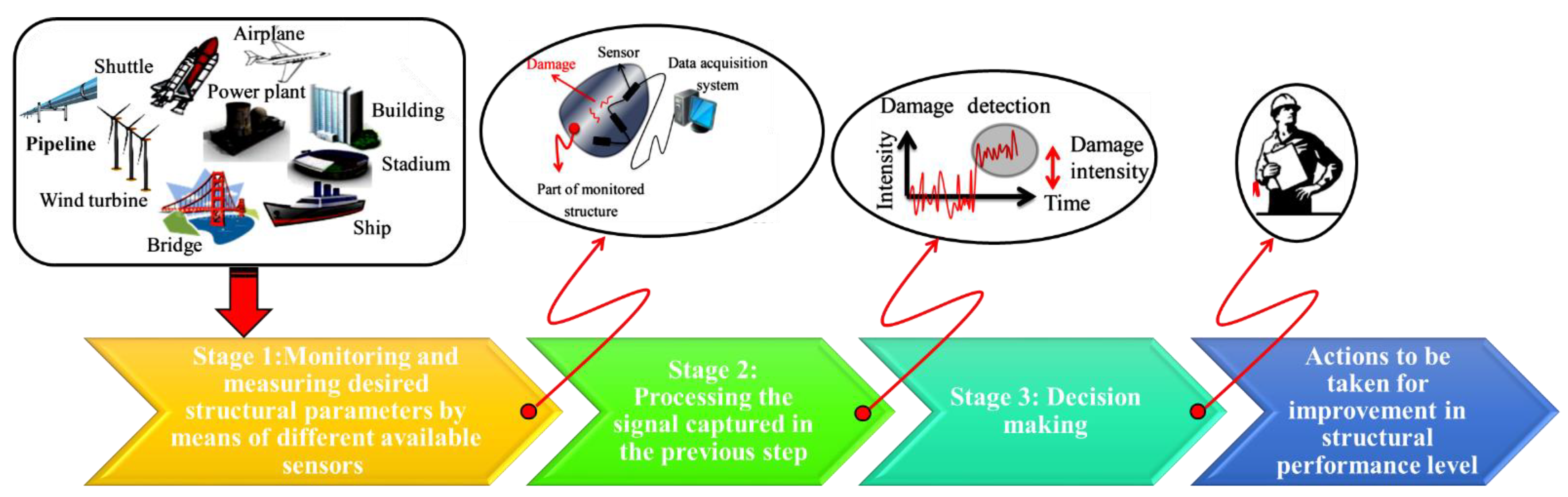
| Structural health monitoring techniques | SHM is a new field of research and development that emanated from smart materials and structures. SHM has attracted considerable attention in recent years for assessments in infrastructure and aerospace vehicle applications. The goal of SHM to develop automated systems can enable continuous monitoring, inspection, and the detection of damage to structures, to minimize the need for human labor. | [1,2] |
| Advances in structural control | The control of structures is a study in which smart and nanomaterials are utilized for various purposes. Due to their versatile applications, smart materials such as PZT transducers can control metallic and non-metallic structural components as the main object for controlling a structural component’s vibration, noise, and activity. | [3,4] |
| Smart materials and structures | A smart structure is a system containing multifunctional parts that can perform sensing, control, and actuation; it is a primitive analogue of a biological body. Smart materials are used to construct these smart structures, which can perform both sensing and actuation functions. | [5,6] |
| Advanced nanomaterials applications | Metallic nanoparticles are used as reinforcements in alloys for light constructions that have an appropriate resistance and hardness, mainly in the aerospace and automotive sector; for example, titanium nanoparticles are used as a steel alloy element and the resulting alloy shows improved properties with respect to resistance, ductility, temperature, and corrosion resistance. | [7] |
| Nanocomposite applications | A nanocomposite is a matrix to which nanoparticles have been added to improve a particular property of the material. The properties of nanocomposites have caused researchers and companies to consider using this material in several fields such as making flexible batteries, lightweight sensors, composites with even higher strength-to-weight ratios, speeding up the healing process for broken bones, impellers, and blades. | [8] |
| Nano pipes and films | Nano pipes and film systems are widely used in micro/nano-electro-mechanical sensors (NEMS/MEMS); they are among the most critical components in these sensors, such as pressure sensors that are exposed to stress and harsh environmental conditions. | [9] |
| Artificial intelligence application | In early applications, the algorithms of AI-based schemes were used for SHM and damage detections such machine learning, deep learning, and artificial neural networks. | [10,11,12] |
| Self-repair and self-assembly application | Self-repair and self-assembly materials have attracted attention due to their ability to regain their structure and function after damage. In recent years, significant progress has been made in achieving various functions through supramolecular chemistry. Self-repair materials are artificially created substances that have a built-in ability to automatically repair damage without any external diagnosis of the problem or human intervention. | [13] |
| Reconstruction techniques | Introducing smart materials as integral parts of civil structures or active or sensitive constructive elements opens up a wide range of abilities. In the context of building construction, several smart material methodologies are already available and commonly used, for example, piezoelectric transducers for SHM. | [14] |
| Energy harvesting | Piezoelectric energy harvesting is commonly applied in SHM due to its great ability to provide self-powered electronic wearable devices and wireless sensor networks. Piezoelectric converts mechanical energy into electricity with a high efficiency and ease of operation. Harvested power can be used in many medical and industrial applications such as pacemakers, bridge and building monitoring, and tire pressure monitoring techniques. | [15,16,17,18,19] |
Disclaimer/Publisher’s Note: The statements, opinions and data contained in all publications are solely those of the individual author(s) and contributor(s) and not of MDPI and/or the editor(s). MDPI and/or the editor(s) disclaim responsibility for any injury to people or property resulting from any ideas, methods, instructions or products referred to in the content. |
© 2023 by the authors. Licensee MDPI, Basel, Switzerland. This article is an open access article distributed under the terms and conditions of the Creative Commons Attribution (CC BY) license (https://creativecommons.org/licenses/by/4.0/).
Share and Cite
Altabey, W.A.; Noori, M. A Dynamic Analysis of Smart and Nanomaterials for New Approaches to Structural Control and Health Monitoring. Materials 2023, 16, 3567. https://doi.org/10.3390/ma16093567
Altabey WA, Noori M. A Dynamic Analysis of Smart and Nanomaterials for New Approaches to Structural Control and Health Monitoring. Materials. 2023; 16(9):3567. https://doi.org/10.3390/ma16093567
Chicago/Turabian StyleAltabey, Wael A., and Mohammad Noori. 2023. "A Dynamic Analysis of Smart and Nanomaterials for New Approaches to Structural Control and Health Monitoring" Materials 16, no. 9: 3567. https://doi.org/10.3390/ma16093567
APA StyleAltabey, W. A., & Noori, M. (2023). A Dynamic Analysis of Smart and Nanomaterials for New Approaches to Structural Control and Health Monitoring. Materials, 16(9), 3567. https://doi.org/10.3390/ma16093567

