Article

Study on the Application of Modified Sn-Based Solder in Cable Intermediate Joints

1
Faculty of Mechanical and Electrical Engineering, Kunming University of Science and Technology, Kunming 650504, China
2
Faculty of Science, Kunming University of Science and Technology, Kunming 650504, China
*
Author to whom correspondence should be addressed.
Materials 2022, 15(23), 8385; https://doi.org/10.3390/ma15238385
Submission received: 27 September 2022 / Revised: 11 November 2022 / Accepted: 14 November 2022 / Published: 25 November 2022
(This article belongs to the Special Issue New Advances in Nanomaterials)

Abstract

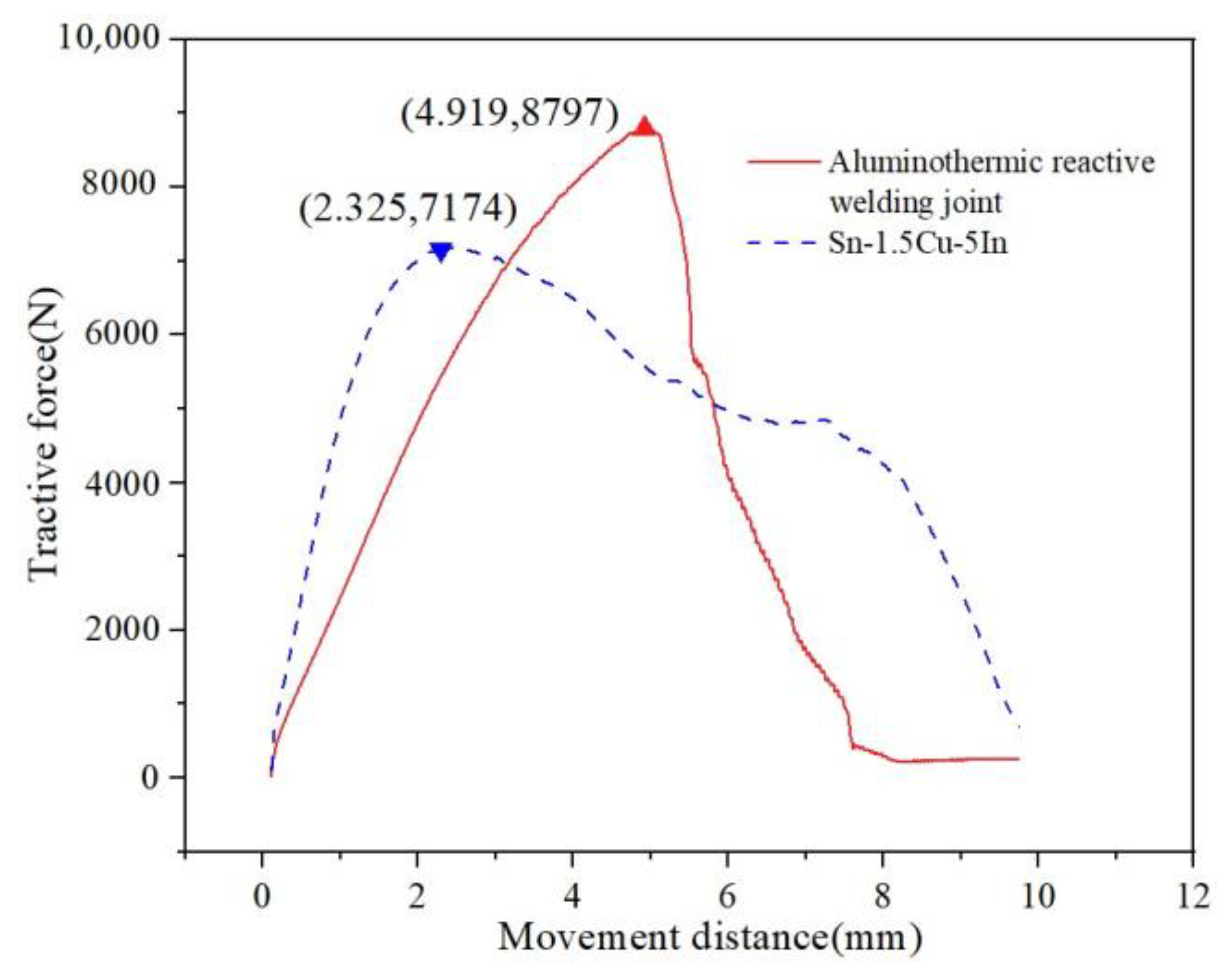
With the increasing use of underground cables, the quantity and quality of intermediate joints demanded are also increasing. The quality of the traditional crimping intermediate joint is easily affected by the actual process of the operator, which may lead to the heating of the crimping part of the wire core, affecting the insulation performance of the cable, and finally causing the joint to break. However, aluminothermic reactive technology has some problems, such as a high welding temperature and an uncontrollable reaction. In order to solve these problems, according to the brazing principle and microalloying method, the optimal content of In in Sn-1.5Cu-based solder was explored, and then the connection of the middle joint of a 10 kV cable was completed using a connecting die and electrical connection process. The contact resistance and tensile strength of the joint were tested to verify the feasibility of this method. The results show that the maximum conductivity of the solder with 3.8% and 5% In content can reach 3.236 × 10⁶ S/m, and the highest wettability is 93.6%. Finally, the minimum contact resistance of the intermediate joint is 7.05 μΩ, which is 43% lower than that of the aluminothermic welded joint, and the tensile strength is close to that of the welded joint, with a maximum of 7174 N.
Keywords: power cable; intermediate joint; Sn-based solder; In; Cu power cable; intermediate joint; Sn-based solder; In; Cu