Article

CO2-Optimization of Post-Tensioned Concrete Slab-Bridge Decks Using Surrogate Modeling
by
Lorena Yepes-Bellver
1,
Alejandro Brun-Izquierdo
1,
Julián Alcalá
2 and
Víctor Yepes
2,*
1
School of Civil Engineering, Universitat Politècnica de València, 46022 Valencia, Spain
2
Institute of Concrete Science and Technology (ICITECH), Universitat Politècnica de València, 46022 Valencia, Spain
*
Author to whom correspondence should be addressed.
Materials 2022, 15(14), 4776; https://doi.org/10.3390/ma15144776
Submission received: 16 May 2022 / Revised: 29 June 2022 / Accepted: 5 July 2022 / Published: 7 July 2022

Abstract

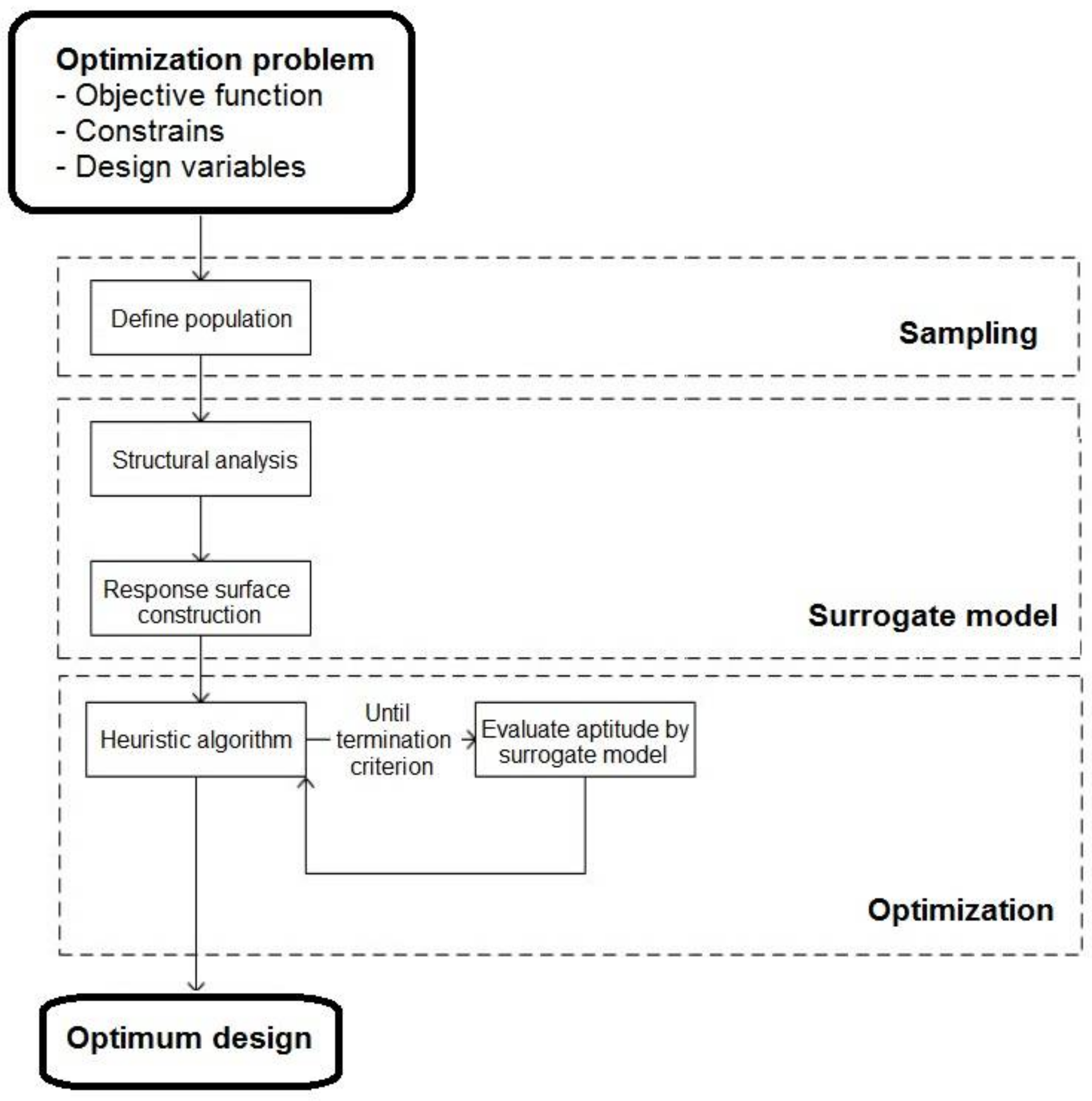
This paper deals with optimizing embedded carbon dioxide (CO2) emissions using surrogate modeling, whether it is the deck of a post-tensioned cast-in-place concrete slab bridge or any other design structure. The main contribution of this proposal is that it allows optimizing structures methodically and sequentially. The approach presents two sequential phases of optimization, the first one of diversification and the second one of intensification of the search for optimums. Finally, with the amount of CO2 emissions and the differentiating characteristics of each design, a heuristic optimization based on a Kriging metamodel is performed. An optimized solution with lower emissions than the analyzed sample is obtained. If CO2 emissions were to be reduced, design recommendations would be to use slendernesses as high as possible, in the range of 1/30, which implies a more significant amount of passive reinforcement. This increase in passive reinforcement is compensated by reducing the measurement of concrete and active reinforcement. Another important conclusion is that reducing emissions is related to cost savings. Furthermore, it has been corroborated that for a cost increase of less than 1%, decreases in emissions emitted into the atmosphere of more than 2% can be achieved.
Keywords: CO2 emission; optimization; metamodel; Kriging; post-tensioned concrete; structural optimization CO2 emission; optimization; metamodel; Kriging; post-tensioned concrete; structural optimization