Effect of High Strain Rate on Adiabatic Shearing of α+β Dual-Phase Ti Alloy



Abstract
1. Introduction
2. Materials and Methods
3. Results and Discussion
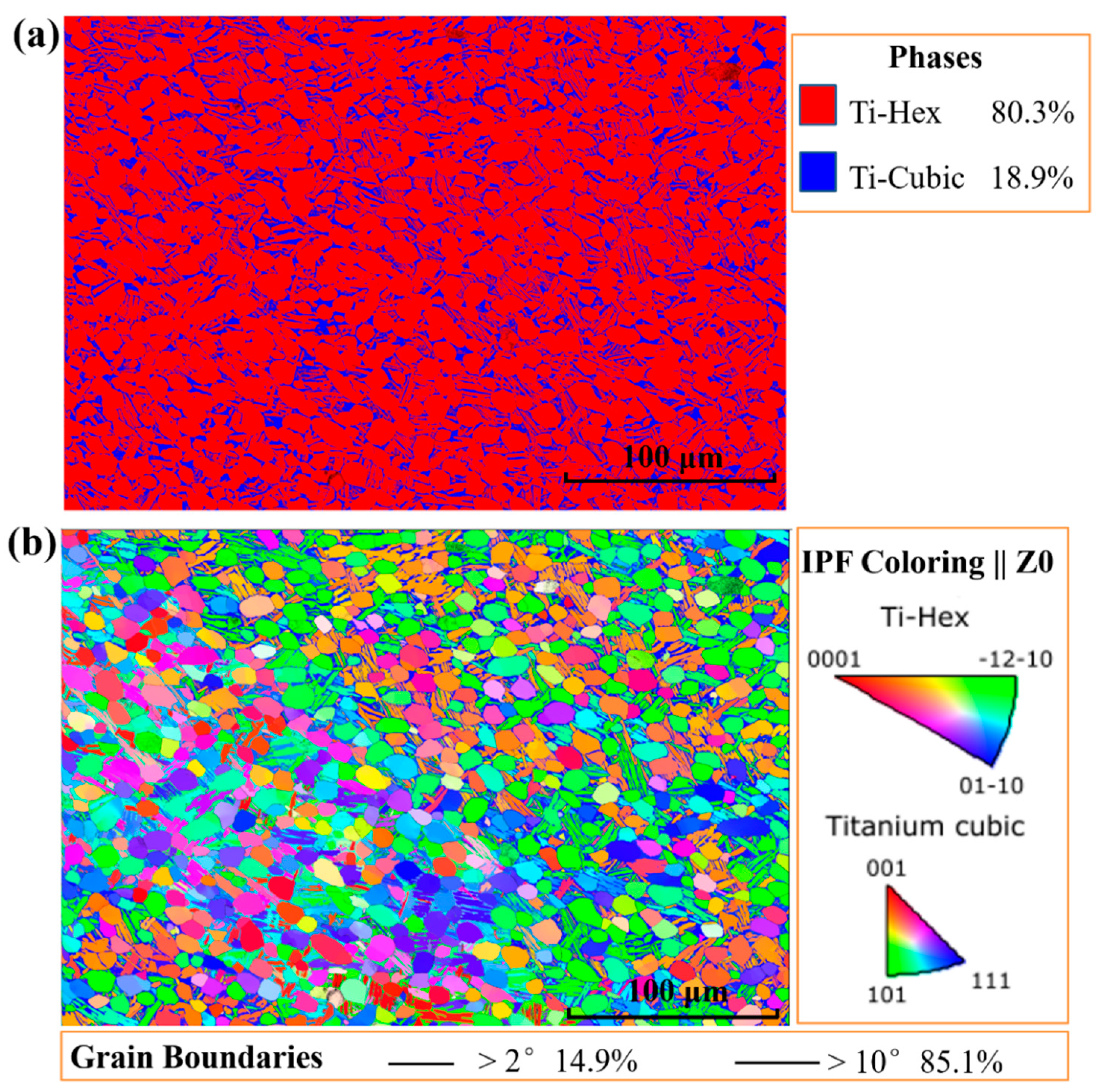
3.1. Microstructure Characterizations
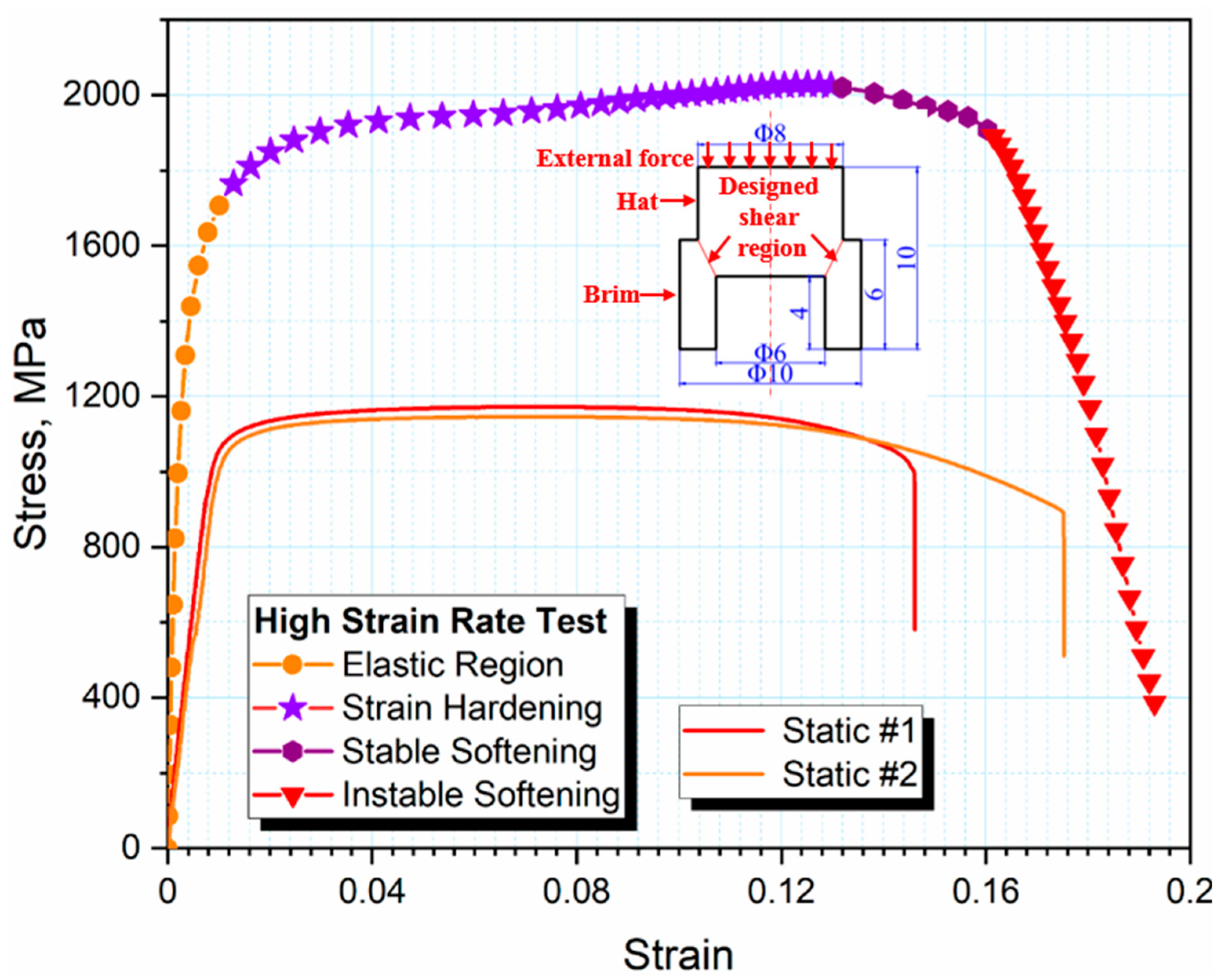
3.2. Mechanical Response at High Strain Rate
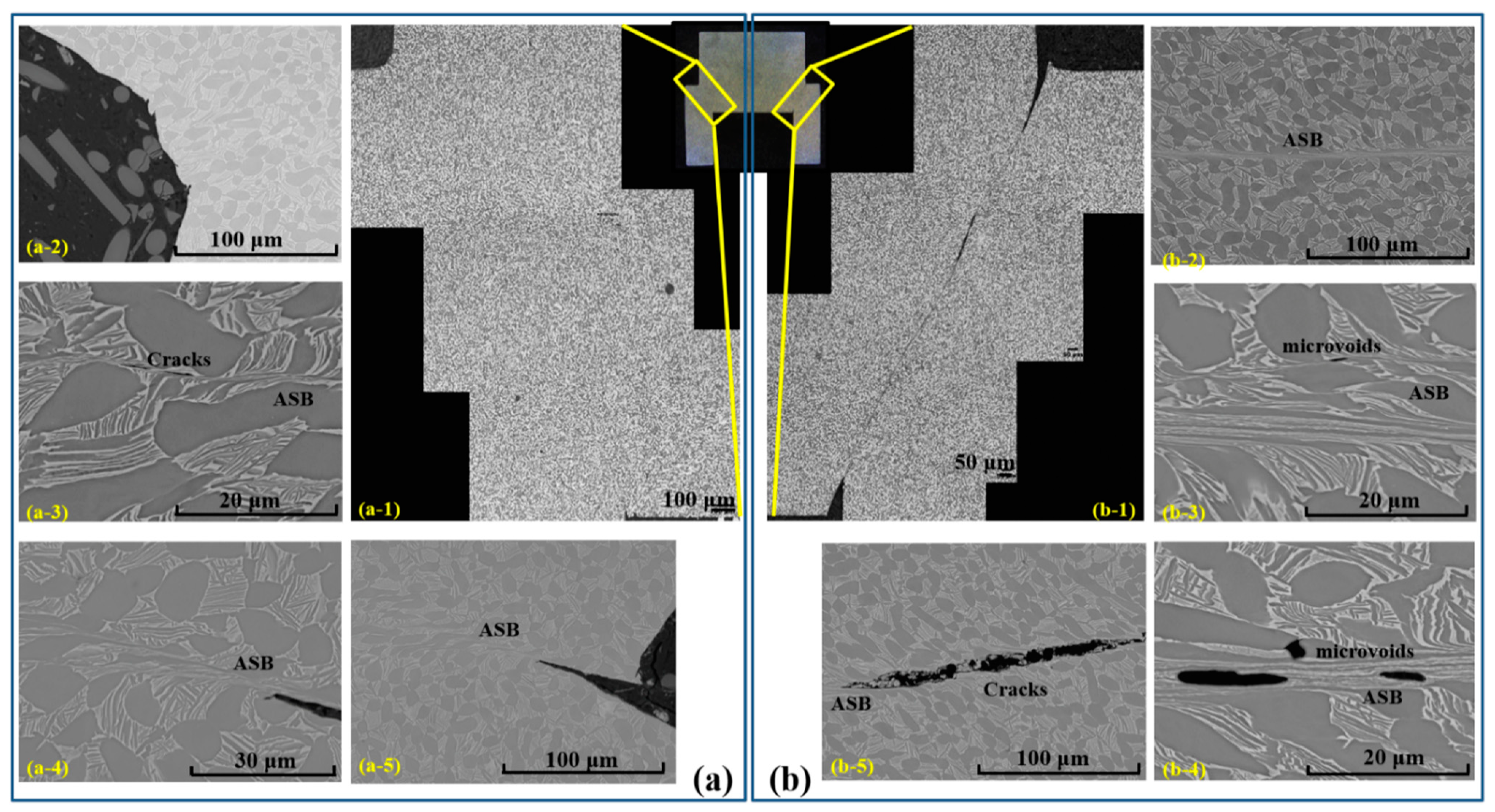
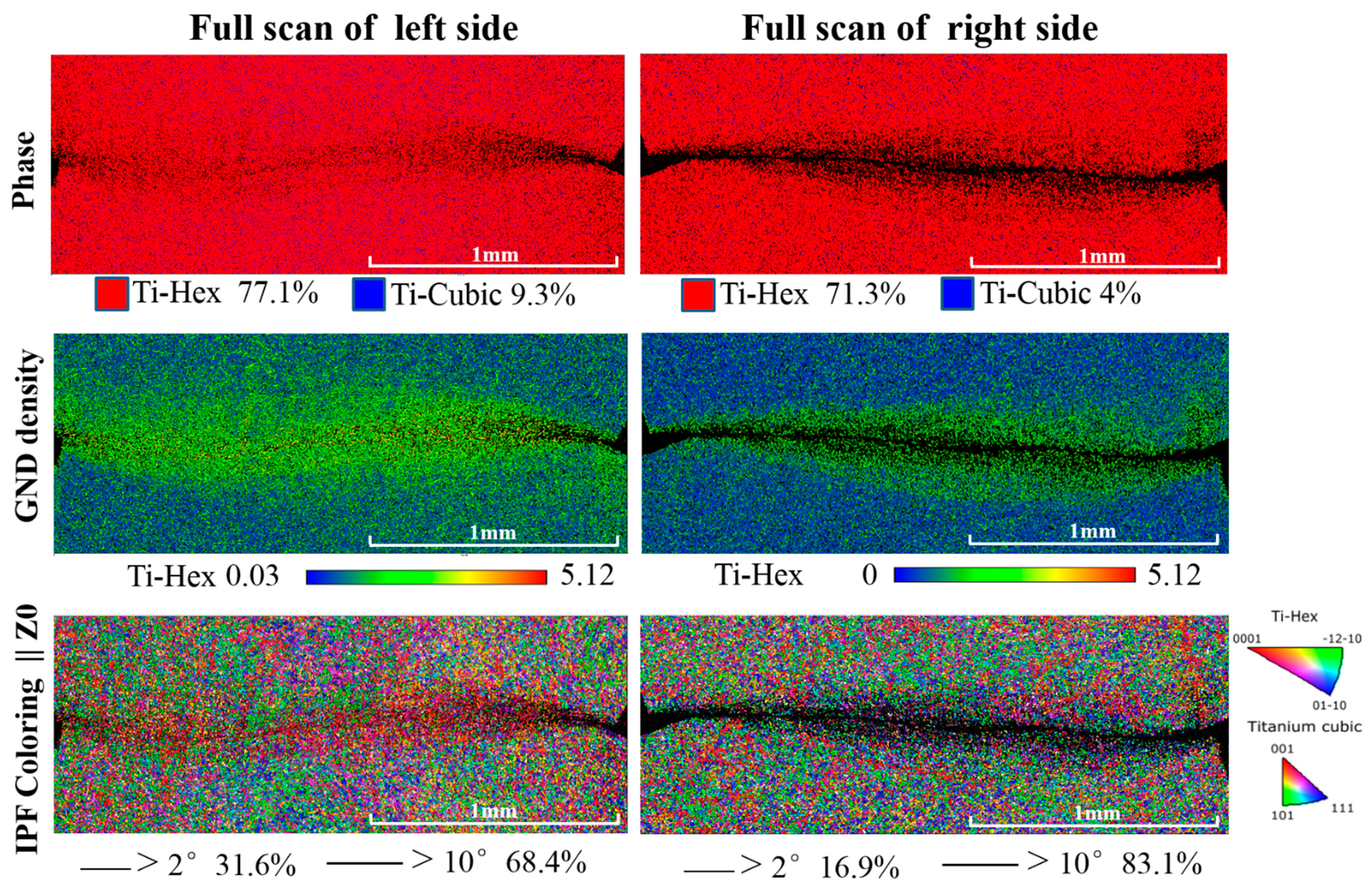
3.3. Local Features of Adiabatic Shear Bands
3.4. Discussion
4. Conclusions
Author Contributions
Funding
Data Availability Statement
Acknowledgments
Conflicts of Interest
References
- Yu, Q.; Shan, Z.-W.; Li, J.; Huang, X.; Xiao, L.; Sun, J.; Ma, E. Strong crystal size effect on deformation twinning. Nature 2010, 463, 335–338. [Google Scholar] [CrossRef]
- Clouet, E.; Caillard, D.; Chaari, N.; Onimus, F.; Rodney, D. Dislocation locking versus easy glide in titanium and zirconium. Nat. Mater. 2015, 14, 931–936. [Google Scholar] [CrossRef] [PubMed]
- Polmear, I.; StJohn, D.; Nie, J.-F.; Qian, M. Chapter 7—Titanium Alloys. In Light Alloys, 5th ed.; Butterworth-Heinemann: Boston, MA, USA, 2017; pp. 369–460. [Google Scholar] [CrossRef]
- Li, X.; Lu, K. Playing with defects in metals. Nat. Mater. 2017, 16, 700–701. [Google Scholar] [CrossRef] [PubMed]
- Kaplan, W.D. The mechanism of crystal deformation. Science 2015, 349, 1059–1060. [Google Scholar] [CrossRef] [PubMed]
- Zhang, Y.; Li, J.; Wang, W.Y.; Li, P.; Tang, B.; Wang, J.; Kou, H.; Shang, S.; Wang, Y.; Kecskes, L.J.; et al. When a defect is a pathway to improve stability: A case study of the L12 Co3TM superlattice intrinsic stacking fault. J. Mater. Sci. 2019, 54, 13609–13618. [Google Scholar] [CrossRef]
- Wang, W.Y.; Tang, B.; Shang, S.-L.; Wang, J.; Li, S.; Wang, Y.; Zhu, J.; Wei, S.; Wang, J.; Darling, K.A.; et al. Local lattice distortion mediated formation of stacking faults in Mg alloys. Acta Mater. 2019, 170, 231–239. [Google Scholar] [CrossRef]
- Bae, J.W.; Lee, J.; Zargaran, A.; Kim, H.S. Enhanced cryogenic tensile properties with multi-stage strain hardening through partial recrystallization in a ferrous medium-entropy alloy. Scr. Mater. 2021, 194, 113653. [Google Scholar] [CrossRef]
- Wu, G.; Chan, K.-C.; Zhu, L.; Sun, L.; Lu, J. Dual-phase nanostructuring as a route to high-strength magnesium alloys. Nature 2017, 545, 80–87. [Google Scholar] [CrossRef]
- Basu, S.; Li, Z.; Pradeep, K.G.; Raabe, D. Strain rate sensitivity of a TRIP-assisted dual-phase high-entropy alloy. Front. Mater. 2018, 5, 30. [Google Scholar] [CrossRef]
- Zou, C.; Li, J.; Wang, W.Y.; Zhang, Y.; Lin, D.; Yuan, R.; Wang, X.; Tang, B.; Wang, J.; Gao, X.; et al. Integrating data mining and machine learning to discover high-strength ductile Titanium alloys. Acta Mater. 2021, 202, 211–221. [Google Scholar] [CrossRef]
- Mantri, S.A.; Choudhuri, D.; Alam, T.; Viswanathan, G.B.; Sosa, J.M.; Fraser, H.L.; Banerjee, R. Tuning the scale of α precipitates in β-titanium alloys for achieving high strength. Scr. Mater. 2018, 154, 139–144. [Google Scholar] [CrossRef]
- Lee, S.W.; Park, C.H.; Hong, J.-K.; Yeom, J.-T. Development of sub-grained α+β Ti alloy with high yield strength showing twinning- and transformation-induced plasticity. J. Alloys Compd. 2020, 813, 152102. [Google Scholar] [CrossRef]
- Danard, Y.; Poulain, R.; Garcia, M.; Guillou, R.; Thiaudiere, D.; Mantri, S.; Banerjee, R.; Sun, F.; Prima, F. Microstructure design and in-situ investigation of TRIP/TWIP effects in a forged dual-phase Ti-10V-2Fe-3Al alloy. Materialia 2019, 8, 100507. [Google Scholar] [CrossRef]
- Kloenne, Z.; Viswanathan, G.; Fox, S.; Loretto, M.; Fraser, H.L. Interface and colony boundary sliding as a deformation mechanism in a novel titanium alloy. Scr. Mater. 2020, 178, 418–421. [Google Scholar] [CrossRef]
- Bertrand, E.; Castany, P.; Péron, I.; Gloriant, T. Twinning system selection in a metastable β-titanium alloy by Schmid factor analysis. Scr. Mater. 2011, 64, 1110–1113. [Google Scholar] [CrossRef]
- Wang, L.; Eisenlohr, P.; Yang, Y.; Bieler, T.R.; Crimp, M.A. Nucleation of paired twins at grain boundaries in titanium. Scr. Mater. 2010, 63, 827–830. [Google Scholar] [CrossRef]
- Qin, H.; Jonas, J.J. Variant selection during secondary and tertiary twinning in pure titanium. Acta Mater. 2014, 75, 198–211. [Google Scholar] [CrossRef]
- Reddy, V.S.; Nath, P.; Horbach, J.; Sollich, P.; Sengupta, S. Nucleation theory for yielding of nearly defect-free crystals: Understanding rate dependent yield points. Phys. Rev. Lett. 2020, 124, 025503. [Google Scholar] [CrossRef] [PubMed]
- Rittel, D.; Landau, P.; Venkert, A. Dynamic recrystallization as a potential cause for adiabatic shear failure. Phys. Rev. Lett. 2008, 101, 165501. [Google Scholar] [CrossRef]
- Ma, X.; Zhao, D.; Yadav, S.; Sagapuram, D.; Xie, K.Y. Grain-subdivision-dominated microstructure evolution in shear bands at high rates. Mater. Res. Lett. 2020, 8, 328–334. [Google Scholar] [CrossRef]
- Bisht, A.; Kumar, S.; Pang, K.H.; Zhou, R.X.; Roy, A.; Silberschmidt, V.V.; Suwas, S. Shear band widening mechanism in Ti-6Al-4V under high strain rate deformation. J. Mater. Res. 2020, 35, 1623–1634. [Google Scholar] [CrossRef]
- Guo, Y.; Ruan, Q.; Zhu, S.; Wei, Q.; Lu, J.; Hu, B.; Wu, X.; Li, Y. Dynamic failure of titanium: Temperature rise and adiabatic shear band formation. J. Mech. Phys. Solids 2020, 135, 103811. [Google Scholar] [CrossRef]
- Guo, Y.; Ruan, Q.; Zhu, S.; Wei, Q.; Chen, H.; Lu, J.; Hu, B.; Wu, X.; Li, Y.; Fang, D. Temperature rise associated with adiabatic shear band: Causality clarified. Phys. Rev. Lett. 2019, 122, 015503. [Google Scholar] [CrossRef] [PubMed]
- El-Azab, A. The statistical mechanics of strain-hardened metals. Science 2008, 320, 1729–1730. [Google Scholar] [CrossRef] [PubMed]
- Arul Kumar, M.; Wronski, M.; McCabe, R.J.; Capolungo, L.; Wierzbanowski, K.; Tome, C.N. Role of microstructure on twin nucleation and growth in HCP titanium: A statistical study. Acta Mater. 2018, 148, 123–132. [Google Scholar] [CrossRef]
- Fan, X.G.; Jiang, X.Q.; Zeng, X.; Shi, Y.G.; Gao, P.F.; Zhan, M. Modeling the anisotropy of hot plastic deformation of two-phase titanium alloys with a colony microstructure. Int. J. Plast. 2018, 104, 173–195. [Google Scholar] [CrossRef]
- Tang, B.; Tang, B.; Han, F.; Yang, G.; Li, J. Influence of strain rate on stress induced martensitic transformation in beta solution treated TB8 alloy. J. Alloys Compd. 2013, 565, 1–5. [Google Scholar] [CrossRef]
- Zhan, H.; Wang, G.; Kent, D.; Dargusch, M. The dynamic response of a metastable β Ti-Nb alloy to high strain rates at room and elevated temperatures. Acta Mater. 2016, 105, 104–113. [Google Scholar] [CrossRef]
- Ben Boubaker, H.; Mareau, C.; Ayed, Y.; Germain, G.; Tidu, A. Impact of the initial microstructure and the loading conditions on the deformation behavior of the Ti17 titanium alloy. J. Mater. Sci. 2020, 55, 1765–1778. [Google Scholar] [CrossRef]
- Landau, P.; Osovski, S.; Venkert, A.; Gärtnerová, V.; Rittel, D. The genesis of adiabatic shear bands. Sci. Rep. 2016, 6, 37226. [Google Scholar] [CrossRef]
- Baik, S.-I.; Gupta, R.K.; Kumar, K.S.; Seidman, D.N. Temperature increases and thermoplastic microstructural evolution in adiabatic shear bands in a high-strength and high-toughness 10 wt.% Ni steel. Acta Mater. 2021, 205, 116568. [Google Scholar] [CrossRef]
- Lins, J.F.C.; Sandim, H.R.Z.; Kestenbach, H.J.; Raabe, D.; Vecchio, K.S. A microstructural investigation of adiabatic shear bands in an interstitial free steel. Mater. Sci. Eng. A 2007, 457, 205–218. [Google Scholar] [CrossRef]
- Ran, C.; Chen, P.; Li, L.; Zhang, W. Dynamic shear deformation and failure of Ti-5Al-5Mo-5V-1Cr-1Fe titanium alloy. Mater. Sci. Eng. A 2017, 694, 41–47. [Google Scholar] [CrossRef]
- Andrade, U.; Meyers, M.A.; Vecchio, K.S.; Chokshi, A.H. Dynamic recrystallization in high-strain, high-strain-rate plastic deformation of copper. Acta Metall. Mater. 1994, 42, 3183–3195. [Google Scholar] [CrossRef]
- Osovski, S.; Rittel, D.; Landau, P.; Venkert, A. Microstructural effects on adiabatic shear band formation. Scr. Mater. 2012, 66, 9–12. [Google Scholar] [CrossRef]
- Wang, B.F.; Yang, Y.; Chen, Z.P.; Zeng, Y. Adiabatic shear bands in alpha-titanium tube under external explosive loading. J. Mater. Sci. 2007, 42, 8101–8105. [Google Scholar] [CrossRef]
- Yan, D.V.P.; Jin, X.L. Characterization of shear band formation and microstructure evolution during orthogonal cutting of Ti-5553: Part I—Shear angle, strain and strain rate. J. Mater. Eng. Perform. 2020, 29, 4063–4074. [Google Scholar] [CrossRef]
- Lieou, C.K.C.; Bronkhorst, C.A. Dynamic recrystallization in adiabatic shear banding: Effective-temperature model and comparison to experiments in ultrafine-grained titanium. Int. J. Plast. 2018, 111, 107–121. [Google Scholar] [CrossRef]
- Yang, Y.; Wang, B.F. Microstructure evolution in adiabatic shear band in α-titanium. J. Mater. Sci. 2006, 41, 7387–7392. [Google Scholar] [CrossRef]
- Cantwell, P.R.; Tang, M.; Dillon, S.J.; Luo, J.; Rohrer, G.S.; Harmer, M.P. Grain boundary complexions. Acta Mater. 2014, 62, 1–48. [Google Scholar] [CrossRef]
- Dillon, S.J.; Harmer, M.P.; Luo, J. Grain boundary complexions in ceramics and metals: An overview. JOM 2009, 61, 38–44. [Google Scholar] [CrossRef]
- Meiners, T.; Frolov, T.; Rudd, R.E.; Dehm, G.; Liebscher, C.H. Observations of grain-boundary phase transformations in an elemental metal. Nature 2020, 579, 375–378. [Google Scholar] [CrossRef]
- Tang, L.; Chen, Z.; Zhan, C.; Yang, X.; Liu, C.; Cai, H. Microstructural evolution in adiabatic shear bands of copper at high strain rates: Electron backscatter diffraction characterization. Mater. Charact. 2012, 64, 21–26. [Google Scholar] [CrossRef]
- Bu, Y.; Li, Z.; Liu, J.; Wang, H.; Raabe, D.; Yang, W. Nonbasal slip systems enable a strong and ductile Hexagonal-Close-Packed high-entropy phase. Phys. Rev. Lett. 2019, 122, 075502. [Google Scholar] [CrossRef] [PubMed]
- Lim, H.; Hale, L.M.; Zimmerman, J.A.; Battaile, C.C.; Weinberger, C.R. A multi-scale model of dislocation plasticity in α-Fe: Incorporating temperature, strain rate and non-Schmid effects. Int. J. Plast. 2015, 73, 100–118. [Google Scholar] [CrossRef]

Publisher’s Note: MDPI stays neutral with regard to jurisdictional claims in published maps and institutional affiliations. |
© 2021 by the authors. Licensee MDPI, Basel, Switzerland. This article is an open access article distributed under the terms and conditions of the Creative Commons Attribution (CC BY) license (https://creativecommons.org/licenses/by/4.0/).
Share and Cite
Hao, F.; Du, Y.; Li, P.; Mao, Y.; Lin, D.; Wang, J.; Gao, X.; Wang, K.; Liu, X.; Song, H.; et al. Effect of High Strain Rate on Adiabatic Shearing of α+β Dual-Phase Ti Alloy. Materials 2021, 14, 2044. https://doi.org/10.3390/ma14082044
Hao F, Du Y, Li P, Mao Y, Lin D, Wang J, Gao X, Wang K, Liu X, Song H, et al. Effect of High Strain Rate on Adiabatic Shearing of α+β Dual-Phase Ti Alloy. Materials. 2021; 14(8):2044. https://doi.org/10.3390/ma14082044
Chicago/Turabian StyleHao, Fang, Yuxuan Du, Peixuan Li, Youchuan Mao, Deye Lin, Jun Wang, Xingyu Gao, Kaixuan Wang, Xianghong Liu, Haifeng Song, and et al. 2021. "Effect of High Strain Rate on Adiabatic Shearing of α+β Dual-Phase Ti Alloy" Materials 14, no. 8: 2044. https://doi.org/10.3390/ma14082044
APA StyleHao, F., Du, Y., Li, P., Mao, Y., Lin, D., Wang, J., Gao, X., Wang, K., Liu, X., Song, H., Feng, Y., Li, J., & Wang, W. Y. (2021). Effect of High Strain Rate on Adiabatic Shearing of α+β Dual-Phase Ti Alloy. Materials, 14(8), 2044. https://doi.org/10.3390/ma14082044