
Abstract
The meshless local Petrov–Galerkin (MLPG) method was developed to analyze 2D problems for flexoelectricity and higher-grade thermoelectricity. Both problems were multiphysical and scale-dependent. The size effect was considered by the strain and electric field gradients in the flexoelectricity, and higher-grade heat flux in the thermoelectricity. The variational principle was applied to derive the governing equations within the higher-grade theory of considered continuous media. The order of derivatives in the governing equations was higher than in their counterparts in classical theory. In the numerical treatment, the coupled governing partial differential equations (PDE) were satisfied in a local weak-form on small fictitious subdomains with a simple test function. Physical fields were approximated by the moving least-squares (MLS) scheme. Applying the spatial approximations in local integral equations and to boundary conditions, a system of algebraic equations was obtained for the nodal unknowns.
1. Introduction
In nanocomposites, nanosized particles are incorporated into a matrix. In these materials, the of surface-to-volume ratio is significantly larger than in their bulk-sized equivalents. Their properties can be improved many times with respect to those known for individual constituents. Mechanical strength, toughness and electrical or thermal conductivity can be dramatically improved in nanocomposites. Therefore, they are starting to be intensively utilized in many engineering fields. However, size-effect phenomena are observed in nanosized structures if the characteristic length of material structure is comparable with the size of the analyzed body [1,2,3,4,5]. Even some new phenomena are observed in nanosized structures, e.g., the electric polarization in centro-symmetric crystals. This is explained by the direct flexoelectricity effect [6,7,8]. In contrast to piezoelectricity, this can be viewed as a higher order effect [9]. If stresses are proportional to the gradients of the electric intensity vector, we are talking about converse flexoelectricity [10,11,12]. Strain and electric intensity vector gradients are very large in nanosized dielectrics, and they should be considered in constitutive equations.
Nanotechnology is also being successfully utilized to improve thermoelectric properties [13]. Thermoelectric materials have the potential to convert waste heat directly into electricity if the thermal conductivity is reduced without affecting the high electrical conductivity [14]. Thermal conductivity is reduced significantly in nanostructures only, as scattering of phonons is observed only on interfaces of nanostructures. Due to this phonon-scattering, thermal conductivity is reduced. Since the electrons are smaller, they are not scattered and the electric conductivity is not reduced. This requires developing a theory for heat conduction where size effects are considered.
Microstructural material characteristics are not considered in the classical continuum theory; results are size-independent. Atomistic models should be able to consider the size-effect in structural elements. However, extremely high requirements are put on computer memory in such approach. Moreover, if we are interested in global response of macro-structural elements, it is more convenient to work with advanced continuum models, in which intrinsic length-scale parameters (characteristic of material microstructure) are considered [15,16,17]. Earlier gradient theory is very complicated, due to many additional material parameters that are unavailable. Aifantis [18] simplified the former theory by introducing only one length-scale parameter. The nonlocality should be considered in the heat conduction problems if the temperature gradients are large [19]. For a special weight function in nonlocal integral expression of the heat flux vector, it is possible to transform the integral form of constitutive law into a differential relationship with a characteristic length-scale parameter representing the nonlocality. In both flexoelectric and higher-grade thermoelectric problems, we have constitutive equations with the intrinsic material parameter representing microstructure and higher derivatives of physical fields than in corresponding problems described by classical theory. Because of coupling among various physical fields, both these problems are multiphysical.
Many discontinuities and damage problems are described by nonlocal models based on the peridynamic theory [20]. Constitutive equations are written in integral form rather than partial differential equations. Various meshless methods have been successfully applied for these problems. Silling and Askari [21] applied the finite point method (FPM) to peridynamics. Moreover, there are also trends of active studies to design meshless methods that take the advantages of the classical and nonlocal theories simultaneously in a meshless framework [22,23,24].
It is necessary to have a reliable and accurate computational tool for solving the multiphysical problems described by gradient theories. Because of higher-order derivatives in governing equations, the C1-continuous elements are required in numerical domain discretization methods in order to guarantee the continuity of field variables and their derivatives on interfaces of elements. It is a difficult task to obey such a requirement, though certain special elements were developed [25,26]. It is more convenient to develop the mixed formulation in the finite element method (FEM) [20,21,25,26]. Both the primary field and its derivatives are approximated as independent field variables in the mixed FEM with using C0 continuous elements. However, numerous degrees of freedom (DOFs) are used in each element, which make it prohibitively expensive for practical use. The order of continuity of the moving least-square (MLS) approximation in the meshless local Petrov–Galerkin method (MLPG) can be tuned to a desired value very easily [22,23,24,27,28,29]. Therefore, it is a natural ambition to apply the MLPG with MLS approximation to problems described by gradient theories with higher-order derivatives in governing equations.
In the present study, the authors have developed a meshless method based on the MLPG weak-formulation for numerical solution of multiphysical problems in dielectric and thermoelectric solids. Both the direct and converse flexoelectricity is considered in dielectric solids. Nodal points are spread on the analyzed domain and each node is surrounded by a small circular subdomain for simplicity, but without loss of generality, for consideration of governing equations in local weak sense within the MLPG method for solution. The spatial variations of primary physical fields were approximated by the moving least-squares (MLS) scheme. After performing the spatial integrations, a system of algebraic or ordinary differential equations for unknown nodal values was obtained. The essential boundary conditions on the global boundary were satisfied in strong sense by the collocation of approximated fields at nodes where essential boundary conditions were prescribed. Illustrative numerical examples are presented and discussed with focusing on comparison of results obtained by the gradient theory with those obtained by classical theory.
2. The MLPG for Flexoelectricity
2.1. The Direct and Converse Flexoelectricity
The electric enthalpy density for piezoelectric solids with strain and electric intensity vector gradients can be written as [25,26,27,28,29,30,31]
where a and c denote the second-order permittivity and the fourth-order elastic constant tensors, respectively. Symbols e and f are used for the piezoelectric and flexoelectric coefficients, respectively. Symbol g denotes the higher order elastic coefficients. Finally, the symbols b and h are used for the converse flexoelectric coefficients and higher-order electric parameters, respectively.
The strain tensor and the electric field vector are related to the displacements and the electric potential by
The strain-gradients are denoted by symbol η
The constitutive equations are obtained from the electric enthalpy density expression (1) as
where , , and are the stress tensor, electric displacements, higher order stress and electric quadrupole, respectively.
In the simplified gradient theory [18,32,33] only one internal length-scale parameter l is present. Then, the higher-order elastic parameters are proportional to the conventional elastic stiffness coefficients and the length material parameter l [34,35] as
with being the Kronecker delta.
A similar idea of simplification has been applied to the higher-order electric parameters
where q is another length-scale parameter.
In the simplified direct flexoelectricity there are considered two independent parameters and for the direct flexoelectric coefficient , [25]. Taking into account the above simplifications, the electric enthalpy density can be written as
Finally, we reduce the number of independent converse flexoelectric coefficients . The stresses induced by electric intensity vector in the orthotropic piezoelectric material with poling direction along the transversal isotropy -axis can be written as
with
where standard Voight notation is applied [36].
A similar form is considered for induced stresses induced by the converse flexoelectricity
with three independent converse flexoelectric coefficients , and by . Note that , and are three independent material coefficients, but are not components of a vector, similar as , in case of direct flexoelectricity.
Then, the final form of the electric enthalpy is given by
The constitutive Equations (4) for orthotropic materials in 2D problem (considered in -plane) can be rewritten into a matrix form as
The Voigt notation is applied for piezoelectric and dielectric coefficients, similarly to elastic coefficients as commonly used in literature [36].
Using the variational principle of least action, it is possible to derive the governing equations for the considered constitutive equations [37]
Essential and natural boundary conditions (b.c.) follow from the variational formulation of boundary value problems:
- (1)
- Essential b.c.:
- (2)
- Natural b.c.:whereand the traction vector and the electric charge are defined aswith , , δ(x) being the Dirac delta function and is the Cartesian component of the unit tangent vector on Γ.
The jump at a corner (xc) on the oriented boundary contour Γ is defined as
2.2. The MLPG Formulation
The presence of gradients of strains and electric intensity vector in the electric enthalpy requires C1 continuous interpolations of primary fields, i.e., displacements and electric potential. Recently, the mixed FEM was developed for considered electro-elasticity problem [38]. The meshless local Petrov–Galerkin method (MLPG) with the moving least-square (MLS) approximation is convenient approach for problems with higher-order derivatives, since the order of continuity can be tuned to a desired value [27,28,29].
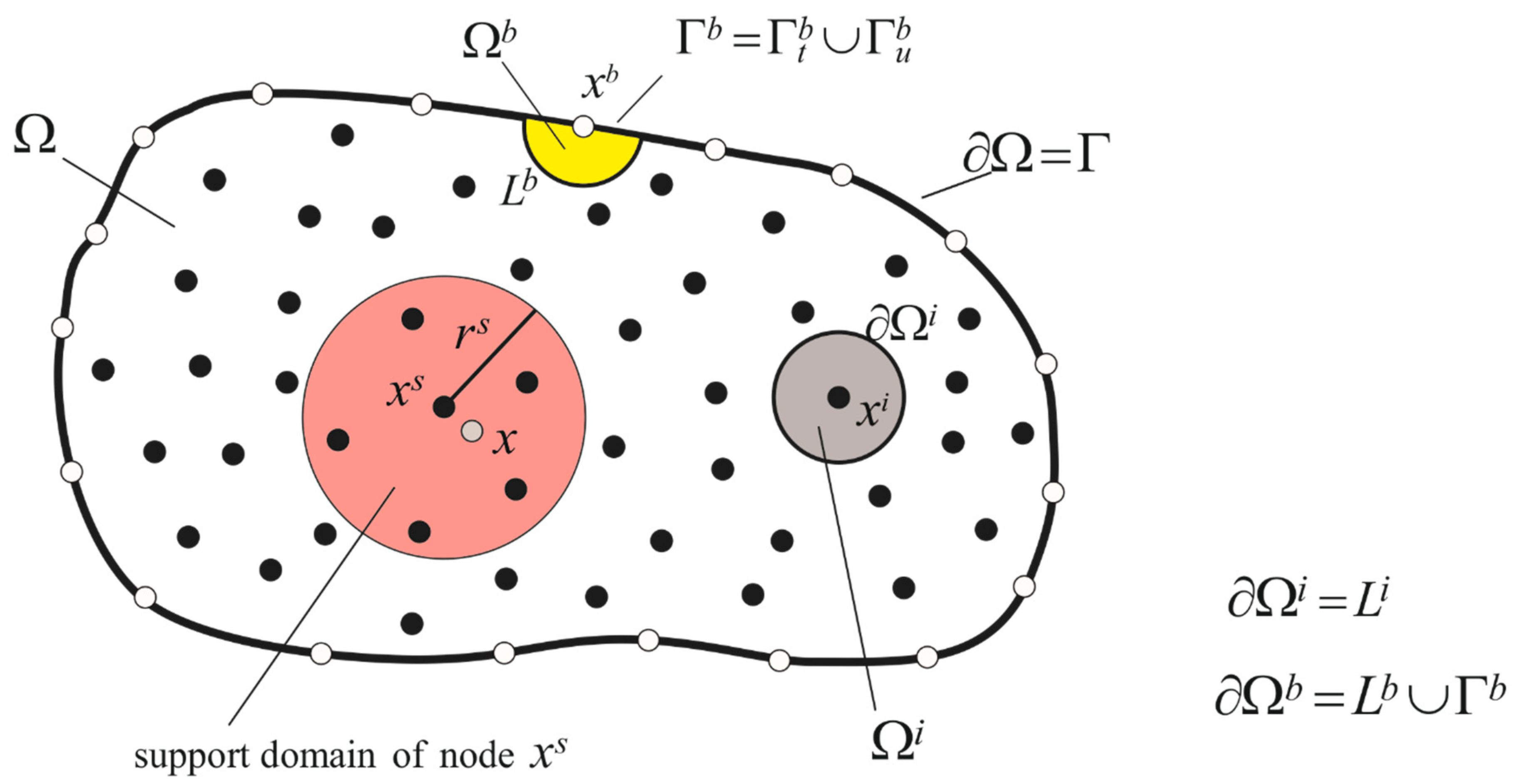
The MLPG method is based on the local weak-form with local fictitious subdomains constructed for the node which is either interior node or boundary node at which natural boundary conditions are prescribed (see Figure 1). The geometry of this subdomain can be arbitrary. However, it is appropriate to select a circular shape for simple numerical evaluation of integrals. One can write the local weak-form of the first governing Equation (15) as
where is a test function.
Figure 1.
Local subdomains and with their boundaries for moving least-squares (MLS) approximation of the trial function; support domain of weight function around node .
Applying the Gauss divergence theorem to domain integrals in (23) one can write
where is the boundary of the local subdomain which consists of three parts , in general, since and , .
If a Heaviside step function is chosen for the test function in each subdomain as
the local weak-form (24) is transformed into the local integral equation
where we have utilized the fact and
with , standing for the final and starting points on .
Similarly, we get local integral equation for the second governing Equation (15)
For numerical solution of the above integral Equations (26) and (27), the MLS approximation of trial functions is applied. The primary fields (mechanical displacements and electric potential) are given by [28]
where and are fictitious nodal parameters for displacements and electric potential, respectively and is the shape function related to the node a. Recall that the shape functions do not satisfy the Kronecker -property. Therefore the nodal unknowns , are not nodal values of displacements and electric potential, but these nodal unknowns can be used for approximation of real nodal values at an arbitrary nodal point by utilizing (28) at . The number of nodes, n, used for the approximation is determined by the size of support domain of the weight function of each node . The node is involved into the approximation at the sample point , only if lies within the support domain of the node , i.e., if . A necessary condition for a regular MLS approximation is that at least weight functions are non-zero (i.e., ) for each sample point , where is the order of the complete basis functions used in MLS approximation. A sufficient number of nodes must be involved in order to ensure the regularity of evaluation of shape functions [27]. A small size of the support domains may induce larger oscillations in the nodal shape functions. In standard discretization methods like the FEM, there are observed discontinuities on interfaces of elements if continuity of approximation is not sufficient. In meshless methods there are no element interfaces and we can use the forth-order spline-type weight function with continuity even for our problem with derivatives of the third order. For the MLS approximation, we have used the complete set of monomials of the 3rd order () [27,28,29] and the weight function has the following form
where and is the size of the support domain. In numerical examples, we have used the numerical model verified in plenty of numerical experiments (e.g., [27,28,39,40]): the radius of local subdomain , radius of support domain , where is the minimal distance of any two nodes. If the number of nodes supporting the approximation at a sample point is smaller than 15 (), additional closest nodes are supplemented as supporting nodes in the adopted numerical model. In problems with simple geometry, it is proposed to employ regular distribution of nodes. The circular shape of subdomain enables us to utilize polar coordinates and facilitate the integrations. Since the radius of local subdomain is rather small, the subdomain around a boundary node can be considered as a section of complete circular domain and is a circular arc (Figure 1). The Gaussian quadrature is used for integrations with using polar coordinate system.
The strains and electric intensity vector are approximated by
where
The first part of the traction vector (19), , can be approximated at a boundary point in terms of primary fields as
where the matrices are defined in Equations (11) and (13) and the matrix is related to the normal vector n(x) on by
Again, the first part of the electric charge (27), , has to be approximated. In the first step the expression of is given by
where,
Now, can be approximated by
with .
The essential boundary conditions are satisfied in the strong-form at nodal points . If the approximation formulas (28) and (30) are used one can write
Substituting the MLS-approximation (32) and (35) into the local boundary-domain integral Equations (26) and (27), we obtain the system of algebraic equations for unknown nodal quantities
which are considered on the sub-domains adjacent to the interior nodes as well as to the boundary nodes on and/or with
2.3. Numerical Examples
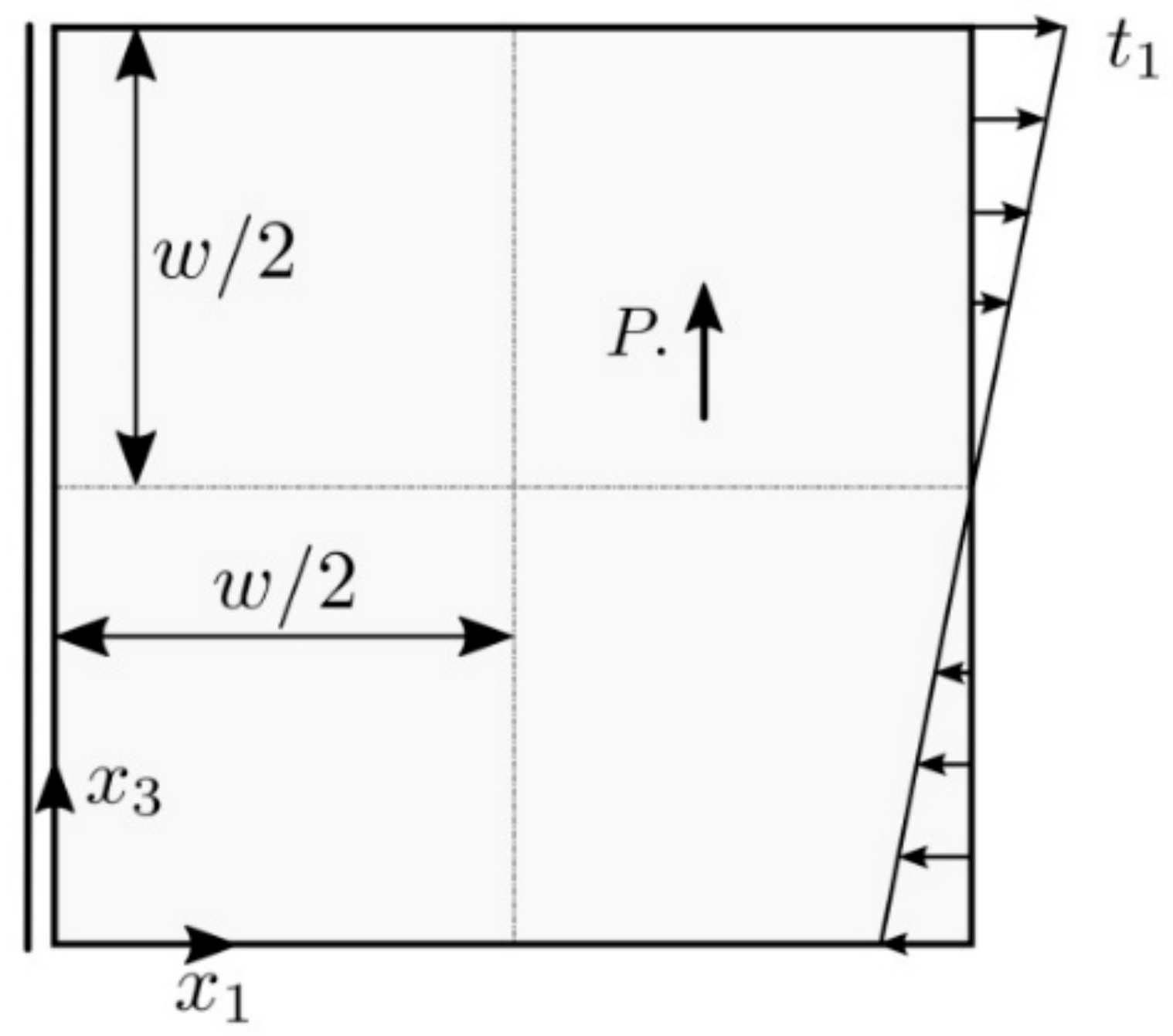
A square panel under bending in Figure 2 is analyzed by the FEM [37] and the MLPG. The piezoelectric material PZT-5H is chosen for the study.
Figure 2.
A square piezoelectric panel under bending.
Polarization of material is considered along coordinate. Following geometry and load are considered in numerical analysis: , . The size effect is control by parameter , defined by with micro-length scale parameter . The parameter is used just in parametric study for investigation of influence of the micro-length scale parameter on the physical response. The flexo-electric coefficients are vanishing here.
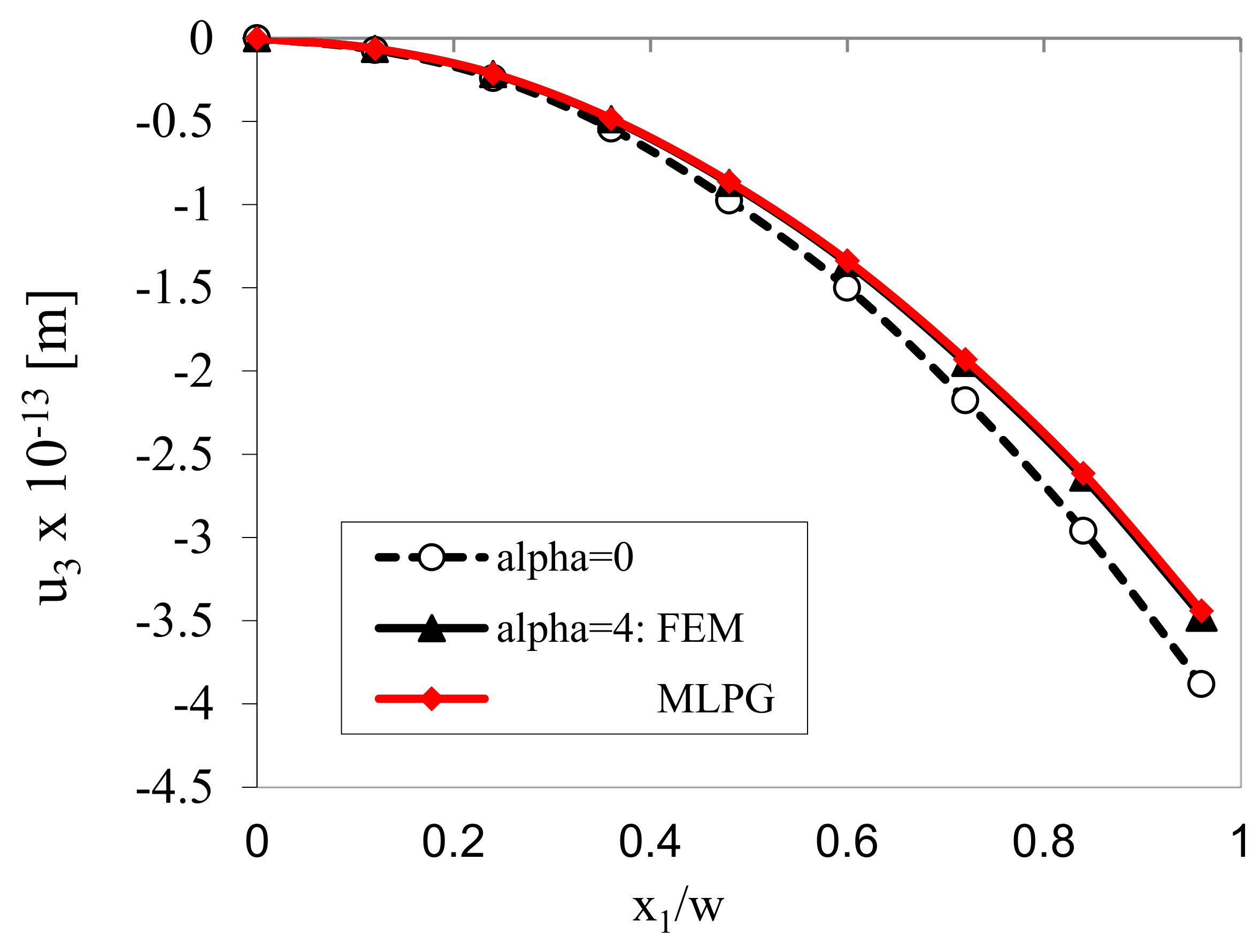
The variation of the panel deflection along is presented in Figure 3. Results are obtained by classical and gradient theories. Recall that the classical and higher-grade problems are to be solved individually, since the governing equations in the higher-grade model are given by the partial differential equations (PDE) of higher order than in classical theory and moreover, some additional boundary conditions are required. In gradient theory only strain gradients are considered in constitutive equations, while gradients of electric intensity vector are vanishing in this example. The deflections resulting from the gradient theory are reduced with respect to those obtained by the classical approach. The FEM and MLPG results are in a good agreement. In the FEM calculations, the special Argyris element [41] was employed in order to achieve higher continuity of approximated field variables.
Figure 3.
Variation of the mechanical displacement u3 at x3 = w/2.
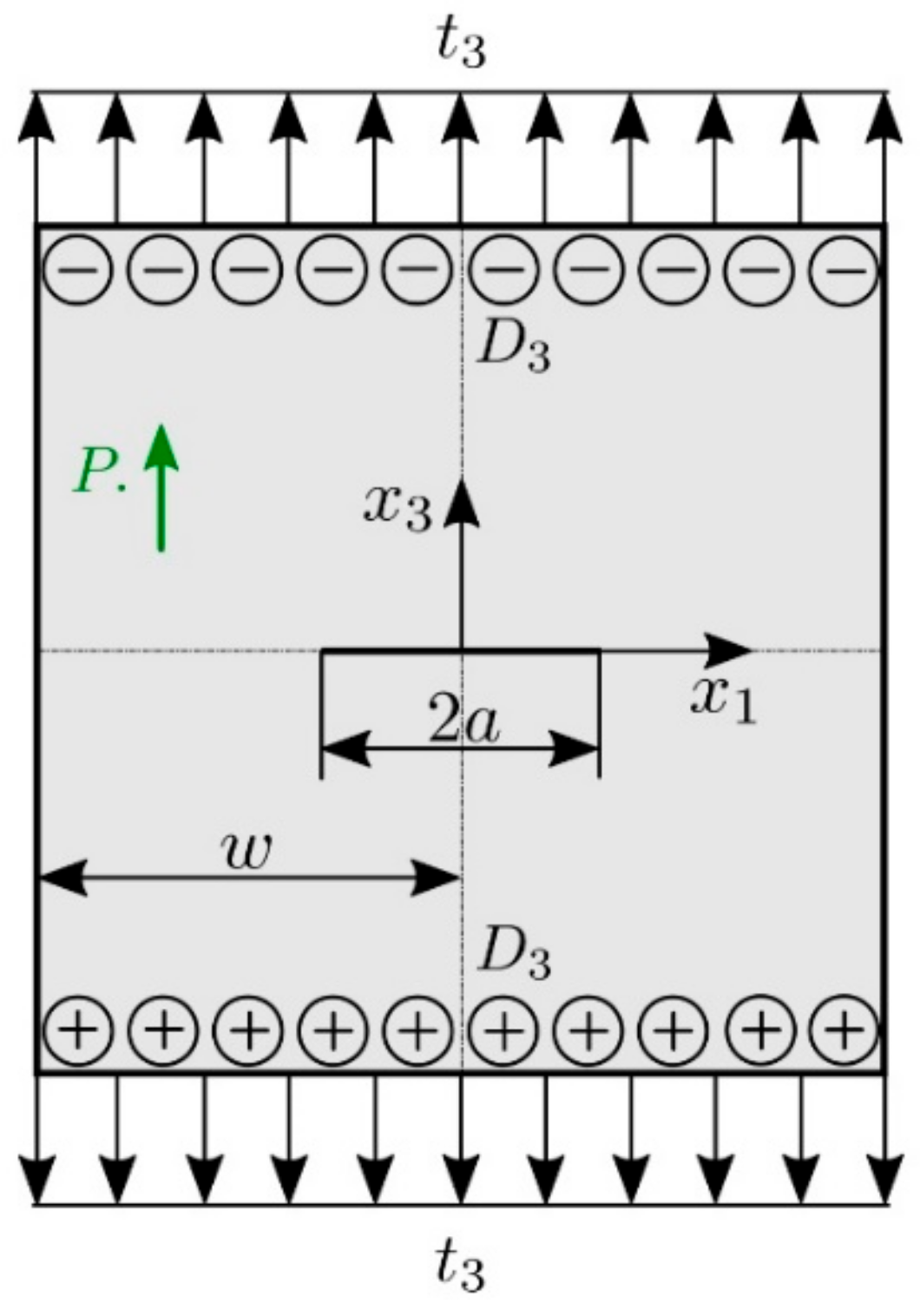
A square plate with a central crack with the geometric parameters , is analyzed (see Figure 4) in the next example. On the top and the bottom boundaries of the plate a combined electro-mechanical loading with and is applied. The crack-faces are free of mechanical tractions and electrical displacements.
Figure 4.
Crack in a square plate under an electro-mechanical loading.
The flexoelectric coefficients are considered to be . The converse flexoelectric coefficients and length scale parameter for the higher-order electric parameters are selected as and , respectively. To assess the effects of the strain- and electric field-gradients, the size-factors , , and f in constitutive equations are defined by
To investigate influence of the strain gradient and electric intensity gradient parameters various integer numbers and are selected in numerical analyses.
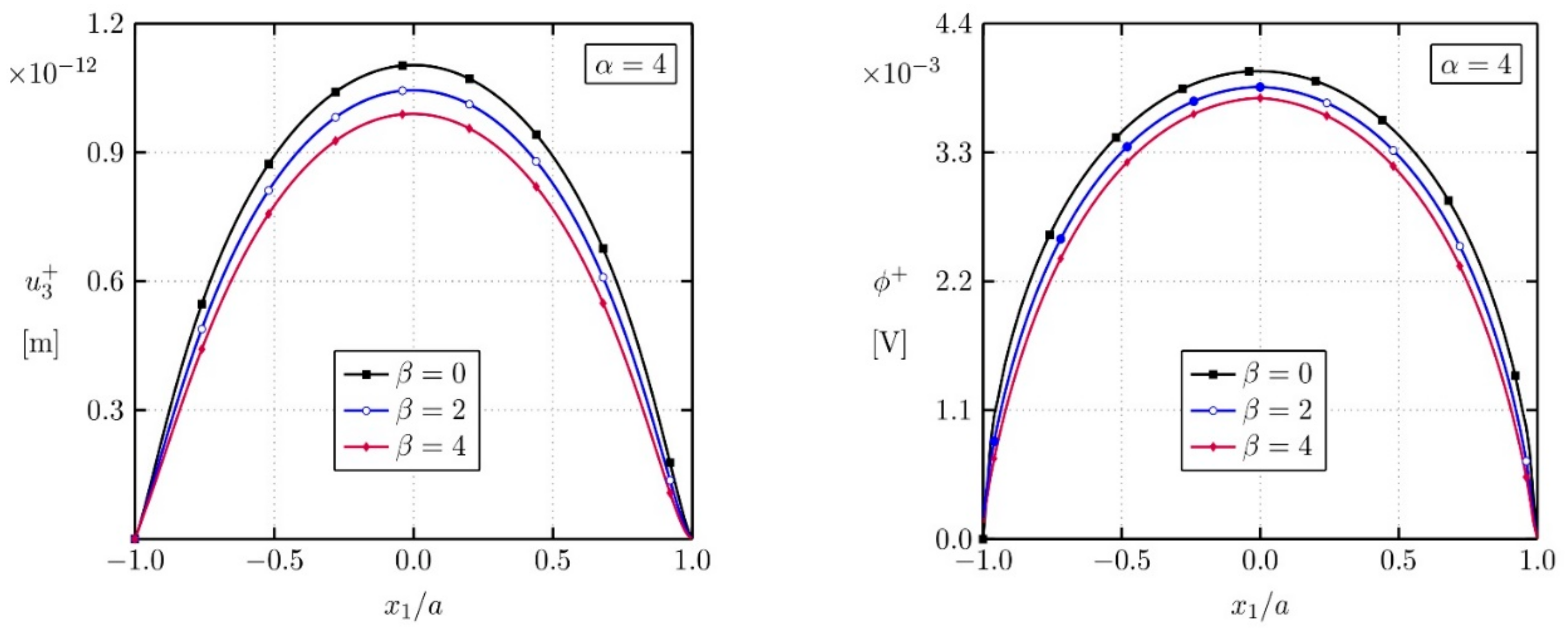
Crack opening displacement and induced electric potential are presented in Figure 5. One can observe that both displacement and electric potential are reduced if the converse flexoelectricity is growing (larger β).
Figure 5.
Crack opening-displacements and electrical potentials φ+ of the upper crack-face for different factors β.
3. Gradient Theory in Thermoelectric Materials
The thermoelectric conversion efficiency is high if the thermal conductivity is low. It can be reduced significantly in nanosized structures. It is due to comparable sizes of phonon mean free path and the structure. Phonons are scattered on interfaces and thermal conductivity is reduced. For this purpose it is needed to develop a theory of heat conduction, where size effect is considered. It is well known that there is no size effect considered in the classical local theory of Fourier heat conduction. Similar to the elasticity problems in nanostructures it is possible to consider the size effect here through the nonlocal heat transport [19]. The heat flux vector in nonlocal theory is given by
where the temperature differences are denoted by with the reference temperature , is the thermal conductivity and is a nonlocal kernel function.
The nonlocal weight function can be selected as
where distance and l is a characteristic length material parameter.
It is easy to show that weight function (41) satisfies the Helmholtz equation
where is the Dirac function.
Then, the integral expression (40) is reduced to the Helmholtz equation
where is the volume density of heat source.
By this way it is possible to replace the integro-differential form of the constitutive law in (40) by a more convenient differential form given in (43). Then, higher-order derivatives in the governing equation appear in this non-local theory of heat conduction than in the classical local Fourier theory.
Formally, the same governing equation as given in Equation (43), can be obtained also in the higher-grade theory with including the higher-grade heat flux (i.e., canonically conjugated fields with ) into constitutive equations in addition to the classical heat flux as
The constitutive equations for thermoelectric materials with higher order heat conduction theory can be written as
where the electric current density is denoted by and , , are the electrical conductivity measured with keeping uniform temperature, Seebeck and Peltier coefficients, respectively. Note that the latter two coefficients are correlated via the absolute temperature as , with , where is the reference temperature. Furthermore, is composed of the heat conduction measured when and contribution to heat conduction because of electric current [42]. The Seebeck coefficient is proportional to the electric current conductivity , and .
The electric intensity vector is related to the electric potential by
Next, orthotropic material properties are considered and the matrix form of constitutive Equations (46) for 2D problems are given by
Then, the governing equations for stationary thermoelectric problem are given by conservation of energy and electric charge as
The weak form of these equations can be written as
where , and are independent boundary densities conjugated with , and , respectively and given as ,
with being the heat flux, and are the Cartesian component of the unit tangent vector on and the jump at a corner on the oriented boundary contour is defined as .
The rate of work of the external “forces” and body source is given by
If only the Joule heating plays the role of heat sources,
and the governing equations become
Furthermore, from the weak formulation, one can deduce the following boundary conditions for coupled thermoelectric problem considered within higher-grade theory
essential b.c.:
natural b.c.:
Substituting the constitutive relationships into the governing equations, we obtain the nonlinear system of the PDEs for primary field variables and
Recall that owing to the Joule heat, the problem is nonlinear even if the temperature dependence of material coefficients were neglected. Finally, making use the proportionality relationship , the system of governing equations become
3.1. The MLPG Formulation in Thermoelectricity
One can see in the previous chapter that MLPG method is based on the local weak-form with local fictitious subdomains . The local weak-form of the first governing Equation (57) is given as
where is a test function.
Applying the Gauss divergence theorem to two domain integrals in (58), one can write
where is the boundary of the local subdomain .
The test function can be arbitrary and we have selected a Heaviside step function
Then, the local weak-form (59) is transformed into the local integral equation
where , stand for the final and starting points on with prescribed heat flux.
The local integral equation for the second governing Equation (57) is given as
The MLS approximation of trial functions is applied for numerical solution of the above local integral Equations (61) and (62). The temperature and electric potential are approximated by [28]
where and are fictitious nodal parameters for temperature and electric potential, respectively and is the shape function related to the node a. The number of nodes n is explained in Section 2.2.
From the definition of heat flux and the higher-grade heat flux in (44), (45) and approximation of temperature (63) we get
where
The electric current density and intensity of electric field are approximated by
The incomplete heat flux and are approximated as
where
with , .
The essential boundary conditions are satisfied in the strong-form at nodal points . These conditions follows directly from Equations (63) , ,
where .
Substituting the MLS-approximation (64)–(67) into the local boundary-domain integral Equations (61) and (62), we obtain the nonlinear system of algebraic equations
This system can be solved iteratively as
with (), , and
where , .
3.2. Numerical Examples
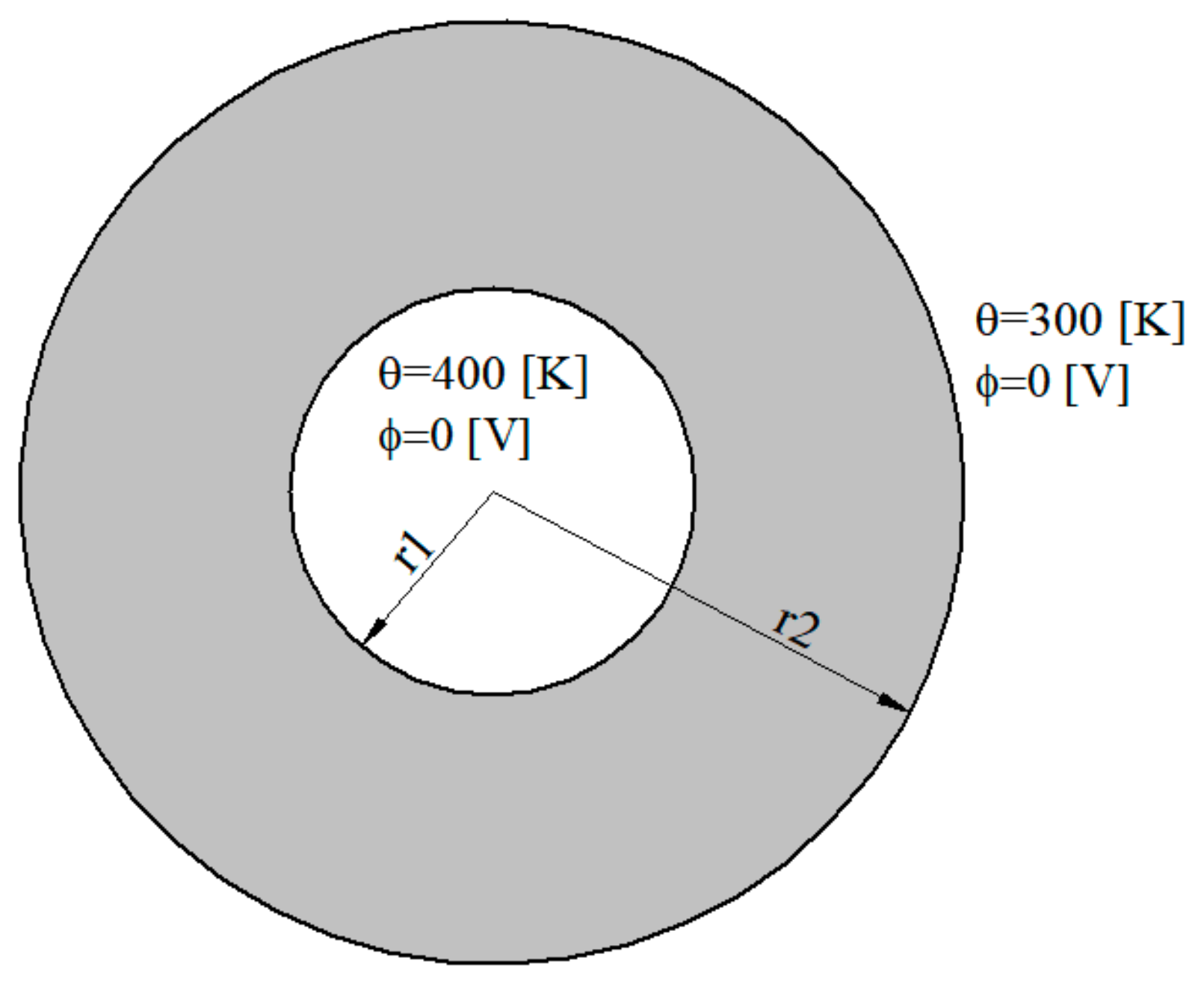
An axially symmetric thermoelectric problems, as shown in Figure 6, is analyzed in the example. The thermoelectric material Bi2Te3, is considered. It has the following material constants [42] with isotropic properties:
Figure 6.
Geometry and boundary conditions.
Characteristic length for the selected material structure is .
Following geometry of the hollow cylinder is considered: internal radius r1 = 1 × 10⁻⁷ m and external radius r2 = 2.5 × 10⁻⁷ m. Vanishing values of electric potentials are prescribed on inner and external surfaces. Furthermore, vanishing values of the temperature gradients on both surfaces are considered.
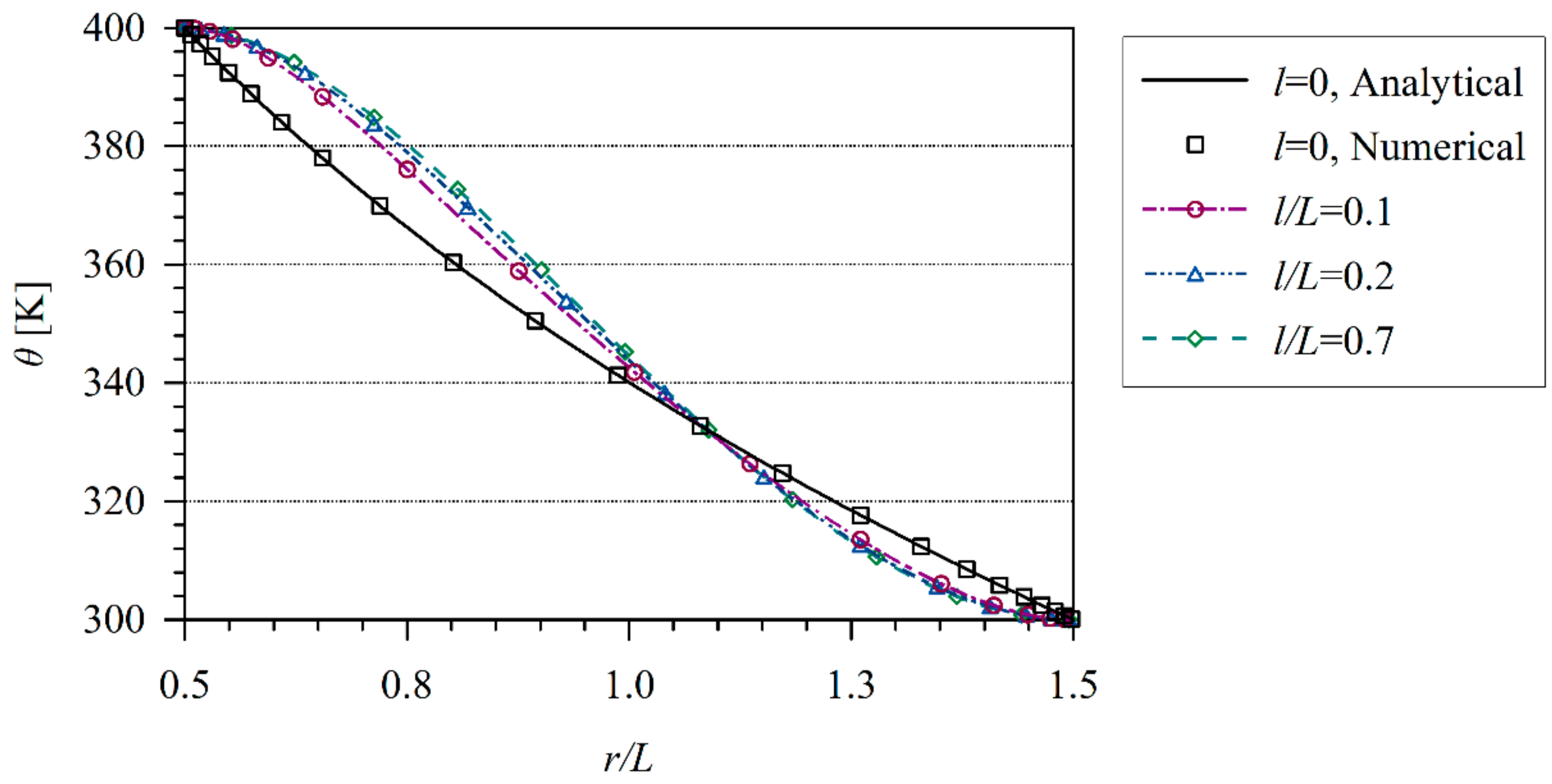
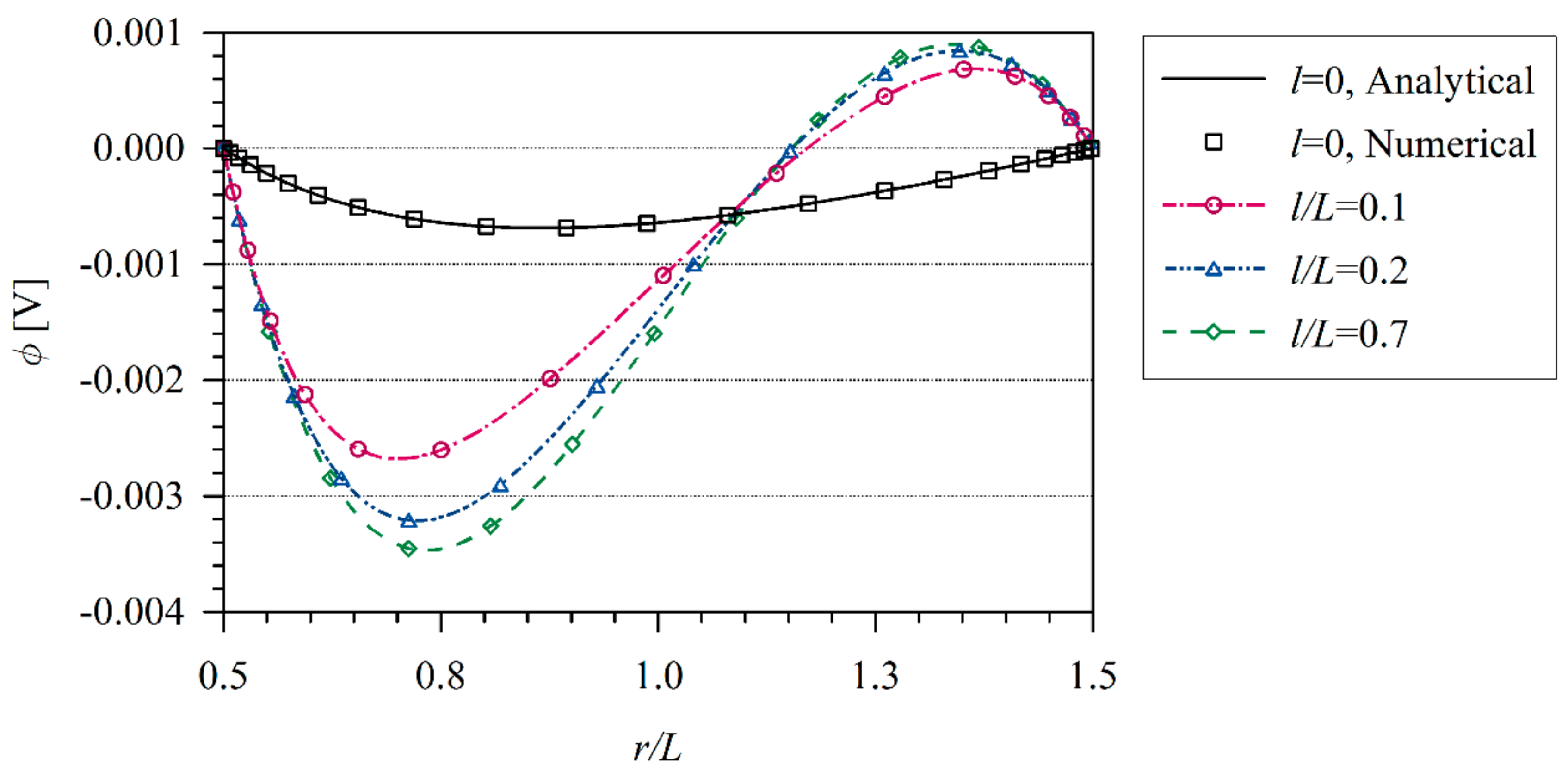
The coupled thermo-electric problem is analyzed numerically. The influence of the tube thickness on temperature and induced electric potential is investigated. Numerical results are presented in Figure 7 and Figure 8. The induced electric potential grows with increasing the value l/L. In classical thermoelectricity, it is possible to find the analytical solution.
Figure 7.
Temperature variation along non dimensional x/L coordinate in hollow cylinder.
Figure 8.
Electric potential variation along non dimensional x/L coordinate in hollow cylinder.
4. Conclusions
The meshless Petrov–Galerkin (MLPG) method was successfully applied to multiphysical problems described by advanced continuum models with microstructural effects. Strain- and electric intensity vector-gradients are considered in constitutive equations for electric displacement and stresses in flexoelectricity, respectively. Similarly, the constitutive equations for thermoelectric materials contain higher-order derivatives of temperature in the higher-grade heat conduction theory. It allows to describe the heat transfer in nanostructures more realistic. The governing equations are derived for both multiphysical problems, where size effects are considered. These equations contain higher order of derivatives of physical fields than in the classical continuum models. Application of classical domain discretization methods to corresponding boundary value problems brings some difficulties with continuity of approximated fields.
The proposed MLPG computational method with the MLS approximation of fields is very convenient to solve governing equations of gradient theory with high-order derivatives. The order of continuity of the MLS approximation can be tuned to a desired value very easily. Therefore, the present computational method is promising to be applied to multiphysical problems described by gradient theories. The operation of the developed computational scheme is verified via comparison of partial numerical results with analytical solutions and/or FEM results.
Author Contributions
J.S., subject formulation, manuscript preparation and coordination; V.S., equation derivations and manuscript preparation; P.H.W., numerical solution by the meshless method. All authors have read and agreed to the published version of the manuscript.
Funding
This research was funded by the APVV FUNDER, grant number APVV-18-0004 and “the VEGA, grand number VEGA-2/0061/20”.
Acknowledgments
The authors acknowledge the support by the Slovak Science and Technology Assistance Agency registered under number APVV-18-0004 and VEGA-2/0061/20.
Conflicts of Interest
The authors declare no conflict of interest.
References
- Buhlmann, S.; Dwir, B.; Baborowski, J.; Muralt, P. Size effects in mesoscopic epitaxial ferroelectric structures: Increase of piezoelectric response with decreasing feature-size. Appl. Phys. Lett. 2002, 80, 3195–3197. [Google Scholar] [CrossRef]
- Cross, L.E. Flexoelectric effects: Charge separation in insulating solids subjected to elastic strain gradients. J. Mater. Sci. 2006, 41, 53–63. [Google Scholar] [CrossRef]
- Harden, J.; Mbanga, B.; Eber, N.; Fodor-Csorba, K.; Sprunt, S.; Gleeson, J.T.; Jakli, A. Giant flexoelectricity of bent-core nematic liquid crystals. Phys. Rev. Lett. 2006, 97, 157802. [Google Scholar] [CrossRef] [PubMed]
- Zhu, W.; Fu, J.Y.; Li, N.; Cross, L.E. Piezoelectric composite based on the enhanced flexoelectric effects. Appl. Phys. Lett. 2006, 89, 192904. [Google Scholar] [CrossRef]
- Catalan, G.; Lubk, A.; Vlooswijk, A.H.G.; Snoeck, E.; Magen, C.; Janssens, A.; Rispens, G.; Rijnders, G.; Blank, D.H.A.; Noheda, B. Flexoelectric rotation of polarization in ferroelectric thin films. Nat. Mater. 2011, 10, 963–967. [Google Scholar] [CrossRef]
- Kogan, S.M. Piezoelectric effect during inhomogeneous deformation and acoustic scattering of carriers in crystals. Sov. Phys. Solid State 1964, 5, 2069–2070. [Google Scholar]
- Meyer, R.B. Piezoelectric effects in liquid crystals. Phys. Rev. Lett. 1969, 22, 918–921. [Google Scholar] [CrossRef]
- Sharma, P.; Maranganti, R.; Sharma, N.D. On the possibility of piezoelectric nanocomposites without using piezoelectric materials. J. Mech. Phys. Solids 2007, 55, 2328–2350. [Google Scholar] [CrossRef]
- Deng, Q.; Liu, L.; Sharma, P. Flexoelectricity in soft materials and biological membranes. J. Mech. Phys. Solids 2014, 62, 209–227. [Google Scholar] [CrossRef]
- Landau, L.D.; Lifshitz, E.M. Electrodynamics of Continuous Media, 2nd ed.; Butterworth-Heinemann: Oxford, UK, 1984; pp. 358–371. [Google Scholar]
- Yang, J.S. Effects of electric field gradient on an antiplane crack in piezoelectric ceramics. Int. J. Fract. 2004, 127, L111–L116. [Google Scholar] [CrossRef]
- Yang, X.M.; Hu, Y.T.; Yang, J.S. Electric field gradient effects in anti-plane problems of polarized ceramics. Int. J. Solids Struct. 2004, 41, 6801–6811. [Google Scholar] [CrossRef]
- Hicks, L.; Dresselhaus, M.S. Thermoelectric figure of merit of avone-dimensional conductor. Phys. Rev. B 1993, 47, 16631. [Google Scholar] [CrossRef] [PubMed]
- Minnich, A.J.; Dresselhaus, M.S.; Ren, Z.F.; Chen, G. Bulk nanostructured thermoelectric materials: Current research and future prospects. Energy Envir. Sci. 2009, 2, 466–479. [Google Scholar] [CrossRef]
- Eringen, A.C. Non-local polar field theory. In Continuum Physics; Eringen, A.C., Ed.; Academic Press: New York, NY, USA, 1976; Volume 4. [Google Scholar]
- Mindlin, R.D. Micro-structure in linear elasticity. Arch. Ration. Mech. Anal. 1964, 16, 51–78. [Google Scholar] [CrossRef]
- Mindlin, R.D. Second gradient of strain and surface-tension in linear elasticity. Int. J. Solids Struct. 1965, 1, 417–438. [Google Scholar] [CrossRef]
- Aifantis, E. On the microstructural origin of certain inelastic models. ASME J. Eng. Mater. Tech. 1984, 106, 326–330. [Google Scholar] [CrossRef]
- Allen, P.B. Size effects in thermal conduction by phonons. Phys. Rev. B. 2014, 90, 054301. [Google Scholar] [CrossRef]
- Silling, S.A. Reformulation of elasticity theory for discontinuities and large-range forces. J. Mech. Phys. Sol. 2000, 48, 175–209. [Google Scholar] [CrossRef]
- Silling, S.A.; Askari, E.A. meshfree method based on the peridynamic model of solid mechanic. Comput. Struct. 2005, 83, 1526–1535. [Google Scholar] [CrossRef]
- Shojaei, A.; Mudric, T.; Zaccariotto, M.; Galvanetto, V.A. Coupled meshless finite point/peridynamic method for 2D dynamic fracture analysis. Int. J. Mech. Sci. 2016, 119, 419–431. [Google Scholar] [CrossRef]
- Ren, B.; Fan, H.; Bergel, G.L.; Regueiro, R.A.; Lai, X.; Li, S. A peridynamics–SPH coupling approach to simulate soil fragmentation induced shock waves. Comput. Mech. 2015, 55, 287–302. [Google Scholar] [CrossRef]
- Shojaei, A.; Zaccariotto, M.; Galvanetto, V. Coupling of 2D discretized peridynamics with a meshless method based on classical elasticity using switching nodal behaviour. Eng. Comput. 2017, 34, 1334–1366. [Google Scholar] [CrossRef]
- Deng, F.; Deng, Q.; Yu, W.; Shen, S. Mixed finite elements for flexoelectric solids. J. Appl. Mech. 2017, 84, 081004. [Google Scholar] [CrossRef]
- Dong, L.; Atluri, S.N. A simple procedure to develop efficient & stable hybrid/mixed elements, and Voronoi cell finite elements for macro- & micromechanics. CMC: Comput. Mater. Contin. 2011, 24, 61–104. [Google Scholar]
- Atluri, S.N. The Meshless Method (MLPG) for Domain and BIE Discretizations; Tech Science Press: Forsyth, GA, USA, 2004. [Google Scholar]
- Sladek, J.; Stanak, P.; Han, Z.D.; Sladek, V.; Atluri, S.N. Applications of the MLPG method in engineering & Sciences: A review. CMES: Comput. Model. Engn. Sci. 2013, 92, 423–475. [Google Scholar]
- Sladek, J.; Sladek, V.; Repka, M.; Kasala, J.; Bishay, P. Evaluation of effective material properties in magneto-electro-elastic composite materials. Compos. Struct. 2017, 109, 176–186. [Google Scholar] [CrossRef]
- Maranganti, R.; Sharma, N.D.; Sharma, P. Electromechanical coupling in nonpiezoelectric materials due to nanoscale nonlocal size effects: Green’s function solutions and embedded inclusions. Phys. Rev. B. 2006, 74, 014110. [Google Scholar] [CrossRef]
- Hu, S.L.; Shen, S.P. Electric field gradient theory with surface effect for nano-dielectrics. CMC: Comput. Mater. Contin. 2009, 13, 63–87. [Google Scholar]
- Altan, S.; Aifantis, E. On the structure of the mode III crack-tip in gradient elasticity. Scr. Metall. Mater. 1992, 26, 319–324. [Google Scholar] [CrossRef]
- Askes, H.; Aifantis, E. Gradient elasticity in statics and dynamics: An overview of formulations, length scale identification procedures, finite element implementations and new results. Int. J. Solids Struct. 2011, 48, 1962–1990. [Google Scholar] [CrossRef]
- Gitman, I.; Askes, H.; Kuhl, E.; Aifantis, E. Stress concentrations in fractured compact bone simulated with a special class of anisotropic gradient elasticity. Int. J. Solids Struct. 2010, 47, 1099–1107. [Google Scholar] [CrossRef]
- Yaghoubi, S.T.; Mousavi, S.M.; Paavola, J. Buckling of centrosymmetric anisotropic beam structures within strain gradient elasticity. Int. J. Solids Struct. 2017, 109, 84–92. [Google Scholar] [CrossRef]
- Parton, V.Z.; Kudryavtsev, B.A. Electromagnetoelasticity, Piezoelectrics and Electrically Conductive Solids; Gordon and Breach Science Publishers: New York, NY, USA, 1988. [Google Scholar]
- Sladek, J.; Sladek, V.; Wunsche, M.; Zhang, C. Effects of electric field and strain gradients on cracks in piezoelectric solids. Eur. J. Mech. A Solids 2018, 71, 187–198. [Google Scholar] [CrossRef]
- Sladek, J.; Sladek, V.; Repka, M.; Schmauder, S. Mixed FEM for quantum nanostructured solar cells. Compos. Struct. 2019, 229, 111460. [Google Scholar] [CrossRef]
- Atluri, S.N.; Sladek, J.; Sladek, V.; Zhu, T. The local boundary integral equation (LBIE) and its meshless implementation for linear elasticity. Comput. Mech. 2000, 25, 180–198. [Google Scholar]
- Sladek, V.; Sladek, J.; Zhang, C. Computation of stresses in non-homogeneous elastic solids by local integral equation method: A comparative study. Comput. Mech. 2008, 41, 827–845. [Google Scholar] [CrossRef]
- Argyris, J.H.; Fried, I.; Scharpf, D.W. The tuba family of plate elements for the matrix displacement method. Aeronaut. J Royal Soc. 1968, 72, 701–709. [Google Scholar] [CrossRef]
- Yang, Y.; Gao, C.; Li, J. The effective thermoelectric properties of core-shell composites. Acta Mech. 2014, 225, 1211–1222. [Google Scholar] [CrossRef]
© 2020 by the authors. Licensee MDPI, Basel, Switzerland. This article is an open access article distributed under the terms and conditions of the Creative Commons Attribution (CC BY) license (http://creativecommons.org/licenses/by/4.0/).