Review

Analysis of the Challenges and Development of Hydrogen-Powered Combustion Piston Engines †

Oil and Gas Institute—National Research Institute, 31-503 Krakow, Poland
This article is an extension and, above all, an update of an article previously published in Energies entitled: A Comprehensive Overview of Hydrogen-Fueled Internal Combustion Engines: Achievements and Future Challenges. Energies 2021, 14, 6504. https://doi.org/10.3390/en14206504.
Energies 2026, 19(8), 1898; https://doi.org/10.3390/en19081898
Submission received: 15 February 2026 / Revised: 12 March 2026 / Accepted: 15 March 2026 / Published: 14 April 2026
(This article belongs to the Section A: Sustainable Energy)

Abstract

This article provides a comprehensive review of current state of knowledge regarding the ongoing development of hydrogen-fueled internal combustion engines (H2ICE). It describes the key challenges, the resolution of which will determine further progress in the development, practical application, and popularization of H2ICE. The article details the problems associated with creating and optimizing the fuel mixture in the H2ICE cylinder. It also highlights directions for development of hydrogen injection, ignition, and boosting processes. The risks resulting from abnormal combustion processes and the related optimization of combustion strategies in H2ICE are extensively discussed. Problems and difficulties associated with adapting existing engine designs to hydrogen fueling are also considered. Attention is paid to the different degradation patterns and the requirements placed on engine lubricating oil when fueling engines with hydrogen. The article then describes emissions from hydrogen-fueled engines, with particular emphasis on high NOx emissions and methods for reducing those emissions. The last part of the article discusses the influence of hydrogen admixture in various hydrocarbon fuels on combustion processes, engine performance and harmful exhaust emissions into the atmosphere. The article stands out in that it identifies and describes the most important challenges that determine the further development of H2ICE engines. It also provides a comprehensive overview of the current state of knowledge in the field of ongoing development of hydrogen-powered internal combustion engines (H2ICE).

1. Introduction

Hydrogen, a fuel with high energy density, has significant potential as a fuel for internal combustion engines (ICEs) especially in the aspects of energy and environment. Hydrogen-powered combustion engines enable a more economical transition to low-emission transportation by retrofitting existing internal combustion engines without the need for batteries or fuel cells. Therefore, a hydrogen-powered internal combustion engine is a logical evolution of the conventional hydrocarbon-fueled internal combustion engine. Many of hydrogen’s properties favor efficient combustion in H2ICEs [1]. Hydrogen’s wide flammability range allows for very efficient lean-burn operation, reducing fuel consumption and thermal stress. Although hydrogen has a high octane number (~130), combustion knock poses a significant challenge to performance comparable to modern spark-ignition engines. Its low ignition energy makes hydrogen readily ignitable but also makes it susceptible to pre-ignition. Therefore, it is essential to avoid hot spots in the cylinder, which is a major challenge when the short extinguishing distance combined with the high flame temperature is used [1].
Despite significant progress in fuel optimization and combustion strategies, hydrogen-only combustion engines typically exhibit lower efficiency compared to traditional gasoline or diesel engines. In response, extensive research is underway to improve the energy efficiency of hydrogen engines, which is crucial for their wider deployment [2]. In general, combustion of air–hydrogen mixtures presents challenges. These include the production of large amounts of nitrogen oxides (NOx) and a high tendency for abnormal combustion, including engine knocking, mainly due to the chemical properties of the fuel. Hydrogen’s methane number, which is by definition zero, contributes to its high propensity to initiate combustion knock [2].
The lower heating value (LHV), which measures the energy released during fuel combustion per unit mass, is almost three times higher than that of conventional CH4 fuels, demonstrating the high potential of H2 as a clean energy carrier. However, H2 has the lowest density due to its lower molecular weight, and therefore the power density is low in the gas phase, measured per unit volume. In turn, the higher laminar flame velocity of H2 helps improve combustion efficiency by improving chemical reactivity [1,3,4].
Although these problems can be mitigated by using a lean mixture, which also enhances combustion efficiency. The presence of excess air reduces exhaust gas temperature and, consequently, exhaust gas enthalpy, which adversely affects the engine boost process. To date, significant research, development, and optimization efforts have been conducted to redesign conventional internal combustion engines (H2ICEs) to accommodate hydrogen fueling. The goal has been to address specific issues related to airflow, fuel injection, mixture formation, ignition, combustion, as well as exhaust aftertreatment systems (EATS). A suitable fuel injection strategy, in this case both port fuel injection (PFI) and direct injection (DI), has proven crucial for the successful deployment of hydrogen-fueled internal combustion engines (H2ICEs) [1,3,4]. At the current stage of H2ICE development, direct hydrogen injection (DHI) shows significant potential for improving engine performance. This is possible thanks to the ability to control the process of creating the fuel–air mixture and prevent irregular combustion processes. However, issues such as air–fuel mixture homogenization are key areas requiring further work and optimization. Therefore, further work is needed on hydrogen injection control and mixture preparation to maximize engine efficiency without compromising performance [5,6]. This work should include reducing NOx and particulate emissions resulting from the combustion of lubricating oil in the cylinders. They must also consider reducing the risk of hydrogen and water vapor accumulation in the crankcase. Improving the durability of the ignition and fuel injection systems and optimizing the turbocharging system to ensure adequate airflow for lean combustion are also important [6,7,8,9,10,11].
Research and practical observations conducted so far have shown that when converting a conventional combustion engine to hydrogen power, various characteristics of the target application must be taken into account [12].

2. Challenges and Solutions

Hydrogen-fueled spark-ignition internal combustion engines (H2 SI-ICE) have been under particularly intense development for several years and are now mature enough to be commercially introduced. Hydrogen’s characteristic properties, such as flammability, low ignition energy, and the formation of water vapor as a combustion byproduct, pose main challenges to achieving high engine efficiency and lubrication [2,3]. Water vapor can penetrate engine components, causing corrosion and oil emulsification, and hydrogen embrittlement poses a threat to key engine parts such as pistons and injectors. Improvements to important engine components remain necessary to optimize efficiency and durability. A deeper understanding of hydrogen mixing and combustion properties is also necessary, as well as further research into spark-assisted combustion [13,14,15]. Therefore, many challenges remain to be addressed, the most important of which are:
  • Higher thermal and mechanical loads on internal engine components than in an engine powered by hydrocarbon fuel. This is caused by the high combustion temperatures associated with hydrogen fuel, which increases the thermal load on pistons, injector nozzles, and cylinder walls [16,17].
  • Differences in fuel delivery. Unlike liquid fuels, hydrogen is a gas, and to deliver the same amount of energy, injectors must deliver a larger volume of hydrogen. This requires precisely designed nozzles that can manage high flow rates and prevent turbulence [16,17].
  • Hydrogen embrittlement occurs when hydrogen atoms penetrate the metal structure of engine parts, weakening them, causing microscopic cracks and chipping. Pistons, injectors, and valves are particularly vulnerable. This phenomenon can drastically shorten component life, requiring OEMs to develop new alloys, surface treatments, and coatings resistant to hydrogen embrittlement [16,17]. Some manufacturers are exploring the possibility of using coated or reinforced pistons that are resistant to hydrogen damage [16,17].
  • A byproduct of hydrogen combustion is water vapor, which poses a significant problem in engine lubrication [17]. Water vapor can enter the crankcase, where it accumulates in the engine oil, causing oil emulsification. Water mixes with the engine lubricating oil, creating a milky, unstable emulsion that affects oil flow through the engine’s lubrication channels. Furthermore, water causes corrosion of engine components. Lubricating oils containing water can freeze, preventing proper lubrication during engine start-up [17]. In hydrogen-powered ICEs, the water content in the lubricating oil can reach up to 2% (V/V), significantly higher than in engines powered by conventional fuels [17]. Specialized lubricating oils with strong demulsifying properties can reduce the risk of loss of lubricating properties, ensuring longer drain intervals and minimizing fleet downtime [17].
  • The occurrence of combustion knock, which is related to the maximum heat release rate of combustion, duration of combustion, and maximum combustion pressure [18,19]. Unlike conventional fuels, hydrogen has low ignition energy and an exceptionally wide flammability range, meaning it can ignite much more easily. This increases the likelihood of pre-ignition and combustion knock, especially under high load or sudden changes in rotational speed. Knocking is not always caused by auto-ignition of the final mixture but is determined by the mutual synergy and amplification of the flame and pressure wave [19,20]. The pressure wave rapidly compresses the unburned mixture (dose) before the flame reaches it, shortening the reaction time in the unburned zone. This causes a significant increase in the overall reaction velocity and flame propagation velocity, and the pressure wave is then amplified by the flame heat. This leads to the occurrence of combustion knock [20,21]. Appropriate changes to the ignition timing to optimize the combustion pressure increase process in the cylinder dose, and the use of exhaust gas recirculation (EGR) technology to lower the cylinder temperature, can reduce combustion knock. The Miller cycle can not only lower the unburned zone temperature but also reduce combustion pressure, resulting in a better anti-knock effect than with EGR technology [20,21].
In PFI engines, backfire is a common problem, caused by improper timing and fuel injection, excessive exhaust gases remaining in the combustion chamber, slow combustion in the cylinder, and improper hydrogen distribution in the intake valve area [22]. To completely avoid backfire, PFI engines should be avoided, and DI engines should be adopted instead. Table 1 summarizes the main causes inducing backfire in PFI ICEs.
In an Otto engine, hydrogen combustion is always associated with combustion anomalies, such as knocking and pre-ignition [16,19,22]. Generally, the occurrence of uncontrolled combustion phenomena (abnormal combustion) is a factor limiting the efficiency of hydrogen engines. The decisive factors for avoiding combustion anomalies include the homogeneity of the fuel–air mixture, turbulence that increases the mixing and flame rate, avoiding hot zones in the combustion chamber, an appropriate mixture ignition strategy, and lubricating oil composition. Direct hydrogen injection eliminates the volumetric efficiency losses compared to PFI systems. At the same time, it causes problems related to the required mixture homogenization, which can be solved by optimizing the fuel dose movement in the combustion chamber [1,23,24,25].

3. Hydrogen Injection, Ignition and Boost in H2ICE

In hydrogen-powered ICEs, both Port Fuel Injection (PFI-H2ICE) and Direct Injection (DI-H2ICE) are being developed, including low-pressure direct injection (LPDI) and high-pressure direct injection (HPDI). Port Fuel Injection is characterized by a simple design, reliability, ease of maintenance, cost-effectiveness, and does not require major modifications to hydrocarbon-fueled engines (gasoline and diesel engines) to adapt them to hydrogen. A disadvantage of PFI-H2ICE is its low engine performance due to low power output [26,27]. This is primarily due to the displacement of air from the engine’s combustion chamber, where the volume of hydrogen introduced into the combustion chamber replaces a portion of the air volume. This reduces the amount of oxygen available for combustion and limits the amount of hydrogen that can be introduced into the chamber, thus limiting the power output [27,28]. This is due to the lower cylinder pressure and lower heat release rate (HRR) than in Late Direct Injection (LDI), and consequently, reduced break mean effective pressure (BMEP) and NOx emissions during the operating cycle. Furthermore, due to the higher hydrogen combustion rate, the risk of abnormal combustion conditions, such as pre-ignition and engine knock, increases. Higher combustion temperature increases NOx emissions, according to the Zeldovich mechanism [27,29]. To avoid abnormal combustion and reduce NOx emissions, a lean mixture burn strategy is often used in PFI-H2ICE, which further reduces power output [4,18,30,31,32,33,34,35,36,37,38,39].
In summary, direct hydrogen injection (DI-H2ICE) provides higher specific power, better efficiency, and faster response to load changes compared to PFI. This is achieved by reducing pump work and lowering demands on the turbocharging system [6,40]. In the case of ICE with hydrogen direct injection (DI-H2ICE), due to its no air displacement effect, significantly higher engine power density is achieved even with lean fuel mixtures, with reduced NOx emissions [31,32]. Theoretically, a DI-H2ICE engine can achieve more than 17% more power compared to gasoline engines of the same displacement [9,33]. Furthermore, the DI strategy, which injects hydrogen after or near the intake valve opening, prevents the dangerous backfire phenomenon [34]. In Spark Ignition Internal Combustion Engines, direct H2 injection promotes a more uniform distribution of the fuel–air mixture, thus reducing the occurrence backfire. This solution, with H2 injection at the beginning of the compression stroke, prevents engine knock [34]. Unlike PFI, direct injection allows for flexibility in injection timing. This makes it possible to organize the injection of hydrogen, mixing it with air, and creating a combustible mixture in the combustion chamber. This will initiate stratified combustion, which increases the efficiency and performance of the H2ICE [35,36,37,38]. The NOx emission characteristics in various engine operating conditions are determined by differences in mixture homogeneity. Therefore, NOx emissions increase with Start of Injection (SOI) delay at low doses and decrease at high doses [4,37,38,39]. Stratified mixture combustion improves H2ICE performance and efficiency at low loads at the expense of increased NOx emissions. Furthermore, the injection strategy used has a significant impact on DI efficiency and NOx formation. In this context, two main types of DI systems can be distinguished: low-pressure direct injection (LPDI) and high-pressure direct injection (HPDI). The injection type is associated with a well-defined injection strategy, which in turn must be synchronized with the ignition timing in both PFI and DI [1]. A distinction can be made between multiple DI strategies before and after the spark, while single DI is divided into late and early injections [4,6,40]. Therefore, due to the possibility of improving engine performance by controlling the mixture formation processes and significantly reducing combustion anomalies, direct hydrogen injection (H2DI) is a beneficial solution for practical applications [10]. However, to maximize DI-H2ICE efficiency and reduce exhaust emissions, further in-depth understanding of the injection characteristics and their impact on charge stratification is necessary. Direct hydrogen injection allows for greater turbulence in the fuel mixture flow in the internal combustion engine compared to the level of turbulence generated during the intake stroke [10]. Proper design of injector nozzles is crucial for achieving a homogeneous hydrogen–air mixture, which helps reduce combustion knock and ensure stable engine operation. Optimizing the injection hole position, number, and orientation, in conjunction with chamber geometry, to achieve optimal engine efficiency should also be considered in injector nozzle design [10,11,41]. Injector location in the cylinder head has a significant impact on the mixture uniformity and combustion. Modifying the cylinder heads of hydrogen-powered engines, due to the limited space available for the injector and spark or glow plug, is often a design challenge.
The advantages and disadvantages of two primary types of spark ignition H2ICE which can be differentiated by its injection method were summarized in Table 2.
In H2ICE, high spark voltage is required to ignite the mixture, but at the same time, ignition requires low spark energy. Excessive spark energy can cause spark plug erosion. However, the combination of high voltage and low spark energy poses a challenge for many ignition system designs, often requiring dedicated solutions for SI-H2ICE. Because the minimum ignition energy of hydrogen is significantly lower than that of hydrocarbon fuels (e.g., gasoline, diesel, natural gas), both the ignition coil and spark plug must be redesigned and adapted for hydrogen-fueled engines [11]. The goal is to eliminate uncontrolled sparks caused by residual, secondary ignition energy from the coil and the hot tip of the ground electrode of a traditional J-gap spark plug, which protrudes into the combustion chamber [42]. In general, spark plugs must have excellent thermal management to prevent hot spots, which can cause premature ignition. The ignition coil and ignition control unit (ICU) play a key role in generating and shaping the spark, which affects ignition and spark plug wear. The challenge with igniting hydrogen–fuel mixtures compared to other fuels is that hydrogen requires higher breakdown voltages and more sophisticated spark control to maintain acceptable spark plug electrode erosion. There are two main spark driver design approaches: inductive and capacitive discharge. These differ in the way the energy released in the spark is stored and the way the spark characteristics are controlled. The energy is stored as charge in a capacitor or as an induced magnetic field in the coil, respectively. These systems have varying degrees of freedom in controlling the spark characteristics. This significantly impacts ignition characteristics and spark plug wear. When using induction ignition, there is a high risk of sparks, often called “ghost sparks,” resulting from residual energy trapped in the induction coils and the persistence of voltage on the spark plug electrodes. This trapped energy can be large enough to cause a spark during the intake stroke when the pressure and breakdown voltage are low and a combustible mixture is present in the cylinder [13,43].
Hydrogen-fueled combustion engines, even with optimized direct hydrogen injection, typically have lower power density compared to conventional fossil-fueled engines. This has been a key challenge limiting their widespread adoption to date. An effective solution to this problem is charging the engine using turbochargers or superchargers, which can significantly increase power while maintaining low NOx emissions. Hydrogen engines require different turbocharging characteristics compared to hydrocarbon-fueled engines. The intake air mass flow rate is approximately 1.5 times higher at high loads, while the exhaust gas temperature is 0.6 times lower. These two parameters are considered key criteria for turbocharger selection [44,45,46,47,48,49,50,51]. In H2ICE, a particular challenge when designing or selecting a turbocharging system is the very high air requirement for NOx-free combustion. This eliminates the need for exhaust aftertreatment systems. The excess air factor λ must be at least 2.3 throughout the engine operating range. This doubles the air requirement compared to similar gasoline engines. NOx emissions from H2ICEs with homogeneous combustion depend on the excess air factor λ. Maximum NOx emissions are achieved at λ around 1.2 [44,45]. When leaner mixtures are used, the concentration decreases and is exceptionally low above λ = 2.4 (reaching single-digit levels in the ppm range) [45,49,51].
In summary, optimizing a dedicated H2ICE turbocharger for an engine requires full consideration of lean combustion characteristics. This presents three challenges [6,51,52,53]:
  • the large intake air mass required for lean combustion and high-power density.
  • the wide range of intake air masses required to meet high engine speed requirements.
  • the low exhaust gas temperature and enthalpy caused by ultra-lean combustion. This makes it difficult to achieve a high compression ratio to meet the intake air demand.

4. Hydrogen Combustion Strategies in H2ICE

In the case of H2ICE, the mixture preparation and combustion strategies are designed to ensure high thermal efficiency. High power output, low NOx emissions, high combustion efficiency (i.e., low hydrogen losses) and stable combustion without any irregularities are also important. Stoichiometric combustion can be beneficial for achieving high maximum power, torque and limited boost pressure. However, this is associated with the risk of increased NOx emissions and potential irregularities in the combustion process [6,9]. Lean combustion combined with Exhaust Gas Recirculation (EGR) reduces the frequency of abnormal combustion phenomena and places lower requirements on boost pressure compared to lean-burn operation alone (without EGR). This is because the minimum ignition energy of H2–air mixtures increases dramatically as the mixture drops below the stoichiometric operating regime [54]. Furthermore, air dilution with the optimal amount of EGR allows for high specific power, high efficiency, and low NOx emissions [55].
In lean or ultra-lean H2ICE combustion, the turbocharger’s turbine has access to only a limited amount of exhaust enthalpy. This creates a problem in transient operating conditions of turbocharged engines. While delaying the injection timing can address this issue, it can also negatively impact engine efficiency.
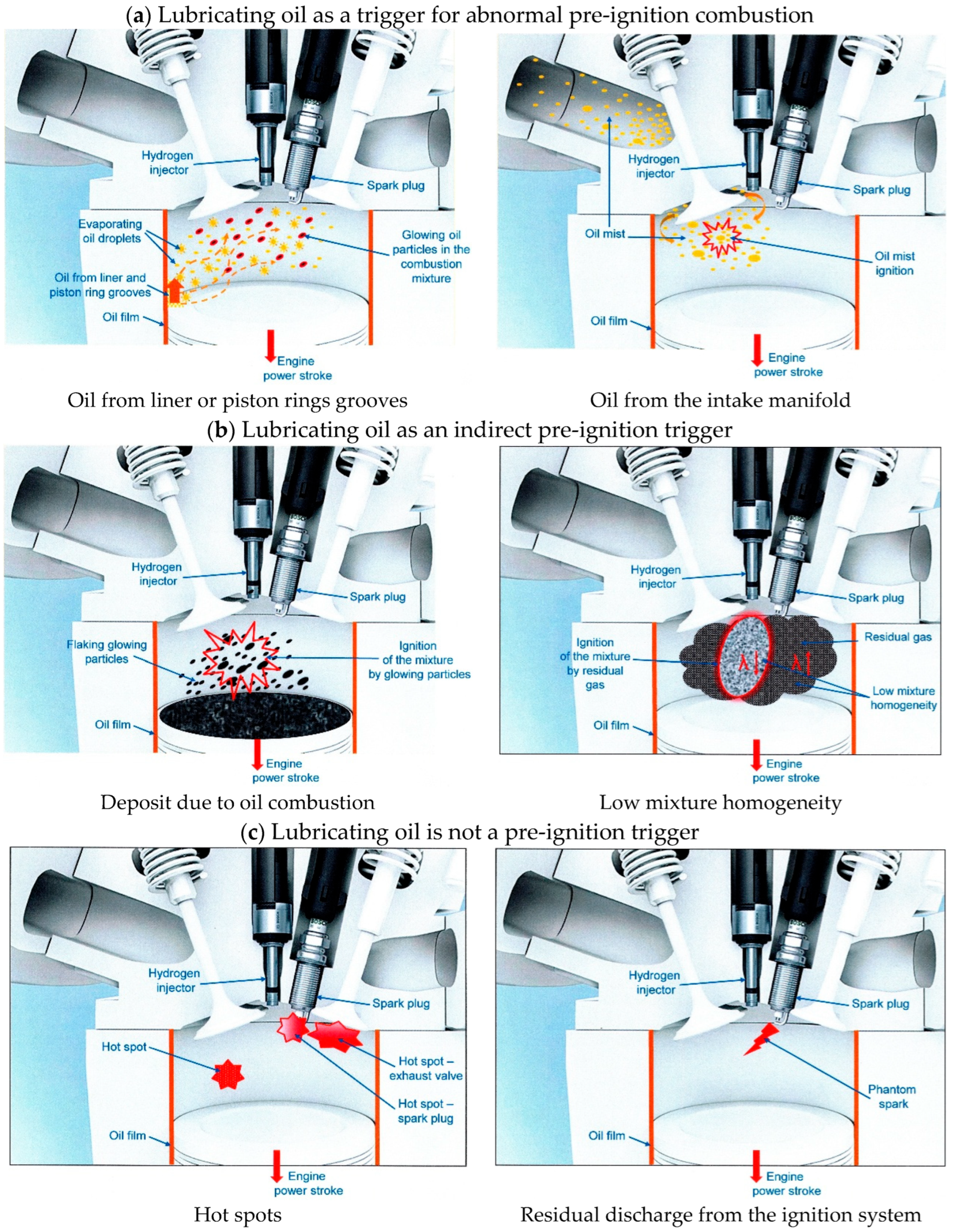
Combustion anomalies in H2ICE include phenomena such as backfire, pre-ignition and engine knock [56]. The risk of backfire primarily applies to PFI-H2ICE. In this case, the flammable H2/air mixture in the intake port can be ignited by factors such as hot gases or hot spots in the combustion chamber during intake valve opening. If premature combustion occurs after the intake valves close, we are dealing with pre-ignition or knocking combustion, depending on the timing of the premature combustion in relation to the ignition timing [57,58,59]. Flame return, pre-ignition and knocking are interrelated phenomena [57,60,61,62]. Figure 1 presents the causes and factors of pre-ignition [22,60,63,64].
In hydrogen engines, pre-ignition is an undesirable phenomenon, an abnormal combustion that must be prevented. In this case, during the engine’s compression stroke, pre-ignition occurs in the combustion chamber, which begins before the planned ignition timing initiated by the ignition system. Pre-ignition causes increased surface temperatures in the engine cylinder, increased heat dissipation, acoustic oscillations, rapid pressure increases, and a faster rate of chemical heat release [22,63,64]. Secondary effects can accelerate the combustion process, which, if uncontrolled, can lead to thermal runaway and engine damage. The pre-ignition limit causes difficulties in operating H2ICEs under near-stoichiometric conditions. Further, deeper understanding and control of pre-ignition phenomena in practical applications is necessary. Understanding the mechanisms of pre-ignition, establishing operating limits, and developing control strategies are key areas of ongoing research aimed at improving H2ICE performance and reliability [2]. In the case of backfires, challenges arise due to flashback, which is the uncontrolled combustion of the fresh hydrogen–air mixture during the intake stroke. Preventive techniques include:
  • Combustion chamber filling strategy involves injecting clean air into the chamber and then drawing in the fuel–air mixture to remove/neutralize any hotspots.
  • Controlling and regulating the residual hydrogen concentration in the intake ports to minimize the risk of flashback.
  • Optimizing fuel injection and mixture formation by combining and optimizing variable valve timing for the intake and exhaust valves [2].
Knocking combustion is the phenomenon of self-ignition of the fuel–air mixture ahead of the flame front. Knocking results in abnormally high cylinder pressure and temperature, increased heat transfer through the cylinder walls, and reduced engine efficiency. When seeking methods to prevent knock, variables such as engine compression ratio, ignition timing, and optimization of hydrogen–air dilution should be considered [2,12].
Currently, three main hydrogen fuel injection systems are being developed and are available on the market: port fuel injection (PFI), low-pressure direct injection (LPDI), and high-pressure direct injection (HPDI). The hydrogen injection system, along with the ignition method and the organization of the mixture formation process, determine the combustion strategy—Table 3.

5. Changes to the Design of the Hydrogen-Powered Engine

The biggest challenge in achieving maximum H2ICE efficiency, comparable to diesel engines, is preventing uncontrolled combustion phenomena (pre-ignition, knock), given the low ignition energy of hydrogen. Homogeneity of the fuel–air mixture, turbulence that increases mixing and flame speed, and avoiding hot spots in the combustion chamber are crucial for achieving higher power density. Achieving these goals requires appropriate cylinder head and intake port design. The design and operating parameters of the supercharging system, a dedicated ignition system, and the composition of the engine lubricating oil are also important [23,66]. The intensity and direction of flammable mixture movement in H2ICE are influenced by three variables: intake port design, piston shape, and injector position. When adapting an existing engine (e.g., a CI engine), the scope for optimizing these three parameters is limited. Where it is not possible to design a dedicated swirl-oriented intake duct, a sufficient level of air–fuel dose motion intensity can be achieved by using shrouds (small plates with an asymmetric cross-section placed over the intake port ring). These mask a specific area of the intake duct, directing the incoming air to the cylinder head and creating swirl-based motion of the mixture [23]. However, these shrouds result in a decrease in volumetric efficiency for the target swirl level compared to a swirl-oriented intake port design. Thanks to its wide flammability range and high combustion rate, hydrogen is an attractive fuel, particularly for lean mixtures [40,67,68]. The results of studies conducted to date have shown that lean hydrogen mixtures are less prone to self-ignition of tail gases than hydrocarbon fuels [7]. This allows the use of a piston with a higher compression ratio, which enables higher thermal efficiency to be achieved [69,70]. Proper material selection and cooling methods are key factors influencing temperature distribution in the piston crown. This significantly impacts the formation of hot spots, which can potentially cause pre-ignition. By changing the piston material from steel to aluminum with additional bottom cooling, hot spot areas can be reduced. This, in turn, reduces the risk of pre-ignition due to higher thermal con-ductivity and shorter distances between cooling channels [25,57,58]. Further research is also required into the degradation of piston material caused by the long-term effects of a hydrogen environment on aluminium and its alloys [59]. As aluminium pistons are characterised by greater heat loss than steel pistons, this may result in a reduction in the engine’s thermal efficiency [71]. In order to minimise losses associated with blow-by into the crankcase, it is necessary to reduce friction losses through controlled oil consumption and to limit the release of trapped hydrogen, which is typically associated with high peak pressures and thermal loads; furthermore, the piston ring set must be optimized. This applies primarily to the correct design of the rings, the piston grooves, the clearance between the top ring and the piston, and the clearance between the piston skirt and the cylinder wall. Coatings can also be applied to oil rings. In standard diesel engines, hard ion-plated coatings and chrome–ceramic coatings (CKS) are most commonly used to improve safety with regard to combustion residues [6]. A low degree of combustion mixture movement (i.e., swirl coefficient) can result in reduced mixture homogeneity. This can result in reduced combustion speed and increased NOx emissions. This can also lead to an increased incidence of pre-ignition and knocking combustion [6,72]. To increase flame propagation velocity and heat release rate, it is necessary to increase the fuel mixture turbulence [73,74]. Especially under lean combustion conditions, the mixture dose turbulence must be intensified to achieve good mixture homogeneity and heat release rate while maintaining acceptable flow efficiency. Given the low lubricity of hydrogen valves and valve seat inserts can be made from cast steel with a hard surface coating [6]. Another problem is the optimization of the spark plug and hydrogen injector (in the case of direct injection) arrangement in the engine cylinder head depending on the shape and type of combustion chamber [6]. To address this issue a pre-chamber [75,76,77], a multi-spark plug configuration [6,78], or a pent-roof fire deck can be used. Such a solution has the potential to generate a better quality fuel–air mixture in either a centrally or side-chamber injector configuration [78,79]. The properties of hydrogen as a gaseous fuel for H2ICE pose several challenges related to the design and operation of the injectors, the most important of which include:
  • Due to the low energy density of hydrogen (i.e., 0.08 kg/m3 compared to 692 kg/m3 for isooctane at 300 K and 1 atm [67]), the injectors must be sized to provide a large flow volume under supersonic flow conditions. This is a prerequisite for the engine to achieve the required high power output.
  • The low density of hydrogen and its high volumetric flow rates result in a need for larger injectors [80], which can pose challenges in terms of their location and installation in the cylinder head.
  • Hydrogen has very low lubricity and viscosity. This can lead to accelerated wear and reduce the service life of the injectors [81,82].
  • The injector needle opening and closing process must be smooth to reduce the high impact velocities of the needle’s conical tip against the seat and the associated resonance effects [78].
  • The phenomenon of hydrogen embrittlement makes the selection of materials from which injectors and other engine components are made of very important (austenitic and ferritic steels are preferred over martensitic steels) [83,84].
A very important design parameter of hydrogen injectors is the needle opening direction, i.e., whether the needle opens inward or outward. Recently, outward-opening injectors have attracted considerable interest in practical applications for H2ICE [85,86,87,88,89,90]. Compared to inward-opening injectors, outward-opening injectors have a larger nozzle cross-section. This helps to increase the hydrogen flow rate and improve sealing and damping properties [87,90,91], which may facilitate the preparation of a stratified mixture near TDC [92,93,94,95,96,97].
The high autoignition temperature of hydrogen (i.e., ~853 K compared to ~523 K for diesel fuel [38]) makes autoignition of hydrogen in a compression ignition engine difficult to achieve without the use of an additional ignition source [98]. At the same time, hydrogen has low ignition energy [99], which creates the risk of abnormal combustion. To prevent the spark plug from exceeding the fuel’s auto-ignition temperature, high-temperature range or low-flash-point spark plugs [100] are required. Furthermore, platinum spark plug electrodes can act as a catalyst between the hydrogen and oxygen reactions and should therefore be avoided. Nickel electrodes, on the other hand, are prone to a high rate of erosion [101,102]. Therefore, it is recommended to use spark plugs with iridium electrodes because they have high erosion resistance [103]. Finally, when it comes to spark plug design, the volume of the spark plug pocket should be as small as possible. This is necessary to minimize the amount of high-temperature residual gases trapped in the pocket [103]. It is also important to note that the low electrical conductivity of H2 compared to hydrocarbon mixtures requires that no residual charge remains in the ignition coils after ignition, as this can lead to pre-ignition [104,105,106,107].
Lean combustion at high engine loads may require an increase in boost pressure in an H2ICE engine. This increase in boost pressure can be as much as 1.8 times that of a gasoline or diesel engine of comparable power [6,78]. This is mainly caused by the high stoichiometric air–fuel ratio in the H2ICE engine.
This poses a significant challenge for the turbocharging system, especially in the low torque and maximum power output engine ranges. A single-stage turbocharging system, which is an optimized combination of a highly efficient compressor and a variable geometry turbine (VGT), is unable to provide the required air mass flow. This is due to the rapid increase in compressor pressure and limited exhaust gas enthalpy during lean combustion [6,78,108]. Consequently, high power output can be achieved using multistage VGT systems, but with increased exhaust gas backpressure, which can be reduced by electrifying the VGT system [78,108]. With increased boost pressure, the temperature at the compressor outlet can reach up to 250 °C. This can cause damage to the compressor material [6,78]. High water vapor content in the exhaust gas increases the risk of turbine housing corrosion occurring. Therefore, the design and materials selection for a turbocharging system must be carefully considered. In such cases, alternative materials such as titanium are often used [42,108,109,110,111].
Due to the small size of hydrogen molecules, H2ICEs are characterized by significant blow-by, which makes it possible for a large amount of hydrogen to enter the crankcase [112]. To counteract this, active crankcase ventilation (CCV) is required to maintain the total unburned hydrogen concentration in the crankcase below the lower explosive limit (i.e., 4% V/V in air). Alternatively, the blow-by can be diluted to a low hydrogen concentration by providing an additional air intake in the crankcase [112]. Another challenge is the destructive effect hydrogen is known to have on materials. The two main mechanisms of hydrogen destructive effect on H2ICE materials are hydrogen embrittlement (HE) and high-temperature hydrogen attack (HTHA). HE is formed by the diffusion of hydrogen gas through the metal surface, forming atomic hydrogen inside the alloy (typically at temperatures below 150 °C). This causes a reduction in the ductility of the metal and an increase in the propagation of fatigue cracks [6]. HE occurs either due to metal corrosion or due to another chemical reaction during metal processing. It is formed as a result of metal corrosion or another chemical reaction occurring during metalworking. Importantly, hydrogen diffusion into the material occurs faster than its molecular reaction [6,112]. Compared to austenitic steel, ferritic and martensitic steels are more susceptible to HE because temperature and pressure levels have a major influence on hydrogen diffusion and escape [78]. In the case of HTHA, the degree of damage increases when the steel is subjected to higher temperatures, i.e., above 200 °C. High-carbon steel is more susceptible to HTHA than low-carbon steel. Engine components such as the intake manifold and throttle body are exposed to hydrogen at low temperature and are more susceptible to HE. Combustion chamber components including the injector, cylinder head, valves/valve seat, piston/piston rings, liner and exhaust manifold are typically more susceptible to HTHA [59,112].

6. Lubricating Oil for H2ICE

Combustion produces 2.8 times more water condensate by weight than the combustion of petrol in a rotary engine [103]. Water vapor can enter the crankcase, where it accumulates in the engine oil, which can cause:
  • Oil emulsification: Water mixes with the engine oil, creating a milky, unstable emulsion that impedes oil flow [4].
  • Corrosion: The presence of water on engine components leads to rusting and pitting of metal surfaces [17].
  • Freezing hazard: In colder climates, water-saturated lubricants can freeze, preventing proper lubrication during engine start-up [17].
Tests have shown that water accumulation in H2ICE can reach up to 2% of the lubricating oil volume, which is significantly greater than in conventional engines [17]. To counteract this, new lubricant formulations incorporate additives that support water separation (demulsification) or enable its safe dispersion in the form of small droplets, ensuring continuous lubrication. Furthermore, emulsion stabilizers and anticorrosion additives are essential components of these formulations [17]. Therefore, lubricating oil for H2ICE must have high resistance to emulsification [67,78]. In addition to emulsification, lubricating oil must also be tested for the effects of atomic hydrogen [6]. The results of studies conducted so far have confirmed that the lubrication quality of engine oil and the viscosity index deteriorated with reduced concentrations of thiophosphates (ZDDP) and esters in the presence of hydrogen [112]. Furthermore, in order for H2ICEs to fully utilize their potential, the use of additives is essential to improve the performance of lubricating oils under extreme conditions. Detergents and dispersants, although less important due to cleaner hydrogen combustion, also require careful optimization in H2ICEDs [16].
Developing lubricants specifically tailored for H2ICE is crucial for optimizing performance. The lubricants must be adapted to higher combustion temperatures, increased water production during combustion, and the risk of pre-ignition, while also providing excellent wear protection, anti-corrosion properties, as well as high thermal stability. Recent H2ICE lubricant formulations seem to focus on complex multifunctional additive packages that address multiple issues simultaneously. These packages are designed to reduce the risk of pre-ignition, prevent water-induced corrosion, and maintain oil pumpability at low temperatures [17,113,114]. Furthermore, the presence of excess hydrogen and high combustion chamber pressure leads to significantly higher partial pressure of oxygen in the combustion chamber This can accelerate oil oxidation, especially at high temperatures. This may require the use of highly effective antioxidant additives to protect the engine oil [115]. Due to the low minimum ignition energy, hydrogen-fueled engines are highly susceptible to pre-ignition—significantly more so than engines fueled by hydrocarbon fuels. Since the resistance to pre-ignition depends on the oil composition and, in particular, on the quality of the base oil and the additive package, this should be considered as early as at the stage of formulating the lubricating oil composition [113,114,115]. Additional difficulties in developing lubricating oils suitable for H2ICE result from the need to ensure the chemical compatibility of the lubricating oil with hydrogen to prevent degradation and exhaustion of the additive potential [115].

7. H2ICE Exhaust Emissions

Water is the main by-product of hydrogen combustion, with approximately 8.9 kg of water produced for every kilogram of hydrogen burned [69,116]. Therefore, a significant challenge is managing the relatively large amounts of water vapor using solutions that include controlling the mixture temperature with limited EGR rates [116]. Water from the exhaust system can be used to inject water into the intake port [12] or into a heat exchanger such as an intercooler or engine radiator.
The exhaust emissions from H2ICE consist mainly of NOx. Hydrocarbons (HC), carbon monoxide (CO), and particulate matter (PM) are present at very low levels and originate from the combustion of the lubricating oil. The lubricating oil comes from the cylinder liner and turbocharger [117,118]. The amount of oil incorporated into the combustion process depends on the engine wear rate, which naturally increases with engine operation. The mixture quality, engine load, combustion duration, and boost level influence the NOx emission characteristics, especially in regions with high excess air ratios. Nearly NOx-free combustion can be achieved with an excess air ratio (λ) of 2.0 to 2.8, depending on the given limits. NOx emissions from H2ICE in the case of homogeneous combustion depend on the excess air ratio (λ). Maximum NOx emissions are achieved at λ = 1.2. As the leaner mixture is used, the NOx emission concentration decreases and is exceptionally low starting from λ = 2.4 and further towards increasingly leaner mixtures [44,119]. Although it is possible to operate hydrogen engines with very lean mixtures, which eliminates the need for an exhaust gas aftertreatment system, maintaining a lean mixture even at medium engine load requires the use of high boost pressure. This is difficult due to the low enthalpy of the turbocharger exhaust gases, especially during transient engine operating states [44]. Therefore, H2ICE with an exhaust gas aftertreatment system is a better solution when high power density is required. This provides the best compromise between engine efficiency, exhaust emissions, performance, and cost. In lean combustion, the oxidation catalyst performs four functions: it converts unburned fuel (i.e., hydrogen), oxidizes NO to NO2 (in the case of SCR), heats downstream components of the exhaust gas aftertreatment system using the heat of the exothermic reaction, and converts residual CO and HC [44].
Conventional aftertreatment systems from spark-ignition or compression-ignition engines can be adapted to remove NOx from exhaust gases (DeNOx) in hydrogen engines. These systems include a three-way catalytic converter (TWC) for operation under stoichiometric conditions (in the case of spark-ignition engines) [120], or a NOx storage catalyst (NSC) [121], urea-based selective catalytic reduction (urea-SCR), and H2-SCR catalysts [122,123] which are suitable for lean-burn operation in compression-ignition engines. Under stoichiometric combustion conditions, SCR and NSC are unsuitable due to the lack of sufficient HC and CO as reducing agents. Therefore, TWC is used for the combustion of stoichiometric mixtures. In this case, however, there is a challenge associated with the transitions between stoichiometric and lean combustion modes, as the TWC conversion efficiency rapidly and significantly decreases under lean combustion conditions [58]. Therefore, the development of a new material with hydrogen as a reductant is necessary, which poses some challenges [124,125]. During engine operation in transient states, dynamic NOx emissions are generated, which no EATS (Exhaust Aftertreatment Systems) is currently designed to mitigate. Furthermore, a reduced exhaust gas temperature, below the DeNOx cut-off temperature, caused by a significant mixture leaning or during the cold start phase, can lead to EATS failure [126]. One possible solution to this problem could be to combine a urea SCR system with an H2 SCR system supported by Pt and Pd catalysts. Such a system has demonstrated high conversion efficiency, reaching 95% at temperatures around 150 °C [127,128,129]. However, further research is needed on catalyst materials suitable for this temperature range. Another EATS solution investigated is the combination of Three-way NOx Storage Catalysts (TWNSC), which have an increased NOx storage capacity, and SCR. This system can be used in both stoichiometric and lean-burn modes [58,126]. For higher temperature ranges, a combination of TWC and urea SCR can be used, where the urea SCR can be passively fueled by the secondary ammonia (NH3) emissions generated by the TWC. This eliminates the need for an additional urea tank.
In turn, the characteristics of particulate matter emissions from H2DI engines may be strongly dependent on the design of the combustion and injection systems. This applies in particular to the interaction between the hydrogen jets and the oil layer, taking into account the short extinguishing distance of the hydrogen flame.
Although particulate emissions are several orders of magnitude lower for H2ICE engines than for conventional spark-ignition or compression-ignition engines [83,130], the use of a particulate filter may nevertheless be necessary to ensure compliance with future emission limits (e.g., EU-7 and EPA 27). Furthermore, in addition to NOx, HC, CO and PM emissions, methane and nitrous oxide (N2O) may also be formed, mainly due to operation of the catalytic converters [131]. Due to the low HC concentration in exhaust gas, methane emissions should be negligible. However, nitrous oxide can be formed either by NOx oxidation from a lean-burn DeNOx system or by NOx reduction from an SCR catalytic converter [95].

8. Hydrogen as a Fuel Additive

It can be noted that the use of hydrogen as a pure fuel for internal combustion engines still requires overcoming numerous problems and solving many challenges [1]. However, the use of hydrogen as an admixture to hydrocarbon fuels, including liquid and gaseous fuels, has the potential to bring significant benefits. Due to the lack of structural carbon, hydrogen used as an admixture can reduce HC and CO emissions from engines powered by conventional hydrocarbon fuels [52,53]. Hydrogen admixtures are most commonly used in diesel fuel and biodiesel. The addition of hydrogen to diesel fuel can significantly increase the thermal efficiency of diesel engines [132,133,134,135]. Hydrogen admixtures can significantly improve the combustion process and its quality due to higher temperatures and higher flame propagation speeds than pure diesel fuel [132,136,137,138,139]. Furthermore, hydrogen can improve clean diesel combustion due to wider flammability limits compared to hydrocarbon fuels, thereby improving the Brake Thermal Efficiency (BTE) of diesel engines [140]. Blending hydrogen into diesel fuel can shift the upper heat release limit closer to the injection time (TDC), leading to improved efficiency in compression ignition engines [140]. Although hydrogen has a higher energy content per unit weight than diesel fuel, other factors such as the air–fuel ratio and engine design features can also have a major impact on improving its thermal efficiency (BTE). Moreover, the high calorific value of hydrogen can positively influence the BTE of diesel engines. This is possible by accelerating the combustion process of the hydrogen and diesel fuel mixture, and consequently increasing the engine efficiency [139,141,142]. A higher calorific value does not always translate to complete combustion. This is also influenced by the amount of excess air and the quality of the fuel–air mixing in the combustion chamber. The admixture of hydrogen to diesel fuel can facilitate the homogenization of the fuel–air mixture [136,141,143], leading to a rapid release of energy and more complete combustion [144]. Although some studies have shown that blending hydrogen into diesel fuel can increase combustion efficiency, other studies indicate that combustion efficiency may be reduced [145,146]. In summary, the differences in the results of studies conducted so far prove that adding hydrogen to diesel fuel at different engine loads may cause different changes in the performance of compression-ignition engines [147,148].
Fueling a compression ignition engine with biodiesel reduces the thermal efficiency of diesel engines. This is due to the lower calorific value, higher viscosity, lower volatility and higher density of biodiesel [136]. Adding hydrogen to biodiesel can synergistically increase combustion efficiency. This leads to improved BTE due to the high energy release rate from hydrogen and high oxygen content [136,149,150,151].
The BTE of biodiesel-fueled engines can also be increased by utilizing the higher energy content of hydrogen and its better miscibility with air [151], as well as its higher diffusivity and shorter extinction path.
The challenge is excessive hydrogen induction, which can cause too rapid combustion due to the increased number of ignition points, as hydrogen has a shorter ignition delay time compared to other fuels. The additional ignition sources created in this way can initiate an uncontrolled combustion process in various places in the combustion chamber. This will accelerate the combustion process. As a result, it may lead to a reduction in the engine BTE due to incomplete combustion or excessive heat loss [136,152]. Similarly to the case of the addition of hydrogen to diesel fuel, the addition of hydrogen to biodiesel can have varying effects on BTE depending on the engine load conditions [153].
Various studies have shown that adding hydrogen to the air in compression ignition engines reduces brake-specific fuel consumption (BSFC) [133,154]. This is due to the high diffusivity of hydrogen, which enables the creation of a well-homogenized mixture with the intake air. Furthermore, the higher flame speed and heating value of hydrogen compared to hydrocarbon fuels can intensify the combustion of the injected fuel and increase brake power while reducing BSFC [141,144,155,156]. However, increasing the hydrogen injection rate beyond a certain level can reduce fuel efficiency. In such cases, the oxygen-poor environment can slow down the oxidation of hydrogen and hydrocarbons. This leads to incomplete combustion and increased fuel consumption (BSFC) [136,155].
Hydrogen as an admixture to diesel fuel or other hydrocarbon fuels can have a significant impact on the combustion process parameters. Hydrogen admixture to diesel fuel can promote diesel fuel combustion due to its excellent air-mixing properties [144]. Furthermore, it can delay the ignition of the fuel dose, leading to a violent or even explosive combustion process [157]. The high flammability and high combustion rate of hydrogen may also contribute to an increase in the cylinder pressure [137,158,159]. Hydrogen admixture can significantly prolong the combustion phase of the premix. As a result, less of the supplied fuel can be burned in the diffusion phase. Most of the fuel supplied that burns during the pre-combustion phase may cause an increase in cylinder pressure [160]. Hydrogen admixture to biodiesel has a similar effect on the cylinder pressure [161,162,163,164]. However, as found throughout these experiments, not under all engine load conditions will the addition of hydrogen to biodiesel result in an increase in cylinder pressure [136,153]. THydrogen admixture can cause reduced cylinder pressure in biodiesel engines at low loads. This is due to a very lean air–hydrogen mixture [153]. Various studies have shown that a diesel engine can be driven by heat transfer during the mixed-combustion phase [136,139]. The high velocity of the hydrogen flame can also increase the rate of heat release during the premixed combustion stage [133,165,166]. HHowever, larger doses of hydrogen can greatly increase the peak heat release rate, which can lead to abnormal combustion knock such as flash-over [167]. Adding hydrogen can increase the ignition delay in biodiesel engines, providing enough time for the biodiesel to evaporate. This will increase the heat release rate during combustion [163,168]. Moreover, the addition of hydrogen to biodiesel can increase the heat release rate in biodiesel-fueled engines due to the increased combustion rate, high flame propagation velocity and high calorific value of the gaseous fuel [162,164,169,170]. However, low hydrogen combustion efficiency at low engine loads can also reduce the rate of heat release in biodiesel-powered engines [153].
In general, hydrogen admixture increases the ignition delay in compression ignition engines [144,171]. This is due to the lower cetane number and higher auto-ignition temperature of hydrogen compared to diesel fuel [172]. Furthermore, the amount of diesel fuel injected is insufficient to completely burn all the hydrogen supplied to the combustion chamber. The formation of a lean fuel–air mixture prolongs the combustion phase of the preliminary mixture, delays heat release and extends the ignition delay period [173,174]. However, adding more hydrogen to diesel fuel may shorten the ignition delay time due to an increase in cylinder gas temperature resulting from hydrogen combustion [175]. Various studies have shown that adding hydrogen to biodiesel can adversely affect the ignition delay time. This is due to the higher autoignition temperature of hydrogen compared to fuels such as biodiesel [136,163,176]. Adding hydrogen to biodiesel can reduce the oxygen concentration in the fuel mixture. This can lead to increased ignition delay [136]. Ignition delay in dual-fuel engines running on biodiesel blended with hydrogen may be greater at lower engine loads than at higher engine loads. Oxygen deficiency resulting from hydrogen substitution in the air at lower engine loads can cause an extended ignition delay.
The results of numerous studies [139,177] have shown that adding hydrogen to diesel fuel can shorten combustion time due to the high combustion speed of hydrogen [177,178], while at the same time accelerating the process of mixing air with fuel [136]. Furthermore, the addition of hydrogen to diesel fuel can significantly increase the peak heat release rate, shortening the combustion duration [179]. However, a shorter combustion duration may lead to more severe combustion knock [180].
Regarding the effect of hydrogen admixture in hydrocarbon fuel on the emission of harmful exhaust components, it has been found that adding hydrogen to diesel fuel may increase CO emissions. This is because adding hydrogen can reduce the oxygen concentration in the air–hydrogen mixture, leading to increased CO emissions [136]. Furthermore, adding more hydrogen to diesel fuel can increase the in-cylinder temperature, dissociating CO2 into CO and O. Furthermore, the high reaction rate of hydrogen can lead to depletion of the oxygen available in the combustion chamber, preventing further oxidation of CO [181]. Water produced by the hydrogen oxidation reaction can react with diesel hydrocarbons (steam reforming) resulting in increased CO emissions [181]. Adding hydrogen to diesel fuel can increase the rate of CO production, especially at higher engine loads. This is due to a significant reduction in oxygen concentration and a shorter reaction time [136]. However, adding hydrogen to diesel fuel at lower engine loads can reduce CO emissions thanks to the sufficient amount of oxygen present in leaner fuel–air mixtures [136]. When hydrogen is added to biodiesel, CO emissions are reduced [153,161,162]. This reduction is significantly influenced by the oxygen content of the fuel. Furthermore, adding hydrogen to biodiesel can further reduce CO2 emissions by reducing the amount of carbon introduced into the combustion chamber [136]. The high rate of hydrogen combustion and rapid flame propagation can increase the temperature in the cylinder, especially at the end of the combustion cycle, resulting in accelerated and more complete combustion [169]. Furthermore, hydrogen can catalyze the oxidation of CO (a reaction called the “wet mechanism” of CO oxidation) [182]. The addition of hydrogen can reduce the number of super-rich zones due to the reduced amount of biodiesel injected, which can lower CO emissions [136].
Adding hydrogen to diesel fuel can reduce CO2 emissions due to its carbon-free structure [139,166,171]. Furthermore, the overall H/C ratio of the fuel mixture can be increased by adding hydrogen. This shortens the combustion time and improves combustion efficiency [137,183]. Furthermore, the high flame propagation speed of hydrogen can increase the combustion efficiency of the fuel mixture and consequently reduce CO2 emissions [137].
In biodiesel-fueled engines, hydrogen blending can reduce CO2 emissions due to hydrogen not containing any carbon [172]. Generally, adding hydrogen can increase the H/C ratio of the fuel supplied, thereby reducing CO2 emissions [153,184].
Adding hydrogen to diesel fuel can reduce HC emissions in compression-ignition engines. This is due not only to the lack of carbon in hydrogen fuel but also to hydrogen’s wide flammability range and short extinguishment path. This can improve the combustion of the fuel–air mixture [181,185]. Moreover, the high combustion rate of hydrogen can accelerate diesel combustion, reducing HC emissions. Furthermore, the addition of hydrogen can raise the in-cylinder temperature, promoting post-flame HC oxidation [141]. Furthermore, adding hydrogen to the intake air can extend the ignition delay, allowing for better mixing of air and fuel prior to ignition [157]. Hydrogen can also help to ensure a uniform fuel–air mixture thanks to its high diffusivity in air, thereby increasing combustion efficiency while reducing hydrocarbon emissions [133]. However, some studies indicate that adding hydrogen to diesel fuel may increase hydrocarbon emissions [137,177]. This increase in HC emissions may be due to inadequate pilot fuel injection resulting in poor ignition of the gaseous fuel. Hydrogen admixture can reduce the oxygen concentration in the fuel–air mixture, which will result in incomplete combustion of diesel fuel, but at the same time increase HC emissions [166]. Furthermore, depletion of most of the oxygen supplied to the combustion chamber due to the rapid combustion of hydrogen can result in incomplete combustion of the diesel fuel injected into the combustion chamber at the end of the injection period. Increased HC emissions may also be caused by flame extinction due to the high hydrogen combustion coefficient [136] and longer ignition times in lean mixture conditions. This is a result of hydrogen addition, which can lead to incomplete combustion [179]. Nevertheless, most studies have shown that adding hydrogen to biodiesel results in reduced HC emissions [162,186]. The high flammability limit, high combustion rate and high calorific value of hydrogen can significantly help in the complete combustion of injected biodiesel and, at the same time, in reducing UHC emissions [186]. The high speed of hydrogen flame propagation can promote homogenization of the fuel–air mixture and improve the combustion process. Furthermore, hydrogen combustion can increase the in-cylinder temperatures, leading to more complete oxidation of HC to CO2 [163]. However, blending hydrogen into biodiesel can increase HC emissions at lower engine load levels [153].
The results of studies conducted so far have shown that adding hydrogen to diesel fuel may increase NOx emissions [137,173]. This is due, among others, to the high calorific value of hydrogen, which can increase the peak pressure and temperature of the combustion mixture in the cylinder and consequently increase NOx emissions [183]. In turn, the high flame propagation rate of hydrogen can promote complete combustion by raising the pressure and temperature in the cylinder [160]. Furthermore, the addition of hydrogen can increase local temperatures in the early stage of expansion, accelerating NOx production. Hydrogen blending with diesel fuel extends the ignition delay, which facilitates better mixing of the fuel–air mixture before ignition, raising the cylinder temperature and inevitably increasing NOx emissions [157,187]. In the case of lean combustion, hydrogen blending with diesel fuel can reduce NOx emissions. Hydrogen admixture can contribute to homogenizing the fuel–air mixture and eliminating fuel-rich zones. Furthermore, extending combustion time at higher hydrogen contents can reduce the heat release rate, which can reduce NOx emissions [146,185].
Using biodiesel to fuel an engine results in high NOx emissions, which can be further increased by blending hydrogen with biodiesel [153,162]. The much higher calorific value of hydrogen compared to biodiesel can cause a significant increase in engine cylinder temperature as well as pressure and therefore increase NOx emissions [170]. Furthermore, blending hydrogen with biodiesel can extend the ignition delay and consequently enhance the pre-combustion phase [136], which can increase the temperature in the cylinder, resulting in the formation of more NOx [163]. Higher flame and exhaust temperatures, high flame spread speed and rapid hydrogen combustion are important factors that can contribute to higher NOx emissions in biodiesel engines. However, similar to adding hydrogen to diesel fuel, adding hydrogen to biodiesel can also reduce NOx formation at lower engine loads [161,188]. This is due to the low gas temperature in the cylinder and the imperfect combustion process at lower engine loads.
Adding hydrogen to diesel fuel can increase flame temperature and intensify hydrocarbon combustion, reducing particulate matter (PM) formation. Furthermore, adding hydrogen to diesel fuel can reduce PM size and its numerical concentration [179]. Hydrogen blending can also reduce particulate matter emissions from biodiesel-powered engines by reducing the carbon content of the fuel–air mixture [153,188,189]. Furthermore, adding hydrogen to biodiesel can reduce particulate matter emissions due to the oxygen contained in biodiesel and the high hydrogen combustion rate [149].
Table 4 compares the effect of increasing hydrogen blending to various fuels on the combustion characteristics and emission levels of an engine powered by these fuels.

9. Conclusions

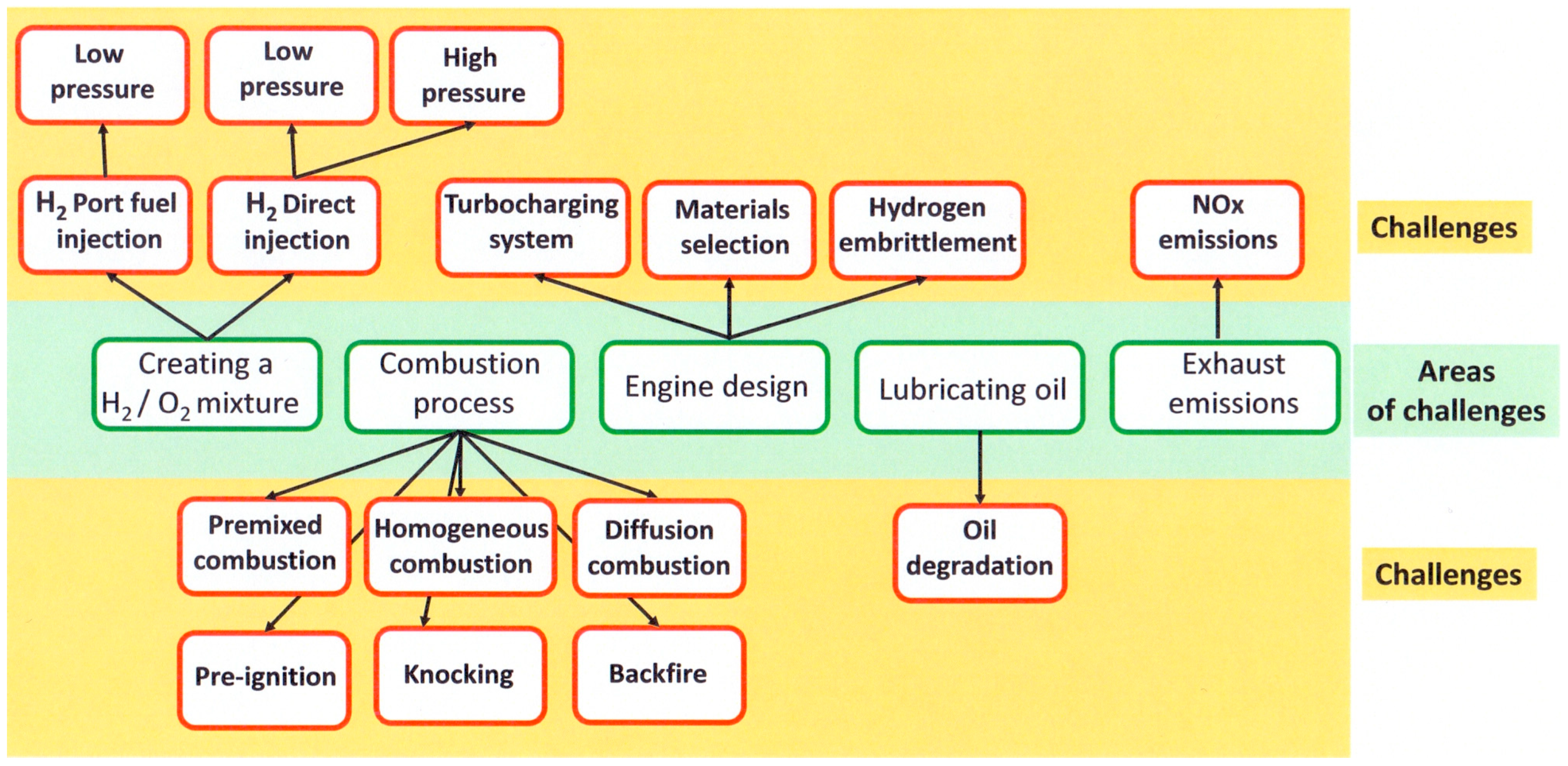
The full utilization of hydrogen as a carbon-free, environmentally friendly fuel for piston combustion engines still requires resolving multiple challenges. Hydrogen’s unique properties, such as flammability, low ignition energy, and water vapor combustion products, pose significant challenges to engine performance and lubrication, and therefore, engine durability. Hydrogen combustion creates entirely new conditions that impact engine wear, corrosion, and lubrication efficiency that conventional engines are not designed to handle. Technical challenges such as pre-ignition, water-induced corrosion, and hydrogen embrittlement still require further, comprehensive research. The occurrence of abnormal combustion processes of hydrogen fuel in engines poses a significant challenge. Therefore, further in-depth studies of the hydrogen combustion mechanism and the introduction of new, targeted strategies for controlling the combustion process are necessary. Further research is also necessary on engine operation under transient conditions, particularly during engine start-up. Further development of hydrogen-compatible lubricants is also crucial. Emissions from hydrogen-powered engines can be reduced to negligible levels using standard exhaust aftertreatment systems. Since CO2 is completely absent from exhaust gases produced in such combustion, the hydrogen engine can be described as a drive system with zero or near-zero environmental impact. Reducing the high NOx emissions, however, poses a more pronounced challenge. Therefore, further research into low-temperature combustion and lean-burn combustion technology is necessary. Figure 2 shows the areas of challenges and the challenges themselves that must be overcome to enable the further development of H2ICE.
The results of studies conducted to date on the effect of hydrogen admixture to various fuels on the combustion process and emissions of harmful components, especially in compression-ignition engines, have demonstrated benefits in terms of combustion efficiency and reduced emissions, apart from NOx. Generally, hydrogen admixture increases BTE and exhaust gas temperature, while simultaneously reducing BSFC and volumetric efficiency. Furthermore, compared to pure diesel fuel, the in-cylinder temperature of a dual-fuel engine fueled with hydrogen-admixed diesel fuel increases while the combustion duration is shortened. Hydrogen admixture can improve exhaust emission characteristics, apart from NOx emissions. Combustion knock easily develops when higher amounts of hydrogen are added, which poses a challenge. The research findings to date indicate a possible solution to this problem by optimizing EGR and CR, but this requires further research, including reducing abnormal combustion processes and optimizing hydrogen–air mixing in the cylinder.
Overall, further development of H2ICEs requires finding a balance between efficiency, power, and durability. This requires optimizing the mixture formation processes, including the fuel injection system, airflow, turbocharging, exhaust gas recirculation, and consequently, mixture preparation and homogenization, as well as the exhaust aftertreatment system.

Funding

This research received no external funding.

Data Availability Statement

No new data were created or analyzed in this study. Data sharing is not applicable to this article.

Conflicts of Interest

The author declares no conflicts of interest.

References

  1. Stepien, Z.A. Comprehensive Overview of Hydrogen-Fueled Internal Combustion Engines: Achievements and Future Challenges. Energies 2021, 14, 6504. [Google Scholar] [CrossRef]
  2. Singh, M.; Singla, M.K.; Beryozkina, S.; Gupta, J.; Safaraliev, M. Hydrogen vehicles and hydrogen as a fuel for vehicles: A-State-of-the-Art review. Int. J. Hydrogen Energy 2024, 64, 1001–1010. [Google Scholar] [CrossRef]
  3. Brancaleoni, P.P.; Corti, E.; Ravaglioli, V.; Moro, D.; Silvagni, G. Innovative torque-based control strategy for hydrogen internal combustion engine. Int. J. Hydrogen Energy 2024, 73, 203–220. [Google Scholar] [CrossRef]
  4. Musy, F.; Ortiz, R.; Ortiz, I.; Ortiz, A. Hydrogen-fuelled internal combustion engines: Direct Injection versus Port-Fuel Injection. Int. J. Hydrogen Energy 2025, 137, 925–938. [Google Scholar] [CrossRef]
  5. Karagoz, Y.; Balcı, O.; Koten, H. Investigation of hydrogen usage on combustion characteristics and emissions of a spark ignition engine. Int. J. Hydrogen Energy 2019, 44, 14243–14256. [Google Scholar] [CrossRef]
  6. Goyal, H.; Jones, P.; Bajwa, A.; Parsons, D.; Akehurst, S.; Davy, M.H.; Leach, F.; Esposito, S. Design trends and challenges in hydrogen direct injection (H2DI) internal combustion engines—A review. Int. J. Hydrogen Energy 2024, 86, 1179–1194. [Google Scholar] [CrossRef]
  7. Onorati, A.; Payri, R.; Vaglieco, B.M.; Agarwal, A.K.; Bae, C.; Bruneaux, G.; Canakci, M.; Gavaises, M.; Günthner, M.; Hasse, C.; et al. The role of hydrogen for future internal combustion engines. Int. J. Engine Res. 2022, 23, 529–540. [Google Scholar] [CrossRef]
  8. Algayyim, S.J.M.; Saleh, K.; Wandel, A.P.; Fattah, I.M.R.; Yusaf, T.; Alrazen, H.A. Influence of natural gas and hydrogen properties on internal combustion engine performance, combustion, and emissions: A review. Fuel 2024, 362, 130844. [Google Scholar] [CrossRef]
  9. Shinde, B.J.; Karunamurthy, K. Recent progress in hydrogen fuelled internal combustion engine (H2ICE)—A comprehensive outlook. Mater. Today Proc. 2022, 51, 1568–1579. [Google Scholar] [CrossRef]
  10. Silveira, J.P.; Fagundez, J.L.S.; Garlet, R.A.; Martins, M.E.S.; Salau, N.P.G.; Lanzanova, T.D.M. Hydrogen-fueled PFI SI engine investigation for near-zero NOx emissions in de-throttled and supercharged ultra-lean burn conditions. Int. J. Hydrogen Energy 2024, 91, 800–813. [Google Scholar] [CrossRef]
  11. Ben Houidi, M.; Moreno-Cabezas, K.; Zaihi, A.; Aljohani, B.; Wu, H.; AlRamadan, A.; Cenker, E.; Im, H.G.; Roberts, W.I. Investigating hydrogen direct injection technology: A comparative analysis of nozzle geometries for enhanced mixing in internal combustion engines. Proc. Combust. Inst. 2024, 40, 105631. [Google Scholar] [CrossRef]
  12. Kapus, P.; Raser, B.; Arnberger, A.; Heindl, R.; Egert, M.; Kunder, N.; Fraidl, G.; Weißbäck, M.; Grabner, P. High Efficiency Hydrogen Internal Combustion Engine—Carbon Free Powertrain for Passenger Car Hybrids and Commercial Vehicles. In Proceedings of the 43rd International Vienna Motor Symposium, Vienna, Austria, 27–29 April 2022. [Google Scholar]
  13. Ängeby, J.; Wärnberg, J.; Andersson, Ö.; Richter, M.; Tunestål, P. Developing Hydrogen Fueled SI-ICE for Heavy Duty Applications. In Proceedings of the 46th International Vienna Motor Symposium, Vienna, Austria, 14–16 May 2025. [Google Scholar]
  14. Ängeby, J.; Tidholm, J.; Gustafsson, B.; Johnsson, A. Ignition Systems for SI-ICE Fueled by Alternative and Renewable Fuels. In Proceedings of the ASME 2023 ICE Forward Conference, Pittsburgh, PA, USA, 8–11 October 2023; p. V001T03A005. [Google Scholar] [CrossRef]
  15. Wärnberg, J.; Garnemark, O.; Safari, A.; Ehleskog, R.; Krishnamoorthy, H. An H2 ICE Concept for the Very Heavy (16L) Applications by Volvo Group. In Proceedings of the 44th International Vienna Motor Symposium, Vienna, Austria, 2 May 2023. [Google Scholar]
  16. Rensselar, J.V. Hydrogen-fuelled internal combustion engine technology moves toward commercialization. Tribol. Lubr. Technol. 2024, 80, 42–48. [Google Scholar]
  17. Moore, S. The same but different: The unique lubricant challenges of hydrogen engines. Lubes Greases 2024, 30. [Google Scholar]
  18. Sun, T.; Hong, J.; Zhang, T.; Sun, B.; Yang, B.; Lu, L.; Li, L.; Wu, K. Hydrogen engine operation strategies: Recent progress, industrialization challenges, and perspectives. Int. J. Hydrogen Energy 2023, 48, 366–392. [Google Scholar] [CrossRef]
  19. Zhang, Q.; Song, G.; Wang, X.; Li, M. Effects of injection strategy on the knocking behavior of a pilot ignited direct injection natural gas engine. Fuel 2022, 308, 121920. [Google Scholar] [CrossRef]
  20. Yang, Z.; W, J.; Yun, H.; Zhang, H.; Xu, J. Diagnosis and control of abnormal combustion of hydrogen internal combustion engine based on the hydrogen injection parameters. Int. J. Hydrogen Energy 2022, 47, 15887–15895. [Google Scholar] [CrossRef]
  21. Li, Y.; Gao, W.; Li, Y.; Fu, Z.; Zou, J. Numerical investigation on combustion and knock formation mechanism of hydrogen direct injection engine. Fuel 2022, 316, 123302. [Google Scholar] [CrossRef]
  22. Gao, J.; Wang, X.; Song, P.; Tian, G.; Ma, C. Review of the backfire occurrences and control strategies for port hydrogen injection internal combustion engines. Fuel 2022, 307, 121553. [Google Scholar] [CrossRef]
  23. Thewes, M.; Virnich, L.; Dhongde, A.; Boberic, A.; Zimmer, P.; Pischinger, S. Is 30 Bar Mean Effective Pressure the Limit for Spark Ignited Commercial Hydrogen Engines? In Proceedings of the 46th International Vienna Motor Symposium, Vienna, Austria, 14–16 May 2025. [Google Scholar]
  24. Schumacher, M. Einfluss des Brennverfahrens auf die Thermodynamik des Wasserstoffmotors mit Niederdruck-Direkteinblasung. Ph.D. Thesis, Firedrich-Alexander Universität, Erlangen, Germany, Erlangen-Nürnberg, Erlangen, Germany, 2019. [Google Scholar] [CrossRef]
  25. Meske, R.; Schmidt, K.; Shiba, H.; Capellmann, R.; Retzlaff, M.; Zimmer, P.; Boberic, A.; Pischinger, S.; Virnich, L. Component and Combustion Optimization of a Hydrogen Internal Combustion Engine to Reach High Specific Power for Heavy-Duty Applications. In Proceedings of the JSAE Kyoto, Kyoto, Japan, 29 August–1 September 2023. [Google Scholar]
  26. Natarajan, S.; Abraham, M.; Rajesh, M.; Subash, G.P.; Kunal, R.; Das, L. DelHy 3W—Hydrogen fuelled Hy-Alfa three wheeler. In Proceedings of the SAE 2013 World Congress & Exhibition; SAE International: Warrendale, PA, USA, 2013. [Google Scholar] [CrossRef]
  27. Lu, Y.; Que, J.; Xia, Y.; Li, X.; Jiang, Q.; Feng, L. A comparative study of the effects of EGR on combustion and emission characteristics of port fuel injection and late direct injection in hydrogen internal combustion engine. Appl. Energy 2024, 375, 123830. [Google Scholar] [CrossRef]
  28. Wang, L.; Hong, C.; Li, X.; Yang, Z.; Guo, S.; Li, Q. Review on blended hydrogen-fuel internal combustion engines: A case study for China. Energy Rep. 2022, 8, 6480–6498. [Google Scholar] [CrossRef]
  29. Li, Z.; Zhang, W.; Chen, Z.; Ren, Z.; Ning, S.; Li, M. A kinetics mechanism of NOx formation and reduction based on density functional theory. Sci. Total Environ. 2023, 867, 161519. [Google Scholar] [CrossRef] [PubMed]
  30. Kawahara, N.; Azimov, U. Abnormal combustion in hydrogen-fuelled IC engines. In Hydrogen for Future Thermal Engines; Tingas, E.-A., Ed.; Springer International Publishing: Cham, Switzerland, 2023; pp. 459–482. [Google Scholar] [CrossRef]
  31. Eichlseder, H.; Wallner, T.; Freymann, R.; Ringler, J. The potential of hydrogen internal combustion engines in a future mobility scenario. In Proceedings of the Future Transportation Technology Conference & Exposition; SAE International: Warrendale, PA, USA, 2003. [Google Scholar] [CrossRef]
  32. Wang, L.; Li, H.; Huang, Z.; Wang, L.; Chen, W. Impact of hydrogen direct injection on engine combustion and emissions in a GDI engine. Adv. Mech. Eng. 2023, 15, 16878132231189117. [Google Scholar] [CrossRef]
  33. Rottengruber, H.; Berckmüller, M.; Elsässer, G.; Brehm, N.; Schwarz, C. Direct-injection hydrogen SI-engine—Operation strategy and power density potentials. In Proceedings of the 2004 Powertrain & Fluid Systems Conference & Exhibition; SAE International: Warrendale, PA, USA, 2004. [Google Scholar] [CrossRef]
  34. Matthias, N.S.; Wallner, T.; Scarcelli, R. A hydrogen direct injection engine concept that exceeds U.S. DOE light-duty efficiency targets. SAE Int. J. Engines 2012, 5, 838–849. [Google Scholar] [CrossRef]
  35. Wimmer, A.; Wallner, T.; Ringler, J.; Gerbig, F. H2-direct injection—A highly promising combustion concept. In Proceedings of the SAE 2005 World Congress & Exhibition; SAE International: Warrendale, PA, USA, 2005. [Google Scholar] [CrossRef]
  36. Verhelst, S.; Demuynck, J.; Sierens, R.; Scarcelli, R.; Matthias, N.S.; Wallner, T. Update on the progress of hydrogen-fueled internal combustion engines. In Renewable Hydrogen Technologies; Elsevier: Amsterdam, The Netherlands, 2013; pp. 381–400. [Google Scholar] [CrossRef]
  37. Wallner, T. Efficiency and emissions potential of hydrogen internal combustion engine vehicles. In Proceedings of the SIAT 2011; The Automotive Research Association of India: Maharashtra, India, 2011. [Google Scholar] [CrossRef]
  38. Heindl, R.; Eichlseder, H.; Spuller, C. New and innovative combustion systems for the H2–ICE: Compression ignition and combined processes. SAE Int. J. 2009, 2, 1231–1250. [Google Scholar] [CrossRef]
  39. Khalid, A.H.; Said, M.F.M.; Veza, I.; Abas, M.; Faizullizam Roslan, M.; Abubaker, S.; Jalal, M. Hydrogen port fuel injection: Review of fuel injection control strategies to mitigate backfire in internal combustion engine fuelled with hydrogen. Int. J. Hydrogen Energy 2024, 66, 571–581. [Google Scholar] [CrossRef]
  40. Mohamed, M.; Longo, K.; Zhao, H.; Hall, J.; Harrington, A. Hydrogen engine insights: A comprehensive experimental examination of port fuel injection and direct injection. In Proceedings of the WCX SAE World Congress Experience, Detroit, MI, USA, 16–18 April 2024; SAE paper 2024-01-2611. Volume 1. [Google Scholar] [CrossRef]
  41. Barba, C.; Lehmann, J.; Conitz, M.; Erforth, D. H2ICE: An Additional Contribution to Defossilization. In Proceedings of the 46th International Vienna Motor Symposium, Vienna, Austria, 14–16 May 2025. [Google Scholar]
  42. Liu, L.; Suo, G.; Zhang, Y.; He, H.; Yang, X.; Leggott, P.; Sethi, V. Cummins 6.7L Direct Injection, Lean Burn Hydrogen Engine for Medium- and Heavy-Duty Commercial Vehicles. In Proceedings of the 46th International Vienna Motor Symposium, Vienna, Austria, 14–16 May 2025. [Google Scholar]
  43. Ängeby, J.; Åmål, A.B. Robust Ignition and Spark Plug Wear for H2 SI-ICE. In Proceedings of the 6th International Conference on Ignition Systems for SI Engines, Berlin, Germany, 17–18 September 2024. [Google Scholar]
  44. Schutting, E.; Roiser, S.; Eichlseder, H.; Lux, S.; Kleiber, S. Hydrogen Engine Exhaust Aftertreatment. In Proceedings of the 43rd International Vienna Motor Symposium, Vienna, Austria, 27–29 April 2022. [Google Scholar]
  45. Bevilacqua, V.; Gallo, A.; Böger, M. Hydrogen Combustion Engine—High Performance, No Emissions. In Proceedings of the 43rd International Vienna Motor Symposium, Vienna, Austria, 27–29 April 2022. [Google Scholar]
  46. Novella, R.; García, A.; Gomez-Soriano, J.; Fogu’e-Robles, A. Exploring dilution potential for full load operation of medium duty hydrogen engine for the transport sector. Appl. Energy 2023, 349, 121635. [Google Scholar] [CrossRef]
  47. Beyer, A.; Di Domenico, D.; Beatrice, C.; Kulzer, A.C. High-pressure direct injection as enabling technology for high-power density hydrogen SI engines: Experimental analysis of the influence of jet-guided combustion regimes on efficiency and abnormal combustion. Energy Convers. Manag. 2025, 326, 119497. [Google Scholar] [CrossRef]
  48. Sopena, C.; Di’eguez, P.M.; S’ainz, D.; Urroz, J.C.; Guelbenzu, E.; Gandía, L.M. Conversion of a commercial spark ignition engine to run on hydrogen: Performance comparison using hydrogen and gasoline. Int. J. Hydrogen Energy 2010, 35, 1420–1429. [Google Scholar] [CrossRef]
  49. Kim, J.; Rajoo, S. A Numerical Study on Turbocharging System for PFI-SI Type Hydrogen Combustion Engine. In Proceedings of the 15th International Conference on Engines & Vehicles, Capri, Italy, 12–16 September 2021; p. 2021-24–0094. [Google Scholar] [CrossRef]
  50. Azizianamiri, A.; Tauzia, X.; Maiboom, A.; Perrot, N. Combustion characteristics and efficiency of a turbocharged hydrogen-fueled internal combustion engine under ultra-lean, high-load conditions. In Proceedings of the 17th International Conference on Engines and Vehicles, Capri, Italy, 14–17 September 2025. SAE Technical Paper 2025-24-0048. [Google Scholar] [CrossRef]
  51. Lai, F.-Y.; Gao, Y.-L.; Sun, B.-G.; Chen, K.; Li, S.-Y.; Ma, N.; Chen, Z.-Y.; Luo, Q.-H.; Bao, L.-Z. A novel turbocharging matching method for hydrogen engines and experimental validation to achieve high power performance. Appl. Therm. Eng. 2026, 284, 129159. [Google Scholar] [CrossRef]
  52. Jincheng, L.; Dingchao, Q.; Linghai, H.; Heyang, M.; Yingjun, G.; Yanfeng, G.; Liming, Z.; Minglu, S.; Yanlong, W.; Chaoyu, Z. FAW High-Efficiency Zero-Emission Miller Cycle Hydrogen Internal Combustion Engine for Carbon Neutrality. In Proceedings of the 43rd International Vienna Motor Symposium, Vienna, Austria, 27–29 April 2022. [Google Scholar]
  53. Virnich, L.; Lindemann, D.; Müther, M.; Schaub, J.; Huth, V.; Geiger, J. How to Improve Transient Engine Performance of HD Hydrogen Engines while Maintaining Lowest NOx Emissions. In Proceedings of the 42nd International Vienna Motor Symposium, Vienna, Austria, 29–30 April 2021. [Google Scholar]
  54. Koch, T.D.; Sousa, A.; Bertram, D. H2-Engine operation with EGR achieving high power and high efficiency emission-free combustion. In Proceedings of the 2019 JSAE/SAE Powertrains, Fuels and Lubricants, Kyoto, Japan, 26–29 August 2019. SAE paper 2019-01-2178. [Google Scholar] [CrossRef]
  55. Kim, Y.; Ha, J.; Park, C.; Choi, Y.; Lee, K.; Baek, H.; Gong, W. Effects of exhaust gas recirculation on nitrogen oxides, brake torque and efficiency in a hydrogen direct injection spark ignition engine. Int. J. Engine Res. 2024, 25, 1124–1135. [Google Scholar] [CrossRef]
  56. Di’eguez, P.M.; Urroz, J.C.; S’ainz, D.; Machin, J.; Arana, M.; Gandía, L.M. Characterization of combustion anomalies in a hydrogen-fueled 1.4 L commercial spark-ignition engine by means of in-cylinder pressure, block-engine vibration, and acoustic measurements. Energy Convers. Manag. 2018, 172, 67–80. [Google Scholar] [CrossRef]
  57. Boberic, A.; Pischinger, S.; Virnich, L.; Deppenkemper, K.; Meske, R.; Dörnenburg, F.; Andreas, G.; Roman, M. Measures to achieve high specific power with a heavy-duty H2 internal combustion engine: A numerical and experimental analysis. In Proceedings of the 31st Aachen Colloquium Sustainable Mobility, Aachen, Germany, 10–12 October 2022. [Google Scholar]
  58. Koerfer, T. Efficiency-biased design of an H2-fueled internal combustion engine for heavy and challenging applications. In Proceedings of the 16th International Conference on Engines & Vehicles, Capri, Italy, 10–14 September 2023. SAE paper 2023-24-0075. [Google Scholar] [CrossRef]
  59. Azeem, N.; Beatrice, C.; Vassallo, A.; Pesce, F.; Rossi, R.; Khalid, A. Review and evaluation of metals and alloy’s compatibility with hydrogen-fueled internal combustion engines. Int. J. Engine Res. 2023, 24, 4204–4225. [Google Scholar] [CrossRef]
  60. Bao, L.Z.; Sun, B.G.; Luo, Q.H. Experimental investigation of the achieving methods and the working characteristics of a near-zero NOx emission turbocharged direct-injection hydrogen engine. Fuel 2022, 319, 123746. [Google Scholar] [CrossRef]
  61. Seykens, X.; Doosje, E.; Bekdemir, C.; Gompel, P.v. Hydrogen combustion concepts: Comparison of port fuel injection with spark ignition and high pressure direct injection (HPDI)—Power density, efficiency, and emissions. In Proceedings of the 44th International Vienna Motor Symposium, Vienna, Austria, 26–28 April 2023. [Google Scholar]
  62. Kim, Y.; Park, C.; Choi, Y.; Oh, J.; Lee, J. Effects of varying excess air ratios on a hydrogen-fueled spark ignition engine with PFI and DI systems under low-load conditions. Int. J. Automot. Technol. 2023, 24, 1531–1542. [Google Scholar] [CrossRef]
  63. Lee, J.; Park, C.; Bae, J.; Kim, Y.; Choi, Y.; Lim, B. Effect of different excess air ratio values and spark advance timing on combustion and emission characteristics of hydrogen-fueled spark ignition engine. Int. J. Hydrogen Energy 2019, 44, 25021–25030. [Google Scholar] [CrossRef]
  64. Xu, P.; Ji, C.; Wang, S.; Bai, X.; Cong, X.; Su, T.; Shi, L. Realizing low emissions on a hydrogen-fueled spark ignition engine at the cold start period under rich combustion through ignition timing control. Int. J. Hydrogen Energy 2019, 44, 8650–8658. [Google Scholar] [CrossRef]
  65. Arnberger, A.; Olofsson, E.; Södertälje, A.B.; Mumford, D. Commercial Hydrogen Engine with HPDI: Roadmap to High Efficien, Zero CO2 and Zero Pollutants. In Proceedings of the 46th International Vienna Motor Symposium, Vienna, Austria, 14–16 May 2025. [Google Scholar]
  66. Güdden, A.; Zimmer, P.; Marcus, M.; Pischinger, S. Performance improvement of direct injection H2-ICE with flat cylinder heads. In Proceedings of the 13th Dessauer Gasmotoren-Konferenz, Dessau-Rosslau, Germany, 15–16 May 2024. [Google Scholar]
  67. Verhelst, S.; Wallner, T. Hydrogen-fueled internal combustion engines. Prog. Energy Combust. Sci. 2009, 35, 490–527. [Google Scholar] [CrossRef]
  68. Molina, S.; Novella, R.; Gomez-Soriano, J.; Olcina-Girona, M. Impact of medium- pressure direct injection in a spark-ignition engine fueled by hydrogen. Fuel 2024, 360, 130618. [Google Scholar] [CrossRef]
  69. Azeem, N.; Beatrice, C.; Vassallo, A.; Pesce, F.; Davide, G.; Guido, C.; Rossi, R. Comparative analysis of different methodologies to calculate lambda (λ) based on extensive and systemic experimentation on a hydrogen internal combustion engine. In Proceedings of the WCX SAE World Congress Experience, Detroit, MI, USA, 18–20 April 2023. SAE paper 2023-01-0340. [Google Scholar] [CrossRef]
  70. Laget, O.; Rouleau, L.; Cordier, M.; Duffour, F.; Maio, G.; Giuffrida, V.; Kumar, R.; Nowak, L. A comprehensive study for the identification of the requirements for an optimal H2 combustion engine. Int. J. Engine Res. 2023, 24, 4326–4342. [Google Scholar] [CrossRef]
  71. Papaioannou, N.; Leach, F.; Davy, M. Thermal analysis of steel and aluminium pistons for an HSDI diesel engine. In Proceedings of the WCX SAE World Congress Experience, Detroit, MI, USA, 9–11 April 2019. SAE paper 2019-01-0546. [Google Scholar] [CrossRef]
  72. Rouleau, L.; Duffour, F.; Walter, B.; Kumar, R.; Nowak, L. Experimental and numerical investigation on hydrogen internal combustion engine. In Proceedings of the 15th International Conference on Engines & Vehicles, Naples, Italy, 12–16 September 2021. SAE paper 2021-24-0060. [Google Scholar] [CrossRef]
  73. Bradley, D.; Haq, M.Z.; Hicks, R.A.; Kitagawa, T.; Lawes, M.; Sheppard, C.G.W.; Woolley, R. Turbulent burning velocity, burned gas distribution, and associated flame surface definition. Combust. Flame 2003, 133, 415–430. [Google Scholar] [CrossRef]
  74. Kim, D.; Rao, L.; Kook, S.; Lee, S.W.; Baek, H.K. The effect of intake port shape on in-cylinder flow field and turbulence distribution in a high-tumble production engine with endoscope accesses. Int. J. Engine Res. 2023, 24, 4154–4168. [Google Scholar] [CrossRef]
  75. Peters, N.; Bunce, M. Lambda determination challenges for ultra-lean hydrogen- fueled engines and the impact on engine calibration. SAE Int. J. Adv. Curr. Pract. Mobil. 2023, 6, 523–532. [Google Scholar] [CrossRef]
  76. Basha, K.; Basha, J.; Balasubramani, S.; Sivasankaralingam, V. Effect of prechamber geometrical parameters and operating conditions on the combustion characteristics of the hydrogen-air mixtures in a pre-chamber spark ignition system. Int. J. Hydrogen Energy 2023, 48, 25593–25608. [Google Scholar] [CrossRef]
  77. Liu, X.; Aljabri, H.; Silva, M.; AlRamadan, A.S.; Ben Houidi, M.; Cenker, E.; Im Hong, G. Hydrogen pre-chamber combustion at lean-burn conditions on a heavy-duty diesel engine: A computational study. Fuel 2023, 335, 127042. [Google Scholar] [CrossRef]
  78. Dober, G.; Hoffmann, G.; Piock Borgwarner, W.; Doradoux, L.; Meissonnier, G.; Borgwarner, E.O.; Cardon, C. Application of H2 ICE technology on commercial vehicles. In Proceedings of the 31st Aachen Colloquium Sustainable Mobility, Aachen, Germany, 10–12 October 2022. [Google Scholar]
  79. Coureau, O.; Dauverchain, B.; Leroy, J.-B.; Aufranc, G.; Corbières, B.; Griffaton, B.; Perrot, N.; Gautrot, X.; Grizivatz, R. HyMot: H2 engine optimized for light commercial vehicle applications with near-zero emissions. In Proceedings of the 45th International Vienna Motor Symposium, Vienna, Austria, 24–26 April 2024. [Google Scholar] [CrossRef]
  80. Virnich, L.; Durand, T.; Schaub, S.; Ghetti, S.; Van der Put, D. Optimization of powertrain layout to maximize benefits of an H2 internal combustion engine. In Proceedings of the Powertrain Systems in Mobile Machines 2022; VDI Verlag: Düsseldorf, Germany, 2022; pp. 79–94. [Google Scholar] [CrossRef]
  81. Welch, A.; Mumford, D.; Munshi, S.; Holbery, J.; Boyer, B.; Younkins, M.; Holbery, J. Challenges in developing hydrogen direct injection technology for internal combustion engines. In Proceedings of the 2008 SAE International Powertrains, Fuels and Lubricants Congress, Shanghai, China, 23–25 June 2008. SAE paper 2008-01-2379. [Google Scholar] [CrossRef]
  82. Yip, H.L.; Srna, A.; Yuen, A.C.Y.; Kook, S.; Taylor, R.A.; Yeoh, G.H.; Medwell, P.; Chan, Q.N. A review of hydrogen direct injection for internal combustion engines: Towards carbon-free combustion. Appl. Sci. 2019, 9, 4842. [Google Scholar] [CrossRef]
  83. Dober, G.; Piock, W.; Doradoux, L.; Meissonnier, G.; Da Graca, M.; Baralon, D.; Piock, F. On the road experience with a LCV H2 ICE: A practical path to eliminate emissions. In Proceedings of the 32nd Aachen Colloquium Sustainable Mobility, Aachen, Germany, 9–11 October 2023. [Google Scholar]
  84. Gomes Antunes, J.M.; Mikalsen, R.; Roskilly, A.P. An experimental study of a direct injection compression ignition hydrogen engine. Int. J. Hydrogen Energy 2009, 34, 6516–6522. [Google Scholar] [CrossRef]
  85. Wang, X.; Sun, B.G.; Luo, Q.H.; Bao, L.Z.; Su, J.; Liu, J.; Li, X. Visualization research on hydrogen jet characteristics of an outward-opening injector for direct injection hydrogen engines. Fuel 2020, 280, 118710. [Google Scholar] [CrossRef]
  86. Laichter, J.; Kaiser, S.A.; Rajasegar, R.; Srna, A. Optical investigation of mixture formation in a hydrogen-fueled heavy-duty engine with direct-injection. SAE Int. J. Adv. Curr. Pract. Mobil. 2023, 6, 593–612. [Google Scholar] [CrossRef]
  87. Lee, S.; Hwang, J.; Bae, C. Understanding hydrogen jet dynamics for direct injection hydrogen engines. Int. J. Engine Res. 2023, 24, 4433–4444. [Google Scholar] [CrossRef]
  88. Lee, S.; Kim, G.; Bae, C. Effect of injection and ignition timing on a hydrogen-lean stratified charge combustion engine. Int. J. Engine Res. 2022, 23, 816–829. [Google Scholar] [CrossRef]
  89. Lee, S.; Kim, G.; Bae, C. Lean combustion of stratified hydrogen in a constant volume chamber. Fuel 2021, 301, 121045. [Google Scholar] [CrossRef]
  90. Dober, G.; Hoffmann, G.; Doradoux, L.; Meissonnier, G. Direct injection systems for hydrogen engines. MTZ Worldw. 2021, 82, 60–65. [Google Scholar] [CrossRef]
  91. Pelzetter, R.; Peppler, M.; Schück, C.; Morel, V. Hydrogen engine for a passenger car hybrid powertrain. MTZ Worldw. 2023, 84, 24–31. [Google Scholar] [CrossRef]
  92. Sankesh, D.; Petersen, P.; Lappas, P. Flow characteristics of natural-gas from an outward-opening nozzle for direct injection engines. Fuel 2018, 218, 188–202. [Google Scholar] [CrossRef]
  93. Montanaro, A.; Allocca, L.; Meccariello, G. High-pressure hydrogen jet behavior: Flow rate and inner morphology investigation. In Proceedings of the WCX SAE World Congress Experience, Detroit, MI, USA, 16–18 April 2024. SAE paper 2024-01-2617. [Google Scholar] [CrossRef]
  94. Kufferath, A.; Krüger, M.; Jianye, S.; Eichlseder, H.; Koch, T. H2 ICE powertrains for future on-road mobility. In Proceedings of the 42nd International Vienna Motor Symposium, Vienna, Austria, 29–30 April 2021. [Google Scholar]
  95. Kufferath, A.; Naber, D.; Cornetti, G.; Grzeszik, R.; Krüger, M.; Gaballo, M.R. Development of combustion process and operating strategy for a low-emission hydrogen engine. In Proceedings of the 31st Aachen Colloquium Sustainable Mobility, Aachen, Germany, 10–12 October 2022. Paper No. 12. [Google Scholar]
  96. Yamane, K. Hydrogen fueled ICE, successfully overcoming challenges through high pressure direct injection technologies: 40 years of Japanese hydrogen ICE research and development. In Proceedings of the WCXTM18: SAE World Congress Experience, Detroit, MI, USA, 10–12 April 2018. SAE paper 2018-01-1145. [Google Scholar] [CrossRef]
  97. d’Ambrosio, S.A.F. Diesel engines equipped with piezoelectric and solenoid injectors: Hydraulic performance of the injectors and comparison of the emissions, noise and fuel consumption. Appl. Energy 2018, 211, 1324–1342. [Google Scholar] [CrossRef]
  98. Dimitriou, P.; Tsujimura, T. A review of hydrogen as a compression ignition engine fuel. Int. J. Hydrogen Energy 2017, 42, 24470–24486. [Google Scholar] [CrossRef]
  99. Bao, L.Z.; Sun, B.G.; Luo, Q.H.; Li, J.; Qian, D.C.; Ma, H.Y.; Guo, Y. Development of a turbocharged direct-injection hydrogen engine to achieve clean, efficient, and high-power performance. Fuel 2022, 324, 124713. [Google Scholar] [CrossRef]
  100. Das, L. Near-term introduction of hydrogen engines for automotive and agricultural application. Int. J. Hydrogen Energy 2002, 27, 479–487. [Google Scholar] [CrossRef]
  101. Stockhausen, W.F.; Natkin, R.J.; Kabat, D.M.; Reams, L.; Tang, X.; Hashemi, S.; Szwabowski, S.; Zanardelli, S.; Vance, P. Ford P2000 hydrogen engine design and vehicle development program. In Proceedings of the SAE 2002 World Congress & Exhibition, Detroit, MI, USA, 4–7 March 2002. SAE paper 2002-01-0240. [Google Scholar] [CrossRef]
  102. Natkin, R.J.; Denlinger, A.R.; Younkins, M.A.; Weimer, A.Z.; Hashemi, S.; Vaught, A.T. Ford 6.8L hydrogen IC engine for the E-450 shuttle van. In Proceedings of the 2007 SAE World Congress, Detroit, MI, USA, 16–19 April 2007. SAE paper 2007-01-4096. [Google Scholar] [CrossRef]
  103. Takahashi, D.; Matsubara, N.; Yamashita, A.; Nakata, K. Toyota’s hydrogen-engine development to contribute to carbon neutrality. In Proceedings of the 44th International Vienna Motor Symposium, Vienna, Austria, 26–28 April 2023. [Google Scholar]
  104. Morsy, M.H.; Chung, S.H. Laser-induced multi-point ignition with a single-shot laser using two conical cavities for hydrogen/air mixture. Exp. Therm. Fluid Sci. 2003, 27, 491–497. [Google Scholar] [CrossRef]
  105. Boker, D.; Brüggemann, D. Advancing lean combustion of hydrogen-air mixtures by laser-induced spark ignition. Int. J. Hydrogen Energy 2011, 36, 14759–14767. [Google Scholar] [CrossRef]
  106. Morsy, M.H. Review and recent developments of laser ignition for internal combustion engines applications. Renew. Sustain. Energy Rev. 2012, 16, 4849–4875. [Google Scholar] [CrossRef]
  107. Pal, A.; Agarwal, A.K. Comparative study of laser ignition and conventional electrical spark ignition systems in a hydrogen fuelled engine. Int. J. Hydrogen Energy 2015, 40, 2386–2395. [Google Scholar] [CrossRef]
  108. Chi, Y.; Shin, B.; Hoffmann, S.; Ullrich, J. Hydrogen internal combustion engine: Zero- impact emission technology for sustainable mobility. In Proceedings of the 31st Aachen Colloquium Sustainable Mobility, Aachen, Germany, 10–12 October 2022. Paper No. 11. [Google Scholar]
  109. Chi, Y.; Shin, B.; Pelzetter, R.; Tichy, M.; Peppler, M.; Hoffmann, S.; Morel, V.; Schück, C.; Jochmann, P.; Schünemann, E. Hydrogen engine for a passenger car hybrid powertrain: Attractive solution for sustainable mobility. In Proceedings of the 44th International Vienna Motor Symposium, Vienna, Austria, 26–28 April 2023. [Google Scholar]
  110. Grabner, P.; Christoforetti, P.; Gschiel, K.; Roiser, S.; Eichlseder, H. Transient operation of hydrogen engines. In Proceedings of the 44th International Vienna Motor Symposium, Vienna, Austria, 26–28 April 2023. [Google Scholar]
  111. Gürbüz, H.; Akçay, I.H. Evaluating the effects of boosting intake-air pressure on the performance and environmental-economic indicators in a hydrogen-fueled SI engine. Int. J. Hydrogen Energy 2021, 46, 28801–28810. [Google Scholar] [CrossRef]
  112. Verhelst, S. Hydrogen engine-specific properties. Int. J. Hydrogen Energy 2001, 26, 987–990. [Google Scholar] [CrossRef]
  113. Stepien, Z.; Urzedowska, W.; Oleksiak, S.; Czerwiński, J. Research on Emissions and Engine Lube Oil Deterioration of Diesel Engines with BioFuels (RME). SAE Int. J. Fuels Lubr. 2011, 4, 125–138. [Google Scholar] [CrossRef]
  114. Stępień, Z. A Study of Factors Influencing the Formation of Harmful Deposits in the Diesel Engine Injectors. Maint. Reliab. 2017, 19, 331–337. [Google Scholar] [CrossRef]
  115. Sotiropoulou, E.; Tozzi, L.; Narasimhamurthy, S.; Goma, K.; Iwasaki, H.; Ishikuma, R.; Trapp, C. Maximizing the Performance of H2-ICEs via Advanced Combustion, EGR and Lubricating oil Technologies. In Proceedings of the 20th Symposium “Sustainable Mobility, Transport and Power Generation”, Graz, Austria, 4–5 September 2025. [Google Scholar]
  116. Buzzi, L.; Biasin, V.; Galante, A.; Gessaroli, D.; Pesce, F.; Tartarini, D.; Vassallo, A.; Scalabrini, S.; Sacco, N.; Rossi, R. Experimental investigation of hydrogen combustion in a single cylinder PFI engine. Int. J. Engine Res. 2023, 25, 358–372. [Google Scholar] [CrossRef]
  117. Rossegger, B.; Schneider, M.; Leis, A.; Engelmayer, M.; Wimmer, A. New Approaches to Lube Oil Consumption Measurement Based on the Tracer Method. In Proceedings of the International Powertrains, Fuels & Lubricants Meeting, Kyoto, Japan, 26–29 August 2019. SAE Technical Paper 2019-01-0077. [Google Scholar]
  118. Eichlseder, H.; Hausberger, S.; Beidl, C.; Steinhaus, T. Zero Impact–Objective and Significance for Vehicle Powertrains and Air Quality. In Internationale Motorenkongress 2021; Springer Fachmedien Wiesbaden: Baden, Germany, 2021. [Google Scholar]
  119. Grabner, P. Potentiale eines Wasserstoffmotors mit Innerer Gemischbildung Hinsichtlich Wirkungsgrad, Emissionen und Leistung. Ph.D. Thesis, TU Graz, Graz, Austria, 2009. [Google Scholar]
  120. Ling-zhi, B.; Bai-gang, S.; Qing-he, L.; Yong-li, G.; Xi, W.; Fu-shui, L.; Chao, L. Simulation and experimental study of the NOx reduction by unburned H2 in TWC for a hydrogen engine. Int. J. Hydrogen Energy 2020, 45, 20491–20500. [Google Scholar] [CrossRef]
  121. Scholl, F.; Gerisch, P.; Neher, D.; Kettner, M.; Langhorst, T.; Koch, T.; Klaissle, M. Development of a NOx storage-reduction catalyst based min-NOx strategy for small-scale NG-fueled gas engines. SAE Int. J. Fuels Lubr. 2016, 9, 734–749. [Google Scholar] [CrossRef]
  122. Savva, P.G.; Costa, C.N. Hydrogen lean-DeNOx as an alternative to the ammonia and hydrocarbon selective catalytic reduction (SCR). Catal. Rev. 2011, 53, 91–151. [Google Scholar] [CrossRef]
  123. Borchers, M.; Keller, K.; Lott, P.; Deutschmann, O. Selective catalytic reduction of NOx with H2 for cleaning exhausts of hydrogen engines: Impact of H2O, O2, and NO/H2 ratio. Ind. Eng. Chem. Res. 2021, 60, 6613–6626. [Google Scholar] [CrossRef]
  124. Abdulhamid, H.; Fridell, E.; Skoglundh, M. Influence of the type of reducing agent (H2, CO, C3H6 and C3H8) on the reduction of stored NOx in a Pt/BaO/Al2O3 model catalyst. Top. Catal. 2004, 30/31, 161–168. [Google Scholar] [CrossRef]
  125. Lindholm, A.; Currier, N.; Fridell, E.; Yezerets, A.; Olsson, L. NOx storage and reduction over Pt based catalysts with hydrogen as the reducing agentInfluence of H2O and CO2. Appl. Catal. B 2007, 75, 78–87. [Google Scholar] [CrossRef]
  126. Sterlepper, S.; Fischer, M.; Claßen, J.; Huth, V.; Pischinger, S. Concepts for hydrogen internal combustion engines and their implications on the exhaust gas aftertreatment system. Energies 2021, 14, 8166. [Google Scholar] [CrossRef]
  127. Olympiou, G.G.; Efstathiou, A.M. Industrial NOx control via H2-SCR on a novel supported-Pt nanocatalyst. Chem. Eng. J. 2011, 170, 424–432. [Google Scholar] [CrossRef]
  128. Leicht, M.; Schott, F.J.P.; Bruns, M.; Kureti, S. NOx reduction by H2 on WOx/ZrO2-supported Pd catalysts under lean conditions. Appl. Catal. B 2012, 117–118, 275–282. [Google Scholar] [CrossRef]
  129. Hahn, C.; Endisch, M.; Schott, F.J.P.; Kureti, S. Kinetic modelling of the NOx reduction by H2 on Pt/WO3/ZrO2 catalyst in excess of O2. Appl. Catal. B 2015, 168–169, 429–440. [Google Scholar] [CrossRef]
  130. Beduneau, J.; Doradoux, L.; Meissonnier, G.; Graca, M.D.; Rimlinger, Y.; Dober, G.; Piock, F. An affordable CO2 free propulsion system—H2ICE on the road. In Proceedings of the 44th International Vienna Motor Symposium, Vienna, Austria, 26–28 April 2023. [Google Scholar]
  131. Kamasamudram, K.; Henry, C.; Currier, N.; Yezerets, A. N2O formation and mitigation in diesel aftertreatment systems. SAE Int. J. Engines 2012, 5, 688–698. [Google Scholar] [CrossRef]
  132. Putrasari, Y.; Praptijanto, A.; Nur, A.; Santoso, W.B.; Pratama, M.; Dimyani, A.; Suherman, S.; Wahono, B.; Wardana, M.K.A.; Lim, O. Thermal efficiency and emission characteristics of a diesel-hydrogen dual fuel CI engine at various loads condition. J. Mechatron. Electr. Power Veh. Technol. 2018, 9, 49. [Google Scholar] [CrossRef]
  133. Koten, H. Hydrogen effects on the diesel engine performance and emissions. Int. J. Hydrogen Energy 2018, 43, 10511–10519. [Google Scholar] [CrossRef]
  134. Hoang, A.T.; Pham, V.V. A study on a solution to reduce emissions by using hydrogen as an alternative fuel for a diesel engine integrated exhaust gas recirculation. In Proceedings of the AIP Conference Proceedings; AIP Publishing LLC: Melville, NY, USA, 2020; Volume 2235, p. 20035. [Google Scholar]
  135. Qin, Z.; Yang, Z.; Jia, C.; Duan, J.; Wang, L. Experimental study on combustion characteristics of diesel–hydrogen dual-fuel engine. J. Therm. Anal. Calorim. 2020, 142, 1483–1491. [Google Scholar] [CrossRef]
  136. Hosseini, S.H.; Tsolakis, A.; Alagumalai, A.; Mahian, O.; Lam, S.S.; Pan, J.; Peng, W.; Tabatabeai, M.; Aghbashlo, M. Use of hydrogen in dual-fuel diesel engines. Prog. Energy Combust. Sci. 2023, 98, 101100. [Google Scholar] [CrossRef]
  137. Deb, M.; Sastry, G.R.K.; Bose, P.K.; Banerjee, R. An experimental study on combustion, performance and emission analysis of a single cylinder, 4-stroke DI-diesel engine using hydrogen in dual fuel mode of operation. Int. J. Hydrogen Energy 2015, 40, 8586–8598. [Google Scholar] [CrossRef]
  138. Hamdan, M.O.; Selim, M.Y.E.; Al-Omari, S.-A.A.B.; Elnajjar, E. Hydrogen supplement combustion with diesel in compression ignition engine. Renew. Energy 2015, 82, 54–60. [Google Scholar] [CrossRef]
  139. Zhou, J.H.; Cheung, C.S.; Leung, C.W. Combustion, performance, regulated and unregulated emissions of a diesel engine with hydrogen addition. Appl. Energy 2014, 126, 1–12. [Google Scholar] [CrossRef]
  140. Saravanan, N.; Nagarajan, G. Performance and emission studies on port injection of hydrogen with varied flow rates with Diesel as an ignition source. Appl. Energy 2010, 87, 2218–2229. [Google Scholar] [CrossRef]
  141. Kumar, R.S.; Loganathan, M.; Gunasekaran, E.J. Performance, emission and combustion characteristics of CI engine fuelled with diesel and hydrogen. Front. Energy 2015, 9, 486–494. [Google Scholar] [CrossRef]
  142. Luo, Q.; Hu, J.-B.; Sun, B.; Liu, F.; Wang, X.; Li, C.; Bao, L. Experimental investigation of combustion characteristics and NOx emission of a turbocharged hydrogen internal combustion engine. Int. J. Hydrogen Energy 2019, 44, 5573–5584. [Google Scholar] [CrossRef]
  143. Demirci, A.; Koten, H.; Gumus, M. The effects of small amount of hydrogen addition on performance and emissions of a direct injection compression ignition engine. Therm. Sci. 2018, 22, 1395–1404. [Google Scholar] [CrossRef]
  144. Saravanan, N.; Nagarajan, G. Hydrogen-diesel dual fuel combustion in a direct injection diesel engine. Int. J. Renew. Energy Technol. 2011, 2, 259. [Google Scholar] [CrossRef]
  145. Sharma, P.; Dhar, A. Effect of hydrogen supplementation on engine performance and emissions. Int. J. Hydrogen Energy 2018, 43, 7570–7580. [Google Scholar] [CrossRef]
  146. Dimitriou, P.; Tsujimura, T.; Suzuki, Y. Low-load hydrogen-diesel dual-fuel engine operation—A combustion efficiency improvement approach. Int. J. Hydrogen Energy 2019, 44, 17048–17060. [Google Scholar] [CrossRef]
  147. Debnath, B.K.; Saha, U.K.; Sahoo, N. Effect of hydrogen-diesel quantity variation on brake thermal efficiency of a dual fuelled diesel engine. J. Power Technol. 2012, 92, 55–67. [Google Scholar]
  148. Verma, S.; Suman, A.; Das, L.M.; Kaushik, S.C.; Tyagi, S.K. A renewable pathway towards increased utilization of hydrogen in diesel engines. Int. J. Hydrogen Energy 2020, 45, 5577–5587. [Google Scholar] [CrossRef]
  149. Chaichan, M.T. Performance and emission characteristics of CIE using hydrogen, biodiesel, and massive EGR. Int. J. Hydrogen Energy 2018, 43, 5415–5435. [Google Scholar] [CrossRef]
  150. Ozcanli, M.; Akar, M.A.; Calik, A.; Serin, H.; Atakan, M.; Calik, A.; Serin, H. Using HHO (Hydroxy) and hydrogen enriched castor oil biodiesel in compression ignition engine. Int. J. Hydrogen Energy 2017, 42, 23366–23372. [Google Scholar] [CrossRef]
  151. Kumar, R.S.; Loganathan, M.; Gunasekaran, E.J. Experimental investigation of the effect of simultaneous nitrogen, hydrogen and EGR addition in a biodiesel operated CI engine. Biofuels 2017, 8, 685–692. [Google Scholar]
  152. Geo, V.E.; Nagarajan, G.; Nagalingam, B. Studies on dual fuel operation of rubber seed oil and its bio-diesel with hydrogen as the inducted fuel. Int. J. Hydrogen Energy 2008, 33, 6357–6367. [Google Scholar] [CrossRef]
  153. Zhou, J.H.; Cheung, C.S.; Leung, C.W. Combustion, performance and emissions of ULSD, PME and B50 fueled multi-cylinder diesel engine with naturally aspirated hydrogen. Int. J. Hydrogen Energy 2013, 38, 14837–14848. [Google Scholar] [CrossRef]
  154. Castro, N.; Toledo, M.; Amador, G. An experimental investigation of the performance and emissions of a hydrogen-diesel dual fuel compression ignition internal combustion engine. Appl. Therm. Eng. 2019, 156, 660–667. [Google Scholar] [CrossRef]
  155. Kose, H.; Ciniviz, M. An experimental investigation of effect on diesel engine performance and exhaust emissions of addition at dual fuel mode of hydrogen. Fuel Process. Technol. 2013, 114, 26–34. [Google Scholar] [CrossRef]
  156. Yadav, V.S.; Soni, S.L.; Sharma, D. Performance and emission studies of direct injection C.I. engine in duel fuel mode (hydrogen-diesel) with EGR. Int. J. Hydrogen Energy 2012, 37, 3807–3817. [Google Scholar] [CrossRef]
  157. Mcwilliam, L.; Megaritis, A. Experimental investigation of the effect of combined hydrogen and diesel combustion on the particulate size distribution from a high speed direct injection diesel engine. Int. J. Veh. Des. 2009, 50, 107–123. [Google Scholar] [CrossRef]
  158. Masood, M.; Mehdi, S.N.; Reddy, P.R. Experimental investigations on a hydrogendiesel dual fuel engine at different compression ratios. J. Eng. Gas Turbines Power 2007, 129, 572–578. [Google Scholar] [CrossRef]
  159. Wu, H.W.; Wu, Z.Y. Combustion characteristics and optimal factors determination with Taguchi method for diesel engines port-injecting hydrogen. Energy 2012, 47, 411–420. [Google Scholar] [CrossRef]
  160. Saravanan, N.; Nagarajan, G.; Sanjay, G.; Dhanasekaran, C.; Kalaiselvan, K.M. Combustion analysis on a DI diesel engine with hydrogen in dual fuel mode. Fuel 2008, 87, 3591–3599. [Google Scholar] [CrossRef]
  161. Sarıkoç, S.; Ünalan, S.; Ors, I. Experimental study of hydrogen addition on waste cooking oil biodiesel-diesel-butanol fuel blends in a DI diesel engine. BioEnergy Res. 2019, 12, 443–456. [Google Scholar] [CrossRef]
  162. Kanth, S.; Ananad, T.; Debbarma, S.; Das, B. Effect of fuel opening injection pressure and injection timing of hydrogen enriched rice bran biodiesel fuelled in CI engine. Int. J. Hydrogen Energy 2021, 46, 28789–28800. [Google Scholar] [CrossRef]
  163. Chelladorai, P.; Varuvel, E.G.; Martin, L.J.; Bedhannan, N. Synergistic effect of hydrogen induction with biofuel obtained from winery waste (grapeseed oil) for CI engine application. Int. J. Hydrogen Energy 2018, 43, 12473–12490. [Google Scholar] [CrossRef]
  164. Jaikumar, S.; Bhatti, S.K.; Srinivas, V. Experimental explorations of dual fuel CI engine operating with guizotia abyssinica methyl ester–diesel blend (B20) and hydrogen at different compression ratios. Arab. J. Sci. Eng. 2019, 44, 10195–10205. [Google Scholar] [CrossRef]
  165. Karagoz, Y.; Sandalcl, T.; Yüksek, L.; Dalklllç, A.S.; Wongwises, S. Effect of hydrogendiesel dual-fuel usage on performance, emissions and diesel combustion in diesel engines. Adv. Mech. Eng. 2016, 8, 1–13. [Google Scholar] [CrossRef]
  166. Karagoz, Y.; Sandalci, T.; Yüksek, L.; Dalkiliç, A.S. Engine performance and emission effects of diesel burns enriched by hydrogen on different engine loads. Int. J. Hydrogen Energy 2015, 40, 6702–6713. [Google Scholar] [CrossRef]
  167. Sharma, P.; Dhar, A.; Tripathi, G.; Sharma, P.; Dhar, A. Effect of hydrogen fumigation on combustion stability and unregulated emissions in a diesel fuelled compression ignition engine. Appl. Energy 2019, 253, 113620. [Google Scholar] [CrossRef]
  168. Kose, H.; Acaroglu, M. The effect of hydrogen addition to Cynara biodiesel on engine performance and emissions in diesel engine. Energy Sources Part A Recover. Util. Environ. Eff. 2020, 46, 8455–8474. [Google Scholar] [CrossRef]
  169. Pereira, S.; Fernandes, M.; Nogueira, M.F.M.; Rodrigues, C.; Belchior, P.; Emilia, M.; Lima Tostes, E. Experimental investigation of hydrogen addition in the intake air of compressed ignition engines running on biodiesel blend. Int. J. Hydrogen Energy 2017, 42, 4530–4539. [Google Scholar] [CrossRef]
  170. Pullagura, G.; Alapati, B.; Kantipudi, M.B.; Prakash, R.; Babji Alapati, M.; Prakash, R. Effect of hydrogen enrichment on the combustion characteristics of a biofuel diesel engine. IOSR J. Eng. 2012, 2, 2250–3021. [Google Scholar] [CrossRef]
  171. Lilik, G.K.; Zhang, H.; Herreros, J.M.; Haworth, D.C.; Boehman, A.L. Hydrogen assisted diesel combustion. Int. J. Hydrogen Energy 2010, 35, 4382–4398. [Google Scholar] [CrossRef]
  172. De Morais, A.M.; Mendes Justino, M.A.; Valente, O.S.; Hanriot, S.D.M.; Sodré, J.R. Hydrogen impacts on performance and CO2 emissions from a diesel power generator. Int. J. Hydrogen Energy 2013, 38, 6857–6864. [Google Scholar] [CrossRef]
  173. Yang, Z.; Chu, C.; Wang, L.; Huang, Y. Effects of H2 addition on combustion and exhaust emissions in a diesel engine. Fuel 2015, 139, 190–197. [Google Scholar] [CrossRef]
  174. Manigandan, S.; Atabani, A.E.; Ponnusamy, V.K.; Pugazhendhi, A.; Gunasekar, P.; Prakash, S. Effect of hydrogen and multiwall carbon nanotubes blends on combustion performance and emission of diesel engine using Taguchi approach. Fuel 2020, 276, 118120. [Google Scholar] [CrossRef]
  175. Talibi, M.; Hellier, P.; Morgan, R.; Lenartowicz, C.; Ladommatos, N. Hydrogen-diesel fuel co-combustion strategies in light duty and heavy duty CI engines. Int. J. Hydrogen Energy 2018, 43, 9046–9058. [Google Scholar] [CrossRef]
  176. Descombes, G.; Podevin, P.; Aldhaidhawi, M.; Chiriac, R.; Badescu, V.; Descombes, G.; Podevin, P. Investigation on the mixture formation, combustion characteristics and performance of a Diesel engine fueled with Diesel, Biodiesel B20 and hydrogen addition. Int. J. Hydrogen Energy 2017, 42, 16793–16807. [Google Scholar] [CrossRef]
  177. Karagoz, Y.; Güler, I.; Sandalci, T.; Yüksek, L.; Dalkiliç, A.S. Effect of hydrogen enrichment on combustion characteristics, emissions and performance of a diesel engine. Int. J. Hydrogen Energy 2016, 41, 656–665. [Google Scholar] [CrossRef]
  178. Ghazal, O.H. Performance and combustion characteristic of CI engine fueled with hydrogen enriched diesel. Int. J. Hydrogen Energy 2013, 38, 15469–15476. [Google Scholar] [CrossRef]
  179. Zhou, J.H.; Cheung, C.S.; Zhao, W.Z.; Leung, C.W. Diesel-hydrogen dual-fuel combustion and its impact on unregulated gaseous emissions and particulate emissions under different engine loads and engine speeds. Energy 2016, 94, 110–123. [Google Scholar] [CrossRef]
  180. Szwaja, S.; Grab-Rogalinski, K. Hydrogen combustion in a compression ignition diesel engine. Int. J. Hydrogen Energy 2009, 34, 4413–4421. [Google Scholar] [CrossRef]
  181. Barrios, C.C.; Domínguez-Saez, A.; Hormigo, D. Influence of hydrogen addition on combustion characteristics and particle number and size distribution emissions of a TDI diesel engine. Fuel 2017, 199, 162–168. [Google Scholar] [CrossRef]
  182. Chiriac, R.; Apostolescu, N. Emissions of a diesel engine using B20 and effects of hydrogen addition. Int. J. Hydrogen Energy 2013, 38, 13453–13462. [Google Scholar] [CrossRef]
  183. Sandalci, T.; Karagoz, Y. Experimental investigation of the combustion characteristics, emissions and performance of hydrogen port fuel injection in a diesel engine. Int. J. Hydrogen Energy 2014, 39, 18480. [Google Scholar] [CrossRef]
  184. Juknelevicius, R.; Szwaja, S.; Pyrc, M.; Gruca, M. Influence of hydrogen co-combustion with diesel fuel on performance, smoke and combustion phases in the compression ignition engine. Int. J. Hydrogen Energy 2019, 44, 19026–19034. [Google Scholar] [CrossRef]
  185. Yilmaz, I.T.; Gumus, M. Effects of hydrogen addition to the intake air on performance and emissions of common rail diesel engine. Energy 2018, 142, 1104–1113. [Google Scholar] [CrossRef]
  186. Journal, I.; Issn, M.E.; Publishing, P.; Fakhruddin, H.N.; Ali, M.Y.; Hussain, M.M. Analysis of hydrogen enriched treble biofuel blended with diesel for performance, emission and combustion characteristics on CI engine. Int. J. Automot. Mech. Eng. 2017, 14, 4634–4648. [Google Scholar] [CrossRef]
  187. Verma, S.; Kumar, K.; Das, L.M.; Kaushik, S.C.; Tyagi, S.K. Experimental analysis on the effect of hydrogen supply systems in a diesel dual fuel engine. J. Energy Environ. Sustain. 2019, 7, 59–62. [Google Scholar] [CrossRef]
  188. Nag, S.; Sharma, P.; Gupta, A.; Dhar, A. Experimental study of engine performance and emissions for hydrogen diesel dual fuel engine with exhaust gas recirculation. Int. J. Hydrogen Energy 2019, 44, 12163–12175. [Google Scholar] [CrossRef]
  189. Bika, A.S.; Franklin, L.M.; Kittelson, D.B.; Shu, O.; Pdwwhu, P.; Vwhp, G.V.; Kittelson, D. Emissions effects of hydrogen as a supplemental fuel with diesel and biodiesel. SAE Int. J. Fuels Lubr. 2009, 1, 283–292. [Google Scholar] [CrossRef]
Figure 1. Causes and factors of pre-ignition.
Energies 19 01898 g001
Figure 2. Areas of challenge and challenges themselves that determine the further development of H2ICE.
Energies 19 01898 g002
Table 1. List of main causes of backfire in PFI ICE and the mechanisms of its formation.
Main Causes Inducing Backfire in PFI ICEMechanisms of Formation
Hot spots in the combustion chamberSources of high surface temperatures originate from burnt lubricating oil, engine oil, soot particles, deposits on spark plugs, etc. During the intake stroke, the fresh mixture of hydrogen and air will ignite upon contact with hot particles, causing the flame to flash back.
KnockingBackfire and knocking combustion are related. High-intensity backfire is mainly caused by knocking combustion in the preceding cycle, where knocking causes an increase in the temperature of engine components, creating hot spots that initiate backfire.
Pre-ignitionPremature ignition in the combustion chamber during the compression stroke will cause the mixture to ignite when the intake valve opens in the next cycle, causing the flame to flash back into the intake manifold.
High residual exhaust gas temperatureAs the amount of residual exhaust gases in the combustion chamber increases, the combustion pressure and temperature rise, which increases the likelihood of backfire.
High concentration of hydrogen and air mixture in the intake ductThis is most often caused by high flow rates of injected hydrogen and incorrect injection angles.
Abnormal electric dischargeCaused by residual energy in the ignition system due to the low ion concentration in hydrogen flame.
Incomplete combustion of last cycle.Incomplete combustion in the last cycle may enter the intake manifold and ignite the fresh mixture.
Inappropriate valve timing.Flashback often occurs due to the return of exhaust gases to the intake manifold during valve overlap period.
Inappropriate spark timing.Increasing the ignition advance will increase the pressure and temperature of the reagents, which will accelerate the chemical reaction, and this in turn will lead to flashback.
Inappropriate injection timingEarly hydrogen injection will create a rich zone of hydrogen and air mixture in the intake valve area, which is prone to backfire.
High hydrogen–air equivalence ratioA higher hydrogen–air equivalence ratio towards stoichiometric will result in more intense heat release due to very rapid combustion, which will lead to strong pressure oscillations and cause high combustion temperatures.
Table 2. Two primary types of spark ignition H2-ICE which can be differentiated by its injection method [27,39].
Injection MethodAdvantagesDisadvantagesCauses of DisadvantagesPrevention Methods
Port fuel injection
PFI-H2-ICE
Easier, simplest and cheaper to be converted from gasoline engine compared to DISome shortcomings in power output despite its relatively lower cost.Hydrogen replaced and occupied some portion of air, which led to drop in engine power output.
The PFI strategy, characterized by a homogeneous fuel–air mixture, enables relatively high brake thermal efficiency and limited NOx emissions at low loads thanks to the use of a lean fuel mixtureLarge decrease in volumetric efficiency.Displacement of intake air by hydrogen, leading to a reduction in power density.This can be counteracted by using an efficient supercharger system or by injecting cryogenic hydrogen into the intake manifold at extremely low temperatures.
PFI enables retrofitting of existent engines with hydrogen injectionRisk of abnormal combustions, such as pre-ignition and knock, is increased.Rapid hydrogen combustion rate.To avoid incorrect combustion and reduce NOx emissions, the PFI-H2ICE engine uses a lean fuel mixture strategy, which results in reduced power output.
High NOx emission.Elevated combustion temperatures increase NOx emissions, primarily based on the Zeldovich mechanism.To avoid incomplete combustion and reduce NOx emissions, a lean fuel mixture strategy is used, which, however, further reduces power output.
The use of EGR slows down the flame speed and lowers the temperature in the cylinder, which leads to a significant reduction in NOx emissions as the EGR ratio increases, especially under heavy load.
Incorrect combustion in the intake manifold, leading to reduced engine performance, reduced power and possible damage to internal combustion chamber components. Occurrence of backfire into the intake manifold.
Backfire is a much more serious problem in hydrogen PFI compared to hydrogen DI ICE where it can be completely avoided.
Short quenching distance, hot spot in the combustion chamber, low ignition energy, high flame velocity, low lean-burn limits of hydrogen, engine speed, fuel–air equivalence ratio, load, valve timing and spark timing imply a higher risk of flame backfiring into the intake manifold.Lean-burn operation, optimized valve timing, optimized spark timing, exhaust gas recirculation (EGR), water injection, optimization of intake system, flame arrestor as well as optimized injection timing and fuel injection system.
By delaying the moment of hydrogen fuel injection during the intake stroke, it is possible to prevent the accumulation of high concentrations of hydrogen mixture near the intake valve, while simultaneously cooling it at each hot spot.
Direct injection
DI-H2-ICE
Direct hydrogen injection (H2DI) enables higher specific power, better efficiency and smoother transient response compared to PFI thanks to reduced pumping work and lower demands on the supercharger system.Significant increase in NOx emissions in the case of LDI compared to PFI.
NOx emissions increase with delayed Start of Injection (SOI) at low loads but decrease at high loads
Stratified combustion. Unlike PFI, the DI strategy provides flexibility in injection timing, allowing the mixture to be organized in the cylinder for stratified combustion, which further increases the efficiency and performance of H2ICE. However, due to the variability of mixture homogeneity and its local concentration changes in the combustion chamber, NOX emissions increase under various operating conditions.Exhaust gas recirculation (EGR) is an effective and simple strategy for achieving a compromise between power and emissions and reducing the risk of incomplete, abnormal combustion. Currently, EGR is one of the most promising areas of development for H2ICE. Cold EGR seems to offer a better balance between performance and NOX emissions compared to lean burn and hot EGR.
The direct injection strategy does not depend on supplying air to the engine cylinder and enables stratified combustion to be achieved by delaying the injection timing to order the mixture in the cylinder. This is referred to as late direct injection (LDI), which further increases power and economy.
H2DI allows, thanks to its high degree of freedom, for better counteraction against the occurrence of incorrect combustion than PFI.
Table 3. Processes that influence combustion strategies [65].
Fuel InjectionIgnitionMixture FormationCombustion Process
Multi Point Injection
(MPI)
Spark ignitedSwirl-basedExternal mixture formation (multi-point injection—MPI or port fuel injection—PFI) is the cheapest solution. Good mixture formation and, consequently, low NOx emissions partially compensate for the disadvantage of requiring higher boost pressure. Homogeneous combustion.
Due to the increased risk of flashback, and backfire MPI can be risky in HD applications. Premixed combustion.
Tumble-based
Low-Pressure Direct Injection
(LP-DI)
Spark ignitedSwirl-basedDirect injection (DI) reduces the risk of backfire and exploits the potential of high BMEP thanks to the high calorific value of the mixture. This potential can only be exploited if proper mixture formation is ensured. The concept of low-pressure direct injection (LP-DI) is attracting considerable interest in current commercial research and development projects for hydrogen engines. Homogeneous combustion.
Tumble-based
Dual Fuel
(Diesel + H2)
Diesel IgnitedSwirl-basedThe dual-fuel approach is a pragmatic way to reduce CO2 emissions while maintaining maximum modularity compared to a basic diesel engine.
Diffusion combustion.
High-Pressure Direct InjectionDiesel IgnitedIgnition PromoterThe properties of hydrogen, such as its wide ignition limits and low ignition energy, facilitate compression ignition, but its high auto-ignition temperature of 858 K (at 1 bar) requires a very high compression ratio and temperatures above 1100 K to achieve a sufficiently short ignition delay time of less than 1 ms. In practice, this temperature cannot be achieved across the entire map range by increasing the compression ratio alone, so additional measures such as intake air heating or ignition aids such as ignition promoters are necessary. Diffusion combustion.
High-Pressure Direct InjectionDiesel IgnitedNon-premixed
(diffusion)
A non-premixed (diffusion) combustion on hydrogen offers significant benefits compared to Spark Ignited (SI) concepts (no knocking, high compression ratio, no strong trade-off between excess air ratio and NOX emission, Diesel-like efficiency). As an ignition enabler a liquid ignition promoter is favorable. The high injection pressure (250 bar or higher) is a significant disadvantage. Diffusion combustion.
High-Pressure Direct InjectionCarbon neutral ignitionNon-premixed
(diffusion)
A local hot spot in the form of a glow plug is a possibility to support the ignition in a wide operation range of the engine. The advantage is a carbon-free process, the disadvantage is the limited control of the combustion, and the effort of adding a glow plug system. Diffusion combustion.
Table 4. The influence of increasing hydrogen admixture for various fuels on the characteristics of the combustion process and the emission level of an engine powered by these fuels. An upward-pointing arrow indicates an increase, a downward-pointing arrow indicates a decrease, and a question mark indicates that there is no clear upward or downward trend.
FuelDiesel + H2Biodiesel + H2CNG + H2Biogas + H2
H2 contentAs H2 increasesAs H2 increasesAs H2 increases
Braking thermal efficiency (BTE)Energies 19 01898 i001Energies 19 01898 i001Energies 19 01898 i001Energies 19 01898 i001
Brake specific fuel consumption (BSFC)Energies 19 01898 i002Energies 19 01898 i002Energies 19 01898 i002Energies 19 01898 i001
Combustion characteristics
In-cylinder pressureAt low load
Energies 19 01898 i002
At medium and high load
Energies 19 01898 i001
At high load
Energies 19 01898 i001
At low load
Energies 19 01898 i002
Energies 19 01898 i001Energies 19 01898 i001
In-cylinder temperatureEnergies 19 01898 i001Energies 19 01898 i001Energies 19 01898 i001Energies 19 01898 i001
Ignition delayAt low load
Energies 19 01898 i001
At medium and high load
Energies 19 01898 i002
Energies 19 01898 i001Energies 19 01898 i002Energies 19 01898 i001
Combustion efficiencyEnergies 19 01898 i001Energies 19 01898 i001Energies 19 01898 i002Energies 19 01898 i001
Effect of H2 on emission
HCEnergies 19 01898 i002?Energies 19 01898 i001At low load
Energies 19 01898 i001
At medium and high load
Energies 19 01898 i002
Energies 19 01898 i002Energies 19 01898 i002
CO2Energies 19 01898 i002Energies 19 01898 i002Energies 19 01898 i002Energies 19 01898 i002
COAt low load
Energies 19 01898 i002
At medium and high load
Energies 19 01898 i001
Energies 19 01898 i002Energies 19 01898 i002Energies 19 01898 i002
NOxEnergies 19 01898 i001At low load
Energies 19 01898 i002
At medium and high load
Energies 19 01898 i001
Energies 19 01898 i001Energies 19 01898 i001
PMEnergies 19 01898 i002Energies 19 01898 i002Energies 19 01898 i002Energies 19 01898 i002
Disclaimer/Publisher’s Note: The statements, opinions and data contained in all publications are solely those of the individual author(s) and contributor(s) and not of MDPI and/or the editor(s). MDPI and/or the editor(s) disclaim responsibility for any injury to people or property resulting from any ideas, methods, instructions or products referred to in the content.