Article

Reaction Zone Evolution Governing Thermal Output in a Zeolite 13X Sorption Reactor: An Experimental Study


Guangdong Provincial Key Laboratory of Functional Soft Condensed Matter, School of Materials and Energy, Guangdong University of Technology, Guangzhou 510006, China
*
Author to whom correspondence should be addressed.
Energies 2026, 19(8), 1874; https://doi.org/10.3390/en19081874 (registering DOI)
Submission received: 8 March 2026 / Revised: 4 April 2026 / Accepted: 9 April 2026 / Published: 12 April 2026
(This article belongs to the Section D: Energy Storage and Application)

Abstract

Sorption thermal energy storage is pivotal for enhancing renewable energy utilization and supporting the transition to carbon neutrality. Its performance hinges on the formation and dynamic evolution of the reaction zone. However, the lack of in situ, spatially resolved measurement tools has hampered a mechanistic understanding and rational design. To address this, this study presents a method for characterizing the reaction zone dynamics through high-resolution intra-reactor temperature profiling. Applying this method to a zeolite 13X packed-bed reactor, we establish, for the first time, quantitative empirical correlations between operating parameters and these intrinsic reaction zone properties. A key finding is that the stable duration and output temperature are governed by the length, propagation velocity, and exothermic area of the reaction zone, coupled with the total sorption heat. Furthermore, the effects of the four critical operational parameters, including inlet air temperature, relative humidity, airflow rate, and packing thickness, on both the reaction zone characteristics and thermal output performances were systematically investigated. By integrating these mechanistic insights, we propose a hierarchical control strategy and actionable application guidelines to tailor the thermal output on demand.

1. Introduction

According to the International Energy Agency (IEA), global energy demand has grown at an average annual rate of approximately 2.6% over the past decade, yet fossil fuels still constitute nearly 80% of the global energy mix [1]. Enhancing the efficient utilization of renewable energy sources is therefore critical to achieving the Net Zero Emissions (NZE) target by 2050, representing a central challenge for the energy transition. However, the widespread adoption of promising renewable energy sources, such as solar energy and low-grade industrial waste heat, is hindered by their inherent intermittency, temporal variability, and geographical dispersion [2]. In this context, energy storage technologies have emerged as an attractive solution, gaining increasing research attention for their ability to store renewable energy and release it on demand, thereby mitigating supply–demand mismatches [3].
Energy storage technology is typically categorized into sensible heat storage (SHS), latent heat storage (LHS), and sorption thermal heat storage (STES). Sensible heat storage utilizes the temperature changes in the storage medium (such as water and molten salts) to store thermal energy. Although it has been widely commercially applied, its performance is constrained by relatively low energy storage density and inevitable heat losses during long-term storage. A latent heat storage system utilizes the phase transition process of phase change materials (PCM) to store and release heat. Although LHS offers higher energy density and better temperature regulation capability compared with SHS, its practical applications are limited by low thermal conductivity, supercooling, phase separation, and potential material leakage [4]. Sorption thermal energy storage (STES) operates through physical or chemical reactions between a sorbent and a sorbate to store and release thermal energy. It is characterized by high energy storage density and no heat loss during the storage process [5,6]. According to the mass exchange with the external environment, the STES system can be classified into open and closed systems. Closed systems employ evaporators/condensers to supply and recover the adsorbate, featuring a relatively complex configuration and stringent requirements for the vacuum level. Also, it contributes to achieving higher temperature rises and multifunctional applications (capable of both heating and cooling applications) [7]. The open sorption thermal energy storage system is one significant structure of STES systems, which is characterized by a simple structure (the basic structure consists of a reactor and a fan) and high energy and exergy efficiency [8]. In this system, atmospheric humid air acts as both the sorbate source and the heat transfer fluid. Moisture from the air is adsorbed by the sorbent material, and the subsequent release of sorption heat is utilized to raise the air temperature. Although it has promising application potential, the open STES technology remains largely limited to laboratory-scale research [9,10]. Despite growing research advances in the sorption material and system design [11], the commercial application of the open STES technology remains limited. Key barriers include the significant disconnect between material development, device integration, and system engineering, as well as an insufficient understanding of the intrinsic working mechanisms within sorption reactors and the unpredictable nature of their thermal output performance.
Sorption materials serve as a core component of open sorption thermal energy storage systems. Key sorption properties, including water uptake capacity, energy storage density, and sorption kinetics, determine the theoretical upper limit of the system’s operational performance. The selection of sorption materials is governed by multiple criteria, including high water uptake amount, large energy storage density, large thermal conductivity, good thermal stability, and low cost [12]. Thanks to the rapid advances in materials science, a wide range of sorbent materials has been developed and investigated in accordance with the aforementioned selection principle. Sorption materials are generally categorized into three types: physical sorbents, chemical sorbents, and composite sorbents, each exhibiting distinct sorption mechanisms [13]. Physical sorbents (like silica gel [14], zeolite 13X [15]) operate primarily through intermolecular interactions, such as van der Waals forces and hydrogen bonding, to adsorb water vapor with an energy storage density of 47–180 kWh/m3 [16]. Chemical sorbents (like MgSO4 [17]) involve both intermolecular forces and the formation of chemical bonds during water vapor uptake; the theoretical heat storage density varies in the range of 215–441 kWh/m3 [18]. Composite sorbents combine mechanisms characteristic of both physical and chemical sorption processes. Their energy storage density lies between that of physical adsorbents and chemical adsorbents (106–278 kWh/m3) [19]. Consequently, these materials exhibit distinct sorption kinetics and equilibrium properties, resulting in varied output thermal performance when implemented in open thermal energy storage reactors.
However, recent studies on open sorption thermal energy storage systems have predominantly emphasized overall performance metrics such as energy storage density and output temperature, while paying considerably less attention to process-oriented characteristics like thermal output stability and discharge duration, which critically influence end-user thermal comfort. Over the past five years, research has increasingly focused on understanding the underlying mechanisms of the sorption process and enhancing process-oriented characteristics. A key finding indicates that the sorption reaction zone (or “reaction wave”) plays a critical role in predicting the system’s thermal output performance. Although the detailed mechanisms governing the behavior of this reaction zone remain incompletely understood, it has been established that its characteristics are predominantly determined by the sorption properties of the materials employed. Zhang et al. [20] demonstrated that both zeolite 13X and SrBr2·H2O exhibit a stable sorption reaction zone propagating at a constant velocity, which enables stable thermal output. In contrast, systems packed with activated alumina–25% LiCl composite experience a dispersed sorption reaction throughout the reactor, leading to unstable thermal performance. Lin et al. [21] conducted a comprehensive analysis of the sorption process in sorption reactors from a heat and mass transfer perspective. Their findings indicate that solid sorbents exhibiting Type I and Type V sorption isotherms offer the advantage of a stable heat supply. Zhang et al. [22] further demonstrated that a suitable combination of different sorbents, such as employing an alumina–25% LiCl composite in the first reactor and SrBr2·H2O in the second, can achieve both stable thermal output and high energy storage density. Moreover, the theory of the reaction zone can also be applied to extend the investigation of other aspects of open STES systems. It is noted that conventional performance adjustments in open sorption thermal energy storage (STES) systems, whether through operational parameters or reactor dimensions [23,24], ultimately work by altering the characteristics of the reaction zone.
Therefore, extending the investigations on the sorption reaction zone characteristics and searching for its inner relationship with the output thermal performance can lead to a new research direction of STES technology. Most previous studies have assumed that the sorption reaction within the bed occurs at a sharp dimensionless “reaction front” [25], which is an idealization that deviates from actual reaction kinetics that can show the reaction. Some studies [26,27] have attempted to describe the dynamic process using a “stratified reaction zone” with finite thickness, yet simplified the air parameters within the reaction region based on the humidity gradient, but this approach still fails to align with practical operating conditions.
Recent research on real sorption reaction zones remains limited, relying primarily on simulation studies [21,28,29,30,31] and lacking sufficient experimental validation of the real-time continuous sorption reaction evolutions. Generally, the sorption reaction zone can be characterized by the temperature distributions, water vapor pressure gradient, and water content distributions, and the difficulty of experimental measurements decreases progressively. In addition, real-time continuous measurement of the distributions of water vapor pressure and water content remains challenging, owing to the impossibility of the high-density distribution of sensors. Gaeini et al. [32] measured moisture content changes during the hydration process using magnetic resonance imaging (MRI). The results demonstrate that the reaction zone propagates from the reactor inlet toward the outlet. However, achieving real-time continuous measurement of this phenomenon remains challenging through this measurement method. Gao et al. [33] measured the pressure drop between the inlet and outlet of the reactor to validate their simulation model and utilized the simulated water vapor pressure gradient to represent the evolution of the sorption reaction zone. However, the ability of the simulation results to accurately represent the actual sorption process within the reactor remains unvalidated. Compared to monitoring water vapor pressure gradients or moisture content distributions, measuring temperature profiles along the reactor length provides a testing method that is simpler to implement, more operable, and offers superior reliability and accuracy. However, the majority of the literature merely measured the inlet and outlet temperature of the sorption reactor; only a limited amount of literature has measured the temperature profiles along the reactor. Zhang et al. [20] employed an infrared camera to measure temperature distributions along the reactor length. A key advantage of this method is its ability to provide temporally continuous temperature data. However, due to the fundamental measurement principle of infrared thermography, the acquired temperature corresponds to the surface of the reactor container rather than the actual sorption temperature within the bed. Furthermore, as the reactor was exposed to the ambient environment without thermal insulation, significant heat loss occurred, introducing additional errors into the temperature measurements.
While previous studies have largely focused on bulk performance metrics or simulated reaction fronts, a lack of direct experimental measurement and analysis of the intra-reactor reaction zone dynamics has hindered the development of predictive design rules and effective control strategies. To bridge this gap, this work makes three primary contributions: First, it develops and validates a non-invasive, temperature-based method for in situ, high-resolution mapping of the reaction zone (characterizing its length λ, propagation velocity vᵣ, and heat release distribution qᵥ). Second, by applying this method, it established a comprehensive set of empirical relationships between the key operational parameters and these intrinsic reaction zone properties, revealing the critical finding that λ and vᵣ are independent of bed thickness. This finding leads to a novel decoupled design framework for open sorption thermal energy storage systems. Third, it provides the systematic experimental dataset quantifying the individual and interactive effects of inlet temperature, humidity, airflow rate, and packing thickness on both the reaction zone and the final thermal output. Ultimately, this study translates these mechanistic insights into practical application guidelines and a hierarchical control strategy, offering a clear pathway from operational strategies to user-defined thermal output. The proposed methodology and findings advance the fundamental understanding and practical design of efficient and controllable sorption thermal energy storage systems.

2. Materials and Apparatus

2.1. Materials

Zeolite 13X was selected due to its strong affinity for water vapor and large sorption rate caused by its well-developed narrow microporous structure and high surface area (BET surface area is around 508 m2/g [34]), which makes it a representative adsorbent for thermochemical heat storage studies. Furthermore, zeolite 13X exhibits a classic IUPAC Type I water vapor sorption isotherm, characterized by a rapid approach to saturation at low relative pressures (e.g., 85% saturation at 20% RH and 298 K [29]). The steep uptake increase exhibited by zeolite 13X at low relative humidity underscores its exceptional water vapor-capturing ability over a wide humidity range. This robust performance ensures continuous moisture sorption, facilitating the formation of a relatively narrow heat and mass transfer zone and thereby yielding a distinct and well-defined reaction zone [21]. Zeolite 13X spherical particles (2–3 mm in diameter) used in this study were supplied by Shanghai McLean Biochemical Technology Co., Ltd. (Shanghai, China).

2.2. Apparatus and Testing Methods

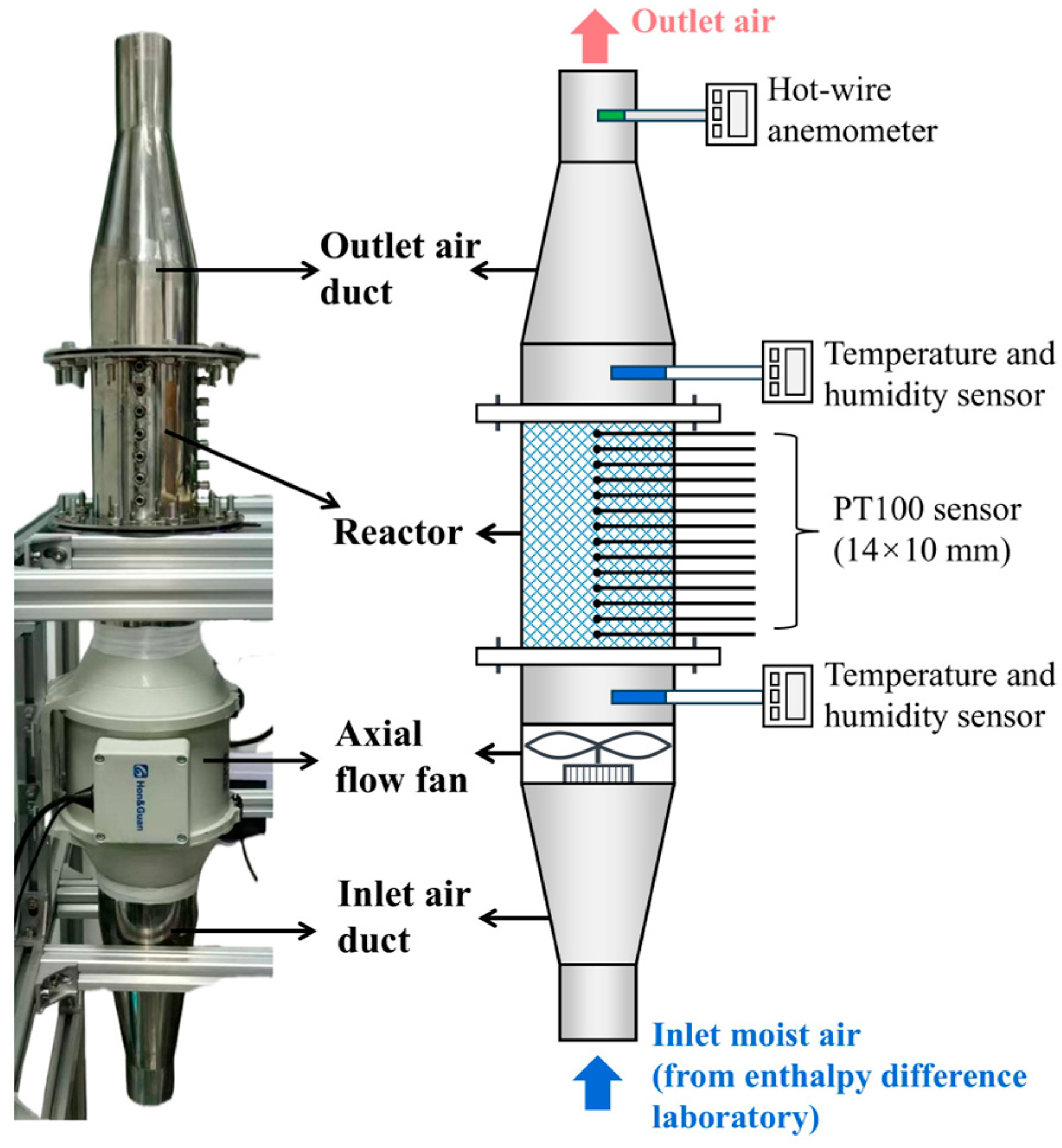
This study aims to directly measure the axial temperature distribution in the reaction zone, from which the axial sorption reaction heat power profile can be derived to characterize the sorption reaction zone. Based on the sorption and desorption characteristics of zeolite 13X, an experimental setup for testing thermal output performance was constructed (as shown in Figure 1). The apparatus adopted is vertically arranged, consisting of an inlet duct, an adjustable-speed axial fan, a sorption reactor, and an outlet duct from bottom to top. The sorption reactor is a cylindrical stainless-steel container with an inner diameter of 100 mm, a length of 150 mm, and a wall thickness of 2 mm. It is densely packed with zeolite 13X particles, which were thoroughly dried at 250 °C in an oven prior to packing inside the reactor. To obtain the axial temperature distribution of the reactor, 14 PT100 platinum resistance thermometers with an accuracy of 0.15 °C were installed along the central axis at 10 mm intervals. The entire experimental setup was placed in a 58.7 m3 psychrometric chamber, where temperature and relative humidity are controlled with precisions of ±0.1 °C (within −15–60 °C) and ±3.0% RH (within 20.0–92.0% RH), respectively. This environment provides constant temperature and humidity inlet air for the measurement system.
Driven by the adjustable-speed axial fan, the inlet air with constant temperature and humidity flows into the reaction bed through the inlet duct. The inlet duct is designed with a diffuser structure to ensure uniform velocity distribution across the cross-section of the reactor. The outlet air, after undergoing a sorption reaction, is discharged through a converging duct, which ensures a uniform velocity profile inside the final circular pipe with a diameter of 50 mm. The airflow velocity is measured using a hot-wire anemometer with an accuracy of 0.15 m/s. Experimental tests verified that the reactor design ensures relatively uniform airflow distribution, with a maximum relative velocity difference of 10% among the center points, wall points, and midpoints between them at the reactor outlet. The temperature and relative humidity of the inlet and outlet air are measured by two thermos-hygrometers (Rotronic AG, Bassersdorf, Switzerland) (Rotronic HC2-IC102), with accuracies of ±0.1 °C and ±0.8% RH, respectively. The outer surface of the setup is insulated with 30 mm-thick elastomeric foam. In this experiment, the heat loss rate was determined by evaluating the heat flux from the outer surface of the reactor to the outer surface of the thermal insulation layer. The corresponding surface temperatures of the reactor and insulation layer were measured using K-type thermocouples with an accuracy of 0.15 °C. For the cylindrical reaction bed, the heat loss rate was calculated using the following expression:
Q l o s s = 2 π λ i n s L ( T 1 T 2 ) l n ( r 2 / r 1 )
where λins [W/(m·K)] is the thermal conductivity of the thermal insulation, L [m], r1 [m], and r2 [m] denote the reactor length, outer radius of the reactor, and outer radius of the insulation layer, respectively. T1 [K] and T2 [K] represent the inner and outer surface temperatures of the insulation layer. Experimental results verified that the heat loss to the environment during the sorption process accounts for only 0.10–0.19% of the total exothermic energy with a relative uncertainty of 3.93–3.96%, which is negligible.
Existing research has demonstrated that the thermal output performance of open sorption thermal energy storage systems is predominantly governed by operational parameters, including inlet air temperature and relative humidity, air velocity, and structural parameters like reactor thickness. To investigate the influencing mechanisms of these parameters, 12 distinct experimental cases were configured in this study, as detailed in Table 1. The porosity was maintained within a narrow range of 0.414–0.425 through uniform and tight packing of the zeolite 13X pellets, thereby minimizing the influence of porosity variations. The procedure to achieve dense and uniform packing is as follows: Zeolite 13X particles were slowly loaded into the reaction bed in batches, accompanied by repeated vibration and compaction. Specifically, testing Cases 1–3, Cases 4–6, Cases 7–9, and Cases 10–12 facilitates analysis of the influences of inlet air relative humidity, inlet air temperature, air velocity, and packing thickness of zeolite 13X.
ε = 1 V p V a = 1 m 0 / ρ s V a
where Va [m3] is the volume inside the reaction bed, and Vp [m3] is the total volume of all adsorbent particles. The volume Vp is calculated by dividing the packing mass of the adsorbent (m0, kg) by the true density (ρs, kg/m3) of the zeolite 13X particles.

2.3. Performance Characterizations

2.3.1. Reaction Zone Characteristics

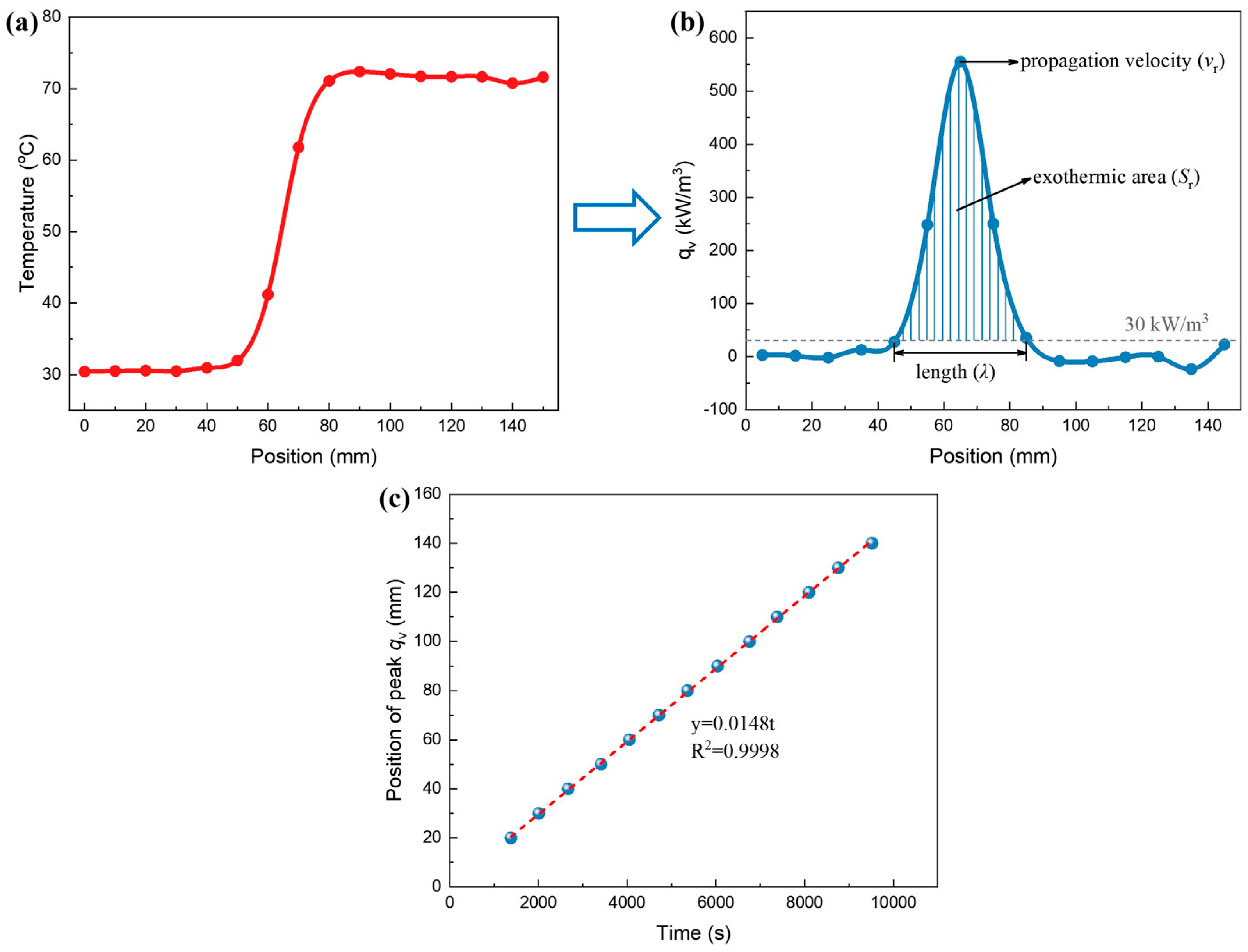
The reaction section is characterized by the volumetric sorption exothermic power (qv) along the reaction bed, and its key characteristic parameters, including propagation velocity (v) and section width (λ). qv can be calculated from the temperature distribution data measured by 14 equally spaced PT100 sensors installed along the bed (as shown in Figure 2a,b). To simplify the calculation, the derivation is based on the following justified assumptions:
(1)
The air flow inside the reactor is quasi-1D plug flow;
(2)
The zeolite 13X particles are homogeneous and isotropic, and they are packed in the reactor uniformly;
(3)
The outlet air is totally dried;
(4)
There is no solid heat storage.
Based on the above assumption, the formula for qv can be expressed by:
q v = C p , g ρ g u i n d T d L   ( k W / m 3 )
where Cp,g [kJ/kg/K] and ρg [kg/m3] mean the specific heat capacity and density of air, respectively, uin [m/s] is the air velocity, and dT/dL [K/m] represents the temperature gradient along the airflow direction within the sorption reactor.
Based on the temporal profiles of volumetric sorption exothermic power, the propagation velocity (vr) and length (λ) of the reaction zone can be determined. The propagation velocity (vr) is obtained by identifying reaction section profiles where the peak qv occurs at positions ranging from 20 mm to 140 mm in 10 mm increments. A linear regression is performed with operating time as the abscissa and the peak location as the ordinate, and the slope of the resulting fit corresponds to the propagation velocity (Figure 2c). The reaction zone width is determined by analyzing full spatial profiles of the curve of qv. To mitigate the influence of extended low-intensity regions that contribute little to the total heat release, a threshold of 30 kW/m3 is used to define the start and end boundaries of the zone. A sensitivity analysis was conducted by comparing the reaction zone lengths obtained using threshold values of 20, 30, and 40 kW/m3. The results demonstrate that the variation in reaction zone length is within 7.1%, which is insensitive to reasonable variations around the adopted threshold of 30 kW/m3. The distance between these two boundaries is taken as the value of λ, as shown in Figure 2b.

2.3.2. Thermal Output Performance Parameters of the Reactor

The key sorption exothermic performance parameters of the reaction bed include water uptake capacity (x), effective heating duration (teff), stable output temperature (To,s), stable output duration (ts), and sorption thermal energy storage density (Qv). The total water uptake of the reactor can be calculated based on the mass change of the adsorbent before and after the reaction, which was measured by an electronic balance with an accuracy of 0.01 g:
x = m 1 m 0 m 0   ( g / g )
According to the ASHRAE standard 55 [35], 27 °C was selected as the minimum temperature threshold for effective thermal heat supply. The effective heat supply duration, denoted as teff, is defined as the time interval between the first instance when the outlet temperature rises to 27 °C and the moment it subsequently decreases to the same temperature. In this study, the starting point of the stable phase is identified as the moment when the sharp peak in the rising segment declines to its minimum value, while the end point is taken as the time point preceding a sustained temperature drop, specifically when the exponentially weighted moving average decreases by more than 0.3% from its maximum value during the phase. The average temperature during this interval is regarded as the stable output temperature (To,s), and the corresponding time span is defined as the stable output duration (ts).
The volumetric energy storage density of the reactor is calculated by the differential temperature of the inlet and outlet air:
E S D v = ρ g c p , g A u i n V t 0 t 1   T o u t T i n d t   ( k W h / m 3 )
where A [m2] denotes the cross-sectional area of the sorption reactor, V [m3] represents the reactor volume, and t0 [s] and t1 [s] indicate the start and end times of the sorption reaction, respectively. Tout [K] and Tin [K] refer to the outlet and inlet temperatures of the reaction bed, respectively.

3. Reaction Zone Characteristics and Its Intrinsic Relationship with the Thermal Output Performance

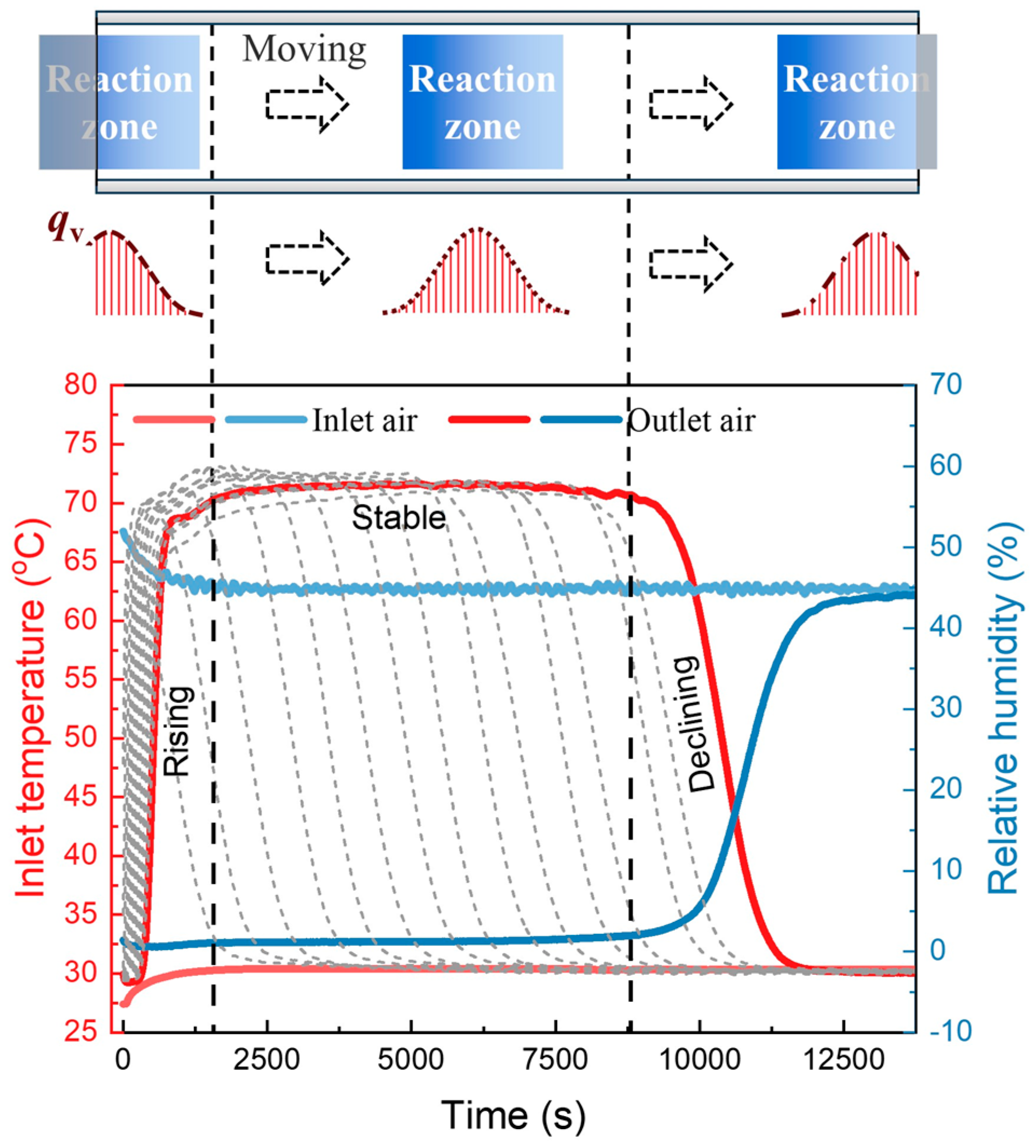
The Type I sorption isotherms enable the zeolite 13X sorption reactor to efficiently capture moisture from humid inlet air. Experimental results demonstrate that, with an appropriate packing thickness, the outlet air can be completely dried (see Figure 3). Under this condition, the total water uptake of the reactor remains constant, determined solely by the inlet air flow rate and moisture content. Consequently, the total sorption exothermic heat remains stable, as it is governed by the water uptake capacity and the enthalpy of sorption. Owing to the distinct reaction zone characteristics and heat transfer mechanisms during sorption, the output temperature profile of the zeolite 13X bed displays a well-defined three-stage evolution: a rising, a stable, and a declining phase. Throughout the reaction, the axial temperature profiles maintain uniformly spaced intervals, confirming the presence of a stable sorption reaction zone that propagates toward the outlet at a constant velocity.
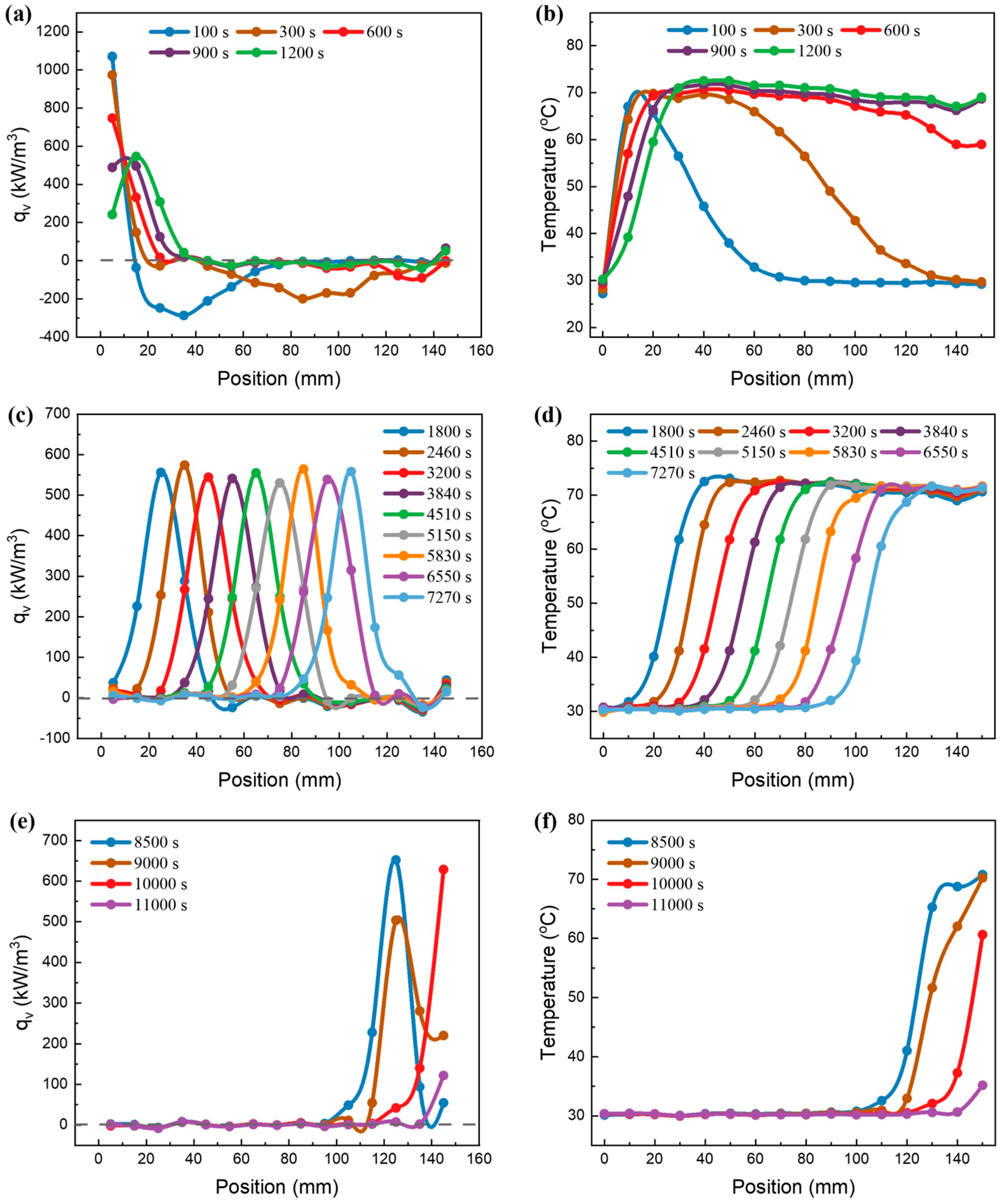
The sorption reaction zone characteristics and thermal output performance throughout the three stages of the output temperature profile are illustrated using results from Test Case 6. Figure 4a–f present the temporal evolution of air temperature at 10 mm intervals along the reactor during each stage, along with the distribution of sorption thermal power (qv) at representative time instants.
(1)
Rising phase of the output temperature. During this phase, sorption initiates preferentially in the dry adsorbent at the reactor inlet due to its initial exposure to humid air, leading to progressive development of the reaction zone from the inlet toward the interior. Initially (e.g., 100 s), all adsorbent remains dry and at ambient temperature, exhibiting high sorption affinity. Water vapor in the incoming humid air is rapidly and completely adsorbed by a thin adsorbent layer close to the inlet, releasing intense sorption heat (qv = 1071.1 kW/m3 at the first 10 mm within 100 s; see Figure 4a). This causes a sharp rise in sensible heat in both the adsorbent and the air stream in this region. In contrast, downstream adsorbent experiences no sorption due to the absence of water vapor in the flowing air. Driven by the established thermal gradient, heat is transferred from the high-temperature upstream sorbent to the downstream adsorbent, increasing its temperature (see Figure 4b). Consequently, a declining temperature profile is observed along the reactor.
As an increasing number of adsorbents reach sorption saturation, the reaction zone widens and migrates toward the outlet (e.g., 100 s → 300 s → 600 s, see Figure 4a). Within the reaction zone, the temperature of upstream adsorbent (e.g., at 10 mm and 20 mm) decreases as saturation progresses, while downstream adsorbent (beyond 30 mm) experiences a temperature rise due to intensifying sorption. Both the sorbents and air inside the reaction section are rapidly heated to a stable temperature and maintain this state consistently. Once the reaction zone passes, the saturated adsorbent releases no additional heat; its residual sensible heat is gradually transferred to the flowing air, allowing the adsorbent to cool slowly back toward the inlet air temperature.
The outlet temperature increases continuously throughout this phase (see Figure 3, which can be attributed to the constant total sorption heat release resulting from the fixed water uptake. This heat is transferred to both the flowing air and the adsorbent. As the sorption process advances, the proportion of sensible heat transferred to the adsorbent decreases, leading to a corresponding increase in the sensible heat acquired by the air stream.
(2)
Stable phase of output temperature. The reaction bed consists of three distinct zones: a fully reacted zone, an active reaction zone, and an unreacted zone (Figure 4c). In the fully reacted zone, the adsorbent temperature equals the inlet air temperature, and no further sorption occurs, so the air passes through this region with constant temperature and humidity. Upon entering the reaction zone, the air stream contacts unsaturated adsorbent, triggering sorption reactions that release heat and raise the temperature of both the adsorbent and the air until the stable output temperature is reached. At this point, all water vapor in the air is completely adsorbed. The air then flows into the unreacted zone, where the adsorbent is already at the stable output temperature, and no sorption takes place. Consequently, the air exits the bed at a consistent temperature, thereby maintaining a stable outlet temperature.
As the reaction progresses, the adsorbent in the upstream section of the reaction zone becomes saturated and transitions into the fully reacted zone, while the adsorbent in the upstream part of the unreacted zone gradually initiates sorption. This leads to a continuous expansion of the fully reacted zone and a corresponding reduction of the unreacted zone. Although the thickness of the reaction zone remains largely constant, it propagates toward the outlet at an approximately constant velocity (see Figure 2).
The value of qv within the reaction zone initially increases and then decreases along the flow direction, which is governed by sorption conditions and reaction kinetics. In the upstream portion of the reaction zone, although the adsorbent temperature is low and water vapor pressure is high, it already approaches saturation states, which leads to low sorption capacity and minimal enthalpy change. In the downstream section, despite the adsorbent being relatively dry, the higher temperature and lower vapor partial pressure weaken its sorption affinity and reduce heat release. The central part of the reaction zone exhibits optimal conditions, namely moderate temperature, vapor concentration, and sorption capacity, leading to intense reaction activity and the highest exothermic power.
(3)
Declining phase of the output temperature. During this stage, only the fully reacted zone and the reaction zone are present in the sorption bed. As the upstream section of the reaction zone continuously reaches sorption saturation and merges into the fully saturated zone, the thickness of the reaction zone gradually decreases. Concurrently, the adsorbent within the reaction zone progressively approaches saturation, resulting in a continuous reduction in the total sorption heat release. Consequently, the temperature of the outlet air decreases correspondingly.
Based on the evolution of reaction zone characteristics and the associated outlet temperature response during the sorption process, key parameters are employed to quantify the thermal output performance of the zeolite 13X sorption bed. Throughout the stable phase, the temperature increase of the inlet air results solely from the total sorption heat released by the bed. This heat can be calculated as the product of the total adsorbed water mass (equivalent to the humidity ratio of the incoming moist air) and the enthalpy of sorption:
Δ T = m ˙ g · d i n d o u t · Δ H a d m ˙ g · C p , g = d i n d o u t · Δ H a d C p , g   ( K )  
where ΔHad is the sorption enthalpy, 3642.9 kJ/kg [36], where dout is assumed to be 0 when employing zeolite 13X, since the outlet air is dry, as proved in Figure 3.
Thus, the stable output temperature of the zeolite 13X reactor can be expressed by:
T o , s = T i n + d i n · Δ H a d C p , g   K
The calculation formula for the heat release power of the sorption reactor during the stable phase is given by:
P s = C p , g m ˙ g T o u t T i n   W P s = C p , g ρ g A u i n T o u t T i n   W
The instantaneous heat release power of zeolite 13X can be expressed by the operating parameters by substituting Equation (6) into Equation (8):
P s = ρ g A u i n d i n · Δ H a d   W
Theoretically, according to the physical meaning of the exothermic area of the reaction zone (Sr), the relationship between Ps and Sr can be expressed by:
P s = S r A   W
The stable output duration corresponds to the time interval over which the complete reaction zone is maintained within the sorption bed, and can be quantified as follows:
t s = L λ ν r   ( s )
The thermal energy stored during the stable output phase can be calculated using the following expression:
E S D v , s = P s · t s V = ρ g u i n d i n Δ H a d L λ L   ( k W h / m 3 )
The models presented in this section (Equations (6)–(12)) are simplified engineering tools derived from core thermodynamic and mass balance principles. Their purpose is to capture the dominant performance trends and provide first-order quantitative predictions for system design, rather than to resolve all complex local and transient phenomena. The subsequent comparison with experimental data will assess their utility in linking operating parameters to system-level outputs.

4. Influence of Operating Parameters on Reaction Zone Characteristics and Thermal Output Performance

Current research on open sorption reactors indicates that critical performance-influencing factors include air flow rate, inlet air relative humidity, inlet air temperature, and the packing thickness of the sorbent material. A comparative analysis of how these parameters affect both reaction zone characteristics and thermal output performance is presented below, supported by experimental findings.

4.1. Influence of the Inlet Air Relative Humidity

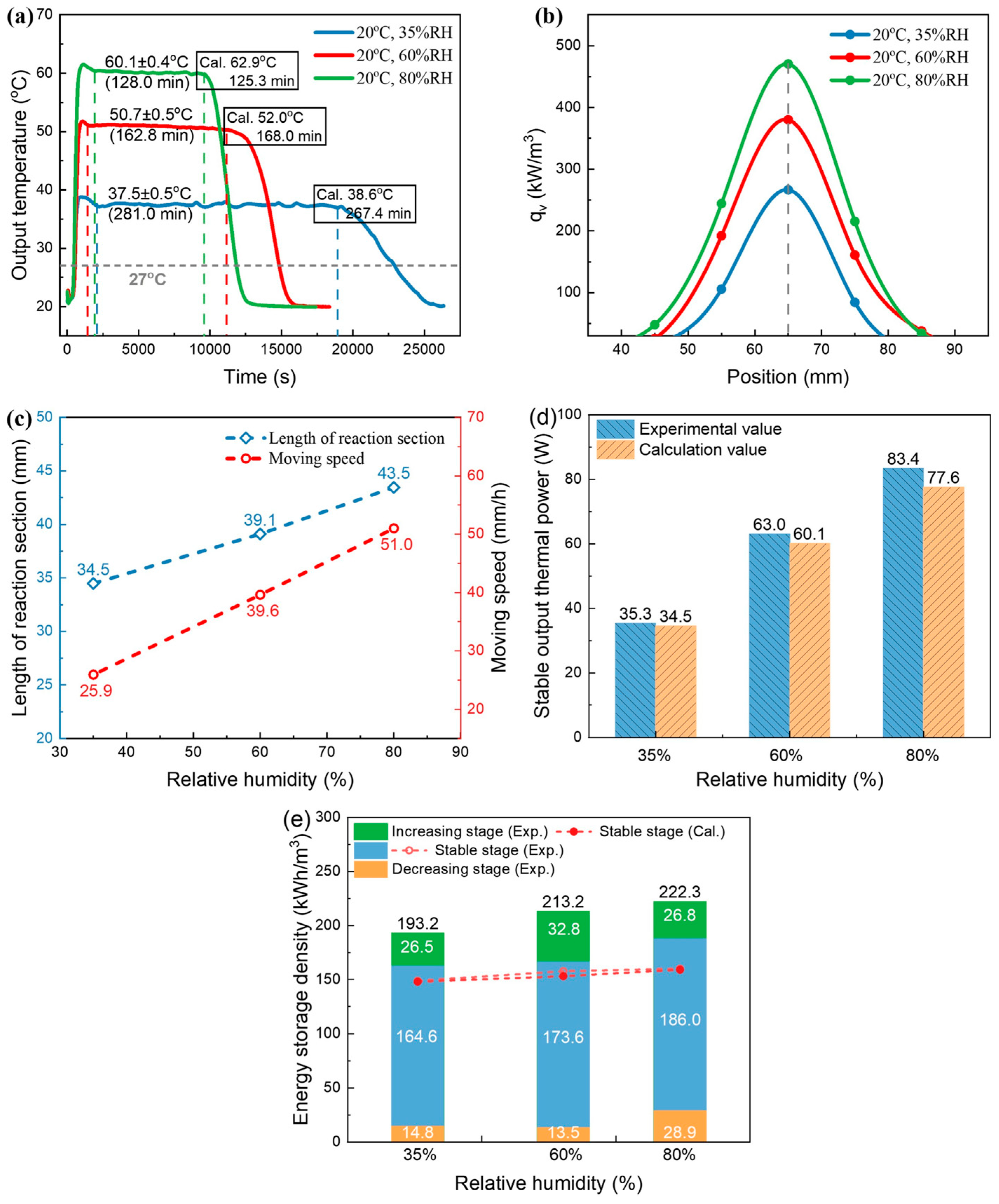
Consistent with typical operating conditions of open sorption reactors, this study investigates three representative relative humidity levels, namely, 35% RH, 60% RH, and 80% RH at 20 °C to evaluate their effects on reaction zone behavior and thermal output characteristics in a zeolite 13X bed. Sorption principles indicate that higher relative humidity at a constant inlet temperature increases water vapor pressure, thereby enhancing the sorption rate. Figure 5a illustrates that both the stable output temperature and total output duration exhibit a positive correlation with increasing humidity. These trends are consistent with the observed changes in reaction zone properties. Figure 5b demonstrates that both reaction zone length and peak value of qv rise with humidity. This behavior can be explained by the nearly constant equilibrium sorption capacity of zeolite 13X (0.208 g/g, 0.215 g/g, and 0.215 g/g, respectively) under the three humidity levels, consistent with its Type I sorption isotherm. Therefore, the higher moisture content in the inlet air enables more extensive reaction with the adsorbent before saturation, thereby contributing to an extended spatial extent of the reaction zone. The increased water vapor pressure is expected to intensify the sorption rate, promoting greater moisture uptake and thermal release per unit time. This, in turn, likely amplifies both the longitudinal distribution of heat release and the propagation velocity of the reaction zone, as each segment attains saturation more rapidly (Figure 5b). Consequently, the associated increase in the total sorption heat released per unit time correlates with an elevated output temperature, which aligns with the observed expansion of the reaction zone area. Overall, the data indicate that increased humidity primarily enhances performance through its direct effect on vapor pressure and sorption kinetics, within the coupled heat and mass transfer processes of the system.
The stable output temperature increases from 37.5 °C to 60.1 °C as the relative humidity increases from 35% to 80%. The relative deviation between experimental values and predictions from Equation (7) remained within 2.5–4.6%, indicating good agreement under the tested conditions. Due to the lengthened reaction zone and the increased propagation velocity, the stable output duration reduces from 281.0 min at 35% RH to 128.0 min at 80% RH. Predictions of output duration via Equation (11) showed relative errors of only 2.1–4.8%, demonstrating its utility for estimating the stable output duration based on reaction zone characteristics in this system.
The temperature rising phase is relatively short, characterized by a rapid increase in Tout to a peak value, followed by a swift decline to To,s. This “temperature spike” is attributed to the intense sorption heat release from the initially highly dry zeolite 13X. During the temperature declining phase, the rate of decline increases with relative humidity, likely due to enhanced heat transfer driven by a larger temperature gradient during sensible heat exchange. Figure 5d shows that the output heating power during the stable phase increases from 35.5 W to 83.4 W as the relative humidity increases from 35% RH to 80% RH. The relative error of the stable heating power calculated by Equation (9) is 2.2–6.9%, suggesting that this simplified model provides a reasonable estimate of the output heating power. Figure 5e indicates that the total storage density increases from 193.2 to 222.3 kWh/m3 with rising relative humidity. The contributions from the rising and declining phases remain relatively consistent across tested conditions, accounting for 6.3–13.0% and 15.4–21.9% of the total storage, respectively. In contrast, the stable phase shows an increasing trend with humidity and constitutes the majority (71.6–76.6%) of the total energy storage. The effective heating duration (Tout > 27 °C) under the three humidity conditions is 373.7 min, 238.5 min, and 189.8 min, respectively. The corresponding effective energy storage densities reach 187.3, 211.1, and 220.7 kWh/m3, representing 97.0–99.3% of the total storage density, confirming effective utilization of the stored heat for heating applications.

4.2. Influence of the Air Flow Rate

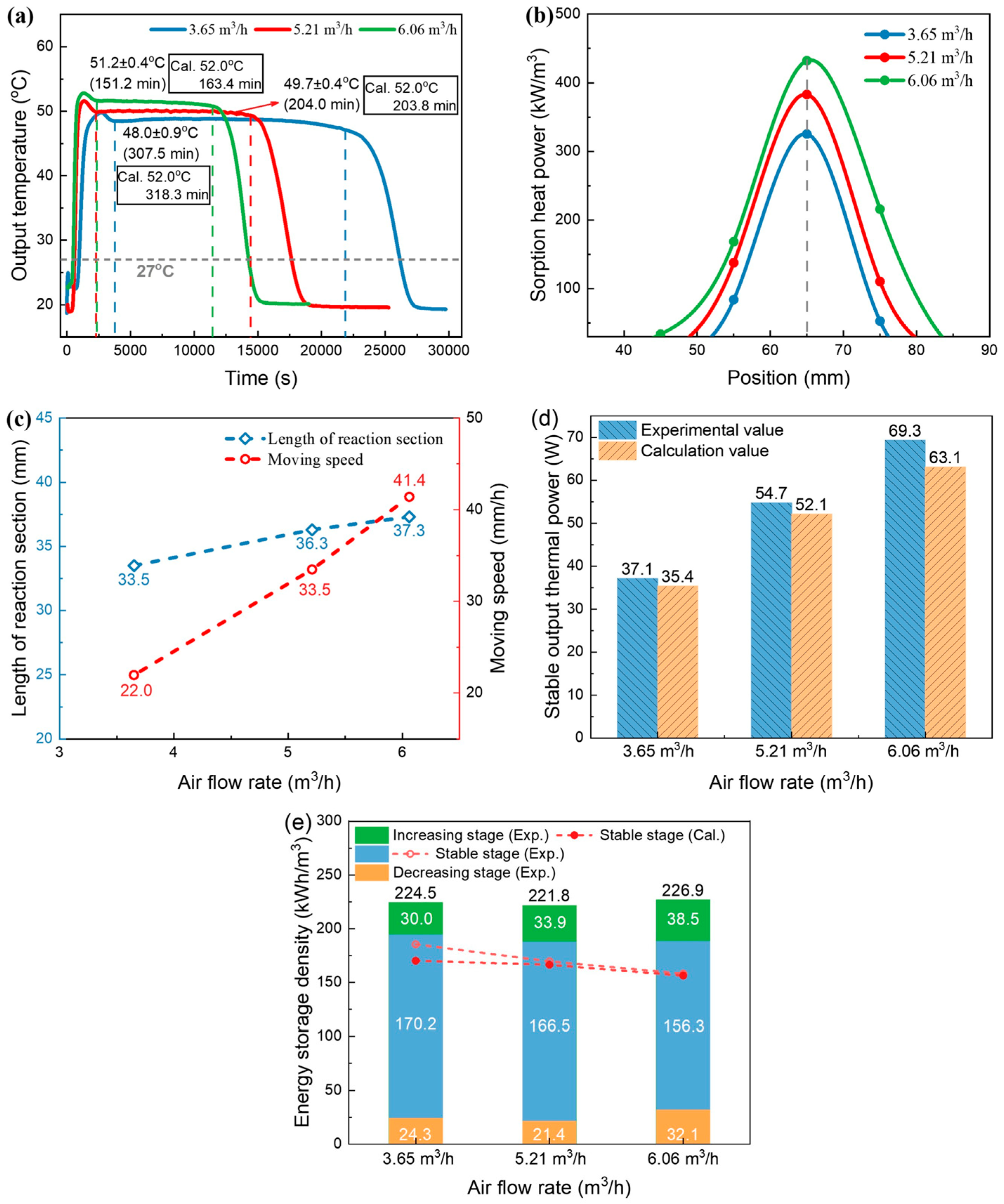
Air flow rate is a key operational parameter affecting sorption performance. While increased flow rate does not alter the equilibrium uptake capacity, it significantly enhances sorption kinetics by improving convective heat and mass transfer. From an application perspective, flow rate adjustment offers a practical method for regulating thermal power output to meet user demands. This study investigates the effects of air flow rate on both reaction zone characteristics and thermal output performance of a zeolite 13X reactor, employing three representative flow rate levels of 3.65 m3/h, 5.21 m3/h, and 6.06 m3/h. Figure 6a shows that higher flow rates reduce the duration of the rising, stable, and declining phases of the output temperature. The peak temperature of the “temperature spike” during the rising phase increases from 49.8 °C to 52.8 °C, while the value of To,s rises from 48.0 °C to 51.2 °C. The relative deviation between measured values and predictions from Equation (6) ranges from 1.5% to 8.5%.
The thermal output behavior during the stable phase is governed by the evolution of the reaction zone. The length of the reaction zone (λ) is determined by the balance between mass input and the local adsorption rate. A deeper analysis of the competing influences of flow rate reveals a clear hierarchy: On one hand, increased flow rate enhances convective mass (and heat) transfer, which accelerates the local sorption kinetics. This kinetic enhancement represents a tendency that could, in principle, lead to a more concentrated (shorter) reaction zone, as each segment of the bed reaches saturation faster. On the other hand, and critically, a higher flow rate delivers a proportionally greater moisture influx into the bed. A fundamental mass balance requires that to process this increased vapor flux, the adsorbent bed must provide a correspondingly longer reactive volume, thereby extending the spatial extent (λ) of the reaction zone. The data in Figure 6b show that the net effect is an increase in reaction zone length with flow rate. This observation indicates that, under the present experimental conditions, the lengthening effect dictated by the mass balance requirement is the dominant factor, overriding the kinetic tendency for shortening. Concurrently, the intensified moisture uptake and heat release per unit time result in a significant increase in the value of qv along the reaction zone. The peak qv rises from 325.2 kW/m3 to 432.2 kW/m3, consistent with the trends shown in Figure 6b. Moreover, the area of the reaction zone increases with airflow rate due to the increased zone length and qv, resulting in greater thermal output power.
Higher flow rates enhance sorption kinetics, which increases the rate at which the sorbent approaches local equilibrium. It is important to note that increased flow rate simultaneously enhances both convective mass and heat transfer. Under the present experimental conditions, the observed increase in the propagation velocity of the reaction zone (from 22.0 mm/h to 41.4 mm/h as shown in Figure 6c) is predominantly influenced by the resulting enhancement in mass transfer, which drives the advancement of the sorption reaction zone. Figure 6c illustrates that the propagation velocity of the reaction zone increases from 22.0 mm/h to 41.4 mm/h as the flow rate increases from 3.65 m3/h to 6.06 m3/h. The stable output duration decreases with increasing flow rate primarily because the faster propagation velocity outweighs the effect of the increased reaction zone length, leading to a shorter time for the reaction front to traverse the fixed bed. Specifically, as the flow rate rises from 3.65 to 6.06 m3/h, the output duration declines from 318.3 to 151.2 min. The relative error between these experimental values and the predictions from Equation (11) ranges from 0.1% to 8.1%. Figure 6d shows that the stable output thermal power increases with increasing air flow rate. It is noted that the relative deviation between measured values and predictions from Equation (9) ranges from 4.8% to 9.0%. Figure 6e shows that the energy storage density is influenced little by variations in air flow rate, owing to the close water uptake amount and sorption enthalpy. The storage density during the stable phase increases marginally with increasing flow rate and constitutes 68.9–75.8% of the total. The effective heating duration (Tout > 27 °C) under the three flow rates is 419.8 min, 284.3 min, and 229.7 min, respectively. The corresponding effective energy storage densities represent 99.2–99.6% of the total storage.

4.3. Influence of Inlet Air Temperature

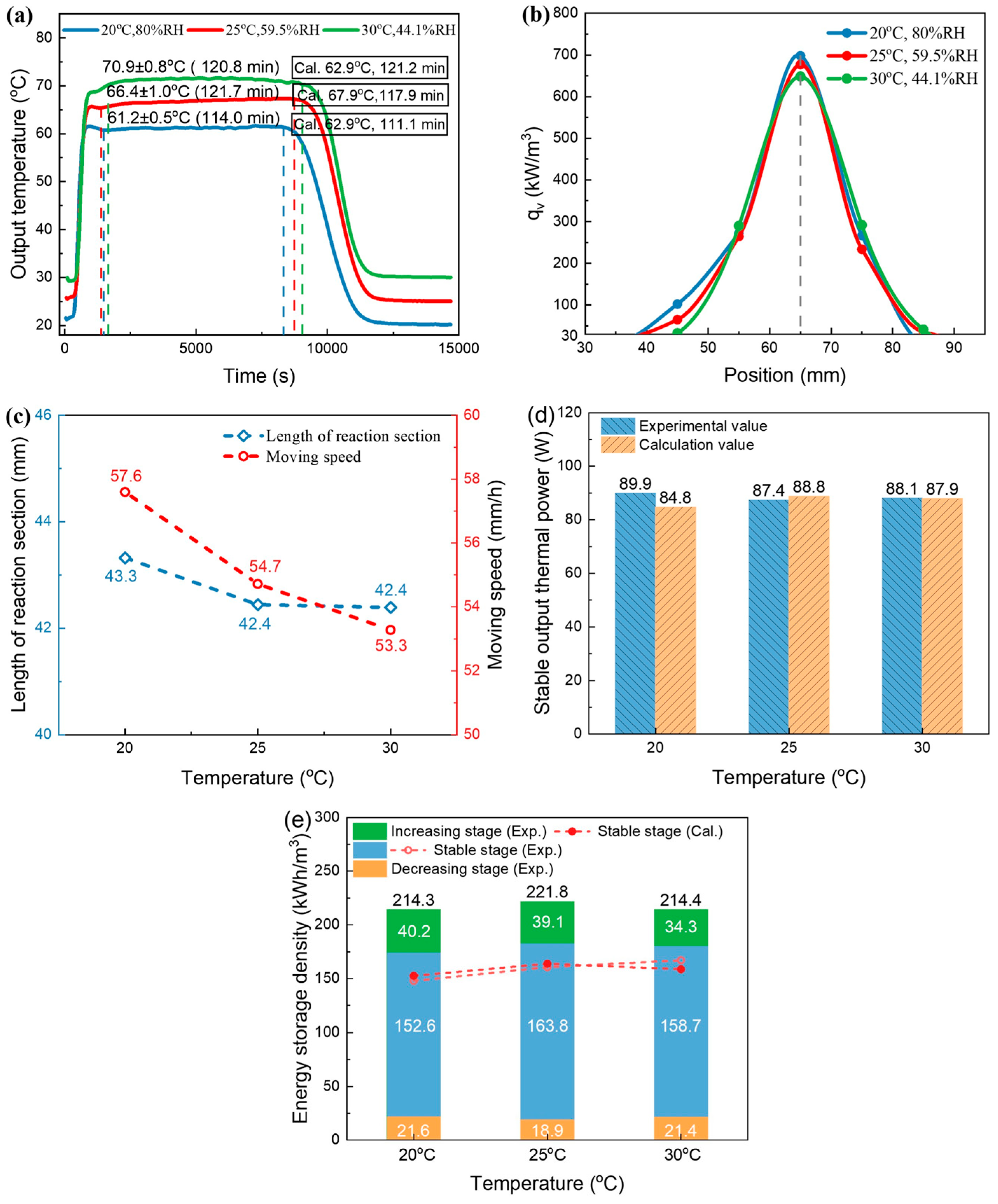
The inlet air temperature is another significant operating parameter of open sorption thermal energy storage systems, but its specific impact on the thermal output performance has received limited attention in previous studies. This study experimentally investigated three representative inlet air temperatures—20 °C, 25 °C, and 30 °C—with the moisture content maintained at 8.83 g/kg dry air. Figure 7a illustrates the variation in output temperature profiles under the above three inlet air temperatures. As the inlet temperature increases, the output temperature curve shifts upward vertically, while the temperature difference between the inlet and outlet remains nearly constant, ranging between approximately 40.9 °C and 41.4 °C. The total reaction time remains nearly identical under three temperature conditions. Specifically, the duration of the rising phase is consistent among the cases, whereas the stable phase exhibits a slight increasing trend with rising Tin, ranging between 114.0 and 121.7 min. The declining phase gradually shortens as Tin increases. The relative errors between the calculated and experimental values for To,s and the ts, obtained using Equations (7) and (11), are 2.3–2.8% and 0.3–3.1%, respectively. As shown in Figure 7b, as Tin increases from 20 °C to 30 °C, the peak sorption heat power increases from 648.4 kW/m3 to 697.9 kW/m3, while the length of the reaction zone remains relatively constant, varying in the range of 42.4–43.3 mm (see Figure 7c). Furthermore, the propagation velocity of the reaction zone decreases slightly with increasing Tin (see Figure 7c). The area of the reaction zone remains almost constant, resulting in approximately constant thermal output power. Figure 7d,e present that Tin has little influence on the value of both stable output thermal power and volumetric energy storage density, which is consistent with the similar water uptake amounts (0.206–0.215 g/g) observed across the tested temperatures. The stable phase of Tout contributes to 71.2–74.0% of the total energy storage density. The relative error between experimental energy storage density and the calculated one is only 1.8–4.1%, which indicates the applicability of Equation (12) for estimating the energy storage density under the conditions investigated in this study.

4.4. Influence of Packing Thickness of Sorbents

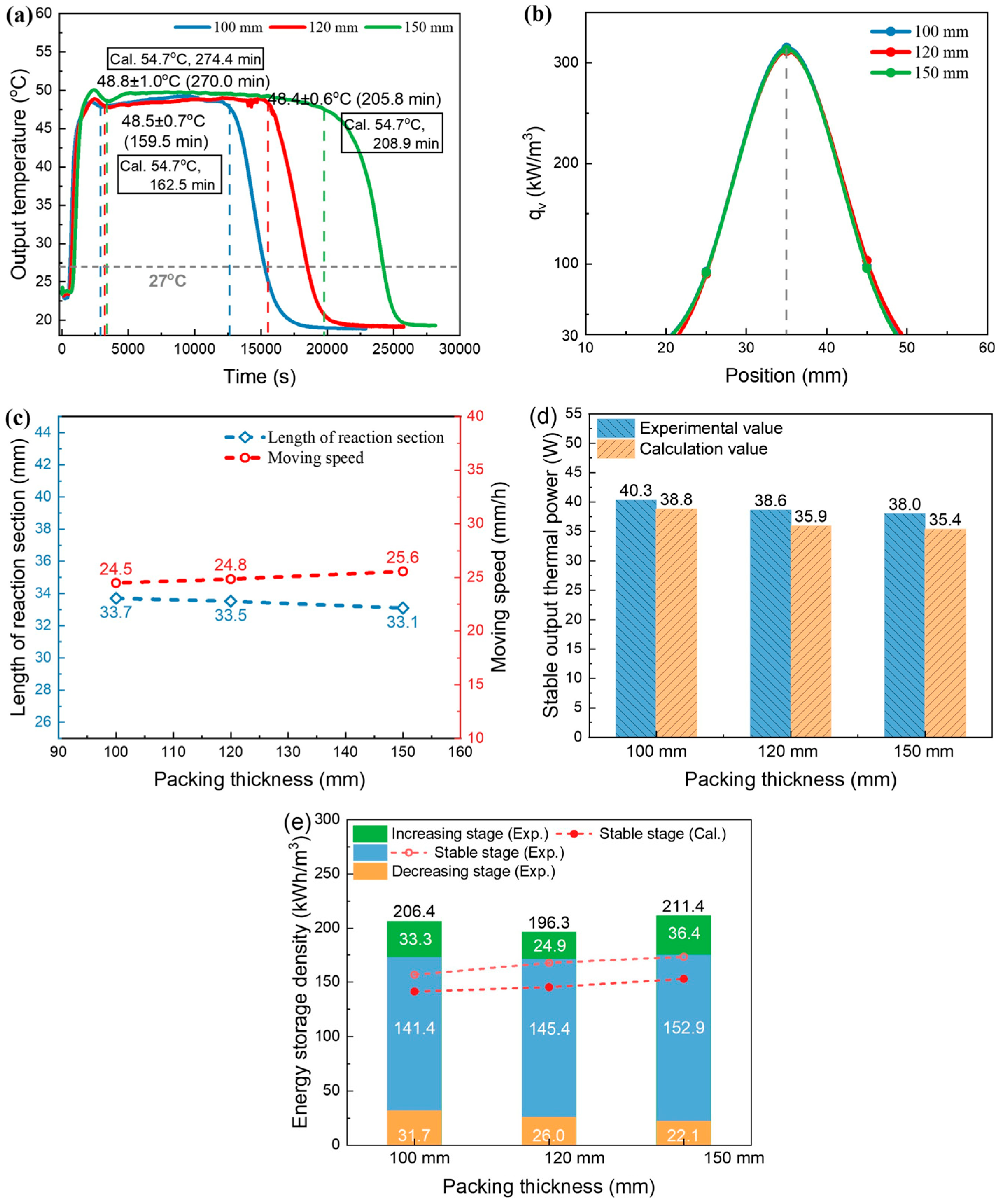
The sorbent packing thickness within the sorption bed critically affects both the total thermal energy storage capacity and the heating supply duration. Nevertheless, the influence of packing thickness on system performance remains inadequately explored in existing literature. This study investigates three packing thicknesses, including 100 mm, 120 mm, and 150 mm, to evaluate their effects on reaction zone dynamics and thermal output behavior, with the aim of providing practical guidance for sorbent bed sizing. Figure 8a shows the output temperature profiles corresponding to the three packing thicknesses. Both the duration of the stable phase and the total reaction time exhibit a significant increase with greater packing thickness. The measured stable phase durations show good agreement with the values calculated using Equation (11) with a relative error of merely 1.5–1.9%. Figure 8b demonstrates that the shape of the reaction zone remains nearly identical across the different packing thicknesses. Accordingly, as shown in Figure 8c, the length and propagation velocity of the reaction zone show no significant variation with packing thickness, with the value ranges of 24.5–25.6 mm and 33.1–33.7 mm/h, respectively. The key finding that λ and v are independent of bed thickness provides a fundamental basis for system design. Figure 8d,e indicate that both the stable output thermal power and total energy storage density are not significantly affected by the packing thickness, ranging from 206.4 kWh/m3 to 211.4 kWh/m3.
The energy storage density during the stable phase was found to be 11.0–15.4% lower than the theoretical value obtained by Equation (12). This discrepancy indicates that the ideal conditions assumed in the model (e.g., complete utilization of all adsorbent) were not fully attained in the experiment. A plausible explanation for the lower measured density could be the influence of internal mass transfer limitations within the zeolite pellets. At the relatively low air velocities tested, the external convective mass transfer rate may have been reduced, potentially exacerbating the internal diffusion resistance. This could lead to slower sorption kinetics and incomplete utilization of the adsorbent’s core during the finite duration of the stable phase, thereby reducing the effective storage density. Other factors, such as minor heat losses or slight deviations from the assumed complete drying of the outlet air, may also have contributed to the observed difference. The effective heating durations (Tout > 27 °C) for three packing thicknesses were measured as 244.5 min, 287.8 min, and 388.8 min, respectively. The corresponding effective energy storage density was determined to be 192.9–208.9 kWh/m3, representing 97.8–98.8% of the total storage energy density.

5. Preliminary Guidelines for System Design and Operations

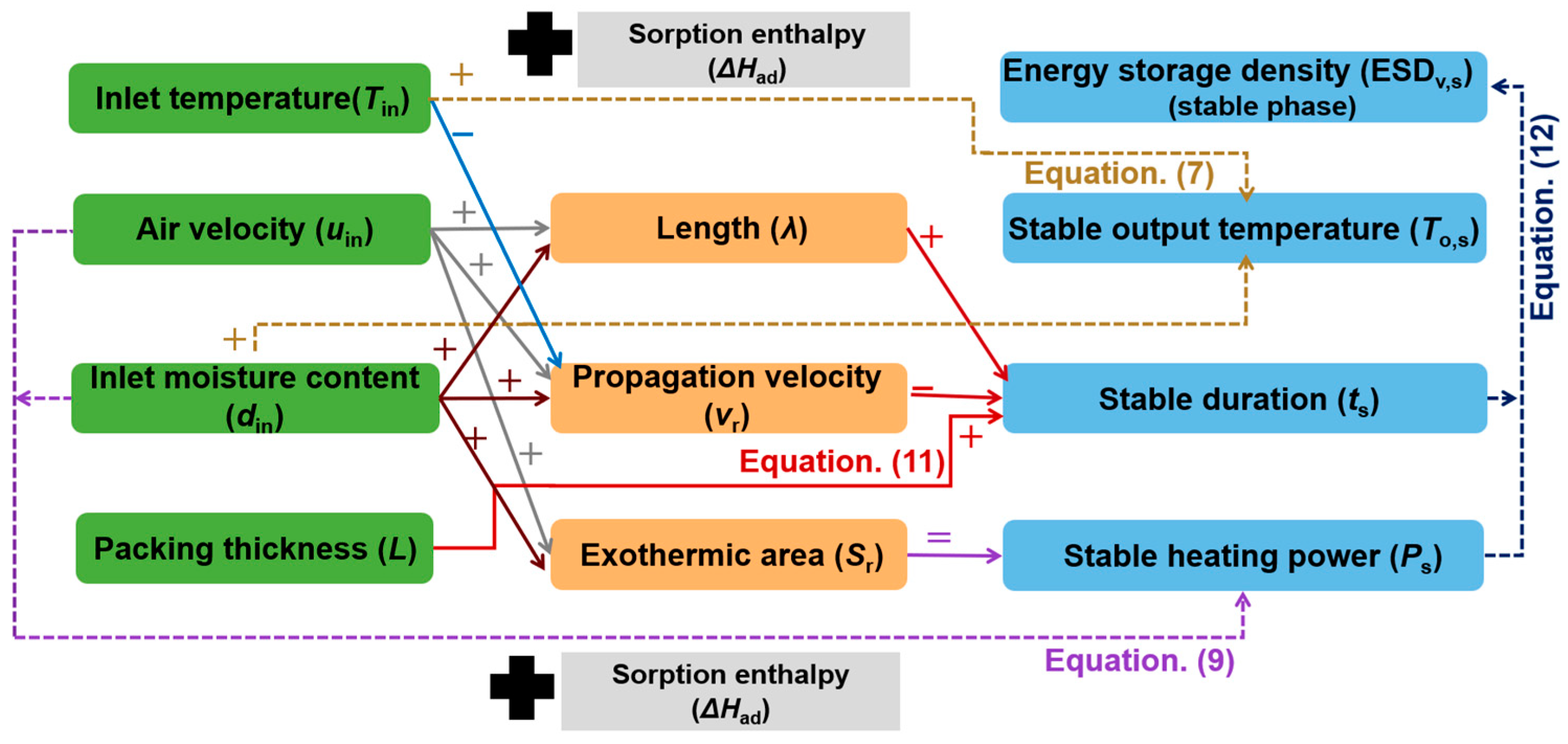
The experimental findings on reaction zone evolution and thermal output provide actionable insights for the design and operation of open sorption thermal energy storage (STES) systems. The zeolite 13X reactor demonstrated robust performance with a volumetric energy storage density ranging from 193.2 kWh/m3 to 222.3 kWh/m3. Its ability to maintain significant water uptake even at low relative humidity endows it with exceptional climate adaptability. Experimental results indicate that the thermal output performance—characterized by the output temperature (To,s), stable duration (ts) and output thermal power (Ps), and energy storage density (ESDv,s) during the stable phase—can be theoretically predicted based on both operating parameters (inlet temperature Tin, air velocity uin, inlet moisture content din, and packing thickness L) and reaction zone characteristics (length λ, propagation velocity vr, and exothermic area Sr). The correlations among these parameters are illustrated in Figure 9.
From a user-oriented perspective, the thermal output can be conceptually tailored by manipulating three key parameters: output temperature, heating power, and heating duration. The following preliminary framework outlines the primary relationships observed in this study, which are most directly applicable under conditions of a stable reaction zone, relatively uniform flow, and high sorbent utilization. It should be noted that in a practical system, these parameters are coupled, and their precise control would require integrated strategies to manage secondary effects on mass transfer, stability, and pressure drop.
(1)
Adjustment of heating temperature. The temperature rise (ΔT = To,sTin) is primarily influenced by the inlet air moisture content (din), as defined by Equation (6). Since ΔT is largely theoretically independent of inlet temperature, airflow rate, and packing thickness, integrating a low-power, adjustable humidifier provides a direct method for setting the target output temperature. The required din for a desired ΔT can be directly calculated from Equation (6).
(2)
Adjustment of heating Power. The thermal power output can be regulated by varying either din or the airflow rate. While din affects both temperature and power, adjusting the airflow rate provides a primary and effective lever for modulating the heat output power. While this adjustment will inevitably introduce secondary changes in the bed temperature profile and mass transfer dynamics due to system coupling, its dominant and most direct effect is on the convective heat removal rate, thereby controlling the power output. Given the approximately linear relationship between heating power and airflow rate, incorporating a variable-speed fan offers an effective method for power regulation.
(3)
Adjustment of heating Duration. The effective heating duration is primarily determined by the stable phase. Once To,s and the airflow rate are fixed, the duration can be extended by increasing the packing thickness, as per Equation (11). Crucially, the reaction zone length (λ) and propagation velocity (vr)—key inputs for Equation (11)—can be estimated from empirical correlations derived from our data: λ exhibits a near-linear relationship with inlet relative humidity and airflow rate (e.g., increasing from 38 mm to 52 mm as RHin rises from 35% to 80%), while vr increases approximately linearly with airflow rate (e.g., from 22.0 to 41.4 mm/h as flow rate increases from 3.65 to 6.06 m3/h). These empirical relationships provide a practical basis for preliminary system sizing.

6. Conclusions

This study developed a simple, reliable experimental method for directly characterizing sorption reaction evolution through high-precision measurements of intra-reactor temperature profiles, thereby addressing the critical gap of insufficient experimental validation on reaction zone dynamics in existing research. Zeolite 13X served as an excellent benchmark sorbent, facilitating the formation of a complete reaction zone and leading to a stable thermal output due to its Type I sorption isotherm. Key findings are summarized as follows:
(1)
The output temperature curves exhibit a characteristic three-stage evolution: rising, stable, and declining, which is governed by sorption dynamics and the heat release distribution between the air stream and the adsorbent pellets. Specifically, during the stable phase, a fully reacted zone propagates at a constant velocity towards the reactor outlet. Its length (λ) and propagation velocity (vr) can predict the stable duration using Equation (11) (mean error is 4.1%). The exothermic area (Sr) can predict the stable output thermal power using Equation (10) (mean error is 4.8%), while the combination of λ, vr, and Sr can predict the energy storage density during the stable phase by Equation (12) (mean error is 2.5%). The assumption of complete drying is justified by the extremely steep Type-I isotherm of Zeolite 13X, which ensures near-zero effluent humidity during the stable adsorption phase.
(2)
Operating parameters distinctly impact thermal output by modulating λ, vr, and Sr. Inlet air humidity and flow rate are the most influential: higher inlet air relative humidity enhances λ, vr, and Sr, leading to higher stable output temperature (To,s) and shorter stable duration (ts); Increased airflow rate also expands λ, vr, and Sr, enhancing thermal output power (Ps) but reducing ts. In contrast, higher inlet air temperature has only a minor influence on reaction zone characteristics. Notably, packing thickness does not alter reaction zone characteristics but changes the stable duration obviously.
(3)
The zeolite 13X reactor demonstrates favorable heating performance over a wide humidity range, exhibiting good climate adaptability. The energy storage density varies in the range of 193.2–222.3 kWh/m3, with the temperature rise ranging from 17.5 to 41.4 °C. The effective heating (Tout > 27 °C) accounts for 96.9–99.6% of the total stored heat, confirming its strong suitability for heating applications. Moreover, the value of To,s and Ps can be accurately predicted using the proposed theoretical formulas (Equations (7) and (9)) with an average relative error of 5.0%.
This study establishes practical strategies for tailoring thermal output via reactor operation for diverse needs. Future work should extend this methodology to composite and chemical sorbents to assess its broader applicability and further investigate the influence of sorbent particle size on reaction zone dynamics. Such efforts would significantly contribute to accelerating the commercialization of sorption-based thermal energy storage.

Author Contributions

Conceptualization, T.W., Y.Z. and Y.C.; methodology, T.W., Y.W., Y.Z. and Y.C.; validation, T.W., Y.W. and Y.Z.; investigation, T.W., Y.W. and Y.Z.; data curation, T.W. and Y.W.; writing—original draft preparation, T.W.; writing—review and editing, Y.Z. and Y.C.; supervision, Y.Z.; funding acquisition, Y.Z. All authors have read and agreed to the published version of the manuscript.

Funding

This work was funded by the National Natural Science Foundation of China (No. 52306234), the Youth Program of the Overseas Talent Introduction Project of Guangdong Province’s Major Talent Engineering (No. 2023QN10L600), Natural Science Foundation of Guangdong Province (No. 2025A1515010992), and the Basic and Applied Basic Research Foundation of Guangdong Province under the contract (No. SL2024A04J01069).

Data Availability Statement

The data presented in this study are available on request from the corresponding author.

Conflicts of Interest

The authors declare no conflicts of interest.

References

  1. The International Energy Agency. World Energy Outlook 2024; The International Energy Agency: Paris, France, 2024. [Google Scholar]
  2. Jeyaraj, T.; Ponnusamy, A.; Selvaraj, D. Hybrid Renewable Energy Systems Stability Analysis Through Future Technique: A Review. Appl. Energy 2025, 383, 125355. [Google Scholar] [CrossRef]
  3. Yu, J.; Tang, Y.M.; Chau, K.Y.; Nazar, R.; Ali, S.; Iqbal, W. Role of Solar-Based Renewable Energy in Mitigating CO2 Emissions: Evidence from Quantile-on-Quantile Estimation. Renew. Energy 2022, 182, 216–226. [Google Scholar] [CrossRef]
  4. Fern, A.I.; Calder, A.; Barreneche, C. The Relevance of Thermochemical Energy Storage in the Last Two Decades: The Analysis of Research Evolution. J. Energy Storage 2022, 51, 104377. [Google Scholar] [CrossRef]
  5. Ali, H.M.; Rehman, T.; Arici, M.; Said, Z.; Durakovic, B.; Mohammed, H.I.; Kumar, R.; Rathod, M.K.; Buyukdagli, O.; Teggar, M. Advances in Thermal Energy Storage: Fundamentals and Applications. Prog. Energy Combust. Sci. 2024, 100, 101109. [Google Scholar] [CrossRef]
  6. Elbahloul, A.A.; Zeidan, E.B.; El-sharkawy, I.I.; Hamed, A.M.; Radwan, A. Recent Advances in Multistage Sorption Thermal Energy Storage Systems. J. Energy Storage 2022, 45, 103683. [Google Scholar] [CrossRef]
  7. Gado, M.G.; Palomba, V.; Brancato, V.; Frazzica, A. An Innovative Intermediate-Based Sorption Thermal Energy Storage (STES) Concept for Power-to-Heating/Cooling Purposes in Buildings: From Experimental Dynamics to Operational Examination. Energy Convers. Manag. 2025, 327, 119584. [Google Scholar] [CrossRef]
  8. Humbert, G.; Sciacovelli, A. Topology Optimization for Mass Transfer Enhancement in Open Thermochemical Energy Storage Reactors. J. Energy Storage 2023, 64, 107132. [Google Scholar] [CrossRef]
  9. Zhang, Y.; Wang, R. Sorption Thermal Energy Storage: Concept, Process, Applications and Perspectives. Energy Storage Mater. 2020, 27, 352–369. [Google Scholar] [CrossRef]
  10. Gordeeva, L.G.; Tu, Y.D.; Pan, Q.; Palash, M.L.; Saha, B.B.; Aristov, Y.I.; Wang, R.Z. Metal-Organic Frameworks for Energy Conversion and Water Harvesting: A Bridge between Thermal Engineering and Material Science. Nano Energy 2021, 84, 105946. [Google Scholar] [CrossRef]
  11. Zbair, M.; Bennici, S. Survey Summary on Salts Hydrates and Composites Used in Thermochemical Sorption Heat Storage: A Review. Energies 2021, 14, 3105. [Google Scholar] [CrossRef]
  12. Yan, T.; Xu, X.K.; Wang, Z.; Zhang, H.; Pan, W.G.; Wang, L.W. Review on Solid-Gas Sorption Heat Storage: Materials, Processes and System Optimization. J. Energy Storage 2024, 100, 113589. [Google Scholar] [CrossRef]
  13. Zeng, Z.; Zhao, B.; Wang, R. Water Based Adsorption Thermal Battery: Sorption Mechanisms and Applications. Energy Storage Mater. 2023, 54, 794–821. [Google Scholar] [CrossRef]
  14. Wang, C.; Yang, H.; Nie, B.; Zou, B.; Li, Z.; Han, J.; Tong, L.; Wang, L.; Ding, Y. Discharging Behavior of a Shell-and-Tube Based Thermochemical Reactor for Thermal Energy Storage: Modeling and Experimental Validation. Int. J. Heat Mass Transf. 2022, 183, 122160. [Google Scholar] [CrossRef]
  15. Feng, C.; E, J.; Han, W.; Deng, Y.; Zhang, B.; Zhao, X.; Han, D. Key Technology and Application Analysis of Zeolite Adsorption for Energy Storage and Heat-Mass Transfer Process: A Review. Renew. Sustain. Energy Rev. 2021, 144, 110954. [Google Scholar] [CrossRef]
  16. Kuznik, F.; Johannes, K.; Obrecht, C.; David, D. A Review on Recent Developments in Physisorption Thermal Energy Storage for Building Applications. Renew. Sustain. Energy Rev. 2018, 94, 576–586. [Google Scholar] [CrossRef]
  17. Zondag, H.; Kikkert, B.; Smeding, S.; de Boer, R.; Bakker, M. Prototype Thermochemical Heat Storage with Open Reactor System. Appl. Energy 2013, 109, 360–365. [Google Scholar] [CrossRef]
  18. Edem, K.; Tsoukpoe, N.; Schmidt, T.; Urs, H.; Amanda, B.; Ruck, W.K.L. A Systematic Multi-Step Screening of Numerous Salt Hydrates for Low Temperature Thermochemical Energy Storage. Appl. Energy 2014, 124, 1–16. [Google Scholar] [CrossRef]
  19. Kiyabu, S.; Shkatulov, A.; Ahmed, A.; Greene, S.M.; Huinink, H.P.; Siegel, D.J. Materials for Thermochemical Energy Storage and Conversion: Attributes for Low-Temperature Applications. Mater. Horiz. 2026, 13, 2087–2126. [Google Scholar] [CrossRef]
  20. Zhang, Y.; Dong, H.; Wang, R.; Feng, P. Air Humidity Assisted Sorption Thermal Battery Governed by Reaction Wave Model. Energy Storage Mater. 2020, 27, 9–16. [Google Scholar] [CrossRef]
  21. Lin, Y.C.; Fan, Y.B.; Chen, S.; Zhang, X.J.; Frazzica, A.; Jiang, L. Wave Analysis Method for Air Humidity Assisted Sorption Thermal Battery: A New Perspective. Energy Convers. Manag. 2023, 277, 116638. [Google Scholar] [CrossRef]
  22. Zhang, Y.; Yan, T.; Wang, R. A New Strategy of Dual-Material Reactors for Stable Thermal Output of Sorption Thermal Battery. Energy 2024, 293, 130692. [Google Scholar] [CrossRef]
  23. Zeng, Z.; Zhao, B.; Chen, W.; Ernest Chua, K.J.; Wang, R. Strategies of Stable Thermal Output and Humidity Dual Control for a Packed-Bed Adsorption Thermal Battery. Energy 2023, 278, 127978. [Google Scholar] [CrossRef]
  24. Ren, J.; Cao, X.; Zhou, X.; Wu, L.; Zhao, N.; Zhang, P. Experimental Study on the Heat Storage and Release Performance of an Open Adsorption Thermal Storage System for Solar Energy Storage. J. Energy Storage 2025, 123, 116817. [Google Scholar] [CrossRef]
  25. Michel, B.; Mazet, N.; Neveu, P. Experimental Investigation of an Open Thermochemical Process Operating with a Hydrate Salt for Thermal Storage of Solar Energy: Local Reactive Bed Evolution. Appl. Energy 2016, 180, 234–244. [Google Scholar] [CrossRef]
  26. Wyttenbach, J.; Bougard, J.; Descy, G.; Skrylnyk, O.; Courbon, E.; Frère, M.; Bruyat, F. Performances and Modelling of a Circular Moving Bed Thermochemical Reactor for Seasonal Storage. Appl. Energy 2018, 230, 803–815. [Google Scholar] [CrossRef]
  27. Malley-Ernewein, A.; Lorente, S. Analysis of Thermochemical Energy Storage in an Elemental Configuration. Sci. Rep. 2019, 9, 15875. [Google Scholar] [CrossRef] [PubMed]
  28. Zhang, Y.; Yan, T.; Chen, Y. Analysis of the Output Performance of Open Sorption Heat Storage Reactors through the Characterizations of “Reaction Wave” Model. Chem. Eng. Sci. 2025, 307, 121310. [Google Scholar] [CrossRef]
  29. Li, W.; Klemeš, J.J.; Wang, Q.; Zeng, M. Numerical Analysis on the Improved Thermo-Chemical Behaviour of Hierarchical Energy Materials as a Cascaded Thermal Accumulator. Energy 2021, 232, 120937. [Google Scholar] [CrossRef]
  30. Gao, S.; Wang, S.; Hu, P.; Wang, J. Prediction Method of Adsorption Thermal Energy Storage Reactor Performances Based on Reaction Wave Model. Appl. Energy 2025, 377, 124363. [Google Scholar] [CrossRef]
  31. Abohamzeh, E.; Frey, G. Numerical Investigation of the Adsorption Process of Zeolite/Water in a Thermochemical Reactor for Seasonal Heat Storage. Energies 2022, 15, 5944. [Google Scholar] [CrossRef]
  32. Gaeini, M.; Wind, R.; Donkers, P.A.J.; Zondag, H.A.; Rindt, C.C.M. Development of a Validated 2D Model for Flow, Moisture and Heat Transport in a Packed Bed Reactor Using MRI Experiment and a Lab-Scale Reactor Setup. Int. J. Heat Mass Transf. 2017, 113, 1116–1129. [Google Scholar] [CrossRef]
  33. Gao, S.; Wang, S.; Hu, P.; Wang, J.; Sun, Y.; Ma, Z. Performance of Sorption Thermal Energy Storage in Zeolite Bed Reactors: Analytical Solution and Experiment. J. Energy Storage 2023, 64, 107154. [Google Scholar] [CrossRef]
  34. Wang, Z.; Xu, X.K.; Yan, T.; Zhang, H.; Wang, L.W.; Pan, W.G. Preparation and Thermal Properties of Zeolite 13X/MgSO4-LiCl Binary-Salt Composite Material for Sorption Heat Storage. Appl. Therm. Eng. 2024, 245, 122905. [Google Scholar] [CrossRef]
  35. Standard 55; Thermal Environmental Conditions for Human Occupancy. American Society of Heating, Refrigerating and Air-Conditioning Engineers: Peachtree Corners, GA, USA, 2023.
  36. Gaeini, M.; Zondag, H.A.; Rindt, C.C.M. Effect of Kinetics on the Thermal Performance of a Sorption Heat Storage Reactor. Appl. Therm. Eng. 2016, 102, 520–531. [Google Scholar] [CrossRef]
Figure 1. Schematic diagram of the testing rig of the open sorption heat storage reactor with zeolite 13X.
Energies 19 01874 g001
Figure 2. (a) The temperature distributions along the reactor length; (b) the reaction zone presented by qv, and (c) the method to obtain the propagation velocity of the reaction section (selected operating condition: Case 6 in Table 1).
Energies 19 01874 g002
Figure 3. Three-stage evolution of the output temperature profile and its correlation with reaction zone migration (Grey dashed lines indicate temperature distributions at 10 mm intervals from 10 mm to 140 mm along the reactor, operating condition: Case 6 in Table 1).
Energies 19 01874 g003
Figure 4. The characterizations of the reaction section and its relationship with the output temperature during the three changing phases of output temperature (selected operating condition: group 6 in Table 1). (a) The reaction zone and (b) temperature distributions during the rising phase; (c) the reaction zone and (d) temperature distributions during the stable phase; (e) the reaction zone and (f) temperature distributions during the stable phase.
Energies 19 01874 g004
Figure 5. The influences of relative humidity of the inlet air on (a) the variations of output temperature, stable temperature, and duration time; (b) the shape of reaction section; (c) the length and propagation velocity of the reaction zone; (d) stable heat release power and (e) thermal energy storage density (Tin = 20 °C, air flow rate = 5.86 m3/h, packing thickness = 150 mm).
Energies 19 01874 g005
Figure 6. The influences of air flow rate on (a) the variations of output temperature, stable temperature, and duration time; (b) the shape of reaction section; (c) the length and propagation velocity of reaction zone; (d) stable heat release power and (e) thermal energy storage density (Tin = 20 °C, relative humidity = 60%, packing thickness = 150 mm).
Energies 19 01874 g006
Figure 7. The influences of inlet temperature on (a) the variations of output temperature, stable temperature, and duration time; (b) the shape of reaction section; (c) the length and propagation velocity of reaction zone; (d) stable heat release power and (e) thermal energy storage density (moisture content = 8.83 g/kg dry air, air flow rate = 6.18 m3/h, packing thickness = 150 mm).
Energies 19 01874 g007
Figure 8. The influences of the packing thickness on (a) the variations of output temperature, stable temperature, and duration time; (b) the shape of reaction section; (c) the length and propagation velocity of reaction zone; (d) stable heat release power and (e) energy storage density (Tin = 20 °C, relative humidity = 65%, air flow rate = 3.78 m3/h).
Energies 19 01874 g008
Figure 9. The correlations among operating parameters, reaction zone characteristics, and thermal output performance of open sorption reactors.
Energies 19 01874 g009
Table 1. The adopted operation conditions and packing conditions of the adsorbent.
CaseInlet Air Temperature (°C)Relative Humidity of Inlet Air (%)Flow Rate (m3/h)Packing Thickness
(mm)
Mass of Dry Zeolite 13X (g)Porosity *
12035.05.86150816.00.423
22060.05.86150817.30.423
32080.05.86150816.20.423
42080.06.18150818.70.422
52559.56.18150820.90.420
63044.16.18150816.70.422
72060.03.65150830.00.414
82060.05.21150820.40.420
92060.06.06150824.50.417
102065.03.78150818.40.422
112065.03.78120667.50.421
122065.03.78100551.20.425
* The porosity (ε) of the reactor is defined as the volume percentage of the void spaces in relation to the total reactor volume, and it can be described by Equation (2).
Disclaimer/Publisher’s Note: The statements, opinions and data contained in all publications are solely those of the individual author(s) and contributor(s) and not of MDPI and/or the editor(s). MDPI and/or the editor(s) disclaim responsibility for any injury to people or property resulting from any ideas, methods, instructions or products referred to in the content.