Article

Assessment of the AUSM Scheme for Near-Nozzle Flow Field Characterization of Under-Expanded Hydrogen Jets


Energy Department, Politecnico di Torino, Corso Duca degli Abruzzi, 24, 10129 Torino, Italy
*
Author to whom correspondence should be addressed.
Energies 2026, 19(8), 1871; https://doi.org/10.3390/en19081871 (registering DOI)
Submission received: 13 March 2026 / Revised: 2 April 2026 / Accepted: 5 April 2026 / Published: 11 April 2026

Abstract

Hydrogen is a carbon-free energy carrier that can support decarbonization of the energy and transport systems. Its usage as a fuel in internal combustion engines can abate the pollutants and CO2 emissions but also presents various challenges. Among these, the formation of under-expanded jets requires proper injector design and accurate control of the injection process. CFD can accelerate the development of hydrogen engine technologies towards market readiness. Low-dissipative density-based schemes are essential to accurately describe the complex flow structures, that affect mixture formation in under-expanded injections. In the present work, the AUSM scheme was implemented in the OpenFOAM library, and successfully used to simulate an experimental hydrogen-into-nitrogen injection. The numerical method, validated against experimental Schlieren images, was compared with the Kurganov–Noelle–Petrova scheme implemented in the current density-based OpenFOAM solver. The numerical results highlighted the reduced dissipation of the AUSM scheme, leading to improved jet penetration and gas mixing. The investigation demonstrated the superior performance of the AUSM scheme, suggesting it as an alternative OpenFOAM solver. Nevertheless, the study identified areas for improvement and critical issues associated with this type of simulations.

1. Introduction

The growing demand for low-carbon energy solutions has gained increasing interest in hydrogen (H2) as an alternative fuel that can help internal combustion engines (ICEs) to meet the increasingly strict EU regulations [1]. Hydrogen is carbon-free; thus, H2-fueled ICEs (H2ICEs) are not subject to HC, CO and CO2 emissions, while using a suitable lubricating oil can prevent emissions associated with its combustion [1,2]. H2ICEs represent a near-term solution to decarbonization and emission challenges since they allow the retrofitting of conventional ICEs [3] and can leverage existing ICE know-how as well as established large-scale manufacturing and supply chains [4]. The NOx emissions that can potentially affect H2ICEs, can be brought close to zero by adopting ultra-lean combustion strategies. This is possible due to the wide range of flammability of hydrogen (air–fuel equivalence ratio, namely λ , from 0.14 to 10), as the excess air in the mixture reduces the combustion temperature, thereby suppressing NOx formation. The low engine power, due to the ultra-lean mixture and the low density of gaseous hydrogen, requires supercharging combined with direct injection (DI) to achieve comparable power output to current state-of-the-art conventional ICEs [4]. While supercharging increases the air mass in the cylinder without enlarging the engine displacement, DI improves the engine volumetric efficiency compared to port fuel injection (PFI), preventing air displacement by the low-density hydrogen in the intake manifold. In addition, DI eliminates backfiring as injection occurs after the intake valve closure (IVC) and enables the stratification of the charge. Specifically, it is possible to obtain a richer mixture close to the spark plug, that gets progressively leaner close to the cylinder walls. Charge stratification reduces pumping losses and wall heat transfer, improving the engine efficiency, and also lowers the risk of pre-ignition [1]. Hydrogen injectors are frequently derived from modified gasoline direct injectors [5,6,7,8,9], featuring pressures of 20–30 bar for low-pressure DI (LPDI) and above 100 bar for high-pressure DI (HPDI) [10]. These pressure levels enable late-injection strategies, in which fuel is delivered within a very short time window during the final phase of the compression stroke, when the in-cylinder pressure is high. In both LP- and HPDI applications, the H2 jet is typically under-expanded because the ratio of total pressure upstream of the injector nozzle to in-cylinder static pressure exceeds a threshold value. The threshold ratio depends on the gas and on the geometry considered, including circular orifices and rectangular slots, as reported in [11]. For hydrogen jets issuing from a circular orifice, this threshold pressure ratio is approximately 3.85 [12]. Therefore, the hydrogen jet in H2ICEs is characterized by complex phenomena, including gas dynamics shocks and the Mach disk, that strongly affect key parameters of the injection, such as mass flow rate, jet tip penetration, and jet cone angle. The understanding of how under-expansion influences the mixture formation, and consequently the performance and efficiency of the engine, is fundamental for the design of H2ICEs [13]. Although fundamental, experimental studies on hydrogen are currently restricted to a limited range of configurations and operating conditions [13]. In this context, CFD is a relevant tool that, once validated against the available experimental data, can improve the comprehension of under-expanded hydrogen jets [4], and more generally support the development of ICEs [3,14]. Numerical simulations of under-expanded jets are typically compared against experimental Schlieren images of the near-nozzle field [15,16,17,18,19], and other relevant quantities such as the injected mass flow rate. The Mach disk position can also be validated against empirical correlations of its distance from the nozzle outlet [20]. The evaluation of jet penetration is less commonly addressed in the literature. A study of this kind, which investigates the effects of jet caps mounted at the top of the injector, is presented in [3]. CFD is also economically convenient compared to not easily reconfigurable experimental apparatus, and it also provides the quantitative measurement of air–fuel mixing and the in-cylinder temperature field, that are difficult to be obtained experimentally [21]. In the presence of gas-dynamic shocks, as is the case for under-expanded jets, density-based schemes outperform pressure-based ones, which had been originally developed for incompressible flows [15]. Furthermore, the complex jet structure requires increasing the scheme accuracy. This is achieved in space through either slope limiters, which linearly reconstructs the numerical solution, or high order Weighted Essentially Non Oscillatoraty (WENO) polynomials [22]. The accuracy in time is accordingly increased by using Runge–Kutta algorithms that can be easily constructed in the case of explicit schemes [16,23]. A very fine mesh is mandatory to accurately capture the jet structure and the Mach disk, and it enables Large Eddy Simulation (LES) for turbulence modeling [15,17,18,19]. Since the Mach disk and other small-scale phenomena are confined to a small portion of the computational domain, Adaptive Mesh Refinement (AMR) can be effectively used to reduce the computational cost of the simulations [19]. The Advection Upstream Splitting Methods (AUSM), including the original AUSM [24] and its variants AUSM+ [25] and AUSM+-up [26], are particularly attractive because they provide: (i) robust and accurate solutions for gas-dynamic shocks, (ii) applicability over a wide range of Mach numbers (for AUSM+-up), and (iii) straightforward extension to real gas models, since they do not require diagonalization of the governing system of equations [27]. The AUSM scheme was used as reference in numerical studies of supersonic air jets in both two- and three-dimensional axisymmetric domains [28], as well as to investigate the acoustic characteristics of supersonic planar jets [29]. AUSM+ and AUSM+-up have demonstrated good performance in simulating multi-species under-expanded jets. Specifically, under-expanded hydrogen and methane jets were successfully simulated in [17,18,19], analyzing how pressure ratio and ambient pressure affect key injection features, such as jet penetration, mixture formation, and the near-nozzle flow field. The AUSM+-up, implemented in a hybrid scheme [30], accurately described the Richtmyer–Meshkov instabilities in multi-species simulations [31]. Moreover, it was used in a reactive solver designed for detonation problems [32]. Within the OpenFOAM framework, simulations of under-expanded jets [15,16] have been predominantly performed using rhoCentralFoam [33]. This solver implements the Kurgnavov–Noelle–Petrova (KNP) scheme [34] and is currently the mainly density-based method of the OpenFOAM library. However, numerical oscillations, especially with the use of aggressive slope limiters, were reported in [28,32,35]. The KNP scheme thus requires very small Courant numbers and it is usually combined with high order Runge–Kutta time scheme, that improve numerical diffusion. In fact, although slope limiters achieve second-order accuracy in space, third- or fourth-order time schemes are typically used; furthermore, numerical oscillations were also observed without slope limiters. At the same time, studies [28,32] highlighted the reduced diffusion of AUSM schemes, which can accurately describe shocks and vortices. The aim of the present work is to assess the accuracy of the AUSM scheme in reproducing an experimental H2 injection [12] and to compare its performance with that of the KNP scheme. The AUSM scheme, implemented in a OpenFOAM solver, was preferred over the AUSM+ and AUSM+-up since these schemes are mainly intended for low Mach number flows, which are not relevant here. This investigation includes model validation against experimental data as well as the analysis of the numerical results from both schemes.

2. Numerical Methodology

2.1. Governing Equations

The governing equations of compressible flows, including the partial differential equations of mass conservation, momentum balance, and energy conservation, can be written as:
ρ t + · ρ U = 0
ρ U t + · ρ U U + p [ I ] = · [ σ ]
ρ e t t + · ρ e t + p U = · [ σ ] · U · Q
where ρ is the density, U is the velocity vector and e t = e + 1 2 U 2 is the total internal energy, with e being the internal energy. In the present work, the ideal gas model was adopted and the internal energy is equal to e = 1 γ 1 p ρ , where γ = c p c v is the heat specific ratio. Since the mixture was expected to exceed the temperature range covered by the JANAF polynomials [36], a constant specific heat model was considered (see Table 1). The stress tensor is [ σ ] = μ U + U T 2 3 μ · U · [ I ] , while the heat flux is given by the Fourier law as Q = k T , where k is the thermal conductivity. The presence of different gaseous species can be taken into account by considering the following transport-diffusion equation for the i-th gas [15]:
ρ Y i t + · ρ Y i U = · ρ D Y i
where the diffusivity is related to the Schmidt number (Sc) as D = μ ρ Sc . The Schmidt number is set to S c = 0.7 , following common practice in this type of simulations [21,37]. The viscosity is given by μ = μ l + μ t , with μ l and μ t being the laminar and turbulent viscosity, respectively. The laminar viscosity is obtained from the Sutherland law [38]:
μ l = A S T 1 + T S T
where A s and T S are coefficients specified in Table 1.

2.2. Turbulence Modeling

Turbulence is modeled using the Wall-Adaptive Large Eddy (WALE) model proposed by [39], which has been successfully applied in previous similar studies [18,19]. The turbulent viscosity is computed as:
μ t = C w Δ 2 S i j d S i j d 3 / 2 S i j S i j 5 / 2 + S i j d S i j d 5 / 4
where C w = 0.325 and the filter Δ is related to the mesh size by Δ = V 1 / 3 , with V being the volume of the computational cell. S i j d and S i j are, respectively, the components of the tensors:
[ S d ] = dev sym U × U
and:
[ S ] = sym U

2.3. AUSM Scheme

The AUSM scheme [24,40] splits the inviscid fluxes into a convective flux f c , and a pressure flux f p . By integrating Equations (1)–(4) over the control volume Ω , the system of equations can be written as:
d d t q ¯ t = 1 Ω Ω f c + f p d A + 1 Ω Ω S d A
with q ¯ t = 1 Ω Ω q t , V d V and
q = ρ ρ U ρ e t ρ Y i f c = ρ U ρ U U ρ h t U ρ Y i U f p = 0 p n 0 0 S = 0 [ σ ] · n [ σ ] · U q · n ρ D i Y i n
The total enthalpy is h t = h + 1 2 U 2 , while U = U · n is the velocity component along the surface normal direction n . The term Y i n = Y i · n represents the directional derivative of Y i along n . The surface integrals can be approximated as a summation over the faces of the computational cells, and Equation (9) becomes:
d d t q ¯ = 1 Ω f f f c + f f p A f + 1 Ω f S f A f
where:
f f c = ρ f U f ρ f U f U f ρ f h t , f U f ρ f Y i , f U f f f p = 0 p f n 0 0
The AUSM rewrites the convective flux in terms of the interface Mach number M f = U f a f , with a f being the interface sound speed:
f f c = M f ρ f a f ρ f U f a f ρ f h t , f a f ρ f Y i , f a f = M f f ^ c q f
The convective flux is finally estimated by upwinding the interface quantities according to:
f ^ c q f = f ^ c q O if M f 0 f ^ c q N if M f < 0
where the subscripts O and N refer to the states of the owner and the neighbor cells, respectively. The interface Mach number M f is computed as:
M f = M O + + M N
where:
M k ± = ± 1 4 Ma k ± 1 2 if | Ma k | 1 1 2 Ma k ± | Ma k | if | Ma k | > 1
with Ma k = U k · n a , and k = O / N . The interface pressure is approximated as:
p f = p O + + p N
where p k ± are given by:
p k ± = 1 4 p k Ma k ± 1 2 2 Ma k if | Ma k | 1 1 2 p k Ma k ± | Ma k | Ma k if | Ma k | > 1
The interface velocity of the energy source term [ σ ] · U f is evaluated as:
U f = U O if M f 0 U N if M f < 0
The spatial reconstruction of the numerical solution that determines the owner and neighbor states is performed using the Van Leer limiter [41], which achieves second order accuracy in space. The time derivative is discretized using the fourth-order Runge–Kutta scheme, in order to ensure proper temporal accuracy. The Runge–Kutta scheme is constructed by successively applying the Euler method over the four Runge–Kutta steps [15,16,23]:
  • first step.
    K 1 = L q ¯ n
    q ¯ ( 1 ) = q ¯ n + Δ t 2 K 1
  • second step.
    K 2 = L q ¯ ( 1 )
    q ¯ ( 2 ) = q ¯ n + Δ t 2 K 2
  • third step.
    K 3 = L q ¯ ( 2 )
    q ¯ ( 3 ) = q ¯ n + Δ t K 3
  • fourth step.
    K 4 = L q ¯ ( 3 )
    q ¯ n + 1 = q ¯ n + Δ t 1 6 K 1 + 1 3 K 2 + 1 3 K 3 + 1 6 K 4
where L is the right-hand side of Equation (9).

3. Case Study

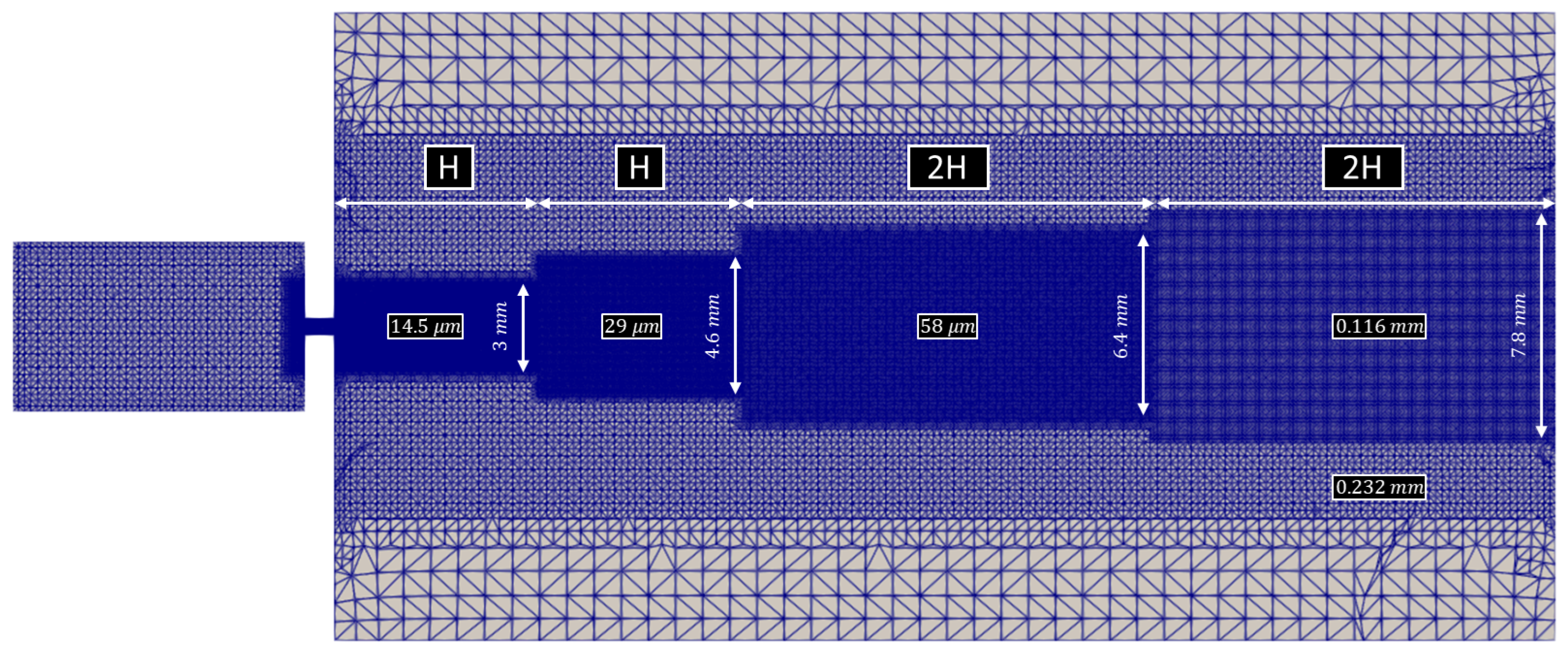
The reference experimental injection is presented in [12]. An injector with hole diameter of 0.58 mm, is supplied with hydrogen at nominal pressure of 200 bar, and connected to a low pressure environment, filled with nitrogen (N2) at 10 bar. A hexahedral-dominant mesh was created using cfMesh, as shown in Figure 1.
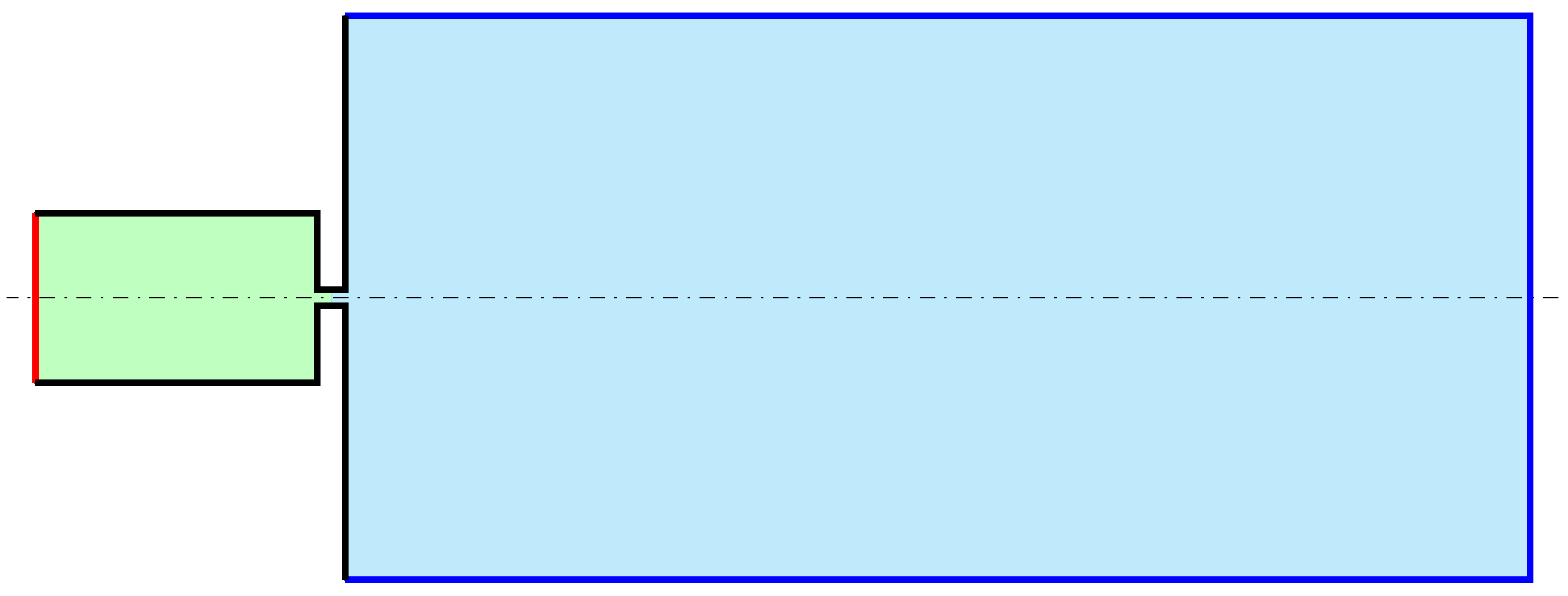
The computational domain consists of a high pressure chamber of radius 6 mm and length 10 mm, and a low pressure environment of radius 10 mm and length of 42 mm. The nozzle is modeled as a cylinder of diameter d = 0.58 mm and length L = 1 mm. The grid, with a base size of 0.928 mm, is progressively refined toward the nozzle within cylindrical regions. The dimension H is set to H = 12 D , and the maximum refinement level is 6, resulting in approximately 40 computational cells across the nozzle diameter. This mesh resolution was found to accurately describe the flow field structures, resolving turbulent scales down to approximately the Taylor length scale [15,18]. It is worth noting that the computational domain extends well beyond the refined region where the flow is accurately resolved. In general, when only a small portion of a larger environment is simulated, appropriate boundary conditions should be imposed. This requires knowledge of the time history of the flow variables at the boundaries, or at least their steady-state values when the transient behavior is not of interest. Since this information is often unavailable, a common practical solution is to place the domain boundaries sufficiently far from the jet to avoid boundary interactions and to prescribe the static pressure of the undisturbed environment, where the fluid remains subsonic. The total number of cells is around 25 millions. Initially, hydrogen occupies the high pressure tank and half of the nozzle at a pressure of 140 bar, corresponding to the effective steady-state injection pressure estimated upstream of the nozzle hole [12]. The rest of the computational domain contains nitrogen at 10 bar. With the employed setup, this numerical model does not simulate the real transient nozzle opening, during which pressure upstream of the nozzle hole and flow rate through it increase progressively. Instead, the model assumes an instant release of a diaphragm separating the high-pressure hydrogen from the low-pressure air, resulting in an instantaneous opening. While this affects the transient phenomena at the start of injection (SOI), there is no influence on the steady-state near-nozzle field under investigation. The initial temperature of both hydrogen and air is equal to 298 K. Total pressure and temperature boundary conditions are prescribed at the inlet of the high pressure chamber, while zero gradient temperature and outlet static pressure are imposed at the low pressure environment boundaries, as the flow is expected to remain subsonic. No slip condition is imposed for velocity at the domain walls. The complete domain boundaries are illustrated in Figure 2, and the corresponding boundary conditions are reported in Table 2.

4. Results and Discussion

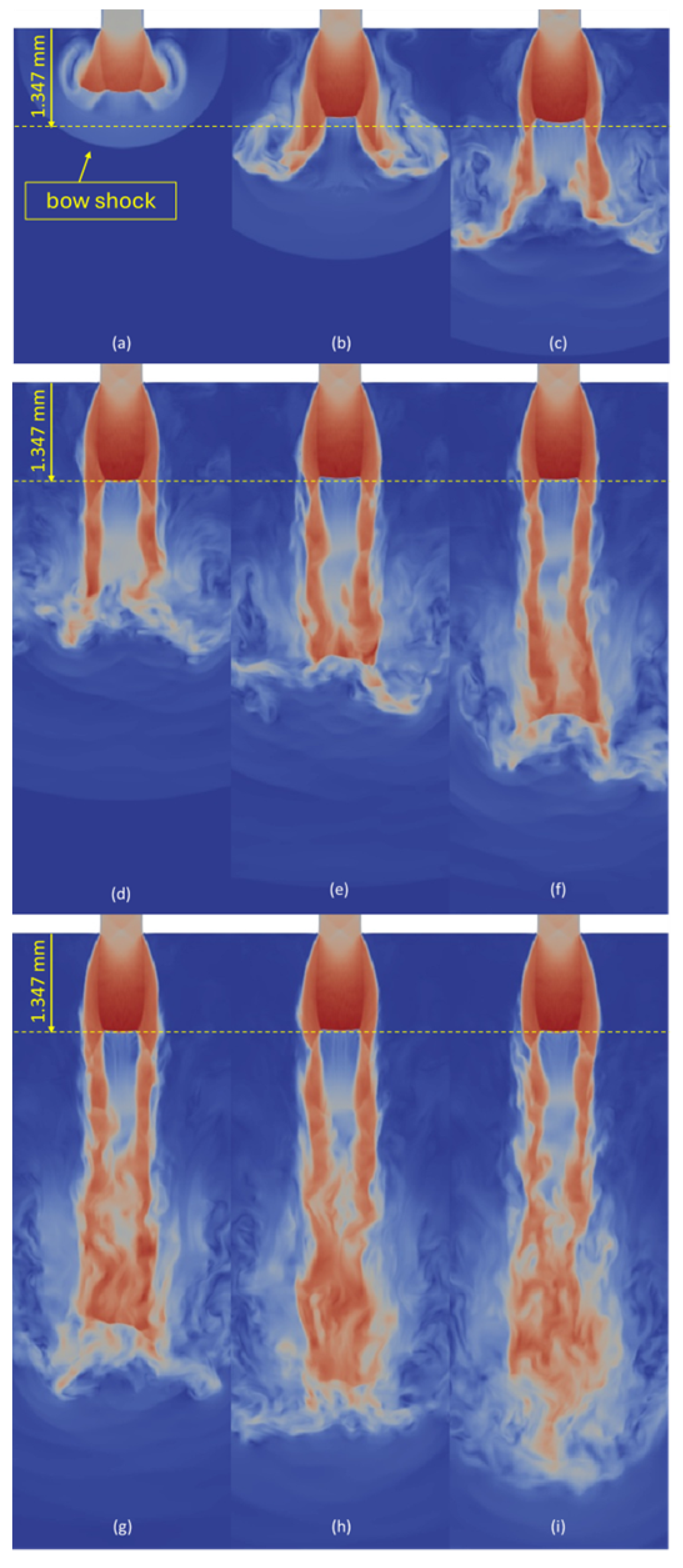
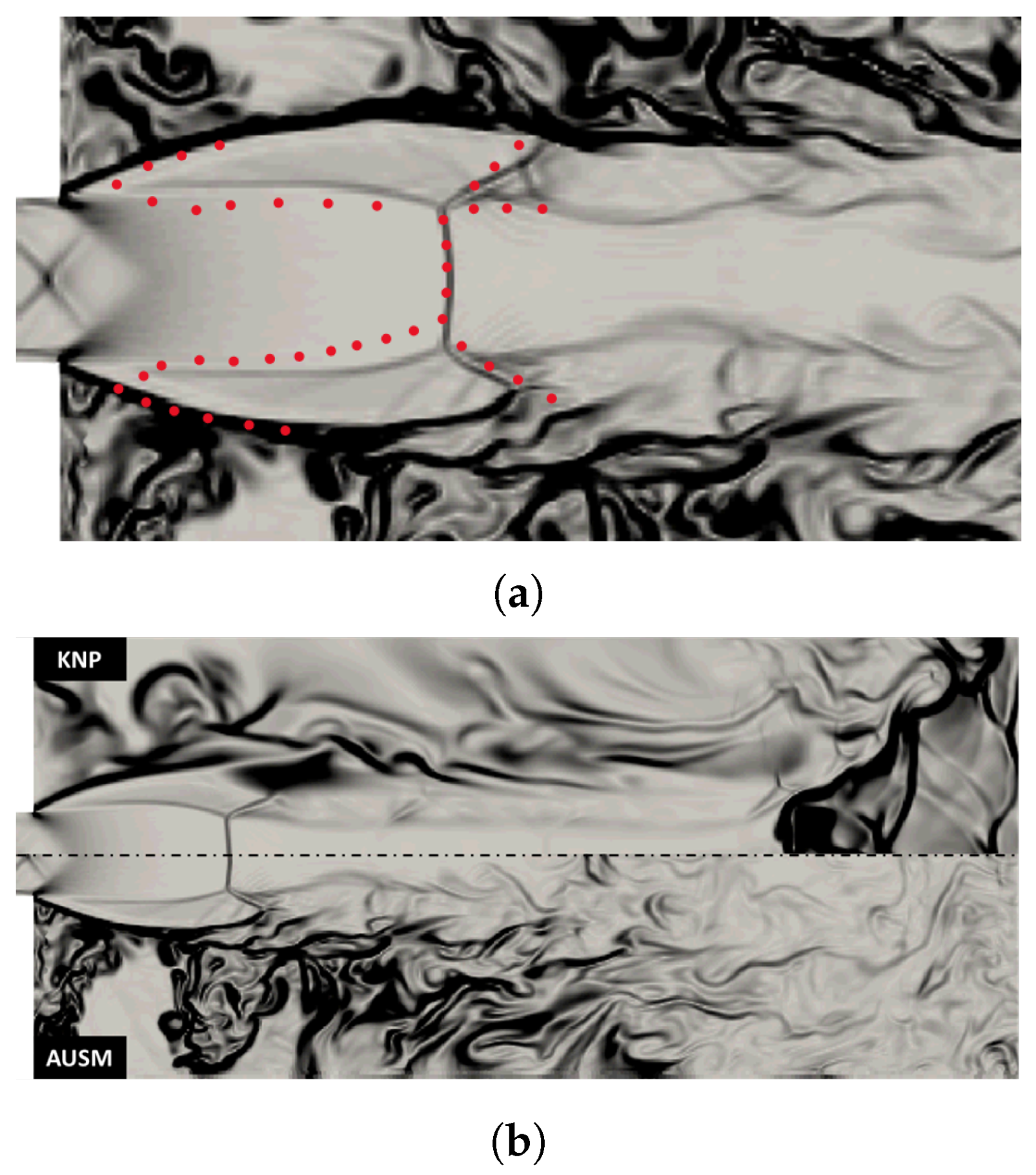
Two simulations were performed using the KNP scheme available in rhoCentralFoam, enhanced with the Runge–Kutta time integration scheme, and the AUSM scheme, which was newly implemented as described in Section 2. The KNP simulation was considered a reference case, since the same numerical investigation had already been successfully simulated in [15]. The following analysis therefore focuses on the differences between the two solvers in the numerical results, and, more specifically, on the accuracy of the AUSM scheme. Both simulations were performed on two computational nodes, each with 32 cores, equipped with Intel Xeon 6130 CPUs. The simulation time is approximately 90.5 h for the KNP simulation and 162.9 h for the AUSM one; further improvements of the AUSM scheme implementation in OpenFOAM can reduce the required computational time. Figure 3 shows the temporal evolution of the velocity magnitude obtained using the AUSM scheme, with the steady-state position of the numerical Mach disk indicated by the yellow dotted line (at a distance of 1.347 mm from the nozzle outlet). A spherical shock, known as a bow shock [17], propagates through the quiescent air in Figure 3a, while the hydrogen jet develops more slowly. Figure 3b shows the initial Mach disk, which forms approximately 6 μs after the SOI and moves toward its final position in Figure 3b–f, while its diameter increases. From this point onward, the Mach disk position and structure do not change significantly, while the jet continues to evolve at the tip and in the surrounding flow field, as illustrated in Figure 3g–i. Although this reproduces the reference injection, the experimental transient lasts around 170 μs, which is much slower than in simulations, where the Mach disk reaches its steady position after about 20 μs. This discrepancy, as anticipated in Section 3, was likely caused by the time delay associated with the pressurization of the injector chamber, which was not accounted for in the present simulation. The numerical Schlieren images in Figure 4 are obtained at t = 25 μ s by computing the magnitude of the density-gradient. Figure 4a shows a magnification of the near-nozzle field of the AUSM simulation result, compared with experimental data here represented as red dots replicating the relevant experimental discontinuities clearly visible in the optical data reported in [12]. The distance of the Mach disk from the nozzle outlet is approximately 1.347 mm for the ASUM simulation, and is very close to the experimental value of 1.345 mm. The AUSM scheme provides a diameter of 0.504 mm, which is a bit larger than the experimental diameter of 0.367 mm. However, AUSM numerical results show satisfactory agreement with experimental data. The Mach disk obtained with the KNP scheme can be observed in Figure 4b, where the KNP (upper half) and the AUSM simulations (lower half) are compared. The position and dimension of the Mach disk in the KNP simulation are 1.347 mm and 0.519 mm, respectively. While both schemes accurately predict the position of the Mach disk, the discrepancies on its diameter appear to be related to an asymmetry in the experimental datum, which is probably caused by reflected pressure waves that are absent in the present simulations, since the shorter simulated transient prevents any wall interaction. Table 3 summarizes the main geometrical features of the numerical and experimental Mach disks.
After reaching choked conditions, the computed mass flow rates are 1.856 g/s and 1.891 g/s for the AUSM and KNP simulations, respectively. A reference value can be obtained from the mass flow rate through an isentropic convergent nozzle at choked conditions [12]:
m ˙ = p 0 C D A e γ R T 0 2 γ + 1 γ + 1 2 ( γ 1 )
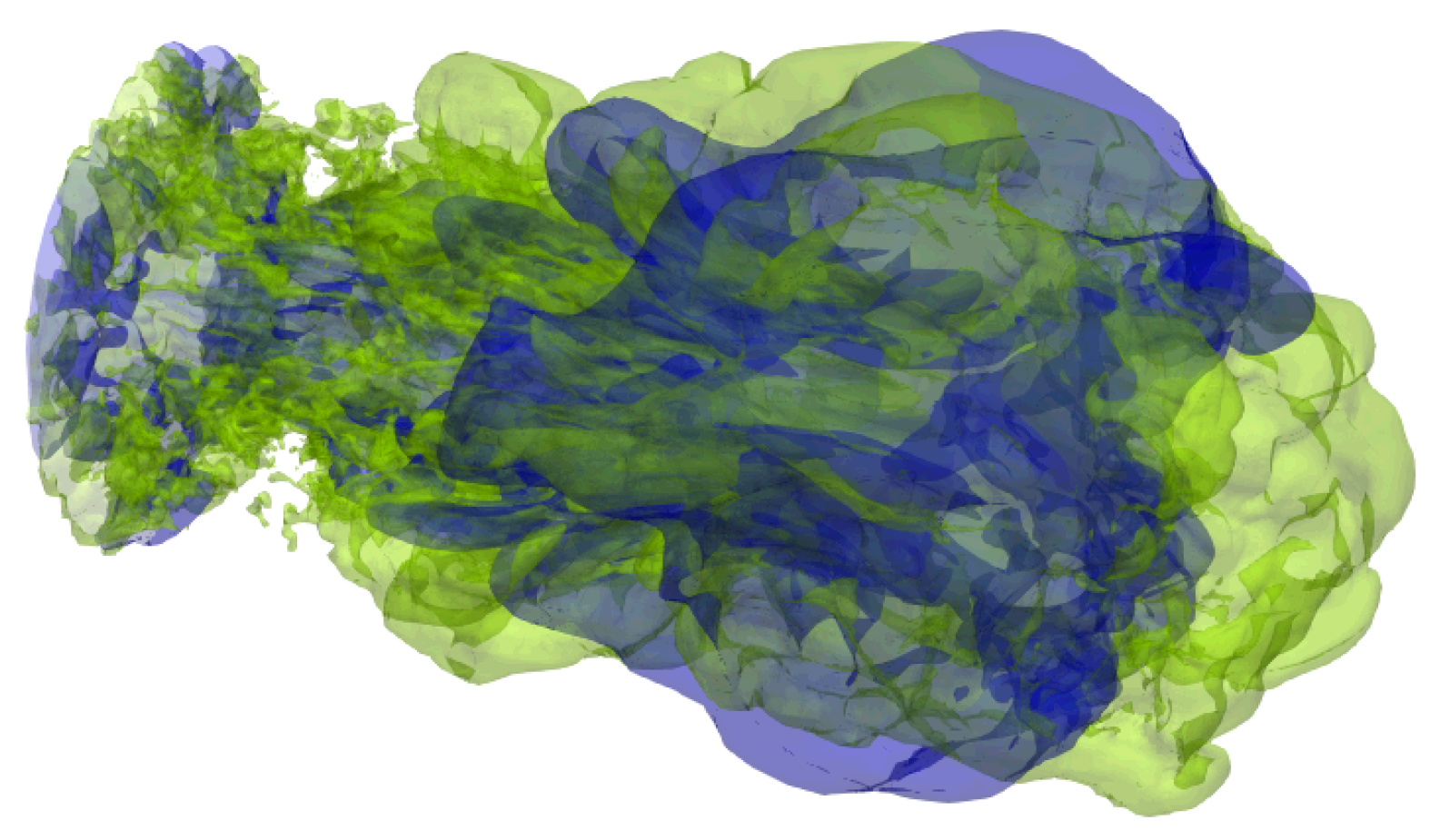
where p 0 and T 0 are, respectively, the total injection pressure and temperature, A e is the nozzle exit cross-sectional area, and C D = 0.79 is the discharge coefficient reported in [12]. For p 0 = 140 bar and T 0 = 298 K, the mass flow rate is equal to 1.805 g / s . In general, Figure 4 highlights the reduced dissipation of the AUSM scheme, which better capture small flow vortices, that tend to be smoothed and dissipated by the KNP scheme. This allows the smaller scales of turbulence to be better resolved—as small vortices are not dissipated—enhancing turbulent mixing. Figure 5 presents the isocontour surfaces of H2 mass fraction equal to 0.1 at t = 25 μ s , where the AUSM scheme (green isocontour) predicts a quicker jet penetration and a more intense gas mixing than KNP one (blue isocontour), in the region surrounding the jet. This results in a larger AUSM jet with surface area of 245.176   mm 2 and volume of 40.661 mm 3 , compared to 161.473 mm 2 and 40.661 mm 3 for the KNP simulation. The surface-to-volume ratio of the AUSM jet is approximately 52% higher than that of the KNP jet: the more pronounced wrinkled surface of the jet obtained with the AUSM scheme compared to the KNP one further highlights the reduced numerical diffusion of the former scheme.
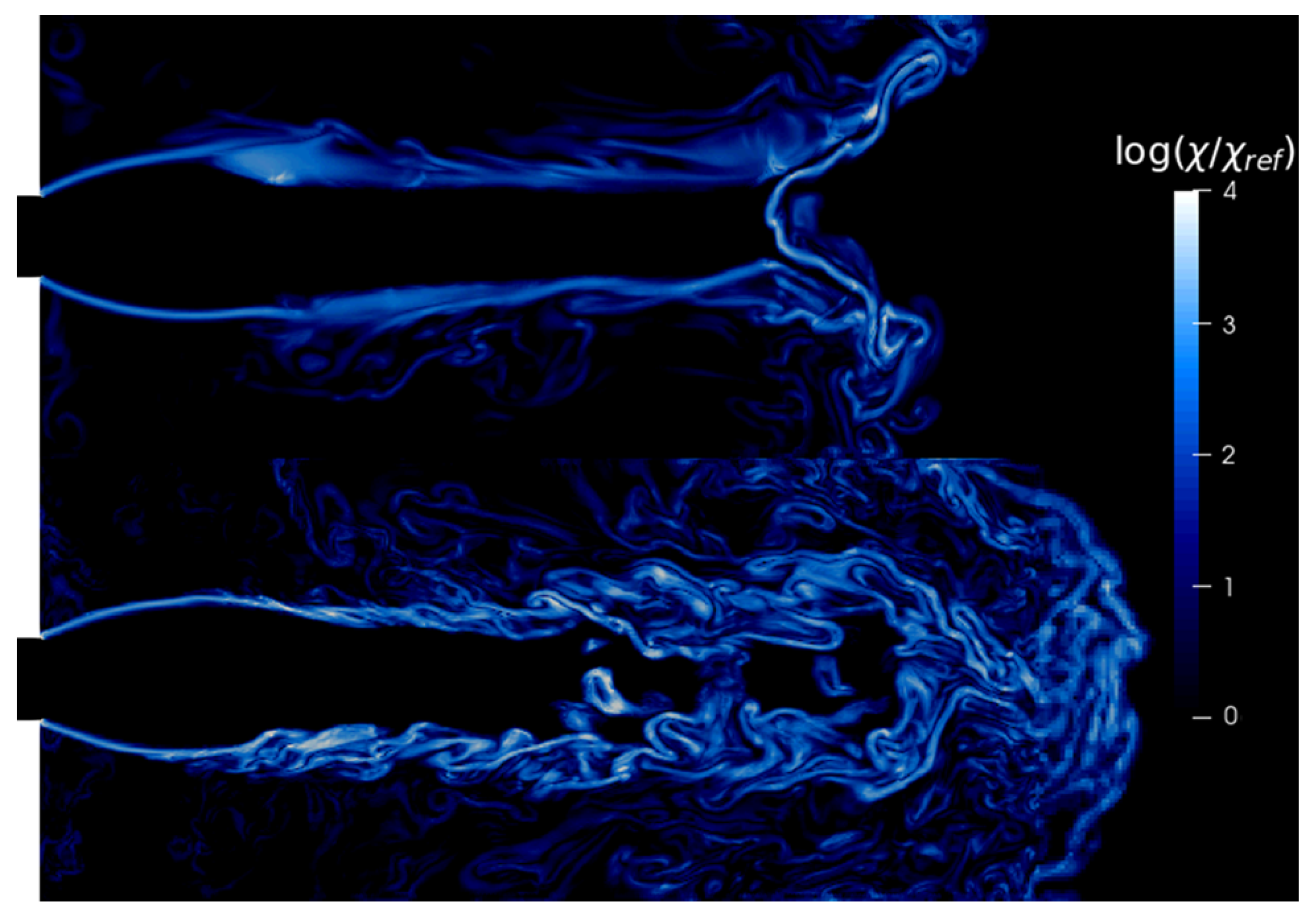
The analysis of the Scalar Dissipation Rate (SDR) confirms the higher mixing activity involving the AUSM simulation. The SDR of a scalar c is defined as [42,43]:
χ = 2 D c c 2
where D c is the mixture fraction diffusivity. Figure 6 shows the l o g 10 χ / χ ref of the H2 mass fraction, where χ ref = 2 D ref c max D 2 , with c max = 1 and D ref is the reference diffusivity of the far field [43]. The SDR field is quite uniform in the KNP simulation, with a well-defined surface that delimits the hydrogen jet from the surrounding nitrogen. The low SDR values do not indicate that mixing has already occurred, but rather that the mixing process is just starting. In contrast, this surface is wider and more corrugated in the AUSM simulation, indicating that mixing involves a larger amount of air. The high SDR values, comparable to those observed in the KNP simulation, suggest that the mixing process is still ongoing.
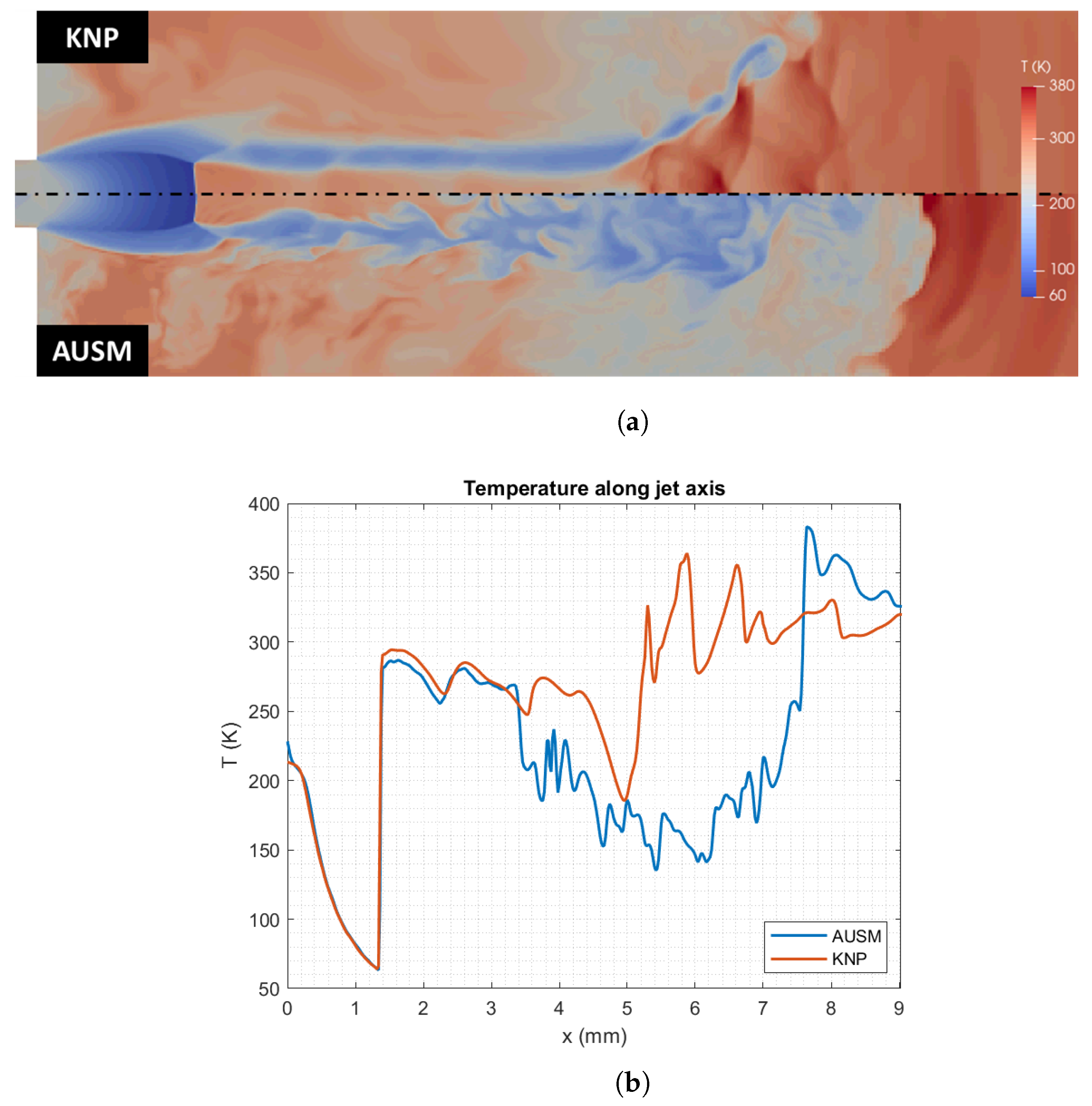
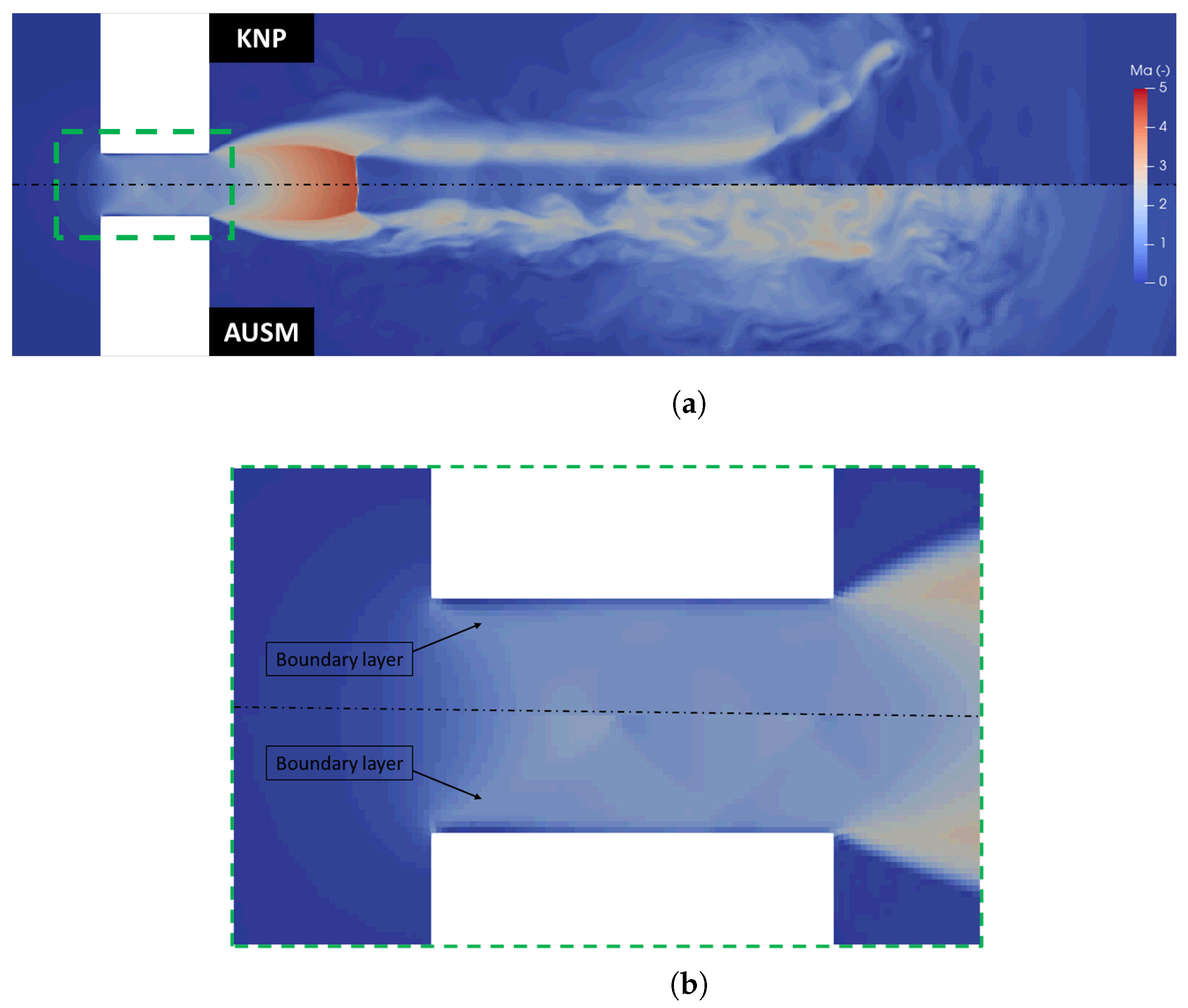
These results demonstrate the superior accuracy of the AUSM scheme for multi-component supersonic flows, outperforming the KNP scheme and providing a more detailed representation of the flow field. Despite its higher computational cost, the AUSM scheme offers a favorable trade-off between accuracy, applicability to real-gas models, and computational efficiency, making it a suitable density-based solver for the OpenFOAM library [29,31,32]. Figure 7 compares the temperature fields computed with the AUSM scheme (upper half) and the KNP scheme (lower half), while the temperature along the jet axis of the two simulations is shown in Figure 7b. Hydrogen undergoes an intense expansion at the nozzle exit, leading to the formation of a low-temperature region, where the hydrogen temperature drops to approximately 60 K. The minimum temperature is similar for both models, while more pronounced differences are observed at the nozzle outlet and downstream of the Mach disk. The former are attributed to oscillations inside the nozzle, where shocks originate at the nozzle’s sharp edges and subsequently reflect further along the walls; the latter result from a different mixing between the hot N2 and the cold H2. The use of a real gas model could improve accuracy, as the ideal gas model is not suitable for describing gases at such low temperatures, particularly hydrogen, which has a negative Joule–Thomson coefficient [17]. On the other hand, the present authors note that the JANAF polynomials are not valid for calculating specific heat under these conditions, as the gas temperature is well below the lower JANAF temperature limit, which typically corresponds to ambient temperature. Therefore, an appropriate specific heat model should be established, regardless of the gas model used. Nevertheless, the ideal gas model and the constant specific heat assumption still provide an accurate description of the Mach disk structure. The Mach number is presented in Figure 8a, where both the KNP (upper half) and the AUSM scheme (lower half) provide a Mach number around 1.4 at the nozzle outlet. According to [44], a supersonic flow in a convergent duct can be attributed to the formation of a boundary layer inside the channel. Figure 8b shows the magnification of the Mach field inside the nozzle. In both simulations, a thin boundary layer detaches from the nozzle wall as a result of the abrupt variation in nozzle cross-section. The boundary layer reduces the effective cross-sectional area of the nozzle, forming a convergent-divergent geometry that accelerates the flow to supersonic velocities. The boundary layer is slightly thicker in the KNP simulation.

5. Conclusions

The AUSM scheme was implemented in an OpenFOAM library. The solver was successfully validated against an experimental under-expanded H2 injection from the literature. The numerical model accurately captured the near-nozzle field and the results were in satisfactory agreement with other CFD investigations in the literature. The numerical results were compared with those computed with the KNP scheme, which is commonly used for simulating under-expanded jets in OpenFOAM. The Mach disk structure was well reproduced by both schemes, whereas more pronounced differences were observed in the flow field downstream of and surrounding the disk. The lower dissipation of the AUSM scheme resulted in a significantly higher turbulence intensity, which increased the jet penetration and enhanced the gas mixing. Specifically, the isocontour surfaces of the hydrogen mass fraction revealed a larger jet volume and surface, as well as a higher surface to volume ratio, while the SDR confirmed the higher mixing activity. In conclusion, the present work demonstrated the superior performance of the AUSM scheme and proposed it as an alternative numerical method for the simulation of multi-component supersonic flows within the OpenFOAM environment.

Author Contributions

Conceptualization, O.V.; methodology, A.F., O.V. and C.B.; software, C.B.; validation, C.B.; formal analysis, O.V. and C.B.; investigation, O.V. and C.B.; resources, A.F.; data curation, C.B.; writing—original draft preparation, C.B.; writing—review and editing, A.F. and O.V.; visualization, C.B.; supervision, A.F. and O.V.; project administration, A.F.; funding acquisition, A.F. All authors have read and agreed to the published version of the manuscript.

Funding

This publication is part of the project PNRR-NGEU which has received funding from the MUR—DM 118/2023.

Data Availability Statement

The original contributions presented in this study are included in the article. Further inquiries can be directed to the corresponding author.

Acknowledgments

Computational resources provided by HPC@PoliTO, www.hpc.polito.it (accessed on 4 February 2026).

Conflicts of Interest

Authors have no known competing financial interests or personal relationship that could have appeared to influence the work reported in this paper.

Abbreviations

The following abbreviations are used in this manuscript:
AUSMAdvection Upwind Splitting Method
AMRAdaptative Mesh Refinement
CFDComputational Fluid Dynamics
DIDirect Injection
HPDIHigh Pressure Direct Injection
H2ICEsH2 Internal Combustion Engines
IVCIntake Valve Closure
KNPKurganov–Noelle–Petrova
LESLarge Eddy Simulation
LPDILow Pressure Direct Injection
PFIPort Fuel Injection
SDRScalar Dissipation Rate
SOIStart Of Injection
WALEWall Adaptative Large Eddy
WENOWeighted Essentially Non Oscillatory

References

  1. Stępień, Z. A comprehensive overview of hydrogen-fueled internal combustion engines: Achievements and future challenges. Energies 2021, 14, 6504. [Google Scholar] [CrossRef]
  2. Hu, Z.; Yuan, S.; Wei, H.; Huang, Z.; Wei, H.; Chan, S.H.; Zhou, L. High-pressure injection or low-pressure injection for a direct injection hydrogen engine? Int. J. Hydrogen Energy 2024, 59, 383–389. [Google Scholar] [CrossRef]
  3. Pavan, N.; Cicalese, G.; Gestri, L.; Fontanesi, S.; Breda, S.; Mechi, M.; Vongher, S.; Postrioti, L.; Buitoni, G.; Martino, M. Effects of Jet Caps on Hydrogen Piezoelectric Injectors for DI Applications: Experiments and 3D-CFD Simulations. In Proceedings of the WCX SAE World Congress Experience; SAE Technical Paper; SAE International: Warrendale, PA, USA, 2025. [Google Scholar]
  4. Onorati, A.; Payri, R.; Vaglieco, B.M.; Agarwal, A.K.; Bae, C.; Bruneaux, G.; Canakci, M.; Gavaises, M.; Günthner, M.; Hasse, C.; et al. The role of hydrogen for future internal combustion engines. Int. J. Engine Res. 2022, 23, 529–540. [Google Scholar] [CrossRef]
  5. Merotto, L.; Balmelli, M.; Soltic, P. Hydrogen direct injection: Optical investigation of premixed and jet-guided combustion modes. Int. J. Hydrogen Energy 2024, 61, 284–295. [Google Scholar] [CrossRef]
  6. Liu, X.; Srna, A.; Yip, H.L.; Kook, S.; Chan, Q.N.; Hawkes, E.R. Performance and emissions of hydrogen-diesel dual direct injection (H2DDI) in a single-cylinder compression-ignition engine. Int. J. Hydrogen Energy 2021, 46, 1302–1314. [Google Scholar] [CrossRef]
  7. Liu, X.; Yang, L.; Chan, Q.N.; Kook, S. Split injection strategies for a high-pressure hydrogen direct injection in a small-bore dual-fuel diesel engine. Int. J. Hydrogen Energy 2024, 57, 904–917. [Google Scholar] [CrossRef]
  8. Kim, S.; Lee, J.; Lee, S.; Lee, S.; Kim, K.; Min, K. Effects of various compression ratios on a direct injection spark ignition hydrogen-fueled engine in a single-cylinder engine. Int. J. Automot. Technol. 2024, 25, 1159–1172. [Google Scholar] [CrossRef]
  9. Park, C.; Kim, Y.; Oh, S.; Oh, J.; Choi, Y.; Baek, H.; Lee, S.W.; Lee, K. Effect of fuel injection timing and injection pressure on performance in a hydrogen direct injection engine. Int. J. Hydrogen Energy 2022, 47, 21552–21564. [Google Scholar] [CrossRef]
  10. Ferrari, A.; Pizzo, P. Injection Technologies and Mixture Formation Strategies for Spark Ignition and Dual-Fuel Engines; SAE International: Warrendale, PA, USA, 2022. [Google Scholar]
  11. Ferrari, A. Fondamenti di Termofluidodinamica per le Macchine; CittàStudiEdizioni: Novara, Italy, 2020. [Google Scholar]
  12. Yip, H.L.; Srna, A.; Liu, X.; Kook, S.; Hawkes, E.R.; Chan, Q.N. Visualization of hydrogen jet evolution and combustion under simulated direct-injection compression-ignition engine conditions. Int. J. Hydrogen Energy 2020, 45, 32562–32578. [Google Scholar] [CrossRef]
  13. Falfari, S.; Cazzoli, G.; Mariani, V.; Bianchi, G.M. Hydrogen application as a fuel in internal combustion engines. Energies 2023, 16, 2545. [Google Scholar] [CrossRef]
  14. Gurri, S.; Vento, O.; Marello, O.; Finesso, R.; Gallo, A.; Vargiu, L.; Ferrari, A. A methodology for boundary condition optimization in 3D-CFD of internal combustion engines. Appl. Therm. Eng. 2026, 292, 130270. [Google Scholar] [CrossRef]
  15. Duronio, F.; De Vita, A. CFD analysis of hydrogen and methane turbulent transitional under-expanded jets. Int. J. Heat Fluid Flow 2024, 107, 109381. [Google Scholar] [CrossRef]
  16. Duronio, F.; Ranieri, S.; Mascio, A.D.; Vita, A.D. Simulation of high pressure, direct injection processes of gaseous fuels by a density-based OpenFOAM solver. Phys. Fluids 2021, 33, 066104. [Google Scholar] [CrossRef]
  17. Hamzehloo, A.; Aleiferis, P. Large eddy simulation of near-nozzle shock structure and mixing characteristics of hydrogen jets for direct-injection spark-ignition engines. In Proceedings of the International Conference on Heat Transfer, Fluid Mechanics and Thermodynamics, Orlando, FL, USA, 14–16 July 2014. [Google Scholar]
  18. Hamzehloo, A.; Aleiferis, P. Gas dynamics and flow characteristics of highly turbulent under-expanded hydrogen and methane jets under various nozzle pressure ratios and ambient pressures. Int. J. Hydrogen Energy 2016, 41, 6544–6566. [Google Scholar] [CrossRef]
  19. Hamzehloo, A.; Aleiferis, P. Numerical modelling of transient under-expanded jets under different ambient thermodynamic conditions with adaptive mesh refinement. Int. J. Heat Fluid Flow 2016, 61, 711–729. [Google Scholar] [CrossRef]
  20. Franquet, E.; Perrier, V.; Gibout, S.; Bruel, P. Free underexpanded jets in a quiescent medium: A review. Prog. Aerosp. Sci. 2015, 77, 25–53. [Google Scholar] [CrossRef]
  21. Allocca, L.; Montanaro, A.; Meccariello, G.; Duronio, F.; Ranieri, S.; De Vita, A. Under-eXpanded Gaseous Jets Characterization for Application in Direct Injection Engines: Experimental and Numerical Approach; Technical Report, SAE Technical Paper; SAE International: Warrendale, PA, USA, 2020. [Google Scholar]
  22. Zaghi, S.; Di Mascio, A.; Favini, B. Application of WENO-positivity-preserving schemes to highly under-expanded jets. J. Sci. Comput. 2016, 69, 1033–1057. [Google Scholar] [CrossRef]
  23. Vuorinen, V.; Keskinen, J.P.; Duwig, C.; Boersma, B.J. On the implementation of low-dissipative Runge–Kutta projection methods for time dependent flows using OpenFOAM®. Comput. Fluids 2014, 93, 153–163. [Google Scholar] [CrossRef]
  24. Liou, M.S.; Steffen, C.J., Jr. A new flux splitting scheme. J. Comput. Phys. 1993, 107, 23–39. [Google Scholar] [CrossRef]
  25. Liou, M.S. A sequel to ausm: Ausm+. J. Comput. Phys. 1996, 129, 364–382. [Google Scholar] [CrossRef]
  26. Liou, M.S. A sequel to AUSM, Part II: AUSM+-up for all speeds. J. Comput. Phys. 2006, 214, 137–170. [Google Scholar] [CrossRef]
  27. Kitamura, K.; Liou, M.S.; Chang, C.H. Extension and comparative study of AUSM-family schemes for compressible multiphase flow simulations. Commun. Comput. Phys. 2014, 16, 632–674. [Google Scholar] [CrossRef]
  28. Zang, B.; US, V.; New, T.H.D. OpenFOAM based numerical simulation study of an underexpanded supersonic jet. In Proceedings of the 55th AIAA Aerospace Sciences Meeting, Grapevine, TX, USA, 9–13 January 2017; p. 0747. [Google Scholar]
  29. Arya, N.; Bhaduri, S.; De, A. Acoustic characteristics of supersonic planar impinging jets. Eur. J. -Mech.-B/Fluids 2023, 102, 56–79. [Google Scholar] [CrossRef]
  30. Modesti, D.; Pirozzoli, S. A low-dissipative solver for turbulent compressible flows on unstructured meshes, with OpenFOAM implementation. Comput. Fluids 2017, 152, 14–23. [Google Scholar] [CrossRef]
  31. Duronio, F.; Di Mascio, A. Implementation and assessment of a low-dissipative OpenFOAM solver for compressible multi-species flows. Comput. Fluids 2024, 274, 106240. [Google Scholar] [CrossRef]
  32. Jiang, C.; Pan, J.; Zhu, Y.; Li, J.; Quaye, E.K. Development and verification of a high-speed compressible reactive flow solver in OpenFOAM. J. Comput. Sci. 2022, 63, 101780. [Google Scholar] [CrossRef]
  33. Greenshields, C.J.; Weller, H.G.; Gasparini, L.; Reese, J.M. Implementation of semi-discrete, non-staggered central schemes in a colocated, polyhedral, finite volume framework, for high-speed viscous flows. Int. J. Numer. Methods Fluids 2010, 63, 1–21. [Google Scholar] [CrossRef]
  34. Kurganov, A.; Noelle, S.; Petrova, G. Semidiscrete central-upwind schemes for hyperbolic conservation laws and Hamilton–Jacobi equations. SIAM J. Sci. Comput. 2001, 23, 707–740. [Google Scholar] [CrossRef]
  35. Marcantoni, L.G.; Elaskar, S.; Tamagno, J.; Saldía, J.; Krause, G. An assessment of the OpenFOAM implementation of the KNP scheme to simulate strong explosions. Shock Waves 2021, 31, 193–202. [Google Scholar] [CrossRef]
  36. Chase, M.W. NIST-JANAF thermochemical tables. J. Phys. Chem. Ref. Data 1998, 28, 1951. [Google Scholar]
  37. Vuorinen, V.; Yu, J.; Tirunagari, S.; Kaario, O.; Larmi, M.; Duwig, C.; Boersma, B. Large-eddy simulation of highly underexpanded transient gas jets. Phys. Fluids 2013, 25, 016101. [Google Scholar] [CrossRef]
  38. Sutherland, W. LII. The viscosity of gases and molecular force. Lond. Edinb. Dublin Philos. Mag. J. Sci. 1893, 36, 507–531. [Google Scholar] [CrossRef]
  39. Nicoud, F.; Ducros, F. Subgrid-scale stress modelling based on the square of the velocity gradient tensor. Flow Turbul. Combust. 1999, 62, 183–200. [Google Scholar] [CrossRef]
  40. Toro, E.F. Riemann Solvers and Numerical Methods for Fluid Dynamics: A Practical Introduction; Springer Science & Business Media: Berlin/Heidelberg, Germany, 2013. [Google Scholar]
  41. Van Leer, B. Towards the ultimate conservative difference scheme. II. Monotonicity and conservation combined in a second-order scheme. J. Comput. Phys. 1974, 14, 361–370. [Google Scholar] [CrossRef]
  42. Duronio, F.; Montanaro, A.; Ranieri, S.; Allocca, L.; De Vita, A. Under-expanded jets characterization by means of cfd numerical simulation using an open foam density-based solver. In Proceedings of the 15th International Conference on Engines & Vehicles; SAE Technical Paper; SAE International: Warrendale, PA, USA, 2021. [Google Scholar]
  43. Yu, J.; Vuorinen, V.; Kaario, O.; Sarjovaara, T.; Larmi, M. Visualization and analysis of the characteristics of transitional underexpanded jets. Int. J. Heat Fluid Flow 2013, 44, 140–154. [Google Scholar] [CrossRef]
  44. Afroosheh, M.; Vakilimoghaddam, F.; Paraschivoiu, M. Boundary layer effects on the critical nozzle of hydrogen sonic jet. Int. J. Hydrogen Energy 2017, 42, 7440–7446. [Google Scholar] [CrossRef]
Figure 1. Computational mesh section.
Energies 19 01871 g001
Figure 2. Boundary and initial conditions: inlet (red), outlet (blue) and wall (black). Hydrogen is represented in light green, and nitrogen in cyan.
Energies 19 01871 g002
Figure 3. Velocity magnitude time evolution for AUSM simulation: 3 μs (a), 6 μs (b), 9 μs (c), 12 μs (d), 15 μs (e), 18 μs (f), 21 μs (g), 23 μs (h), and 25 μs (i). Red: high velocity, blue: low velocity.
Energies 19 01871 g003
Figure 4. Numerical Schlieren images at 25 μs: (a) magnification of the Mach disk for the AUSM simulation (red dots indicate experimental data); (b) comparison between KNP (upper half) and AUSM results (lower half).
Energies 19 01871 g004
Figure 5. Iso-surfaces of H2 mass fraction equal to 0.1 at 25 μs: KNP (blue), and AUSM (green).
Energies 19 01871 g005
Figure 6. SDR of H2 mass fraction at 25 μs: KNP scheme (top), and AUSM scheme (bottom).
Energies 19 01871 g006
Figure 7. (a) Temperature fields at 25 μs of KNP (upper half) and AUSM (lower half); (b) temperature along jet axis of KNP (red) and AUSM (blue).
Energies 19 01871 g007
Figure 8. (a) Mach field at 25 μs, and (b) zoom of the Mach field inside the nozzle of KNP (upper half) and AUSM (lower half).
Energies 19 01871 g008
Table 1. Thermophysical properties.
Specie c p ( J / kg K ) A S ( μ Pa / K · s ) T S ( K )
N 2 1040 1.512 120
H 2 14,303 0.6362 72
Table 2. Boundary conditions.
BoundaryPressureTemperatureVelocity
TypeValueTypeValueType
inlettotalPressure140 bartotalTemperature298 KzeroGradient
outletfixedValue10 barzeroGradient-zeroGradient
wallzeroGradient-zeroGradient-noSlip
Table 3. Geometrical features of the Mach disks.
DataDistance (mm)Diameter (mm)
Experimental1.3450.367
KNP1.3470.519
AUSM1.3470.504
Disclaimer/Publisher’s Note: The statements, opinions and data contained in all publications are solely those of the individual author(s) and contributor(s) and not of MDPI and/or the editor(s). MDPI and/or the editor(s) disclaim responsibility for any injury to people or property resulting from any ideas, methods, instructions or products referred to in the content.