Baseline Load Estimation Using Intelligent Performance Quantification for Incentive-Based Demand Response Programs

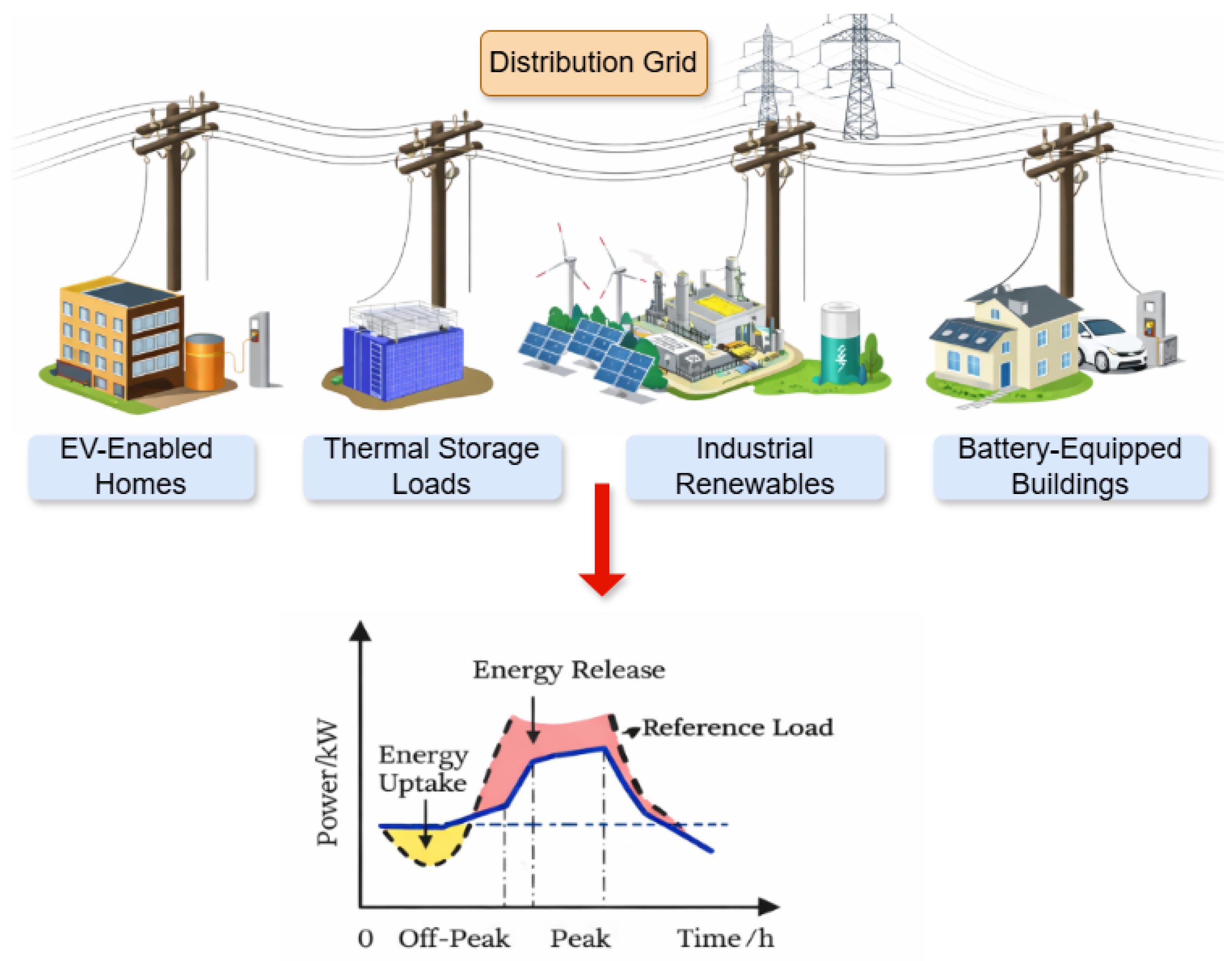
 ,
,  ,
,
Abstract
1. Introduction
Contributions of the Paper
- This paper reframes baseline load estimation as a performance quantification and economic settlement problem, rather than only a statistical prediction task.
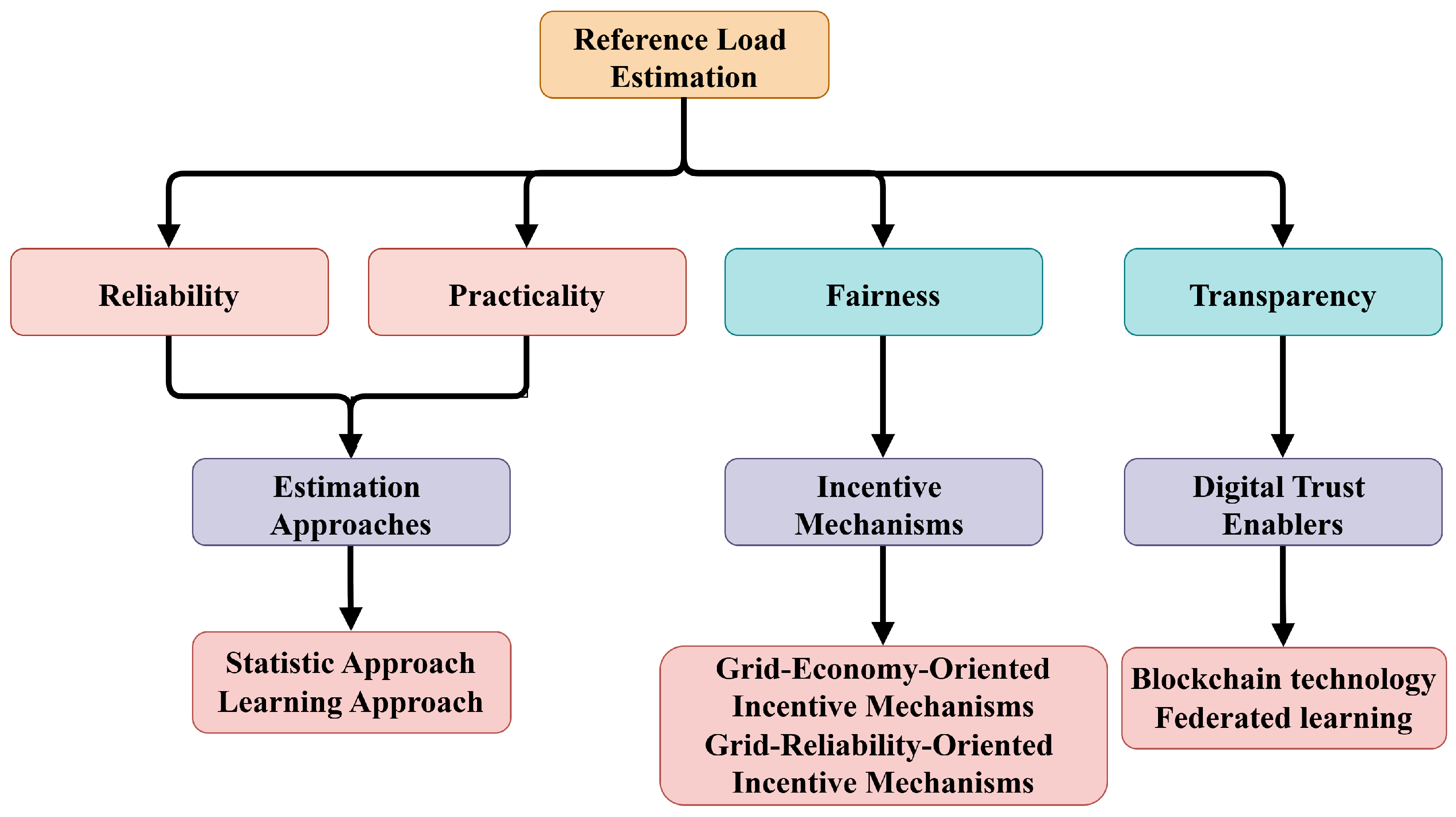
- It proposes a four-dimensional evaluation framework based on reliability, practicality, fairness, and transparency, enabling a more complete assessment of baseline methods in real DR settings.
- It maps estimation approaches to DR service classes, settlement structures, and end-user types, thereby providing a decision-support taxonomy for method selection.
- It extends the review beyond conventional model comparison by incorporating digital trust enablers, manipulation resistance, and baseline-light alternatives as part of future market-ready baseline intelligence.
2. Conceptual Foundations and Market-Oriented Requirements of Baseline Load Estimation
2.1. Reliability
2.2. Practicality
2.3. Fairness
2.4. Transparency
3. Taxonomy of Baseline Load Estimation Approaches
3.1. Rule-Based and Statistical Approach
3.2. Regression-Based Approaches
3.3. Probabilistic Approaches
3.4. Machine Learning Approaches
3.5. Hybrid and Physics-Informed Approaches
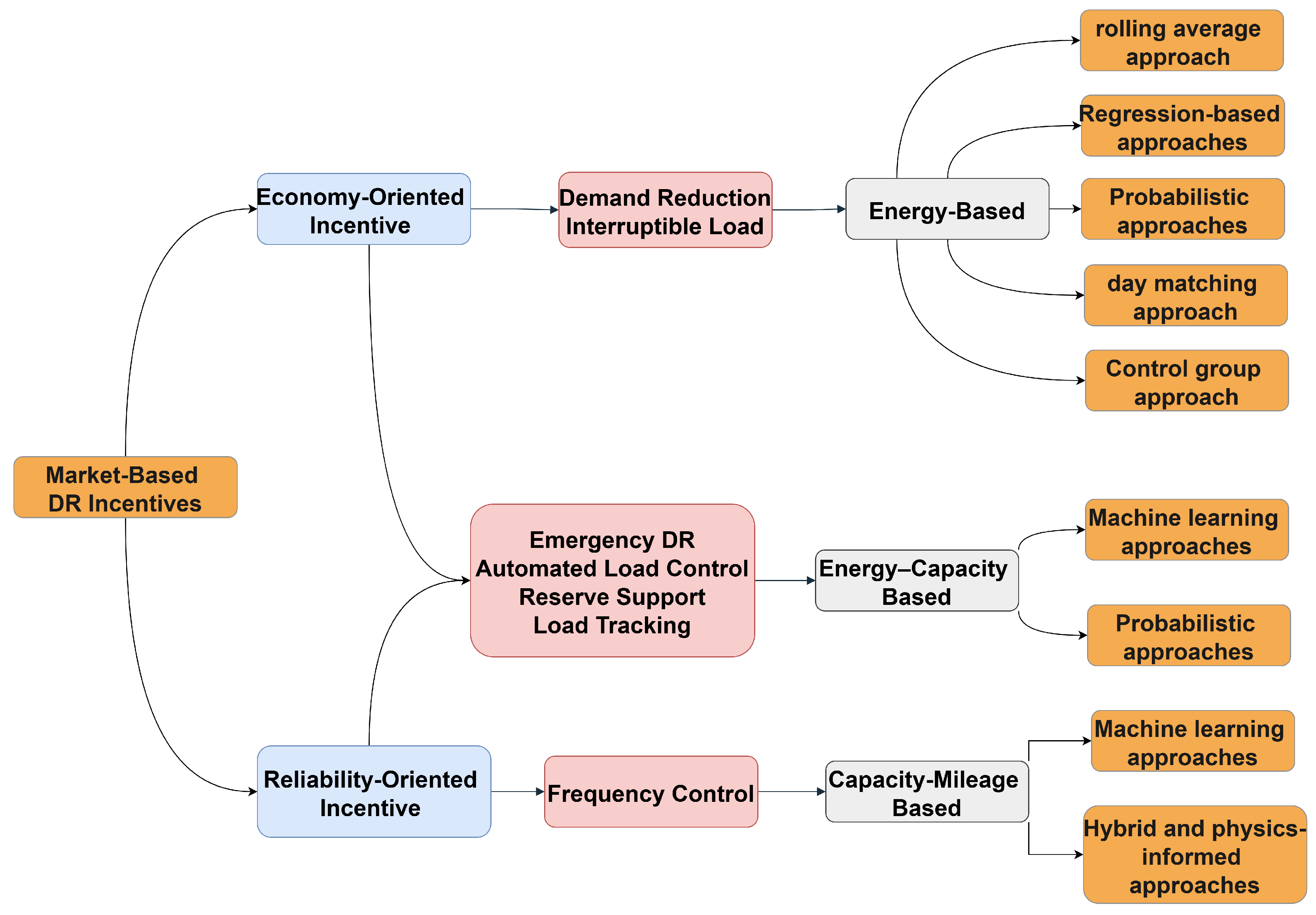
4. Incentive Mechanisms for Market-Oriented DR
4.1. Grid-Economy-Oriented Incentive Mechanisms
4.1.1. Energy-Based Compensation Structures
4.1.2. Credit-Scoring and Performance Rating Mechanisms
4.1.3. Self-Reported Baseline Declaration
4.1.4. Profit-Sharing and Revenue Allocation Models
4.1.5. Hierarchical Game-Theoretic Mechanisms
4.2. Grid-Reliability-Oriented Incentive Mechanisms
4.2.1. Capacity-Based Compensation Schemes
4.2.2. Mileage-Based Performance Payments
4.2.3. Incentive-Compatible Contract Design
5. Digital Trust Enablers in DR Market
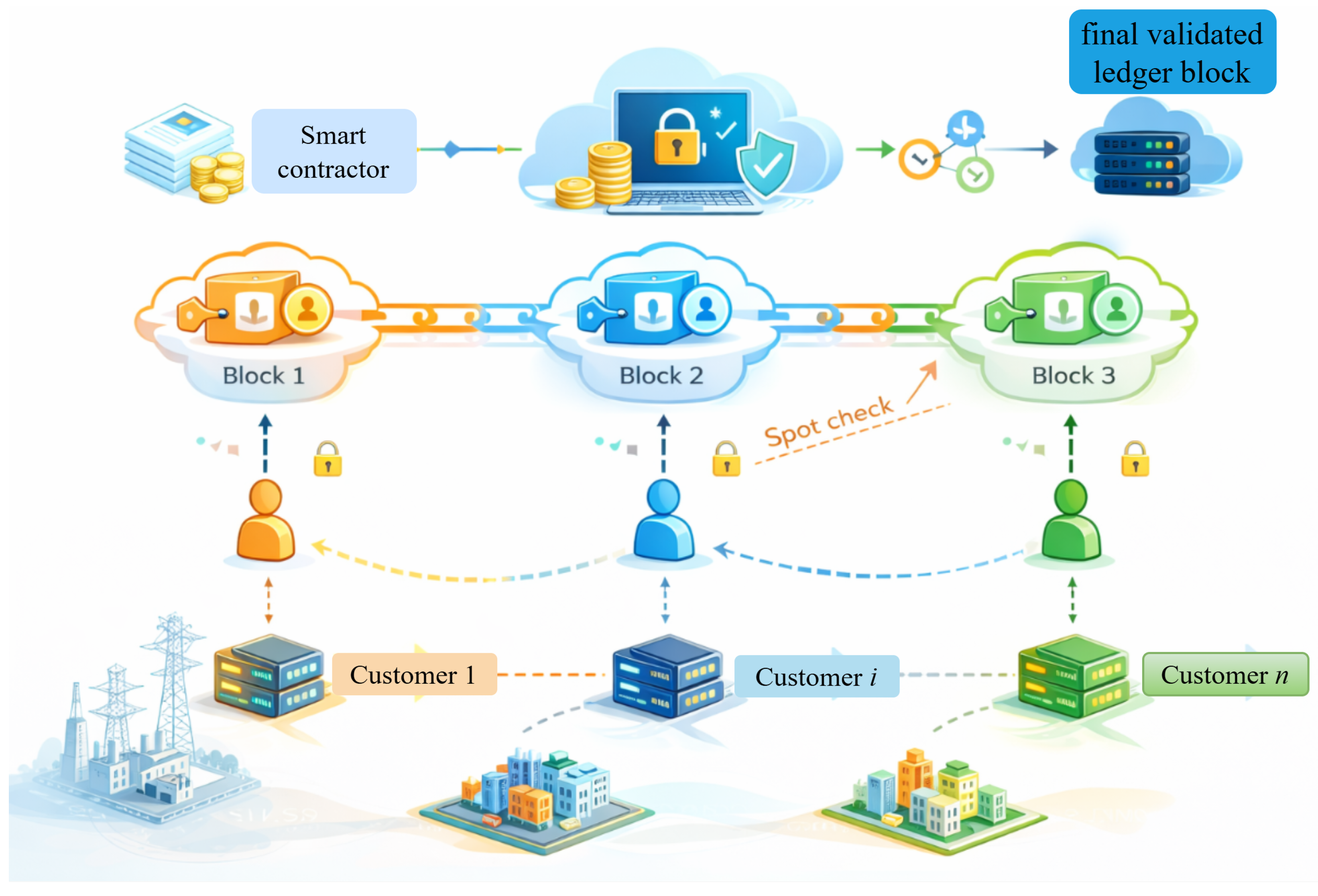
5.1. Blockchain Technology
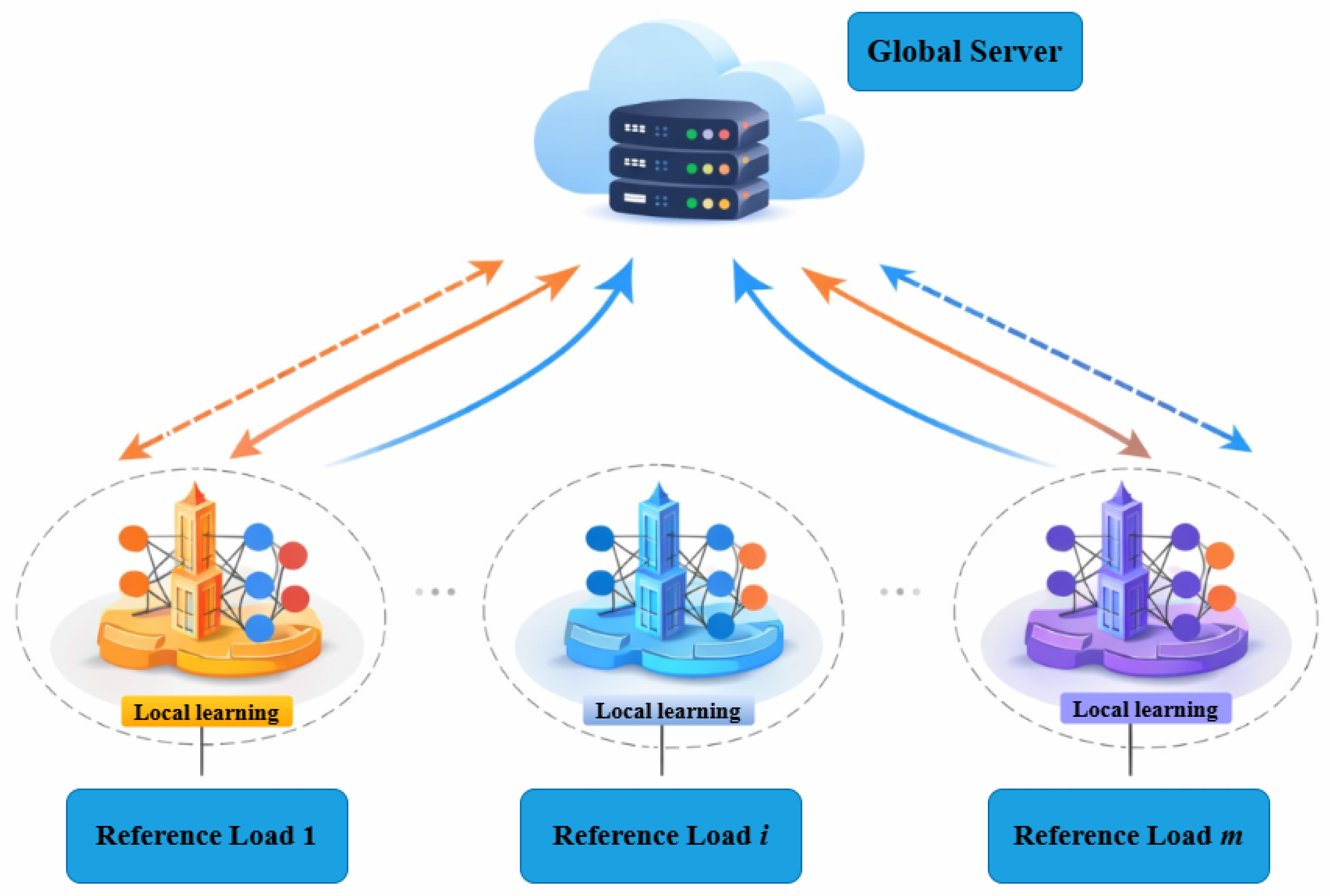
5.2. Federated Learning
6. Open Challenges and Future Research Directions
6.1. Invisible Behind-the-Meter Consumption Behaviors
6.2. Overlapping Consumers in Multi-Service Participation
6.3. The Dilemma of Unavailable Data
6.4. Trustworthiness of Baseline Load Estimation Methods
7. Conclusions
Author Contributions
Funding
Data Availability Statement
Acknowledgments
Conflicts of Interest
References
- Ejuh Che, E.; Roland Abeng, K.; Iweh, C.D.; Tsekouras, G.J.; Fopah-Lele, A. The impact of integrating variable renewable energy sources into grid-connected power systems: Challenges, mitigation strategies, and prospects. Energies 2025, 18, 689. [Google Scholar] [CrossRef]
- Kabeyi, M.J.B.; Olanrewaju, O.A. Sustainable energy transition for renewable and low carbon grid electricity generation and supply. Front. Energy Res. 2022, 9, 743114. [Google Scholar] [CrossRef]
- Islam, M.M.; Yu, T.; Giannoccaro, G.; Mi, Y.; La Scala, M.; Nasab, M.R.; Wang, J. Improving reliability and stability of the power systems: A comprehensive review on the role of energy storage systems to enhance flexibility. IEEE Access 2024, 12, 152738–152765. [Google Scholar] [CrossRef]
- Tang, H.; Wang, S.; Li, H. Flexibility categorization, sources, capabilities and technologies for energy-flexible and grid-responsive buildings: State-of-the-art and future perspective. Energy 2021, 219, 119598. [Google Scholar] [CrossRef]
- Siano, P. Demand response and smart grids—A survey. Renew. Sustain. Energy Rev. 2014, 30, 461–478. [Google Scholar] [CrossRef]
- Li, Y.; Yang, Y.; Zhang, F.; Li, Y. A Stackelberg game-based approach to load aggregator bidding strategies in electricity spot markets. J. Energy Storage 2024, 95, 112509. [Google Scholar] [CrossRef]
- Türkoğlu, A.S.; Erkmen, B.; Eren, Y.; Erdinç, O.; Küçükdemiral, İ. Integrated approaches in resilient hierarchical load forecasting via TCN and optimal valley filling based demand response application. Appl. Energy 2024, 360, 122722. [Google Scholar] [CrossRef]
- Li, K.; Wang, F.; Mi, Z.; Fotuhi-Firuzabad, M.; Duić, N.; Wang, T. Capacity and output power estimation approach of individual behind-the-meter distributed photovoltaic system for demand response baseline estimation. Appl. Energy 2019, 253, 113595. [Google Scholar] [CrossRef]
- Lee, H.; Jang, H.; Oh, S.H.; Kim, N.W.; Kim, S.; Lee, B.T. Novel single group-based indirect customer baseline load calculation method for residential demand response. IEEE Access 2021, 9, 140881–140895. [Google Scholar] [CrossRef]
- Muqtadir, A.; Li, B.; Ying, Z.; Songsong, C.; Kazmi, S.N. Nowcasting the next hour of residential load using boosting ensemble machines. Sci. Rep. 2025, 15, 7157. [Google Scholar] [CrossRef]
- Chandrasekaran, R.; Paramasivan, S.K. Advances in deep learning techniques for short-term energy load forecasting applications: A review. Arch. Comput. Methods Eng. 2025, 32, 663–692. [Google Scholar] [CrossRef]
- Klyuev, R.V.; Morgoev, I.D.; Morgoeva, A.D.; Gavrina, O.A.; Martyushev, N.V.; Efremenkov, E.A.; Mengxu, Q. Methods of forecasting electric energy consumption: A literature review. Energies 2022, 15, 8919. [Google Scholar] [CrossRef]
- Srinivasan, S.; Kumarasamy, S.; Andreadakis, Z.E.; Lind, P.G. Artificial intelligence and mathematical models of power grids driven by renewable energy sources: A survey. Energies 2023, 16, 5383. [Google Scholar] [CrossRef]
- Xu, T.; Wang, F. Review and prospect of power demand response implementation. Distrib. Energy 2024, 9, 1–11. [Google Scholar]
- Gabaldón, A.; García-Garre, A.; Ruiz-Abellón, M.C.; Guillamón, A.; Álvarez Bel, C.; Fernandez-Jimenez, L.A. Improvement of customer baselines for the evaluation of demand response through the use of physically-based load models. Util. Policy 2021, 70, 101213. [Google Scholar] [CrossRef]
- Ziras, C.; Heinrich, C.; Bindner, H.W. Why baselines are not suited for local flexibility markets. Renew. Sustain. Energy Rev. 2021, 135, 110357. [Google Scholar] [CrossRef]
- Liaquat, S.; Zia, M.F.; Benbouzid, M. Modeling and formulation of optimization problems for optimal scheduling of multi-generation and hybrid energy systems: Review and recommendations. Electronics 2021, 10, 1688. [Google Scholar] [CrossRef]
- Zhang, Y.; Fan, S.; Meng, Y.; He, G. Payment and incentive allocation in demand response based on cost causation principle. IEEE Trans. Ind. Appl. 2025, 61, 8674–8687. [Google Scholar] [CrossRef]
- Valentini, O.; Andreadou, N.; Bertoldi, P.; Lucas, A.; Saviuc, I.; Kotsakis, E. Demand response impact evaluation: A review of methods for estimating the customer baseline load. Energies 2022, 15, 5259. [Google Scholar] [CrossRef]
- Lind, L.; Chaves-Ávila, J.P.; Valarezo, O.; Sanjab, A.; Olmos, L. Baseline methods for distributed flexibility in power systems considering resource, market, and product characteristics. Util. Policy 2024, 86, 101688. [Google Scholar] [CrossRef]
- Yan, X.; Gao, B.; Yu, Y.; Liu, N. Cooperated operation for renewable energy community with energy storage capacity rental in the frequency regulation market. IEEE Trans. Ind. Inform. 2023, 20, 5182–5192. [Google Scholar] [CrossRef]
- Chen, Y.; Liu, F.; Wei, W.; Mei, S. Energy sharing at demand side: Concept, mechanism and prospect. Autom. Electr. Power Syst. 2021, 45, 1–11. [Google Scholar]
- Lee, K.; Lee, H.; Lee, H.; Yoon, Y.; Lee, E.; Rhee, W. Assuring explainability on demand response targeting via credit scoring. Energy 2018, 161, 670–679. [Google Scholar] [CrossRef]
- Lv, T.; Yan, Y.; Li, L.; Zhou, Z.; Zhang, Z.; Zhang, T.; Yang, L.; Lin, Z. Credit-based demand side incentive mechanism optimization for load aggregator. Energy Rep. 2022, 8, 227–234. [Google Scholar] [CrossRef]
- Anil, V.; Arun, S. Credit rating-based transactive energy system with uncertainties in energy behavior. IEEE Access 2023, 11, 132101–132118. [Google Scholar] [CrossRef]
- Wang, X.; Tang, W. Modeling and analysis of baseline manipulation in demand response programs. IEEE Trans. Smart Grid 2021, 13, 1178–1186. [Google Scholar] [CrossRef]
- Segovia, E.; Vukovic, V.; Bragatto, T. Comparison of baseline load forecasting methodologies for active and reactive power demand. Energies 2021, 14, 7533. [Google Scholar] [CrossRef]
- Haring, T.; Andersson, G. Contract design for demand response. In Proceedings of the IEEE PES Innovative Smart Grid Technologies, Europe; IEEE: New York, NY, USA, 2014; pp. 1–6. [Google Scholar]
- Hurley, D.; Peterson, P.; Whited, M. Demand Response as a Power System Resource; Synapse Energy Economics Inc.: Cambridge, MA, USA, 2013. [Google Scholar]
- Chapman, N. Techno-Economic Assessment of Business Cases for Multi-Energy Demand Response. Ph.D. Thesis, The University of Manchester, Manchester, UK, 2016. [Google Scholar]
- Ullah, K.; Basit, A.; Ullah, Z.; Aslam, S.; Herodotou, H. Automatic generation control strategies in conventional and modern power systems: A comprehensive overview. Energies 2021, 14, 2376. [Google Scholar] [CrossRef]
- Fraija, A.; Henao, N.; Agbossou, K.; Kelouwani, S.; Fournier, M. Cooperative price-based demand response program for multiple aggregators based on multi-agent reinforcement learning and Shapley-value. Sustain. Energy Grids Netw. 2024, 40, 101560. [Google Scholar] [CrossRef]
- Tang, H.; Wang, S. Game-theoretic optimization of demand-side flexibility engagement considering the perspectives of different stakeholders and multiple flexibility services. Appl. Energy 2023, 332, 120550. [Google Scholar] [CrossRef]
- Chao, H.-P. Demand response in wholesale electricity markets: The choice of customer baseline. J. Regul. Econ. 2011, 39, 68–88. [Google Scholar] [CrossRef]
- Chao, H.-P.; DePillis, M. Incentive effects of paying demand response in wholesale electricity markets. J. Regul. Econ. 2013, 43, 265–283. [Google Scholar] [CrossRef]
- Zhang, L.; Zhu, T.; Xiong, P.; Zhou, W.; Yu, P.S. A robust game-theoretical federated learning framework with joint differential privacy. IEEE Trans. Knowl. Data Eng. 2022, 35, 3333–3346. [Google Scholar] [CrossRef]
- Sciume, G.; Palacios-Garcia, E.J.; Gallo, P.; Sanseverino, E.R.; Vasquez, J.C.; Guerrero, J.M. Demand response service certification and customer baseline evaluation using blockchain technology. IEEE Access 2020, 8, 139313–139331. [Google Scholar] [CrossRef]
- Ghasemi, A.; Hojjat, M.; Saebi, J.; Neisaz, H.R.; Hosseinzade, M.R. An investigation of the customer baseline load (CBL) calculation for industrial demand response participants–A regional case study from Iran. Sustain. Oper. Comput. 2023, 4, 88–95. [Google Scholar] [CrossRef]
- Lee, E.; Lee, K.; Lee, H.; Kim, E.; Rhee, W. Defining virtual control group to improve customer baseline load calculation of residential demand response. Appl. Energy 2019, 250, 946–958. [Google Scholar] [CrossRef]
- Wu, T.; Hu, R.; Zhu, H.; Jiang, M.; Lv, K.; Dong, Y.; Zhang, D. Combined IXGBoost-KELM short-term photovoltaic power prediction model based on multidimensional similar day clustering and dual decomposition. Energy 2024, 288, 129770. [Google Scholar] [CrossRef]
- Muqtadir, A.; Li, B.; Qi, B.; Chen, S.; Shi, K. DualDRNet: A Unified Deep Learning Framework for Customer Baseline Load Estimation and Demand Response Potential Forecasting for Load Aggregators. IEEE Access 2025, 13, 167280–167301. [Google Scholar] [CrossRef]
- Muthirayan, D.; Kalathil, D.; Poolla, K.; Varaiya, P. Baseline estimation and scheduling for demand response. In Proceedings of the 2018 IEEE Conference on Decision and Control (CDC); IEEE: New York, NY, USA, 2018; pp. 4857–4862. [Google Scholar]
- Binz Varghese, K. Baseline Load Estimation of Residential Customers for Incentive Based Demand Response Programs. Ph.D. Thesis, Universitat Politècnica de Catalunya, Barcelona, Spain, 2024. [Google Scholar]
- Jiang, H.; Kong, X.; Zhang, X.; Wang, Z.; Guo, M. Deep Learning-based Quantile Regression for Demand Response Potential Assessment. In Proceedings of the 2024 IEEE Power & Energy Society General Meeting (PESGM); IEEE: New York, NY, USA, 2024; pp. 1–5. [Google Scholar]
- Zhang, X.; Hug, G.; Kolter, J.Z.; Harjunkoski, I. Demand response of ancillary service from industrial loads coordinated with energy storage. IEEE Trans. Power Syst. 2017, 33, 951–961. [Google Scholar] [CrossRef]
- Chen, Y.; Xu, P.; Chu, Y.; Li, W.; Wu, Y.; Ni, L.; Bao, Y.; Wang, K. Short-term electrical load forecasting using the Support Vector Regression (SVR) model to calculate the demand response baseline for office buildings. Appl. Energy 2017, 195, 659–670. [Google Scholar] [CrossRef]
- Weng, Y.; Yu, J.; Rajagopal, R. Probabilistic baseline estimation based on load patterns for better residential customer rewards. Int. J. Electr. Power Energy Syst. 2018, 100, 508–516. [Google Scholar] [CrossRef]
- Tehrani, N.H.; Khan, U.T.; Crawford, C. Baseline load forecasting using a Bayesian approach. In Proceedings of the 2016 IEEE Canadian Conference on Electrical and Computer Engineering (CCECE); IEEE: New York, NY, USA, 2016; pp. 1–4. [Google Scholar]
- Li, K.; Wang, B.; Wang, Z.; Wang, F.; Mi, Z.; Zhen, Z. A baseline load estimation approach for residential customer based on load pattern clustering. Energy Procedia 2017, 142, 2042–2049. [Google Scholar] [CrossRef]
- Sun, M.; Wang, Y.; Teng, F.; Ye, Y.; Strbac, G.; Kang, C. Clustering-based residential baseline estimation: A probabilistic perspective. IEEE Trans. Smart Grid 2019, 10, 6014–6028. [Google Scholar] [CrossRef]
- Bapin, Y.; Zarikas, V. Probabilistic estimation of spinning reserves in smart grids with Bayesian-driven reserve allocation adjustment algorithm. Int. J. Energy Sect. Manag. 2021, 15, 433–455. [Google Scholar] [CrossRef]
- Klem, A.; Stephen, G. Capacity valuation of demand response in the presence of variable generation through Monte Carlo analysis. In Proceedings of the 2019 IEEE Power & Energy Society Innovative Smart Grid Technologies Conference (ISGT); IEEE: New York, NY, USA, 2019; pp. 1–5. [Google Scholar]
- Jost, D.; Speckmann, M.; Sandau, F.; Schwinn, R. A new method for day-ahead sizing of control reserve in Germany under a 100% renewable energy sources scenario. Electr. Power Syst. Res. 2015, 119, 485–491. [Google Scholar] [CrossRef]
- Wang, S.; Sun, Y.; Zhang, S.; Zhou, Y.; Hou, D.; Wang, J. Very short-term probabilistic prediction of PV based on multi-period error distribution. Electr. Power Syst. Res. 2023, 214, 108817. [Google Scholar] [CrossRef]
- He, Y.; Yu, N.; Wang, B. Online probability density prediction of wind power considering virtual and real concept drift detection. Appl. Energy 2025, 396, 126318. [Google Scholar] [CrossRef]
- Gassar, A.A.A. Short-term energy forecasting to improve the estimation of demand response baselines in residential neighborhoods: Deep learning vs. machine learning. Buildings 2024, 14, 2242. [Google Scholar] [CrossRef]
- Xiao, J.W.; Liu, P.; Fang, H.; Liu, X.K.; Wang, Y.W. Short-term residential load forecasting with baseline-refinement profiles and bi-attention mechanism. IEEE Trans. Smart Grid 2023, 15, 1052–1062. [Google Scholar] [CrossRef]
- Ardiansyah; Kim, Y.; Choi, D. Lstm-based multi-step soc forecasting of battery energy storage in grid ancillary services. In Proceedings of the 2021 IEEE International Conference on Communications, Control, and Computing Technologies for Smart Grids (SmartGridComm); IEEE: New York, NY, USA, 2021; pp. 276–281. [Google Scholar]
- Khosravi, N.; Dowlatabadi, M.; Sabzevari, K. A hierarchical deep learning approach to optimizing voltage and frequency control in networked microgrid systems. Appl. Energy 2025, 377, 124313. [Google Scholar] [CrossRef]
- Yao, X.; Fu, X.; Zong, C. Short-term load forecasting method based on feature preference strategy and LightGBM-XGboost. IEEE Access 2022, 10, 75257–75268. [Google Scholar] [CrossRef]
- Jo, Y.; Hur, J. An improved ramp events forecasting of wind generating resources using ensemble learning of numerical weather prediction: The case of Jeju Island’s wind farms. Therm. Sci. Eng. Prog. 2025, 66, 103936. [Google Scholar] [CrossRef]
- Hao, Z.; Liu, S.; Zhang, Y.; Ying, C.; Feng, Y.; Su, H.; Zhu, J. Physics-informed machine learning: A survey on problems, methods and applications. arXiv 2022, arXiv:2211.08064. [Google Scholar]
- Huang, X.; Li, Q.; Tai, Y.; Chen, Z.; Liu, J.; Shi, J.; Liu, W. Time series forecasting for hourly photovoltaic power using conditional generative adversarial network and Bi-LSTM. Energy 2022, 246, 123403. [Google Scholar] [CrossRef]
- Harikrishnan, G.; Sreedharan, S. Advanced short-term load forecasting for residential demand response: An XGBoost-ANN ensemble approach. Electr. Power Syst. Res. 2025, 242, 111476. [Google Scholar]
- Wu, W.; Wang, Z.; Li, X.; Guo, L.; Liu, Y.; Zhai, J.; Wang, C. Physics-informed probability distribution assessment for primary frequency regulation capability of wind farms considering wind speed uncertainty. J. Mod. Power Syst. Clean Energy 2025, 14, 541–551. [Google Scholar]
- Bao, Y.Q.; Shen, C.; Wang, Q.; Zhang, J.L. Demand response based on Kalman-filtering for the frequency control. J. Electr. Eng. Technol. 2019, 14, 1087–1094. [Google Scholar] [CrossRef]
- Panda, S.K. Electrical load and solar power forecasting using machine learning techniques. J. King Saud Univ.–Eng. Sci. 2025, 37, 1–14. [Google Scholar] [CrossRef]
- Wen, Q.; Liu, Y. Feature engineering and selection for prosumer electricity consumption and production forecasting: A comprehensive framework. Appl. Energy 2025, 381, 125176. [Google Scholar] [CrossRef]
- Koltsaklis, N.; Panapakidis, I.P.; Pozo, D.; Christoforidis, G.C. A prosumer model based on smart home energy management and forecasting techniques. Energies 2021, 14, 1724. [Google Scholar] [CrossRef]
- AlHammadi, K.A. Analysis of Energy Storage Technologies in the United Arab Emirates: Current State and Future Needs. Ph.D. Thesis, Khalifa University of Science, Abu Dhabi, United Arab Emirates, 2024. [Google Scholar]
- Ellman, D.; Xiao, Y. Incentives to manipulate demand response baselines with uncertain event schedules. IEEE Trans. Smart Grid 2020, 12, 1358–1369. [Google Scholar] [CrossRef]
- Zhen, C.; Niu, J.; Tian, Z.; Lu, Y.; Liang, C. Risk-averse transactions optimization strategy for building users participating in incentive-based demand response programs. Appl. Energy 2025, 380, 125009. [Google Scholar] [CrossRef]
- Vuelvas, J.; Ruiz, F.; Gruosso, G. Limiting gaming opportunities on incentive-based demand response programs. Appl. Energy 2018, 225, 668–681. [Google Scholar] [CrossRef]
- Wang, X.; Tang, W. A self-reported baseline demand response program for mitigation of baseline manipulation. In Proceedings of the 2021 IEEE Power & Energy Society General Meeting (PESGM); IEEE: New York, NY, USA, 2021; pp. 1–5. [Google Scholar]
- Muthirayan, D.; Kalathil, D.; Poolla, K.; Varaiya, P. Mechanism design for demand response programs. IEEE Trans. Smart Grid 2019, 11, 61–73. [Google Scholar] [CrossRef]
- Wijaya, T.K.; Vasirani, M.; Aberer, K. When bias matters: An economic assessment of demand response baselines for residential customers. IEEE Trans. Smart Grid 2014, 5, 1755–1763. [Google Scholar] [CrossRef]
- Dobakhshari, D.G.; Gupta, V. A contract design approach for phantom demand response. IEEE Trans. Autom. Control 2018, 64, 1974–1988. [Google Scholar] [CrossRef]
- Dehghanpour, K.; Nehrir, H. An agent-based hierarchical bargaining framework for power management of multiple cooperative microgrids. IEEE Trans. Smart Grid 2017, 10, 514–522. [Google Scholar] [CrossRef]
- Yang, Y.; Zhao, Y.; Yan, G.; Mu, G.; Chen, Z. Real time aggregation control of P2H loads in a virtual power plant based on a multi-period Stackelberg game. Energy 2024, 303, 131484. [Google Scholar] [CrossRef]
- Samadi, M.; Kebriaei, H.; Schriemer, H.; Erol-Kantarci, M. Stochastic demand response management using mixed-strategy Stackelberg game. IEEE Syst. J. 2022, 16, 4708–4718. [Google Scholar] [CrossRef]
- Cui, F.; An, D.; Zhang, G. A game strategy for demand response based on load monitoring in smart grid. Front. Energy Res. 2023, 11, 1240542. [Google Scholar] [CrossRef]
- Nekouei, E.; Alpcan, T.; Chattopadhyay, D. Game-theoretic frameworks for demand response in electricity markets. IEEE Trans. Smart Grid 2014, 6, 748–758. [Google Scholar] [CrossRef]
- Stanelyte, D.; Radziukyniene, N.; Radziukynas, V. Overview of demand-response services: A review. Energies 2022, 15, 1659. [Google Scholar] [CrossRef]
- Aghamohamadi, M.; Hajiabadi, M.E.; Samadi, M. A novel approach to multi energy system operation in response to DR programs; an application to incentive-based and time-based schemes. Energy 2018, 156, 534–547. [Google Scholar] [CrossRef]
- Ma, K.; Kumar, P. Incentive compatibility in stochastic dynamic systems. IEEE Trans. Autom. Control 2020, 66, 651–666. [Google Scholar] [CrossRef]
- Li, Z.; Hu, P.; Li, S.; Zhao, W.; Wang, X. Research on Capacity Market Settlement Method Based on VCG Mechanism. In Proceedings of the 2024 3rd Asian Conference on Frontiers of Power and Energy (ACFPE); IEEE: New York, NY, USA, 2024; pp. 200–204. [Google Scholar]
- Abedrabboh, K.; Al-Fagih, L. Applications of mechanism design in market-based demand-side management: A review. Renew. Sustain. Energy Rev. 2023, 171, 113016. [Google Scholar] [CrossRef]
- Wang, T.; Xu, Y.; Withanage, C.; Lan, L.; Ahipaşaoğlu, S.D.; Courcoubetis, C.A. A fair and budget-balanced incentive mechanism for energy management in buildings. IEEE Trans. Smart Grid 2016, 9, 3143–3153. [Google Scholar] [CrossRef]
- Yang, F.; Feng, J.; Li, D.; Zhang, B. Incentive-compatibility auction and renewable energy pricing strategy based on incomplete Information game of price cost declaration. Energy Sources Part B Econ. Plan. Policy 2023, 18, 2280880. [Google Scholar] [CrossRef]
- Koukaras, P.; Afentoulis, K.D.; Gkaidatzis, P.A.; Mystakidis, A.; Ioannidis, D.; Vagropoulos, S.I.; Tjortjis, C. Integrating blockchain in smart grids for enhanced demand response: Challenges, strategies, and future directions. Energies 2024, 17, 1007. [Google Scholar] [CrossRef]
- Li, B.; Banimenia, I.; Chuan, L.; Zhansheng, H.; Zhao, J. Incentive-based demand response program with self-reported baseline supported by blockchain technology. IET Smart Grid 2023, 6, 205–218. [Google Scholar] [CrossRef]
- Xi, L.; Wang, C.; Zheng, T.; Zhang, K. Baseline Load Estimation for Demand Response Based on Blockchain and Neural Networks. In Proceedings of the 2023 IEEE International Conference on Mechatronics and Automation (ICMA); IEEE: New York, NY, USA, 2023; pp. 2259–2264. [Google Scholar]
- Junaidi, N.; Abdullah, M.P.; Alharbi, B.; Shaaban, M. Blockchain-based management of demand response in electric energy grids: A systematic review. Energy Rep. 2023, 9, 5075–5100. [Google Scholar] [CrossRef]
- Sarker, M.A.A.; Shanmugam, B.; Azam, S.; Thennadil, S. Enhancing smart grid load forecasting: An attention-based deep learning model integrated with federated learning and XAI for security and interpretability. Intell. Syst. Appl. 2024, 23, 200422. [Google Scholar] [CrossRef]
- Wang, R.; Qiu, H.; Gao, H.; Li, C.; Dong, Z.Y.; Liu, J. Adaptive horizontal federated learning-based demand response baseline load estimation. IEEE Trans. Smart Grid 2023, 15, 1659–1669. [Google Scholar] [CrossRef]
- Chen, Y.; Chen, C.; Zhang, X.; Cui, M.; Li, F.; Wang, X.; Yin, S. Privacy-preserving baseline load reconstruction for residential demand response considering distributed energy resources. IEEE Trans. Ind. Inform. 2021, 18, 3541–3550. [Google Scholar] [CrossRef]
- Shi, Y.; Li, Y. Demand Response Flexibility Prediction of Residents Based on Federated Learning. In Proceedings of the 2022 China International Conference on Electricity Distribution (CICED); IEEE: New York, NY, USA, 2022; pp. 70–74. [Google Scholar]
- Cheng, H.; Lu, T.; Hao, R.; Li, J.; Ai, Q. Incentive-based demand response optimization method based on federated learning with a focus on user privacy protection. Appl. Energy 2024, 358, 122570. [Google Scholar] [CrossRef]
- Danish, S.M.; Hameed, A.; Ranjha, A.; Srivastava, G.; Zhang, K. Block-FeDL: Electric vehicle charging load forecasting using federated learning and blockchain. IEEE Trans. Veh. Technol. 2024, 74, 2048–2056. [Google Scholar] [CrossRef]
- Srivastava, A.; Zhao, J.; Zhu, H.; Ding, F.; Lei, S.; Zografopoulos, I.; Haider, R.; Vahedi, S.; Wang, W.; Valverde, G.; et al. Distribution system behind-the-meter ders: Estimation, uncertainty quantification, and control. IEEE Trans. Power Syst. 2024, 40, 1060–1077. [Google Scholar] [CrossRef]
- Li, H.; Wang, Z.; Hong, T.; Piette, M.A. Energy flexibility of residential buildings: A systematic review of characterization and quantification methods and applications. Adv. Appl. Energy 2021, 3, 100054. [Google Scholar] [CrossRef]
- Tian, J.; Gao, Y.; Wang, X.; Chen, Y. Behind-the-Meter PV Power Disaggregation via Ensemble Machine Learning Methods. In Proceedings of the 2024 9th Asia Conference on Power and Electrical Engineering (ACPEE); IEEE: New York, NY, USA, 2024; pp. 1170–1174. [Google Scholar]
- Qu, Z.; Ge, X.; Lu, J.; Wang, F. Unsupervised disaggregation of aggregated net load considering behind-the-meter PV based on virtual PV sample construction. Appl. Energy 2025, 381, 125007. [Google Scholar] [CrossRef]
- Kamoona, A.; Song, H.; Jalili, M.; Wang, H.; Razzaghi, R.; Yu, X. Online electric vehicle charging detection based on memory-based transformer using smart meter data. Appl. Energy 2025, 398, 126353. [Google Scholar] [CrossRef]
- Zang, X.; Li, H.; Wang, S. Levelized cost quantification of energy flexibility in high-density cities and evaluation of demand-side technologies for providing grid services. Renew. Sustain. Energy Rev. 2025, 211, 115290. [Google Scholar] [CrossRef]
- Gopal, J.N.; Madhu, B.; Somu, S.; Anand, A.J. Explainable AI (XAI) for Energy Demand Forecasting. In Neural Networks and Graph Models for Traffic and Energy Systems; IGI Global Scientific Publishing: Hershey, PA, USA, 2025; pp. 115–138. [Google Scholar]
- Nwakanma, C.I.; Ahakonye, L.A.C.; Njoku, J.N.; Gyawali, P.; Srivastava, A.K. Explainable AI for interpretable and model-agnostic energy consumption prediction. In Proceedings of the 2025 IEEE Industry Applications Society Annual Meeting (IAS); IEEE: New York, NY, USA, 2025; pp. 1–6. [Google Scholar]
- Peivand, A.; Farsani, E.A.; Abdolmohammadi, H.R. Accelerating optimal scheduling prediction in power system: A multi-faceted GAN-assisted prediction framework. Renew. Energy 2024, 230, 120830. [Google Scholar] [CrossRef]
- Li, G.; Wu, Y.; Yan, C.; Fang, X.; Li, T.; Gao, J.; Xu, C.; Wang, Z. An improved transfer learning strategy for short-term cross-building energy prediction using data incremental. In Proceedings of the Building Simulation; Springer: Berlin/Heidelberg, Germany, 2024; Volume 17, pp. 165–183. [Google Scholar]
- Tian, C.; Liu, Y.; Zhang, G.; Yang, Y.; Yan, Y.; Li, C. Transfer learning based hybrid model for power demand prediction of large-scale electric vehicles. Energy 2024, 300, 131461. [Google Scholar] [CrossRef]
- Gao, Y.; Hu, Z.; Shi, S.; Chen, W.A.; Liu, M. Adversarial discriminative domain adaptation for solar radiation prediction: A cross-regional study for zero-label transfer learning in Japan. Appl. Energy 2024, 359, 122685. [Google Scholar] [CrossRef]



| Service Class | Typical Programs | Settlement Basis | Baseline and Measurement Requirements (Practical Implications) | Key Refs. |
|---|---|---|---|---|
| Grid-economy-oriented DR | Demand bidding, interruptible load, emergency response, direct load control | Energy deviation (kWh) relative to baseline during events | Sensitive to baseline bias and event-day abnormality. Needs transparent baseline rules. Needs bias control. Needs explicit validation. Ensures genuine flexibility is rewarded. | [19,20,22] |
| Reputation and performance rating (within economy-oriented DR) | Credit scoring, performance rating, priority dispatch | Long-run score derived from repeated events; affects access, price, and selection | Require detect baseline manipulation. Validate performance ex post. Use repeated participation data. Ensure auditable scoring | [23,24,25,26] |
| Self-reported baseline declaration (within economy-oriented DR) | Customer declares expected consumption; deviations settled | Declared baseline as settlement reference; penalties for strategic misreporting | Needs penalty clauses. Needs auditing. Needs historical benchmarking. Preserves fairness and credibility. | [27,28] |
| Grid-reliability-oriented DR | Contingency reserve, load following, frequency regulation | Capacity reservation (kW) and performance obligations; penalties for non-delivery | Baseline is secondary to availability. Needs qualification tests. Needs availability constraints. Needs verification procedures. Ensures contracted flexibility can be delivered when called. | [29,30] |
| Fast balancing and regulation services | Frequency regulation and real-time balancing | Mileage-based performance plus capacity components | Needs high time-resolution metering. Needs strict tracking metrics. Rewards fast and accurate response. Focuses on signal tracking and responsiveness. Not limited to event energy alone. | [3,31] |
| Local flexibility markets | Distribution-level congestion management and local services | Service-specific settlement; baseline disputes can dominate | Baselines may be unsuitable in some local settings. Baseline-light alternatives may be preferable. Can reduce fairness disputes. Can reduce settlement friction where applicable. | [16] |
| Multi-service and multi-aggregator participation | Storage and distributed energy resources (DERs) portfolios participating across services and aggregators | Mixed settlement across services; risk of double compensation | Requires coordinated accounting and settlement rules. Prevents double counting. Preserves stakeholder incentives. Requires strong governance and auditable coordination. | [5,32,33] |
| Estimation Technique | Ease of Implementation | Estimation Reliability | Settlement Bias Risk | DER/EV Observability | Non-Stationarity Robustness | Applicable DR Schemes | Typical End-Users |
|---|---|---|---|---|---|---|---|
| Rule-based technique | Very High | Limited | High | Low | Low | Load curtailment programs | Small and commercial consumers |
| Reference group technique | High | Moderate | Medium | Medium | Medium | Market-based bidding | Commercial and light industrial users |
| Day matching | High | Moderate | Medium to High | Low | Low | Interruptible load contracts | Residential participants |
| Statistical curve-fitting | Moderate | Moderate | Medium | Low to Medium | Medium | Price-responsive DR | Residential customers |
| Probabilistic approaches | Moderate | Moderate | Medium | Moderate | Medium | Capacity reserve, demand bidding | Prosumers, energy storage systems |
| ML algorithms | Low | High | Medium | Moderate to High | Medium | Load following, frequency support | Industrial loads, aggregators |
| Hybrid and physics-informed techniques | Low | High | Low to Medium | High | High | Multi-service DR (ancillary and energy) | Prosumers, storage, industrial users |
| Estimation Category | Typical Error (MAPE) | Data Requirements | Computational Scalability and Complexity |
|---|---|---|---|
| Rule-Based and Statistical | High (10–20%+) | Low: Requires only historical load data and basic calendar mapping. | Very High: Uses simple arithmetic operations and scales to millions of users. |
| Regression-Based | Moderate (8–15%) | Moderate: Requires historical load, weather data, and time-of-day features. | High: Fast training and inference; easy to deploy in cloud environments. |
| Probabilistic Approaches | Low to Moderate (5–12%) | High: Requires historical variance, distribution metrics, and stochastic variables. | Moderate: More computationally demanding due to simulation and parameter updating. |
| Machine Learning | Low (3–8%) | Very High: Requires large granular historical datasets and high-resolution metering. | Low to Moderate: High training time and possible need for GPUs. |
| Hybrid and Physics-Informed | Very Low (<5%) | Extensive: Requires multi-domain data, including physical parameters such as thermal inertia. | Low: Complex to tune and deploy; scalability is often limited to specific microgrids. |
| Mechanism | Baseline Dependence | Typical Vulnerabilities | Recommended Mitigation and Verification | Key Refs. |
|---|---|---|---|---|
| Energy-based compensation | High | Overpayment or underpayment due to systematic bias. Reduced market confidence if reductions are not verifiable. | Add validation and verification procedures. Monitor bias. Enforce transparent baseline rules. Ensure reductions reflect genuine flexibility. | [22] |
| Credit scoring and performance rating | Medium | Baseline manipulation to improve apparent delivery. Scoring instability when detection is weak. | Use manipulation detection. Apply repeated-event scoring. Maintain auditable score and eligibility updates. | [24,25] |
| Self-reported baseline declaration | High | Intentional baseline inflation. Information asymmetry between customer and operator. | Use penalty clauses. Audit declared baselines. Benchmark against historical data. Enforce settlement rules for deviations and non-dispatched overuse. | [74] |
| Capacity-based compensation | Low to medium | Inflated capability claims. Non-delivery when called. Over-procurement risk. | Use qualification tests. Enforce availability obligations. Apply non-delivery penalties. Periodically verify technical readiness. | [86] |
| Mileage-based performance payments | Low to medium | Poor tracking quality hidden by coarse monitoring. Misalignment when performance metrics are weak. | Use high-resolution telemetry. Track response accuracy and speed. Settle based on performed regulation work. | [21] |
| Incentive-compatible contract design (auction and mechanism design) | Medium | High complexity. Privacy concerns. Budget-balance constraints in practice. | Use budget-balanced and privacy-aware variants. Simplify computation. Retain strategic robustness where feasible. | [84,85] |
| Challenge | Why It Disrupts Baseline Estimation and Settlement | Research Directions and Practical Design Responses | Key Refs. |
|---|---|---|---|
| Invisible behind-the-meter DER behavior | Aggregators often see only net load. DER generation and flexible demand remain hidden. This increases uncertainty and gaming risk. | Net-load disaggregation. Context-aware modeling. Verification designs that reduce manipulation. | [101,102] |
| Overlapping participation across multiple services and aggregators | Concurrent participation creates attribution ambiguity. It may cause double compensation. It may also cause unpaid non-delivery. | Coordinated settlement rules. Cross-aggregator coordination. Auditable accounting infrastructures. | [4] |
| Lack of clean non-DR data for training and validation | Frequent DR participation reduces clean non-event data. Rare critical events further limit validation quality. | Synthetic data generation. Transfer learning. Validation protocols for synthetic data use. | [108,109] |
| Accuracy–interpretability trade-off | High-accuracy models may be hard to explain. This reduces trust. It also complicates settlement disputes. | Explainable AI. Physics-informed models. Balance accuracy, transparency, and credibility. | [106,107] |
Disclaimer/Publisher’s Note: The statements, opinions and data contained in all publications are solely those of the individual author(s) and contributor(s) and not of MDPI and/or the editor(s). MDPI and/or the editor(s) disclaim responsibility for any injury to people or property resulting from any ideas, methods, instructions or products referred to in the content. |
© 2026 by the authors. Licensee MDPI, Basel, Switzerland. This article is an open access article distributed under the terms and conditions of the Creative Commons Attribution (CC BY) license.
Share and Cite
Sajid, S.; Li, B.; Qi, B.; Berehman, B.; Guo, Q.; Athar, M.; Muqtadir, A. Baseline Load Estimation Using Intelligent Performance Quantification for Incentive-Based Demand Response Programs. Energies 2026, 19, 1851. https://doi.org/10.3390/en19081851
Sajid S, Li B, Qi B, Berehman B, Guo Q, Athar M, Muqtadir A. Baseline Load Estimation Using Intelligent Performance Quantification for Incentive-Based Demand Response Programs. Energies. 2026; 19(8):1851. https://doi.org/10.3390/en19081851
Chicago/Turabian StyleSajid, Suhaib, Bin Li, Bing Qi, Badia Berehman, Qi Guo, Muhammad Athar, and Ali Muqtadir. 2026. "Baseline Load Estimation Using Intelligent Performance Quantification for Incentive-Based Demand Response Programs" Energies 19, no. 8: 1851. https://doi.org/10.3390/en19081851
APA StyleSajid, S., Li, B., Qi, B., Berehman, B., Guo, Q., Athar, M., & Muqtadir, A. (2026). Baseline Load Estimation Using Intelligent Performance Quantification for Incentive-Based Demand Response Programs. Energies, 19(8), 1851. https://doi.org/10.3390/en19081851