Article

Optimal Configuration of Virtual Inertia and Fast Frequency Response in Low-Inertia Power Systems


by
Xiaohuan Zhao
,
Rutuo Wen
and
Weike Mo
*
Energy and Electricity Research Center, International Energy College, Zhuhai Campus, Jinan University, Zhuhai 519070, China
*
Author to whom correspondence should be addressed.
Energies 2026, 19(8), 1848; https://doi.org/10.3390/en19081848
Submission received: 18 March 2026 / Revised: 5 April 2026 / Accepted: 7 April 2026 / Published: 9 April 2026

Abstract

To address the declining system inertia levels and the associated frequency security challenges arising from the increasing penetration of renewable generation, this study proposes a coordinated configuration of virtual inertia (VI) and fast frequency response (FFR) resources in low-inertia power systems. An improved system frequency response (SFR) model is established by incorporating synchronous inertia response (SIR), primary frequency response (PFR) and FFR. Through the improved model, analytical expressions for the rate of change in frequency (RoCoF) and the frequency nadir are derived as functions of each decision variable. These expressions reveal a decoupled mechanism in which each frequency security constraint drives the configuration of a specific resource type. A coordinated optimization model is then formulated to minimize total ancillary service cost subject to these frequency security constraints. Systematic case studies under multiple scenarios validate the proposed model and reveal that VI and FFR requirements increase monotonically with rising renewable penetration, with H v = 2.89 s and α = 0.19 at 70% penetration. FFR is further shown to offer significantly greater cost effectiveness for nadir improvement than VI. These results provide quantitative guidance for the optimal configuration of both resource types under varying system conditions.

1. Introduction

As the global energy transition continues to accelerate, the installed capacity of wind and photovoltaic generation is expanding rapidly, while the share of conventional synchronous generators in the generation mix is progressively declining. Consequently, the effective rotational inertia of power systems is decreasing [1,2]. The reduction in system inertia causes significant changes in post-disturbance frequency dynamics. On the one hand, lower inertia leads to a higher RoCoF following a disturbance, which not only increases the risk of disconnection of distributed energy resources but also threatens the safe operation of conventional generating units. A sufficiently large RoCoF may even cause synchronous machines to experience pole slipping, resulting in internal structural damage to the units [3,4]. On the other hand, reduced inertia causes the frequency nadir to drop further, increasing the likelihood of triggering under-frequency load shedding (UFLS). The frequency may collapse before the governor responds, and PFR alone may prove insufficient to restore system frequency [5]. How to optimally configure frequency regulation resources in low-inertia power systems so that both the RoCoF and frequency nadir remain within safe limits under various disturbance scenarios has become an important research topic in system planning.
VI and FFR have attracted extensive research attention as two emerging types of frequency regulation resources [6]. VI emulates the rotor motion equation of synchronous machines through power electronic converter control to deliver active power proportional to the RoCoF during the initial disturbance phase, effectively augmenting system inertia and mitigating the rate of frequency decline [7,8]. FFR delivers a predetermined power injection within hundreds of milliseconds to a few seconds before PFR takes effect, slowing the frequency decline and improving the nadir [9]. Reference [10] demonstrated that FFR is highly effective in preventing the frequency nadir from exceeding its limit under high renewable penetration scenarios. Reference [11] further demonstrated that co-dispatching multiple frequency services introduces functional overlap and economic substitutability, whose combined effectiveness depends on the interplay between their respective response characteristics and the prevailing system inertia level. The Australian National Electricity Market has incorporated both VI-type and FFR-type services into the Very Fast Frequency Control Ancillary Services (FCAS) market framework for procurement, further motivating research on the coordinated configuration and economic cost of these two resources [12,13].
However, several gaps remain in the existing literature on the joint optimization of VI and FFR. From a modeling perspective, quantifying the individual contribution of each resource type requires a frequency response model capable of decoupling VI and FFR. The low-order SFR model [14] has become the standard framework for frequency security constrained analysis owing to its closed-form analytical tractability and computational efficiency. It has been further refined through multi-machine aggregation [15] and analytical nadir expressions [16]. However, this framework is built upon a single inertia constant and a single governor loop, rendering it inherently unable to distinguish between VI (millisecond-scale inertia response) and FFR (second-scale power injection). When the two are merged into a single regulation loop, their independent contributions to the RoCoF and nadir cannot be separately captured in the analytical constraints. Owing to this modeling limitation, most existing studies focus on only one type of resource. References [17,18] addressed VI scheduling and configuration. Reference [19] investigated VI configuration with the objective of optimizing system damping ratio from a small-signal stability perspective, without considering frequency security constraints such as RoCoF or nadir limits. However, these studies generally impose incomplete frequency security constraints, considering either the RoCoF constraint or the nadir constraint alone, which means the resulting configuration cannot guarantee that the other metric remains within its safe limit. Reference [20] introduced both constraints in a unit commitment framework with multiple frequency services and identified economic substitution relationships among different resources, but similarly relied on an equivalent model that lumps VI and FFR together, failing to analytically link each constraint to the configuration of the corresponding resource type. Moreover, as frequency control reserve requirements rise in low-inertia power systems, the procurement cost of frequency regulation resources has increased significantly. Optimizing the control strategies of power electronic devices and coordinating the dynamic configuration of multiple resource types can effectively reduce the reliance on conventional spinning reserve capacity [21]. Nevertheless, a coordinated configuration framework for joint VI and FFR capacity planning that explicitly minimizes total ancillary service cost remains incomplete [22]. The quantitative relationships between resource configuration requirements and system cost under different penetration rates and disturbance scenarios warrant further investigation.
To address these gaps, this study establishes an improved SFR model and incorporates VI and FFR as two distinct frequency regulation resources within a unified analytical framework. The main contributions of this study are as follows:
  • Within the improved SFR model incorporating multiple frequency regulation resources, the analytical relationships between the RoCoF and nadir with respect to VI and FFR are derived separately, revealing the demand mechanism by which each type of constraint drives the configuration of each resource type. On this basis, with reference to the Australian FCAS market pricing framework, a coordinated optimization model for VI and FFR resources is formulated with the objective of minimizing ancillary service cost.
  • Through systematic case studies across multiple renewable generation integration levels and credible contingency magnitudes, the variation patterns of VI and FFR configuration requirements and system cost under different scenarios are quantitatively revealed, the condition boundaries under which each resource type dominates frequency security are identified, and quantitative guidance is provided for economically optimal resource planning in low-inertia grids.
The remainder of this study is organized as follows: Section 2 establishes the improved SFR model and derives the analytical relationships for frequency security metrics. Section 3 formulates the coordinated optimization model. Section 4 presents multi-scenario case study analyses. Section 5 draws the conclusions.

2. Frequency Response Modeling with Multiple Regulation Resources

2.1. Mechanism of System Frequency Dynamic Response

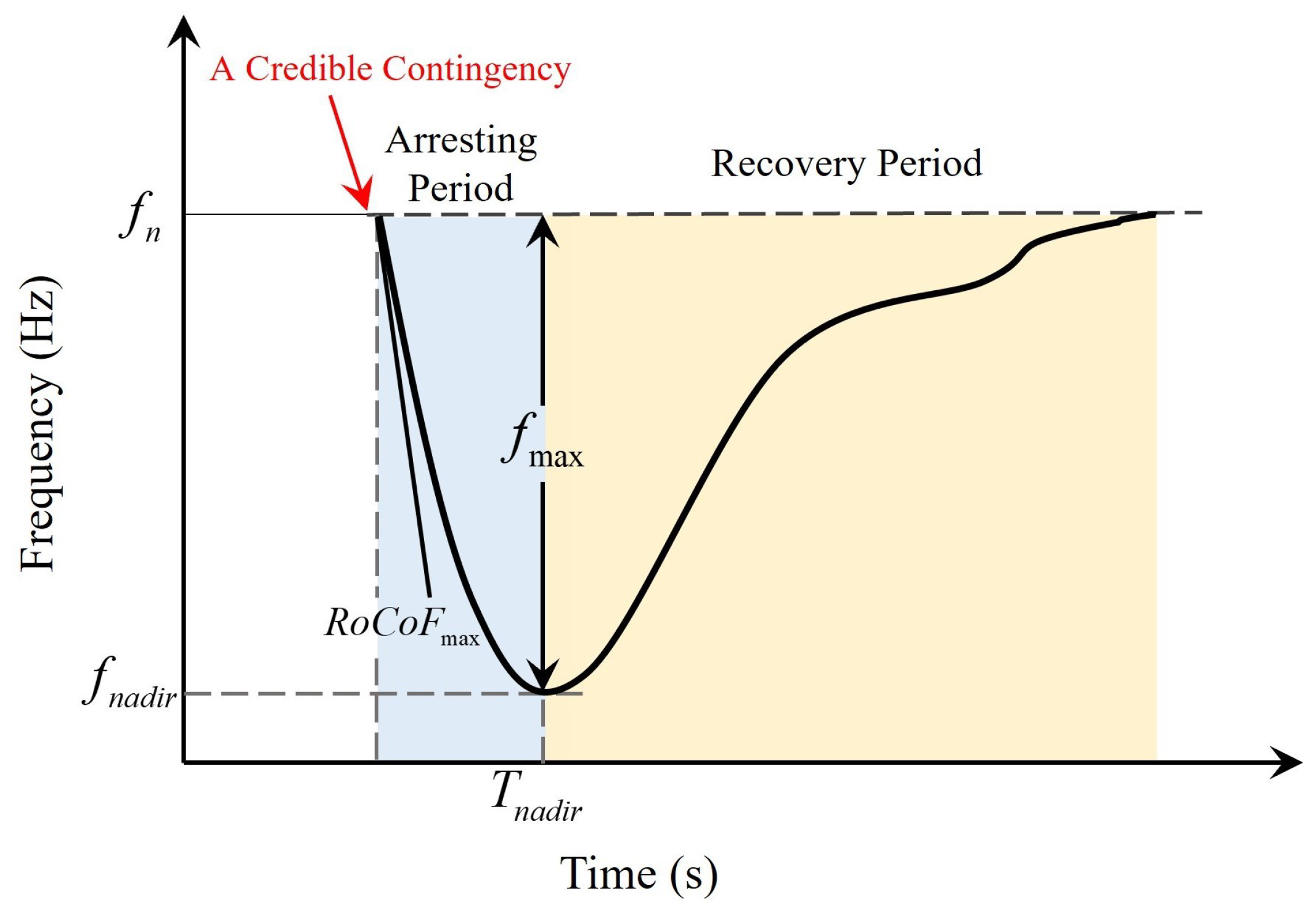
The key indicators of power system frequency stability include the maximum RoCoF and the maximum frequency deviation. When a load disturbance occurs in the system, the system frequency deviates from its nominal value. During this transition, the rotational inertia of synchronous machines resists frequency changes, while the governor simultaneously responds to the frequency deviation, arresting the frequency decline and guiding the system toward a new equilibrium point [23], as illustrated in Figure 1.
From the characteristics of the frequency dynamic response, the frequency response process can be broadly divided into the arresting period and the recovery period. Based on the regulation resources that contribute during each phase and their energy source characteristics, three response types can be distinguished [7].
SIR is the inherent response to an imbalanced torque acting on the turbines of synchronous generators, which resists changes in the RoCoF and provides enough time for PFR to arrest the frequency. Upon the occurrence of a generation loss event, the synchronous generators in the system immediately release their stored kinetic energy to maintain the balance between generation and consumption, thereby suppressing frequency fluctuations.
PFR is the action to arrest and stabilize frequency in response to a frequency deviation. It originates from generator governor response, load response and other devices that provide immediate response based on local measurements and control. This regulation mechanism relies on the power transmission of mechanical systems, resulting in a relatively slow response; however, it can continuously provide power support over an extended period and effectively maintain the medium-to-long-term stability of the system frequency.
FFR is the controlled contribution of active power from a generating unit or power electronic device, aimed at relieving the torque imbalance of synchronous generators by rapidly increasing or reducing the active power injection to the system, which helps arrest the frequency change and support the frequency indirectly.

2.2. Structure of the Improved SFR Model

To distinguish the influence mechanisms of different frequency regulation resources on system frequency dynamics and to improve system operational stability through rational resource arrangement, this study refines the traditional SFR model by introducing two separate components for new-type frequency regulation resources. The first is VI, characterized by an equivalent inertia time constant H v . The second is FFR from flexible resources such as battery energy storage systems (BESS), characterized by the FFR weight coefficient α , which scales the fraction of available FFR capacity committed to regulation. These two parameters, H v and α , serve as the core decision variables of the coordinated optimization model. By determining their optimal values across different renewable energy penetration scenarios, an economically efficient arrangement of frequency regulation resources can be achieved to improve system frequency stability.
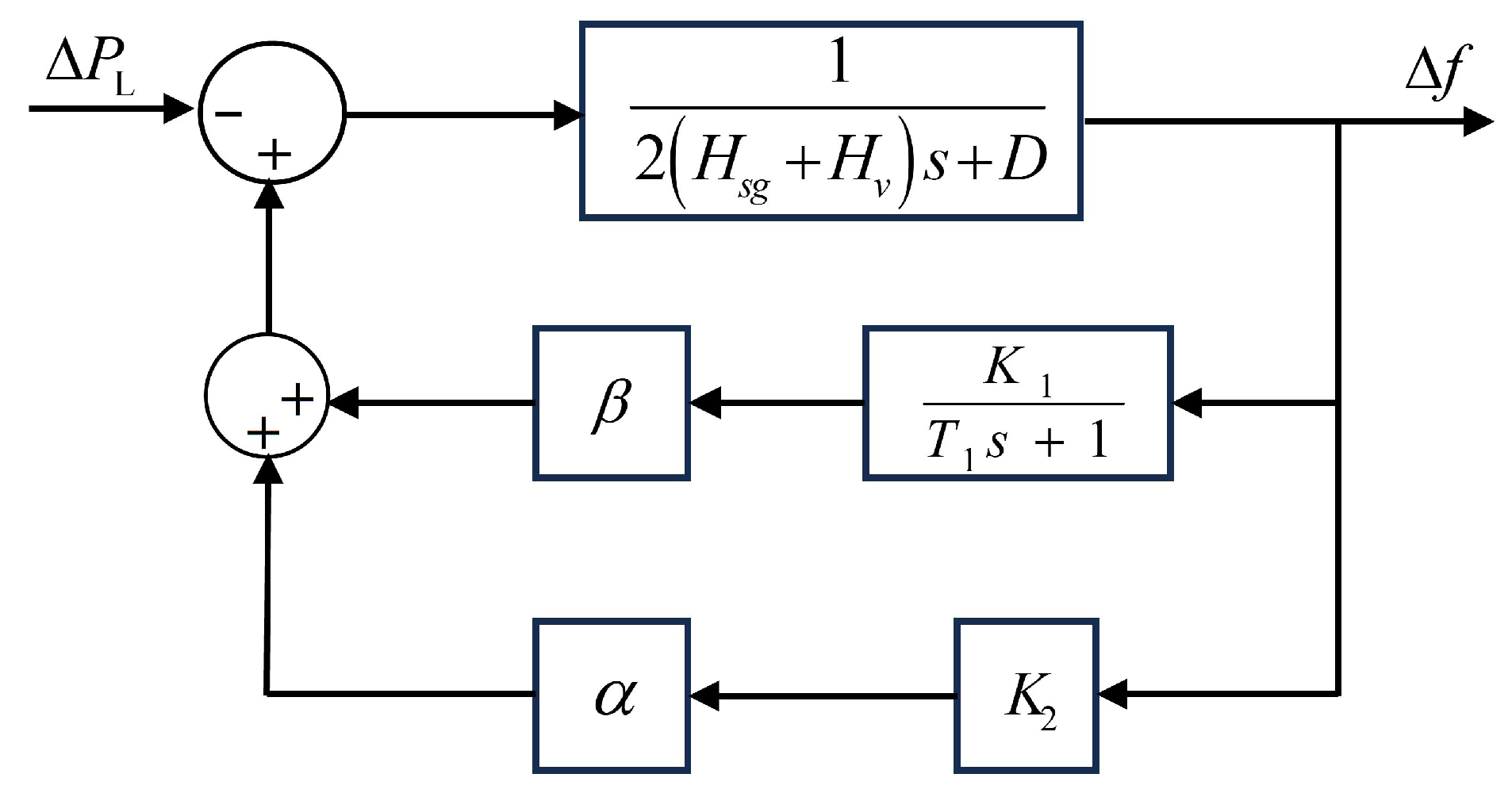
The improved SFR model is shown in Figure 2, comprising three coupled components: inertia response, PFR and FFR. Each component is described below.
Following a disturbance to the power system, the active power–frequency regulation process encompasses inertia response and PFR, which can be described by the rotor motion as in Equation (1).
2 H d Δ f d t = Δ P m Δ P L D Δ f
where H is the total equivalent inertia time constant of the system, Δ f is the frequency deviation, Δ P m is the change in mechanical power, Δ P L is the load disturbance power, D is the load damping coefficient. The total equivalent inertia time constant comprises the synchronous generator inertia constant H sg and the VI constant H v , as expressed in Equation (2).
H = H sg + H v
For a single synchronous generator, the inertia time constant is defined as the ratio of the rotational kinetic energy at rated angular speed to the rated capacity, as given in Equation (3).
H i = E k , i S i = J i ω i 2 2 S i
where H i , E k , i , S i , J i , and ω i are the inertia time constant, kinetic energy at rated angular speed, rated capacity, moment of inertia, and rated angular speed of the i-th generator, respectively. For a multi-machine system, H sg is the capacity-weighted sum of the inertia time constants of all online synchronous generators, which is given in Equation (4).
H sg = i G H i S i S base
where G is the set of online synchronous generators and S base is the system base capacity.
Grid-forming converters emulate the rotor motion equation of synchronous machines through VI control, drawing energy from the DC-side storage elements. The system-level VI is expressed as in Equation (5).
H v = j V H v , j S v , j S base
where V is the set of grid-forming devices providing VI, H v , j and S v , j are the VI constant and rated capacity of the j-th device, respectively.
The PFR component characterizes the response of the synchronous generator governor [24]. For power systems with high renewable generation penetration, a variable representing the penetration level needs to be incorporated into the model. The synchronous machine capacity coefficient β is defined as the ratio of the effective generation capacity of synchronous machines to the total system capacity. Assuming that increased renewable penetration is achieved by decommissioning synchronous machines, β decreases as the penetration rate increases. The governor regulates the mechanical power output by detecting the frequency deviation Δ f and adjusting the valve position of the steam or hydro turbine. Constrained by mechanical actuation delays and steam volume effects, the governor response exhibits a substantial dynamic lag, which is represented by a first-order transfer function, as shown in Equation (6). Since the frequency deviation following a credible contingency rapidly exceeds the governor deadband, and output saturation is precluded by the capacity constraints imposed in the optimization, these nonlinearities have a limited effect on the nadir and are neglected.
G gov ( s ) = β K 1 1 + T 1 s
where K 1 is the equivalent gain of the synchronous machine governor and T 1 is the combined time constant of the governor and prime mover.
The FFR component represents BESS, supercapacitors, or load-side resources with fast control capability. Unlike conventional generators, power-electronic devices have no mechanical rotating parts. Power-electronic FFR resources such as BESS reach full output within hundreds of milliseconds, significantly ahead of the governor response which takes several seconds. The switching delay is therefore negligible and FFR is modeled as a delay-free proportional element, which is given in Equation (7).
G FFR ( s ) = α K 2
where K 2 is the unit regulation gain of the FFR resources, and α is the FFR weighting coefficient, which represents the proportion of fast frequency regulation capacity deployed. This coefficient serves as a key decision variable in the coordinated optimization. By actively adjusting α , power can be rapidly injected during the initial phase of a disturbance, effectively enhancing system damping and compensating for the frequency decline caused by insufficient inertia.

2.3. Analytical Expressions for Frequency Response

Based on the SFR model shown in Figure 2, the closed-loop transfer function of the system can be derived, yielding the frequency deviation in the s-domain as shown in Equation (8).
Δ f ( s ) = Δ P L 2 ( H sg + H v ) T 1 · T 1 s + 1 s 2 + 2 ζ ω n s + ω n 2
where the natural oscillation frequency ω n can be described by Equation (9).
ω n = K eq 2 ( H sg + H v ) T 1
where the damping ratio ζ can be described by Equation (10).
ζ = ( D + α K 2 ) T 1 + 2 ( H sg + H v ) 2 2 ( H sg + H v ) T 1 K eq
where K eq is the equivalent stiffness coefficient, defined in Equation (11).
K eq = D + β K 1 + α K 2
Equation (8) indicates that the frequency response dynamics are determined by the inertia H sg + H v , the damping D, and the equivalent regulation gain K eq .
At the initial instant following a disturbance, the PFR has not yet acted, the frequency deviation is zero and the power contributions from the governor system and load damping are both zero [25]. The RoCoF at this moment is entirely determined by the inertia as shown in Equation (12), from which the required H v can be calculated by Equation (13).
RoCoF max = lim t 0 + d Δ f d t = | Δ P L | f 0 2 ( H sg + H v )
H v = | Δ P L | f 0 2 RoCoF max H sg
The frequency nadir Δ f nadir occurs at the instant when d Δ f / d t = 0 . For an underdamped system ( 0 < ζ < 1 ), the time at which the maximum frequency deviation occurs, t nadir can be calculated by Equation (14).
t nadir = 1 ω n 1 ζ 2 π arctan ω n T 1 1 ζ 2 1 + ζ ω n T 1
Substituting into the frequency-domain response equation, the analytical expression for the maximum frequency deviation is obtained by Equation (15).
| Δ f nadir |   = | Δ P L | K eq 1 + ( K eq T 1 D α K 2 ) 2 4 ( H sg + H v ) T 1 K eq ( D + α K 2 ) 2 T 1 2 · e ζ 1 ζ 2 π arctan ω n T 1 1 ζ 2 1 + ζ ω n T 1
From Equations (12) and (15), the following observations can be made. The RoCoF is determined solely by the total system inertia H sg + H v and the disturbance magnitude, independent of the regulation gains; increasing H v directly reduces the post-disturbance RoCoF. The maximum frequency deviation, by contrast, depends not only on the total inertia but also on the equivalent stiffness coefficient K eq , the governor time constant T 1 , and the damping coefficient D.
The proposed model adopts widely accepted analytical simplifications, including the capacity-weighted aggregation of synchronous generators and the linearization of governor-turbine dynamics, thereby neglecting non-ideal nonlinearities such as governor deadbands, output saturation limits and ramp-rate constraints. For the derived analytical solutions to remain valid in practice, the dispatched VI and FFR resources must maintain sufficient capacity margins to prevent nonlinear saturation during frequency transients. Additionally, their activation delays must be negligible to align with the idealized assumptions inherent in these expressions.

3. Coordinated Optimization Strategy Under Frequency Security Constraints

Building on the improved SFR model established in Section 2, this section formulates a coordinated optimization model for VI and FFR resource configuration. The model employs H v and α as decision variables, minimizes the total ancillary service cost as the objective, and simultaneously enforces RoCoF and frequency nadir security constraints.

3.1. Objective Function

To quantify the configuration cost of VI and FFR, this study adopts the pricing mechanism administered by the Australian Energy Market Operator (AEMO) as a reference. Since October 2023, Australia’s National Electricity Market has introduced a Very Fast FCAS spot market targeting low-inertia inverter-based resources with response times under 1 s, whose technical positioning closely aligns with the requirements of VI and FFR services. According to the AEMO market settlement guidelines [26], the trading amount (TA) for each frequency control service is given by Equation (16).
TA = EA × ASP
where Enabled Amount (EA) is the activated regulation capacity, and Ancillary Service Price (ASP) is the market clearing price.
The FFR weighting coefficient α is dimensionless; the actual FFR power capacity committed to frequency regulation is given by Equation (17).
EA FFR = α · S base
The VI decision variable H v is an inertia time constant and must first be converted to an equivalent power capacity. The instantaneous active power output of the VI control loop can be described by Equation (18).
P VI = 2 H v S base f 0 · d Δ f d t
At the initial instant of a disturbance, the RoCoF reaches its maximum. Substituting Equation (12) into Equation (18), the maximum VI service capacity can be calculated by Equation (19).
EA VI = H v · | Δ P L | · S base H sg + H v
The economic objective function can be described by Equation (20).
min C total = C VI · EA VI + C FFR · EA FFR
where C VI and C FFR are the unit service prices for VI and FFR, respectively.

3.2. Frequency Security Constraints

The RoCoF and frequency nadir are the two key indicators of frequency stability. Following a credible active power disturbance, both must remain within their permissible limits. Combining Equations (12) and (15), the dual frequency security constraints are given by Equations (21) and (22).
| Δ P L | f 0 2 ( H sg + H v ) RoCoF lim
| Δ f nadir | Δ f lim
where RoCoF lim and Δ f lim are the maximum allowable RoCoF and maximum allowable frequency deviation for maintaining system frequency stability, respectively.
The inertia constant provided by VI devices is subject to an upper bound, as given in Equation (23).
0 H v H v , max
where H v , max is the maximum inertia constant that VI devices can provide.
The FFR configuration must satisfy its maximum available capacity limit, as given in Equation (24).
0 α α max
where α max is the maximum allowable value of the FFR weighting coefficient.

3.3. Complete Optimization Model

Integrating the objective function in Section 3.1, the dual frequency security constraints, and the physical bounds on the decision variables, the complete coordinated optimization model can be described in Equation (25).
min H v , α C total = C VI · EA VI + C FFR · EA FFR s . t . | Δ P L | f 0 2 H sg + H v RoCoF lim s . t . | Δ f nadir | Δ f lim s . t . 0 H v H v , max s . t . 0 α α max
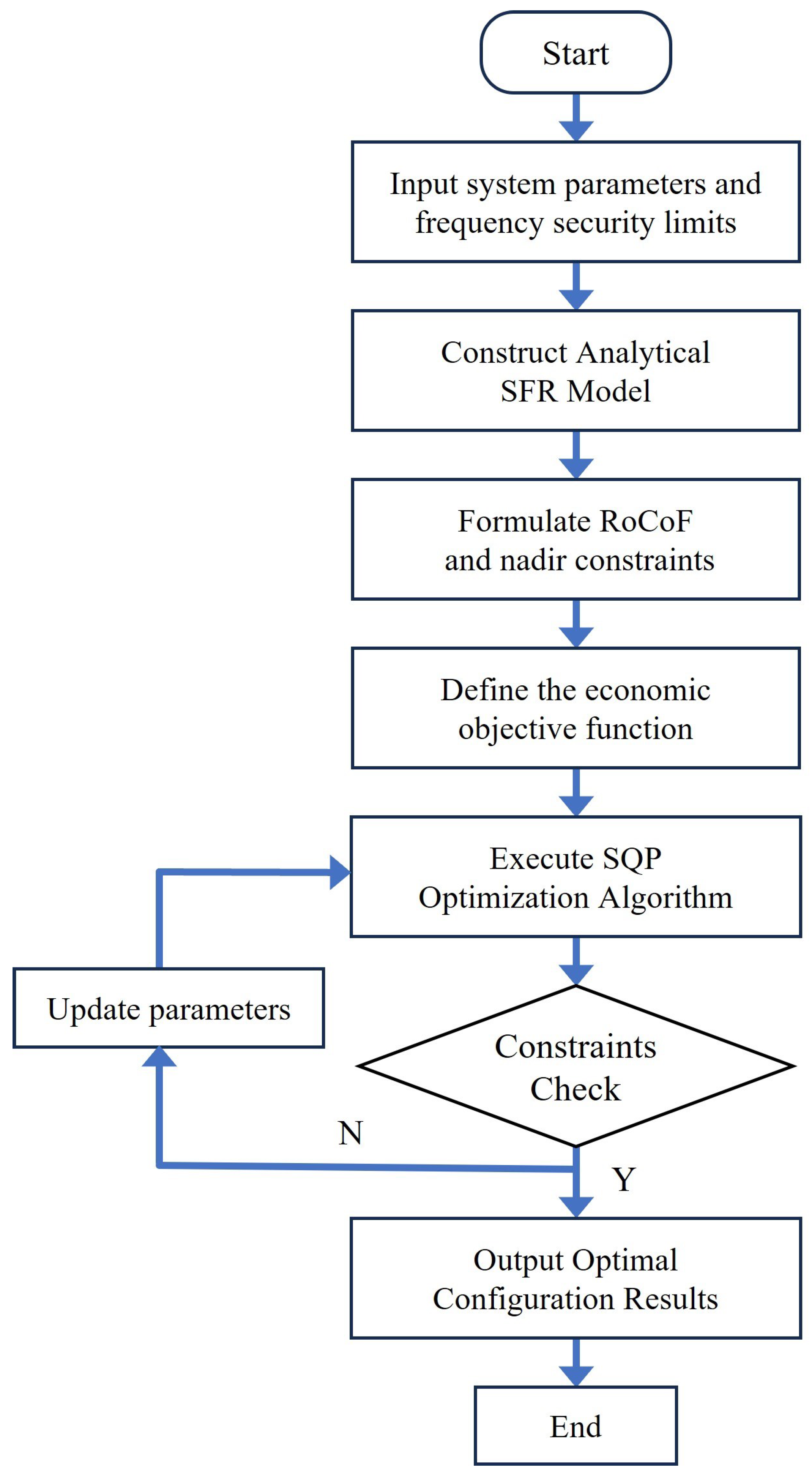
Since the model includes nonlinear constraints, it is solved using the sequential quadratic programming (SQP) algorithm. The resulting ( H v , α ) constitutes the economically optimal VI and FFR configuration scheme for a given scenario.
The implementation of the proposed coordinated configuration strategy is illustrated in the flowchart in Figure 3.

4. Case Studies

4.1. System Parameters and Scenario Setup

To validate the effectiveness of the proposed coordinated optimization method, a provincial-level power grid is adopted as the test case. The total installed capacity is S base = 35,000 MW and the nominal frequency is f 0 = 50 Hz. The synchronous machine governor gain is K 1 = 20 , the FFR gain is K 2 = 10 , the governor time constant is T 1 = 5 , the load damping coefficient is D = 1.0 . The maximum credible contingency is defined as a single unit trip resulting in an active power deficit of 3000 MW.
Since October 2023, the Australian NEM has formally implemented the Very Fast FCAS spot market, designed specifically for fast-responding inverter-based resources such as energy storage [12]. The technical positioning of this market closely aligns with the requirements of VI and FFR services. Accordingly, market price data from this market are adopted in this study [27] with the VI service price set to C VI = 2.4 $/MW and the FFR service price set to C FFR = 0.8 $/MW. The RoCoF limit is set to 0.5 Hz/s and the maximum allowable frequency deviation is 0.6 Hz.
To analyze the impact of different renewable penetration levels on resource configuration, four representative penetration scenarios are defined. The coefficient β represents the ratio of the effective synchronous machine generation capacity to the total system capacity. Considering that some synchronous machines operate at low output levels under high penetration conditions with limited frequency regulation reserve margins, β is set to 80% of the synchronous machine share, i.e., β = 0.8 × ( 1 η ) , where η is the renewable generation penetration rate. The parameters for each scenario are listed in Table 1.

4.2. Analysis of Renewable Generation Integration Scenarios

Based on the coordinated optimization model, the optimal resource configuration results for the four penetration scenarios are summarized in Table 2.
As shown in Table 2, both the VI configuration requirement H v and the FFR configuration requirement α increase monotonically with rising renewable generation integration. In Scenario 1, the synchronous inertia H sg = 4.3 s is sufficient, with the RoCoF at 0.50 Hz/s and the nadir at 49.56 Hz both within the safety limits; so, no additional VI or FFR resources are needed. In Scenario 2, as the system inertia drops to H sg = 3.3 s, the RoCoF constraint first reaches its limit of 0.50 Hz/s, requiring H v = 0.99 s of VI to satisfy the RoCoF requirement. After VI configuration, the frequency nadir has not yet violated its limit; so, no FFR is needed. In Scenario 3, with the system inertia further reduced to H sg = 2.0 s, both the RoCoF and nadir constraints are binding, necessitating not only H v = 2.29 s of VI but also α = 0.10 of FFR. In Scenario 4, as the system inertia decreases further, the configuration requirements for both resource types continue to grow.
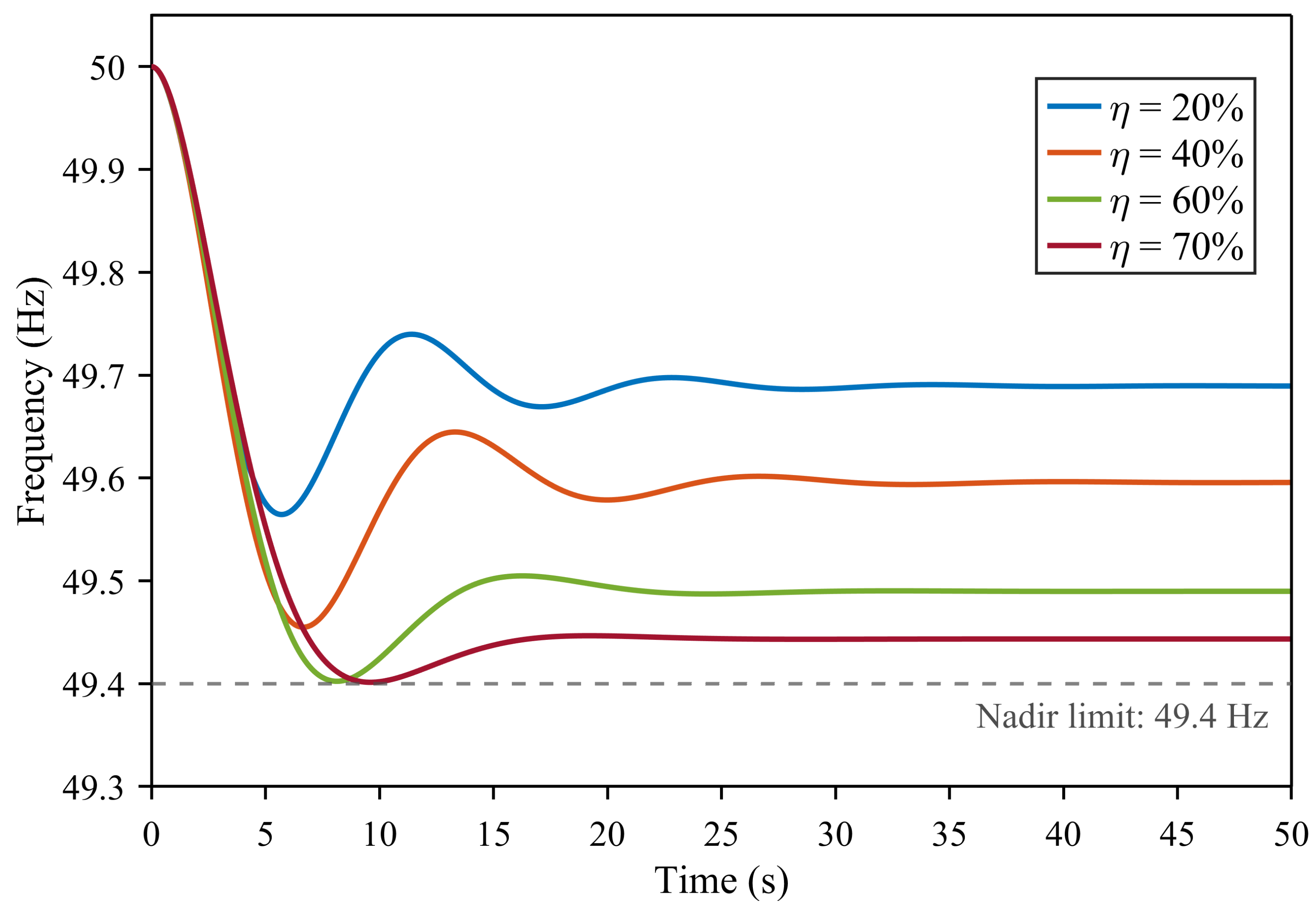
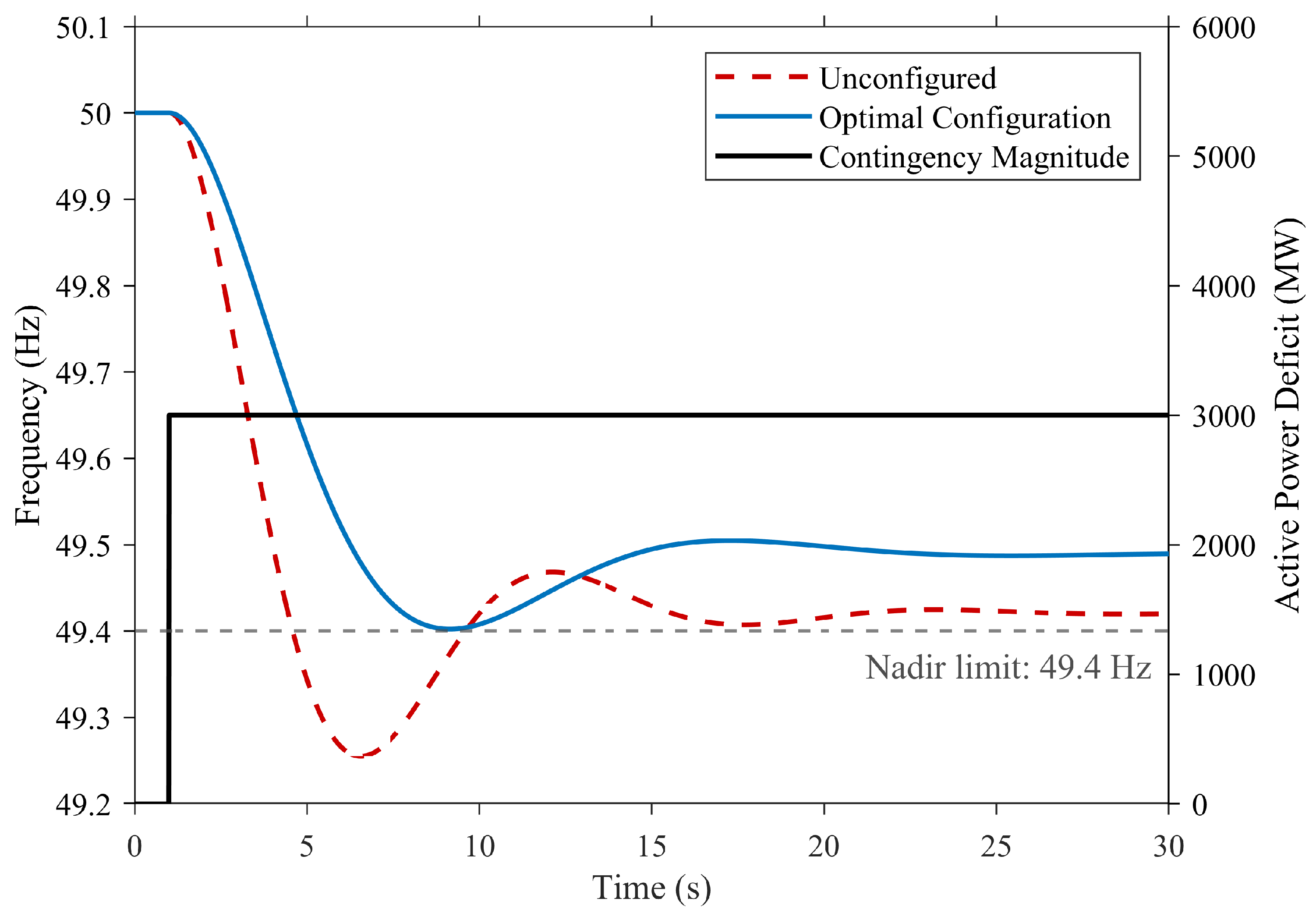
The frequency response following a credible contingency for each penetration scenario is shown in Figure 4. It can be observed that the frequency decline becomes more pronounced with increasing penetration: the frequency nadir in Scenario 1 is 49.56 Hz, well above the safety limit, while the nadir in Scenario 4 just reaches the 49.40 Hz safety boundary. Figure 5 provides a comparative frequency response for Scenario 3. It shows that through rational resource configuration, the frequency response process is significantly optimized, with both RoCoF and nadir maintained within the security constraints. This further verifies the effectiveness of the proposed optimization model. Under the optimal configuration scheme, the frequency indicators of all scenarios are maintained within the safe range, verifying the effectiveness of the proposed optimization model.
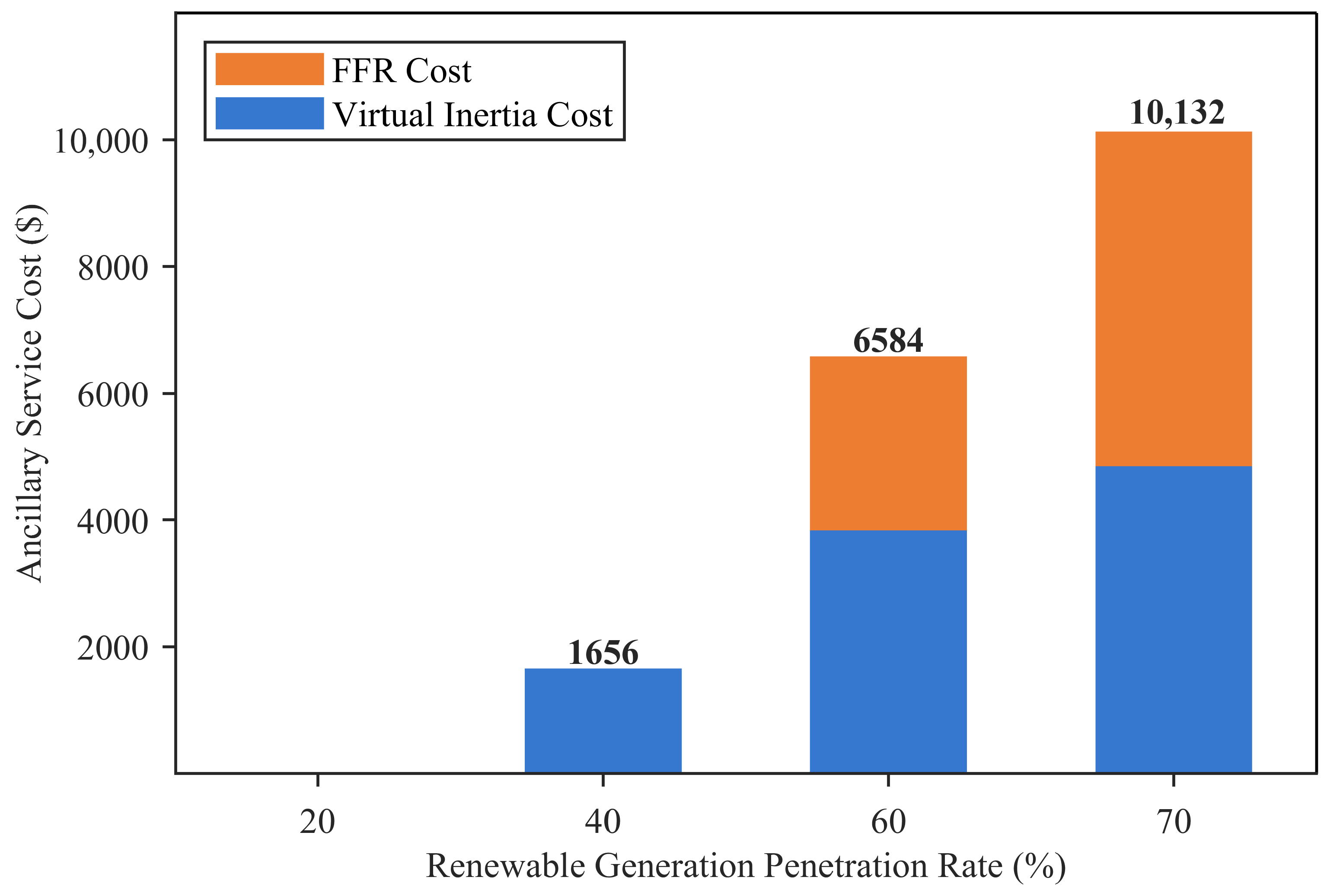
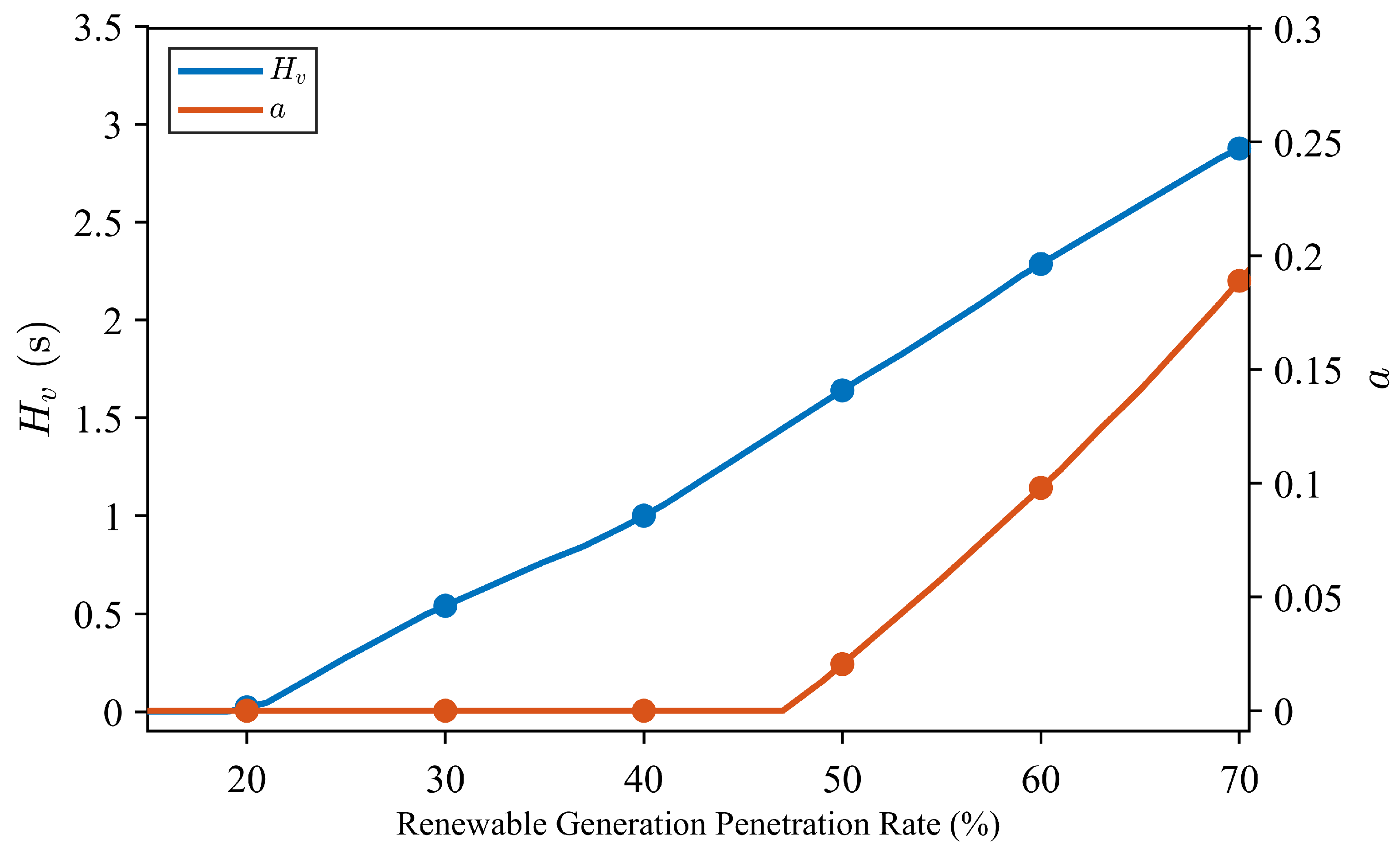
As the penetration rate increases, the configuration requirements and costs for both resource types grow further. The cost composition for each scenario is compared in Figure 6, and the trends of H v and α with penetration rate are shown in Figure 7.
According to the RoCoF formula, the RoCoF depends only on the total system inertia and the disturbance magnitude. Under a 3000 MW disturbance, the system requires at least 4.28 s of total inertia to keep the RoCoF within its constraint. As the renewable penetration increases across scenarios and synchronous inertia decreases accordingly, the required VI also increases. Meanwhile, with the declining share of synchronous machines participating in frequency regulation, the system’s PFR capability weakens, demanding more FFR to prevent the frequency nadir from exceeding its limit. It is noteworthy that across all scenarios, the final total inertia remains approximately constant, indicating that the system seldom procures additional VI for nadir improvement; instead, FFR assumes the primary responsibility for nadir improvement.

4.3. Analysis of Credible Contingency with Different Magnitudes

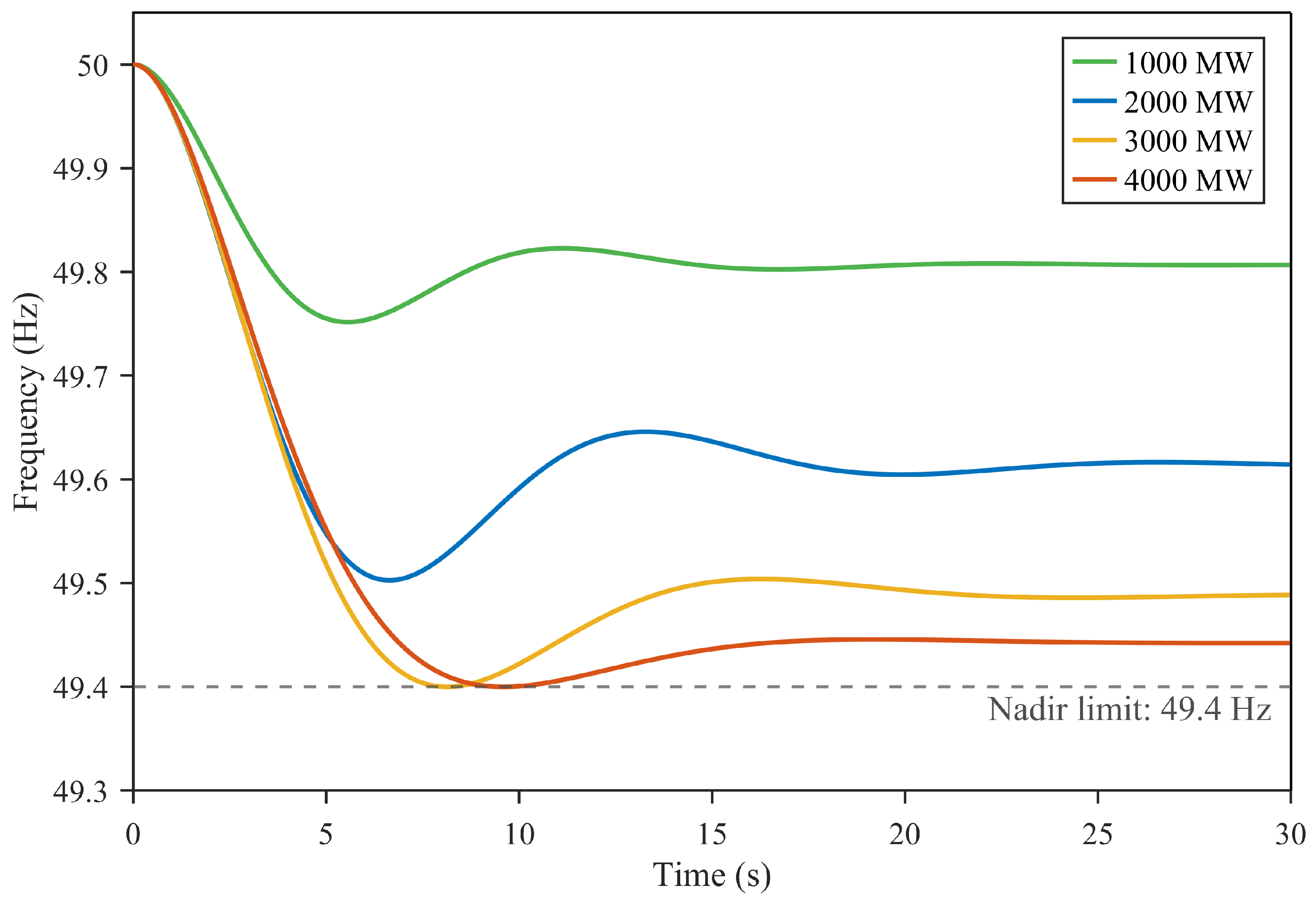
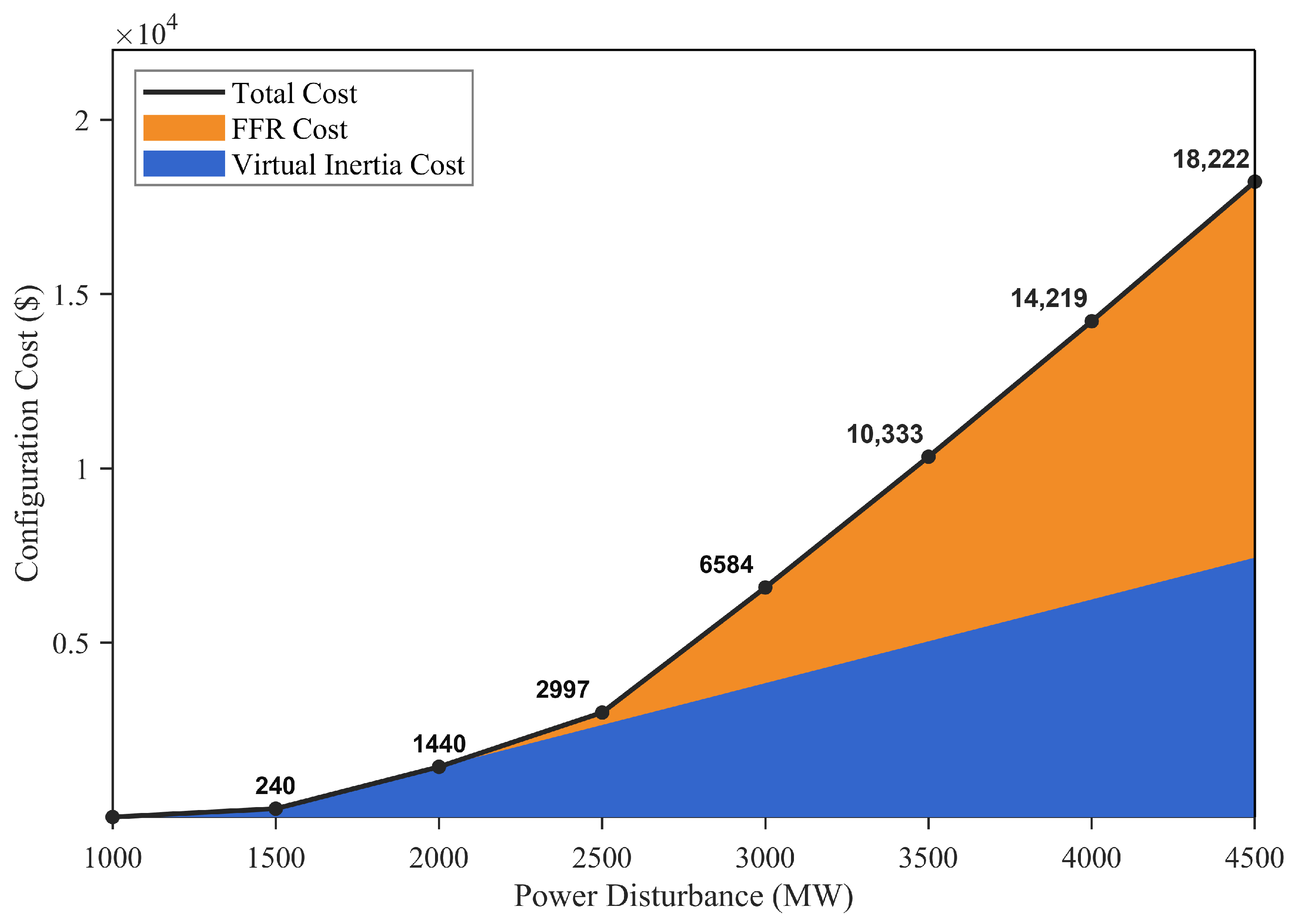
To analyze the impact of contingency magnitude on the optimal configuration, the penetration rate is fixed at 60% ( H sg = 2.0 s, β = 0.32 ) and the maximum credible contingency power deficit is increased from 1000 MW to 4000 MW. The frequency dynamic curves are shown in Figure 8. Representative scenarios are selected to illustrate the transition from requiring no resource configuration under a small contingency to a gradual increase in the optimal configuration of these resources as the contingency intensifies. The key frequency indicators, configuration results and costs are presented in Table 3, and the configuration costs under different contingency magnitudes are shown in Figure 9.
As indicated by Table 3 and Figure 9, the credible contingency magnitude exerts a significant influence on the optimal configuration strategy, and the total cost increases steadily with contingency magnitude. When the disturbance is relatively small, the system can satisfy both frequency security constraints by deploying VI alone, with α remaining at zero and the total cost arising entirely from VI procurement. Once the disturbance exceeds 2000 MW, VI alone can no longer maintain the frequency nadir above 49.40 Hz, triggering the nadir constraint and marking the point at which FFR becomes a necessary part of the configuration. As the disturbance further increases, both H v and α grow in parallel, but α increases at a faster rate, causing a reversal in the cost structure. At a 2500 MW disturbance, VI accounts for approximately 88% of the total cost, whereas at 3500 MW the costs of the two resources are roughly equal. As FFR assumes primary responsibility for satisfying the nadir constraint, its configuration and cost share expand significantly in large-disturbance scenarios.
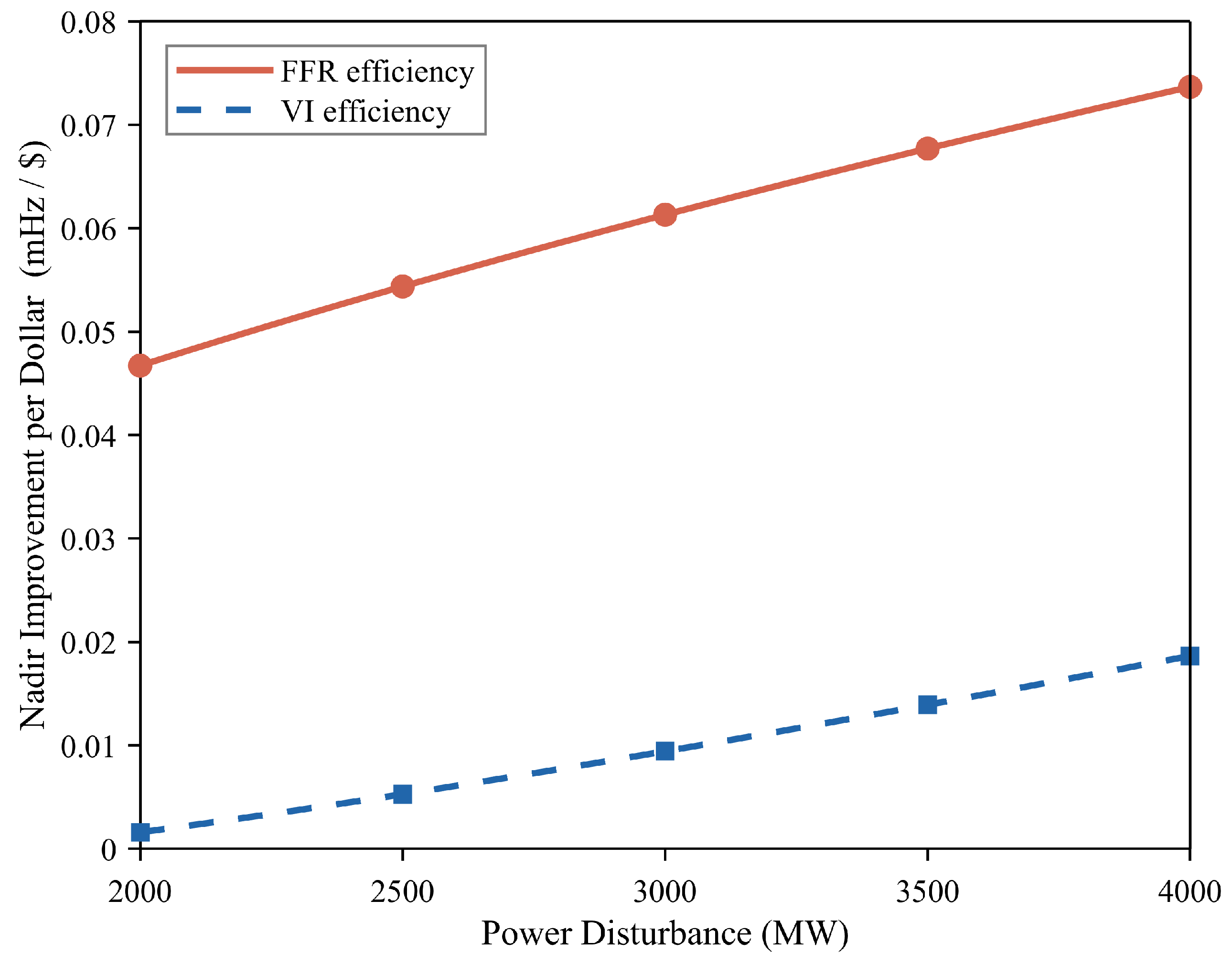
An economic efficiency analysis comparing the nadir improvement per unit cost of VI and FFR is presented in Figure 10. Beyond the minimum inertia level required to satisfy the RoCoF constraint, the nadir improvement per unit cost achieved by FFR substantially exceeds that of VI. FFR acts directly on the system frequency regulation response, producing an immediate and pronounced improvement in the frequency nadir, with the improvement becoming even more significant at larger disturbances. VI can only indirectly affect the frequency nadir by modifying the system oscillation dynamics, an effect that is particularly limited when the governor time constant is large. Combined with the inherent price advantage of FFR, the system consistently prioritizes heavy deployment of FFR in scenarios requiring nadir improvement, while the economic investment share of VI remains low. This further indicates that in large-disturbance scenarios, relying on inertia compensation alone is neither sufficient to meet the nadir constraint nor economically viable; the rational configuration of FFR is therefore essential for maintaining frequency security in high-penetration grids.

5. Conclusions

This study proposes a coordinated configuration of VI and FFR resources in low-inertia power systems. Based on an improved SFR model incorporating multiple frequency regulation resources, a coordinated optimization framework that minimizes ancillary service cost is established. These findings provide quantitative guidance for frequency regulation resource planning in high-penetration, low-inertia power systems. The analytical results are summarized as follows:
  • The analytical results show that VI primarily suppresses the post-disturbance RoCoF by augmenting system inertia, while FFR and PFR primarily govern the frequency nadir. This difference in physical roles determines how each frequency security constraint drives the configuration of the corresponding resource type.
  • Case studies across varying renewable generation integration levels and disturbance magnitudes show that both VI and FFR requirements increase monotonically with rising penetration, reaching H v = 2.89 s and α = 0.19 at 70% penetration.
  • Once the RoCoF constraint is satisfied, FFR offers significantly higher cost effectiveness for nadir improvement than VI. In high-penetration, large-disturbance scenarios, relying solely on inertia compensation is neither sufficient to satisfy the nadir constraint nor economically viable and the rational configuration of FFR is key to ensuring system frequency security.
Future work may extend the proposed framework by incorporating the stochastic uncertainties of renewable generation and exploring its integration into multi-period market mechanisms. Meanwhile, the limitations of insufficient consideration for multi-type frequency regulation resource characteristics will be refined to enhance the adaptability of the proposed scheme in practical applications.

Author Contributions

Conceptualization, X.Z. and W.M.; methodology, X.Z. and W.M.; software, X.Z.; validation, X.Z.; formal analysis, R.W.; investigation, X.Z. and R.W.; resources, R.W.; data curation, X.Z., R.W. and W.M.; writing—original draft preparation, X.Z.; writing—review and editing, R.W. and W.M.; visualization, W.M.; supervision, X.Z. and W.M. All authors have read and agreed to the published version of the manuscript.

Funding

This work is funded by the Special Funds for the Cultivation of Guangdong College Students’ Scientific and Technological Innovation (“Climbing Program” Special Funds, No. Pdjh2025bk036).

Data Availability Statement

The original contributions presented in the study are included in the article, further inquiries can be directed to the corresponding author.

Conflicts of Interest

The authors declare no conflicts of interest.

Abbreviations

The following abbreviations are used in this manuscript:
AEMOAustralian Energy Market Operator
BESSsBattery Energy Storage Systems
FCASsFrequency Control Ancillary Services
FFRFast Frequency Response
PFRPrimary Frequency Response
RoCoFRate of Change in Frequency
SFRSystem Frequency Response
SIRSynchronous Inertia Response
SQPSequential Quadratic Programming
UFLSUnder-Frequency Load Shedding
VIVirtual Inertia

References

  1. Saleem, M.; Saha, S. Assessment of frequency stability and required inertial support for power grids with high penetration of renewable energy sources. Electr. Power Syst. Res. 2024, 229, 110184. [Google Scholar] [CrossRef]
  2. Johnson, S.C.; Rhodes, J.D.; Webber, M.E. Understanding the impact of non-synchronous wind and solar generation on grid stability and identifying mitigation pathways. Appl. Energy 2020, 262, 114492. [Google Scholar] [CrossRef]
  3. He, C.; Geng, H.; Rajashekara, K.; Chandra, A. Analysis and control of frequency stability in low-inertia power systems: A review. IEEE/CAA J. Autom. Sin. 2024, 11, 2363–2383. [Google Scholar] [CrossRef]
  4. Johnson, S.C.; Papageorgiou, D.J.; Mallapragada, D.S.; Deetjen, T.A.; Rhodes, J.D.; Webber, M.E. Evaluating rotational inertia as a component of grid reliability with high penetrations of variable renewable energy. Energy 2019, 180, 258–271. [Google Scholar] [CrossRef]
  5. Tielens, P.; Van Hertem, D. The Relevance of Inertia in Power Systems. Renew. Sustain. Energy Rev. 2016, 55, 999–1009. [Google Scholar] [CrossRef]
  6. Zhou, J.; Guo, Y.; Yang, L.; Shi, J.; Zhang, Y.; Li, Y.; Guo, Q.; Sun, H. A review on frequency management for low-inertia power systems: From inertia and fast frequency response perspectives. Electr. Power Syst. Res. 2024, 228, 110095. [Google Scholar] [CrossRef]
  7. Eriksson, R.; Modig, N.; Elkington, K. Synthetic inertia versus fast frequency response: A definition. IET Renew. Power Gener. 2018, 12, 507–514. [Google Scholar] [CrossRef]
  8. Dreidy, M.; Mokhlis, H.; Mekhilef, S. Inertia response and frequency control techniques for renewable energy sources: A review. Renew. Sustain. Energy Rev. 2017, 69, 144–155. [Google Scholar] [CrossRef]
  9. Meng, L.; Zafar, J.; Khadem, S.K.; Collinson, A.; Murchie, K.C.; Coffele, F.; Burt, G.M. Fast frequency response from energy storage systems—A review of grid standards, projects and technical issues. IEEE Trans. Smart Grid 2019, 11, 1566–1581. [Google Scholar] [CrossRef]
  10. González-Inostroza, P.; Rahmann, C.; Álvarez, R.; Haas, J.; Nowak, W.; Rehtanz, C. The role of fast frequency response of energy storage systems and renewables for ensuring frequency stability in future low-inertia power systems. Sustainability 2021, 13, 5656. [Google Scholar] [CrossRef]
  11. Badesa, L.; Teng, F.; Strbac, G. Simultaneous scheduling of multiple frequency services in stochastic unit commitment. IEEE Trans. Power Syst. 2019, 34, 3858–3868. [Google Scholar] [CrossRef]
  12. Australian Energy Market Operator. Very Fast FCAS Market Commencement: Design and Rule Changes; Technical Report; AEMO: Melbourne, Australia, 2023. [Google Scholar]
  13. Australian Energy Market Commission. Very Fast Frequency Response—Final Determination; Technical report; AEMC: Sydney, Australia, 2021. [Google Scholar]
  14. Anderson, P.M.; Mirheydar, M. A low-order system frequency response model. IEEE Trans. Power Syst. 2002, 5, 720–729. [Google Scholar] [CrossRef]
  15. Shi, Q.; Li, F.; Cui, H. Analytical method to aggregate multi-machine SFR model with applications in power system dynamic studies. IEEE Trans. Power Syst. 2018, 33, 6355–6367. [Google Scholar] [CrossRef]
  16. Liu, L.; Li, W.; Ba, Y.; Shen, J.; Jin, C.; Wen, K. An analytical model for frequency nadir prediction following a major disturbance. IEEE Trans. Power Syst. 2020, 35, 2527–2536. [Google Scholar] [CrossRef]
  17. Ding, T.; Zeng, Z.; Qu, M.; Catalao, J.P.; Shahidehpour, M. Two-stage chance-constrained stochastic thermal unit commitment for optimal provision of virtual inertia in wind-storage systems. IEEE Trans. Power Syst. 2021, 36, 3520–3530. [Google Scholar] [CrossRef]
  18. Shen, Y.; Wu, W.; Wang, B.; Sun, S. Optimal allocation of virtual inertia and droop control for renewable energy in stochastic look-ahead power dispatch. IEEE Trans. Sustain. Energy 2023, 14, 1881–1894. [Google Scholar] [CrossRef]
  19. Borsche, T.S.; Liu, T.; Hill, D.J. Effects of rotational inertia on power system damping and frequency transients. In Proceedings of the 2015 54th IEEE Conference on Decision and Control (CDC), Osaka, Japan, 15–18 December 2015; IEEE: Piscataway, NJ, USA, 2015; pp. 5940–5946. [Google Scholar] [CrossRef]
  20. Badesa, L.; Teng, F.; Strbac, G. Optimal portfolio of distinct frequency response services in low-inertia systems. IEEE Trans. Power Syst. 2020, 35, 4459–4469. [Google Scholar] [CrossRef]
  21. Xu, T.; Jang, W.; Overbye, T. Commitment of fast-responding storage devices to mimic inertia for the enhancement of primary frequency response. IEEE Trans. Power Syst. 2017, 33, 1219–1230. [Google Scholar] [CrossRef]
  22. Qiu, D.; Baig, A.M.; Wang, Y.; Wang, L.; Jiang, C.; Strbac, G. Market design for ancillary service provisions of inertia and frequency response via virtual power plants: A non-convex bi-level optimisation approach. Appl. Energy 2024, 361, 122929. [Google Scholar] [CrossRef]
  23. Kundur, P. Power system stability. Power Syst. Stab. Control 2007, 10, 7-1. [Google Scholar]
  24. Huang, H.; Ju, P.; Jin, Y.; Yuan, X.; Qin, C.; Pan, X.; Zang, X. Generic system frequency response model for power grids with different generations. IEEE Access 2020, 8, 14314–14321. [Google Scholar] [CrossRef]
  25. Liu, J.; Wang, C.; Zhao, J.; Bi, T. Rocof constrained unit commitment considering spatial difference in frequency dynamics. IEEE Trans. Power Syst. 2023, 39, 1111–1125. [Google Scholar] [CrossRef]
  26. Australian Energy Market Operator. Settlements Guide to Ancillary Services and Frequency Performance Payments; Technical Report; AEMO: Melbourne, Australia, 2025. [Google Scholar]
  27. Australian Energy Regulator. Quarterly Global FCAS Prices by Services; Technical Report; AER: Melbourne, Australia, 2025.
Figure 1. Frequency response following a disturbance.
Energies 19 01848 g001
Figure 2. Improved SFR model incorporating multiple frequency regulation resources.
Energies 19 01848 g002
Figure 3. Flowchart of the coordinated optimization strategy for VI and FFR.
Energies 19 01848 g003
Figure 4. Frequency response following a credible contingency for each penetration scenario.
Energies 19 01848 g004
Figure 5. Comparative system frequency response for Scenario 3.
Energies 19 01848 g005
Figure 6. Cost composition comparison across penetration scenarios.
Energies 19 01848 g006
Figure 7. Trends of H v and α with increasing renewable generation integration.
Energies 19 01848 g007
Figure 8. Frequency response following a credible contingency with different magnitudes.
Energies 19 01848 g008
Figure 9. Configuration cost under credible contingencies of different magnitudes.
Energies 19 01848 g009
Figure 10. Cost efficiency comparison for frequency nadir improvement following a credible contingency.
Energies 19 01848 g010
Table 1. System parameter settings for each scenario.
ScenarioRenewable Generation Penetration Rate H sg (s) β
Scenario 120%4.30.64
Scenario 240%3.30.48
Scenario 360%2.00.32
Scenario 470%1.40.24
Table 2. Optimal resource configuration results for each penetration scenario.
Scenario H v (s) α VI Cost ($)FFR Cost ($)Total Cost ($)RoCoF (Hz/s) f nadir (Hz)
Scenario 10000.5049.56
Scenario 20.990165616560.5049.45
Scenario 32.290.103840274465840.5049.40
Scenario 42.890.194848528410,1320.5049.40
Table 3. Optimal configuration results following a credible contingency with different magnitudes (60% renewable generation penetration rate).
Δ P L (MW) H v (s) α Total Cost ($)RoCoF (Hz/s) f nadir (Hz)
10000000.3649.75
20000.857014400.5049.50
30002.2860.09965840.5049.40
40003.7140.28514,2190.5049.40
Disclaimer/Publisher’s Note: The statements, opinions and data contained in all publications are solely those of the individual author(s) and contributor(s) and not of MDPI and/or the editor(s). MDPI and/or the editor(s) disclaim responsibility for any injury to people or property resulting from any ideas, methods, instructions or products referred to in the content.