Article

Dynamic Fault Recovery Strategy for Active Distribution Networks Based on a Two-Layer Hybrid Algorithm Under Extreme Ice and Snow Conditions

State Grid Hubei Electric Power Research Institute, Wuhan 430077, China
*
Author to whom correspondence should be addressed.
Energies 2026, 19(7), 1784; https://doi.org/10.3390/en19071784
Submission received: 9 February 2026 / Revised: 22 March 2026 / Accepted: 3 April 2026 / Published: 5 April 2026
(This article belongs to the Special Issue Distributed Energy Systems: Progress, Challenges, and Prospects)

Abstract

To address the issues of suboptimal recovery performance, low timeliness, and poor economic efficiency associated with traditional fault recovery methods following large-scale power outages in active distribution networks (ADNs) caused by extreme weather, this paper proposes a dynamic fault recovery strategy for ADNs based on a two-layer hybrid algorithm under extreme ice and snow conditions. First, a line fault rate model considering the thermal effect of current under extreme ice and snow conditions is constructed, and an information entropy-based typical scenario screening method is introduced to filter the fault scenarios. Second, a photovoltaic (PV) output model and a time-varying load model under the influence of extreme ice and snow conditions are established. Subsequently, a multi-objective dynamic fault recovery model is formulated, incorporating island partitioning and integration constraints based on the concept of single-commodity flow, alongside tightened relaxation constraints. To achieve an accurate and rapid solution for the fault recovery model, a two-layer hybrid algorithm is proposed. This algorithm combines an outer-layer improved binary grey wolf optimizer (IBGWO) and an inner-layer second-order cone relaxation (SOCR) algorithm to solve the discrete and continuous decision variables within the model, respectively. Finally, the effectiveness and superiority of the proposed method are verified using the PG&E 69-bus and IEEE 123-bus systems.

1. Introduction

As the probability of extreme weather events increases globally, the risk of distribution system faults caused by such events also rises. Consequently, power supply restoration following distribution network faults under the impact of extreme weather has become a widely researched hot topic [1,2,3]. Compared with the unidirectional power supply mode and insufficient fault response capability of traditional distribution networks, active distribution networks (ADNs) offer a better decision-making space for recovery during faults [4,5,6]. This is because ADNs can autonomously respond to changes in load demand and network topology to regulate power flow and are equipped with distributed generators (DGs) that serve as backup black-start power sources.
Numerous scholars have conducted research on distribution network fault recovery and resilience enhancement under the impact of extreme weather disasters. Reference [7] explored a robust fault recovery strategy for multi-source flexible interconnected distribution networks under extreme ice disaster scenarios; by constructing a two-stage robust optimization model aimed at minimizing load shedding, it addressed the impact of DGs fluctuations on post-disaster recovery, significantly enhancing the operational robustness of systems with a high proportion of renewable energy under extreme faults. Reference [8] focused on the resilience enhancement of ADNs under extreme ice disasters and proposed an active defense strategy based on fault scenario prediction; through pre-disaster active network reconfiguration and post-disaster optimal matching of maintenance resources, a “prevention-recovery” synergy was achieved, significantly reducing load loss. Reference [9] proposed a framework for generating probabilistic fault scenarios of distribution networks under extreme weather based on component fragility models and Monte Carlo simulations, and quantified the operational resilience of distribution networks under the impact of extreme weather by defining corresponding probabilistic risk indices. The above studies have conducted detailed research on fault recovery and resilience enhancement of distribution networks under extreme weather; however, they only analyzed single-fault scenarios at the initial stage of the fault, without considering the long-term spatial-temporal evolution of faults under prolonged extreme weather. Given that fault scenarios in distribution networks may change over time under such long-duration conditions, dynamically adjusting recovery strategies during the fault period is of significant research value.
Regarding the dynamic evolution of distribution network faults under extreme weather, Reference [10] took extreme typhoon weather as an example, simulated the time-varying wind speed during the typhoon’s movement based on the Batts model, and constructed a time-varying fault model to dynamically analyze fault scenarios, achieving dynamic recovery across various fault periods. Reference [11] focused on the compound disaster of typhoons and waterlogging faced by coastal cities, established a coupling relationship between real-time fault probabilities of substations, lines, and cables with wind speed and water depth, and constructed a real-time fault probability model for each line. This allowed for real-time adjustments of recovery strategies according to disaster evolution, significantly improving the dynamic recovery capability of the power grid under complex compound disasters. Reference [12] analyzed sudden urban flooding to establish a spatial-temporal fault evolution model for distribution network lines based on the rapid flood spreading (RFS) method, and achieved a dynamic response to fault evolution by considering the fluctuations of DGs and loads simultaneously during the dynamic solution process. All the aforementioned studies investigated the dynamic evolution of faults under extreme weather and accurately depicted the fault evolution process; however, their fault recovery models are relatively complex, leading to low solution efficiency. Considering the critical need for rapid response in fault recovery after a distribution network fault, effectively responding to topological changes for rapid recovery remains an urgent problem to be solved.
Regarding the timeliness requirement for rapid response in distribution network fault recovery under extreme weather, Reference [13] proposed a coordinated recovery strategy for hybrid AC/DC distribution networks centered on DC lines. By establishing a mixed-integer second-order cone programming (MISOCP) fault recovery model aimed at maximizing resilience indices, it improved the solution efficiency while ensuring the accuracy of the recovery scheme. Reference [14] proposed a rapid fault recovery method for distribution networks combining soft open points (SOPs) and mobile energy storage systems (MESSs), which ensured efficient fault recovery while considering the economic efficiency of the recovery process. Reference [15] proposed a “pre-disaster, during-disaster, and post-disaster” three-stage coordinated resilience enhancement strategy; by integrating resources such as MESSs, DGs, and on-load tap changers (OLTCs), and introducing the coupling impact of traffic network congestion into the scheduling, it achieved a rapid response for distribution network fault recovery under the impact of extreme weather. The above studies improved the overall solution efficiency by building MISOCP models or utilizing multi-resource coordination for fault recovery. However, relying solely on traditional MISOCP modeling and multi-resource coordination still struggles to meet the rapid response timeliness required for distribution network fault recovery under sudden emergencies.
To address the aforementioned issues and investigate fault recovery under the impact of extreme weather, this paper takes extreme ice and snow conditions as an example and proposes a dynamic fault recovery strategy for active distribution networks (ADNs) based on a two-layer hybrid algorithm. The specific contributions are as follows: First, a line fault rate model considering the thermal effect of current and the spatial-temporal evolution of faults under extreme ice and snow conditions is established. Second, a distributed photovoltaic (PV) output model and a time-varying load model under the influence of extreme ice and snow conditions are constructed. Then, a dynamic fault recovery model is formulated with the objectives of minimizing load shedding and the number of switching operations. Simultaneously, island partitioning and integration constraints based on the single-commodity flow concept, as well as tightened relaxation constraints, are introduced into the model. The proposed two-layer hybrid algorithm is adopted to solve this model. Finally, the effectiveness and superiority of the proposed method are verified through the PG&E 69-bus and IEEE 123-bus systems.

2. Line Fault Rate Model Considering the Thermal Effect of Current Under Extreme Ice and Snow Conditions

All simulation analyses in this study were implemented using MATLAB R2020b software (MathWorks Inc., Natick, MA, USA).

2.1. Extreme Ice and Snow Meteorological Model

The line fault rate of the distribution network under extreme ice and snow conditions is closely related to the distance from each conductor in the network to the meteorological center of the extreme weather [16]. In this section, a coordinate system is established with the root bus of the distribution network as the origin, and the moving model of the extreme ice and snow weather is described using the coordinates of the extreme ice and snow meteorological center I x , t , I y , t and the moving speed v ice of the meteorological center:
I x , t = I x , 0 + v ice cos θ I y , t = I y , 0 + v ice sin θ
where I x , t and I y , t represent the x-coordinate and y-coordinate of the extreme ice and snow meteorological center at time t , respectively; I x , 0 and I y , 0 represent the initial x-coordinate and y-coordinate of the extreme ice and snow meteorological center, respectively; and θ represents the angle between the moving speed v ice of the extreme ice and snow meteorological center and the x-axis.

2.2. Conductor Fault Model

2.2.1. Conductor Ice Growth Rate Model Considering the Thermal Effect of Current

By comprehensively considering the effects of the thermal effect of current, ambient temperature, wind speed, and precipitation probability, a conductor ice growth rate model is established [17] as follows:
m i j C i j 0 d τ i j , t d t = I i j , t 2 R i j 1 + μ 1 τ i j , t τ ref A c τ i j , t τ envir
g i j , t = a 1 τ i j , t + a 2 v wind + a 3 ρ rain
where m i j is the mass per unit length of the conductor of line i j , C i j 0 is the specific heat capacity of the conductor material of line i j , and τ i j , t is the operating temperature of line i j at time t ; I i j , t is the current of line i j at time t ; R i j is the resistance of line i j , and μ 1 is the temperature coefficient of resistance; τ envir and τ ref are the current ambient temperature and the rated ambient temperature, respectively, and A c is the convective heat transfer coefficient; g i j , t is the ice growth rate of line i j at time t , v wind is the ambient wind speed, and ρ rain is the precipitation probability; and a 1 , a 2 , and a 3 are constant coefficients.

2.2.2. Conductor Ice Accretion Thickness Model

The ice accretion thickness of a conductor is related to the distance from the meteorological center and the ice accretion growth rate of the conductor [18]. Accordingly, the conductor ice accretion thickness model for a given line at a certain time is formulated as:
H i j , t = 0 t G i j , t exp 1 2 x i j I x , t σ x 2 + y i j I y , t σ y 2 d t
G i j , t = b 1 d i j line + b 1 d i j line 2 + b 2 g i j , t 0.0554
where H i j , t denotes the ice accretion thickness of line i j at time t ; G i j , t is the ice accretion growth rate per unit conductor length; x i j and y i j represent the coordinate information of line i j ; σ x and σ y denote the load parameters of line i j along the x- and y-axes, respectively; d i j line is the outer diameter of line i j ; b 1 and b 2 are constant coefficients.

2.2.3. Conductor Fault Rate Model

An exponential function is used to fit the relationship between conductor ice accretion thickness and the line fault rate under extreme ice and snow conditions [19], which can be expressed as:
R i j , t line = c 1 exp H i j , t c 2 N line
where R i j , t line denotes the fault rate of line i j at time t ; N line represents the allowable ice load that the line can withstand; and c 1 and c 2 are constant coefficients.

2.3. Pole–Tower Fault Model

2.3.1. Ice Accretion Load on Pole–Tower

The vertical load generated by the self-weight of the conductors on both sides of a pole–tower and the corresponding ice accretion weight produces tensile forces on the pole–tower. This load is defined as the ice accretion load acting on the pole–tower [20], and the model is formulated as:
G i j , t pole = g i j , t line l 1 + l 2 2 + F 1 h 1 g i j , t line l 1 + F 2 h 2 g i j , t line l 2
g i j , t line = 0.277 H i j , t H i j , t + d i j line
where G i j , t pole denotes the ice accretion load acting on the pole–tower corresponding to the line at time t ; g i j , t line is the unit vertical load of line i j at time t ; l 1 and l 2 represent the span lengths on the two sides of the pole–tower; F 1 and F 2 are the horizontal tensile forces of the conductors on the two sides of the pole–tower; and h 1 and h 2 denote the height differences between the pole–tower and its adjacent pole–towers on both sides.

2.3.2. Pole–Tower Fault Rate Model

An exponential function is employed to fit the relationship between the ice accretion load on poles and towers and their fault rate under extreme ice and snow conditions [19], which can be expressed as:
R i j , t pole = c 3 exp G i j , t pole c 4 N pole
where R i j , t pole denotes the fault rate of the pole–tower corresponding to line i j at time t ; N pole represents the maximum ice accretion load that the pole–tower can withstand; c 3 and c 4 are constant coefficients.

2.4. Overall Fault Rate of Distribution Lines

The conductor and pole–tower are combined and equivalently represented by an overall line fault rate [21]. Accordingly, the line fault rate can be expressed as:
R i j , t fault = 1 s 1 R i j , s , t line m 1 R i j , m , t pole
where R i j , t fault denotes the overall fault rate of line i j at time t ; s is the number of conductors (bundles) of line i j ; m is the number of pole–towers along line i j ; R i j , s , t line denotes the fault rate of the s -th conductor of line i j at time t ; and R i j , m , t pole denotes the fault rate of the m -th pole–tower corresponding to line i j at time t .

2.5. Typical Fault Scenario Screening

As distribution networks consist of numerous components, the number of fault scenarios resulting from the passage of extreme ice and snow conditions is immense. To ensure that the analyzed fault scenarios are more realistic, it is necessary to screen for typical fault scenarios. In this paper, an information entropy-based typical scenario screening method is employed to analyze the fault scenario set [10], and the entropy of the distribution system can be described as follows:
W = t T i j Ψ log 2 R i j , t fault Z i j , t
where T is the duration of the passage of extreme ice and snow conditions; Ψ is the set of all lines in the distribution network; and Z i j , t is the operating state of line i j at time t , which is used to describe whether a fault has occurred. Herein, Z i j , t is a binary variable, and the probability of Z i j , t = 1 depends on R i j , t fault , indicating that a fault occurs on line i j at time t .
By calculating the entropy of the fault scenarios and obtaining its distribution, W min and W max can be determined based on the distribution of entropy W . If the entropy of a fault scenario is excessively small or large, it represents an extremely low probability of occurrence for that scenario; therefore, such a fault scenario can be considered atypical. Through this method, typical fault scenarios with high occurrence probabilities and severe consequences can be screened out based on the fault entropy for further analysis:
W min t T i j Ψ log 2 R i j , t fault Z i j , t W max t Z i j , t 1

3. Distributed Generators and Load Characteristic Models

3.1. Distributed Generators Output Model

DGs mainly include distributed photovoltaic generators (PVGs), wind turbine generators (WTGs), and micro turbines (MTs). Under extreme ice and snow conditions, WTGs suffer from severe mechanical loads and degraded aerodynamic performance (due to blade icing), which often forces them to shut down immediately; therefore, their reliability for critical black-start operations is extremely low. PVGs have a lower icing threshold and exhibit sudden power fluctuation characteristics; however, their capacity for rapid de-icing and swift restoration of power generation makes them highly responsive candidates for black-start operations [22]. Simultaneously, to ensure an effective guarantee for power supply restoration following faults caused by extreme ice and snow conditions, MTs, which feature stable power output and convenient control, are selected as black-start DGs to be integrated into the distribution network [23].
After a fault occurs in the distribution network, the output model of PVGs, whose photovoltaic panels are affected by ice accretion, can be expressed as:
P i , t PV = δ 1 S i , t e δ 2 H i , t PV
Q i , t PV = P i , t PV tan θ PV
H i , t PV = δ 3 e δ 4 x i PV I x , t δ 4 2 + y i PV I y , t δ 4 2
where P i , t PV and Q i , t PV denote the active and reactive power outputs of the distributed photovoltaic unit at bus i at time t , respectively; S i , t represents the solar irradiance at bus i at time t ; H i , t PV is the ice accretion thickness of the distributed photovoltaic unit at bus i at time t ; θ PV denotes the power factor angle of the distributed photovoltaic unit; x i PV and y i PV are the x- and y-coordinates of the distributed photovoltaic unit at bus i ; and δ 1 , δ 2 , δ 3 , and δ 4 are ice accretion coefficients.

3.2. Load Characteristic Model

Load buses are classified into first-, second-, and third-level loads according to their importance in the power system. Based on load controllability, loads can also be divided into controllable and uncontrollable loads [24]. Controllable loads can shed a certain proportion of their demand after a fault occurs in order to support the power supply restoration of other de-energized load buses, and thus play an important role in the fault restoration process.
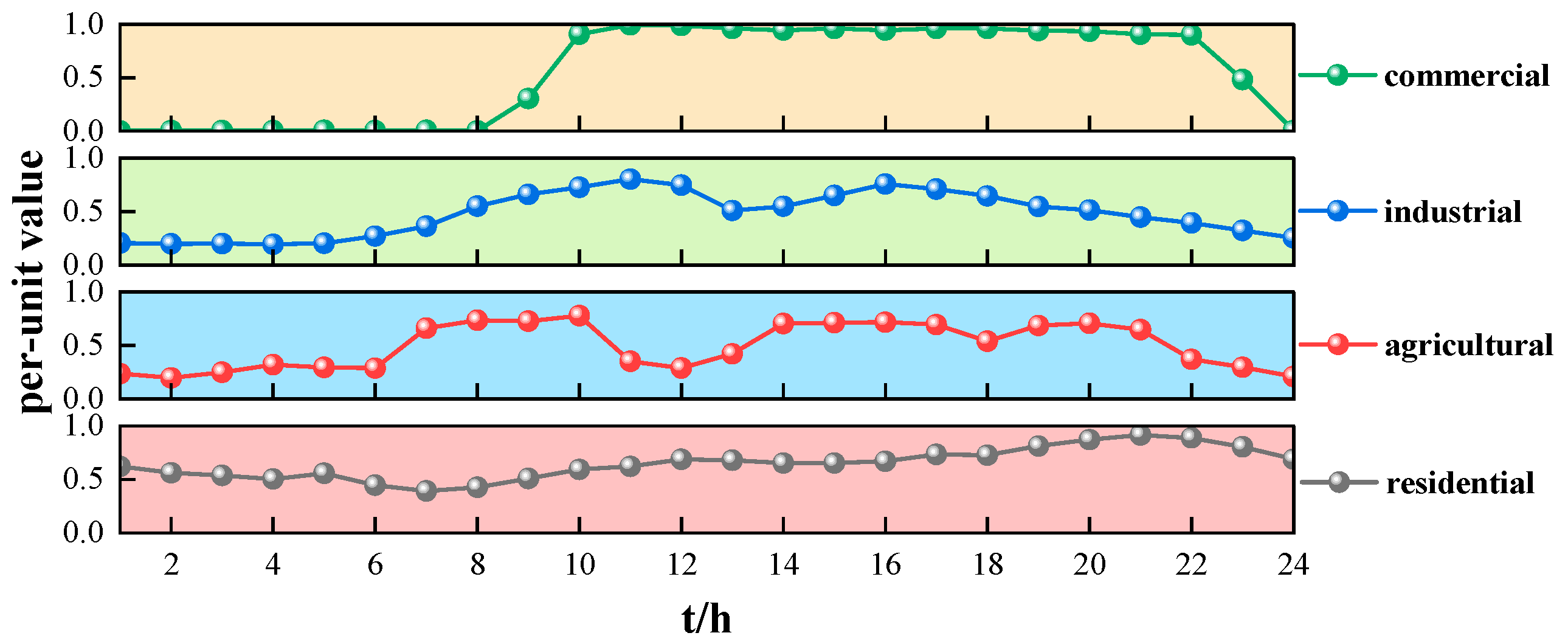
The loads at different buses in a distribution network exhibit time-varying characteristics; however, different load types generally follow relatively stable daily load profiles. In this paper, daily load demand ratio curves are adopted to describe the time-varying characteristics of loads [25]. Electricity consumers are categorized into four types, namely industrial, agricultural, commercial, and residential loads, and the corresponding daily load demand curves are shown in Figure 1. Since the proportions of different load types vary among buses, the temporal variation trends of daily load curves also differ from bus to bus. Accordingly, the daily load demand of a bus at each time period can be expressed as:
P i , t load = z = 1 Z P i N μ i z L z , t
where P i , t load denotes the load demand of bus i at time t ; Z represents the number of load types, with Z = 4 ; P i N is the rated load power of bus i ; μ i z denotes the proportion of the z -th load type in the total load at bus i ; and L z , t represents the daily load demand ratio of the z -th load type at time t .

4. Fault Restoration Model

4.1. Objective Functions

Considering the long duration of faults under the impact of extreme ice and snow conditions, dynamic decision-making is adopted for fault recovery to ensure that load buses with high weights are prioritized for restoration, while simultaneously reducing operational reliability costs and the socioeconomic losses caused by power outages. The objective function is formulated to minimize the amount of load shedding and the number of switching operations. It divides the fault period into several sub-time intervals and formulates distinct recovery strategies for each sub-interval. Ultimately, by accumulating the recovery costs of all intervals and minimizing the total cost, the fault recovery strategy is guaranteed to be optimal throughout the entire fault cycle. The objective function is expressed as follows:
(1)
Load Shedding
f 1 = t N T i Ω ω i S i , t cu Δ t
where N T denotes the number of sub-intervals in the fault horizon; Ω is the set of all buses; ω i represents the load weight of bus i , where the weights of first-, second-, and third-level loads are set to 10, 5, and 1, respectively; S i , t cu denotes the load shedding at bus i at time t ; and Δ t denotes the length of each time interval during the fault period.
(2)
Number of switch operations
f 2 = t N T i j Ψ Y i j ( 0 ) t ( 1 Y i j t ) + Y i j t ( 1 Y i j ( 0 ) t )
where Ψ denotes the set of all lines in the distribution network; Y i j ( 0 ) t and Y i j t represent the initial switching state and the current switching state of the switch on line i j at time t , respectively (0 represents open and 1 represents closed).
In summary, the objective function of the fault restoration model is formulated by minimizing the total restoration cost:
min f = ξ load f 1 + ξ sw f 2
where ξ load is the load shedding cost coefficient; ξ sw is the switching operation cost coefficient.

4.2. Island Partitioning and Merging Method

Based on the single-commodity flow concept, this paper performs island partitioning for de-energized areas with black-start DGs as the core. Meanwhile, bus state variables and line switching state variables are introduced to enable the merging of islanded regions, thereby restoring power supply to de-energized loads [26]. The island partitioning and merging constraints are described in the form of virtual power flows as follows:
i j Ψ P i j , t k i Ψ P k i , t = α i , t , i Ω / Ω DG , t N T
i j Ψ P i j , t k i P k i , t = P i , t , DG , i Ω DG , t N T P i , t , DG 1 , i Ω DG , t N T
M γ i j , t P i j , t M γ i j , t γ i j , t = y i j , t   &   α i , t   &   α j , t
where P i j , t and P k i , t denote the virtual power flows of lines i j and k i at time t , respectively; α i , t represents the energization state of bus i at time t , where 1 represents energized and 0 represents de-energized; P i , t , DG denotes the net virtual power inflow of the black-start DGs at bus i at time t ; P i , t , DG 1 represents that black-start DGs buses cannot be independently connected to the distribution network; Ω DG denotes the set of all black-start DGs buses; M is a sufficiently large positive constant; y i j , t represents a binary variable representing the operating state of line i j at time t , which takes the value of 1 if the line is connected and 0 if disconnected; γ i j , t represents whether bus i , bus j , and line i j are within the same islanded supply region at time t , where 1 represents yes and 0 represents no.

4.3. Constraints

4.3.1. Network Topology Constraints

To ensure that the network operates in a radial structure during the restoration process, the network topology constraints can be expressed as:
y i j , t = z i j , t + z j i , t i j Ψ z i j , t 1
where z i j , t and z j i , t are line flow direction variables. If bus i is the parent bus of bus j at time t , then z i j , t = 1 and z j i , t = 0 ; otherwise, z i j , t = 0 and z j i , t = 1 .

4.3.2. Load Constraints

When faults occur in the distribution network, partial controllable loads can be curtailed according to agreements signed with controllable load users [27], allowing more flexible fault restoration decisions. Therefore, the load shedding amount is subject to the following constraints:
0 P i , t cu P i , t load , t 1 , N T 0 Q i , t cu Q i , t load , t 1 , N T
P i , t cu = α i , t P i , t load , t 1 , N T Q i , t cu = α i , t Q i , t load , t 1 , N T
where Equation (24) represents the load shedding constraint for controllable loads, and Equation (25) represents the load shedding constraint for uncontrollable loads; P i , t cu and Q i , t cu denote the curtailed active and reactive load at bus i at time t , respectively; P i , t load and Q i , t load represent the active and reactive load demands of bus i at time t , respectively.

4.3.3. Power Flow Constraints

The DistFlow power flow model is adopted to describe the radial operation of the distribution network [28]. In addition, bus state variables and line status variables are incorporated into the constraints to accommodate the continuously changing topology of the distribution network during the restoration process.
i j Ψ P i j , t k i Ψ P k i , t R k i I k i , t sq = P i , t DG α i , t P i , t load i j Ψ Q i j , t k i Ψ Q k i , t X k i I k i , t sq = Q i , t DG α i , t Q i , t load t 1 , N T
U i , t sq U j , t sq = 2 R i j P i j , t + X i j Q i j , t R i j 2 + X i j 2 I i j , t sq
I i j , t sq = P i j , t 2 + Q i j , t 2 U i , t sq
where P i j , t and Q i j , t denote the active and reactive power flowing from bus i to bus j at time t , respectively; P i , t DG and Q i , t DG represent the active and reactive power outputs of the black-start DGs at bus i at time t , respectively; R i j is the resistance of line i j ; X i j is the reactance of line i j ; I i j , t sq denotes the squared magnitude of the current on line i j at time t ; U i , t sq denotes the squared voltage magnitude of bus i at time t .

4.3.4. Second-Order Cone Constraints

Since the power flow constraints include quadratic terms, the nonlinear constraint (28) is relaxed using a second-order cone relaxation technique based on the relationships among voltage, current, and power. This relaxation transforms the constraint into a standard second-order cone form [29]:
I i j , t sq P i j , t 2 + Q i j , t 2 U i , t sq
2 P i j , t 2 Q i j , t I i j , t sq U i , t sq 2 I i j , t sq + U i , t sq

4.3.5. Tightened Relaxation Constraints

Traditional DistFlow second-order cone relaxation models are highly prone to becoming unsolvable when handling line outages due to the failure of Equation (27). The conventional approach addresses this by employing the Big-M method, which introduces an empirical, sufficiently large constant [30]. However, the introduction of such an extremely large constant often results in an excessively large relaxation feasible region and low computational efficiency. To address this issue, this paper proposes tightening the relaxation boundaries using the physical voltage limits of the distribution network. This mathematical reconstruction ensures the strict feasibility of the second-order cone relaxation under extreme line outages, effectively suppresses numerical ill-conditioning issues during the optimization process, and guarantees the timeliness of dynamic decision-making. The reconstruction of Equation (27) is formulated as follows:
U i , t sq U j , t sq 2 R i j P i j , t + X i j Q i j , t + R i j 2 + X i j 2 I i j , t sq + M 1 y i j , t 0 U i , t sq U j , t sq 2 R i j P i j , t + X i j Q i j , t + R i j 2 + X i j 2 I i j , t sq M 1 y i j , t 0
M = U n max U n min
where M is the constant after the tightening process; and U n max and U n min are the squared values of the upper and lower limits of the bus voltage magnitude according to the safe operating specifications, respectively.

4.3.6. MT Output Constraints

P i , min MT P i , t MT P i , max MT Q i , min MT Q i , t MT Q i , max MT
where P i , max MT and P i , min MT are the upper and lower limits of the active power output of the MT at the bus, respectively; Q i , max MT and Q i , min MT are the upper and lower limits of the reactive power output of the MT at the bus, respectively.

4.3.7. General Constraints

α i , t U n min U i , t sq α i , t U n max
0 I i j , t sq y i j , t I max
y i j , t P max P i j , t y i j , t P max y i j , t Q max Q i j , t y i j , t Q max
where U n min and U n max denote the minimum and maximum allowable values of the squared voltage magnitude at a bus, respectively; I max represents the maximum allowable squared current magnitude of a line; P max and Q max denote the maximum allowable active and reactive power of a line, respectively.

5. Solution Algorithm

Since the proposed model involves 0–1 integer discrete decisions, such as switching operations and uncontrollable load shedding, as well as coupled continuous physical constraints related to power flow, power, voltage, and current, it constitutes a mixed-integer second-order cone programming (MISOCP) problem. Although solving the MISOCP using mature commercial solvers can ensure satisfactory power restoration performance, the solution process is often constrained by the branch-and-bound strategy of the solver, which limits computational efficiency and solution accuracy. To address these issues, this paper adopts a two-layer hybrid algorithm that combines an improved binary grey wolf optimization (IBGWO) with a second-order cone relaxation (SOCR) algorithm to solve the proposed model.

5.1. Improved Binary Grey Wolf Optimization

5.1.1. Binary Grey Wolf Optimization

The core principle of the grey wolf optimization (GWO) is to simulate the hunting behavior of grey wolf packs and exploit their cooperative social hierarchy to achieve optimization. The algorithm establishes a hierarchical structure for the wolf pack, dividing the population into four levels: α , β , δ , and ω . Among them, the α , β , and δ wolves act as the core decision-makers, guiding the hunting strategy and encirclement of the prey, while the ω wolves serve as execution agents that cooperate in the hunt by following the guidance of the higher-ranking wolves. In the algorithm, the prey represents the global optimal solution of the optimization problem; the α , β , and δ wolves correspond to the three best candidate solutions that are closest to the prey; and the ω wolves represent the remaining candidate solutions, which gradually approach the prey under the leadership of the three dominant wolves, i.e., progressively converge toward the optimal solution [31]. The encircling behavior of grey wolves around the prey is defined as follows:
D ( k ) = C X p k X k
X ( k + 1 ) = X p ( k ) A D ( k )
C = 2 r 1 A = 2 a r 2 a a = 2 × ( 1 k K )
where k and K denote the current iteration number and the maximum number of iterations, respectively; D ( k ) represents the distance between a grey wolf individual and the prey; X p k denotes the position of the prey at the k -th iteration; X k represents the position of a grey wolf individual; A and C are coefficient vectors; r 1 and r 2 are random vectors uniformly distributed in [0, 1]; and a is the convergence factor, which decreases linearly from 2 to 0 as the number of iterations increases.
In optimization problems, the position of the prey, i.e., the global optimal solution, cannot be obtained at the initial stage. It is therefore assumed that the α , β , and δ wolves have better knowledge of the potential location of the prey. Accordingly, the behavior of the wolf pack in estimating the prey position can be expressed as follows:
D α ( k ) = C 1 X α ( k ) X ( k ) D β ( k ) = C 2 X β ( k ) X ( k ) D δ ( k ) = C 3 X δ ( k ) X ( k )
where D α ( k ) , D β ( k ) , and D δ ( k ) denote the distances between the α , β , and δ wolves and a given ω wolf individual in the pack at the k -th iteration, respectively; X α ( k ) , X β ( k ) , and X δ ( k ) represent the positions of the α , β , and δ wolves at the k -th iteration, i.e., the three best solutions; C 1 , C 2 , and C 3 denote the search distance weighting coefficients between the α , β , and δ wolves and a given ω wolf individual; and X ( k ) represents the position of a given ω wolf individual at the k -th iteration, i.e., a candidate solution.
After determining the position of the prey, the encircling and hunting behavior of the grey wolf pack can be expressed as follows:
X 1 ( k ) = X α ( k ) A 1 D α ( k ) X 2 ( k ) = X β ( k ) A 2 D β ( k ) X 3 ( k ) = X δ ( k ) A 3 D δ ( k )
X k + 1 = X 1 ( k ) + X 2 ( k ) + X 3 ( k ) 3
where X 1 ( k ) , X 2 ( k ) , and X 3 ( k ) denote the position–distance weighting factors of an ω wolf with respect to the three best solutions represented by the α , β , and δ wolves, respectively.
Since the distribution network fault restoration model involves a series of 0–1 integer discrete decision variables, such as switching operations and uncontrollable load shedding, the binary grey wolf optimization (BGWO) is adopted to solve these decisions. In the BGWO, the position of each grey wolf represents the 0–1 states of these discrete decision variables. The corresponding transformation function is defined as follows:
sigmoid X k + 1 = 1 1 + exp 10 X k + 1 0.5
X ( k + 1 ) = 1 , sigmoid X ( k + 1 ) > r 0 , sigmoid X ( k + 1 ) r
where sigmoid denotes the transfer function, and r is a random number uniformly distributed in [0, 1].

5.1.2. Improvement Strategies

Although the GWO has advantages such as fast convergence, few control parameters, and ease of implementation, it suffers from several limitations when applied to high-dimensional, multi-constrained distribution network fault restoration problems. These limitations include poor diversity of the initial population, relatively low solution accuracy, and a tendency to fall into local optima, which restrict its applicability to complex optimization problems. To address these issues, the following improvements are introduced in this paper.
(1)
Sobol Sequence
To mitigate the problem of insufficient diversity and individual clustering in the initial population, the Sobol sequence is employed. Owing to its low-discrepancy, randomness, and good space-filling properties, the Sobol sequence can generate uniformly distributed sampling points in high-dimensional spaces, thereby enhancing population diversity and improving the global search capability in the early stage of the algorithm. Accordingly, the Sobol sequence is used to generate the initial population, which is then linearly mapped to the value ranges of the optimization variables [32].
The Sobol sequence can be expressed as:
S = Sobol ( N , D )
where S denotes the initial population generated using the Sobol sequence; N represents the number of individuals in the population; and D denotes the dimensionality of each individual.
Based on the Sobol sequence, the initial population is linearly mapped to obtain the inverse mapping of the initial population position variables, which can be expressed as:
X = l + ( u l ) S
where u and l denote the upper and lower bounds of the decision variable domain, respectively.
(2)
Improved Convergence Factor and Position Update Strategy
(a)
Convergence Factor Improvement Strategy
As shown in Equation (39), the convergence factor a decreases linearly from 2 to 0 with the increase in the number of iterations, and it has a significant impact on the optimization performance of the algorithm. However, for complex optimization problems, a linearly decreasing convergence factor cannot accurately characterize the dynamic evolution of the optimization process. This limitation considerably restricts the search capability of the algorithm. To address this issue, a cosine-function-based improvement strategy for the convergence factor is proposed in this paper. Through this improvement, the variation pattern of the convergence factor better conforms to the nonlinear characteristics of practical optimization processes, effectively balancing the global exploration and local exploitation abilities of the algorithm while accelerating the convergence speed. The adaptive adjustment mechanism of the convergence factor a based on the cosine function is expressed as follows [33]:
a = 2 × 1 + cos ( k 1 ) π / ( K 1 ) 2 , 0 < k K 2 2 × 1 cos ( k 1 ) π / ( K 1 ) 2 , K 2 < k K
    (b)
Position Update Improvement Strategy
In the standard GWO, position updating mainly relies on the interaction between individual wolves and the best individuals in the population, which introduces a certain degree of randomness. Due to this randomness, high-quality solutions may be replaced by inferior ones during the position update process, leading to fluctuations in solution quality and reduced optimization accuracy. To address this issue and fully exploit the historical experience of individuals, the concept of particle swarm optimization (PSO) is incorporated into the GWO framework. Specifically, the ideas of using individual historical best positions and the global best position to guide position updates are introduced into the GWO position update formula. The improved GWO position update formula is expressed as follows:
X ( k + 1 ) = κ 1 r 1 τ 1 X α ( k ) + τ 2 X β ( k ) + τ 3 X δ ( k ) + κ 2 r 2 X α ( k ) X ( k ) τ 1 = X 1 ( k ) X 1 ( k ) + X 2 ( k ) + X 3 ( k ) + ε τ 2 = X 2 ( k ) X 1 ( k ) + X 2 ( k ) + X 3 ( k ) + ε τ 3 = X 3 ( k ) X 1 ( k ) + X 2 ( k ) + X 3 ( k ) + ε
κ 1 = κ cos 2 ( k π 2 K ) κ 2 = κ κ 1
where τ 1 , τ 2 , and τ 3 are inertia weight coefficients; κ 1 and κ 1 are learning factors; κ denotes the base value of the learning factor; and ε is a very small positive constant introduced to prevent the denominator of the inertia weight factor from becoming zero, where ε = e 15 is adopted in this study.
(3)
Lévy Flight
To address the tendency of the GWO to become trapped in local optima during the later stages of the optimization process, the Lévy flight mechanism is introduced in this paper. Lévy flight is a random search strategy that follows a Lévy distribution and enhances global exploration by alternating between long- and short-distance search steps, thereby significantly improving the global search capability of the algorithm [34].
To further strengthen the global exploration ability of the GWO, when the absolute value of the position–distance weighting factor is less than 1, indicating that the algorithm has entered the local exploitation stage, the Lévy flight strategy is incorporated into the position update process. In addition, a greedy selection mechanism is employed to compare the fitness values of the original solution and the newly generated solution, retaining the superior one. The specific implementation principle is described as follows:
X ( k + 1 ) = X ( k + 1 ) + L L ( γ ) , 0.5 A < 1 X ( k + 1 ) , A < 0.5
L L γ = 0.01 u v γ ( X X α )
X ( k + 1 ) = X ( k ) , f X new ( k ) > f X ( k ) X new ( k ) , f X new ( k ) f X ( k )
where L denotes the weighting factor controlling the step size; L ( γ ) represents the step length following a Lévy distribution; u and v are random variables subject to a standard normal distribution; γ is a random number uniformly distributed in the interval [0, 2]; X new ( k ) denotes the newly generated solution; f X new ( k ) represents the fitness value of the new solution; and f X ( k ) denotes the fitness value of the original solution.

5.2. Two-Layer Hybrid Algorithm

To prevent any single term from becoming excessively large and dominating the entire optimization process during model solving, the objective function (19) is normalized as follows:
f = λ 1 f 1 f 1 + λ 2 f 2 f 2
where f denotes the normalized fitness value; f 1 and f 2 represent the maximum allowable load shedding and maximum number of switching operations of the system in each time period, respectively; and λ 1 , λ 2 are the weighting coefficients, which are set to 0.7 and 0.3, respectively.
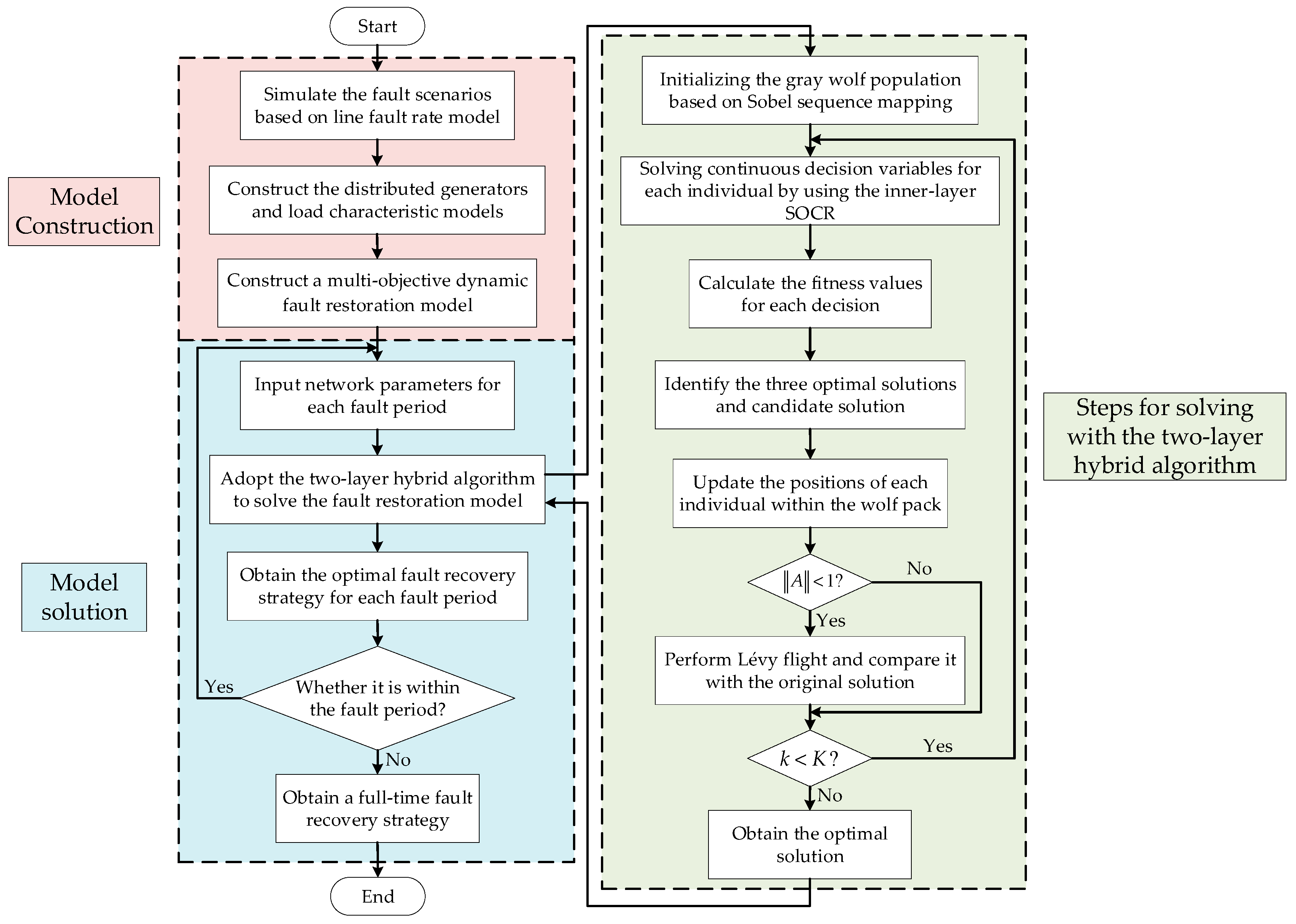
The IBGWO introduced in Section 5.1 is employed as the outer-layer algorithm to solve the discrete decision variables, while the SOCR method is adopted as the inner-layer algorithm to solve the continuous decision variables. The coordination of these two algorithms improves both the solution accuracy and computational efficiency of the proposed model. The overall solution procedure is summarized as follows:
(1)
The network parameters for each fault time period are input, and the initial population of the IBGWO is generated based on Sobol sequence mapping;
(2)
According to the wolf positions, i.e., the discrete topological decisions, the inner-layer SOCR algorithm is employed to solve the continuous decision variables under each discrete topology;
(3)
The fitness values of all candidate solutions are evaluated, and the positions of the α , β , and δ wolves, corresponding to the three best solutions, are determined;
(4)
The positions of all individuals in the wolf pack are updated to obtain the positions of the ω wolves, which represent candidate solutions.
(5)
The absolute value of the position–distance weighting factor A is examined. If A < 1 , Lévy flight is performed, and the resulting solution is compared with the original one to obtain the optimal candidate solution;
(6)
If the maximum number of iterations is reached, the optimal candidate solution is output; otherwise, the algorithm returns to Step 2 and continues the iteration;
(7)
The optimal repair strategy for each time period is obtained.

5.3. Fault Restoration Procedure

Based on the above analysis, the implementation procedure of the proposed dynamic fault restoration strategy under extreme ice and snow weather conditions is illustrated in Figure 2.

6. Case Study

6.1. Case Parameters

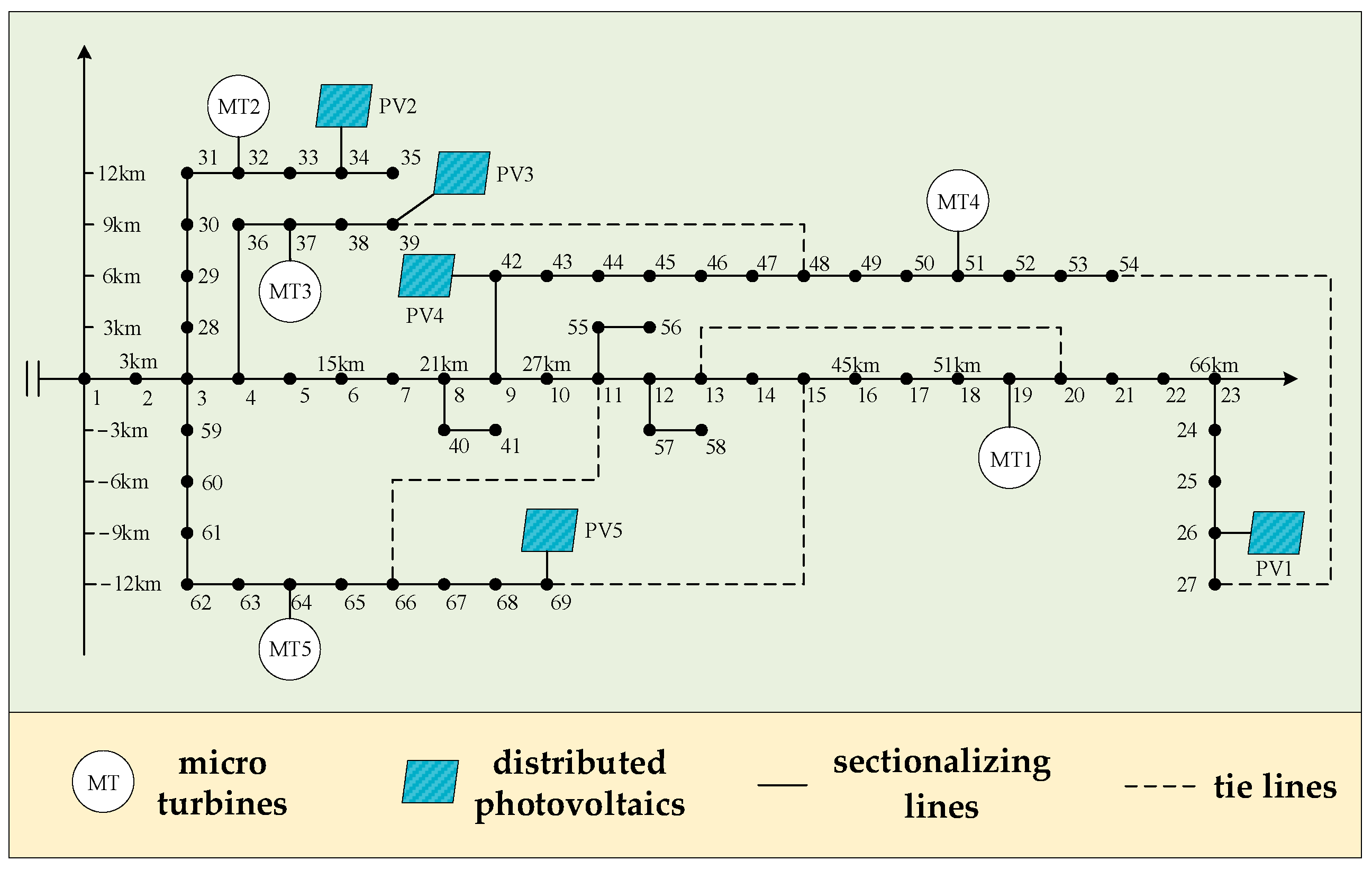
This paper takes the PG&E 69-bus test system model shown in Figure 3 as the case study. The system consists of 69 buses and 73 lines, where the buses serve as load connection points. Lines 11–66, 13–20, 15–69, 27–54, and 39–48 are tie lines, and the remaining lines are sectionalizing lines.
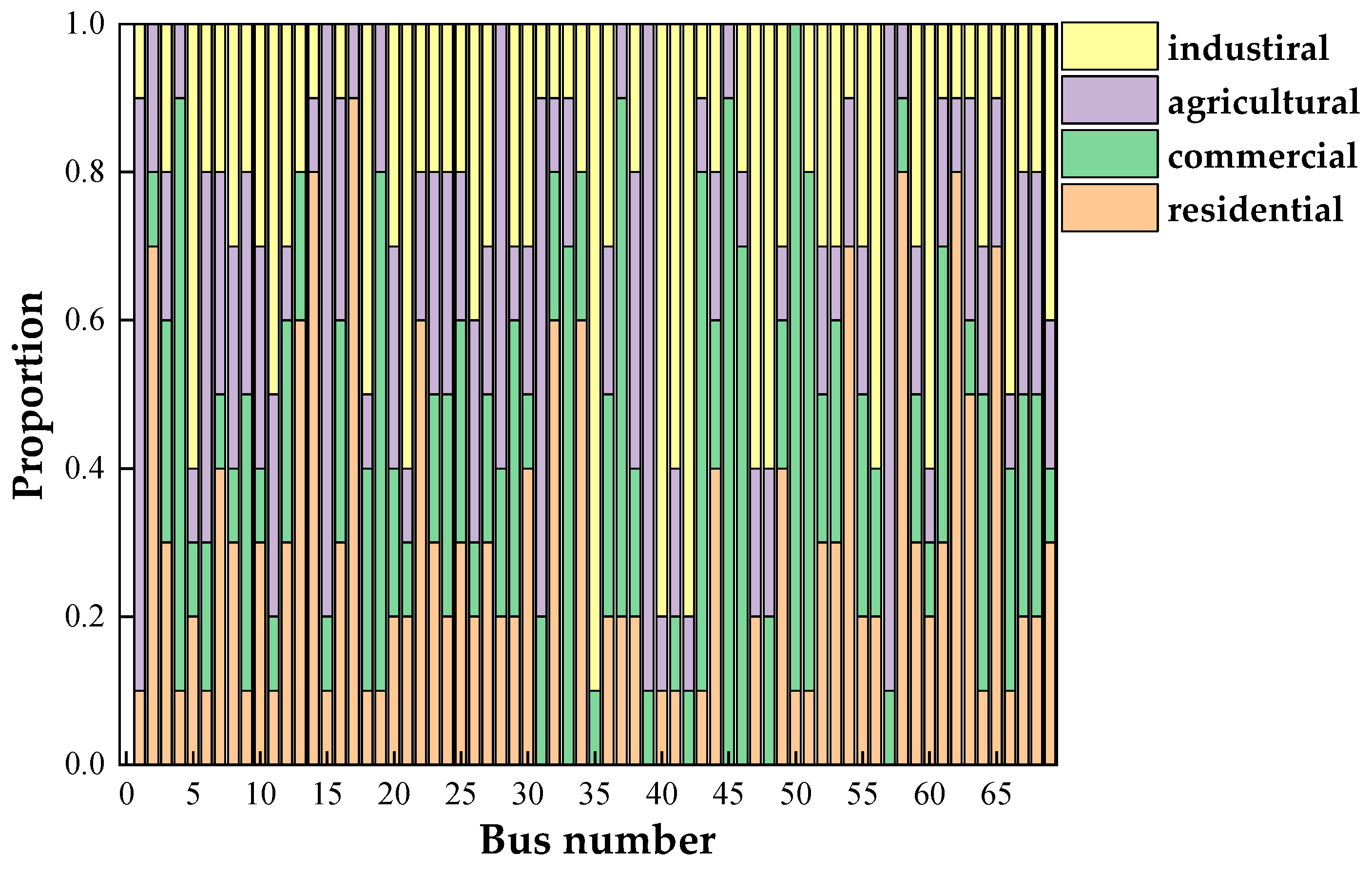
According to the reliability assessment standards, the load shedding cost is calculated as the product of 2.4 CNY/kWh and the load weight grade; the switching operation cost is 100 CNY/operation. The MTs connection points are at buses 19, 32, 37, 51, and 64, and the PVGs connection points are at buses 26, 34, 39, 42, and 69. The detailed parameters of the MTs, the weight grades of each load bus, and the load types are shown in Table 1, Table 2 and Table 3, respectively. The load proportional coefficients of each bus during the fault period are shown in Figure 4.

6.2. Simulation Parameters

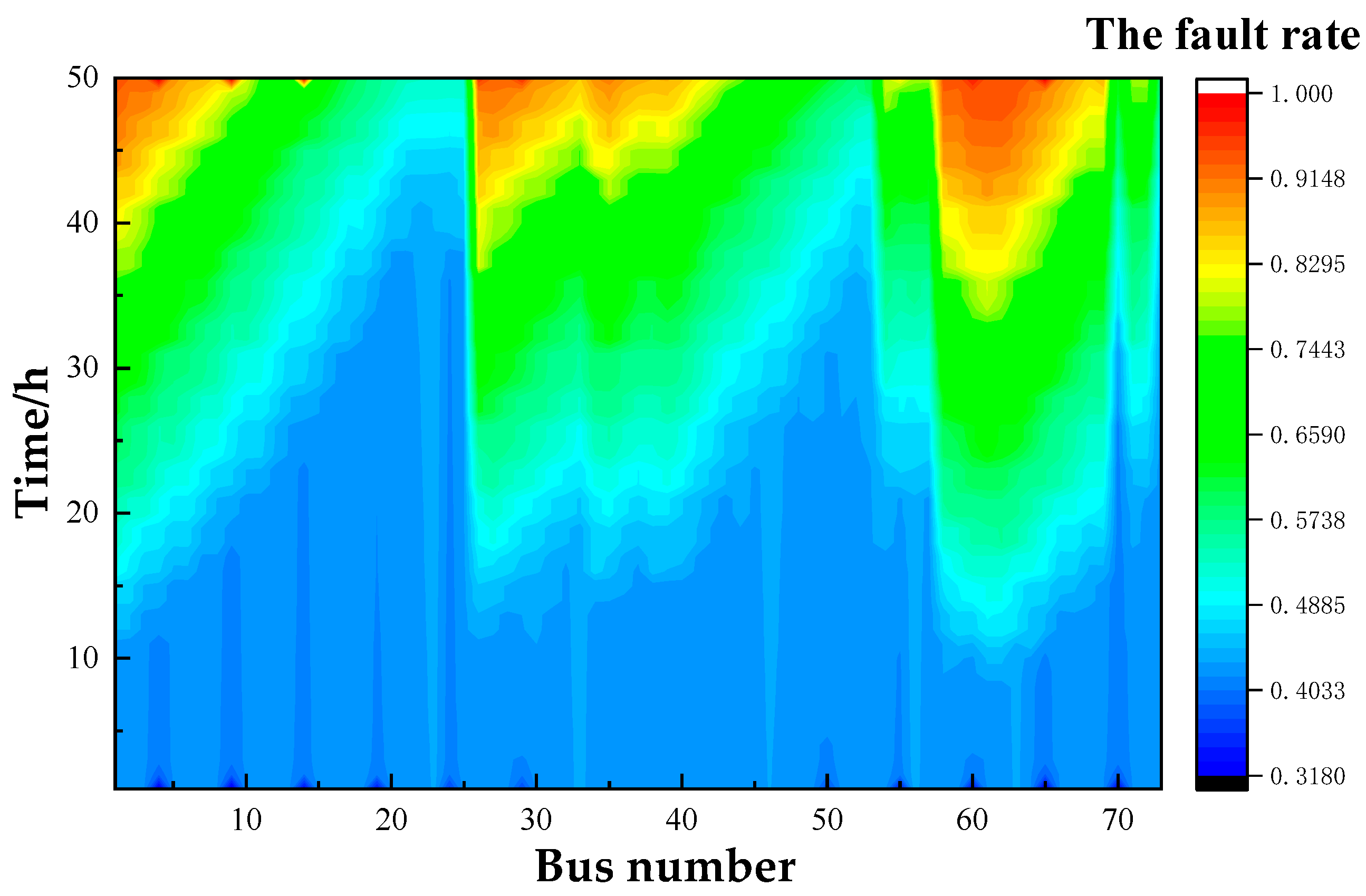
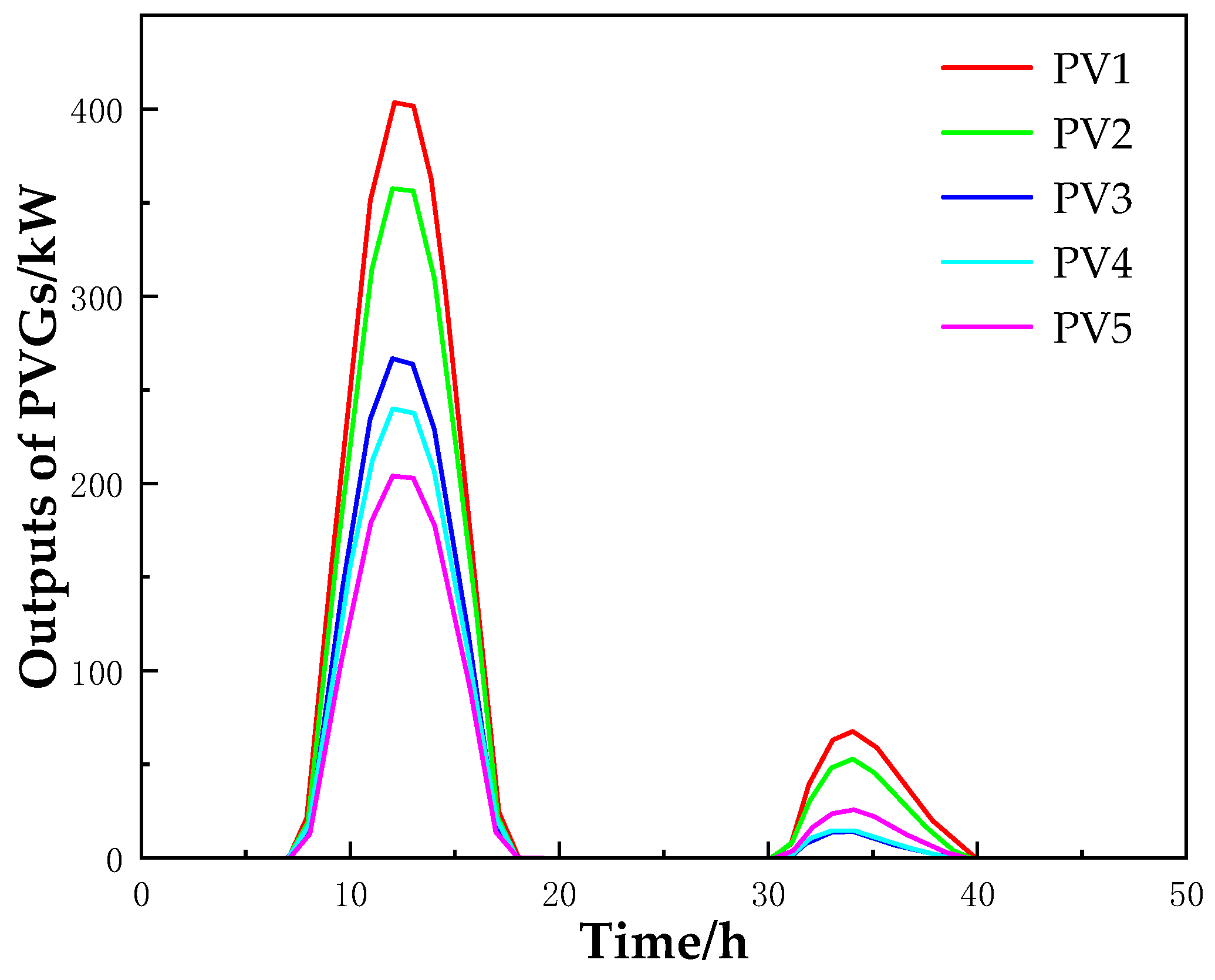
Based on the coordinate system established in Figure 3, the initial center coordinates of the extreme ice and snow weather are (−150 km, −150 km). It moves at an angle of 45° to the x-axis at a speed of 4.2 km/h for a duration of 50 h. The simulation parameters refer to the constant coefficients in the line fault rate model set in Reference [17], which are as follows: a 1 = 0.02 , a 2 = 0.0133 , a 3 = 0.000588 , b 1 = 0.0277 , b 2 = 1.088 , c 1 = 0.18 , c 2 = 20 , c 3 = 0.1 , and c 4 = 10 . The line fault rates and PVGs outputs under this simulation scenario are shown in Figure 5 and Figure 6.
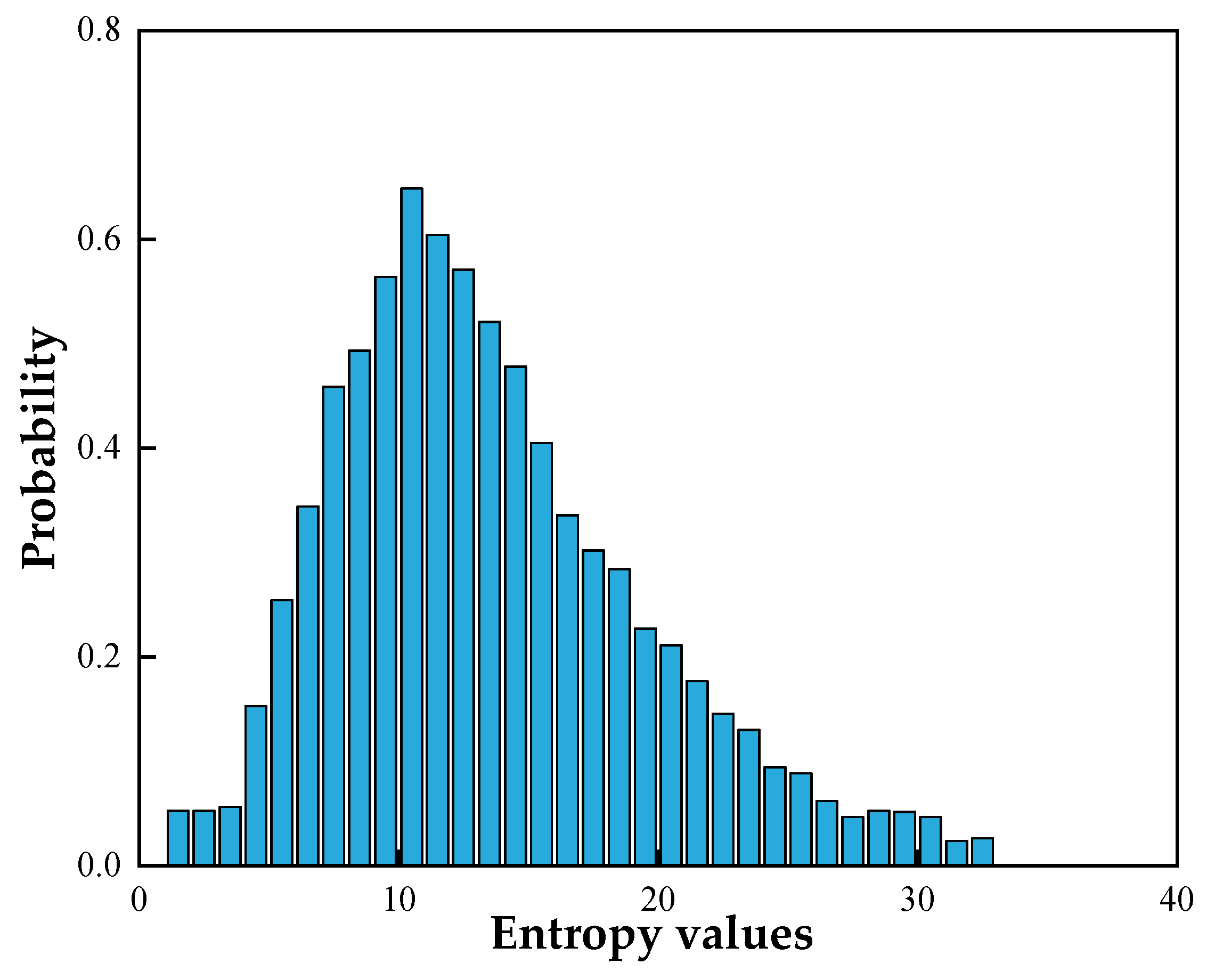
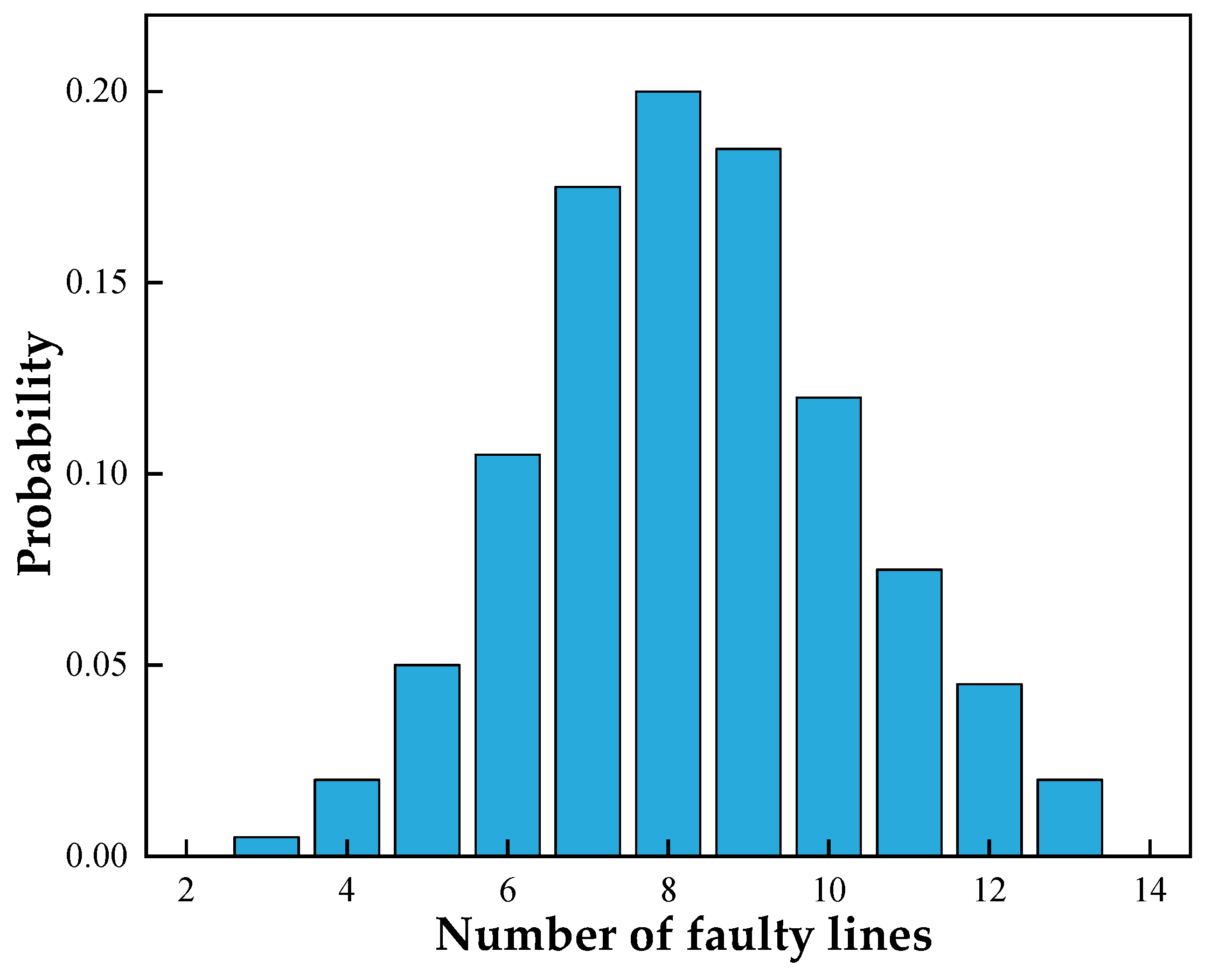
Based on the constructed line fault rate model, the information entropy-based typical scenario screening method is utilized to analyze the fault scenario set, obtaining the probability distribution characteristics of the entropy values of the distribution network fault scenarios. The probability distribution of the entropy values and the probability distribution of the number of faulty lines are shown in Figure 7 and Figure 8. The system information entropy is concentrated in the range of (4, 24). Therefore, for the screening of typical fault scenarios, W min and W max are set to 4 and 24, respectively. According to the simulated fault scenarios, those with entropy values between 10 and 12 have a higher probability and are classified as typical fault scenarios. As can be seen from Figure 8, the probability is higher when the number of concurrent faults is 8. Therefore, taking the 8-line concurrent fault as an example, a typical fault scenario that satisfies the information entropy requirements is selected. In this fault scenario, lines (S4, S60), (S28, S29), (S10, S67), and (S21, S25) experience faults at 40 h, 40.75 h, 42 h, and 42.75 h, respectively, after the onset of the ice and snow weather.

6.3. Analysis of Fault Recovery Results

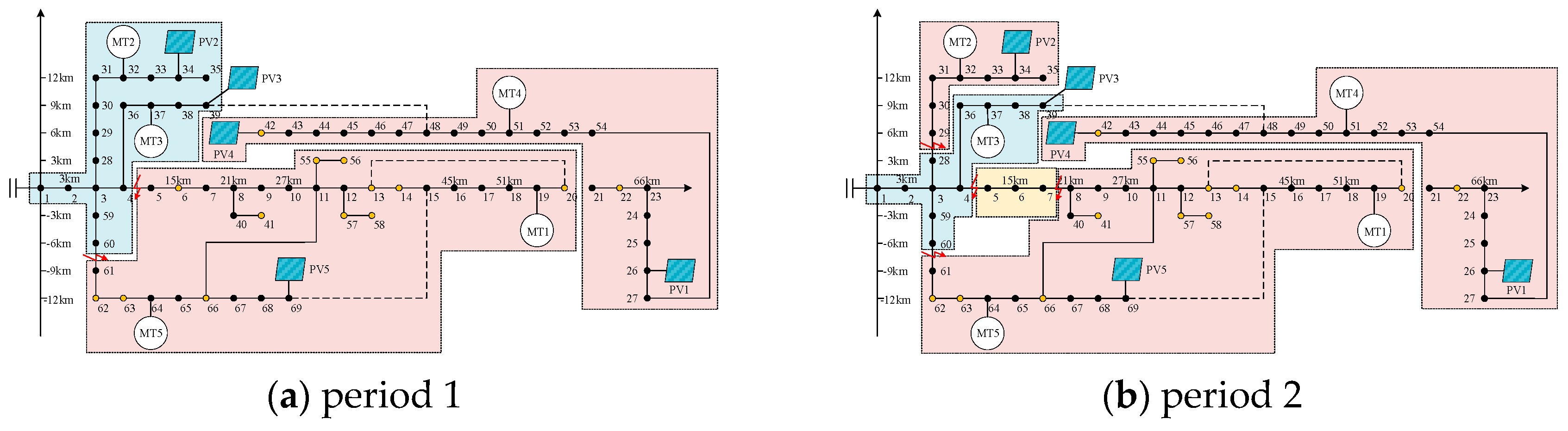
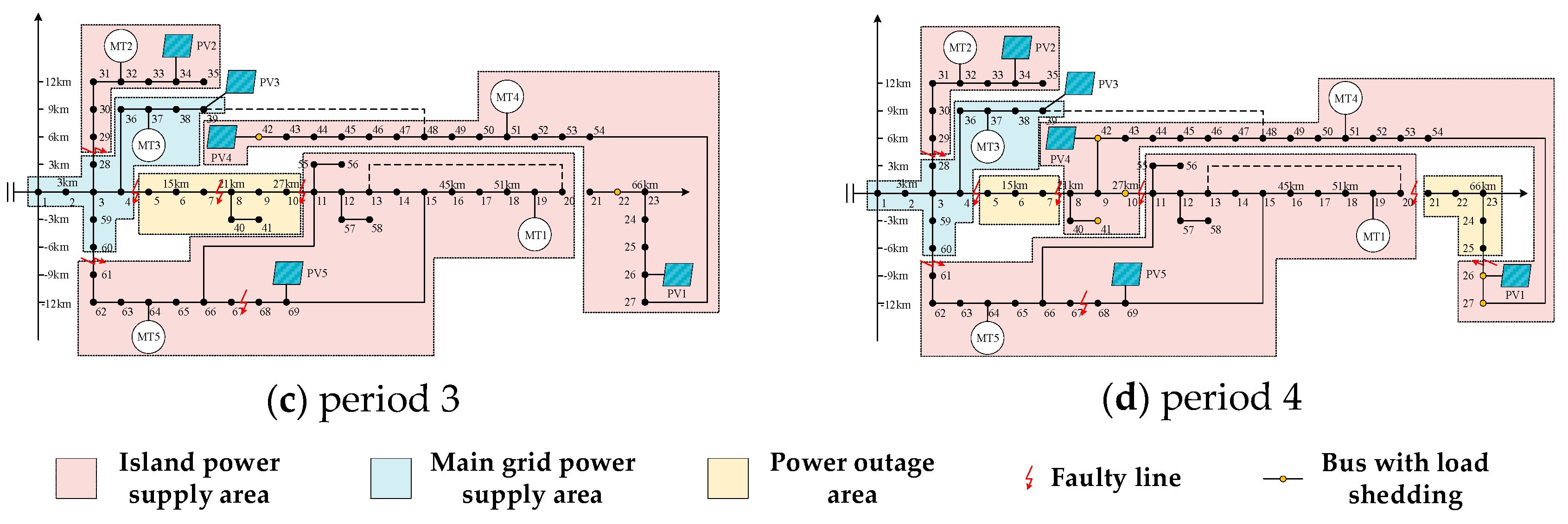
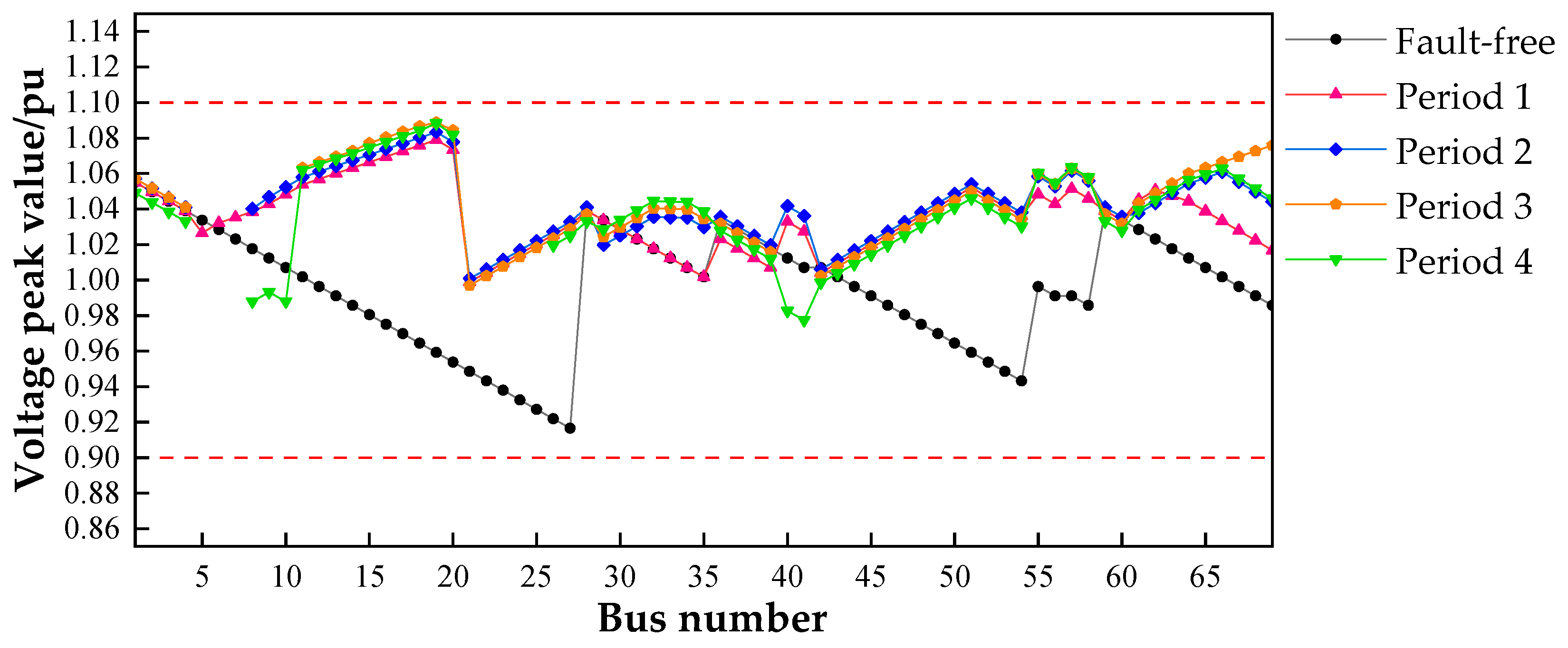
For the fault scenario set in Section 6.2, the fault recovery results of the proposed method in different periods are shown in Figure 9 and Table 4, and the bus voltage distributions under fault-free conditions and during different fault periods are shown in Figure 10.
As shown in Figure 9a, faults occur on lines S4 and S60. To achieve minimum load shedding and fully utilize the outputs of DGs during this period, the recovery model closes the tie line switches 11–66 and 27–54, and opens the sectionalizing line switches 9–42 and 20–21. It combines MT1, MT5, and PV5, as well as MT4, PV1, and PV4, to form two integrated islands for power supply restoration to the loads within the respective areas. Simultaneously, partial bus loads are shed to maintain the power flow balance within the islands, effectively achieving power supply restoration for essential loads. As shown in Figure 9b, considering fault evolution, faults occur on lines S7 and S28 during this period. The model integrates MT2 and PV2 into a single island to restore the power supply to the outaged loads within this area. Meanwhile, the DGs outputs and the amount of load shedding within each island are adjusted according to the fluctuations in loads and PVGs outputs. As shown in Figure 9c, faults occur on lines S10 and S67 during this period. By closing the tie line switch 15–69, the model integrates MT1, MT5, and PV5 into a new island with a different topological configuration to restore the power supply to the area, while simultaneously adjusting the DGs outputs and load shedding within each island. As shown in Figure 9d, faults occur on lines S20 and S25 during this period. The model closes the sectionalizing line switch 9–42 to incorporate buses 8–10, 40, and 41 into the island formed by MT4, PV1, and PV4 for power supply restoration. This achieves the full utilization of resources and demonstrates the flexibility and scalability of the proposed method. As can be seen from Table 4, a high level of power supply restoration is guaranteed during all fault periods, verifying that the proposed method achieves excellent recovery performance.
Simultaneously, as shown in Figure 10, the voltage threshold is set between 0.9 and 1.1 (pu) to ensure voltage stability during the restoration process. under the recovery strategies in each fault period, the voltages of all buses, except for some outaged ones, are maintained at a stable level, which verifies the reliability of the proposed fault recovery method.

6.4. Comparative Analysis of Schemes

6.4.1. Scheme Settings

To verify the reliability and superiority of the proposed fault recovery method, five different schemes are established to make recovery decisions for the fault scenarios screened in Section 6.2, and a comparative analysis is conducted based on their respective operational results:
(1)
Scheme 1: Solving the model using a single SOCR through the Gurobi commercial solver (Gurobi Optimization, Houston, TX, USA) integrated with MATLAB R2020b.
(2)
Scheme 2: Solving the model using a single IBGWO.
(3)
Scheme 3: Solving the model using a two-layer hybrid algorithm based on BPSO and SOCR.
(4)
Scheme 4: Solving the model using a two-layer hybrid algorithm based on BGWO and SOCR.
(5)
Scheme 5: Solving the model using the proposed two-layer hybrid algorithm based on IBGWO and SOCR.

6.4.2. Comparative Analysis of Recovery Results Among Different Schemes

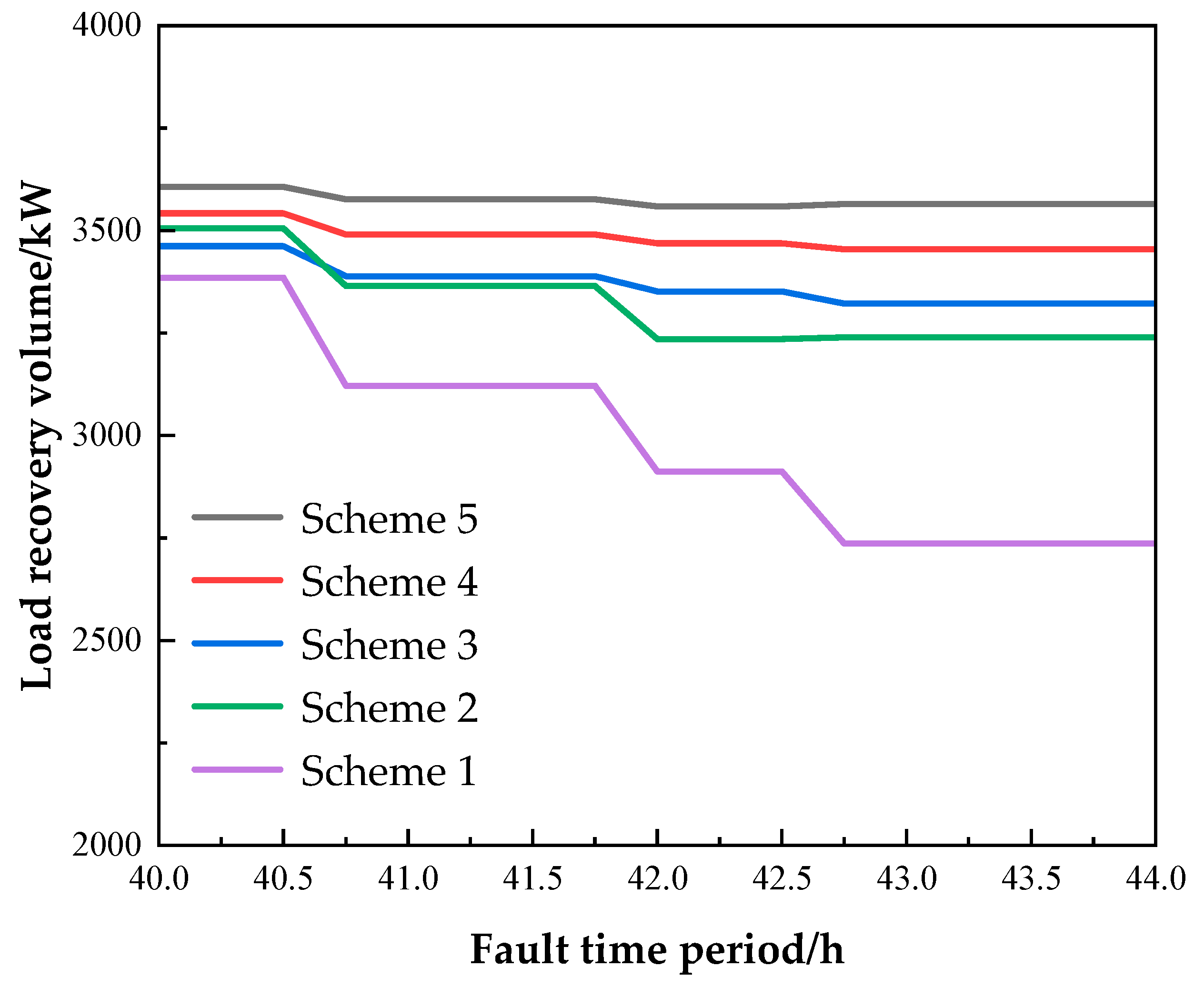
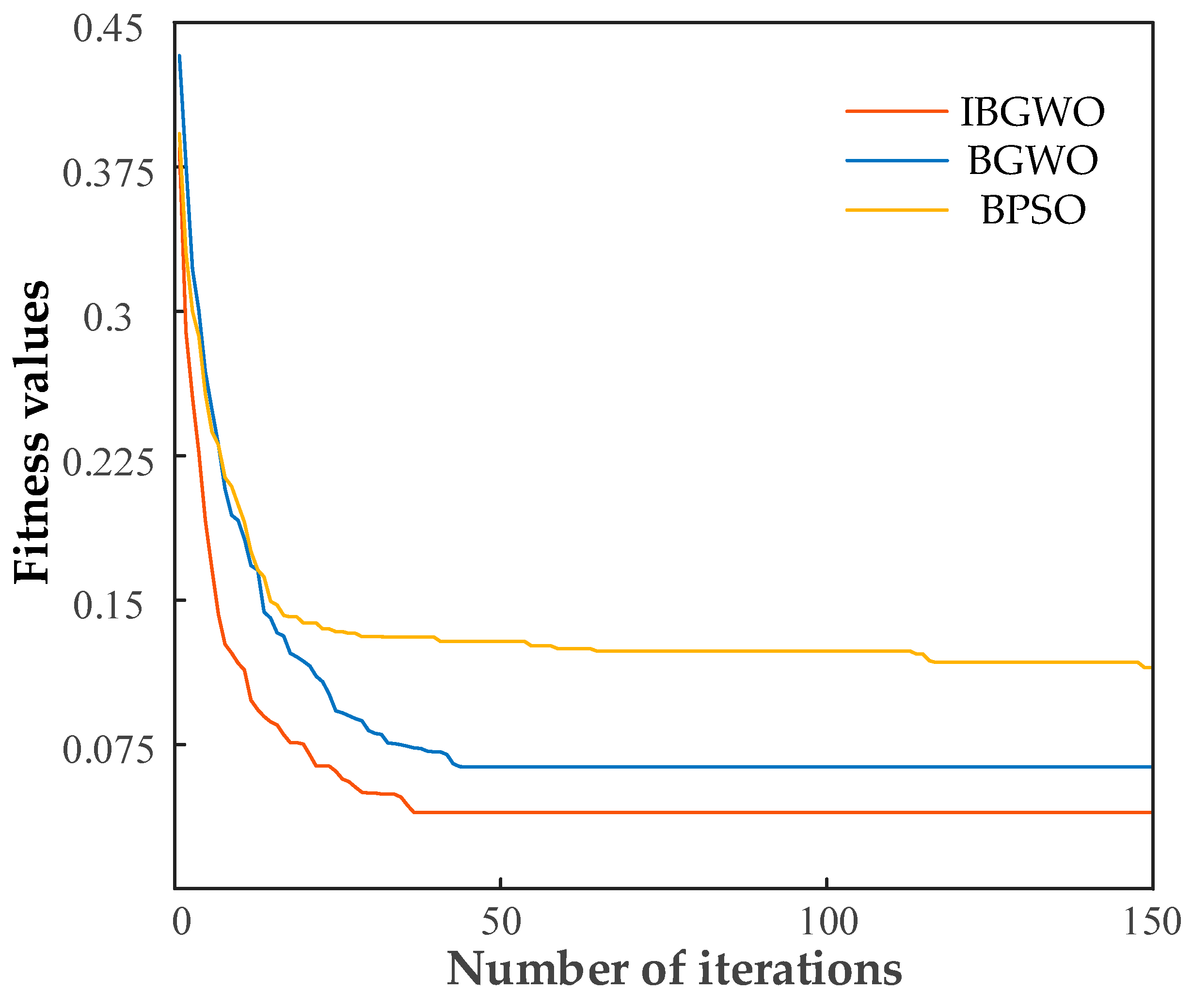
By averaging the results of multiple fault recoveries for the fault scenarios set in Section 6.2, the comparison of power supply restoration results for each scheme during different periods is shown in Figure 11 and Table 5. The curves of the fitness values of the two-layer hybrid algorithms using different heuristic algorithms versus the number of iterations are shown in Figure 12.
As can be seen from Figure 11 and Table 5, the proposed method (i.e., Scheme 5) exhibits certain superiority over the other schemes in terms of the restored load and the percentage of restored power supply in each period during the fault. Simultaneously, the proposed method demonstrates advantages in recovery costs and model solution times. Compared with Schemes 1, 2, 3, and 4, the total recovery cost is reduced by 18.82%, 11.32%, 9.11%, and 6.65%, respectively, and the solution efficiency is improved by 38.55%, 49.50%, 32%, and 26.09%, respectively. These results verify the superiority of the proposed method in terms of economy and computational efficiency.
Comparing the single solution algorithm framework used in Schemes 1 and 2 with the two-layer hybrid algorithm framework used in Schemes 3, 4, and 5, it is evident that the recovery performance of the two-layer hybrid algorithm is generally better than that of the single solution algorithm. The reason is that the two-layer hybrid algorithm can not only perform a global search for discrete variables throughout the distribution network fault recovery process but also efficiently solve the continuous variables in the recovery process. It improves the solution efficiency while searching for the optimal recovery topology, further verifying the superiority and feasibility of the proposed two-layer hybrid algorithm framework in solving such problems.
As shown in Figure 12, comparing the heuristic algorithms adopted in Schemes 3 and 4 with the proposed one, the proposed IBGWO exhibits distinct superiority over traditional BGWO and BPSO in terms of both convergence speed and convergence accuracy. This further indicates that compared with traditional heuristic algorithms, the fault recovery performance of the proposed IBGWO demonstrates better timeliness, global search capability, and convergence accuracy.
Based on the comprehensive comparative analysis of the recovery results of the aforementioned schemes, it can be concluded that, in terms of fault recovery performance, compared with making decisions using a single SOCR or a single heuristic algorithm, the two-layer hybrid algorithm provides a broader decision space. Moreover, the proposed two-layer hybrid algorithm based on IBGWO and SOCR achieves better recovery performance than other heuristic algorithms, fully verifying the superiority of the proposed method. In terms of model solution performance, the two-layer hybrid algorithm can fully utilize the respective advantages of the inner and outer layer algorithms, significantly improving the global search capability and solution efficiency of the model. This enhances the rapid response capability of the system when facing sudden faults and provides a guarantee for dynamic recovery in response to fault evolution.

6.4.3. Comparative Analysis of the Economy Among Different Schemes

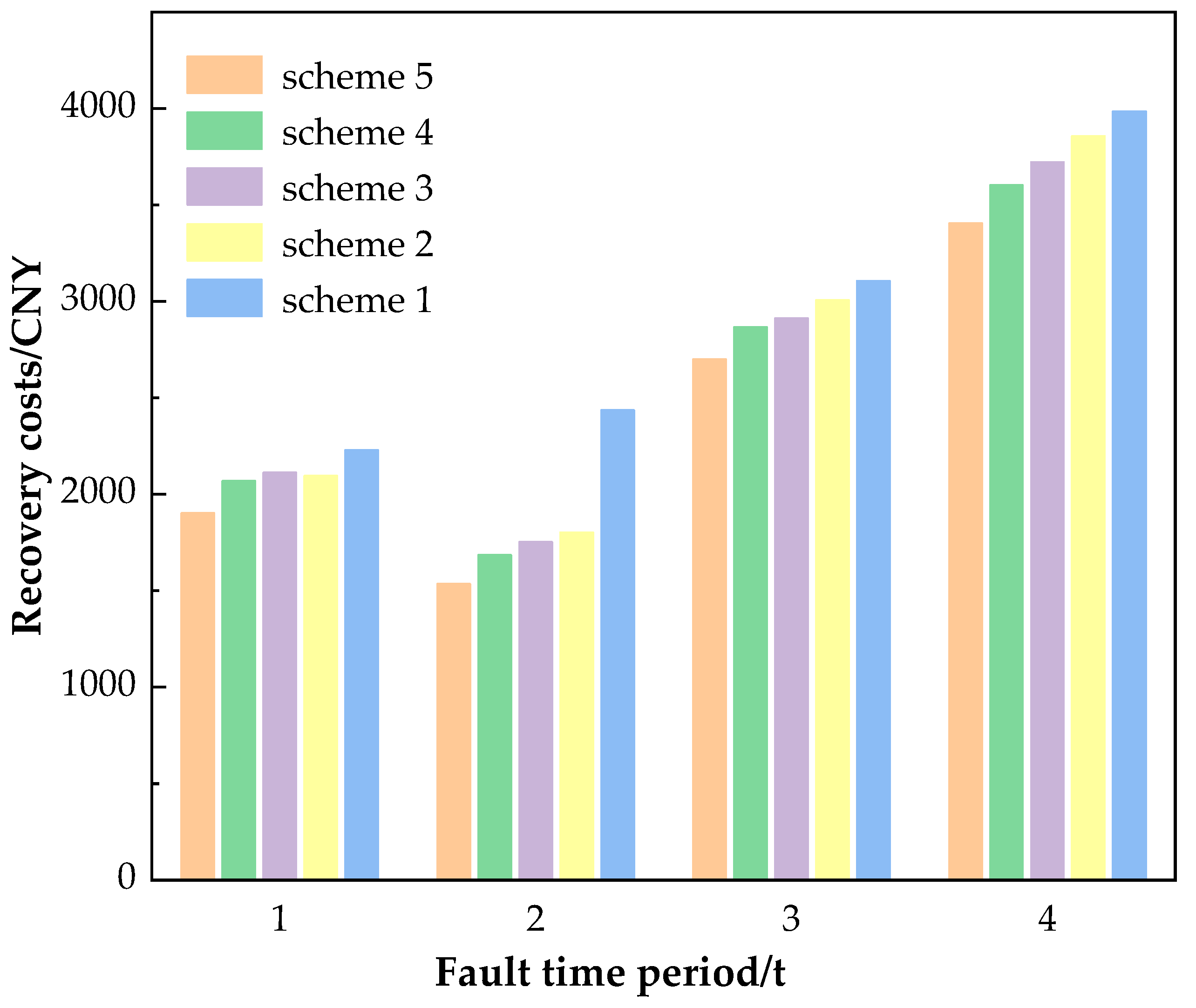
The recovery costs of each scheme in different fault periods are shown in Figure 13. As can be seen from Figure 13, when Scheme 1 uses a single SOCR to solve the model, the recovery cost in each fault period shows a monotonically increasing trend alongside fault evolution. In contrast, the recovery costs of the other schemes in period 2 decrease compared to period 1. This result verifies the limitations of a single SOCR in conducting global searches during the dynamic fault recovery process.
Furthermore, by comparing the proposed method with other recovery schemes, it shows distinct advantages in recovery costs across all fault periods: in period 1, the costs are reduced by 14.59%, 9.20%, 9.94%, and 8.06% compared to Schemes 1, 2, 3, and 4, respectively; in period 2, they are reduced by 36.99%, 14.83%, 12.39%, and 8.87%, respectively; in period 3, they are reduced by 13.09%, 10.20%, 7.29%, and 5.80%, respectively; and in period 4, they are reduced by 14.55%, 11.71%, 8.53%, and 5.49%, respectively. The above results further represent that the fault recovery effect of the proposed method offers better economy compared to the other schemes.
Based on the comprehensive economic comparative analysis of the schemes across different fault periods, it can be concluded that due to its superior global search capability, the two-layer hybrid algorithm can fully explore the fault recovery potential of the distribution network, yielding better economy compared to single solution algorithms. Furthermore, the fault recovery decisions made by the proposed method demonstrate better economy than the other schemes, and it can better adjust the recovery decisions dynamically in response to fault evolution, which further solidifies the superiority of the proposed method.

6.5. Analysis of Recovery Results for the IEEE 123-Bus System

6.5.1. Simulation Parameter Settings

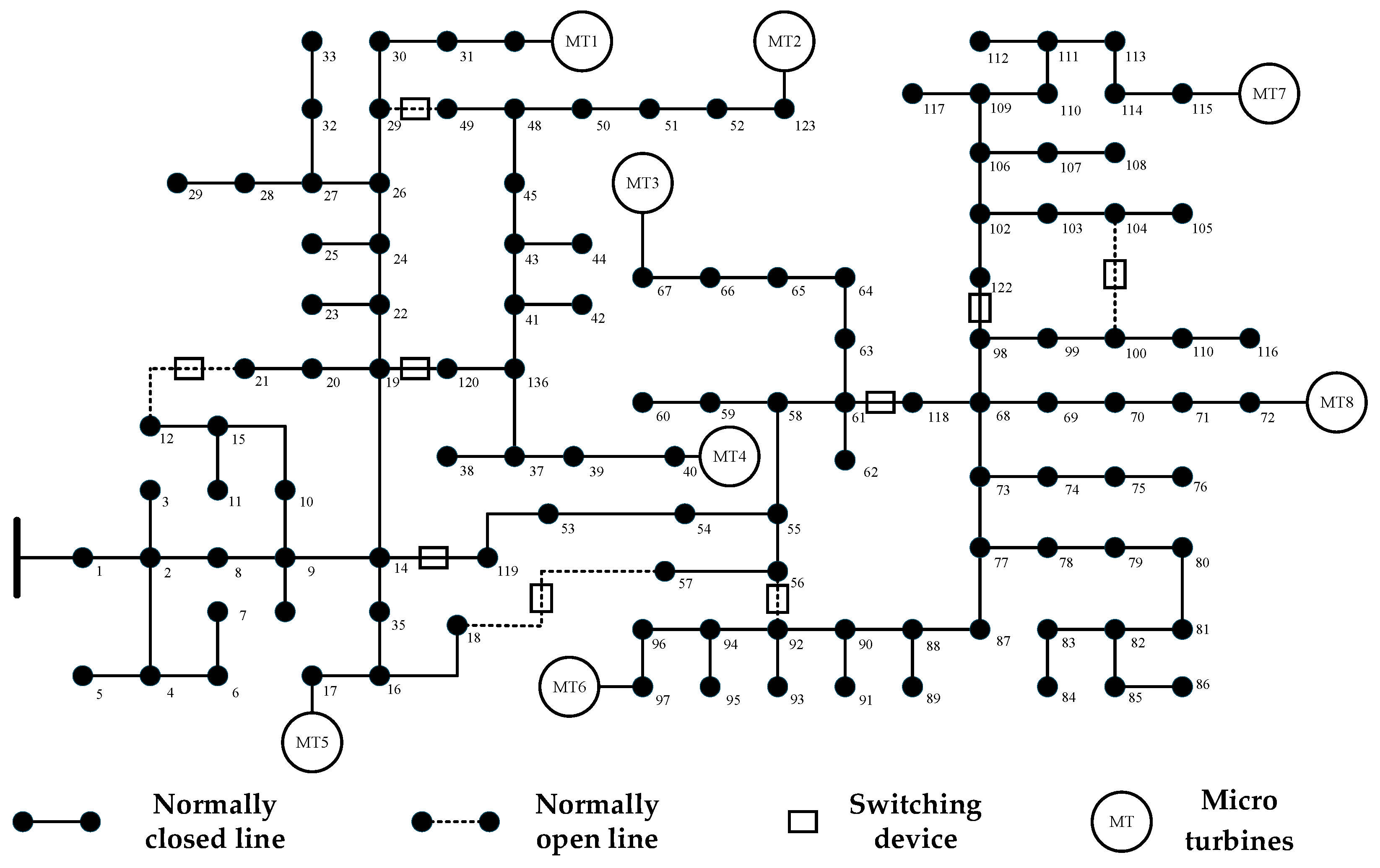
To further verify the applicability and scalability of the proposed method, this paper utilizes the IEEE 123-bus distribution network test system model from Reference [35] to conduct fault recovery experiments under extreme ice and snow conditions. Micro turbines (MTs) are selected to be installed at buses 17, 40, 67, 72, 115, 121, and 123. The bus numbering and network topology are shown in Figure 14. The parameters of the distributed generators, distribution lines, and loads refer to Reference [36].
To more realistically reproduce the dynamic impact process of extreme ice and snow weather on the distribution network, this study no longer presents a single fixed fault scenario throughout the entire disaster process. Instead, based on the constructed moving model of the extreme ice and snow weather, core disaster-causing parameters—such as the meteorological center position, ambient wind speed, and precipitation intensity—are sampled period by period. The conductor ice thickness and tower ice load of the lines at corresponding moments are calculated. Simultaneously, the above state variables are mapped to the distribution network line fault rate model under extreme ice and snow conditions (constructed in Section 2) to solve for the real-time fault probabilities of the lines and towers in each period. Based on the Monte Carlo sampling method, a series of random dynamic fault scenarios conforming to the spatial-temporal evolution laws of the disaster are generated. This scenario set fully considers the temporal sequence and randomness of faults during the passage of extreme ice and snow weather, making it closer to actual engineering scenarios of distribution networks affected by disasters.

6.5.2. Analysis of Recovery Results

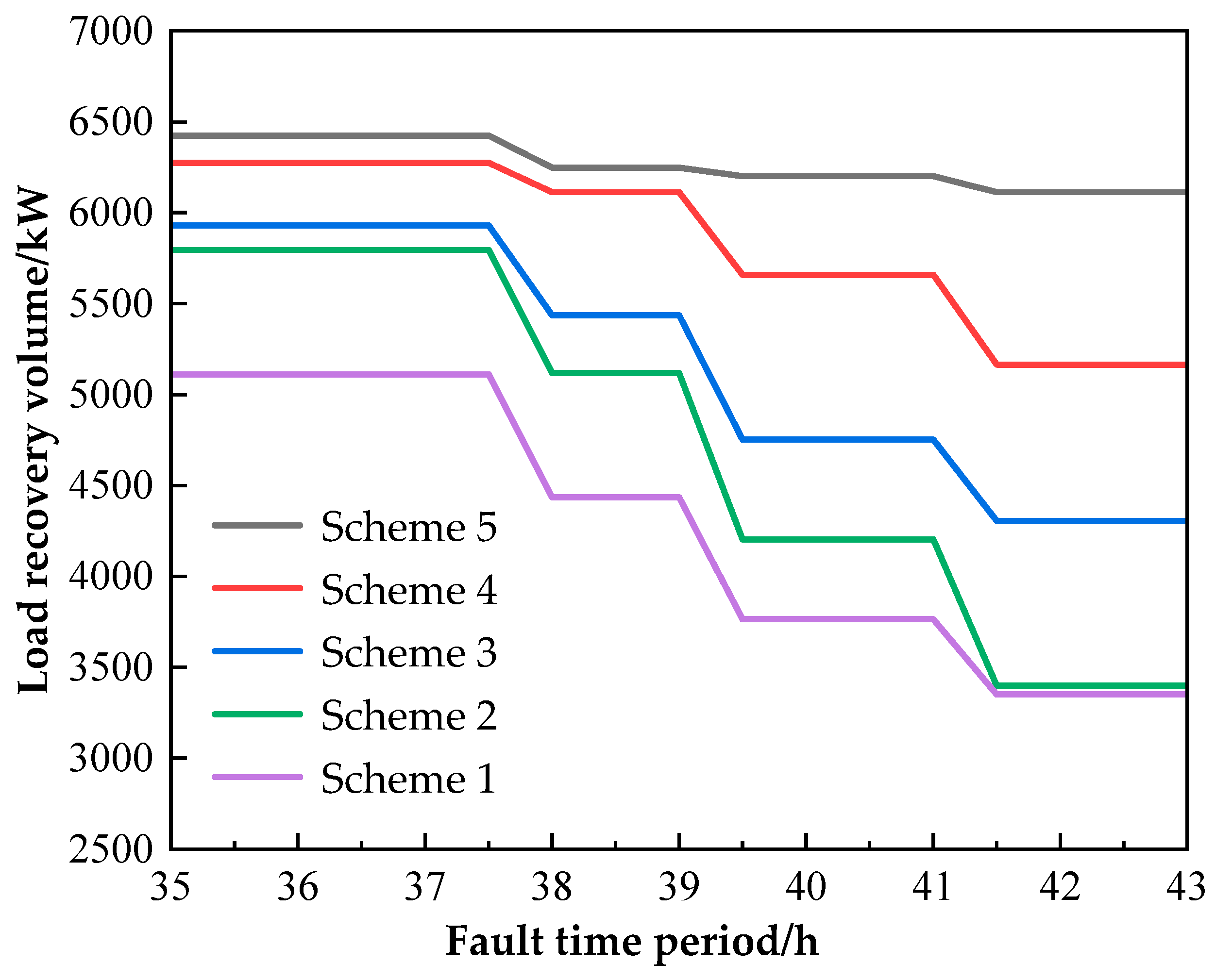
After generating a total of 50 fault scenarios, the five schemes are similarly applied multiple times to these scenarios, obtaining the average values of the total restored power load in each period, as shown in Figure 15.
It can be seen that for the 123-bus system, the proposed two-layer hybrid algorithm based on IBGWO and SOCR still demonstrates a favorable effect on improving the recovery of the distribution network. It can restore the post-disaster power supply of the system to nearly 90.31%, which is significantly higher than the other four schemes. Evidently, the proposed scheme exhibits distinct superiority over the other schemes in terms of the amount of restored load and the percentage of restored power supply in each period during the fault. Simultaneously, this verifies the applicability and scalability of the proposed method in large-scale distribution systems.

7. Conclusions

By constructing a line fault rate model considering the thermal effect of current under extreme ice and snow conditions to simulate the dynamic fault evolution process of distribution network components over time, this paper proposes an active distribution network dynamic fault recovery method based on a two-layer hybrid algorithm. Through case study analysis, the following conclusions can be drawn:
(1)
Based on the proposed line fault rate model considering the thermal effect of current, the evolution process of distribution line faults over time under extreme ice and snow conditions is accurately depicted. Furthermore, the information entropy-based typical scenario screening method is utilized to screen for typical fault scenarios, which improves the accuracy of identifying fault locations in the distribution network.
(2)
By comparatively analyzing the fault recovery results between the single solution algorithm framework and the proposed two-layer hybrid algorithm framework, it is evident that the two-layer hybrid algorithm outperforms the single solution algorithm in terms of overall recovery performance, algorithm solution efficiency and accuracy, and recovery economy. This verifies the effectiveness of the proposed solution framework.
(3)
By comparatively analyzing the proposed IBGWO-based solution framework and traditional heuristic algorithm-based solution frameworks, the fault recovery results indicate that the proposed method possesses stronger global search capability and higher solution efficiency, thereby verifying its feasibility and superiority.
However, there are still some areas for improvement in this study. For instance, the proposed method still has certain limitations when addressing the need for rapid response in the distribution system during sudden emergencies. Future research could consider combining the pre-fault optimal operational scheduling of the distribution network with post-fault rapid recovery. Through collaborative optimization, the rapid response capability of the distribution network to sudden emergencies can be further enhanced, thereby improving the overall operational resilience of the distribution network.

Author Contributions

Conceptualization, F.Y. and X.C.; methodology, F.Y. and X.C.; software, X.C.; validation, F.Y., X.C. and K.C.; formal analysis, H.X.; investigation, K.C.; resources, K.C.; writing—original draft preparation, F.Y.; writing—review and editing, F.Y. and X.C.; supervision, Y.K.; project administration, Y.K.; funding acquisition, Y.K. All authors have read and agreed to the published version of the manuscript.

Funding

This research was funded by State Grid Hubei Electric Power Co., Ltd. Technology Project under Grant 521532240024 and the National Natural Science Foundation of China under Grant 52407118.

Data Availability Statement

The original contributions presented in this study are included in the article. Further inquiries can be directed to the corresponding author.

Conflicts of Interest

This manuscript was conducted and prepared based on the technical requirements of State Grid Hubei Electric Power Co., Ltd. Technology Project (Grant No. 521532240024) and National Natural Science Foundation of China (Grant No. 52407118). All five authors are employees of State Grid Hubei Electric Power Research Institute. We declare no conflicts of interest.

Abbreviations

The following abbreviations are used in this manuscript:
ADNsActive distribution networks
DGsDistributed generators
RFSRapid flood spreading
MISOCPMixed-integer second-order cone programming
SOPsSoft open points
MESSsMobile energy storage systems
OLTCsOn-load tap changers
PVPhotovoltaic
PVGsPhotovoltaic generators
WTGsWind turbine generators
MTsMicro turbines
GWOGrey wolf optimization
BGWOBinary grey wolf optimization
IBGWOImproved binary grey wolf optimization
PSOParticle swarm optimization
BPSOBinary particle swarm optimization
SOCRSecond-order cone relaxation

References

  1. Kasimalla, S.R.; Park, K.; Zaboli, A.; Hong, Y.; Choi, S.L.; Hong, J. An evaluation of sustainable power system resilience in the face of severe weather conditions and climate changes: A comprehensive review of current advances. Sustainability 2024, 16, 3047. [Google Scholar] [CrossRef]
  2. Abdelmalak, M.; Benidris, M. Proactive generation redispatch to enhance power system resilience during hurricanes considering unavailability of renewable energy sources. IEEE Trans. Ind. Appl. 2022, 58, 3044–3053. [Google Scholar] [CrossRef]
  3. Manousakis, N.M.; Kalkanis, K.; Sinioros, D.P.; Kokkosis, A.; Psomopoulos, C.S. Wildfire and smoke effects on power transmission and distribution systems safety: An analytical review. Front. Energy Res. 2026, 14, 1759856. [Google Scholar] [CrossRef]
  4. Schmitt, K.; Bhatta, R.; Chamana, M.; Murshed, M.; Osman, I.; Bayne, S.; Canha, L. A review on active customers’ participation in smart grids. J. Mod. Power Syst. Clean Energy 2023, 11, 3–16. [Google Scholar] [CrossRef]
  5. Heidari-Akhijahani, A.; Butler-Purry, K.L. A review on black-start service restoration of active distribution systems and microgrids. Energies 2023, 17, 100. [Google Scholar] [CrossRef]
  6. Arefifar, S.A.; Alam, M.S.; Hamadi, A. A review on self-healing in modern power distribution systems. J. Mod. Power Syst. Clean Energy 2023, 11, 1719–1733. [Google Scholar] [CrossRef]
  7. Tang, B.; He, L.; Zhou, L.; Zhao, H.; Wang, K.; Zhang, P. Robust fault recovery strategy for multi-source flexibly interconnected distribution networks in extreme disaster scenarios. Front. Energy Res. 2024, 12, 1345839. [Google Scholar] [CrossRef]
  8. Liu, X.; Wang, H.; Sun, Q.; Guo, T. Research on fault scenario prediction and resilience enhancement strategy of active distribution network under ice disaster. Int. J. Electr. Power Energy Syst. 2022, 135, 107478. [Google Scholar] [CrossRef]
  9. Poudel, S.; Dubey, A.; Bose, A. Risk-based probabilistic quantification of power distribution system operational resilience. IEEE Syst. J. 2020, 14, 3527–3538. [Google Scholar] [CrossRef]
  10. Xu, J.; Zhang, T.; Du, Y.; Zhang, W.; Yang, T.; Qiu, J. Islanding and dynamic reconfiguration for resilience enhancement of active distribution systems. Electr. Power Syst. Res. 2020, 189, 106749. [Google Scholar] [CrossRef]
  11. Ma, N.; Xu, Z.; Wang, Y.; Liu, G.; Xin, L.; Liu, D.; Liu, Z.; Shi, J.; Chen, C. Strategies for Improving the Resiliency of Distribution Networks in Electric Power Systems during Typhoon and Water-Logging Disasters. Energies 2024, 17, 1165. [Google Scholar] [CrossRef]
  12. Afzal, S.; Mokhlis, H.; Illias, H.A.; Bajwa, A.A.; Mekhilef, S.; Mubin, M.; Muhammad, M.A.; Shareef, H. Modelling spatiotemporal impact of flash floods on power distribution system and dynamic service restoration with renewable generators considering interdependent critical loads. IET Gener. Transm. Distrib. 2023, 18, 368–387. [Google Scholar] [CrossRef]
  13. Zhang, L.; Zhang, B.; Tang, W.; Lu, Y.; Zhao, C.; Zhang, Q. A Coordinated Restoration Method of Hybrid AC–DC Distribution Network with Electric Buses Considering Transportation System Influence. IEEE Trans. Ind. Inform. 2022, 18, 8236–8246. [Google Scholar] [CrossRef]
  14. Zhao, S.; Li, K.; Yin, M.; Yu, J.; Yang, Z.; Li, Y. Transportable energy storage assisted post-disaster restoration of distribution networks with renewable generations. Energy 2024, 295, 131105. [Google Scholar] [CrossRef]
  15. Tang, W.; Wei, C.; Qian, T.; Huang, Y. A multi-stage coordinated resilience enhancement strategy for distribution networks considering voltage quality. Int. J. Electr. Power Energy Syst. 2025, 172, 111312. [Google Scholar] [CrossRef]
  16. Panteli, M.; Pickering, C.; Wilkinson, S.; Dawson, R.; Mancarella, P. Power system resilience to extreme weather: Fragility modeling, probabilistic impact assessment, and adaptation measures. IEEE Trans. Power Syst. 2017, 32, 3747–3757. [Google Scholar] [CrossRef]
  17. Hou, H.; Wang, Y.; Bai, X.; Lv, J.; Cui, R.; Zhang, L.; Li, S.; Li, Z. Modelling icing growth on overhead transmission lines: Current advances and future directions. Energy Convers. Econ. 2024, 5, 343–357. [Google Scholar] [CrossRef]
  18. Zhang, G.; Zhang, F.; Zhang, X.; Wu, Q.; Meng, K. A multi-disaster-scenario distributionally robust planning model for enhancing the resilience of distribution systems. Int. J. Electr. Power Energy Syst. 2020, 122, 106161. [Google Scholar] [CrossRef]
  19. Aguila Téllez, A.; Krishnan, N.; García, E.; Carrión, D.; Ruiz, M. A probabilistic framework for reliability assessment of active distribution networks with high renewable penetration under extreme weather conditions. Energies 2025, 18, 6525. [Google Scholar] [CrossRef]
  20. Yan, M.; Shahidehpour, M.; Paaso, A.; Zhang, L.; Alabdulwahab, A.; Abusorrah, A. Distribution system resilience in ice storms by optimal routing of mobile devices on congested roads. IEEE Trans. Smart Grid 2021, 12, 1314–1328. [Google Scholar] [CrossRef]
  21. Ma, S.S.; Chen, B.K.; Wang, Z.Y. Resilience enhancement strategy for distribution systems under extreme weather events. IEEE Trans. Smart Grid 2018, 9, 1442–1451. [Google Scholar] [CrossRef]
  22. Wu, Y.; Lin, Z.; Liu, C.; Huang, T.; Chen, Y.; Ru, Y.; Chen, J. Resilience enhancement for urban distribution network via risk-based emergency response plan amendment for ice disasters. Int. J. Electr. Power Energy Syst. 2022, 141, 108183. [Google Scholar] [CrossRef]
  23. Sekhavatmanesh, H.; Cherkaoui, R. A multi-step reconfiguration model for active distribution network restoration integrating DG start-up sequences. IEEE Trans. Sustain. Energy 2020, 11, 2879–2888. [Google Scholar] [CrossRef]
  24. Liu, W.; Xu, Q.; Qin, M.; Yang, Y. A post-disaster fault recovery model for distribution networks considering road damage and dual repair teams. Energies 2024, 17, 5020. [Google Scholar] [CrossRef]
  25. Guo, X.; Guo, W.; Jiang, X.; Wang, W.; Zhu, J. Recovery strategy of distribution network based on power supply capability assessment of local area configured with energy gateway. Energies 2025, 18, 2215. [Google Scholar] [CrossRef]
  26. Wang, Y.; Xu, Y.; Li, J.; He, J.; Wang, X. On the radiality constraints for distribution system restoration and reconfiguration problems. IEEE Trans. Power Syst. 2020, 35, 3294–3296. [Google Scholar] [CrossRef]
  27. Dan, Y.; Zhong, H.; Wang, C.; Wang, J.; Fei, Y.; Yu, L. A graph deep reinforcement learning-based fault restoration method for active distribution networks. Energies 2025, 18, 4420. [Google Scholar] [CrossRef]
  28. Ding, T.; Li, F.; Li, X.; Sun, H.; Bo, R. Interval radial power flow using extended DistFlow formulation and Krawczyk iteration method with sparse approximate inverse preconditioner. IET Gener. Transm. Distrib. 2015, 9, 1998–2006. [Google Scholar] [CrossRef]
  29. He, Y.; Li, Y.; Liu, J.; Xiang, X.; Sheng, F.; Zhu, X.; Fang, Y.; Wu, Z. A two-stage fault reconfiguration strategy for distribution networks with high penetration of distributed generators. Electronics 2025, 14, 1872. [Google Scholar] [CrossRef]
  30. Poudel, S.; Dubey, A.; Schneider, K.P. A generalized framework for service restoration in a resilient power distribution system. IEEE Syst. J. 2021, 15, 252–263. [Google Scholar] [CrossRef]
  31. Emary, E.; Zawbaa, H.M.; Hassanien, A.E. Binary grey wolf optimization approaches for feature selection. Neurocomputing 2016, 172, 371–381. [Google Scholar] [CrossRef]
  32. Zhang, C.; Liu, H.; Zhou, Q.; Liu, C. Improved hybrid grey wolf optimization algorithm based on dimension learning-based hunting search strategy. IEEE Access 2023, 11, 13738–13753. [Google Scholar] [CrossRef]
  33. Liu, J.; Wei, X.; Huang, H. An improved grey wolf optimization algorithm and its application in path planning. IEEE Access 2021, 9, 121944–121956. [Google Scholar] [CrossRef]
  34. Heidari, A.A.; Pahlavani, P. An efficient modified grey wolf optimizer with Lévy flight for optimization tasks. Appl. Soft Comput. 2017, 60, 115–134. [Google Scholar] [CrossRef]
  35. Chen, B.; Ye, Z.; Chen, C.; Wang, J. Toward a MILP Modeling Framework for Distribution System Restoration. IEEE Trans. Power Syst. 2019, 34, 1749–1760. [Google Scholar] [CrossRef]
  36. Schneider, K.P.; Mather, B.A.; Pal, B.C. Analytic Considerations and Design Basis for the IEEE Distribution Test Feeders. IEEE Trans. Power Syst. 2018, 33, 3181–3188. [Google Scholar] [CrossRef]
Figure 1. Daily load demand curves.
Energies 19 01784 g001
Figure 2. The implementation procedure of the proposed dynamic fault restoration strategy.
Energies 19 01784 g002
Figure 3. PG&E 69-bus case study model.
Energies 19 01784 g003
Figure 4. The load proportional coefficients of each bus.
Energies 19 01784 g004
Figure 5. The line fault rates.
Energies 19 01784 g005
Figure 6. The outputs of PVGs.
Energies 19 01784 g006
Figure 7. The probability distribution of the entropy values.
Energies 19 01784 g007
Figure 8. The probability distribution of the number of faulty lines.
Energies 19 01784 g008
Figure 9. The fault recovery methods of the proposed method in different periods.
Energies 19 01784 g009aEnergies 19 01784 g009b
Figure 10. The bus voltage distributions.
Energies 19 01784 g010
Figure 11. The comparison of power supply restoration results for each scheme.
Energies 19 01784 g011
Figure 12. The curves of the fitness values of the different heuristic algorithms.
Energies 19 01784 g012
Figure 13. The recovery costs of each scheme in different fault periods.
Energies 19 01784 g013
Figure 14. The IEEE 123-bus distribution network test system model.
Energies 19 01784 g014
Figure 15. The comparison of power supply restoration results for each scheme.
Energies 19 01784 g015
Table 1. Parameters for MT.
MT NumberAccess PointsCapacity/kW
MT119550
MT23255
MT33770
MT4511800
MT564150
Table 2. Load bus weight levels.
Bus NumberWeight Levels
11, 12, 18, 21, 38, 39, 50, 53first-loads
7–10, 16, 17, 37, 40, 43, 44, 48, 54–60, 68, 69second-loads
otherthird-loads
Table 3. Load types.
Bus NumberLoad Types
1–6, 9, 10, 24, 26–29, 41–44, 62–63, 68–69uncontrollable loads
othercontrollable loads
Table 4. The fault recovery results of the proposed method in different periods.
Fault Time PeriodRestored Load/kWRestoration Rate/%Restoration Cost/CNY
period 13606.7694.861902.52
period 23575.9694.051535.16
period 33559.2393.612699.08
period 43564.9393.763504.52
Table 5. The comparison results of the restoration strategies for the five schemes.
Fault Restoration SchemeRestoration Cost/CNYRestoration Rate of Each Period/%Solution Time/s
Period 1Period 2Period 3Period 4
scheme 111753.8689.0482.1176.6071.9883
scheme 210759.5892.2088.5185.1085.19101
scheme 310497.9591.0489.1388.1587.3875
scheme 410221.3893.1691.8191.2590.8669
scheme 59541.2894.8694.0593.6193.7651
Disclaimer/Publisher’s Note: The statements, opinions and data contained in all publications are solely those of the individual author(s) and contributor(s) and not of MDPI and/or the editor(s). MDPI and/or the editor(s) disclaim responsibility for any injury to people or property resulting from any ideas, methods, instructions or products referred to in the content.