1. Introduction
Distribution-network state estimation refers to a class of algorithms that infer and solve system state variables based on measurements acquired by phasor measurement units (PMUs). As a core component of state awareness, its objective is to track the real-time operating conditions of distribution networks with high accuracy and fast computational speed [
1,
2]. However, with the continuously increasing penetration of distributed energy resources, the uncertainty and volatility of distribution-network operation have been markedly intensified. Meanwhile, severe external disturbances such as icing and typhoons may cause deviations in line parameters or even structural changes in network topology, making conventional state-estimation methods less capable of reflecting actual operating conditions. This, in turn, leads to increased computational burden and degraded estimation accuracy and credibility [
3,
4]. In addition, distribution networks are currently undergoing large-scale renewal of existing assets, where high-performance measurement devices coexist with legacy terminals for extended periods. As a result, the data reported to the dispatch center are heterogeneous, with substantial differences in measurement types and data quality, which further complicates the dispatchers’ ability to form a consistent and accurate understanding of system states. Therefore, in response to the evolving operational characteristics and increasingly complex measurement environments of distribution networks, how to rationally deploy measurement devices and, on this basis, achieve system-wide high-confidence state estimation and improve the reliability of the estimated states has become one of the key problems that must be addressed in building a distribution-network state-awareness framework [
5].
High-accuracy, real-time measurements provided by PMUs can substantially improve the accuracy of state estimation. However, due to cost constraints, it is impractical to deploy PMUs at every bus in a distribution network. In recent years, a variety of optimization approaches have been developed for PMU placement. In [
6], an error-degree analysis principle was introduced, and an improved hybrid genetic-simulated annealing algorithm was employed to obtain an optimized PMU deployment scheme. In [
7], a PMU placement method combining graph theory and the analytic hierarchy process was proposed, which achieves network-wide observability while, to some extent, ensuring measurement redundancy. On the basis of [
7], the work in [
8] further incorporated contingency-related constraints as secondary optimization objectives to determine PMU locations. With the increasing adoption of renewable generation and demand response, distribution-network topologies are changing more frequently; therefore, the impacts of multiple topology scenarios should be taken into account [
9,
10].
When PMU deployment is insufficient, pseudo-measurements must be incorporated to enable fast state estimation. In [
11], a power-system state-estimation method based on a residual-connection deep neural network and multi-source data fusion was proposed; however, the accuracy of the pseudo-measurements is constrained by prediction performance, and under large operating fluctuations such pseudo-measurement construction cannot adequately capture the system’s dynamic variations. To address insufficient measurement redundancy and the resulting unobservability due to communication failures or missing data, ref. [
12] proposed a machine-learning strategy that leverages spatiotemporal correlations and historical distribution data to generate pseudo-measurements. Nevertheless, since the pseudo-measurements are still produced through forecasting, the final state-estimation results may remain vulnerable to deficiencies.
To effectively address voltage-stability issues in distribution networks, both series-connected and shunt-connected voltage-mitigation devices have been developed. Owing to their superior performance, series-connected devices have been deployed on a large scale in practical distribution systems. In [
13], decoupled control of the device was implemented to realize grid-connected power regulation and voltage control. In [
14], physical switching elements were incorporated into single-phase full-bridge and three-phase half-bridge structures, enabling series/parallel reconfiguration of the device through switch operations. However, these approaches impose stringent requirements on grid-side data acquisition and typically rely on the assumption that the reference voltage on the network side is set to a reasonable value.
In summary, to address the limitations of existing centralized PMU placement schemes, this paper proposes a distribution-network-partitioning-based PMU deployment method. Based on the resulting PMU locations, pseudo-measurement data are constructed for unobservable buses, and a state-estimation algorithm is employed to solve for the distribution-network states. The estimated states are then processed and fed into flexible voltage-regulation devices to regulate voltages and satisfy bus-voltage requirements. Finally, case studies and comparative simulations are conducted to verify the accuracy and feasibility of the proposed distribution-network state-estimation method.
2. Partitioning-Based PMU Placement Method for Distribution Networks
Traditional definitions of electrical distance are typically described based on impedance or network topology, which makes it difficult to comprehensively reflect the coupling strength and mutual influence between buses under practical operating conditions [
15]. To this end, this paper derives sensitivity indices to characterize the strength of electrical interactions among buses. By leveraging sensitivity information to capture how disturbances propagate through the network, the coupling relationships between buses can be quantified more accurately, thereby providing a solid basis for the subsequent optimal placement of PMU measurements at partition boundary buses and for state estimation. According to the Jacobian matrix of power-flow equations, the system sensitivity matrix can be expressed as
where
SPδ and
SQδ denote the sensitivities of the bus-voltage phase angle with respect to the injected active and reactive power, respectively, while
SPU and
SQU represent the sensitivities of the bus-voltage magnitude with respect to the injected active and reactive power, respectively.
Considering the characteristics of distribution networks, the impact of active-power variations on bus voltages is neglected, and clustering is performed only based on reactive-power sensitivities. Building on the concept of modularity, the modularity-based partitioning method is further improved to achieve optimized partitioning for large-scale power networks. To address the clustering problem in complex networks, Girvan et al. proposed the community-detection theory and the notion of modularity [
16], which is expressed as
where
Q is the modularity index;
Aij denotes the weight of the edge connecting node
i and node
j;
S is the set of all nodes in the system;
m is the sum of the weights of all edges in the network;
aj is the sum of the weights of all edges incident to node
j; and
δ(
i,
j) is a clustering indicator function, where
δ(
i,
j) = 1 if nodes
i and
j belong to the same cluster, and
δ(
i,
j) = 0 otherwise.
Building on the above reactive-power sensitivity analysis, the improved modularity function for network partitioning is formulated as follows:
where
wij is the entry of the reactive-power sensitivity matrix, i.e.,
wij =
ωij, and
ki denotes the sum of all improved edge weights incident to node
i, given by
, where
mQ denotes the sum of the weights of all edges in the system.
The modularity function Q is computed based on the network topology and is used to obtain an optimal clustering that separates buses with different coupling strengths. A larger Q indicates stronger interconnections between different communities.
For a network with N nodes, the partitioning strategy is summarized as follows:
Step 1: Treat all nodes as a single cluster and compute (3).
Step 2: For node i, randomly select a connected node j from its neighboring nodes and form a candidate new cluster. Compute the corresponding modularity gain ΔQ. If ΔQ > 0, merge nodes i and j into a new cluster; otherwise, keep the original cluster unchanged.
Step 3: Regard each newly formed cluster as an independent super-node and repeat the partitioning procedure in Step 2.
Step 4: Continue until all nodes have been traversed and no further increase in the modularity function Q can be achieved; the resulting partitioning is then output.
Based on the above partitioning framework, the distribution network can be divided into multiple clustered subareas. Considering that boundary buses between adjacent subareas constitute critical measurement points, PMUs—despite their relatively high cost—are installed at all boundary buses.
3. Power Pseudo-Measurement Construction Based on Power Transfer Distribution Factors
In distribution-network state estimation, the limited coverage of measurement terminals and constraints in data acquisition often result in sparsely deployed direct-measurement devices, rendering some buses and lines unobservable. In this section, power pseudo-measurements are constructed based on power transfer distribution factors (PTDFs) to restore observability for unobservable buses.
The measurement model of power-system state estimation can be formulated in terms of the state vector and the measurement vector, expressed as
where
Z is the system measurement vector;
h(
x) denotes the nonlinear measurement function;
x is the system state vector; and
ε is the measurement-noise vector assumed to follow a Gaussian distribution,
ε~
N(0,
σ), where
σ =
diag(
σ1,
σ2,…,
σn).
In power-system state analysis, to simplify pseudo-measurement construction while retaining acceptable accuracy, the following assumptions are adopted: the bus-voltage magnitudes satisfy
Ui ≈
Uj ≈ 1 p.u.; the angle difference can be approximated by sin(
θi −
θj) ≈
θi −
θj, cos(
θi −
θj) ≈ 1. The indirect measurement point connected to a PMU is denoted as bus
j, and the pseudo-measurement bus is denoted as bus
k. When the active power at directly observed bus
i changes, the resulting bus-voltage variations can be derived from the power-flow equations as
Let
Eii = (
Gii +
BiiBii)
−1,
Fii = −(
Gii +
BiiBii)
−1Bii. Then, the above expression can be simplified as follows:
From (7) and (8), the injected power at the indirectly observed bus
j can be obtained. Using the variation in the injected power at bus
j, the corresponding branch power variation associated with the unobservable bus
k can be derived as follows:
Ultimately, the power variation of the branch connected to the unobservable bus k can be inferred from the directly observed bus i, thereby improving pseudo-measurement accuracy to a certain extent. By incorporating the resulting pseudo-measurements into the measurement model, network observability can be restored through state estimation.
4. State-Estimation-Based Voltage-Regulation Method Using Flexible Voltage-Control Devices
By feeding the above hybrid measurement model together with the constructed pseudo-measurements into the regional distribution-network state-estimation framework, the system states of the power network can be solved.
4.1. State Estimation Using the Weighted Least-Squares (WLS) Method
For a distribution network with N buses, when the system parameters and network topology are given, the measurement model can be expressed in the form of (4).
With the pseudo-measurements constructed as described above, together with the existing measurements of the network, the measurement vector
Z is formed. By minimizing the sum of squared measurement errors
ε, the estimate of the system state vector
x can be obtained. The objective function is given as follows:
where
R denotes the covariance matrix of measurement errors and
R−1 is the corresponding weighting matrix.
The above objective can be rewritten as
where
H(
x) is the measurement Jacobian matrix that incorporates the pseudo-measurements.
By applying linearization and algebraic rearrangement, the state variables are solved iteratively. The iteration terminates once the estimation accuracy of the state variables reaches the prescribed threshold.
4.2. Flexible Pressure-Regulating Equipment
First, PMUs are deployed based on the distribution-network partitioning results. Next, pseudo-measurement data are constructed. Finally, SCADA measurements, PMU measurements, and pseudo-measurements are integrated, and weighted least-squares (WLS) state estimation is performed to estimate the system states. On this basis, the estimated voltage states can provide decision support for distribution-network voltage regulation and operational control. To overcome the limitations of existing methods for mitigating voltage-limit violations, a voltage-regulation strategy using flexible voltage-regulation devices is proposed based on the state-estimation results.
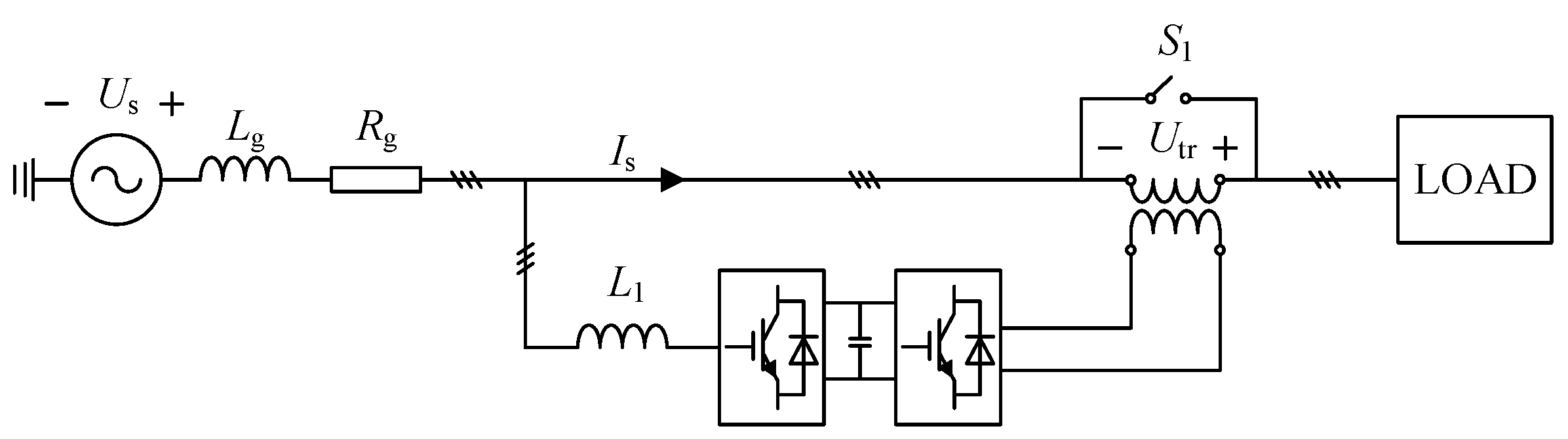
The flexible pressure regulating equipment (FPRE) adopts a series-compensation topology built upon a single-phase AC-DC-AC rectifier inverter unit and employs a dual closed-loop control scheme. As shown in
Figure 1. It enables fast and continuous regulation within a voltage-deviation range of −50 V to +66 V, ensuring that the load-side voltage deviation complies with relevant standards. This approach can effectively alleviate overvoltage and undervoltage issues that commonly occur during peak demand periods and at the end of long distribution feeders, thereby improving the voltage compliance rate at feeder terminals.
The output voltage of the series-connected module is given by
where
Rg and
Lg denote the compensation resistance and compensation reactance, respectively.
4.3. Distribution-Network Voltage-Regulation Process
To improve the computational efficiency of system-wide state estimation in distribution networks, the network is divided into multiple subareas according to the aforementioned partitioning strategy, and PMUs are deployed at the boundary buses. Moreover, based on the proposed pseudo-measurement construction method, measurements for indirectly observed buses and unobservable buses can be inferred. By feeding these measurements into the WLS state-estimation model, the system-wide state estimates can be obtained. The detailed procedure is as follows:
Step 1: Acquire and input the network-wide topology, the numbers of branches and buses, raw measurement data, and SCADA-based power-flow results to preliminarily compute the sensitivity-based electrical distance.
Step 2: Partition the distribution-network buses according to the sensitivity-based electrical distance into several subareas (e.g., I, II, III, …) and install PMUs at the boundary buses.
Step 3: For each subarea, based on the PMU measurements at boundary buses, construct power pseudo-measurements for indirectly observed buses and unobservable buses using the proposed method.
Step 4: Perform WLS state estimation using the measurements of each subarea.
Step 5: Feed the state-estimation results into the flexible voltage-regulation devices, which regulate bus voltages according to (13) until the voltages meet the prescribed standards.
The partition will be adjusted only when the following situations occur:
If the operation mode/switch status remains unchanged, the existing partition results and sensitivity matrix will be retained, and only the measurements and weights in the rolling estimation will be updated.
If a topological change is detected, the network admittance matrix Y will be reconstructed, and the Jacobian matrix and sensitivity (or PTDF) mapping will be updated at the new operating point. Then, the partition and boundary identification/retrieval from the typical topology library will be re-executed to ensure that the observability and control requirements are still met under the new topology. The strategy of only updating when the topology changes is both in line with the actual operation characteristics of the distribution network and can avoid repeating full calculations in each control cycle, ensuring the online calculation efficiency.
5. Case Study
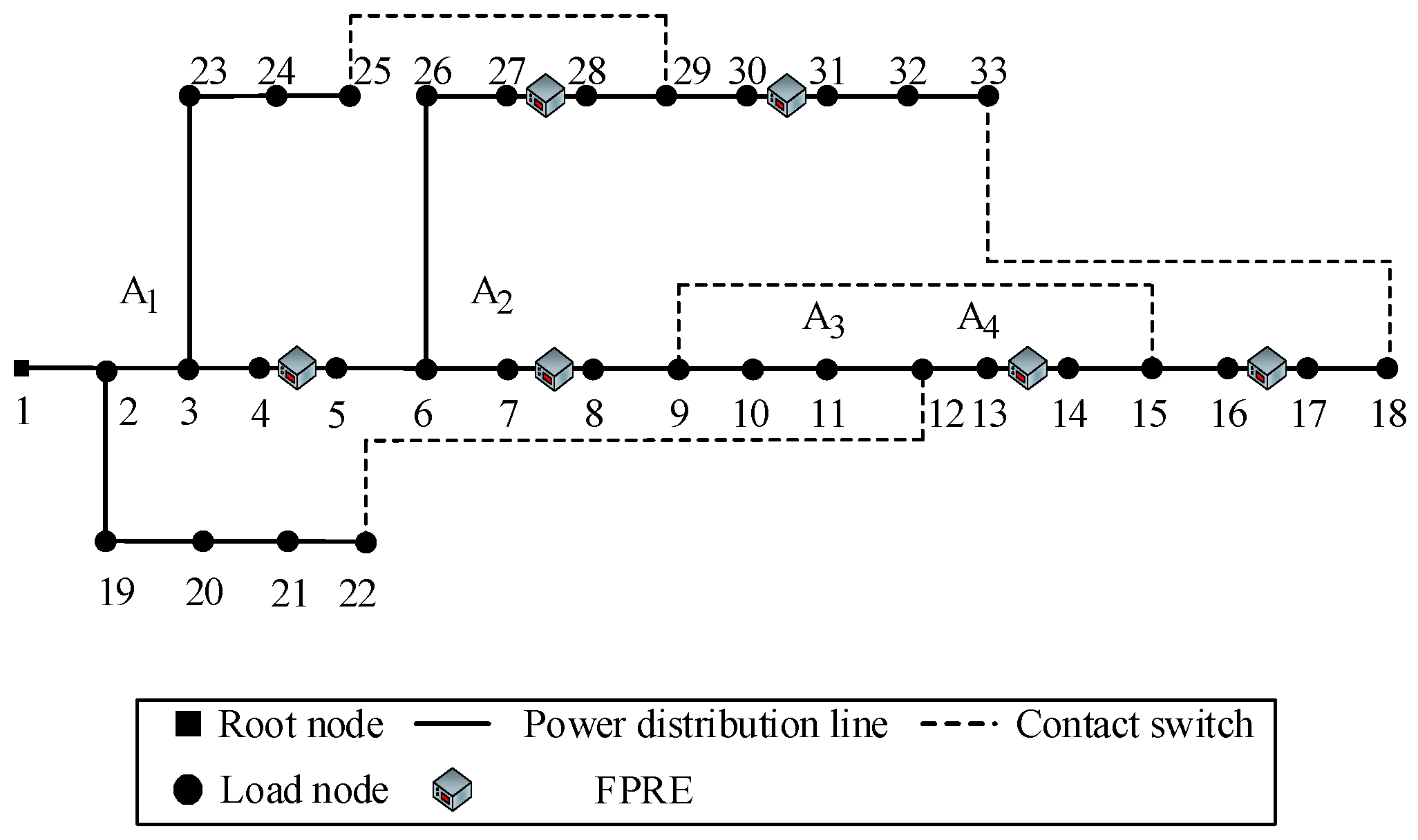
The IEEE 33-bus test system is selected to validate the proposed observability-aware optimal measurement-device deployment method, thereby demonstrating its feasibility and effectiveness. The electrical interconnection of the IEEE 33-bus system is shown in
Figure 2. The system has a nominal voltage of 12.66 kV and a total load demand of 3.715 MW and 2.30 Mvar. It consists of 33 buses, 32 feeder branches, and five tie switches. The rated branch parameters of the network are given in [
17].
Using the proposed partitioning method, the equivalent electrical distance
ω and the modularity value
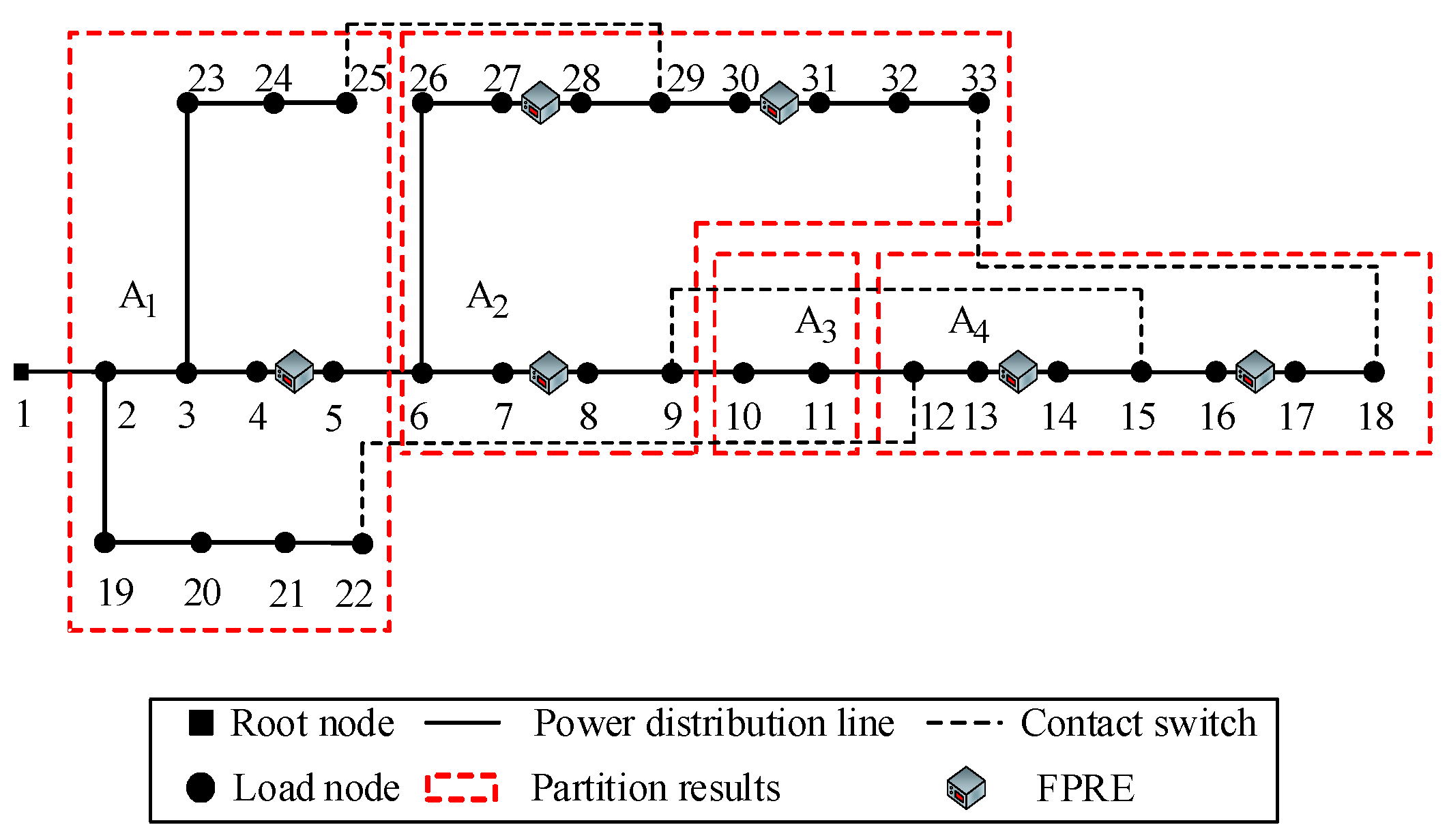
Q of the network are calculated. Based on these results, the IEEE 33-bus system can be partitioned into four subareas, as illustrated in
Figure 3. The subarea assignment of each bus is listed in
Table 1.
According to
Figure 3 and
Table 1, the boundary buses between subareas A
1 and A
2 are buses 5 and 6; those between A
2 and A
3 are buses 9 and 10; and those between A
3 and A
4 are buses 11 and 12. These boundary buses are responsible for exchanging electrical parameters and operational information between adjacent subareas. Considering system operational requirements and the interdependence among subareas, PMUs can therefore be installed at bus 5 or 6, bus 9 or 10, and bus 11 or 12.
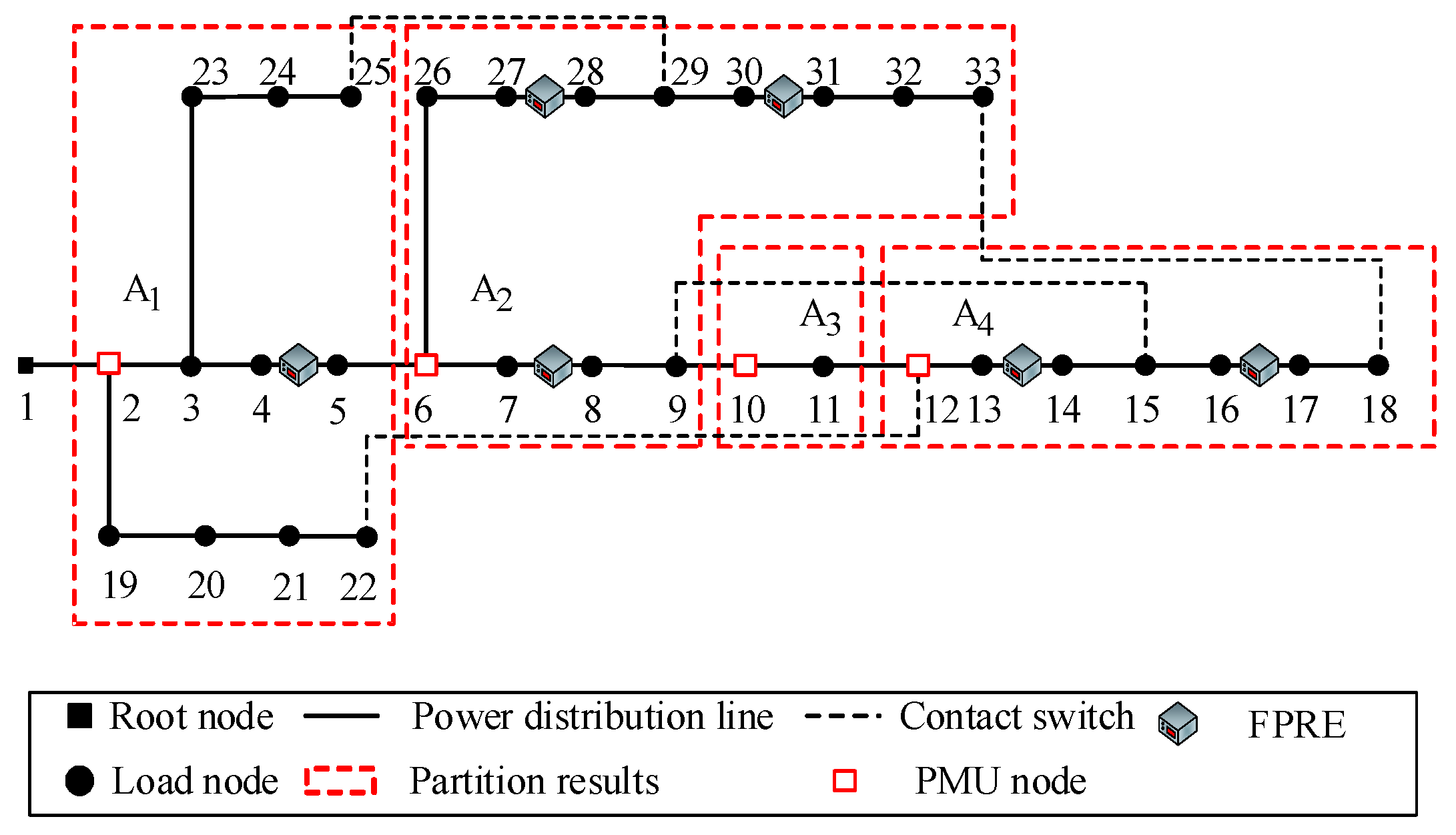
To further improve the monitoring accuracy of bus voltages and currents within each subarea and to maximize the utilization of PMU measurement capability, the PMUs are placed at the first bus of the subsequent subarea, i.e., buses 2, 6, 10, and 12. This placement provides better coverage of the key buses in each subarea and helps avoid monitoring blind spots. The IEEE 33-bus system with PMUs installed is shown in
Figure 4.
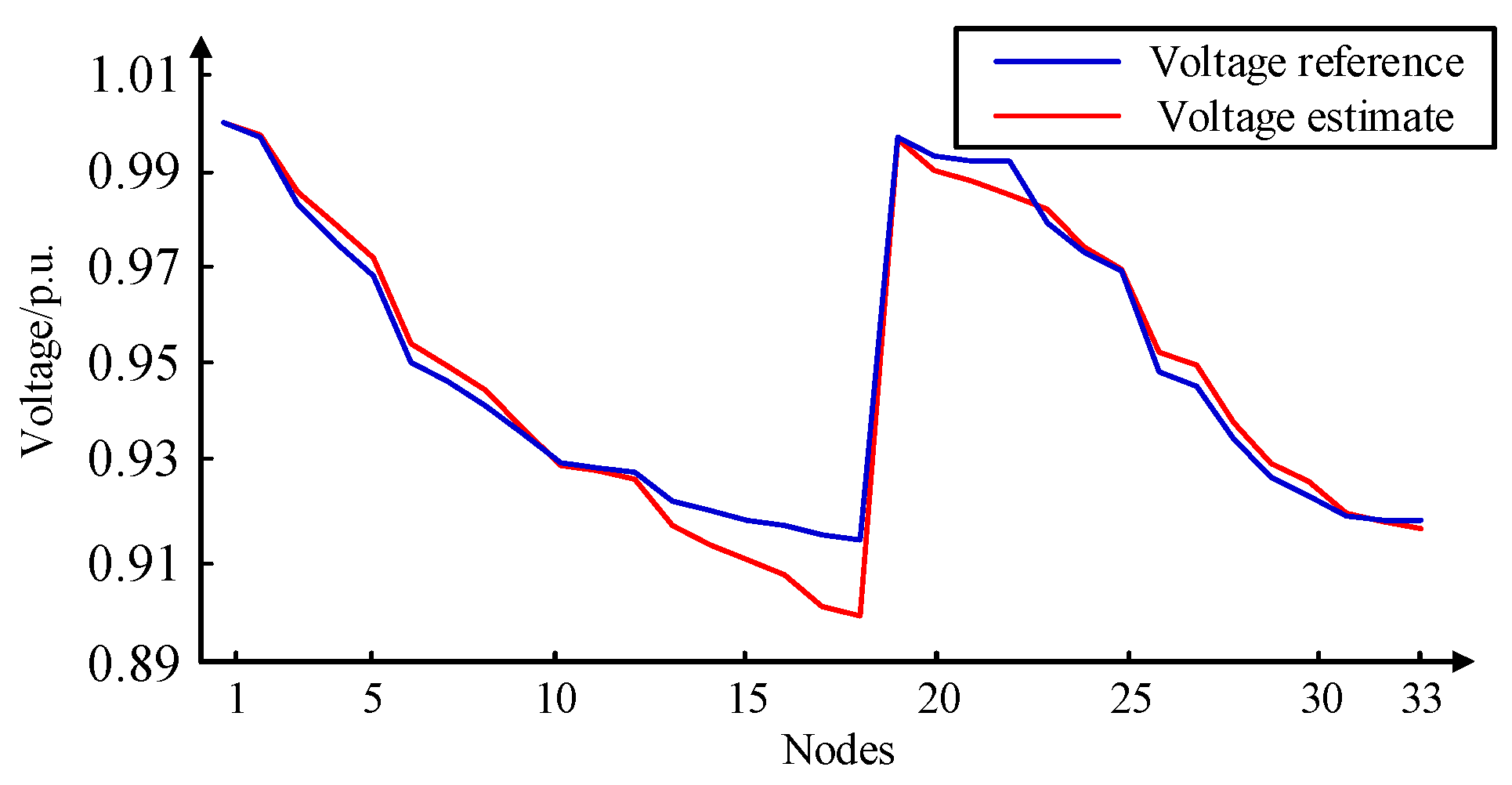
Based on the above PMU installation scheme, state estimation is implemented on a MATLAB 2021 simulation platform. The comparison between the estimated bus voltages and the reference values is shown in
Figure 5.
The maximum error occurs at bus 18, with a maximum error
W of 0.01607 p.u. The mean error
Wmean is calculated using the following formula. Based on the WLS state-estimation results under the given PMU placement scheme, the obtained mean error
Wmean is 0.0038 p.u.
The results show that the estimated voltages are in good agreement with the reference voltages, indicating that the proposed PMU placement strategy and the corresponding WLS estimation model constructed based on the PMU-installed buses can accurately determine the network states. This validates the effectiveness and applicability of the proposed method.
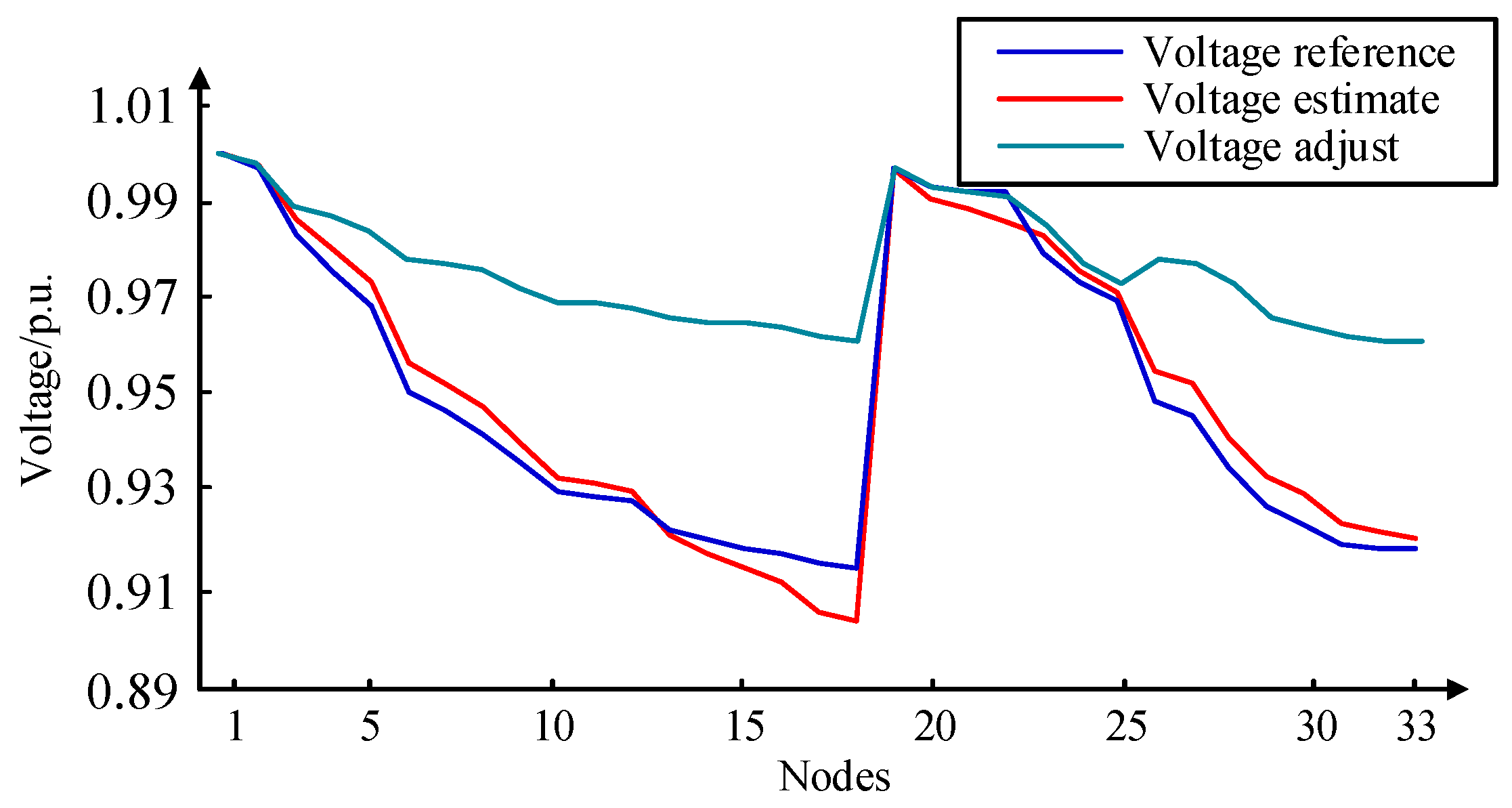
The above state-estimation results are then fed into the flexible voltage-regulation devices for voltage control, and the resulting voltage adjustment performance is illustrated in
Figure 6.
As shown in
Figure 6, all bus voltages lie within 0.95–1.00 p.u. Overall, the voltage magnitude exhibits a decreasing trend along the feeder direction, and a noticeable voltage step change appears around the mid-feeder buses. This reflects the impact of the distribution-network topology and variations in branch power-flow distribution on voltage profiles. After introducing the flexible voltage-regulation device, the adjusted-voltage curve shows an overall uplift compared with the benchmark voltage profile, with a pronounced improvement at the feeder-end buses. This effectively mitigates the risk of undervoltage under long feeders and peak-load conditions, thereby enhancing the voltage compliance level across buses.
To quantify the accuracy of the estimation results, the mean absolute error (MAE) is introduced as the performance metric of the proposed algorithm, which is defined as
where
xi denotes the
i th component of the true state vector,
denotes the
i th component of the estimated state vector, and
n is the dimension of the state vector.
We further compare the proposed pseudo-measurement construction method with PMU measurements, and the results are summarized in
Table 2.
As can be seen, the results obtained by the proposed method are close to those using PMU measurements, indicating that the proposed approach can effectively reflect the measurement performance provided by PMUs.
In addition, to evaluate the effectiveness of the proposed state-estimation algorithm and voltage-control strategy in voltage regulation, we conduct comparative experiments with the generalized maximum-likelihood iterative extended Kalman filter (GMIEKF). The results are reported in
Table 3.
Compared with GMIEKF, the proposed method reduces the voltage violation duration from 3.054 s to 2.641 s (a reduction of 0.413 s), indicating that the proposed strategy can bring bus voltages back to the permissible range faster and thus improve voltage security. Meanwhile, the convergence time of the proposed method is 1.752 s, which is shorter than that of GMIEKF (1.958 s), i.e., reduced by 0.206 s, demonstrating a faster dynamic response.
Overall, while ensuring estimation accuracy and practical controllability, the proposed method achieves faster convergence and significantly shortens the duration of voltage violations.
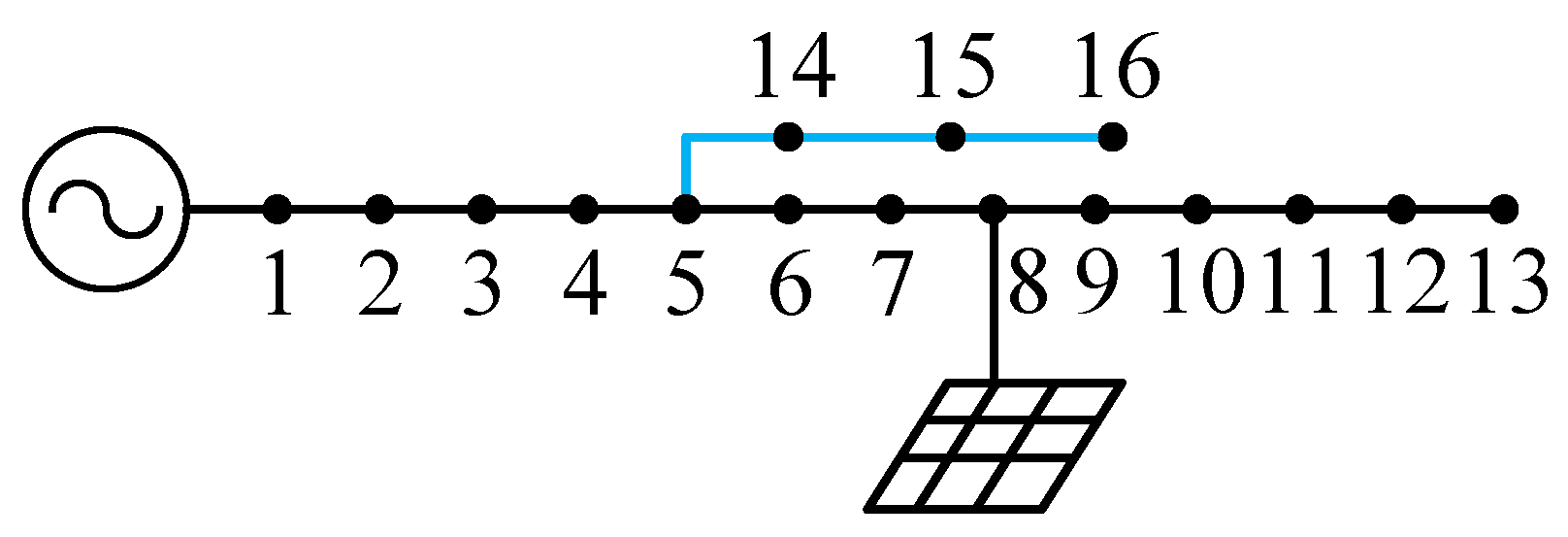
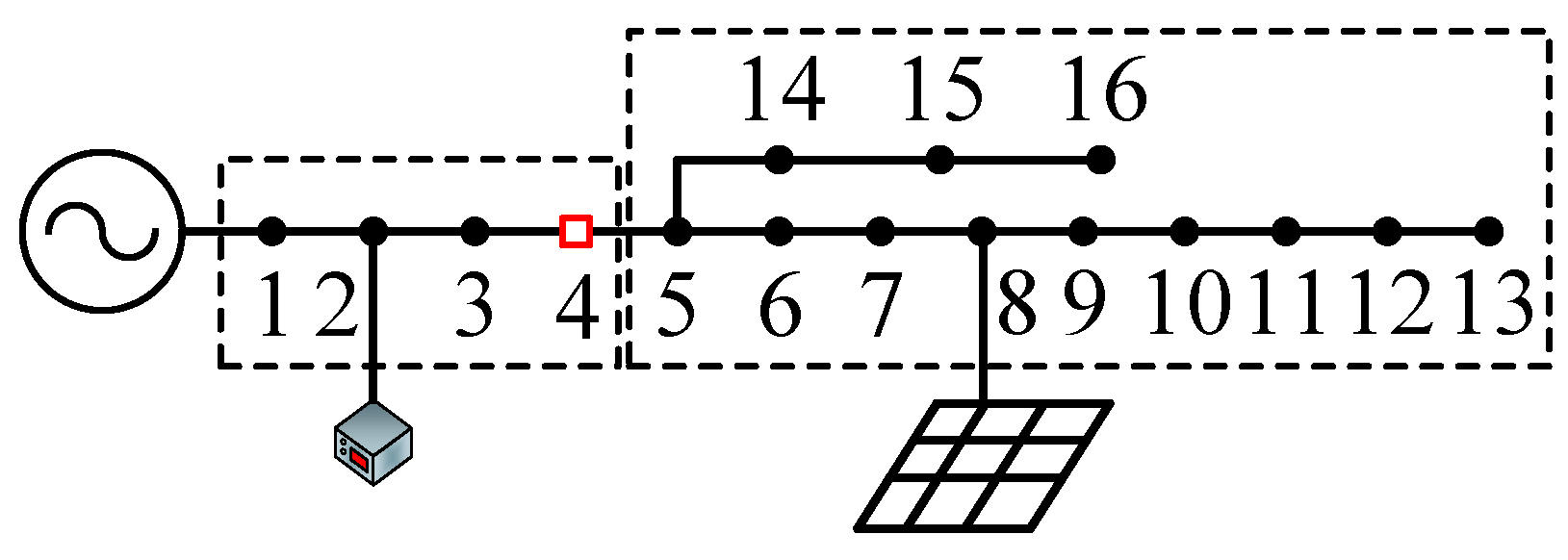
A practical distribution feeder in China is shown in
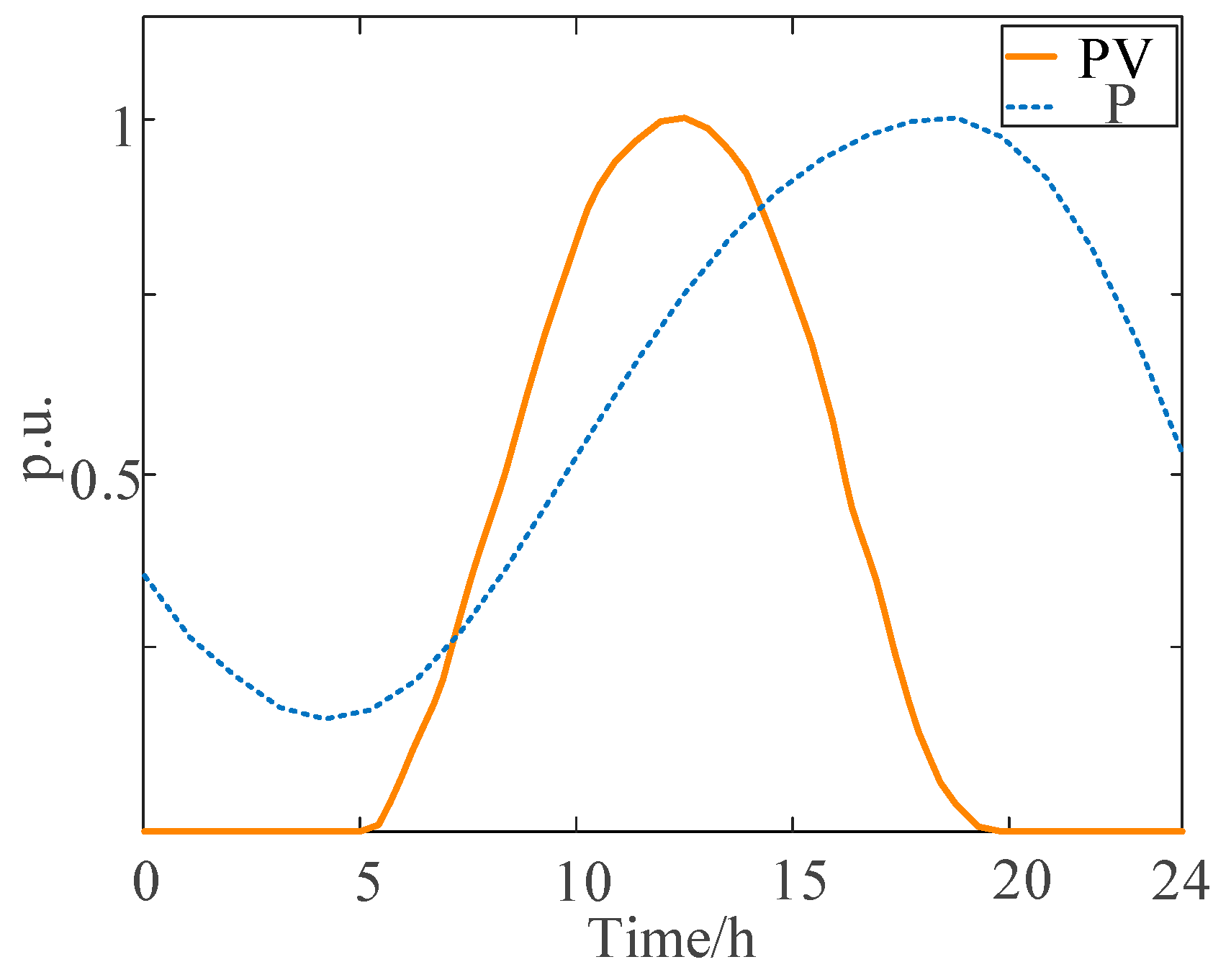
Figure 7 with a voltage level of 35 kV. A photovoltaic (PV) plant is installed at bus 8. The maximum PV generation in summer is used as the base value, and the daily PV output is expressed in per-unit form, as shown in
Figure 8. Using the proposed method, the above feeder is analyzed.
The distribution network is partitioned using the modularity-based approach. The partitioning result is illustrated in
Figure 9, and a PMU is installed at boundary bus 2 to measure the entire network.
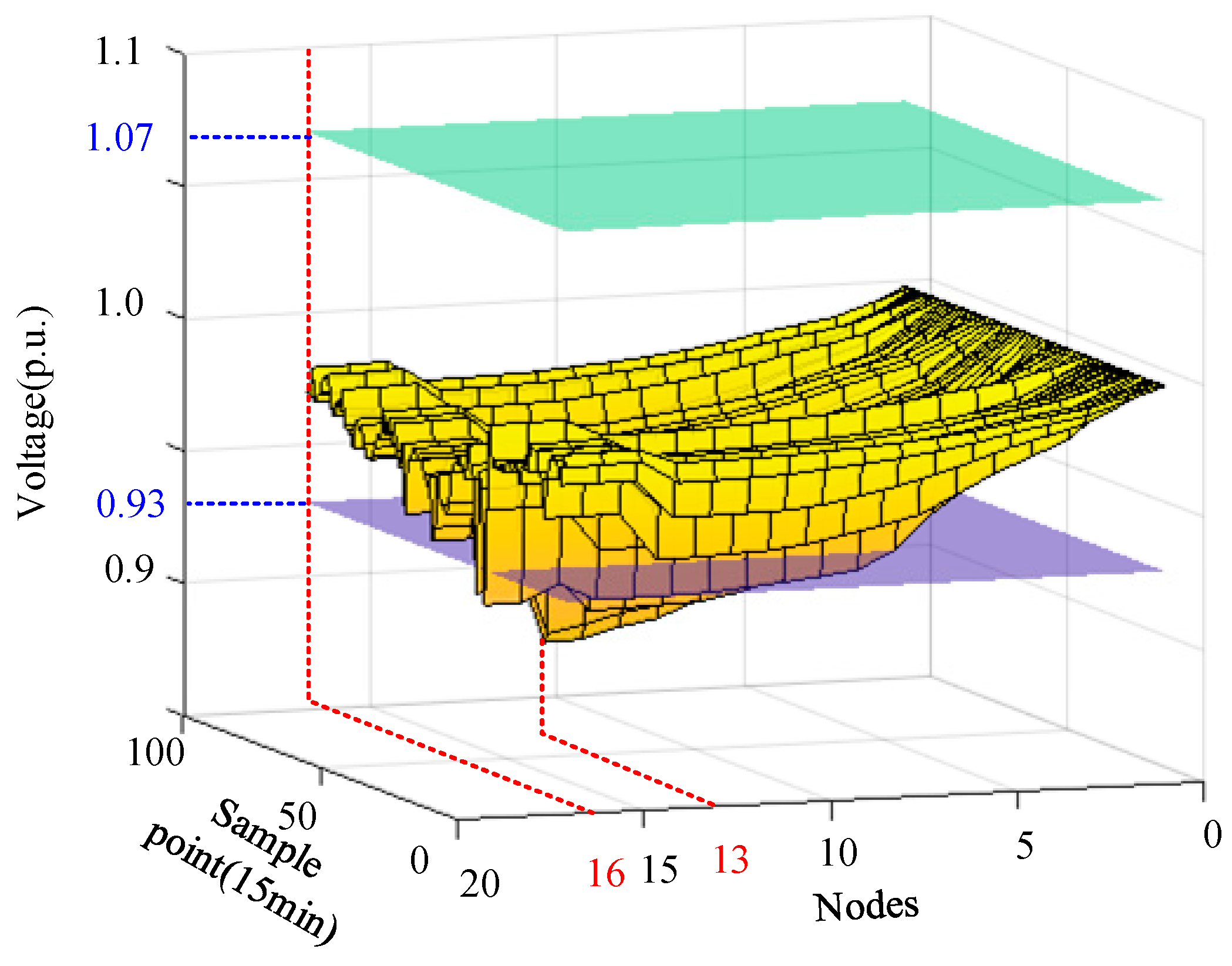
The measurement results are shown in
Figure 10.
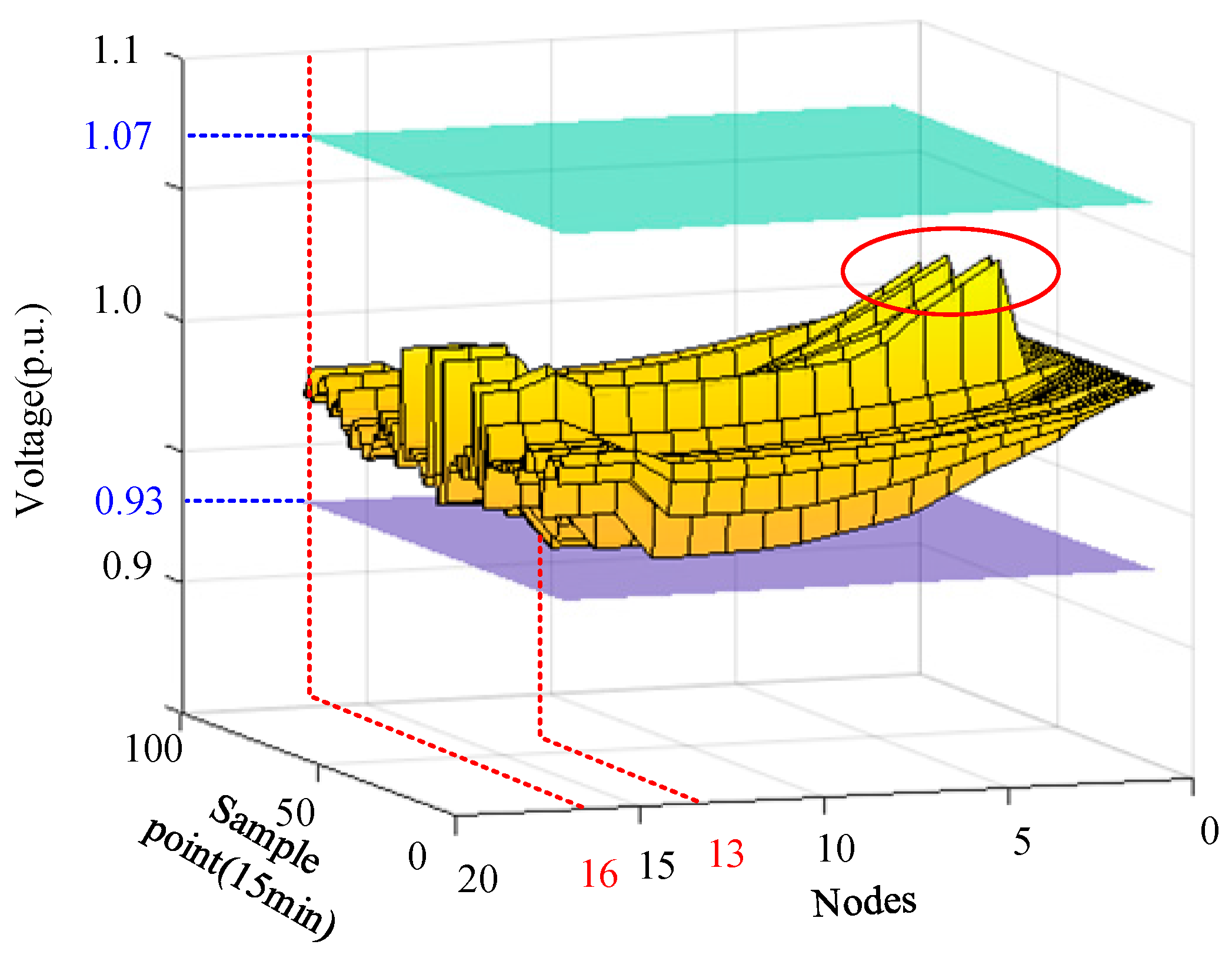
After connecting the FPRE at bus 2, it is only necessary to appropriately boost the voltage during undervoltage periods to bring the end-bus voltages that violate the limits back into the safe range. The bus-voltage distributions are shown in
Figure 11 below. It can be observed that, when voltage violations occur at the end buses, the voltage at the bus where the FPRE is installed increases (red region), thereby restoring the end-bus voltages to the normal range.