Article

Evaluating Battery Degradation Models in Rolling-Horizon BESS Arbitrage Optimization

by
Chase Humiston
1,
Mehmet Cetin
2 and
Anderson Rodrigo de Queiroz
2,*
1
Department of Financial Mathematics, North Carolina State University, Raleigh, NC 27606, USA
2
Department of Civil, Construction and Environmental Engineering, North Carolina State University, Raleigh, NC 27606, USA
*
Author to whom correspondence should be addressed.
Energies 2026, 19(4), 1056; https://doi.org/10.3390/en19041056
Submission received: 22 December 2025 / Revised: 3 February 2026 / Accepted: 12 February 2026 / Published: 18 February 2026
(This article belongs to the Special Issue Electricity Market Design and Renewable Energy Sources)

Abstract

Battery Energy Storage Systems (BESS) can benefit from price volatility in electricity markets, but frequent cycling increases degradation and reduces long-term value. This study develops a rolling-horizon dispatch framework in which battery operation is fully price-driven, while degradation is evaluated separately to isolate the effect of degradation model choice. A 48 h look-ahead window is solved repeatedly and advanced by 24 h, with only the first 24 h of decisions implemented and remaining capacity carried forward. Degradation is assessed using three widely used model classes: Linear-Calendar (LC), Energy-Throughput (ET), and Cycle-Based rainflow (CB) models. The framework is applied to Electric Reliability Council of Texas (ERCOT) 15 min real-time prices for 2024 (Houston Zone). LC and ET result in limited annual capacity loss (≈2%) and modest economic impact, while the CB model predicts substantially higher degradation and large negative valuation. Sensitivity analysis shows that CB-based results are highly dependent on parameter calibration. Overall, the results highlight the strong influence of degradation modeling choices on BESS valuation under rolling-horizon operation.

1. Introduction

1.1. Background and Literature Overview

Battery Energy Storage Systems (BESS) have become essential assets in power systems with high renewable penetration and increasing price volatility. Their fast response and bidirectional power capability allow them to absorb short-term imbalances and respond directly to market signals. Prior studies have consistently shown that BESS provide operational flexibility that supports renewable integration and system reliability, while also enabling participation in competitive electricity markets [1,2]. As a result, storage is no longer viewed as a passive support technology, but as an active market participant whose economic performance depends on operational decisions and battery health [3,4].
This shift has placed growing emphasis on market-driven operation of BESS, particularly in energy arbitrage and revenue-stacking applications. Regulatory developments have enabled storage to participate across energy and ancillary service markets, creating new revenue opportunities but also increasing operational intensity [5]. Several studies have shown that coordinating arbitrage with other services can significantly improve short-term revenues, both at grid scale and in behind-the-meter installations [6,7]. At the same time, market environments characterized by frequent price swings and scarcity events have been identified as especially attractive for merchant BESS investment [8]. These conditions encourage aggressive cycling behavior, which directly links short-term profitability to long-term battery aging and makes degradation modeling a critical component of economic assessment.
In highly volatile electricity markets, energy arbitrage has emerged as a primary value stream for BESS. Arbitrage profitability depends on the ability to charge during low-price periods and discharge during short-lived price spikes, making operational performance sensitive to high-frequency price dynamics. Prior work has quantified arbitrage value in both day-ahead and real-time markets, showing that storage revenues increase with price volatility and temporal price dispersion [9]. Real-time arbitrage, in particular, requires continuous operational adaptation to rapidly changing prices. Data-driven and sequential decision approaches, including reinforcement learning and rolling-horizon optimization, have been used to capture these dynamics under realistic market conditions [10,11,12]. These effects are especially pronounced in ERCOT, where the absence of a capacity market and the presence of frequent scarcity pricing create strong incentives for aggressive arbitrage operation [13,14,15]. As a result, ERCOT provides a natural testbed for studying volatility-driven BESS operation under real-time market signals. While ERCOT is used here as an illustrative example of a highly volatile real-time market, the proposed framework itself does not rely on market-specific rules or pricing mechanisms and could be applied broadly to other regions and systems.
As operational resolution increases, battery degradation becomes inseparable from arbitrage performance. A growing body of literature has focused on incorporating aging effects into arbitrage models to better represent long-term economic outcomes. Linear-Calendar models represent time-driven degradation independent of cycling behavior, while Energy-Throughput models link capacity fade directly to cumulative charged and discharged energy [16,17]. More advanced Cycle-Based approaches, often implemented using rainflow-counting algorithms, capture the nonlinear dependence of degradation on cycle depth and operational intensity [18,19,20]. Studies integrating these models into arbitrage optimization have shown that degradation-aware dispatch tends to reduce cycling frequency and shift operation away from deep discharge events [21,22]. These findings highlight that the choice of aging representation strongly influences both operational behavior and estimated lifetime value of BESS assets.
Beyond pure arbitrage, many studies have shown that combining multiple services, for instance energy arbitrage, reserves, and ancillary services, can significantly improve short-term revenues. Revenue-stacking strategies have been analyzed for both grid-scale and behind-the-meter storage, demonstrating that coordinated participation across markets increases utilization and profitability [6,7]. However, higher utilization also intensifies cycling, which accelerates battery aging and increases long-term replacement costs. While several studies embed degradation costs directly into the optimization framework for multi-service operation, the resulting outcomes are highly sensitive to the assumed degradation model and parameter calibration [11,16,23]. This creates a challenge: aggressive revenue stacking may appear economically attractive in the short term yet lead to rapid capacity loss when aging effects are modeled differently. Despite its importance, the interaction between degradation model choice, arbitrage-driven dispatch, and multi-service operation remains underexplored in a controlled comparative setting.

1.2. Novelty and Contributions

In most existing studies that jointly consider arbitrage and multi-service operation, battery aging is handled by embedding degradation costs directly into the optimization objective. This approach internalizes the trade-off between short-term revenue and long-term capacity loss by penalizing cycling intensity during dispatch. While effective for generating degradation-aware operating policies, it also tightly couples operational decisions to specific aging assumptions. As a result, differences in degradation formulations, such as linear throughput-based versus nonlinear Cycle-Based models, can fundamentally alter dispatch behavior, making it difficult to isolate the impact of degradation model choice itself. This limitation motivates alternative evaluation frameworks that separate price-driven operation from aging assessment, allowing the sensitivity of economic outcomes to degradation modeling assumptions to be examined more transparently.
Relative to existing studies that optimize BESS operation by embedding degradation costs directly into the objective, the novelty of this work lies in its deliberate separation of dispatch and aging evaluation. Rather than proposing a new degradation-aware control strategy, this study isolates the effect of degradation model choice by holding the dispatch logic constant and fully price-driven. This design allows different aging formulations to be compared under identical market conditions and operating profiles, revealing how modeling assumptions alone can lead to fundamentally different lifetime and economic outcomes. By focusing on comparative sensitivity rather than optimal control, the methodological approach employed here clarifies how strongly BESS valuation depends on the selected degradation representation in arbitrage-driven and multi-service operating contexts. This design intentionally does not seek an optimal lifetime-aware operating strategy; instead, it serves as a diagnostic framework to isolate and expose the pure impact of degradation model structure on economic valuation. The approach presented here is applied to a problem using ERCOT data; however, it is general in nature and could be applied to other systems as well.

2. Materials and Methods

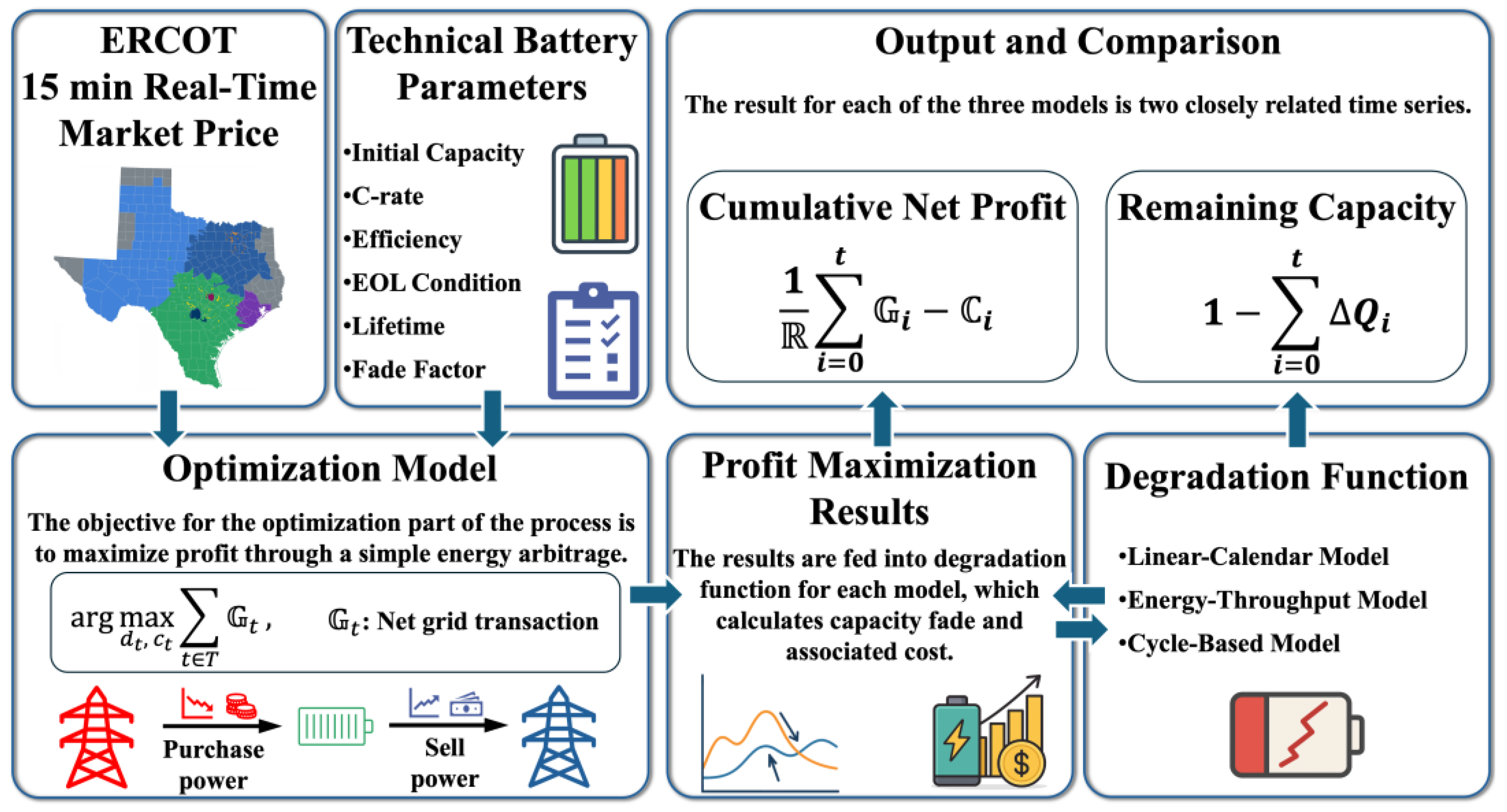
Figure 1 shows the overall framework of analysis of this paper, including the connection between the input data, methods, analysis and outputs developed in the study. These are further detailed in the next sections of the manuscript.

2.1. Overview

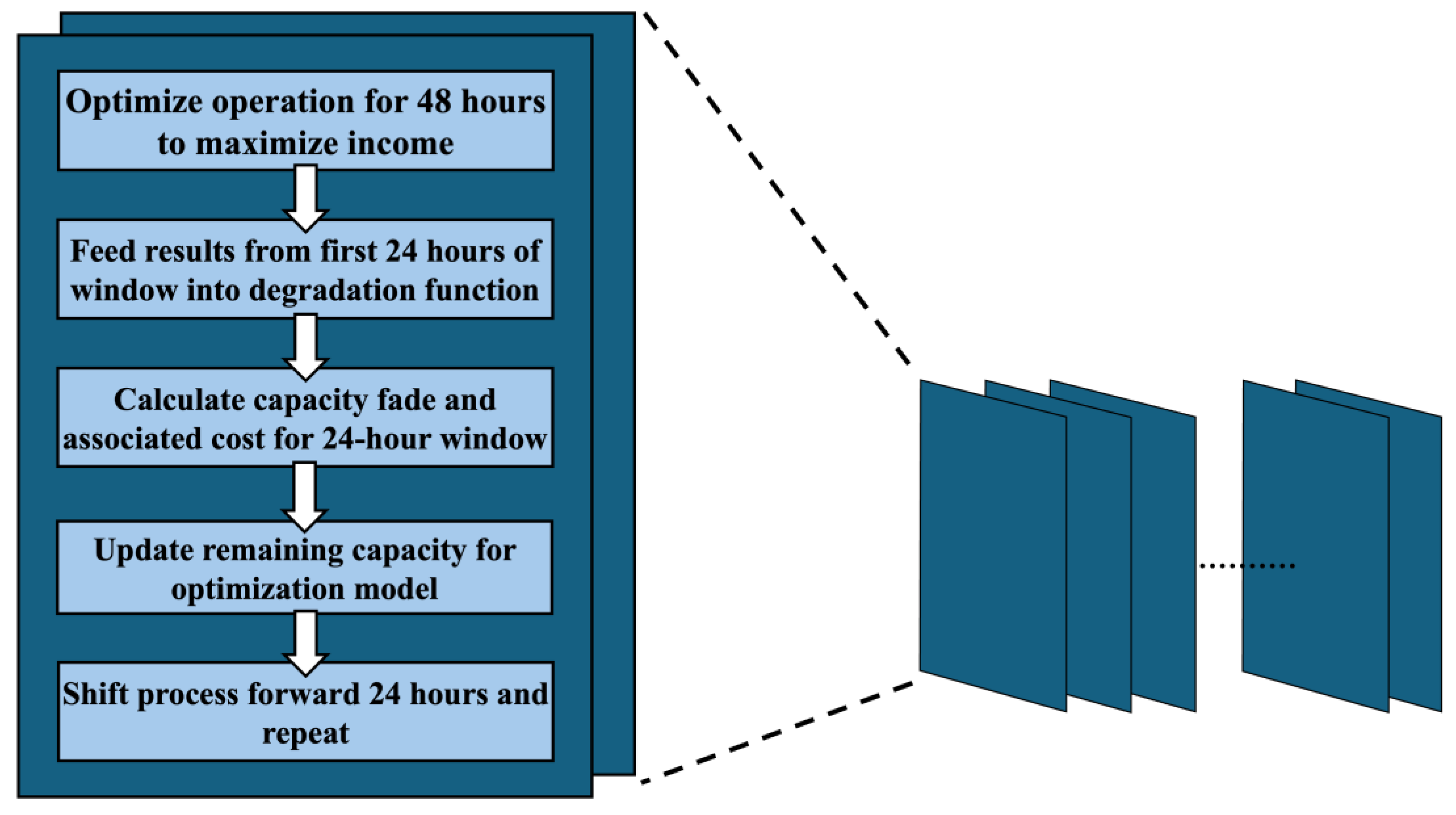
In this study, we compare three different methods for modeling battery degradation: Linear-Calendar, Energy-Throughput, and Cycle-Based. All models are run on the same input data. The market input for our models is a time series for electricity prices. And the technical input includes battery specifications and operating parameters. The basic formulation for running each model is also the same. The process starts by solving a model to maximize profit for a 48 h time horizon. The set T refers to the timesteps within each such window. The results from the first 24 h of the model are then taken and fed into the degradation function for that model, which calculates capacity fade and associated cost. The remaining capacity for the battery is updated, and then the process shifts forward 24 h and starts again. In a standard 24 h optimization, the algorithm implicitly assumes that the energy remaining in the battery at the end of the day is valueless, which leads to a tendency to fully discharge the battery. This behavior artificially creates an unnecessary discharge cycle every night, thereby unjustifiably increasing degradation and causing the model to miss potential arbitrage opportunities in the early hours of the following day [24].
The 48 h look-ahead window adopted in this study allows the algorithm to anticipate next-day price signals, while only implementing decisions for the first 24 h. This approach explicitly introduces the economic value of keeping the battery charged overnight, enabling inter-temporal arbitrage to be properly represented in the model. The literature has shown that, particularly under scenarios with high renewable-generation uncertainty, such extended optimization horizons significantly improve both solution quality and operational realism [25]. This splitting of the optimization and degradation calculations is done to ensure consistent comparisons, but it also means that the profit maximization is naïve to the degradation cost. The exclusion of degradation costs from the optimization objective is a deliberate modeling choice. By keeping the dispatch problem fully price-driven and identical across all cases, the framework avoids conflating operational behavior with degradation assumptions and allows differences in economic outcomes to be attributed solely to the degradation model formulation.
The only parameter that changes within each optimization window is the market price of electricity pt. All of the other parameters remain constant within each horizon. The C parameter reflects the C-rate of the battery, which is calculated as the inverse of duration in hours. The remaining capacity Qrem is the capacity of the BESS at the start of the window. This value is updated by the degradation function in between each window. The remaining capacity is different than the initial capacity QB, which is used to convert capacity fade into degradation cost and does not change at any point while running the model. The initial state of charge SoC0 starts at the minimum permissible SoC for the first window and is taken from the results of the previous window for each window after that. The minimum and maximum depth-of-discharge parameters, DoDmin and DoDmax, constrain the permissible SoC for the battery. A 0% DoD corresponds to the battery being charged to its full capacity and a 100% DoD corresponds to a battery with no charge remaining. The one-way efficiency η is the charging/discharging efficiency of the battery and is computed as the square root of the round-trip efficiency. Since the intent is to replicate a round-trip efficiency parameter, the charging and discharging efficiency use the same one-way efficiency parameter. A 50% charging efficiency would mean only half of the power purchased from the grid actually ends up stored in the BESS. And the end-of-life condition EOL is the percentage remaining of the original capacity at which the battery would need to be replaced.
The only true decision variable for the optimization phase is how much to charge or discharge at each timestep. In the model, this value manifests into five variables. The first two are ct and dt, which split power transfer into charging and discharging, respectively. The next is a binary indicator variable It that signals whether or not the BESS is charging at each timestep. This is used to prevent simultaneous charging and discharging of the BESS. The next variable in the model is SoCt, which holds the state of charge throughout the window. This value is a direct result of the values for the charging and discharging variables but is included to simplify the process of tracking the results. The SoCt at the end of 24 h is the value that is carried forward as the SoC0 parameter for the next window. And the net grid transaction G t combines the net power transfer with the price. This is the same value whose sum is maximized in the objective function.
The variables related to degradation are calculated outside of the optimization process. The capacity fade Q t is calculated by the specific degradation function being used in that model. The degradation cost C t converts Q t into a dollar value based on BESS price and EOL.

2.2. Optimization Model

2.2.1. Objective Function

The objective for the optimization part of the process is to maximize profit through a simple energy arbitrage. The idea is to purchase power to charge the BESS when energy prices are cheap and sell power back to the grid when prices are high. Because this process does not consider degradation cost, this optimization naturally encourages aggressive arbitrage through frequent cycling. The objective function is defined as follows:
argmax d t , c t t T G t = t T p t d t c t t ; t T

2.2.2. Structural Constraints

The state-of-charge constraint connects the power being transferred to/from the grid to the power stored in the BESS. The SoC at each timestep is the sum of the previous SoC and the net result of charging and discharging during the timestep. The previous SoC for the first timestep is the initial SoC. The charging and discharging parameters, expressed in MW, are multiplied by the size of the timestep to express SoC as MWh. This constraint also applies to the charging and discharging efficiency parameter.
S o C t = S o C t 1 + η c t 1 η d t T ; t T
The charge and discharge limits enforce the rate at which the BESS can transfer energy to/from the grid. It is important to note that these constraints are in terms of the remaining capacity Qrem. While this parameter remains constant within each window, it is reduced between windows based on the degradation function. So, the charge and discharge limits will get smaller over time. These constraints also utilize the charging indicator variable to ensure that the BESS is not simultaneously charging and discharging power, as well as the C-rate to ensure the battery is transferring power at the appropriate rate.
c t C Q r e m I t ; t T
d t C Q r e m 1 I t ; t T
The state-of-charge constraints enforce the depth-of-discharge limits on the BESS. Operating at the extremes of battery capacity (near 0% or 100%) causes faster degradation, which makes the Linear-Calendar and Energy-Throughput models less useful. Constricting the allowed SoC can make these models more accurate and doing the same for the Cycle-Based model allows for a fair comparison. Like the charge/discharge constraints, the SoC constraints are also in terms of the Qrem parameter that reduces with capacity fade.
S o C t 1 D o D m a x Q r e m ; t T
S o C t 1 D o D m i n Q r e m ; t T

2.3. Degradation

2.3.1. Overview

This is the formulation for the models that are solved for each 48 h period. The models are constructed in Python 3.12 using the Pyomo version 6.9.5 with the Gurobi version 13.0.0 solver. In between the solving of each window, a degradation function F d e g . is used to calculate the capacity fade. While the inputs are different for each degradation function, all have the same output. Q t is the capacity fade for each timestep.
F d e g . = Q t ; t T
Before the degradation cost can be computed, we first need to get the replacement cost of the battery. This formula comes from the National Renewable Energy Laboratory’s 2025 Report [26]. The report gives a linear formula for cost in $ kW in terms of duration. The inverse of the C-rate gives the duration. Multiplying by Q B (MWh), C (1/h) and 1000 converts the formula to pure dollars.
R = 240.80   C 1 + 379.16 1000   Q B C
To get the degradation cost per timestep, the replacement cost must then be scaled by the amount of capacity that can be lost before the battery must be replaced. This calculation uses the EOL parameter, which represents the percentage of the original capacity at which the battery must be replaced (and the replacement cost is incurred). For simplicity, the cost is applied evenly for all capacity fades. In other words, losing the first 1% of capacity when the battery is new incurs the same degradation cost as losing the last 1% of capacity before the battery must be replaced.
C t = R Q t Q B 1 E O L
The LC, ET, and CB degradation models were selected to represent three widely used and complementary modeling paradigms that span increasing levels of behavioral detail and computational complexity. Together, they capture time-driven aging (LC), linear cycling-related degradation based on cumulative energy throughput (ET), and nonlinear depth-of-discharge-dependent aging based on cycle structure (CB). This structured selection allows systematic comparison of commonly adopted degradation representations within a rolling-horizon framework (Figure 2), while maintaining a fixed, price-driven dispatch that is compatible with linear optimization solvers and avoids introducing additional state variables or electrochemical dynamics at this stage [20,27,28].

2.3.2. Functions

Linear-Calendar
This is the simplest of the degradation functions. Linear-Calendar degradation assumes that the BESS will degrade by the same amount in each timestep and that it will reach its EOL percent of initial capacity in L years. This is the model for which the DoD range is most important because degradation is going to be most linear within a restricted DoD range. For this model, the fact that it is naïve to degradation cost is irrelevant because the degradation cost is incurred regardless of operation. Integrating the degradation function into the optimization process would yield the same result.
F L C E O L , L , t = 1 E O L L × 365 × 24 × T 1 ; t T
Energy-Throughput
A step up from the Linear-Calendar function, the Energy-Throughput function takes the operation results into account. This model assumes charging and discharging degrade the BESS equally and effectively uses the amount the DoD changes during each period. The sum of power charged and power discharged is divided by two to avoid double counting throughput. The key insight here is revealed by Wankmüller et al. [17]—the fade factor f E T , which converts the throughput to degradation. Because it is a linear function, this method could also be integrated into the optimization. Unlike the Linear-Calendar function, this method of calculating degradation would impact operation and cause less cycling if it were a part of the operation decision. So, separating the optimization and degradation phases does impact the results for this model.
F E T f E T , c t , d t , Q B , t = f E T d t c t 2 Q B t ; t T
Cycle-Based
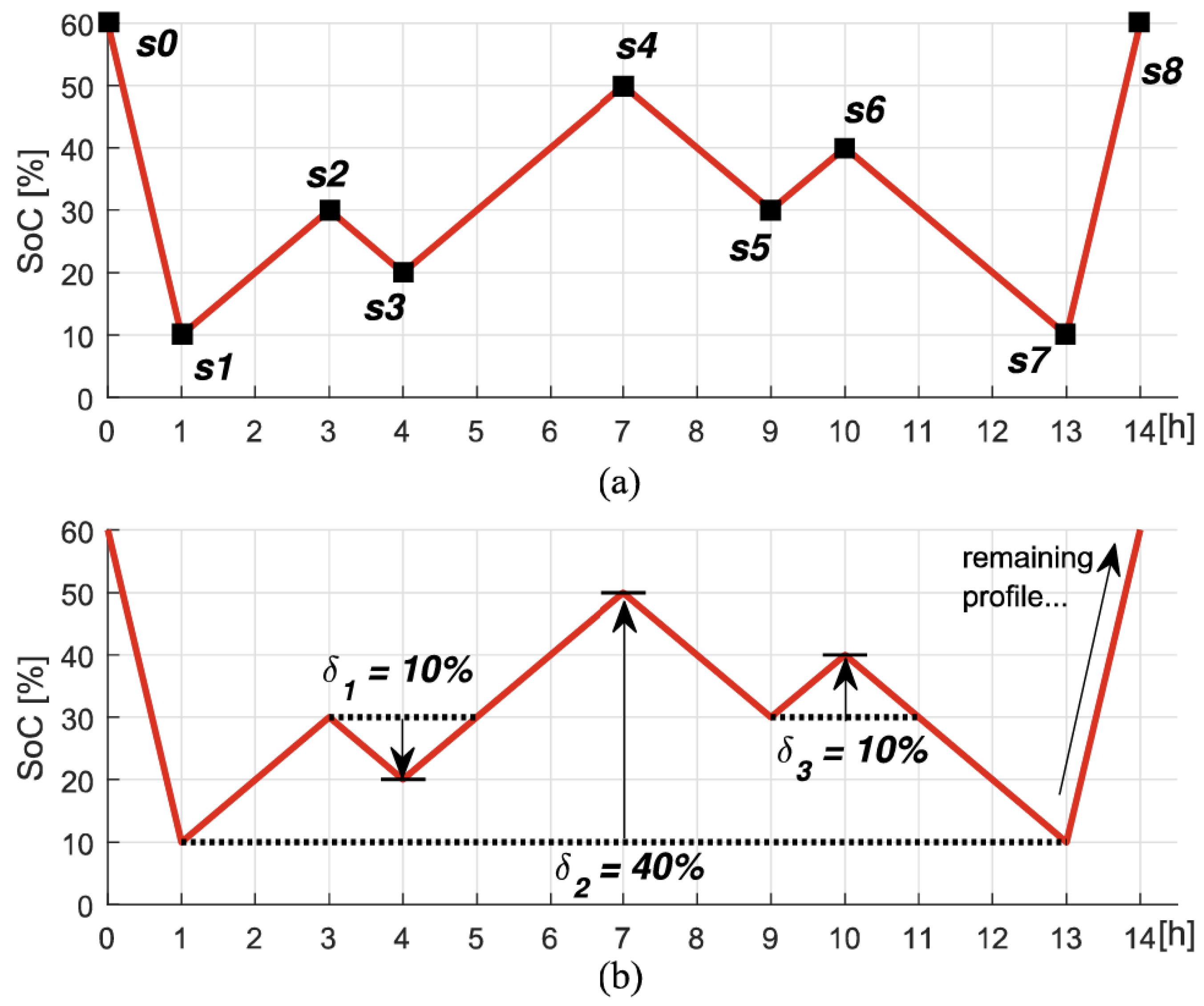
This method is the most complex of the degradation functions considered. As shown in [20], the Cycle-Based function centers on the rainflow-counting algorithm that attributes more degradation to cycles with deeper discharges. This function differs from the other two in that it is highly nonlinear and could not be integrated into the Pyomo Mixed-Integer Linear Programming (MILP) problem. The basic idea is to convert the S o C t time series into cycles (Figure 3), after which degradation is an exponential c α C B function of these cycle depths, multiplied by a fade factor f C B similar to the one used in the Energy-Throughput function. The rainflow algorithm combined with the nonlinear degradation function yields the total capacity loss over a given day. This daily degradation is then evenly distributed across the timesteps within that day to obtain a timestep-level degradation series that can be integrated into the rolling-horizon framework.
In the Cycle-Based degradation model, battery aging is evaluated by identifying charge–discharge cycles from the state-of-charge (SoC) time series rather than by directly tracking energy throughput. The rainflow-counting method is used to decompose the SoC profile into individual cycles with different depths of discharge. Each identified cycle represents a physical charging and discharging event, and deeper cycles are assumed to cause more severe degradation than shallow ones. This approach allows the model to capture the nonlinear relationship between cycling intensity and battery aging under arbitrage-driven operation.
  • Rainflow Algorithm [20]:
    (1)
    Start from the beginning of the profile (as in Figure 3).
    (2)
    Calculate ∆SoC1 = |SoC0 − SoC1|, ∆SoC2 = |SoC1 − SoC2|, ∆SoC3 = |SoC2 − SoC3|.
    (3)
    If ∆SoC2 ≤ ∆SoC1 and ∆SoC2 ≤ ∆SoC3, then a full cycle associated with SoC1 and SoC2 has been identified. Remove SoC1 and SoC2 from the profile and repeat the identification using points SoC0, SoC3, SoC4, SoC5, …
    (4)
    If a cycle has not been identified, shift the identification forward and repeat the identification using points SoC1, SoC2, SoC3, SoC4, …
    (5)
    The identification is repeated until no more full cycles can be identified throughout the remaining profile.
    (6)
    The remainder of the rainflow residue contains only half cycles.
Full cycles correspond to complete charge–discharge events, while the remaining half cycles represent incomplete cycles that still contribute proportionally to degradation.
F C B C y c l e s , f C B , α C B , t = t 24 c C y c l e s f C B c α C B

2.4. Summary

The end result for each of the three models is two closely related time series. The first is the cumulative net profit (loss) over time, calculated as follows:
1 R i = 0 t G i C i ; t T m o d e l
The second is the remaining capacity as a percent of initial capacity:
1 i = 0 t Q i ; t T m o d e l
For both of these equations, T m o d e l refers to the set of all timesteps in the entire model, not just any one horizon.

3. Case Study

3.1. Market Input

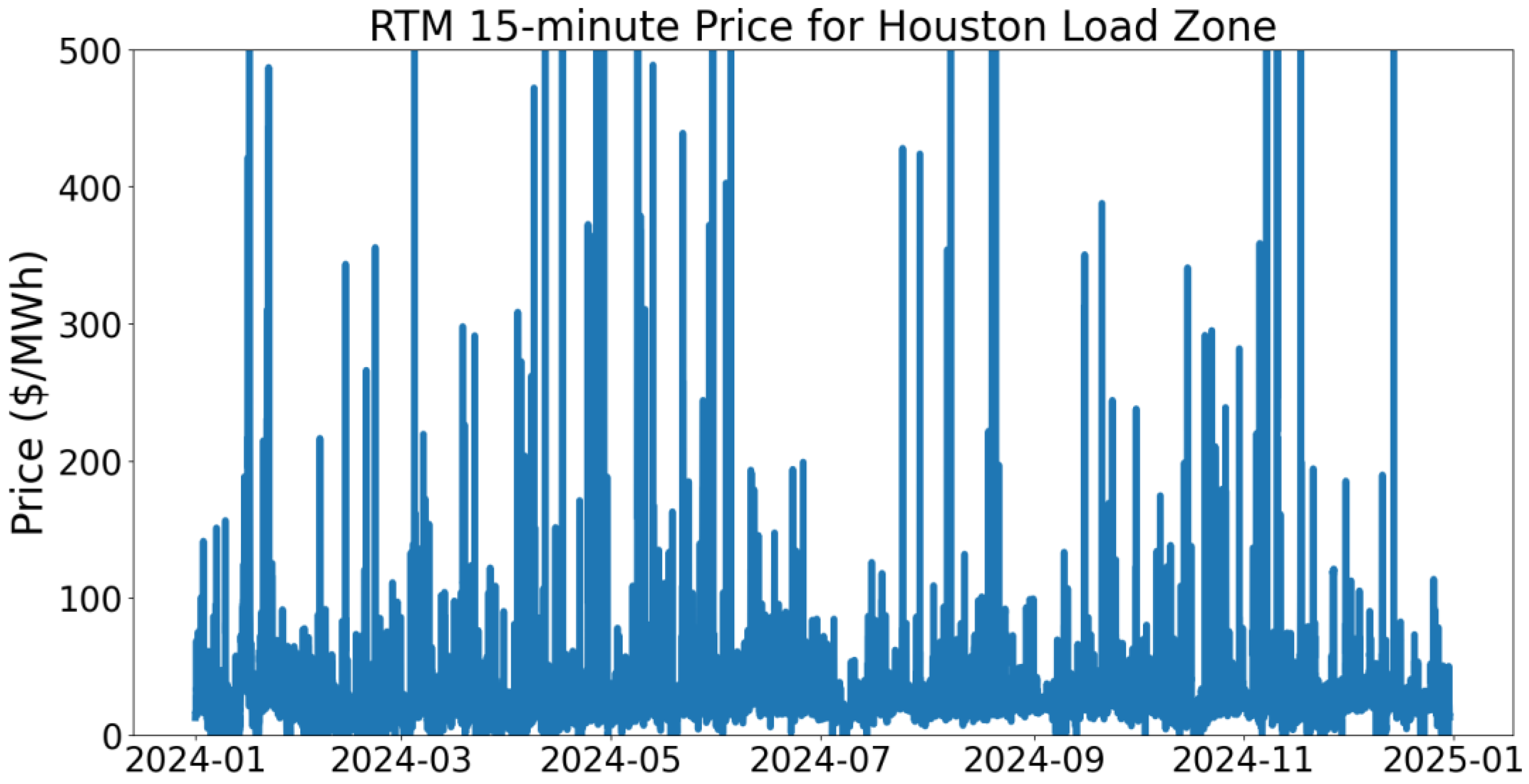
The input price time series (Figure 4) comes from the Electric Reliability Council of Texas (ERCOT) 15 min Real-Time Market (RTM) price data for the Houston Load Zone. This data represents a dynamic electricity market with intra-day fluctuations, as well as occasional extreme events such as price spikes and negative prices. The pricing in this area is largely similar to other load zones within ERCOT and was chosen simply as a representation of real market pricing. Data was pulled for all of 2024, as well as the first day of 2025 (for the 48 h horizon with the 24th hour being the end of 2024). A key assumption is that the BESS capacity is small enough that it cannot impact price. This study is meant to examine degradation modeling on a single utility-scale BESS and would not necessarily generalize to a large facility with many batteries.

3.2. Technical Input

The battery parameters used to run these models were derived from other research in the BESS space and listed in Table 1. The set-up parameters (efficiency, EOL, lifetime, capacity, and C-rate) were all taken from a single study conducted by Grimaldi et al. [11]. This source was chosen because it is one of the best collections of set-up parameters. While some of the values used by other papers differ, these chosen values are all comparable with what has been used elsewhere. The degradation parameters (fade factors and exponential term) were taken from other previous literature that outlined their respective degradation functions [17,20].

4. Results

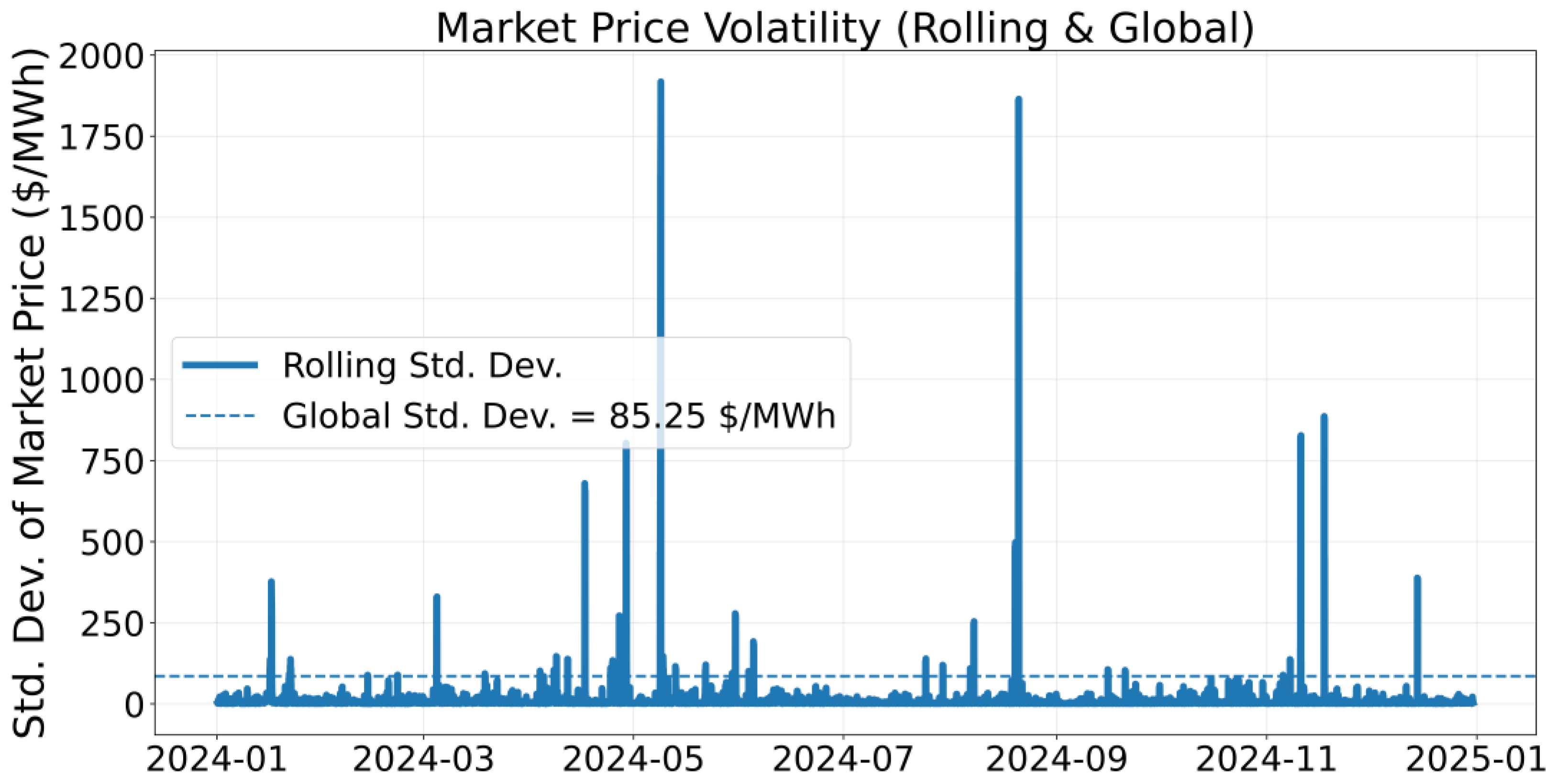
To better contextualize the operational and revenue results, we first examine the statistical properties of the ERCOT real-time price series used as the market input. Figure 5 reports the rolling standard deviation of prices together with the full-sample (global) standard deviation, providing a concise measure of price volatility over time. The results confirm that the market environment is characterized by sustained variability punctuated by periods of elevated volatility, consistent with the price dynamics shown in the market input data. This characterization helps explain the timing and magnitude of arbitrage opportunities observed in the cumulative profit trajectories across all degradation models.
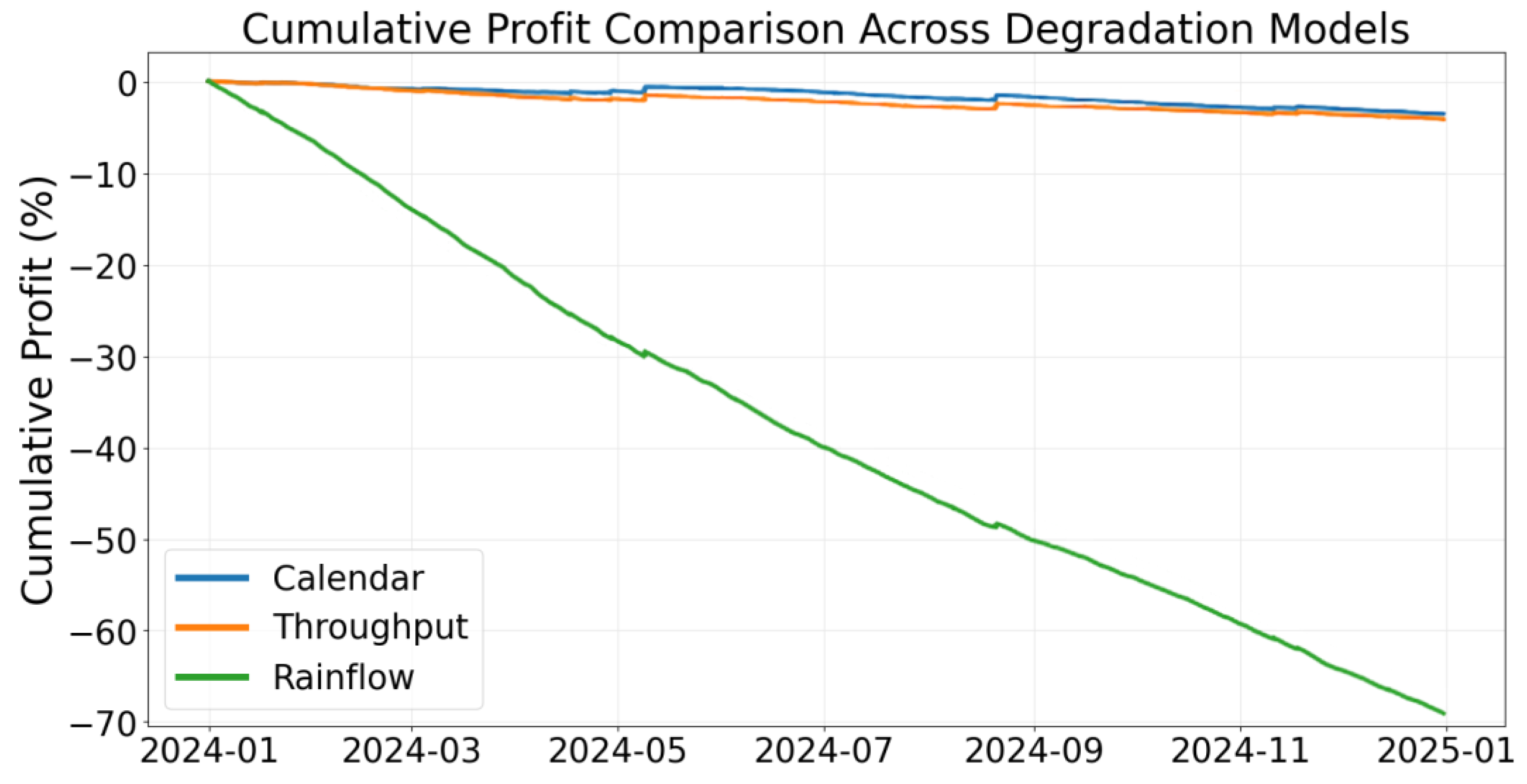
The two output series both tell similar stories. The net profit (loss) over time (Figure 6) shows a steady decline for all models. While the losses for the Linear-Calendar and Energy-Throughput models are small (−3.60% and −4.15% respectively), the loss for the Cycle-Based model is much more extreme (−68.9%). In all profit series, a few slight upticks can be seen where the models briefly made money. These correspond with spikes in the RTM price, as can be seen in Figure 4. Overall, these results certainly seem to support the basis for revenue-stacking BESS operation where systems make money not only by participating in the energy-only market, but also by participating in ancillary services and capacity markets.
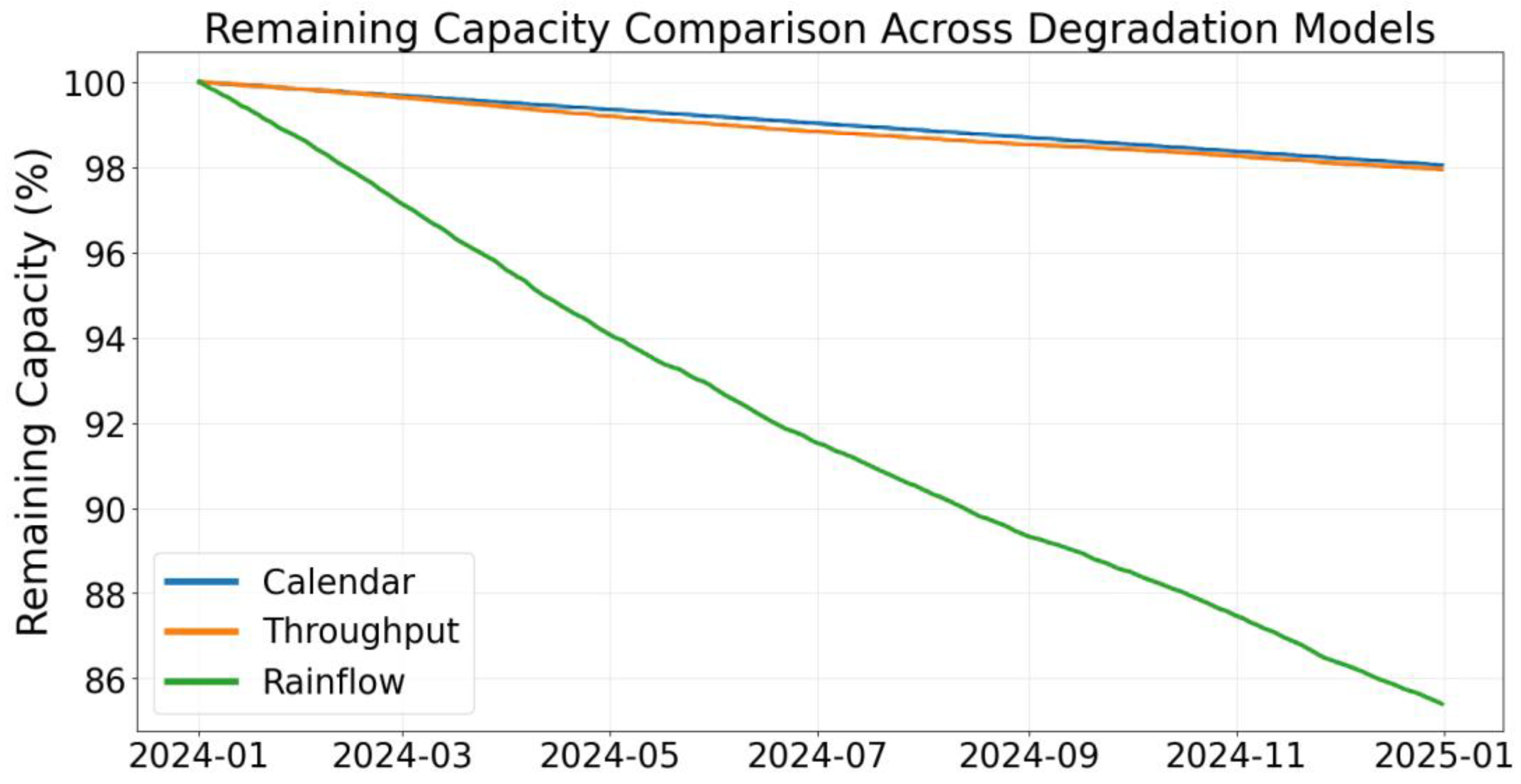
The remaining capacity series (Figure 7) looks very similar to the net profit series, only without the occasional upticks. The LC and ET models produced moderate degradation (2.0% and 2.11% respectively) while the CB model produced severe degradation (14.97%) over the course of the year. Given the EOL parameter, which dictates that the battery must be replaced once degradation reaches 20%, the results of the CB model indicate that the battery would last less than two years. The more extreme economic and capacity loss outcomes observed under the Cycle-Based model should therefore not be interpreted as realistic operational predictions. Rather, they reflect the strong sensitivity of valuation results to nonlinear aging formulations when aggressive, price-driven cycling is imposed.
Table 2 presents key outcomes across studies conducted for arbitrage optimization based on the different modeling approaches.
A key issue revealed by these results is the need for model calibration. It is important to note that the studies used to develop these models do not all work with exactly the same types of lithium-ion batteries. The study that developed the ET model used a LiFePO4 battery, and the study that developed the CB model used a Li(NiMnCo)O2 battery [17,20]. So, technical input parameters implemented by each model may not yield a one-to-one comparison. For example, switching out the fade factor on the CB model fCB for the fade factor from the ET model fET yields very different results. In fact, such a model actually returns a positive profit of 1.91% and produces degradation of only 0.90%. However, to ensure that the models yield physically meaningful and consistent results, the parameters used in each modeling approach were selected in accordance with the battery chemistries whose degradation behavior best matches the underlying assumptions of the model. Accordingly, LFP-type lithium-ion battery parameters were employed for the Energy-Throughput-based model, while NMC-type battery parameters were used for the Cycle-Based model. The fundamental reason for this chemistry-dependent distinction lies in the intrinsically different degradation mechanisms associated with these battery structures.
LFP-type batteries undergo only minimal structural degradation during charge/discharge processes due to their highly robust and stable crystal structures formed by strong covalent bonds [29]. This highly durable crystal structure preserves its integrity even under deep charge/discharge cycles, thereby contributing only marginally to overall battery aging [29]. Their aging behavior is therefore not dominated by mechanical damage, which remains negligible, but instead exhibits a largely linear relationship with energy delivery, which degrades the lithium inventory after each cycle [30]. For this reason, LFP batteries are expected to be more accurately characterized using Energy-Throughput-based degradation models.
In contrast, NMC-type batteries experience severe mechanical stresses during charge/discharge cycling, particularly under deep discharge conditions. Owing to the layered crystal structure of NMC cathodes, these stresses promote the formation of microcracks within the active material particles [31]. Beyond disrupting intra-particle electrical contact and isolating the active material, these microcracks also allow electrolyte penetration into the particle interior, leading to the creation of fresh reactive surfaces [32]. On these newly exposed surfaces, the formation of the Cathode–Electrolyte Interphase is initiated, triggering additional side reactions that accelerate lithium inventory depletion relating to the depth of discharge [32]. Consequently, because NMC degradation is strongly coupled to mechanical stress and exhibits a nonlinear dependence on depth of discharge—and because the energy delivery caused degradation—it is more appropriately represented using a nonlinear Cycle-Based degradation framework. The model with this substitution flips the sign on the net income over the year and produces degradation much closer to the LC and ET models. Ultimately, it is impossible to know which parameters are correct without using real BESS data.
Another issue with this modeling process is that the degradation function is handled outside of the optimization phase. This inherently leads to aggressive cycling well above the level that a degradation-conscious optimization would produce. Intuitively, a BESS operating at this level of activity should degrade faster than the simple Linear-Calendar model would suggest. But, again, it is impossible to say if degradation should be as severe as that of the Cycle-Based model. A comparison with data from actual BESS operation would be needed to properly evaluate this matter.
Finally, this study assumes perfect 48 h price foresight, which does not reflect real market decision environments. A valuable extension would incorporate price uncertainty by replacing perfect foresight with short-term price forecasting models. Recent studies show that short-term electricity price forecasting models designed for renewable-driven volatility can provide more realistic inputs for market-based optimization frameworks, especially when moving beyond perfect foresight assumptions [33,34]. This would allow the BESS to make decisions based on realistic expectations rather than deterministic future prices, thereby improving the external validity of the results.
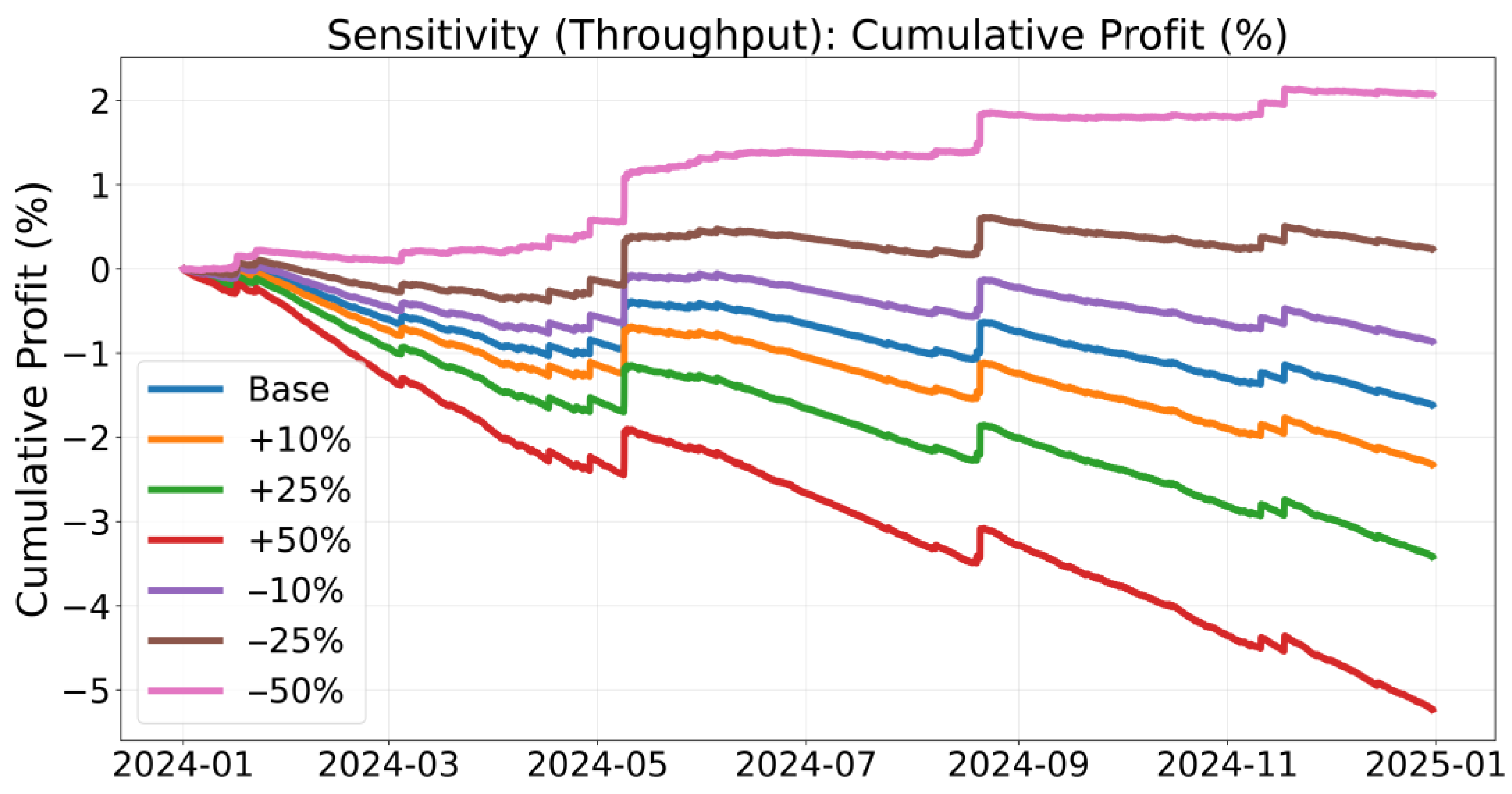
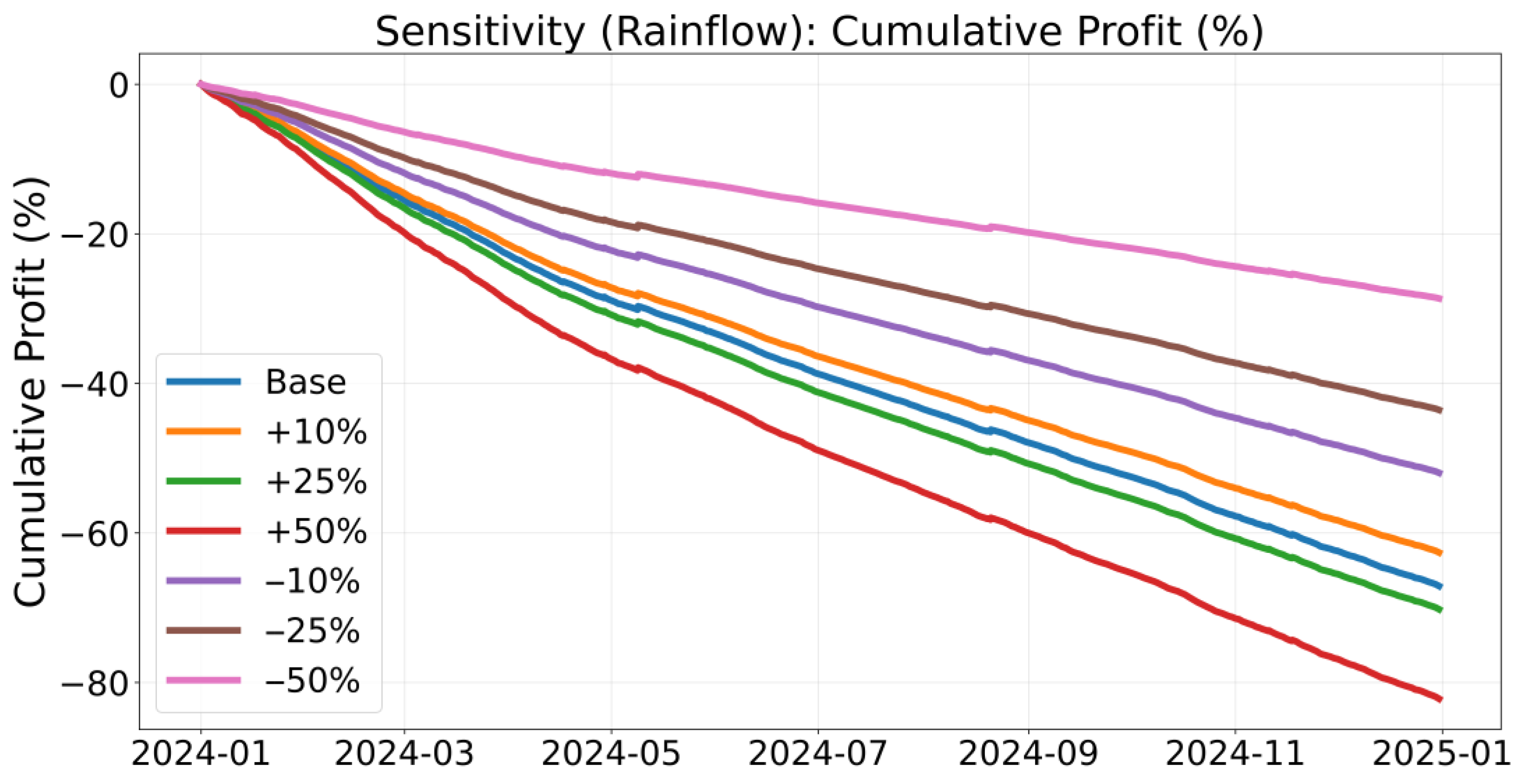
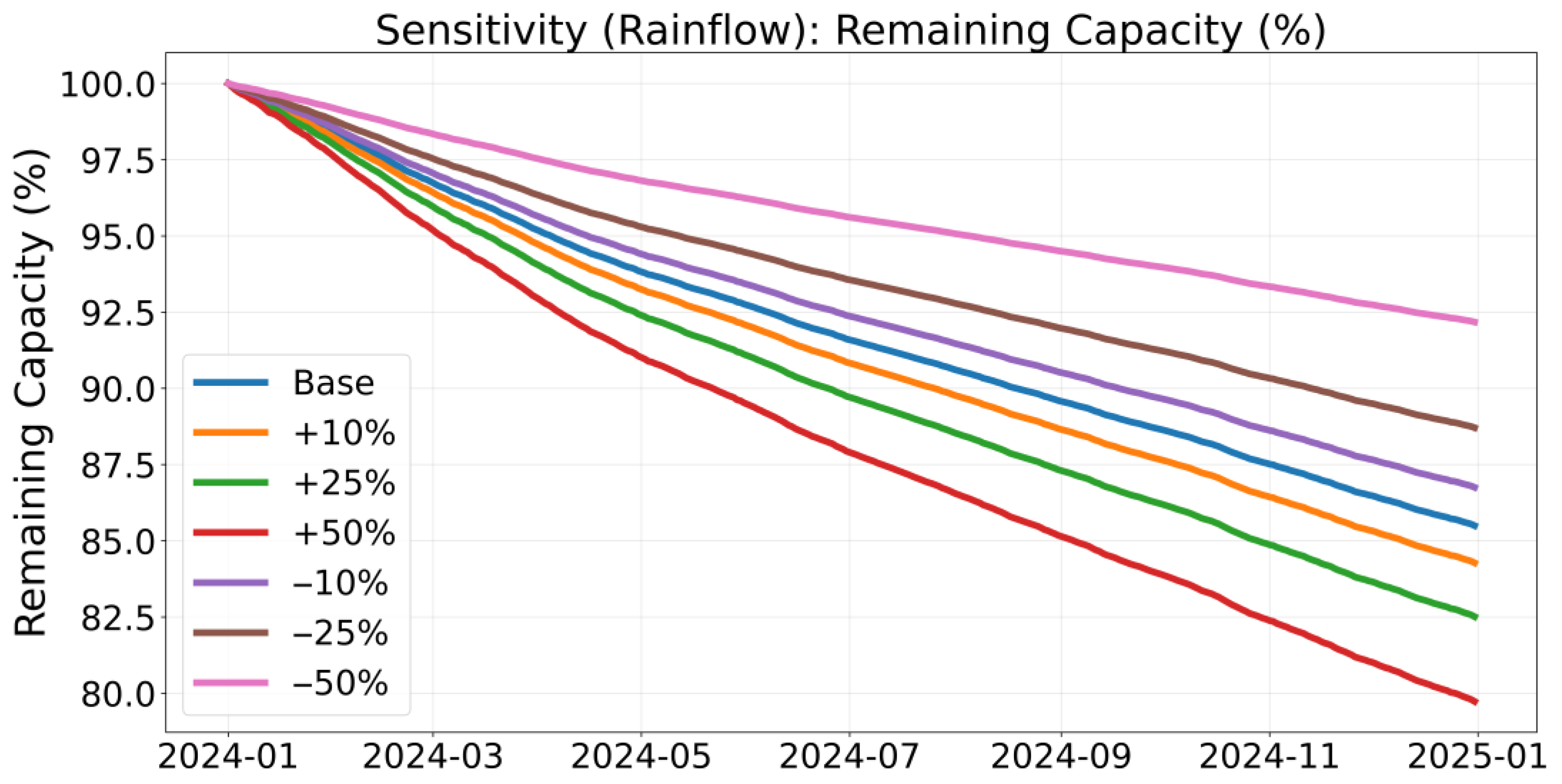
To evaluate the robustness of the degradation modeling framework, a sensitivity analysis was conducted on the two key degradation parameters: the fade factor of the Energy-Throughput model (fET) and the fade factor of the Cycle-Based (rainflow) model (fCB). Each parameter was independently increased and decreased by ±10%, ±25%, and ±50%, while all other system settings, price signals, and optimization logic were kept unchanged, following the methodology described in Section 2.
Figure 8 presents the sensitivity of cumulative profit, expressed as a percentage of the initial investment, to variations in fET. The results show a clear and nearly linear relationship between fET and economic performance. Increasing fET consistently reduces cumulative profit, while decreasing fET improves profitability. This behavior reflects the direct proportionality between energy throughput and degradation cost in the throughput-based formulation, indicating that economic outcomes are strongly and predictably linked to the calibration of fET.
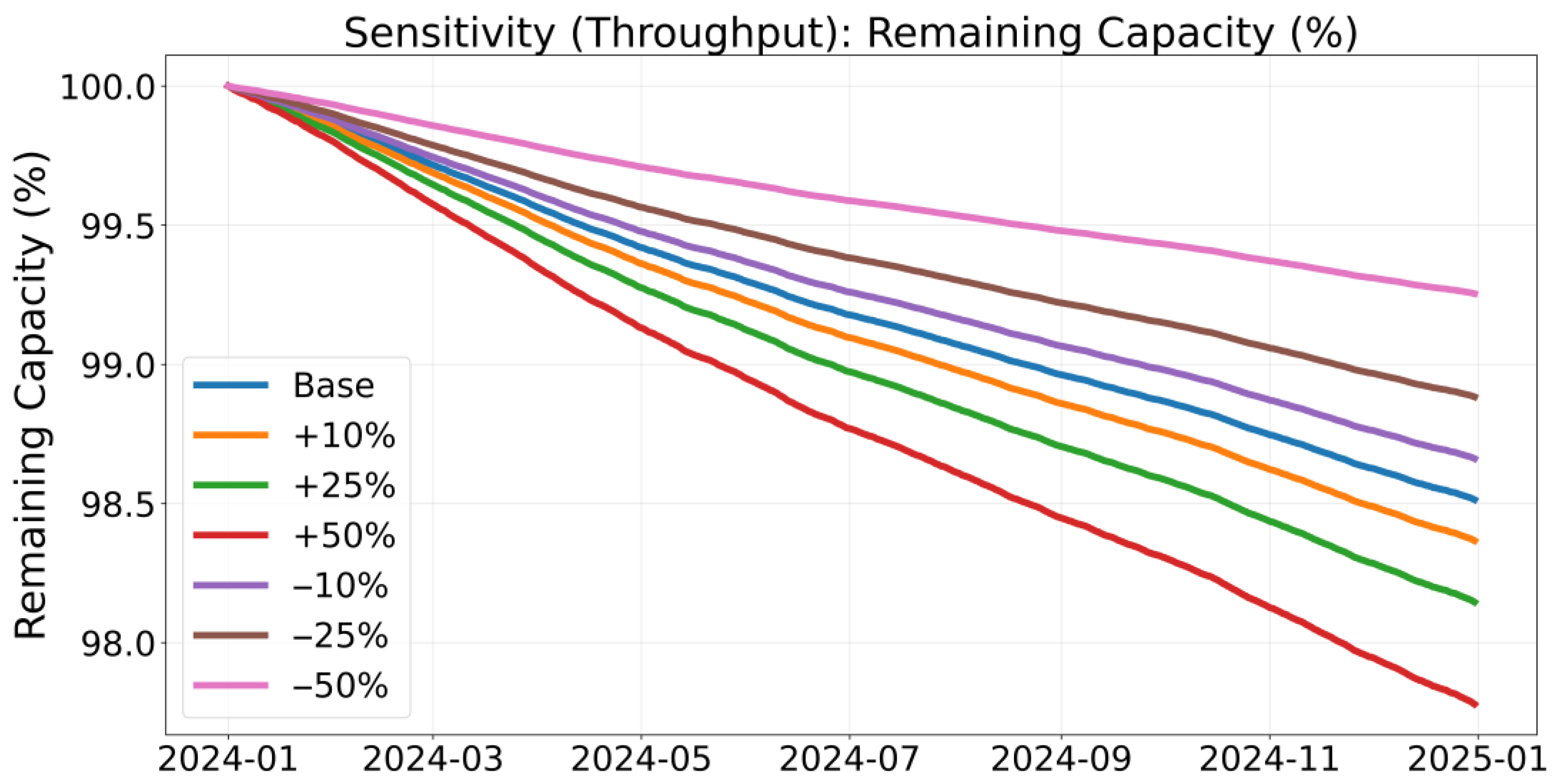
Figure 9 reports the corresponding remaining capacity trajectories for the same fET variations. Higher fET values lead to faster capacity loss, while lower values preserve usable capacity over time. The smooth and monotonic separation between curves indicates that the Energy-Throughput model responds in a stable and predictable manner to parameter changes, with no abrupt regime shifts.
In contrast, Figure 10 and Figure 11 show the sensitivity results for the rainflow-based degradation model with respect to fCB. Compared to the throughput model, cumulative profit is substantially more sensitive to changes in fCB. Moderate increases in fCB result in sharp declines in profitability, and even small parameter deviations lead to large economic penalties. The remaining capacity results further confirm this behavior, as higher fCB values cause rapid and significant capacity depletion.
Overall, the sensitivity analysis highlights a fundamental difference between the two degradation modeling approaches. The Energy-Throughput model exhibits gradual and interpretable responses to parameter uncertainty, whereas the rainflow-based model shows high sensitivity, where small calibration errors can propagate into large physical and economic impacts. These findings underline the importance of careful parameter selection and calibration when Cycle-Based degradation models are coupled with profit-driven operational optimization, consistent with prior observations in the battery degradation literature.

5. Discussion

The results of this study support the need for careful consideration of a degradation modeling function, as well as calibration for the technical parameters. There are two different directions for further work that could take place. The first would be to obtain data for the state of charge SoCt and capacity fade t of an actual BESS that could be used to calibrate the degradation function parameters. This could help tune the fade factor fET of the Energy-Throughput model as well as the fade factor fCB and exponential term αCB of the Cycle-Based model. The other direction would be to integrate the degradation function into the optimization phase for more accurate operation decisions. As discussed in Section 2.3.2, this is arbitrary for the Linear-Calendar model and already possible for the Energy-Throughput model, but impossible for the Cycle-Based model as is. However, there have been some efforts to linearize this degradation function that could be worth exploring [20]. The best possible BESS optimization model that can come from the methods considered in this study would likely result from combining both of these directions for further work as well as revenue stacking.
The severity of the Cycle-Based results is a direct and expected consequence of the modeling framework rather than a flaw in the approach. Because dispatch is intentionally fixed and driven solely by market prices, nonlinear aging formulations such as rainflow-based cycle models are exposed to aggressive cycling patterns that they penalize strongly by design. If degradation costs had been internalized within the optimization, each degradation model would have generated a distinct dispatch profile, making it impossible to separate the effects of operational behavior from the mathematical structure of the degradation model itself. By decoupling operation and degradation, this study demonstrates that the observed divergence in economic valuation arises entirely from differences in degradation modeling assumptions, not from differences in control strategy.
Several studies have shown that rainflow-based cycle aging models can be linearized and embedded within mixed-integer linear programming frameworks, enabling degradation-aware dispatch optimization. Such approaches are well suited for studies whose primary objective is to derive optimal control policies that balance short-term profit against long-term battery health. Extending the proposed framework to include piecewise linearized rainflow models as mixed-integer linear programming within the optimization, and thereby enabling a direct comparison between embedded and post hoc degradation treatments, represents a natural and important direction for future research. Moreover, more detailed electrochemical aging models, such as SEI-based formulations, can represent additional state-dependent effects, but they require extra model states, thermal coupling, and extensive calibration that are outside the scope of this study [35,36]. Comparing these electrochemical models with the LC/ET/CB approaches and aligning the evaluation with standardized frameworks are important directions for future work. Another notable point is that while this study adopts static degradation representations to enable a controlled comparison across modeling approaches, there are some studies conducted to account for reversible degradation and recovery effects observed in electrochemical systems [37]. Incorporating recovery mechanisms into rolling-horizon degradation models, and assessing their impact, represents another important direction for future work. In addition, considering interactive control between BESS and the grid, including voltage–power coordination frameworks for storage inverters [38], may also be an interesting direction for future work.

Author Contributions

Conceptualization, C.H., M.C. and A.R.d.Q.; investigation, C.H., M.C. and A.R.d.Q.; writing—original draft preparation, C.H. and M.C.; writing—review and editing, C.H., M.C. and A.R.d.Q.; visualization, C.H., M.C. and A.R.d.Q.; supervision, A.R.d.Q. All authors have read and agreed to the published version of the manuscript.

Funding

This research received no external funding.

Data Availability Statement

The original contributions presented in this study are included in the article. Further inquiries can be directed to the corresponding author.

Conflicts of Interest

The authors declare no conflicts of interest.

Nomenclature

Sets
TTime
Parameters
ptPrice at Time t ($)
CC-rate
QBInitial Capacity (MWh)
QremRemaining Capacity (MWh)
SoC0Initial State of Charge (MWh)
DoDminMinimum Depth of Discharge (%)
DoDmaxMaximum Depth of Discharge (%)
ηOne-Way Efficiency (%)
∆tTimestep (hr)
EOLEnd-of-Life Condition (%)
LLifetime (years)
fETFade Factor for Energy-Throughput Model
fCBFade Factor for Cycle-Based Model
aCBExponential Term for Cycle-Based Model
Variables
ctPower Charging at Time t (MW)
dtPower Discharging at Time t (MW)
SoCtState of Charge at Time t (MWh)
ItCharging Indicator at Time t (0, 1)
∆QtChange in Capacity at Time t (MWh)
G t Net Grid Transaction at Time t
tDegradation Cost at Time t
Replacement Cost
Functions
Fdeg (·) General Degradation Function
FLC (·) Linear-Calendar Degradation
FET (·) Energy-Throughput Degradation
FCB (·) Cycle-Based Degradation

References

  1. Hannan, M.A.; Wali, S.; Ker, P.; Rahman, M.A.; Mansor, M.; Ramachandaramurthy, V.; Muttaqi, K.; Mahlia, T.; Dong, Z. Battery energy-storage system: A review of technologies, optimization objectives, constraints, approaches, and outstanding issues. J. Energy Storage 2021, 42, 103023. [Google Scholar] [CrossRef]
  2. Datta, U.; Kalam, A.; Shi, J. A review of key functionalities of battery energy storage system in renewable energy integrated power systems. Energy Storage 2021, 3, e224. [Google Scholar] [CrossRef]
  3. Chatzigeorgiou, N.G.; Theocharides, S.; Makrides, G.; Georghiou, G.E. A review on battery energy storage systems: Applications, developments, and research trends of hybrid installations in the end-user sector. J. Energy Storage 2024, 86, 111192. [Google Scholar] [CrossRef]
  4. Nazaralizadeh, S.; Banerjee, P.; Srivastava, A.K.; Famouri, P. Battery Energy Storage Systems: A Review of Energy Management Systems and Health Metrics. Energies 2024, 17, 1250. [Google Scholar] [CrossRef]
  5. Sakti, A.; Botterud, A.; O’Sullivan, F. Review of wholesale markets and regulations for advanced energy storage services in the United States: Current status and path forward. Energy Policy 2018, 120, 569–579. [Google Scholar] [CrossRef]
  6. Paredes, Á.; Aguado, J.A. Revenue stacking of BESSs in wholesale and aFRR markets with delivery guarantees. Electr. Power Syst. Res. 2024, 234, 110633. [Google Scholar] [CrossRef]
  7. Seward, W.; Qadrdan, M.; Jenkins, N. Revenue stacking for behind the meter battery storage in energy and ancillary services markets. Electr. Power Syst. Res. 2022, 211, 108292. [Google Scholar] [CrossRef]
  8. Robertson, M.; Mirzapour, O.; Palmer, K. Charging Up: The State of Utility-Scale Electricity Storage in the United States; Resources for the Future: Washington, DC, USA, 2025; Available online: https://media.rff.org/documents/Report_25-09.pdf (accessed on 10 December 2025).
  9. Mercier, T.; Olivier, M.; De Jaeger, E. The value of electricity storage arbitrage on day-ahead markets across Europe. Energy Econ. 2023, 123, 106721. [Google Scholar] [CrossRef]
  10. Wang, H.; Zhang, B. Energy Storage Arbitrage in Real-Time Markets via Reinforcement Learning. In Proceedings of the 2018 IEEE Power & Energy Society General Meeting (PESGM), Portland, OR, USA, 5–10 August 2018; pp. 1–5. [Google Scholar] [CrossRef]
  11. Grimaldi, A.; Minuto, F.D.; Brouwer, J.; Lanzini, A. Profitability of energy arbitrage net profit for grid-scale battery energy storage considering dynamic efficiency and degradation using a linear, mixed-integer linear, and mixed-integer non-linear optimization approach. J. Energy Storage 2024, 95, 112380. [Google Scholar] [CrossRef]
  12. Zonjee, T.; Torbaghan, S.S. Energy Storage Arbitrage in Day-Ahead Electricity Market Using Deep Reinforcement Learning. In Proceedings of the 2023 IEEE Belgrade PowerTech, Belgrade, Serbia, 25–29 June 2023; pp. 1–7. [Google Scholar] [CrossRef]
  13. Mathrani, A. Texas: A High Stakes Frontier for US Battery Energy Storage Systems. Available online: https://www.rabobank.com/knowledge/d011484585-texas-a-high-stakes-frontier-for-us-battery-energy-storage-systems (accessed on 17 January 2026).
  14. Potomac Economics. 2024 State of the Market Report for the Ercot Electricity Markets. May 2025. Available online: https://www.potomaceconomics.com/wp-content/uploads/2025/06/2024-State-of-the-Market-Report.pdf (accessed on 10 December 2025).
  15. Golding, G. Solar and Battery Storage Help Meet Record-Breaking Texas Electricity Demand; Federal Reserve Bank of Dallas: Dallas, TX, USA, 2025; Available online: https://www.dallasfed.org/research/economics/2025/0114 (accessed on 14 November 2025).
  16. Bai, Y.; Wang, J.; He, W. Energy arbitrage optimization of lithium-ion battery considering short-term revenue and long-term battery life loss. Energy Rep. 2022, 8, 364–371. [Google Scholar] [CrossRef]
  17. Wankmüller, F.; Thimmapuram, P.R.; Gallagher, K.G.; Botterud, A. Impact of battery degradation on energy arbitrage revenue of grid-level energy storage. J. Energy Storage 2017, 10, 56–66. [Google Scholar] [CrossRef]
  18. Akpinar, K.N.; Gundogdu, B.; Ozgonenel, O. A novel cycle counting perspective for energy management of grid integrated battery energy storage systems. Energy Rep. 2023, 9, 123–131. [Google Scholar] [CrossRef]
  19. Shi, Y.; Xu, B.; Tan, Y.; Kirschen, D.; Zhang, B. Optimal Battery Control Under Cycle Aging Mechanisms in Pay for Performance Settings. IEEE Trans. Autom. Control 2019, 64, 2324–2339. [Google Scholar] [CrossRef]
  20. Xu, B.; Zhao, J.; Zheng, T.; Litvinov, E.; Kirschen, D.S. Factoring the Cycle Aging Cost of Batteries Participating in Electricity Markets. IEEE Trans. Power Syst. 2018, 33, 2248–2259. [Google Scholar] [CrossRef]
  21. Pelzer, D.; Ciechanowicz, D.; Knoll, A. Energy arbitrage through smart scheduling of battery energy storage considering battery degradation and electricity price forecasts. In 2016 IEEE Innovative Smart Grid Technologies—Asia (ISGT-Asia); IEEE: New York, NY, USA, 2016; pp. 472–477. [Google Scholar] [CrossRef]
  22. He, G.; Chen, Q.; Moutis, P.; Kar, S.; Whitacre, J.F. An intertemporal decision framework for electrochemical energy storage management. Nat. Energy 2018, 3, 404–412. [Google Scholar] [CrossRef]
  23. Su, H.; Feng, D.; Zhou, Y.; Hao, X.; Yi, Y.; Li, K. Impact of uncertainty on optimal battery operation for price arbitrage and peak shaving: From perspectives of analytical solutions and examples. J. Energy Storage 2023, 62, 106909. [Google Scholar] [CrossRef]
  24. Hu, Z.; Zeng, X.; Feng, C.; Diao, H. Optimizing Charging and Discharging at Bus Battery Swap Stations Under Varying Environmental Temperatures. Processes 2025, 13, 81. [Google Scholar] [CrossRef]
  25. Bouaicha, H. Optimal Day-Ahead Scheduling of a Hybrid Electric Grid Using Weather Forecasts. Master’s Thesis, Naval Postgraduate School, Monterey, CA, USA, 2013. Available online: https://calhoun.nps.edu/server/api/core/bitstreams/0f0dc3e0-6e29-4d4d-a384-a1d31b6f2e7b/content (accessed on 12 January 2026).
  26. Cole, W.; Ramasamy, V.; Turan, M. Cost Projections for Utility-Scale Battery Storage: 2025 Update; National Renewable Energy Laboratory (NREL): Golden, CO, USA, 2025. Available online: https://www.nrel.gov/docs/fy25osti/93281.pdf (accessed on 23 November 2025).
  27. Yarimca, G.; Cetkin, E. Review of Cell Level Battery (Calendar and Cycling) Aging Models: Electric Vehicles. Batteries 2024, 10, 374. [Google Scholar] [CrossRef]
  28. Collath, N.; Tepe, B.; Englberger, S.; Jossen, A.; Hesse, H. Aging aware operation of lithium-ion battery energy storage systems: A review. J. Energy Storage 2022, 55, 105634. [Google Scholar] [CrossRef]
  29. Zhang, G.; Li, M.; Ye, Z.; Chen, T.; Cao, J.; Yang, H.; Ma, C.; Jia, Z.; Xie, J.; Cui, N.; et al. Lithium Iron Phosphate and Layered Transition Metal Oxide Cathode for Power Batteries: Attenuation Mechanisms and Modification Strategies. Materials 2023, 16, 5769. [Google Scholar] [CrossRef]
  30. Madani, S.S.; Shabeer, Y.; Allard, F.; Fowler, M.; Ziebert, C.; Wang, Z.; Panchal, S.; Chaoui, H.; Mekhilef, S.; Dou, S.X.; et al. A Comprehensive Review on Lithium-Ion Battery Lifetime Prediction and Aging Mechanism Analysis. Batteries 2025, 11, 127. [Google Scholar] [CrossRef]
  31. Eldesoky, A.; Bauer, M.; Bond, T.; Kowalski, N.; Corsten, J.; Rathore, D.; Dressler, R.; Dahn, J.R. Long-Term Study on the Impact of Depth of Discharge, C-Rate, Voltage, and Temperature on the Lifetime of Single-Crystal NMC811/Artificial Graphite Pouch Cells. J. Electrochem. Soc. 2022, 169, 100531. [Google Scholar] [CrossRef]
  32. Qu, J.; Xie, Z.; Bicket, I.C.; Yuan, H.; Zuin, L.; Andelic, M.; Qu, W.; Botton, G.A.; Liu, H. Insights into Fast-Charge-Induced Cracking and Bulk Structural Deterioration of Ni-Rich Layered Cathodes for Lithium-Ion Batteries. ACS Nano 2025, 19, 33202–33211. [Google Scholar] [CrossRef] [PubMed]
  33. Fan, H.; Liu, W.; Zhang, Z.; Run, W.; Duan, Y.; Liu, D. EPformer: Unlocking day-ahead electricity price forecasting accuracy using the time–frequency domain feature learning strategy considering renewable energy. Renew. Energy 2026, 261, 125296. [Google Scholar] [CrossRef]
  34. Michalakopoulos, V.; Menos-Aikateriniadis, C.; Sarmas, E.; Zakynthinos, A.; Georgilakis, P.S.; Askounis, D. Less Is More: Data-Driven Day-Ahead Electricity Price Forecasting with Short Training Windows. Energies 2026, 19, 376. [Google Scholar] [CrossRef]
  35. Dong, G.; Wei, J. A physics-based aging model for lithium-ion battery with coupled chemical/mechanical degradation mechanisms. Electrochim. Acta 2021, 395, 139133. [Google Scholar] [CrossRef]
  36. Li, R.; Kirkaldy, N.D.; Oehler, F.F.; Marinescu, M.; Offer, G.J.; O’Kane, S.E.J. The importance of degradation mode analysis in parameterising lifetime prediction models of lithium-ion battery degradation. Nat. Commun. 2025, 16, 2776. [Google Scholar] [CrossRef]
  37. Meng, X.; Sun, C.; Mei, J.; Tang, X.; Hasanien, H.M.; Jiang, J.; Fan, F.; Song, K. Fuel cell life prediction considering the recovery phenomenon of reversible voltage loss. J. Power Sources 2025, 625, 235634. [Google Scholar] [CrossRef]
  38. Zhang, W.; Sun, C.; Alharbi, M.; Hasanien, H.M.; Song, K. A voltage-power self-coordinated control system on the load-side of storage and distributed generation inverters in distribution grid. Ain Shams Eng. J. 2025, 16, 103480. [Google Scholar] [CrossRef]
Figure 1. General framework and summary of the method used to evaluate and compare different degradation function models.
Energies 19 01056 g001
Figure 2. Representation of the rolling-horizon optimization process.
Energies 19 01056 g002
Figure 3. (a) SoC profile and (b) resulting cycle counts [20].
Energies 19 01056 g003
Figure 4. Market input. Y-axis is cut off to show detail, but price spikes go as high as $5000/MWh.
Energies 19 01056 g004
Figure 5. Rolling and global standard deviations of the market.
Energies 19 01056 g005
Figure 6. Cumulative income as a percent of initial investment. Negative values indicate a loss.
Energies 19 01056 g006
Figure 7. Remaining capacity. Degradation is much more severe for the CB model than for the LC and ET models.
Energies 19 01056 g007
Figure 8. Sensitivity analysis for cumulative profit of the Energy-Throughput model.
Energies 19 01056 g008
Figure 9. Sensitivity analysis for remaining capacity of the Energy-Throughput model.
Energies 19 01056 g009
Figure 10. Sensitivity analysis for cumulative profit of the Cycle-Based model.
Energies 19 01056 g010
Figure 11. Sensitivity analysis for remaining capacity of the Cycle-Based model.
Energies 19 01056 g011
Table 1. Technical input parameters.
DescriptionParameterValueUnitsSource
Initial CapacityQB2MWh[11]
C-rateC0.5h−1[11]
Efficiencyη88.5%[11]
End-of-Life ConditionEOL80%[11]
LifetimeL10years[11]
Fade Factor (ET)fET2.71 × 10−5N/A[17]
Fade Factor (CB)fCB5.24 × 10−4N/A[17]
Exponential Term (CB)αCB2.03N/A[20]
Table 2. Comparison of the outcomes across different arbitrage optimization studies.
SourceModelOptimization StrategyKey Findings
This
work
Linear-Calendar (LC),
Energy-Throughput (ET),
Cycle-Based (CB)
Non-internalized
Degradation Cost
LC shows −3.60% profit loss,
ET shows −4.15% loss,
CB shows −68.9% loss
[11]Cycle-BasedDynamic Efficiency,
Internalized Degradation Cost
Yearly net profit reduction in the 13–24% range compared to no-degradation scenario
[16]Energy-ThroughputInternalized Degradation CostProfit drops to 49.4% of optimal when prediction error is ~12.5%
[17]Energy-ThroughputInternalized Degradation CostRevenue reduces by 12–46%
(from 358 $/kWh to 194–314 $/kWh)
[20]Cycle-BasedInternalized and Non-internalized Degradation CostIgnoring degradation leads to negative profit (−$775 k to −$42.1 M); internalizing it yields positive profit ($10 k to $276 k)
Disclaimer/Publisher’s Note: The statements, opinions and data contained in all publications are solely those of the individual author(s) and contributor(s) and not of MDPI and/or the editor(s). MDPI and/or the editor(s) disclaim responsibility for any injury to people or property resulting from any ideas, methods, instructions or products referred to in the content.