Next Article in Journal
Energy Transition in the BRICS: A Comparative Assessment of the Determinants of Renewable Energy Consumption
Previous Article in Journal
Review on Dynamic Inflow Sensing Layout Optimization for Large-Scale Wind Farms: Wake Modeling, Data-Driven Prediction, and Multi-Objective Uncertainty Optimization
 
 
Due to scheduled maintenance work on our servers, there may be short service disruptions on this website between 11:00 and 12:00 CEST on March 28th.
Article

Optimising Drag-Reducing Agent Performance for Energy-Efficient Pipeline Transport
1
Department of Petroleum Engineering, College of Engineering, University of Kerbala, Karbala 56001, Iraq
2
Technical Instructor Training Institute, Middle Technical University, Baghdad 10074, Iraq
3
Department of Building Engineering, Energy Systems and Sustainability Science, University of Gävle, 801 76 Gävle, Sweden
4
Research Center in Industrial Technologies CRTI, P.O. Box 64, Cheraga, Algiers 16014, Algeria
5
Materials and Energy Engineering Laboratory (LMGE), Technology Department, Faculty of Technology, 20 Aout 1955 University of Skikda, P.O. Box 26, Skikda 21000, Algeria
6
Applied Science Research Center, Applied Science Private University, Amman P.O. Box 11931, Jordan
*
Author to whom correspondence should be addressed.
Energies 2026, 19(3), 812; https://doi.org/10.3390/en19030812
Submission received: 27 December 2025 / Revised: 25 January 2026 / Accepted: 2 February 2026 / Published: 4 February 2026
(This article belongs to the Special Issue Modeling and Planning of Energy Systems)

Abstract

The high energy consumption and cost of operation which result from substantial pressure losses during the transportation of crude oil over long-distance pipelines due to frictional drag created by turbulence are fundamental issues. In order to cope with such challenges, the current research intends to develop a simulation-based study that employs MATLAB R2016b and Minitab 21 to assess the effectiveness of drag-reducing agents (DRAs). An effective mathematical representation of the use of basic fluid mechanics with a semi-empirical correlation on the DRA performance is therefore created and its performance compared to actual pipeline data, showing good compatibility with experimental results. The findings show that DRA addition can produce a significant reduction in the pressure drop by 30–35% with an increase in the overall flow efficiency by 40–60%. Using 25 ppm DRA concentration at a Reynolds number of 323,159 enables an optimised prediction of 33.43% in drag reduction with an efficiency of 45.13%. Moreover, it is also found that there are considerable energy savings, flatter radial velocity profiles, and enhanced particle transport, which highlights the radical effect of DRAs on the hydrodynamics of flows. More importantly, it is determined that DRAs are one of the most effective and cost-efficient solutions to improve throughput and decrease the pumping power in the oil pipeline. However, further research is required to generalise the model to multiphase flows and use the newest optimisation algorithms to control the dosage dynamically.

1. Introduction

The pipeline transportation of crude oil is a very important part of the world energy platform, where the cost of operation and energy consumption are the most important factors [1]. Recent improvements in DRAs specified their transformative prospective in optimising the efficacy of crude oil transport through pipelines. The application of DRAs has become progressively vigorous in alleviating frictional losses linked to turbulent flow, by this means not only dropping operational costs but also meaningfully refining flow rates [2]. The integrated advanced polymers and Nano-additives showed potential in augmenting the stability and performance of these agents under variable flow conditions, resolving previously recognised challenges such as polymer degradation and performance inconsistency [3]. Essentially, the implication of projecting modelling containing computational fluid dynamics (CFD) is that it allowed for tailored DRA formulations that can be reformed to specific pipeline conditions and fluid features. This ground-breaking methodology opens new paths for sustainable energy transportation, highlighting the request for constant research to perfect these technologies further and discover their implication in complicated multiphase flows. By optimising DRA performance, the oil and gas industry can attain considerable energy savings while minimising environmental effects, aiding in introducing a more effective and environmentally responsible future in pipeline transport systems.
The frictional resistance that is experienced in the flow of fluids is one of the largest challenges in the operations of a pipeline and it requires a substantial pumping power, which increases the operational cost. To efficiently deal with this problem, the DRAs emerged as the effective method for effectively reducing the losses associated with friction in turbulent flow regimes. For example, mechanical practices such as pipe liners and coatings can decrease surface roughness but characteristically do not resolve the essential turbulence of the flow, causing negligible reductions in pumping power. Moreover, changes in flow rates and fluid properties can hamper the efficacy of traditional additives such as surfactants, that might not steadily produce the desired drag reduction across various operational conditions. On the other hand, DRAs precisely target turbulent flow dynamics, delivering a more consistent and significant reduction in frictional losses, thus demonstrating that they are a well-organised solution for energy conservation in pipeline transport [4].
Drag reduction using polymer has had a long history and one of the materials that has been widely used in the study is polyacrylamide (PAM). The success of drag reduction depends essentially on the molecular weight distribution of the polymer, as stated by Brandfellner et al. [5], who delivered a quantitative account of the way polyacrylamide molecular weight distributions influence the performance of the drag reduction. This molecular-based insight is the basis of maximising the DRA formulations. Nevertheless, the most important issue regarding the preservation of drag reduction efficiency is the recovery of polymers following mechanical loading. Cussuol et al. [6] examined polymer drag reduction regeneration, and their research exposes a piece of information in understanding the recovery mechanism upon which some polymers are able to restore their drag-reducing ability following degradation. The basic physics of polymer-induced drag reduction is a complicated process based on elasticity and inertia interactions of turbulent viscoelastic flows. This is specifically introduced by Housiadas and Beris [7], who investigated the effects of changes in these properties on the overall performance of drag reduction in channel flows.
The operational challenges of pipeline systems with drag-reducing polymers have been identified within the context of their practical application. Jouenne et al. [8] carried out extensive experiments on the changes in high-molecular-weight polyacrylamide (HPAM) solutions during their transport through the turbulent pipeline flow, which gives essential information about the stability of these agents and their long-lasting operation in specific conditions. Karami et al. [9] categorically described the degradation mechanism of the drag-reducing polymers in aqueous solution, which revealed most of the factors that influence the breakdown of the polymer in a turbulent medium. To deal with the problem of degradation, new methods have been designed, which include the nanoparticle-induced drag reduction technique of polyacrylamide in high-Reynolds-number turbulent flows. In this aspect, Li et al. [10] showed how nanomaterial integration can be used to improve the stability and performance of the polymer.
Polymer degradation in turbulent drag-reducing flows in pipes has been reported by Sandoval et al. [11], who studied the nature of the processes that degrade polymer chains due to mechanical stress during pipeline transportation. Based on such investigation, Soares et al. [12] found that there exists a serious shortcoming of polymeric drag reducers: in tubes with imposed pressure, the efficiency is lost at large Reynolds numbers, which is also a major limitation to high-flow-rate applications. The existing knowledge on the mechanical degradation and de-aggregation of drag-reducing polymers in turbulent flows was synthesised by a review conducted by Soares [13], who provided a framework for the understanding of the intricate degradation processes that restrict the performance of DRA.
The recent experimental studies have increased the knowledge regarding the polymer drag reduction under different operational conditions. Experimental studies by Chen et al. [14] on turbulent drag reduction impact of polyacrylamide solution when used in loop pipe systems have provided useful information on the recirculating configuration performance. Other methods have been investigated on the transport of heavy oil. For example, Sun et al. [15] tested the ability of self-generating foam injection to reduce drag in thermally produced heavy oil, which is a novel oil transportation method of viscous crude oil.
Other than conventional polymer-based techniques, new materials and surface treatment have proved themselves as potential drag reduction techniques. A potential of sustainable materials is demonstrated by Pathak et al. [16], who created biomass-derived self-regenerative multifunctional superhydrophobic films, possessing oil–water remediation properties and drag reduction properties. To maximise the stability of drag-reducing agents, Lv et al. [17] examined the incorporation of siloxane bonds in ultrahigh-molecular-weight polyolefin drag-reducing agents, which proved to have better shear resistance, which is important in the long-run operations of the pipeline. Cheng et al. [18] reviewed the design principles and application of polymer-based lubricating drag-reducing materials in a comprehensive manner, giving a picture of the current trends in the development of materials formulation and application strategies. Specifically, a clear development in this sector is the consequence of having environmentally friendly drag-reducing agents. Zhang et al. [19] examined sodium alginate as a green alternative to reduce drag during fragmentation of a hydraulic fracturing in the environment with the dynamic analysis of the report on FFT defining its performance. Various applications of surface engineering techniques inspired by marine animals have also demonstrated its potential. Hossain et al. [20] have devised optimised sprayable surfaces that enable effective drag reduction in severe working conditions. In the case of heavy and waxy crude oils, Ratnakar et al. [21] examined flow assurance applicable for allowing pipeline transport without the intervention of chemical additives, particularly the problematic aspects of the transportation of such problematic fluids.
A newer frontier is the use of two-dimensional materials in drag reduction. Fang et al. [22] conducted a review of the progress of two-dimensional material in drag reduction, explaining how and where these new nanomaterials come in. A biomimetic solution to drag reduction has attracted a great deal of attention, and Wang et al. [23] conducted a review of non-smooth biomimetic structures and their used in energy-saving technologies. Superhydrophobic multilayer composite structures, as reported by Jiang et al. [24], showed higher anti-icing and drag reduction results, increasing the functional application of surface treatments.
The basic knowledge of the two-dimensional materials is still developing, and Kumar et al. [25] shared the knowledge of the carbon electrode materials and energy storage uses that can guide the materials choice to be used in the drag reduction application. The mechanical action of two-dimensional materials such as the effects of frictional slipping, as observed by Yin et al. [26], is essential in the determination of their functionality in drag-reducing applications. The fundamental knowledge that can be used in the drag reduction mechanisms is the preparation and transport properties of one- and two-dimensional nanochannels, as reviewed by Fan and Zheng [27]. The quantification of slip length and friction reduction at the experimental boundaries slip using omniphobic and two-dimensional coating by Zhang et al. [28] is useful in providing practical information on modifying the surface through experimentation.
Zaharin et al. [29] thoroughly reviewed the advancements in the field of materials-based nanolubricants in two dimensions, and their possible applications in tribology, which is applicable to drag reduction. Natural materials have also shown promise; Li et al. [30] confirmed that mesoporous diatom biosilica microcapsules exhibit high oil-carrying capacity and good tribological properties. The review by Ren et al. [31], on the development of two-dimensional metal–organic frameworks to sense applications, is a proof of the versatility of two-dimensional materials to an array of functional applications. New possibilities in the development of drag reduction agents were provided by advanced production methods of encapsulated two-dimensional materials that were studied by Krasheninnikov et al. [32], with an opportunity to be applied in the future. New advances in two-dimensional heterostructures, as reported by Hu et al. [33], and theoretical advances in pentagonal two-dimensional materials, as reported by Shah et al. [34], broaden the design space of materials to be used in drag reduction processes.
Nanocellulose-MXene functional materials reviewed by Al-Fakih et al. [35] are advanced composite systems that can be used in drag reduction. The impact of ageing on two-dimensional fibre-reinforced composites under the influence of the environment, examined by Li et al. [36], would be valuable in predicting performance in the long term. Lastly, the interfacial characteristics of a two-dimensional materials-based membrane subject, explored by Verma and Sharma [37], provided the final clues about the phenomenon of the drag reduction at the fluid–solid interface, which would complete the complex of the drag-reducing agent performance optimisation using combined CFD and ANOVA techniques.
Referring to the aforementioned studies, it can be stated that the majority of these studies focused mostly on DRAs without investigating how specific types of DRAs perform under variable operating conditions in long-distance crude oil transport. Furthermore, there is little attention given to the holistic effect of DRAs on energy efficiency and flow dynamics from a computational side despite addressing pressure drops in crude oil pipelines. Thus, the current research intends to fill the gap by specifically analysing DRA performance through simulation practices. Also, this research travels around this dimension, paving the way for further examination into energy savings and operational optimisations. To conduct this aim, the current research introduces an innovative synthesised model that integrates the computational fluid dynamics (CFD) on the performance of the DRAs in crude oil pipelines with the Analysis of Variance (ANOVA). In contrast to the other past literature which (often) dwells upon individual facets of DRA application, this study provides and verifies a strong mathematical model that combines basic fluid mechanics with a semi-empirical correlation of DRA performance, and then uses sophisticated statistical techniques to quantitatively and optimally express the nonlinear, multifaceted interactions between DRA concentration, Reynolds number and key performance indices, including drag reduction and flow efficiency. This is a highly powerful and data-driven methodology of making specific predictions and optimisations of DRA deployment by offering a huge leap forward, compared to the traditional methods of trial and error or a single-discipline approach. Overall, this research not only discusses existing research gaps but also delivers noteworthy visions into enhancing operational efficiency and sustainability in the oil industry.

2. Case Study

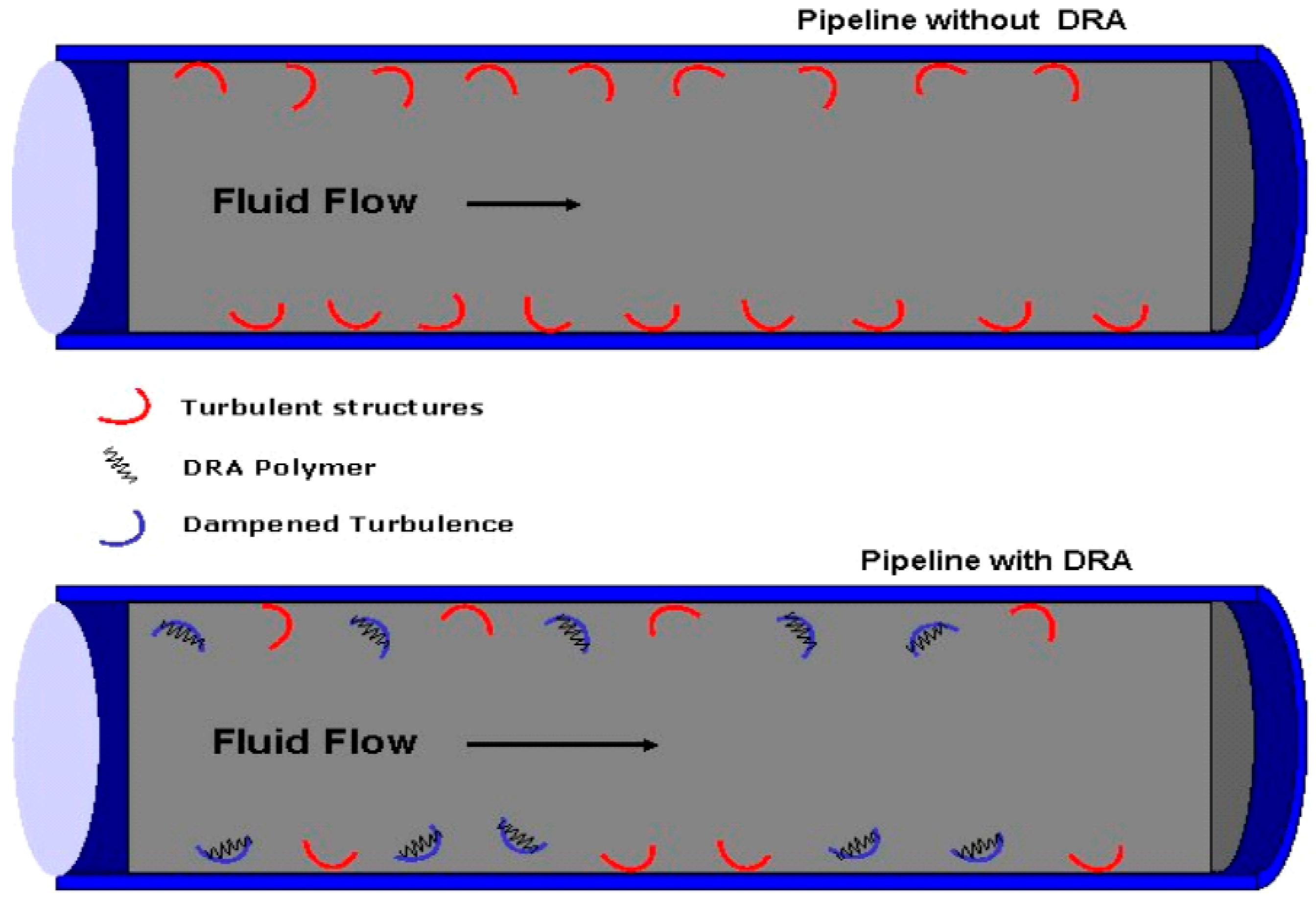
The conceptual design to study the influence of the DRAs in a crude oil pipeline is presented in Figure 1, which shows a typical piping system where the interpretation of the flow is altered by the addition of the DRAs. The diagram graphically illustrates the effect of the DRAs on the turbulent flow structure in the immediate vicinity of the pipe wall, which causes the decrease in the frictional resistance and the flatter radial velocity profile [38]. It leads to reduced pressure drops within the pipeline, increased flow efficiency, and decreased energy expenditures on pumping, which is the key way in which DRAs can increase the hydrodynamic effectiveness of long-distance crude oil transportation.
The experiment is on a medium capacity, 50 km long onshore pipeline of internal diameter 0.5 m that is filled with crude oil that is modelled as a Newtonian fluid. Table 1 provides the list of simulation parameters, which include a series of operational conditions (between 0.2 and 0.5 m3/s, 293 and 323 K, and drag-reducing agent (DRA) mass fractions up to 0.002 wt%) and allow one to assess the performance of the DRA in a variety of hydrodynamic and thermodynamic conditions [40].

3. Methodology

All simulations and data analyses were carried out using MATLAB® R2016b (MathWorks, MA, USA). The pipeline flow model was implemented through custom MATLAB scripts based on the Darcy–Weisbach equation, with drag reduction effects introduced via empirical correlations linking the friction factor to the Reynolds number and DRA concentration. Parametric sweeps over flow conditions and additive concentrations were performed numerically, and particle transport behaviour was estimated using a kinematic post-processing approach derived from the computed mean velocity field. MATLAB was also used for numerical integration, matrix-based computation, and the generation of all plots and 3D surface visualisations presented in this research.

4. Mathematical Model

The mathematical equations governing crude oil flow through pipelines are based on fundamental conservation laws, and the friction-induced pressure drop is commonly described by the Darcy–Weisbach equation.
The effect of DRAs is also included in the model, where the significance of a drag reduction percentage is added, and the percentage varies the base friction factor depending on the concentration of DRA, Reynolds number, and temperature through a semi-empirical correlation. This change results in a reduced pressure drop and, consequently, lower pumping power. Energy savings and improvements in flow efficiency are systematically studied to determine the beneficial effects of using DRAs in pipeline transport systems.
The key assumptions of the current model can be noted to understand the modelling framework employed. The flow conditions are assumed to be steady-state, incompressible, and fully developed through the horizontal constant-diameter pipe. The crude oil is considered to be of single phase with homogeneous properties, while the added DRAs have uniform distribution at ppm levels, resulting in negligible changes in the density of the fluid mixture. The added drag-reducing capability is also considered to occur through an adjustment to the friction factor, as opposed to other viscoelastic models of non-Newtonian behaviours of the fluid. Temperature effects, as well as the interactions of phases in the crude oil mixture, have also not been considered, other than the Reynolds-number-dependent mechanical degradation term introduced as part of the model formulation. The movement of the dispersed phase is also considered through the kinematic tracer model if the conditions have to be evaluated.

4.1. Flow Fundamentals

The principles of continuity, momentum, and energy conservation govern the transport of crude oil through long-distance pipelines. The Darcy–Weisbach equation describes the pressure drop due to frictional loss for steady, incompressible flow in a horizontal pipeline [41].
P = f   L D ρ v 2 2  
where ΔP is the pressure drop, f is the Darcy friction factor, L is the pipeline length, D is the internal diameter of the pipeline, ρ is the density of crude oil, and v is the average flow velocity. The volumetric flow rate, Q, and velocity are related by the following:
v = 4 Q π D 2
The Reynolds number, a key parameter defining the flow regime, is given by the following:
R e = ρ v D μ
where μ is the dynamic viscosity. For turbulent flow, when Re > 4000, the friction factor depends on both the Reynolds number and the pipe roughness (ε). Equation (4) represents the Churchill correlation, which is valid for all flow regimes [42].
f = 8 ( ( 8 R e ) 12 + 1 ( A 1 + A 2 ) 1.3 ) 1 12
where
A 1 = ( 2.457 ln ( 1 7 ( R e ) 0.9 + 0.27 ε D   ) ) 16
and
A 2 = ( 37,530 R e ) 16

4.2. Drag Reduction by DRA

The addition of drag-reducing agents, which are typically high-molecular-weight polymers or surfactants, changes the turbulent structure of the flow. This alteration results in a reduction in wall shear stress, leading to a decrease in the overall pressure drop. This phenomenon is commonly quantified by the drag reduction (DR) percentage, which is defined as follows [43]:
D R % = P 0 P D R A P 0 × 100
where P 0 is the pressure drop without DRA (Pa), and P D R A is the pressure drop with DRA (Pa). The modified friction factor in the presence of DRA is expressed as follows:
f D R A = f 0 1 D R
where f 0 represents the baseline friction factor without additives. The maximum drag reduction (MDR) achievable in polymer solutions is limited by the Virk asymptote.
1 f M D R = 19 l o g 10 R e f M D R 32.4
This limit represents the theoretical maximum reduction in drag achievable for the turbulent flow of polymer solutions. Beyond this point, further contraction of the DRA would result in diminishing returns. To account for the dependence of drag reduction on Reynolds number, temperature, and DRA concentration, a semi-empirical correlation is utilised.
D R = α   l o g 10 R e 1 e β C D R A × 1 γ T T 0
In this research, C D R A is defined as the concentration (fraction by weight), T as the fluid temperature (K), and T 0 as the reference temperature. The constants α, β, and γ are empirical values determined through laboratory calibration. Consequently, the efficiency of the drag-reducing agent ς D R A is defined as the ratio of the reduction in pressure drop to the baseline pressure drop.
ς D R A = 1 P D R A P 0
The main energy consumption in pipeline transport comes from the mechanical work needed to overcome friction losses between the flowing fluid and the pipe wall. The pumping power requirement is expressed in the counter of Equation (10).
P = P Q ς P
where P represents the pumping power, Δ P is the total pressure drop across the pipeline, Q is the volumetric flow rate, and ς P is the pump efficiency. When DRA is present, the friction factor decreases, which results in a lower pressure drop and, consequently, reduced pumping power.
P D R A = f D R A D   ρ v 3 π D 2 8 ς P
The power saving efficiency due to the DRA addition is then defined as follows:
ς e n e r g = P 0 P D R A P 0 × 100
where P 0 is the power without DRA. Interestingly, the above developed model has valuable applications across different fields. Specifically, it can be used to optimise pipeline design to lessen energy loss, improve oil recovery rate in the oil and gas sector, in addition to improving mixing and reaction times in chemical processing. Furthermore, it can help in investigating pollutant transport in environmental implications in addition to being combined with real-time monitoring systems for adjusting the dynamic flow condition. In summary, the model developed can potentially improve the efficiency and performance in multiple fluid transport industries.
The key assumed properties of the DRA in the model are as follows:
  • Type: High-molecular-weight, flexible polymer additive.
  • Molecular weight: Very large (typically 106–107 g/mol range to enable turbulence interaction).
  • Concentration range: 0–60 ppm.
  • Solubility: Fully soluble/dispersible in the carrier fluid.
  • Primary mechanism: Turbulence suppression via polymer stretching in turbulent eddies.
  • Effect on viscosity: Slight increase in apparent viscosity at low shear; shear-thinning tendency at higher shear rates.
  • Elastic behaviour: Viscoelastic response contributing to the damping of turbulent fluctuations.
  • Thermal stability: Effective within moderate pipeline temperatures (performance decays at elevated temperature due to polymer degradation).
  • Mechanical degradation: Drag reduction decreases at very high Reynolds numbers because of polymer chain scission under strong shear.
  • Density impact: Negligible change to bulk fluid density at ppm concentrations.
The multiple regression equation used in this research was developed using MATLAB. The regression analysis was performed on the simulated dataset generated from the hydraulic model, where drag reduction and efficiency were expressed as functions of Reynolds number and DRA concentration. MATLAB’s built-in numerical and statistical tools were used to fit the regression coefficients through a least-squares approach. The regression model assumes that:
(i)
The relationship between the dependent and independent variables can be approximated by a smooth polynomial or nonlinear empirical function;
(ii)
The input variables are independent within the tested range;
(iii)
Residual errors are randomly distributed with no systematic bias;
(iv)
The fitted equation is valid only within the simulated parameter space. This regression serves as a surrogate predictive model for rapid performance estimation and does not replace the underlying hydraulic equations described in Section 3.

4.3. Model Validation

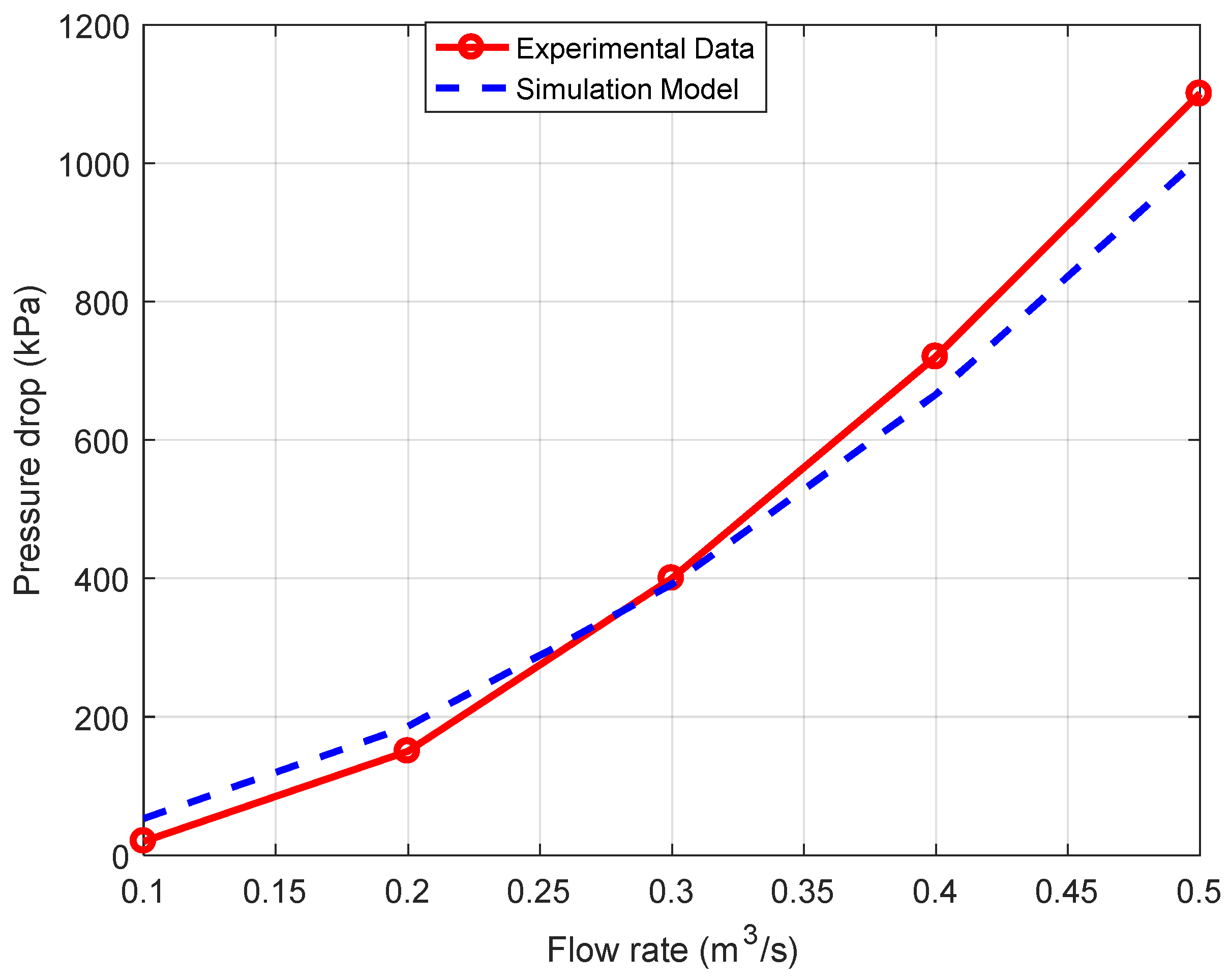
A comparative study of pressure drop versus length of the pipe is provided in Figure 2 and experimental results and a scaled simulation model are compared under different flow conditions. The experimental results [42], represented by a solid curve with circular points, also display a nonlinear rise in pressure drop with length of pipe, which is in agreement with the effects of turbulent flow, as explained by the Darcy–Weisbach Equation (1). The scaled model is a close match to this trend and the model shows a high level of agreement to both lower and higher flow rates, which confirms and authenticates the model fidelity in capturing the dominant physical processes of frictional losses. The small deviations at intermediate flow rates (0.2–0.35 m3/s) can be explained by simplifications in the scaling assumptions or experimental errors, including sensor resolution and unexplained small losses. Altogether, this correlation proves that the model is reliable in predictive analysis and parametric optimisation of a drag reduction study.
The critical input variables used in the simulations are explicitly defined to ensure reproducibility. The crude oil was modelled with a density of 850 kg/m3 and a dynamic viscosity of μ = 0.015–0.035 Pa·s, representing typical medium crude oil under pipeline operating conditions. The DRA was treated as a high-molecular-weight polymer additive applied at concentrations ranging from 0 to 100 ppm. At these low concentrations, the DRA was assumed to have a negligible effect on bulk fluid density but to influence flow behaviour through turbulence suppression. Its performance was incorporated using an empirical drag reduction model with a maximum drag reduction capacity of approximately 60–70% under optimal conditions, along with a Reynolds-number-dependent degradation factor to account for mechanical shear effects. These parameters form the basis of the hydraulic performance calculations which are presented in the current research.
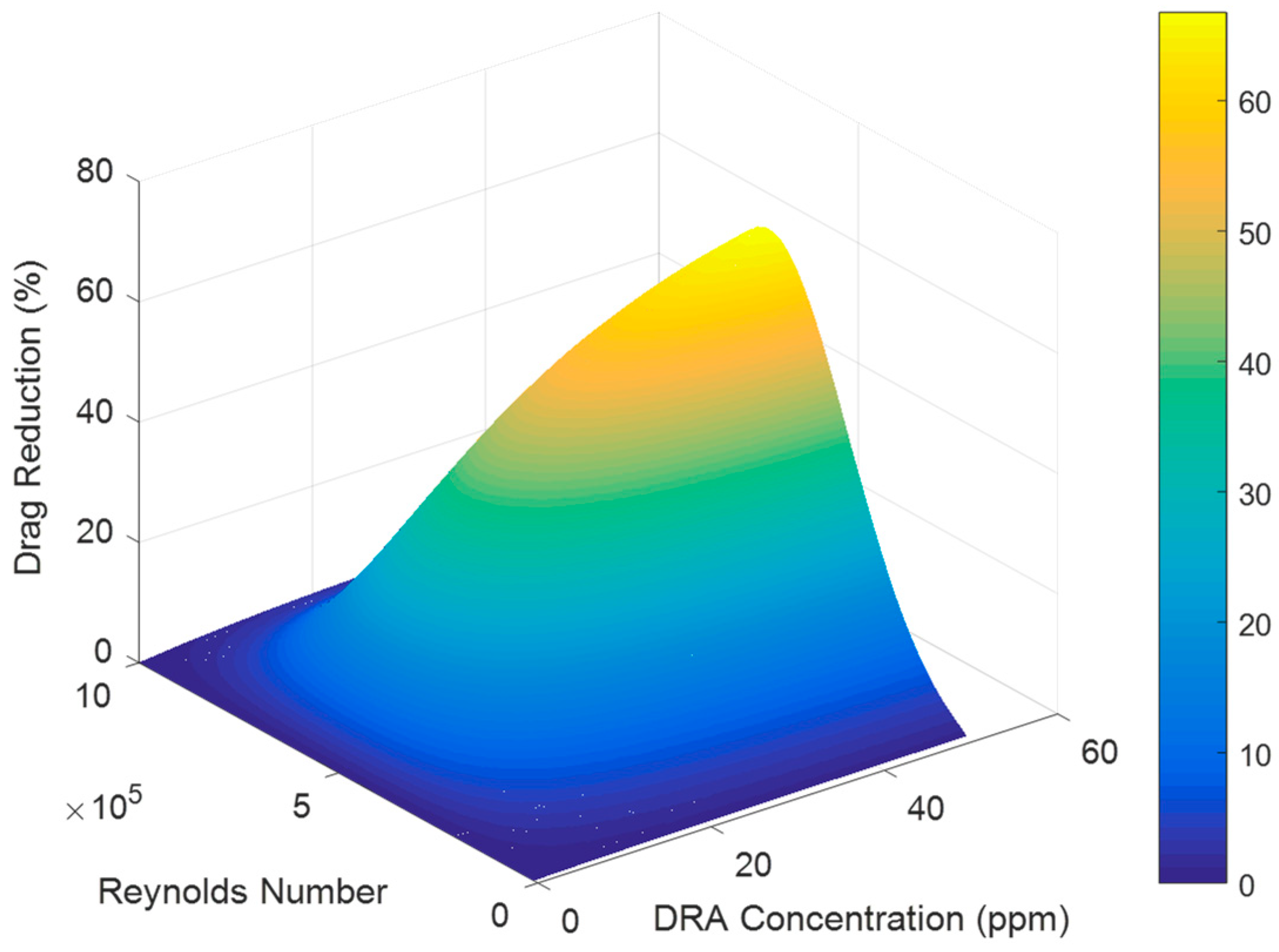
Figure 3 shows the drag reduction performance as a function of Reynolds number and DRA concentration. In the low Reynolds number regime, the drag reduction is very limited (about 5% or so), since the turbulence is weak. As the Reynolds number increases, turbulence becomes stronger, and therefore, the interaction between polymer and turbulence becomes more effective, which leads to a rapid increase in drag reduction. In the intermediate regime, especially within the concentration of 30–60 ppm, the drag reduction reaches about 40–60%, indicating a strong frictional suppression. A surface peak corresponds to an optimal condition where the drag reduction reaches about 65–70%. The maximum mentioned here represents the best balance between the polymer concentration and the turbulent energy. At high Reynolds numbers, drag reduction decreases with increasing mechanical degradation of the polymer chains under the influence of high shear stresses. An increase in the concentration higher than the optimal one yields diminishing improvements, since the mechanism of drag reduction is closer to saturation. Results confirm that both the regime of flow and additive concentration can set up an upper limit for the achievable efficiency of drag reduction.
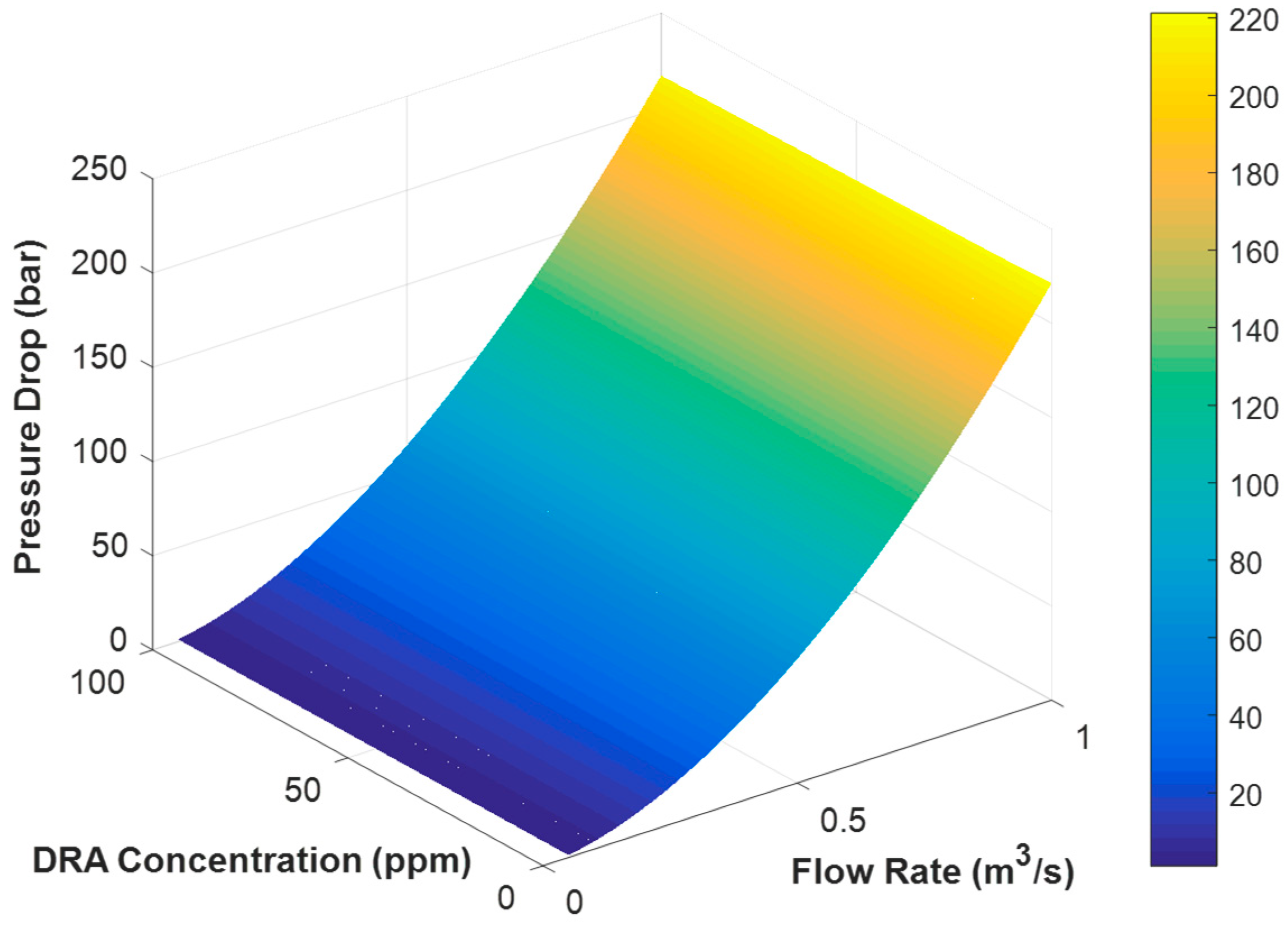
Figure 4 shows that the increase in pressure loss with flow rate in a 0.5 m diameter of crude oil pipeline is nonlinear because the product of the Darcy–Weisbach number is a quadratic of velocity, as dictated by the Darcy–Weisbach equation. The introduction of drag-reducing agents (DRAs) leads to a significant reduction in pressure, particularly in high-flow, turbulent conditions (Re > 4 × 10⁵). Using DRAs at concentrations as low as 100 ppm can lower the pressure drop by more than 30% compared to situations without DRAs. This is suppressed by the fact that the DRA suppresses the near-wall turbulence and reduces the effective friction factor, effectively reducing the energy dissipation. The findings highlight a high dependence between hydrodynamic factors and DRA effectiveness, which highlights that the best approach of the DRA dosage can result in large pumping energy and operational expenses reduction, particularly in high-throughput pipeline systems.
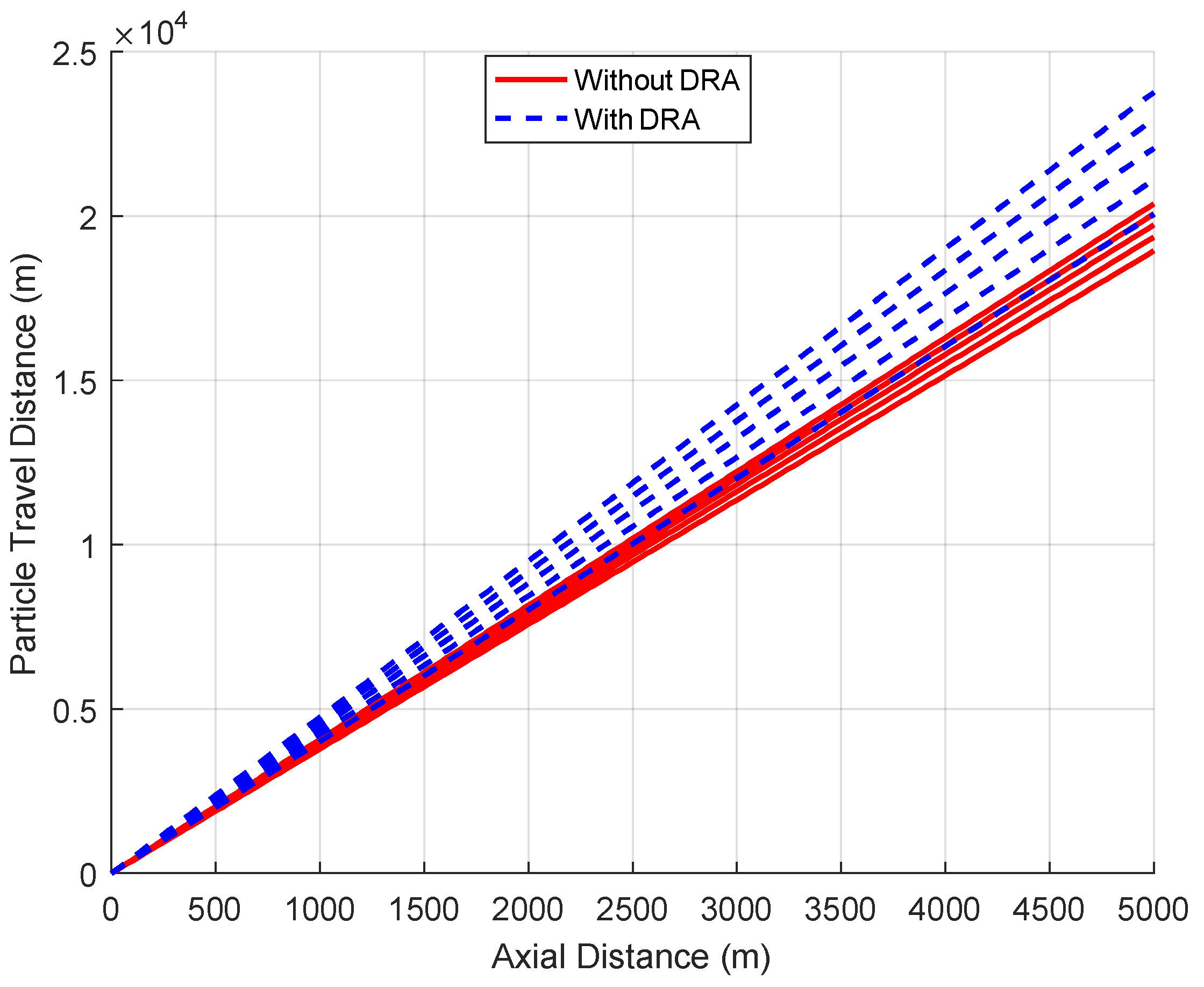
Figure 5 demonstrates the axial particle displacement for the pipeline with and without DRAs, as well as with varied concentrations of DRAs. The trends for all cases show an almost linear increase in axial particle displacement with axial distance through the pipeline due to constant transport operations. The trends for cases with higher axial distance and with the use of DRAs show higher particle displacement compared to the base case.
At the exit point of the pipeline with an axial distance of 5000 m, the improvement in the axial particle displacement for cases with DRAs compared to the base case is between 10% and 25%, showing improvement in transport with less wall effect and higher velocity distribution. Particle trajectories were found via a kinematic “post-processing” method that used the Eulerian velocity field, instead of the more expensive lakeside model that employed Lagrangian particles. We employed the assumption that the particles are locally passively tracing the mean velocity field with no interparticle hydrodynamic effects or radial mixing, since this approach is adequate to demonstrate relative transport gains due to drag reduction while remaining computationally inexpensive.
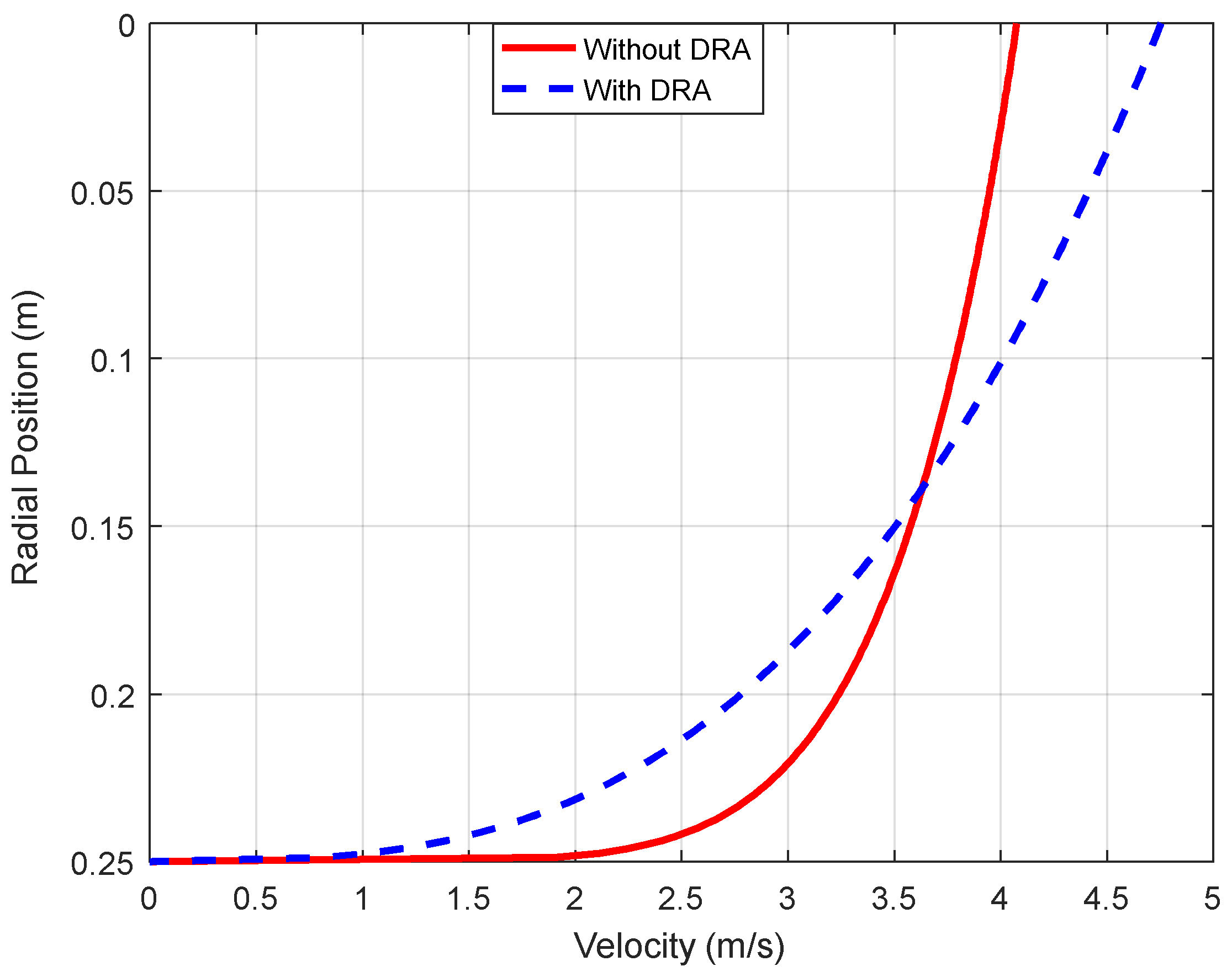
The radial velocity distribution across the pipeline is shown in Figure 6 and compared against the base line flow (without DRA) and that of the flow altered by the drag-reducing agents. The solid red curve is a typical classical parabolic shape of the turbulent flow, with a maximum velocity in the centreline and a sharp drop to the wall of the pipe by shear forces. By comparison, the modified profile based on the DRA (dashed blue curve) exhibits a much flatter and more homogeneous distribution of velocity in the radial direction. This flattening implies that there is a very large decrease in the velocity gradient in the proximity of the wall, and this becomes evident due to the censoring of the turbulent eddies by the DRA. This results in an upsurge in the average flow velocity, which results in a higher overall transport efficiency, as there is less energy dissipated in the boundary layer and therefore less frictional drag overall. Furthermore, it should be noted that the intersection of the nonlinear velocity profiles in Figure 6 happens as a result to the varying impacts of DRAs on the flow features. This intersection point implies a transition where the DRA’s effect flattens the velocity profile, permitting it to converge with the baseline profile at definite radial positions. In this regard, some parameters, including the shear forces, altered velocity gradients, and specific operating conditions, can support this phenomenon, representing that, under specific situations, the DRA’s effect on turbulence becomes dissimilar to the baseline flow.
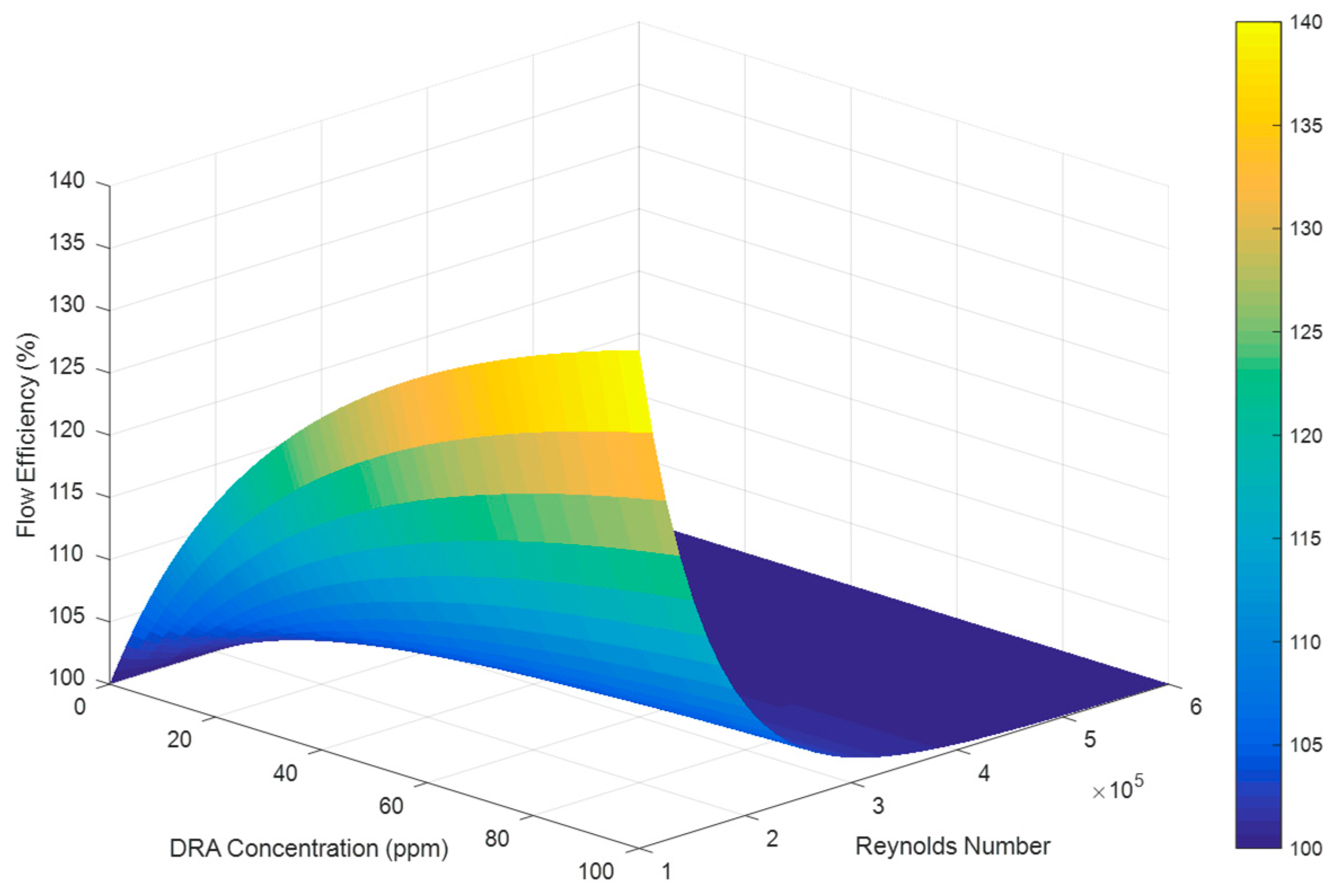
Figure 7 shows the dependence between flow efficiency, DRA concentration and Reynolds number, which indicates a large improvement of the pipeline performance when drag-reducing agents are added. The findings suggest that, as the DRA concentration is increased, the flow efficiency is enhanced significantly, especially at lower Reynolds numbers when turbulent effects are easily controlled. The model estimates a peak efficiency of flow at about 135% or even 35% higher than the baseline, where there is no DRA. This increase is because near-wall turbulence has been suppressed and less friction loss has been experienced, resulting in a better volumetric transport. The observed nonlinear dependence of the Reynolds number is another indication that it is important to optimise the dosage of DRA with respect to the flow parameters with an aim of ensuring that maximum energy is saved and operational throughput increases in long-distance crude oil pipes.
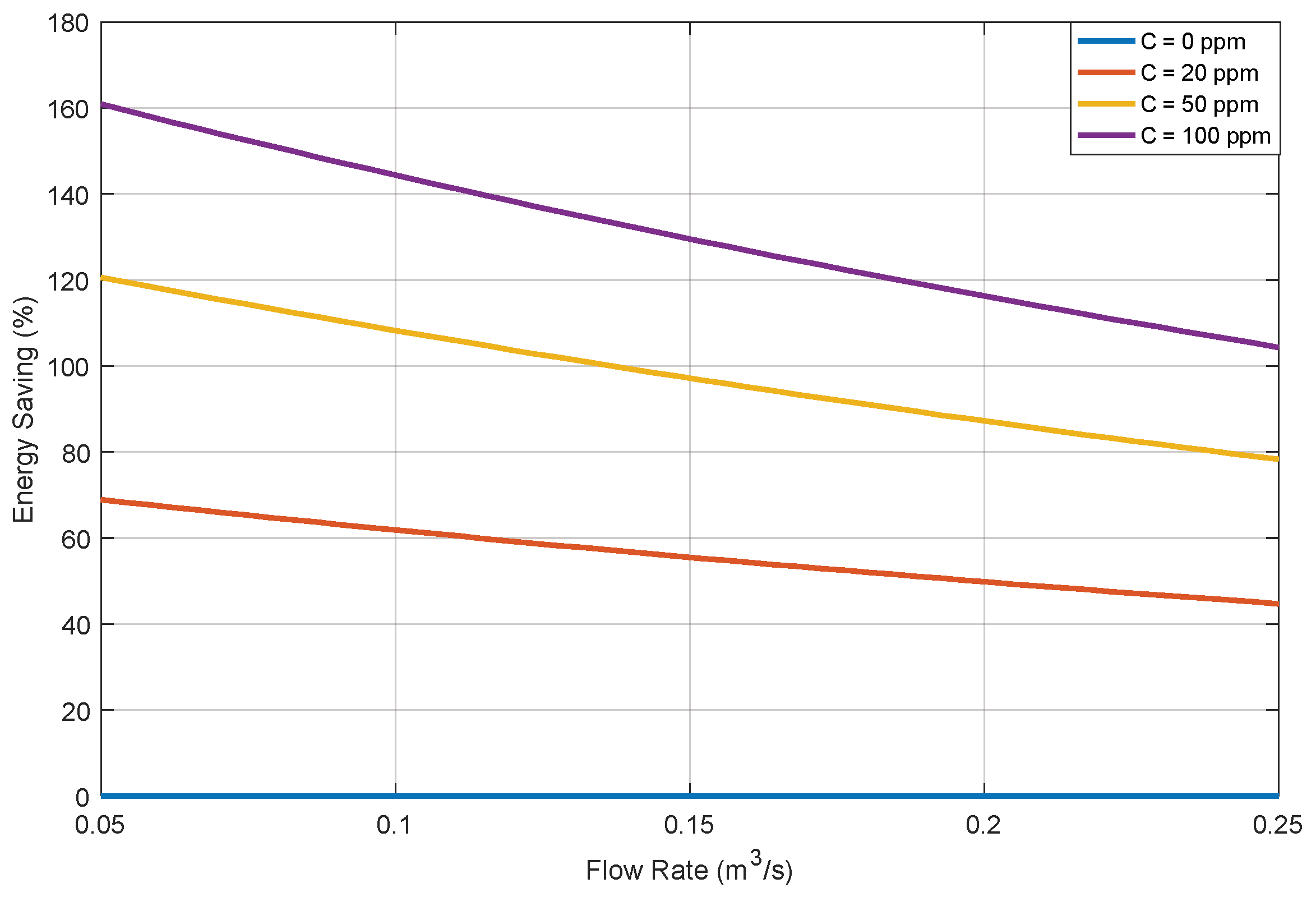
Figure 8 shows the energy-saving and flow rate dependence on various concentrations of the DRAs, which elucidates a steady decrease in the energy-saving efficiency with the flow rate. Energy savings at a DRA concentration of 100 ppm and flow rate of 0.25 m3/s tend to decline about 10%, whereas, at lower concentrations (20–50 ppm), they tend to do the same though with lower absolute savings. This is due to the degradation of the polymeric DRAs caused by shear in high flow velocities, thereby reducing their ability to suppress turbulence in the immediate vicinity of the wall of the pipe. The findings point at the fact that the application of the DRA is most beneficial at medium Reynolds numbers, when the mechanical degradation is minimised, whereas energy-saving potential is maximised.
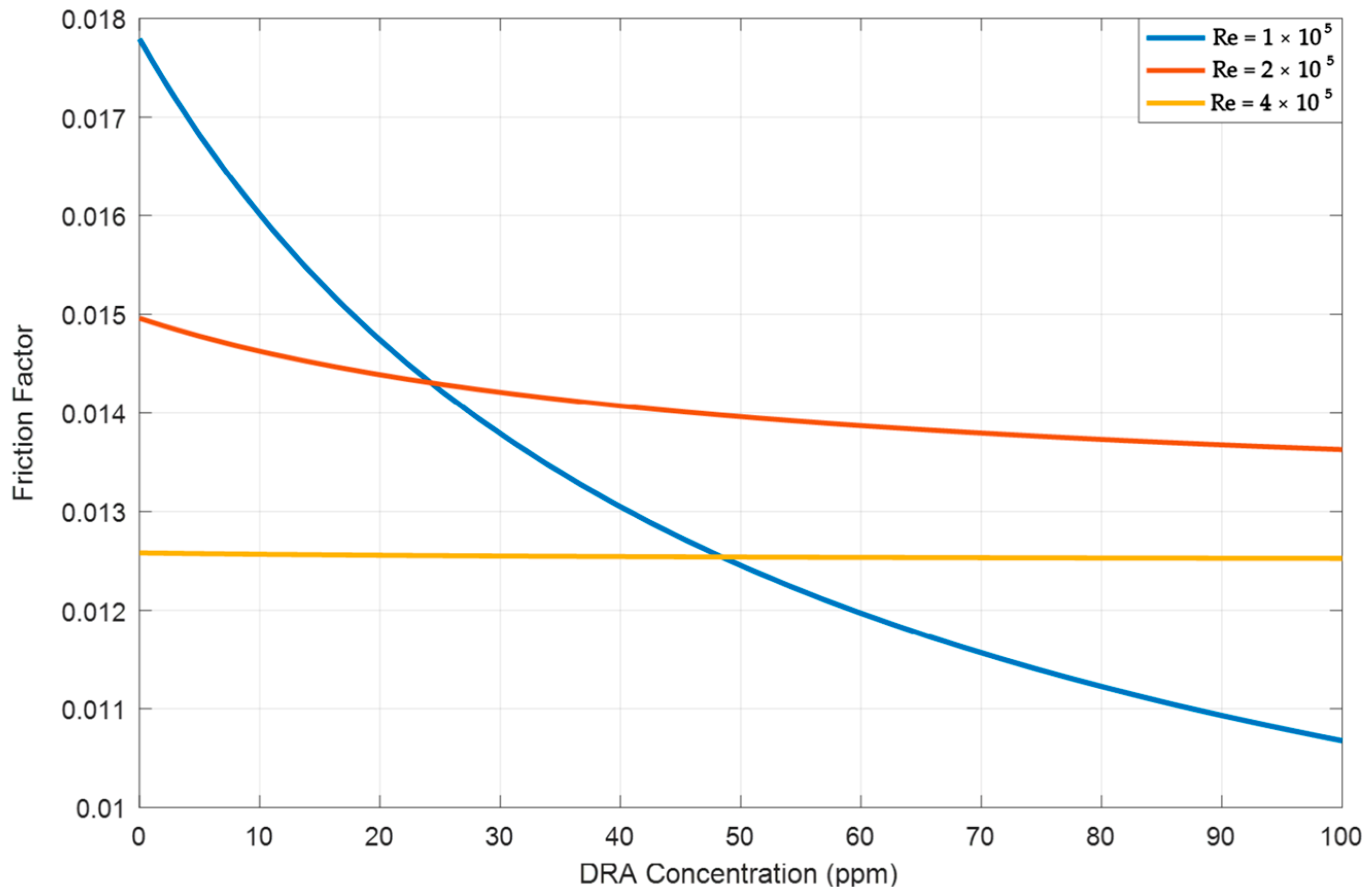
Figure 9 shows that the concentration of drag-reducing agent (DRA) has a substantial effect on the Darcy friction factor in different Reynolds numbers (Re = 1 × 10⁵, 2 × 10⁵, and 4 × 10⁵). The findings indicate a strong decrease in the friction factor as DRA concentration increases, which is the most significant at lower Reynolds numbers. Namely, at Re = 1 × 10⁵, the friction factor is reduced by about 40% as the DRA concentration goes up to 100 ppm. This has been improved by the fact that the polymer molecules smother near-wall turbulence. Nevertheless, at larger Reynolds numbers (e.g., Re = 4 × 10⁵), the higher shear forces cause polymer chain scission and mechanical degradation of the polymer, resulting in a lower drag-reducing potential of the agent and a reduced sensitivity of the friction factor to variations in DRA concentration.

5. Statistical Analysis

The ANOVA test strictly measures the effect of the concentration of DRA and Reynolds number on the performance of the system, which demonstrates a very significant (p < 0.001 of all factors) and complex nonlinear correlation between the two effects of drag reduction and efficiency increase. The resulting third-order regression models have outstanding predictive power, as indicated by the R2 and R2 (adjusted) of both the responses being greater than 99.2, which proves the accuracy of the models in the predictive power of the underlying physical phenomena. The analysis shows that the effect of increasing DRA concentration on performance is positive, but it is buffered by large quadratic and interactive effects with Reynolds number, which in turn has a significant negative effect. As an example, in an optimised state of 25 ppm DRA and a Reynolds number of 323,159, the model predicts a drag reduction of 33.43% and an efficiency improvement of 45.13%, which highlights the powerful synergistic performance possible with a well-controlled system of parameters.

5.1. Regression Equation

The regression model generated extremely significant predictive equations of both the drag reduction and improvement of efficiency, as summarised by the regression equations in Table 2.
These third-order equations of a type of the polynomial determine a quantitative relation between the response variables and the most important operational parameters of the DRA concentration and Reynolds number. The drag reduction percentage model, as well as the efficiency improvement percentage model, show remarkably high statistical fidelity of the model terms, as they all have a p-value of 0.000, which proves the significance of the main effects, quadratic and cubic terms of the model, and the interaction between the drag reduction concentration and the Reynolds number. Such a formidable regression model offers an effective empirical research tool that would precisely predict the effectiveness of drag-reducing agents in different pipeline flow conditions.
The regression analysis of the drag reduction output, as in Table 3, indicates that the nonlinear relationship between drag reduction and the independent variables is statistically significant (p < 0.001 in all the terms) and complex. This model shows that the drag reduction is increasing with the DRA concentration with the positive linear coefficient of 0.1394, the positive cubic term coefficient of 0.000260 and a significant negative quadratic coefficient of −0.01891, which indicates a point of diminishing returns. At the same time, the Reynolds number has a great negative effect, which has a coefficient of −0.000160, which demonstrates that the ability to reduce drag becomes less effective in high-turbulence regimes. The important positive interaction (0.000007) of concentration and Reynolds number also explains the interdependent influence of concentration and Reynolds number on the drag reduction mechanism.
According to the regression coefficients shown in Table 4, the output from the efficiency improvement, the developed model indicates that there is a statistically significant relationship (p < 0.001 to all terms) and a nonlinear relationship between operational parameters and system performance. The positive linear coefficient of the DRA concentration (0.1882) shows that it has a direct, positive effect on efficiency, but the negative quadratic part (−0.02553) is so large that there is also a point in which the effect is saturated. At the same time, the Reynolds number has a significant negative linear correlation (−0.000217), which shows that higher turbulence levels, in turn, complicate efficiency gains. The teamwork (0.000009) and cubic terms (0.000352) are also very strong indicators of the sophistication of the model, as the synergistic and higher-order interactions between DRA dosage and flow hydrodynamics were characterised. Having such a high value of R2 of 99.22%, it can be seen that the model has a tremendous ability to forecast efficiency gains and is a potent tool of quantitative optimisation of DRA introduction in pipeline operations.

5.2. Model Summary

In the case of the drag reduction output, a model summary shows an outstanding predictive accuracy and strength with an S value at 1.83683, showing a high level of accuracy in the residuals. The model summarises a drag reduction variance of 99.22% R2, R2 (adj) of 99.21% and indicates that the predictors are very relevant and the model is not over-fitted. The reported R2 value of 99.20% also assures the fact that the model can be generalised to new data with a PRESS value of 5383.53. Also, the low AICc (6376.86) and BIC (6435.64) values depict an ideal balance between the complexity of the model and goodness-of-fit and confirm the regression equation as a valid instrument in predicting the performance of drag reductions. In terms of the efficiency improvement output, the model also has a perfect statistical performance, as demonstrated by an S value of 2.47972. The R2 (adj) and R2 estimates are 99.21% and 99.22%, respectively, which emphasises the strength of the model to consolidate almost all the variations in efficiency improvement. The estimated R2 value of 99.20% and PRESS of 9811.49 confirm that it is a powerful predictor of unknown data. The information criteria, having an AICc of 7319.19 and BIC of 7377.96, also testify to the parsimony and high explanatory power of the model, making it a reliable structure to estimate the improvements in flow efficiency of the use of different DRA concentrations and Reynolds numbers.
The drag reduction output is shown in Table 5 and the efficiency improvement output is shown in Table 6.

5.3. Pareto

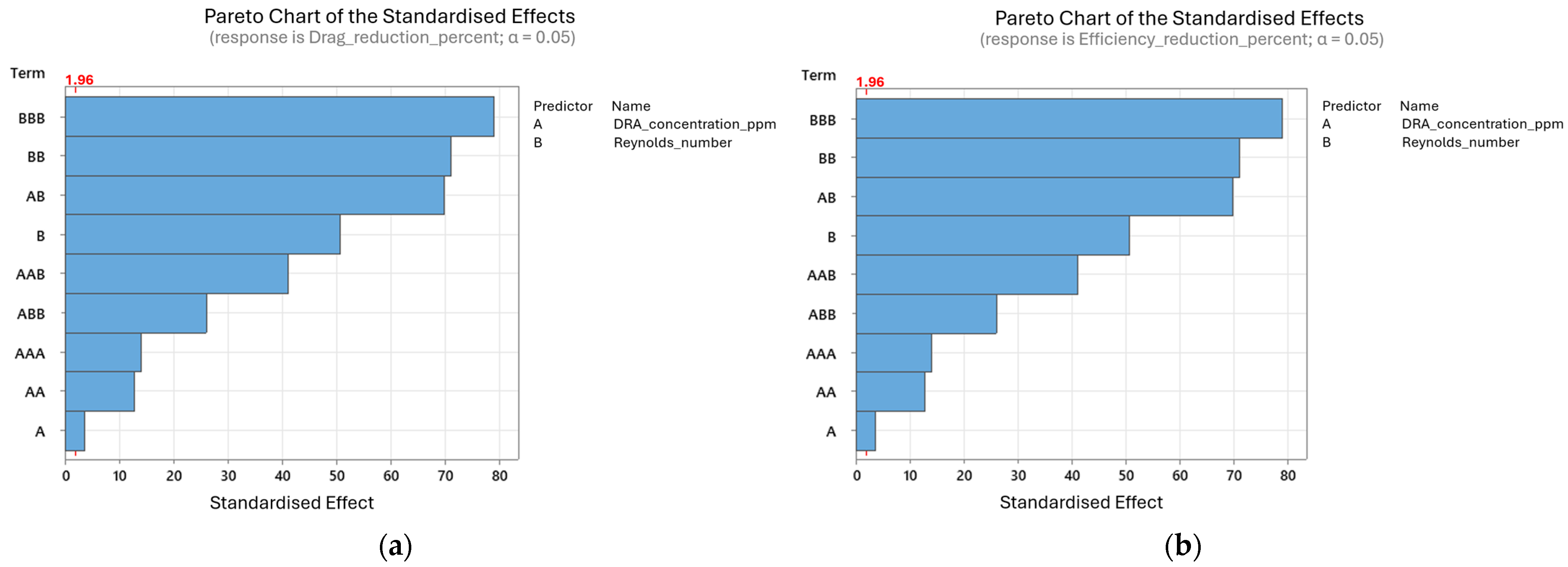
Figure 10 provides the Pareto analysis of the outputs of the percentage of drag reduction, as well as the efficiency improvement, demonstrating the standardised impact of the main factors and interaction with each other on the system response. As seen in the analysis, the most statistically significant variables are DRA concentration, Reynolds number and their quadratic and interaction terms, whose absolute standardised effects are significantly higher than critical value (0.05). Namely, the model is dominated by the linear and higher-order terms of DRA concentration and Reynolds number, which are significant (with the largest t-values of up to 78.76 and 69.67, respectively), with p-values of 0.000, to prove its strong impact on both drag reduction and flow efficiency. This rank of parameter importance is paramount in optimisation, as a critical parameter of the system should have acute control of DRA dosage and flow velocity to optimise the system performance.

5.4. Probability

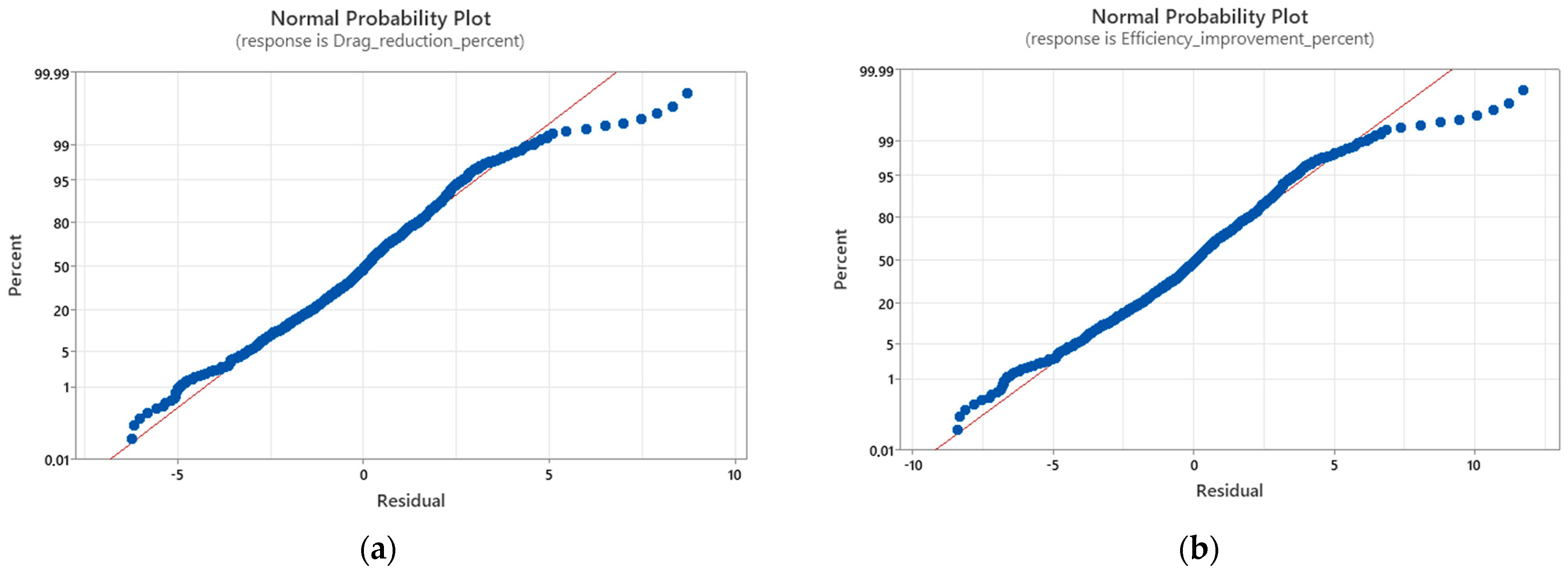
The probability plots used in Figure 11 to show the outputs with the percentage of drag reduction as well as the degree of improvement in efficiency illustrate a high pinnacle of conformity to a normal distribution due to the data points being very near to the theoretical diagonal reference line. The insignificant variation noted throughout the quantile plots implies that the residues of the regression models are good and meet the main assumption of normality needed in the validity of the next ANOVA and parametric tests. The high level of normality, indicated by the very low p-values of all model terms (on the order of 0.001), supports the validity of the developed empirical models and confirms the strong statistical reliability of the relationships between the governing variables—DRA concentration and Reynolds number—and the resulting hydrodynamic performance metrics.
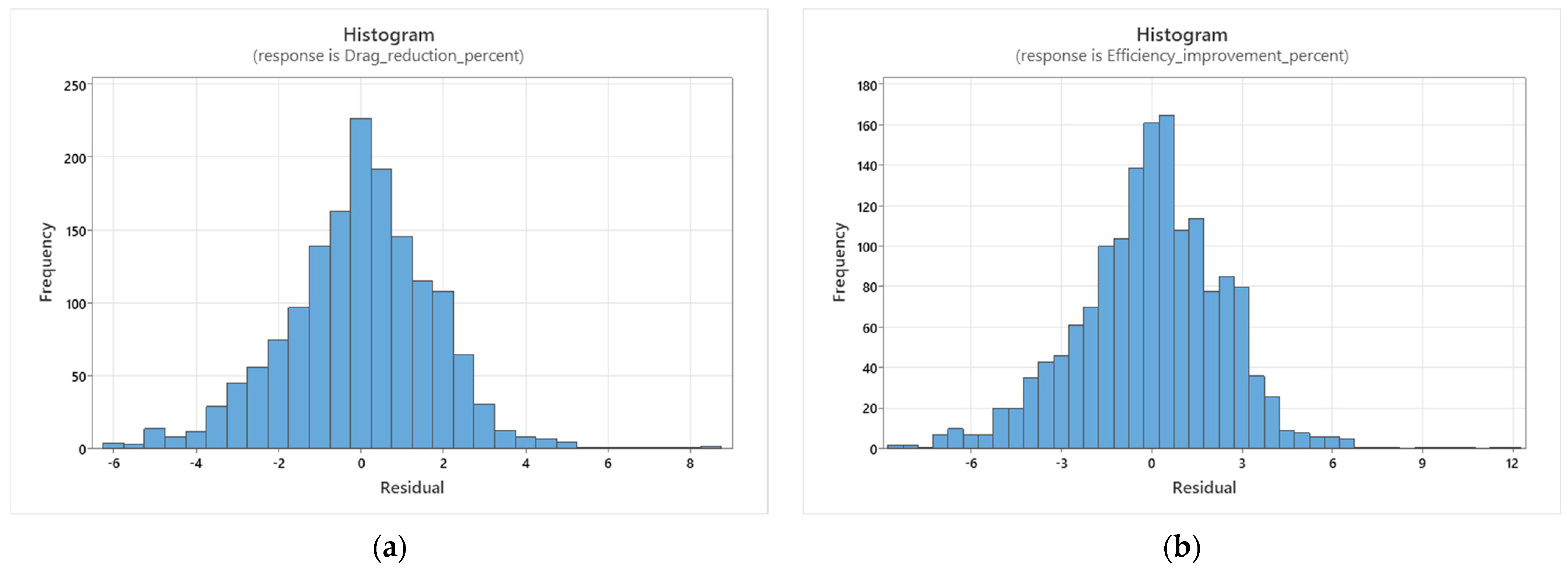
Figure 12 shows the histograms of the residuals of the output of the drag reduction percentage and efficiency improvement, which show that the distribution is close to a normal distribution, which supports the assumptions of the underlying regression model. The distribution of the residuals of the drag reduction (Figure 12a) are concentrated in the vicinity of zero with a standard deviation (S) of 1.84, whereas the distribution of the residuals of the efficiency improvement (Figure 12b) shows more or less the same distribution with an S value of 2.48, which implies that the model errors are not particularly biased or systematic. This conformity to normal distribution that is illustrated by the bell-shaped curves, and the low value of skewness reflect the soundness of the ANOVA test and the statistical validity of the predictive equations to measure the effect of DRA concentration and Reynolds number on the operation of the system.
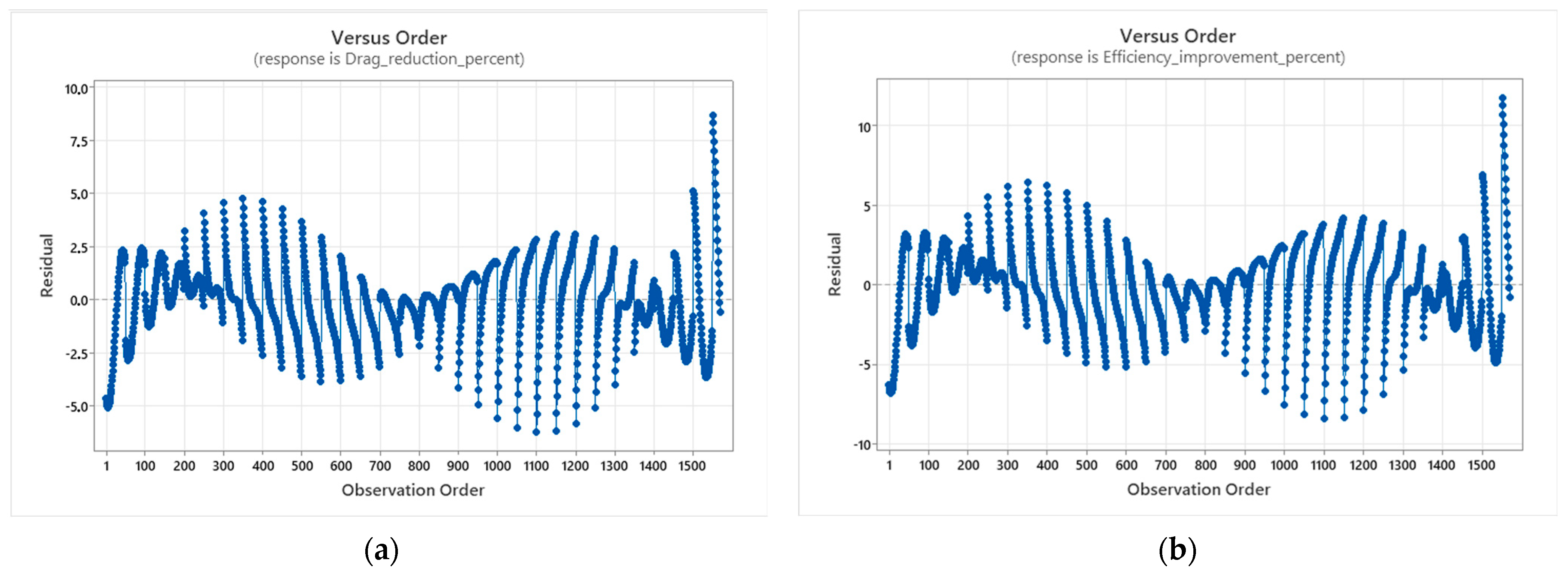
The versus order plots of the drag reduction percentage and efficiency improvement outputs are shown in Figure 13, which show the distribution of the residuals versus the order of observation to determine whether the errors are independent and homoscedastic in the regression model. The residuals of both the responses are randomly dispersed about the value of zero and no identifiable patterns or systematic tendencies appear in the plot, which proves the lack of autocorrelation and confirms the assumption of independent errors. Such randomness, together with the uniformity of the standard deviation in the series of observations, suggests that the model is well-specified and that the statistical assumptions of ANOVA are met, which further justifies the fact that the predictive equations are reliable predictors of drag reduction and efficiency improvement of the fluid under different DRA concentrations and Reynolds numbers.
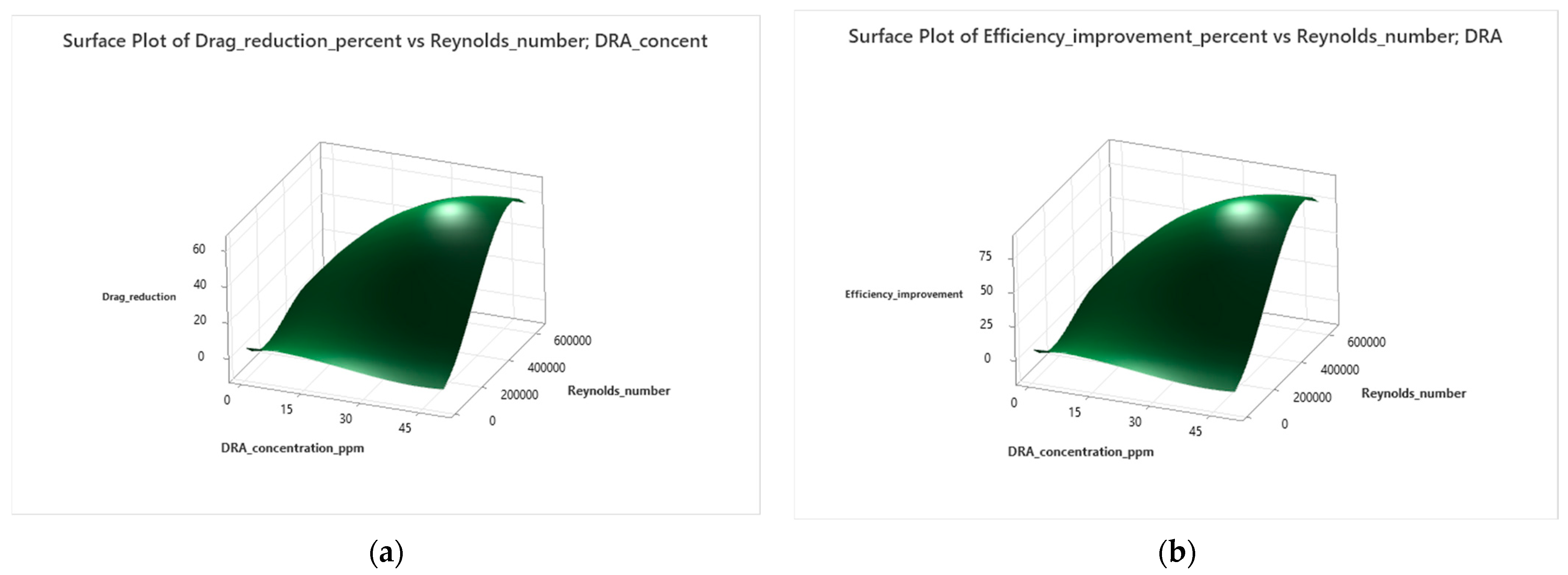
The simultaneous dependence of percentage change in drag and change in efficiency at the moment where the DRA concentration is varied and the Reynolds number is varied are visualised in three-dimensional surface plots, as illustrated in Figure 14. The plots show a very nonlinear interaction such that decrease in drag and improvement of efficiency increase considerably with the increasing DRA concentration, particularly at lower-to-moderate Reynolds numbers (about less than 3 × 10⁵), and under non-optimised conditions of 25 ppm DRA concentration at the Reynolds number of 323,159, the maximum improvements of 33–45% are made. The positive impacts, however, reduce with the higher Reynolds numbers since more shear influences the degradation of the polymer additives and thus restrict their suppression properties. The nonlinear dependence that is difficult to balance highlights the urgency of the balanced optimisation of flow conditions and chemical dosage to gain maximum benefits in the operation of DRA implementation in pipeline transport.

5.5. Multi-Response Optimisation and Prediction

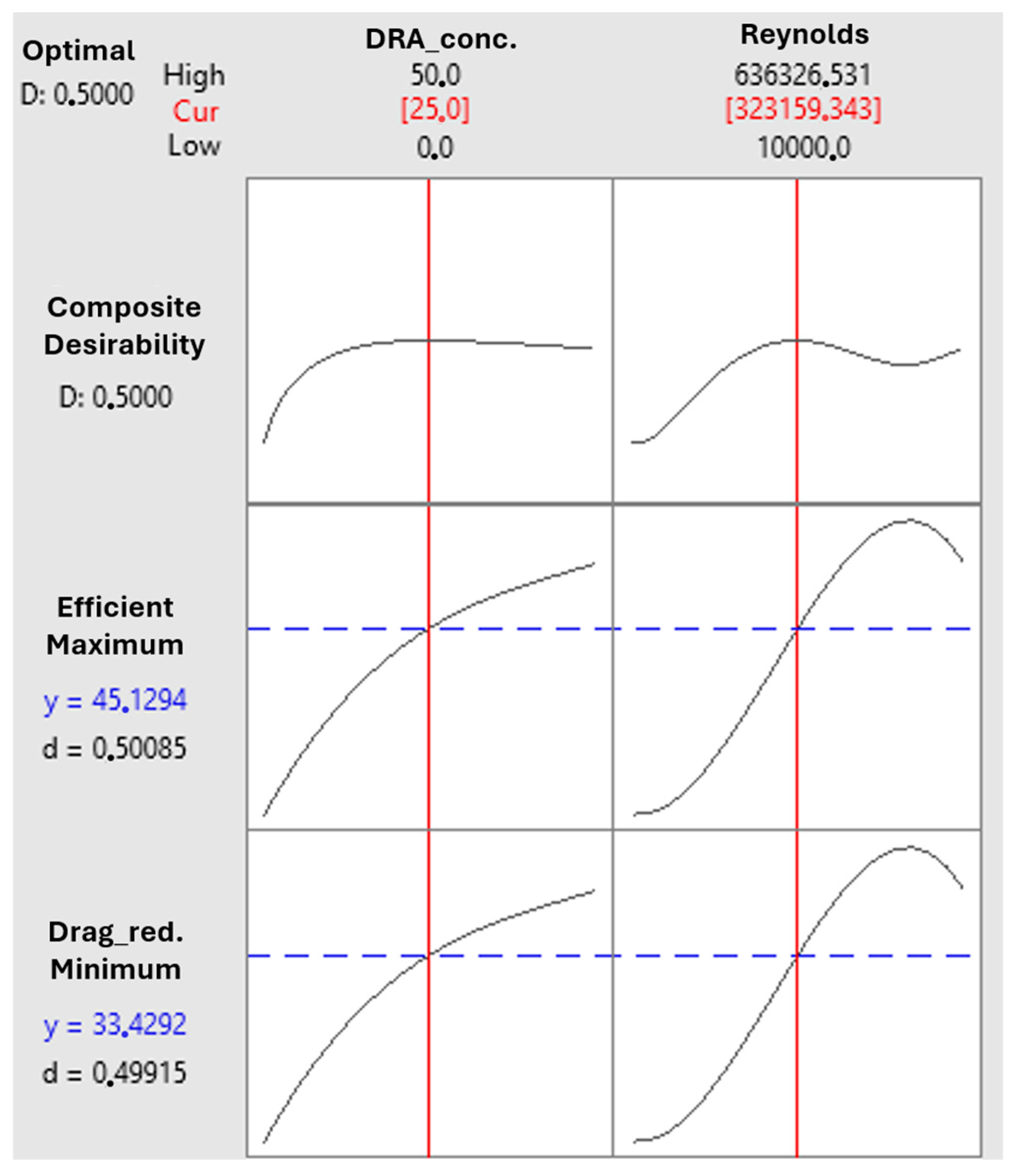
The multiple response prediction results obtained during the optimisation analysis are provided in Table 7 and Figure 15, and it was found that, under 25 ppm DRA concentration and 323,159 Reynolds number, the model predicts a drag reduction of 33.43% with a corresponding 45.13% improvement in the flow efficiency. This optimal point based on the proven regression models is a good compromise between the interacting effects of both additive concentration and flow hydrodynamics, and it shows that the moderate level of dosage of DRA, under the high-throughput condition, can give a significant increase in performance, which is a reduction in the percentage of up to 40% loss in frictional pressure at a cost of a remarkable increase in the total transport performance of the crude oil pipeline system.

6. Conclusions and Recommendations for Future Research

According to the dynamic simulation and statistical analysis performed in this research, the following specific conclusions are made for the influence of the drag-reducing agents on the crude oil in the pipeline transportation:
  • The implementation of DRAs has led to a significant reduction in losses due to frictional pressure. The simulations showed the model to reduce in the range of 30% to 35% under different operating conditions; this is more pronounced in high flow rates, where the turbulent drag becomes dominant, and the optimised model shows a 33.43% decrease in the drag at a DRA concentration of 25 ppm and a Reynolds number of 323,159.
  • The flow efficiency of the pipeline system in general was greatly increased, with the analysis displaying an improvement of 40–60% over the base case where there are no additives added; the optimisation model measures this by an improvement in the efficiency of the core flow velocity by 45.13% at the optimal point.
  • The resulting decrease in pressure drop is directly proportional to the reduction in pumping power requirement, and energy savings at low rates of flow can be as high as nearly 60% at low flow rates and at moderate levels of DRA concentrations; but energy savings diminish with the increasing rate of flow, and at high flow rates (0.25 m3/s) and at high concentrations of DRA (100 ppm) the energy savings become very low (only 10%).
  • The modelling of particle paths showed that, with the addition of DRA, the cumulative travel distance of the particles to the pipe outlet is raised by about 10–25% with respect to concentration, meaning that the sustained axial velocity is elevated and the occurrence of solid deposition or depositing long-distance pipelines is decreased.
  • Radial velocity profile analysis showed that DRAs effectively decrease the velocity gradient across the pipe cross-section by smoothing turbulent eddies and decreasing the velocity gradient at the wall, which minimises energy dissipation at the boundary layer and is a direct hydrodynamic manifestation of the drag reduction effect.
  • The complexity of the relationship between the Reynolds number and the DRA concentration to the effectiveness of the DRAs is that, as the Reynolds number increases, the decrease in the friction factor increases with DRA concentration up to approximately 40%, then the decrease is smaller as the Reynolds number increases further (e.g., Re = 4 × 10⁵).
  • One of the main identified practical difficulties is that the polymeric DRAs can be degraded under high shear conditions, and reduces the efficiency and energy-saving opportunities of the latter in high-flow settings, forcing one to pay close attention to the choice of DRAs, their injection locations, and redosing approaches to long-distance pipeline segments to prevent undesired result loss.
  • The formulated regression equations that have a remarkably high R2 value of 99.22% effectively represent the effect of DRA concentration and Reynolds number on system responses and the multiple response prediction effectively finds an operational sweet spot where both drag reduction and efficiency improvement are maximised, which can be used as a reliable data-driven model of cost-effective DRA dosage planning in a real-world pipeline operation.
  • Future research should develop the existing single-phase model to facilitate multiphase oil–water-gas systems to more accurately reflect the reality in the field, and employ more advanced optimisation strategies, like Particle Swarm Optimisation (PSO) [44] or Genetic Algorithms (GAs) [45] to dynamically estimate the most cost-efficient dosage of DRA in the conditions of transient flow and complicated pipeline networks.

Author Contributions

Conceptualization, E.Q.H., F.L.R., M.A.A.-O., A.C., M.K. and I.M.; methodology, E.Q.H., F.L.R., M.A.A.-O., A.A., A.C., M.K. and I.M.; software, E.Q.H.; formal analysis, E.Q.H., F.L.R., M.A.A.-O., A.A., A.C., M.K. and I.M.; data curation, E.Q.H., F.L.R., M.A.A.-O., A.A., A.C., M.K. and I.M.; writing—original draft preparation, E.Q.H., F.L.R., M.A.A.-O., A.C., M.K. and I.M.; writing—review and editing, E.Q.H., F.L.R., M.A.A.-O., A.A., A.C., M.K. and I.M.; visualisation, E.Q.H., F.L.R., M.A.A.-O., A.A., A.C., M.K. and I.M.; project administration, A.A. All authors have read and agreed to the published version of the manuscript.

Funding

This research received no external funding.

Data Availability Statement

Data is contained within the article.

Conflicts of Interest

The authors declare no conflicts of interest.

Nomenclature

A1, A2Intermediate variables in the Churchill friction factor correlation
CDRAConcentration of the drag-reducing agent (fraction by weight)
DInternal diameter of the pipeline (m)
DRDrag reduction percentage (%)
fDarcy friction factor
f0Baseline Darcy friction factor without DRA
fDRADarcy friction factor with DRA
fMDRFriction factor at maximum drag reduction
LPipeline length (m)
PPumping power (W)
P0Pumping power without DRA (W)
PDRAPumping power with DRA (W)
ΔPPressure drop (Pa)
ΔP0Pressure drop without DRA (Pa)
ΔPDRAPressure drop with DRA (Pa)
QVolumetric flow rate (m3/s)
ReReynolds number
TFluid temperature (K)
T0Reference temperature (K)
VAverage flow velocity (m/s)
α,β,γEmpirical constants in the DRA correlation
ςDRAEfficiency of the drag-reducing agent
ςenergPower saving efficiency (%)
ςPPump efficiency
εPipe wall roughness (m)
ε/DRelative roughness
μ Dynamic viscosity of the fluid (Pa s)
ρ Density of the fluid (kg/m3)

References

  1. Alhamd, S.J.; Rashid, F.L.; Al-Obaidi, M.A.; Aldami, A.K. Unveiling crude oil viscosity and rheological properties: An experimental comparison of Nano silica and Nano Molybdenum disulfide in Bazargan Oilfield. Fuel 2025, 381, 133698. [Google Scholar] [CrossRef]
  2. AL-Dogail, A.; Gajbhiye, R.; Patil, S. A review of drag-reducing agents (DRAs) in the petroleum industry. Arab. J. Sci. Eng. 2023, 48, 8287–8305. [Google Scholar] [CrossRef]
  3. Baakeem, S.S.; Hashlamoun, K.; Hethnawi, A.; Mheibesh, Y.; Nassar, N.N. Drag reduction by polymer additives: State-of-the-art advancements in experimental and numerical approaches. Ind. Eng. Chem. Res. 2024, 63, 7485–7506. [Google Scholar] [CrossRef]
  4. Graham, M.D. Drag reduction and the dynamics of turbulence in simple and complex fluids. Phys. Fluids 2014, 1, 26. [Google Scholar] [CrossRef]
  5. Brandfellner, L.; Muratspahić, E.; Bismarck, A.; Müller, H.W. Quantitative description of polymer drag reduction: Effect of polyacrylamide molecular weight distributions. J. Non-Newton. Fluid Mech. 2024, 325, 105185. [Google Scholar]
  6. Cussuol, J.D.; Soares, E.J.; Siqueira, R.N.; Moreira, K.C.C.S.R.; Dalmaschio, C.J. Polymer drag reduction regeneration. J. Non-Newton. Fluid Mech. 2023, 321, 105126. [Google Scholar] [CrossRef]
  7. Housiadas, K.D.; Beris, A.N. Polymer-induced drag reduction: Effects of the variations in elasticity and inertia in turbulent viscoelastic channel flow. Phys. Fluids 2003, 15, 2369–2384. [Google Scholar] [CrossRef]
  8. Jouenne, S.; Anfray, J.; Cordelier, P.R.; Mateen, K.; Levitt, D.; Souilem, I.; Marchal, P.; Lemaitre, C.; Choplin, L.; Nesvik, J. Degradation (or lack thereof) and drag reduction of HPAM solutions during transport in turbulent flow in pipelines. Oil Gas Facil. 2015, 4, 80–92. [Google Scholar] [CrossRef]
  9. Karami, H.R.; Rahimi, M.; Ovaysi, S. Degradation of drag reducing polymers in aqueous solutions. Korean J. Chem. Eng. 2018, 35, 34–43. [Google Scholar] [CrossRef]
  10. Li, X.; Pan, J.; Shi, J.; Chai, Y.; Hu, S.; Han, Q.; Zhang, Y.; Li, X.; Jing, D. Nanoparticle-induced drag reduction for polyacrylamide in turbulent flow with high Reynolds numbers. Chin. J. Chem. Eng. 2023, 56, 290–298. [Google Scholar] [CrossRef]
  11. Sandoval, G.; Trevelin, R.; Soares, E.; Silveira, L.; Thomaz, F.; Pereira, A.S. Polymer degradation in turbulent drag reducing flows in pipes. Rev. De. Eng. Térmica 2015, 14, 03. [Google Scholar] [CrossRef]
  12. Soares, E.J.; Sandoval, G.A.B.; Silveira, L.; Pereira, A.S.; Trevelin, R.; Thoma, F. Loss of efficiency of polymeric drag reducers induced by high Reynolds number for flows in tubes with imposed pressure. Phys. Fluids 2015, 27, 125105. [Google Scholar] [CrossRef]
  13. Soares, E.J. Review of mechanical degradation and de-aggregation of drag reducing polymers in turbulent flows. J. Non-Newton. Fluid Mech. 2020, 276, 104225. [Google Scholar] [CrossRef]
  14. Chen, Y.; Lin, X.; He, M.; Yang, P.; Li, C.; Nechval, A.M.; Valeev, A.R. An experimental investigation on the turbulent drag reduction effect of polyacrylamide solution in the loop pipe. J. Pipeline Sci. Eng. 2025, 5, 100264. [Google Scholar] [CrossRef]
  15. Sun, J.; Meng, F.; Wang, Z.; Zeng, X.; Wen, Y.; Wang, S.; Lu, Y.; Sun, N.; Li, W. Drag reduction performance in transportation of thermally produced heavy oil by self-generating foam injection. Int. J. Multiph. Flow 2025, 193, 105389. [Google Scholar] [CrossRef]
  16. Pathak, P.; Kaur, P.; Grewal, H.S. Biomass derived self-regenerative multifunctional superhydrophobic film for oil-water remediation and drag-reduction behaviour. J. Environ. Manag. 2025, 394, 127590. [Google Scholar] [CrossRef]
  17. Lv, S.; Yang, F.; Yu, Z.; Li, C.; Sun, G.; Sun, Y.; Zeng, H.; Li, X.; Yao, B. Enhancing shear resistance in ultrahigh-molecular-weight polyolefin drag-reducing agents via siloxane bond integration. Energy 2025, 320, 135281. [Google Scholar] [CrossRef]
  18. Cheng, Y.; Zhang, J.; Wang, Z. Polymer-based lubricating drag reducing materials: Design and applications. Appl. Mater. Today 2025, 42, 102624. [Google Scholar] [CrossRef]
  19. Zhang, X.; Cheng, Z.; Dai, X.; Xin, Y.; Liu, K.; Lin, M.; Liang, Y.; Xiao, Y.; Lu, Y.; Zhang, G.; et al. Eco-friendly sodium alginate for drag reduction in hydraulic fracturing: Experimental and FFT-based dynamic analysis. Int. J. Biol. Macromol. 2025, 329, 147945. [Google Scholar] [CrossRef]
  20. Hossain, M.N.; Kim, H.N.; Park, G.D.; Kim, Y.; Lee, S.J. Optimized sprayable marine creature inspired surface for effectual drag reduction under harsh conditions. Prog. Org. Coat. 2025, 207, 109384. [Google Scholar] [CrossRef]
  21. Ratnakar, R.K.; Pandian, S.; Mary, H.; Choksi, H. Flow assurance methods for transporting heavy and waxy crude oils via pipelines without chemical additive intervention. Pet. Res. 2025, 10, 204–215. [Google Scholar] [CrossRef]
  22. Fang, M.; Li, X.; Kong, H.; Li, M.; Hu, Z.; Liu, X. Advances of two-dimensional materials on drag reduction: Mechanisms and applications. Nano Mater. Sci. 2025, in press. [Google Scholar] [CrossRef]
  23. Wang, Y.; Lu, C.; Cui, C.; Lu, W.; Sun, J.; Fan, J.; Zhang, Y. A review of research on drag reduction and energy-saving of non-smooth biomimetic structure and its application. Mater. Today Commun. 2025, 48, 113429. [Google Scholar] [CrossRef]
  24. Jiang, X.; Zhou, C.; Su, J.; Tang, S.; Li, N. Enhanced anti-icing and drag reduction of multilayer composite structure superhydrophobic surface. Appl. Surf. Sci. 2025, 686, 162178. [Google Scholar] [CrossRef]
  25. Kumar, Y.A.; Alagarasan, J.K.; Ramachandran, T.; Rezeq, M.D.; Bajaber, M.A.; Alalwiat, A.A.; Moniruzzaman, M.; Lee, M. The landscape of energy storage: Insights into carbon electrode materials and future directions. J. Energy Storage 2024, 86, 111119. [Google Scholar] [CrossRef]
  26. Yin, Y.F.; Dang, R.Q.; Wu, D.; Li, M.; Li, Y.H.; Gao, H.J. Mechanics of microblister tests in 2D materials accounting for frictional slippage. Carbon 2024, 229, 119495. [Google Scholar] [CrossRef]
  27. Fan, L.; Zheng, J.H. Preparation, types, and applications of one- and two-dimensional nanochannels and their transport properties for water and ions. Nanotechnol. Rev. 2024, 13, 20240097. [Google Scholar] [CrossRef]
  28. Zhang, M.Y.; Wang, X.Q.; Wang, J.; Li, Y.; Wang, Y.S.; Wan, Y. Measurement of slip length and friction reduction: An experimental study about boundary slip using omniphobic and 2D coatings. Tribol. Int. 2025, 202, 110279. [Google Scholar] [CrossRef]
  29. Zaharin, H.A.; Ghazali, M.J.; Thachnatharen, N.; Ezzah, F.; Walvekar, R.; Khalid, M. Progress in 2D materials based nanolubricants: A review. FlatChem 2023, 38, 100485. [Google Scholar] [CrossRef]
  30. Li, M.H.; Liu, S.P.; Cao, M.M.; Zhou, Z.; Rao, J.S.; Zhang, Y.X. Fabrication of natural mesoporous diatom biosilica micro-capsules with high oil-carrying capacity and tribological property. Tribol. Int. 2024, 200, 110170. [Google Scholar] [CrossRef]
  31. Ren, X.; Liu, Z.; Zhang, T.; Jiang, X.; Fang, Q.; Li, Y.; Ma, F.; Chen, R.; Zhang, H.; Ni, H. Review on two-dimensional metal–organic frameworks for biological sensing: Current challenges and new frontiers. J. Mater. Sci. 2024, 59, 10724–10743. [Google Scholar] [CrossRef]
  32. Krasheninnikov, A.V.; Lin, Y.C.; Suenaga, K. Graphene bilayer as a template for manufacturing novel encapsulated 2D materials. Nano Lett. 2024, 24, 12733–12740. [Google Scholar] [CrossRef]
  33. Hu, X.; He, W.; Wang, D.; Chen, L.; Fan, X.; Ling, D.; Bi, Y.; Wu, W.; Ren, S.; Rong, P.; et al. Recent progress in two-dimensional BiO2 heterostructures. Nanoscale 2025, 17, 661–686. [Google Scholar] [CrossRef] [PubMed]
  34. Shah, N.A.; Janjua, R.A.; Jin, Y.; Evans, J.; Shen, J.Q.; He, S.L. Theoretical development in the realm of pentagonal 2D materials. J. Appl. Phys. 2024, 136, 130701. [Google Scholar] [CrossRef]
  35. Al-Fakih, G.O.A.; Ilyas, R.A.; Atiqah, A.; Atikah, M.S.N.; Saidur, R.; Dufresne, A.; Saharudin, M.S.; Abral, H.; Sapuan, S.M. Advanced functional materials based on nanocellulose/Mxene: A review. Int. J. Biol. Macromol. 2024, 278, 135207. [Google Scholar] [CrossRef]
  36. Li, C.Y.; Feng, C.H.; Zhang, L.; Shan, J.T.; Shi, M.X. A review of the effect of hydrothermal aging on the mechanical properties of 2D fiber-reinforced resin matrix composites. Polym. Adv. Technol. 2024, 35, e6239. [Google Scholar] [CrossRef]
  37. Verma, A.K.; Sharma, B.B. Interfacial properties of 2D materials-based membrane: A combined first-principles and classical simulations study. Comput. Mater. Sci. 2025, 246, 113457. [Google Scholar] [CrossRef]
  38. Wang, Z.; Yu, X.; Li, J.; Wang, J.; Zhang, L. The use of biobased surfactant obtained by enzymatic syntheses for wax deposition inhibition and drag reduction in crude oil pipelines. Catalysts 2016, 6, 61. [Google Scholar] [CrossRef]
  39. Sreedhar, I.; Sai Darshan, A.; Srivastava, S.; Jain, V. Complex behavior of polymers as drag reducing agents through pipe fittings. J. Appl. Fluid Mech. 2018, 11, 467–474. [Google Scholar] [CrossRef]
  40. Gasljevic, K.; Hoyer, K.; Matthys, E.F. Intentional mechanical degradation for heat transfer recovery in flow of drag-reducing surfactant solutions. Exp. Therm. Fluid Sci. 2017, 84, 251–265. [Google Scholar] [CrossRef]
  41. Shakarami, R.; Sadeghi, M.T. An intelligent flow measurement system based on pressure drop in straight pipeline: A deep learning approach. Sci. Rep. 2025, 15, 35358. [Google Scholar] [CrossRef]
  42. Liu, K.; Xiong, X.; Dai, X.; Liang, Y.; Gou, J.; Cheng, Z.; Zhang, G.; Lu, Y. Lab-scale investigation of drag reduction for crude oil by oil-soluble polymers. Sci. Rep. 2025, 15, 32048. [Google Scholar] [CrossRef] [PubMed]
  43. Ali, Q.M.A.; Al-Ausi, T. Drag force reduction of flowing crude oil by polymers addition. Iraqi J. Mech. Mater. Eng. 2008, 8, 146–159. [Google Scholar]
  44. Hussien, H.B.; Abid, A.J.; Yasin, N.M.; Saleh, A.L.; Habil, H.J. Optimizing power system performance: The significance of placement and sizing of battery energy storage systems. J. Tech. 2025, 7, 28–36. [Google Scholar] [CrossRef]
  45. Al-Obaidi, M.A.; Li, J.P.; Alsadaie, S.; Kara-Zaïtri, C.; Mujtaba, I.M. Modelling and optimisation of a multistage reverse osmosis processes with permeate reprocessing and recycling for the removal of N-nitrosodimethylamine from wastewater using species conserving genetic algorithms. Chem. Eng. J. 2018, 350, 824–834. [Google Scholar] [CrossRef]
Figure 1. Effect of drag-reducing agent in a pipeline [39].
Energies 19 00812 g001
Figure 2. Comparison between experimental data and simulation results of pressure drop against flow rate.
Energies 19 00812 g002
Figure 3. Variation in drag reduction with Reynolds number and DRA concentration.
Energies 19 00812 g003
Figure 4. Variation in pressure drop with flow rate and DRA concentration.
Energies 19 00812 g004
Figure 5. Particle trajectories in nonlinear flow.
Energies 19 00812 g005
Figure 6. Nonlinear velocity profiles in a pipe.
Energies 19 00812 g006
Figure 7. Nonlinear velocity profiles in a pipe. Flow efficiency against DRA concentration and Reynolds number.
Energies 19 00812 g007
Figure 8. Energy saving against flow rate for different DRA concentrations.
Energies 19 00812 g008
Figure 9. Effect of DRA concentration on friction factor.
Energies 19 00812 g009
Figure 10. Pareto for (a) drag reduction output and (b) efficiency improvement output.
Energies 19 00812 g010
Figure 11. Normal probability for (a) drag reduction output and (b) efficiency improvement output.
Energies 19 00812 g011
Figure 12. Histogram for (a) drag reduction output and (b) efficiency improvement output.
Energies 19 00812 g012
Figure 13. Versus order for (a) drag reduction output and (b) efficiency improvement output.
Energies 19 00812 g013
Figure 14. 3D plot for (a) drag reduction output and (b) efficiency improvement output.
Energies 19 00812 g014
Figure 15. Multiple response prediction.
Energies 19 00812 g015
Table 1. Pipe geometry and operating conditions.
ParameterValue
Density, ρ 850 kg/m3
Dynamic viscosity, μ 0.003 Pa·s
Pipe length, L50,000 m
Pipe diameter, D0.5 m
Relative roughness, ε/D0.0001
Temperature range, T293–323 K
Flow rate range, Q0.2–0.5 m3/s
DRA concentration range0–0.002
Table 2. Regression models.
D r a g r e d u c t i o n D r a g _ r e d u c t i o n _ p e r c e n t
= 6.156 + 0.1394 D R A _ c o n c e n t r a t i o n _ p p m
0.000160 R e y n o l d s _ n u m b e r
0.01891 D R A _ c o n c e n t r a t i o n _ p p m * D R A _ c o n c e n t r a t i o n _ p p m
+ 0.000000 R e y n o l d s _ n u m b e r * R e y n o l d s _ n u m b e r
+ 0.000007 D R A _ c o n c e n t r a t i o n _ p p m * R e y n o l d s _ n u m b e r
+ 0.000260 D R A _ c o n c e n t r a t i o n _ p p m * D R A _ c o n c e n t r a t i o n _ p p m * D R A _ c o n c e n t r a
t i o n _ p p m 0.000000 R e y n o l d s _ n u m b e r * R e y n o l d s _ n u m b e r * R e y n o l d s _ n u m b e r
0.000000 D R A _ c o n c e n t r a t i o n _ p p m * D R A _ c o n c e n t r a t i o n _ p p m * R e y n o l d s _ n u m b
e r 0.000000 D R A _ c o n c e n t r a t i o n _ p p m * R e y n o l d s _ n u m b e r * R e y n o l d s _ n u m b e r
E f f i c i e n c y i m p r o v e m e n t E f f i c i e n c y _ i m p r o v e m e n t _ p e r c e n t = 8.310 + 0.1882 D R A _ c o n c e n t r a t i o n _ p p m
0.000217 R e y n o l d s _ n u m b e r
0.02553 D R A _ c o n c e n t r a t i o n _ p p m * D R A _ c o n c e n t r a t i o n _ p p m
+ 0.000000 R e y n o l d s _ n u m b e r * R e y n o l d s _ n u m b e r
+ 0.000009 D R A _ c o n c e n t r a t i o n _ p p m * R e y n o l d s _ n u m b e r
+ 0.000352 D R A _ c o n c e n t r a t i o n _ p p m * D R A _ c o n c e n t r a t i o n _ p p m * D R A _ c
o n c e n t r a t i o n _ p p m
0.000000 R e y n o l d s _ n u m b e r * R e y n o l d s _ n u m b e r * R e y n o l d s _ n u m b e r
0.000000 D R A _ c o n c e n t r a t i o n _ p p m * D R A _ c o n c e n t r a t i o n _ p p m * R e y n o
l d s _ n u m b e r
0.000000 D R A _ c o n c e n t r a t i o n _ p p m * R e y n o l d s _ n u m b e r * R e y n o l d s _ n u
m b e r
Table 3. Coefficients for drag reduction output.
TermCoefSE Coef
Constant6.1560.377
DRA_concentration_ppm0.13940.0379
Reynolds_number−0.0001600.000003
DRA_concentration_ppm∗DRA_concentration_ppm−0.018910.00147
Reynolds_number∗Reynolds_number0.0000000.000000
DRA_concentration_ppm∗Reynolds_number0.0000070.000000
DRA_concentration_ppm∗DRA_concentration_ppm∗DRA_concentration_ppm0.0002600.000019
Reynolds_number∗Reynolds_number∗Reynolds_number−0.0000000.000000
DRA_concentration_ppm∗DRA_concentration_ppm∗Reynolds_number−0.0000000.000000
DRA_concentration_ppm∗Reynolds_number∗Reynolds_number−0.0000000.000000
Term
Constant
DRA_concentration_ppm
Reynolds_number
DRA_concentration_ppm∗DRA_concentration_ppm
Reynolds_number∗Reynolds_number
DRA_concentration_ppm∗Reynolds_number
DRA_concentration_ppm∗DRA_concentration_ppm∗DRA_concentration_ppm
Reynolds_number∗Reynolds_number∗Reynolds_number
DRA_concentration_ppm∗DRA_concentration_ppm∗Reynolds_number
DRA_concentration_ppm∗Reynolds_number∗Reynolds_number
95% CI
(5.416; 6.896)
(0.0652; 0.2137)
(−0.000167; −0.000154)
(−0.02180; −0.01603)
(0.000000; 0.000000)
(0.000006; 0.000007)
(0.000224; 0.000297)
(−0.000000; −0.000000)
(−0.000000; −0.000000)
(−0.000000; −0.000000)
TermT-Valuep-ValueVIF
Constant16.320.000
DRA_concentration_ppm3.680.000145.11
Reynolds_number−50.560.000157.20
DRA_concentration_ppm∗DRA_concentration_ppm−12.840.000584.37
Reynolds_number∗Reynolds_number71.010.000648.61
DRA_concentration_ppm∗Reynolds_number69.670.000207.18
DRA_concentration_ppm∗DRA_concentration_ppm∗DRA_concentration_ppm14.080.000211.06
Reynolds_number∗Reynolds_number∗Reynolds_number−78.760.000226.97
DRA_concentration_ppm∗DRA_concentration_ppm∗Reynolds_number−40.980.00078.14
DRA_concentration_ppm∗Reynolds_number∗Reynolds_number−26.000.00077.12
Table 4. Coefficients for efficiency improvement output.
TermCoefSE Coef
Constant8.3100.509
DRA_concentration_ppm0.18820.0511
Reynolds_number−0.0002170.000004
DRA_concentration_ppm∗DRA_concentration_ppm−0.025530.00199
Reynolds_number∗Reynolds_number0.0000000.000000
DRA_concentration_ppm∗Reynolds_number0.0000090.000000
DRA_concentration_ppm∗DRA_concentration_ppm∗DRA_concentration_ppm0.0003520.000025
Reynolds_number∗Reynolds_number∗Reynolds_number−0.0000000.000000
DRA_concentration_ppm∗DRA_concentration_ppm∗Reynolds_number−0.0000000.000000
DRA_concentration_ppm∗Reynolds_number∗Reynolds_number−0.0000000.000000
Term
Constant
DRA_concentration_ppm
Reynolds_number
DRA_concentration_ppm∗DRA_concentration_ppm
Reynolds_number∗Reynolds_number
DRA_concentration_ppm∗Reynolds_number
DRA_concentration_ppm∗DRA_concentration_ppm∗DRA_concentration_ppm
Reynolds_number∗Reynolds_number∗Reynolds_number
DRA_concentration_ppm∗DRA_concentration_ppm∗Reynolds_number
DRA_concentration_ppm∗Reynolds_number∗Reynolds_number
95% CI
(7.311; 9.309)
(0.0880; 0.2885)
(−0.000225; −0.000208)
(−0.02943; −0.02163)
(0.000000; 0.000000)
(0.000009; 0.000009)
(0.000303; 0.000401)
(−0.000000; −0.000000)
(−0.000000; −0.000000)
(−0.000000; −0.000000)
TermT-Valuep-ValueVIF
Constant16.320.000
DRA_concentration_ppm3.680.000145.11
Reynolds_number−50.560.000157.20
DRA_concentration_ppm∗DRA_concentration_ppm−12.840.000584.37
Reynolds_number∗Reynolds_number71.010.000648.61
DRA_concentration_ppm∗Reynolds_number69.670.000207.18
DRA_concentration_ppm∗DRA_concentration_ppm∗DRA_concentration_ppm14.080.000211.06
Reynolds_number∗Reynolds_number∗Reynolds_number−78.760.000226.97
DRA_concentration_ppm∗DRA_concentration_ppm∗Reynolds_number−40.980.00078.14
DRA_concentration_ppm∗Reynolds_number∗Reynolds_number−26.000.00077.12
Table 5. Coefficients for efficiency improvement output.
SR2R2adjPRESSR2predAICcBIC
1.8368399.22%99.21%5383.5399.20%6376.866435.64
Table 6. Efficiency improvement output.
SR2R2adjPRESSR2predAICcBIC
2.4797299.22%99.21%9811.4999.20%7319.197377.96
Table 7. Variable settings.
VariableSetting
DRA_concentration_ppm25
Reynolds_number323,159
ResponseFitSE Fit95% CI95% PI
Efficiency_improvement_percent45.1290.117(44.900; 45.359)(40.260; 49.999)
Drag_reduction_percent33.42920.0867(33.2590; 33.5993)(29.8222; 37.0361)
Disclaimer/Publisher’s Note: The statements, opinions and data contained in all publications are solely those of the individual author(s) and contributor(s) and not of MDPI and/or the editor(s). MDPI and/or the editor(s) disclaim responsibility for any injury to people or property resulting from any ideas, methods, instructions or products referred to in the content.