Next Article in Journal
CO2 Injection for Enhanced Gas Recovery in Tight Gas Reservoirs of the Central Shenfu Area
Previous Article in Journal
Smart Reuse of Waste Heat from Data Centres: Energy and Exergy Analysis for a District-Heating Network in Bulgaria
Previous Article in Special Issue
Assessment of Offshore Solar Photovoltaic and Wind Energy Resources in the Sea Area of China
 
 
Due to scheduled maintenance work on our servers, there may be short service disruptions on this website between 11:00 and 12:00 CEST on March 28th.
Article

Joint Environment Design Parameters for Offshore Floating Wind Turbines in the Yangjiang Sea Area of China

1
China Energy Engineering Group Guangdong Electric Power Design Institute Co., Ltd., Guangzhou 510663, China
2
College of Engineering, Ocean University of China, Qingdao 266100, China
*
Author to whom correspondence should be addressed.
Energies 2026, 19(3), 802; https://doi.org/10.3390/en19030802
Submission received: 24 December 2025 / Revised: 14 January 2026 / Accepted: 19 January 2026 / Published: 3 February 2026

Abstract

In recent years, the increasing frequency of strong and super typhoons has been attributed to rising sea surface temperatures due to global warming. This study utilized the Weather Research and Forecasting (WRF) and Simulating WAves Nearshore (SWAN) models to analyze 30 years of wind and wave data for the Yangjiang sea area in China. The accuracy of the numerical simulations was validated using observed data from typhoons Ty201213, Ty201522, Ty201822, and Ty202118, along with wind and wave data from December 2024. This study utilized the P-III distribution to analyze design wind parameters. At a height of 10 m, the 3 s and 10 min mean wind speeds for the 100- and 50-year return periods were 62.21 m/s, 47.85 m/s, 57.99 m/s, and 44.61 m/s, respectively. At hub height (170 m), the corresponding values were 80.27 m/s, 61.75 m/s, 74.84 m/s, and 57.57 m/s. Furthermore, this study successfully applied a 2D-KDE approach to construct a joint probability model and derive environmental contours for extreme environmental assessments. The HS and TP at project point P for the 100- and 50-year return periods are 13.61 m and 15.91 s, as well as 12.39 m and 15.07 s, respectively.

1. Introduction

In recent years, more and more countries have actively developed renewable energy to mitigate the effects of global warming. Numerous studies have indicated that the South China Sea holds abundant wind and wave energy [1,2]. China plans to achieve an offshore floating wind capacity of 200 GW by 2050 [3].
Due to rising sea surface temperatures from global warming, the frequency of typhoons in the Northwest Pacific has shown a gradual decline; however, their intensity has been increasing. The strong winds and waves associated with strong and super typhoons present significant challenges for the design and safety of ocean engineering and offshore structures [4]. While the fifth generation of European Centre for Medium-Range Weather Forecasts reanalysis (ERA5) data offers high resolution reanalysis data, many studies indicate that ERA5 data tend to underestimate wind fields during typhoon events [5]. This study employs the Weather Research and Forecasting (WRF) model to accurately simulate wind fields during typhoons. The WRF model supports parallel computing and is characterized by portability and efficiency. WRF can simulate both real atmospheric conditions and idealized scenarios, facilitating weather forecasting while serving as a platform for academic exchange among researchers. Currently, WRF is extensively used in studies of wind, precipitation, and air–sea coupling, showing particularly strong performance in simulating wind fields and precipitation with high accuracy compared to real-world observations [6,7]. Many scholars have used the WRF model to study wind fields during typhoon events, such as Typhoon Hagupit and Typhoon Hato, achieving favorable results [8,9]. The WRF model offers various schemes, with significant impacts on typhoon simulations primarily from microphysical (MP) schemes, cumulus (CU) schemes, and planetary boundary layer (PBL) schemes [10,11].
The Simulating WAves Nearshore (SWAN) model has been widely adopted internationally for simulating nearshore waves [12,13]. SWAN simulates processes such as wave generation, propagation, scattering, and dissipation. It employs linear wave equations and nonlinear energy balance equations to describe wave evolution. The SWAN model incorporates various physical parameterization schemes, such as wave generation source terms, wind-generated waves, nonlinear interactions, and whitecapping dissipation, to better simulate wave characteristics under different conditions. Wu et al. (2018) utilized SWAN to simulate waves during typhoons in the South China Sea, achieving satisfactory results [14]. Research by Zijlema et al. (2012) and Xu et al. (2019) indicates that the wave simulations in the SWAN model during typhoons are primarily influenced by parameterization schemes for wind input, whitecapping, and wind drag formula [15,16].
In fields such as ocean engineering, wind turbine design, and environmental risk assessment, the accurate assessment of the probability of extreme environmental events (e.g., typhoons, giant waves, strong winds) is paramount. The environmental contour method serves as a core statistical technique for this purpose. Its goal is to construct the joint probability distribution of multivariate environmental parameters as well as subsequently derive extreme design conditions for a specified return period (e.g., 50-year or 100-year event) [17]. Traditional univariate frequency analysis fails to capture the complex dependencies between variables, potentially leading to significant underestimation or overestimation of the risk associated with joint extreme events. Consequently, the development of robust and efficient multivariate joint probability models has become a key research focus. At the core of the classic Inverse First-Order Reliability Method (IFORM) framework lies the conditional joint distribution model, and it relies on the Rosenblatt transformation. This approach develops environmental contours by breaking down the joint probabilistic distribution into a product of conditional distributions, thereby transforming the multivariate extreme value problem into a series of univariate problems [18]. Copula theory provides a revolutionary tool for multivariate joint distribution modeling. It separates the marginal distributions of individual variables from the dependence structure that links them together via a copula function [19,20]. The strength of this approach lies in its flexibility to choose the most suitable marginal distributions while independently modeling complex, nonlinear dependencies, particularly tail dependence, which is critical for risk assessment. In contrast to parametric models, kernel density estimation (KDE) is a non-parametric method that requires no prior assumptions about the underlying distribution form. It estimates the probability density function directly from data using a kernel function, offering superior adaptability to complex or multi-modal data distributions [21]. The core of its performance hinges on the optimal selection of the smoothing parameter (bandwidth). Recent research efforts are dedicated to developing more advanced bandwidth selection algorithms. For example, the diffusion-based kernel density estimator (diffKDE) proposed by the University of Kiel provides a suite of estimates with different smoothing intensities, thereby better handling multi-modal data and boundary problems [22]. International research on environmental contour methods demonstrates a clear evolution from traditional parametric models towards more flexible and robust frameworks. The conditional joint distribution model has enhanced its practical utility in engineering through integration with Bayesian methods. The copula model, with its powerful capacity for characterizing dependence structures, especially tail correlation, has become a mainstream tool for multivariate extreme value analysis. Meanwhile, the non-parametric kernel density model exhibits unique value in addressing uncertainties within complex systems due to its inherent distribution-free flexibility. Future research trends are expected to focus on the comparative coupling of multiple models, optimizing computational efficiency for higher-dimensional problems.
This paper investigates the environmentally design parameters of deep-sea floating wind turbines using the frequently typhoon-affected Yangjiang sea area project in Guangzhou as a case study. Section 2 introduces the data sources and outlines the configuration of the SWAN and WRF models. Section 3 presents the model validation process, along with the computational methods and results for design wind speeds and design waves. Section 4 serves as the conclusion.

2. Data and Methodology

2.1. Data

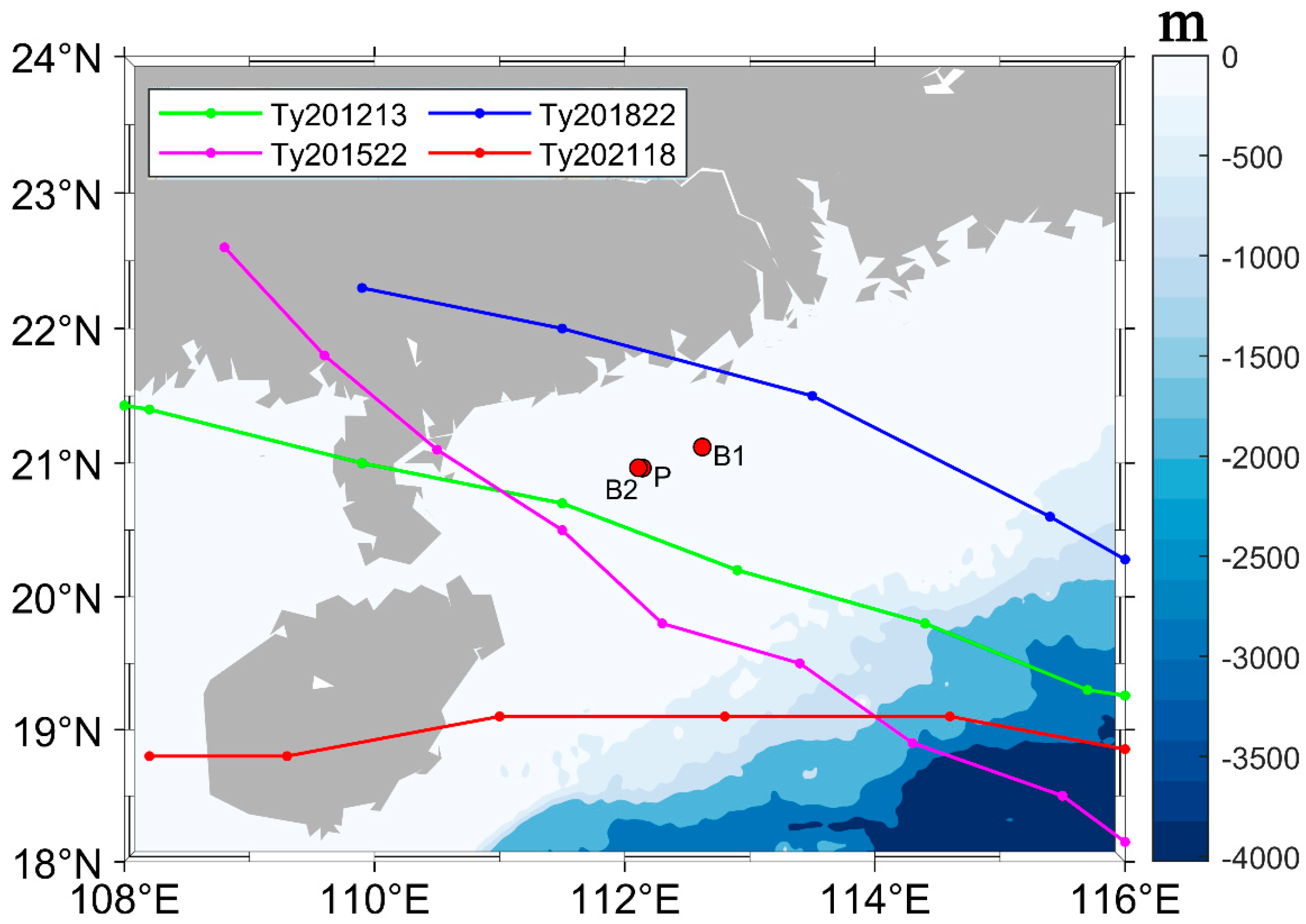
To validate wind and wave conditions, observational buoy B1 near the engineering project was utilized, selecting typhoon data from Ty201213, Ty201522, Ty201822, and Ty202118 to verify wind, significant wave heights (HS), and mean periods (TM) during typhoon conditions. Temporary buoy B2 data were used for validation of wind and waves during normal periods. The initial and boundary conditions for the WRF model are sourced from ERA5 (https://cds.climate.copernicus.eu/datasets/reanalysis-era5-single-levels?tab=overview, accessed on 10 August 2024) reanalysis data. ETOPO1 (https://ngdc.noaa.gov/mgg/global/relief/ETOPO1/tiled/, accessed on 15 August 2024) is used to provide bathymetric data for SWAN. Water depth, along with buoy observation stations B1 and B2, the project location P, and typhoon tracks, are illustrated in Figure 1 and Table 1.

2.2. Numerical Simulation

2.2.1. WRF Model

A 30-year wind field simulation of the Guangdong sea area was conducted using the WRF 4.3 model, employing a triple-nested domain. The time integration steps were set at 135 s, 45 s, and 15 s, respectively. The Mercator projection was utilized with vertical stratification comprising 37 layers. The simulation range of the WRF model extends from 7.85° S to 35.67° N and from 91.94° E to 138.06° E.
According to Siavash et al. (2021) and Jiang et al. (2025) [23,24], during WRF model computations, a 30 h loop was used, with the first 6 h for spin-up and the remaining 24 h for analysis. Following Yi et al. (2023) [25], we applied a 400 km radius around the Yangjiang engineering project to distinguish typhoon and normal periods. During typhoon periods, grid-nudging assimilation was employed to reduce typhoon track errors. The sea surface roughness and related air–sea flux parameters followed the default WRF model settings.
Based on relevant literature and prior work [26,27,28], we selected the Thompson MP scheme, KF CU scheme, and YSU PBL scheme for wind field simulations during typhoon events [29,30,31]. For normal weather conditions, we selected the Thompson MP scheme, Tiedtke CU scheme, and MYJ PBL scheme based on the literature and recommendations from the WRF user manual [32,33]. Other parameterization schemes remain unchanged, including the RRTMG [34] longwave and shortwave schemes. A modified MM5 scheme is used with the YSU PBL scheme for Surface Layer Options, while the Eta Similarity scheme is employed with the MYJ PBL scheme [35]. Specific WRF configuration settings are detailed in Table 2.

2.2.2. SWAN Model

The fundamental equations and source terms of SWAN are similar to those of WAM, but it incorporates an implicit formulation for shallow water wave propagation. During computation, SWAN allows the choice between a Cartesian coordinate system (in meters) and a spherical coordinate system (in degrees). The equation is as follows:
N t + x C x N + y C y N + σ C σ N + θ C θ N = S tot σ
where x and y represent Cartesian coordinates, t is time, and θ denotes the propagation direction of the dynamic density component. N represents the dynamic density spectrum. The model accounts for all physical processes affecting wave dynamics from deep water to coastal areas, including wind growth, interactions between individual waves, wave breaking, and energy dissipation due to bottom friction. C x , C y , C σ and C θ denote the propagation velocities of dynamic density in different directions. In shallow water conditions, the source term includes six distributions:
S tot = S in + S nl 3 + S nl 4 + S ds , w + S ds , b + S ds , br
where S in represents the wind input, S ds , b denotes the bottom friction term, and S ds , w signifies the whitecapping dissipation term. The term S nl 4 indicates the four-wave interaction. The depth-induced breaking term S ds , br and the three-wave interaction term S nl 3 are included in the SWAN model to better simulate wave conditions in shallow water regions, distinguishing it from other numerical wave models.
In this study, the SWAN model adopts a dual-nested domain, and the simulation range spans from 5° N to 25° N and from 105° E to 125° E. Based on prior experience and the relevant literature, we utilize the Westhuysen wind input [37], FIT wind drag formula, AB [38] whitecapping, and Jonswap bottom friction [39] physical parameterization schemes to simulate HS and TM in this region. The specific settings of the SWAN model are shown in Table 3.

3. Result and Discussion

3.1. Validation of WRF and SWAN

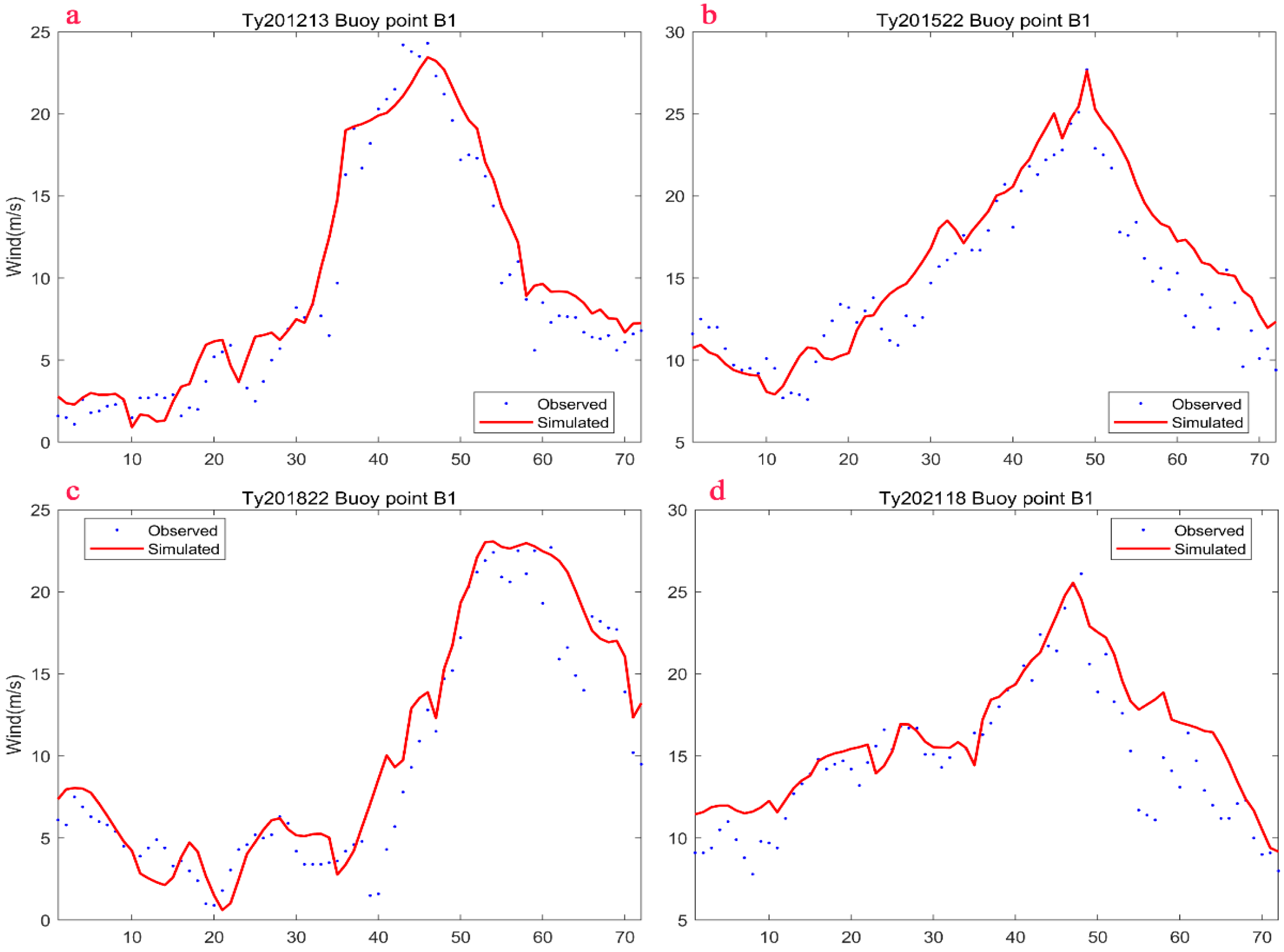
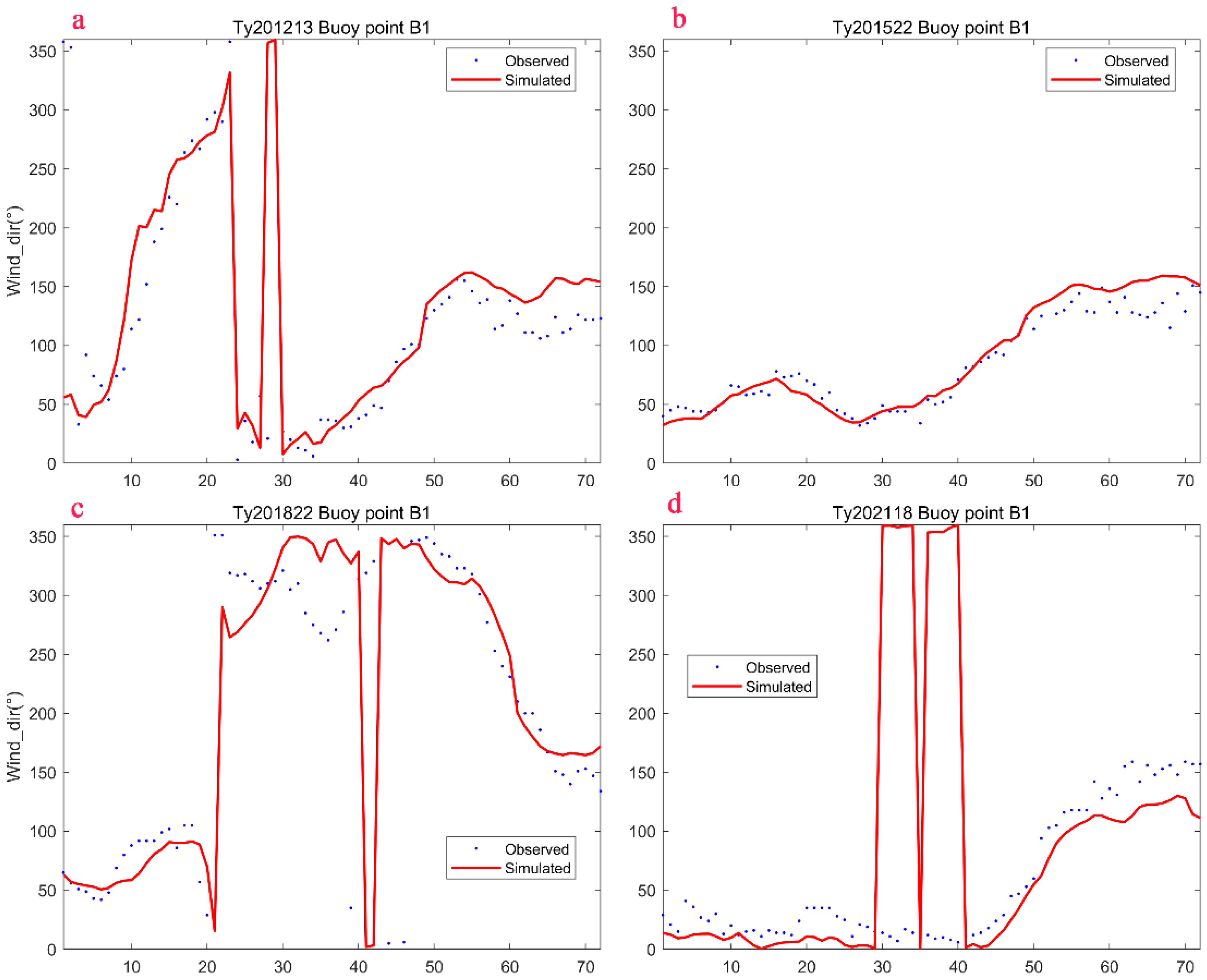
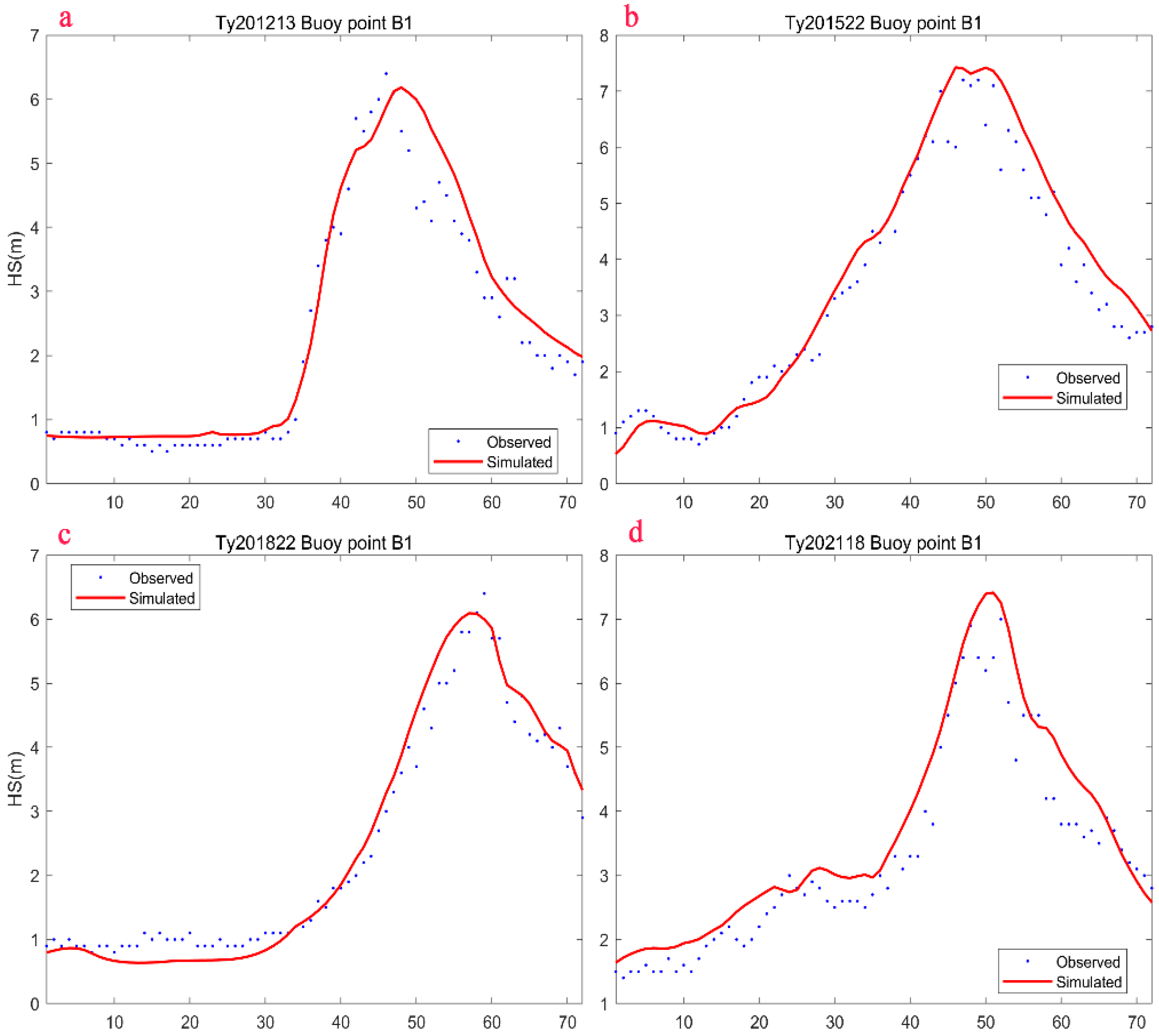
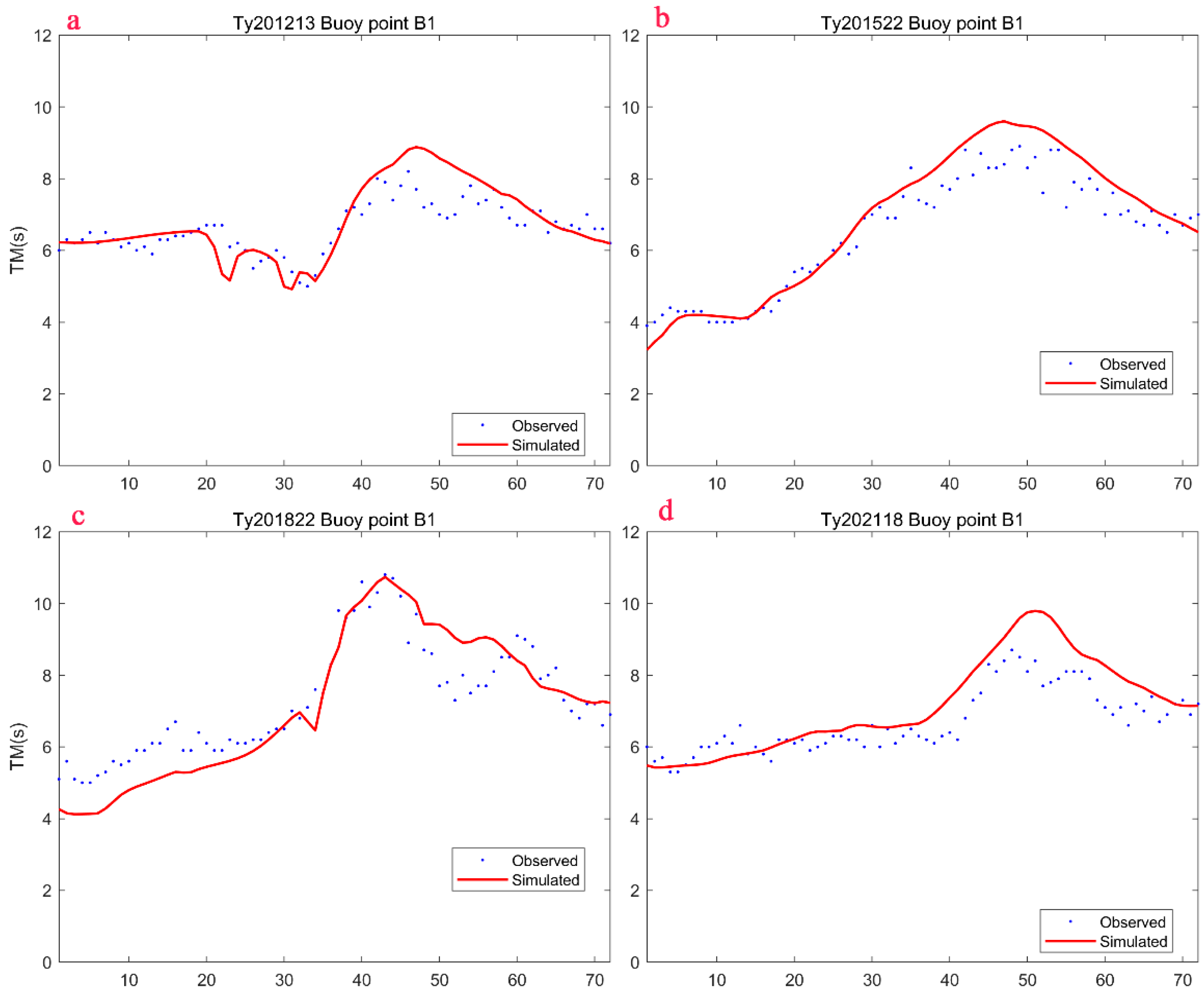
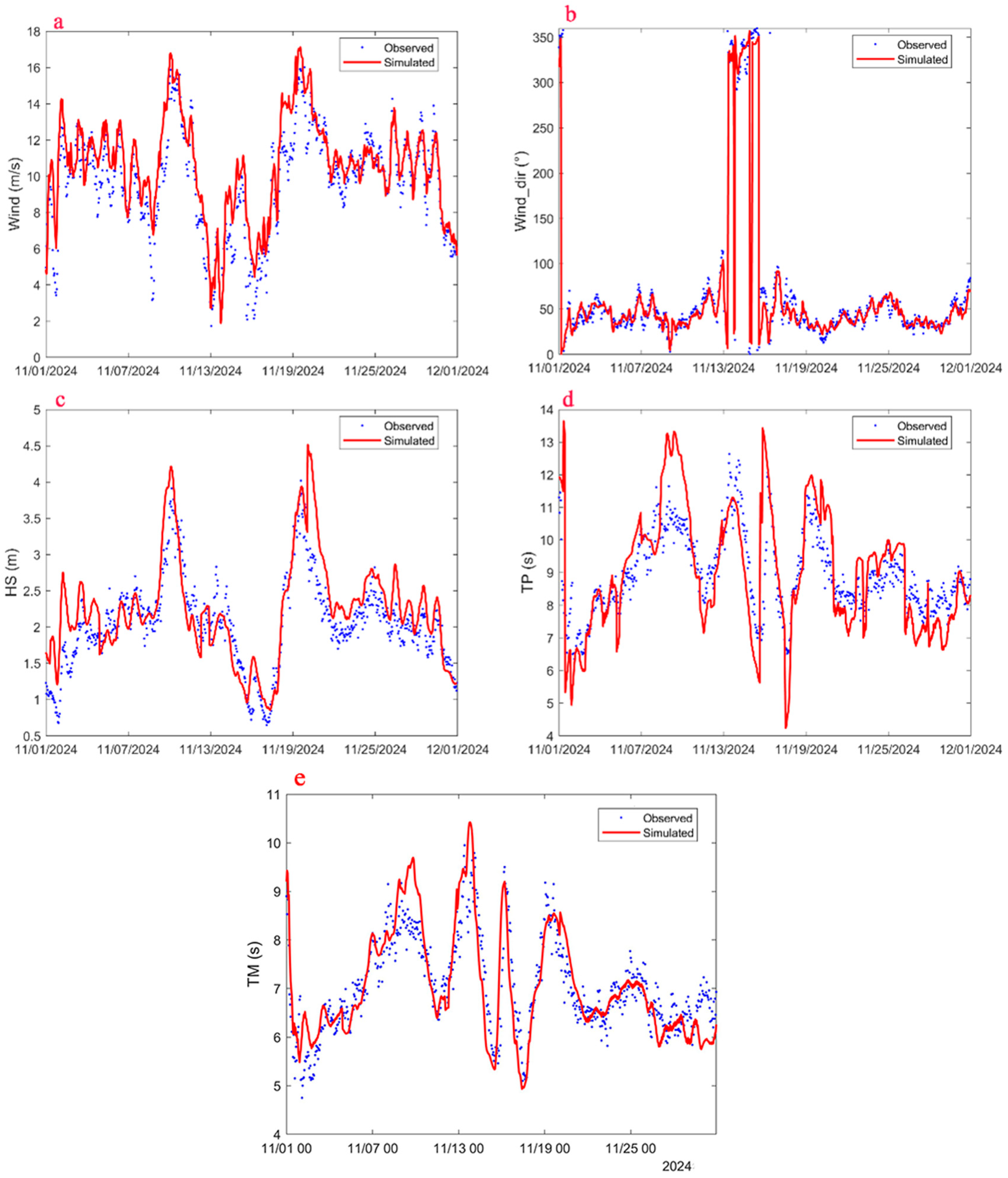
To validate the simulated data in the engineering sea area during typhoon conditions, we selected the B1 buoy for verification using observed data from typhoons Ty201213, Ty201522, Ty201822, and Ty202118. Figure 2, Figure 3, Figure 4 and Figure 5 present comparisons between observed and simulated wind speed, wind direction, HS, and TM at the B1 buoy during typhoon events. The results indicate that the simulated data align well with the observed data, with the simulated maximum wind speed and HS showing high consistency with the observed values. Additionally, the temporary buoy B2 recorded the observed wind speed, wind direction, HS, TM, and peak periods (TP) data from 1 November 2024 to 1 December 2024. Figure 6 presents a comparison of observed wind speed, wind direction, HS, and TP data from the B2 buoy under normal weather conditions with simulated data. The results demonstrate that the WRF and SWAN models can effectively simulate the wind and waves in the engineering sea area during normal weather conditions.

3.2. Design Wind Speed

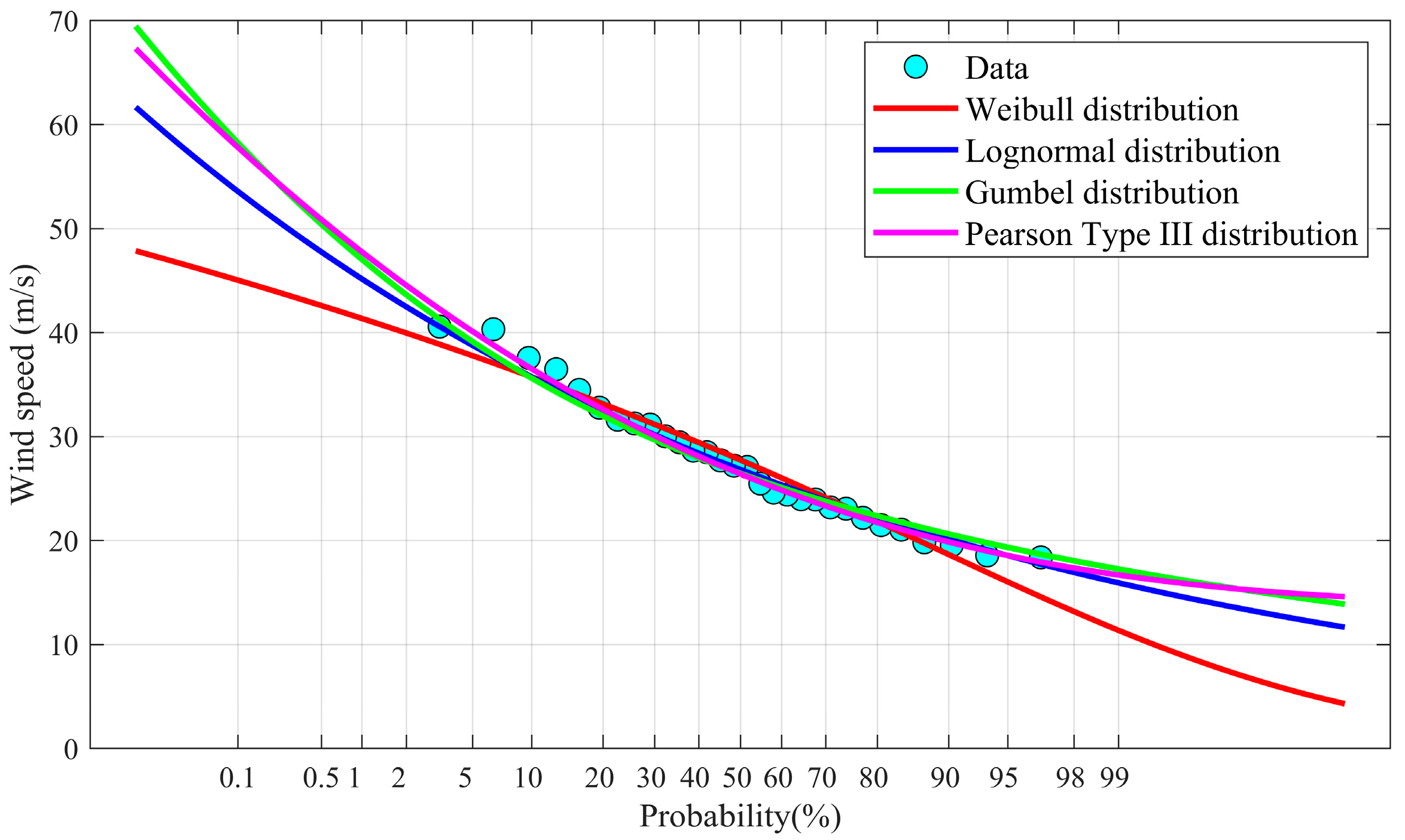
Using the WRF and SWAN models, we conducted a 30-year (1994–2023) reanalysis of marine environmental element data for the project sea area. Based on the 30-year reanalyzed marine environmental element data, we applied the Weibull, log-normal, Gumbel, and P-III models to fit the probability distribution of annual wind speed extremes. The fitting results are shown in Figure 7.
The four probability distributions, Gumbel, log-normal, Weibull, and P-III, were employed for fitting the distribution of annual extreme wind speeds at project point P. To determine the optimal distribution for the extreme value sequence, the goodness of fit was assessed using the K-S test, root-mean-square error method, and AIC criteria. This comprehensive evaluation aimed to select the most suitable marginal distribution type for ocean environmental factor annual extremes. The fitting test results for each distribution are presented in Table 4.
The Dn values for the distribution fittings of annual extreme wind speeds at project point P are all less than Dn,α, indicating that all distributions pass the K-S test and demonstrate good fit. In the statistical distribution curve, the fitted tail of the P-III distribution closely aligns with the empirical points, indicating a good fit. Similarly, in the fitting process of the P-III distribution, the empirical frequency points and the theoretical frequency curves obtained through different fitting methods are plotted on the same probability paper. First, it is ensured that the estimated curve passes through the center of the data cluster to avoid overall overestimation or underestimation. Special attention is given to the fitting in the high recurrence period (low frequency) region. The selected curve should align with the tail behavior of the data in terms of its extension trend at high quantiles, ensuring the accuracy of the extreme value analysis. Finally, a quantitative comparison is conducted using statistical tests to calculate the AIC values for different empirical fitting methods that meet the aforementioned criteria. The method corresponding to the smallest statistical value is selected. Based on the comprehensive results of extreme value statistical tests for various marine factors, the P-III distribution is identified as the optimal distribution type for calculating the design recurrence values of wind parameters at project point P.
For the design values of other wind parameters, calculations can be made according to relevant design standards.
(1)
Wind Speed at Hub Height
Assuming a mathematical expression for wind speed variation with height, a commonly used model is the power law curve:
V ( z ) = V z r z z r α
where V z r and z r represent wind speed at an arbitrary height and arbitrary height, respectively. z is the hub height, and V ( z ) is the wind speed at the hub height. α is the coefficient, which is set to 0.09 based on data from nearby meteorological towers.
(2)
Conversion of 3s Wind Speed
The American Petroleum Institute (API) standards provide empirical formulas for converting average wind speeds over different time periods to the 1 h average wind speed U 1 h r :
U t U 1 h r = 1.277 + 0.296 tanh [ 0.39 ln ( 45 t ) ] , 1 s < t < 3600 s
where U 1 h r is the 1 h average wind speed, and U t is the average wind speed over any given time within one hour.
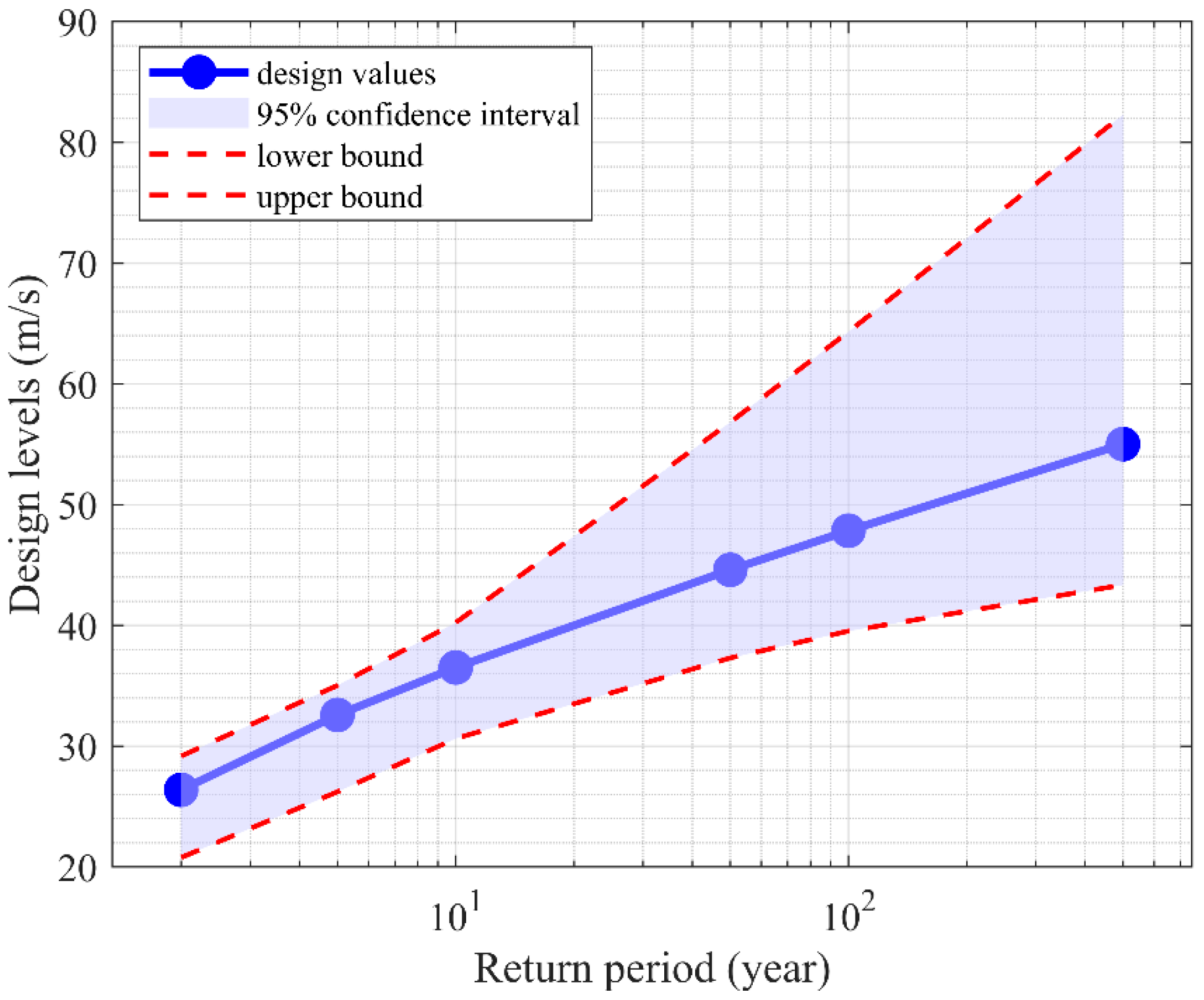
The mean wind speeds at project point P for different return periods, heights, and t time periods are shown in Table 5. Figure 8 presents the design levels (ordinate) corresponding to different return periods (abscissa, logarithmic scale), where blue solid points denote the design values, the light purple shaded area represents the 95% confidence interval, and the red dashed lines mark the lower/upper bounds of the interval. Notably, the underlying data sample of this study has a length of 30 years. When extrapolating to ultra-long return periods (e.g., 500 years) based on such a short sample, the uncertainty of statistical extrapolation will be further magnified, leading to an even broader confidence interval (inferred from the trend in this figure). Such a wide interval implies a large fluctuation range of design values for ultra-long return periods, which poses challenges to the safety margin assessment of marine engineering structures. This also highlights the practical significance of optimizing modeling methods (e.g., non-parametric approaches like KDE) to mitigate extrapolation uncertainty.

3.3. Design Waves

3.3.1. IFORM Theory

Marine engineering applications such as offshore wind turbines, drilling platforms, ship design, and coastal structures exhibit strong coupling effects and inherent randomness. Conventional univariate extreme value analysis neglects the interdependencies among variables, often resulting in overly conservative designs. By considering only the individual maximum of each variable, this approach yields occurrence probabilities significantly lower than those of joint extremes. Moreover, it may lead to non-conservative risks due to the omission of unfavorable combinations, such as high wave heights coupled with high wind speeds.
The IFORM integrated with the environmental contour concept effectively addresses these limitations. Recognized in international standards such as IEC 61400-3-2 [40] and DNV-RP-C205 [41], IFORM provides a robust framework for defining extreme environmental conditions in design. It employs probability space transformations to construct a hypersurface of constant failure probability.
The environmental variables are represented by a vector X = (X1, X2, …, Xn), where, for instance, X1 denotes significant wave height (Hs) and X2 represents 10 m wind speed (U10). The joint cumulative distribution function (CDF) is expressed as follows:
FX(x) = P(X1x1, …, Xnxn)
A major challenge lies in accurately capturing the complex correlations among marine environmental parameters. Deriving an analytical solution for the high-dimensional joint extreme value distribution remains generally infeasible.
The structural failure probability Pf is mapped to a hypersphere in standard normal space via the following relation:
Pf = P(g(X) ≤ 0) = Φ(−β)
where g(X) denotes the limit state function, and β is the reliability index.
For a target return period, designated TR (measured in years), the annual failure probability can be determined by the following:
Pf,annual = 1/(TRN)
where N represents the number of independent environmental events per year.
The corresponding reliability index is expressed as follows:
β = −Φ−1(Pf,annual) = Φ−1(1 − 1/(TRN))
The construction of environmental contours primarily involves transforming the original correlated non-normal variables X into independent standard normal variables U. The principal methodologies include the following:
(1)
Rosenblatt Transformation
This method applies a chain-rule factorization to the joint CDF:
U 1 = Φ 1 ( F X 1 ( x 1 ) ) U 2 = Φ 1 ( F X 2 | X 1 ( x 2 | x 1 ) ) U n = Φ 1 ( F X n | X 1 , , X n 1 ( x n | x 1 , , x n 1 ) )
While the Rosenblatt transformation can accurately capture any dependency structure, it demands an understanding of the conditional distributions associated with environmental variables. Its computational complexity increases significantly in high-dimensional settings with intricate correlations.
(2)
Nataf Transformation
Based on a Gaussian copula assumption, the Nataf transformation converts the marginal distributions as follows:
Z i = Φ 1 ( F X i ( x i ) )
The linear correlation matrix RZ is adjusted from the original correlation matrix using Hermite polynomial integration:
ρ Z i Z j   = G ( ρ X i   X j , σ X i , σ X j )
(3)
Copula Function Approach
This technique directly models the joint probability distribution of environmental variables using a copula function:
F X ( x ) = C ( F X 1   ( x 1 ) , , F X n   ( x n ) )
Commonly used copula families include Gaussian, t, Clayton, and Gumbel.
In the U-space, the failure boundary is defined by a hypersphere of radius β:
B = { u R n : u = β }
By inversely transforming points from this hypersphere in standard normal space back to the physical variable space, the environmental contour is obtained:
C = { x R n : x = T 1 ( u ) ,   u = β }
A parametric approach can be employed for contour generation. For a bivariate case involving significant wave height Hs and spectral peak period Tp, the contour is derived as follows:
x 1 = F X 1 1 ( Φ ( β cos θ ) ) x 2 = F X 2 | X 1 1 ( Φ ( β sin θ ) | x 1 )

3.3.2. Two-Dimensional Kernel Density Estimation

Two-dimensional kernel density estimation (KDE) provides a flexible non-parametric alternative, capable of effectively capturing the correlation structure of wave parameters and other variables, provided that sufficient data are available.
Consider nn independent and identically distributed two-dimensional sample points { X i = ( X i , Y i ) } i = 1 n drawn from an unknown joint probability density function f(x). The objective is to estimate f(x) using a non-parametric approach. The core idea of kernel density estimation is to center a kernel function at each sample point, thereby transforming the discrete sample set into a continuous density distribution.
The estimated density is given by the weighted average of all kernel functions:
f ^ h ( x ) = 1 n i = 1 n K H ( x X i )
where KH(⋅) denotes the kernel function controlled by the bandwidth matrix H.
The kernel function K(⋅) must satisfy the following conditions: non-negativity, K(u) ≥ 0; normalization, 2 K ( u ) d u = 1 ; symmetry, K ( u ) = K ( u ) .
In two-dimensional KDE, a bandwidth matrix HH (symmetric positive definite) is introduced to accommodate potential anisotropy in the data:
f ^ h ( x ) = 1 n i = 1 n K H ( x X i )
K H ( u ) = H 1 / 2 K ( H 1 / 2 u )
H governs the shape and scale of the kernel: if H = h2I, the kernel is isotropic; if H contains off-diagonal elements, it can capture correlations between variables. Through the spectral decomposition H = RDRT, the rotation matrix R controls the orientation of the kernel, while the scaling matrix D determines the axis lengths.
Bandwidth selection is a central challenge in KDE, as it directly influences the bias–variance trade-off of the estimator. The theoretical criterion for bandwidth selection is to minimize the mean integrated squared error (MISE):
M I S E ( H ) = E f ^ H ( x ) f ( x ) 2 d x
Common bandwidth selection algorithms include the following:
(1)
Smoothed Cross-Validation (SCV)
This method minimizes the cross-validation score:
S C V ( H ) = f ^ H 2 ( x ) d x 2 n i = 1 n f ^ H , i ( X i )
where f ^ H , i denotes the density estimate obtained after excluding the i-th sample.
(2)
Plug-In Method
This approach approximates the MISE via Taylor expansion to solve for the optimal H. First, the Hessian matrix is estimated, leading to the following optimal bandwidth formula for the Gaussian kernel:
Ψ = ( 2 f ) f d x
H op t = n 1 / 3 4 3 1 / 3 Ψ ^ 1 / 3
(1)
Rule-of-Thumb Method
A simplified bandwidth for isotropic Gaussian kernels can be expressed as follows:
h = 4 3 n 1 / 5 σ ^
where σ ^ represents the sample standard deviation. For two-dimensional data, this should be adjusted according to the characteristics of each variable.
This study adopts the Rule-of-Thumb method to determine the bandwidth, which is calculated based on the sample standard deviation and sample size referring to Silverman’s rule to balance computational efficiency and estimation accuracy for extreme value intervals.

3.3.3. Hs-Tp Environmental Contours

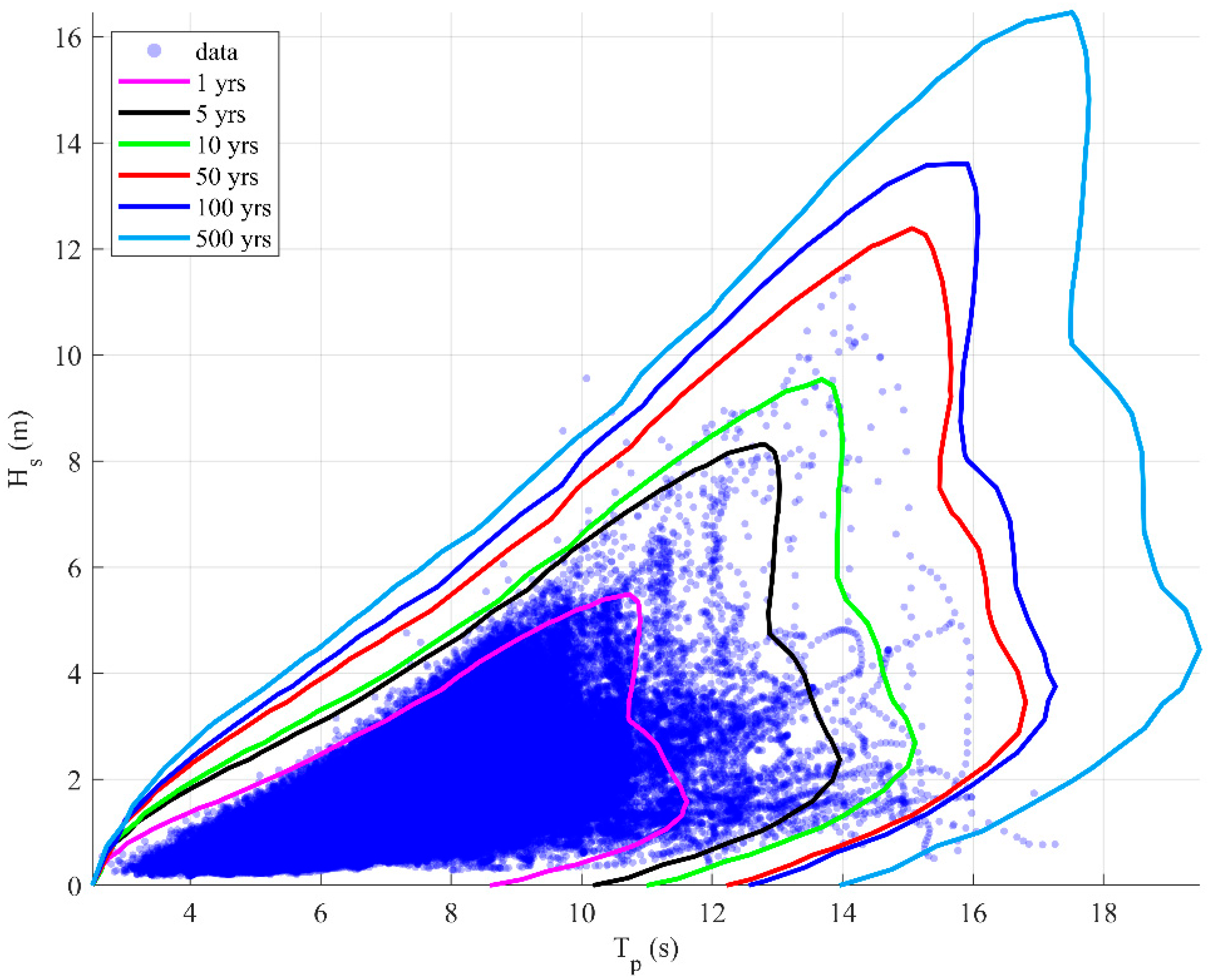
The Hs-Tp environmental contour defines a joint exceedance boundary in terms of a specified return period, serving as a critical input for the design loads of marine structures. For instance, the 50-year contour encompasses all combinations of Hs and Tp that may induce structural responses corresponding to a 50-year return period. In practice, marine environmental parameters such as Hs and Tp often exhibit non-Gaussian marginal distributions and complex nonlinear dependencies. Conventional parametric assumptions (e.g., log-normal or Weibull distributions) or simplistic correlation coefficients may fail to capture their true joint probabilistic structure. Two-dimensional kernel density estimation (2D KDE) provides a non-parametric approach to estimate a smooth, data-driven joint probability density function directly from scattered observational data, without presupposing any specific distribution family. It effectively captures the underlying distribution and dependence characteristics. The IFORM is then employed to map the joint probability problem into an independent U-space, within which a limit state surface corresponding to a specified failure probability can be determined.
The integrated KDE–IFORM procedure for constructing environmental contours comprises the following key steps:
Step 1: Joint Probability Modeling via 2D KDE
Long-term hourly hindcast data of Hs and Tp from the project sea area (1994–2023) are used. To improve normality and numerical stability, logarithmic transforms are applied, (x, y) = (log(Hs), log(Tp)). The joint probability density at any point (x, y) is estimated as follows:
f ^ ( x , y ) = 1 n h x h y i = 1 n K ( x X i h x ) K ( y Y i h y )
where n is the sample size, K(⋅) is the Gaussian kernel, hx and hy are bandwidths optimized via cross-validation, and (Xi, Yi) are the log-transformed samples. The output is a smooth joint probability density function f{Hs, Tp}(log(h), log(t)) that accurately reflects the empirical dependence structure.
Step 2: Transformation to Standard Normal Space
Using the Rosenblatt transformation, the correlated non-Gaussian variables (log(Hs), log(Tp)) are mapped into independent standard normal variables (U1, U2) via conditional cumulative distribution functions. First, transform log(Hs) to U1:
Φ ( u 1 ) = F log ( H s ) log ( ( h ) )
u 1 = Φ 1 ( F log ( H s ) log ( ( h ) ) )
where the marginal CDF F{log(Hs)} is obtained by integrating the KDE:
F log ( H s ) log ( ( h ) ) = log ( h ) f ^ ( x , y ) d y d x
Then, transform log(Tp) conditioned on Hs to U2:
Φ ( u 2 ) = F log ( T p ) | log ( H s ) ( log ( t ) | log ( ( h ) )
u 2 = Φ 1 ( F log ( T p ) | log ( H s ) ( log ( t ) | log ( ( h ) ) )
where the conditional CDF F{log(Tp)|log(Hs)} is derived from the KDE as follows:
F log ( T p ) | log ( H s ) ( log ( t ) | log ( ( h ) ) = log ( t ) f ^ ( log ( h ) , y ) d y f ^ ( log ( h ) , y ) d y
Each point (Hs, Tp) in the physical space thus corresponds uniquely to a point (U1,U2) in U-space.
Step 3: Contour Definition in U-Space
In the independent standard normal space, the limit state surface corresponding to an annual exceedance probability is defined by a circle centered at the origin, u12 + u22 = β2. The radius β is directly related to the annual exceedance probability. In the two-dimensional independent standard normal space, the probability that a point is located outside the circle that is centered at the origin and has a radius of β.
Step 4: Inverse Mapping to Physical Space
Points located on the circle in U-space are converted back to the physical (Hs, Tp) space through the inverse Rosenblatt transformation. The resulting set of points forms the environmental contour for the specified return period.
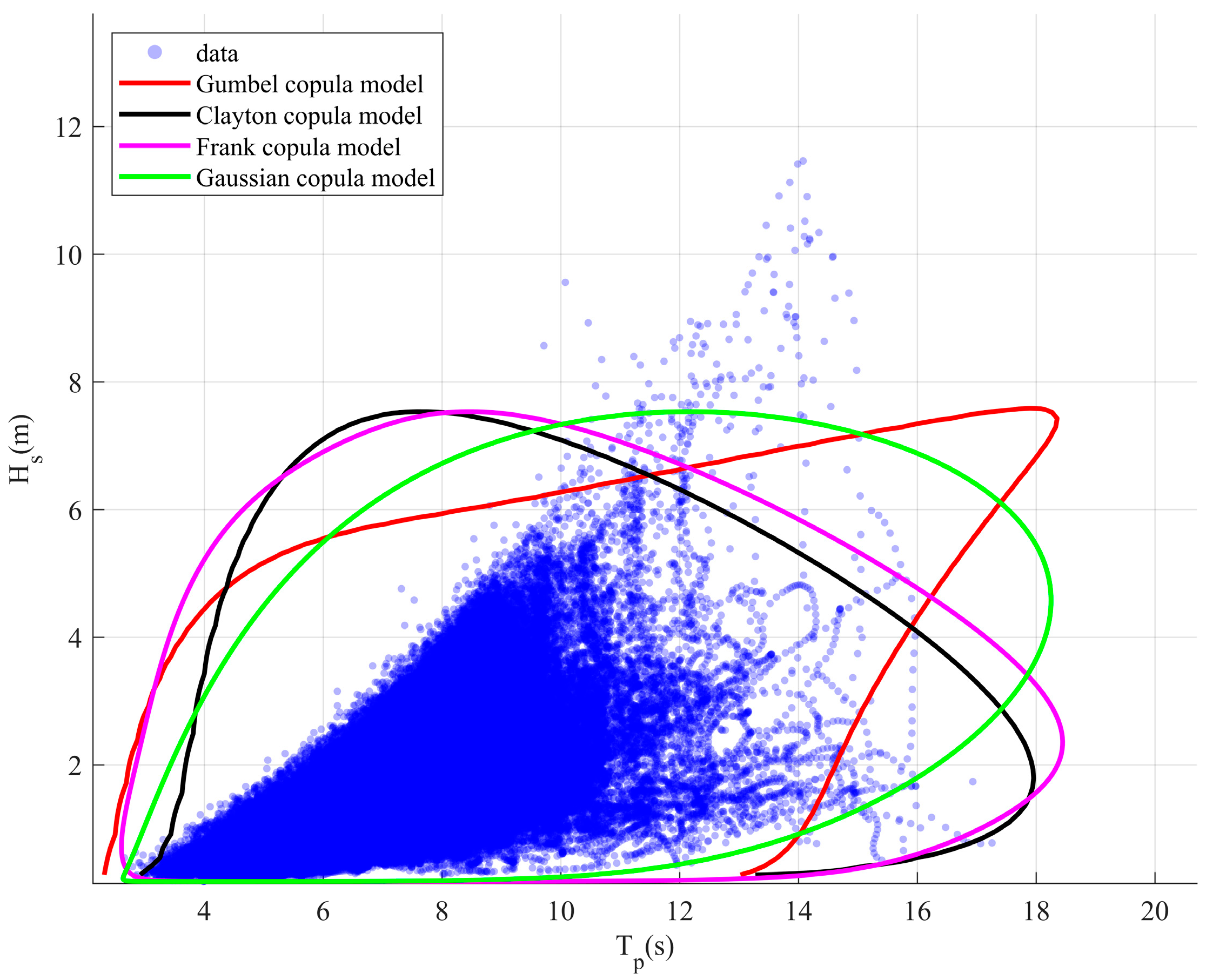
Traditional parametric methods require pre-specified marginal distributions and copula functions (e.g., Gumbel, Weibull, or Gumbel copula). Incorrect assumptions can introduce bias, and such models often struggle to capture complex nonlinear dependencies, particularly under extreme extrapolation. In contrast, the KDE-IFORM approach is fully data-driven, flexibly adapts to the true joint distribution, inherently incorporates all interdependencies, and generally yields more accurate extreme environmental estimates.
Based on 30 years (1994–2023) of hourly hindcast data for the project sea area, the Hs-Tp environmental contours derived from the KDE-IFORM method are presented in Figure 9.
The extreme environmental boundary, derived from hindcast marine environmental data, defines an envelope encompassing the specified return period and accurately reflects the dependency between variables. Discrete points along this contour provide the requisite inputs for the reliability design and evaluation of marine engineering structures. The resulting design values of the extreme HS and the associated TP in the project sea area are listed in Table 6.
In Figure 10, the blue scatter points represent the original observational data, while the red, black, pink, and green curves denote the 100-year return period environmental envelopes fitted by the Gumbel, Clayton, Frank, and Gaussian copula models, respectively. Visual inspection of the plot yields the following key observations: all four copula models exhibit poor agreement between their fitted envelopes and the distribution pattern of the original data, particularly the clustering characteristics of scatter points in the region of large Hs. These models fail to effectively capture the actual correlation of extreme environmental parameters (i.e., large Hs and large Tp). Traditional copula models rely on the assumptions of parametric marginal distributions and fixed correlation structures, which are incompatible with the heavy-tailed and asymmetric distribution characteristics of marine environmental parameters. This inconsistency leads to significant fitting deviations of the envelopes in the extreme value region.

4. Conclusions

To estimate the design wind speeds and waves for project point P in the coastal waters near Guangzhou for different return periods, this study employed the WRF and SWAN to simulate wind and wave conditions over a 30-year period (1994–2023). The WRF model utilized Thompson MP, KF CU, and YSU PBL for typhoon wind field simulations, while Thompson MP, Tiedtke CU, and MYJ PBL were applied for normal conditions. For the SWAN model, the Westhuysen wind input FIT wind drag formula AB whitecapping and JONSWAP bottom friction were utilized for wave simulations in the project sea area.
Validation through buoy B1’s measured data (wind speed, wind direction, HS, and TM) during typhoons Ty201213, Ty201522, Ty201822, and Ty202118 demonstrated good consistency between simulated and observed data. Additionally, comparisons of buoy B2’s measured values under normal weather conditions for wind speed, wind direction, HS, and TP confirmed that the WRF and SWAN models effectively simulate normal conditions in the project area. The design wind speeds at project point P for different return periods were fitted using Gumbel, log-normal, Weibull, and P-III probability distributions. The optimal distribution was selected based on the K-S test, RMSE, and AIC. Results indicated that the P-III distribution closely approximated the tail of the empirical data, yielding a good fit. At a height of 10 m, the 3 s and 10 min mean wind speeds for 100-year and 50-year return periods were 62.21 m/s, 47.85 m/s, 57.99 m/s, and 44.61 m/s, respectively. At hub height (170 m), the corresponding values were 80.27 m/s, 61.75 m/s, 74.84 m/s, and 57.57 m/s.
This study successfully applied a two-dimensional KDE approach to construct a joint probability model and derive environmental contours for extreme environmental assessment. The HS and TP at project point P for 100-year and 50-year return periods are 13.61 m and 15.91 s, as well as 12.39 m and 15.07 s, respectively. The results demonstrate that this non-parametric method offers significant advantages in characterizing the joint distribution of key environmental parameters, specifically wave height and wave period. A major strength of KDE is its independence from prior assumptions regarding the underlying distribution forms, enabling it to adaptively capture complex dependence structures and multi-modal features present in the data, thereby avoiding potential biases caused by model misspecification. This capability is particularly critical for accurately describing environmental parameters under complex meteorological conditions, such as during typhoon passages overlapping with normal sea states, ensuring that the derived contours genuinely reflect the intrinsic characteristics of the data. The environmental contour method based on two-dimensional KDE proves to be a powerful and flexible tool, especially suitable for situations where parametric model assumptions are questionable or data structures are complex. The validation under normal weather conditions relies solely on one month of measured data from the B2 temporary buoy, which may result in the model not accurately simulating long-term design parameters for the engineering location. In future work, we will collect more measured data under normal weather conditions at the engineering site to enhance the long-term simulation accuracy of the model, and we will focus on the development of more computationally efficient algorithms and on exploring the integration of KDE with extreme value theory, to further enhance the characterization of tail risks associated with joint extreme events.

Author Contributions

Methodology, Z.L. and Y.Z.; Software, Y.Z.; Validation, S.L., J.W. and D.J.; Investigation, Z.L. and J.W.; Resources, J.W. and S.L.; Data curation, D.P. and S.L.; Writing—original draft, D.J. and Z.L.; Writing—review & editing, Z.L. and Z.W.; Supervision, Z.W.; Project administration, Z.W.; Formal analysis, D.P., S.L. and Y.Z.; Conceptualization, D.P. and Z.L. All authors have read and agreed to the published version of the manuscript.

Funding

This research was funded by Research on Key Technology of Protection against Pile and Marine Cable Erosion in Offshore Wind Farm (EV12151W) and Integration and Development of Floating Lidar Wind Measurement and Marine Hydrological 3D Monitoring System (EX13031W), the National Natural Science Foun-dation of China (42377457), the Natural Science Foundation of Shandong Province (ZR2023QE016), and the Fundamental Research Funds for the Central Universities (No. 202513038).

Data Availability Statement

The original contributions presented in this study are included in this article. Further inquiries can be directed to the corresponding authors.

Acknowledgments

This study was financially supported by the Science and Technology Project of China Energy Engineering Group Guangdong Electric Power Design Institute Co., Ltd.: Research on Key Technology of Protection against Pile and Marine Cable Erosion in Offshore Wind Farm (EV12151W) and Integration and Development of Floating Lidar Wind Measurement and Marine Hydrological 3D Monitoring System (EX13031W), the National Natural Science Foundation of China (42377457), the Natural Science Foundation of Shandong Province (ZR2023QE016), and the Fundamental Research Funds for the Central Universities (No. 202513038).

Conflicts of Interest

Authors Zhenglin Li, Dongdong Pan, Shicheng Lin, and Jun Wang were employed by the company China Energy Engineering Group Guangdong Electric Power Design Institute Co., Ltd. The remaining authors declare that the research was conducted in the absence of any commercial or financial relationships that could be construed as a potential conflict of interest. The authors declare that this study received funding from the Science and Technology Project of China Energy Engineering Group Guangdong Electric Power Design Institute Co., Ltd., Science and Technology Project of China Energy Engineering Group Guangdong Electric Power Design Institute Co., Ltd., the National Natural Science Foundation of China, the Natural Science Foundation of Shandong Province, and the Fundamental Research Funds for the Central Universities. The funder was not involved in the study design, collection, analysis, interpretation of data, the writing of this article, or the decision to submit it for publication.

References

  1. Jiang, D.; Zhuang, D.; Huang, Y.; Wang, J.; Fu, J. Evaluating the spatio-temporal variation of China’s offshore wind resources based on remotely sensed wind field data. Renew. Sustain. Energy Rev. 2013, 24, 142–148. [Google Scholar] [CrossRef]
  2. Wang, Z.F.; Duan, C.L.; Dong, S. Long-term wind and wave energy resource assessment in the South China sea based on 30-year hindcast data. Ocean Eng. 2018, 163, 58–75. [Google Scholar] [CrossRef]
  3. Wang, X.; Tan, Z. On the combination of physical parameterization schemes for tropical cyclone track and intensity forecasts in the context of uncertainty. J. Adv. Model. Earth Syst. 2023, 15, e2022MS003381. [Google Scholar] [CrossRef]
  4. Feng, X.; Zheng, J.; Yan, Y. Wave spectra assimilation in typhoon wave modeling for the East China Sea. Coast. Eng. 2012, 69, 29–41. [Google Scholar] [CrossRef]
  5. Xiong, J.; Yu, F.J.; Fu, C.; Dong, J.X.; Liu, Q.X. Evaluation and improvement of the ERA5 wind field in typhoon storm surge simulations. Appl. Ocean Res. 2022, 118, 103000. [Google Scholar] [CrossRef]
  6. Salvao, N.; Bentamy, A.; Soares, C.G. Developing a new wind dataset by blending satellite data and wrf model wind predictions. Renew. Energy 2022, 198, 283–295. [Google Scholar] [CrossRef]
  7. de Assis Tavares, L.F.; Shadman, M.; de Freitas Assad, L.P.; Estefen, S.F. Influence of the wrf model and atmospheric reanalysis on the offshore wind resource potential and cost estimation: A case study for Rio de Janeiro state. Energy 2022, 240, 122767. [Google Scholar] [CrossRef]
  8. Sun, J.; He, H.; Hu, X.; Wang, D.; Song, J. Numerical simulations of typhoon Hagupit (2008) using WRF. Weather. Forecast. 2019, 34, 999–1015. [Google Scholar] [CrossRef]
  9. Wen, Y.; Xu, X.K.; Waseda, T.; Lin, P.Z. Energy flux variations and safety assessment of offshore wind and wave resources during typhoons in the northern South China Sea. Ocean Eng. 2024, 302, 117683. [Google Scholar] [CrossRef]
  10. Di, Z.; Gong, W.; Gan, Y.; Shen, C.; Duan, Q. Combinatorial Optimization for WRF Physical Parameterization Schemes: A Case Study of Three-Day Typhoon Simulations over the Northwest Pacific Ocean. Atmosphere 2019, 10, 233. [Google Scholar] [CrossRef]
  11. Jiang, D.; Huang, B.; Miao, Q.S.; Sun, H.; Wang, Z.F. Typhoon wind and wave numerical forecasting optimization in the South China Sea based on observation data. Nat. Hazards 2025, 121, 9653–9677. [Google Scholar] [CrossRef]
  12. Liu, N.; Ling, T.; Wang, H.; Zhang, Y.; Gao, Z.; Wang, Y. Numerical simulation of Typhoon Muifa (2011) using a Coupled Ocean-Atmosphere-Wave-Sediment Transport (COAWST) modeling system. J. Ocean. Univ. China 2015, 14, 199–209. [Google Scholar] [CrossRef]
  13. Drost, E.J.F.; Lowe, R.J.; Ivey, G.N.; Jones, N.L.; Péquignet, C.A. The effects of tropical cyclone characteristics on the surface wave fields in Australia’s North West region. Cont. Shelf Res. 2017, 139, 35–53. [Google Scholar] [CrossRef]
  14. Wu, Z.Y.; Jiang, C.B.; Deng, B.; Chen, J.; Cao, Y.G.; Li, L.J. Evaluation of numerical wave model for typhoon wave simulation in South China Sea. Water Sci. Eng. 2018, 11, 229–235. [Google Scholar] [CrossRef]
  15. Zijlema, M.; van Vledder, G.; Ph Holthuijsen, L.H. Bottom friction and wind drag for wave models. Coast. Eng. 2012, 65, 19–26. [Google Scholar] [CrossRef]
  16. Xu, Y.; Zhang, J.; Xu, Y.; Ying, W.; Wang, Y.; Che, Z.; Zhu, Y. Analysis of the spatial and temporal sensitivities of key parameters in the SWAN model: An example using Chan-hom typhoon waves. Estuar. Coast. Shelf Sci. 2019, 232, 106489. [Google Scholar] [CrossRef]
  17. Haver, S. On the joint distribution of heights and periods of sea waves. Ocean Eng. 1987, 14, 359–376. [Google Scholar] [CrossRef]
  18. Winterstein, S.; Ude, T.C.; Cornell, C.A.; Bjerager, P.; Haver, S. Environmental parameters for extreme response: Inverse FORM with omission factors. In Proceedings of the ICOSSAR-93, Innsbruck, Austria, 9–13 August 1993. [Google Scholar]
  19. Montes-Iturrizaga, R.; Heredia-Zavoni, E. Multivariate environmental contours using C-vine copulas. Ocean Eng. 2016, 118, 68–82. [Google Scholar] [CrossRef]
  20. Noh, Y.; Sun, M. Environmental contours using copulas for extreme load estimate of offshore wind turbines. Ocean Eng. 2025, 326, 120919. [Google Scholar] [CrossRef]
  21. Wang, Y. A novel environmental contour method for predicting long-term extreme wave conditions. Renew. Energy 2020, 162, 926–933. [Google Scholar] [CrossRef]
  22. Wang, Y. Robust adaptive analysis of dynamic responses of offshore sustainable energy systems. Ocean Eng. 2023, 273, 114022. [Google Scholar] [CrossRef]
  23. Jiang, D.; Huang, B.G.; Miao, Q.S.; Sun, H.; Wang, Z.F. Extreme design wave parameters optimization of typhoon wave for ocean engineering based on numerical simulation and observation data in the South China Sea. Ocean Eng. 2025, 323, 120603. [Google Scholar] [CrossRef]
  24. Siavash, G.; Sarmad, G.; Hasan, K.-Z.; Parvin, G. Sensitivity of WRF-simulated 10 m wind over the Persian Gulf to different boundary conditions and PBL parameterization schemes. Atmos. Res. 2021, 247, 105–147. [Google Scholar]
  25. Yi, J.; Zhang, X.; Zou, G.; Zhang, K.; Wang, J. A Numerical Simulation Study on the Probable Maximum Typhoon Wave in the South China Sea. Sustainability 2023, 15, 10254. [Google Scholar] [CrossRef]
  26. Wang, Y.; Zhou, L.; Hamilton, K. Effect of Convective entrainment/detrainment on the simulation of the tropical precipitation diurnal cycle. Mon. Weather Rev. 2007, 135, 567–585. [Google Scholar] [CrossRef]
  27. Xi, D.; Chu, K.; Tan, Z.M.; Gu, J.F.; Shen, W.; Zhang, Y.; Tang, J. Characteristics of warm cores of tropical cyclones in a 25-km-mesh regional climate simulation over CORDEX East Asia domain. Clim Dyn. 2021, 57, 2375–2389. [Google Scholar] [CrossRef]
  28. Tu, C.; Zhao, Z.; Zhou, M.; Li, W.; Xie, M.; Ni, C.; Chen, S. Assessment of Different Boundary Layer Parameterization Schemes in Numerical Simulations of Typhoon Nida Based on Aircraft Observations. Atmosphere 2023, 14, 1403. [Google Scholar] [CrossRef]
  29. Thompson, G.; Field, P.R.; Rasmussen, R.M.; Hall, W.D. Explicit forecasts of winter precipitation using an improved bulk microphysics scheme. Part II: Implementation of a new snow parameterization. Mon. Weather Rev. 2008, 136, 5095–5115. [Google Scholar] [CrossRef]
  30. Kain, J.S. The Kain-Fritsch convective parameterization: An update. J. Appl. Meteorol. 2004, 43, 170–181. [Google Scholar] [CrossRef]
  31. Hong, S.Y.; Noh, Y.; Dudhia, J. A new vertical diffusion package with an explicit treatment of entrainment processes. Mon. Weather Rev. 2006, 134, 2318–2341. [Google Scholar] [CrossRef]
  32. Tiedtke, M. A comprehensive mass flux scheme for cumulus parameterization in large-scale models. Mon. Weather Rev. 1989, 117, 1779–1800. [Google Scholar] [CrossRef]
  33. Janjic, Z.I. The surface layer in the NCEP Eta Model. In Eleventh conference on numerical weather prediction. Am. Meteorol. Soc. 1996, 19–23, 354–355. [Google Scholar]
  34. Iacono, M.J.; Delamere, J.S.; Mlawer, E.J.; Shephard, M.W.; Clough, S.A.; Collins, W.D. Radiative forcing by long-lived greenhouse gases: Calculations with the AER radiative transfer models. J. Geophys. Res. 2008, 113, D13103. [Google Scholar] [CrossRef]
  35. Jimenez, P.A.; Dudhia, J.; Gonzalez-Rouco, J.F.; Navarro, J.; Montavez, J.P.; García-Bustamante, E. A revised scheme for the WRF surface layer formulation. Mon. Weather Rev. 2012, 140, 898–918. [Google Scholar] [CrossRef]
  36. Tewari, M.; Chen, F.; Wang, W.; Dudhia, J.; LeMone, M.; Mitchell, K. Implementation and verification of the unified NOAH land surface model in the WRF model. In Proceedings of the 20th Conference on Weather Analysis and Forecasting/16th Conference on Numerical Weather Prediction, Seattle, DC, USA, 12–16 January 2004; Volume 14. [Google Scholar]
  37. Yan, L. An Improved Wind Input Source Term for Third Generation Ocean Wave Modelling. In Scientific Report WR-No 87-8; Royal Netherlands Meteorological Institute (KNMI): De Bilt, The Netherlands, 1987. [Google Scholar]
  38. Westhuysen, A.J.V.D.; Zijlema, M.; Battjes, J.A. Nonlinear saturation-based whitecapping dissipation in swan for deep and shallow water. Coast. Eng. 2007, 54, 151–170. [Google Scholar] [CrossRef]
  39. Hasselmann, K.; Barnett, T.P.; Meerburg, A.; Müller, P.; Olbers, D.J.; Richter, K.; Sell, W.; Walden, H.; Bouws, E.; Carlson, H.; et al. Measurements of wind-wave growth and swell decay during the Joint North Sea Wave Project (JONSWAP). Ergaenzungsheft Zur Dtsch. Hydrogr. Z. Reihe A 1973, 8, 1–95. [Google Scholar]
  40. IEC 61400-3-2; Wind Energy Generation Systems-Part 3-2: Design Requirements for Floating Offshore Wind Turbines. IEC: Geneva, Switzerland, 2019.
  41. DNVGL RP-C205; Design of Offshore Wind Turbine Structures. DNV: Oslo, Norway, 2019.
Figure 1. The required water depths for the SWAN model, along with the locations of buoys B1 and B2, project position P, and the typhoon tracks for Ty201213, Ty201522, Ty201822, and Ty202118.
Energies 19 00802 g001
Figure 2. Comparison of simulated and observed wind speed at the B1 buoy during typhoon events (a) Ty201213, (b) Ty201522, (c) Ty201822, (d) Ty202118.
Energies 19 00802 g002
Figure 3. Comparison of simulated and observed wind direction at the B1 buoy during typhoon events (a) Ty201213, (b) Ty201522, (c) Ty201822, (d) Ty202118.
Energies 19 00802 g003
Figure 4. Comparison of simulated and observed HS at the B1 buoy during typhoon events (a) Ty201213, (b) Ty201522, (c) Ty201822, (d) Ty202118.
Energies 19 00802 g004
Figure 5. Comparison of simulated and observed TM at the B1 buoy during typhoon events (a) Ty201213, (b) Ty201522, (c) Ty201822, (d) Ty202118.
Energies 19 00802 g005
Figure 6. Comparison of simulated wind (a), wind direction (b), HS (c), TP (d), TM (e), and observed data at the B2 buoy during normal events.
Energies 19 00802 g006
Figure 7. Fitting of annual extreme wind speed distribution at project point P.
Energies 19 00802 g007
Figure 8. The 95% confidence intervals for return values.
Energies 19 00802 g008
Figure 9. Hs-Tp environmental contours for various return periods at project point P.
Energies 19 00802 g009
Figure 10. Hs-Tp environmental contours for 100-year return periods at project point P using copula models.
Energies 19 00802 g010
Table 1. The latitude and longitude along with the water depths for buoy points B1 and B2, as well as project point P.
BuoyLatitudeLongitudeDepth (m)
B121.12° N112.62° E50.1
B220.97° N112.11° E46
P20.96° N112.14° E46.66
Table 2. Specific settings of the WRF model.
DOM1DOM2DOM3
Resolution27 km9 km3 km
Map projectionsMercator
Time_steps135 s45 s15 s
Shortwave radiationRRTMG
Longwave radiationRRTMG
MPThompson
CUKF (typhoon events) Tiedtke (normal events)None
PBLYSU (typhoon events) MYJ (normal events)
Land surface optionsUnified Noah land surface model [36]
Surface Layer OptionsRevised MM5 (typhoon events) Eta Similarity (normal events)
Boundary update frequency1 h
Sea-surface roughnessdefault
Grid nudgingguv gt gq = 0.0003 s−1
Table 3. Specific settings of the SWAN model.
Domain1Domain2
Resolution10 km1 km
Time_steps1200 s300 s
Wind inputWesthuysen
Wind drag formulaFIT
WhitecappingAB
Bottom frictionJonswap
Water depthETOPO1
Frequencies0.05–1.0 HZ
Table 4. Statistical test results for annual extreme values at project.
Probability DistributionsK-SRMSEAIC
DnDn,αvValue
Wind (m/s)Weibull0.10860.24170.04413−181.26
Log-normal0.08290.24170.02952−207.46
Gumbel0.07630.24170.03792−192.29
P-III0.07450.24170.02283−220.86
Table 5. Mean wind speeds at project point P under different conditions and return periods.
ItemsReturn Period
251050100500
Wind (10 m)3 s34.3142.3747.4857.9962.2171.53
10 min26.3932.5936.5244.6147.8555.02
Wind (170 m)3 s44.2754.6761.2774.8480.2792.3
10 min34.0542.0647.1357.5761.7571
Table 6. Joint design wave parameters at project point P.
ItemsReturn Period (Year)
151050100500
Hs (m)5.498.319.5412.3913.6116.46
Tp (s)10.7412.8213.6815.0715.9117.52
Disclaimer/Publisher’s Note: The statements, opinions and data contained in all publications are solely those of the individual author(s) and contributor(s) and not of MDPI and/or the editor(s). MDPI and/or the editor(s) disclaim responsibility for any injury to people or property resulting from any ideas, methods, instructions or products referred to in the content.