Article

Performance of CaMn0.625Ti0.125Fe0.125Mg0.125O3 Oxygen Carrier in the Chemical Looping Combustion of Biomass

1
State Key Laboratory of Cool Combustion, School of Energy and Power Engineering, Huazhong University of Science & Technology, Wuhan 430074, China
2
State Key Laboratory of Clean and Efficient Coal Utilization, Taiyuan University of Technology, Taiyuan 030024, China
*
Author to whom correspondence should be addressed.
These authors contributed equally to this work.
Energies 2026, 19(3), 714; https://doi.org/10.3390/en19030714
Submission received: 4 January 2026 / Revised: 24 January 2026 / Accepted: 25 January 2026 / Published: 29 January 2026
(This article belongs to the Section A4: Bio-Energy)

Abstract

Chemical looping combustion (CLC) has been recognized as a promising CO2 capture technology, in which oxygen carriers (OCs) transport lattice oxygen to the fuel instead of the air. This study aims to evaluate a newly developed perovskite OC for biomass CLC and to clarify the role of staged fuel conversion in improving gas–solid redox efficiency. This is the first application of perovskite OC CaMn0.625Ti0.125Fe0.125Mg0.125O3 in biomass CLC using a dual-stage fluidized bed. The perovskite OC was synthesized via a solid-phase synthesis method, and its performance in a dual-stage fluidized bed reactor was evaluated using pine wood chips and furfural residues as model solid fuels. The in situ conversion of volatile compounds and gasification products derived from the two biomass types was comprehensively studied. The effects of operational parameters, including temperature, OC-to-biomass ratio, and gas flow rate, on the combustion efficiency and CO2 yield were examined. Results showed that separated gasification–combustion enhanced the combustion efficiency and CO2 yield. At 950 °C, an OC-to-pine chip ratio of 100:1, and a gas flow rate of 0.7 L/min, the maximum combustion efficiency and CO2 yield of 79% and 82% were obtained, respectively. Moreover, under the optimal gasification conditions (gasification rate > 99%), increasing the fuel concentration resulted in an increase in the oxygen release from 0.21 g to 0.40 g. Concurrently, the corresponding total oxygen demand increased from 4.34% to 10.56%, indicating the suitability of CaMn0.625Ti0.125Fe0.125Mg0.125O3 in the CLC of biomass.

1. Introduction

Biomass chemical looping combustion (BCLC) is an advanced carbon-negative combustion technology that integrates the intrinsic CO2 capture capability of chemical looping systems with the carbon-neutral properties of biomass [1]. The technology is operated via a redox-mediated process, in which metal oxide oxygen carriers (OCs) undergo cyclic redox reactions in the air and fuel reactors. During pyrolysis in the fuel reactor, biomass is thermochemically decomposed to obtain volatile species (e.g., H2, CO, CO2, and CH4) and residual char (R1) [2]. Although gaseous components readily form gas–solid interactions with OCs (R2), the solid char must be gasified in situ [3] via steam/CO2 injection (R3) to produce syngas (primarily CO and H2) for subsequent redox reactions (R4 and R5), ultimately generating CO2 and H2O for sequestration [4].
Biomass → volatiles (CO, H2, and CH4) + Char
volatiles + MeOx → MeOx−1 + CO2 (g) + H2O (g)
Char + H2O (g) → CO (g) + H2 (g) + ash
H2 (g) + MeOx → MeOx−1 + H2O (g)
CO (g) + MeOx → MeOx−1 + CO2 (g)
Recent advancements have focused on chemical looping oxygen uncoupling (CLOU) materials that release gaseous oxygen at high temperatures (700–1200 °C), enhancing the solid-to-fuel conversion efficiency [5]. Current CLOU candidates include transition metal oxides (e.g., CuO [6,7], Co3O4 [8], and Mn2O3 [8,9]) and perovskite-type oxides. Among the two, perovskites (ABO3/AB2O4) are particularly promising because of their nonstoichiometric oxygen capacity, structural stability, and redox durability [10]. The compositions of the A-site (typically alkaline earth metals, e.g., La [11] and Ca [12]) and B-site (transition metals, e.g., Mn [9], Fe [13,14], and Cu [15]) govern the oxygen vacancy formation and ionic mobility in the perovskite [16]. While CaMnO3−δ systems have emerged as cost-effective candidates, their practical implementation requires elemental doping to mitigate structural instability during prolonged cycling [17]. Experimental studies have shown that B-site substitution with Ti, Mg, and Fe can considerably improve the performance of perovskites. Mattisson-Henrik et al. demonstrated that the doping of Ti and Fe in CaMnO3−δ maintains the oxygen uncoupling capacity while stabilizing the crystalline phases. Among these, Ti and Fe effectively form a crystalline phase with Mn, whereas its Mg doping results in the formation of separated MgO domains [18]. Rydén et al. demonstrated the temperature-dependent O2 release kinetics on CaMn0.875Ti0.125O3 (Oxygen uncoupling performance improves with increasing temperature), achieving a CH4 combustion efficiency of 99.8% via optimized oxygen partial pressure control [19]. Belviso et al. synthesized the CaMn0.9Mg0.1O3−δ OC and conducted continuous testing in a 10 kWth reactor. The results confirmed a sustained operation (>350 h) with a 3% mass-specific O2 release at 850 °C; they attributed this mechanical stability to Mg incorporation [20].
However, interactions between biomass ash and perovskite OCs pose critical challenges in CLOU, particularly due to the alkali-induced deactivation of OCs [21]. Ash components are partitioned into volatile fly ash (e.g., K, Na, S, and Cl) and residual bottom ash (e.g., Ca, Si, Mg, Al, and Fe), with SiO2 and alkali metals having contrasting effects [22]. Research indicates that specific ash elements—notably potassium (K), calcium (Ca), and silicon (Si)—interact detrimentally with OCs, suppressing their reactivity [23]. K exhibits a propensity to migrate into the bulk structure of OC particles. This migration facilitates the formation of thermodynamically stable compounds, specifically KTi8O16.5, which irreversibly sequesters active material. Ca, conversely, predominantly accumulates on the external surfaces of OC particles. This surface enrichment promotes particle agglomeration, thereby disrupting the hydrodynamic behavior essential for effective fluidization within reactor systems [24]. Si reacts chemically with OC components, generating distinct, inert metal silicate phases—notably Fe2SiO4 (fayalite) and Al2SiO5 (aluminum silicate). The formation of these phases depletes the concentration of redox-active species within the OCs and significantly impairs their fundamental lattice oxygen transfer capacity [25,26,27]. Furthermore, fine particulate ash present in the reaction environment deposits onto the porous surfaces of OCs. This deposition process leads to the development of a cohesive, low-melting-point ash layer. This layer acts as a physical barrier, hindering direct gas–solid contact at the reactive sites. Consequently, carbon conversion efficiency is reduced [28], fluidization dynamics are adversely affected, and the sensitivity of the OCs to oscillating redox conditions is diminished [29]. Gu et al. observed that SiO2-rich wheat straw ash promotes particle sintering via K-silicate formation, whereas K-rich ash promotes the reactivity of iron-based OCs [27]. Zhang’s findings corroborated this dual behavior of SiO2-rich wheat straw ash, reporting a threshold ash content of 20%, beyond which sintering dominates the morphological evolution of the OC [30].
The speciation of alkaline metals plays a crucial role in the deactivation mechanisms of OC. KCl dominates the gas-phase alkali emissions during CLOU, with the atmosphere-dependent adsorption on OCs [31,32]. Andersson et al. performed TGA-MS analysis and reported the improved adsorption of KCl on CaMn0.775Ti0.125Mg0.15O3−δ OC under reducing conditions, with the occurrence of temperature-dependent absorption kinetics [33]. In addition to alkali metals, acidic elements (e.g., S, Cl) in solid fuels can also induce poisoning and deactivation of OCs. Sulfur compounds such as SO2 and H2S create additional poisoning pathways via the formation of CaSO4 or CaS, respectively, as evidenced by a 28% decrease in the combustion efficiency of CaMn0.9Mg0.1O3−δ during prolonged H2S exposure. Moreover, the formation of a CaSO4 crystalline phase was observed on the surface of the OC. CaMn0.775Ti0.125Mg0.1O2.9−δ in simulated syngas fuel (3000 ppm H2S in CH4) for 29 h of continuous operation. Compared to pure CH4 fuel, combustion efficiency decreased by 18%, with CaSO4 also identified in the OC. Current research on the combustion performance and morphological evolution of perovskite oxygen carriers with solid fuels predominantly focuses on mixed combustion within single-reactor systems, where fuel pyrolysis gases are typically oversimplified using CH4 or CO for simulated combustion. This approach substantially deviates from actual pyrolysis conditions. Hence, investigating the reactivity between solid fuel pyrolysis gases and perovskite oxygen carriers in dual-reactor systems is essential.
Accordingly, this study aims to investigate the applicability of perovskite OC CaMn0.625Ti0.125Fe0.125Mg0.125O3 for biomass chemical looping combustion in a dual-stage fluidized bed reactor, with particular emphasis on the conversion behavior of biomass pyrolysis and gasification products. Pine wood chips and pine wood char were selected as solid fuels to evaluate the CLC performance of CaMn0.625Ti0.125Fe0.125Mg0.125O3 in two combustion modes, i.e., mixed and separated combustion modes. The optimal combustion mode (i.e., separated combustion) was further investigated by analyzing the effects of the temperature and biomass-to-OC ratio (B/O ratio) on the combustion efficiency and CO2 yield. The microevolutionary behavior of OC particles was investigated using scanning electron microscopy–energy-dispersive X-ray spectroscopy (SEM–EDS) and X-ray diffraction (XRD).

2. Materials and Methods

2.1. Perovskite OC Synthesis

The perovskite-type OC, CaMn0.625Ti0.125Fe0.125Mg0.125O3, was prepared via solid-state synthesis. Stoichiometric amounts of precursor materials, totaling 400 g, were accurately weighed, including 201.70 g of Ca(OH)2 (Xin Shen Test Chemical Technology Co., Ltd., Wuhan, China, analytical grade, ≥99%), 27.15 g of TiO2 (Xin Shen Test Chemical Technology Co., Ltd., Wuhan, China, ≥99%), 27.00 g of Fe2O3 (Xin Shen Test Chemical Technology Co., Ltd., Wuhan, China, ≥99%), 129.45 g of Mn3O4 (Xin Shen Test Chemical Technology Co., Ltd., Wuhan, China, ≥99%), and 14.67 g of MgO (Xin Shen Test Chemical Technology Co., Ltd., Wuhan, China, ≥99%). The mixture was homogenized by mechanical blending and then dried at 105 °C for 12 h to remove the adsorbed moisture. Next, the powder was milled in a planetary ball mill (Changsha Tianchuang XQM-4, Changsha, China) at 300 rpm for 3 h to reduce its particle size and increase its reactivity. The powder was granulated via a uniaxial hydraulic press (Changsha Miqi MD-30, Changsha, China) at a uniaxial pressure of 5 MPa to form cylindrical pellets, which were disaggregated using a mechanical crusher and sieved to obtain particles of 150–350 μm for subsequent redox testing.

2.2. Biomass Feedstock Preparation

Pine sawdust (PS) was selected as the experimental feedstock. Before experiments, it underwent the following standardized pretreatment procedures: (1) dehydration at 120 °C for 12 h under atmospheric pressure, (2) mechanical pulverization, and (3) particle-size classification (150–350 μm) using ASTM-standard sieves. PS-derived char (PSC) was produced via pyrolytic decomposition in a tubular reactor in an N2 atmosphere at 850 °C for 30 min at a heating rate of 10 °C/min. Proximate and ultimate analyses were performed according to ASTM D7582 [34] and ASTM D5373 [35] protocols, respectively. The elemental and industrial analysis results of the biomass are presented in Table 1.

2.3. Experimental Equipment and Procedures

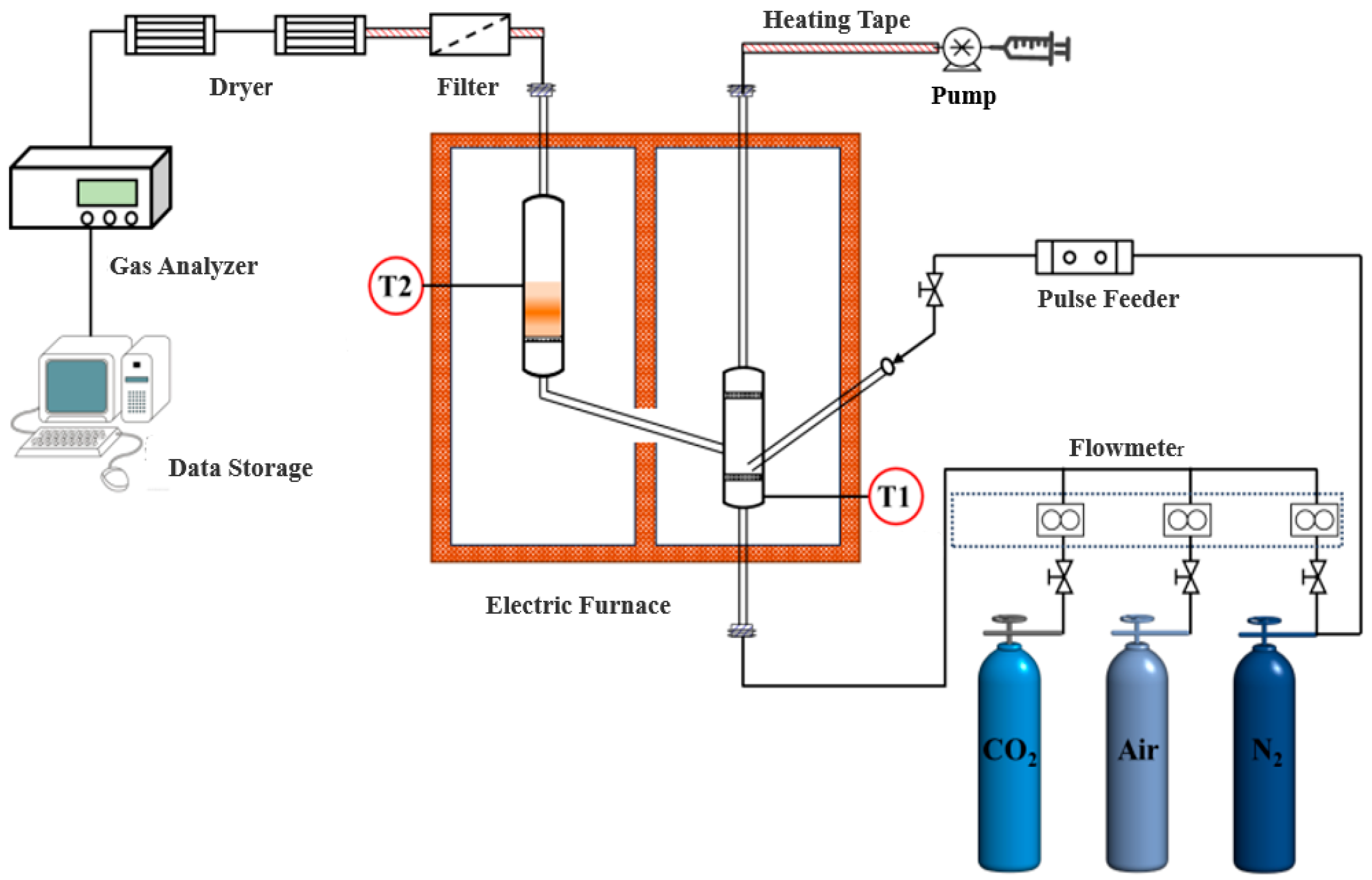
Herein, the reaction performance of CaMn0.625Ti0.125Fe0.125Mg0.125O3 was systematically examined in a dual-stage fluidized bed reactor [36] using biomass pyrolysis–gasification and redox reaction experiments. The reactor system (Figure 1) included two independently controlled stages, i.e., a primary reactor (T1, 80 mm × 30 mm) for biomass conversion and a secondary reactor (T2, 160 mm × 30 mm) for OC-mediated syngas combustion. Exhaust gases were sequentially treated by particulate filtration, tar condensation, and desiccant drying before real-time compositional analysis via nondispersive infrared (NDIR) spectroscopy, with detection limits of CO/CO2 ± 50 ppm, CH4/H2 ± 100 ppm, and O2 ± 0.1 vol.%.
The specific experimental conditions are shown in Table 2. For BCLC in the mixed mode, OCs (0.15–0.35 mm) were preoxidized in the primary reactor under an air flow (950 °C, 30 min), followed by steam injection and biomass feeding in an N2 atmosphere. Reduction cycles were terminated upon CO2 depletion (<0.5%), followed by oxidative regeneration with air. During separated biomass pyrolysis experiments, OCs were preoxidized in the primary reactor in air. Subsequently, biomass particles (0.15–0.35 mm) were introduced into the secondary reactor via high-pressure N2 pulse injection in an N2 environment. The pyrolysis gas resulting from high-temperature biomass decomposition was transferred to the primary reactor for the reaction with the preoxidized OC. Separated biomass gasification experiments were performed using a procedure similar to pyrolysis experiments, with the exception that steam was coinjected (0.1–0.5 mL/min) with biomass particles into the secondary reactor to promote gasification. Triplicate experiments were performed to ensure reproducibility (relative standard deviation < 5%), with critical parameters, including the pulse duration (100 ms) and thermal profiles (pyrolysis zone = 950 °C), rigorously controlled. This dual-mode approach enabled the comparative analysis of staged and integrated biomass conversion pathways while quantifying OC performance degradation mechanisms.

2.4. Data Evaluation

The combustion efficiency was calculated as follows:
η c = 1 t 0 t 1 4 F C H 4   +   F C O   +   F H 2   +   2 F C O 2 d t m f u e l   ×   Ω O 2
where F i (i = CH4, CO, and H2) is the molar flow rate during the reduction phase (mol/s), F C O 2 is the molar flow rate of CO2 during the oxidation phase (mol/s), t 0 is the starting time of the reduction phase (s), t 1 is the end time of the reduction phase (s), m f u e l is the mass of the fuel added (g), and Ω O 2 is the molar amount of oxygen required for the complete combustion of the fuel (mol/g).
The carbon capture efficiency was calculated as follows:
η C C = t 0 t 1 ( F C H 4   +   F C O +   F C O 2 ) d t t 0 t t o t a l ( F C H 4   +   F C O   +   F C O 2 ) d t
where F i (i = CH4, CO, and H2) is the molar flow rate throughout the oxidation–reduction process (mol/s) and t t o t a l is the end time of the entire oxidation–reduction process (s).
The gas yield was calculated as follows:
γ i = t 0 t 1 ( F i ) d t t 0 t 1 ( F C H 4 +   F C O +   F C O 2 +   F H 2 ) d t
The gas yield can be interpreted as the percentage of the gas component γ i (i = CO, CO2, CH4, and H2) in the total gas produced.
The carbon conversion rate was calculated as follows:
r i = F C H 4 +   F C O +   F C O 2 m f u e l   ×   n c , f u e l
The carbon conversion rate reflects the rate at which the carbon in the biomass is transformed into different gaseous components during the gasification process.
The carbon conversion efficiency was calculated as follows:
X c = t 0 t 1 ( F C H 4 +   F C O   +   F C O 2 ) d t m f u e l   ×   n c , f u e l

2.5. Characterization Methods

The morphology and surface elemental distribution of the fresh and reacted oxygen carrier particles were analyzed using scanning electron microscopy coupled with energy-dispersive X-ray spectroscopy (SEM–EDS). SEM was employed to examine the particle surface structure and morphological evolution after different chemical looping combustion modes, while EDS mapping was used to identify the spatial distribution of major elements and trace impurities on the oxygen carrier surfaces. The textural properties of the oxygen carrier, including the specific surface area, pore volume, and average pore diameter, were determined by N2 adsorption–desorption measurements based on the Brunauer–Emmett–Teller (BET) method. Prior to analysis, the samples were degassed to remove physically adsorbed species. The crystalline phases of the oxygen carrier before and after redox reactions were identified by X-ray diffraction (XRD). XRD analysis was performed to investigate phase composition, structural stability, and possible phase evolution of the perovskite oxygen carrier during biomass chemical looping combustion.

3. Results and Discussion

3.1. Carbon Balance Analysis

As shown in Table 3, the carbon balance under different experimental conditions ranged from 103.1% ± 1.2% to 107.7% ± 1.4% across triplicate runs. The values exceeding 100.0% were attributed to tar deposition in the reactor and instrumental errors. Notably, in separated gasification experiments, carbon release during pyrolysis and gasification accounted for 76.4% and 23.6% of the total carbon input, respectively.

3.2. Effect of Mixed and Separated Modes of CLC

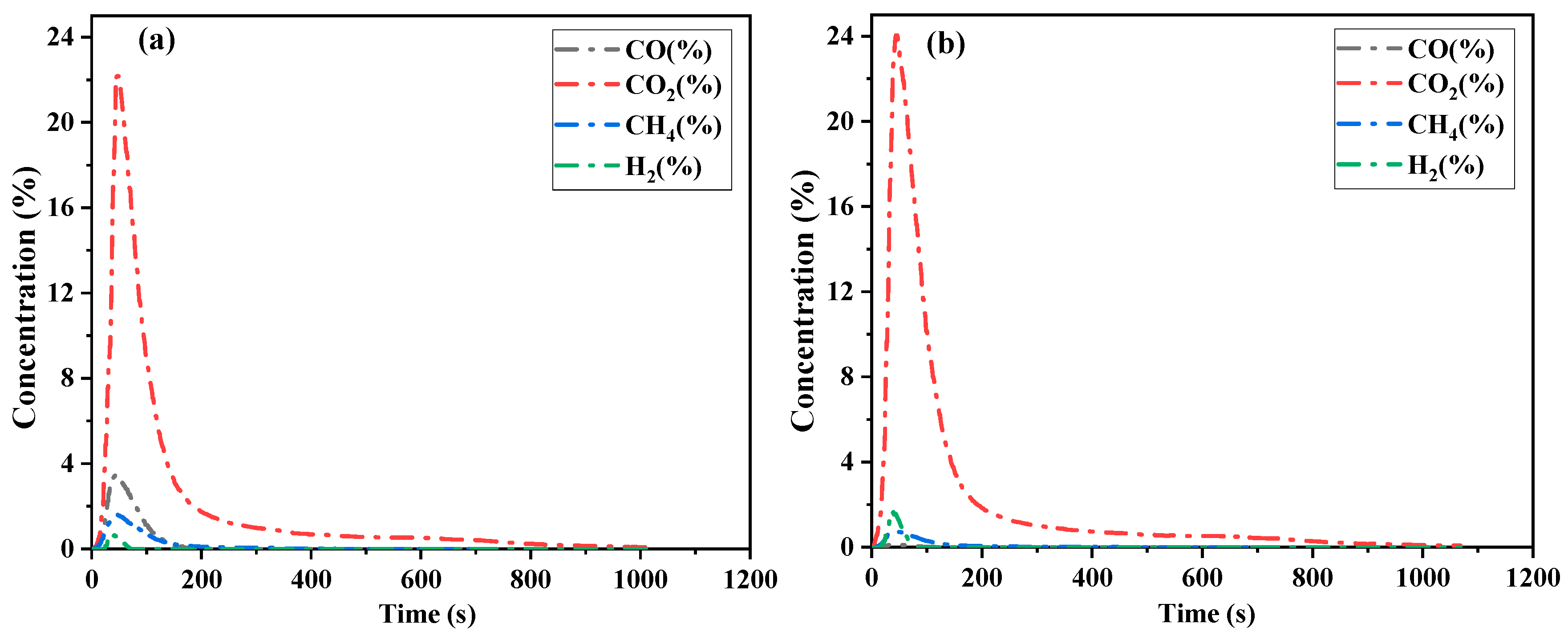
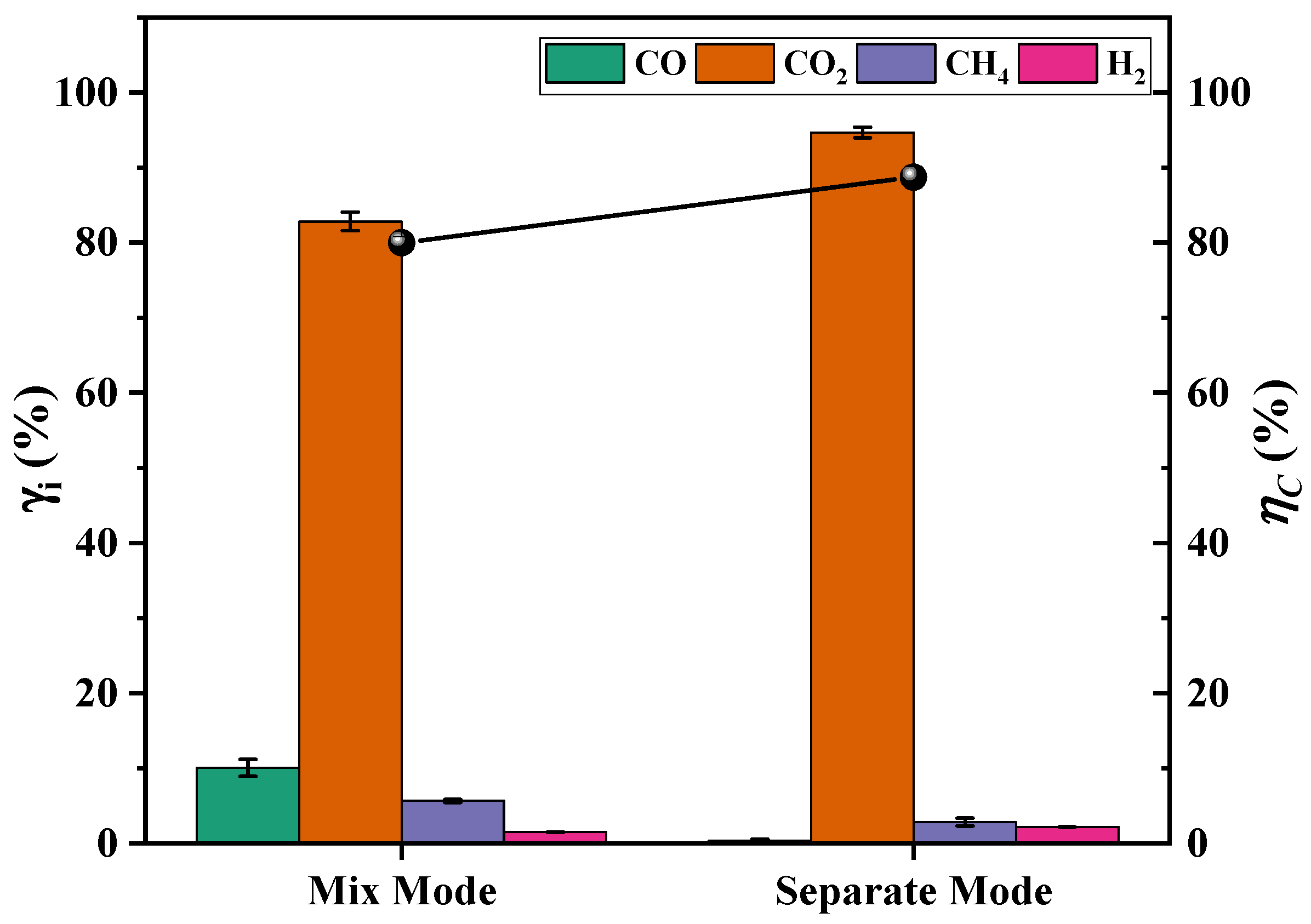
The gasification contact mode plays a crucial role in the syngas conversion efficiency of BCLC. As shown in Figure 2 and Figure 3, on PS, at 950 °C and 30% H2O, the separated contact mode achieves superior performance, with a CO2 concentration peak and a combustion efficiency is 24.04% (vs. 22.18% in the mixed mode) and 89% (vs. 79% in the mixed mode), respectively. This increase is attributed to the quick generation and then limited residence time of syngas in the mixed mode between the biomass and OC. In the separated mode, the syngas generated in the first reactor serves as the fluidizing gas in the second reactor filled with OC, which allows it to sufficiently interact with the OC. Additionally, the perovskite OC preferentially oxidizes CO due to its high reactivity and simple reaction pathway (CO + O → CO2), which reduces the CO yield from 10.04% to 0.34%, while the CH4 yield decreases from 5.65% to 2.81% because of its higher activation energy requirements. The separated mode improves syngas conversion from volatile compound–rich biomass by aligning gas generation with the redox capacity of the OC, thereby maximizing carbon utilization and combustion efficiency. This also suggests that the gas–solid contact should be considered in industrial plants.

3.3. Performance of Biomass Pyrolysis and Gasification in the Separated Mode

BCLC comprises two distinct stages, i.e., pyrolysis and gasification. The reactivity of the OC varies between these stages, necessitating the separate evaluation of its performance in each stage. Experimental results demonstrate that the separated mode yields a higher combustion efficiency and carbon conversion, more effectively reflecting the redox capability of the OC. Therefore, the reactivity of the OC toward the products of biomass pyrolysis and gasification was investigated under separated mode conditions. Furthermore, fuels employed in experiments, i.e., in situ produced biomass pyrolysis gas and gasification gas, better reflect practical conditions than synthetic gas mixtures typically used in laboratory studies.

3.3.1. Conversion of the In Situ Pyrolysis Gas from Biomass by OC

Biomass pyrolysis involves the thermochemical decomposition of organic materials under limited-oxygen or anaerobic conditions via sequential reactions, including dehydration, depolymerization, isomerization, decarboxylation, and carbonization. This process generates three primary product streams: pyrolysis oil (e.g., tars and aromatic hydrocarbons), noncondensable gases (e.g., CO, CO2, H2, C1–C4 hydrocarbons, and H2S [37]), and solid residues (e.g., biochar and ash). In CLC, OCs directly interact with pyrolysis-derived volatiles via gas–solid redox reactions. The OCs facilitate the oxidation of combustible gases (e.g., CO, H2, and CH4) and catalytically reform tar via partial oxidation [38]. Simultaneously, alkali metals (e.g., K and Na) and contaminants (e.g., S, Cl, and heavy metals) in biomass are deposited onto OC surfaces [39], leading to the deactivation of OCs via three primary mechanisms: (1) pore blockage due to ash agglomeration, (2) active site poisoning due to sulfate/chloride formation [40], and (3) structural degradation due to redox-induced phase transformations.
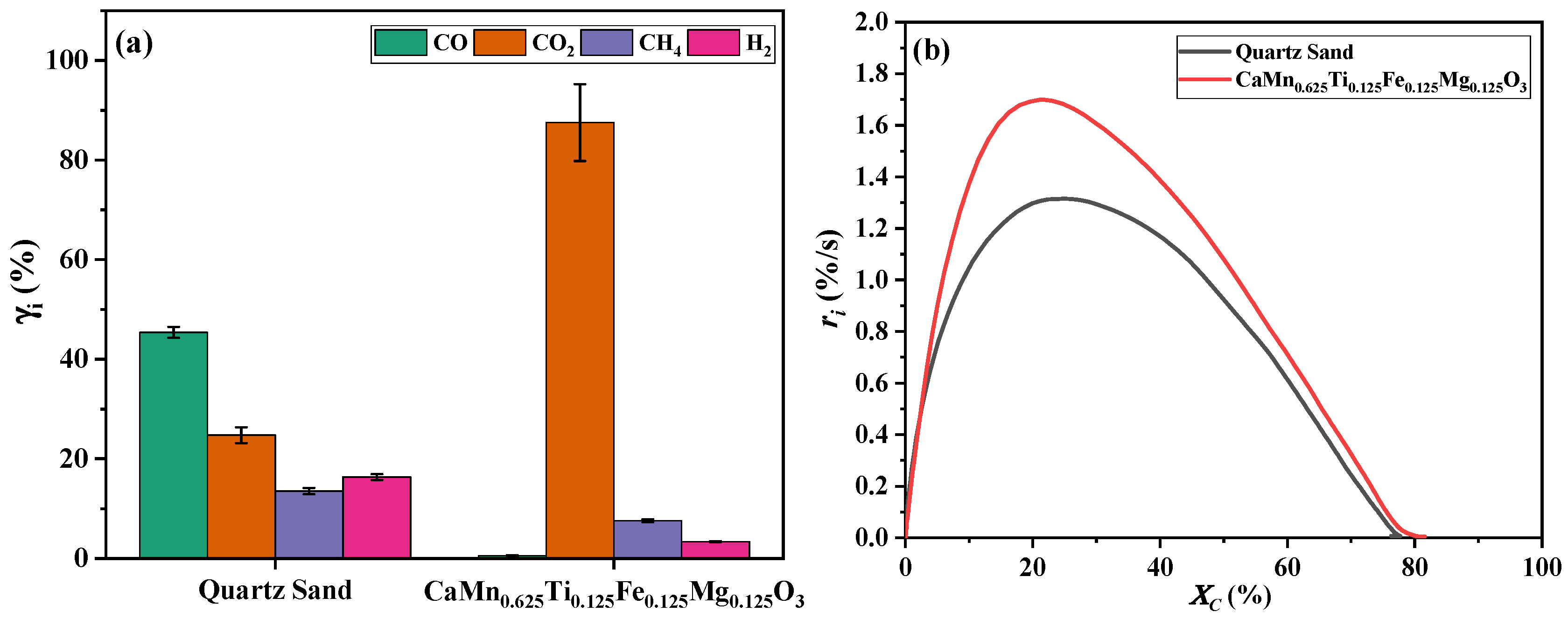
PS underwent fast pyrolysis in a dual-stage fluidized bed reactor in an N2 carrier gas to generate pyrolysis volatiles. CaMn0.625Ti0.125Fe0.125Mg0.125O3 exhibits a significant oxygen uncoupling capacity at high temperatures, enabling the release of gaseous oxygen for syngas conversion. As shown in Figure 4a, the primary pyrolysis product at 850 °C is CO (yield = 45.39%) in the absence of OCs. After OC introduction, catalytic oxidation converts 99% of CO to CO2, reducing the CO yield to 0.52% and increasing the CO2 yield from 24.75% to 84.52%. Concurrently, H2 and CH4 yields decrease, but the reduction in the CH4 yield is less pronounced (13.51% → 7.59%) than that in the H2 yield because of kinetic limitations from gas-phase diffusion barriers and high activation energy (≥120 kJ/mol) [41].
Figure 4b shows the OC-mediated carbon conversion dynamics. During the initial reaction stages (carbon conversion = 0–2.5%), OCs exhibit a negligible enhancement in the conversion rates due to a high syngas flux. Progressive pyrolysis intensifies the catalytic effects of the OC, resulting in an increase in the peak carbon conversion rates from 1.38%/s (quartz sand) to 1.68%/s (OCs). Notably, introducing OCs does not alter the total carbon conversion efficiency (21.39% vs. 23.68% for inert bed materials), probably because unconverted carbon compounds, such as C2H4, tar, or undetectable heavy hydrocarbons, are converted to measurable CO2 [42], thus confirming their role in accelerating kinetics without modifying thermodynamic equilibria.

3.3.2. Effect of OC on In Situ Biomass Char Gasification Gas

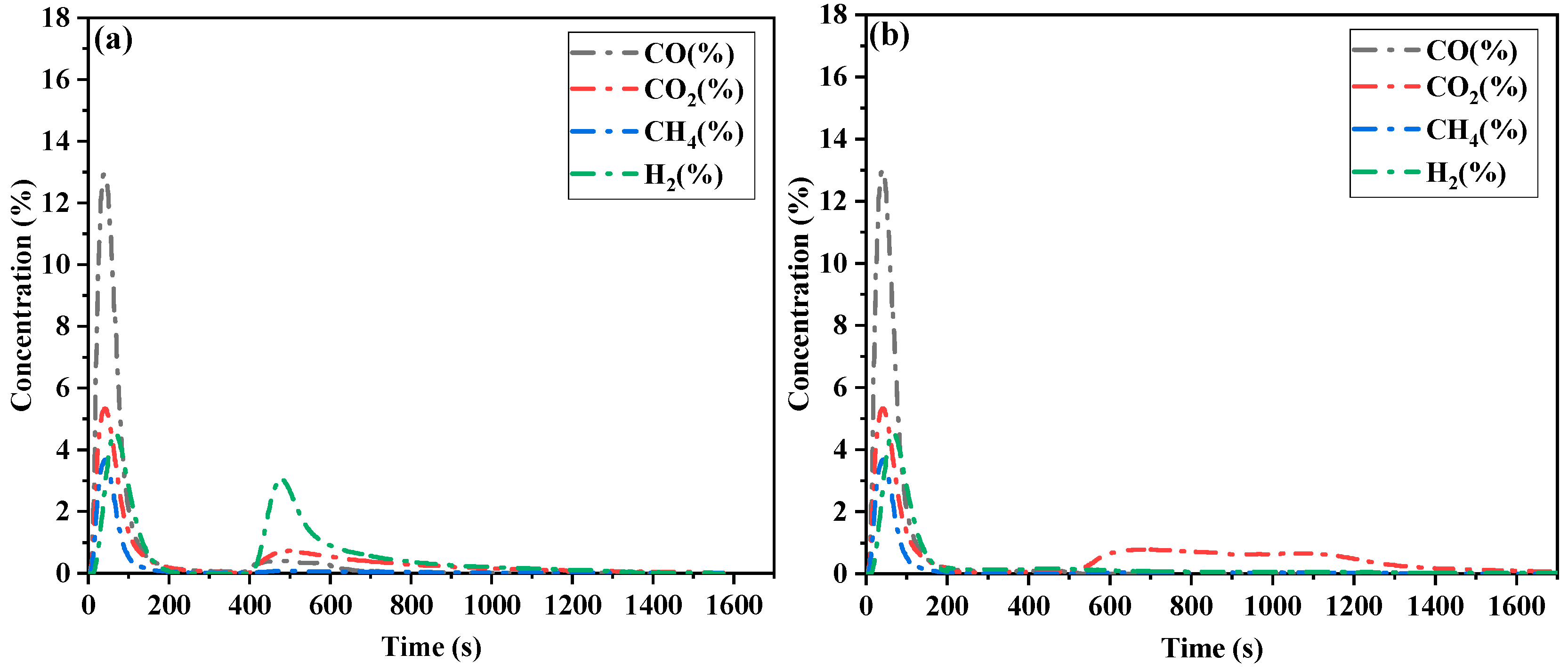
In situ produced biochar, which is the carbon-rich solid residue produced during biomass pyrolysis, undergoes steam-assisted gasification (C + H2O → CO + H2; CO + H2O ⇌ CO2 + H2) to generate syngas for subsequent OC-mediated combustion. At 850 °C and 30 vol.% H2O (N2 balance), PSC is gasified after complete pyrolysis (200 s in an N2 atmosphere), producing syngas primarily composed of H2, with a peak concentration of 3.05%, and smaller amounts of CO, CO2, and CH4 (Figure 5a). The gasification process lasts for 1000 s, after which the gas concentrations return to baseline levels. OC introduction results in the near-complete oxidation of the syngas, as indicated by the detection of only CO2 in the exhaust streams (Figure 5b).
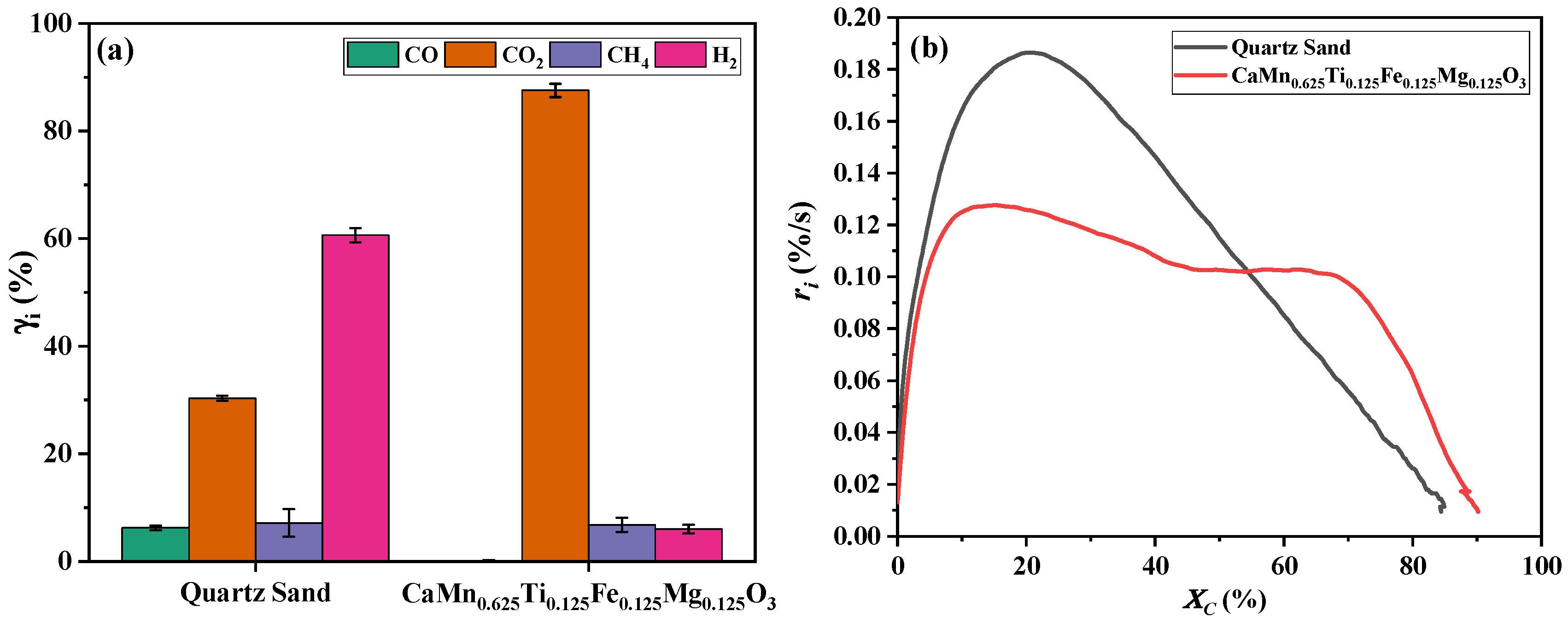
Figure 6a illustrates the effect of OCs on the gas yield and carbon conversion kinetics. After the addition of the OC, the CO2 yield considerably increases from 30.31% (inert bed) to 87.54% (OC bed), while the H2 yield sharply decreases from 60.63% to 5.97%. This shows the selective oxidation behavior of OCs, where CO preferentially adsorbs onto active sites for rapid oxidation (CO + O* → CO2), whereas H2 requires dissociative adsorption (H2 → 2H) and a higher activation energy to form H2O [43]. The CH4 yield remains stable (~3.5%) because of kinetic limitations in C–H bond cleavage. Transition metals, such as Fe, within the perovskite structure catalyze tar cracking, converting macromolecular carbon into CO2 via surface-mediated oxidation, thereby improving the carbon conversion efficiency. The carbon conversion rates exhibit distinct profiles: a unimodal curve on quartz sand (indicating single-step gasification) and a bimodal trend in OC systems (Figure 6b). The secondary peak is due to CO disproportionation (2CO → C + CO2), which temporarily suppresses conversion rates before steam reforming becomes dominant [44].

3.4. Effect of the Temperature and B/O Ratio

3.4.1. Conversion of Pyrolysis Products in the Separated Mode

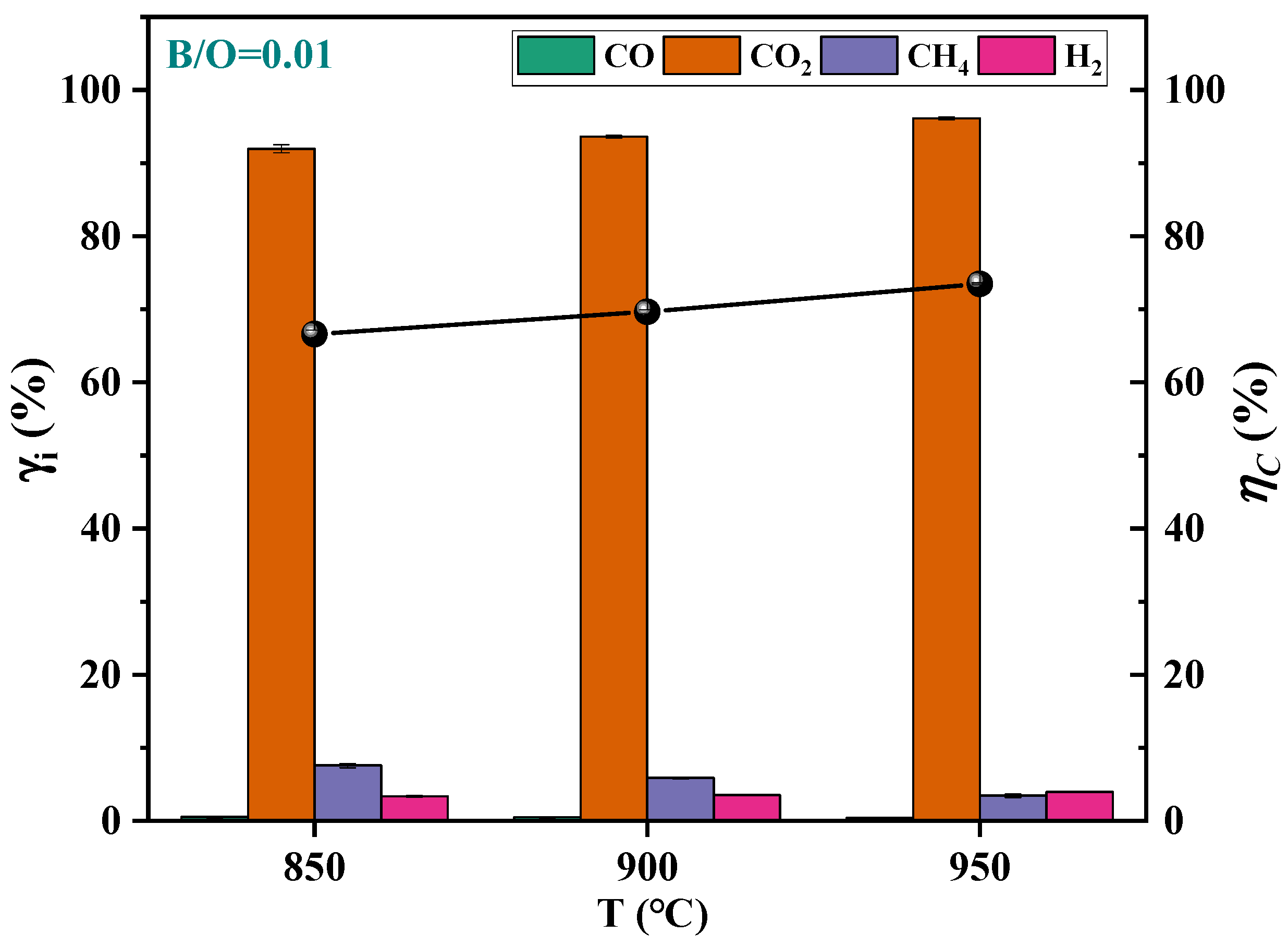
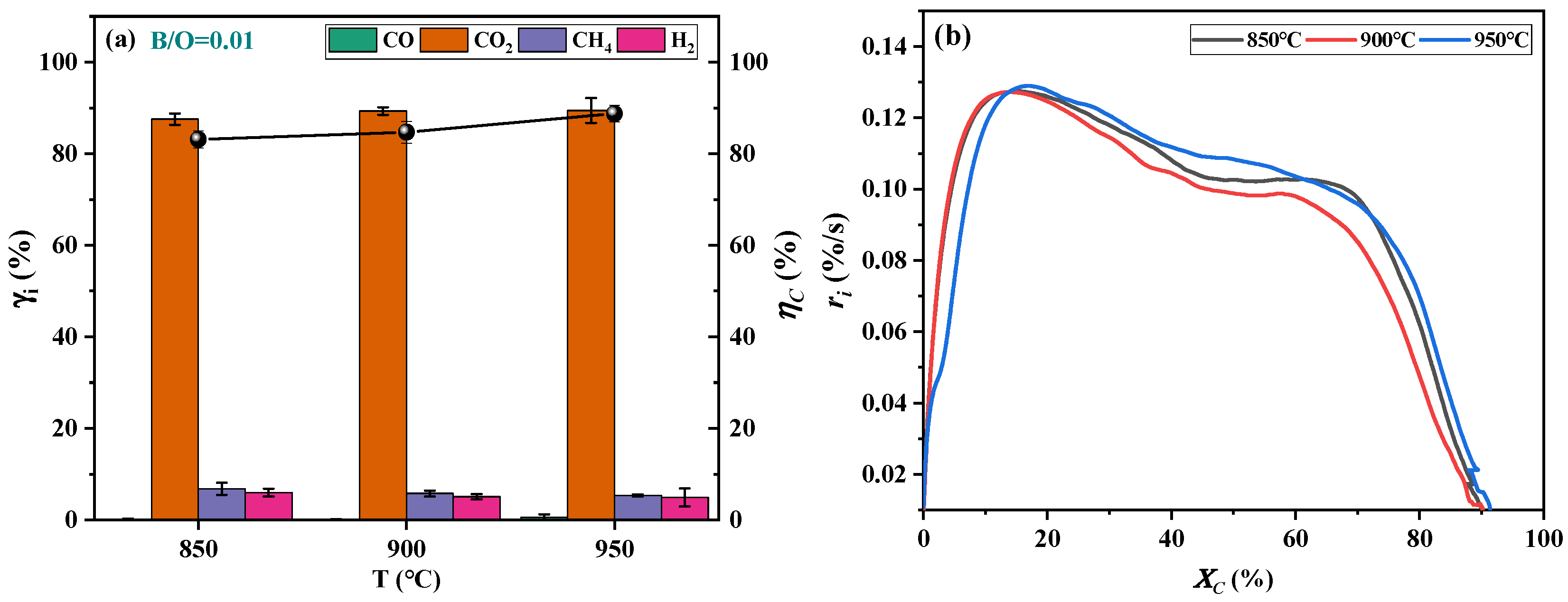
The temperature critically modulates biomass pyrolysis dynamics and combustion efficiency in chemical looping systems, as demonstrated by the thermochemical evolution of PS in different thermal regimes (850–950 °C). As shown in Figure 7, CaMn0.625Ti0.125Fe0.125Mg0.125O3 facilitates the oxidative conversion of pyrolysis volatiles at 850 °C, achieving a CO2 yield of 87.52% via preferential CO oxidation and partial tar cracking. When the temperature increases to 900 °C, gas-phase oxidation kinetics are enhanced, increasing the CO2 yield to 93.62% via intensified tar decomposition (92%) and steam-assisted reforming (H2 yield = 4.2% → 6.7%, ΔT = +50 °C). After further heating to 950 °C, the CO2 yield marginally improves (95.4%), but the carbon conversion efficiency is the same (25.1%), reflecting thermodynamic equilibrium constraints.
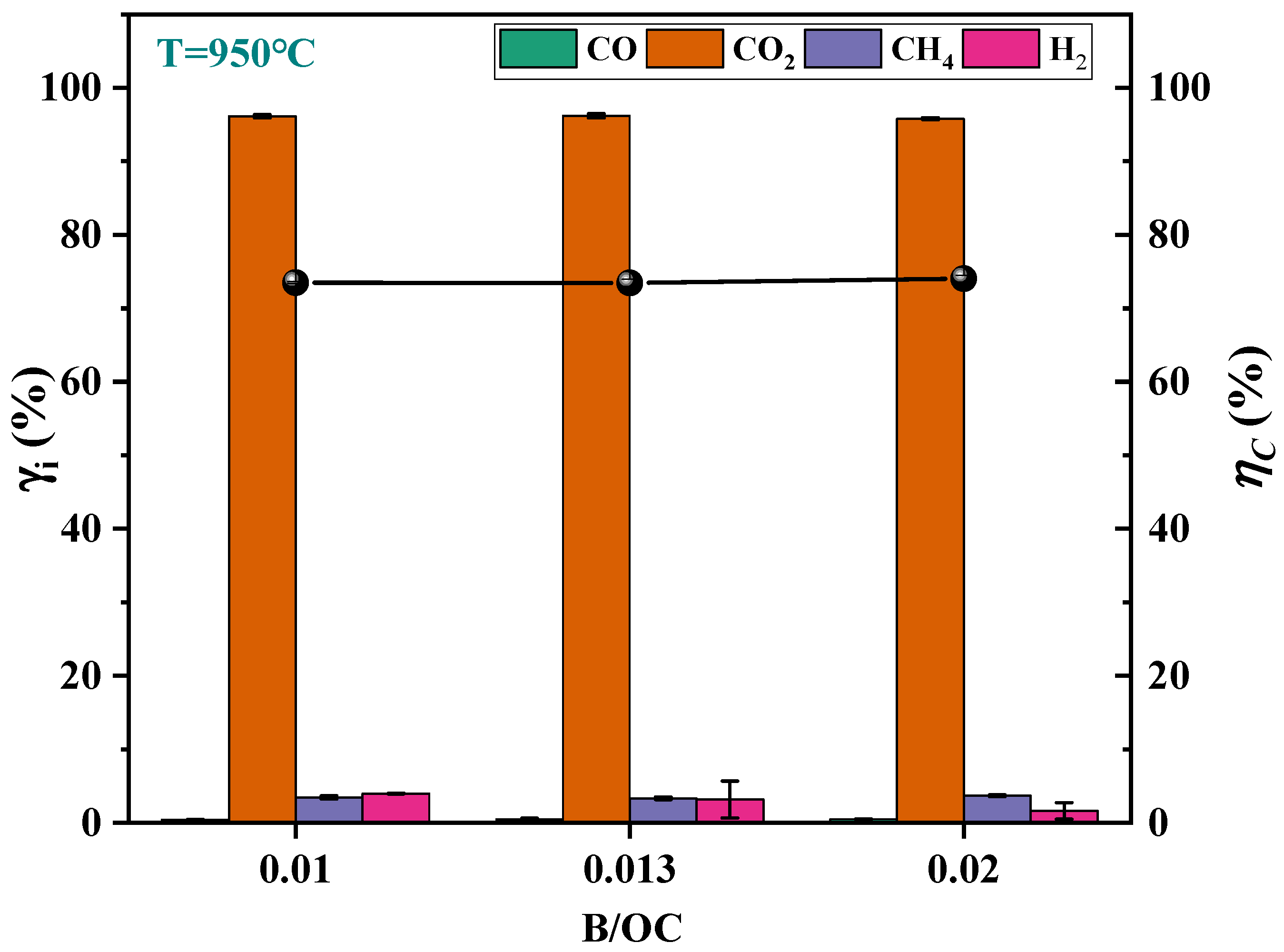
The oxygen-to-fuel ratio plays a critical role in determining the combustion efficiency, product distribution, and environmental impact in CLC systems. Excess oxygen promotes complete combustion, reducing the emissions of CO and unburned hydrocarbons while improving the energy conversion efficiency. However, this is accompanied by drawbacks: increased NOx formation and higher auxiliary energy consumption for oxygen supply. By contrast, insufficient oxygen leads to incomplete fuel conversion, resulting in high concentrations of greenhouse gases (e.g., CO) and volatile organic compounds (VOCs) [45]. To address this trade-off, we adjusted the B/O ratio, which utilizes the oxygen uncoupling capability of perovskite materials. Figure 8 shows the combustion performance of CaMn0.625Ti0.125Fe0.125Mg0.125O3 at 950 °C at different B/O ratios, which demonstrates that increasing the B/O ratio from 0.01 to 0.02 has a negligible effect on the combustion efficiency, which remains stable at ~74%. This is because of the superior oxygen release capacity of the perovskite, with 30 g of the OC providing more gaseous oxygen than is required for the complete combustion of PS. However, as the B/O ratio increases, the H2 yield significantly decreases from 3.9% to 1.6% while the CH4 yield remains constant at ~3.5%. This decrease in the H2 yield is attributed to the reduced catalytic activity of the perovskite at higher concentrations of biomass-derived syngas because at high concentrations surface-active sites become saturated, hindering steam reforming reactions (CxHy + H2O → CO + H2).

3.4.2. Conversion of Gasification Products in the Separated Mode

Temperature-dependent analysis (Figure 9) shows that the combustion efficiency increases from 83.13% at 850 °C to 88.75% at 950 °C due to improved redox kinetics. At 950 °C, the initial carbon conversion rates decrease because of the dominance of CO disproportionation. However, subsequent steam reforming increases the rates (1.58%/s vs. 1.12%/s at 900 °C). This thermochemical interaction underscores the dual role of the temperature in modulating reaction pathways (disproportionation vs. oxidation) and optimizing carbon utilization.
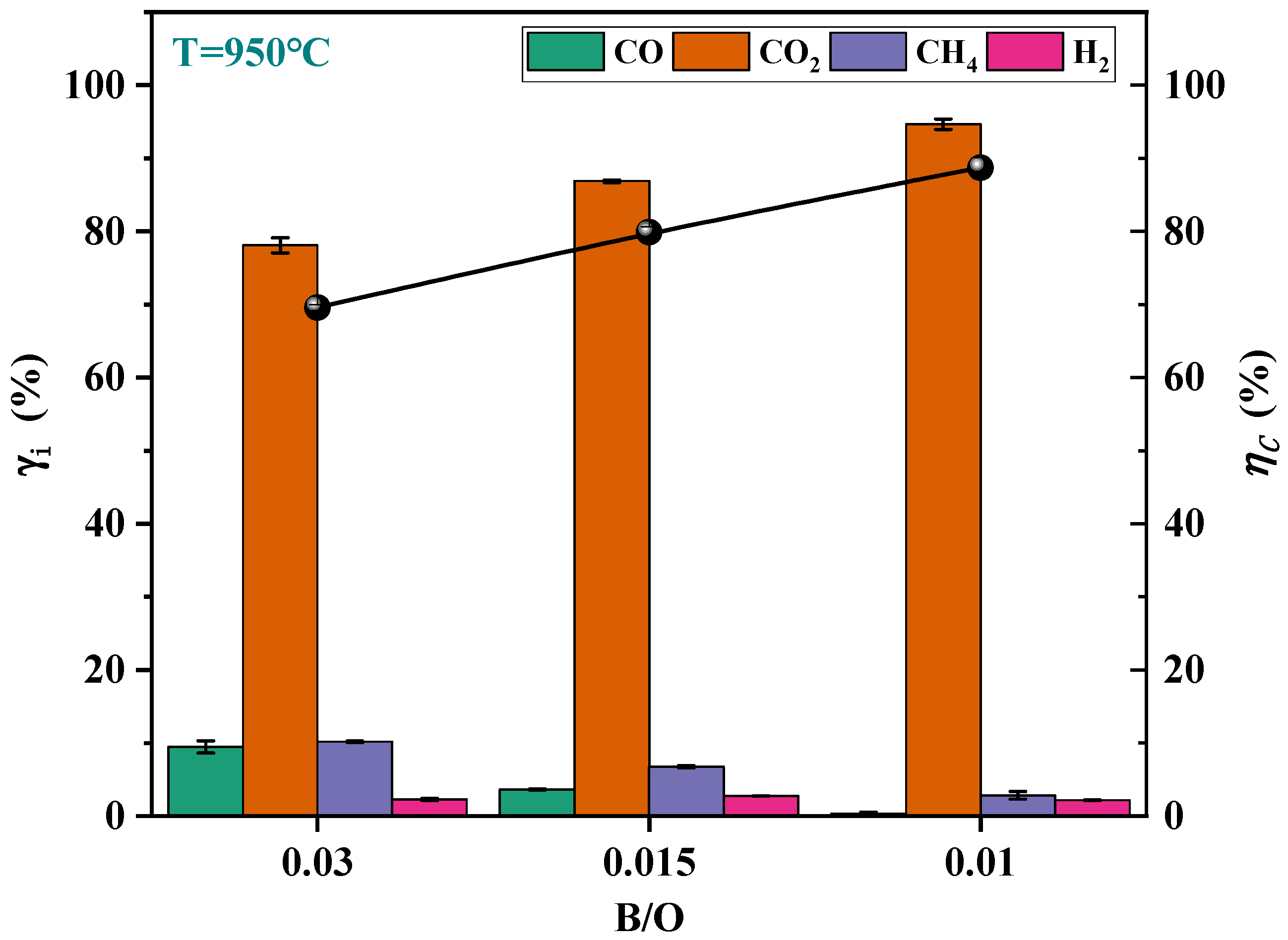
In the separated gasification CLC experiments, 0.3 g of biomass char was used, and the B/O ratio was adjusted by varying the OC mass (10, 20, and 30 g), which is different from the separated pyrolysis CLC mode. As illustrated in Figure 10, at 950 °C, a B/O ratio of 0.03 (10 g of OC) yields 78.1% of CO2, along with 9.46% of CO and 10.15% of CH4. When the B/O ratio decreases to 0.01 (30 g of OC), the CO and CH4 yields decrease to 0.34% and 2.83%, respectively, while the CO2 yield increases to 94.66%. Correspondingly, the combustion efficiency increases from 69.57% to 88.71%. These results indicate that a higher OC loading markedly improves biomass char gasification gas conversion by supplying abundant active sites and lattice oxygen, thereby promoting the oxidation of unconverted CO and CH4.

3.5. Characterization of OCs

3.5.1. FESEM

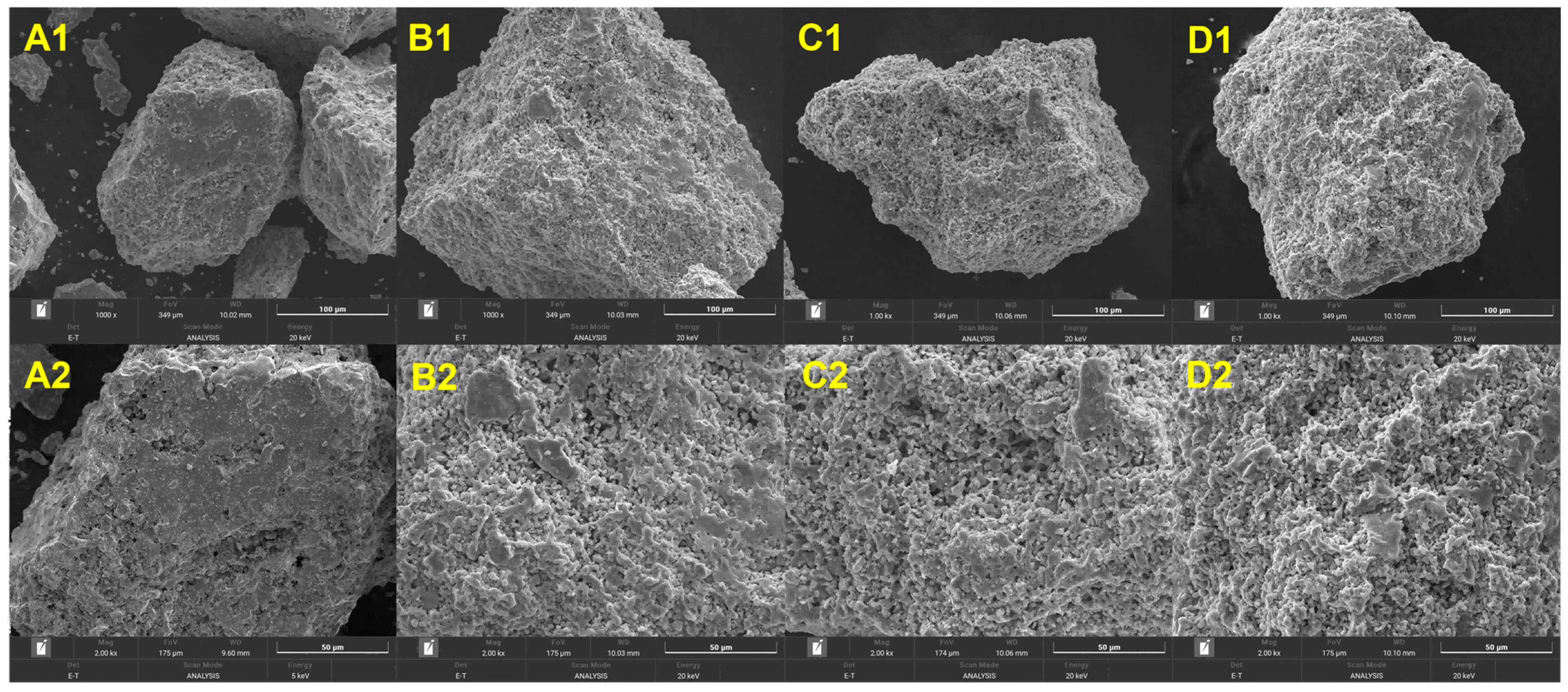
Field-emission SEM (FESEM) was employed to study the apparent morphology of the OC under different experimental conditions. As shown in Figure 11, the fresh OC (Figure 11(A1,A2)), synthesized via the solid-state method, exhibits a smooth surface with well-developed porous structures. After mixed combustion (Figure 11(B1,B2)), the average particle size of the OC markedly increases from 157.14 to 300.21 μm. This increase is attributed to biomass ash deposition on the OC surface, resulting in direct contact between the OC and fuel during combustion. After separated gasification (Figure 11(C1,C2)) and pyrolysis (Figure 11(D1,D2)), the OC surface becomes rough due to thermal stress and redox reactions, with increased porosity in nonsintered regions.

3.5.2. EDS

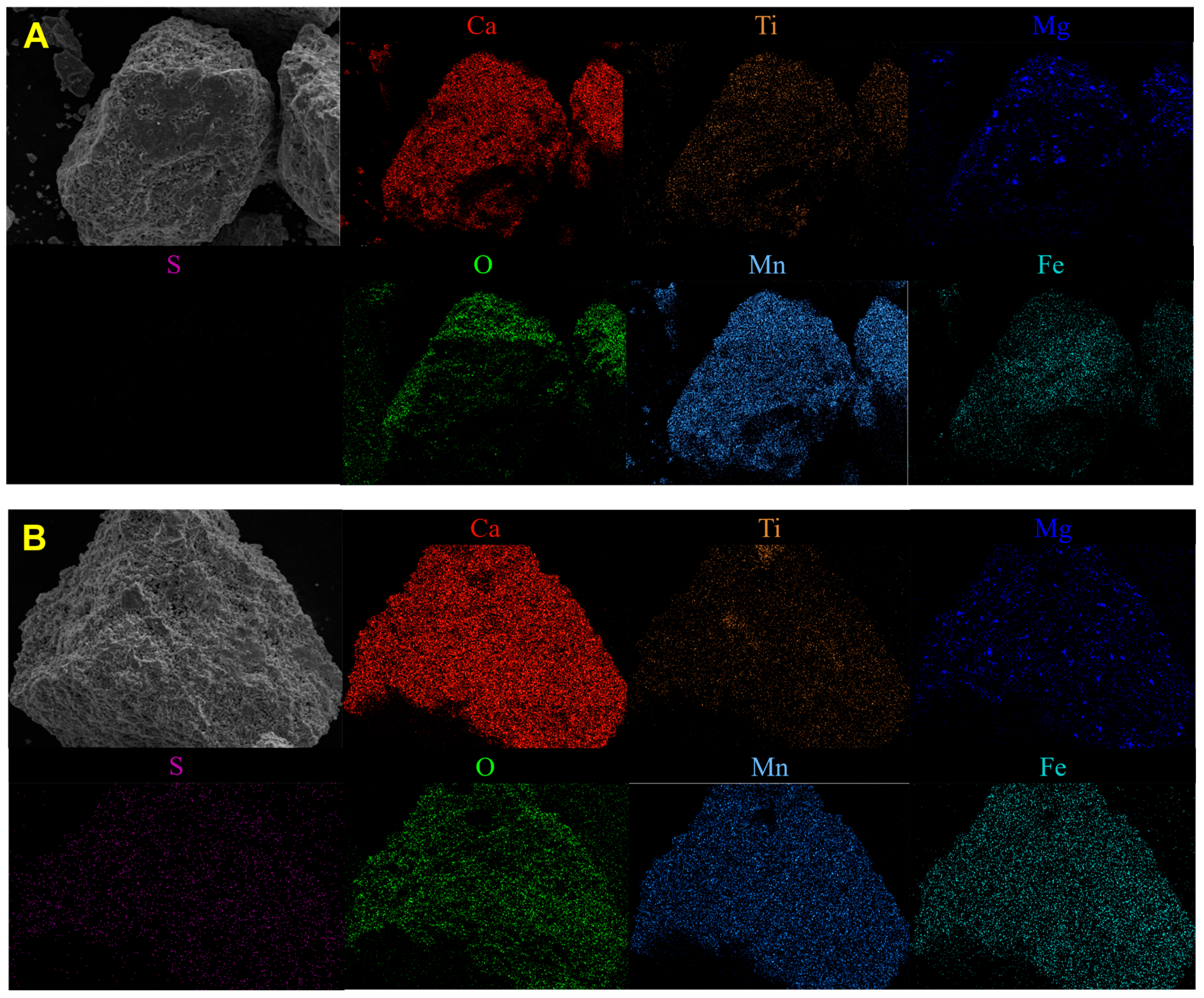
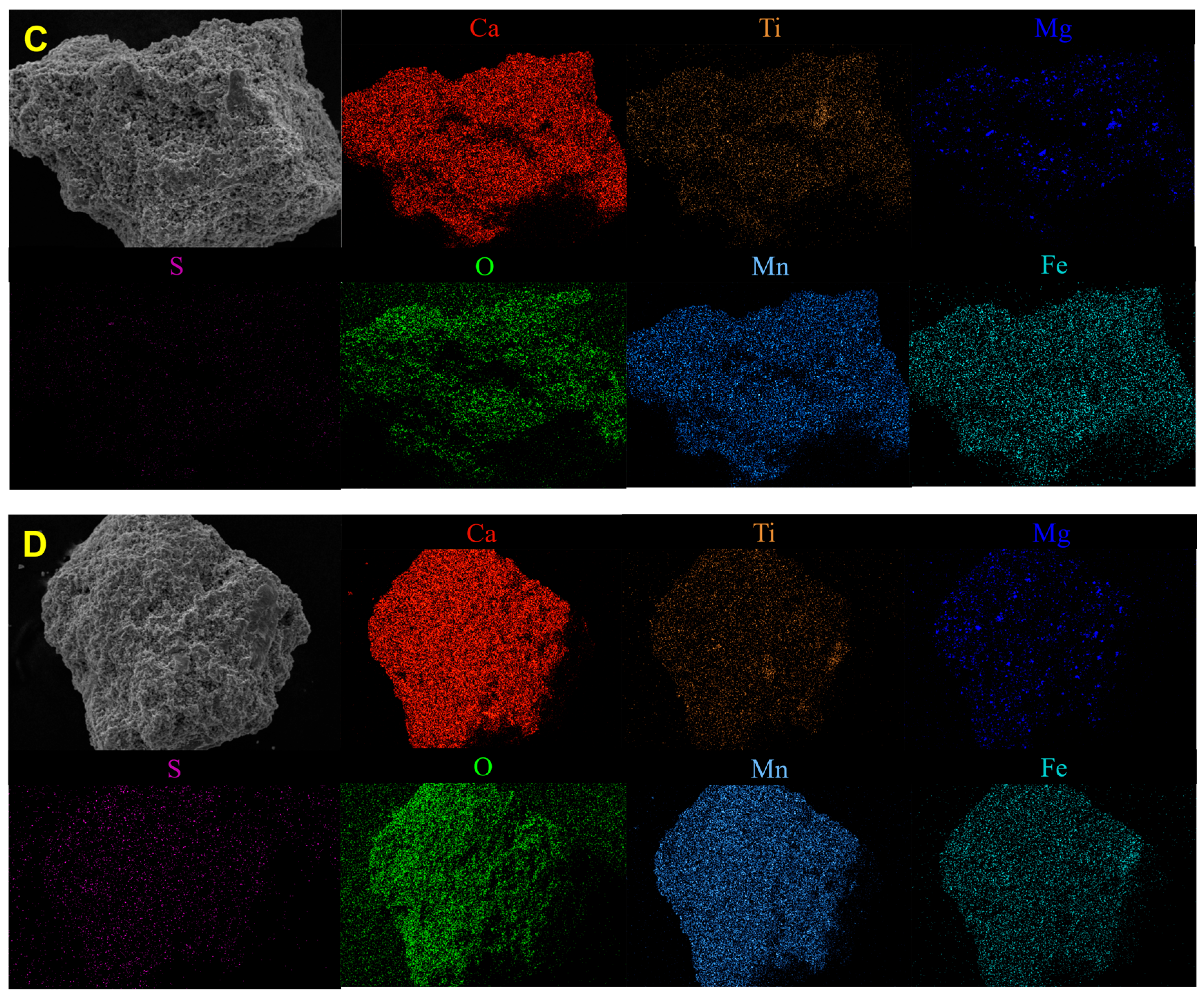
EDS mapping reveals a homogeneous distribution of Ca, Mn, Ti, Fe, and O on the surfaces of fresh and reacted OCs, confirming the structural integrity of the perovskite matrix. Mg is slightly separated on OC, probably due to its lower ionic mobility in the lattice. Notably, S is not detected in fresh OCs (Figure 12A) but is detected in all reacted OCs (Figure 12B–D), appearing as discrete hotspots on their surfaces. After CLC in the mixed mode, sulfur detected on the OC surface may have originated from the biomass ash deposited on OC particles during combustion. By contrast, after CLC in the separated mode, sulfur detected on the OC surface may have originated only from gaseous sulfur compounds (e.g., H2S and SO2) generated during biomass pyrolysis/gasification. This evidence indicates that the separated combustion mode not only enhances combustion efficiency but also establishes traceable corrosion pathways for acidic elements to degrade the OC.

3.5.3. BET

Table 4 shows the Brunauer–Emmett–Teller (BET) analysis results of the OCs, which show that the specific surface area of the OC increases from 0.19 m2/g to 0.34, 0.87, and 0.75 m2/g, respectively, while the pore volume and pore size remain almost unchanged. This is attributed to (1) the capacity of CaMn0.625Ti0.125Fe0.125Mg0.125O3 OC to release gaseous O2 and (2) structural lattice changes during redox cycles that facilitate the formation and expansion of O2 release pathways, which result in the better development of particle microporosity. Notably, the specific surface areas of the separated pyrolysis and gasification samples are 2.4 and 2.3 times greater than those of the mixed combustion samples, respectively. This difference can be attributed to biomass ash accumulation, which is in agreement with the SEM results (Figure 11(B1,B2)). This demonstrates that intensive gas-phase redox cycling enriches the pore structure of the OC, increasing the gas–solid contact area and thereby improving its reactivity.

3.5.4. XRD

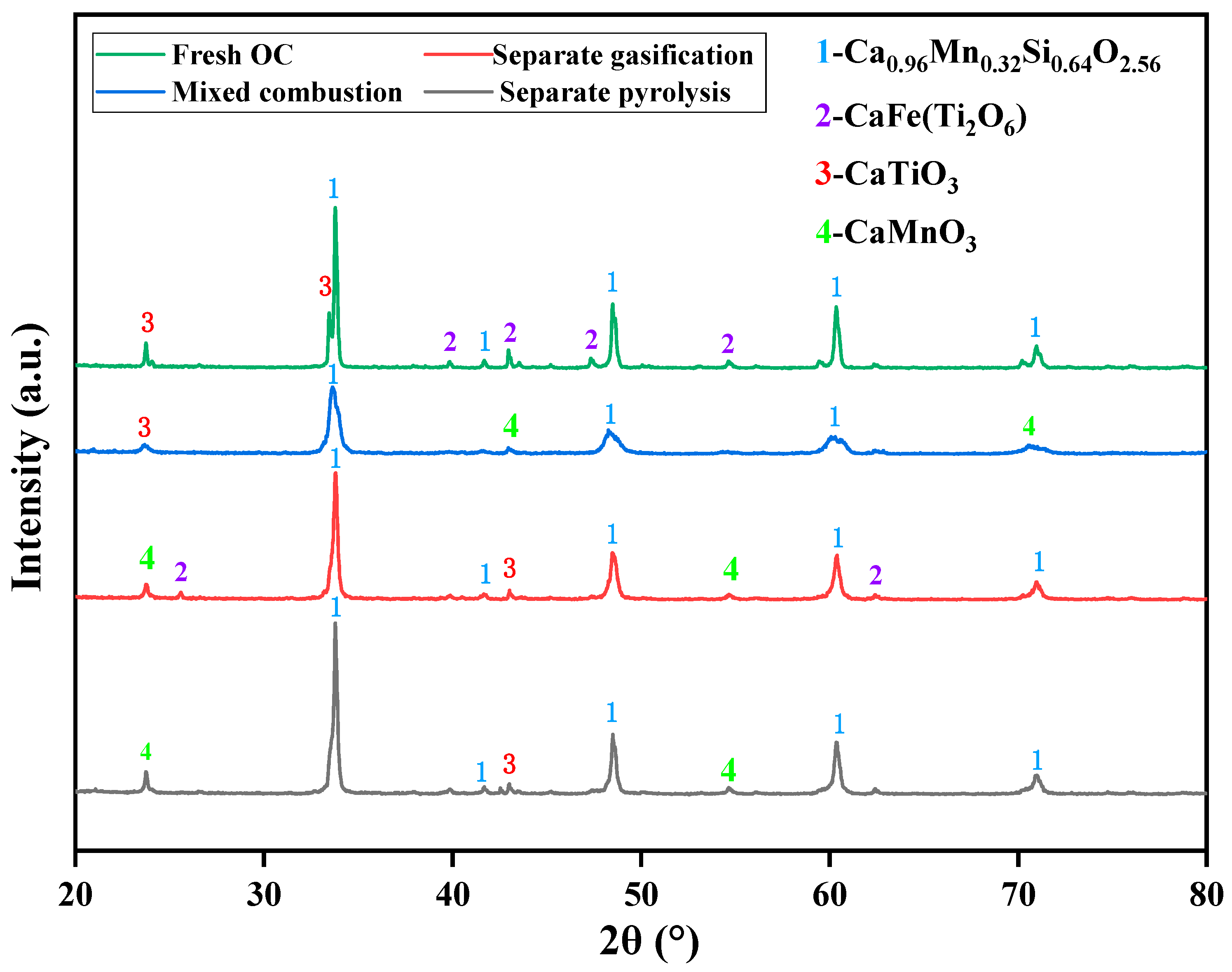
The XRD patterns of the samples are presented in Figure 13. The primary crystalline phases of the fresh sample synthesized via ball milling and high-temperature calcination are CaTiO3, CaFe(Ti2O6), and Ca0.96Mn0.32Si0.64O2.56. These phases serve as the main redox-active components. In the samples reacted under the three conditions, a new phase, CaMnO3, is detected, which represents the decomposition product of the pristine inclusion crystals subjected to cyclic redox stress. The crystalline phases observed in the XRD patterns are consistent with previous reports on Ca–Mn–Ti–Fe perovskite systems [46,47]. Concurrently, the peak intensities of CaTiO3 and Ca0.96Mn0.32Si0.64O2.56 decrease, indicating the partial amorphization or grain size refinement of the particle structure [43,44]. Notably, the main active phases (CaTiO3 and Ca0.96Mn0.32Si0.64O2.56) maintain their structural integrity despite phase segregation, confirming the resistance of CaMn0.625Ti0.125Fe0.125Mg0.125O3 to bulk degradation. The absence of Fe- or Mg-containing secondary phases indicates that the dopants are effectively stabilized within the perovskite lattice, preventing cation migration. The OCs demonstrate robust performance in BCLC systems, where ash-mediated surface reactions primarily govern long-term phase evolution without compromising redox functionality. Notably, while no sulfide crystalline phases are detected in any samples, sulfur dispersion on particle surfaces is identified via EDS analysis. This apparent discrepancy can be attributed to the limited number of experimental cycles, resulting in the insufficient sulfur-induced degradation of the OC to generate crystalline reaction products with a detectable signal intensity.

4. Conclusions

In this paper, a perovskite-type oxygen carrier, CaMn0.625Ti0.125Fe0.125Mg0.125O3, was synthesized via a solid-state method, and its performance in biomass chemical looping combustion (BCLC) was evaluated in a dual-stage fluidized bed reactor using PS and PSC as fuels. Performance metrics (i.e., combustion efficiency and CO2 yield) and the morphological/mineralogical evolution of the OC were systematically investigated under different combustion modes (mixed vs. separated), temperatures, and B/O ratios. The novelty of this work lies in the first evaluation of CaMn0.625Ti0.125Fe0.125Mg0.125O3 in BCLC and in demonstrating that a two-stage configuration (decoupling biomass conversion from OC oxidation) can enhance gas–solid contact and improve overall conversion. The main conclusions of the study are as follows:
(1)
The separated combustion mode demonstrates superior performance to the mixed mode, yielding significantly higher peak CO2 concentrations (24.04% vs. 12.81%) and combustion efficiencies (89% vs. 79%), along with substantial reductions in CO and CH4 emissions, than the mixed combustion mode.
(2)
CaMn0.625Ti0.125Fe0.125Mg0.125O3 markedly enhances the oxidation of gaseous products during biomass pyrolysis and char gasification. The CO2 yields increase from 24.75% and 30.31% (without the OC) to 84.52% and 87.54% (with the OC), respectively, while CO and H2 yields decrease significantly.
(3)
The temperature and B/O ratio significantly influence the CO2 yield and combustion performance. High temperatures enhance oxygen release kinetics and catalytic activity, improving carbon conversion. While low B/O ratios significantly boost the combustion efficiency and suppress CO/CH4 emissions, excessive fuel concentrations saturate active sites, inhibiting catalytic functions.
(4)
Characterization results confirm that the OC maintains overall structural robustness during BCLC, while surface evolution is mainly governed by ash/impurity deposition and redox cycling: SEM/EDS shows evident surface morphological changes and the appearance of sulfur on reacted particles; BET indicates an increased specific surface area after cycling; and XRD suggests that the main crystalline phases remain identifiable with limited phase evolution under the tested cycles.
In summary, the perovskite-type CaMn0.625Ti0.125Fe0.125Mg0.125O3 OC demonstrates excellent oxygen release capacity and catalytic activity in BCLC, particularly under separated combustion conditions. This significantly enhances the combustion efficiency and CO2 yield while reducing the emission of hazardous gases.

Author Contributions

Methodology, Y.M. and J.M.; Formal analysis, Y.M. and W.L.; Investigation, W.L.; Resources, J.M.; Data curation, Y.M. and W.L.; Writing—original draft, W.L.; Writing—review & editing, Y.M.; Supervision, J.M. and Z.D.; Project administration, J.M., Z.D. and H.Z.; Funding acquisition, H.Z. All authors have read and agreed to the published version of the manuscript.

Funding

This work was supported by National Natural Science Foundation of China (Nos. 52176107 and 52025063) and State Key Laboratory of Clean and Efficient Coal Utilization, Taiyuan University of Technology (Grant No. MJNYSKL202507). The staff from the Analytical and Testing Center at Huazhong University of Science and Technology are appreciated for the relevant analytical work.

Data Availability Statement

The data presented in this study are available on request from the corresponding author. The data are not publicly available due to privacy.

Conflicts of Interest

The authors declare no conflicts of interest.

References

  1. Cabello, A.; Abad, A.; Gayán, P.; de Diego, L.F.; Garcia-Labiano, F.; Adanez, J. Effect of operating conditions and H2S presence on the performance of CaMg0.1Mn0.9O3−δ perovskite material in chemical looping combustion (CLC). Energy Fuels 2014, 28, 1262–1274. [Google Scholar] [CrossRef]
  2. Hu, D.; Cao, G.; Du, M.; Huang, J.; Zhao, J.; Li, C.; Fang, Y. Insight into the biomass pyrolysis volatiles reaction with an iron-based oxygen carrier in a two-stage fixed-bed reactor. Chem. Eng. J. 2023, 465, 142860. [Google Scholar] [CrossRef]
  3. Bhui, B.; Prabu, V. Experimental and kinetic studies on in-situ CO2 gasification based chemical looping combustion of low ash coal using Fe2O3 as the oxygen carrier. J. CO2 Util. 2019, 291, 103–116. [Google Scholar] [CrossRef]
  4. Zhao, X.; Zhou, H.; Sikarwar, V.-S.; Zhao, M.; Park, A.H.A.; Fennell, P.S.; Shen, L.; Fan, L. Biomass-based chemical looping technologies: The good, the bad and the future. Energy Environ. Sci. 2017, 10, 1885–1910. [Google Scholar] [CrossRef]
  5. Liu, L.; Li, K.; Liu, H.; Sun, Z. A DFT-based kinetic model for Cu-Al oxygen carrier material in chemical looping with oxygen uncoupling. Fuel 2025, 381, 133572. [Google Scholar] [CrossRef]
  6. Zhou, Z.; Lu, H.; Nordness, O.; Bollas, G.M. Continuous regime of chemical-looping combustion (CLC) and chemical-looping with oxygen uncoupling (CLOU) reactivity of CuO oxygen carriers. Appl. Catal. B Environ. 2015, 166, 132–144. [Google Scholar] [CrossRef]
  7. Cormos, C.C. Assessment of copper-based chemical looping air separation system for energy efficiency improvements of oxy-combustion and gasification power plants. Appl. Therm. Eng. 2018, 130, 120–126. [Google Scholar] [CrossRef]
  8. Idziak, K.; Czakiert, T.; Krzywanski, J.; Zylka, A.; Kozlowska, M.; Nowak, W. Safety and environmental reasons for the use of Ni-, Co-, Cu-, Mn- and Fe-based oxygen carriers in CLC/CLOU applications: An overview. Fuel 2020, 268, 117245. [Google Scholar] [CrossRef]
  9. Li, X.; Faust, R.; Purnomo, V.; Mei, D.; Linderholm, C.; Lyngfelt, A.; Mattisson, T. Performance of a perovskite-structured calcium manganite oxygen carrier produced from natural ores in a batch reactor and in operation of a chemical-looping combustion reactor system. Chem. Eng. J. 2024, 497, 154516. [Google Scholar] [CrossRef]
  10. Li, C.; Soh, K.C.K.; Wu, P. Formability of ABO3 perovskites. J. Alloys Compd. 2004, 372, 40–48. [Google Scholar] [CrossRef]
  11. Kumar, S.; Zhuo, C.; Sudeshna, G.; Qin, L.; Colijn, H.; Mohammad, Z.; Fan, L. Nanoscale structural transformations in LaFeO3 oxygen carriers for enhanced reactivity in chemical looping combustion. Powder Technol. 2024, 444, 119988. [Google Scholar] [CrossRef]
  12. Liang, W.; Wang, F.; Wang, C.; Yang, H.; Cui, W.; Yue, G. Investigation on the oxygen-carrying performance and reaction kinetics of CaMnxFe1-xO3−δ perovskites prepared from red mud. Fuel 2023, 331, 125929. [Google Scholar] [CrossRef]
  13. Shen, X.; Sun, Y.; Wu, Y.; Wang, J.; Jiang, E.; Xu, X.; Su, J.; Jia, Z. The coupling of CH4 partial oxidation and CO2 splitting for syngas production via double perovskite-type oxides LaFexCo1-xO3. Fuel 2020, 268, 117381. [Google Scholar] [CrossRef]
  14. Zhang, Z.; Wang, Y.; Zhu, L.; Li, J.; Wang, F.; Yu, G. Performance of Fe2O3/Al2O3 oxygen carrier modified by CaCO3 and CaSO4 in chemical looping combustion. Appl. Therm. Eng. 2019, 160, 113813. [Google Scholar] [CrossRef]
  15. Patzschke, C.-F.; Boot-Handford, M.-E.; Song, Q.; Fennell, P.S. Co-precipitated Cu-Mn mixed metal oxides as oxygen carriers for chemical looping processes. Chem. Eng. J. 2021, 407, 127093. [Google Scholar] [CrossRef]
  16. Li, Z.; Larring, Y. Thermochemically stable novel oxygen carriers based on CaMn1-x-yTixFeyO3−δ for chemical looping. Energy Fuels 2024, 38, 15642–15651. [Google Scholar] [CrossRef]
  17. Galinsky, N.; Mishra, A.; Zhang, J.; Li, F. Ca1-xAxMnO3 (A = Sr and Ba) perovskite based oxygen carriers for chemical looping with oxygen uncoupling (CLOU). Appl. Energy 2015, 157, 358–367. [Google Scholar] [CrossRef]
  18. Mattisson-Henrik, T.-M.; Leion, D.; Jing, Z. Examination of perovskite structure CaMnO3−δ with MgO addition as oxygen carrier for chemical looping with oxygen uncoupling using methane and syngas. Int. J. Chem. Eng. 2013, 2013, 679560. [Google Scholar] [CrossRef]
  19. Rydén, M.; Lyngfelt, A.; Mattisson, T. CaMn0.875Ti0.125O3 as oxygen carrier for chemical-looping combustion with oxygen uncoupling (CLOU)—Experiments in a continuously operating fluidized-bed reactor system. Int. J. Greenh. Gas Control 2011, 5, 356–366. [Google Scholar] [CrossRef]
  20. Belviso, C. State-of-the-art applications of fly ash from coal and biomass: A focus on zeolite synthesis processes and issues. Prog. Energy Combust. Sci. 2018, 65, 109–135. [Google Scholar] [CrossRef]
  21. Zhou, T.; Zhang, W.; Shen, Y.; Luo, S.; Ren, D. Progress in the change of ash melting behavior and slagging characteristics of co-gasification of biomass and coal: A review. J. Energy Inst. 2023, 111, 101414. [Google Scholar] [CrossRef]
  22. Mlonka-Medrala, A.; Magdziarz, A.; Gajek, M.; Nowińska, K.; Nowak, W. Alkali metals association in biomass and their impact on ash melting behaviour. Fuel 2020, 261, 116421. [Google Scholar] [CrossRef]
  23. Hanning, M.; Corcoran, A.; Lind, F.; Rydén, M. Biomass ash interactions with a manganese ore used as oxygen-carrying bed material in a 12 MWth CFB boiler. Biomass Bioenergy 2018, 119, 179–190. [Google Scholar] [CrossRef]
  24. Bao, J.; Li, Z.; Cai, N. Interaction between iron-based oxygen carrier and four coal ashes during chemical looping combustion. Appl. Energy 2014, 115, 549–558. [Google Scholar] [CrossRef]
  25. Corcoran, A.; Marinkovic, J.; Lind, F.; Rydén, M. Ash properties of ilmenite used as bed material for combustion of biomass in a circulating fluidized bed boiler. Energy Fuels 2014, 28, 7672–7679. [Google Scholar] [CrossRef]
  26. Staničić, I.; Andersson, V.; Hanning, M.; Mattisson, T.; Backman, R.; Leion, H. Combined manganese oxides as oxygen carriers for biomass combustion—Ash interactions. Chem. Eng. Res. Des. 2019, 149, 104–120. [Google Scholar] [CrossRef]
  27. Gu, H.; Shen, L.; Zhong, Z.; Zhou, Y.; Liu, W.; Niu, X.; Ge, H.; Jiang, S.; Wang, L. Interaction between biomass ash and iron ore oxygen carrier during chemical looping combustion. Chem. Eng. J. 2015, 277, 70–78. [Google Scholar] [CrossRef]
  28. Gyllén, A.; Knutsson, P.; Lind, F.; Thunman, H. Magnetic separation of ilmenite used as oxygen carrier during combustion of biomass and the effect of ash layer buildup on its activity and mechanical strength. Fuel 2020, 269, 117470. [Google Scholar] [CrossRef]
  29. Dai, J.; Whitty, K. Effects of coal ash on CuO as an oxygen carrier for chemical looping with oxygen uncoupling. Energy Fuels 2018, 32, 11656–11665. [Google Scholar] [CrossRef]
  30. Zhang, S.; Gu, H.; Zhao, J.; Shen, L.; Wang, L. Development of iron ore oxygen carrier modified with biomass ash for chemical looping combustion. Energy 2019, 186, 115893. [Google Scholar] [CrossRef]
  31. Hildor, F.; Zevenhoven, M.; Brink, A.; Hupa, L.; Leion, H. Understanding the interaction of potassium salts with an ilmenite oxygen carrier under dry and wet conditions. ACS Omega 2020, 5, 22966–22977. [Google Scholar] [CrossRef] [PubMed]
  32. Eriksson, J.-E.; Zevenhoven, M.; Yrjas, P.; Brink, A.; Hupa, L. Corrosion of heat transfer materials by potassium-contaminated ilmenite bed particles in chemical-looping combustion of biomass. Energies 2022, 15, 2740. [Google Scholar] [CrossRef]
  33. Andersson, V.; Soleimanisalim, A.-H.; Kong, X.; Leion, H.; Mattisson, T.; Pettersson, J.B. Alkali interactions with a calcium manganite oxygen carrier used in chemical looping combustion. Fuel Process. Technol. 2022, 227, 10. [Google Scholar] [CrossRef]
  34. ASTM D7582-15; Standard Test Methods for Proximate Analysis of Coal and Coke by Macro Thermogravimetric Analysis. ASTM International: West Conshohocken, PA, USA, 2015.
  35. ASTM D5373-21; Standard Test Methods for Determination of Carbon, Hydrogen and Nitrogen in Analysis Samples of Coal and Carbon in Analysis Samples of Coal and Coke. ASTM International: West Conshohocken, PA, USA, 2021.
  36. Ma, J.; Mei, D.; Wang, C.; Tian, X.; Liu, Z.; Zhao, H. Sulfur fate during in-situ gasification chemical looping combustion (iG-CLC) of coal. Chem. Eng. J. 2021, 406, 126773. [Google Scholar] [CrossRef]
  37. Zhao, Y.; Yan, Y.; Jiang, Y.; Cao, Y.; Wang, Z.; Li, J.; Yan, C.; Wang, D.; Yuan, L.; Zhao, G. Release pattern of light aromatic hydrocarbons during the biomass roasting process. Molecules 2024, 29, 1188. [Google Scholar] [CrossRef]
  38. Jahangiri, H.; Bennett, J.; Mahjoubi, P.; Wilson, K.; Gu, S. A review of advanced catalyst development for Fischer-Tropsch synthesis of hydrocarbons from biomass derived syn-gas. Catal. Sci. Technol. 2014, 4, 2210–2229. [Google Scholar] [CrossRef]
  39. Zhang, Y.; Liang, Y.; Li, S.; Yuan, Y.; Zhang, D.; Wu, Y.; Xie, H.; Brindhadevi, K.; Pugazhendhi, A.; Xia, C. A review of biomass pyrolysis gas: Forming mechanisms, influencing parameters, and product application upgrades. Fuel 2023, 347, 10. [Google Scholar] [CrossRef]
  40. Uddin, M.-K.; Abd Malek, N.N.; Jawad, A.H.; Sabar, S. Pyrolysis of rubber seed pericarp biomass treated with sulfuric acid for the adsorption of crystal violet and methylene green dyes: An optimized process. Int. J. Phytoremediation 2023, 25, 393–402. [Google Scholar] [CrossRef]
  41. Xiong, J.; Dong, M.; Huang, Z.; Liu, H.; Hou, H.; Liang, Y.; Lu, J. Facet-dependent reaction mechanism of Fe-based oxygen carrier for CH4 chemical looping combustion. Int. J. Hydrogen Energy 2025, 105, 1153–1163. [Google Scholar] [CrossRef]
  42. Ma, J.; Tian, X.; Wang, C.; Zhao, H.; Liu, Z.; Zheng, C. Fate of fuel nitrogen during in situ gasification chemical looping combustion of coal. Fuel Process. Technol. 2021, 215, 106710. [Google Scholar] [CrossRef]
  43. Gueci, L.; Arena, F.; Todaro, S.; Bonura, G.; Cajumi, A.; Bertini, M.; Ferrante, F.; Nania, C.; Duca, D. CO-PROX on MnO2 catalysts: DFT-based microkinetic and experimental macrokinetic approaches. Catal. Today 2024, 434, 8. [Google Scholar] [CrossRef]
  44. Jiao, Y.; Tian, W.; Chen, H.; Shi, H.; Yang, B.; Li, C.; Shao, Z.; Zhu, Z.; Li, S. In situ catalyzed Boudouard reaction of coal char for solid oxide-based carbon fuel cells with improved performance. Appl. Energy 2015, 141, 200–208. [Google Scholar] [CrossRef]
  45. Shen, Y. Biomass-derived porous carbons for sorption of volatile organic compounds (VOCs). Fuel 2023, 336, 19. [Google Scholar] [CrossRef]
  46. Liu, L.; Li, Z.; Li, Z.; Larring, Y.; Cai, N. Perovskite oxygen carrier with chemical memory under reversible chemical looping conditions with and without SO2 during reduction. Chem. Eng. J. 2021, 424, 130417. [Google Scholar] [CrossRef]
  47. Liu, L.; Li, Z.; Li, Z.; Larring, Y.; Cai, N. Heterogeneous reaction kinetics of a perovskite oxygen carrier for chemical looping combustion coupled with oxygen uncoupling. Chem. Eng. J. 2021, 417, 128054. [Google Scholar] [CrossRef]
Figure 1. Schematic diagram of the dual-stage fluidized bed reactor.
Energies 19 00714 g001
Figure 2. Gas concentration in different CLC modes: (a) mixed and (b) separated combustion.
Energies 19 00714 g002
Figure 3. Gas yield and combustion efficiency in different CLC modes.
Energies 19 00714 g003
Figure 4. Effect of the OC on the (a) gas yield and (b) carbon conversion rate during biomass pyrolysis.
Energies 19 00714 g004
Figure 5. Changes in the concentration of the PS char gasification gas (a) without and (b) with the OC.
Energies 19 00714 g005
Figure 6. Effect of the OC on the (a) gasification rate, (b) carbon conversion rate, and carbon conversion during PS char gasification.
Energies 19 00714 g006
Figure 7. Effect of the temperature on the gas yield and combustion efficiency in the separated mode.
Energies 19 00714 g007
Figure 8. Effect of the B/O ratio on the pyrolysis CLC in the separated mode.
Energies 19 00714 g008
Figure 9. Effect of the temperature on gasification CLC in the separated mode: (a) gas yield and combustion efficiency, and (b) carbon conversion rate.
Energies 19 00714 g009
Figure 10. Effect of the B/O ratio on gasification CLC in the separated mode.
Energies 19 00714 g010
Figure 11. SEM images of the OC after reactions under different conditions: (A1,A2) the fresh OC, (B1,B2) after mixed combustion, (C1,C2) after separated gasification, and (D1,D2) after separated pyrolysis.
Energies 19 00714 g011
Figure 12. EDS images of the OC after reactions under different conditions: (A) the fresh OC, (B) after mixed combustion, (C) after separated gasification, and (D) after separated pyrolysis.
Energies 19 00714 g012aEnergies 19 00714 g012b
Figure 13. XRD patterns of OC samples.
Energies 19 00714 g013
Table 1. Elemental and proximate analyses of the biomass.
SampleElemental Analysis
(wt.%, ad)
Industrial Analysis
(wt.%, ad)
CHNSO *FCVMA
PS47.075.820.170.2446.7018.6077.160.883.36
PSC79.981.830.90.4311.3678.319.776.425.50
Note: FC, fixed carbon; V, volatile; M, moisture; A, ash. * The mass percentage of O is calculated as the difference between the total wt.% and the sum of the wt.% of individual elements.
Table 2. Experimental conditions.
Test NumberConditionsT (°C)Bed MaterialFuelNo. of CyclesAtmosphere
1 (Normal CLC)Mixed95030 g OC0.3 g PS30.7 L/min N2 + 0.3 L/min H2O
2 (Conversion of the gasification products of biomass)Separated95030 g OC0.3 g PS30.7 L/min N2 + 0.3 L/min H2O
3 (Biomass pyrolysis)Separated85030 g SiO20.3 g PS31 L/min N2
4 (Conversion of pyrolysis products)Separated85030 g OC0.3 g PS31 L/min N2
5 (Conversion of pyrolysis products)Separated90030 g OC0.3 g PS31 L/min N2
6 (Combustion of pyrolysis products)Separated95030 g OC0.3 g PS31 L/min N2
7 (Combustion of pyrolysis products)Separated95030 g OC0.4 g PS31 L/min N2
8 (Combustion of pyrolysis products)Separated95030 g OC0.6 g PS31 L/min N2
9 (In situ char gasification)Separated85030 g SiO20.3 g PSC30.7 L/min N2 + 0.3 L/min H2O
10 (Conversion of in situ char gasification products)Separated85030 g OC0.3 g PSC30.7 L/min N2 + 0.3 L/min H2O
11 (Conversion of in situ char gasification products)Separated90030 g OC0.3 g PSC30.7 L/min N2 + 0.3 L/min H2O
12 (Conversion of in situ char gasification products)Separated95030 g OC0.3 g PSC30.7 L/min N2 + 0.3 L/min H2O
13 (Conversion of in situ char gasification products)Separated95020 g OC0.3 g PSC30.7 L/min N2 + 0.3 L/min H2O
14 (Conversion of in situ char gasification products)Separated95010 g OC0.3 g PSC30.7 L/min N2 + 0.3 L/min H2O
Table 3. Carbon balances.
Test NumberCarbon Balance (%)Conditions
1103.1 ± 1.2Mixed
2106.7 ± 1.4Separated
3107.7 ± 1.4Separated
4105.7 ± 0.8Separated
9104.5 ± 2.4Separated
10106.1 ± 1.5Separated
Table 4. Specific surface areas, pore volumes, and pore size of OCs after reactions under different conditions.
OCSpecific Surface (m2/g)Pore Volume (cm3/g)Pore Diameter (nm)
Fresh0.190.000333.41
Mixed combustion0.340.000535.69
Separated gasification0.870.000429.99
Separated pyrolysis0.750.000236.72
Disclaimer/Publisher’s Note: The statements, opinions and data contained in all publications are solely those of the individual author(s) and contributor(s) and not of MDPI and/or the editor(s). MDPI and/or the editor(s) disclaim responsibility for any injury to people or property resulting from any ideas, methods, instructions or products referred to in the content.