Article

Reassessing the International Competitiveness and Economic Sustainability of China’s Solar PV Industry: A Systematic Review and Evidence Synthesis


by
Lijing Liu
* and
Maria Elisabeth Teixeira Pereira
Department of Business and Economics, University of Aveiro, 3810-193 Aveiro, Portugal
*
Author to whom correspondence should be addressed.
Energies 2026, 19(2), 508; https://doi.org/10.3390/en19020508
Submission received: 5 December 2025 / Revised: 14 January 2026 / Accepted: 19 January 2026 / Published: 20 January 2026
(This article belongs to the Section A2: Solar Energy and Photovoltaic Systems)

Abstract

This study systematically reviews and re-evaluates the international competitiveness and economic sustainability of China’s solar photovoltaic (PV) industry. Based on the PRISMA protocol, it integrates both qualitative and quantitative evidence from 70 core English-language publications published between 2000 and 2025. An analytical framework is developed that combines keyword co-occurrence analysis, thematic clustering, and mechanism pathway mapping. The study identifies three key thematic domains: policy governance mechanisms, economic feasibility and cost structures, and the coupling between technological innovation and environmental performance. The findings reveal a transition in China’s PV development pathway—from early policy-driven expansion to the co-evolution of institutional adaptation and market mechanisms—highlighting the dynamic tension among multi-level variables. Four institutional dimensions and associated variable chains are proposed, uncovering long-term contradictions such as the reliance on subsidies versus structural efficiency and the strategic mismatch between national industrial strategies and global decarbonization goals. The study suggests that future research should prioritize system modeling, feedback mechanism identification, and the theoretical expansion of multi-level governance frameworks. In doing so, this review provides a reusable variable classification framework for analyzing green industrial transformation and offers policy insights for emerging economies engaged in global climate governance.

1. Introduction

The global power system is undergoing a profound structural transformation at a critical historical juncture. Staying within the 1.5 °C warming threshold requires massive and sustained investment in renewable energy, with the International Energy Agency estimating that at least 450 GW of new capacity must be added annually—far exceeding current deployment levels [1]. Solar photovoltaic (PV), as a foundational technology, has surpassed all other energy sources to become the leading contributor to global capacity expansion for seven consecutive years, driven by its unmatched scalability and declining costs [2]. It is now widely recognized as central to deep decarbonization pathways [3]. However, the global energy transition is not merely technological—it is reshaping the foundations of industrial competitiveness, resource distribution, and the strategic configuration of national energy systems [2]. Within this context, China has propelled its solar PV sector to global prominence through aggressive deployment and large-scale industrialization. In 2023 alone, China added 216.88 GW of new capacity, accounting for over 38% of the global total [4], and exported more than 80% of the world’s PV modules [5]. Figure 1 provides a macro-level context by illustrating global renewable energy capacity additions and the rising share of China in the solar PV market from 2010 to 2023.
From less than 20 GW in 2010 to over 340 GW in 2023, global solar capacity has experienced exponential growth, with China’s market share rising from under 5% to nearly 40%. This trend signifies more than just scale—it reflects China’s evolving strategic position within the global clean energy ecosystem.
Nevertheless, this dominance masks underlying structural vulnerabilities. China’s competitiveness has long depended on low-cost production, limited innovation originality, weak green supply chains, and rising geopolitical risks [6,7,8]. While playing a pivotal role in enabling global transitions, China’s domestic PV manufacturing remains energy- and carbon-intensive, with limited progress in decarbonization [9]. Concurrently, growing trade protectionism—particularly in the EU and US—has heightened uncertainty in China’s export-led growth model [10,11]. Technologically, China lags behind in high-efficiency conversion, smart PV systems, and integrated energy-storage solutions [12,13].
Institutional friction is further amplified by the institutionalization of green trade rules such as the EU’s Carbon Border Adjustment Mechanism (CBAM) [14], while new manufacturing hubs in countries such as Vietnam and India are intensifying competitive pressures. Although Chinese firms still occupy core positions in the global PV innovation network [15], the nature of competition is shifting toward systemic resilience and green innovation [16].
Despite extensive literature on PV policy incentives [17], economic viability, and environmental performance [18], few studies provide an integrated framework capturing the interdependence of international competitiveness, sustainability trajectories, and cross-dimensional policy interactions. Existing reviews often remain fragmented and static, lacking a dynamic lens for systemic interactions [19,20].
This review addresses these gaps by systematically synthesizing 70 core studies published between 2000 and 2025, focusing on China’s solar PV sector. The research is guided by three questions: (1) What structural mechanisms support China’s PV competitiveness? (2) How do international competitiveness and sustainability interact—are they complementary or conflicting? (3) What limitations persist in existing research frameworks?
This paper contributes to the literature by (1) employing PRISMA protocols and bibliometric techniques to ensure methodological transparency; (2) identifying four key themes—policy design, cost structures, technological advancement, and environmental outcomes—via keyword co-occurrence analysis; and (3) constructing an integrated mechanism framework to support future modeling and policy research.

2. Methodology

This chapter sets out the methodological foundations of the review by detailing how relevant literature was identified, selected, and analyzed. It explains the criteria used to guide the search process, the rationale behind the co-word analysis approach, the procedures for data extraction, and the logic underpinning the construction of the analytical framework. The overall aim is to ensure that the review process remains transparent, theoretically grounded, and reproducible.

2.1. Literature Search and Screening Process

Aiming to systematically capture the relationship between the academic development of China’s PV industry and international competitiveness and economic sustainability, this paper follows the PRISMA 2020 guidelines [21] and adopts a structured and traceable literature selection process. The primary data sources include the Web of Science Core Collection (SCI/SSCI) and Scopus, supplemented by ScienceDirect and Google Scholar to ensure comprehensive coverage. The retrieval period spans from 1 January 2000 to 31 March 2025, with the language limited to English. Although a supplementary CNKI search was conducted, no Chinese-language studies directly addressing the coupled framework of international competitiveness and sustainability were identified under the predefined inclusion criteria. This suggests potential differences in thematic emphasis across language-specific research communities.
The search strategy was developed around the core terms “solar photovoltaic” and “China” and expanded to include related concepts such as “international competitiveness”, “economic sustainability”, “policy”, “innovation”, “cost”, “levelized cost of electricity (LCOE)”, and “green trade barrier”. Boolean operators (e.g., AND, OR) were applied to enhance both recall and precision [22]. The full search syntax has been published on the Open Science Framework (OSF) to ensure transparency and reproducibility [23] and can be found at10.17605/OSF.IO/K7JNU.
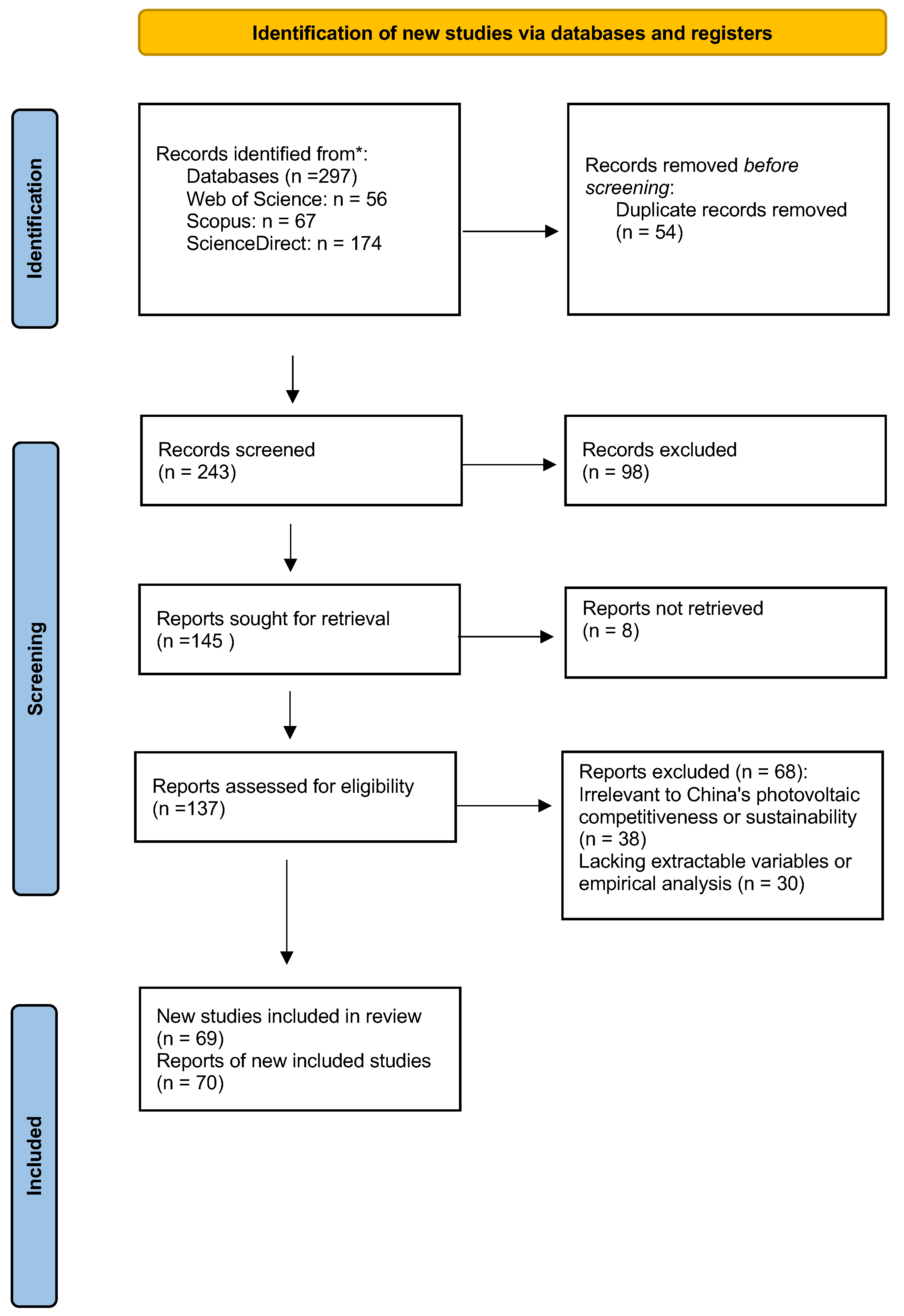
The literature search was conducted in accordance with the PRISMA 2020 guidelines to ensure transparency and reproducibility. Records were identified through three major academic databases: Web of Science (n = 56), Scopus (n = 67), and ScienceDirect (n = 174), yielding a total of 297 records. All retrieved records were imported into Zotero for reference management. Duplicate records (n = 54) were identified and removed using Zotero’s built-in duplicate detection function, followed by manual verification to ensure accuracy. After the removal of duplicates, 243 records remained for title and abstract screening, during which 98 records were excluded due to irrelevance to photovoltaic competitiveness or sustainability. A total of 145 reports were sought for retrieval, of which 8 could not be accessed. he remaining 137 full-text articles were assessed for eligibility. Among these, 68 studies were excluded because they were either not directly related to China’s photovoltaic competitiveness and sustainability (n = 38) or lacked extractable variables or empirical relevance (n = 30). Ultimately, 70 studies were included in the final qualitative synthesis and thematic analysis. The search was conducted using the Topic field with the following core search string: (photovoltaic OR “solar PV”) AND (competitiveness OR export OR “market share”) AND (sustainability OR emissions OR carbon OR environment) AND China. This search strategy was designed to capture studies that simultaneously address photovoltaic development, international competitiveness, sustainability-related outcomes, and the Chinese context. To ensure objectivity and consistency, a double independent screening process was implemented. Two researchers conducted screening separately, with disagreements resolved through discussion and consensus [24]. Figure 2 illustrates the complete screening process.

2.2. Keyword Co-Occurrence Analysis and Thematic Clustering

To systematically identify the core thematic and semantic structures, this study adopts keyword co-occurrence analysis. VOSviewer (version 1.6.20) was used to extract co-occurrence matrices and detect clusters, supporting identification of research hotspots and thematic evolution [25].
Keywords were sourced from Author Keywords and Keywords Plus, exported from Zotero in RIS format, and cleaned manually with Excel. Standardization included merging variants and eliminating generic terms. A co-occurrence threshold of four was applied, retaining 47 keywords.We employed bibliometric techniques to explore the thematic structure and intellectual landscape of the literature on China’s photovoltaic industry. VOSviewer was used to visualize keyword co-occurrence networks and identify major research clusters.
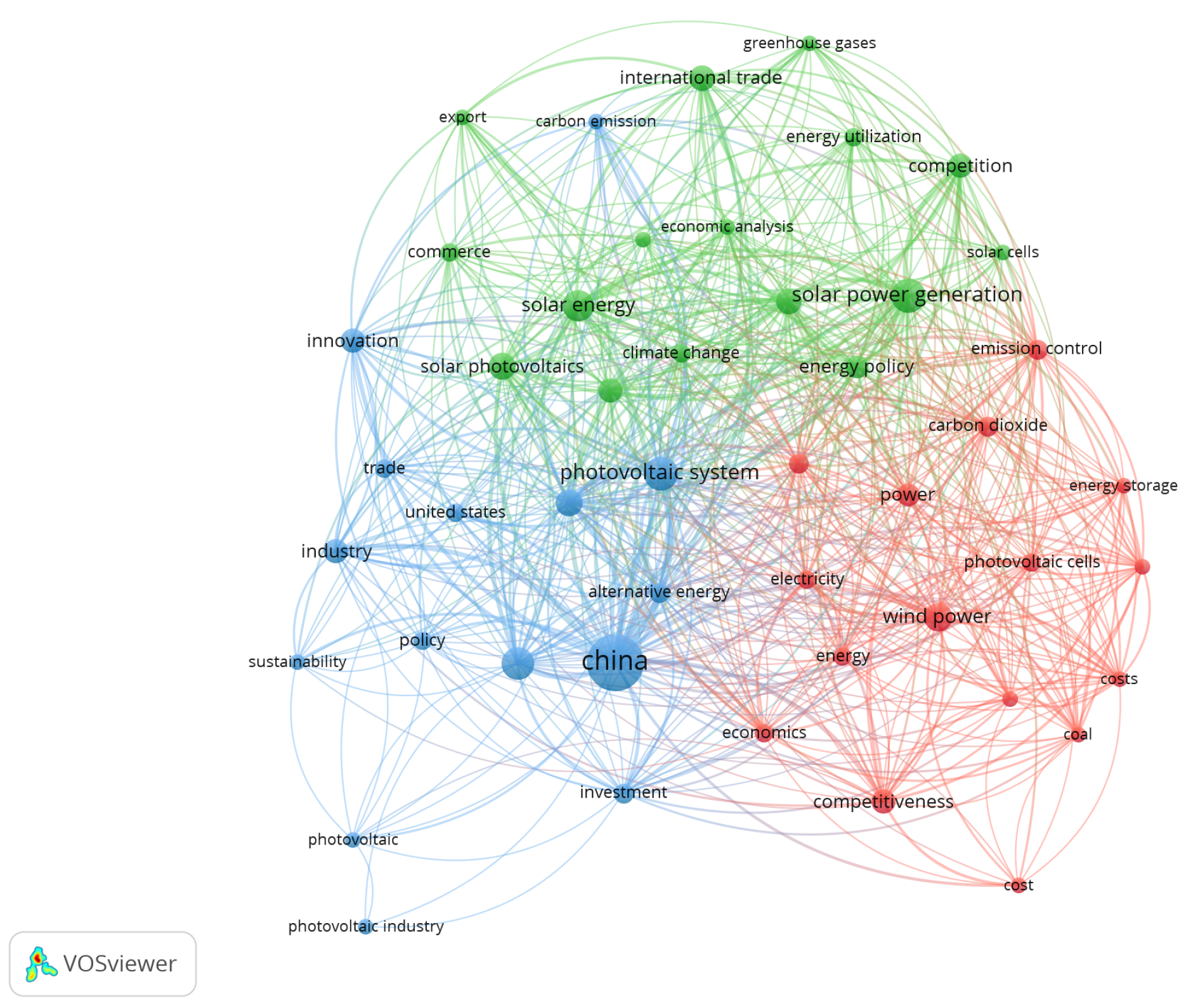
Bibliographic records were exported from Zotero in RIS format. During the data cleaning stage, manual verification was combined with Excel-assisted coordination to standardize spelling variants (e.g., “LCOE” and “levelized cost of electricity”), remove overly generic terms (e.g., “solar energy”), and merge semantically equivalent expressions (e.g., “policy support” and “subsidy scheme”). A co-occurrence frequency threshold of 4 was applied, resulting in 47 high-frequency keywords retained for clustering analysis. The keyword co-occurrence network was visualized using a distance-based layout algorithm, in which semantically similar keywords are positioned closer to each other. Node clustering was conducted using the Louvain modularity algorithm, a widely adopted community-detection method for large-scale networks due to its efficiency and robustness in identifying thematic structures. In the resulting maps generated by VOSviewer in Figure 3, different colors were automatically assigned to clusters, node size represents keyword frequency, and edge thickness indicates co-occurrence strength, producing a structured and interpretable thematic visualization. Cluster labeling was performed through interpretive synthesis, combining the semantic characteristics of high-frequency keywords with the substantive content and contextual background of the original studies. Inductive reasoning and manual semantic validation were jointly applied to ensure interpretative accuracy and theoretical coherence. The resulting thematic clusters form the analytical foundation of the thematic synthesis in Section 3 and support the subsequent construction of the variable system and identification of interaction mechanisms. Visualization used a distance-based layout with the Louvain modularity algorithm for clustering. Node size indicates keyword frequency; edge thickness indicates co-occurrence strength. Clusters were named based on the semantic characteristics of high-frequency keywords. The resulting clusters form the analytical basis for later chapters and support variable system construction.
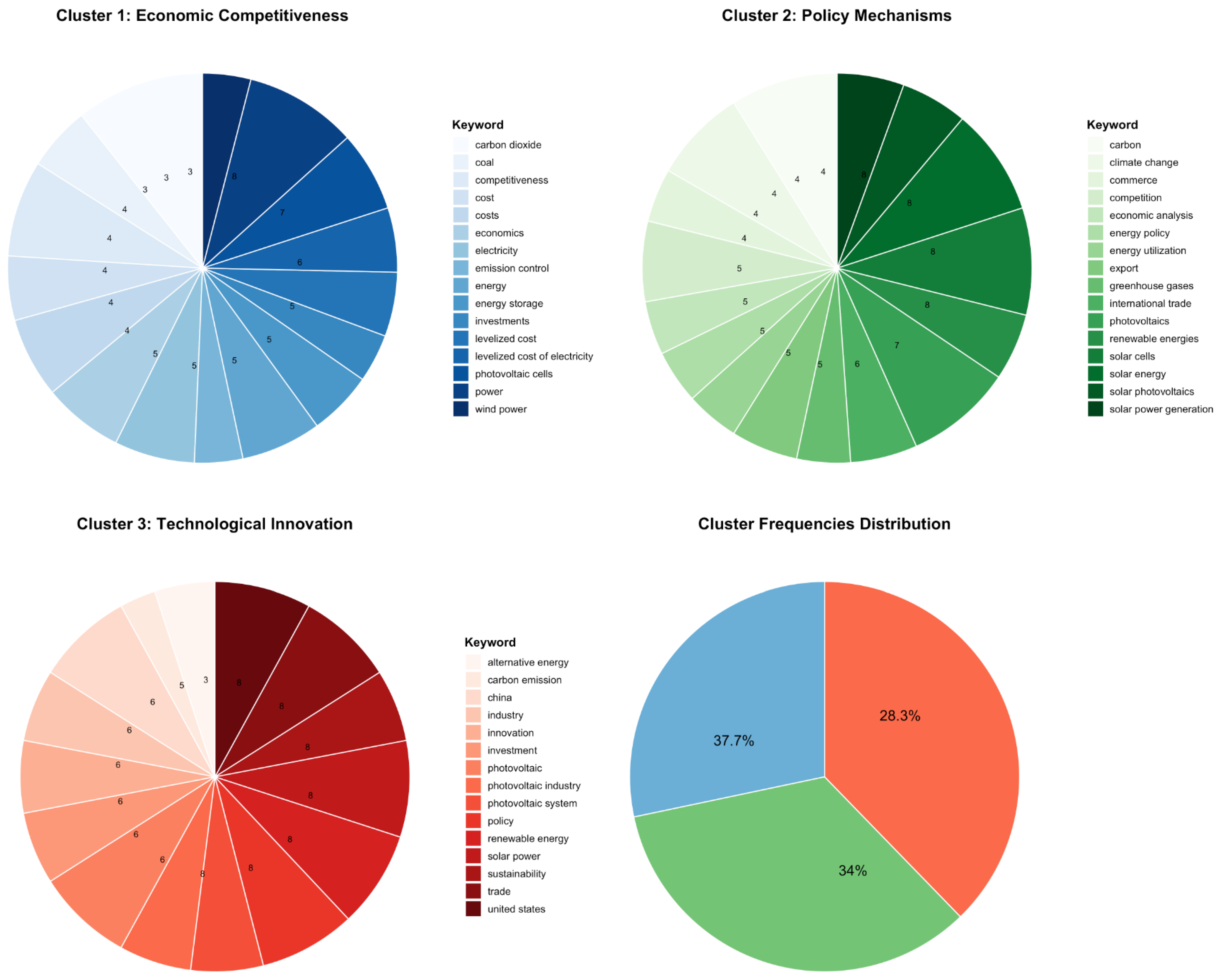
To further analyze the distribution of keywords across thematic clusters, the frequency distribution and cluster-wise proportion of high-frequency terms are presented in Figure 4.
The results indicate that Cluster 1 (economic feasibility and cost structure) accounts for 37.7% of the total keyword occurrences, Cluster 2 (policy mechanisms and trade) accounts for 34.0%, and Cluster 3 (technology and sustainability) for 28.3%. This suggests that while economic analysis remains dominant, the roles of policy and technology are increasingly emphasized, forming a tri-pillar knowledge structure involving policy, economics, and innovation. To identify cross-thematic core nodes, degree centrality and betweenness centrality for all keywords were further calculated. The analysis highlights “policy”, “energy policy”, “cost”, and “innovation” as both highly frequent and structurally central terms in the network. These keywords serve as semantic bridges across multiple clusters, reflecting a systemically coupled mechanism underpinning China’s international PV competitiveness [26]. Such structural insights offer theoretical foundations for subsequent variable construction, mechanism mapping, and policy integration.

2.3. Thematic Maturity and Evolutionary Trends

To gain deeper insights into the structural composition and developmental stages of research on China’s PV industry competitiveness and economic sustainability, this study employs thematic map analysis. This method, originally proposed by Cobo et al. [27], positions co-occurring keywords in a two-dimensional space defined by centrality and density, enabling the identification of thematic maturity and evolution.
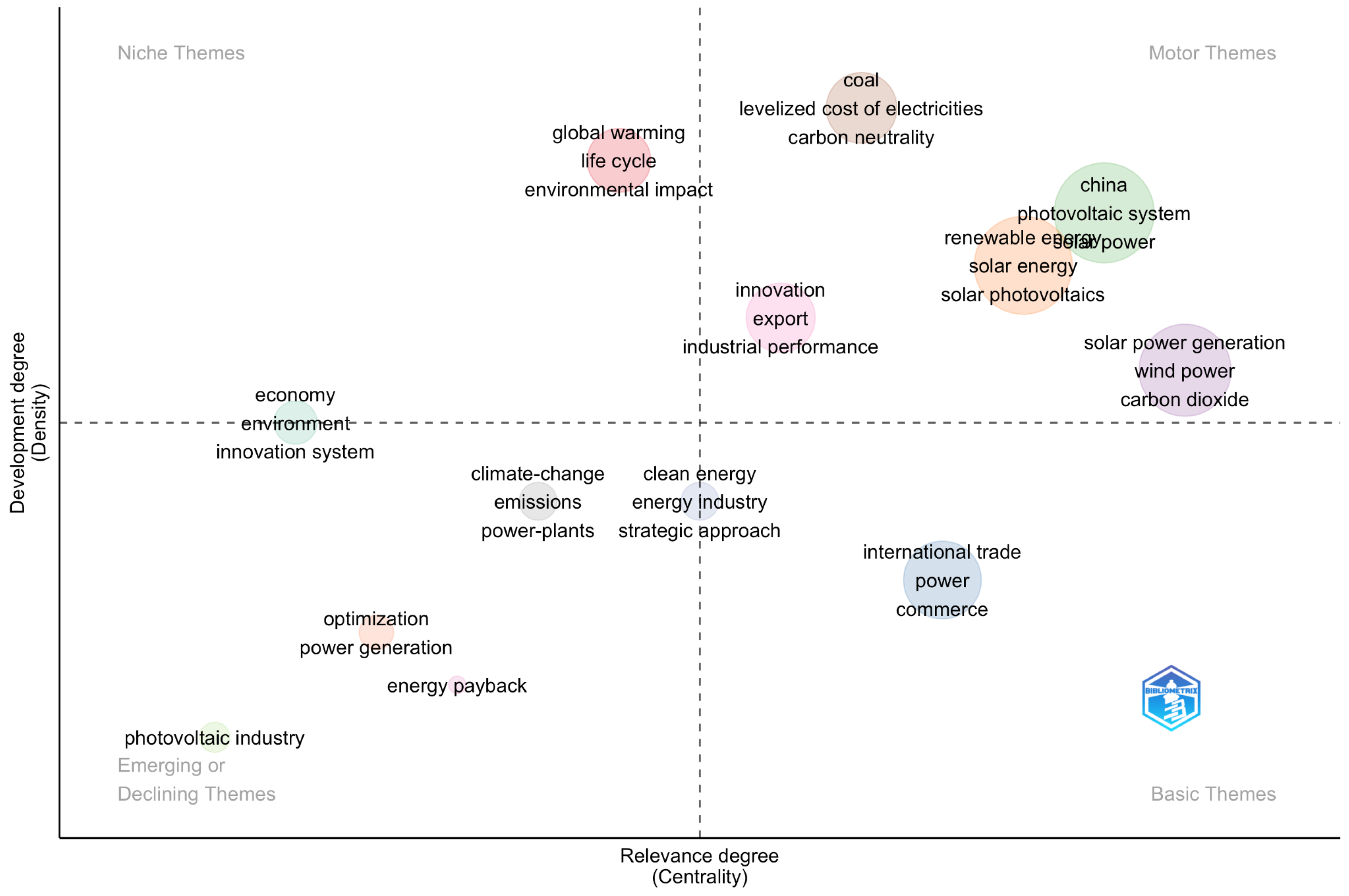
The thematic map reveals that “levelized cost of electricity”, “solar photovoltaics”, and “carbon neutrality” cluster in the upper-right quadrant, representing motor themes centered on economic viability and green transition. These themes demonstrate a high degree of theoretical coherence and strong policy relevance. However, their analytical frameworks heavily rely on LCOE-based cost accounting models, often overlooking embedded variables such as environmental externalities and institutional complexity. This reliance on LCOE and other costing models as the main analytical tools may lead to a path-locking tendency in theoretical explanatory power, limiting multidimensional understanding of the sustainable basis of PV competitiveness [15].
In the lower-right quadrant, basic themes such as “solar power generation”, “wind power”, and “carbon dioxide” underscore the central role of renewable energy deployment and emission reduction goals in the field. However, most related studies remain descriptive in nature and lack causal mechanism construction or cross-scale comparative frameworks, which limits their theoretical depth.
In the upper-left quadrant, keywords such as “environmental impact”, “life cycle”, and “global warming” form a niche cluster focused on life cycle assessment (LCA) and environmental effect estimation. Although these studies have established mature methodological systems, their weak linkages with dominant policy and economic discourses restrict their ability to influence the mainstream knowledge architecture [17]. This phenomenon, akin to a “semantic island”, suggests that sustainability concerns have not been fully integrated into the core pathways of photovoltaic competitiveness studies in China.
The lower-left quadrant includes themes such as “photovoltaic industry”, “energy payback”, and “optimization”, indicating research topics that are either declining in relevance or remain underexplored. These keywords were prominent in literature before 2010 but have since faded due to rising attention to policy instruments, green trade, and financial mechanisms. This shift not only reflects a change in academic focus but also reveals structural omissions in the exploration of optimization mechanisms and industrial transformation pathways [7].
In summary, current studies on China’s PV competitiveness and sustainability are structured around a triad of cost constraints, policy intervention, and technological evolution, while themes such as environmental life cycle and institutional adaptability remain marginalized. Future research should prioritize structural integration and thematic convergence to develop a more systemic theoretical framework that captures the synergistic interactions among policy, technology, and environment in response to the global green transition.

2.4. Conceptual Framework and Semantic Dimensions

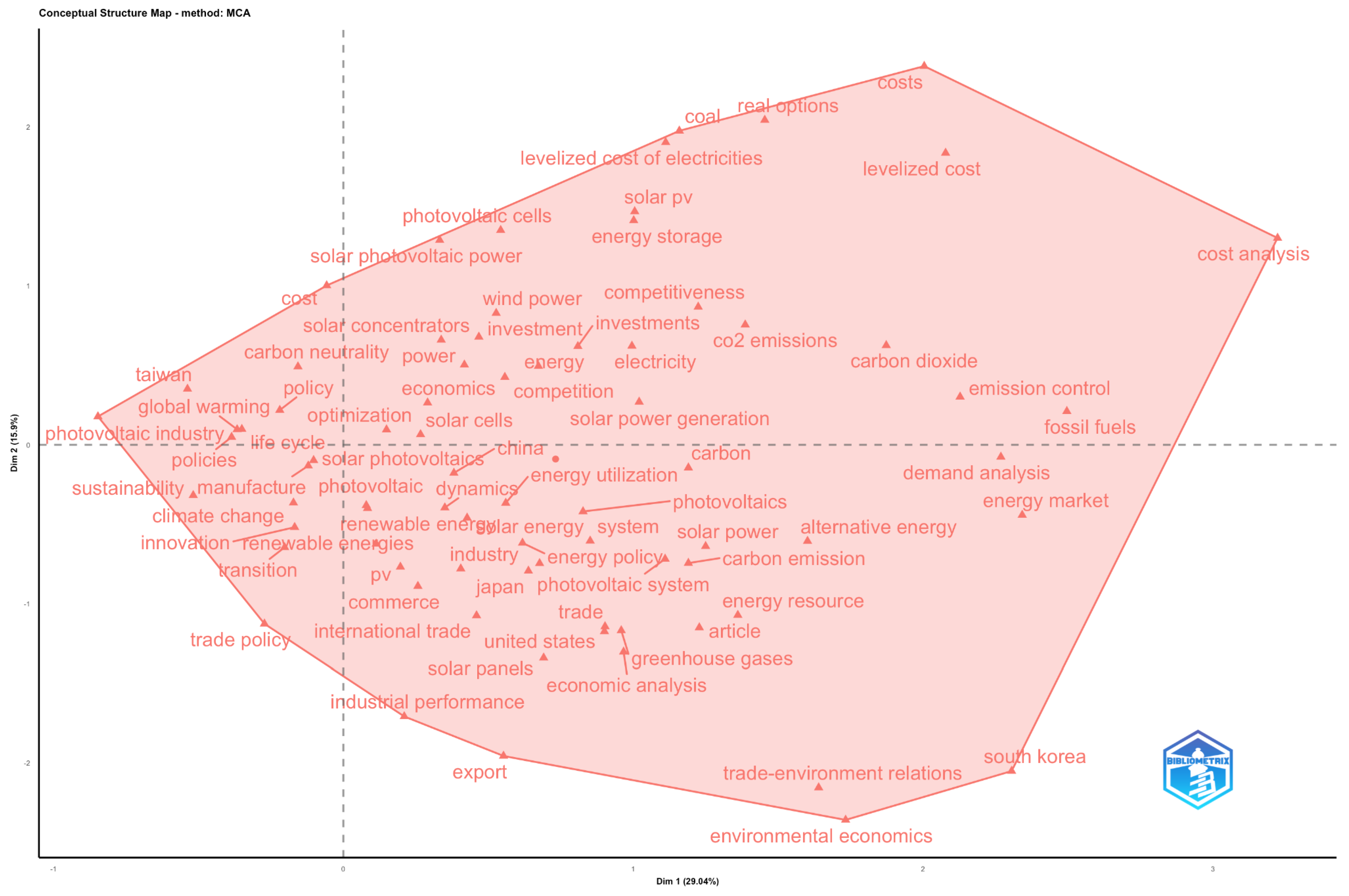
To further identify the core conceptual structure and semantic relationships among research themes, this study constructs a factorial map using the Bibliometrix tool. Multiple correspondence analysis (MCA) is employed to project the co-occurrence data of keywords into a two-dimensional space. This approach reveals deep structural divergences in variable design, analytical focus, and thematic orientation, thereby complementing the earlier clustering-based thematic analysis [27].
The factorial map divides the semantic network into two significant tension axes: the first axis reflects the “policy–technology” structural tension, and the second axis represents the “cost–environment” topic differentiation. Keywords such as “policy support”, “international trade” and “carbon border adjustment” form a policy governance group oriented toward institutional regulation and global market interaction. “LCOE”, “grid parity”, and “cost structure” cluster around economic feasibility and pricing mechanism logic, while “life cycle assessment”, “recycling” and “carbon footprint” form an environmental pathway centered on life cycle and green performance. “R&D intensity”, “innovation diffusion” and “technology transfer” represent the internal upgrade mechanisms of the technology innovation chain.
From the perspective of overall distribution, a strong synergistic structure has been formed between the two dimensions of “policy–economy”, while the connection between the “technology–environment” dimension is weak. This indicates that the green innovation path is still on the periphery of systematic research [17]. There is a lack of mediating keywords between “innovation” and “carbon reduction”, reflecting that the mechanism of how policy incentives can be translated into environmental performance through technological pathways has not yet been fully constructed [13]. In addition, some keywords such as “efficiency”, “sustainability”, and “deployment” are at the edge of the quadrants, showing multi-topic intersection but insufficient cohesion. They may act as “structural holes” as bridges that have not been systematically integrated in existing models [26]. These structural tensions provide a theoretical breakthrough for subsequent coupling analysis of mechanism variables and also suggest that future research should focus on building cross-dimensional variable pathways to achieve dynamic synergy between institutional regulation, market mechanisms and green performance.

2.5. Data Extraction and Coding Strategy

Structured extraction and semantic coding were conducted on the 70 core studies, covering: (1) bibliographic data; (2) thematic classification; (3) methodological profile; (4) variable characteristics; and (5) findings and mechanisms.
Data were processed in Zotero and Excel by two researchers independently and cross-checked for consistency. Coding principles included semantic consistency, analytical clarity, and cross-study comparability. Variables were classified into four analytical dimensions: policy mechanisms, economic and cost structures, technological and environmental sustainability, and institutional–market compatibility.
Bridging variables such as “carbon border tax” connect multiple dimensions. These variables help identify coordination gaps and policy sensitivities.

Quality Appraisal and Evidence Weighting

Given the substantial methodological heterogeneity of the included studies—ranging from econometric analyses and techno-economic modeling to policy evaluations and life-cycle assessments—a single standardized risk-of-bias scoring tool was not considered appropriate. Instead, this review adopted a structured narrative quality appraisal framework to assess the methodological credibility and relevance of the evidence.
Each study was qualitatively appraised along four dimensions: methodological transparency, data robustness, contextual relevance to China’s photovoltaic industry, and analytical rigor. Quality considerations were not used as mechanical exclusion criteria, but rather to inform evidence weighting and interpretation during thematic synthesis. Studies demonstrating higher analytical clarity and robustness were prioritized in constructing mechanism pathways, while more descriptive or context-specific studies were interpreted with appropriate caution.

3. Thematic Synthesis and Mechanism Analysis

This chapter systematically presents the thematic structure, core mechanism variables, and interaction pathways in studies of China’s PV industry competitiveness and economic sustainability. Table 1 presents the classification of mechanism variables and their representative references, which serves as the basis for the subsequent thematic synthesis and mechanism pathway analysis.Building on the variable system and clustering methods established in Section 2, 70 core SSCI/SCI articles are analyzed through keyword co-occurrence and variable extraction to identify critical dimensions—namely policy mechanisms, economic and cost structures, technological and environmental performance, and institutional–market coordination. The resulting analysis reveals not only the multidimensional coupling among research themes but also the evolutionary dynamics and structural tensions among mechanism variables, offering a theoretical foundation for subsequent modeling and policy design.

3.1. Research Topic Structure and Keyword Cluster Analysis

To reveal the thematic structure and semantic associations in the literature, this study adopts keyword co-occurrence analysis using VOSviewer. As a widely used approach in systematic reviews, this method helps to identify research themes and trace their evolutionary patterns [35]. In total, 70 English-language core articles (2000–2024) exported from Zotero, Author Keywords and Keywords Plus were extracted. After standardizing spellings and merging synonyms, the dataset was exported in RIS format and processed in VOSviewer (v1.6.20). A minimum co-occurrence threshold of four was applied, resulting in 47 high-frequency keywords used to construct the co-occurrence network and perform clustering analysis.
Building on the co-occurrence structure, clustering analysis identified three major thematic communities in the network (Figure 3), based on a distance-based visualization layout and the Louvain modularity algorithm. In the network, node size indicates keyword frequency, edge thickness represents co-occurrence strength, and colors denote cluster membership. The results reveal distinct thematic focuses: Cluster 1 centers on the economic feasibility and cost structure of the PV industry; Cluster 2 emphasizes policy mechanisms, international trade, and climate-related energy policies; Cluster 3 is dedicated to technological innovation and industrial advancement. Figure 4 summarizes the frequency distribution and cluster-wise proportions.

3.2. Topic Maturity and Evolutionary Trends

To gain deeper insights into the structural composition and developmental stages of research on China’s PV competitiveness and sustainability, thematic map analysis is employed, following Cobo et al. [27]. As shown in Figure 5, the thematic map generated using Bibliometrix plots 47 high-frequency keywords across four quadrants: motor themes, basic themes, niche themes, and emerging or declining themes. Motor themes, such as “LCOE” and “carbon neutrality”, demonstrate coherent theoretical and policy relevance but rely heavily on LCOE-based models [15]. Basic themes, including “solar power generation” and “carbon dioxide”, are widely discussed but often lack causal mechanism construction. Niche themes centered on LCA and environmental impacts remain weakly connected to mainstream competitiveness discourses [17], creating “semantic islands”. Emerging or declining themes, such as “energy payback” and “optimization”, highlight shifting attention and potential blind spots regarding optimization pathways and industrial transformation [7].
In summary, current research is structured around a triad of cost, policy, and technology, while topics such as environmental life-cycle metrics and institutional adaptability are relatively marginalized. Future research should integrate these peripheral topics into core analytical frameworks.

3.3. Conceptual Structure and Semantic Dimensions

To further identify core conceptual structures and semantic relationships, a factorial map based on multiple correspondence analysis (MCA) is constructed using Bibliometrix. Figure 6 shows that two significant axes emerge: “policy–technology” and “cost–environment”. Policy-related keywords cluster around institutional regulation and global market interactions; cost-related terms emphasize economic feasibility and pricing mechanisms; environmental terms form a distinct life-cycle and green performance cluster; and technology-related keywords are associated with innovation chains and diffusion. However, weak linkages between the technology and environment clusters suggest that green innovation pathways remain peripheral in systematic research [13,17]. Keywords such as “efficiency” and “sustainability” occupy edge positions, indicating structural holes that have not been fully integrated into existing models [26]. These insights highlight the need for cross-dimensional variable pathways to achieve dynamic synergy between institutional regulation, market mechanisms, and green performance.

3.4. Mechanism Structure and Variable Analysis

3.4.1. Policy Mechanism Evolution

The evolution of China’s PV policy framework can be broadly categorized into three phases: the introduction period (2005–2010), the expansion period (2011–2017), and the transition period (2018–present). This trajectory reflects a shift from government-driven incentive structures to market-oriented regulatory mechanisms. Each phase is characterized by distinct policy priorities and institutional arrangements, which have profoundly influenced the international competitiveness and economic sustainability of China’s PV industry.
The introduction period (2005–2010) marked the onset of institutional development driven by top-down policy interventions. The enactment of the Renewable Energy Law in 2005 formally established mandatory grid connection and cost-sharing mechanisms for renewable electricity, laying the legislative foundation for large-scale deployment [36]. Concurrently, the “Golden Sun Program” focused on enhancing supply-side capacity through state subsidies and technical demonstration projects, substantially expanding domestic manufacturing capabilities. Joint funding initiatives led by the National Development and Reform Commission (NDRC) and the Ministry of Science and Technology mobilized investment to strengthen module production [37,38]. However, due to an underdeveloped domestic market and lagging grid infrastructure, over 80% of PV modules were exported during this period, resulting in a highly export-oriented industrial structure where international demand became the primary outlet for domestic capacity [39].
Starting in 2011, China’s solar PV policies shifted focus from supply-side incentives to demand-side stimulation. The introduction of a nationwide feed-in tariff (FIT) regime significantly boosted domestic market demand, while the adoption of zonal FIT rates in 2013 improved regional adaptability. Under this policy shift, initiatives such as the “PV Poverty Alleviation Program” and the “Top Runner Program” accelerated the deployment of distributed PV systems, with annual installed capacity increasing rapidly [40]. However, this rapid expansion led to substantial fiscal strain. By 2015, subsidy arrears exceeded tens of billions of RMB, triggering severe cash flow challenges and weakening investment enthusiasm. Grid integration and dispatch systems lagged, especially in northwestern provinces, where curtailment rates remained high [41]. Discrepancies in policy interpretation and implementation among local governments further exacerbated systemic inefficiencies, highlighting tensions between policy design and execution.
The “531 Policy” introduced in 2018 marked a pivotal transition, steering the industry from a subsidy-dependent model toward a more market-driven framework [42]. The policy halted approvals for new subsidized projects, compelling enterprises to recalibrate business models and respond more directly to market price signals. Mechanisms such as competitive bidding and the renewable portfolio standard (RPS) were implemented, enhancing price discovery and driving down electricity costs, thereby paving the way for grid parity. Meanwhile, instruments like the tradable green certificate (TGC) scheme and the national carbon market gradually opened new revenue streams beyond subsidies, strengthening market-based operational capabilities [43]. Nonetheless, regional disparities in policy execution and institutional alignment persisted, and incomplete substitution of subsidies by robust market mechanisms led to rising project risks and uncertain returns, particularly in regions with weak institutional guarantees [11].
A retrospective review of these three policy stages reveals two dominant institutional feedback mechanisms. The first, “subsidy-led expansion—international market shock—policy response”, illustrates the vulnerability of subsidy-driven growth to external trade uncertainties [12]. The second, “subsidy-induced cost reduction—innovation crowding-out—market restructuring”, underscores the pressure on enterprises to sustain R&D and competitiveness following subsidy withdrawal [44]. Accordingly, future solar policy must strengthen coordination between central and local governance and enhance integration of green certificate trading, carbon pricing, and dispatch mechanisms, fostering systemic alignment across policy, technology, and markets. To complement the qualitative thematic synthesis, quantitative evidence derived from the bibliometric analysis further supports the necessity of the proposed integrated framework. The keyword clustering results indicate that the reviewed literature is distributed across multiple dominant thematic groups rather than being concentrated along a single explanatory dimension. Specifically, clusters related to economic competitiveness account for approximately 37.7% of keyword occurrences, followed by policy-oriented themes (34.0%) and technology–sustainability-related themes (28.3%). This relatively balanced distribution suggests that no single factor dominates the literature, highlighting the need for a framework capable of capturing interactions across multiple institutional dimensions. Moreover, the multivariate correspondence analysis provides additional quantitative support for the structural coherence of this thematic configuration. The first two dimensions of the analysis jointly explain over 45% of the total variance in the keyword–document matrix, indicating a stable and interpretable thematic structure rather than a fragmented or diffuse pattern. The proximity of competitiveness-oriented and sustainability-oriented themes along these dimensions further suggests that these two perspectives are frequently discussed in conjunction rather than in isolation. Thus, these quantitative patterns demonstrate that policy, cost, technology, institutional, and market variables are systematically interconnected in the existing literature. This evidence directly supports the advantage of the proposed framework, which explicitly models interaction pathways among institutional factors, over single-factor or linear analytical approaches.

3.4.2. Economic Feasibility and Cost Structure

Against the backdrop of accelerating globalization and the energy transition, economic feasibility has emerged as a key metric for assessing international competitiveness and sustainability. Since 2000, China’s PV sector has undergone structural transformation—from high-cost import dependency to scale-driven cost reduction and eventually grid parity. Core variables include LCOE, capital expenditure (CAPEX), and non-technical costs. Recent studies highlight significant downward trends in China’s LCOE, attributed to economies of scale, efficiency improvements, and policy incentives [13]. However, as grid parity becomes widespread and even negative premiums emerge, the proportion of non-technical costs—such as interest rates, land acquisition, and taxation—has increased, leading to a reconfiguration of the cost structure [16].
Studies on PV economic feasibility have shifted from static cost comparisons to dynamic mechanism-based analyses, focusing on interactions among institutions, economic structures, and system integration. Policy instruments such as energy storage integration, carbon pricing, and renewable portfolio standards significantly influence cost structures [9]. As system integration and dispatch costs rise, tensions between “nominal cost-effectiveness” and “system-level compatibility” have become central, highlighting the need to embed institutional design into cost evaluation [32].
During the initial phase (2000–2010), economic feasibility was constrained by institutional lag, external dependence, and market failures. Unit installation costs relied heavily on imported polysilicon, cells, and equipment, keeping LCOE above USD 0.3/kWh and undermining profitability expectations. Although the Renewable Energy Law (2005) offered a policy framework, incentives remained focused on administrative approvals and subsidies, lacking integration with market pricing and investment signals. As a result, policies failed to become endogenous to cost decisions [9,45]. High costs, weak institutional design, and limited market participation reinforced a “non-viable economics—financing shrinkage—constrained expansion” deadlock [46]. This stage reveals triadic structural tensions among cost, institutions, and markets, where institutional inertia and limited market responses exacerbated economic infeasibility [47,48].
Since 2011, the industry has entered a phase of cost restructuring driven by large-scale manufacturing, leading to a qualitative leap in economic feasibility. Policies such as the Golden Sun Program, distributed PV subsidies, and FIT frameworks shifted from short-term incentives to long-term market formation, clarifying return expectations and reducing investment risks [29]. Manufacturing growth pushed module prices from USD 1.5/W in 2011 to less than USD 0.3/W by 2017, bringing LCOE below USD 0.1/kWh [49]. A “cost–policy–scale” positive feedback loop emerged, but structural tensions persisted: internal competition and rising non-technical costs increasingly dominated LCOE, reflecting new rigidities in total system costs [50,51]. Regional policy mismatches exacerbated uneven feasibility, as resource-rich regions struggled with grid access and delayed subsidies, while coastal regions relied on institutional compensation [31,52].
Since 2018, the post-subsidy era has shifted evaluation logic from “subsidy-driven financial return” to “market-oriented lifecycle competitiveness”. While LCOE in many cities has dropped below coal-fired power [30], non-technical costs—including financing conditions, land, grid connection, and carbon pricing—have become key constraints [53,54,55]. Economic feasibility is increasingly shaped by institutional configurations rather than manufacturing efficiencies, reconfiguring cost centers from manufacturing to institutional and resource domains and reinforcing regional disparities.

3.4.3. Technology and Environmental Sustainability

Technological advancement is widely regarded as a key driver of cost reduction and efficiency improvement in the PV sector. However, under mounting carbon neutrality pressures, an efficiency-centric innovation logic is increasingly challenged. With the integration of life cycle assessment (LCA), carbon footprint analysis, and eco-design principles, environmental performance has become a crucial consideration in PV technology pathways [56]. Nonetheless, improvements in technical efficiency do not necessarily reduce environmental burdens; rebound effects driven by energy shifts, material complexity, and supply chain externalities have been observed [57].
This contradiction highlights a central tension in green innovation: how to optimize environmental performance alongside cost and efficiency improvements. High-efficiency cells may entail increased carbon emissions and rare material consumption, while recycling mechanisms for decommissioned modules remain underdeveloped [58,59]. The relationship between PV technological innovation and environmental performance has undergone phased transformation. Early efforts (2000–2010) focused on conversion efficiency and yield, with limited use of LCA metrics. During 2011–2017, environmental indicators gradually entered evaluation frameworks, but manufacturing remained emissions-intensive, particularly in raw material processing [60]. More recently, policies have encouraged green innovation, emphasizing recyclability and emission reduction. Yet empirical studies reveal trade-offs: thin-film modules offer better recyclability but lower initial efficiency, while high-efficiency heterojunction technologies require energy-intensive processes [61]. Institutional mechanisms to internalize environmental externalities remain inadequate, generating latent risks and delayed responses [62,63].
In summary, the relationship between technological innovation and environmental performance exhibits a non-linear evolution characterized by phase-specific restructuring and shifting variable weights. The prevailing paradigm is transitioning from efficiency-driven innovation to synergistic optimization that integrates environmental criteria, institutional incentives, and LCA-based evaluations. Achieving genuine synergy requires embedding environmental performance as a core objective in institutional design and innovation assessment, constructing life-cycle-based evaluation frameworks, integrating carbon trading with producer responsibility, and enhancing inter-agency data sharing.

3.4.4. Market Coordination and Institutional Adaptation

The international competitiveness of China’s PV industry relies not only on technological and cost advantages, but fundamentally on coordination between institutional frameworks and market mechanisms. Although the sector initially benefited from strong policy support and rapid system expansion, the global shift toward rule-based governance and institutionalized competition has made regulation–market alignment a critical factor for long-term sustainability [64]. While China’s administrative apparatus exhibits strong implementation capacity, its policy-centric development model has led to delayed market incentives and distorted price signals, particularly during subsidy withdrawal [65].
China’s PV governance system faces three adaptation challenges. First, misalignment between the pace of policy incentives and technological progress has created a “regulatory gap” during transitions from subsidies to markets. Second, asymmetries between domestic pricing models, market access rules, and international carbon border policies constrain competitiveness [66]. Third, the institutional framework lacks integrated mechanisms for coordinating incentives, oversight, and market allocation, limiting synergies across green capacity, finance, and power trading platforms. PV firms have faced difficulties in financing, cost uncertainty, and transaction instability due to underdeveloped spot markets, long-term contracts, and green credit systems [34]. Prices have often been administratively determined rather than market-driven, making investment behavior more dependent on policy windows than long-term expectations [67,68].
In the post-subsidy era, project viability increasingly depends on whether market mechanisms provide stable income streams and institutional certainty. Fragmented green electricity platforms, illiquid green certificate markets, and volatile carbon prices limit firms’ ability to hedge risks [69]. These structural issues reveal that China’s PV market has not completed its transition from policy-supported to rule-based competition. Future institutional design must shift from growth facilitation to governance assurance. Priorities include building unified green electricity trading platforms and traceable renewable certificate systems, integrating green finance with carbon markets to internalize externalities, and harmonizing regional policies to overcome local protectionism and enable cross-regional energy allocation [70].

3.4.5. Synergy Mechanisms of Competitiveness and Sustainability

After systematically reviewing the development path and core mechanisms of China’s PV industry, it becomes clear that international competitiveness and economic sustainability evolve under multiple interacting mechanisms rather than a single dominant factor. Five variables—policy drive, cost structure, technological innovation, environmental performance and system–market coordination—constitute a highly interactive composite system characterized by path dependence, stage lag, and potential for synergistic promotion [71]. Four main mechanism dimensions can be delineated: policy mechanisms (subsidy intensity, incentive structure, policy stability); economic feasibility (manufacturing costs, LCOE, financing channels, non-technical costs); technology–environment (conversion efficiency, carbon footprint, material recovery rate, green design); and institutional–market (trading mechanisms, price signal strength, green financial instruments, regional coordination).
Some variables function as structural drivers (e.g., policy incentives, institutional setups), others as mediating links (e.g., financing capacity, recycling technology), and still others as outcome variables (e.g., kWh cost reduction, carbon performance). Relationships unfold through complex feedback loops: cost reductions accelerate diffusion and market penetration, enhancing social acceptability and enforceability of policy instruments; green finance strengthens firms’ capacity to invest in environmental responsibility, amplifying institutional incentives and performance outcomes [33,72]. These feedbacks underscore the need to move beyond linear, single-cause models toward systemic simulations that capture inter-variable tensions, asymmetries, and path dependencies [73]. Based on these insights, an interaction pathway diagram is developed (Figure 7), illustrating transmission and feedback loops across policy, institutions, markets, costs, and technology.

4. Critical Discussion and Future Research Directions

Although existing studies on China’s PV sector have extensively examined policy incentives, cost structures, and technology diffusion, there remains a structural flatness in causal interpretation. Many empirical analyses simplify inter-variable relationships into static linear causality—for instance, attributing surges in installed capacity directly to FIT intensity [74], or inferring competitiveness from patent network density alone [42]. This reductionist approach overlooks systemic dynamics such as feedback loops and mediation channels, weakening explanatory power and policy relevance.
Most studies focus on either “policy–economy” or “technology–performance” linkages, while neglecting nested logics between institutional coordination and market responsiveness. Mechanisms such as green credit, carbon trading, or recycling systems are often treated as control variables rather than mediating or feedback channels [75]. Some variables, such as green finance, play dual roles as both policy tools and drivers of firm behavior, but this duality is obscured by single-variable models. As a result, coupling failures and transmission breakdowns in mechanism chains are often overlooked [76].
Future research must develop mechanism models with built-in feedback logic, interaction nodes, and structural tension indicators to simulate institutional responses and industrial evolution. Greater variable precision is needed to reveal nested institutional tensions. For example, carbon accounting functions as a regulatory mandate at national scale but as a compliance burden at firm level; technical standards may be market-entry thresholds in coastal provinces but barriers in inland regions. Instead of flattening such variables, models should employ interaction terms and cross-classified designs to reveal uneven functions across spatial and organizational dimensions [77,78,79].
Mechanism modeling should move beyond single-variable causality. Subsidy policies, for instance, should be modeled through hierarchical structures mapping how tools such as green credit, carbon trading, and technical standards operate differently at central, local, and enterprise levels. System dynamics modeling can identify feedback mechanisms such as “subsidy → capacity expansion → market saturation → policy contraction”, helping explain disruptions following policy shocks like the “531 Policy”. Data strategies must expand beyond traditional industrial statistics to integrate firm-level financials, patent data, and international trade databases (e.g., UN Comtrade, OECD) to capture policy spillovers and institutional shocks. The goal of empirical research should shift from evaluating whether a policy works to identifying which combinations of mechanisms foster resilience and competitiveness under conditions of declining subsidies, rising trade barriers, and immature domestic carbon markets.

5. Conclusions and Policy Recommendations

Based on a systematic review of 70 core English-language studies, this paper constructs an analytical framework focusing on five types of institutional variables—policy, cost, technology, institutions, and markets—to explain the structural logic of China’s PV industry in terms of international competitiveness and sustainable development. Unlike traditional literature that analyzes policy impacts or cost changes along single lines, this paper demonstrates that key factors act through interconnected pathways. For example, the effectiveness of a central policy depends on whether local governments possess fiscal resources and administrative capacity, whether financial institutions are willing to support higher-risk PV projects, and whether firms can convert policy dividends into long-term technological investment. Weakness in any intermediary link may break the overall pathway.
Policy outcomes, in turn, reshape mechanisms. When subsidies lead to project concentration and resource waste, regulators tend to tighten incentives, discouraging future investors. Although such phenomena appear in the literature, they are rarely incorporated into unified institutional models, making it difficult to explain stage- or region-specific differences in policy effectiveness. By constructing an interaction mechanism map, this paper emphasizes not only “driving relationships” but also “constraint feedback” and “conditional dependence” among mechanisms, offering a more realistic and structured perspective on China’s PV development path.
Four policy recommendations emerge. First, in designing policy instruments, a shift from “single incentive orientation” to “portfolio strategy orientation” is needed. Traditional subsidies effectively reduced early-stage project costs, but in a mature industry, sole reliance on fiscal transfers is unsustainable and may distort price signals. Future policies should strengthen combinations of fiscal incentives and market mechanisms, such as using differential subsidies to guide initial investment while relying on competitive grid-based mechanisms for efficient resource allocation, and reducing policy uncertainty through predictable incentive cycles. Overlapping or conflicting tools, such as mismatched FIT and green certificates, should be avoided.
Second, in constructing the institutional environment, supporting mechanisms between central frameworks and local implementation should be strengthened, particularly in project approval, land management, and grid access. A unified and stable institutional interface is needed to prevent structural obstacles arising from local protectionism or regulatory vacuums. Standardization of green finance systems, tailored PV financing tools, and credit rating systems can help spread financial support to small and medium-sized enterprises and marginal regions, bridging institutional–market gaps.
Third, market mechanisms must better reflect price signals. This includes promoting electricity spot markets and interconnected green power trading platforms to dynamically align PV prices with system marginal costs, developing medium- and long-term power purchase agreements (PPAs) to enhance cash-flow predictability and reduce financing risks, and improving the pricing logic and quota setting of green certificate trading mechanisms so that they effectively incentivize green investment rather than functioning as formalities.
Finally, in linking technological innovation with environmental performance, green R&D should incorporate life-cycle carbon footprints and recyclability, rather than focusing narrowly on efficiency. At the national level, “green design standards” can guide firms to internalize environmental responsibilities, and metrics such as carbon intensity can be included in export review systems to cope with tightening international green barriers. Policy measures such as patent subsidies, university–industry–research platforms, and public testing bases should accelerate diffusion from “laboratories to markets”, enhancing both the speed and sustainability of innovation.
Theoretically, this study contributes in three ways. First, in mechanism identification, it moves beyond single-variable determinants (e.g., subsidies, patents, costs) and constructs a multidimensional system covering policy tools, institutional arrangements, cost structures, market allocation, and green performance. Second, in path construction, it introduces keyword clustering, mechanism variable classification, and interaction mapping to clarify directional relationships, feedback logic, adjustment paths, and potential conflict structures, laying a foundation for future causal modeling and system simulations. Third, in practical guidance, it proposes policy suggestions based on mechanism synergy principles, emphasizing coordinated advancement of systems, markets, and technology for iterative policy optimization and cross-regional design.
This study also has limitations. First, although the 70 English-language studies cover international mainstream research, many high-quality Chinese-language studies that focus on local practice and micro-institutional operations are not systematically incorporated, potentially causing deviations from the actual policy environment. Second, as this paper is based on a systematic review, causal verification of mechanisms and path strength requires further empirical studies using tools such as structural equation modeling (SEM), system dynamics (SD), or hierarchical linear modeling (HLM). Third, although the mechanism integration diagram provides heuristic insights, it does not yet constitute an operational mathematical model; future research can incorporate variable weights and feedback speeds to develop simulation tools for scenario prediction and policy evaluation.
Looking ahead, research on China’s PV industry should expand toward cross-mechanism modeling, dynamic feedback analysis, and micro-institutional embedding. On the data side, multi-level systems combining macro policies, regional markets, and firm behavior are needed. On the modeling side, predictive capabilities and policy evaluation functions should be enhanced to support comparison and optimization of policy portfolios. In the context of deepening global green transformation, only systematic, structured, and cross-level mechanism research can provide robust theoretical support and practical solutions for the high-quality development of China’s PV industry and its response to international competition.

Author Contributions

Conceptualization, L.L.; methodology, L.L.; validation, L.L. and M.E.T.P.; formal analysis, L.L.; investigation, L.L.; resources, L.L.; data curation, L.L.; writing—original draft preparation, L.L.; writing—review and editing, M.E.T.P.; visualization, L.L.; supervision, M.E.T.P. All authors have read and agreed to the published version of the manuscript.

Funding

This research received no external funding.

Institutional Review Board Statement

Not applicable.

Informed Consent Statement

Not applicable.

Data Availability Statement

The datasets generated and/or analyzed during the current study are available from the corresponding author upon reasonable request.

Conflicts of Interest

The authors declare no conflicts of interest. The funders had no role in the design of the study; in the collection, analyses, or interpretation of data; in the writing of the manuscript; or in the decision to publish the results.

References

  1. IEA. World Energy Outlook 2023; International Energy Agency: Paris, France, 2023. [Google Scholar]
  2. IRENA. Renewable Energy Statistics 2023; International Renewable Energy Agency: Abu Dhabi, United Arab Emirates, 2023. [Google Scholar]
  3. Lin, B.; Liu, Y. Global carbon neutrality and China’s contribution: The impact of international carbon market policies on China’s photovoltaic product exports. Energy Policy 2024, 193, 114299. [Google Scholar] [CrossRef]
  4. NEA. National Energy Administration Statistical Bulletin; National Education Association: Washington, DC, USA, 2024. [Google Scholar]
  5. IEA PVPS. Energy Investment and Transition Outlook; Technical Report; Institute for Energy Economics and Financial Analysis: Lakewood, OH, USA, 2023. [Google Scholar]
  6. Zhang, W.; Yu, K.; Fang, Y. A Gravity Model Analysis of China’s Trade in Renewable Energy Goods With ASEAN Countries as Well as Japan and South Korea. Front. Environ. Sci. 2022, 10, 953005. [Google Scholar] [CrossRef]
  7. Chen, S. The impact of green trade barriers on China’s photovoltaic products exports to ASEAN. Front. Environ. Sci. 2024, 12, 1459950. [Google Scholar] [CrossRef]
  8. World Trade Organization. World Trade Report 2023: Re-Globalization for a Secure, Inclusive and Sustainable Future; World Trade Organization: Geneva, Switzerland, 2023; Available online: https://www.wto.org/english/res_e/booksp_e/wtr23_e/wtr23_e.pdf (accessed on 20 January 2025).
  9. Liu, D.; Liu, J.; Wang, S.; Xu, M.; Akbar, S. Contribution of international photovoltaic trade to global greenhouse gas emission reduction: The example of China. Resour. Conserv. Recycl. 2019, 143, 114–118. [Google Scholar] [CrossRef]
  10. Agostino, M.; Giunta, A.; Ruberto, S.; Scalera, D. Global value chains and energy-related sustainable practices. Evidence from Enterprise Survey data. Energy Econ. 2023, 127, 107068. [Google Scholar] [CrossRef]
  11. Wang, M.; Xie, Z. International trade barriers, export and industrial resilience: An empirical study based on the EU and USA antidumping and countervailing policies on photovoltaic products. Energy Policy 2025, 201, 114556. [Google Scholar] [CrossRef]
  12. Castellanos, S.; Santibañez-Aguilar, J.E.; Shapiro, B.B.; Powell, D.M.; Peters, I.M.; Buonassisi, T.; Kammen, D.M.; Flores-Tlacuahuac, A. Sustainable silicon photovoltaics manufacturing in a global market: A techno-economic, tariff and transportation framework. Appl. Energy 2018, 212, 704–719. [Google Scholar] [CrossRef]
  13. Martulli, A.; Gota, F.; Rajagopalan, N.; Meyer, T.; Quiroz, C.; Costa, D.; Paetzold, U.; Malina, R.; Vermang, B.; Lizin, S. Beyond silicon: Thin-film tandem as an opportunity for photovoltaics supply chain diversification and faster power system decarbonization out to 2050. Sol. Energy Mater. Sol. Cells 2025, 279, 113212. [Google Scholar] [CrossRef]
  14. Zou, C.; Li, S.; Xiong, B.; Liu, H.; Ma, F. Revolution and significance of “Green Energy Transition” in the context of new quality productive forces: A discussion on theoretical understanding of “Energy Triangle”. Pet. Explor. Dev. 2024, 51, 1611–1627. [Google Scholar] [CrossRef]
  15. Ding, J.; Du, D.; Duan, D.; Xia, Q.; Zhang, Q. A network analysis of global competition in photovoltaic technologies: Evidence from patent data. Appl. Energy 2024, 375, 124010. [Google Scholar] [CrossRef]
  16. Yin, G.; He, X.; Qin, Y.; Chen, L.; Hu, Y.; Liu, Y.; Zhang, C. Assessing China’s solar power potential: Uncertainty quantification and economic analysis. Resour. Conserv. Recycl. 2025, 212, 107908. [Google Scholar] [CrossRef]
  17. Grau, T.; Huo, M.; Neuhoff, K. Survey of photovoltaic industry and policy in Germany and China. Energy Policy 2012, 51, 20–37. [Google Scholar] [CrossRef]
  18. Espinosa, N.; Laurent, A.; Krebs, F. Ecodesign of organic photovoltaic modules from Danish and Chinese perspectives. Energy Environ. Sci. 2015, 8, 2537–2550. [Google Scholar] [CrossRef]
  19. Zhu, X.; Liao, B.; Yang, S.; Pardalos, P.M. Evolutionary game analysis on government subsidy policy and bank loan strategy in China’s distributed photovoltaic market. Ann. Math. Artif. Intell. 2022, 90, 753–776. [Google Scholar] [CrossRef]
  20. Zou, H.; Du, H.; Ren, J.; Sovacool, B.K.; Zhang, Y.; Mao, G. Market dynamics, innovation, and transition in China’s solar photovoltaic (PV) industry: A critical review. Renew. Sustain. Energy Rev. 2017, 69, 197–206. [Google Scholar] [CrossRef]
  21. Page, M.J.; McKenzie, J.E.; Bossuyt, P.M.; Boutron, I.; Hoffmann, T.C.; Mulrow, C.D.; Shamseer, L.; Tetzlaff, J.M.; Akl, E.A.; Brennan, S.E.; et al. The PRISMA 2020 statement: An updated guideline for reporting systematic reviews. BMJ 2021, 372, n71. [Google Scholar] [CrossRef]
  22. Xiao, Y.; Watson, M. Guidance on Conducting a Systematic Literature Review. J. Plan. Educ. Res. 2019, 39, 93–112. [Google Scholar] [CrossRef]
  23. Moher, D.; Liberati, A.; Tetzlaff, J.; Altman, D.G.; The PRISMA Group. Preferred Reporting Items for Systematic Reviews and Meta-Analyses: The PRISMA Statement. PLoS Med. 2009, 6, e1000097. [Google Scholar] [CrossRef]
  24. Tranfield, D.; Denyer, D.; Smart, P. Towards a Methodology for Developing Evidence-Informed Management Knowledge by Means of Systematic Review. Br. J. Manag. 2003, 14, 207–222. [Google Scholar] [CrossRef]
  25. Van Eck, N.J.; Waltman, L. Software survey: VOSviewer, a computer program for bibliometric mapping. Scientometrics 2010, 84, 523–538. [Google Scholar] [CrossRef] [PubMed]
  26. Burt, R. Structural Holes and Good Ideas. Am. J. Sociol. 2004, 110, 349–399. [Google Scholar] [CrossRef]
  27. Cobo, M.; López-Herrera, A.; Herrera-Viedma, E.; Herrera, F. An approach for detecting, quantifying, and visualizing the evolution of a research field: A practical application to the Fuzzy Sets Theory field. J. Inf. 2011, 5, 146–166. [Google Scholar] [CrossRef]
  28. Jia, F.; Sun, H.; Koh, L. Global solar photovoltaic industry: An overview and national competitiveness of Taiwan. J. Clean. Prod. 2016, 126, 550–562. [Google Scholar] [CrossRef]
  29. Song, X.; Huang, Y.; Zhang, Y.; Zhang, W.; Ge, Z. An Appraisal on China’s Feed-In Tariff Policies for PV and Wind Power: Implementation Effects and Optimization. Sustainability 2023, 15, 5137. [Google Scholar] [CrossRef]
  30. Fan, J.; Wei, S.; Yang, L.; Wang, H.; Zhong, P.; Zhang, X. Comparison of the LCOE between coal-fired power plants with CCS and main low-carbon generation technologies: Evidence from China. Energy 2019, 176, 143–155. [Google Scholar] [CrossRef]
  31. Shubbak, M. The technological system of production and innovation: The case of photovoltaic technology in China. Res. Policy 2019, 48, 993–1015. [Google Scholar] [CrossRef]
  32. Yang, D.; Liu, J.; Yang, J.; Ding, N. Life-cycle assessment of China’s multi-crystalline silicon photovoltaic modules considering international trade. J. Clean. Prod. 2015, 94, 35–45. [Google Scholar] [CrossRef]
  33. Wei, D.; Ahmad, F.; Abid, N.; Khan, I. The impact of digital inclusive finance on the growth of the renewable energy industry: Theoretical and logical Chinese experience. J. Clean. Prod. 2023, 428, 139357. [Google Scholar] [CrossRef]
  34. Urban, F.; Geall, S.; Wang, Y. Solar PV and solar water heaters in China: Different pathways to low carbon energy. Renew. Sustain. Energy Rev. 2016, 64, 531–542. [Google Scholar] [CrossRef]
  35. Callon, M.; Courtial, J.P.; Turner, W.A.; Bauin, S. From translations to problematic networks: An introduction to co-word analysis. Soc. Sci. Inf. 1983, 22, 191–235. [Google Scholar] [CrossRef]
  36. Zhang, S.; Zhao, X.; Andrews-Speed, P.; He, Y. The development trajectories of wind power and solar PV power in China: A comparison and policy recommendations. Renew. Sustain. Energy Rev. 2013, 26, 322–331. [Google Scholar] [CrossRef]
  37. Liu, C.S.; Hsiao, C.T.; Chang, D.S.; Hsiao, C.H. How the European Union’s and the United States’ anti-dumping duties affect Taiwan’s PV industry: A policy simulation. Renew. Sustain. Energy Rev. 2016, 53, 296–305. [Google Scholar] [CrossRef]
  38. Binz, C.; Anadon, L.D. Unrelated diversification in latecomer contexts: Emergence of the Chinese solar photovoltaics industry. Environ. Innov. Soc. Transitions 2018, 28, 14–34. [Google Scholar] [CrossRef]
  39. Lu, X.; Chen, S.; Nielsen, C.; Zhang, C.; Li, J.; Xu, H.; Wu, Y.; Wang, S.; Song, F.; Wei, C.; et al. Combined solar power and storage as cost-competitive and grid-compatible supply for China’s future carbon-neutral electricity system. Proc. Natl. Acad. Sci. USA 2021, 118, e2103471118. [Google Scholar] [CrossRef] [PubMed]
  40. Yan, J.; Yang, Y.; Elia Campana, P.; He, J. City-level analysis of subsidy-free solar photovoltaic electricity price, profits and grid parity in China. Nat. Energy 2019, 4, 709–717. [Google Scholar] [CrossRef]
  41. Lo, K.; Castán Broto, V. Co-benefits, contradictions, and multi-level governance of low-carbon experimentation: Leveraging solar energy for sustainable development in China. Glob. Environ. Change 2019, 59, 101993. [Google Scholar] [CrossRef]
  42. Hu, F.; Mou, S.; Wei, S.; Qiu, L.; Hu, H.; Zhou, H. Research on the evolution of China’s photovoltaic technology innovation network from the perspective of patents. Energy Strategy Rev. 2024, 51, 101309. [Google Scholar] [CrossRef]
  43. Tu, Q.; Mo, J.; Betz, R.; Cui, L.; Fan, Y.; Liu, Y. Achieving grid parity of solar PV power in China- The role of Tradable Green Certificate. Energy Policy 2020, 144, 111681. [Google Scholar] [CrossRef]
  44. Yang, L.; Hua, H.; Zhang, J. The impact of phasing out subsidy for financial performance of photovoltaic enterprises: Evidence from “531 new policy” on China’s photovoltaic industry. Front. Energy Res. 2024, 12, 1486351. [Google Scholar] [CrossRef]
  45. D’Agostino, A.L.; Sovacool, B.K.; Bambawale, M.J. And then what happened? A retrospective appraisal of China’s Renewable Energy Development Project (REDP). Renew. Energy 2011, 36, 3154–3165. [Google Scholar] [CrossRef]
  46. Voituriez, T.; Wang, X. Real challenges behind the EU-China PV trade dispute settlement. Clim. Policy 2015, 15, 670–677. [Google Scholar] [CrossRef]
  47. Aïd, R.; Bahlali, M.; Creti, A. Green innovation downturn: The role of imperfect competition. Energy Econ. 2023, 123, 106754. [Google Scholar] [CrossRef]
  48. Jackson, M.; Lewis, J.; Zhang, X. A green expansion: China’s role in the global deployment and transfer of solar photovoltaic technology. Energy Sustain. Dev. 2021, 60, 90–101. [Google Scholar] [CrossRef]
  49. Jia, Z.; Lin, B. The impact of removing cross subsidies in electric power industry in China: Welfare, economy, and CO2 emission. Energy Policy 2021, 148, 111994. [Google Scholar] [CrossRef]
  50. Zhang, D.; Chai, Q.; Zhang, X.; He, J.; Yue, L.; Dong, X.; Wu, S. Economical assessment of large-scale photovoltaic power development in China. Energy 2012, 40, 370–375. [Google Scholar] [CrossRef]
  51. Liu, Z.; Marino, M.; Reinoso, J.; Paggi, M. A continuum large-deformation theory for the coupled modeling of polymer–solvent system with application to PV recycling. Int. J. Eng. Sci. 2023, 187, 103842. [Google Scholar] [CrossRef]
  52. Pan, J.; Chen, X.; Luo, X.; Zeng, X.; Liu, Z.; Lai, W.; Xu, Y.; Lu, C. Analysis of the impact of China’s energy industry on social development from the perspective of low-carbon policy. Energy Rep. 2022, 8, 14–27. [Google Scholar] [CrossRef]
  53. Han, X.; Zhang, H.; Yu, X.; Wang, L. Economic evaluation of grid-connected micro-grid system with photovoltaic and energy storage under different investment and financing models. Appl. Energy 2016, 184, 103–118. [Google Scholar] [CrossRef]
  54. Sun, H.; Zhi, Q.; Wang, Y.; Yao, Q.; Su, J. China’s solar photovoltaic industry development: The status quo, problems and approaches. Appl. Energy 2014, 118, 221–230. [Google Scholar] [CrossRef]
  55. Luo, Z.; He, J.; Hu, S. Driving force model to evaluate China’s photovoltaic industry: Historical and future trends. J. Clean. Prod. 2021, 311, 127637. [Google Scholar] [CrossRef]
  56. Fu, Y.; Liu, X.; Yuan, Z. Life-cycle assessment of multi-crystalline photovoltaic (PV) systems in China. J. Clean. Prod. 2015, 86, 180–190. [Google Scholar] [CrossRef]
  57. Bueno, P.T.; Salvia, A.L.; Rebelatto, B.G.; Brandli, L.L. Promoting sustainability in the solar industry: Bibliometric and systematic analysis of alternatives for the end-of-life of photovoltaic modules. Discov. Sustain. 2024, 5, 147. [Google Scholar] [CrossRef]
  58. Wang, J.; Feng, Y.; He, Y. Insights for China from EU management of recycling end-of-life photovoltaic modules. Sol. Energy 2024, 273, 112532. [Google Scholar] [CrossRef]
  59. Zhang, N.; Jiang, Y.; Zhao, X.; Deng, J.; Mi, Q.; Li, J. How much carbon dioxide has the Chinese PV manufacturing industry emitted? J. Clean. Prod. 2023, 425, 138904. [Google Scholar] [CrossRef]
  60. Jiang, X.; Zhu, K.; Wang, S. The potential for reducing China’s carbon dioxide emissions: Role of foreign-invested enterprises. Glob. Environ. Change 2015, 35, 22–30. [Google Scholar] [CrossRef]
  61. Latunussa, C.E.; Ardente, F.; Blengini, G.A.; Mancini, L. Life Cycle Assessment of an innovative recycling process for crystalline silicon photovoltaic panels. Sol. Energy Mater. Sol. Cells 2016, 156, 101–111. [Google Scholar] [CrossRef]
  62. Quitzow, R.; Huenteler, J.; Asmussen, H. Development trajectories in China’s wind and solar energy industries: How technology-related differences shape the dynamics of industry localization and catching up. J. Clean. Prod. 2017, 158, 122–133. [Google Scholar] [CrossRef]
  63. Li, J.; Peng, L.; Yan, Y.; Wang, Y.; Zhang, J.; Li, M.; Xie, K. Technological progress and coupling renewables enable substantial environmental and economic benefits from coal-to-olefins. J. Environ. Manag. 2024, 353, 120225. [Google Scholar] [CrossRef]
  64. Bai, B.; Wang, Z.; Chen, J. Shaping the solar future: An analysis of policy evolution, prospects and implications in China’s photovoltaic industry. Energy Strategy Rev. 2024, 54, 101474. [Google Scholar] [CrossRef]
  65. Liu, D.; Zou, H.; Qiu, Y.; Du, H. Consumer reaction to green subsidy phase-out in China: Evidence from the household photovoltaic industry. Energy Econ. 2024, 129, 107270. [Google Scholar] [CrossRef]
  66. Bukarica, V.; Tomsic, Z. Energy efficiency policy evaluation by moving from techno-economic towards whole society perspective on energy efficiency market. Renew. Sustain. Energy Rev. 2017, 70, 968–975. [Google Scholar] [CrossRef]
  67. Yu, H. Virtuous cycle of solar photovoltaic development in new regions. Renew. Sustain. Energy Rev. 2017, 78, 1357–1366. [Google Scholar] [CrossRef]
  68. Sandor, D.; Fulton, S.; Engel-Cox, J.; Peck, C.; Peterson, S. System Dynamics of Polysilicon for Solar Photovoltaics: A Framework for Investigating the Energy Security of Renewable Energy Supply Chains. Sustainability 2018, 10, 160. [Google Scholar] [CrossRef]
  69. Liu, D.; Qi, S.; Xu, T. In the post-subsidy era: How to encourage mere consumers to become prosumers when subsidy reduced? Energy Policy 2023, 174, 113451. [Google Scholar] [CrossRef]
  70. Onabowale, O. Energy policy and sustainable finance: Navigating the future of renewable energy and energy markets. World J. Adv. Res. Rev. 2025, 25, 2235–2252. [Google Scholar] [CrossRef]
  71. Koseoglu, N.M.; van den Bergh, J.C.; Lacerda, J.S. Allocating subsidies to R&D or to market applications of renewable energy? Balance and geographical relevance. Energy Sustain. Dev. 2013, 17, 536–545. [Google Scholar] [CrossRef]
  72. Wu, J.; Tang, G.; Wang, R.; Sun, Y. Multi-Objective Optimization for China’s Power Carbon Emission Reduction by 2035. J. Therm. Sci. 2019, 28, 184–194. [Google Scholar] [CrossRef]
  73. Fu, X.; Fan, W.; Lin, H.; Li, N.; Li, P.; Ju, L.; Zhou, F. A Risk Aversion Dispatching Optimal Model for a Micro Energy Grid Integrating Intermittent Renewable Energy and Considering Carbon Emissions and Demand Response. Processes 2019, 7, 916. [Google Scholar] [CrossRef]
  74. Dong, C.; Zhou, R.; Li, J. Rushing for subsidies: The impact of feed-in tariffs on solar photovoltaic capacity development in China. Appl. Energy 2021, 281, 116007. [Google Scholar] [CrossRef]
  75. Garlet, T.; Ribeiro, J.; Savian, F.; Siluk, J. Value chain in distributed generation of photovoltaic energy and factors for competitiveness: A systematic review. Sol. Energy 2020, 211, 396–411. [Google Scholar] [CrossRef]
  76. Chen, J.; Liu, Y.; Wang, L. Research on Coupling Coordination Development for Photovoltaic Agriculture System in China. Sustainability 2019, 11, 1065. [Google Scholar] [CrossRef]
  77. Yuan, C.; Liu, S.; Yang, Y.; Chen, D.; Fang, Z.; Shui, L. An analysis on investment policy effect of China’s photovoltaic industry based on feedback model. Appl. Energy 2014, 135, 423–428. [Google Scholar] [CrossRef]
  78. Zhu, X.; Gu, Z.; He, C.; Chen, W. The impact of the belt and road initiative on Chinese PV firms’ export expansion. Environ. Dev. Sustain. 2024, 26, 25763–25783. [Google Scholar] [CrossRef]
  79. Leutert, W. Innovation through iteration: Policy feedback loops in China’s economic reform. World Dev. 2021, 138, 105173. [Google Scholar] [CrossRef]
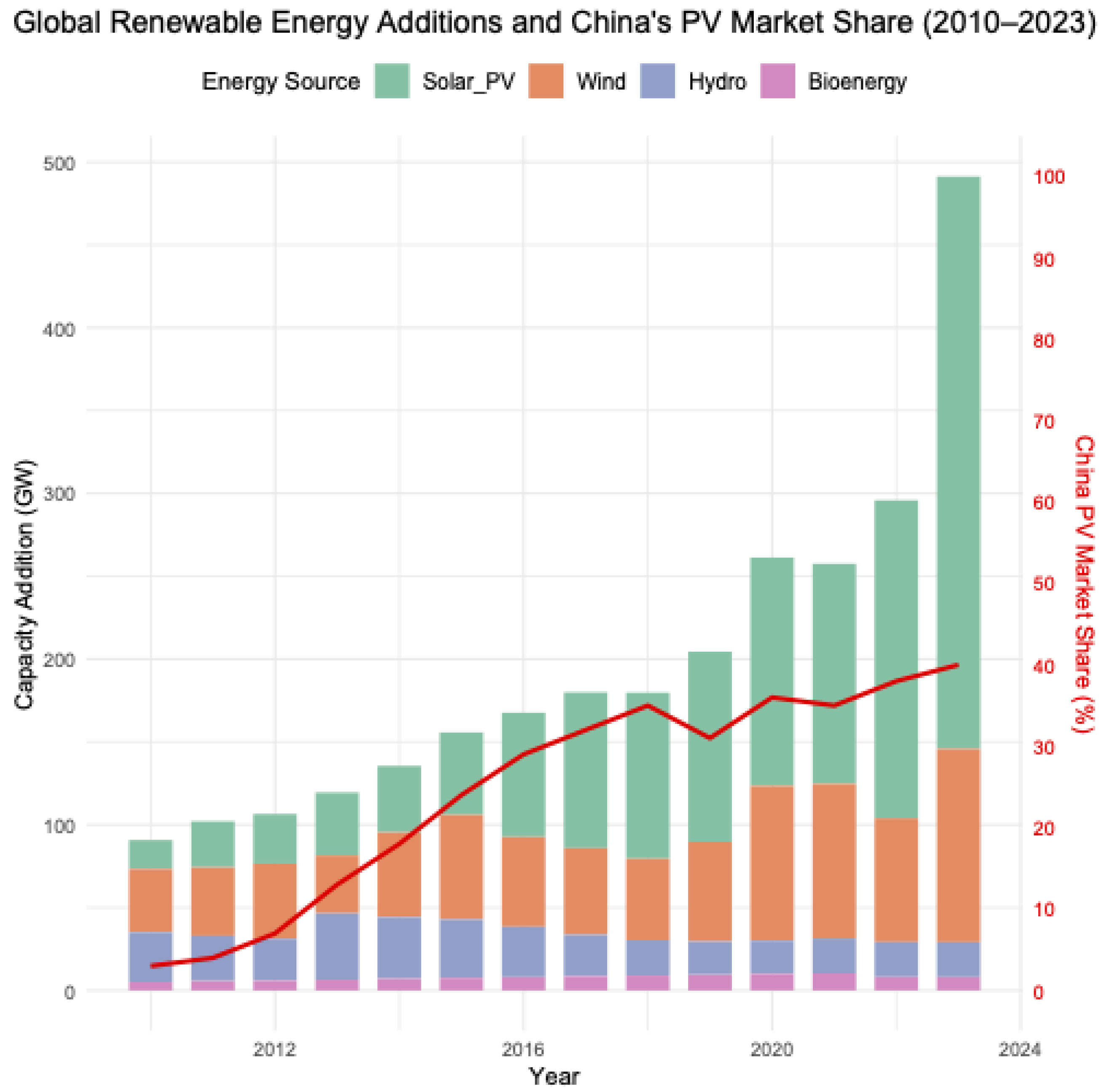
Figure 1. Global additions of renewable energy capacity and China’s share of the solar PV market, 2010–2023. Data sources: IRENA (2024), IEA PVPS (2024).
Energies 19 00508 g001
Figure 2. Literature screening flow based on the PRISMA 2020 guidelines.
Energies 19 00508 g002
Figure 3. Keyword co-occurrence network and clustering (VOSviewer).
Energies 19 00508 g003
Figure 4. Keyword frequency distribution across thematic clusters and overall proportion.
Energies 19 00508 g004
Figure 5. Thematic map of co-occurring keywords derived from 70 core articles on China’s solar PV industry.
Energies 19 00508 g005
Figure 6. Conceptual structure map based on multiple correspondence analysis (MCA), showing the semantic positioning of high-frequency keywords in the literature on China’s PV industry competitiveness and sustainability. Dots represent individual keywords, and arrows indicate the principal semantic dimensions.
Energies 19 00508 g006
Figure 7. Mechanism pathway diagram illustrating interlinkages among policy, institutional, market, cost, and technological factors influencing the competitiveness and sustainability of China’s solar PV industry.
Energies 19 00508 g007
Table 1. Mechanism variable classification and representative references.
VariableDimensionDefinitionRepresentative Reference
Policy SupportPolicy MechanismGovernment incentives such as subsidies, tax reliefs, and policy mandatesJia et al. (2016) [28]
Feed-in TariffPolicy MechanismGuaranteed electricity price to ensure return on investment for renewablesSong et al. (2023) [29]
Carbon Border TaxInstitutional–MarketCross-border tax applied to imports based on carbon contentChen (2024) [7]
LCOEEconomic & Cost StructureLevelized cost of electricity across life-cycle costsFan et al. (2019) [30]
Production CostEconomic & Cost StructureTotal manufacturing cost including labor and materialsCastellanos et al. (2018) [12]
Technology InnovationTech & SustainabilityAdvancement and diffusion of novel PV technologiesShubbak (2019) [31]
Carbon EmissionsTech & SustainabilityLifecycle GHG emissions associated with PV modulesYang et al. (2015) [32]
Green FinanceInstitutional–MarketFinancial mechanisms enabling environmental investmentWei et al. (2023) [33]
Institutional CoordinationInstitutional–MarketHarmonization of policy, regulation, and market implementationUrban et al. (2016) [34]
Disclaimer/Publisher’s Note: The statements, opinions and data contained in all publications are solely those of the individual author(s) and contributor(s) and not of MDPI and/or the editor(s). MDPI and/or the editor(s) disclaim responsibility for any injury to people or property resulting from any ideas, methods, instructions or products referred to in the content.