Article

Experimental Evaluation of the Bioenergy Potential of Enterolobium cyclocarpum (Orejero) Fruit Peel Residue

by
Zully-Esmeralda Gómez-Rosales
1,
Paola-Andrea Hernández-Mejía
1,
Andrés-Gonzalo Forero-González
1,
Johanna-Karina Solano-Meza
2,
Javier Rodrigo-Ilarri
3 and
María-Elena Rodrigo-Clavero
3,*
1
Department of Environmental Engineering, Santo Tomás University, Road 9 Street 51-11, Bogota 110231, Colombia
2
Chemical Engineering Department, EAN University, Bogota 110221, Colombia
3
Instituto de Ingeniería del Agua y del Medio Ambiente (IIAMA), Universitat Politècnica de València, 46022 Valencia, Spain
*
Author to whom correspondence should be addressed.
Energies 2026, 19(2), 360; https://doi.org/10.3390/en19020360 (registering DOI)
Submission received: 11 December 2025 / Revised: 29 December 2025 / Accepted: 5 January 2026 / Published: 12 January 2026
(This article belongs to the Special Issue Biomass and Waste-to-Energy for Sustainable Energy Production)

Abstract

This study presents an experimental evaluation of the bioenergy potential of Enterolobium cyclocarpum (“orejero”) fruit peel residue, an underutilized agroforestry by-product in tropical America. Although the species is widely used for shade and fodder in livestock systems, its fruit peel has not yet been characterized for energy recovery purposes. Fruit samples were collected in rural areas of Tesalia (Huila, Colombia), and the peel fraction was analyzed in certified laboratories. The moisture content of the peel was determined as 11 wt%, and the lower heating value was measured as 0.015 TJ/t following ASTM E711-06. Elemental analysis according to ASTM D5373-16 yielded (dry basis): 37.2 wt% C, 4.09 wt% H, 0.45 wt% N and 0.13 wt% S. Based on Colombian cultivation and production data, the theoretical energy potential was estimated as 3.6 TJ/year per hectare. The technical energy potential reached 0.18 and 0.21 TJ/year per hectare for combustion and gasification, respectively. CO2-equivalent emissions were also estimated for both conversion routes, revealing a trade-off between the higher energy yield and higher specific emissions associated with gasification. Overall, the results show that E. cyclocarpum fruit peel residue has a calorific value comparable to widely used agri-food residues in Colombia (e.g., sugarcane bagasse and oil palm fiber), but with a substantially higher per-hectare energy potential due to its large residue fraction. Its high availability, favorable fuel properties, and compatibility with decentralized combustion and gasification technologies support its use as a promising feedstock for bioenergy generation in rural or off-grid areas, in line with circular economy and sustainable energy transition strategies.

1. Introduction

Enterolobium cyclocarpum, commonly known as “orejero,” belongs to the family Mimosaceae, genus Enterolobium, and species cyclocarpum [1]. Native to the American tropics, E. cyclocarpum is widely used in reforestation and the restoration of degraded forested areas. It is also commonly employed to provide shade and fodder in livestock systems and has applications based on its agroindustrial, nutritional, and medicinal properties. In many regions, the fruit is used as a feed supplement for cattle, improving meat and milk production, and in some cases, it is also consumed by humans [2]. However, despite its multiple uses, no studies have addressed the energy valorization of its fruit peel residue to date [3]. This contrasts with the growing body of literature evaluating the energy potential of other agricultural and agroforestry residues, indicating that E. cyclocarpum remains an underexplored resource in the field of bioenergy. Hereafter, the species is referred to as E. cyclocarpum, and the studied biomass is referred to as E. cyclocarpum fruit peel (also termed “peel residue” when discussing recoverable residue flows).
Utilization of agricultural residual biomass as an energy source can support fossil-fuel substitution and decentralized energy supply in rural or off-grid contexts. In addition, diverting residues from uncontrolled disposal (e.g., open burning or landfilling) can improve resource efficiency and reduce local environmental impacts when conversion technologies are applied [4,5]. At the global and regional scale, several assessments have shown that agricultural residues can provide substantial theoretical and technical energy potentials, even after accounting for sustainability constraints and competing uses [6,7].
In Colombia, the National Energy Plan 2020–2050 projects growth of up to 8% in energy generation from biomass, with an expected installed cogeneration capacity of 314 MW by 2028 [8]. The country has favorable natural and structural conditions for rural energy development based on biomass, primarily due to its strong agroindustrial capacity [5]. At the national level, several studies have been conducted on the energy potential of residual biomass from crops such as potato, maize, plantain, banana, sugarcane, cassava and oil palm [9,10,11], with significant contributions from these sectors [8]. More recent analyses have evaluated the spatial distribution and energy potential of agricultural residues for rural households and decentralized energy systems in departments such as La Guajira and high-mountain municipalities of the Santurbán páramo, reinforcing the strategic role of residual biomass in Colombia’s rural energy transition [12,13,14]. Despite these advances, a large fraction of agricultural residues remains underutilized or discarded due to the lack of appropriate technologies or technical knowledge, which poses both environmental and resource-efficiency challenges [15].
Biomass is a renewable energy source with near-neutral greenhouse gas emissions, and its efficient use can significantly reduce fossil fuel consumption. However, one key limitation to its widespread utilization is the potentially low calorific value and heterogeneous quality of certain residues [16]. For this reason, physicochemical characterization is essential to assess the combustion quality and energy potential of each specific biomass. In particular, fruit processing and fruit peel residues have attracted increasing attention as feedstocks for energy and materials, since they are generated in large amounts and are often landfilled or used in low-value applications such as compost or animal feed [17]. Several studies have demonstrated that waste products from fruit preparation and processing can exhibit lower heating values comparable to, or only slightly below, those of conventional agricultural residues, making them suitable for thermochemical conversion [18,19]. Beyond direct combustion/gasification approaches, fruit peel residues have also been widely investigated under pyrolysis pathways to obtain co-products such as biochar and bio-oil, often targeting subsequent resource utilization (e.g., adsorption, soil amendment, or chemical platforms). Recent work has emphasized the role of feedstock physicochemical properties in controlling pyrolysis kinetics and product distributions [20]. Multiple studies have reported the feasibility of converting fruit peels into functional biochars or bio-oils through slow/fast pyrolysis routes [21,22]. Nevertheless, the energy potential of E. cyclocarpum fruit peel has not yet been explored.
The fruit peel residue generated by Enterolobium cyclocarpum can be considered an agricultural by-product with promising energy recovery potential. Its use as a substitute for conventional fossil fuels (e.g., coal, gasoline, diesel) in various thermal or power applications could provide substantial environmental and economic benefits [23]. To evaluate this potential, however, a detailed analysis of the physicochemical properties of the residue is required. Physicochemical analyses are employed to determine the energy content of biomass. These assessments are expressed on a dry basis. Thus, determining the moisture content is the first step in evaluating fuel quality [24]. Subsequently, elemental analysis is conducted to quantify the concentrations of key elements—carbon, hydrogen, nitrogen, and sulfur—responsible for combustion reactions and associated emissions [25]. The lower heating value (LHV) and elemental composition are then used to estimate the theoretical energy potential (EP) and to compare different energy conversion technologies. This approach is consistent with national guidelines such as the Colombian Atlas of Residual Biomass Energy Potential, which provides a methodological framework for the quantification of EP and technical energy potential (TEP) in agricultural and agroindustrial systems [26].
The scientific contribution of this study is twofold: (i) it provides new experimental physicochemical data for E. cyclocarpum fruit peel residue obtained from accredited laboratory analyses, and (ii) it delivers a comparative assessment of combustion and gasification as decentralized conversion routes using a consistent energy-potential framework under Colombian conditions. Specifically, this study (i) characterizes the peel residue in terms of moisture content, lower heating value and elemental composition, (ii) estimates theoretical and technical energy potentials using Colombian cultivation and production data, and (iii) evaluates combustion versus gasification for rural/off-grid deployment. While pyrolysis is an important thermochemical option for fruit peel residues, it is considered here primarily as a contextual benchmark and a future pathway for co-product valorization.

2. Materials and Methods

This study was carried out in four stages: (i) selection and preparation of E. cyclocarpum fruits and peel residue, (ii) determination of residue percentage and moisture content, (iii) physicochemical characterization of the peel (elemental composition and lower heating value), and (iv) estimation of the theoretical and technical energy potentials, including an assessment of CO2-equivalent emissions for different conversion technologies. The overall sampling and sample-preparation procedure is illustrated in Figure 1.
Dried fruits were collected from rural areas in Tesalia (Huila, Colombia), where orejero is traditionally used as a fodder supplement. Tesalia is located in the upper Magdalena Valley, within the Colombian tropical dry-forest belt, which represents a typical eco-climatic setting for E. cyclocarpum in the country [27,28]. E. cyclocarpum is characteristic of seasonally dry tropical forests and is commonly retained in pasture-based agroforestry/silvopastoral systems because it provides shade and its pods are used as a dry-season feed source for livestock [29,30]. Accordingly, Tesalia provides a representative and biomass-available setting to evaluate a fruit-peel by-product generated in livestock landscapes, while enabling collection of fruits with homogeneous maturity and immediate processing to minimize storage-related variability.
The fruits were transported to the laboratory, where seeds and peel were separated and weighed to determine the fraction of residual biomass. The peel fraction was then ground, sieved, and conditioned for moisture and calorimetric analyses.

2.1. Residue Percentage and Moisture Content

The samples used in this study consisted of fruit peels from Enterolobium cyclocarpum, collected from mature fruits in 2022 in the rural area of Tesalia, Huila (Colombia). A total of 1000 g of fruit was gathered for analysis.
Each fruit was individually weighed to determine the total weight, including the peel. Subsequently, the seeds were manually separated from the peel, and both components were individually weighed in order to calculate the proportion of residual biomass. The percentage of residue was determined using Equation (1).
% residue = (mass of peel/mass of whole fruit) · 100%
Moisture content was then assessed using a thermogravimetric moisture analyzer (MB–120C, PCE Instruments, Meschede, Alemania) at the Laboratory of the Universidad Santo Tomás. The equipment consists of a precision balance integrated with a heating chamber capable of reaching up to 160 °C, maintaining a set temperature with a precision of ±1 °C during the drying process. The drying temperature is adjustable, and the maximum weighing capacity is 210 g, with a readability of 0.01 g or 0.001 g. The device determines the moisture content by comparing the initial and final weights of the sample after the drying cycle [31].

2.2. Physicochemical Analysis

The fruit peels were first ground using a mechanical mill and then sieved through a 0.75 mm mesh. From the pulverized biomass, 5 g were collected and sent to an accredited environmental laboratory for analysis. For the residue fraction analysis, n = 10 fruits were randomly selected and manually separated into peel and seed fractions prior to weighing.
Elemental composition analysis was performed in accordance with the ASTM D5373 standard (Standard Test Methods for Determination of Carbon, Hydrogen, and Nitrogen in Analysis Samples of Coal and Carbon in Analysis Samples of Coal and Coke) [32]. While these standards require internal replicate measurements and quality-control procedures to ensure method precision, the laboratory issued an official report providing only the final certified values; standard deviations were not reported in the delivered certificate. Hence, the values reported in this study correspond to the certified final results.
In addition, the LHV of the Enterolobium cyclocarpum fruit peel residue was determined following the ASTM E711-06 standard (Standard Test Method for Gross Calorific Value of Refuse-Derived Fuel by the Bomb Calorimeter) [33]. The procedure involved combusting samples in a bomb calorimeter, a device used to estimate the energy content of a fuel under conditions of constant volume.

2.3. Theoretical Energy Potential Calculation Methodology

The EP was calculated based on the mathematical models presented in Annex D of the Atlas of Residual Biomass Energy Potential in Colombia [26] (Equation (2)).
EP = Mrs · E
where EP is the theoretical energy potential [TJ/year]; Mrs is the mass of dry residue [t/year], and E is the energy content of the residue per unit mass [TJ/t].
Energy content E is equivalent to the LHV, expressed in TJ per ton of dry biomass.
The annual dry mass of agricultural residue was calculated using Equation (3).
Mrs = A · Rc · Mrg · Yrs
where Mrs is the mass of dry residue [t/year]; A is the cultivated area [ha/year]; Rc is the crop yield [t of main product per ha]; Mrg is the residue-to-product ratio [t of residue per t of main product], and Yrs is the dry matter fraction of the residue [t dry residue per t wet residue].

2.4. Selection of Energy Conversion Technologies

The selection of suitable technologies for the energy recovery of Enterolobium cyclocarpum fruit peel was based on the BREF document titled Best Available Techniques (BAT) Reference Document for Large Combustion Plants, developed under the Integrated Pollution Prevention and Control (IPPC) framework [34]. This reference outlines the most efficient and environmentally sound practices for energy generation from agricultural residues in large-scale facilities.
In recent years, the industrial sector has shown increasing interest in utilizing agroindustrial residues as alternatives to landfill disposal. According to the BREF document, the two principal thermal conversion technologies identified for biomass are combustion and gasification. For combustion systems, the best available techniques (BAT) include fluidized bed combustion, pulverized fuel combustion, and grate firing systems. In the case of gasification, the highest-performing configurations are pressurized gasification integrated with combined cycle systems and gasification units coupled with internal combustion engines (G-ICE) [35].
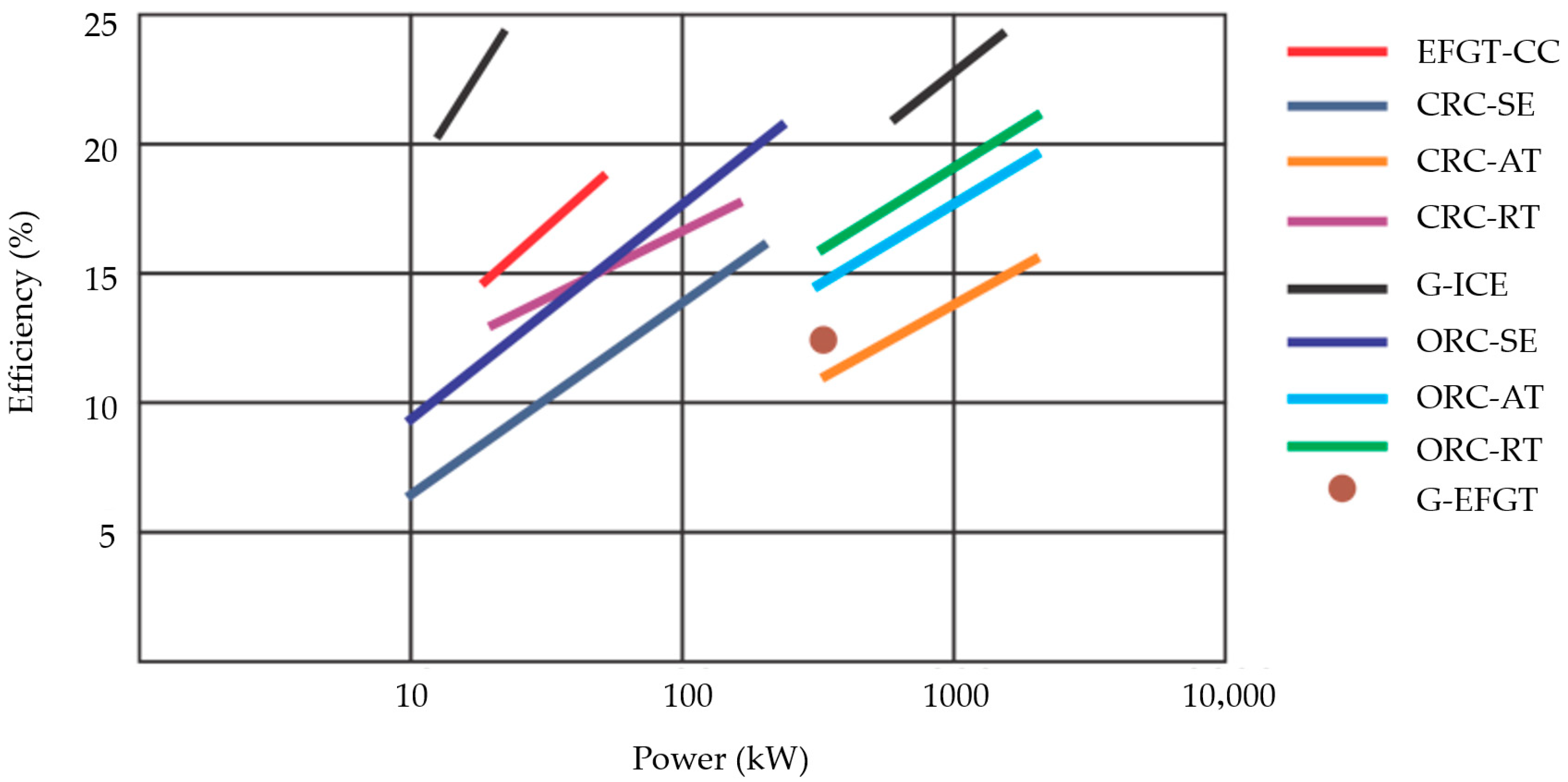
Further insights into the range of available technologies and their possible configurations for biomass energy recovery were drawn from recent technical literature [36,37], which categorizes and compares technologies in terms of efficiency and scale of application (Figure 2).
Figure 2 presents a comparative overview of available biomass energy conversion technologies based on their efficiency and typical output capacity. Among these, the G-ICE technology (Gasification + Internal Combustion Engine) stands out with an efficiency range of 22–24% and an average power output of approximately 1000 kW. As a secondary option, the Organic Rankine Cycle (ORC) shows efficiencies between 16% and 23%, with a typical output around 900 kW [38].
In general, small-scale generation systems tend to operate below 24% efficiency, while high-capacity systems can reach up to 60%, depending on the technology used. However, these values may vary depending on the characteristics of the biomass feedstock [35]. The technologies discussed above are considered suitable for the energy recovery of E. cyclocarpum peel due to their relatively high efficiency and technological maturity, especially when compared to other options still under development [36].
Table 1 summarizes the electrical efficiencies and nominal capacities of various biomass conversion technologies, supporting the selection rationale outlined in this section [39].

2.5. Technical Energy Potential Calculation Methodology

Based on the selected conversion technologies, the percentage IAR was estimated, and Equation (4) was applied to calculate the TEP [40].
TEP = EP · 0.4 · IAR · PTef
where TEP is the technical energy potential; EP is the theoretical energy potential; 0.4 is the technology capacity utilization factor, IAR is the industrial agricultural residue fraction, and PTef is the efficiency of the selected technology.
The IAR represents the technically recoverable share of the total agricultural residue, after accounting for field losses, logistics, and residue retention requirements for soil conservation. Reported technically recoverable fractions are typically 30–50% in practice [41], and soil-quality constraints often require 25–30% of residues to remain on the field, limiting the usable fraction to approximately 40–60% [42]. Similar values (≈0.4–0.5) are used in biomass availability assessments [43]. Based on these ranges, we adopted IAR = 0.6 as an upper-bound recoverability assumption for a high-yield tropical agricultural residue.
The fixed power coefficient (0.4) was used as a typical overall conversion factor from solid biomass to useful energy under realistic operational conditions. Overall conversion efficiencies for conventional biomass pathways are commonly reported within ~35–45% [44,45], and similar coefficients (≈0.35–0.45) are used by international organizations in technical potential and pre-feasibility assessments [46,47].
By applying Equation (4), the amount of energy that can be effectively recovered using each selected technology was estimated. This enables the identification of the most suitable conversion pathway for valorizing the E. cyclocarpum residue under practical conditions.

2.6. Emissions Estimation Methodology

The estimation of CO2-equivalent emissions for the two selected conversion pathways (combustion and gasification) was based on stoichiometric balances derived from the ultimate analysis of E. cyclocarpum peel. The elemental mass fractions of carbon, hydrogen, nitrogen and sulfur measured in Section 3.2, together with oxygen calculated by difference [48,49], were converted into an empirical formula of the form CaHbOcNdSe on a dry basis. Based on the stoichiometry of combustion and gasification reactions, a molar balance was performed using the elemental composition values obtained from laboratory analyses [50]. The coefficients a–e were calculated by dividing each elemental mass fraction by its atomic weight and normalizing with respect to carbon.
For complete combustion with air, the global reaction of the biomass can be written as Equation (5):
CaHbOcNdSe + νO2 (O2 + 3.76 N2) →
a CO2 + (b/2) H2O + (d/2) N2 + e SO2 + 3.76 νO2 N2
where νO2 is the stoichiometric molar coefficient of oxygen, obtained from the elemental balances (Equation (6)):
νO2 = a + b/4 − c/2 − e
assuming that sulfur is fully oxidized to SO2 and that fuel-bound nitrogen is released as N2. On this basis, the molar amounts of CO2, H2O, SO2 and N2 in the flue gas were calculated per mole of biomass and subsequently converted into mass emissions per unit mass of dry peel.
For air-blown gasification, a sub-stoichiometric global reaction of the type of Equation (7):
CaHbOcNdSe + λ (O2 + 3.76 N2) →
νCO CO + νCO2 CO2 + νH2 H2 + νCH4 CH4 + νH2O H2O + νN2 N2 + νH2S H2S
was assumed, where λ is the molar air-to-fuel ratio (λ < νO2) and νi are the molar coefficients of the main product-gas components. These coefficients were determined by solving the elemental balances for C, H, O, N and S, using representative product-gas compositions for biomass air gasification reported in the literature.
In both cases, CO2-equivalent emissions were estimated by assuming that all carbon present in the flue gas (combustion) or in the product gas (gasification) is ultimately oxidized to CO2 during energy conversion. The resulting CO2 mass per unit mass of dry biomass was then related to the useful energy output by dividing by the corresponding TEP for each technology (Section 2.5). This yields CO2-equivalent emissions expressed per unit of recovered energy, enabling a consistent comparison between combustion and gasification.
The CO2-equivalent values reported in Results section are intended as a theoretical indirect indicator associated with the total process air volume required/handled by each conversion pathway, expressed per unit of useful energy, and not as the direct biogenic CO2 released by biomass carbon oxidation.

3. Results

3.1. Residue Percentage and Moisture Content

The residue fraction in Table 2 was determined from 10 randomly selected fruits (n = 10). This sample size is consistent with preliminary morphological and biomass-partition characterization in tropical tree species. In such cases, within-tree variability in fruit component proportions is often low and sample sizes of ~8–15 fruits are commonly used for exploratory estimates. Technical botanical and agroforestry references also recommend sampling on the order of 10–12 fruits for preliminary fruit morphological descriptions and partition assessments [51,52,53]. Given that the purpose here is to obtain an average residue fraction for energy-potential calculations, the current sampling is adequate for an exploratory assessment, although broader sampling would be required for full variability characterization.
Table 2 shows that the average weight of the Enterolobium cyclocarpum fruit is 17.98 g, of which 39.74% corresponds to the seed and 60.26% to the peel. This indicates that approximately 60% of the fruit is not utilized, resulting in a generation of 270 tons of peel residue per hectare per year. This value corresponds to an upper-bound scenario obtained by applying the experimentally measured peel fraction to a theoretical maximum fruit yield.
In addition to the residue fraction, the moisture content of E. cyclocarpum peel was determined using the thermogravimetric moisture analyzer described in Section 2.1. Moisture measurements were performed on a composite peel sample prepared from the same batch of fruits used for the residue percentage analysis, rather than on individual fruits, since the objective was to obtain a representative value for subsequent energy calculations. Several replicate determinations yielded an average moisture content of 11 wt% (wet basis). The variability between replicates was within the precision of the instrument, so this mean value was adopted as representative of the peel moisture under the conditions of this study.
In this study, the fruit yield used in Equation (3) was set to Rc = 450 t/ha·year, representing a maximum-productivity (upper-bound) scenario under intensive planting conditions, adopted to estimate the maximum theoretical energy potential of Enterolobium cyclocarpum. The experimentally determined residue fraction was Mrg = 0.60 (t wet peel per t fruit). The dry-matter fraction of the residue was computed from the measured moisture content (≈11% wt), giving Yrs = 0.89 (t dry peel per t wet peel). For the base calculation, A = 1 ha. The input values adopted for Equation (3) are summarized in Table 3.

3.2. Physicochemical Analysis

Table 4 presents the results of the physicochemical parameters. The LHV of E. cyclocarpum peel was found to be 6435 BTU/lb, equivalent to 0.015 TJ/t. This value is comparable to those of other commonly utilized agri-food residues, such as sugarcane bagasse (0.0186 TJ/ton) [6], oil palm fiber (0.0185 TJ/t) [11], and coffee husk (0.0186 TJ/t) [54,55,56].
Additionally, the dry-basis chemical composition of the residue was determined, yielding the following percentages: Carbon 37.2%, Hydrogen 4.09%, Nitrogen 0.45%, and Sulfur 0.13%. Oxygen was not measured directly in this study. Following ultimate-analysis methodologies for solid fuels, oxygen is commonly obtained by difference from the quantified elements and ash [48,49]. Accordingly, oxygen was calculated on a dry basis as shown in Equation (8):
O (%) = 100 − (C + H + N + S + Ash)
Since ash content was not determined experimentally for this residue in the present dataset, a representative value of Ash = 3.0 wt% (dry basis) was adopted for a lignocellulosic peel/fruit residue, consistent with literature discussing typical ash contents in biomass and their implications [57]. Using the measured values (dry basis: C = 37.2%, H = 4.09%, N = 0.45%, S = 0.13%), the resulting oxygen content is O ≈ 55.1% (dry basis).

3.3. Theoretical Energy Potential

In the case study, the EP of E. cyclocarpum peel residue was estimated at 3.6 TJ/year per hectare, reflecting the high yield of residual biomass associated with this species (Table 5).
In contrast, crops with similar LHV but lower residue production show significantly lower energy potential, as shown in Table 6. These differences are primarily due to the smaller amount of residue generated per hectare compared to E. cyclocarpum [40].

3.4. Technical Energy Potential

The TEP for both combustion and gasification technologies was calculated, as these two are the most widely used and efficient biomass energy conversion systems available on the market [58]. The analysis showed that combustion of 270 t of peel residue/year per hectare could generate approximately 0.18 TJ/year. In contrast, gasification could produce up to 0.21 TJ/year. This difference is primarily attributed to the higher energy conversion efficiency associated with gasification compared to combustion [59] (Table 7).

3.5. Emissions Estimation

Regarding greenhouse gas (GHG) emissions, the values presented in Table 8 must be interpreted carefully. In this study, the reported CO2-equivalent values do not represent the biogenic CO2 released by oxidation of the biomass carbon (which is of the same order of magnitude for both pathways for a given fuel composition and useful energy output). Instead, the reported values correspond to a theoretical indirect CO2-equivalent indicator associated with the total process air volume required/handled by each conversion pathway, normalized per unit of useful energy [9].
Combustion was modelled with an air demand close to the stoichiometric requirement (relatively low total air handled per unit of useful energy) [60]. In contrast, air-blown gasification is an oxygen-deficient (sub-stoichiometric) process typically operated at equivalence ratios well below 1 (commonly ~0.2–0.4), but it may involve a larger overall volume of process air handled across the conversion system to sustain reactor thermal conditions and enable stable syngas production [61,62,63].
Finally, biomass-based energy is often treated as “carbon-neutral” in many assessment contexts; however, the climate interpretation of biogenic CO2 depends on the selected accounting framework and system boundary assumptions. Therefore, Table 8 should not be interpreted as a full life-cycle climate comparison of combustion versus gasification [64,65].

4. Discussion

4.1. Energy Potential of E. cyclocarpum Peel in the Context of Residual Biomass

The experimental characterization shows that E. cyclocarpum peel has an LHV of approximately 0.015 TJ/t, which falls within the typical range reported for agricultural residues and lignocellulosic biomasses used for thermochemical conversion [18,19]. When compared with other agroindustrial residues commonly used for energy purposes, such as sugarcane bagasse, oil palm fiber or coffee husk, the calorific value of E. cyclocarpum peel is slightly lower but of the same order of magnitude, indicating that it falls within the operating window of conventional combustion and gasification technologies already applied to similar feedstocks [18].
A brief comparison with other biomass-to-energy studies indicates that the fuel properties obtained here are consistent with those reported for fruit-processing residues used for thermochemical conversion. For example, a recent study reported that several fruit-processing by-products exhibit moisture contents around ~15 wt% and average LHVs in the range of typical solid biofuels, supporting their suitability for energy recovery [19]. In this context, the measured LHV and moisture content of E. cyclocarpum peel fall within the range commonly reported for fruit-derived residues considered for direct energy use.
What differentiates E. cyclocarpum peel from more established residues is not its calorific value but its very high residue yield per unit area. The experimentally determined peel fraction (60.26% of fruit mass), combined with a fruit yield of 450 t/year per hectare, results in an estimated 270 t of peel/year per hectare. Together with the measured lower heating value and dry matter fraction, this translates into an EP of 3.6 TJ/year per hectare. On a per-hectare basis, this EP exceeds values typically reported for many agricultural residues once they are normalized by cultivated area [6,7]. For instance, studies on cereal straws and similar field residues often report EP values on the order of 0.1–0.3 TJ/year per hectare, depending on yield, residue-to-product ratios and moisture content [6,7]. The high EP of E. cyclocarpum peel can be interpreted as the combined effect of (i) a large fraction of the fruit mass becoming peel and (ii) the relatively high productivity of E. cyclocarpum trees in the case-study region.
The adopted value of 450 t/ha·year represents a maximum-productivity (upper-bound) scenario and is used to estimate the maximum theoretical energy potential. Reported fruit/pod production can vary substantially with site conditions and management and is often reported on a per-tree basis. Importantly, the estimated peel residue yield and the derived energy indicators scale linearly with the assumed fruit yield; therefore, site-specific yields lower than the adopted maximum would proportionally reduce the reported EP and TEP values.
From an environmental and systems perspective, this means that a residue currently underutilized or disposed of as waste may represent a significant source of renewable energy, particularly in rural areas where the species is already integrated into livestock and agroforestry systems. Recent assessments of agricultural biomass residues in Colombia and other Latin-American regions highlight the contribution that such resources can make to rural energy supply and to the implementation of circular bioeconomy strategies [12,13,14]. The elemental composition of E. cyclocarpum peel (moderate carbon content and very low nitrogen and sulfur) is consistent with other lignocellulosic biomasses used for thermochemical conversion and supports its suitability as a fuel from both a combustion and an emission-control standpoint [18,19].

4.2. Technical Assessment of Conversion Technologies

The transition from a theoretical energy potential of 3.6 TJ/year per hectare to technical energy potentials of 0.18 and 0.21 TJ/year per hectare for combustion and gasification, respectively, reflects the combined effect of restricting the residue to its industrially available fraction, the assumed capacity factor and the conversion efficiencies of the selected technologies. The resulting technical potentials correspond to approximately 5–6% of the theoretical potential. This magnitude of reduction is consistent with what is usually observed when theoretical, technical and sustainable potentials are compared for agricultural residues at national and regional scales, once competing uses, logistics and technological constraints are accounted for [6,7,14].
The assumptions used to transition from EP to TEP are also aligned with commonly reported ranges in residue-availability assessments. Studies on sustainable residue removal frequently conclude that only a fraction of the theoretical residue production is technically and sustainably mobilizable once soil protection, competing uses, and logistics are considered, with reported sustainable/technical removal fractions spanning wide ranges depending on crop, soil, and management [66,67,68]. Likewise, the performance values adopted for small-scale biomass power pathways are consistent with recent reviews reporting typical electrical efficiency ranges of ~20–35% for gasification–engine systems, depending on scale and gas cleaning [69,70].
Since TEP scales linearly with both IAR and the 0.4 coefficient, alternative site-specific assumptions within the reported literature ranges would proportionally change the reported TEP values.
The higher technical energy potential obtained for gasification is directly linked to the larger electrical efficiency assumed for gasification–internal combustion engine (G-ICE) systems (around 25%) compared with small-scale combustion-based power plants (around 21%). The efficiency advantage of gasification–engine configurations for small-scale biomass power generation has been widely documented, especially in the context of decentralized rural electrification [60,71]. In addition, G-ICE systems are modular and can operate effectively in the sub-megawatt range, which makes them attractive for off-grid or weak-grid settings that are common in many rural areas.
Nevertheless, the selection of gasification as the preferred option must be nuanced by practical considerations. Experience from demonstration projects shows that small-scale gasifiers require relatively narrow moisture ranges, robust gas cleaning systems and an adequate level of local technical capacity to ensure stable operation and to avoid engine damage caused by tars and particulates [71,72]. In this respect, the moderate moisture content of E. cyclocarpum peel (≈11 wt%) is favorable, as it reduces pre-drying requirements. However, logistical aspects such as collection, preprocessing (size reduction, screening) and on-site storage must be carefully evaluated in future techno-economic assessments.
Combustion-based systems, by contrast, are technologically simpler and can be more robust under variable operating conditions, particularly when heat is the primary output (e.g., drying, hot-water production or low-temperature process heat) rather than electricity. Technologies such as biomass-fired steam cycles and Organic Rankine Cycle (ORC) units can reach electrical efficiencies in the range of 16–23%, but they generally involve higher capital costs and more complex auxiliary systems than engine-based plants of comparable size [71,72]. The choice between combustion and gasification will therefore depend not only on achievable efficiencies and technical energy potentials, but also on project scale, energy-use profile (heat versus power), local skills and financing conditions.

4.3. Environmental Implications and CO2-Equivalent Emissions

The comparison of CO2-equivalent emissions per unit of useful energy indicates that, under the assumptions adopted in this study, gasification leads to higher emissions than direct combustion. To avoid misinterpretation, it is important to distinguish between (i) process-related emissions indicators reported at the conversion unit level and (ii) life-cycle emissions, which include upstream and downstream stages (e.g., collection, transport, auxiliary electricity, infrastructure, and end-use). In widely used reporting frameworks, biogenic CO2 from biomass combustion/conversion is typically reported separately from fossil emissions, and climate-change indicators may be disaggregated into fossil vs. biogenic contributions [73,74]. Therefore, the CO2-equivalent values discussed here should be interpreted as process-level theoretical indicators under the adopted methodology, and not as a full life-cycle assessment (LCA)-based climate comparison between technologies. The CO2-equivalent values in Table 8 are reported as an indirect air-handling indicator and should therefore not be interpreted as biogenic CO2 intensity or as a full life-cycle climate comparison [64,65]. This result is mainly associated with the larger air injection required to sustain the gasification process and with the presence of intermediate carbonaceous species (CO, CH4 and light hydrocarbons) that are subsequently oxidized to CO2 in the engine. Similar patterns have been reported in other assessments where gasification pathways exhibit higher specific CO2 emissions at the conversion stage, even when they outperform combustion in terms of overall energy efficiency [71,75].
It is important to interpret these results within a broader environmental framework. The carbon in E. cyclocarpum peel is biogenic, and the residue is currently underutilized or disposed of as waste. When such biomass replaces fossil fuels like coal, diesel or heavy fuel oil in thermal and power applications, the net effect can be a reduction in life-cycle greenhouse gas emissions, provided that sustainable harvesting practices and appropriate logistics are ensured [12,14]. Furthermore, the use of a residue that might otherwise be landfilled or openly burned contributes to reducing local environmental impacts such as uncontrolled emissions, odors and vector proliferation, and to implementing circular economy strategies in agroindustrial systems [13].
In this context, the environmental relevance of E. cyclocarpum peel lies less in the absolute magnitude of its CO2 emissions during conversion and more in its capacity to displace fossil-based energy carriers, mitigate local environmental impacts associated with residue accumulation and landfill disposal, and close nutrient and carbon loops in agroforestry systems.

4.4. Limitations of the Study

This study has several limitations that should be considered when interpreting the results. First, the experimental characterization of E. cyclocarpum peel was carried out at laboratory scale using samples collected in a single Colombian municipality. The physicochemical properties and residue yields of E. cyclocarpum may vary with climatic conditions, soil characteristics, management practices and genetic variability of the trees. Therefore, the values reported here should be viewed as representative of the specific case study rather than universally applicable.
Second, the estimation of EP and TEP relies on a set of simplifying assumptions regarding cultivated area, fruit yields, residue-to-product ratios, dry matter content and industrially available residue fractions. Although these parameters are consistent with existing guidelines and biomass potential assessments for agricultural residues, their uncertainty has not been explicitly quantified [6,14]. Third, the analysis of conversion technologies is based on literature values for electrical efficiencies and capacity factors, rather than on pilot-scale tests using E. cyclocarpum peel as feedstock. No detailed techno-economic evaluation was conducted, and aspects such as investment cost, operation and maintenance expenses, and revenue streams were beyond the scope of this work [71,72]. In addition, the practical availability of E. cyclocarpum fruit residues may be reduced by competing uses in livestock–agroforestry systems. The species’ pods/fruits are widely used as livestock feed supplements in tropical systems, and in some contexts residues may also be returned to the soil or composted to support soil organic matter and nutrient cycling [30,66,76]. Such competing uses can reduce the fraction realistically recoverable for energy conversion and should be considered when scaling-up supply chains; this is partly reflected in the recoverability assumption adopted in the technical potential calculations.
Finally, the environmental assessment was limited to CO2-equivalent emissions at the conversion stage, without performing a full LCA that would include upstream (cultivation, harvesting, transport) and downstream (ash management, infrastructure) processes. A more comprehensive LCA would be required to quantify the net greenhouse gas savings and other environmental trade-offs associated with large-scale deployment of E. cyclocarpum-based energy systems [75].

4.5. Perspectives for Future Research

Building on the results presented here, future research should address these limitations through an integrated experimental and modelling approach. Pilot-scale trials of both combustion and gasification technologies using E. cyclocarpum peel as feedstock would provide more accurate data on conversion efficiencies, operational stability, emission profiles and maintenance requirements under realistic conditions [71,72]. Techno-economic assessments could then be developed to evaluate investment and operating costs, levelized cost of electricity and heat, and the sensitivity of project feasibility to key parameters such as plant size, feedstock price and capacity factor [75].
From an environmental perspective, a full LCA comparing E. cyclocarpum-based energy systems with conventional fossil and alternative biomass pathways would help clarify their contribution to climate-change mitigation and other impact categories. In parallel, spatially explicit analyses—similar to those recently conducted for agricultural residues in Colombian departments such as La Guajira—could be used to identify priority areas where E. cyclocarpum plantations and peel residues overlap with unmet energy demand in rural communities [12,14].
Finally, future work could explore complementary valorization routes for E. cyclocarpum peel beyond power generation, such as heat-only applications, densified biofuels (pellets, briquettes) or integration into biorefinery schemes, in line with emerging strategies for the sustainable use of agroindustrial residues in tropical and subtropical countries [13,18]. And may extend the present screening by assessing pyrolysis of E. cyclocarpum peel residue to co-produce biochar/bio-oil and evaluate downstream resource utilization options under Colombian local conditions.

5. Conclusions

This study provides the first experimental dataset and a comparative screening of the energy-potential of Enterolobium cyclocarpum (“orejero”) fruit peel residue as a bioenergy feedstock under Colombian conditions. The certified laboratory characterization indicates that the peel residue exhibits fuel properties within the range of lignocellulosic agricultural residues commonly considered for thermochemical conversion, supporting its technical suitability for energy recovery.
The main differentiating factor of this resource is not an unusually high calorific value, but the high peel fraction of the fruit and the potentially high residue yield per unit area under the upper-bound production scenario adopted in this work. When combined with a consistent methodological framework for theoretical and technical potential estimation, the results suggest that E. cyclocarpum peel residue can represent a relevant local biomass stream for decentralized energy applications in rural or off-grid contexts. Detailed quantitative outputs are reported in Table 4, Table 5, Table 6, Table 7 and Table 8.
From a technology-comparison perspective, both combustion and gasification are feasible conversion routes. Gasification shows slightly higher technical energy recovery in the assessed configuration, whereas combustion remains a simpler and generally more robust option depending on the required energy service (heat versus electricity), local skills, and operational constraints. The reported CO2-equivalent values should be interpreted as process-level theoretical indicators under the adopted methodology, not as full life-cycle climate results; a complete LCA would be required to quantify net greenhouse-gas benefits versus fossil alternatives.
Practical deployment will depend on site-specific residue availability (including potential competing uses in livestock and soil-return practices), logistics, and technology operation at scale. Future work should prioritize multi-site sampling and pilot-scale conversion tests. Integrated techno-economic and life-cycle assessments will be required to support real implementation.

Author Contributions

Conceptualization, Z.-E.G.-R. and J.-K.S.-M.; methodology, Z.-E.G.-R., M.-E.R.-C. and J.R.-I.; validation, Z.-E.G.-R., M.-E.R.-C. and J.R.-I.; formal analysis, Z.-E.G.-R., J.-K.S.-M. and M.-E.R.-C.; investigation, P.-A.H.-M. and A.-G.F.-G.; resources, P.-A.H.-M. and A.-G.F.-G.; data curation, Z.-E.G.-R. and M.-E.R.-C.; writing—original draft preparation, Z.-E.G.-R. and M.-E.R.-C.; writing—review and editing, M.-E.R.-C. and J.R.-I.; visualization, Z.-E.G.-R. and J.-K.S.-M.; supervision, M.-E.R.-C. and J.R.-I.; funding acquisition, M.-E.R.-C. and J.R.-I. All authors have read and agreed to the published version of the manuscript.

Funding

This research received no external funding.

Data Availability Statement

The original contributions presented in the study are included in the article, further inquiries can be directed to the corresponding author.

Conflicts of Interest

The authors declare no conflicts of interest.

References

  1. Gonzales, E.; Hamrick, J.L.; Smouse, P.E.; Trapnell, D.W.; Peakall, R. The impact of landscape disturbance on spatial genetic structure in the Guanacaste tree, Enterolobium cyclocarpum (Fabaceae). J. Hered. 2010, 101, 133–143. [Google Scholar] [CrossRef]
  2. Quintero-Ortiz, M.K.; Duarte-Quintero, L.P. Uso del fruto orejero (Enterolobium cyclocarpum) en la alimentación bovina. In Proceedings of the IV Foro-DIE 2022 (Zootecnia–Ocaña), Ocaña, Colombia, 20 June 2022. [Google Scholar]
  3. Falowo, O.A.; Oloko-Oba, M.I.; Betiku, E. Biodiesel production intensification via microwave irradiation-assisted transesterification of oil blend using nanoparticles from elephant-ear tree pod husk as a base heterogeneous catalyst. Chem. Eng. Process. Process Intensif. 2019, 140, 157–170. [Google Scholar] [CrossRef]
  4. Bout, A.E.; Pfau, S.F.; van der Krabben, E.; Dankbaar, B. Residual Biomass from Dutch Riverine Areas—From Waste to Ecosystem Service. Sustainability 2019, 11, 509. [Google Scholar] [CrossRef]
  5. López Martínez, G.; Buriticá Arboleda, C.; Silva Lora, E. Electric Power from Agricultural Residual Biomass (ARB) in Colombia—Option of Rural Development after the Armed Conflict. In Proceedings of the 26th European Biomass Conference and Exhibition (EUBCE), Copenhagen, Denmark, 14–17 May 2018; pp. 253–256. [Google Scholar] [CrossRef]
  6. Bentsen, N.S.; Felby, C.; Thorsen, B.J. Agricultural residue production and potentials for energy and materials services. Prog. Energy Combust. Sci. 2014, 40, 59–73. [Google Scholar] [CrossRef]
  7. Avcıoğlu, A.O.; Dayıoğlu, M.A.; Türker, U. Assessment of the energy potential of agricultural biomass residues in Turkey. Renew. Energy 2019, 138, 610–619. [Google Scholar] [CrossRef]
  8. Unidad de Planeación Minero Energética. Plan Energético Nacional Colombia: Ideario Energético 2050; Ministerio de Minas y Energía: Bogotá, Colombia, 2015. Available online: https://www1.upme.gov.co/documents/pen_idearioenergetico2050.pdf (accessed on 22 July 2025).
  9. Solano, I.; Aguilar, O.; Dominguez, C.; Ramirez, G.; Aguilar, O. Evaluación del rendimiento energético del bagazo de caña de un ingenio azucarero vs su aprovechamiento mediante gasificación. Rev. Inic. Cient. 2020, 6, 30–35. [Google Scholar] [CrossRef]
  10. Diez, O.A.; Cárdenas, G.J.; Mentz, L.F. Poder calorífico superior de bagazo, médula y sus mezclas, provenientes de la caña de azúcar de Tucumán, R. Argentina. Rev. Ind. Agric. Tucumán 2010, 87, 29–38. [Google Scholar]
  11. Carranza Rojas, E. Pirólisis de la Fibra de Palma Africana de Aceite; Universidad de los Andes (Uniandes): Bogotá, Colombia, 2015. [Google Scholar] [CrossRef]
  12. Calvo-Saad, M.J.; Solís-Chaves, J.S.; Murillo-Arango, W. Suitable municipalities for biomass energy use in Colombia based on a multicriteria analysis from a sustainable development perspective. Heliyon 2023, 9, e19874. [Google Scholar] [CrossRef] [PubMed]
  13. Ibarra-Mojica, D.M.; Prada-Soto, M.L.; Monroy-Sarmiento, L.S.; Duarte-Rodríguez, L.A. Energy potential of agricultural residual biomass in municipalities of the highlands of the Santurbán Páramo, Colombia. Front. Sustain. Food Syst. 2025, 9, 1672988. [Google Scholar] [CrossRef]
  14. Rodríguez Romero, T.E.; Cabello Eras, J.J.; Sagastume Gutierrez, A.; Mendoza Fandiño, J.M.; Rueda Bayona, J.G. The Energy Potential of Agricultural Biomass Residues for Household Use in Rural Areas in the Department La Guajira (Colombia). Sustainability 2025, 17, 974. [Google Scholar] [CrossRef]
  15. Ramírez, M.A.; Ortiz, G.A. Estimación del Potencial Energético a Partir de la Biomasa Primaria Agrícola en el Departamento de Putumayo; Universidad Distrital Francisco José de Caldas: Bogotá, Colombia, 2021; Available online: http://hdl.handle.net/11349/30055 (accessed on 22 July 2025).
  16. Vergara, J.C.; Rojas, G.; Ortegon, K. Sugarcane straw recovery for bioenergy generation: A case of an organic farm in Colombia. ACS Omega 2020, 5, 7950–7955. [Google Scholar] [CrossRef] [PubMed]
  17. Özyuğuran, A.; Yaman, S. Prediction of calorific value of biomass from proximate analysis. Energy Procedia 2017, 107, 130–136. [Google Scholar] [CrossRef]
  18. Sajdak, M.; Velázquez-Martí, B.; López-Cortés, I. Quantitative and qualitative characteristics of biomass derived from pruning Phoenix canariensis hort. ex Chabaud and Phoenix dactylifera L. Renew. Energy 2014, 71, 545–552. [Google Scholar] [CrossRef]
  19. Bača, P.; Mašán, V.; Vanýsek, P.; Burg, P.; Binar, T.; Suchý, P.; Vaňková, L. Evaluation of the Thermal Energy Potential of Waste Products from Fruit Preparation and Processing Industry. Appl. Sci. 2024, 14, 1080. [Google Scholar] [CrossRef]
  20. Huang, J.; Chen, Y.; Chen, X.; Jia, D.; Evrendilek, F.; Liu, J. Pyrolytic Valorization of Polygonum multiflorum Residues: Kinetic, Thermodynamic, and Product Distribution Analyses. Processes 2025, 13, 2701. [Google Scholar] [CrossRef]
  21. Lam, S.S.; Liew, R.K.; Cheng, C.K.; Rasit, N.; Ooi, C.K.; Ma, N.L.; Ng, J.H.; Lam, W.H.; Chong, C.T.; Chase, H.A. Pyrolysis production of fruit peel biochar for potential use in treatment of palm oil mill effluent. J. Environ. Manag. 2018, 213, 400–408. [Google Scholar] [CrossRef]
  22. Selvarajoo, A.; Wong, Y.L.; Khoo, K.S.; Chen, W.-H.; Show, P.L. Biochar production via pyrolysis of citrus peel fruit waste as a potential usage as solid biofuel. Chemosphere 2022, 294, 133671. [Google Scholar] [CrossRef]
  23. Collí Pacheco, J.P. Estudio del Efecto del Contenido y Tamaño de Partículas de la Testa de la Semilla del Fruto de Pich (Enterolobium cyclocarpum) Sobre las Propiedades de un Almidón Termoplástico a Base de Dicho Fruto. Master’s Thesis, Centro de Investigación Científica de Yucatán (CICY), Posgrado en Materiales Poliméricos, Mérida, Mexico, 2018. [Google Scholar]
  24. Arango Osorno, S.E.; Montoya Restrepo, J.; Vásquez, Y.; Flor, D.Y. Análisis fisicoquímico del proceso de co-compostaje de biomasa de leguminosa y ruminaza. Rev. Colomb. Cienc. Hortíc. 2017, 10, 345–354. [Google Scholar] [CrossRef]
  25. Pinilla, J.C.; Riquelme Espergue, F.; Acuña Aroca, B. Antecedentes iniciales para la utilización de especies de Salix como biomasa para energía en la Región de Aysén. Cienc. Investig. For. 2021, 27, 62–74. [Google Scholar] [CrossRef]
  26. Unidad de Planeación Minero Energética (UPME). Anexo D: Modelos Matemáticos para Evaluar Potencial Energético de Biomasa Residual. In Atlas del Potencial Energético de la Biomasa Residual en Colombia; UPME: Bogotá, Colombia, 2005. [Google Scholar]
  27. Ministerio de Ambiente y Desarrollo Sostenible; Instituto de Investigación de Recursos Biológicos Alexander von Humboldt. Programa Nacional para la Conservación y Restauración del Bosque Seco Tropical en Colombia: Plan de Acción 2020–2030; Ministerio de Ambiente y Desarrollo Sostenible: Bogotá, Colombia, 2021.
  28. Pizano, C.; García, H. (Eds.) El Bosque Seco Tropical en Colombia; Instituto de Investigación de Recursos Biológicos Alexander von Humboldt (IAvH): Bogotá, Colombia, 2014. [Google Scholar]
  29. Thomas, E.; Gil-Tobón, C.; Gutiérrez, J.P.; Alcázar-Caicedo, C.; Moscoso-Higuita, L.G.; Becerra, L.A.; Loo, J.; González, M.A. Genetic diversity of Enterolobium cyclocarpum in Colombian seasonally dry tropical forest: Implications for conservation and restoration. Biodivers. Conserv. 2017, 26, 825–848. [Google Scholar] [CrossRef]
  30. Tropical Forages. Enterolobium cyclocarpum (Jacq.) Griseb. (Species Profile/Fact Sheet). 2020. Available online: https://tropicalforages.info/pdf/enterolobium_cyclocarpum.pdf (accessed on 10 May 2025).
  31. PCE Ibérica. Balanza de Humedad Mini Serie PCE-MB C. 25 February 2023. Available online: https://www.pce-iberica.es/medidor-detalles-tecnicos/balanzas/balanza-humedad-pce-mb-c.htm (accessed on 10 May 2025).
  32. ASTM D5373-16; Standard Test Methods for Determination of Carbon, Hydrogen, and Nitrogen in Analysis Samples of Coal and Carbon in Analysis Samples of Coal and Coke. ASTM International: West Conshohocken, PA, USA, 2016.
  33. ASTM E711-06(2018); Standard Test Method for Gross Calorific Value of Refuse-Derived Fuel by the Bomb Calorimeter. ASTM International: West Conshohocken, PA, USA, 2018.
  34. European Commission. Best Available Techniques (BAT) Reference Document for Large Combustion Plants. Industrial Emissions Directive 2010/75/EU (Integrated Pollution Prevention and Control); JRC Science for Policy Report; EUR 28836 EN; Publications Office of the European Union: Luxembourg, 2017. [Google Scholar] [CrossRef]
  35. Instituto de Estudios Tecnológicos Prospectivos. Documento de Referencia Sobre las Mejores Técnicas Disponibles en el Ámbito de las Grandes Instalaciones de Combustión; Centro Común de Investigación: Sevilla, Spain, 2006. [Google Scholar]
  36. Rincón Martínez, J.M.; Silva Lora, E.E. Bioenergía: Fuentes, Conversión y Sustentabilidad; Red Iberoamericana de Aprovechamiento de Residuos Orgánicos en Producción de Energía: Bogotá, Colombia, 2016. [Google Scholar]
  37. Arias Aguilar, D. Tecnologías para la Generación de Energía a Partir de la Biomasa Forestal; Universidad Nacional de Ciencias Forestales: Siguatepeque, Honduras, 2017. [Google Scholar]
  38. Rettig, A.; Lagler, M.; Lamare, T.; Li, S.; Mahadea, V.; McCallion, S.; Chernushevich, J. Application of Organic Rankine Cycles (ORC). In Proceedings of the World Engineers Convention, Geneva, Switzerland, 4–9 September 2011. [Google Scholar]
  39. Arnavat, M. Performance Modeling and Validation of Biomass Gasifiers for Trigeneration Plants. Doctoral Thesis, Universitat Rovira i Virgili, Tarragona, Spain, 2011. [Google Scholar]
  40. Cáceres-Martínez, L.E.; Guío-Pérez, D.C.; Rincón Prat, S.L. Potencial energético teórico y técnico de biomasa residual disponible en Colombia para el aprovechamiento en procesos de transformación termoquímica. In Proceedings of the 3er Congreso de Energía Sostenible, Bogotá, Colombia, 24–26 October 2016. [Google Scholar]
  41. Scarlat, N.; Martinov, M.; Dallemand, J.-F. Assessment of the availability of agricultural crop residues in the European Union: Potential and limitations for bioenergy use. Waste Manag. 2010, 30, 1889–1897. [Google Scholar] [CrossRef]
  42. Lal, R. World crop residues production and implications of its use as a biofuel. Environ. Int. 2005, 31, 575–584. [Google Scholar] [CrossRef]
  43. Hoornweg, D.; Bhada-Tata, P. What a Waste: A Global Review of Solid Waste Management; World Bank: Washington, DC, USA, 2012; Available online: http://hdl.handle.net/10986/17388 (accessed on 14 July 2025).
  44. Demirbaş, A. Biomass resource facilities and biomass conversion processing for fuels and chemicals. Energy Convers. Manag. 2001, 42, 1357–1378. [Google Scholar] [CrossRef]
  45. McKendry, P. Energy production from biomass (part 1): Overview of biomass. Bioresour. Technol. 2002, 83, 37–46. [Google Scholar] [CrossRef]
  46. Food and Agriculture Organization of the United Nations (FAO). Bioenergy and Food Security: The BEFS Analytical Framework; FAO: Rome, Italy, 2010. [Google Scholar]
  47. International Renewable Energy Agency (IRENA). Global Bioenergy Supply and Demand Projections: A Working Paper for REmap 2030; IRENA: Abu Dhabi, United Arab Emirates, 2014. [Google Scholar]
  48. ASTM E870-82(2013); Standard Test Methods for Analysis of Wood Fuels. ASTM International: West Conshohocken, PA, USA, 2013.
  49. ASTM D3176-24; Standard Practice for Ultimate Analysis of Coal and Coke. ASTM International: West Conshohocken, PA, USA, 2024.
  50. González Garcia, R.A. Simulación del Proceso de Gasificación de Biomasa; Universidad EAFIT: Medellín, Colombia, 2016. [Google Scholar]
  51. Carvalho, P.E.R. Espécies Arbóreas Brasileiras; Embrapa Florestas: Colombo, Brazil, 2008; Available online: http://jbb.ibict.br/handle/1/1476 (accessed on 28 May 2025).
  52. Orwa, C.; Mutua, A.; Kindt, R.; Simons, A.; Jamnadass, R. Agroforestree Database: A Tree Species Reference and Selection Guide; World Agroforestry: Nairobi, Kenya, 2009. [Google Scholar]
  53. Souza, V.C.; Lorenzi, H. Botânica Sistemática: Guia Ilustrado para Identificação das Famílias de Angiospermas da Flora Brasileira, Baseado em APG II; Plantarum: Nova Odessa, Brazil, 2005. [Google Scholar]
  54. Rodriguez Valencia, N.; Zambrano Franco, D.A. Los subproductos del café: Fuente de energía renovable. Av. Tec. Cenicafé 2010, 393, 2. [Google Scholar]
  55. Unidad de Planeación Minero Energética (UPME). Anexo B. Muestreo Caracterización Biomasa Residual. In Atlas del Potencial Energético de la Biomasa Residual en Colombia; UPME: Bogotá, Colombia, 2005. [Google Scholar]
  56. Unidad de Planeación Minero Energética (UPME). Anexo A: Biomasa, Fuente Renovable de Energía. In Atlas del Potencial Energético de la Biomasa Residual en Colombia; UPME: Bogotá, Colombia, 2016. [Google Scholar]
  57. Puri, L.; Hu, Y.; Naterer, G. Critical review of the role of ash content and composition in biomass pyrolysis. Front. Fuels 2024, 2, 1378361. [Google Scholar] [CrossRef]
  58. Puente-Urbina, A. Caracterización de biomasas lignocelulósicas y su procesamiento térmico: Estado y oportunidades en el Instituto Tecnológico de Costa Rica. Rev. Tecnol. Marcha 2022, 35, 119–128. [Google Scholar] [CrossRef]
  59. Patiño Martínez, P.E. Vegetable residual biomass: Technologies of transformation and current status. Innovaciencia 2014, 2, 45–52. [Google Scholar] [CrossRef]
  60. Galiano, M. Estudio de Emisión de Gases Procedentes de un Sistema de Aprovechamiento de Biomasa. Bachelor’s Thesis, Universidad de Jaén, Escuela Politécnica Superior (Linares), Linares, Jaén, Spain, 25 October 2017. [Google Scholar]
  61. Basu, P. Biomass Gasification and Pyrolysis: Practical Design and Theory; Academic Press: Cambridge, MA, USA, 2010. [Google Scholar]
  62. Knoef, H.A.M. (Ed.) Handbook Biomass Gasification; BTG Biomass Technology Group: Enschede, The Netherlands, 2005. [Google Scholar]
  63. Turns, S.R. An Introduction to Combustion: Concepts and Applications, 3rd ed.; McGraw-Hill: New York, NY, USA, 2012. [Google Scholar]
  64. UNEP/SETAC Life Cycle Initiative. Scoping Elements for Biogenic Carbon in Life Cycle Assessment; United Nations Environment Programme/SETAC: Paris, France, 2023. [Google Scholar]
  65. IEA Bioenergy. Carbon Accounting in Bio-CCUS Supply Chains; IEA Bioenergy: Paris, France, 2022. [Google Scholar]
  66. Kludze, H.; Deen, B.; Weersink, A.; Van Acker, R.; Janovicek, K.; De Laporte, A.; Mcdonald, I. Estimating sustainable crop residue removal rates and costs based on soil organic matter dynamics and rotational complexity. Biomass Bioenergy 2013, 56, 607–618. [Google Scholar] [CrossRef]
  67. IEA Bioenergy. Agricultural Residues for Energy in Sweden; (Task 43 Report TR2016-05); IEA Bioenergy: Paris, France, 2016. [Google Scholar]
  68. Zhang, P.; He, Y.; Ren, T.; Wang, Y.; Liu, C.; Li, N.; Li, L. The crop residue removal threshold ensures sustainable agriculture in the purple soil region of Sichuan, China. Sustainability 2021, 13, 3799. [Google Scholar] [CrossRef]
  69. Abouemara, K.; Shahbaz, M.; McKay, G.; Al-Ansari, T. The review of power generation from integrated biomass gasification and solid oxide fuel cells: Current status and future directions. Fuel 2024, 360, 130511. [Google Scholar] [CrossRef]
  70. Patuzzi, F.; Basso, D.; Vakalis, S.; Antolini, D.; Piazzi, S.; Benedetti, V.; Cordioli, E.; Baratieri, M. State-of-the-art of small-scale biomass gasification systems: An extensive and unique monitoring review. Energy 2021, 223, 120039. [Google Scholar] [CrossRef]
  71. Situmorang, Y.A.; Zhao, Z.; Yoshida, A.; Abudula, A.; Guan, G. Small-scale biomass gasification systems for power generation (<200 kW class): A review. Renew. Sustain. Energy Rev. 2020, 117, 109486. [Google Scholar] [CrossRef]
  72. Villarini, M.; Bocci, E.; Di Carlo, A.; Savuto, E.; Pallozzi, V. The case study of an innovative small scale biomass waste gasification heat and power plant contextualized in a farm. Energy Procedia 2015, 82, 335–342. [Google Scholar] [CrossRef]
  73. GHG Protocol. Stationary Combustion Guidance; World Resources Institute (WRI): Washington, DC, USA; World Business Council for Sustainable Development (WBCSD): Washington, DC, USA, 2005. [Google Scholar]
  74. Zampori, L.; Pant, R. Suggestions for Updating the Product Environmental Footprint (PEF) Method; Joint Research Centre, European Commission: Luxembourg, 2019. [Google Scholar]
  75. Torres, P.J.P.; Venturini, O.J.; Escobar Palacio, J.C.; Costa Silva, R.A.; Renó, M.L.G. Biomass based Rankine cycle, ORC and gasification system for electricity generation for isolated communities in Bonfim city, Brazil. IET Renew. Power Gener. 2019, 13, 737–743. [Google Scholar] [CrossRef]
  76. Feedipedia. Guanacaste (Enterolobium cyclocarpum). 2025. Available online: https://www.feedipedia.org/node/296 (accessed on 10 May 2025).
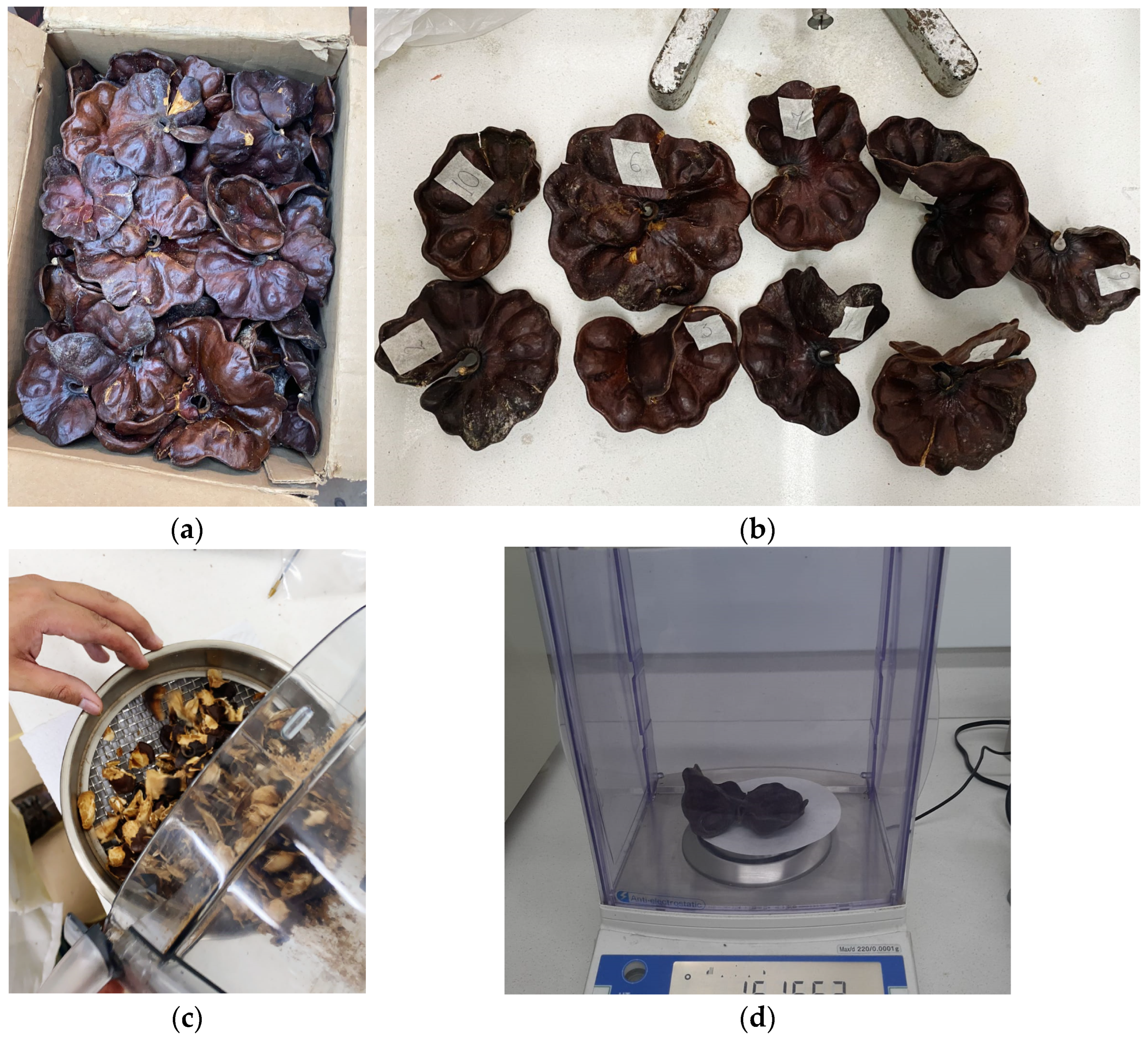
Figure 1. Experimental procedure for the characterization of Enterolobium cyclocarpum fruit peel residue: (a) bulk dried peel residue collected in Tesalia (Huila, Colombia); (b) individual fruits labelled for the determination of peel and seed mass fractions; (c) grinding and sieving of the peel fraction; (d) weighing of the prepared samples on an analytical balance.
Energies 19 00360 g001
Figure 2. Biomass energy conversion technologies and their efficiencies [18]: Externally Fired Gas Turbine Combustion Chamber—EFGT-CC; Conventional Rankine Cycle—CRC; Organic Rankine Cycle—ORC; Gasification—Internal Combustion Engine—G-ICE; Gasifier with Externally Fired Gas Turbine—G-EFGT; Axial Turbine—AT; Radial Turbine—RT; Screw Expander—SE.
Energies 19 00360 g002
Table 1. Electrical efficiency and nominal capacity of biomass-based power generation technologies.
TechnologiesElectrical
Efficiency (%)
Nominal
Capacity (MW)
Small-scale gas engines20–32%<0.5
Large-scale gas engines26–36%0.5–3.0
Diesel engines23–38%>3.0
Steam turbine15–35%1–50
Small-scale gas turbine24–31%0.8–10
Large-scale gas turbine26–31%10–100
Combined cycle (Brayton + Rankine)30–45%1–30
Combined cycle (Gas engine + Rankine)40–50%1–10
Fuel cell35–60%0.01–1
Stirling engine11–20%<0.1
Table 2. Residue percentage.
Sample No.Fruit Weight with Peel (g)Seed Weight (g)Peel Residue Weight (g)Residue
Percentage (%)
119.917.1212.7964.24
219.138.6710.4654.68
318.146.7411.3962.79
413.024.578.4564.90
520.988.5112.4759.44
628.1012.8115.2954.41
715.154.3710.7971.22
820.8111.159.6646.42
911.762.289.4880.61
1012.755.207.5459.14
Average17.987.1410.8360.26
Table 3. Input parameters used for the peel residue yield estimation (upper-bound scenario).
ParameterValue
Cultivated area (A) [ha/year]1
Crop yield (Rc) [t fruit per ha·year]450
Residue-to-product ratio (Mrg) [t wet peel per t fruit, experimental]0.60
Dry matter fraction of the residue (Yrs) [t dry peel per t wet peel, from moisture content]0.89
Table 4. Physicochemical properties of E. cyclocarpum peel.
ParameterResultUnitsMethod
Lower Heating Value0.015TJ/tASTM E711-06 [33]
Elemental Analysis
Nitrogen0.45% dry basis (DB)ASTM D5373-16 [32]
Carbon37.2
Sulfur0.13
Hydrogen4.09
Oxygen55.1ASTM D3176-24 [49]
ASTM E870-82 [48]
Ash3assumed
Table 5. Theoretical energy potential of E. cyclocarpum peel.
ParameterValue
Theoretical Energy Potential (EP) [TJ/year]3.6
LHV of Enterolobium cyclocarpum [BTU/lb]6435
LHV of Enterolobium cyclocarpum [kcal/kg]3577.4
LHV of Enterolobium cyclocarpum [TJ/t]0.015
Table 6. Comparison of theoretical energy potential from agricultural residues.
CropResidueTheoretical Energy Potential Per Hectare (TJ/Year)
SugarcaneBagasse2.49
Oil palmFiber0.35
CoffeeHusk0.0043
E. cyclocarpumPeel3.6
Table 7. Technical energy potential calculation results.
ParameterValue
Technical energy potential—Combustion (TJ/year)0.18
Technical energy potential—Gasification (TJ/year)0.21
Theoretical energy potential (EP) (TJ/year)3.6
IAR—Industrial agricultural residue0.6
Constant0.4
Technology efficiency—Combustion0.21
Technology efficiency—Gasification0.25
Note: IAR = 0.6 denotes the technically recoverable fraction of total agricultural residues (not the peel fraction reported in Table 2), and it is adopted within commonly reported ranges of recoverability (≈0.3–0.6) considering logistics and soil-residue retention constraints [41,42,43]. The 0.4 coefficient represents a typical overall biomass-to-useful-energy conversion factor (≈0.35–0.45) for conventional biomass conversion routes and technical-potential estimations [44,45,46,47].
Table 8. Theoretical CO2-equivalent indicator associated with total process air handling (indirect), by technology.
TechnologyCO2 Equivalent (t CO2 eq/TJ)
Combustion0.0007
Gasification3.5898
Disclaimer/Publisher’s Note: The statements, opinions and data contained in all publications are solely those of the individual author(s) and contributor(s) and not of MDPI and/or the editor(s). MDPI and/or the editor(s) disclaim responsibility for any injury to people or property resulting from any ideas, methods, instructions or products referred to in the content.